Medical Termination Of
Pregnancy
PREETY JHA
ROLL NO 172
Overview
 Introduction
 MTP act
 Methods of MTP
 Conclusion
Introduction
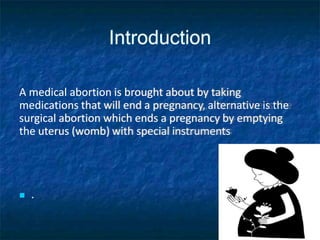
A medical abortion is brought about by taking
medications that will end a pregnancy, alternative is the
surgical abortion which ends a pregnancy by emptying
the uterus (womb) with special instruments
 .
 Hippocratic oath forbade physicians from
inducing elective abortions
 But, Aristotle held that abortion was ethical if
performed in the first trimester of pregnancy
 Before 1971:
- Abortion – purposely causing miscarriage
- 1860 IPC under British rule – induced
abortion is illegal
- Abortion practitioners would either be
incarcerated for 3yrs or fined or both
- Women could be imprisoned upto 7yrs & also
would be fined
- Only exception was abortion done to save
women life
MTP 1971
 Conditions under which a pregnancy can be
terminated
 Who can perform such terminations
 The place where such terminations can be
performed
 Conditions where pregnancy can be
terminated:
- Medical
- Eugenic
- Humanitarian
- Socio economic
Qualification to perform abortion
 Assistance of atleast 25 cases of MTP in
approved institution
 6months of Housemanship in OB&G
 A PG qualification in OB&G
 3yrs of practice in OBG for those doctors
registered before 1971 MTP act was passed
Place where MTP performed
 Place established and maintained by Govt.
 Non Govt institutions can perform provided
they obtain license from Chief Medical Officer
of the district.
 Consent
- Can only be terminated on a written informed
consent of the woman, husband consent not
required
- <18yr or lunatic – written consent of parent or
legal guardian.
 Termination is permitted upto 20wks of
pregnancy
 When pregnancy >12 week 2medical
practitioners opinion required
 The abortion has to be performed confidentially
and reported to Director of Health Services in
prescribed form
Methods of termination
1st trimester
 Medical - Mifepristone
- Mifepristone & Misoprostol
- Methotrexate & Misoprostol
- Tamoxifene & misoprostol
 Surgical – Vacuum aspiration
- suction evacuation & or curettage
- Dialatation and evacuation
Rapid Slow
2nd trimester
 Prostaglandins – Misoprostol
- Carboprost
- Dinoprost
 Dilatation and evacuation – 13-14wks
 Intrauterine instillation of hypertonic solutions
 Oxytocin infusion
 Hysterectomy
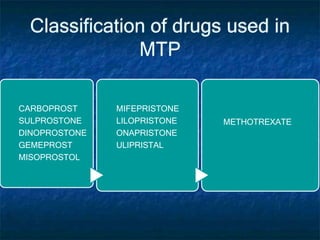
Classification of drugs used in
MTP
CARBOPROST
SULPROSTONE
DINOPROSTONE
GEMEPROST
MISOPROSTOL
MIFEPRISTONE
LILOPRISTONE
ONAPRISTONE
ULIPRISTAL
METHOTREXATE
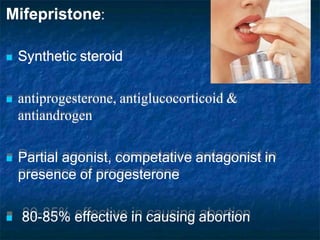
Mifepristone:
 Synthetic steroid
 antiprogesterone, antiglucocorticoid &
antiandrogen
 Partial agonist, competative antagonist in
presence of progesterone
 80-85% effective in causing abortion
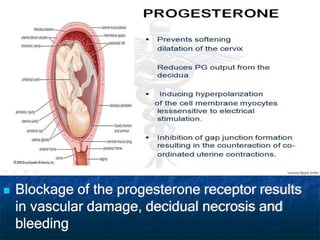
 Blockage of the progesterone receptor results
in vascular damage, decidual necrosis and
bleeding
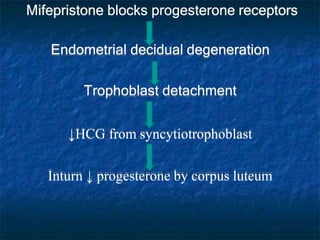
Mifepristone blocks progesterone receptors
Endometrial decidual degeneration
Trophoblast detachment
↓HCG from syncytiotrophoblast
Inturn ↓ progesterone by corpus luteum
Pharmacological actions
 Decidual breakdown by blockade of uterine PR
 Detachment of the blastocyst which decreases hCG
production
 Decrease in progesterone secretion from the corpus
luteum
 increase uterine PG levels
 sensitizes the myometrium to their contractile actions.
 Cervical softening, which facilitates expulsion of the
detached blastocyst
Pharmacokinetics
 Orally active with good bioavailability
 t1/2 of 20-40 hrs
 Bound by α 1-acid glycoprotein.
 Hepatic metabolism and enterohepatic
circulation
 Metabolic products are found predominantly in
the faeces
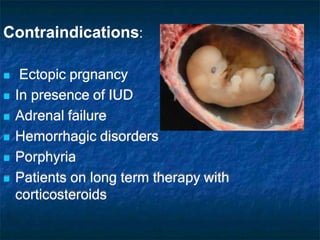
Contraindications:
 Ectopic prgnancy
 In presence of IUD
 Adrenal failure
 Hemorrhagic disorders
 Porphyria
 Patients on long term therapy with
corticosteroids
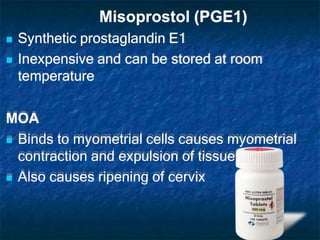
Misoprostol (PGE1)
 Synthetic prostaglandin E1
 Inexpensive and can be stored at room
temperature
MOA
 Binds to myometrial cells causes myometrial
contraction and expulsion of tissues
 Also causes ripening of cervix
PHARMACOKINETICS
 After oral administration, rapidly absorbed from the GI tract.
 t1/2 20-40 mins
 DOSE:400 μg oral misoprostol, the plasma misoprostol level
increases rapidly and peaks at about 30 minutes declines
rapidly by 120 minutes and remains low thereafter.
 ROUTES OF ADMINISTRATION : Oral, vaginal, sublingual,
buccal or rectal
 Mainly urinary excretion
 Protocol
200mg of mifepristone given orally on day1
On day 3 misoprostol 400mcg PO
Or 800mcg PV
Patient remains in hospital for 4hrs during which
expulsion occurs in 95% of cases
Mifepristone 200mg oral
36-48hrs later 800microgram misoprostol
vaginal
Then misoprostol 400microgram oral every
3hrs (4doses)
 Success rate is 97%
Gemeprost
 PGE1 analogue (16, 16-dimethyl-trans-d2- PGE1
methyl ester)
 Used as a vaginal pessary. Every 3-6hrs for 5 doses
in 24hrs
 Has got 90% success rates
 Used as a non-surgical method to dilate the cervix
before VA in late-first and early-second-trimester
abortion
SE : Vaginal bleeding, cramps, nausea, vomiting, diarrhea,
headache, muscle weakness , backache ,chest pain
CARBOPROST
 Carboprost tromethamine PGF2α analogue
 First analogue to be tested clinically on a large scale
for the termination of second trimester pregnancy.
 MOA- It acts on the corpus luteum to cause
luteolysis, forming a corpus albicans and stopping the
production of progesterone
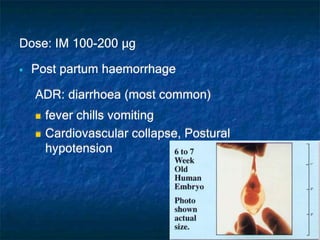
Dose: IM 100-200 µg
 Post partum haemorrhage
ADR: diarrhoea (most common)
 fever chills vomiting
 Cardiovascular collapse, Postural
hypotension
DINOPROSTONE
 Synthetic derivative of PGE2
 ROUTE OF ADMINISTRATION : vaginal/ oral
 Intravaginal suppository 20mg 3-5 hrs repeated. (17hrs)
 Half life 2.5-5 mins. Excreted in urine
 Induction abortion in second trimester/ early abortion
 Cervical ripening-10mg tab / 0.5 mg gel 6 hrly
 SE- Prolonged vaginal bleeding, Severe menstrual cramps ,GI
toxicity.
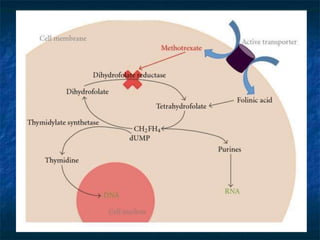
Methotrexate
 MTX is an antifolate belonging to the
antimetabolite class of antineoplastic agent.
 MTX is a cell cycle specific chemotherapeutic
agents that acts on S-phase &
 thus inhibit DNA synthesis
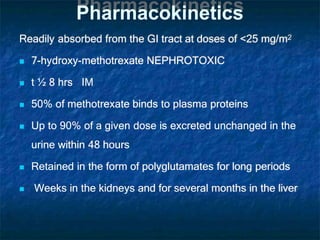
Pharmacokinetics
Readily absorbed from the GI tract at doses of <25 mg/m2
 7-hydroxy-methotrexate NEPHROTOXIC
 t ½ 8 hrs IM
 50% of methotrexate binds to plasma proteins
 Up to 90% of a given dose is excreted unchanged in the
urine within 48 hours
 Retained in the form of polyglutamates for long periods
 Weeks in the kidneys and for several months in the liver
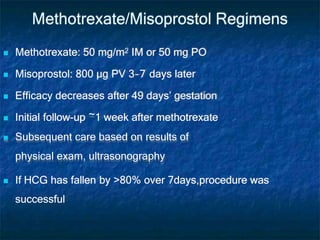
Methotrexate/Misoprostol Regimens
 Methotrexate: 50 mg/m2 IM or 50 mg PO
 Misoprostol: 800 µg PV 3–7 days later
 Efficacy decreases after 49 days’ gestation
 Initial follow-up ~1 week after methotrexate
 Subsequent care based on results of
physical exam, ultrasonography
 If HCG has fallen by >80% over 7days,procedure was
successful
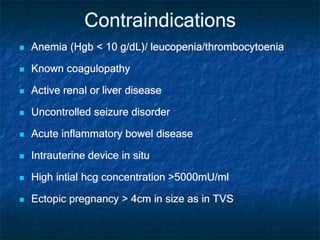
Contraindications
 Anemia (Hgb < 10 g/dL)/ leucopenia/thrombocytoenia
 Known coagulopathy
 Active renal or liver disease
 Uncontrolled seizure disorder
 Acute inflammatory bowel disease
 Intrauterine device in situ
 High intial hcg concentration >5000mU/ml
 Ectopic pregnancy > 4cm in size as in TVS
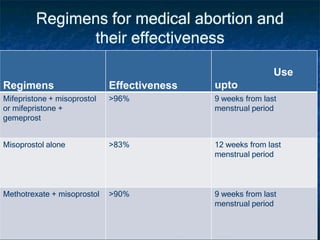
Regimens for medical abortion and
their effectiveness
Regimens Effectiveness
Use
upto
Mifepristone + misoprostol
or mifepristone +
gemeprost
>96% 9 weeks from last
menstrual period
Misoprostol alone >83% 12 weeks from last
menstrual period
Methotrexate + misoprostol >90% 9 weeks from last
menstrual period
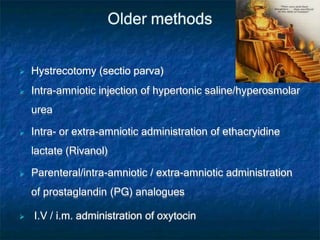
Older methods
 Hystrecotomy (sectio parva)
 Intra-amniotic injection of hypertonic saline/hyperosmolar
urea
 Intra- or extra-amniotic administration of ethacryidine
lactate (Rivanol)
 Parenteral/intra-amniotic / extra-amniotic administration
of prostaglandin (PG) analogues
 I.V / i.m. administration of oxytocin
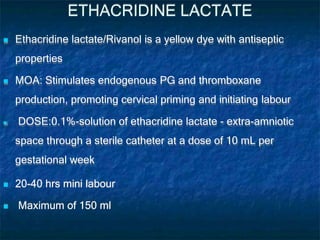
ETHACRIDINE LACTATE
 Ethacridine lactate/Rivanol is a yellow dye with antiseptic
properties
 MOA: Stimulates endogenous PG and thromboxane
production, promoting cervical priming and initiating labour
 DOSE:0.1%-solution of ethacridine lactate - extra-amniotic
space through a sterile catheter at a dose of 10 mL per
gestational week
 20-40 hrs mini labour
 Maximum of 150 ml
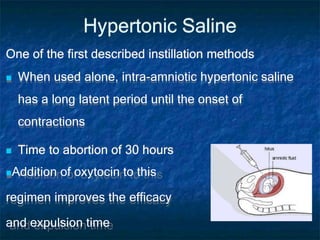
Hypertonic Saline
One of the first described instillation methods
 When used alone, intra-amniotic hypertonic saline
has a long latent period until the onset of
contractions
 Time to abortion of 30 hours
Addition of oxytocin to this
regimen improves the efficacy
and expulsion time
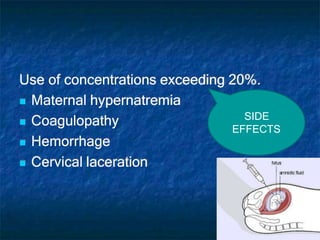
Use of concentrations exceeding 20%.
 Coagulopathy
 Hemorrhage
 Cervical laceration
 Maternal hypernatremia
SIDE
EFFECTS
IV OXYTOCIN
 First described by Winkler and associates
 100 units per 500 mL of DNS, is infused over 3
hours
 The dose is increased 50 units per 500 mL of
DNS until delivery is achieved
 Maximum of 300 units
 Mean time to delivery of 8.2 hours
UREA
 Rapidly traverses cell membranes
 Has a long instillation to abortion interval when
used alone
 Intra-amniotic urea, 80 to 90 g, with intravenous
oxytocin
 Average time to expulsion of 19 to 29 hours
Bibliography
 Goodmann and Gilman’s The pharmacological basis of therapeutics
12th edition
 Text Book of Obstetrics; D.C Dutta 4th edition
 Preventive and Social Medicine 21st Edition
 Udaykumar P. Medical Pharmacology. 4th ed. New Delhi: CBS Publishers;
2013.
 Sharma HL, Sharma KK. Principles of Pharmacology. 2nd ed. New Delhi:
Paras Medical Publishers; 2011.
 Uptodate.com
 Ashok PW, Templeton AA. Non-surgical mid-trimester termination of
pregnancy: a review of 500 consecutive cases. Br J Obstet Gynaecol
1999;106:706
 Stubblefield PG, Carr-Ellis S, Borgatta L.Methods for induced abortion.
Obstet Gynecol2004;104:174-85

mtp-170513153856 (1) (1).pptx

  • 1.
  • 2.
    Overview  Introduction  MTPact  Methods of MTP  Conclusion
  • 3.
    Introduction A medical abortionis brought about by taking medications that will end a pregnancy, alternative is the surgical abortion which ends a pregnancy by emptying the uterus (womb) with special instruments  .
  • 4.
     Hippocratic oathforbade physicians from inducing elective abortions  But, Aristotle held that abortion was ethical if performed in the first trimester of pregnancy
  • 5.
     Before 1971: -Abortion – purposely causing miscarriage - 1860 IPC under British rule – induced abortion is illegal - Abortion practitioners would either be incarcerated for 3yrs or fined or both - Women could be imprisoned upto 7yrs & also would be fined - Only exception was abortion done to save women life
  • 6.
    MTP 1971  Conditionsunder which a pregnancy can be terminated  Who can perform such terminations  The place where such terminations can be performed
  • 7.
     Conditions wherepregnancy can be terminated: - Medical - Eugenic - Humanitarian - Socio economic
  • 8.
    Qualification to performabortion  Assistance of atleast 25 cases of MTP in approved institution  6months of Housemanship in OB&G  A PG qualification in OB&G  3yrs of practice in OBG for those doctors registered before 1971 MTP act was passed
  • 9.
    Place where MTPperformed  Place established and maintained by Govt.  Non Govt institutions can perform provided they obtain license from Chief Medical Officer of the district.
  • 10.
     Consent - Canonly be terminated on a written informed consent of the woman, husband consent not required - <18yr or lunatic – written consent of parent or legal guardian.
  • 11.
     Termination ispermitted upto 20wks of pregnancy  When pregnancy >12 week 2medical practitioners opinion required  The abortion has to be performed confidentially and reported to Director of Health Services in prescribed form
  • 12.
    Methods of termination 1sttrimester  Medical - Mifepristone - Mifepristone & Misoprostol - Methotrexate & Misoprostol - Tamoxifene & misoprostol  Surgical – Vacuum aspiration - suction evacuation & or curettage - Dialatation and evacuation Rapid Slow
  • 13.
    2nd trimester  Prostaglandins– Misoprostol - Carboprost - Dinoprost  Dilatation and evacuation – 13-14wks  Intrauterine instillation of hypertonic solutions  Oxytocin infusion  Hysterectomy
  • 14.
    Classification of drugsused in MTP CARBOPROST SULPROSTONE DINOPROSTONE GEMEPROST MISOPROSTOL MIFEPRISTONE LILOPRISTONE ONAPRISTONE ULIPRISTAL METHOTREXATE
  • 15.
    Mifepristone:  Synthetic steroid antiprogesterone, antiglucocorticoid & antiandrogen  Partial agonist, competative antagonist in presence of progesterone  80-85% effective in causing abortion
  • 16.
     Blockage ofthe progesterone receptor results in vascular damage, decidual necrosis and bleeding
  • 17.
    Mifepristone blocks progesteronereceptors Endometrial decidual degeneration Trophoblast detachment ↓HCG from syncytiotrophoblast Inturn ↓ progesterone by corpus luteum
  • 18.
    Pharmacological actions  Decidualbreakdown by blockade of uterine PR  Detachment of the blastocyst which decreases hCG production  Decrease in progesterone secretion from the corpus luteum  increase uterine PG levels  sensitizes the myometrium to their contractile actions.  Cervical softening, which facilitates expulsion of the detached blastocyst
  • 19.
    Pharmacokinetics  Orally activewith good bioavailability  t1/2 of 20-40 hrs  Bound by α 1-acid glycoprotein.  Hepatic metabolism and enterohepatic circulation  Metabolic products are found predominantly in the faeces
  • 20.
    Contraindications:  Ectopic prgnancy In presence of IUD  Adrenal failure  Hemorrhagic disorders  Porphyria  Patients on long term therapy with corticosteroids
  • 21.
    Misoprostol (PGE1)  Syntheticprostaglandin E1  Inexpensive and can be stored at room temperature MOA  Binds to myometrial cells causes myometrial contraction and expulsion of tissues  Also causes ripening of cervix
  • 22.
    PHARMACOKINETICS  After oraladministration, rapidly absorbed from the GI tract.  t1/2 20-40 mins  DOSE:400 μg oral misoprostol, the plasma misoprostol level increases rapidly and peaks at about 30 minutes declines rapidly by 120 minutes and remains low thereafter.  ROUTES OF ADMINISTRATION : Oral, vaginal, sublingual, buccal or rectal  Mainly urinary excretion
  • 23.
     Protocol 200mg ofmifepristone given orally on day1 On day 3 misoprostol 400mcg PO Or 800mcg PV Patient remains in hospital for 4hrs during which expulsion occurs in 95% of cases
  • 24.
    Mifepristone 200mg oral 36-48hrslater 800microgram misoprostol vaginal Then misoprostol 400microgram oral every 3hrs (4doses)  Success rate is 97%
  • 25.
    Gemeprost  PGE1 analogue(16, 16-dimethyl-trans-d2- PGE1 methyl ester)  Used as a vaginal pessary. Every 3-6hrs for 5 doses in 24hrs  Has got 90% success rates  Used as a non-surgical method to dilate the cervix before VA in late-first and early-second-trimester abortion SE : Vaginal bleeding, cramps, nausea, vomiting, diarrhea, headache, muscle weakness , backache ,chest pain
  • 26.
    CARBOPROST  Carboprost tromethaminePGF2α analogue  First analogue to be tested clinically on a large scale for the termination of second trimester pregnancy.  MOA- It acts on the corpus luteum to cause luteolysis, forming a corpus albicans and stopping the production of progesterone
  • 27.
    Dose: IM 100-200µg  Post partum haemorrhage ADR: diarrhoea (most common)  fever chills vomiting  Cardiovascular collapse, Postural hypotension
  • 28.
    DINOPROSTONE  Synthetic derivativeof PGE2  ROUTE OF ADMINISTRATION : vaginal/ oral  Intravaginal suppository 20mg 3-5 hrs repeated. (17hrs)  Half life 2.5-5 mins. Excreted in urine  Induction abortion in second trimester/ early abortion  Cervical ripening-10mg tab / 0.5 mg gel 6 hrly  SE- Prolonged vaginal bleeding, Severe menstrual cramps ,GI toxicity.
  • 29.
    Methotrexate  MTX isan antifolate belonging to the antimetabolite class of antineoplastic agent.  MTX is a cell cycle specific chemotherapeutic agents that acts on S-phase &  thus inhibit DNA synthesis
  • 31.
    Pharmacokinetics Readily absorbed fromthe GI tract at doses of <25 mg/m2  7-hydroxy-methotrexate NEPHROTOXIC  t ½ 8 hrs IM  50% of methotrexate binds to plasma proteins  Up to 90% of a given dose is excreted unchanged in the urine within 48 hours  Retained in the form of polyglutamates for long periods  Weeks in the kidneys and for several months in the liver
  • 32.
    Methotrexate/Misoprostol Regimens  Methotrexate:50 mg/m2 IM or 50 mg PO  Misoprostol: 800 µg PV 3–7 days later  Efficacy decreases after 49 days’ gestation  Initial follow-up ~1 week after methotrexate  Subsequent care based on results of physical exam, ultrasonography  If HCG has fallen by >80% over 7days,procedure was successful
  • 34.
    Contraindications  Anemia (Hgb< 10 g/dL)/ leucopenia/thrombocytoenia  Known coagulopathy  Active renal or liver disease  Uncontrolled seizure disorder  Acute inflammatory bowel disease  Intrauterine device in situ  High intial hcg concentration >5000mU/ml  Ectopic pregnancy > 4cm in size as in TVS
  • 35.
    Regimens for medicalabortion and their effectiveness Regimens Effectiveness Use upto Mifepristone + misoprostol or mifepristone + gemeprost >96% 9 weeks from last menstrual period Misoprostol alone >83% 12 weeks from last menstrual period Methotrexate + misoprostol >90% 9 weeks from last menstrual period
  • 36.
    Older methods  Hystrecotomy(sectio parva)  Intra-amniotic injection of hypertonic saline/hyperosmolar urea  Intra- or extra-amniotic administration of ethacryidine lactate (Rivanol)  Parenteral/intra-amniotic / extra-amniotic administration of prostaglandin (PG) analogues  I.V / i.m. administration of oxytocin
  • 37.
    ETHACRIDINE LACTATE  Ethacridinelactate/Rivanol is a yellow dye with antiseptic properties  MOA: Stimulates endogenous PG and thromboxane production, promoting cervical priming and initiating labour  DOSE:0.1%-solution of ethacridine lactate - extra-amniotic space through a sterile catheter at a dose of 10 mL per gestational week  20-40 hrs mini labour  Maximum of 150 ml
  • 38.
    Hypertonic Saline One ofthe first described instillation methods  When used alone, intra-amniotic hypertonic saline has a long latent period until the onset of contractions  Time to abortion of 30 hours Addition of oxytocin to this regimen improves the efficacy and expulsion time
  • 39.
    Use of concentrationsexceeding 20%.  Coagulopathy  Hemorrhage  Cervical laceration  Maternal hypernatremia SIDE EFFECTS
  • 40.
    IV OXYTOCIN  Firstdescribed by Winkler and associates  100 units per 500 mL of DNS, is infused over 3 hours  The dose is increased 50 units per 500 mL of DNS until delivery is achieved  Maximum of 300 units  Mean time to delivery of 8.2 hours
  • 41.
    UREA  Rapidly traversescell membranes  Has a long instillation to abortion interval when used alone  Intra-amniotic urea, 80 to 90 g, with intravenous oxytocin  Average time to expulsion of 19 to 29 hours
  • 43.
    Bibliography  Goodmann andGilman’s The pharmacological basis of therapeutics 12th edition  Text Book of Obstetrics; D.C Dutta 4th edition  Preventive and Social Medicine 21st Edition  Udaykumar P. Medical Pharmacology. 4th ed. New Delhi: CBS Publishers; 2013.  Sharma HL, Sharma KK. Principles of Pharmacology. 2nd ed. New Delhi: Paras Medical Publishers; 2011.  Uptodate.com  Ashok PW, Templeton AA. Non-surgical mid-trimester termination of pregnancy: a review of 500 consecutive cases. Br J Obstet Gynaecol 1999;106:706  Stubblefield PG, Carr-Ellis S, Borgatta L.Methods for induced abortion. Obstet Gynecol2004;104:174-85