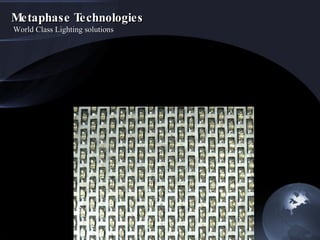
Who We Are? General and custom LED illumination Launched in 1995 – Bensalem PA 2000+ Standard lighting designs Expertise in Electro-Optics, Mechanical, Electronics, and Non Imaging illumination 4 Engineers + 6 technical/assembly staff Complete Cost effective solutions Full in-house testing and verification Customers include – P&G, BF Goodrich, J&J
Work we’ve Done Machine Vision FDA RGB+IR Railroad signals LED arrays + power supply Barcode readers Lensing Military 100 watt lighting Automotive High Power Linelights After Market
CORE COMPETENCIES DESIGN APPLICATION ENGINEERING – from Concept to Verification to Product SOLID MODELING – From SLA Prototyping to Molding OPTICAL DESIGN / LIGHTING – Complete verification PROJECT MANAGEMENT – Turn-key Solutions Power Supplies – From Schematic to Fabrication Manufacturing Integrated services Sourcing LEDs , Hardware/Components, Molds
CORE Products   and  Capabilities Product Development -  Concept -> Prototype -> Detailed Design -> Manufacturing  LED Driver Electronics  - Custom, cost and performance requirements.  Optical Design  - To maximize lighting effectiveness.  Mechanical Design  - Housings and thermal management.  Integration/Retrofit  - Into your luminaire or system  Prototypes  - Rapid turn-around and application assessment.  Test and Evaluation   Qualification and Certification Project/Program Management   Manufacturing   News Release  - Approved as an ACES partner  4-06
Applications Addressed: Automotive - inspection Marine - accent Outdoor/Signage – Security, spotlight, Low level illumination Rail – reading and warning lights Architectural – projection, accent Military - inspection Decorative - backlighting Pharmaceutical – high speed inspection, color rendering, OCR
Lighting – Why so important? 80 %  of success depends on Proper illumination Contrast Resolution Repeatability Speed of processing Cost of system Garbage in – Garbage out Lighting is an Art form –  Distances – angles - Brightness No Substitute for Hands-on
Considerations for Illumination Color or Monochrome Camera; Desired features; lighting; cost; Size of area to be illuminated (FOV) cost; space constraints; lensing; process speed Nature of object – size ; surface ; artifact/s  Specular; diffuse; structure of light source; type and size of defect Environmental and mechanical constraints light source; structure; background; wash down? Maintenance Speed of application light source type; stability; repeatability; resolution of detail Service life of light light source type; cost of ownership
6 General Lighting Techniques –  Which  Best  Creates a detectable and repeatable contrast with the desired artifact/s on the inspected object.  An object is an optical filter – Light rays are modified in 3 ways –  Transmitted ; absorbed; reflected Directional Front Illumination Front Ringlight near axis (Brightfield) Illumination Front Ring off axis (Darkfield) Illumination Coaxial Illumination Transmitted ( Back) Illumination Diffuse Dome Illumination
Light Source Types Solid State LED – Electro-luminescent output Halogen – Gas filled – filament Fiber Optics is the conduit Xenon – Gas filled – arc Fluorescent – Gaseous discharge
The LED advantage Long lasting – 100k+ hrs Pricing- Cost of Ownership From Monochromatic to Infinite Color tuning. Design flexibility Voltage flexible  Shock/vibration resistant “ Cold” light Instant On -  NANOsec’s Intensity Adjustable Intensity unlimited High efficiency
Some LED background Die structure – PN junction 3mm and 5mm Surface mount “ Cold light” Heat
Some LED background LED Parameters Current driven “ White” LEDs
Front Lighting - Directed Creates contrast and shadows through incidence angles Good control of contrasts May create unwanted shadows Design Flexible in setting up multiple sources Uneven Intensity – Inverse Sq Law Good for long arrays
Front Lighting - Diffused Creates contrast and shadows through incidence angles Softer – non directional lower contrast Reduced glare on specular objects Design Flexible in setting up multiple sources Easy to implement Uneven Intensity – Inverse Sq Law  E=1/d ²
Near Axis – (Brightfield) Ringlight Generally good for standard applications.  Provides a uniform intense shadow free illumination.  Not suitable for reflective surfaces Camera Mountable Sizes from 75mm to 150mm Easy alignment
Off-Axis (Darkfield) Ringlight Highlights defects on highly specular surfaces Surface Defects Stratches Minor relief Occlusions Solder pads
Coaxial Illumination Light on axis with camera line of sight Eliminates shadows Excellent for highly specular surfaces Uniform across field of view
Dome Lighting Non-directional diffuse light eliminates glare and shadows For use on highly reflective surfaces Eliminates the Inverse Square law  E=1/d ²
Back Lighting Sharp silhouettes of objects for edge detection and even illumination for opaque and transparent targets Diffuse – Collimated - Polarized Provides dimensional analysis Ideal for Transparent Packaging/product verification Drill holes and perforations – sharp edges Birefringence
Metaphase Technologies Value-Added Lighting solutions  Line Lighting Sharp silhouettes of objects for edge detection and even illumination for opaque and transparent targets Works with Line scan camera Higher resolution Higher Intensity Topography
Custom Structured Lighting Combinations of basic setups Bk + Diffuse Dome light Better resolution Higher Intensity Multiple Topographies Multiple artifacts
Enhancements and beyond the Human Eye Filters Complimentary colors increase contrast Neutral Density (ND) filters provide flat attenuation Reduces Ambient noise Polarizing Reduces specular glare IR Contrast features; dyes  - 840-940nm Invisible to naked eye – silicon sensitive Benefits – Eliminates light noise; Saves on shielding UV Fluorescent dyes
Power Supplies Open Frame Strobe DC Controller Constant Current – Voltage Interfaces
GROWTH AREAS META-Bright Arrays MetaBright ™ Flex line lights IR Modules UV Modules High Brightness LED’s Optical Assemblies

MTI Capabilties test

  • 1.
  • 2.
    Who We Are?General and custom LED illumination Launched in 1995 – Bensalem PA 2000+ Standard lighting designs Expertise in Electro-Optics, Mechanical, Electronics, and Non Imaging illumination 4 Engineers + 6 technical/assembly staff Complete Cost effective solutions Full in-house testing and verification Customers include – P&G, BF Goodrich, J&J
  • 3.
    Work we’ve DoneMachine Vision FDA RGB+IR Railroad signals LED arrays + power supply Barcode readers Lensing Military 100 watt lighting Automotive High Power Linelights After Market
  • 4.
    CORE COMPETENCIES DESIGNAPPLICATION ENGINEERING – from Concept to Verification to Product SOLID MODELING – From SLA Prototyping to Molding OPTICAL DESIGN / LIGHTING – Complete verification PROJECT MANAGEMENT – Turn-key Solutions Power Supplies – From Schematic to Fabrication Manufacturing Integrated services Sourcing LEDs , Hardware/Components, Molds
  • 5.
    CORE Products and Capabilities Product Development - Concept -> Prototype -> Detailed Design -> Manufacturing LED Driver Electronics - Custom, cost and performance requirements. Optical Design - To maximize lighting effectiveness. Mechanical Design - Housings and thermal management. Integration/Retrofit - Into your luminaire or system Prototypes - Rapid turn-around and application assessment. Test and Evaluation Qualification and Certification Project/Program Management Manufacturing News Release - Approved as an ACES partner 4-06
  • 6.
    Applications Addressed: Automotive- inspection Marine - accent Outdoor/Signage – Security, spotlight, Low level illumination Rail – reading and warning lights Architectural – projection, accent Military - inspection Decorative - backlighting Pharmaceutical – high speed inspection, color rendering, OCR
  • 7.
    Lighting – Whyso important? 80 % of success depends on Proper illumination Contrast Resolution Repeatability Speed of processing Cost of system Garbage in – Garbage out Lighting is an Art form – Distances – angles - Brightness No Substitute for Hands-on
  • 8.
    Considerations for IlluminationColor or Monochrome Camera; Desired features; lighting; cost; Size of area to be illuminated (FOV) cost; space constraints; lensing; process speed Nature of object – size ; surface ; artifact/s Specular; diffuse; structure of light source; type and size of defect Environmental and mechanical constraints light source; structure; background; wash down? Maintenance Speed of application light source type; stability; repeatability; resolution of detail Service life of light light source type; cost of ownership
  • 9.
    6 General LightingTechniques – Which Best Creates a detectable and repeatable contrast with the desired artifact/s on the inspected object. An object is an optical filter – Light rays are modified in 3 ways – Transmitted ; absorbed; reflected Directional Front Illumination Front Ringlight near axis (Brightfield) Illumination Front Ring off axis (Darkfield) Illumination Coaxial Illumination Transmitted ( Back) Illumination Diffuse Dome Illumination
  • 10.
    Light Source TypesSolid State LED – Electro-luminescent output Halogen – Gas filled – filament Fiber Optics is the conduit Xenon – Gas filled – arc Fluorescent – Gaseous discharge
  • 11.
    The LED advantageLong lasting – 100k+ hrs Pricing- Cost of Ownership From Monochromatic to Infinite Color tuning. Design flexibility Voltage flexible Shock/vibration resistant “ Cold” light Instant On - NANOsec’s Intensity Adjustable Intensity unlimited High efficiency
  • 12.
    Some LED backgroundDie structure – PN junction 3mm and 5mm Surface mount “ Cold light” Heat
  • 13.
    Some LED backgroundLED Parameters Current driven “ White” LEDs
  • 14.
    Front Lighting -Directed Creates contrast and shadows through incidence angles Good control of contrasts May create unwanted shadows Design Flexible in setting up multiple sources Uneven Intensity – Inverse Sq Law Good for long arrays
  • 15.
    Front Lighting -Diffused Creates contrast and shadows through incidence angles Softer – non directional lower contrast Reduced glare on specular objects Design Flexible in setting up multiple sources Easy to implement Uneven Intensity – Inverse Sq Law E=1/d ²
  • 16.
    Near Axis –(Brightfield) Ringlight Generally good for standard applications. Provides a uniform intense shadow free illumination. Not suitable for reflective surfaces Camera Mountable Sizes from 75mm to 150mm Easy alignment
  • 17.
    Off-Axis (Darkfield) RinglightHighlights defects on highly specular surfaces Surface Defects Stratches Minor relief Occlusions Solder pads
  • 18.
    Coaxial Illumination Lighton axis with camera line of sight Eliminates shadows Excellent for highly specular surfaces Uniform across field of view
  • 19.
    Dome Lighting Non-directionaldiffuse light eliminates glare and shadows For use on highly reflective surfaces Eliminates the Inverse Square law E=1/d ²
  • 20.
    Back Lighting Sharpsilhouettes of objects for edge detection and even illumination for opaque and transparent targets Diffuse – Collimated - Polarized Provides dimensional analysis Ideal for Transparent Packaging/product verification Drill holes and perforations – sharp edges Birefringence
  • 21.
    Metaphase Technologies Value-AddedLighting solutions Line Lighting Sharp silhouettes of objects for edge detection and even illumination for opaque and transparent targets Works with Line scan camera Higher resolution Higher Intensity Topography
  • 22.
    Custom Structured LightingCombinations of basic setups Bk + Diffuse Dome light Better resolution Higher Intensity Multiple Topographies Multiple artifacts
  • 23.
    Enhancements and beyondthe Human Eye Filters Complimentary colors increase contrast Neutral Density (ND) filters provide flat attenuation Reduces Ambient noise Polarizing Reduces specular glare IR Contrast features; dyes - 840-940nm Invisible to naked eye – silicon sensitive Benefits – Eliminates light noise; Saves on shielding UV Fluorescent dyes
  • 24.
    Power Supplies OpenFrame Strobe DC Controller Constant Current – Voltage Interfaces
  • 25.
    GROWTH AREAS META-BrightArrays MetaBright ™ Flex line lights IR Modules UV Modules High Brightness LED’s Optical Assemblies