
Manga School Nakano / The curriculum plans
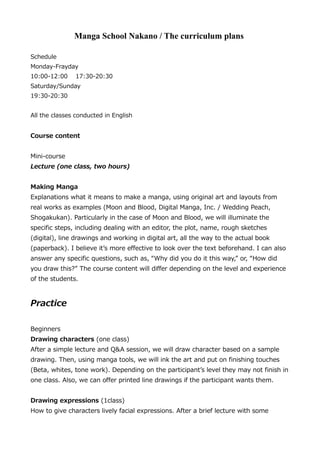
Schedule
Monday-Frayday
10:00-12:00

17:30-20:30

Saturday/Sunday
19:30-20:30
All the classes conducted in English

Course content
Mini-course
Lecture (one class, two hours)
Making Manga
Explanations what it means to make a manga, using original art and layouts from
real works as examples (Moon and Blood, Digital Manga, Inc. / Wedding Peach,
Shogakukan). Particularly in the case of Moon and Blood, we will illuminate the
specific steps, including dealing with an editor, the plot, name, rough sketches
(digital), line drawings and working in digital art, all the way to the actual book
(paperback). I believe it’s more effective to look over the text beforehand. I can also
answer any specific questions, such as, “Why did you do it this way,” or, “How did
you draw this?” The course content will differ depending on the level and experience
of the students.

Practice
Beginners
Drawing characters (one class)
After a simple lecture and Q&A session, we will draw character based on a sample
drawing. Then, using manga tools, we will ink the art and put on finishing touches
(Beta, whites, tone work). Depending on the participant’s level they may not finish in
one class. Also, we can offer printed line drawings if the participant wants them.
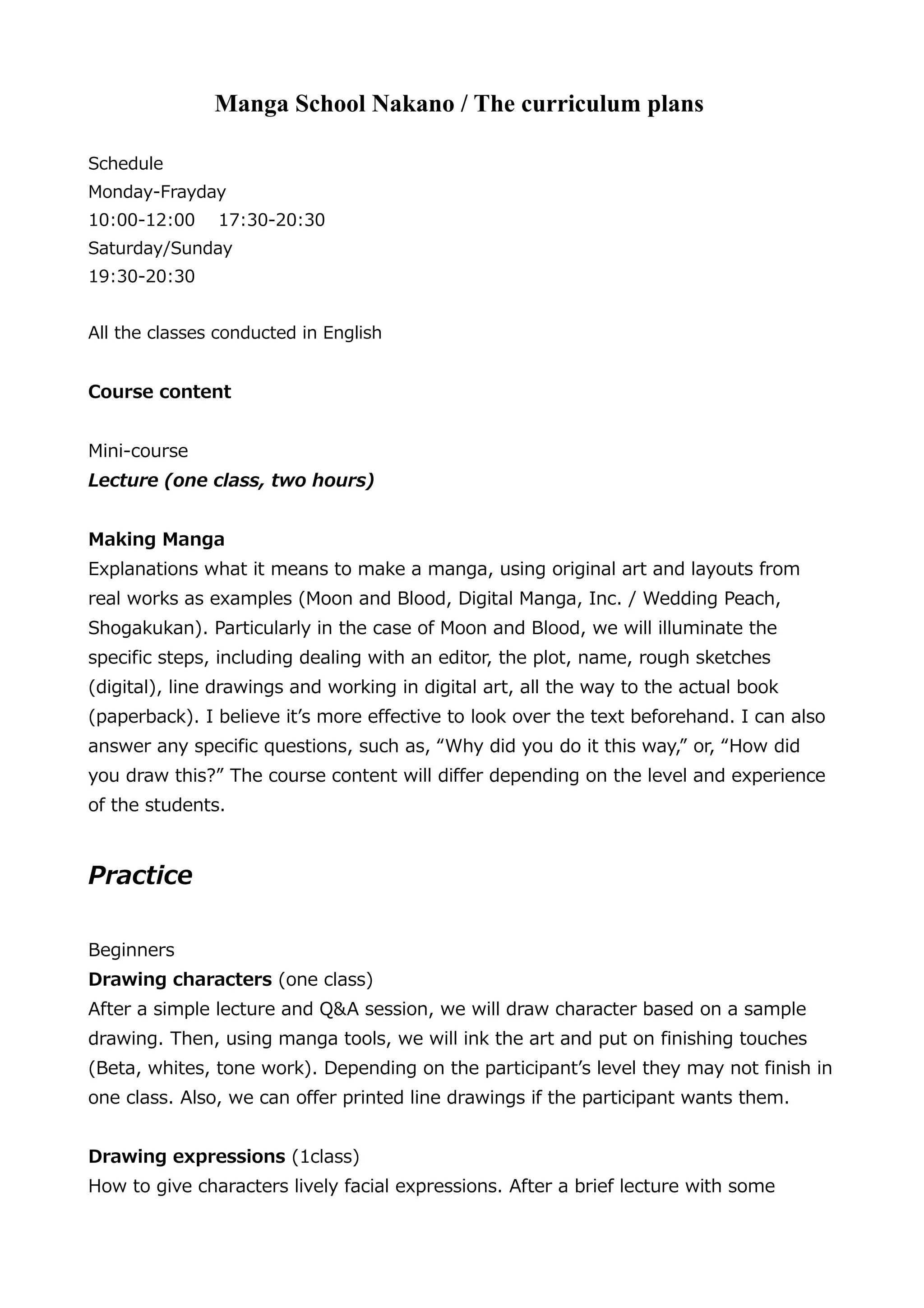
Drawing expressions (1class)
How to give characters lively facial expressions. After a brief lecture with some
examples and Q&A, the student will draw character faces with various expressions
based on the example.
Drawing a scene 1 day (2 classes, pencil work & inking)
After a brief lecture with examples and Q&A, the student will draw characters with
backgrounds based on the example. Also: Drawing backgrounds with perspective.

General
Drawing “chibi” characters/cute mascots
Covers some tips for drawing the “chibi” characters and cute mascots seen in many
Japanese manga/anime. Explains the differences between normal characters and
chibi characters. Observe an artist converting a character into “chibi” style, and see
how it is done. Then practice drawing a chibi/mascot character.
Four-panel manga (one day, two classes)

We will use a relatively easy example of four-panel manga, “Essay Manga.” After
lectures using real examples to show how students how they can draw upon daily life
for four-panel manga material, and how to shape that into four parts with exposition,
development turn and conclusion, they will begin to draw. We will finish with inking,
tone work/coloring.
Character designs (one day, two classes)

The student will create a character and draw one scene in the setting provided.
Then, after a lecture about character design, the student will draw from his or her
own imagination with no example supplied. I will suggest approaches and help guide
the whole process, with students free to ask questions at any time.

==========================
Short course
A course longer than two days, or a combination of multiple mini-courses. These will be
arranged after receiving applications. Take X per week, or take them in a sequence
(aimed at travelers). There is also the option to make it into a class (for long-term
residents). Also, if there is something you want to learn in particular, let us know and we
will consider it.
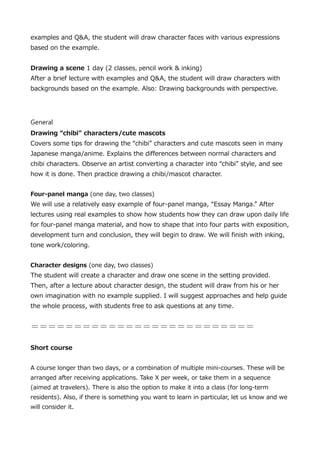
Designing your own character (one day/for everyone)
Create a character and draw one scene in the setting provided. Then, after a lecture
about character design, draw from your own imagination with no example supplied. I
will suggest approaches and help guide the whole process, with students free to ask
questions at any time.
+one more day

Designing other characters
Choose one person from the setting provided, perhaps one of the people around the
character drawn in the previous lesson. Give him or her a face. This can be one of
the character’s family members or friends, for example.
Creating your own characters
(Two days/ intermediate – For students who have drawn manga stories or want to)
After a brief lecture, the student will make an original character and give him or her
a background. Students will give their character three-dimensional depth, and, if
possible, draw other characters, such as friends. They will also draw one scene to
illustrate the character's personality.
Drawing 4-8page short one-shot manga (3 days)
Because it is difficult to draw short story manga, I suggest students draw based on
their own experience, or a slice of everyday life. This is very much like an expanded
version of the four-panel manga mentioned above. The student will learn how the
frame layout should be arranged, and how artists lead reader’s eyes, etc. The
students consult me with
(If a student has a certain idea and story, of course he or she may use it.)
Coloring (1-2 classes)
The techniques I teach are watercolors and digital (Photoshop) coloring. This can be
combined with other courses, like “Coloring your drawings.” I demonstrate my
original color illustrations so that you see what they are really like.
Digital work (1-2 classes)
Some tips with Manga Studio. I'm not an expert in this field, but there still might be
something I can teach. If a student is a beginner, for example, I have plenty to
teach. It also could be combined with other classes. This also covers finishing
techniques (tone work, for instance) for drawing works, or for drawing a character
with Manga Studio from scratch, for instance.
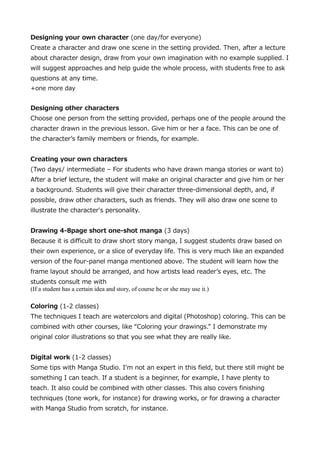
Long course
For people who live or plan to stay in Japan for a long time.
Manga Production (Advanced)
Over 12 weeks (3 months), students will aim to complete a 16-page one-shot
manga. The content is the same as the “Manga Production” course for Japanese
people. 1-2classes /week
Course goals
Students will learn as they go through the manga production process by completing
standalone manga works. They will experience the necessary elements behind
manga production from beginning to end.
Preliminary drawings: 1-2 months
Plot submission
Adapt your own plot to an exposition-development-climax-conclusion structure.
Outline the events, then separate them and reconstruct them with effectiveness in
mind (bubble outlines).
Think about the characters’ lines (specifically speech mannerisms to match their
personalities and ways to set apart their vocabularies).
※Write the profile of your main character.
Turn your bubble outline into a page list.
●Think based on each page spread (split up the pages while considering the layout
in broad terms)
Thoroughly omit any unnecessary elements.
Cut out unneeded episodes/lines.
Think about how individual episodes and lines relate to each other. Make the artist’s
intent clear when it comes to individual elements.
Rough character sketches
Make character designs based on the settings and stories you have previously
completed. As you do so, keep in mind how you want to show characters’
personalities based on the drawings and how you want the readers to receive them.
(Do you want them to be repulsed, to feel they can trust the character, to want to
befriend the character?)
Making name
Settle on a flow of layouts and panels with awareness of how the reader will see the
page.
Think of what you want to show for each page spread.
Think about opening up space for the parts you want to show, and boldly cutting
other parts.
(You will often have to cut out sections during the naming step.)
Always be aware of the camera, of what you want to show and of how you want to
show it while creating your compositions.
Drawing: 1-2 months
Rough character sketches + backgrounds
Be mindful of character expressions and poses. Are you using powerful expressions?
Poses that conflict with the setting? Movement?
Inking characters + background (props)
Carefully select and arrange props. You can use objects to show characters’
personalities or elaborate on the story.
Rough sketches of backgrounds
Draw backgrounds with simple perspective. Learn what is typically omitted in manga
and put the method into practice.
Inking backgrounds –Effects
Effect lines (集中線、スピード線、ベタフラ,eyc. saturated linework, speed lines, starbursts,
etc.), psychological backgrounds, and more.
Finishing:
ベタ painting black part(shinny effect, etc.).ホワイト
Tone work
※Techniques will include perspective, tracing over photographs and tone work, as
necessary for the individual student.

Manga School Nakano/The curriculum plans

  • 1.
    Manga School Nakano/ The curriculum plans Schedule Monday-Frayday 10:00-12:00 17:30-20:30 Saturday/Sunday 19:30-20:30 All the classes conducted in English Course content Mini-course Lecture (one class, two hours) Making Manga Explanations what it means to make a manga, using original art and layouts from real works as examples (Moon and Blood, Digital Manga, Inc. / Wedding Peach, Shogakukan). Particularly in the case of Moon and Blood, we will illuminate the specific steps, including dealing with an editor, the plot, name, rough sketches (digital), line drawings and working in digital art, all the way to the actual book (paperback). I believe it’s more effective to look over the text beforehand. I can also answer any specific questions, such as, “Why did you do it this way,” or, “How did you draw this?” The course content will differ depending on the level and experience of the students. Practice Beginners Drawing characters (one class) After a simple lecture and Q&A session, we will draw character based on a sample drawing. Then, using manga tools, we will ink the art and put on finishing touches (Beta, whites, tone work). Depending on the participant’s level they may not finish in one class. Also, we can offer printed line drawings if the participant wants them. Drawing expressions (1class) How to give characters lively facial expressions. After a brief lecture with some
  • 2.
    examples and Q&A,the student will draw character faces with various expressions based on the example. Drawing a scene 1 day (2 classes, pencil work & inking) After a brief lecture with examples and Q&A, the student will draw characters with backgrounds based on the example. Also: Drawing backgrounds with perspective. General Drawing “chibi” characters/cute mascots Covers some tips for drawing the “chibi” characters and cute mascots seen in many Japanese manga/anime. Explains the differences between normal characters and chibi characters. Observe an artist converting a character into “chibi” style, and see how it is done. Then practice drawing a chibi/mascot character. Four-panel manga (one day, two classes) We will use a relatively easy example of four-panel manga, “Essay Manga.” After lectures using real examples to show how students how they can draw upon daily life for four-panel manga material, and how to shape that into four parts with exposition, development turn and conclusion, they will begin to draw. We will finish with inking, tone work/coloring. Character designs (one day, two classes) The student will create a character and draw one scene in the setting provided. Then, after a lecture about character design, the student will draw from his or her own imagination with no example supplied. I will suggest approaches and help guide the whole process, with students free to ask questions at any time. ========================== Short course A course longer than two days, or a combination of multiple mini-courses. These will be arranged after receiving applications. Take X per week, or take them in a sequence (aimed at travelers). There is also the option to make it into a class (for long-term residents). Also, if there is something you want to learn in particular, let us know and we will consider it.
  • 3.
    Designing your owncharacter (one day/for everyone) Create a character and draw one scene in the setting provided. Then, after a lecture about character design, draw from your own imagination with no example supplied. I will suggest approaches and help guide the whole process, with students free to ask questions at any time. +one more day Designing other characters Choose one person from the setting provided, perhaps one of the people around the character drawn in the previous lesson. Give him or her a face. This can be one of the character’s family members or friends, for example. Creating your own characters (Two days/ intermediate – For students who have drawn manga stories or want to) After a brief lecture, the student will make an original character and give him or her a background. Students will give their character three-dimensional depth, and, if possible, draw other characters, such as friends. They will also draw one scene to illustrate the character's personality. Drawing 4-8page short one-shot manga (3 days) Because it is difficult to draw short story manga, I suggest students draw based on their own experience, or a slice of everyday life. This is very much like an expanded version of the four-panel manga mentioned above. The student will learn how the frame layout should be arranged, and how artists lead reader’s eyes, etc. The students consult me with (If a student has a certain idea and story, of course he or she may use it.) Coloring (1-2 classes) The techniques I teach are watercolors and digital (Photoshop) coloring. This can be combined with other courses, like “Coloring your drawings.” I demonstrate my original color illustrations so that you see what they are really like. Digital work (1-2 classes) Some tips with Manga Studio. I'm not an expert in this field, but there still might be something I can teach. If a student is a beginner, for example, I have plenty to teach. It also could be combined with other classes. This also covers finishing techniques (tone work, for instance) for drawing works, or for drawing a character with Manga Studio from scratch, for instance.
  • 4.
    Long course For peoplewho live or plan to stay in Japan for a long time. Manga Production (Advanced) Over 12 weeks (3 months), students will aim to complete a 16-page one-shot manga. The content is the same as the “Manga Production” course for Japanese people. 1-2classes /week Course goals Students will learn as they go through the manga production process by completing standalone manga works. They will experience the necessary elements behind manga production from beginning to end. Preliminary drawings: 1-2 months Plot submission Adapt your own plot to an exposition-development-climax-conclusion structure. Outline the events, then separate them and reconstruct them with effectiveness in mind (bubble outlines). Think about the characters’ lines (specifically speech mannerisms to match their personalities and ways to set apart their vocabularies). ※Write the profile of your main character. Turn your bubble outline into a page list. ●Think based on each page spread (split up the pages while considering the layout in broad terms) Thoroughly omit any unnecessary elements. Cut out unneeded episodes/lines. Think about how individual episodes and lines relate to each other. Make the artist’s intent clear when it comes to individual elements. Rough character sketches
  • 5.
    Make character designsbased on the settings and stories you have previously completed. As you do so, keep in mind how you want to show characters’ personalities based on the drawings and how you want the readers to receive them. (Do you want them to be repulsed, to feel they can trust the character, to want to befriend the character?) Making name Settle on a flow of layouts and panels with awareness of how the reader will see the page. Think of what you want to show for each page spread. Think about opening up space for the parts you want to show, and boldly cutting other parts. (You will often have to cut out sections during the naming step.) Always be aware of the camera, of what you want to show and of how you want to show it while creating your compositions. Drawing: 1-2 months Rough character sketches + backgrounds Be mindful of character expressions and poses. Are you using powerful expressions? Poses that conflict with the setting? Movement? Inking characters + background (props) Carefully select and arrange props. You can use objects to show characters’ personalities or elaborate on the story. Rough sketches of backgrounds Draw backgrounds with simple perspective. Learn what is typically omitted in manga and put the method into practice. Inking backgrounds –Effects Effect lines (集中線、スピード線、ベタフラ,eyc. saturated linework, speed lines, starbursts, etc.), psychological backgrounds, and more. Finishing:
  • 6.
    ベタ painting blackpart(shinny effect, etc.).ホワイト Tone work ※Techniques will include perspective, tracing over photographs and tone work, as necessary for the individual student.