MSN 572 Week 8 Diagnostics Assignment
Scenario: Cardiovascular: body system
54-year-old man with S/S: shortness of breath, chest pain and
fever.
You can use CHF or Heart failure for shortness of breath
Ischemic heart disease or myocarditis for chest pain
Endocarditis for fever
Diagnostics Assignment (lab and radiology)
Each group will be assigned a body system and the
signs/symptoms presenting with that system. From this, each
group member of the group will formulate at least one different,
primary care differential diagnosis with lab and radiology (as
applies) workup and plan for that differential. For the lab and
radiology that you include, you will need to provide
interpretation, to include what the high/low values are as well
as common indications that occur with highs/lows. Your
differential and diagnostic workup and treatment must be
supported by peer-reviewed, recent references and resources
pointing to best practices. There must be a minimum of three
references per differential. All of this should be laid out in
APA style and presented in a format of your choosing.
Each member will outline or narrate their work-up for their
differential. The workup should include the appropriate lab
work or other diagnostics with rationale and interpretation, and
a treatment plan (including any medications, education, follow -
up plan) with supporting references. The group must submit all
workups in one document. If a student drops from the course
midterm, the remaining group members must still present a
minimum of three differentials for the case.
Note: Please see the rubric in the course for weighting of each
section. Rubric is on top of the
sample that I attached.
MSN 572 Case Study
Kirsten McBurney
Chandarong Shawn Lam
Case Study Scenario
Scenario: GI is your body system, 42-years-old female with
abdominal pain and constipation
Criteria Exceeds
Expectations
Meets Expectations
Below Expectations Far Below Standard
Group Identifies 3
Appropriate
Differentials
25%
Differentials are
appropriate to
presenting
symptoms, each
group member has
identified a
differential, and
differentials are
medical diagnoses.
25 points
Differentials are
appropriate for entry-
level providers and
all group members
have unique
differentials, but
differentials may not
be medical
diagnoses
20 points
All group members
have unique
differentials, but
differentials are not
applicable, or
relevant, or are not
medical diagnoses.
16 points
Not all group
members have
unique differentials
or differentials
chosen are not
medical
diagnoses/do not
relate to symptoms
10 points
Each Differential
Includes a
complete and
applicable lab and
radiology workup,
as appropriate 30%
Workup is specific to
the chosen
differential and does
not include
unnecessary testing.
Student considers
insurance coverage
or costs.
30 points
Workup is specific to
chosen differential,
but may include too
many or not enough
labs/testing.
May or may not
consider insurance
or costs.
25 points
Workup is only
generally applicable
to differential, and
does not narrow
objective findings.
No mention of
insurance or cost.
20 points
Workup is not
appropriate to the
differential. This
would be
labs/radiology that
would not provide
needed information
towards final
diagnosis.
No mention of
insurance or cost.
15 points
Each workup
Includes complete
interpretation of lab
work/ radiology, as
necessary 30%
Interpretation
includes high/low
values, as well as
all/most clinical
conditions
associated with
high/low values.
30 points
Interpretation
includes high/low
values, but only
includes several
conditions
associated with high
or low values
25 points
Interpretation
includes high/low
values, but only
includes some/few
associated
conditions
20 points
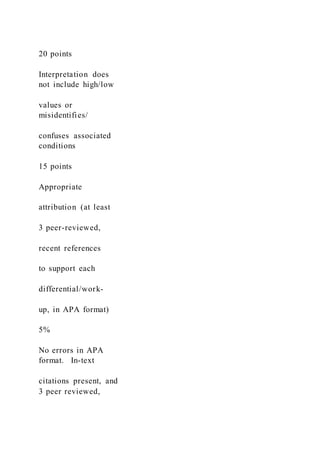
Interpretation does
not include high/low
values or
misidentifies/
confuses associated
conditions
15 points
Appropriate
attribution (at least
3 peer-reviewed,
recent references
to support each
differential/work-
up, in APA format)
5%
No errors in APA
format. In-text
citations present, and
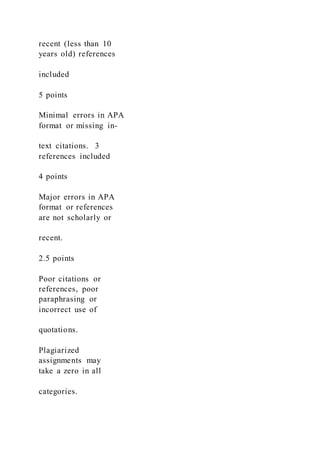
3 peer reviewed,
recent (less than 10
years old) references
included
5 points
Minimal errors in APA
format or missing in-
text citations. 3
references included
4 points
Major errors in APA
format or references
are not scholarly or
recent.
2.5 points
Poor citations or
references, poor
paraphrasing or
incorrect use of
quotations.
Plagiarized
assignments may
take a zero in all
categories.
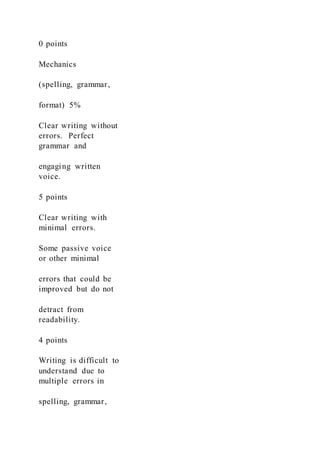
0 points
Mechanics
(spelling, grammar,
format) 5%
Clear writing without
errors. Perfect
grammar and
engaging written
voice.
5 points
Clear writing with
minimal errors.
Some passive voice
or other minimal
errors that could be
improved but do not
detract from
readability.
4 points
Writing is difficult to
understand due to
multiple errors in
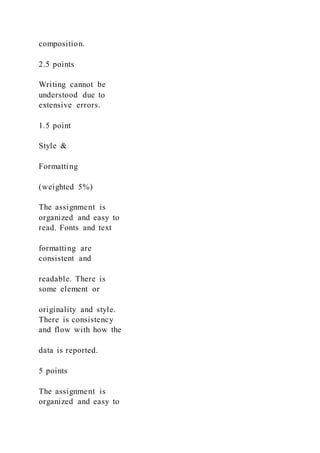
spelling, grammar,
composition.
2.5 points
Writing cannot be
understood due to
extensive errors.
1.5 point
Style &
Formatting
(weighted 5%)
The assignment is
organized and easy to
read. Fonts and text
formatting are
consistent and
readable. There is
some element or
originality and style.
There is consistency
and flow with how the
data is reported.
5 points
The assignment is
organized and easy to
read. Fonts and text
formatting are usually
consistent and
readable. There is
consistency and flow.
Might be missing the
element or originality
and style.
4 points
The assignment is
somewhat organized
but not always easy to
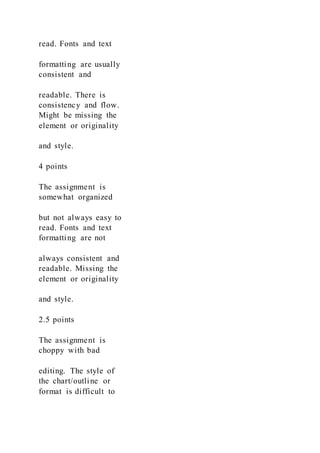
read. Fonts and text
formatting are not
always consistent and
readable. Missing the
element or originality
and style.
2.5 points
The assignment is
choppy with bad
editing. The style of
the chart/outline or
format is difficult to
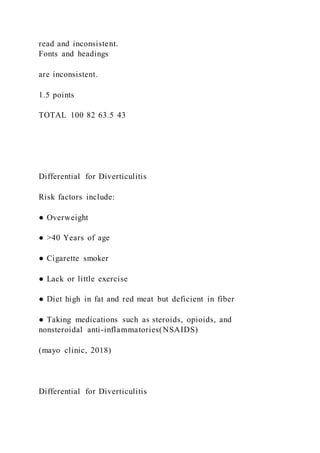
read and inconsistent.
Fonts and headings
are inconsistent.
1.5 points
TOTAL 100 82 63.5 43
Differential for Diverticulitis
Risk factors include:
● Overweight
● >40 Years of age
● Cigarette smoker
● Lack or little exercise
● Diet high in fat and red meat but deficient in fiber
● Taking medications such as steroids, opioids, and
nonsteroidal anti-inflammatories(NSAIDS)
(mayo clinic, 2018)
Differential for Diverticulitis
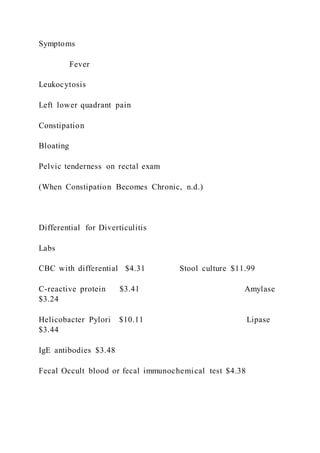
Symptoms
Fever
Leukocytosis
Left lower quadrant pain
Constipation
Bloating
Pelvic tenderness on rectal exam
(When Constipation Becomes Chronic, n.d.)
Differential for Diverticulitis
Labs
CBC with differential $4.31 Stool culture $11.99
C-reactive protein $3.41 Amylase
$3.24
Helicobacter Pylori $10.11 Lipase
$3.44
IgE antibodies $3.48
Fecal Occult blood or fecal immunochemical test $4.38
Labs
CBC with differential-measurement of the number of red blood
cells, platelets, and different white blood
cells. Those being neutrophils, lymphocytes, monocytes,
basophils, and eosinophils.
WBC Normal values 4,500-11,000 cells/mcl
Abnormal low indicates bone marrow disorders, sepsis,
autoimmune disorders, immune disorders,
lymphoma and other cancers to name a few
Abnormal high indicates Infection, inflammation, leukemia,
allergies, asthma, severe stress to name a
few
Hemoglobin Men 14-17.5 gm/dL
Women 12.3-15.3 gm/dL
Abnormal low indicates anemia, acute or chronic bleeding,
Bone marrow disorder, chronic inflammatory
disease,
Nutritional deficiencies, and chronic kidney disease
Abnormal high indicates dehydration, pulmonary disease,
kidney disease, high altitude living, and
polycythemia
Hematocrit Men 41.5-50.4 %
Women 36.9-44.6%
Same as hemoglobin
(Connor, 2020)
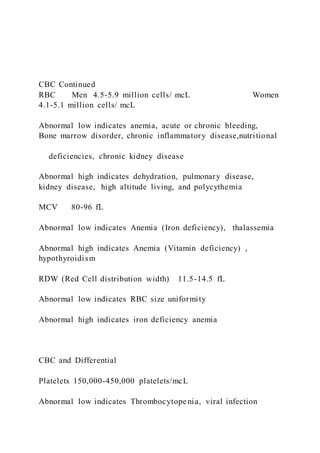
CBC Continued
RBC Men 4.5-5.9 million cells/ mcL Women
4.1-5.1 million cells/ mcL
Abnormal low indicates anemia, acute or chronic bleeding,
Bone marrow disorder, chronic inflammatory disease,nutritional
deficiencies, chronic kidney disease
Abnormal high indicates dehydration, pulmonary disease,
kidney disease, high altitude living, and polycythemia
MCV 80-96 fL
Abnormal low indicates Anemia (Iron deficiency), thalassemia
Abnormal high indicates Anemia (Vitamin deficiency) ,
hypothyroidism
RDW (Red Cell distribution width) 11.5-14.5 fL
Abnormal low indicates RBC size uniformity
Abnormal high indicates iron deficiency anemia
CBC and Differential
Platelets 150,000-450,000 platelets/mcL
Abnormal low indicates Thrombocytope nia, viral infection
Abnormal high indicates Cancer, Inflammatory bowel disease,
Rheumatoid Arthritis
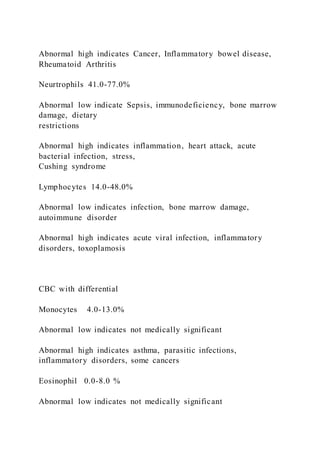
Neurtrophils 41.0-77.0%
Abnormal low indicate Sepsis, immunodeficiency, bone marrow
damage, dietary
restrictions
Abnormal high indicates inflammation, heart attack, acute
bacterial infection, stress,
Cushing syndrome
Lymphocytes 14.0-48.0%
Abnormal low indicates infection, bone marrow damage,
autoimmune disorder
Abnormal high indicates acute viral infection, inflammatory
disorders, toxoplamosis
CBC with differential
Monocytes 4.0-13.0%
Abnormal low indicates not medically significant
Abnormal high indicates asthma, parasitic infections,
inflammatory disorders, some cancers
Eosinophil 0.0-8.0 %
Abnormal low indicates not medically significant
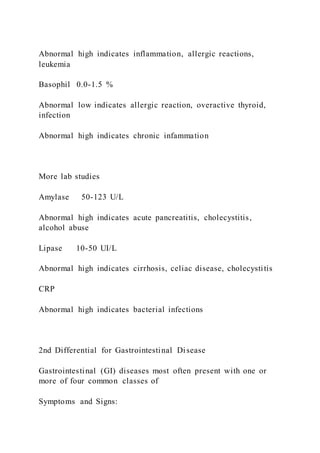
Abnormal high indicates inflammation, allergic reactions,
leukemia
Basophil 0.0-1.5 %
Abnormal low indicates allergic reaction, overactive thyroid,
infection
Abnormal high indicates chronic infammation
More lab studies
Amylase 50-123 U/L
Abnormal high indicates acute pancreatitis, cholecystitis,
alcohol abuse
Lipase 10-50 UI/L
Abnormal high indicates cirrhosis, celiac disease, cholecystitis
CRP
Abnormal high indicates bacterial infections
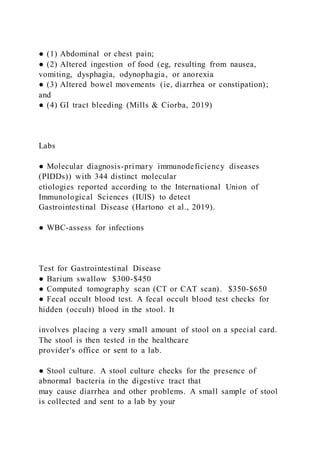
2nd Differential for Gastrointestinal Disease
Gastrointestinal (GI) diseases most often present with one or
more of four common classes of
Symptoms and Signs:
● (1) Abdominal or chest pain;
● (2) Altered ingestion of food (eg, resulting from nausea,
vomiting, dysphagia, odynophagia, or anorexia
● (3) Altered bowel movements (ie, diarrhea or constipation);
and
● (4) GI tract bleeding (Mills & Ciorba, 2019)
Labs
● Molecular diagnosis-primary immunodeficiency diseases
(PIDDs)) with 344 distinct molecular
etiologies reported according to the International Union of
Immunological Sciences (IUIS) to detect
Gastrointestinal Disease (Hartono et al., 2019).
● WBC-assess for infections
Test for Gastrointestinal Disease
● Barium swallow $300-$450
● Computed tomography scan (CT or CAT scan). $350-$650
● Fecal occult blood test. A fecal occult blood test checks for
hidden (occult) blood in the stool. It
involves placing a very small amount of stool on a special card.
The stool is then tested in the healthcare
provider's office or sent to a lab.
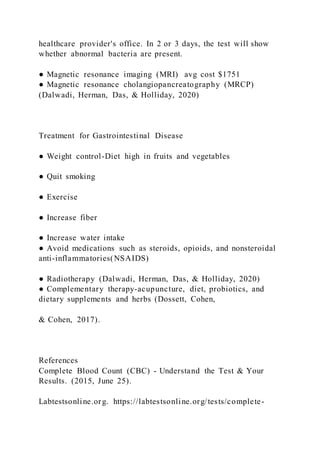
● Stool culture. A stool culture checks for the presence of
abnormal bacteria in the digestive tract that
may cause diarrhea and other problems. A small sample of stool
is collected and sent to a lab by your
healthcare provider's office. In 2 or 3 days, the test will show
whether abnormal bacteria are present.
● Magnetic resonance imaging (MRI) avg cost $1751
● Magnetic resonance cholangiopancreatography (MRCP)
(Dalwadi, Herman, Das, & Holliday, 2020)
Treatment for Gastrointestinal Disease
● Weight control-Diet high in fruits and vegetables
● Quit smoking
● Exercise
● Increase fiber
● Increase water intake
● Avoid medications such as steroids, opioids, and nonsteroidal
anti-inflammatories(NSAIDS)
● Radiotherapy (Dalwadi, Herman, Das, & Holliday, 2020)
● Complementary therapy-acupuncture, diet, probiotics, and
dietary supplements and herbs (Dossett, Cohen,
& Cohen, 2017).
References
Complete Blood Count (CBC) - Understand the Test & Your
Results. (2015, June 25).
Labtestsonline.org. https://labtestsonline.org/tests/complete-
blood-count-cbc
Connor, G. J. (2020). Lab values interpretation : the ultimate
laboratory tests manual of reference
ranges and what they mean.
Dalwadi, S. M., Herman, J. M., Das, P., & Holliday, E. B.
(2020). Novel Radiotherapy
Technologies in the Treatment of Gastrointestinal Malignancies.
Hematology/oncology clinics of
North America, 34(1), 29–43.
https://doi.org/10.1016/j.hoc.2019.08.016
Dossett, M. L., Cohen, E. M., & Cohen, J. (2017). Integrative
Medicine for Gastrointestinal
Disease. Primary care, 44(2), 265–280.
https://doi.org/10.1016/j.pop.2017.02.002
Hartono, S., Ippoliti, M. R., Mastroianni, M., Torres, R., &
Rider, N. L. (2019). Gastrointestinal
Disorders Associated with Primary Immunodeficiency Diseases.
Clinical reviews in allergy &
immunology, 57(2), 145–165. https://doi.org/10.1007/s12016-
018-8689-9
Mayo clinic. (2018). Diverticulitis - Symptoms and causes.
Mayo Clinic;
https://www.mayoclinic.org/diseases-
conditions/diverticulitis/symptoms-causes/syc-20371758
Mills, J. C., & Ciorba, M. A. (2019). Chapter 13:
Gastrointestinal Disease. Retrieved from
https://accessmedicine.mhmedical.com/content.aspx?sectionid=
198222337
https://labtestsonline.org/tests/complete-blood-count-cbc
https://doi.org/10.1016/j.hoc.2019.08.016
https://www.mayoclinic.org/diseases-
conditions/diverticulitis/symptoms-causes/syc-20371758
References
When Constipation Becomes Chronic. (n.d.). GI Associates.
Retrieved June 24, 2021, from
https://gi.md/resources/articles/when-constipation-becomes-
chronic
Slide 1Case Study ScenarioSlide 3Differential for
DiverticulitisDifferential for DiverticulitisDifferential for
DiverticulitisLabsCBC ContinuedCBC and DifferentialCBC
with differentialMore lab studies2nd Differential for
Gastrointestinal DiseaseLabsTest for Gastrointestinal
DiseaseTreatment for Gastrointestinal
DiseaseReferencesReferences

Msn 572 week 8 diagnostics assignment scenario cardiovas

  • 1.
    MSN 572 Week8 Diagnostics Assignment Scenario: Cardiovascular: body system 54-year-old man with S/S: shortness of breath, chest pain and fever. You can use CHF or Heart failure for shortness of breath Ischemic heart disease or myocarditis for chest pain Endocarditis for fever Diagnostics Assignment (lab and radiology) Each group will be assigned a body system and the signs/symptoms presenting with that system. From this, each group member of the group will formulate at least one different, primary care differential diagnosis with lab and radiology (as applies) workup and plan for that differential. For the lab and radiology that you include, you will need to provide interpretation, to include what the high/low values are as well as common indications that occur with highs/lows. Your differential and diagnostic workup and treatment must be supported by peer-reviewed, recent references and resources pointing to best practices. There must be a minimum of three references per differential. All of this should be laid out in APA style and presented in a format of your choosing. Each member will outline or narrate their work-up for their differential. The workup should include the appropriate lab work or other diagnostics with rationale and interpretation, and
  • 2.
    a treatment plan(including any medications, education, follow - up plan) with supporting references. The group must submit all workups in one document. If a student drops from the course midterm, the remaining group members must still present a minimum of three differentials for the case. Note: Please see the rubric in the course for weighting of each section. Rubric is on top of the sample that I attached. MSN 572 Case Study Kirsten McBurney Chandarong Shawn Lam Case Study Scenario Scenario: GI is your body system, 42-years-old female with abdominal pain and constipation Criteria Exceeds Expectations Meets Expectations
  • 3.
    Below Expectations FarBelow Standard Group Identifies 3 Appropriate Differentials 25% Differentials are appropriate to presenting symptoms, each group member has identified a differential, and differentials are medical diagnoses. 25 points Differentials are appropriate for entry- level providers and all group members have unique differentials, but
  • 4.
    differentials may not bemedical diagnoses 20 points All group members have unique differentials, but differentials are not applicable, or relevant, or are not medical diagnoses. 16 points Not all group members have unique differentials or differentials chosen are not medical diagnoses/do not relate to symptoms 10 points Each Differential Includes a
  • 5.
    complete and applicable laband radiology workup, as appropriate 30% Workup is specific to the chosen differential and does not include unnecessary testing. Student considers insurance coverage or costs. 30 points Workup is specific to chosen differential, but may include too many or not enough labs/testing. May or may not consider insurance or costs. 25 points
  • 6.
    Workup is only generallyapplicable to differential, and does not narrow objective findings. No mention of insurance or cost. 20 points Workup is not appropriate to the differential. This would be labs/radiology that would not provide needed information towards final diagnosis. No mention of insurance or cost. 15 points Each workup Includes complete interpretation of lab
  • 7.
    work/ radiology, as necessary30% Interpretation includes high/low values, as well as all/most clinical conditions associated with high/low values. 30 points Interpretation includes high/low values, but only includes several conditions associated with high or low values 25 points Interpretation includes high/low values, but only includes some/few associated conditions
  • 8.
    20 points Interpretation does notinclude high/low values or misidentifies/ confuses associated conditions 15 points Appropriate attribution (at least 3 peer-reviewed, recent references to support each differential/work- up, in APA format) 5% No errors in APA format. In-text citations present, and 3 peer reviewed,
  • 9.
    recent (less than10 years old) references included 5 points Minimal errors in APA format or missing in- text citations. 3 references included 4 points Major errors in APA format or references are not scholarly or recent. 2.5 points Poor citations or references, poor paraphrasing or incorrect use of quotations. Plagiarized assignments may take a zero in all categories.
  • 10.
    0 points Mechanics (spelling, grammar, format)5% Clear writing without errors. Perfect grammar and engaging written voice. 5 points Clear writing with minimal errors. Some passive voice or other minimal errors that could be improved but do not detract from readability. 4 points Writing is difficult to understand due to multiple errors in spelling, grammar,
  • 11.
    composition. 2.5 points Writing cannotbe understood due to extensive errors. 1.5 point Style & Formatting (weighted 5%) The assignment is organized and easy to read. Fonts and text formatting are consistent and readable. There is some element or originality and style. There is consistency and flow with how the data is reported. 5 points The assignment is organized and easy to
  • 12.
    read. Fonts andtext formatting are usually consistent and readable. There is consistency and flow. Might be missing the element or originality and style. 4 points The assignment is somewhat organized but not always easy to read. Fonts and text formatting are not always consistent and readable. Missing the element or originality and style. 2.5 points The assignment is choppy with bad editing. The style of the chart/outline or format is difficult to
  • 13.
    read and inconsistent. Fontsand headings are inconsistent. 1.5 points TOTAL 100 82 63.5 43 Differential for Diverticulitis Risk factors include: ● Overweight ● >40 Years of age ● Cigarette smoker ● Lack or little exercise ● Diet high in fat and red meat but deficient in fiber ● Taking medications such as steroids, opioids, and nonsteroidal anti-inflammatories(NSAIDS) (mayo clinic, 2018) Differential for Diverticulitis
  • 14.
    Symptoms Fever Leukocytosis Left lower quadrantpain Constipation Bloating Pelvic tenderness on rectal exam (When Constipation Becomes Chronic, n.d.) Differential for Diverticulitis Labs CBC with differential $4.31 Stool culture $11.99 C-reactive protein $3.41 Amylase $3.24 Helicobacter Pylori $10.11 Lipase $3.44 IgE antibodies $3.48 Fecal Occult blood or fecal immunochemical test $4.38
  • 15.
    Labs CBC with differential-measurementof the number of red blood cells, platelets, and different white blood cells. Those being neutrophils, lymphocytes, monocytes, basophils, and eosinophils. WBC Normal values 4,500-11,000 cells/mcl Abnormal low indicates bone marrow disorders, sepsis, autoimmune disorders, immune disorders, lymphoma and other cancers to name a few Abnormal high indicates Infection, inflammation, leukemia, allergies, asthma, severe stress to name a few Hemoglobin Men 14-17.5 gm/dL Women 12.3-15.3 gm/dL Abnormal low indicates anemia, acute or chronic bleeding, Bone marrow disorder, chronic inflammatory disease, Nutritional deficiencies, and chronic kidney disease Abnormal high indicates dehydration, pulmonary disease, kidney disease, high altitude living, and polycythemia Hematocrit Men 41.5-50.4 % Women 36.9-44.6% Same as hemoglobin (Connor, 2020)
  • 16.
    CBC Continued RBC Men4.5-5.9 million cells/ mcL Women 4.1-5.1 million cells/ mcL Abnormal low indicates anemia, acute or chronic bleeding, Bone marrow disorder, chronic inflammatory disease,nutritional deficiencies, chronic kidney disease Abnormal high indicates dehydration, pulmonary disease, kidney disease, high altitude living, and polycythemia MCV 80-96 fL Abnormal low indicates Anemia (Iron deficiency), thalassemia Abnormal high indicates Anemia (Vitamin deficiency) , hypothyroidism RDW (Red Cell distribution width) 11.5-14.5 fL Abnormal low indicates RBC size uniformity Abnormal high indicates iron deficiency anemia CBC and Differential Platelets 150,000-450,000 platelets/mcL Abnormal low indicates Thrombocytope nia, viral infection
  • 17.
    Abnormal high indicatesCancer, Inflammatory bowel disease, Rheumatoid Arthritis Neurtrophils 41.0-77.0% Abnormal low indicate Sepsis, immunodeficiency, bone marrow damage, dietary restrictions Abnormal high indicates inflammation, heart attack, acute bacterial infection, stress, Cushing syndrome Lymphocytes 14.0-48.0% Abnormal low indicates infection, bone marrow damage, autoimmune disorder Abnormal high indicates acute viral infection, inflammatory disorders, toxoplamosis CBC with differential Monocytes 4.0-13.0% Abnormal low indicates not medically significant Abnormal high indicates asthma, parasitic infections, inflammatory disorders, some cancers Eosinophil 0.0-8.0 % Abnormal low indicates not medically significant
  • 18.
    Abnormal high indicatesinflammation, allergic reactions, leukemia Basophil 0.0-1.5 % Abnormal low indicates allergic reaction, overactive thyroid, infection Abnormal high indicates chronic infammation More lab studies Amylase 50-123 U/L Abnormal high indicates acute pancreatitis, cholecystitis, alcohol abuse Lipase 10-50 UI/L Abnormal high indicates cirrhosis, celiac disease, cholecystitis CRP Abnormal high indicates bacterial infections 2nd Differential for Gastrointestinal Disease Gastrointestinal (GI) diseases most often present with one or more of four common classes of Symptoms and Signs:
  • 19.
    ● (1) Abdominalor chest pain; ● (2) Altered ingestion of food (eg, resulting from nausea, vomiting, dysphagia, odynophagia, or anorexia ● (3) Altered bowel movements (ie, diarrhea or constipation); and ● (4) GI tract bleeding (Mills & Ciorba, 2019) Labs ● Molecular diagnosis-primary immunodeficiency diseases (PIDDs)) with 344 distinct molecular etiologies reported according to the International Union of Immunological Sciences (IUIS) to detect Gastrointestinal Disease (Hartono et al., 2019). ● WBC-assess for infections Test for Gastrointestinal Disease ● Barium swallow $300-$450 ● Computed tomography scan (CT or CAT scan). $350-$650 ● Fecal occult blood test. A fecal occult blood test checks for hidden (occult) blood in the stool. It involves placing a very small amount of stool on a special card. The stool is then tested in the healthcare provider's office or sent to a lab. ● Stool culture. A stool culture checks for the presence of abnormal bacteria in the digestive tract that may cause diarrhea and other problems. A small sample of stool is collected and sent to a lab by your
  • 20.
    healthcare provider's office.In 2 or 3 days, the test will show whether abnormal bacteria are present. ● Magnetic resonance imaging (MRI) avg cost $1751 ● Magnetic resonance cholangiopancreatography (MRCP) (Dalwadi, Herman, Das, & Holliday, 2020) Treatment for Gastrointestinal Disease ● Weight control-Diet high in fruits and vegetables ● Quit smoking ● Exercise ● Increase fiber ● Increase water intake ● Avoid medications such as steroids, opioids, and nonsteroidal anti-inflammatories(NSAIDS) ● Radiotherapy (Dalwadi, Herman, Das, & Holliday, 2020) ● Complementary therapy-acupuncture, diet, probiotics, and dietary supplements and herbs (Dossett, Cohen, & Cohen, 2017). References Complete Blood Count (CBC) - Understand the Test & Your Results. (2015, June 25). Labtestsonline.org. https://labtestsonline.org/tests/complete-
  • 21.
    blood-count-cbc Connor, G. J.(2020). Lab values interpretation : the ultimate laboratory tests manual of reference ranges and what they mean. Dalwadi, S. M., Herman, J. M., Das, P., & Holliday, E. B. (2020). Novel Radiotherapy Technologies in the Treatment of Gastrointestinal Malignancies. Hematology/oncology clinics of North America, 34(1), 29–43. https://doi.org/10.1016/j.hoc.2019.08.016 Dossett, M. L., Cohen, E. M., & Cohen, J. (2017). Integrative Medicine for Gastrointestinal Disease. Primary care, 44(2), 265–280. https://doi.org/10.1016/j.pop.2017.02.002 Hartono, S., Ippoliti, M. R., Mastroianni, M., Torres, R., & Rider, N. L. (2019). Gastrointestinal Disorders Associated with Primary Immunodeficiency Diseases. Clinical reviews in allergy & immunology, 57(2), 145–165. https://doi.org/10.1007/s12016- 018-8689-9 Mayo clinic. (2018). Diverticulitis - Symptoms and causes. Mayo Clinic; https://www.mayoclinic.org/diseases- conditions/diverticulitis/symptoms-causes/syc-20371758 Mills, J. C., & Ciorba, M. A. (2019). Chapter 13: Gastrointestinal Disease. Retrieved from https://accessmedicine.mhmedical.com/content.aspx?sectionid= 198222337 https://labtestsonline.org/tests/complete-blood-count-cbc
  • 22.
    https://doi.org/10.1016/j.hoc.2019.08.016 https://www.mayoclinic.org/diseases- conditions/diverticulitis/symptoms-causes/syc-20371758 References When Constipation BecomesChronic. (n.d.). GI Associates. Retrieved June 24, 2021, from https://gi.md/resources/articles/when-constipation-becomes- chronic Slide 1Case Study ScenarioSlide 3Differential for DiverticulitisDifferential for DiverticulitisDifferential for DiverticulitisLabsCBC ContinuedCBC and DifferentialCBC with differentialMore lab studies2nd Differential for Gastrointestinal DiseaseLabsTest for Gastrointestinal DiseaseTreatment for Gastrointestinal DiseaseReferencesReferences