UNIVERSIT`A DEGLI STUDI DI TRENTO
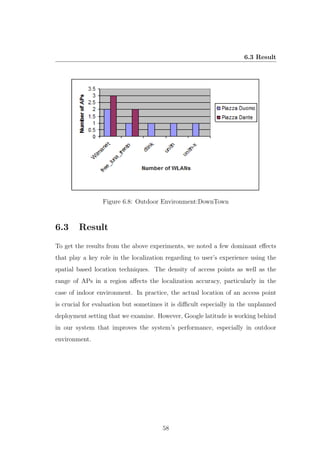
Facolt`a di Scienze Matematiche, Fisiche e Naturali
Corso di Laurea Specialistica in Informatica
Master of Science in Computer Science
Tesi di Laurea
Final Thesis
Development and Evaluation of a
Localization Component for Mobile
Service Applications
Relatore/Adviser: Laureando/Graduand:
Prof. Fabio Casati Mohammad Obaidul Haque
Anno Accademico 2008–2009
To my mother, family and friends
Acknowledgements
Thanks to all the people who have provided me guidance during this
thesis work. In particular, thanks to my FBK supervisor Marco Pis-
tore for providing me directions to complete this work, Michele Train-
otti for his guidance regarding system design and implementation,
and Prof. Fabio Casati for acting as my formal thesis adviser. Fi-
nally, thanks to my family and friends for their continuous support
and encouragement along the way.
Abstract
We have investigated the different location techniques and the location
sharing tools for the developing a localization platform for the large
scale environment in an innovative way. In our research, we have seen
that it is easy to locate the user’s location and the place of interest
from Wi-Fi data with Google latitude geographic data as alternative
to GPS. In practice, Wi-Fi data is easy to map with the contextual
information that could be helpful to localization.
There is need a platform for the localization that is able to au-
tomatically cope with the distributed data sources whereas on the
algorithmic solution there is need a technique that can transform to
location that are meaningful. In this thesis, we have implemented a
platform that can collect such data and facilitate the instant sensible
location information to mobile user. In our empirical evaluation, we
evaluate the users’ experience in the indoor and the outdoor environ-
ment. The result shows that the users’ experience is more reliable
within the community based WLAN infrastructure, particularly in
the indoor environment. This approach depends on the deployment
structure, coverage area and density of access points.
Contents
Contents ix
1 Introduction 1
1.1 Motivation . . . . . . . . . . . . . . . . . . . . . . . . . . . . . . . 1
1.2 Research Objective . . . . . . . . . . . . . . . . . . . . . . . . . . 3
1.3 Outline of Thesis . . . . . . . . . . . . . . . . . . . . . . . . . . . 3
2 Background and Related Works 5
2.1 Location Technologies . . . . . . . . . . . . . . . . . . . . . . . . 5
2.1.1 Handset Based . . . . . . . . . . . . . . . . . . . . . . . . 5
2.1.2 Cellular Network Based . . . . . . . . . . . . . . . . . . . 6
2.1.3 Radio Beacon Based . . . . . . . . . . . . . . . . . . . . . 7
2.2 Location Sharing Tools . . . . . . . . . . . . . . . . . . . . . . . . 9
2.2.1 IYOUT . . . . . . . . . . . . . . . . . . . . . . . . . . . . 9
2.2.2 Google Latitude . . . . . . . . . . . . . . . . . . . . . . . . 10
2.2.3 Zonetag . . . . . . . . . . . . . . . . . . . . . . . . . . . . 10
2.2.4 Place Lab . . . . . . . . . . . . . . . . . . . . . . . . . . . 11
2.3 Related works . . . . . . . . . . . . . . . . . . . . . . . . . . . . . 12
3 Research Problem 16
3.1 Research Issue . . . . . . . . . . . . . . . . . . . . . . . . . . . . . 16
v
3.2 Methodology . . . . . . . . . . . . . . . . . . . . . . . . . . . . . 20
3.3 Justification and Area of Application . . . . . . . . . . . . . . . . 22
4 Analysis and Requirement 24
4.1 Review and Analysis of Background Technology . . . . . . . . . . 24
4.1.1 Localization techniques . . . . . . . . . . . . . . . . . . . . 24
4.1.1.1 Handset vs Network . . . . . . . . . . . . . . . . 24
4.1.1.2 Range of Coverage . . . . . . . . . . . . . . . . . 25
4.1.1.3 Indoor and/or Outdoor . . . . . . . . . . . . . . 26
4.1.1.4 Mobile Services . . . . . . . . . . . . . . . . . . . 27
4.1.1.5 Cost and Privacy . . . . . . . . . . . . . . . . . . 27
4.1.1.6 Critical Thinking . . . . . . . . . . . . . . . . . . 28
4.1.2 Location Sharing Tools . . . . . . . . . . . . . . . . . . . . 29
4.1.3 Point of Interested . . . . . . . . . . . . . . . . . . . . . . 31
4.2 System Requirement . . . . . . . . . . . . . . . . . . . . . . . . . 32
5 System Architecture and Implementation 37
5.1 System Architecture . . . . . . . . . . . . . . . . . . . . . . . . . 37
5.1.1 Client . . . . . . . . . . . . . . . . . . . . . . . . . . . . . 39
5.1.2 Server . . . . . . . . . . . . . . . . . . . . . . . . . . . . . 40
5.1.3 Google Latitude . . . . . . . . . . . . . . . . . . . . . . . . 41
5.1.4 Communication Protocol . . . . . . . . . . . . . . . . . . . 43
5.2 Implementation . . . . . . . . . . . . . . . . . . . . . . . . . . . . 43
5.2.1 Data Model and Management . . . . . . . . . . . . . . . . 44
5.2.1.1 Description of Location Model . . . . . . . . . . . 44
5.2.1.2 Data Management . . . . . . . . . . . . . . . . . 46
5.2.2 Localization Algorithm and Analysis . . . . . . . . . . . . 47
6 Empirical Evaluation and Result 50
6.1 Experiment Setup and Data Collection . . . . . . . . . . . . . . . 50
6.2 Evaluation . . . . . . . . . . . . . . . . . . . . . . . . . . . . . . . 51
6.2.1 Case-Indoor . . . . . . . . . . . . . . . . . . . . . . . . . . 51
6.2.2 Case-Outdoor . . . . . . . . . . . . . . . . . . . . . . . . . 56
6.3 Result . . . . . . . . . . . . . . . . . . . . . . . . . . . . . . . . . 58
7 Conclusion and Future Work 59
7.1 Conclusion . . . . . . . . . . . . . . . . . . . . . . . . . . . . . . . 59
7.2 Future Work . . . . . . . . . . . . . . . . . . . . . . . . . . . . . . 60
References 66
List of Figures
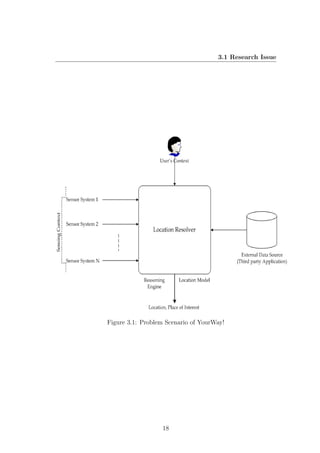
3.1 Problem Scenario of YourWay! . . . . . . . . . . . . . . . . . . . 18
4.1 Location Technologies Range of Coverage (1) . . . . . . . . . . . . 26
4.2 Positioning Methods, accuracy and Application (38) . . . . . . . . 27
4.3 Snapshot of the Place . . . . . . . . . . . . . . . . . . . . . . . . . 32
5.1 YourWay! Architecture Overview . . . . . . . . . . . . . . . . . . 38
5.2 Location Model . . . . . . . . . . . . . . . . . . . . . . . . . . . . 45
5.3 Database Scheme . . . . . . . . . . . . . . . . . . . . . . . . . . . 47
6.1 Case-Indoor . . . . . . . . . . . . . . . . . . . . . . . . . . . . . . 52
6.2 Entrance Position of Ground Floor . . . . . . . . . . . . . . . . . 53
6.3 Middle Position of Ground Floor . . . . . . . . . . . . . . . . . . 53
6.4 Screenshots one of Second Floor . . . . . . . . . . . . . . . . . . . 54
6.5 Screenshots two of Second Floor . . . . . . . . . . . . . . . . . . . 55
6.6 Screenshots of Third and Fourth Floor . . . . . . . . . . . . . . . 55
6.7 Outdoor Environment:University and FBK . . . . . . . . . . . . . 56
6.8 Outdoor Environment:DownTown . . . . . . . . . . . . . . . . . . 58
viii
List of Tables
4.1 Handset or Network based Dependence . . . . . . . . . . . . . . . 25
4.2 Appropriate Positioning Methods for Mobile Location Services . . 34
4.3 Different Location Techniques with their associates cost . . . . . . 35
4.4 Different Tools with their Location Techniques and Application
Domain . . . . . . . . . . . . . . . . . . . . . . . . . . . . . . . . 36
ix
Chapter 1
Introduction
What we can see, hear in heterogeneous environment mobile services application
make easier to let us explore, facilitated by advances in wider deployment of
communications technology, battery technology, and portable device. This paves
the way to interact mobile user and computing devices in different locations
and situation. A new approach has emerged the termed ”Context-aware” in the
mobile services application.
1.1 Motivation
Location can determine the users’ information needs and their service choices
at the right situation. This has lead to emergence of mobile services applica-
tion, the context-awareness. Due to the rapid evolution of wireless mobile net-
work, context-aware mobile services become increasingly complex as localization
technologies and business innovation has been improved. In general, Context-
aware mobile application trends to provide symbolic location than absolute lo-
cation (12). Symbolic location is an abstract description of an object’s location,
which can refer to places, persons, or other objects (22). For example, ”at Office”
1
1.1 Motivation
or ”at Home” provides meaningful location information that could be cue for the
mobile services application.
Thinking about, Wireless LAN network outs there and pervasive whereas mo-
bile user are seamlessly connected. We can use it to collect contextual information
about the mobile assets. We can know where they are, which temperature are
there in, humidity, pressure, and even user are motion or not. That is the con-
textual information. As we know the contextual information and switchness1
, we
may put some intelligence to it then we can create a right application for mobile
user that can decide where they are and what’s the right place at the time. For
instance, end user using a calendar application and every time he is in meeting.
He can move it when he is in meeting. Sometimes he forgets to do it. Thinking
about it can be automated. As application knows the context and where he is,
it can tell that he is in meeting in a room. Somebody have meeting with him
in the next few hours, directly come to the place and talk with him. It can be
definitely easier for mobile user by knowing the contextual information via the
Wireless LAN.
In this thesis, we closely examine the integration and the processing of the
contextual information is difficult in the mobile setting environment due to its
inherent dynamism and unpredictability nature (9), (28). We also study the
different location-tracking techniques and location sharing tools, particularly IY-
OUIT2
and Google Latitude3
, analyze and understand how its work that could
be used to calculate the location of mobile object as part of the context-aware
solution. Working in this thesis gives me the opportunity to get in knowledge
1
Switchness is a computer networking device that connects network segments. available at
http://en.wikipedia.org/wiki/Network-Switch
2
http://www.iyouit.eu
3
www.google.com/latitude
2
1.2 Research Objective
and hands on experience of this topic.
1.2 Research Objective
From the motivation, we know that the irregularity dimensions of contextual in-
formation makes hard to estimate place are truly in physical space. Since the
contextual information could be imprecise coordinates from unconventional sen-
sor (Wi-Fi), user context, or location sharing tools and need to transform it to
make sensible location, it often causes mistakes. In practice, the symbolic infor-
mation is useful in developing a platform and map with other information (e.g.
user profile) could be helpful to localization. So, in this thesis, we have imple-
mented a localization platform that can track the user’s location and identify the
place of interest through the integration and the processing of different datasets
of the contextual information from distributed sources. This platform is called
YourWay!. We have also evaluated the platform regarding to users’ practical ex-
perience in the indoor and the outdoor environment. In this thesis, we will use
Wi-Fi location techniques and Google latitude application as alternative location
technology.
1.3 Outline of Thesis
The remainder of this thesis is organized as follows. The first two chapters of the
thesis provide background information on topics that are relevant to the thesis;
related works and the research problem are discussed in the subsequent chapters.
We begin in Chapter 2 by introducing the different location technologies and
location sharing tools for providing the location information to mobile devices.
We also discuss the previous related work. Chapter 3 describes the problem of
the thesis and consequently presents the methodology, justification, and area of
3
1.3 Outline of Thesis
application. Chapter 4 discusses the critical analysis of different location tech-
niques and location sharing tools in terms of various criteria. We also define the
system requirement based on our analysis. Chapter 5, we presents the overview
of the system architecture and describes each component of the architecture. We
also describe the technical part of the thesis. Chapter 6, we evaluate the system
regarding to the users’ experience in the two cases: indoor and outdoor and dis-
cuss the experiment results. Chapter 7, we summarize our work, contributions
and the future work about this thesis.
4
Chapter 2
Background and Related Works
This chapter presents a critical overview of location techniques, tools and previous
work pertinent to this thesis. Shortfalls in this work are collated in chapter 4
which then identifies a set of requirements for YourWay!
2.1 Location Technologies
We discuss some location technologies which are currently used to locate auto-
matically mobile objects such as mobile phone or laptop in indoor and outdoor
environment. Location technologies may be roughly classified between those that
work outdoors and those that work indoors. The first two categories support for
outdoor and the last one is for indoor positioning techniques (39).
2.1.1 Handset Based
Global Positioning System (GPS)1
developed by United States Department of De-
fense determines user’s current position in 3D - latitude, longitude, and altitude
with an accuracy of 5 meters using signals broadcast by satellites. It uses a tri-
1
http://en.wikipedia.org/wiki/GPS
5
2.1 Location Technologies
angulation method (measures an angles between the mobile object and reference
points) that is based on signals from 4 satellites out of a system of 24 satellites.
Assisted Global Positioning System (A-GPS) was developed by Bell Labs to
enhance the performance of a GPS satellite-based positioning system using an
assistance server or other data from a network (35). In certain conditions where
surrounded by tall buildings or signals are weakened, GPS has difficult to locate
position. Then A-GPS can improve positioning in terms of location accuracy,
success rate, time, and battery consumption.
Forward Link Trilateration (FLT) is a time based technique that the mobile
unit has precise timing and is receiving three or more base station signals. It
sends the time differences to a location processor to determine location through
triangulation. It needs synchronization among base stations. FLT is typically
used as a backup for non-FLT/A-GPS phones (35).
Enhanced Observed Time Difference (EOTD) is also a time based method,
whereby the handset measures the arrival time of signals transmitted from three
plus Base Transceiver Stations (BTS). This time measurement capability of EOTD
is a new function in the handset. The measurements returned are related to the
distance from each BTS to MS (Mobile Station) and the position of the MS is
estimated using triangulation. In MS based EOTD, the position function is in
the handset and the position is returned to serving mobile location center (38).
2.1.2 Cellular Network Based
Cell identity (Cell-ID) is the signature and identity of a BTS. In the Cell-ID
positioning method, the cell that the handset is connected to is the location
’measurement’ of the handset’s position. A Cell-ID approach assumes the mobile
6
2.1 Location Technologies
is at the serving cell’s antenna coordinates in an Omni-directional cell, or the
center point of a sector in a sector cell (38). The information is available in
the network and at the handset. The cell ID is then converted to a geographic
position using knowledge of the operator’s network. Sometime Cell-ID with Time
Advance (TA) represents the round trip delay between the mobile and the serving
BTS (35). TA is used in a TDMA-liked system to avoid overlapping of bursts
transmitted by multiple users. It is represented by 6 bit integer number.
Time of Arrival (TOA) calculates position using triangulation from at least
three base stations (39). As the receiver knows exact the time of transmission,
it is possible to calculate the distance from each base station by observing the
time taken to arrive. This implies that all transmitters and receivers are perfectly
synchronized (5).
Differential Time of Arrival (TDOA) resolved the synchronization problem
having in TOA by using several transmitters synchronized to a common time
base, and measuring time difference of arrival at the receiver (45).
Angle of Arrival (AOA)1
measures the angle of arrival of signals, coming from a
particular mobile subscriber, at the two base stations, and from this can calculate
the user’s position. So it requires minimum of two base stations with directional
antennae (31).
2.1.3 Radio Beacon Based
Infrared (IR) detects a person wearing a badge that periodically emits an ID in
a building (e.g. in the ceilings) (43). It uses proximity method (using signal
signatures or identity of neighboring base stations) for user location detection.
1
http://en.wikipedia.org/wiki/AOA
7
2.1 Location Technologies
It requires visual line of sight to function, and normally does not have very high
accuracy (known as resolution). Moreover, it cannot work when the device (e.g.
a PDA) is in a user’s pocket (39).
Ultrasound calculates position based on proximity when transmitters send sig-
nals to receiver. It also sends reference radio signals and using timing difference
between the ultrasound and radio signals to achieve very accuracy, even to the
point of determining the orientation of the target (27).
Target with transmitter emits a radio frequency containing some sort of ID
information and its location is determined either by proximity to a receiver, or
triangulation from received signal strengths to multiple receivers. It doesn’t re-
quire line of sight, but signal strengths depends upon the density of the objects
(e.g. furniture, people) in the building and so accuracy is limited (37). RF tags
known as RFIDs are being widely implemented for asset tracking in warehouses as
a replacement for bar coded tags, and so costs are such systems are dropping (39).
In general, WLAN (Wi-Fi) provide Ethernet connections and Internet access
through laptop equipped with wireless LAN cards. It emit radio frequency signals
from wireless router which can be used to determine precise location of any Wi-
Fi enable devices such laptops, PDA, smart phones or RFID tag where users
are being used (37). Such devices have ranges of roughly 50 meters that provides
some degree of location information. It can be improved by the dense deployment
of wireless routers (39). Today, 802.11 networks are used in public places and
hence later this may prove a low-cost method for Location based services.
Bluetooth is a low cost, radio frequency technology for very short range (10
meters) ad hoc networking to support what are called personal area networks
8
2.2 Location Sharing Tools
(PANs). It can be used to replace the cables connecting portable/fixed electron-
ics devices (e.g. between headphones and music player). It could be used for
proximity based location services when a Bluetooth enabled device comes within
range of a services point (41).
2.2 Location Sharing Tools
Location sharing tool is enhanced for developing a system that provides location
information as a third party application. The number and variety of location-
aware tools is growing rapidly. We have presented some tools that can be used
for developing the platform.
2.2.1 IYOUT
IYOUIT is a mobile application service to share personal experiences with others
while on the go on the web and on the mobile phone. It has been developed as
a prototype by DoCoMo Euro-Labs1
in Munich together with the Dutch Telem-
atica Instituut in a joint research project. It is currently non-profit and freely
available at no charge. The application is made for Nokia series-60 and designed
to seamlessly run 24/7 and use GSM Cell ID and GPS as position techniques.
It supports four target domains: Share (community-based context sharing),
Life (life support through context-aware guidance), Blog (enhanced contextual
blogging) and Play (playful experience of context-awareness in games). It is based
on its own framework of software components to host various services and data
sources (e.g. location information). Framework components, for instance, track
the positions of users via GPS and cellular information and identify places of in-
1
http://www.docomoeurolabs.de/
9
2.2 Location Sharing Tools
terest over time by learning form their past behavior, scanned Bluetooth/WLAN
beacons, local weather or observed products (8).
2.2.2 Google Latitude
Google Latitude is a location-aware mobile application developed by Google. It
allows a mobile phone user to allow certain other people on his or her Gmail
contact list to track where he or she is. These people can track the user (or more
accurately, his or her phone) on Google Maps via their own iGoogle1
accounts.
The user can control the accuracy and details of what each of the other users
can see - an exact location can be allowed, or it can be limited to identifying the
city only. For privacy, it can also be turned off by the user, or a location can
be manually entered. The user must enable the location features of the phone,
which are normally only transmitted to emergency telephone numbers such as
wireless E911.
It is compatible with Google Android, Windows Mobile or Symbian s60 and
compatible with iPhone and iPod touch devices. Google Latitude can use Wi-Fi
access points, Cell ID or GPS to work out user’s location.
2.2.3 Zonetag
ZoneTag2
is a rich tool that enables context-aware upload of photographs from
camera phones. It automatically supply location metadata for each photograph
and support media annotation via context-based tag suggestion. It is research
prototype release from yahoo research Berkeley.
1
Available at this site http://en.wikipedia.org/wiki/IGoogle
2
http://zonetag.research.yahoo.com
10
2.2 Location Sharing Tools
It is suitable for Nokia and Motorola Phones Use Bluetooth GPS (when avail-
able) and Cell ID (34). The two primary components of ZoneTag are the client ap-
plication, running on Nokia or Motorola, and the ZoneTag server, a PHP/MySQL
application providing location translation and suggested tags to the client as well
as processing uploaded images and metadata from the client and passing the
images and tags to Flickr1
.
2.2.4 Place Lab
Place lab2
developed by Intel Research Institute estimates devices (e.g. lap-
tops, PDA and cell phone) location by scanning for fixed radio beacons such
as nearby 802.11 access points and GSM (Global System for Mobile Communi-
cation) cell towers and referencing the beacon’s position cached in the mobile
devices databases. PlaceLab can provide user location with upto 15 meters of
accuracy (3).
PlaceLab is a very practical, high-coverage and low-cost location determination
system in that no additional hardware is required. However, presence of beacons,
corresponding receivers and beacon database is assumed. Place Lab addresses
both the lack of ubiquity and the high-cost of entry of existing approaches to
location. It focus on maximizing coverage as measured by the percent of time
location fixes are available in people’s daily lives and providing a low barrier to
entry for users and developers.
1
http://www.flickr.com/
2
http://www.placelab.org/
11
2.3 Related works
2.3 Related works
Previous applications have used predefined context and/or locations. The thesis
paper is related to the following research direction:
In general, Peoples are working on the fixed network computer terminals in
the environment such as office, university campus or home environment. By
monitoring access to those terminals, location data can be gathered cheaply,
non-intrusively, and reliably. The ruser service offered by Unix systems can be
used to build an effective location tracking system (40). The advantage is that
no additional hardware is required but this approach is suitable for that environ-
ment where people are regularly accessed in fixed and networked computers (17).
In contrast, most common system for outdoor environment is the Global Posi-
tioning System (GPS). The advantage of GPS is that it is a globally available
location system that can be easily adapted for use in a variety of contexts. But
GPS transmissions are blocked by buildings where its satellite signals are not
visible (20). Therefore it cannot be used indoors or other places where people
spend their time.
The Olivetti Active Badge system (43) is IR based location system. In this
system, it detects person who wears a small infrared badge which emits a unique
id every 10 second or on demand and Central server collects data from fixed
infrared sensors around the building, stores this information, aggregates it, and
provides an API for using the data. It was used in several applications, for
example aiding a telephone receptionist by dynamically updating the telephone
extension a user was closest to (20). Augment-able reality (29) allows users
to dynamically attach newly created digital information such as voice notes or
photographs to the physical environment, through wearable computers as well as
12
2.3 Related works
normal computers. Attached data is stored with contextual tags such as location
IDs and object IDs that are obtained by wearable sensors, so the same or other
wearable users can notice them when they come to the same context.
Audio Aura provides serendipitous information through auditory cues based on
people’s physical actions in the workplace. It uses predefined locations and de-
signed for users to find each other or objects in the environment (19). AROMA (24)
provides remote awareness of colleagues through the use of abstract information
that people able to maintain about other beings who are located physically close.
Features were abstracted from audio and video signals captured in colleagues’
space. The features were delivered to the other colleagues and rendered in a
variety of ways, to investigate whether abstract representations of captured data
conveys a sense of remote presence. Its object-oriented architecture used cap-
ture objects to encapsulate sensors and abstractor objects to extract features.
The Forget-Me-Not (16) was a wearable memory aid device that constantly logs
physical context to retrieve information based on the user’s personal history, for
example finding a lost documents, remembering somebody’s name, recalling how
to operate a piece of machinery and stored this information in a database. The
Remembrance Agent is a proactive memory aid that uses the physical context of
a wearable computer to provide notes that might be relevant in that context, for
example class notes when entering a specific classroom (30). These applications
remind the user of past events associated with a location.
ComMotion is a location aware environment that has predefined content as-
sociated to locations, however its main feature is user-defined content and the
possibility to subscribe to Web content based on location. Using satellite-based
GPS position sensing, comMotion gradually learns about the locations in its
user’s daily life based on travel patterns (18). The paper approach a system to
13
2.3 Related works
extracting meaningful places is proposed by Ashbrook and Starner (6). Sets of
important coordinates are determined as those at which the GPS signal reap-
pears after an absence of 10 minutes or longer. These sets are then clustered
into ”significant locations” (i.e. places) using a variant of the k-means clustering
algorithm. Patterson et. al. (23) use real-world knowledge of bus schedules and
stop locations, along with acceleration and turning speed to infer mobile places
(e.g. bus, car), as well as the location of parking lots and bus stops where users
change mode of transportation. The approach by Laasonen, et al. (15) used the
cell towers of a GSM phone network to learn important places in a user’s daily
routine. Their approach allows place extraction over a wide area using existing
infrastructure (the cellular network) and does not require knowledge of network
topology or even the locations of the cell towers. But the accuracy of the derived
place is very coarse. Nurmi and Koolwaaij et al.(22) have proposed different
methods for inferring so-called places from GSM data that is enriched with GPS
coordinates whenever a GPS device is available for large scale environment. They
have addressed that the labeling has been done in an ad hoc fashion and poor
performence particularly in dense area due to cluster size and meaningfulness of
the clusters.
Due to rapid deployment WLAN infrastructure, a Wi-Fi localization technique
becomes popular. The paper (14) use background knowledge about the physical
location of WLAN access points and the MAC1
addresses of the access points
to identify significant places. In contrast, Place Lab provides accuracy ranging
between 15 and 60 meters and high coverage (3). Similar approaches are using
1
MAC address is a unique identifier assigned to most network adapters. available at
http://en.wikipedia.org/wiki/MAC/
14
2.3 Related works
in Microsoft’s Virtual Earth1
and SkyHook2
Wireless. Unfortunately, high power
consumption and lack of user context make to not used frequently ”on the go”
for location techniques.
1
http://virtualearth.msn.com
2
http://www.skyhookwireless.com
15
Chapter 3
Research Problem
3.1 Research Issue
With the rapid evolution of wireless mobile network and context-aware mobile
applications, contextual information such as coordinate or landmark are some-
times meaningless to the end user or the mobile service provider (14). Since it
does not carry any additional information relate to the end user. In turn, location
is the most commonly used forms of the contextual information (9), (28) that is
easy to collect via WLAN whereas other pieces of contextual information may
be inferred from location such as ”my place of work” or ”my birth place”. In
practice, it is hard to gather and process (22).
The term Context has been define by Schmidt et al as ”Knowledge about the
user’s and IT device’s state, including surroundings, situation, and to a less ex-
tent, location” (33). Opposite of this, Dey et al define Context as ”any infor-
mation that can be used to characterize the situation of an entity. An entity is
a person, place, or object that is considered relevant to the interaction between
a user and an application, including the user and applications themselves; this
16
3.1 Research Issue
definition may be specialized for location as a subset of context” (4). According
to Schilit (32), the term Context can be network connectivity, network resources,
location, time, temperature, and even current social situation. To be addressed
the problem, we have divided the current Context into sensing context and user’s
context (9). The sensing context deals only the location related information using
existing positioning techniques such as GPS, Cell Tower, and Wi-Fi through the
mobile phone, PDA, or Laptop. In contrast, the user’s context specifies only users
surrounding properties (e.g. user profile, location, place of interest). Both of con-
text domains have not sufficient separately for resolution the research problem
due to different granularity information (see the figure 3.1) (28).
GPS or A-GPS gives accurate location information but its representation in ge-
ometric coordinate such as (60◦
N, 24◦
E). This numeric representation is difficult
to understand for the end user. It plays a role as the key element for navigation
services. GSM cell tower on the other hand covers several meters. Within this
coverage area, it identifies relative proximity one or more mobile objects. In gen-
eral, it provides better location information in the urban and /or the sub-urban
than in the rural environment (22). In contrast, Wi-Fi, Bluetooth, RFID or IR
provides approximately accurate location information within the few meters of
coverage area, particularly in the indoor environment. But these location tech-
niques provide symbolic coordinate which do not provide reasoning about spatial
property (distance, inclusion) without any additional information (7). The term
inclusion leads to range query or nearest neighbor query for example, find a
nearest restaurants. It is clear that they provide only location without relation
to other locations in a certain range (25). On the other hand, cellular based
location techniques such as TDOA, AOA, EOTD, and TOA depend on signal
strength, time, and antenna dimension that make difficult to calculated user po-
17
3.1 Research Issue
Figure 3.1: Problem Scenario of YourWay!
18
3.1 Research Issue
sition and expensive. However, a major hardware investment is needed to support
these location techniques (5). Due to limitation of technologies, a hybridization
technique that may be GPS and Cell-ID, or GPS and Wi-Fi improves accuracy
in the indoor and the outdoor but still problem existing there. We have observed
that these technologies are closely related to location awareness but apart from
context awareness approach.
Places can be roughly defined as a combination of a physical location, mean-
ings and activities that relate to the physical location (21). For example, home,
office and university are places whereas some street 42, (60.43, 42.38) or 4286 are
not (22). It can be used to support awareness by providing cues about the user’s
generic situation in context-awareness domain (28). For example, Tom is a neu-
rologist in Santa Chiara Hospital. He is visiting frequently in hospital, chamber,
home or other places. Tom wants to make personalize his activities among these
places. For example, sometimes he forgets to switch off the mobile phone when
he is being in Operation Theater. He can do it manually but sometimes it will
make extra burden in daily activities. Knowing that he has point of interested
place, the application has to filter the results by receiving different source of lo-
cation information from current environment that gives the current location of
user and services such as automatically switch off the mobile phone. However the
information ”point of interested place” is a user’s context parameter.
We have observed some issues in this thesis. Firstly, the seamless provision
of sensing context and user’s context data may generate a sensible location to
end user over the situation (8), (9). Since the provision is very difficult in the
context-aware domain. We feel deeply the importance to build the platform in
novel (hopefully better ways) for satisfying the thesis goal over the existing tools
and technology. Secondly, user’s context such her location, the people and objects
19
3.2 Methodology
around her is more dynamic and no common, standard way to handle it (4).
Thirdly, the location information from sensing context has different source, data
format and difficult to use for further process (22).
3.2 Methodology
We propose a solution to solve the problem scenario (see the figure 3.1) in an
innovative way. The idea is that we have developed a platform on the top of the
third party application, Google latitude application, wireless LANs (Wi-Fi) and
context-aware technology. Google latitude provides location information (only
city level) with a generic accuracy in KML1
or JSON2
format that can be feed to
our system. These file format are geographic data structure containing latitude
and longitude coordinate of location information. Google latitude provides higher
privacy of user location. User has full control to manipulate his/her location from
igoogle or google latitude application using public location badge.
Wi-Fi is a popular wireless LAN technology that is widely deployed such as
offices, public areas, and home environments. Wi-Fi networks are beginning to
provide location based information and services. In practice, a Wi-Fi access point
has coverage of only ten meter (26). The main advantage is that it is very cheap
and easily deployed in the environment. Wi-Fi access points are broadcasting
beacon after a certain interval which contains its unique identifier, signal strength
and others information. Therefore, knowing to which access point an end user
is connected already pinpoints the location fairly accurately. As the location of
1
Keyhole Markup Language is an XML-based language. Available at this site
http://en.wikipedia.org/wiki/KML
2
JavaScript Object Notation is a computer data interchange format. Available at this site
http://en.wikipedia.org/wiki/JSON
20
3.2 Methodology
this access point has to be known, we can easily implement this by maintaining
a simple database (3), (44).
We have build up a hierarchical location model containing the information
of physical location, user profile, and Wi-Fi access points. Since the learning of
end user location is incremental, platform need to dynamically capture, store, and
labeled the location. Platform provides the location query upon receiving request
from client. This implies that a core component of the platform named Location
Resolver mapping and reasoning among the contextual information. There are
two main fold: one is context aggregation and other is context reasoning. The
whole process can be divided into two phases named Training and Localization
phase respectively.
• Training Phase: mobile device listen to beacon from sensor system i where
i=1.....N. It records list of access points in each scan. Location Manager
then automitically collects list of access point through mobile devices and
store in local storage. Location Manager also builds the location model by
tracing Wi-Fi access points. In this stage, user explicitly set contexts e.g.
place of interest, physical location information when system detects new
access point.
• Localization Phase: User connects to latitude server using userid via mobile
mobile phone, or Laptop. Then GPS coordinate from Latitude server and
Wi-Fi access point information from mobile are transmitting to the Location
manager. It updates all recorded in internal data structure, to be resolved
into an actual address record and applies reasoning to identify place of user,
such as home, office etc. It select lowest coverage area of access point.
21
3.3 Justification and Area of Application
Various applications that focus on automatically data gathering and context rea-
soning have been proposed. One of the example, the Place Lab uses a radio
beacon (GSM Cell Tower and Wi-Fi) based approach to identify the user. It de-
signs a toolkit for gathering various locations information but does not support
for associating semantics with location information (36). IYOUIT aggregates
low level data from sensors (GPS and Cell ID) and consequently being mapped
to qualitative concept (e.g. Home, Office) using semantic web technology in
the form of Web Ontology Language1
(OWL). But this technology provides im-
plicit knowledge of location and sometimes can not handle large amount of data
efficiently (8). In context toolkit, there is no reasoning engine and any imple-
mentation of intelligence. It uses attribute-value pair that has not any semantic
meaning if not used additional programming logic (13). Li et al. Pervasive’06:
Association of semantics to individual GSM cells but the Size of GSM cells varies
that gives poor granularity. Active badge system (42) is a first context-awareness
application using IR enabled badge for aiding telephone receptionist that shows
a table of names alongside a dynamically display of locations and telephone ex-
tensions. Staff wearing badges can have telephone calls directed to their current
location. The system did not take context into account like where they are.
Our system can also be applied in indoor and outdoor environment. It would
allow end user to enter context-specific information regarding place, point of in-
terest, or event etc. End users could discover location-specific information about
developments in their constantly changing the environment. In the case of busi-
ness, our system will provide an easy way to exact location information that
1
OWL is knowledge representation language. available at http://www.w3.org/TR/owl-
features/
22
3.3 Justification and Area of Application
could be offered right mobile services at the right time over the Wireless LANs
infrastructure.
23
Chapter 4
Analysis and Requirement
This chapter analysis the existing approaches and techniques presented in chapter
2 with respect to some criteria. Following this, a set of requirements for YourWay!
are identified.
4.1 Review and Analysis of Background Tech-
nology
4.1.1 Localization techniques
For identifying the best approach for localization, we have analyzed and com-
pared different techniques with regard to accuracy, coverage area, service, and
infrastructure cost etc in this section.
4.1.1.1 Handset vs Network
Of the techniques, some are implemented solely on the network side, and some
can work on the handset independently of the network (e.g. GPS, Wi-Fi). Both of
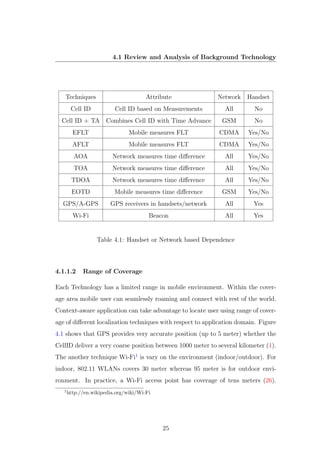
these approaches carry some attributes to locate a position (see the table 4.1) (5).
24
4.1 Review and Analysis of Background Technology
Techniques Attribute Network Handset
Cell ID Cell ID based on Measurements All No
Cell ID + TA Combines Cell ID with Time Advance GSM No
EFLT Mobile measures FLT CDMA Yes/No
AFLT Mobile measures FLT CDMA Yes/No
AOA Network measures time difference All Yes/No
TOA Network measures time difference All Yes/No
TDOA Network measures time difference All Yes/No
EOTD Mobile measures time difference GSM Yes/No
GPS/A-GPS GPS receivers in handsets/network All Yes
Wi-Fi Beacon All Yes
Table 4.1: Handset or Network based Dependence
4.1.1.2 Range of Coverage
Each Technology has a limited range in mobile environment. Within the cover-
age area mobile user can seamlessly roaming and connect with rest of the world.
Context-aware application can take advantage to locate user using range of cover-
age of different localization techniques with respect to application domain. Figure
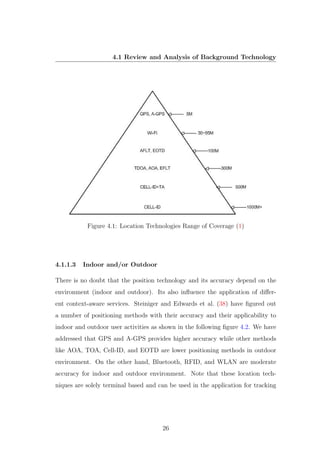
4.1 shows that GPS provides very accurate position (up to 5 meter) whether the
CellID deliver a very coarse position between 1000 meter to several kilometer (1).
The another technique Wi-Fi1
is vary on the environment (indoor/outdoor). For
indoor, 802.11 WLANs covers 30 meter whereas 95 meter is for outdoor envi-
ronment. In practice, a Wi-Fi access point has coverage of tens meters (26).
1
http://en.wikipedia.org/wiki/Wi-Fi
25
4.1 Review and Analysis of Background Technology
Figure 4.1: Location Technologies Range of Coverage (1)
4.1.1.3 Indoor and/or Outdoor
There is no doubt that the position technology and its accuracy depend on the
environment (indoor and outdoor). Its also influence the application of differ-
ent context-aware services. Steiniger and Edwards et al. (38) have figured out
a number of positioning methods with their accuracy and their applicability to
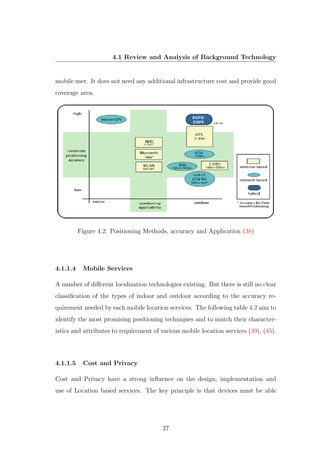
indoor and outdoor user activities as shown in the following figure 4.2. We have
addressed that GPS and A-GPS provides higher accuracy while other methods
like AOA, TOA, Cell-ID, and EOTD are lower positioning methods in outdoor
environment. On the other hand, Bluetooth, RFID, and WLAN are moderate
accuracy for indoor and outdoor environment. Note that these location tech-
niques are solely terminal based and can be used in the application for tracking
26
4.1 Review and Analysis of Background Technology
mobile user. It does not need any additional infrastructure cost and provide good
coverage area.
Figure 4.2: Positioning Methods, accuracy and Application (38)
4.1.1.4 Mobile Services
A number of different localization technologies existing. But there is still no clear
classification of the types of indoor and outdoor according to the accuracy re-
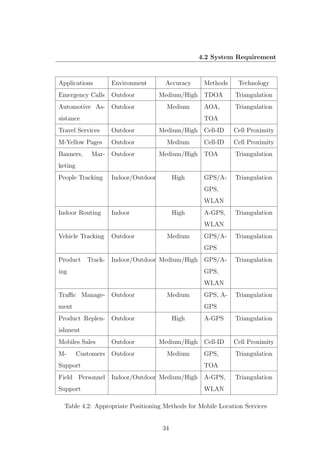
quirement needed by each mobile location services. The following table 4.2 aim to
identify the most promising positioning techniques and to match their character-
istics and attributes to requirement of various mobile location services (39), (45).
4.1.1.5 Cost and Privacy
Cost and Privacy have a strong influence on the design, implementation and
use of Location based services. The key principle is that devices must be able
27
4.1 Review and Analysis of Background Technology
to position themselves based on monitoring of the environment at low cost and
gives the user control over when their location is disclosed, sharing information,
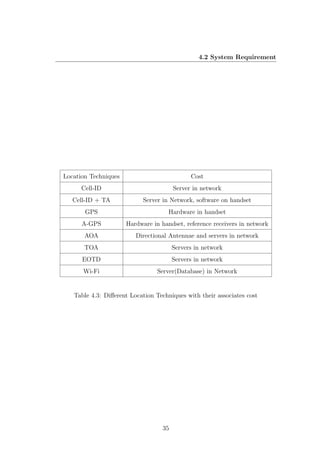
etc. In the following Table 4.3, it is clear that some higher accuracy techniques
requires more modification in both hardware and software components of the
handset and the network (e.g. AOA and TDOA). A-GPS, on the other hand,
requires moderate modifications: the introduction of a GPS reference receiver in
the BTS is required (5).
In contrast, Wi-Fi is very cheap and easy to deploy and pervasive. By knowing
the location of connected access point, system can easily identify user’s location
accurately. The location of this access point has to be known and one way
of implementing this is to maintain a simple database (typically per hotspot
provider) containing the location of every access point (44). With this setting,
we can easily hide the data from intruder using user’s authentication.
4.1.1.6 Critical Thinking
Cell ID method is already in use today and can be supported by all mobile hand-
sets. But the accuracy is generally low in the range of 200 meters. Specially it is
much lower in the rural environment. Signal Strength method is better than Cell
ID but multi path fading and shadowing have a dominant effect in indoor and
outdoor environment (39). Time based method like TOA, TDOA, AOA provides
accurate position information than Cell ID and Signal Strength but a disadvan-
tage is the need for a precise clock in the mobile device for synchronization (45).
GPS technology has the main advantage that it is already in use. But in order
to operate properly, GPS receivers need a clear view of the skies and signals from
at least three or four (depending on the type of information) satellites. GPS
can not detect inside building, heavy label glass and metals. For this to make
28
4.1 Review and Analysis of Background Technology
available within building can only be achieved with correction technology as in
A-GPS under great expenses (45). Infrared-based systems like Active-Badge (43)
are frequently for indoor system, but suffer from short range transmitters and
the huge amount of additional hardware. Ultrasonic waves are another estab-
lished and mature positioning technology used in systems like Cricket (27). They
also need a lot of additional hardware and have a tolerable accuracy. RF and
Bluetooth is the promising technology for indoor in terms of low cost but poor
scalability.
Wi-Fi (IEEE 802.11) access points can be deployed in offices, public area and
home environment etc. Unlike GPS, applications that use wireless APs as bea-
cons work in both indoors and outdoors. AS most laptops, tablet PCs, mobile
phones and personal digital assistants (PDAs) include built-in wireless devices
there is no additional cost or equipment required. No GPS receivers are needed
to use this application (10). Wi-Fi positioning techniques address these facilities
and consider the issue where maximum time peoples are available in his daily
lives. This technique allows user to locate them by listening radio beacon, look-
ing up the associated beacons’ positions in a locally cached, and estimating their
own position referenced to the beacon’s positions in the heterogeneous environ-
ment. These beacons all have unique or semi-unique IDs, for example, a MAC
address (3).
4.1.2 Location Sharing Tools
Tools are underlying different position methods to host various services and data
sources. For example, IYOUIT attempts to deduce the current city and street
using GSM Cell or GPS latitude-longitude information and then providing avail-
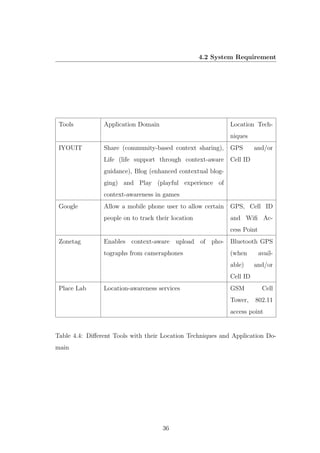
able services in mobile environment. From the following Table 4.4, it is clear that
29
4.1 Review and Analysis of Background Technology
some tools require that the phone, PDA and laptop are GPS enabled. But the
convenience of Google Latitude is that phone, PDA or laptop does not need GPS,
and it will work on almost any mobile phone as well as laptop using igoogle via
internet. The other location technologies like Cell-ID, Wi-Fi or Bluetooth are
available in almost all mobile phone and laptop.
The key point is that developers can build their application for tracking user
current location on the top of existing tools like IYOUIT, Zonetag, Google Lati-
tude etc. For example, IYOUIT allows developers to write their own applications
which integrate with the different context providers and other components in the
Context Management Framework (CMF)1
. But developers need provide a solid
concept of their application to DOCOMO Euro-Labs for getting service. Google
Latitude on the other hand provides user’s city level location information using
public location badge2
by registering into Google latitude with gmail ID without
any cost. Using Google latitude with application, Developers uses the KML or
JSON data file provided by Google latitude for showing geographic features like
points, lines, coordinates, and images. This file format provides ability to specify
images and labels to identify locations as well as to dynamically get such location
information from the remote or local network locations at certain intervals. Zone-
tag also provides location metadata for each photograph (34). Location metadata
carries current location information where user taken a photo. Developers can
take advantage to build their application with location metadata. Place Lab pro-
vides API to allow developer use in their application without constant interaction
with a central service (unlike badge tracking) (2).
1
https://www.iyouit.eu/portal/Developer.aspx
2
http://www.google.com/latitude/apps/badge
30
4.1 Review and Analysis of Background Technology
As earlier noted in the previous section, privacy is very important to end user.
Many researcher pay attention to social identity and try to link social identity with
user profile, particularly place, comments or image(22). With this inspiration,
we have observed that most of peoples are using gmail account in his daily life’s
and sharing personal or commercial information using this identity. Another
observation is that Google latitude provides a userid after creating public location
badge using gmail account which is unique. Our contribution is that we are trying
to link semantic places with gmail account or userid to represent a meaningful
location to user. The other tools like IYOUT, or Zonetag have not such facility
where user has to create another identity. Sometimes it could be burden to user
daily activities.
4.1.3 Point of Interested
In general, point of interested refers to a geographical place where user spends a
substantial amount of time and/or visits frequently. It could be important to an
individual user and mobile service provider where a set of user share information
about physical position and personal preference. For example, a cell phone could
switch to a silent mode when end user enters a place where a ringer is inappro-
priate such as a movie theater, a lecture hall, a place for personal reflection. In
practice, point of interest is a community based where its group member only can
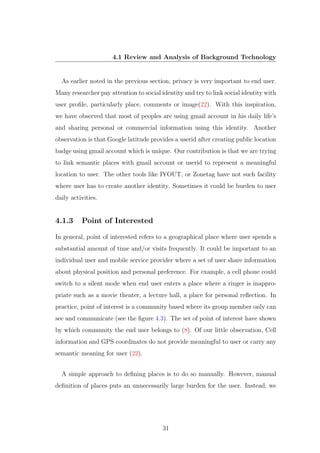
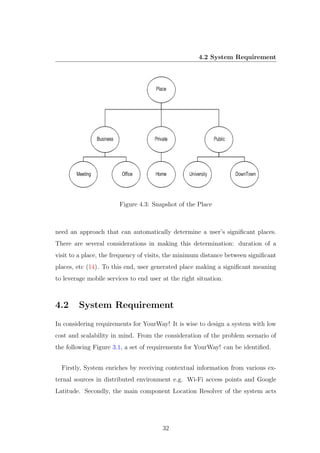
see and communicate (see the figure 4.3). The set of point of interest have shown
by which community the end user belongs to (8). Of our little observation, Cell
information and GPS coordinates do not provide meaningful to user or carry any
semantic meaning for user (22).
A simple approach to defining places is to do so manually. However, manual
definition of places puts an unnecessarily large burden for the user. Instead, we
31
4.2 System Requirement
Figure 4.3: Snapshot of the Place
need an approach that can automatically determine a user’s significant places.
There are several considerations in making this determination: duration of a
visit to a place, the frequency of visits, the minimum distance between significant
places, etc (14). To this end, user generated place making a significant meaning
to leverage mobile services to end user at the right situation.
4.2 System Requirement
In considering requirements for YourWay! It is wise to design a system with low
cost and scalability in mind. From the consideration of the problem scenario of
the following Figure 3.1, a set of requirements for YourWay! can be identified.
Firstly, System enriches by receiving contextual information from various ex-
ternal sources in distributed environment e.g. Wi-Fi access points and Google
Latitude. Secondly, the main component Location Resolver of the system acts
32
4.2 System Requirement
as repository for all contextual information such current contextual information,
particularly Wi-Fi and user generated context such as place of interested. For
resolving this it can use a large database. Thirdly, Location manager needs a
model which allows the representation of physical object themselves and their
relative orientations. To gain full advantage of model, higher level management
is required to enable the execution of spatial based queries. Fourthly, Location
manager exchange location information with authorized user. For now, only the
individual users are authorized to request location information.
33
4.2 System Requirement
Applications Environment Accuracy Methods Technology
Emergency Calls Outdoor Medium/High TDOA Triangulation
Automotive As-
sistance
Outdoor Medium AOA,
TOA
Triangulation
Travel Services Outdoor Medium/High Cell-ID Cell Proximity
M-Yellow Pages Outdoor Medium Cell-ID Cell Proximity
Banners, Mar-
keting
Outdoor Medium/High TOA Triangulation
People Tracking Indoor/Outdoor High GPS/A-
GPS,
WLAN
Triangulation
Indoor Routing Indoor High A-GPS,
WLAN
Triangulation
Vehicle Tracking Outdoor Medium GPS/A-
GPS
Triangulation
Product Track-
ing
Indoor/Outdoor Medium/High GPS/A-
GPS,
WLAN
Triangulation
Traffic Manage-
ment
Outdoor Medium GPS, A-
GPS
Triangulation
Product Replen-
ishment
Outdoor High A-GPS Triangulation
Mobiles Sales Outdoor Medium/High Cell-ID Cell Proximity
M- Customers
Support
Outdoor Medium GPS,
TOA
Triangulation
Field Personnel
Support
Indoor/Outdoor Medium/High A-GPS,
WLAN
Triangulation
Table 4.2: Appropriate Positioning Methods for Mobile Location Services
34
4.2 System Requirement
Location Techniques Cost
Cell-ID Server in network
Cell-ID + TA Server in Network, software on handset
GPS Hardware in handset
A-GPS Hardware in handset, reference receivers in network
AOA Directional Antennae and servers in network
TOA Servers in network
EOTD Servers in network
Wi-Fi Server(Database) in Network
Table 4.3: Different Location Techniques with their associates cost
35
4.2 System Requirement
Tools Application Domain Location Tech-
niques
IYOUIT Share (community-based context sharing),
Life (life support through context-aware
guidance), Blog (enhanced contextual blog-
ging) and Play (playful experience of
context-awareness in games
GPS and/or
Cell ID
Google Allow a mobile phone user to allow certain
people on to track their location
GPS, Cell ID
and Wifi Ac-
cess Point
Zonetag Enables context-aware upload of pho-
tographs from cameraphones
Bluetooth GPS
(when avail-
able) and/or
Cell ID
Place Lab Location-awareness services GSM Cell
Tower, 802.11
access point
Table 4.4: Different Tools with their Location Techniques and Application Do-
main
36
Chapter 5
System Architecture and
Implementation
This section outlines the overall architecture and gives some technical details and
implementation of the system.
5.1 System Architecture
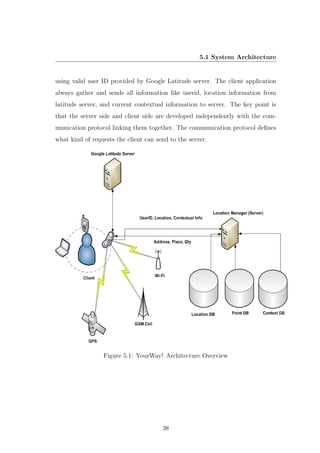
The System architecture consists of three key elements: a mobile phone client,
Google Latitude server and a server system (see Figure 5.1). In general, it is a
client-server architecture where a client communicates with the server and the
server manages a mapping between the location information and the client gen-
erated place of interest. As can be seen on the following figure 5.1, the server
side consists of three major databases, communication interfaces to the mobile
phone and external sources like Google Latitude Server. The Google Latitude
server is provided by external third party named Google Incorporation. In the
client side, a client application are always monitoring by various sensor system
like GSM Cell-ID, Wi-Fi access point or GPS. Client needs to login into server
37
5.1 System Architecture
using valid user ID provided by Google Latitude server. The client application
always gather and sends all information like userid, location information from
latitude server, and current contextual information to server. The key point is
that the server side and client side are developed independently with the com-
munication protocol linking them together. The communication protocol defines
what kind of requests the client can send to the server.
Figure 5.1: YourWay! Architecture Overview
38
5.1 System Architecture
5.1.1 Client
The client application is running on a mobile phone, laptop and any other mo-
bile device. The communication between server and client is made over HTTP1
.
To make the client both extensible and portable, the client functionality is bro-
ken into three parts: scanning 802.11 access points, communication with Google
Latitude server, and communication with system server.
Firstly, Client application reads and collects the transmission of wireless net-
working resources periodically such as 802.11 access points (AP) and/or Cell
information in mobile environment. We generally called this beacon which holds
all information about AP such as SSID2
, MAC address, signal strength, coverage
area etc. MAC address can distinguish desired AP from others AP. As we will
see in the chapter 6, the coverage area and accuracy is depend on the number of
AP in the range of client application. For now, client applications are handling
only AP information as it is widely deployed in places where people spent their
majority time in his daily lives. Client application secondly collects user’s loca-
tion information from latitude server. In this case, mobile user needs to connect
seamlessly with latitude server using userid provided by google latitude. Using
google public location badge, the user can create his/her userid and share only
his/her city level information.
Client application finally transfers user’s city level location information from
latitude server, userid, and list of access points to server and request for current
location. But when client application find new AP after receiving acknowledge-
ment from system server, then user must fills form to upload information like
1
HTTP is an application-level protocol. available at http://en.wikipedia.org/wiki/HTTP/
2
SSID is a name that identifies a particular 802.11 wireless LAN. available at
http://en.wikipedia.org/wiki/SSID/
39
5.1 System Architecture
country, region, city, district/area, street address, house number, floor number
and place of interest precisely. This implies that the information of the new AP
is not available in local storage of the system server.
5.1.2 Server
The System Server is running on a single machine. It is platform independent. It
consists of three databases, location manager, and web server. Location manager
is the core component to resolve the given location estimation into actual address
records. There are two ways to access the server, either from a handset through
GPRS1
-socket connection or from a web-browser through HTTP-connection.
The main task of server is maintaining the association and mapping between
current location information (Wi-Fi and Latitude server) and user defined se-
mantic e.g. place, comments, image etc to satisfy the system goal. For the
resolution, server uses two external databases named context DB and point DB.
In our architecture, context DB plays the important role of storing and serving
the beacon details information (e.g. Wi-Fi or Cell) provided by client devices
to location manager. This information always includes SSID, MAC, Range, and
signal strength, but may also contain other information like latitude, longitude,
the age of the data, etc. As MAC is unique identifier context DB is handling effi-
ciently large amount of data using indexing and supports faster query to server.
Point DB on the other hand, contains point of interested places (tag) with userid
of each client. Each tag is associated with the physical location records. The idea
is that establishing a spatial relationship2
between user and surroundings. Loca-
1
General packet radio service is packet oriented mobile data service available at
http://en.wikipedia.org/wiki/GPRS/
2
A spatial relation specifies how some object is located in space in relation to some reference
object
40
5.1 System Architecture
tion DB is a prerequisite for storing all physical locations of real environment. In
general, it follows a hierarchical approach where describes the interconnections
between neighboring locations. The major contribution of location DB is that
server is serving for transforming raw data from client devices into a representa-
tion meaningful current position to client. The Server is responsible for handling
requests from client application by HTTP connection. It has a connection to the
remote latitude server. The connection between the mobile phone and Server
is stateless and all actions like upload latitude information, upload contextual
information and return user’s current location at the server are based on each
individual request. The entire essential information is therefore store into the
internal class file that the server manipulates.
The system has two kinds of clients one is device with GPS and the other
ones without GPS. Devices with GPS can provide the server with an exact GPS
position. In this case, client directly talks to server. Server then provides a
semantic place using query with exact GPS location information from Location
DB and Point DB. . However this feature is not developed and not tested in
our system due to hardware problems. The second type of client does not have
a GPS device. This type mainly relies on the self-learning system that could be
atomically identifying the user position. The idea is that Wi-Fi and Latitude
information send to server by each client where it is available. Server then maps
each raw sensor data to abstract location.
5.1.3 Google Latitude
Google Latitude is a free application that can be integrated in our system frame-
work for improving accuracy. It is running as background process. The way
of communication between latitude server and client is made over HTTP. It is
41
5.1 System Architecture
clear that Latitude server seamlessly provides location information to server via
client application. In this case client must provide valid userid (gmail account) to
server from mobile devices or igoogle. User can set manually his/her location in
the case of failure diction of wireless networking resources e.g. Wi-Fi or Cell ID.
We do not specify here whether the latitude server is being installed, how server
maintains many client requests and how to it work.
Public location badge is an emerging feature of Google Latitude applications.
With public location badge, user can share his/her latitude location publicly on
a blogs or websites. The location could be only city level without accuracy or the
best available location with an appropriate accuracy provided either by manual
selection or by GPS, Wi-Fi, or cell ID (cell tower) detection. The latitude pro-
vides these locations in the two ways one is the badge’s standards embed HTML1
code and another is KML or JSON. Both of them can be feed to the applica-
tion according to requirement. Standard embed HTML code is used in websites
whether KML or JSON is being used to create a new application. In our system
framework, we are using JSON format that supports GeoJSON2
1.0 specication
for city level location information. It contains latitude and longitude, GeoJSON
properties include the user id, accuracyInMeters, timeStamp, reverseGeocode,
photoUrl, photWidth, photoHeight, placardUrl, placardWidth, placardHeight.
But the latitude and longitude will be the city center, and accuracy will be 0 for
only city level location. Taking advantages of such features, system server can
access at regular interval to latitude server to get the location of a mobile user in
the heterogeneous environment.
1
HyperText Markup Language is markup language for webpage. available at
http://en.wikipedia.org/wiki/HTML
2
GeoJSON is a geospatial data interchange format based on JavaScript Object Notation
(JSON). available at http://geojson.org/geojson-spec.html
42
5.2 Implementation
Google latitude provides higher level privacy to end user. User can control
his/her location using google public location badge. For stopping broadcast lo-
cation information, user can disenable the badge using google latitude websites.
Due to this kind of restriction, system server can not get location information
from latitude server. For resolving this problem, user needs to share at least city
level location information in latitude server.
5.1.4 Communication Protocol
Hypertext Transfer Protocol (HTTP) is an application layer protocol that is run-
ning on the top of TCP/IP1
. TCP/IP has responsible to interconnect between
computers and reliable data transfer. In general, its packet size is 4 byte. One
byte is for header which telling the purpose of the rest of the package and other
three bytes are carrying data and others information. As the very limited system
resources involved with mobile computing, the information must be as small as
possible considering the data transfer. The drawback of this protocol is over-
head. This implies that some of information may be lost or overlapping. This
can be compromised with future extensibility of the protocol depending on the
information.
5.2 Implementation
The Application is developed entirely in Java 2 Standard Edition using JDK
1.6.0.3. The development tool is Netbeans Integrated Development Environment
(IDE)2
6.5. Netbeans IDE is an open source platform that support of all Java
platforms (Java SE, Java EE, and Java ME) for developing mobile application.
1
available at http://en.wikipedia.org/wiki/TCPIP
2
http://netbeans.org/
43
5.2 Implementation
We are also using MySQL1
Server 5.0 as repository for storing and managing
location and contextual information respectively. Communication between the
main application and Database Server is achieved using The library file named
mysql-connector-java-5.0.5.jar. For querying data from repository we have used
Structure Query Language(SQL)2
.
5.2.1 Data Model and Management
The core component Location Resolver rely on Data that are coming from dis-
tributed resources e.g. latitude server, user’s context via mobile device, or local
storage etc (see figure 5.1). As we have pointed in chapter 3, they have different
dimensions that make to difficult for modeling and management. In this section,
we expose a Location Model using simple spatial database that has ability to
provide exact current location of user in heterogeneous environment by querying
via client application.
5.2.1.1 Description of Location Model
Location Model is a hierarchical model that represents geographical location and
meaningful semantic in a fashion of symbolic coordinates (7). It defines all rela-
tionships in form of spatial reasoning. This is the prerequisite for transforming
raw sensor readings into a meaningful location (e.g. Home, Office) to the appli-
cation (22). For example, the application determines whether a location is within
a given range of Wi-Fi access points or which locations are nearby. The location
model (see the figure 5.2) consists of elements, relationships, and attributes (11).
We are using locations as an element and places of interested as attribute. The
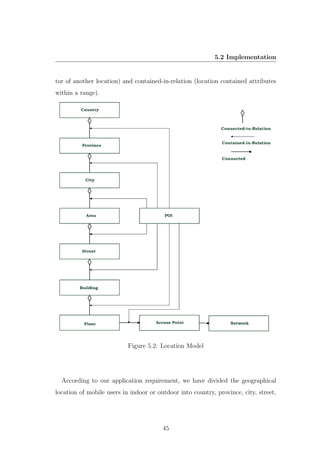
two important relationships are connected-in-relation (one location is an ances-
1
http://www.mysql.com/
2
SQL is database computer language. available at http://en.wikipedia.org/wiki/SQL
44
5.2 Implementation
tor of another location) and contained-in-relation (location contained attributes
within a range).
Figure 5.2: Location Model
According to our application requirement, we have divided the geographical
location of mobile users in indoor or outdoor into country, province, city, street,
45
5.2 Implementation
area, building, and floor explicitly. The top most element is country and the
lower element is floor. There are semantically connected each other by leveraging
a spatial relation of others element. Each location can be attached one or more
Wi-Fi access point whereas access points are associating with a network using the
connected symbol. For example (see the figure 5.2), Access point is connected
with floor, floor connected with building, building associate to street and so on to
form a geographical network. Each network represents specific community (e.g.
SOA Group, Create Net, UniTn) where people are staying his/her majority time.
Within the community, each places of interested are attaching with a specific
location. For instance, SOA group is situated in Via alla casata 56/c, povo,
Trento, Italy. The office is five storied building. Each person is accompanied in
each floor. Authority wants to track the location of each staff using tag like guest
room, conference room, 2nd floor or in a Office. We are trying to formulate the
current situation using location model such as the address divides into building,
street, area, city, province, and country (56/c, Via Alla Cascata, Povo, Trento,
Trentitno, Italy). Each pieces of information has a unique location identity and
associate identity of its ancestor (e.g. link ID). Again each user has own preference
place that must be linked to location identity. This implies that same location
can infer different semantic meaningful location for different user. For resolving,
we attach user identity with place of interest. To this end, Location ID, Link ID
and userid are key element in location model.
5.2.1.2 Data Management
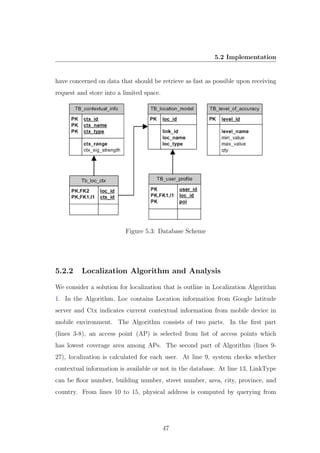
We have sketched a database scheme (see the figure 5.3) to handle efficiently
and easily large amount of data that are coming from heterogeneous resources
and support all operations e.g. location query. It has been implemented in
MySQL relational database system. During the designing of the scheme, we
46
5.2 Implementation
have concerned on data that should be retrieve as fast as possible upon receiving
request and store into a limited space.
Figure 5.3: Database Scheme
5.2.2 Localization Algorithm and Analysis
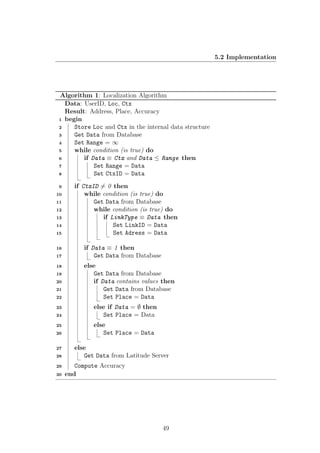
We consider a solution for localization that is outline in Localization Algorithm
1. In the Algorithm, Loc contains Location information from Google latitude
server and Ctx indicates current contextual information from mobile device in
mobile environment. The Algorithm consists of two parts. In the first part
(lines 3-8), an access point (AP) is selected from list of access points which
has lowest coverage area among APs. The second part of Algorithm (lines 9-
27), localization is calculated for each user. At line 9, system checks whether
contextual information is available or not in the database. At line 13, LinkType
can be floor number, building number, street number, area, city, province, and
country. From lines 10 to 15, physical address is computed by querying from
47
5.2 Implementation
database using LinkID. From lines 16 to 25, Place is calculated using LocID and
UserID from Database. At line 29, accuracy is measured using range variable
from database.
48
5.2 Implementation
Algorithm 1: Localization Algorithm
Data: UserID, Loc, Ctx
Result: Address, Place, Accuracy
begin1
Store Loc and Ctx in the internal data structure2
Get Data from Database3
Set Range = ∞4
while condition (is true) do5
if Data ≡ Ctx and Data ≤ Range then6
Set Range = Data7
Set CtxID = Data8
if CtxID = 0 then9
while condition (is true) do10
Get Data from Database11
while condition (is true) do12
if LinkType ≡ Data then13
Set LinkID = Data14
Set Adress = Data15
if Data ≡ 1 then16
Get Data from Database17
else18
Get Data from Database19
if Data contains values then20
Get Data from Database21
Set Place = Data22
else if Data = ∅ then23
Set Place = Data24
else25
Set Place = Data26
else27
Get Data from Latitude Server28
Compute Accuracy29
end30
49
Chapter 6
Empirical Evaluation and Result
In this section, we present our results from the empirical evaluation conducted
using the below two real world examples.
6.1 Experiment Setup and Data Collection
We experiment our system at different locations with three users who have userid
(gmail account) from google latitude server. Due to resource and technical lim-
itation, we were using only laptop for experiment purpose. Each of users were
carrying a laptop and moving around throughout portions of a typical day. At
the begging of the experiment, we set user current location manually (only city
level) using google latitude from igoogle. We assume that all users are currently
in Trento, Italy. In this case, Google Latitude always provides city level location
information (e.g. Trento) when users log in to our system. The coverage and
accuracy of our system depend on the number of WLAN access points in the
environment, making it to difficult to make absolute statements about the sys-
tem’s performance. However, we have sketch two scenario for indoor and outdoor
environment whereas three users may have place of interested over the physical
location.
50
6.2 Evaluation
We have used Intel based laptop running Windows Vista with Atheros AR5007EG
Wireless Network Adaptor during Data Collection. In order to capture trace data
of 802.11 Wi-Fi access points, we have used VistaStumbler1
and collected from di-
verse areas such as University Campus, Downtown, Student Hostel etc. For each
area, we drove around twenty minute with laptop. We have collected AP’s ES-
SID, BSSID, signal strength from VistaStumbler and recorded it in the database
respectively. In this case, we have defined the coverage area of each access point
(MAC address) of WLANs network. Consequently, we have made the hierarchical
location model based on the AP selection place and named the place indicates to
the system that it is importance for user. Currently, we have entered each record
of contextual and location information manually into the database.
6.2 Evaluation
6.2.1 Case-Indoor
The first experiments occur inside a five-story office building at 56/c via alla
cascata, povo, trento. It is a Service Oriented Applications Research Unit(SOA)2
.
The building is mainly constructed of brick that effectively blocks GPS signals.
We have found around fourteen WLANs (e.g GuestsFBK, Legolab, Unitn, CN-
Guest, Science-wifi etc) in the building. For our experiment, we have figured out
only four WLANs network such as GuestsFBK, Legolab, CN-Phone, and CN-
Guest. Each network may have several access points using in each floor of the
building (see the Figure 6.1) whereas each access point has coverage of hundred
meters. In contrast, Legolab has been used in SOA Group among four WLANs
network where two access points (00:1B:2A:64:79:90 and 00:1B:2A:64:79:80) have
coverage of fifty and thirty meters respectively. Each floor of the building have
1
A tool for Windows that facilitates detection of Wireless LANs. available at
http://vistastumbler.software.informer.com/
2
http://soa.fbk.eu/index.php
51
6.2 Evaluation
been covered by the first access point while second access point only available
from second to fourth floor. Three staffs may have place of interest in each floor
as shown in the figure 6.1. For example, first user has the labeled place with ”At
Desk” that indicates he is working in the second floor. Note that all users have a
common labeled place (e.g. SOA Group, FBK) but first floor (not part of SOA
Group) has not any point of interested.
Figure 6.1: Case-Indoor
First Observation: We assume that all users have logged in and send a re-
quest for the location query to our system. From the configuration according
to the figure 6.1, 6.2 and 6.3, we have completed location information in the
database. According to this, we have closely observed the outcome of three users
over the labeled places while they are constantly moving in the ground floor.
Within the range of first access point of Legolab (see the figure 6.3), first user
is in ”SOA Group, FBK”. It is pretty sure that he is in ”56/C via alla cascata”.
52
6.2 Evaluation
But the system can not specify his exact floor position and the place named(e.g.
”Coffee Room”). In contrast, second and third user is in the ground floor when
they are in out of range of first access point of Legolab (see the figure 6.2). In
this case, users can know the exact floor position of the building and their place
of interested. Semantically, they are not currently in the office desk.
Figure 6.2: Entrance Position of Ground Floor
Figure 6.3: Middle Position of Ground Floor
Second Observation: The most important place where three users spend
considerable time appears when users get in the coverage of thirty meters of
second access point of Legolab (see the figure 6.1). It is clear that all users are
53
6.2 Evaluation
in SOA Group. We have observed the user position which floor users have been
belongs. Since three users could be roaming irregularly from second to fourth
floor in the building.
Firstly, first user logged in to the system according to the configuration of the
figure 6.1 and 6.4. In this case, first user shows that the location is more close
to his point of interest (e.g. ”At Desk”). Since it is the exact floor position
the range of second access point of Legolab. Similarly, the third user discovers
his position in the third floor and the location named ”Office”. The outcome is
fulfilled according to the third user’s profile. On the other hand, the position of
the second user could be either in the third floor or fourth floor over the places
named. In this situation, he always gets the same output ”SOA Group, FBK”
from the system. The third user have not idea about his floor position in the
building.
Figure 6.4: Screenshots one of Second Floor
Secondly, three users have worst experience when the system has been config-
uration according to the figure 6.5. Since the client device detects the first access
point of Legolab which covered the each floor of the building and the location
of users is ”SOA Group, FBK”. It is clear that they are all in ”56/C via alla
54
6.2 Evaluation
Cascata” but users have not idea about the floor position. Thirdly, the same
place appear when three users are in the third floor or fourth floor (see the figure
6.6). Three users have the same experience as the previous one.
Figure 6.5: Screenshots two of Second Floor
Figure 6.6: Screenshots of Third and Fourth Floor
Summary of the Observation: Of the observations, we have seen that each
user has one or more choice of places within the coverage area of the same access
point. In this situation, users can not get the exact labeled place. For example,
second user has two places ”At Desk” and ”Meeting Room” in the same access
point(see the figure 6.1). We have also addressed that each access point of WLANs
covers more than one floor in the building. Consequently, users can not get
the floor number with location information. However, users have overall better
55
6.2 Evaluation
expectation over the labeled place in the building, particularly from second to
fourth floor than the ground or first floor.
6.2.2 Case-Outdoor
We have performed the second experiment in university campus, FBK main build-
ing, and city center of Trento. The experiment was conducted with users and
walking around these areas, sending a query to the system. We have completed
locations information (available only in the figures) covered in the database. Since
all areas have different WLAN of varying AP density, we have observed three
user’s experience over three outdoor scenarios as shown in the figure 6.7.
Figure 6.7: Outdoor Environment:University and FBK
Three users have the place of interest over the four places in the university
campus as shown in the figure 6.7. For example, the ground floor has labeled
”Cafeteria”. The first floor and the second floor have labeled ”Class Room”. All
three users have a common tag ”Open Space, DIT” in the open space. Assume
that three users log in to the system based on the setting of access points of
WLANs (see the figure 6.7) and user’s profile. In the open space, users have
56
6.2 Evaluation
checked their current status in the ”Ground Floor” while they are constantly
roaming. It is clear that they are in ”14, Via Sommarive, Povo”. Since each
WLAN has one access point and same the coverage area of hundred meters of
each access point. IRST on the other hand, has handsome amount access points
over three floors especially in first floor. In the first floor, when the first user and
the second user query then the location is ”Class Room”. But when third user
query then the location is ”University, IRST”.
We experiment in the main entrance and the reception room at FBK main
building as shown in the figure 6.7. It is in via sommarive 18, Povo. Three users
have the labeled place ”Reception Room, FBK”. When client devices automat-
ically detect the lowest range access point that is belongs to ”GuestFBK” then
it is pretty sure that they are in ”FBK main building”. Sometimes users can get
wrong location based on the AP selection. For example, ”dlink” that is not part
of FBK has the lower coverage area than GuestsFbk and associated with other
location (e.g. house number different from FBK).
Finally, we experimented in two areas Piazza Duomo and Piazza Dante of the
city center ”Trento” respectively (see the Figure 6.8). During the training phase,
we have observed that number of access points of each WLAN is rapidly changed.
It is difficult to record it in the database. Some records of contextual information
(e.g. Wi-Fi) are obsolete. In this case, users need to frequently renamed the learn
place when client device detects the new access points. Since users are constantly
roaming it could be burden for users.
57
6.3 Result
Figure 6.8: Outdoor Environment:DownTown
6.3 Result
To get the results from the above experiments, we noted a few dominant effects
that play a key role in the localization regarding to user’s experience using the
spatial based location techniques. The density of access points as well as the
range of APs in a region affects the localization accuracy, particularly in the
case of indoor environment. In practice, the actual location of an access point
is crucial for evaluation but sometimes it is difficult especially in the unplanned
deployment setting that we examine. However, Google latitude is working behind
in our system that improves the system’s performance, especially in outdoor
environment.
58
Chapter 7
Conclusion and Future Work
7.1 Conclusion
Through the thesis work, we have investigated to identify the mobile user’s loca-
tion and place of interest from Wi-Fi data that is enriched with the geographical
data of Google latitude in the mobile setting environment (see the chapter 3).
Since WLAN infrastructure is pervasive and we can collect the contextual infor-
mation about the mobile assets via WLAN. Enabling the use of contextual infor-
mation requires system level support and algorithmic solution. There is need a
platform for the system level that facilitate the interactions between location sys-
tems, user past experience and location sharing tools whereas on the algorithmic
solution there is need techniques that can transform from the symbolic coordinate
information to physical address that corresponds to places that are meaningful to
the user from data collected via mobile device. Meaningful places can be used to
provide awareness cues in applications that support social interactions, to provide
personalized and location-sensitive information to the user (21).
The contribution of the thesis address the need by proposing a platform that
supports location model and spatial based localization algorithm be able to cope
with the different datasets and that performs better in heterogamous environ-
59
7.2 Future Work
ment. We also contribute Google latitude alternative to GPS that enriches the
location information (only city level) with the platform. We evaluate the users’
experience in the indoor and the outdoor environment. The result shows that
the users’ experience is more reliable in the community based WLAN infrastruc-
ture in indoor than in outdoor. This approach solely depend the deployment
structure, coverage area and density of access points.
7.2 Future Work
In the future, our goal is to develop a probabilistic approach that can identify
the expected locations with accuracy from a certain range of access point in the
WLAN infrastructure whereas mobile user has one or more interested places.
This technique can be used user’s log file and timing information in this setting.
60
References
[1] Overview of location technologies. http://developer.openwave.
com/omdtdocs/location_studio_sdk/pdf/Intro_to_Location_
Technologies.pdf. viii, 25, 26
[2] Place lab developer’s tutorial. http://www.placelab.org/toolkit/doc/
placelabexample. 30
[3] Place Lab: Device Positioning Using Radio Beacons in the Wild, May 2005.
11, 14, 21, 29
[4] Gregory D. Abowd, Anind K. Dey, Peter J. Brown, Nigel Davies, Mark
Smith, and Pete Steggles. Towards a better understanding of context and
context-awareness. In HUC ’99: Proceedings of the 1st international sympo-
sium on Handheld and Ubiquitous Computing, pages 304–307, London, UK,
1999. Springer-Verlag. 17, 20
[5] Navid Solhjoo Anthony Clarkson, Stephen McCallum and Speros Velentzas.
Hybridised positioning algorithms in location based services. In Proceed-
ings of the 1st Workshop on Positioning, Navigation and Communica-
tion(WPNC’04), 2004. 7, 19, 24, 28
[6] Daniel Ashbrook and Thad Starner. Using GPS to learn significant loca-
tions and predict movement across multiple users. Personal and Ubiquitous
Computing, 7(5):275–286, October 2003. 14
61
REFERENCES
[7] Christian Becker and Frank Dürr. On location models for ubiquitous
computing. Personal Ubiquitous Comput., 9(1):20–31, 2005. 17, 44
[8] Sebastian Boehm, Johan Koolwaaij, Marko Luther, Bertrand Souville,
Matthias Wagner, and Martin Wibbels. Introducing iyouit. In ISWC ’08:
Proceedings of the 7th International Conference on The Semantic Web, pages
804–817, Berlin, Heidelberg, 2008. Springer-Verlag. 10, 19, 22, 31
[9] Guanling Chen and David Kotz. A survey of context-aware mobile comput-
ing research. Technical report, Hanover, NH, USA, 2000. 2, 16, 17, 19
[10] Bowen CL. Using wireless networks to assist navigation for individuals with
disabilities. In Northridge Center on Disabilities’ 21st Annual International
Technology and Persons with Disabilities Conference, Los Angeles, CA, USA,
2006. 29
[11] Svetlana Domnitcheva. Basic location models extentions and challenges,
1998. 44
[12] J. Hightower and G. Borriello. Location systems for ubiquitous computing.
Computer, 34(8):57–66, Aug 2001. 1
[13] Ana Hristova, 2008. Conceptualization and Design of a Context-aware Plat-
form for User-centric Applications. 22
[14] Jong Hee Kang, William Welbourne, Benjamin Stewart, and Gaetano Bor-
riello. Extracting places from traces of locations. In WMASH ’04: Proceed-
ings of the 2nd ACM international workshop on Wireless mobile applications
and services on WLAN hotspots, pages 110–118, New York, NY, USA, 2004.
ACM. 14, 16, 32
62
REFERENCES
[15] Kari Laasonen, Mika Raento, and Hannu Toivonen. Adaptive on-device
location recognition. pages 287–304. Springer-Verlag, 2004. 14
[16] Mik Lamming and Mike Flynn. ”forget-me-not” intimate computing in sup-
port of human memory, 1994. 13
[17] Ulf Leonhardt. Supporting Location-Awareness in Open Distributed Systems.
PhD thesis, University of London, U.K., 1998. 12
[18] Natalia Marmasse and Chris Schmandt. Location-aware information delivery
with commotion. In HUC ’00: Proceedings of the 2nd international sympo-
sium on Handheld and Ubiquitous Computing, pages 157–171, London, UK,
2000. Springer-Verlag. 13
[19] Elizabeth D. Mynatt, Maribeth Back, Roy Want, Michael Baer, and Jason B.
Ellis. Designing audio aura. In CHI ’98: Proceedings of the SIGCHI con-
ference on Human factors in computing systems, pages 566–573, New York,
NY, USA, 1998. ACM Press/Addison-Wesley Publishing Co. 13
[20] G. J. Nelson. Context-Aware and Location Systems. PhD thesis, Cambridge
University, 1998. 12
[21] Petteri Nurmi and Sourav Bhattacharya. Identifying meaningful places:
The non-parametric way. In Pervasive ’08: Proceedings of the 6th Inter-
national Conference on Pervasive Computing, pages 111–127, Berlin, Hei-
delberg, 2008. Springer-Verlag. 19, 59
[22] Petteri Nurmi and Johan Koolwaaij. Identifying meaningful locations. In
Mobile and Ubiquitous Systems: Networking & Services, 2006 Third Annual
International Conference on, pages 1–8, 2006. 1, 14, 16, 17, 19, 20, 31, 44
63
REFERENCES
[23] Donald J. Patterson, Lin Liao, Dieter Fox, and Henry A. Kautz. Inferring
high-level behavior from low-level sensors. In Ubicomp, pages 73–89, 2003.
14
[24] Elin Rønby Pedersen and Tomas Sokoler. Aroma: Abstract representation
of presence supporting mutual awareness. In CHI, pages 51–58, 1997. 13
[25] Gian Pietro Picco, Amy L. Murphy, and Gruia-Catalin Roman. Develop-
ing Mobile Applications: A Lime Primer. In Mohammad Ilyas and Imad
Mahgoub, editors, Mobile Computing Handbook, chapter 2, pages 277–278.
Auerbach (CRC Press), December 2004. Invited contribution. 17
[26] N.R. Prasad. Ieee 802.11 system design. In EEE International Conference
on Personal Wireless Communications, December 2000. 20, 25
[27] Nissanka Bodhi Priyantha, Anit Chakraborty, and Hari Balakrishnan. The
Cricket Location-Support System. In 6th ACM MOBICOM, Boston, MA,
August 2000. 8, 29
[28] Bharat Rao and Louis Minakakis. Evolution of mobile location-based ser-
vices. Commun. ACM, 46(12):61–65, 2003. 2, 16, 17, 19
[29] J. Rekimoto, Y. Ayatsuka, and K. Hayashi. Augment-able reality: situated
communication through physical and digital spaces. In Wearable Computers,
1998. Digest of Papers. Second International Symposium on, pages 68–75,
Oct 1998. 12
[30] Bradley J. Rhodes. The wearable remembrance agent: a system for aug-
mented memory. Wearable Computers, IEEE International Symposium,
0:123, 1997. 13
64
REFERENCES
[31] P Rong and M.L. Sichitiu. Angle of arrival localization for wireless sen-
sor networks. In Sensor and Ad Hoc Communications and Networks, 2006.
SECON ’06. 2006 3rd Annual IEEE Communications Society on, volume 1,
pages 374–382, Sept. 2006. 7
[32] B. Schilit, N. Adams, and R. Want. Context-aware computing applications.
In WMCSA ’94: Proceedings of the 1994 First Workshop on Mobile Com-
puting Systems and Applications, pages 85–90, Washington, DC, USA, 1994.
IEEE Computer Society. 17
[33] Albrecht Schmidt, Kofi Asante Aidoo, Antti Takaluoma, Urpo Tuomela,
Kristof Van Laerhoven, and Walter Van de Velde. Advanced interaction
in context. In HUC ’99: Proceedings of the 1st international symposium
on Handheld and Ubiquitous Computing, pages 89–101, London, UK, 1999.
Springer-Verlag. 16
[34] Shane. Zonetag: Designing context-aware mobile media capture to increase
participation. In In: Proceedings of the Pervasive Image Capture and Shar-
ing: New Social Practices and Implications for Technology Workshop (PICS
2006) at the Eighth International Conference on Ubiquitous Computing (Ubi-
Comp 2006), 2006. 11, 30
[35] Jungwon Min Shu Wang and Byung K. Yi, editors. Location Based Services
for Mobiles: Technologies and Standards, Beijing, 2008. IEEE ICC. 6, 7
[36] Timothy Sohn, William G. Griswold, James Scott, Anthony LaMarca, Yatin
Chawathe, Ian Smith, and Mike Chen. Experiences with place lab: an open
source toolkit for location-aware computing. In ICSE ’06: Proceedings of the
28th international conference on Software engineering, pages 462–471, New
York, NY, USA, 2006. ACM. 22
65
REFERENCES
[37] Prashant Solanki and Huosheng Hu. Techniques used for location-based
services: A survey. Technical Report CSM-428, 2005. 8
[38] Moritz Neun Stefan Steiniger and Alistair Edwardes. Foundations of location
based services. CartouCHe1 - Lecture Notes on LBS, V. 1.0. viii, 6, 7, 26,
27
[39] Charles Steinfield. The development of location based services in mobile
commerce. In In E-life After the Dot Com Bust [41, pages 177–197. 5, 7, 8,
27, 28
[40] Sun Microsystems, Inc. SunOS Reference Manual, March 1990. 12
[41] Hongfeng Wang. Overview of bluetooth technology. 2001. 9
[42] Roy Want, Andy Hopper, Veronica Falc ao, and Jonathan Gibbons. The
active badge location system. ACM Trans. Inf. Syst., 10(1):91–102, 1992. 22
[43] Roy Want, Andy Hopper, Veronica Falcao, and Jon Gibbons. The ac-
tive badge location system. Technical Report 92.1, ORL, 24a Trumpington
Street, Cambridge CB2 1QA, 1992. 7, 12, 29
[44] Maarten Wegdam, Jeroen van Bemmel, Ko Lagerberg, and Peter Lei-
jdekkers. An architecture for user location in heterogeneous mobile networks.
In HSNMC, pages 479–491, 2004. 21, 28
[45] Vasileios Zeimpekis, George M. Giaglis, and George Lekakos. A taxonomy
of indoor and outdoor positioning techniques for mobile location services.
SIGecom Exch., 3(4):19–27, 2003. 7, 27, 28, 29
66

MSc_Thesis

  • 1.
    UNIVERSIT`A DEGLI STUDIDI TRENTO Facolt`a di Scienze Matematiche, Fisiche e Naturali Corso di Laurea Specialistica in Informatica Master of Science in Computer Science Tesi di Laurea Final Thesis Development and Evaluation of a Localization Component for Mobile Service Applications Relatore/Adviser: Laureando/Graduand: Prof. Fabio Casati Mohammad Obaidul Haque Anno Accademico 2008–2009
  • 2.
    To my mother,family and friends
  • 3.
    Acknowledgements Thanks to allthe people who have provided me guidance during this thesis work. In particular, thanks to my FBK supervisor Marco Pis- tore for providing me directions to complete this work, Michele Train- otti for his guidance regarding system design and implementation, and Prof. Fabio Casati for acting as my formal thesis adviser. Fi- nally, thanks to my family and friends for their continuous support and encouragement along the way.
  • 4.
    Abstract We have investigatedthe different location techniques and the location sharing tools for the developing a localization platform for the large scale environment in an innovative way. In our research, we have seen that it is easy to locate the user’s location and the place of interest from Wi-Fi data with Google latitude geographic data as alternative to GPS. In practice, Wi-Fi data is easy to map with the contextual information that could be helpful to localization. There is need a platform for the localization that is able to au- tomatically cope with the distributed data sources whereas on the algorithmic solution there is need a technique that can transform to location that are meaningful. In this thesis, we have implemented a platform that can collect such data and facilitate the instant sensible location information to mobile user. In our empirical evaluation, we evaluate the users’ experience in the indoor and the outdoor environ- ment. The result shows that the users’ experience is more reliable within the community based WLAN infrastructure, particularly in the indoor environment. This approach depends on the deployment structure, coverage area and density of access points.
  • 5.
    Contents Contents ix 1 Introduction1 1.1 Motivation . . . . . . . . . . . . . . . . . . . . . . . . . . . . . . . 1 1.2 Research Objective . . . . . . . . . . . . . . . . . . . . . . . . . . 3 1.3 Outline of Thesis . . . . . . . . . . . . . . . . . . . . . . . . . . . 3 2 Background and Related Works 5 2.1 Location Technologies . . . . . . . . . . . . . . . . . . . . . . . . 5 2.1.1 Handset Based . . . . . . . . . . . . . . . . . . . . . . . . 5 2.1.2 Cellular Network Based . . . . . . . . . . . . . . . . . . . 6 2.1.3 Radio Beacon Based . . . . . . . . . . . . . . . . . . . . . 7 2.2 Location Sharing Tools . . . . . . . . . . . . . . . . . . . . . . . . 9 2.2.1 IYOUT . . . . . . . . . . . . . . . . . . . . . . . . . . . . 9 2.2.2 Google Latitude . . . . . . . . . . . . . . . . . . . . . . . . 10 2.2.3 Zonetag . . . . . . . . . . . . . . . . . . . . . . . . . . . . 10 2.2.4 Place Lab . . . . . . . . . . . . . . . . . . . . . . . . . . . 11 2.3 Related works . . . . . . . . . . . . . . . . . . . . . . . . . . . . . 12 3 Research Problem 16 3.1 Research Issue . . . . . . . . . . . . . . . . . . . . . . . . . . . . . 16 v
  • 6.
    3.2 Methodology .. . . . . . . . . . . . . . . . . . . . . . . . . . . . 20 3.3 Justification and Area of Application . . . . . . . . . . . . . . . . 22 4 Analysis and Requirement 24 4.1 Review and Analysis of Background Technology . . . . . . . . . . 24 4.1.1 Localization techniques . . . . . . . . . . . . . . . . . . . . 24 4.1.1.1 Handset vs Network . . . . . . . . . . . . . . . . 24 4.1.1.2 Range of Coverage . . . . . . . . . . . . . . . . . 25 4.1.1.3 Indoor and/or Outdoor . . . . . . . . . . . . . . 26 4.1.1.4 Mobile Services . . . . . . . . . . . . . . . . . . . 27 4.1.1.5 Cost and Privacy . . . . . . . . . . . . . . . . . . 27 4.1.1.6 Critical Thinking . . . . . . . . . . . . . . . . . . 28 4.1.2 Location Sharing Tools . . . . . . . . . . . . . . . . . . . . 29 4.1.3 Point of Interested . . . . . . . . . . . . . . . . . . . . . . 31 4.2 System Requirement . . . . . . . . . . . . . . . . . . . . . . . . . 32 5 System Architecture and Implementation 37 5.1 System Architecture . . . . . . . . . . . . . . . . . . . . . . . . . 37 5.1.1 Client . . . . . . . . . . . . . . . . . . . . . . . . . . . . . 39 5.1.2 Server . . . . . . . . . . . . . . . . . . . . . . . . . . . . . 40 5.1.3 Google Latitude . . . . . . . . . . . . . . . . . . . . . . . . 41 5.1.4 Communication Protocol . . . . . . . . . . . . . . . . . . . 43 5.2 Implementation . . . . . . . . . . . . . . . . . . . . . . . . . . . . 43 5.2.1 Data Model and Management . . . . . . . . . . . . . . . . 44 5.2.1.1 Description of Location Model . . . . . . . . . . . 44 5.2.1.2 Data Management . . . . . . . . . . . . . . . . . 46 5.2.2 Localization Algorithm and Analysis . . . . . . . . . . . . 47
  • 7.
    6 Empirical Evaluationand Result 50 6.1 Experiment Setup and Data Collection . . . . . . . . . . . . . . . 50 6.2 Evaluation . . . . . . . . . . . . . . . . . . . . . . . . . . . . . . . 51 6.2.1 Case-Indoor . . . . . . . . . . . . . . . . . . . . . . . . . . 51 6.2.2 Case-Outdoor . . . . . . . . . . . . . . . . . . . . . . . . . 56 6.3 Result . . . . . . . . . . . . . . . . . . . . . . . . . . . . . . . . . 58 7 Conclusion and Future Work 59 7.1 Conclusion . . . . . . . . . . . . . . . . . . . . . . . . . . . . . . . 59 7.2 Future Work . . . . . . . . . . . . . . . . . . . . . . . . . . . . . . 60 References 66
  • 8.
    List of Figures 3.1Problem Scenario of YourWay! . . . . . . . . . . . . . . . . . . . 18 4.1 Location Technologies Range of Coverage (1) . . . . . . . . . . . . 26 4.2 Positioning Methods, accuracy and Application (38) . . . . . . . . 27 4.3 Snapshot of the Place . . . . . . . . . . . . . . . . . . . . . . . . . 32 5.1 YourWay! Architecture Overview . . . . . . . . . . . . . . . . . . 38 5.2 Location Model . . . . . . . . . . . . . . . . . . . . . . . . . . . . 45 5.3 Database Scheme . . . . . . . . . . . . . . . . . . . . . . . . . . . 47 6.1 Case-Indoor . . . . . . . . . . . . . . . . . . . . . . . . . . . . . . 52 6.2 Entrance Position of Ground Floor . . . . . . . . . . . . . . . . . 53 6.3 Middle Position of Ground Floor . . . . . . . . . . . . . . . . . . 53 6.4 Screenshots one of Second Floor . . . . . . . . . . . . . . . . . . . 54 6.5 Screenshots two of Second Floor . . . . . . . . . . . . . . . . . . . 55 6.6 Screenshots of Third and Fourth Floor . . . . . . . . . . . . . . . 55 6.7 Outdoor Environment:University and FBK . . . . . . . . . . . . . 56 6.8 Outdoor Environment:DownTown . . . . . . . . . . . . . . . . . . 58 viii
  • 9.
    List of Tables 4.1Handset or Network based Dependence . . . . . . . . . . . . . . . 25 4.2 Appropriate Positioning Methods for Mobile Location Services . . 34 4.3 Different Location Techniques with their associates cost . . . . . . 35 4.4 Different Tools with their Location Techniques and Application Domain . . . . . . . . . . . . . . . . . . . . . . . . . . . . . . . . 36 ix
  • 10.
    Chapter 1 Introduction What wecan see, hear in heterogeneous environment mobile services application make easier to let us explore, facilitated by advances in wider deployment of communications technology, battery technology, and portable device. This paves the way to interact mobile user and computing devices in different locations and situation. A new approach has emerged the termed ”Context-aware” in the mobile services application. 1.1 Motivation Location can determine the users’ information needs and their service choices at the right situation. This has lead to emergence of mobile services applica- tion, the context-awareness. Due to the rapid evolution of wireless mobile net- work, context-aware mobile services become increasingly complex as localization technologies and business innovation has been improved. In general, Context- aware mobile application trends to provide symbolic location than absolute lo- cation (12). Symbolic location is an abstract description of an object’s location, which can refer to places, persons, or other objects (22). For example, ”at Office” 1
  • 11.
    1.1 Motivation or ”atHome” provides meaningful location information that could be cue for the mobile services application. Thinking about, Wireless LAN network outs there and pervasive whereas mo- bile user are seamlessly connected. We can use it to collect contextual information about the mobile assets. We can know where they are, which temperature are there in, humidity, pressure, and even user are motion or not. That is the con- textual information. As we know the contextual information and switchness1 , we may put some intelligence to it then we can create a right application for mobile user that can decide where they are and what’s the right place at the time. For instance, end user using a calendar application and every time he is in meeting. He can move it when he is in meeting. Sometimes he forgets to do it. Thinking about it can be automated. As application knows the context and where he is, it can tell that he is in meeting in a room. Somebody have meeting with him in the next few hours, directly come to the place and talk with him. It can be definitely easier for mobile user by knowing the contextual information via the Wireless LAN. In this thesis, we closely examine the integration and the processing of the contextual information is difficult in the mobile setting environment due to its inherent dynamism and unpredictability nature (9), (28). We also study the different location-tracking techniques and location sharing tools, particularly IY- OUIT2 and Google Latitude3 , analyze and understand how its work that could be used to calculate the location of mobile object as part of the context-aware solution. Working in this thesis gives me the opportunity to get in knowledge 1 Switchness is a computer networking device that connects network segments. available at http://en.wikipedia.org/wiki/Network-Switch 2 http://www.iyouit.eu 3 www.google.com/latitude 2
  • 12.
    1.2 Research Objective andhands on experience of this topic. 1.2 Research Objective From the motivation, we know that the irregularity dimensions of contextual in- formation makes hard to estimate place are truly in physical space. Since the contextual information could be imprecise coordinates from unconventional sen- sor (Wi-Fi), user context, or location sharing tools and need to transform it to make sensible location, it often causes mistakes. In practice, the symbolic infor- mation is useful in developing a platform and map with other information (e.g. user profile) could be helpful to localization. So, in this thesis, we have imple- mented a localization platform that can track the user’s location and identify the place of interest through the integration and the processing of different datasets of the contextual information from distributed sources. This platform is called YourWay!. We have also evaluated the platform regarding to users’ practical ex- perience in the indoor and the outdoor environment. In this thesis, we will use Wi-Fi location techniques and Google latitude application as alternative location technology. 1.3 Outline of Thesis The remainder of this thesis is organized as follows. The first two chapters of the thesis provide background information on topics that are relevant to the thesis; related works and the research problem are discussed in the subsequent chapters. We begin in Chapter 2 by introducing the different location technologies and location sharing tools for providing the location information to mobile devices. We also discuss the previous related work. Chapter 3 describes the problem of the thesis and consequently presents the methodology, justification, and area of 3
  • 13.
    1.3 Outline ofThesis application. Chapter 4 discusses the critical analysis of different location tech- niques and location sharing tools in terms of various criteria. We also define the system requirement based on our analysis. Chapter 5, we presents the overview of the system architecture and describes each component of the architecture. We also describe the technical part of the thesis. Chapter 6, we evaluate the system regarding to the users’ experience in the two cases: indoor and outdoor and dis- cuss the experiment results. Chapter 7, we summarize our work, contributions and the future work about this thesis. 4
  • 14.
    Chapter 2 Background andRelated Works This chapter presents a critical overview of location techniques, tools and previous work pertinent to this thesis. Shortfalls in this work are collated in chapter 4 which then identifies a set of requirements for YourWay! 2.1 Location Technologies We discuss some location technologies which are currently used to locate auto- matically mobile objects such as mobile phone or laptop in indoor and outdoor environment. Location technologies may be roughly classified between those that work outdoors and those that work indoors. The first two categories support for outdoor and the last one is for indoor positioning techniques (39). 2.1.1 Handset Based Global Positioning System (GPS)1 developed by United States Department of De- fense determines user’s current position in 3D - latitude, longitude, and altitude with an accuracy of 5 meters using signals broadcast by satellites. It uses a tri- 1 http://en.wikipedia.org/wiki/GPS 5
  • 15.
    2.1 Location Technologies angulationmethod (measures an angles between the mobile object and reference points) that is based on signals from 4 satellites out of a system of 24 satellites. Assisted Global Positioning System (A-GPS) was developed by Bell Labs to enhance the performance of a GPS satellite-based positioning system using an assistance server or other data from a network (35). In certain conditions where surrounded by tall buildings or signals are weakened, GPS has difficult to locate position. Then A-GPS can improve positioning in terms of location accuracy, success rate, time, and battery consumption. Forward Link Trilateration (FLT) is a time based technique that the mobile unit has precise timing and is receiving three or more base station signals. It sends the time differences to a location processor to determine location through triangulation. It needs synchronization among base stations. FLT is typically used as a backup for non-FLT/A-GPS phones (35). Enhanced Observed Time Difference (EOTD) is also a time based method, whereby the handset measures the arrival time of signals transmitted from three plus Base Transceiver Stations (BTS). This time measurement capability of EOTD is a new function in the handset. The measurements returned are related to the distance from each BTS to MS (Mobile Station) and the position of the MS is estimated using triangulation. In MS based EOTD, the position function is in the handset and the position is returned to serving mobile location center (38). 2.1.2 Cellular Network Based Cell identity (Cell-ID) is the signature and identity of a BTS. In the Cell-ID positioning method, the cell that the handset is connected to is the location ’measurement’ of the handset’s position. A Cell-ID approach assumes the mobile 6
  • 16.
    2.1 Location Technologies isat the serving cell’s antenna coordinates in an Omni-directional cell, or the center point of a sector in a sector cell (38). The information is available in the network and at the handset. The cell ID is then converted to a geographic position using knowledge of the operator’s network. Sometime Cell-ID with Time Advance (TA) represents the round trip delay between the mobile and the serving BTS (35). TA is used in a TDMA-liked system to avoid overlapping of bursts transmitted by multiple users. It is represented by 6 bit integer number. Time of Arrival (TOA) calculates position using triangulation from at least three base stations (39). As the receiver knows exact the time of transmission, it is possible to calculate the distance from each base station by observing the time taken to arrive. This implies that all transmitters and receivers are perfectly synchronized (5). Differential Time of Arrival (TDOA) resolved the synchronization problem having in TOA by using several transmitters synchronized to a common time base, and measuring time difference of arrival at the receiver (45). Angle of Arrival (AOA)1 measures the angle of arrival of signals, coming from a particular mobile subscriber, at the two base stations, and from this can calculate the user’s position. So it requires minimum of two base stations with directional antennae (31). 2.1.3 Radio Beacon Based Infrared (IR) detects a person wearing a badge that periodically emits an ID in a building (e.g. in the ceilings) (43). It uses proximity method (using signal signatures or identity of neighboring base stations) for user location detection. 1 http://en.wikipedia.org/wiki/AOA 7
  • 17.
    2.1 Location Technologies Itrequires visual line of sight to function, and normally does not have very high accuracy (known as resolution). Moreover, it cannot work when the device (e.g. a PDA) is in a user’s pocket (39). Ultrasound calculates position based on proximity when transmitters send sig- nals to receiver. It also sends reference radio signals and using timing difference between the ultrasound and radio signals to achieve very accuracy, even to the point of determining the orientation of the target (27). Target with transmitter emits a radio frequency containing some sort of ID information and its location is determined either by proximity to a receiver, or triangulation from received signal strengths to multiple receivers. It doesn’t re- quire line of sight, but signal strengths depends upon the density of the objects (e.g. furniture, people) in the building and so accuracy is limited (37). RF tags known as RFIDs are being widely implemented for asset tracking in warehouses as a replacement for bar coded tags, and so costs are such systems are dropping (39). In general, WLAN (Wi-Fi) provide Ethernet connections and Internet access through laptop equipped with wireless LAN cards. It emit radio frequency signals from wireless router which can be used to determine precise location of any Wi- Fi enable devices such laptops, PDA, smart phones or RFID tag where users are being used (37). Such devices have ranges of roughly 50 meters that provides some degree of location information. It can be improved by the dense deployment of wireless routers (39). Today, 802.11 networks are used in public places and hence later this may prove a low-cost method for Location based services. Bluetooth is a low cost, radio frequency technology for very short range (10 meters) ad hoc networking to support what are called personal area networks 8
  • 18.
    2.2 Location SharingTools (PANs). It can be used to replace the cables connecting portable/fixed electron- ics devices (e.g. between headphones and music player). It could be used for proximity based location services when a Bluetooth enabled device comes within range of a services point (41). 2.2 Location Sharing Tools Location sharing tool is enhanced for developing a system that provides location information as a third party application. The number and variety of location- aware tools is growing rapidly. We have presented some tools that can be used for developing the platform. 2.2.1 IYOUT IYOUIT is a mobile application service to share personal experiences with others while on the go on the web and on the mobile phone. It has been developed as a prototype by DoCoMo Euro-Labs1 in Munich together with the Dutch Telem- atica Instituut in a joint research project. It is currently non-profit and freely available at no charge. The application is made for Nokia series-60 and designed to seamlessly run 24/7 and use GSM Cell ID and GPS as position techniques. It supports four target domains: Share (community-based context sharing), Life (life support through context-aware guidance), Blog (enhanced contextual blogging) and Play (playful experience of context-awareness in games). It is based on its own framework of software components to host various services and data sources (e.g. location information). Framework components, for instance, track the positions of users via GPS and cellular information and identify places of in- 1 http://www.docomoeurolabs.de/ 9
  • 19.
    2.2 Location SharingTools terest over time by learning form their past behavior, scanned Bluetooth/WLAN beacons, local weather or observed products (8). 2.2.2 Google Latitude Google Latitude is a location-aware mobile application developed by Google. It allows a mobile phone user to allow certain other people on his or her Gmail contact list to track where he or she is. These people can track the user (or more accurately, his or her phone) on Google Maps via their own iGoogle1 accounts. The user can control the accuracy and details of what each of the other users can see - an exact location can be allowed, or it can be limited to identifying the city only. For privacy, it can also be turned off by the user, or a location can be manually entered. The user must enable the location features of the phone, which are normally only transmitted to emergency telephone numbers such as wireless E911. It is compatible with Google Android, Windows Mobile or Symbian s60 and compatible with iPhone and iPod touch devices. Google Latitude can use Wi-Fi access points, Cell ID or GPS to work out user’s location. 2.2.3 Zonetag ZoneTag2 is a rich tool that enables context-aware upload of photographs from camera phones. It automatically supply location metadata for each photograph and support media annotation via context-based tag suggestion. It is research prototype release from yahoo research Berkeley. 1 Available at this site http://en.wikipedia.org/wiki/IGoogle 2 http://zonetag.research.yahoo.com 10
  • 20.
    2.2 Location SharingTools It is suitable for Nokia and Motorola Phones Use Bluetooth GPS (when avail- able) and Cell ID (34). The two primary components of ZoneTag are the client ap- plication, running on Nokia or Motorola, and the ZoneTag server, a PHP/MySQL application providing location translation and suggested tags to the client as well as processing uploaded images and metadata from the client and passing the images and tags to Flickr1 . 2.2.4 Place Lab Place lab2 developed by Intel Research Institute estimates devices (e.g. lap- tops, PDA and cell phone) location by scanning for fixed radio beacons such as nearby 802.11 access points and GSM (Global System for Mobile Communi- cation) cell towers and referencing the beacon’s position cached in the mobile devices databases. PlaceLab can provide user location with upto 15 meters of accuracy (3). PlaceLab is a very practical, high-coverage and low-cost location determination system in that no additional hardware is required. However, presence of beacons, corresponding receivers and beacon database is assumed. Place Lab addresses both the lack of ubiquity and the high-cost of entry of existing approaches to location. It focus on maximizing coverage as measured by the percent of time location fixes are available in people’s daily lives and providing a low barrier to entry for users and developers. 1 http://www.flickr.com/ 2 http://www.placelab.org/ 11
  • 21.
    2.3 Related works 2.3Related works Previous applications have used predefined context and/or locations. The thesis paper is related to the following research direction: In general, Peoples are working on the fixed network computer terminals in the environment such as office, university campus or home environment. By monitoring access to those terminals, location data can be gathered cheaply, non-intrusively, and reliably. The ruser service offered by Unix systems can be used to build an effective location tracking system (40). The advantage is that no additional hardware is required but this approach is suitable for that environ- ment where people are regularly accessed in fixed and networked computers (17). In contrast, most common system for outdoor environment is the Global Posi- tioning System (GPS). The advantage of GPS is that it is a globally available location system that can be easily adapted for use in a variety of contexts. But GPS transmissions are blocked by buildings where its satellite signals are not visible (20). Therefore it cannot be used indoors or other places where people spend their time. The Olivetti Active Badge system (43) is IR based location system. In this system, it detects person who wears a small infrared badge which emits a unique id every 10 second or on demand and Central server collects data from fixed infrared sensors around the building, stores this information, aggregates it, and provides an API for using the data. It was used in several applications, for example aiding a telephone receptionist by dynamically updating the telephone extension a user was closest to (20). Augment-able reality (29) allows users to dynamically attach newly created digital information such as voice notes or photographs to the physical environment, through wearable computers as well as 12
  • 22.
    2.3 Related works normalcomputers. Attached data is stored with contextual tags such as location IDs and object IDs that are obtained by wearable sensors, so the same or other wearable users can notice them when they come to the same context. Audio Aura provides serendipitous information through auditory cues based on people’s physical actions in the workplace. It uses predefined locations and de- signed for users to find each other or objects in the environment (19). AROMA (24) provides remote awareness of colleagues through the use of abstract information that people able to maintain about other beings who are located physically close. Features were abstracted from audio and video signals captured in colleagues’ space. The features were delivered to the other colleagues and rendered in a variety of ways, to investigate whether abstract representations of captured data conveys a sense of remote presence. Its object-oriented architecture used cap- ture objects to encapsulate sensors and abstractor objects to extract features. The Forget-Me-Not (16) was a wearable memory aid device that constantly logs physical context to retrieve information based on the user’s personal history, for example finding a lost documents, remembering somebody’s name, recalling how to operate a piece of machinery and stored this information in a database. The Remembrance Agent is a proactive memory aid that uses the physical context of a wearable computer to provide notes that might be relevant in that context, for example class notes when entering a specific classroom (30). These applications remind the user of past events associated with a location. ComMotion is a location aware environment that has predefined content as- sociated to locations, however its main feature is user-defined content and the possibility to subscribe to Web content based on location. Using satellite-based GPS position sensing, comMotion gradually learns about the locations in its user’s daily life based on travel patterns (18). The paper approach a system to 13
  • 23.
    2.3 Related works extractingmeaningful places is proposed by Ashbrook and Starner (6). Sets of important coordinates are determined as those at which the GPS signal reap- pears after an absence of 10 minutes or longer. These sets are then clustered into ”significant locations” (i.e. places) using a variant of the k-means clustering algorithm. Patterson et. al. (23) use real-world knowledge of bus schedules and stop locations, along with acceleration and turning speed to infer mobile places (e.g. bus, car), as well as the location of parking lots and bus stops where users change mode of transportation. The approach by Laasonen, et al. (15) used the cell towers of a GSM phone network to learn important places in a user’s daily routine. Their approach allows place extraction over a wide area using existing infrastructure (the cellular network) and does not require knowledge of network topology or even the locations of the cell towers. But the accuracy of the derived place is very coarse. Nurmi and Koolwaaij et al.(22) have proposed different methods for inferring so-called places from GSM data that is enriched with GPS coordinates whenever a GPS device is available for large scale environment. They have addressed that the labeling has been done in an ad hoc fashion and poor performence particularly in dense area due to cluster size and meaningfulness of the clusters. Due to rapid deployment WLAN infrastructure, a Wi-Fi localization technique becomes popular. The paper (14) use background knowledge about the physical location of WLAN access points and the MAC1 addresses of the access points to identify significant places. In contrast, Place Lab provides accuracy ranging between 15 and 60 meters and high coverage (3). Similar approaches are using 1 MAC address is a unique identifier assigned to most network adapters. available at http://en.wikipedia.org/wiki/MAC/ 14
  • 24.
    2.3 Related works inMicrosoft’s Virtual Earth1 and SkyHook2 Wireless. Unfortunately, high power consumption and lack of user context make to not used frequently ”on the go” for location techniques. 1 http://virtualearth.msn.com 2 http://www.skyhookwireless.com 15
  • 25.
    Chapter 3 Research Problem 3.1Research Issue With the rapid evolution of wireless mobile network and context-aware mobile applications, contextual information such as coordinate or landmark are some- times meaningless to the end user or the mobile service provider (14). Since it does not carry any additional information relate to the end user. In turn, location is the most commonly used forms of the contextual information (9), (28) that is easy to collect via WLAN whereas other pieces of contextual information may be inferred from location such as ”my place of work” or ”my birth place”. In practice, it is hard to gather and process (22). The term Context has been define by Schmidt et al as ”Knowledge about the user’s and IT device’s state, including surroundings, situation, and to a less ex- tent, location” (33). Opposite of this, Dey et al define Context as ”any infor- mation that can be used to characterize the situation of an entity. An entity is a person, place, or object that is considered relevant to the interaction between a user and an application, including the user and applications themselves; this 16
  • 26.
    3.1 Research Issue definitionmay be specialized for location as a subset of context” (4). According to Schilit (32), the term Context can be network connectivity, network resources, location, time, temperature, and even current social situation. To be addressed the problem, we have divided the current Context into sensing context and user’s context (9). The sensing context deals only the location related information using existing positioning techniques such as GPS, Cell Tower, and Wi-Fi through the mobile phone, PDA, or Laptop. In contrast, the user’s context specifies only users surrounding properties (e.g. user profile, location, place of interest). Both of con- text domains have not sufficient separately for resolution the research problem due to different granularity information (see the figure 3.1) (28). GPS or A-GPS gives accurate location information but its representation in ge- ometric coordinate such as (60◦ N, 24◦ E). This numeric representation is difficult to understand for the end user. It plays a role as the key element for navigation services. GSM cell tower on the other hand covers several meters. Within this coverage area, it identifies relative proximity one or more mobile objects. In gen- eral, it provides better location information in the urban and /or the sub-urban than in the rural environment (22). In contrast, Wi-Fi, Bluetooth, RFID or IR provides approximately accurate location information within the few meters of coverage area, particularly in the indoor environment. But these location tech- niques provide symbolic coordinate which do not provide reasoning about spatial property (distance, inclusion) without any additional information (7). The term inclusion leads to range query or nearest neighbor query for example, find a nearest restaurants. It is clear that they provide only location without relation to other locations in a certain range (25). On the other hand, cellular based location techniques such as TDOA, AOA, EOTD, and TOA depend on signal strength, time, and antenna dimension that make difficult to calculated user po- 17
  • 27.
    3.1 Research Issue Figure3.1: Problem Scenario of YourWay! 18
  • 28.
    3.1 Research Issue sitionand expensive. However, a major hardware investment is needed to support these location techniques (5). Due to limitation of technologies, a hybridization technique that may be GPS and Cell-ID, or GPS and Wi-Fi improves accuracy in the indoor and the outdoor but still problem existing there. We have observed that these technologies are closely related to location awareness but apart from context awareness approach. Places can be roughly defined as a combination of a physical location, mean- ings and activities that relate to the physical location (21). For example, home, office and university are places whereas some street 42, (60.43, 42.38) or 4286 are not (22). It can be used to support awareness by providing cues about the user’s generic situation in context-awareness domain (28). For example, Tom is a neu- rologist in Santa Chiara Hospital. He is visiting frequently in hospital, chamber, home or other places. Tom wants to make personalize his activities among these places. For example, sometimes he forgets to switch off the mobile phone when he is being in Operation Theater. He can do it manually but sometimes it will make extra burden in daily activities. Knowing that he has point of interested place, the application has to filter the results by receiving different source of lo- cation information from current environment that gives the current location of user and services such as automatically switch off the mobile phone. However the information ”point of interested place” is a user’s context parameter. We have observed some issues in this thesis. Firstly, the seamless provision of sensing context and user’s context data may generate a sensible location to end user over the situation (8), (9). Since the provision is very difficult in the context-aware domain. We feel deeply the importance to build the platform in novel (hopefully better ways) for satisfying the thesis goal over the existing tools and technology. Secondly, user’s context such her location, the people and objects 19
  • 29.
    3.2 Methodology around heris more dynamic and no common, standard way to handle it (4). Thirdly, the location information from sensing context has different source, data format and difficult to use for further process (22). 3.2 Methodology We propose a solution to solve the problem scenario (see the figure 3.1) in an innovative way. The idea is that we have developed a platform on the top of the third party application, Google latitude application, wireless LANs (Wi-Fi) and context-aware technology. Google latitude provides location information (only city level) with a generic accuracy in KML1 or JSON2 format that can be feed to our system. These file format are geographic data structure containing latitude and longitude coordinate of location information. Google latitude provides higher privacy of user location. User has full control to manipulate his/her location from igoogle or google latitude application using public location badge. Wi-Fi is a popular wireless LAN technology that is widely deployed such as offices, public areas, and home environments. Wi-Fi networks are beginning to provide location based information and services. In practice, a Wi-Fi access point has coverage of only ten meter (26). The main advantage is that it is very cheap and easily deployed in the environment. Wi-Fi access points are broadcasting beacon after a certain interval which contains its unique identifier, signal strength and others information. Therefore, knowing to which access point an end user is connected already pinpoints the location fairly accurately. As the location of 1 Keyhole Markup Language is an XML-based language. Available at this site http://en.wikipedia.org/wiki/KML 2 JavaScript Object Notation is a computer data interchange format. Available at this site http://en.wikipedia.org/wiki/JSON 20
  • 30.
    3.2 Methodology this accesspoint has to be known, we can easily implement this by maintaining a simple database (3), (44). We have build up a hierarchical location model containing the information of physical location, user profile, and Wi-Fi access points. Since the learning of end user location is incremental, platform need to dynamically capture, store, and labeled the location. Platform provides the location query upon receiving request from client. This implies that a core component of the platform named Location Resolver mapping and reasoning among the contextual information. There are two main fold: one is context aggregation and other is context reasoning. The whole process can be divided into two phases named Training and Localization phase respectively. • Training Phase: mobile device listen to beacon from sensor system i where i=1.....N. It records list of access points in each scan. Location Manager then automitically collects list of access point through mobile devices and store in local storage. Location Manager also builds the location model by tracing Wi-Fi access points. In this stage, user explicitly set contexts e.g. place of interest, physical location information when system detects new access point. • Localization Phase: User connects to latitude server using userid via mobile mobile phone, or Laptop. Then GPS coordinate from Latitude server and Wi-Fi access point information from mobile are transmitting to the Location manager. It updates all recorded in internal data structure, to be resolved into an actual address record and applies reasoning to identify place of user, such as home, office etc. It select lowest coverage area of access point. 21
  • 31.
    3.3 Justification andArea of Application 3.3 Justification and Area of Application Various applications that focus on automatically data gathering and context rea- soning have been proposed. One of the example, the Place Lab uses a radio beacon (GSM Cell Tower and Wi-Fi) based approach to identify the user. It de- signs a toolkit for gathering various locations information but does not support for associating semantics with location information (36). IYOUIT aggregates low level data from sensors (GPS and Cell ID) and consequently being mapped to qualitative concept (e.g. Home, Office) using semantic web technology in the form of Web Ontology Language1 (OWL). But this technology provides im- plicit knowledge of location and sometimes can not handle large amount of data efficiently (8). In context toolkit, there is no reasoning engine and any imple- mentation of intelligence. It uses attribute-value pair that has not any semantic meaning if not used additional programming logic (13). Li et al. Pervasive’06: Association of semantics to individual GSM cells but the Size of GSM cells varies that gives poor granularity. Active badge system (42) is a first context-awareness application using IR enabled badge for aiding telephone receptionist that shows a table of names alongside a dynamically display of locations and telephone ex- tensions. Staff wearing badges can have telephone calls directed to their current location. The system did not take context into account like where they are. Our system can also be applied in indoor and outdoor environment. It would allow end user to enter context-specific information regarding place, point of in- terest, or event etc. End users could discover location-specific information about developments in their constantly changing the environment. In the case of busi- ness, our system will provide an easy way to exact location information that 1 OWL is knowledge representation language. available at http://www.w3.org/TR/owl- features/ 22
  • 32.
    3.3 Justification andArea of Application could be offered right mobile services at the right time over the Wireless LANs infrastructure. 23
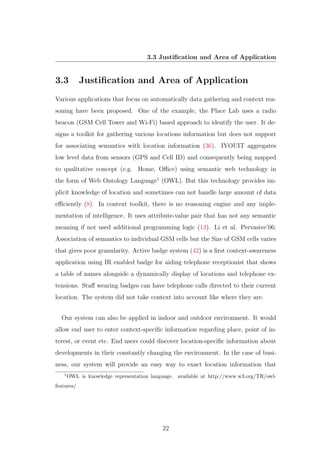
  • 33.
    Chapter 4 Analysis andRequirement This chapter analysis the existing approaches and techniques presented in chapter 2 with respect to some criteria. Following this, a set of requirements for YourWay! are identified. 4.1 Review and Analysis of Background Tech- nology 4.1.1 Localization techniques For identifying the best approach for localization, we have analyzed and com- pared different techniques with regard to accuracy, coverage area, service, and infrastructure cost etc in this section. 4.1.1.1 Handset vs Network Of the techniques, some are implemented solely on the network side, and some can work on the handset independently of the network (e.g. GPS, Wi-Fi). Both of these approaches carry some attributes to locate a position (see the table 4.1) (5). 24
  • 34.
    4.1 Review andAnalysis of Background Technology Techniques Attribute Network Handset Cell ID Cell ID based on Measurements All No Cell ID + TA Combines Cell ID with Time Advance GSM No EFLT Mobile measures FLT CDMA Yes/No AFLT Mobile measures FLT CDMA Yes/No AOA Network measures time difference All Yes/No TOA Network measures time difference All Yes/No TDOA Network measures time difference All Yes/No EOTD Mobile measures time difference GSM Yes/No GPS/A-GPS GPS receivers in handsets/network All Yes Wi-Fi Beacon All Yes Table 4.1: Handset or Network based Dependence 4.1.1.2 Range of Coverage Each Technology has a limited range in mobile environment. Within the cover- age area mobile user can seamlessly roaming and connect with rest of the world. Context-aware application can take advantage to locate user using range of cover- age of different localization techniques with respect to application domain. Figure 4.1 shows that GPS provides very accurate position (up to 5 meter) whether the CellID deliver a very coarse position between 1000 meter to several kilometer (1). The another technique Wi-Fi1 is vary on the environment (indoor/outdoor). For indoor, 802.11 WLANs covers 30 meter whereas 95 meter is for outdoor envi- ronment. In practice, a Wi-Fi access point has coverage of tens meters (26). 1 http://en.wikipedia.org/wiki/Wi-Fi 25
  • 35.
    4.1 Review andAnalysis of Background Technology Figure 4.1: Location Technologies Range of Coverage (1) 4.1.1.3 Indoor and/or Outdoor There is no doubt that the position technology and its accuracy depend on the environment (indoor and outdoor). Its also influence the application of differ- ent context-aware services. Steiniger and Edwards et al. (38) have figured out a number of positioning methods with their accuracy and their applicability to indoor and outdoor user activities as shown in the following figure 4.2. We have addressed that GPS and A-GPS provides higher accuracy while other methods like AOA, TOA, Cell-ID, and EOTD are lower positioning methods in outdoor environment. On the other hand, Bluetooth, RFID, and WLAN are moderate accuracy for indoor and outdoor environment. Note that these location tech- niques are solely terminal based and can be used in the application for tracking 26
  • 36.
    4.1 Review andAnalysis of Background Technology mobile user. It does not need any additional infrastructure cost and provide good coverage area. Figure 4.2: Positioning Methods, accuracy and Application (38) 4.1.1.4 Mobile Services A number of different localization technologies existing. But there is still no clear classification of the types of indoor and outdoor according to the accuracy re- quirement needed by each mobile location services. The following table 4.2 aim to identify the most promising positioning techniques and to match their character- istics and attributes to requirement of various mobile location services (39), (45). 4.1.1.5 Cost and Privacy Cost and Privacy have a strong influence on the design, implementation and use of Location based services. The key principle is that devices must be able 27
  • 37.
    4.1 Review andAnalysis of Background Technology to position themselves based on monitoring of the environment at low cost and gives the user control over when their location is disclosed, sharing information, etc. In the following Table 4.3, it is clear that some higher accuracy techniques requires more modification in both hardware and software components of the handset and the network (e.g. AOA and TDOA). A-GPS, on the other hand, requires moderate modifications: the introduction of a GPS reference receiver in the BTS is required (5). In contrast, Wi-Fi is very cheap and easy to deploy and pervasive. By knowing the location of connected access point, system can easily identify user’s location accurately. The location of this access point has to be known and one way of implementing this is to maintain a simple database (typically per hotspot provider) containing the location of every access point (44). With this setting, we can easily hide the data from intruder using user’s authentication. 4.1.1.6 Critical Thinking Cell ID method is already in use today and can be supported by all mobile hand- sets. But the accuracy is generally low in the range of 200 meters. Specially it is much lower in the rural environment. Signal Strength method is better than Cell ID but multi path fading and shadowing have a dominant effect in indoor and outdoor environment (39). Time based method like TOA, TDOA, AOA provides accurate position information than Cell ID and Signal Strength but a disadvan- tage is the need for a precise clock in the mobile device for synchronization (45). GPS technology has the main advantage that it is already in use. But in order to operate properly, GPS receivers need a clear view of the skies and signals from at least three or four (depending on the type of information) satellites. GPS can not detect inside building, heavy label glass and metals. For this to make 28
  • 38.
    4.1 Review andAnalysis of Background Technology available within building can only be achieved with correction technology as in A-GPS under great expenses (45). Infrared-based systems like Active-Badge (43) are frequently for indoor system, but suffer from short range transmitters and the huge amount of additional hardware. Ultrasonic waves are another estab- lished and mature positioning technology used in systems like Cricket (27). They also need a lot of additional hardware and have a tolerable accuracy. RF and Bluetooth is the promising technology for indoor in terms of low cost but poor scalability. Wi-Fi (IEEE 802.11) access points can be deployed in offices, public area and home environment etc. Unlike GPS, applications that use wireless APs as bea- cons work in both indoors and outdoors. AS most laptops, tablet PCs, mobile phones and personal digital assistants (PDAs) include built-in wireless devices there is no additional cost or equipment required. No GPS receivers are needed to use this application (10). Wi-Fi positioning techniques address these facilities and consider the issue where maximum time peoples are available in his daily lives. This technique allows user to locate them by listening radio beacon, look- ing up the associated beacons’ positions in a locally cached, and estimating their own position referenced to the beacon’s positions in the heterogeneous environ- ment. These beacons all have unique or semi-unique IDs, for example, a MAC address (3). 4.1.2 Location Sharing Tools Tools are underlying different position methods to host various services and data sources. For example, IYOUIT attempts to deduce the current city and street using GSM Cell or GPS latitude-longitude information and then providing avail- able services in mobile environment. From the following Table 4.4, it is clear that 29
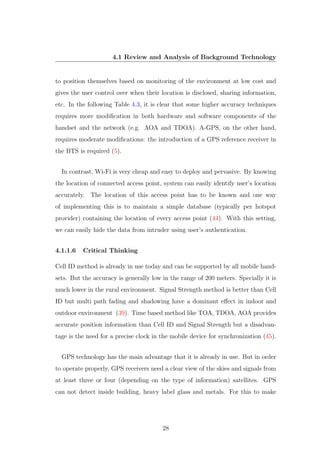
  • 39.
    4.1 Review andAnalysis of Background Technology some tools require that the phone, PDA and laptop are GPS enabled. But the convenience of Google Latitude is that phone, PDA or laptop does not need GPS, and it will work on almost any mobile phone as well as laptop using igoogle via internet. The other location technologies like Cell-ID, Wi-Fi or Bluetooth are available in almost all mobile phone and laptop. The key point is that developers can build their application for tracking user current location on the top of existing tools like IYOUIT, Zonetag, Google Lati- tude etc. For example, IYOUIT allows developers to write their own applications which integrate with the different context providers and other components in the Context Management Framework (CMF)1 . But developers need provide a solid concept of their application to DOCOMO Euro-Labs for getting service. Google Latitude on the other hand provides user’s city level location information using public location badge2 by registering into Google latitude with gmail ID without any cost. Using Google latitude with application, Developers uses the KML or JSON data file provided by Google latitude for showing geographic features like points, lines, coordinates, and images. This file format provides ability to specify images and labels to identify locations as well as to dynamically get such location information from the remote or local network locations at certain intervals. Zone- tag also provides location metadata for each photograph (34). Location metadata carries current location information where user taken a photo. Developers can take advantage to build their application with location metadata. Place Lab pro- vides API to allow developer use in their application without constant interaction with a central service (unlike badge tracking) (2). 1 https://www.iyouit.eu/portal/Developer.aspx 2 http://www.google.com/latitude/apps/badge 30
  • 40.
    4.1 Review andAnalysis of Background Technology As earlier noted in the previous section, privacy is very important to end user. Many researcher pay attention to social identity and try to link social identity with user profile, particularly place, comments or image(22). With this inspiration, we have observed that most of peoples are using gmail account in his daily life’s and sharing personal or commercial information using this identity. Another observation is that Google latitude provides a userid after creating public location badge using gmail account which is unique. Our contribution is that we are trying to link semantic places with gmail account or userid to represent a meaningful location to user. The other tools like IYOUT, or Zonetag have not such facility where user has to create another identity. Sometimes it could be burden to user daily activities. 4.1.3 Point of Interested In general, point of interested refers to a geographical place where user spends a substantial amount of time and/or visits frequently. It could be important to an individual user and mobile service provider where a set of user share information about physical position and personal preference. For example, a cell phone could switch to a silent mode when end user enters a place where a ringer is inappro- priate such as a movie theater, a lecture hall, a place for personal reflection. In practice, point of interest is a community based where its group member only can see and communicate (see the figure 4.3). The set of point of interest have shown by which community the end user belongs to (8). Of our little observation, Cell information and GPS coordinates do not provide meaningful to user or carry any semantic meaning for user (22). A simple approach to defining places is to do so manually. However, manual definition of places puts an unnecessarily large burden for the user. Instead, we 31
  • 41.
    4.2 System Requirement Figure4.3: Snapshot of the Place need an approach that can automatically determine a user’s significant places. There are several considerations in making this determination: duration of a visit to a place, the frequency of visits, the minimum distance between significant places, etc (14). To this end, user generated place making a significant meaning to leverage mobile services to end user at the right situation. 4.2 System Requirement In considering requirements for YourWay! It is wise to design a system with low cost and scalability in mind. From the consideration of the problem scenario of the following Figure 3.1, a set of requirements for YourWay! can be identified. Firstly, System enriches by receiving contextual information from various ex- ternal sources in distributed environment e.g. Wi-Fi access points and Google Latitude. Secondly, the main component Location Resolver of the system acts 32
  • 42.
    4.2 System Requirement asrepository for all contextual information such current contextual information, particularly Wi-Fi and user generated context such as place of interested. For resolving this it can use a large database. Thirdly, Location manager needs a model which allows the representation of physical object themselves and their relative orientations. To gain full advantage of model, higher level management is required to enable the execution of spatial based queries. Fourthly, Location manager exchange location information with authorized user. For now, only the individual users are authorized to request location information. 33
  • 43.
    4.2 System Requirement ApplicationsEnvironment Accuracy Methods Technology Emergency Calls Outdoor Medium/High TDOA Triangulation Automotive As- sistance Outdoor Medium AOA, TOA Triangulation Travel Services Outdoor Medium/High Cell-ID Cell Proximity M-Yellow Pages Outdoor Medium Cell-ID Cell Proximity Banners, Mar- keting Outdoor Medium/High TOA Triangulation People Tracking Indoor/Outdoor High GPS/A- GPS, WLAN Triangulation Indoor Routing Indoor High A-GPS, WLAN Triangulation Vehicle Tracking Outdoor Medium GPS/A- GPS Triangulation Product Track- ing Indoor/Outdoor Medium/High GPS/A- GPS, WLAN Triangulation Traffic Manage- ment Outdoor Medium GPS, A- GPS Triangulation Product Replen- ishment Outdoor High A-GPS Triangulation Mobiles Sales Outdoor Medium/High Cell-ID Cell Proximity M- Customers Support Outdoor Medium GPS, TOA Triangulation Field Personnel Support Indoor/Outdoor Medium/High A-GPS, WLAN Triangulation Table 4.2: Appropriate Positioning Methods for Mobile Location Services 34
  • 44.
    4.2 System Requirement LocationTechniques Cost Cell-ID Server in network Cell-ID + TA Server in Network, software on handset GPS Hardware in handset A-GPS Hardware in handset, reference receivers in network AOA Directional Antennae and servers in network TOA Servers in network EOTD Servers in network Wi-Fi Server(Database) in Network Table 4.3: Different Location Techniques with their associates cost 35
  • 45.
    4.2 System Requirement ToolsApplication Domain Location Tech- niques IYOUIT Share (community-based context sharing), Life (life support through context-aware guidance), Blog (enhanced contextual blog- ging) and Play (playful experience of context-awareness in games GPS and/or Cell ID Google Allow a mobile phone user to allow certain people on to track their location GPS, Cell ID and Wifi Ac- cess Point Zonetag Enables context-aware upload of pho- tographs from cameraphones Bluetooth GPS (when avail- able) and/or Cell ID Place Lab Location-awareness services GSM Cell Tower, 802.11 access point Table 4.4: Different Tools with their Location Techniques and Application Do- main 36
  • 46.
    Chapter 5 System Architectureand Implementation This section outlines the overall architecture and gives some technical details and implementation of the system. 5.1 System Architecture The System architecture consists of three key elements: a mobile phone client, Google Latitude server and a server system (see Figure 5.1). In general, it is a client-server architecture where a client communicates with the server and the server manages a mapping between the location information and the client gen- erated place of interest. As can be seen on the following figure 5.1, the server side consists of three major databases, communication interfaces to the mobile phone and external sources like Google Latitude Server. The Google Latitude server is provided by external third party named Google Incorporation. In the client side, a client application are always monitoring by various sensor system like GSM Cell-ID, Wi-Fi access point or GPS. Client needs to login into server 37
  • 47.
    5.1 System Architecture usingvalid user ID provided by Google Latitude server. The client application always gather and sends all information like userid, location information from latitude server, and current contextual information to server. The key point is that the server side and client side are developed independently with the com- munication protocol linking them together. The communication protocol defines what kind of requests the client can send to the server. Figure 5.1: YourWay! Architecture Overview 38
  • 48.
    5.1 System Architecture 5.1.1Client The client application is running on a mobile phone, laptop and any other mo- bile device. The communication between server and client is made over HTTP1 . To make the client both extensible and portable, the client functionality is bro- ken into three parts: scanning 802.11 access points, communication with Google Latitude server, and communication with system server. Firstly, Client application reads and collects the transmission of wireless net- working resources periodically such as 802.11 access points (AP) and/or Cell information in mobile environment. We generally called this beacon which holds all information about AP such as SSID2 , MAC address, signal strength, coverage area etc. MAC address can distinguish desired AP from others AP. As we will see in the chapter 6, the coverage area and accuracy is depend on the number of AP in the range of client application. For now, client applications are handling only AP information as it is widely deployed in places where people spent their majority time in his daily lives. Client application secondly collects user’s loca- tion information from latitude server. In this case, mobile user needs to connect seamlessly with latitude server using userid provided by google latitude. Using google public location badge, the user can create his/her userid and share only his/her city level information. Client application finally transfers user’s city level location information from latitude server, userid, and list of access points to server and request for current location. But when client application find new AP after receiving acknowledge- ment from system server, then user must fills form to upload information like 1 HTTP is an application-level protocol. available at http://en.wikipedia.org/wiki/HTTP/ 2 SSID is a name that identifies a particular 802.11 wireless LAN. available at http://en.wikipedia.org/wiki/SSID/ 39
  • 49.
    5.1 System Architecture country,region, city, district/area, street address, house number, floor number and place of interest precisely. This implies that the information of the new AP is not available in local storage of the system server. 5.1.2 Server The System Server is running on a single machine. It is platform independent. It consists of three databases, location manager, and web server. Location manager is the core component to resolve the given location estimation into actual address records. There are two ways to access the server, either from a handset through GPRS1 -socket connection or from a web-browser through HTTP-connection. The main task of server is maintaining the association and mapping between current location information (Wi-Fi and Latitude server) and user defined se- mantic e.g. place, comments, image etc to satisfy the system goal. For the resolution, server uses two external databases named context DB and point DB. In our architecture, context DB plays the important role of storing and serving the beacon details information (e.g. Wi-Fi or Cell) provided by client devices to location manager. This information always includes SSID, MAC, Range, and signal strength, but may also contain other information like latitude, longitude, the age of the data, etc. As MAC is unique identifier context DB is handling effi- ciently large amount of data using indexing and supports faster query to server. Point DB on the other hand, contains point of interested places (tag) with userid of each client. Each tag is associated with the physical location records. The idea is that establishing a spatial relationship2 between user and surroundings. Loca- 1 General packet radio service is packet oriented mobile data service available at http://en.wikipedia.org/wiki/GPRS/ 2 A spatial relation specifies how some object is located in space in relation to some reference object 40
  • 50.
    5.1 System Architecture tionDB is a prerequisite for storing all physical locations of real environment. In general, it follows a hierarchical approach where describes the interconnections between neighboring locations. The major contribution of location DB is that server is serving for transforming raw data from client devices into a representa- tion meaningful current position to client. The Server is responsible for handling requests from client application by HTTP connection. It has a connection to the remote latitude server. The connection between the mobile phone and Server is stateless and all actions like upload latitude information, upload contextual information and return user’s current location at the server are based on each individual request. The entire essential information is therefore store into the internal class file that the server manipulates. The system has two kinds of clients one is device with GPS and the other ones without GPS. Devices with GPS can provide the server with an exact GPS position. In this case, client directly talks to server. Server then provides a semantic place using query with exact GPS location information from Location DB and Point DB. . However this feature is not developed and not tested in our system due to hardware problems. The second type of client does not have a GPS device. This type mainly relies on the self-learning system that could be atomically identifying the user position. The idea is that Wi-Fi and Latitude information send to server by each client where it is available. Server then maps each raw sensor data to abstract location. 5.1.3 Google Latitude Google Latitude is a free application that can be integrated in our system frame- work for improving accuracy. It is running as background process. The way of communication between latitude server and client is made over HTTP. It is 41
  • 51.
    5.1 System Architecture clearthat Latitude server seamlessly provides location information to server via client application. In this case client must provide valid userid (gmail account) to server from mobile devices or igoogle. User can set manually his/her location in the case of failure diction of wireless networking resources e.g. Wi-Fi or Cell ID. We do not specify here whether the latitude server is being installed, how server maintains many client requests and how to it work. Public location badge is an emerging feature of Google Latitude applications. With public location badge, user can share his/her latitude location publicly on a blogs or websites. The location could be only city level without accuracy or the best available location with an appropriate accuracy provided either by manual selection or by GPS, Wi-Fi, or cell ID (cell tower) detection. The latitude pro- vides these locations in the two ways one is the badge’s standards embed HTML1 code and another is KML or JSON. Both of them can be feed to the applica- tion according to requirement. Standard embed HTML code is used in websites whether KML or JSON is being used to create a new application. In our system framework, we are using JSON format that supports GeoJSON2 1.0 specication for city level location information. It contains latitude and longitude, GeoJSON properties include the user id, accuracyInMeters, timeStamp, reverseGeocode, photoUrl, photWidth, photoHeight, placardUrl, placardWidth, placardHeight. But the latitude and longitude will be the city center, and accuracy will be 0 for only city level location. Taking advantages of such features, system server can access at regular interval to latitude server to get the location of a mobile user in the heterogeneous environment. 1 HyperText Markup Language is markup language for webpage. available at http://en.wikipedia.org/wiki/HTML 2 GeoJSON is a geospatial data interchange format based on JavaScript Object Notation (JSON). available at http://geojson.org/geojson-spec.html 42
  • 52.
    5.2 Implementation Google latitudeprovides higher level privacy to end user. User can control his/her location using google public location badge. For stopping broadcast lo- cation information, user can disenable the badge using google latitude websites. Due to this kind of restriction, system server can not get location information from latitude server. For resolving this problem, user needs to share at least city level location information in latitude server. 5.1.4 Communication Protocol Hypertext Transfer Protocol (HTTP) is an application layer protocol that is run- ning on the top of TCP/IP1 . TCP/IP has responsible to interconnect between computers and reliable data transfer. In general, its packet size is 4 byte. One byte is for header which telling the purpose of the rest of the package and other three bytes are carrying data and others information. As the very limited system resources involved with mobile computing, the information must be as small as possible considering the data transfer. The drawback of this protocol is over- head. This implies that some of information may be lost or overlapping. This can be compromised with future extensibility of the protocol depending on the information. 5.2 Implementation The Application is developed entirely in Java 2 Standard Edition using JDK 1.6.0.3. The development tool is Netbeans Integrated Development Environment (IDE)2 6.5. Netbeans IDE is an open source platform that support of all Java platforms (Java SE, Java EE, and Java ME) for developing mobile application. 1 available at http://en.wikipedia.org/wiki/TCPIP 2 http://netbeans.org/ 43
  • 53.
    5.2 Implementation We arealso using MySQL1 Server 5.0 as repository for storing and managing location and contextual information respectively. Communication between the main application and Database Server is achieved using The library file named mysql-connector-java-5.0.5.jar. For querying data from repository we have used Structure Query Language(SQL)2 . 5.2.1 Data Model and Management The core component Location Resolver rely on Data that are coming from dis- tributed resources e.g. latitude server, user’s context via mobile device, or local storage etc (see figure 5.1). As we have pointed in chapter 3, they have different dimensions that make to difficult for modeling and management. In this section, we expose a Location Model using simple spatial database that has ability to provide exact current location of user in heterogeneous environment by querying via client application. 5.2.1.1 Description of Location Model Location Model is a hierarchical model that represents geographical location and meaningful semantic in a fashion of symbolic coordinates (7). It defines all rela- tionships in form of spatial reasoning. This is the prerequisite for transforming raw sensor readings into a meaningful location (e.g. Home, Office) to the appli- cation (22). For example, the application determines whether a location is within a given range of Wi-Fi access points or which locations are nearby. The location model (see the figure 5.2) consists of elements, relationships, and attributes (11). We are using locations as an element and places of interested as attribute. The two important relationships are connected-in-relation (one location is an ances- 1 http://www.mysql.com/ 2 SQL is database computer language. available at http://en.wikipedia.org/wiki/SQL 44
  • 54.
    5.2 Implementation tor ofanother location) and contained-in-relation (location contained attributes within a range). Figure 5.2: Location Model According to our application requirement, we have divided the geographical location of mobile users in indoor or outdoor into country, province, city, street, 45
  • 55.
    5.2 Implementation area, building,and floor explicitly. The top most element is country and the lower element is floor. There are semantically connected each other by leveraging a spatial relation of others element. Each location can be attached one or more Wi-Fi access point whereas access points are associating with a network using the connected symbol. For example (see the figure 5.2), Access point is connected with floor, floor connected with building, building associate to street and so on to form a geographical network. Each network represents specific community (e.g. SOA Group, Create Net, UniTn) where people are staying his/her majority time. Within the community, each places of interested are attaching with a specific location. For instance, SOA group is situated in Via alla casata 56/c, povo, Trento, Italy. The office is five storied building. Each person is accompanied in each floor. Authority wants to track the location of each staff using tag like guest room, conference room, 2nd floor or in a Office. We are trying to formulate the current situation using location model such as the address divides into building, street, area, city, province, and country (56/c, Via Alla Cascata, Povo, Trento, Trentitno, Italy). Each pieces of information has a unique location identity and associate identity of its ancestor (e.g. link ID). Again each user has own preference place that must be linked to location identity. This implies that same location can infer different semantic meaningful location for different user. For resolving, we attach user identity with place of interest. To this end, Location ID, Link ID and userid are key element in location model. 5.2.1.2 Data Management We have sketched a database scheme (see the figure 5.3) to handle efficiently and easily large amount of data that are coming from heterogeneous resources and support all operations e.g. location query. It has been implemented in MySQL relational database system. During the designing of the scheme, we 46
  • 56.
    5.2 Implementation have concernedon data that should be retrieve as fast as possible upon receiving request and store into a limited space. Figure 5.3: Database Scheme 5.2.2 Localization Algorithm and Analysis We consider a solution for localization that is outline in Localization Algorithm 1. In the Algorithm, Loc contains Location information from Google latitude server and Ctx indicates current contextual information from mobile device in mobile environment. The Algorithm consists of two parts. In the first part (lines 3-8), an access point (AP) is selected from list of access points which has lowest coverage area among APs. The second part of Algorithm (lines 9- 27), localization is calculated for each user. At line 9, system checks whether contextual information is available or not in the database. At line 13, LinkType can be floor number, building number, street number, area, city, province, and country. From lines 10 to 15, physical address is computed by querying from 47
  • 57.
    5.2 Implementation database usingLinkID. From lines 16 to 25, Place is calculated using LocID and UserID from Database. At line 29, accuracy is measured using range variable from database. 48
  • 58.
    5.2 Implementation Algorithm 1:Localization Algorithm Data: UserID, Loc, Ctx Result: Address, Place, Accuracy begin1 Store Loc and Ctx in the internal data structure2 Get Data from Database3 Set Range = ∞4 while condition (is true) do5 if Data ≡ Ctx and Data ≤ Range then6 Set Range = Data7 Set CtxID = Data8 if CtxID = 0 then9 while condition (is true) do10 Get Data from Database11 while condition (is true) do12 if LinkType ≡ Data then13 Set LinkID = Data14 Set Adress = Data15 if Data ≡ 1 then16 Get Data from Database17 else18 Get Data from Database19 if Data contains values then20 Get Data from Database21 Set Place = Data22 else if Data = ∅ then23 Set Place = Data24 else25 Set Place = Data26 else27 Get Data from Latitude Server28 Compute Accuracy29 end30 49
  • 59.
    Chapter 6 Empirical Evaluationand Result In this section, we present our results from the empirical evaluation conducted using the below two real world examples. 6.1 Experiment Setup and Data Collection We experiment our system at different locations with three users who have userid (gmail account) from google latitude server. Due to resource and technical lim- itation, we were using only laptop for experiment purpose. Each of users were carrying a laptop and moving around throughout portions of a typical day. At the begging of the experiment, we set user current location manually (only city level) using google latitude from igoogle. We assume that all users are currently in Trento, Italy. In this case, Google Latitude always provides city level location information (e.g. Trento) when users log in to our system. The coverage and accuracy of our system depend on the number of WLAN access points in the environment, making it to difficult to make absolute statements about the sys- tem’s performance. However, we have sketch two scenario for indoor and outdoor environment whereas three users may have place of interested over the physical location. 50
  • 60.
    6.2 Evaluation We haveused Intel based laptop running Windows Vista with Atheros AR5007EG Wireless Network Adaptor during Data Collection. In order to capture trace data of 802.11 Wi-Fi access points, we have used VistaStumbler1 and collected from di- verse areas such as University Campus, Downtown, Student Hostel etc. For each area, we drove around twenty minute with laptop. We have collected AP’s ES- SID, BSSID, signal strength from VistaStumbler and recorded it in the database respectively. In this case, we have defined the coverage area of each access point (MAC address) of WLANs network. Consequently, we have made the hierarchical location model based on the AP selection place and named the place indicates to the system that it is importance for user. Currently, we have entered each record of contextual and location information manually into the database. 6.2 Evaluation 6.2.1 Case-Indoor The first experiments occur inside a five-story office building at 56/c via alla cascata, povo, trento. It is a Service Oriented Applications Research Unit(SOA)2 . The building is mainly constructed of brick that effectively blocks GPS signals. We have found around fourteen WLANs (e.g GuestsFBK, Legolab, Unitn, CN- Guest, Science-wifi etc) in the building. For our experiment, we have figured out only four WLANs network such as GuestsFBK, Legolab, CN-Phone, and CN- Guest. Each network may have several access points using in each floor of the building (see the Figure 6.1) whereas each access point has coverage of hundred meters. In contrast, Legolab has been used in SOA Group among four WLANs network where two access points (00:1B:2A:64:79:90 and 00:1B:2A:64:79:80) have coverage of fifty and thirty meters respectively. Each floor of the building have 1 A tool for Windows that facilitates detection of Wireless LANs. available at http://vistastumbler.software.informer.com/ 2 http://soa.fbk.eu/index.php 51
  • 61.
    6.2 Evaluation been coveredby the first access point while second access point only available from second to fourth floor. Three staffs may have place of interest in each floor as shown in the figure 6.1. For example, first user has the labeled place with ”At Desk” that indicates he is working in the second floor. Note that all users have a common labeled place (e.g. SOA Group, FBK) but first floor (not part of SOA Group) has not any point of interested. Figure 6.1: Case-Indoor First Observation: We assume that all users have logged in and send a re- quest for the location query to our system. From the configuration according to the figure 6.1, 6.2 and 6.3, we have completed location information in the database. According to this, we have closely observed the outcome of three users over the labeled places while they are constantly moving in the ground floor. Within the range of first access point of Legolab (see the figure 6.3), first user is in ”SOA Group, FBK”. It is pretty sure that he is in ”56/C via alla cascata”. 52
  • 62.
    6.2 Evaluation But thesystem can not specify his exact floor position and the place named(e.g. ”Coffee Room”). In contrast, second and third user is in the ground floor when they are in out of range of first access point of Legolab (see the figure 6.2). In this case, users can know the exact floor position of the building and their place of interested. Semantically, they are not currently in the office desk. Figure 6.2: Entrance Position of Ground Floor Figure 6.3: Middle Position of Ground Floor Second Observation: The most important place where three users spend considerable time appears when users get in the coverage of thirty meters of second access point of Legolab (see the figure 6.1). It is clear that all users are 53
  • 63.
    6.2 Evaluation in SOAGroup. We have observed the user position which floor users have been belongs. Since three users could be roaming irregularly from second to fourth floor in the building. Firstly, first user logged in to the system according to the configuration of the figure 6.1 and 6.4. In this case, first user shows that the location is more close to his point of interest (e.g. ”At Desk”). Since it is the exact floor position the range of second access point of Legolab. Similarly, the third user discovers his position in the third floor and the location named ”Office”. The outcome is fulfilled according to the third user’s profile. On the other hand, the position of the second user could be either in the third floor or fourth floor over the places named. In this situation, he always gets the same output ”SOA Group, FBK” from the system. The third user have not idea about his floor position in the building. Figure 6.4: Screenshots one of Second Floor Secondly, three users have worst experience when the system has been config- uration according to the figure 6.5. Since the client device detects the first access point of Legolab which covered the each floor of the building and the location of users is ”SOA Group, FBK”. It is clear that they are all in ”56/C via alla 54
  • 64.
    6.2 Evaluation Cascata” butusers have not idea about the floor position. Thirdly, the same place appear when three users are in the third floor or fourth floor (see the figure 6.6). Three users have the same experience as the previous one. Figure 6.5: Screenshots two of Second Floor Figure 6.6: Screenshots of Third and Fourth Floor Summary of the Observation: Of the observations, we have seen that each user has one or more choice of places within the coverage area of the same access point. In this situation, users can not get the exact labeled place. For example, second user has two places ”At Desk” and ”Meeting Room” in the same access point(see the figure 6.1). We have also addressed that each access point of WLANs covers more than one floor in the building. Consequently, users can not get the floor number with location information. However, users have overall better 55
  • 65.
    6.2 Evaluation expectation overthe labeled place in the building, particularly from second to fourth floor than the ground or first floor. 6.2.2 Case-Outdoor We have performed the second experiment in university campus, FBK main build- ing, and city center of Trento. The experiment was conducted with users and walking around these areas, sending a query to the system. We have completed locations information (available only in the figures) covered in the database. Since all areas have different WLAN of varying AP density, we have observed three user’s experience over three outdoor scenarios as shown in the figure 6.7. Figure 6.7: Outdoor Environment:University and FBK Three users have the place of interest over the four places in the university campus as shown in the figure 6.7. For example, the ground floor has labeled ”Cafeteria”. The first floor and the second floor have labeled ”Class Room”. All three users have a common tag ”Open Space, DIT” in the open space. Assume that three users log in to the system based on the setting of access points of WLANs (see the figure 6.7) and user’s profile. In the open space, users have 56
  • 66.
    6.2 Evaluation checked theircurrent status in the ”Ground Floor” while they are constantly roaming. It is clear that they are in ”14, Via Sommarive, Povo”. Since each WLAN has one access point and same the coverage area of hundred meters of each access point. IRST on the other hand, has handsome amount access points over three floors especially in first floor. In the first floor, when the first user and the second user query then the location is ”Class Room”. But when third user query then the location is ”University, IRST”. We experiment in the main entrance and the reception room at FBK main building as shown in the figure 6.7. It is in via sommarive 18, Povo. Three users have the labeled place ”Reception Room, FBK”. When client devices automat- ically detect the lowest range access point that is belongs to ”GuestFBK” then it is pretty sure that they are in ”FBK main building”. Sometimes users can get wrong location based on the AP selection. For example, ”dlink” that is not part of FBK has the lower coverage area than GuestsFbk and associated with other location (e.g. house number different from FBK). Finally, we experimented in two areas Piazza Duomo and Piazza Dante of the city center ”Trento” respectively (see the Figure 6.8). During the training phase, we have observed that number of access points of each WLAN is rapidly changed. It is difficult to record it in the database. Some records of contextual information (e.g. Wi-Fi) are obsolete. In this case, users need to frequently renamed the learn place when client device detects the new access points. Since users are constantly roaming it could be burden for users. 57
  • 67.
    6.3 Result Figure 6.8:Outdoor Environment:DownTown 6.3 Result To get the results from the above experiments, we noted a few dominant effects that play a key role in the localization regarding to user’s experience using the spatial based location techniques. The density of access points as well as the range of APs in a region affects the localization accuracy, particularly in the case of indoor environment. In practice, the actual location of an access point is crucial for evaluation but sometimes it is difficult especially in the unplanned deployment setting that we examine. However, Google latitude is working behind in our system that improves the system’s performance, especially in outdoor environment. 58
  • 68.
    Chapter 7 Conclusion andFuture Work 7.1 Conclusion Through the thesis work, we have investigated to identify the mobile user’s loca- tion and place of interest from Wi-Fi data that is enriched with the geographical data of Google latitude in the mobile setting environment (see the chapter 3). Since WLAN infrastructure is pervasive and we can collect the contextual infor- mation about the mobile assets via WLAN. Enabling the use of contextual infor- mation requires system level support and algorithmic solution. There is need a platform for the system level that facilitate the interactions between location sys- tems, user past experience and location sharing tools whereas on the algorithmic solution there is need techniques that can transform from the symbolic coordinate information to physical address that corresponds to places that are meaningful to the user from data collected via mobile device. Meaningful places can be used to provide awareness cues in applications that support social interactions, to provide personalized and location-sensitive information to the user (21). The contribution of the thesis address the need by proposing a platform that supports location model and spatial based localization algorithm be able to cope with the different datasets and that performs better in heterogamous environ- 59
  • 69.
    7.2 Future Work ment.We also contribute Google latitude alternative to GPS that enriches the location information (only city level) with the platform. We evaluate the users’ experience in the indoor and the outdoor environment. The result shows that the users’ experience is more reliable in the community based WLAN infrastruc- ture in indoor than in outdoor. This approach solely depend the deployment structure, coverage area and density of access points. 7.2 Future Work In the future, our goal is to develop a probabilistic approach that can identify the expected locations with accuracy from a certain range of access point in the WLAN infrastructure whereas mobile user has one or more interested places. This technique can be used user’s log file and timing information in this setting. 60
  • 70.
    References [1] Overview oflocation technologies. http://developer.openwave. com/omdtdocs/location_studio_sdk/pdf/Intro_to_Location_ Technologies.pdf. viii, 25, 26 [2] Place lab developer’s tutorial. http://www.placelab.org/toolkit/doc/ placelabexample. 30 [3] Place Lab: Device Positioning Using Radio Beacons in the Wild, May 2005. 11, 14, 21, 29 [4] Gregory D. Abowd, Anind K. Dey, Peter J. Brown, Nigel Davies, Mark Smith, and Pete Steggles. Towards a better understanding of context and context-awareness. In HUC ’99: Proceedings of the 1st international sympo- sium on Handheld and Ubiquitous Computing, pages 304–307, London, UK, 1999. Springer-Verlag. 17, 20 [5] Navid Solhjoo Anthony Clarkson, Stephen McCallum and Speros Velentzas. Hybridised positioning algorithms in location based services. In Proceed- ings of the 1st Workshop on Positioning, Navigation and Communica- tion(WPNC’04), 2004. 7, 19, 24, 28 [6] Daniel Ashbrook and Thad Starner. Using GPS to learn significant loca- tions and predict movement across multiple users. Personal and Ubiquitous Computing, 7(5):275–286, October 2003. 14 61
  • 71.
    REFERENCES [7] Christian Beckerand Frank Dürr. On location models for ubiquitous computing. Personal Ubiquitous Comput., 9(1):20–31, 2005. 17, 44 [8] Sebastian Boehm, Johan Koolwaaij, Marko Luther, Bertrand Souville, Matthias Wagner, and Martin Wibbels. Introducing iyouit. In ISWC ’08: Proceedings of the 7th International Conference on The Semantic Web, pages 804–817, Berlin, Heidelberg, 2008. Springer-Verlag. 10, 19, 22, 31 [9] Guanling Chen and David Kotz. A survey of context-aware mobile comput- ing research. Technical report, Hanover, NH, USA, 2000. 2, 16, 17, 19 [10] Bowen CL. Using wireless networks to assist navigation for individuals with disabilities. In Northridge Center on Disabilities’ 21st Annual International Technology and Persons with Disabilities Conference, Los Angeles, CA, USA, 2006. 29 [11] Svetlana Domnitcheva. Basic location models extentions and challenges, 1998. 44 [12] J. Hightower and G. Borriello. Location systems for ubiquitous computing. Computer, 34(8):57–66, Aug 2001. 1 [13] Ana Hristova, 2008. Conceptualization and Design of a Context-aware Plat- form for User-centric Applications. 22 [14] Jong Hee Kang, William Welbourne, Benjamin Stewart, and Gaetano Bor- riello. Extracting places from traces of locations. In WMASH ’04: Proceed- ings of the 2nd ACM international workshop on Wireless mobile applications and services on WLAN hotspots, pages 110–118, New York, NY, USA, 2004. ACM. 14, 16, 32 62
  • 72.
    REFERENCES [15] Kari Laasonen,Mika Raento, and Hannu Toivonen. Adaptive on-device location recognition. pages 287–304. Springer-Verlag, 2004. 14 [16] Mik Lamming and Mike Flynn. ”forget-me-not” intimate computing in sup- port of human memory, 1994. 13 [17] Ulf Leonhardt. Supporting Location-Awareness in Open Distributed Systems. PhD thesis, University of London, U.K., 1998. 12 [18] Natalia Marmasse and Chris Schmandt. Location-aware information delivery with commotion. In HUC ’00: Proceedings of the 2nd international sympo- sium on Handheld and Ubiquitous Computing, pages 157–171, London, UK, 2000. Springer-Verlag. 13 [19] Elizabeth D. Mynatt, Maribeth Back, Roy Want, Michael Baer, and Jason B. Ellis. Designing audio aura. In CHI ’98: Proceedings of the SIGCHI con- ference on Human factors in computing systems, pages 566–573, New York, NY, USA, 1998. ACM Press/Addison-Wesley Publishing Co. 13 [20] G. J. Nelson. Context-Aware and Location Systems. PhD thesis, Cambridge University, 1998. 12 [21] Petteri Nurmi and Sourav Bhattacharya. Identifying meaningful places: The non-parametric way. In Pervasive ’08: Proceedings of the 6th Inter- national Conference on Pervasive Computing, pages 111–127, Berlin, Hei- delberg, 2008. Springer-Verlag. 19, 59 [22] Petteri Nurmi and Johan Koolwaaij. Identifying meaningful locations. In Mobile and Ubiquitous Systems: Networking & Services, 2006 Third Annual International Conference on, pages 1–8, 2006. 1, 14, 16, 17, 19, 20, 31, 44 63
  • 73.
    REFERENCES [23] Donald J.Patterson, Lin Liao, Dieter Fox, and Henry A. Kautz. Inferring high-level behavior from low-level sensors. In Ubicomp, pages 73–89, 2003. 14 [24] Elin Rønby Pedersen and Tomas Sokoler. Aroma: Abstract representation of presence supporting mutual awareness. In CHI, pages 51–58, 1997. 13 [25] Gian Pietro Picco, Amy L. Murphy, and Gruia-Catalin Roman. Develop- ing Mobile Applications: A Lime Primer. In Mohammad Ilyas and Imad Mahgoub, editors, Mobile Computing Handbook, chapter 2, pages 277–278. Auerbach (CRC Press), December 2004. Invited contribution. 17 [26] N.R. Prasad. Ieee 802.11 system design. In EEE International Conference on Personal Wireless Communications, December 2000. 20, 25 [27] Nissanka Bodhi Priyantha, Anit Chakraborty, and Hari Balakrishnan. The Cricket Location-Support System. In 6th ACM MOBICOM, Boston, MA, August 2000. 8, 29 [28] Bharat Rao and Louis Minakakis. Evolution of mobile location-based ser- vices. Commun. ACM, 46(12):61–65, 2003. 2, 16, 17, 19 [29] J. Rekimoto, Y. Ayatsuka, and K. Hayashi. Augment-able reality: situated communication through physical and digital spaces. In Wearable Computers, 1998. Digest of Papers. Second International Symposium on, pages 68–75, Oct 1998. 12 [30] Bradley J. Rhodes. The wearable remembrance agent: a system for aug- mented memory. Wearable Computers, IEEE International Symposium, 0:123, 1997. 13 64
  • 74.
    REFERENCES [31] P Rongand M.L. Sichitiu. Angle of arrival localization for wireless sen- sor networks. In Sensor and Ad Hoc Communications and Networks, 2006. SECON ’06. 2006 3rd Annual IEEE Communications Society on, volume 1, pages 374–382, Sept. 2006. 7 [32] B. Schilit, N. Adams, and R. Want. Context-aware computing applications. In WMCSA ’94: Proceedings of the 1994 First Workshop on Mobile Com- puting Systems and Applications, pages 85–90, Washington, DC, USA, 1994. IEEE Computer Society. 17 [33] Albrecht Schmidt, Kofi Asante Aidoo, Antti Takaluoma, Urpo Tuomela, Kristof Van Laerhoven, and Walter Van de Velde. Advanced interaction in context. In HUC ’99: Proceedings of the 1st international symposium on Handheld and Ubiquitous Computing, pages 89–101, London, UK, 1999. Springer-Verlag. 16 [34] Shane. Zonetag: Designing context-aware mobile media capture to increase participation. In In: Proceedings of the Pervasive Image Capture and Shar- ing: New Social Practices and Implications for Technology Workshop (PICS 2006) at the Eighth International Conference on Ubiquitous Computing (Ubi- Comp 2006), 2006. 11, 30 [35] Jungwon Min Shu Wang and Byung K. Yi, editors. Location Based Services for Mobiles: Technologies and Standards, Beijing, 2008. IEEE ICC. 6, 7 [36] Timothy Sohn, William G. Griswold, James Scott, Anthony LaMarca, Yatin Chawathe, Ian Smith, and Mike Chen. Experiences with place lab: an open source toolkit for location-aware computing. In ICSE ’06: Proceedings of the 28th international conference on Software engineering, pages 462–471, New York, NY, USA, 2006. ACM. 22 65
  • 75.
    REFERENCES [37] Prashant Solankiand Huosheng Hu. Techniques used for location-based services: A survey. Technical Report CSM-428, 2005. 8 [38] Moritz Neun Stefan Steiniger and Alistair Edwardes. Foundations of location based services. CartouCHe1 - Lecture Notes on LBS, V. 1.0. viii, 6, 7, 26, 27 [39] Charles Steinfield. The development of location based services in mobile commerce. In In E-life After the Dot Com Bust [41, pages 177–197. 5, 7, 8, 27, 28 [40] Sun Microsystems, Inc. SunOS Reference Manual, March 1990. 12 [41] Hongfeng Wang. Overview of bluetooth technology. 2001. 9 [42] Roy Want, Andy Hopper, Veronica Falc ao, and Jonathan Gibbons. The active badge location system. ACM Trans. Inf. Syst., 10(1):91–102, 1992. 22 [43] Roy Want, Andy Hopper, Veronica Falcao, and Jon Gibbons. The ac- tive badge location system. Technical Report 92.1, ORL, 24a Trumpington Street, Cambridge CB2 1QA, 1992. 7, 12, 29 [44] Maarten Wegdam, Jeroen van Bemmel, Ko Lagerberg, and Peter Lei- jdekkers. An architecture for user location in heterogeneous mobile networks. In HSNMC, pages 479–491, 2004. 21, 28 [45] Vasileios Zeimpekis, George M. Giaglis, and George Lekakos. A taxonomy of indoor and outdoor positioning techniques for mobile location services. SIGecom Exch., 3(4):19–27, 2003. 7, 27, 28, 29 66