MSc Digital Innovation
An introduction
“We are living in a golden age of digital innovation. During our lifetimes, an
entirely new digital infrastructure of computers, mobile devices, broadband
network connections, and advanced application platforms has been
created. This digital infrastructure has, in turn, accelerated the
emergence of new technologies — social media, cloud computing,
analytics, big data, wearable devices, 3D printing —
that enable transformations in the way we live and work, how
companies organise, and the structure of entire industries”
– Fichman et al (2014)
www.smurfitschool.ie
MSc Digital Innovation
Programme Overview
• 90 Credit Programme from Ireland’s leading business school
• Offered one year full-time or two year part-time
• Delivering excellent career prospects
• Exploring technology-centric innovation for individuals, society,
organisations, and markets
• Targeting early and mid career graduates of all disciplines
www.smurfitschool.ie
MSc Digital Innovation
An introduction
• It addresses technology-centric transformation of business, organisations
and society and is designed to equip future business and technology leaders
with the knowledge and skills to succeed in the digital era.
• Classes taught by internationally recognised researchers who engage
directly with the technology companies that have made Dublin
one of Europe’s Digital Hubs.
• You will emerge as insightful, reflective and critically minded
individuals with a unique understanding of the discovery, development,
diffusion, and impact of digital product, process, and
business model innovations.
www.smurfitschool.ie
MSc Digital Innovation
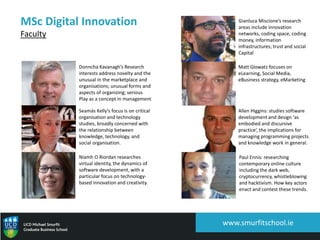
Faculty
Donncha Kavanagh’s Research
interests address novelty and the
unusual in the marketplace and
organisations; unusual forms and
aspects of organizing; serious
Play as a concept in management
Seamás Kelly’s focus is on critical
organisation and technology
studies, broadly concerned with
the relationship between
knowledge, technology, and
social organisation.
Niamh O Riordan researches
virtual identity, the dynamics of
software development, with a
particular focus on technology-
based innovation and creativity.
Gianluca Miscione’s research
areas include innovation
networks, coding space, coding
money, information
infrastructures; trust and social
Capital
Matt Glowatz focuses on
eLearning, Social Media,
eBusiness strategy, eMarketing
Allen Higgins: studies software
development and design ‘as
embodied and discursive
practice’, the implications for
managing programming projects
and knowledge work in general.
Paul Ennis: researching
contemporary online culture
including the dark web,
cryptocurrency, whistleblowing
and hacktivism. How key actors
enact and contest these trends.
MSc Digital Innovation
Structure
Complete 9 modules (PT e.g 5 modules Y1, 4 modules Y2)
– up to 36 class hours contact per module.
Semester 1 (Sep – Dec)
3 modules (PT students 2 modules)
Up to 36 class hours contact per module
Semester 2 (Jan – May)
3 modules (PT students 1 module)
Up to 36 class hours contact per module
Or option of Research Thesis (Jan-Aug)
3 module equivalent over semester 2 & 3
Summer Term (May – Aug)
3 modules (PT students 2 modules)
Block structure
(e.g. 5-6 days or part days over 1, 2 or 3 weeks per module)
www.smurfitschool.ie
CORE (Modules offered may change)
Semester One: Engage with the principles and foundations of practice
• MIS41020 Design, Development, Creativity
• MIS40910 Skills for Business Enquiry
• MIS40680 Managing Strategy and Innovation in a Digital Era
Semester Two: Deepen your understanding
• MIS40640 Cultural and Political Perspectives on Managing Technology and Change
• MIS41010 Outsourcing and Offshoring
• MIS40740 Implementing Digital Projects
• MIS40720 Research Project* (* Subject to approval = 3 module equivalent)
NONCORE (Modules offered may change)
Summer Term: Refine your knowledge
• MIS40650 Knowledge, ICT & Organisation
• MIS41030 Global Information Systems
• MIS41000 Game thinking: Games and Play in a Digital World
• MIS40890 Economics of IT & Digital Markets
• Options from other streams may be available
• NOTE: Students may take suitable elective modules from other subject areas if timetable and
prerequisites allow
MSc Digital Innovation
Modules
www.smurfitschool.ie
MSc Digital Innovation
Further information
Programme Manager: Ms Fiona Lynch
fiona.lynch@ucd.ie
Programme Director: Mr Allen Higgins
allen.higgins@ucd.ie
Admissions Manager: Mr Eoin Taffe
eoin.taffe@ucd.ie
Admissions Team: smurfit.admissions@ucd.ie
+353 (0) 1 716 8885
Connect with alumni: https://www.linkedin.com/grp/home?gid=3720474
Questions?
www.smurfitschool.ie

MSc Digital Innovation: Introduction and Orientation 2017

  • 1.
  • 2.
    MSc Digital Innovation Anintroduction “We are living in a golden age of digital innovation. During our lifetimes, an entirely new digital infrastructure of computers, mobile devices, broadband network connections, and advanced application platforms has been created. This digital infrastructure has, in turn, accelerated the emergence of new technologies — social media, cloud computing, analytics, big data, wearable devices, 3D printing — that enable transformations in the way we live and work, how companies organise, and the structure of entire industries” – Fichman et al (2014) www.smurfitschool.ie
  • 3.
    MSc Digital Innovation ProgrammeOverview • 90 Credit Programme from Ireland’s leading business school • Offered one year full-time or two year part-time • Delivering excellent career prospects • Exploring technology-centric innovation for individuals, society, organisations, and markets • Targeting early and mid career graduates of all disciplines www.smurfitschool.ie
  • 4.
    MSc Digital Innovation Anintroduction • It addresses technology-centric transformation of business, organisations and society and is designed to equip future business and technology leaders with the knowledge and skills to succeed in the digital era. • Classes taught by internationally recognised researchers who engage directly with the technology companies that have made Dublin one of Europe’s Digital Hubs. • You will emerge as insightful, reflective and critically minded individuals with a unique understanding of the discovery, development, diffusion, and impact of digital product, process, and business model innovations. www.smurfitschool.ie
  • 5.
    www.smurfitschool.ie MSc Digital Innovation Faculty DonnchaKavanagh’s Research interests address novelty and the unusual in the marketplace and organisations; unusual forms and aspects of organizing; serious Play as a concept in management Seamás Kelly’s focus is on critical organisation and technology studies, broadly concerned with the relationship between knowledge, technology, and social organisation. Niamh O Riordan researches virtual identity, the dynamics of software development, with a particular focus on technology- based innovation and creativity. Gianluca Miscione’s research areas include innovation networks, coding space, coding money, information infrastructures; trust and social Capital Matt Glowatz focuses on eLearning, Social Media, eBusiness strategy, eMarketing Allen Higgins: studies software development and design ‘as embodied and discursive practice’, the implications for managing programming projects and knowledge work in general. Paul Ennis: researching contemporary online culture including the dark web, cryptocurrency, whistleblowing and hacktivism. How key actors enact and contest these trends.
  • 6.
    MSc Digital Innovation Structure Complete9 modules (PT e.g 5 modules Y1, 4 modules Y2) – up to 36 class hours contact per module. Semester 1 (Sep – Dec) 3 modules (PT students 2 modules) Up to 36 class hours contact per module Semester 2 (Jan – May) 3 modules (PT students 1 module) Up to 36 class hours contact per module Or option of Research Thesis (Jan-Aug) 3 module equivalent over semester 2 & 3 Summer Term (May – Aug) 3 modules (PT students 2 modules) Block structure (e.g. 5-6 days or part days over 1, 2 or 3 weeks per module) www.smurfitschool.ie
  • 7.
    CORE (Modules offeredmay change) Semester One: Engage with the principles and foundations of practice • MIS41020 Design, Development, Creativity • MIS40910 Skills for Business Enquiry • MIS40680 Managing Strategy and Innovation in a Digital Era Semester Two: Deepen your understanding • MIS40640 Cultural and Political Perspectives on Managing Technology and Change • MIS41010 Outsourcing and Offshoring • MIS40740 Implementing Digital Projects • MIS40720 Research Project* (* Subject to approval = 3 module equivalent) NONCORE (Modules offered may change) Summer Term: Refine your knowledge • MIS40650 Knowledge, ICT & Organisation • MIS41030 Global Information Systems • MIS41000 Game thinking: Games and Play in a Digital World • MIS40890 Economics of IT & Digital Markets • Options from other streams may be available • NOTE: Students may take suitable elective modules from other subject areas if timetable and prerequisites allow MSc Digital Innovation Modules www.smurfitschool.ie
  • 8.
    www.smurfitschool.ie MSc Digital Innovation Furtherinformation Programme Manager: Ms Fiona Lynch fiona.lynch@ucd.ie Programme Director: Mr Allen Higgins allen.higgins@ucd.ie Admissions Manager: Mr Eoin Taffe eoin.taffe@ucd.ie Admissions Team: smurfit.admissions@ucd.ie +353 (0) 1 716 8885 Connect with alumni: https://www.linkedin.com/grp/home?gid=3720474
  • 9.

Editor's Notes

  • #5 The programme develops: • Leadership skills regarding the strategic application of IT for innovation • The capacity to create and critically assess the case for ICT development, deployment and use • In-depth knowledge and insights into design of systems, their development and processes • Experience in designing and undertaking industry-relevant research projects • Preparation to be a team player in distributed, cross-cultural, multiple time-zone initiatives
  • #6 Apply for dissertation option: over 2 semesters Industry / Research Project     MIS40720 (faculty supervisors) Research and teaching faculty for innovation, technology & organisation. Donncha Kavanagh’s Research interests address novelty and the unusual in the marketplace and organisations; unusual forms and aspects of organizing; serious Play as a concept in management Skills for Business Enquiry MIS40910 Donncha Kavanagh Seamás Kelly’s Research interests in the area of critical organisation and technology studies, and broadly concerned with the relationship between knowledge, technology, and social organisation. Cultural and Political Perspectives on Managing Technology and Change MIS40640 Séamas Kelly Knowledge, ICT & Organisation MIS40650 Séamas Kelly Niamh O Riordan researches virtual identity, the dynamics of software development, with a particular focus on technology-based innovation and creativity. Managing Strategy and Innovation in a Digital Era MIS40680 Niamh O Riordan Gianluca Miscione’s research areas: Organization, Innovation, and Development; Information Infrastructures; Qualitative and Mixed Research Methodologies; Trust and Social Capital Global Information Systems MIS41030 Gianluca Miscione. Matt Glowatz focuses on eLearning, Social Media, eBusiness strategy, eMarketing Implementing Digital Projects MIS40740 Matt Glowatz Allen Higgins: studies software development and design ‘as embodied and discursive practice’ and look at the implications for managing programming projects and knowledge work in general. MIS41010 Outsourcing and Offshoring Allen Higgins Design, Development, Creativity MIS41020 Allen Higgins Paul Ennis: researching contemporary online culture including the dark web, cryptocurrency, whistleblowing and hacktivism. A core feature of his approach is the manner in which entities from government agencies to activist groups enact and contest these trends. Visiting scholars and lecturers from other departments will be announced.
  • #7 Course Structure The programme is offered over 1 year full-time or 2 year part-time, in either fully taught mode or in conjunction with a research thesis. Each academic year has three semesters: semester 1, semester 2 and semester 3 (also called Summer term). Students complete 9 modules or 6 modules plus the Research Project (Minor Dissertation = 3 module equivalent). Full-time students take 30 credits per semester. Part-time students take 30 credits on average per two semesters. Classes in semesters 1 & 2 run over 12 weeks and may be scheduled for evening or early morning sessions. Intensive classes in Summer term are typically taught in intensive sessions spanning one or more weeks per module. Pathways: Typically, full-time students enrol in three modules in semester one, three modules in semester two, and three modules delivered in multi-day intensive sessions scheduled in Summer term. Part-time students follow the same format except that modules are studied as scheduled over two years.
  • #8 Students complete 9 modules or 6 modules plus the Research Project (Minor Dissertation = 3 module equivalent).