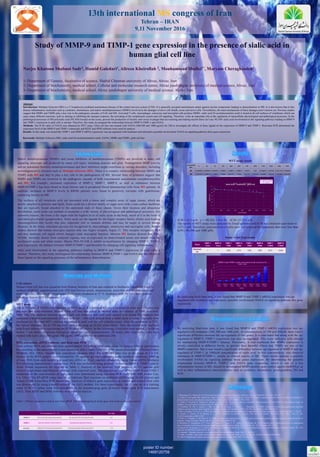
13th international MS congress of Iran
Tehran – IRAN
9,11 November 2016
Study of MMP-9 and TIMP-1 gene expression in the presence of sialic acid in
human glial cell line
Narjes Khatoun Shabani Sadr1, Hamid Galedari1, Alireza Kheirollah 2, Mouhammad Shafiei1*, Maryam Cheraghzadeh3
1- Department of Genetic, facultative of science, Shahid Chamran university of Ahvaz, Ahvaz, Iran
2- Department of biochemistry, medical school, Cellular and molecular research center, Ahvaz jundishapur university of medical science, Ahvaz, Iran
3- Department of biochemistry, medical school, Ahvaz jundishapur university of medical science, Ahvaz, Iran
Abstract
Introduction: Multiple Sclerosis (MS) is a T lymphocyte-mediated autoimmune disease of the central nervous system (CNS). It is generally accepted autoimmune attack against myelin components leading to demyelination in MS. It is also known that in this
disease inflammatory molecules such as cytokines, chemokines, and matrix metalloproteinases (MMPs) involved in the damages of nerve cell sheath, axons and nerve cells. Nevertheless, the main mechanisms of these damages aren’t known yet. Previous studies
suggest that MMPs and TIMPs play a key role in the pathogenic cascades of EAE and MS. Activated T cells, macrophages, astrocytes and microglial cells produce MMPs. sialic acid (N-acetylneuraminic acid) is found at all cell surfaces of vertebrates which can
cause many different reactions, such as starting or inhibiting the immune response, the activating of the complement system and cell signaling. Therefore, it has an important role in the regulation of intracellular physiological and pathological processes. In the
pathological processes of MS polysialic acid (NCAM) located on the axons, prevent the production of myelin; and versus in plaque that are restoring and making myelin there isn’t any NCAM. sialic acid involvement in the signaling pathways leading to MMP-9
and TIMP-1 expression in glial cells is unclear. Therefore, this study investigated the relationship between MMP-9,TIMP-1 and NANA.
Methods: The IC50 value of NANA was obtained by MTT assay. Glial cell line was treated with NANA (300,500 and 1000 µg/ml) for 24h to investigate the effects of these ligand on the expression of MMP-9 and TIMP-1. Real-time PCR determined the
expression level of the MMP-9 and TIMP-1 transcripts and REST and SPSS software were used for analyze.
Results: In this study was found that TIMP-1 and MMP-9 mRNA expression was up-regulated with treatment and indicated a possible involvement NANA on signaling pathway those gene expression.
Keywords: Multiple Sclerosis (MS), sialic acid (N-acetylneuraminic acid), NANA, MMPs and TIMPs, glial cell line
Matrix metalloproteases (MMPs) and tissue inhibitors of metalloproteases (TIMPs) are involved in many cell
signaling processes and produced by many cell types, including neurons and glial. Nonregulated MMP activity
and an imbalance between metalloproteinases and their inhibitors might contribute to various disorders, including
neurodegenerative diseases such as Multiple sclerosis (MS). There is a complex relationship between MMPs and
TIMPs with MS and they’re play a key role in the pathogenesis of MS. Several lines of evidence suggest that
MMPs and TIMPs are involved in the pathogenic cascade of both experimental autoimmune encephalomyelitis
and MS. For example, increased expression of MMP-2, MMP-7, MMP-9, as well as imbalance between
MMP-9/TIMP-1 has been found in brain lesions and in peripheral blood mononuclear cells from MS patients. In
addition, increases in MMP-9 levels in RRMS patients were found to positively correlate with gadolinium-
enhancing lesions on MR.
The surfaces of all vertebrate cells are decorated with a dense and complex array of sugar chains, which are
mostly attached to proteins and lipids. Sialic acids are a diverse family of sugar units with a nine-carbon backbone
that are typically found attached to the outermost ends of these chains. Given their location and ubiquitous
distribution, sialic acids can mediate or modulate a wide variety of physiological and pathological processes. For
unknown reasons, the brain is the organ with the highest level of sialic acids in the body, much of it in the form of
sialylated glycolipids (gangliosides). Sialic acids are the ligands for the Siglec receptor family (Sialic acid binding
immunoglobulin-like lectin) that play important role in immune defense and may be target in several human
diseases. In the brain, sialylated glycans are recognized by macrophages, monocytes and microglial cells. Recent
studies showed that human microglia express only one Siglec receptor, Siglec-11. This receptor recognizes PSA
and thus mediates cell signal which changes some microglial function. Mortem MS lesions showed that PSA-
NCAM, normally absent from analyzed regions, was re-expressed on demyelinated axons and absent from re-
myelinated axons and white matter. Maybe PSA-NCAM is inhibit re-myelination by changing MMP-9, TIMP-1
gene expression, the balance between MMP-9/TIMP-1 and therefore by changing cell signaling inflammatory.
sialic acid involvement in the signaling pathways leading to MMP-9 and TIMP-1 expression in glial cells is
unclear. Therefore, this study investigated the relationship between MMP-9,TIMP-1 and NANA and the effects of
these ligand on the signaling processes of the inflammatory demyelination.
Cell culture
Human Glial cell line was prepared from Pasteur Institute of Iran and cultured in Dulbecco’s modified Eagle’s
medium (DMEM), supplemented with 10% fetal bovine serum, streptomycin, penicillin and amphoteripcin and
tested to ensure absence of Mycoplasma. Cells were incubated at 37 °C incubator with 5% CO2 and replaced
following trypsin/EDTA treatment.
MTT assay
The IC50 value of NANA was obtained by MTT assay. A 5 mM(mg/ml) stock solution of sialic acid (Sigma) was
prepared and filter-sterilized. Human Glial cell line was plated in 96-well plate at a density of 7000 cells/well.
After 24h, The medium solution in each well was removed and cells were treated with serum free medium that
contained a known concentration of sialic acid (20 - 1400 μM) diluted from a 5mM stock solution. The cells were
incubated for 24 h and MTT solution was added to each well for cell viability assay. After 4h incubation at 37ºC,
the optical densities (A) at 570 nm were measured using an ELISA plate reader. Then the results were analyzed
with Excel software for calculating the IC50 value of NANA. In the following, Glial cells were seeded 2.5×10⁶ on
twelve 7 cm dishes (triplicate biological repeat for each concentration), 24 hours after seed cells, cells were
treated with sialic acid (300 μg/ml,500 μg/ml,1000 μg/ml) for an additional 24h.
RNA-extraction, cDNA synthesis, and Real time PCR
Total cellular RNA was isolated from approximately 10 million Glial cells using the Qiagen RNeasy purification
kit according to the manufacturer’s and quantified with a Nano Drop ND-1000 spectrophotometer (Thermo Fisher,
Waltham, MA, USA). Quality was considered adequate when the A260/280 ratio was in the range of 1.8–2.0.
Quality of the RNA samples was evaluated by 2% agarose gel electrophoresis under standard conditions. 1000 ng
of total RNA from each sample was used into cDNA in 10 µL reaction volumes by using Takara cDNA Synthesis
Kit following manufacturer's instructions. PCR was performed using primers for human MMP-9, TIMP-1 and β-
Actin. Primer sequences are reported in Table 1. Analysis of the resulting PCR products on 2% agarose gels
showed single-band amplification products with expected sizes. The expression level of the MMP-9 and TIMP-1
transcripts in the concentration of sialic acid were determined using real-time PCR (ABI7500; ABI, Foster City,
CA, USA). The RT-qPCR assay was run in triplicate 20µl reactions on undiluted cDNA using 10 pM primers and
Takara SYBR Green/Rox PCR master mix. Analysis of relative gene expression in control and treated Glial cells
was determined by using a modification of the ΔΔCt method. For these experiments, the Ct was set to a limiting
value of 30. Ct values were first normalized to the housekeeping gene (β-Actin) within each PCR experiments
(ΔCt). Then REST and SPSS software were used for analyze.
Table 1. Primer sequences used in real time qPCR. The housekeeping β-Actin gene was used as internal control.
MTT assay result
IC50 = (0.5-a)/b y = -9E-05x + 0.6146 IC50 =1273.3 µM
The results of MTT assay were analyzed by Excel software and IC50 was obtained equivalent to
1273.3 µM. Therefore, concentration of sialic acid was selected for treatments that were less than
Ic50 (300,500 and 1000 µM).
Study Gene Exprission
By analyzing Real-time data, it was found that MMP-9 and TIMP-1 mRNA expression was up-
regulated with treatment and indicated a possible involvement NANA on signaling pathway this gene
expression.
By analyzing Real-time data, it was found that MMP-9 and TIMP-1 mRNA expression was up-
regulated with treatment (300, 500 and 1000 µM). At concentrations of 300 and 500µM, there wasn’t
significant difference between the up-regulated of two genes. It is concluded that along with the up-
regulated of MMP-9, TIMP-1 expression was also up-regulated. This event indicates cells attempt
for maintaining MMP-9/TIMP-1 balance. Previously, it was explained that MMPs expression is
strictly controlled at different levels, to prevent their harmful effects and TIMPs are one of the
MMPs controller. But it was found a significant difference between up-regulated of MMP-9 and up-
regulated of TIMP-1, at 1000µM concentration of sialic acid. In this concentration, was observed
imbalance at MMP-9/TIMP-1, similar to clinical reports of MS. These results indicate a possible
involvement NANA on signaling pathway those genes expression. By determining the possible
relationship between MMP-9, TIMP-1 and NANA gene expression, which is one of a key
inflammation factors in MS, should be investigated MMPs another gene control agents (miRNAs); as
well as other inflammatory macromolecules such as cytokines, chemokines, prostaglandins, NO and
ROS.
1. Brennaman LH, Maness PF. NCAM in neuropsychiatric and neurodegenerative disorders. Adv Exp Med Biol 2010., 663: 299–317.
2. Charles P, Hernandez MP, Stankoff B, Aigrot MS, Colin C, Rougon G, Zalc B, Lubetzki C. Negative regulation of central nervous system myelination by
polysialylated-neural cell adhesion molecule. Proc Natl Acad Sci USA 2000.,97: 7585–7590.
3. Charles P, Reynolds R, Seilhean D, Rougon G, Aigrot MS, Niezgoda A, Zalc B, Lubetzki C. Re-expression of PSA-NCAM by demyelinated axons: an
inhibitor of remyelination in multiple sclerosis? Brain 2002., 125: 1972–1979.
4. Comabella, M., Rio, J., Espejo, C., Ruiz de Villa, M., Al-Zayat, H., Nos, C., . . . Montalban, X. (2009). Changes in matrix metalloproteinases and their
inhibitors during interferon-beta treatment in multiple sclerosis. Clin Immunol, 130(2), 145-150. doi: 10.1016/j.clim.2008.09.010
5. Hans Lassmann, W. B. a. C. L. (2001). Heterogeneity of multiple sclerosis pathogenesis: implications for diagnosis and therapy. Trends Mol Med, 7, 115-121.
6. Imitola, J., Chitnis, T., & Khoury, S. J. (2005). Cytokines in multiple sclerosis: from bench to bedside. Pharmacol Ther, 106(2), 163-177. doi:
10.1016/j.pharmthera.2004.11.007
7. Pillai, S., Cariappa, A., & Pirnie, S. P. (2009). Esterases and autoimmunity: the sialic acid acetylesterase pathway and the regulation of peripheral B cell
tolerance. Trends Immunol, 30(10), 488-493. doi: 10.1016/j.it.2009.07.006
8. Sbardella, D., Fasciglione, G. F., Gioia, M., Ciaccio, C., Tundo, G. R., Marini, S., & Coletta, M. (2012). Human matrix metalloproteinases: an ubiquitarian
class of enzymes involved in several pathological processes. Mol Aspects Med, 33(2), 119-208. doi: 10.1016/j.mam.2011.10.015
9. Schauer, R., Srinivasan, G. V., Wipfler, D., Kniep, B., & Schwartz-Albiez, R. (2011). O-Acetylated Sialic Acids and Their Role in Immune Defense. 705, 525-
548. doi: 10.1007/978-1-4419-7877-6_28
10. teinman L. Multiple sclerosis: a two-stage disease. Nature Publishing Group. 2001; 2: 762-764.
11. Varki, A. (2008). Sialic acids in human health and disease. Trends Mol Med, 14(8), 351-360. doi: 10.1016/j.molmed.2008.06.002
12. Yuki N. Ganglioside mimicry and peripheral nerve disease. Muscle Nerve 2007., 35: 691–711.
poster ID number:
1469120759
Gene
TIMP-1
Cont
MMP-9
Cont
TIMP-1
T300
MMP-9
T300
TIMP-1
T500
MMP-9
T500
TIMP-1
T1000
MMP-9
T1000
Expressi
on
1 1 2/05 2/73 3/55 3/95 6/10 10/04
0
2
4
6
8
10
12
TIMP-1
Cont
MMP-9
Cont
TIMP-1
T300
MMP-9
T300
TIMP-1
T500
MMP-9
T500
TIMP-1
T1000
MMP-9
T1000
EXPRESSION
GENE
MMP-9 and TIMP-1 gene expression in the presence of
sialic acid
y = -9E-05x + 0.6146
R² = 0.4977
0
0.1
0.2
0.3
0.4
0.5
0.6
0.7
0 200 400 600 800 1000 1200 1400 1600
OD(570nm)
concentration
Sialic acid Treatment . glial cell
Series1 Linear (Series1)
Forward primer (5’→3') Reverse primer (5’→3') Size (bp)
MMP-9 TCCAGTACCGAGAGAAAGCC GCAGGATGTCATAGGTCACG 114
TIMP-1 TGCACAGTGTTTCCCTGTTT AAGGTGACGGGACTGGAA 114
β-Actin TGGACTTCGAGCAAGAGATG GAAGGAAGGCTGGAAGAGTG 116

MS Poster

  • 1.
    13th international MScongress of Iran Tehran – IRAN 9,11 November 2016 Study of MMP-9 and TIMP-1 gene expression in the presence of sialic acid in human glial cell line Narjes Khatoun Shabani Sadr1, Hamid Galedari1, Alireza Kheirollah 2, Mouhammad Shafiei1*, Maryam Cheraghzadeh3 1- Department of Genetic, facultative of science, Shahid Chamran university of Ahvaz, Ahvaz, Iran 2- Department of biochemistry, medical school, Cellular and molecular research center, Ahvaz jundishapur university of medical science, Ahvaz, Iran 3- Department of biochemistry, medical school, Ahvaz jundishapur university of medical science, Ahvaz, Iran Abstract Introduction: Multiple Sclerosis (MS) is a T lymphocyte-mediated autoimmune disease of the central nervous system (CNS). It is generally accepted autoimmune attack against myelin components leading to demyelination in MS. It is also known that in this disease inflammatory molecules such as cytokines, chemokines, and matrix metalloproteinases (MMPs) involved in the damages of nerve cell sheath, axons and nerve cells. Nevertheless, the main mechanisms of these damages aren’t known yet. Previous studies suggest that MMPs and TIMPs play a key role in the pathogenic cascades of EAE and MS. Activated T cells, macrophages, astrocytes and microglial cells produce MMPs. sialic acid (N-acetylneuraminic acid) is found at all cell surfaces of vertebrates which can cause many different reactions, such as starting or inhibiting the immune response, the activating of the complement system and cell signaling. Therefore, it has an important role in the regulation of intracellular physiological and pathological processes. In the pathological processes of MS polysialic acid (NCAM) located on the axons, prevent the production of myelin; and versus in plaque that are restoring and making myelin there isn’t any NCAM. sialic acid involvement in the signaling pathways leading to MMP-9 and TIMP-1 expression in glial cells is unclear. Therefore, this study investigated the relationship between MMP-9,TIMP-1 and NANA. Methods: The IC50 value of NANA was obtained by MTT assay. Glial cell line was treated with NANA (300,500 and 1000 µg/ml) for 24h to investigate the effects of these ligand on the expression of MMP-9 and TIMP-1. Real-time PCR determined the expression level of the MMP-9 and TIMP-1 transcripts and REST and SPSS software were used for analyze. Results: In this study was found that TIMP-1 and MMP-9 mRNA expression was up-regulated with treatment and indicated a possible involvement NANA on signaling pathway those gene expression. Keywords: Multiple Sclerosis (MS), sialic acid (N-acetylneuraminic acid), NANA, MMPs and TIMPs, glial cell line Matrix metalloproteases (MMPs) and tissue inhibitors of metalloproteases (TIMPs) are involved in many cell signaling processes and produced by many cell types, including neurons and glial. Nonregulated MMP activity and an imbalance between metalloproteinases and their inhibitors might contribute to various disorders, including neurodegenerative diseases such as Multiple sclerosis (MS). There is a complex relationship between MMPs and TIMPs with MS and they’re play a key role in the pathogenesis of MS. Several lines of evidence suggest that MMPs and TIMPs are involved in the pathogenic cascade of both experimental autoimmune encephalomyelitis and MS. For example, increased expression of MMP-2, MMP-7, MMP-9, as well as imbalance between MMP-9/TIMP-1 has been found in brain lesions and in peripheral blood mononuclear cells from MS patients. In addition, increases in MMP-9 levels in RRMS patients were found to positively correlate with gadolinium- enhancing lesions on MR. The surfaces of all vertebrate cells are decorated with a dense and complex array of sugar chains, which are mostly attached to proteins and lipids. Sialic acids are a diverse family of sugar units with a nine-carbon backbone that are typically found attached to the outermost ends of these chains. Given their location and ubiquitous distribution, sialic acids can mediate or modulate a wide variety of physiological and pathological processes. For unknown reasons, the brain is the organ with the highest level of sialic acids in the body, much of it in the form of sialylated glycolipids (gangliosides). Sialic acids are the ligands for the Siglec receptor family (Sialic acid binding immunoglobulin-like lectin) that play important role in immune defense and may be target in several human diseases. In the brain, sialylated glycans are recognized by macrophages, monocytes and microglial cells. Recent studies showed that human microglia express only one Siglec receptor, Siglec-11. This receptor recognizes PSA and thus mediates cell signal which changes some microglial function. Mortem MS lesions showed that PSA- NCAM, normally absent from analyzed regions, was re-expressed on demyelinated axons and absent from re- myelinated axons and white matter. Maybe PSA-NCAM is inhibit re-myelination by changing MMP-9, TIMP-1 gene expression, the balance between MMP-9/TIMP-1 and therefore by changing cell signaling inflammatory. sialic acid involvement in the signaling pathways leading to MMP-9 and TIMP-1 expression in glial cells is unclear. Therefore, this study investigated the relationship between MMP-9,TIMP-1 and NANA and the effects of these ligand on the signaling processes of the inflammatory demyelination. Cell culture Human Glial cell line was prepared from Pasteur Institute of Iran and cultured in Dulbecco’s modified Eagle’s medium (DMEM), supplemented with 10% fetal bovine serum, streptomycin, penicillin and amphoteripcin and tested to ensure absence of Mycoplasma. Cells were incubated at 37 °C incubator with 5% CO2 and replaced following trypsin/EDTA treatment. MTT assay The IC50 value of NANA was obtained by MTT assay. A 5 mM(mg/ml) stock solution of sialic acid (Sigma) was prepared and filter-sterilized. Human Glial cell line was plated in 96-well plate at a density of 7000 cells/well. After 24h, The medium solution in each well was removed and cells were treated with serum free medium that contained a known concentration of sialic acid (20 - 1400 μM) diluted from a 5mM stock solution. The cells were incubated for 24 h and MTT solution was added to each well for cell viability assay. After 4h incubation at 37ºC, the optical densities (A) at 570 nm were measured using an ELISA plate reader. Then the results were analyzed with Excel software for calculating the IC50 value of NANA. In the following, Glial cells were seeded 2.5×10⁶ on twelve 7 cm dishes (triplicate biological repeat for each concentration), 24 hours after seed cells, cells were treated with sialic acid (300 μg/ml,500 μg/ml,1000 μg/ml) for an additional 24h. RNA-extraction, cDNA synthesis, and Real time PCR Total cellular RNA was isolated from approximately 10 million Glial cells using the Qiagen RNeasy purification kit according to the manufacturer’s and quantified with a Nano Drop ND-1000 spectrophotometer (Thermo Fisher, Waltham, MA, USA). Quality was considered adequate when the A260/280 ratio was in the range of 1.8–2.0. Quality of the RNA samples was evaluated by 2% agarose gel electrophoresis under standard conditions. 1000 ng of total RNA from each sample was used into cDNA in 10 µL reaction volumes by using Takara cDNA Synthesis Kit following manufacturer's instructions. PCR was performed using primers for human MMP-9, TIMP-1 and β- Actin. Primer sequences are reported in Table 1. Analysis of the resulting PCR products on 2% agarose gels showed single-band amplification products with expected sizes. The expression level of the MMP-9 and TIMP-1 transcripts in the concentration of sialic acid were determined using real-time PCR (ABI7500; ABI, Foster City, CA, USA). The RT-qPCR assay was run in triplicate 20µl reactions on undiluted cDNA using 10 pM primers and Takara SYBR Green/Rox PCR master mix. Analysis of relative gene expression in control and treated Glial cells was determined by using a modification of the ΔΔCt method. For these experiments, the Ct was set to a limiting value of 30. Ct values were first normalized to the housekeeping gene (β-Actin) within each PCR experiments (ΔCt). Then REST and SPSS software were used for analyze. Table 1. Primer sequences used in real time qPCR. The housekeeping β-Actin gene was used as internal control. MTT assay result IC50 = (0.5-a)/b y = -9E-05x + 0.6146 IC50 =1273.3 µM The results of MTT assay were analyzed by Excel software and IC50 was obtained equivalent to 1273.3 µM. Therefore, concentration of sialic acid was selected for treatments that were less than Ic50 (300,500 and 1000 µM). Study Gene Exprission By analyzing Real-time data, it was found that MMP-9 and TIMP-1 mRNA expression was up- regulated with treatment and indicated a possible involvement NANA on signaling pathway this gene expression. By analyzing Real-time data, it was found that MMP-9 and TIMP-1 mRNA expression was up- regulated with treatment (300, 500 and 1000 µM). At concentrations of 300 and 500µM, there wasn’t significant difference between the up-regulated of two genes. It is concluded that along with the up- regulated of MMP-9, TIMP-1 expression was also up-regulated. This event indicates cells attempt for maintaining MMP-9/TIMP-1 balance. Previously, it was explained that MMPs expression is strictly controlled at different levels, to prevent their harmful effects and TIMPs are one of the MMPs controller. But it was found a significant difference between up-regulated of MMP-9 and up- regulated of TIMP-1, at 1000µM concentration of sialic acid. In this concentration, was observed imbalance at MMP-9/TIMP-1, similar to clinical reports of MS. These results indicate a possible involvement NANA on signaling pathway those genes expression. By determining the possible relationship between MMP-9, TIMP-1 and NANA gene expression, which is one of a key inflammation factors in MS, should be investigated MMPs another gene control agents (miRNAs); as well as other inflammatory macromolecules such as cytokines, chemokines, prostaglandins, NO and ROS. 1. Brennaman LH, Maness PF. NCAM in neuropsychiatric and neurodegenerative disorders. Adv Exp Med Biol 2010., 663: 299–317. 2. Charles P, Hernandez MP, Stankoff B, Aigrot MS, Colin C, Rougon G, Zalc B, Lubetzki C. Negative regulation of central nervous system myelination by polysialylated-neural cell adhesion molecule. Proc Natl Acad Sci USA 2000.,97: 7585–7590. 3. Charles P, Reynolds R, Seilhean D, Rougon G, Aigrot MS, Niezgoda A, Zalc B, Lubetzki C. Re-expression of PSA-NCAM by demyelinated axons: an inhibitor of remyelination in multiple sclerosis? Brain 2002., 125: 1972–1979. 4. Comabella, M., Rio, J., Espejo, C., Ruiz de Villa, M., Al-Zayat, H., Nos, C., . . . Montalban, X. (2009). Changes in matrix metalloproteinases and their inhibitors during interferon-beta treatment in multiple sclerosis. Clin Immunol, 130(2), 145-150. doi: 10.1016/j.clim.2008.09.010 5. Hans Lassmann, W. B. a. C. L. (2001). Heterogeneity of multiple sclerosis pathogenesis: implications for diagnosis and therapy. Trends Mol Med, 7, 115-121. 6. Imitola, J., Chitnis, T., & Khoury, S. J. (2005). Cytokines in multiple sclerosis: from bench to bedside. Pharmacol Ther, 106(2), 163-177. doi: 10.1016/j.pharmthera.2004.11.007 7. Pillai, S., Cariappa, A., & Pirnie, S. P. (2009). Esterases and autoimmunity: the sialic acid acetylesterase pathway and the regulation of peripheral B cell tolerance. Trends Immunol, 30(10), 488-493. doi: 10.1016/j.it.2009.07.006 8. Sbardella, D., Fasciglione, G. F., Gioia, M., Ciaccio, C., Tundo, G. R., Marini, S., & Coletta, M. (2012). Human matrix metalloproteinases: an ubiquitarian class of enzymes involved in several pathological processes. Mol Aspects Med, 33(2), 119-208. doi: 10.1016/j.mam.2011.10.015 9. Schauer, R., Srinivasan, G. V., Wipfler, D., Kniep, B., & Schwartz-Albiez, R. (2011). O-Acetylated Sialic Acids and Their Role in Immune Defense. 705, 525- 548. doi: 10.1007/978-1-4419-7877-6_28 10. teinman L. Multiple sclerosis: a two-stage disease. Nature Publishing Group. 2001; 2: 762-764. 11. Varki, A. (2008). Sialic acids in human health and disease. Trends Mol Med, 14(8), 351-360. doi: 10.1016/j.molmed.2008.06.002 12. Yuki N. Ganglioside mimicry and peripheral nerve disease. Muscle Nerve 2007., 35: 691–711. poster ID number: 1469120759 Gene TIMP-1 Cont MMP-9 Cont TIMP-1 T300 MMP-9 T300 TIMP-1 T500 MMP-9 T500 TIMP-1 T1000 MMP-9 T1000 Expressi on 1 1 2/05 2/73 3/55 3/95 6/10 10/04 0 2 4 6 8 10 12 TIMP-1 Cont MMP-9 Cont TIMP-1 T300 MMP-9 T300 TIMP-1 T500 MMP-9 T500 TIMP-1 T1000 MMP-9 T1000 EXPRESSION GENE MMP-9 and TIMP-1 gene expression in the presence of sialic acid y = -9E-05x + 0.6146 R² = 0.4977 0 0.1 0.2 0.3 0.4 0.5 0.6 0.7 0 200 400 600 800 1000 1200 1400 1600 OD(570nm) concentration Sialic acid Treatment . glial cell Series1 Linear (Series1) Forward primer (5’→3') Reverse primer (5’→3') Size (bp) MMP-9 TCCAGTACCGAGAGAAAGCC GCAGGATGTCATAGGTCACG 114 TIMP-1 TGCACAGTGTTTCCCTGTTT AAGGTGACGGGACTGGAA 114 β-Actin TGGACTTCGAGCAAGAGATG GAAGGAAGGCTGGAAGAGTG 116