Introduction
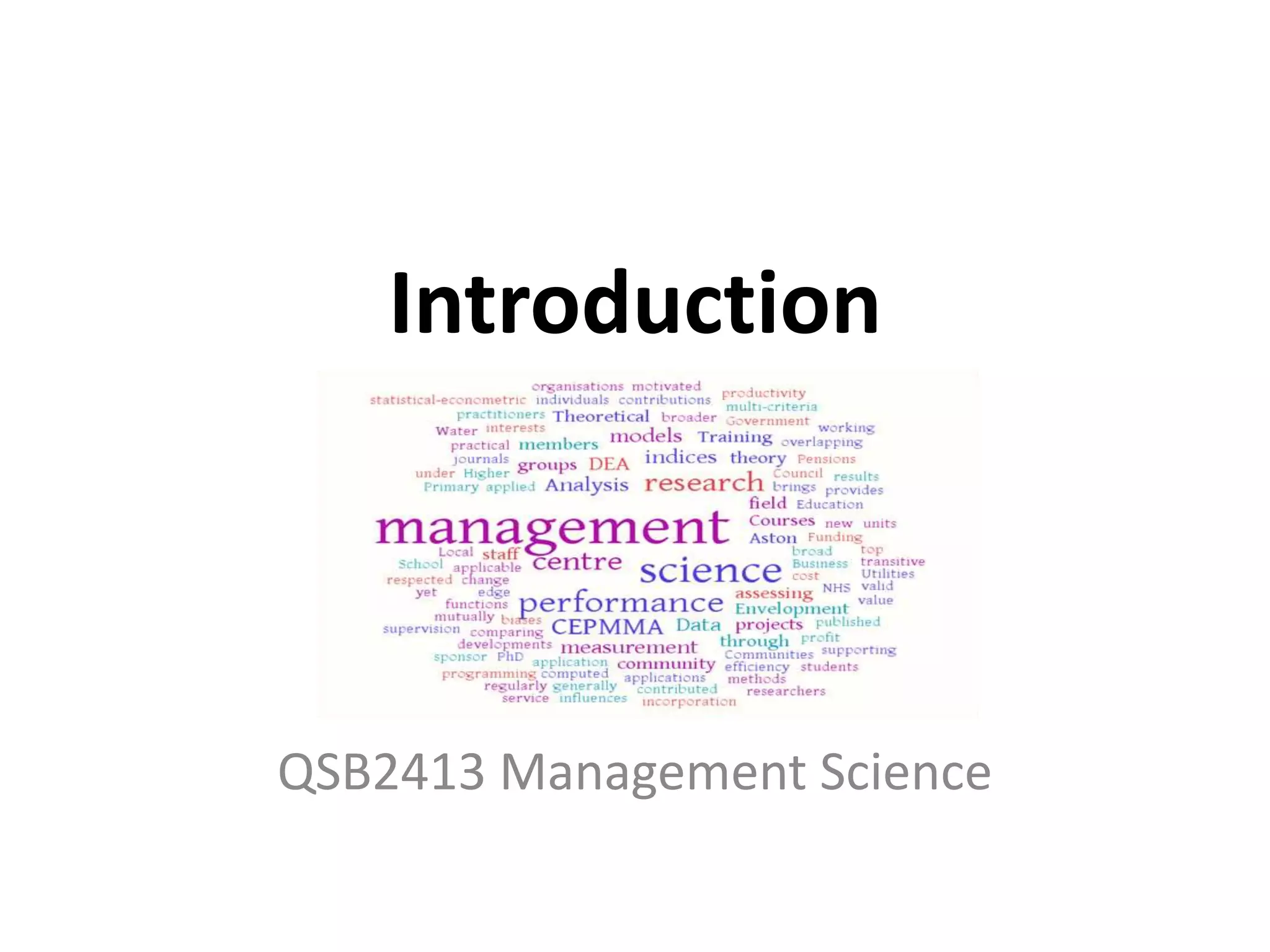
QSB2413 Management Science
Definition
• Management Science (MS) is a discipline that
attempts to aid / support / help / assist
managerial decision making by applying a
scientific approach to managerial problems
that involve quantitative factors.
• MS is concerned with the practical
management of organizations (qualitative
factors in order to deal with quantitative
factors).
Definition
• MS is a whole body of knowledge and
techniques that are based on a scientific
foundation.
• Example of a management scientist must
receive substantial training.
• This training is also is in a whole body of
knowledge and techniques that are based on
the scientific foundations of the discipline.
Definition
• After entering practice, the management
scientist must diagnose a managerial problem
and choose the appropriate MS techniques to
apply in analyzing the problem.
• Then the manager makes the final decision as
to which conclusions from the analysis to
accept.
Operations Research (OR)
• Operations research (OR) is the traditional
name given to the discipline.
• This name is applied because the teams of
scientists in World War II were doing research
on how to manage military operations.
Management Science (MS)
• Management Scientists don’t make decisions, but
managers do.
• A MS study only provides an analysis and
recommendations, based on the quantitative
factors involved in the problem (as input to the
managers).
• Managers find that qualitative factors (intangible
considerations outside MS) are as important as
quantitative factors in making a decision.
Management Science (MS)
• For less extensive managerial problems where
MS can be helpful, the manager may not
choose to consult management scientist and
instead use his or her own basic knowledge of
MS principles to analyze the problem.
• Example, you cannot quantify honesty and
loyalty of your employees.
Management Science (MS)
• MS is based strongly on some scientific fields,
including mathematics and computer science.
• MS team will conduct a systematic
investigation that includes careful data
gathering, developing and testing hypotheses
about the problem (mathematical model) and
applying in the analysis.
• MS team will follow the steps below.
Management Science (MS)
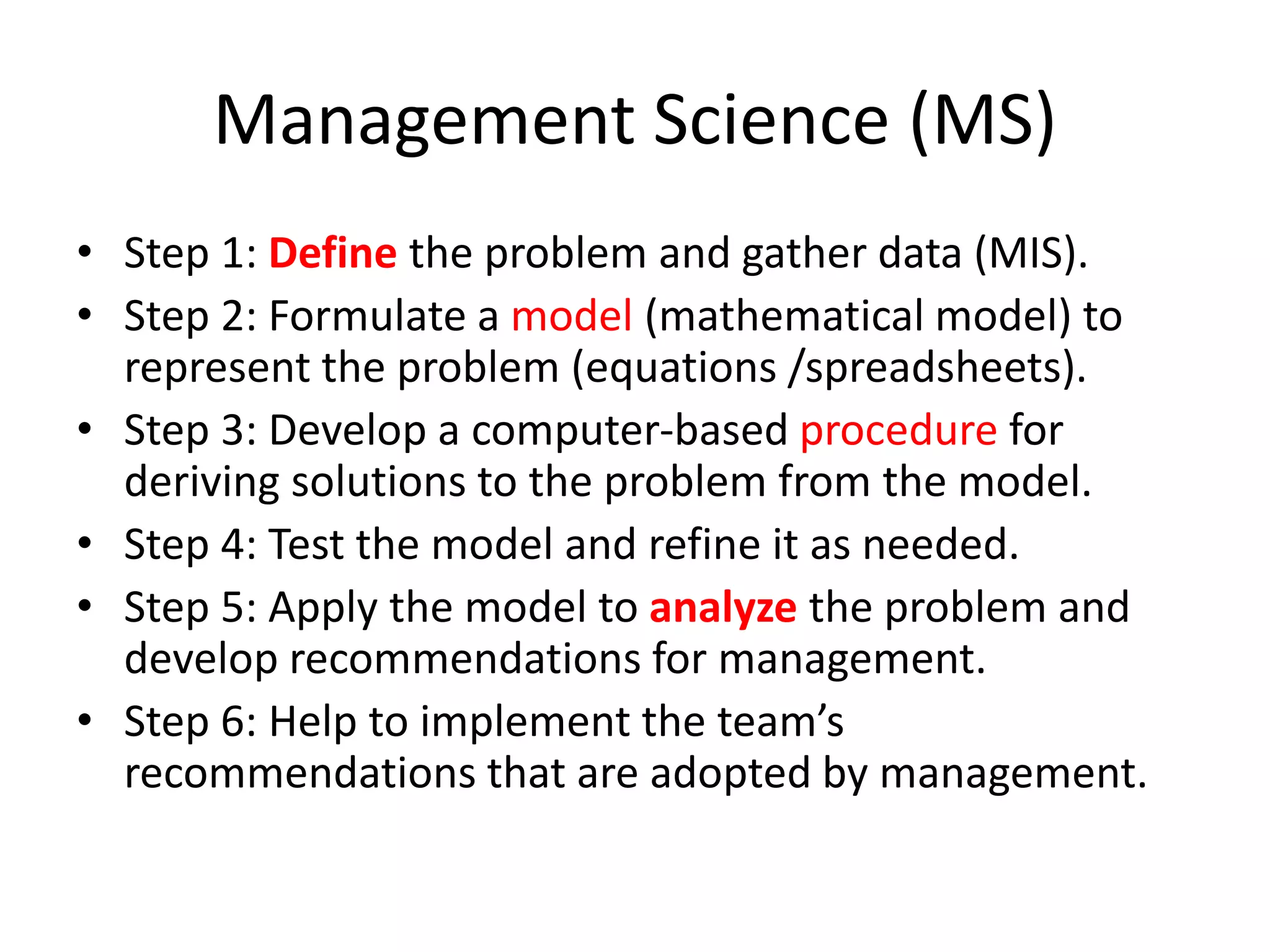
• Step 1: Define the problem and gather data (MIS).
• Step 2: Formulate a model (mathematical model) to
represent the problem (equations /spreadsheets).
• Step 3: Develop a computer-based procedure for
deriving solutions to the problem from the model.
• Step 4: Test the model and refine it as needed.
• Step 5: Apply the model to analyze the problem and
develop recommendations for management.
• Step 6: Help to implement the team’s
recommendations that are adopted by management.
Management Science (MS)
• Many managerial problems revolve around
such quantitative factors as production
quantities, revenues, costs, the amount
available of needed resources, and etc.
• By incorporating these quantitative factors
into a mathematical model and then applying
mathematical procedures to solve the model.
• MS provides a unique way of analyzing
managerial problems.
The impact of MS
• Improving the efficiency of organizations.
• Annual savings in the hundreds of millions of
dollars (e.g. Airline problems – effectively assign
airplanes and crews to flights).
• In health care area, improving management of
health care delivery and operations, decision
making, radiation therapy and clinical diagnosis.
• In military applications, including logistical
planning and war gaming.
Summary
• The onslaught of the computer revolution has
continued to give great impetus / momentum
to its (MS) growth.
• Further impetus now is being provided by the
widespread use of spreadsheet software.
• The software is greatly facilitates the
application of MS by managers and others.
• Managers use the results from MS application
to make decisions in problem solving.
Discussion
• Problem (quantity to produce – decision making
in order to maximize profit).
• Apply mathematical model, e.g. use break- even
analysis (MS approach) to find out the estimated
amount of product X to be produced and sold
(sales forecast). Quantitative factors are fixed
costs, variable costs, revenue and profit.
• Disadvantage of applying equation – possibility
of producing other products will be eliminated.
Discussion 2
• Assume that a construction company named
EcoWorld 2 is planning to build a private
hospital near Kota Damansara with the Eco’s
ideas (focus on environment – landscape).
• Define managerial problems
• Apply MS approach
• Managers make the final decision
Conclusion
• As in any application of MS, a mathematical
model can provide useful guidance.
• But, management needs to make final
decision after considering factors that may not
be included in the model.
• Example, adjusting the sales forecast (quantity
to produce) according to the current needs or
economy situation. (buying power or financial
ability)

MS Lecture 1 introduction

  • 1.
  • 2.
    Definition • Management Science(MS) is a discipline that attempts to aid / support / help / assist managerial decision making by applying a scientific approach to managerial problems that involve quantitative factors. • MS is concerned with the practical management of organizations (qualitative factors in order to deal with quantitative factors).
  • 3.
    Definition • MS isa whole body of knowledge and techniques that are based on a scientific foundation. • Example of a management scientist must receive substantial training. • This training is also is in a whole body of knowledge and techniques that are based on the scientific foundations of the discipline.
  • 4.
    Definition • After enteringpractice, the management scientist must diagnose a managerial problem and choose the appropriate MS techniques to apply in analyzing the problem. • Then the manager makes the final decision as to which conclusions from the analysis to accept.
  • 5.
    Operations Research (OR) •Operations research (OR) is the traditional name given to the discipline. • This name is applied because the teams of scientists in World War II were doing research on how to manage military operations.
  • 6.
    Management Science (MS) •Management Scientists don’t make decisions, but managers do. • A MS study only provides an analysis and recommendations, based on the quantitative factors involved in the problem (as input to the managers). • Managers find that qualitative factors (intangible considerations outside MS) are as important as quantitative factors in making a decision.
  • 7.
    Management Science (MS) •For less extensive managerial problems where MS can be helpful, the manager may not choose to consult management scientist and instead use his or her own basic knowledge of MS principles to analyze the problem. • Example, you cannot quantify honesty and loyalty of your employees.
  • 8.
    Management Science (MS) •MS is based strongly on some scientific fields, including mathematics and computer science. • MS team will conduct a systematic investigation that includes careful data gathering, developing and testing hypotheses about the problem (mathematical model) and applying in the analysis. • MS team will follow the steps below.
  • 9.
    Management Science (MS) •Step 1: Define the problem and gather data (MIS). • Step 2: Formulate a model (mathematical model) to represent the problem (equations /spreadsheets). • Step 3: Develop a computer-based procedure for deriving solutions to the problem from the model. • Step 4: Test the model and refine it as needed. • Step 5: Apply the model to analyze the problem and develop recommendations for management. • Step 6: Help to implement the team’s recommendations that are adopted by management.
  • 10.
    Management Science (MS) •Many managerial problems revolve around such quantitative factors as production quantities, revenues, costs, the amount available of needed resources, and etc. • By incorporating these quantitative factors into a mathematical model and then applying mathematical procedures to solve the model. • MS provides a unique way of analyzing managerial problems.
  • 11.
    The impact ofMS • Improving the efficiency of organizations. • Annual savings in the hundreds of millions of dollars (e.g. Airline problems – effectively assign airplanes and crews to flights). • In health care area, improving management of health care delivery and operations, decision making, radiation therapy and clinical diagnosis. • In military applications, including logistical planning and war gaming.
  • 12.
    Summary • The onslaughtof the computer revolution has continued to give great impetus / momentum to its (MS) growth. • Further impetus now is being provided by the widespread use of spreadsheet software. • The software is greatly facilitates the application of MS by managers and others. • Managers use the results from MS application to make decisions in problem solving.
  • 13.
    Discussion • Problem (quantityto produce – decision making in order to maximize profit). • Apply mathematical model, e.g. use break- even analysis (MS approach) to find out the estimated amount of product X to be produced and sold (sales forecast). Quantitative factors are fixed costs, variable costs, revenue and profit. • Disadvantage of applying equation – possibility of producing other products will be eliminated.
  • 14.
    Discussion 2 • Assumethat a construction company named EcoWorld 2 is planning to build a private hospital near Kota Damansara with the Eco’s ideas (focus on environment – landscape). • Define managerial problems • Apply MS approach • Managers make the final decision
  • 15.
    Conclusion • As inany application of MS, a mathematical model can provide useful guidance. • But, management needs to make final decision after considering factors that may not be included in the model. • Example, adjusting the sales forecast (quantity to produce) according to the current needs or economy situation. (buying power or financial ability)