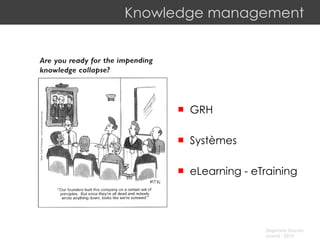
Knowledge management GRH Systèmes eLearning - eTraining
Rendement des champs de maïs http://usda.mannlib.cornell.edu/MannUsda/viewDocumentInfo.do?documentID=1593
Quelques principes de gestion Autonomy An organization is a collection of autonomous professionals. Compensation tied to performance Own performance and group performance Connectivity Work depends critically on the inputs of several collaborators Ubiquity The frontier between home and office, here and  there, vanishes
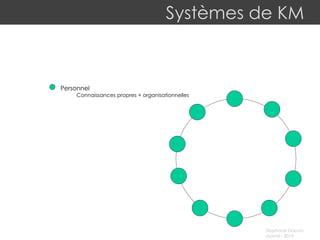
Systèmes de KM Personnel C onnaissances propres + organisationnelles
Systèmes de KM Personnel C onnaissances propres + organisationnelles Connaissances Enregistrements Documents Expertise explicite Expertise tacite Environnement
Systèmes de KM Personnel Savoir propre + organisationnel Connaissances Enregistrements Documents Expertise explicite Expertise tacite Environnement Nouvel employé Formation à l’accès Intégration des nouvelles connaissances Employé sénior Capture de l’expertise
E-Learning vs e-Training E-Learning Apprenant en contrôle Contenu fluide Collaboration Objectif: innover E-Training Instructeur en contrôle Contenu pré-déterminé Automation Objectif : mise à jour
Lectures Hicks, R, R Dattero and S Galup, (2006), "The five-tier knowledge management hierarchy",  Journal of Knowledge Management , 10(1):19-31 Haas, MR and MT Hansen, (2007), "Different knowledge, different benefits: toward a productivity perspective on knowledge sharing in organizations",  Strategic Management Journal , 28(11):1133 Spender, JC, (2008), "Organizational learning and knowledge management: whence and whither?",  Management Learning , 39(2):159 Wong, K, (2005), "Critical success factors for implementing knowledge management in small and medium enterprises",  Industrial Management \& Data Systems , 105(3):261-79 Levy, Moria  (2009) WEB 2.0 implications on knowledge management, Journal of Knowledge Management, 13(1): 120-134
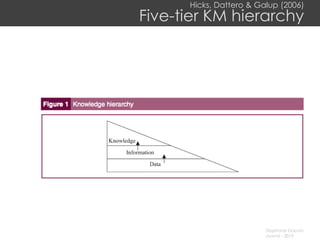
Hicks, Dattero & Galup (2006) Five-tier KM hierarchy Knowledge management promotes an integrated approach to identifying, capturing, retrieving, sharing, and evaluating an enterprise’s information assets. These information assets may include databases, documents, policies and procedures, as well as the un-captured tacit expertise and experience stored in individual workers’ heads (Gartner Group, 1999).
Hicks, Dattero & Galup (2006) Five-tier KM hierarchy
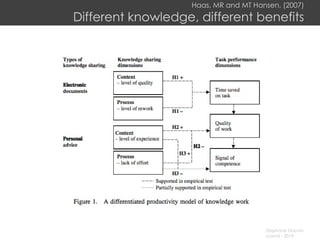
Haas, MR and MT Hansen, (2007) Different knowledge, different benefits
Spender, JC, (2008) Organizational learning and knowledge management: whence and whither?"
Spender, JC, (2008) Organizational learning and knowledge management: whence and whither?" Proposition 1 might be that as long as our theorizing stands on perfect rationality alone, the different aspects of knowledge management will end up as mere subsets of existing disciplines, such as IT or formal decision-making or OT or microeconomics, and there can be no distinct field which is knowledge management’s alone. Proposition 2 is that knowledge management is really about managing knowledge-absences rather than knowledge-assets. Proposition 3 is that if knowledge management is to be about dealing with uncertainty, in Simon’s terms, we necessarily call forth a Model of Man that differs crucially from the model of Rational Man central to most of the management literature and business school discourse. To address the notion of tacit knowledge and skilled practice we cannot rely on a human actor comprising senses and reason alone. Dealing with uncertainty requires us to consider the actor’s imagination too. Proposition 4 is that managing the impact of one’s imagination is about understanding and shaping the constraints on it as it impacts and engages the world. Proposition 5 is that knowledge management is a nascent theory of managing others’ responses to knowledge absences, and at some distance from knowledge management’s avowed focus on managing knowledge assets.
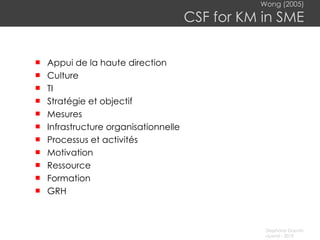
Wong (2005) CSF for KM in SME Appui de la haute direction Culture TI Stratégie et objectif Mesures Infrastructure organisationnelle Processus et activités Motivation Ressource Formation GRH
Levy, Moria  (2009) WEB 2.0 implications on KM Deux applications: Wiki Blogs Trois concepts: RSS (ex – google Reader) Tagging (ex – delicious) Réseaux Sociaux (ex – Facebook / LinkedIn) Outils usuels connaissent peu de succès La discipline est en évolution

SIO6002 - S8

  • 1.
    Knowledge management GRHSystèmes eLearning - eTraining
  • 2.
    Rendement des champsde maïs http://usda.mannlib.cornell.edu/MannUsda/viewDocumentInfo.do?documentID=1593
  • 3.
    Quelques principes degestion Autonomy An organization is a collection of autonomous professionals. Compensation tied to performance Own performance and group performance Connectivity Work depends critically on the inputs of several collaborators Ubiquity The frontier between home and office, here and there, vanishes
  • 4.
    Systèmes de KMPersonnel C onnaissances propres + organisationnelles
  • 5.
    Systèmes de KMPersonnel C onnaissances propres + organisationnelles Connaissances Enregistrements Documents Expertise explicite Expertise tacite Environnement
  • 6.
    Systèmes de KMPersonnel Savoir propre + organisationnel Connaissances Enregistrements Documents Expertise explicite Expertise tacite Environnement Nouvel employé Formation à l’accès Intégration des nouvelles connaissances Employé sénior Capture de l’expertise
  • 7.
    E-Learning vs e-TrainingE-Learning Apprenant en contrôle Contenu fluide Collaboration Objectif: innover E-Training Instructeur en contrôle Contenu pré-déterminé Automation Objectif : mise à jour
  • 8.
    Lectures Hicks, R,R Dattero and S Galup, (2006), "The five-tier knowledge management hierarchy", Journal of Knowledge Management , 10(1):19-31 Haas, MR and MT Hansen, (2007), "Different knowledge, different benefits: toward a productivity perspective on knowledge sharing in organizations", Strategic Management Journal , 28(11):1133 Spender, JC, (2008), "Organizational learning and knowledge management: whence and whither?", Management Learning , 39(2):159 Wong, K, (2005), "Critical success factors for implementing knowledge management in small and medium enterprises", Industrial Management \& Data Systems , 105(3):261-79 Levy, Moria (2009) WEB 2.0 implications on knowledge management, Journal of Knowledge Management, 13(1): 120-134
  • 9.
    Hicks, Dattero &Galup (2006) Five-tier KM hierarchy Knowledge management promotes an integrated approach to identifying, capturing, retrieving, sharing, and evaluating an enterprise’s information assets. These information assets may include databases, documents, policies and procedures, as well as the un-captured tacit expertise and experience stored in individual workers’ heads (Gartner Group, 1999).
  • 10.
    Hicks, Dattero &Galup (2006) Five-tier KM hierarchy
  • 11.
    Hicks, Dattero &Galup (2006) Five-tier KM hierarchy
  • 12.
    Haas, MR andMT Hansen, (2007) Different knowledge, different benefits
  • 13.
    Haas, MR andMT Hansen, (2007) Different knowledge, different benefits
  • 14.
    Spender, JC, (2008)Organizational learning and knowledge management: whence and whither?"
  • 15.
    Spender, JC, (2008)Organizational learning and knowledge management: whence and whither?" Proposition 1 might be that as long as our theorizing stands on perfect rationality alone, the different aspects of knowledge management will end up as mere subsets of existing disciplines, such as IT or formal decision-making or OT or microeconomics, and there can be no distinct field which is knowledge management’s alone. Proposition 2 is that knowledge management is really about managing knowledge-absences rather than knowledge-assets. Proposition 3 is that if knowledge management is to be about dealing with uncertainty, in Simon’s terms, we necessarily call forth a Model of Man that differs crucially from the model of Rational Man central to most of the management literature and business school discourse. To address the notion of tacit knowledge and skilled practice we cannot rely on a human actor comprising senses and reason alone. Dealing with uncertainty requires us to consider the actor’s imagination too. Proposition 4 is that managing the impact of one’s imagination is about understanding and shaping the constraints on it as it impacts and engages the world. Proposition 5 is that knowledge management is a nascent theory of managing others’ responses to knowledge absences, and at some distance from knowledge management’s avowed focus on managing knowledge assets.
  • 16.
    Wong (2005) CSFfor KM in SME Appui de la haute direction Culture TI Stratégie et objectif Mesures Infrastructure organisationnelle Processus et activités Motivation Ressource Formation GRH
  • 17.
    Levy, Moria (2009) WEB 2.0 implications on KM Deux applications: Wiki Blogs Trois concepts: RSS (ex – google Reader) Tagging (ex – delicious) Réseaux Sociaux (ex – Facebook / LinkedIn) Outils usuels connaissent peu de succès La discipline est en évolution