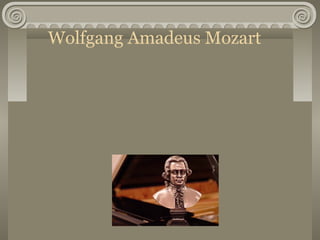
Wolfgang Amadeus Mozart
Born in Salzburg
7th
child of Leopola and
Anna Maria
only he and sister Nannerl
survived infancy
Leopold Mozart
Very respected composer
and violinist
Leopold Mozart, 1765.
First
composition
age 5
transcribed
by Leopold
Later composition age 6
Mozart played for
kings and queens.
This portrait of
him was painted in
1762, when he was
six years old.
Children during Mozart’s time dressed
just like adults. He just finished playing
for Empress Maria Theresa of Austria.
The Mozart Family
As Mozart grew
older, his
reputation spread.
Not only was he a
gifted musician,
but he could also
compose his own
music.
Mozart at 14, 1770.
Mozart
Able to hear complete pieces in
his head
Capability for output
10 years:
8 Symphonies
17 Piano Concertos
6 Operas
Clarinet quartet and quintet
Requiem Mass
11 String Quartets
5 String Quintets
Many Individual Works
“Though it be long, the work is
complete and finished in my mind. I
take out of the bag of my memory
what has previously been collected
into it. For this reason the committing
to paper is done quickly enough.”
— Mozart
“What a delight this is I cannot tell —
all this producing takes place in a
pleasing, lively dream.”
— Mozart
“People make a mistake who think
that my art has come easily to me.
Nobody has devoted so much time
and thought to composition as I.
There is not a famous master whose
work I have not studied over and
over.”
— Mozart
“[My pay is] too much for what I do,
too little for what I could do.”
— Mozart
Mozart’s Music
Simple melodies
Contrasting moods
Rich orchestration
Perfected the serenade
Mozart’s Music
Favored the piano
Concertos written for his performance
Later symphonies considered his best
Operas
Mozart 2 years before
his death in 1777.
Mozart’s music
was meant to be
fun and
entertaining.
Rondo alla Turka
Piano Concerto in A Major
K.488
First movement, Allegro 1786
sold to Prince von Furstenburg
combined elements of sonata and
ritornello form
Mozart & Opera
Opera problems Mozart’s solutions:
1. “stock”characters
2. plots about mythology,
gods, aristocracy
3. “stop & go”
(aria) (recit.)
4. not cohesive (e.g.,
sinfonia)
characters have real, believable
personalities
plots about real-life middle class
characters
continuous flow
arias and recitatives blended together
style, orchestration, harmony,
melody--all contribute to setting
mood & adding depth to characters
Don Giovanni
"The Best Opera Ever Written"
- Richard Wagner
Libretto
By Court poet – Lorenzo Da Ponte (like
Cosi and Figaro)
Based on a very well known existing
story.
Don Juan is a stock character.
Da Ponte and Mozart worked closely
together on the opera right up to the
performance.
Da PonteDa Ponte
used contemporary
characters, not mythological
figures or ancient history
from Rome or Greece
(although he did a few of
those, too)
biting social commentary:
the decadent aristocracy is
compared to the normal,
happy, healthy lust and love
of the common folk
recitative still used
some in German with spoken
dialogue
-- all voice ranges used (instead of the
Baroque’s treble + bass preference)
-- ensembles (groups of solo voices) now
contrasted with arias and recitative
Don Giovanni
Italian comic opera
Don Juan as anti-hero –
critique of aristocracy
Rarely performed in the 1800s –
now regarded as one of Mozart’s
finest operas
1787
Don Giovanni 1787
A comic opera (opera buffa) in 2 acts.
Commissioned by the Prague Opera
company after the success in Prague of
Marriage of Figaro.
Planned as entertainment for visit of
newlywed niece of Emperor – the
archduchess Maria Theresia and Prince
Anton Clemens of Saxony – 14 October
1787.
The Cast
As always the singers determined the nature of
the music – Mozart had to write to their
capabilities. He knew them all except one as he
had conducted them in Figaro.
Don Giovanni – Luigi Bassi had been Count
Almaviva – a fiery Italian `very handsome and
very stupid’ – 22 years old, an excellent mimic
and a very good actor.
The cast requires 3 females (all sopranos), 5
males (3 basses, baritone and tenor), plus
chorus. This small cast reflects the Prague
company exactly.
Characters - Male
Don Giovanni – a cavalier and seducer of
women. An ambivalent role that can be played
a number of ways. Needs a great voice.
Leporello – servant of Don – his assistant in
crime who unlike Don has some reservations
about their activities.
Don Ottavio – fiance of Donna Anna.
Masetto – country peasant lover of Zerlina
Commendatore – elderly knight and man of
honour.
Characters Female
Donna Anna – daughter of
Commendatore and betrothed to
Ottavio.
Donna Elvira a highborn lady from
Burgos – used and abandoned by Don.
Zerlino – a country girl who Don
attempts to seduce.
Synopsis
ACT I
Scene 1. The garden of the Commendatore's house
A disgruntled Leporello keeps watch while Don Giovanni tries to add Donna Anna to his list of
conquests. Don Giovanni runs from the house, followed by Donna Anna, who is trying to unmask him
and calling for help. Her father, coming to her aid, challenges Don Giovanni and is killed by him. Don
Giovanni and Leporello make their escape before Donna Anna reappears with her betrothed, Don
Ottavio, whom she calls on to avenge her dead father.
Scene 2. A street near an inn
Don Giovanni and Leporello come upon Donna Elvira, who has been seduced and abandoned by Don
Giovanni and who is pursuing him. Don Giovanni slips away, leaving Leporello to explain to her that
she is but one of many.
Scene 3. The countryside near Don Giovanni's house
Don Giovanni and Leporello come upon a peasant wedding. Don Giovanni orders Leporello to distract
Masetto, the bridegroom, while he attempts to seduce the bride, Zerlina. He is interrupted by Donna
Elvira, who warns Zerlina and persuades her to come away.
Donna Anna and Don Ottavio, not realising that Don Giovanni is the villain they are looking for, ask
for his help. Elvira appears again and accuses Giovanni of faithlessness, and he tries to convince the
others that she is mad. As he leaves, something in his voice and manner convinces Anna that he is her
attacker and the murderer of her father.
Leporello reports to his master that he has all the peasants feasting and drinking, and Giovanni orders
him to ply them wine, as he intends to add to his list of conquests.
Scene 4. The garden of Don Giovanni's house
Zerlina manages to convince the reproachful Masetto that she has done nothing wrong, but he is again
suspicious when she is alarmed by Don Giovanni's voice. Another attempt on Zerlina foiled by
Masetto's presence, Don Giovanni leads the couple into the house.
Donna Elvira, Donna Anna and Don Ottavio return wearing masks. Accepting Leporello's invitation to
join the party, they hope this will make their revenge easier.
Scene 5. A ballroom in Don Giovanni's house
As the guests feast, dance and sing, Leporello distracts Masetto again and Don Giovanni lures Zerlina
into another room. When she screams for help Giovanni accuses Leporello. But Elvira, Anna and
Ottavio reveal themselves and confront him with their knowledge of his villainy. He makes his escape
ACT II
Scene 1. A street near an inn
Don Giovanni soothes Leporello's indignation with money. He has his eyes on Donna Elvira's maid
and changes clothes with Leporello so he will look like one of her class. Elvira appears at a window
and laments her continuing love for Don Giovanni. He answers from the shadows that he still loves
her, while Leporello, dressed in his clothes, mimes in the street. Elvira comes down and Don
Giovanni instructs the disguised Leporello to lead her away while he serenades the maid.
Masetto and his friends appear, armed and in search of Don Giovanni, who, pretending to be
Leporello, sends the villagers off in different directions, then catches Masetto off guard and beats
him. Zerlina finds Masetto and comforts him.
Scene 2. A courtyard near Donna Anna's house
Leporello has not managed to free himself from Donna Elvira, who still takes him for his master.
Donna Anna, Don Ottavio, Zerlina and Masetto find them and accuse Leporello of Don Giovanni's
crimes. Elvira tries in vain to intercede for her "husband" but Leporello reveals his identity, pleads
innocence and succeeds in making a getaway. Don Ottavio's promises to avenge his beloved's
wrongs.
Scene 3. A cemetery, where the Commendatore is buried
Don Giovanni and Leporello have escaped from their pursuers. Giovanni's narrative of a girl who
took him for Leporello is interrupted by the voice of the statue of the Commendatore reproving him
for his levity and libertinism. Undeterred, he orders the terrified Leporello to invite the
Commendatore to dinner. The statue accepts.
Scene 4. A room in Donna Anna's house
Don Ottavio tries to calm Donna's Anna's grief by reminding her that they will soon be married,
but she begs to him to delay their wedding.
Scene 5. A banquet hall in Don Giovanni's villa
Don Giovanni is interrupted at supper by Donna Elvira, who wants him to change his ways. He
laughs at her and she leaves, but runs back screaming. Investigating, Leporello returns in terror:
the statue has come. The Commendatore enters and, refusing to touch earthly food, invites Don
Giovanni to dine with him. Don Giovanni accepts and is engulfed by the flames of hell, steadfastly
refusing to repent.
The other characters sing an epilogue about how the wicked receive their just deserts.
First Performance
29 October 1787 beginning at 7pm and planned to end
at 9.30.
Mozart had composed the overture the night before it
was to be rehearsed.
Mozart greeted with great cheers on entering pit to
conduct at the keyboard.
A great success and a long run of performances.
Mozart remained in Prague until 13th
November.
Boldini wanted Mozart to stay and write another but
Mozart had to return to Vienna.
Prague was always a great supporter of Mozart and
Mozart remained very fond of the city to the end.
Vienna
The success of Don Giovanni became known in Vienna
and helped Mozart get Gluck’s job as Kammermusikus
to the Emperor.
Command for Vienna performance by Emperor – 7th
May 1788 in Burgtheater.
Joseph II already busy on battlefield of second Turkish
War.
Some alterations to arias and scenes to accommodate
Viennese taste and singers available.
Mozart conducted first three performances. Only
gradually did Vienna warm to the work.
Vienna and Prague versions exist – the Prague is
generally preferred.
Terror and Effects.
Don Giovanni is notable for the introduction of
terror into opera. Naked fear.
To do this he uses Trombones – always
associated with the underworld. They do not
appear until Commendatore statue appears on
stage to condemn Don Giovanni.
At the end of Act I three orchestras play
simultaneously on stage. First band plays
Minuet in G in ¾ for oboes, horns and strings;
then orchestra II turn up and play
Contradanse in G in 2/4 time; orchestra three
Keys
As always the opera is carefully constructed in
terms of key relationships.
D is the opera key – minor at first (overture
and statue scene at end). Overture and opera
end in D major.
Second Act leads from G major to A major, D
major, F major, E flat (sextet). Then to D
major for trumpets and drums. Then to D
minor punishment key for murder. Back to D
major then D minor for end of sextet in E flat.
Liberty
Act I scene 20 Don’s grant reception in the Hall. After
introductory scene with Don, Leporello, Masetto and
Zerlina – key changes to C major for entry of Don
Ottavio, Donna Anna and Donna Elvira (all masked).
After greeting all Don sings `E aperto tutti, a tutti
quanti, viva, viva la liberta’ (it is open to everyone, long
live liberty).
Every one seizes the phrase and it turns into triumphal
march with trumpets and drums
IS this Da Ponte’s personal tribute to Joseph II and his
ideas on personal freedom and enlightenment.
Don Giovanni--Deep thots
1. Describe Don Giovanni’s character & behavior.
2. How does the opera treat the Don or portray his behavior?
Is he portrayed as evil or just mischievous?
3. Does the Don repent? Why is this significant? How does
this contrast with thinking in the Baroque era?
4. How does Don Giovanni reflect the culture, & spirit of the
classical era?
5. What elements of Don Giovanni conflict with
enlightenment thinking?
6. Do you think Don Giovanni would have been more popular
or less popular with Baroque society than it was in the 18th
century? Defend your answer.
This portrait, painted after Mozart’s
death, is said to look the most like
him. It was painted in 1819.
Mozart was 36
years old when
he died in 1791.
In his short life
he wrote over
600
compositions.
Mozart died
penniless despite
his enormous
talent. One of the
greatest composers
the world has ever
known is buried in
an unmarked
grave.
Know about Mozart:
his problems w/ patronage
unusual method of composing
his development of opera
Mozart’s Symphonies
His first symphony was written in 1788.
Rameau had died, Beethoven was 18.
During this quarter century many
changes came to the symphony.
Changes in the Classical
Symphony
Shift in the function and valuation of the
symphony.
Move from introductions to theatre,
plays, operas, civic events.
Move to a piece intrinsic in itself.
Symphony for Symphony’s sake.
K. 550 Symphony in G minor,
No. 40
July 25, 1788
One of the last and most beautiful of the
master.
Labeled “Romantic” by the people of the time
for
Intensity
Chromaticism
Unconventionality
Thematic development
Abundance of Ideas
Ambiguity.
A Roadmap for Form: The
First Movement
Sonata allegro.
Exposition.
Theme for violins in Gminor.
Three note motive that is prime for development,
sequence.
Transition coupled with crescendo to go into the
second theme in Bflat major.
Build up of tension.
Codetta keeps the listener in the contrasting key.
Development:
Develops the three note motive from the
beginning.
Changes melody.
Combines motives.
Sequences downward.
Inversion of motives.
Build up of tension.
Recapitulation
Follows the exposition.
G-minor remains the home key.
Tender… this is a change from convention. Most
composers would go to G major just to end the
work in a triumphant sound.
The Classical Concerto
Solo Concerto: a concerto which displays
the opposition of a solo and the tutti
orchestra.
Three Movements
Fast
Slow
Fast
ABA
Cadenza: a solo passage found in solo concerti.
This passage is either written out or
improvised. It occurs toward the end of a
movement and displays themes from the
movement presented in a fantasy of
improvisation.
The First Movement
Transforms the ritornello form of the
Baroque period to a Sonata Allegro in
the Classical Period.
Theme I is usually orchestral
Theme II uses Theme I and new material
by the soloist.
Development is the tension building area.
Recapitulation in the home key:
symmetry!
The Second Movement
Slow and Lyrical
Key near the tonic but not the tonic.
Not so much distance from the tonic.
Hymn-like character by the soloist.
Third Movement
Allegro Molto (very fast) Presto (even
faster)
Grand Finale
Rondo form: probably shorter than the
first movement.
Cadenza is usually found here also.
Mozart Piano Concerto in G
Major, K. 453
1784 Mozart wrote 6 piano concertos. This
one is written for a 19 year old student,
Barbara von Ployer.
Mozart’s concerti are considered the watershed
of classical concerti. Grand flourishes as well as
intimate conversations make up this style in
Mozart’s mind.
Notice elements present from chamber music as
well as symphony.
Intimate conversation.
Laughing strings.
Mozart Piano Concerto in G
Major, K. 453
March-like character.
Grand contrasts.
Notice the similarities to the symphony.
Use of the woodwinds for coloration.
Use of classical forms: ritornello – sonata
allegro – rondo.
Dazzling writing for the piano as well as
for the orchestra.
Other Forms: Minuet and Trio
Minuet: A Trio B Minuet A
A B A C D C A B A
A B C D A B
The Sonata Cycle
Movement I: Long Dramatic, Sonata Form:
Allegro fast
Movement II: Slow and lyrical, Theme and
Variations or ABA. Andante, Adagio, or Largo
Movement III: Minuet and Trio (18thC.)
Minuet and Scherzo (19thC.), Allegretto or
Allegro
Movement IV: 18th
C = lively and happy ending,
Sonata Allegro, Sonata Rondo, Theme and
Variations. Very Fast. Allegro, Vivace, Presto.
Grand Finale 19th
C. Triumph
The Marriage of Figaro
- celebration of “common people” v. the
decadent aristocracy
Chardin
The Prayer before Meal
1744
Bourgeois (Genre)
Mozart viewing exampleMozart viewing example
Cosi fan Tutte (they all do it)
3 pairs of voices – symmetry of design appeals
to the Classical mind
Mozart listening exampleMozart listening example
-- finale from Act II of The
Marriage of Figaro
-- an ensemble scene (six
voices)
-- contrasting emotions
presented simultaneously
(compare that to the
Baroque ideal aesthetic of
Affect, one mood or
emotion per piece)

Mozart

  • 1.
  • 2.
    Wolfgang Amadeus Mozart Bornin Salzburg 7th child of Leopola and Anna Maria only he and sister Nannerl survived infancy
  • 3.
    Leopold Mozart Very respectedcomposer and violinist Leopold Mozart, 1765.
  • 4.
  • 5.
    Mozart played for kingsand queens. This portrait of him was painted in 1762, when he was six years old. Children during Mozart’s time dressed just like adults. He just finished playing for Empress Maria Theresa of Austria.
  • 6.
  • 7.
    As Mozart grew older,his reputation spread. Not only was he a gifted musician, but he could also compose his own music. Mozart at 14, 1770.
  • 8.
    Mozart Able to hearcomplete pieces in his head Capability for output 10 years: 8 Symphonies 17 Piano Concertos 6 Operas Clarinet quartet and quintet Requiem Mass 11 String Quartets 5 String Quintets Many Individual Works
  • 9.
    “Though it belong, the work is complete and finished in my mind. I take out of the bag of my memory what has previously been collected into it. For this reason the committing to paper is done quickly enough.” — Mozart
  • 10.
    “What a delightthis is I cannot tell — all this producing takes place in a pleasing, lively dream.” — Mozart
  • 13.
    “People make amistake who think that my art has come easily to me. Nobody has devoted so much time and thought to composition as I. There is not a famous master whose work I have not studied over and over.” — Mozart
  • 14.
    “[My pay is]too much for what I do, too little for what I could do.” — Mozart
  • 15.
    Mozart’s Music Simple melodies Contrastingmoods Rich orchestration Perfected the serenade
  • 16.
    Mozart’s Music Favored thepiano Concertos written for his performance Later symphonies considered his best Operas
  • 17.
    Mozart 2 yearsbefore his death in 1777. Mozart’s music was meant to be fun and entertaining. Rondo alla Turka
  • 18.
    Piano Concerto inA Major K.488 First movement, Allegro 1786 sold to Prince von Furstenburg combined elements of sonata and ritornello form
  • 19.
    Mozart & Opera Operaproblems Mozart’s solutions: 1. “stock”characters 2. plots about mythology, gods, aristocracy 3. “stop & go” (aria) (recit.) 4. not cohesive (e.g., sinfonia) characters have real, believable personalities plots about real-life middle class characters continuous flow arias and recitatives blended together style, orchestration, harmony, melody--all contribute to setting mood & adding depth to characters
  • 20.
    Don Giovanni "The BestOpera Ever Written" - Richard Wagner
  • 21.
    Libretto By Court poet– Lorenzo Da Ponte (like Cosi and Figaro) Based on a very well known existing story. Don Juan is a stock character. Da Ponte and Mozart worked closely together on the opera right up to the performance.
  • 22.
    Da PonteDa Ponte usedcontemporary characters, not mythological figures or ancient history from Rome or Greece (although he did a few of those, too) biting social commentary: the decadent aristocracy is compared to the normal, happy, healthy lust and love of the common folk recitative still used some in German with spoken dialogue
  • 23.
    -- all voiceranges used (instead of the Baroque’s treble + bass preference) -- ensembles (groups of solo voices) now contrasted with arias and recitative
  • 24.
    Don Giovanni Italian comicopera Don Juan as anti-hero – critique of aristocracy Rarely performed in the 1800s – now regarded as one of Mozart’s finest operas 1787
  • 25.
    Don Giovanni 1787 Acomic opera (opera buffa) in 2 acts. Commissioned by the Prague Opera company after the success in Prague of Marriage of Figaro. Planned as entertainment for visit of newlywed niece of Emperor – the archduchess Maria Theresia and Prince Anton Clemens of Saxony – 14 October 1787.
  • 26.
    The Cast As alwaysthe singers determined the nature of the music – Mozart had to write to their capabilities. He knew them all except one as he had conducted them in Figaro. Don Giovanni – Luigi Bassi had been Count Almaviva – a fiery Italian `very handsome and very stupid’ – 22 years old, an excellent mimic and a very good actor. The cast requires 3 females (all sopranos), 5 males (3 basses, baritone and tenor), plus chorus. This small cast reflects the Prague company exactly.
  • 27.
    Characters - Male DonGiovanni – a cavalier and seducer of women. An ambivalent role that can be played a number of ways. Needs a great voice. Leporello – servant of Don – his assistant in crime who unlike Don has some reservations about their activities. Don Ottavio – fiance of Donna Anna. Masetto – country peasant lover of Zerlina Commendatore – elderly knight and man of honour.
  • 28.
    Characters Female Donna Anna– daughter of Commendatore and betrothed to Ottavio. Donna Elvira a highborn lady from Burgos – used and abandoned by Don. Zerlino – a country girl who Don attempts to seduce.
  • 29.
    Synopsis ACT I Scene 1.The garden of the Commendatore's house A disgruntled Leporello keeps watch while Don Giovanni tries to add Donna Anna to his list of conquests. Don Giovanni runs from the house, followed by Donna Anna, who is trying to unmask him and calling for help. Her father, coming to her aid, challenges Don Giovanni and is killed by him. Don Giovanni and Leporello make their escape before Donna Anna reappears with her betrothed, Don Ottavio, whom she calls on to avenge her dead father. Scene 2. A street near an inn Don Giovanni and Leporello come upon Donna Elvira, who has been seduced and abandoned by Don Giovanni and who is pursuing him. Don Giovanni slips away, leaving Leporello to explain to her that she is but one of many. Scene 3. The countryside near Don Giovanni's house Don Giovanni and Leporello come upon a peasant wedding. Don Giovanni orders Leporello to distract Masetto, the bridegroom, while he attempts to seduce the bride, Zerlina. He is interrupted by Donna Elvira, who warns Zerlina and persuades her to come away. Donna Anna and Don Ottavio, not realising that Don Giovanni is the villain they are looking for, ask for his help. Elvira appears again and accuses Giovanni of faithlessness, and he tries to convince the others that she is mad. As he leaves, something in his voice and manner convinces Anna that he is her attacker and the murderer of her father. Leporello reports to his master that he has all the peasants feasting and drinking, and Giovanni orders him to ply them wine, as he intends to add to his list of conquests. Scene 4. The garden of Don Giovanni's house Zerlina manages to convince the reproachful Masetto that she has done nothing wrong, but he is again suspicious when she is alarmed by Don Giovanni's voice. Another attempt on Zerlina foiled by Masetto's presence, Don Giovanni leads the couple into the house. Donna Elvira, Donna Anna and Don Ottavio return wearing masks. Accepting Leporello's invitation to join the party, they hope this will make their revenge easier. Scene 5. A ballroom in Don Giovanni's house As the guests feast, dance and sing, Leporello distracts Masetto again and Don Giovanni lures Zerlina into another room. When she screams for help Giovanni accuses Leporello. But Elvira, Anna and Ottavio reveal themselves and confront him with their knowledge of his villainy. He makes his escape
  • 30.
    ACT II Scene 1.A street near an inn Don Giovanni soothes Leporello's indignation with money. He has his eyes on Donna Elvira's maid and changes clothes with Leporello so he will look like one of her class. Elvira appears at a window and laments her continuing love for Don Giovanni. He answers from the shadows that he still loves her, while Leporello, dressed in his clothes, mimes in the street. Elvira comes down and Don Giovanni instructs the disguised Leporello to lead her away while he serenades the maid. Masetto and his friends appear, armed and in search of Don Giovanni, who, pretending to be Leporello, sends the villagers off in different directions, then catches Masetto off guard and beats him. Zerlina finds Masetto and comforts him. Scene 2. A courtyard near Donna Anna's house Leporello has not managed to free himself from Donna Elvira, who still takes him for his master. Donna Anna, Don Ottavio, Zerlina and Masetto find them and accuse Leporello of Don Giovanni's crimes. Elvira tries in vain to intercede for her "husband" but Leporello reveals his identity, pleads innocence and succeeds in making a getaway. Don Ottavio's promises to avenge his beloved's wrongs. Scene 3. A cemetery, where the Commendatore is buried Don Giovanni and Leporello have escaped from their pursuers. Giovanni's narrative of a girl who took him for Leporello is interrupted by the voice of the statue of the Commendatore reproving him for his levity and libertinism. Undeterred, he orders the terrified Leporello to invite the Commendatore to dinner. The statue accepts. Scene 4. A room in Donna Anna's house Don Ottavio tries to calm Donna's Anna's grief by reminding her that they will soon be married, but she begs to him to delay their wedding. Scene 5. A banquet hall in Don Giovanni's villa Don Giovanni is interrupted at supper by Donna Elvira, who wants him to change his ways. He laughs at her and she leaves, but runs back screaming. Investigating, Leporello returns in terror: the statue has come. The Commendatore enters and, refusing to touch earthly food, invites Don Giovanni to dine with him. Don Giovanni accepts and is engulfed by the flames of hell, steadfastly refusing to repent. The other characters sing an epilogue about how the wicked receive their just deserts.
  • 31.
    First Performance 29 October1787 beginning at 7pm and planned to end at 9.30. Mozart had composed the overture the night before it was to be rehearsed. Mozart greeted with great cheers on entering pit to conduct at the keyboard. A great success and a long run of performances. Mozart remained in Prague until 13th November. Boldini wanted Mozart to stay and write another but Mozart had to return to Vienna. Prague was always a great supporter of Mozart and Mozart remained very fond of the city to the end.
  • 32.
    Vienna The success ofDon Giovanni became known in Vienna and helped Mozart get Gluck’s job as Kammermusikus to the Emperor. Command for Vienna performance by Emperor – 7th May 1788 in Burgtheater. Joseph II already busy on battlefield of second Turkish War. Some alterations to arias and scenes to accommodate Viennese taste and singers available. Mozart conducted first three performances. Only gradually did Vienna warm to the work. Vienna and Prague versions exist – the Prague is generally preferred.
  • 33.
    Terror and Effects. DonGiovanni is notable for the introduction of terror into opera. Naked fear. To do this he uses Trombones – always associated with the underworld. They do not appear until Commendatore statue appears on stage to condemn Don Giovanni. At the end of Act I three orchestras play simultaneously on stage. First band plays Minuet in G in ¾ for oboes, horns and strings; then orchestra II turn up and play Contradanse in G in 2/4 time; orchestra three
  • 34.
    Keys As always theopera is carefully constructed in terms of key relationships. D is the opera key – minor at first (overture and statue scene at end). Overture and opera end in D major. Second Act leads from G major to A major, D major, F major, E flat (sextet). Then to D major for trumpets and drums. Then to D minor punishment key for murder. Back to D major then D minor for end of sextet in E flat.
  • 35.
    Liberty Act I scene20 Don’s grant reception in the Hall. After introductory scene with Don, Leporello, Masetto and Zerlina – key changes to C major for entry of Don Ottavio, Donna Anna and Donna Elvira (all masked). After greeting all Don sings `E aperto tutti, a tutti quanti, viva, viva la liberta’ (it is open to everyone, long live liberty). Every one seizes the phrase and it turns into triumphal march with trumpets and drums IS this Da Ponte’s personal tribute to Joseph II and his ideas on personal freedom and enlightenment.
  • 36.
    Don Giovanni--Deep thots 1.Describe Don Giovanni’s character & behavior. 2. How does the opera treat the Don or portray his behavior? Is he portrayed as evil or just mischievous? 3. Does the Don repent? Why is this significant? How does this contrast with thinking in the Baroque era? 4. How does Don Giovanni reflect the culture, & spirit of the classical era? 5. What elements of Don Giovanni conflict with enlightenment thinking? 6. Do you think Don Giovanni would have been more popular or less popular with Baroque society than it was in the 18th century? Defend your answer.
  • 37.
    This portrait, paintedafter Mozart’s death, is said to look the most like him. It was painted in 1819. Mozart was 36 years old when he died in 1791. In his short life he wrote over 600 compositions.
  • 38.
    Mozart died penniless despite hisenormous talent. One of the greatest composers the world has ever known is buried in an unmarked grave.
  • 40.
    Know about Mozart: hisproblems w/ patronage unusual method of composing his development of opera
  • 41.
    Mozart’s Symphonies His firstsymphony was written in 1788. Rameau had died, Beethoven was 18. During this quarter century many changes came to the symphony.
  • 42.
    Changes in theClassical Symphony Shift in the function and valuation of the symphony. Move from introductions to theatre, plays, operas, civic events. Move to a piece intrinsic in itself. Symphony for Symphony’s sake.
  • 43.
    K. 550 Symphonyin G minor, No. 40 July 25, 1788 One of the last and most beautiful of the master. Labeled “Romantic” by the people of the time for Intensity Chromaticism Unconventionality Thematic development Abundance of Ideas Ambiguity.
  • 44.
    A Roadmap forForm: The First Movement Sonata allegro. Exposition. Theme for violins in Gminor. Three note motive that is prime for development, sequence. Transition coupled with crescendo to go into the second theme in Bflat major. Build up of tension. Codetta keeps the listener in the contrasting key.
  • 45.
    Development: Develops the threenote motive from the beginning. Changes melody. Combines motives. Sequences downward. Inversion of motives. Build up of tension.
  • 46.
    Recapitulation Follows the exposition. G-minorremains the home key. Tender… this is a change from convention. Most composers would go to G major just to end the work in a triumphant sound.
  • 47.
    The Classical Concerto SoloConcerto: a concerto which displays the opposition of a solo and the tutti orchestra.
  • 48.
    Three Movements Fast Slow Fast ABA Cadenza: asolo passage found in solo concerti. This passage is either written out or improvised. It occurs toward the end of a movement and displays themes from the movement presented in a fantasy of improvisation.
  • 49.
    The First Movement Transformsthe ritornello form of the Baroque period to a Sonata Allegro in the Classical Period. Theme I is usually orchestral Theme II uses Theme I and new material by the soloist. Development is the tension building area. Recapitulation in the home key: symmetry!
  • 50.
    The Second Movement Slowand Lyrical Key near the tonic but not the tonic. Not so much distance from the tonic. Hymn-like character by the soloist.
  • 51.
    Third Movement Allegro Molto(very fast) Presto (even faster) Grand Finale Rondo form: probably shorter than the first movement. Cadenza is usually found here also.
  • 52.
    Mozart Piano Concertoin G Major, K. 453 1784 Mozart wrote 6 piano concertos. This one is written for a 19 year old student, Barbara von Ployer. Mozart’s concerti are considered the watershed of classical concerti. Grand flourishes as well as intimate conversations make up this style in Mozart’s mind. Notice elements present from chamber music as well as symphony. Intimate conversation. Laughing strings.
  • 53.
    Mozart Piano Concertoin G Major, K. 453 March-like character. Grand contrasts. Notice the similarities to the symphony. Use of the woodwinds for coloration. Use of classical forms: ritornello – sonata allegro – rondo. Dazzling writing for the piano as well as for the orchestra.
  • 54.
    Other Forms: Minuetand Trio Minuet: A Trio B Minuet A A B A C D C A B A A B C D A B
  • 55.
    The Sonata Cycle MovementI: Long Dramatic, Sonata Form: Allegro fast Movement II: Slow and lyrical, Theme and Variations or ABA. Andante, Adagio, or Largo Movement III: Minuet and Trio (18thC.) Minuet and Scherzo (19thC.), Allegretto or Allegro Movement IV: 18th C = lively and happy ending, Sonata Allegro, Sonata Rondo, Theme and Variations. Very Fast. Allegro, Vivace, Presto. Grand Finale 19th C. Triumph
  • 56.
    The Marriage ofFigaro - celebration of “common people” v. the decadent aristocracy Chardin The Prayer before Meal 1744 Bourgeois (Genre)
  • 57.
    Mozart viewing exampleMozartviewing example Cosi fan Tutte (they all do it) 3 pairs of voices – symmetry of design appeals to the Classical mind
  • 58.
    Mozart listening exampleMozartlistening example -- finale from Act II of The Marriage of Figaro -- an ensemble scene (six voices) -- contrasting emotions presented simultaneously (compare that to the Baroque ideal aesthetic of Affect, one mood or emotion per piece)