1Congratulations
Congratulations
MOTOROLAFIRE™XT
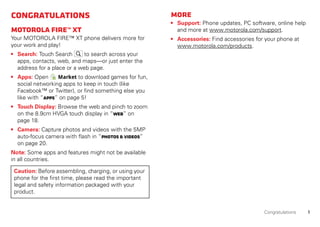
Your MOTOROLA FIRE™ XT phone delivers more for
your work and play!
• Search: Touch Search to search across your
apps, contacts, web, and maps—or just enter the
address for a place or a web page.
• Apps: Open Market to download games for fun,
social networking apps to keep in touch (like
Facebook™ or Twitter), or find something else you
like with “Apps” on page 5!
• Touch Display: Browse the web and pinch to zoom
on the 8.9cm HVGA touch display in “Web” on
page 18.
• Camera: Capture photos and videos with the 5MP
auto-focus camera with flash in “Photos &videos”
on page 20.
Note: Some apps and features might not be available
in all countries.
Caution: Before assembling, charging, or using your
phone for the first time, please read the important
legal and safety information packaged with your
product.
More
• Support: Phone updates, PC software, online help
and more at www.motorola.com/support.
• Accessories: Find accessories for your phone at
www.motorola.com/products.
2 Your phone
Yourphone
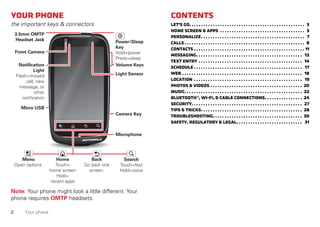
the important keys & connectors
Note: Your phone might look a little different. Your
phone requires OMTP headsets.
3.5mm OMTP
Headset Jack
Front Camera
Notification
Light
Flash=missed
call, new
message, or
other
notification
Micro USB
Microphone
Volume Keys
Light Sensor
Camera Key
Power/Sleep
Key
Hold=power
Press=sleep
Menu
Open options.
Home
Touch=
home screen
Hold=
recent apps
Search
Touch=text
Hold=voice
Back
Go back one
screen.
Contents
Let’s go................................................. 3
Homescreen&apps .................................... 5
Personalize............................................ 7
Calls................................................... 8
Contacts............................................... 11
Messaging............................................. 12
Textentry ............................................ 14
Schedule.............................................. 17
Web ................................................... 18
Location .............................................. 19
Photos &videos ....................................... 20
Music.................................................. 22
Bluetooth™,Wi-Fi,&cableconnections................ 24
Security............................................... 27
Tips&tricks........................................... 28
Troubleshooting...................................... 30
Safety,Regulatory&Legal............................ 31
3Let’s go
Let’sgo
let’s get you up and running
Assemble&charge
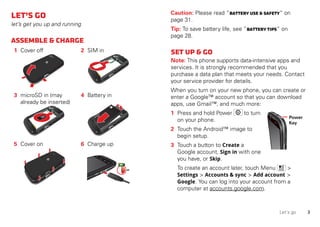
1 Cover off 2 SIM in
3 microSD in (may
already be inserted)
4 Battery in
5 Cover on 6 Charge up
3-6H
Caution: Please read “Battery Use&Safety” on
page 31.
Tip: To save battery life, see “Batterytips” on
page 28.
Setup&go
Note: This phone supports data-intensive apps and
services. It is strongly recommended that you
purchase a data plan that meets your needs. Contact
your service provider for details.
When you turn on your new phone, you can create or
enter a Google™ account so that you can download
apps, use Gmail™, and much more:
1 Press and hold Power to turn
on your phone.
2 Touch the Android™ image to
begin setup.
3 Touch a button to Create a
Google account, Sign in with one
you have, or Skip.
To create an account later, touch Menu >
Settings > Accounts & sync > Add account >
Google. You can log into your account from a
computer at accounts.google.com.
Power
Key
4 Let’s go
4 Enter details to create or sign into your account.
When your phone confirms the account, it shows
account sync options.
• To change whether your phone shows the
Google account’s contacts, Gmail™, and
calendar, touch the Google account name.
• To add another account, touch Add account. For
details, see “Email” on page 13.
• To exit setup touch Home .
If your phone cannot connect, you can touch Menu
> Wireless settings to change mobile network
settings.
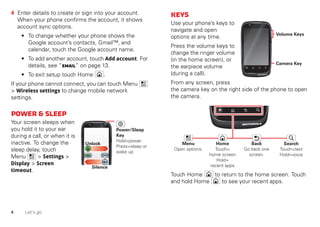
Power&sleep
Your screen sleeps when
you hold it to your ear
during a call, or when it is
inactive. To change the
sleep delay, touch
Menu > Settings >
Display > Screen
timeout.
Silence
Unlock
Power/Sleep
Key
Hold=power
Press=sleep or
wake up
Keys
Use your phone’s keys to
navigate and open
options at any time.
Press the volume keys to
change the ringer volume
(in the home screen), or
the earpiece volume
(during a call).
From any screen, press
the camera key on the right side of the phone to open
the camera.
Touch Home to return to the home screen. Touch
and hold Home to see your recent apps.
Camera Key
Volume Keys
Menu
Open options.
Home
Touch=
home screen
Hold=
recent apps
Search
Touch=text
Hold=voice
Back
Go back one
screen.
5Home screen & apps
Homescreen&apps
a few essentials
Use your home screen for quick access to apps,
search, and more. Download social networking apps
(like Facebook™ or Twitter) to keep in touch!
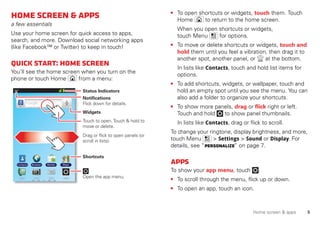
Quickstart:Homescreen
You’ll see the home screen when you turn on the
phone or touch Home from a menu:
11:19
BrowserContacts Market Maps
Notifications
Flick down for details.
Status Indicators
Shortcuts
Open the app menu.
Widgets
Touch to open. Touch & hold to
move or delete.
Drag or flick to open panels (or
scroll in lists).
• To open shortcuts or widgets, touch them. Touch
Home to return to the home screen.
When you open shortcuts or widgets,
touch Menu for options.
• To move or delete shortcuts or widgets, touch and
hold them until you feel a vibration, then drag it to
another spot, another panel, or at the bottom.
In lists like Contacts, touch and hold list items for
options.
• To add shortcuts, widgets, or wallpaper, touch and
hold an empty spot until you see the menu. You can
also add a folder to organize your shortcuts.
• To show more panels, drag or flick right or left.
Touch and hold to show panel thumbnails.
In lists like Contacts, drag or flick to scroll.
To change your ringtone, display brightness, and more,
touch Menu > Settings > Sound or Display. For
details, see “Personalize” on page 7.
Apps
To show your app menu, touch .
• To scroll through the menu, flick up or down.
• To open an app, touch an icon.
6 Home screen & apps
• To group your apps, touch Menu > Manage
groups > Add New Group, then enter the name (to
close the display keyboard, touch Back ). In the
app menu, touch and hold an app to drag it to the
group’s tab. Touch the group’s tab to open it.
• To close the app menu, touch Back .
Tip: To show the last eight apps you opened, touch
and hold Home .
To download new apps from Android Market™, touch
> Market. Touch Search to find an app, or
touch Downloads to show or reinstall the apps you
downloaded. To download apps from websites, you
need to change your security settings: Touch
Menu > Settings > Applications > Unknown
sources.
Warning: Apps downloaded from the web can be from
unknown sources. To protect your phone and personal
data, only download apps from sources you trust.
To move or uninstall your apps, touch Menu >
Settings > Applications > Manage applications. Touch
an app in the list to show details and options.
On your computer, you can browse and manage apps
for all your devices powered by Android™ at
market.android.com.
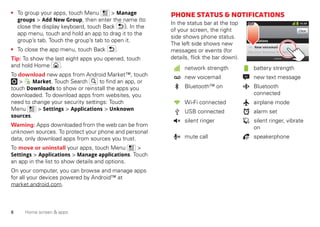
Phonestatus&notifications
In the status bar at the top
of your screen, the right
side shows phone status.
The left side shows new
messages or events (for
details, flick the bar down).
network strength battery strength
new voicemail new text message
Bluetooth™ on Bluetooth
connected
Wi-Fi connected airplane mode
USB connected alarm set
silent ringer silent ringer, vibrate
on
mute call speakerphone
Clear
Notifications
10:32
New voicemail
Dial (Your Voicemail Number)
11:19
7Personalize
Personalize
add your personal touch
Customize your phone’s sounds and appearance to
make it unique to you!
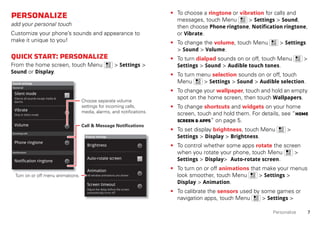
Quickstart:Personalize
From the home screen, touch Menu > Settings >
Sound or Display.
Display settings
Brightness
Screen timeout
All window animations are shown
Animation
Auto-rotate screen
Adjust the delay before the screen
automatically turns off
Sound settings
General
Incoming calls
Only in Silent mode
Vibrate
Volume
Silent mode
Silence all sounds except media &
alarms
Phone ringtone
Notifications
Notification ringtone
Choose separate volume
settings for incoming calls,
media, alarms, and notifications.
Call & Message Notifications
Turn on or off menu animations.
• To choose a ringtone or vibration for calls and
messages, touch Menu > Settings > Sound,
then choose Phone ringtone, Notification ringtone,
or Vibrate.
• To change the volume, touch Menu > Settings
> Sound > Volume.
• To turn dialpad sounds on or off, touch Menu >
Settings > Sound > Audible touch tones.
• To turn menu selection sounds on or off, touch
Menu > Settings > Sound > Audible selection.
• To change your wallpaper, touch and hold an empty
spot on the home screen, then touch Wallpapers.
• To change shortcuts and widgets on your home
screen, touch and hold them. For details, see “Home
screen&apps” on page 5.
• To set display brightness, touch Menu >
Settings > Display > Brightness.
• To control whether some apps rotate the screen
when you rotate your phone, touch Menu >
Settings > Display> Auto-rotate screen.
• To turn on or off animations that make your menus
look smoother, touch Menu > Settings >
Display > Animation.
• To calibrate the sensors used by some games or
navigation apps, touch Menu > Settings >
8 Calls
Display > G-Sensor Calibration (movement) or
E-Compass Calibration (direction).
Language&region
To set your menu language and region, touch
Menu > Settings > Language & keyboard > Select
language
Calls
it’s good to talk
Dial numbers, see recent calls, combine calls, or set
up forwarding, restrictions, and more.
Quickstart:Calls
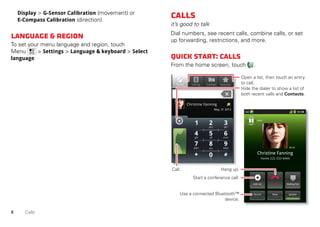
From the home screen, touch .
Contacts FavoritesPhone Call log
May, 31 2012
Christine Fanning
11:19
Dialling PadAdd call
SpeakerMuteRecord
End
Christine Fanning
Home 222-333-4444
Hold
05:32
Open a list, then touch an entry
to call.
Hide the dialer to show a list of
both recent calls and Contacts.
Use a connected Bluetooth™
device.
Hang up.
Start a conference call.
Call.
9Calls
• To make a call, touch , enter a number, then
touch .
When dialing, touch Menu to add a pause
(pauses two seconds), or wait (waits for your
confirmation). To enter the international dialing
code, touch and hold .
• To voice dial, touch > Voice Dialer, say “Call,”
and then a contact name or phone number.
• To answer a call, drag to the right.
• During a call, touch Menu to switch to a
Bluetooth headset (see “Bluetooth™,Wi-Fi,&cable
connections” on page 24). Touch Home or
Back to hide the active call display (to reopen it,
touch ).
Note: Using a mobile device or accessory while
driving may cause distraction and may be illegal.
Always obey the laws and drive safely.
• To end a call, touch .
• To ignore an incoming call, drag to the left.
Tip: For quick access to contacts, see “Favorites” on
page 11.
Recentcalls
To show recent calls, touch > Call log
0
+
End call
• To call, text, open, or save an entry, touch and hold
it.
• To clear the list, touch Menu > Clear call log.
Conferencecalls
To start a conference call, call the first number. After
they answer, touch Add call and call the next number.
When the next number answers, touch Merge calls. To
remove individual callers, touch Manage.
Callwaiting
If you are on a call and a new call arrives:
• With call waiting on, you can drag to the right to
answer the new call and put the old call on hold.
Then, touch Swap to switch between calls, or Merge
calls to combine them.
• With call waiting off, the new call goes straight to
your voicemail.
To turn on call waiting, touch Menu > Settings >
Call settings > Additional settings > Call waiting.
Callforwarding
To forward calls, touch Menu > Settings > Call
settings > Call forwarding. You can forward calls all
10 Calls
the time, or only when your phone is busy,
unanswered, or unreachable (not on the network)
Restrictedcalls
To restrict your phone so that it can only dial a few
numbers, touch Menu > Settings > Call settings >
Fixed Dialing Numbers.
• To turn fixed dialing on, touch FDN activation.
• To add or delete the allowed numbers, touch FDN
list.
Yourphonenumber
To show your phone number, touch Menu >
Settings > About phone > Status > My phone number.
YourcallerID
To hide your number from the people you call, touch
Menu > Settings > Call settings > Additional
settings > Caller ID.
Cooldown
In very limited circumstances, such as where your
phone has been exposed to extreme heat, you may
see “Cool Down” messages. To avoid possible
damage to your battery and phone, you should follow
these instructions until the phone is within its
recommended temperature range. When your phone
is in “Cool Down” mode, only emergency calls can be
made.
Emergencycalls
Note: Your service provider programs one or more
emergency phone numbers that you can call under any
circumstances, even when your phone is locked.
Emergency numbers vary by country. Your
pre-programmed emergency number(s) may not work
in all locations, and sometimes an emergency call
cannot be placed due to network, environmental, or
interference issues.
1 Open the phone, then touch (if your phone is
locked, touch Emergency Call).
2 Enter the emergency number.
3 Touch Call to call the emergency number.
Note: Your mobile device can use AGPS satellite
signals to help emergency services find you (“Location
Services (GPS &AGPS)” on page 35).
11Contacts
Contacts
contacts like you’ve never had before
Keep each friend’s email, phone number, and even
address all in your Contacts for quick access.
Quickstart:Contacts
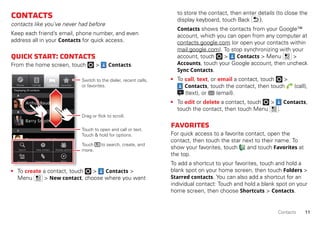
From the home screen, touch > Contacts.
• To create a contact, touch > Contacts >
Menu > New contact, choose where you want
Phone
Displaying 20 contacts
Contacts FavoritesCall log
A
B
C
Arthur Baudo
Barry Smyth
Cheyenne Medina
Christine Fanning
Search New contact
Accounts Import/Export More
Display options
Touch to open and call or text.
Touch & hold for options.
Drag or flick to scroll.
Switch to the dialer, recent calls,
or favorites.
Touch to search, create, and
more.
to store the contact, then enter details (to close the
display keyboard, touch Back ).
Contacts shows the contacts from your Google™
account, which you can open from any computer at
contacts.google.com (or open your contacts within
mail.google.com). To stop synchronizing with your
account, touch > Contacts > Menu >
Accounts, touch your Google account, then uncheck
Sync Contacts.
• To call, text, or email a contact, touch >
Contacts, touch the contact, then touch (call),
(text), or (email).
• To edit or delete a contact, touch > Contacts,
touch the contact, then touch Menu .
Favorites
For quick access to a favorite contact, open the
contact, then touch the star next to their name. To
show your favorites, touch and touch Favorites at
the top.
To add a shortcut to your favorites, touch and hold a
blank spot on your home screen, then touch Folders >
Starred contacts. You can also add a shortcut for an
individual contact: Touch and hold a blank spot on your
home screen, then choose Shortcuts > Contacts.
12 Messaging
Storage&transfer
When you create a new contact, your phone asks if
you want to store it in your Google™ account, phone
memory, or SIM card. Contacts in all three places
appear in your Contacts list, but if you change phones:
• Contacts in your Google™ account can download
when you log into your Google account on a new
Android™ device. You can open these contacts from
any computer at contacts.google.com.
• Contacts on your SIM card can load to a new device
when you insert your SIM card.
• Contacts in your phone memory stay in your old
phone, unless you export them.
To import or export contacts between your phone
memory and a SIM or memory card, touch >
Contacts, then touch Menu > Import/Export.
Messaging
sometimes it’s best to text or email...
Send and receive text with photos or other
attachments, in quick text messages or full emails.
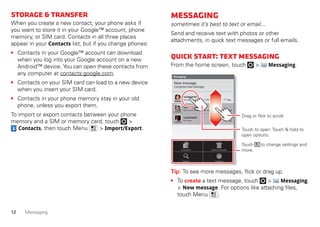
Quickstart:Textmessaging
From the home screen, touch > Messaging.
Tip: To see more messages, flick or drag up.
• To create a text message, touch > Messaging
> New message. For options like attaching files,
touch Menu .
Messaging
New message
Compose new message
12254558787
14447772222
You had 1 missed call from 122545458787 ... 17 Aug
Wanna catch something to eat tonight? How about ... 17 Aug
12223334545
Ha! Thanks. 16 Aug
Settings
Delete threads
Search
Compose
Touch to open. Touch & hold to
open options.
Drag or flick to scroll.
Touch to change settings and
more.
13Messaging
• To open text messages, touch > Messaging,
then touch the sender’s name.
When you see in the status bar at the top of your
screen, flick down the status bar and touch the new
message to open it.
• To respond to a text message, just open it and
enter your response in the text box at the bottom.
• To forward, copy, and more, touch >
Messaging, touch the sender’s name, then touch
and hold the message.
Attachments
To send a file in a text message, touch >
Messaging > New message, then touch Menu >
Attach.
When you open a message with an attachment, touch
Download to download it. Touch the downloaded
attachment to open it, then touch it again to save it,
share it, and more.
Tip: To send and receive large attachments faster, use
“Wi-Finetworks” on page 25.
Email
• To set up Google or Corporate (Microsoft™
Exchange server) accounts, touch Menu >
Settings > Accounts & sync > Add account. For
details, contact the account provider.
To set up standard email accounts (not Gmail™ or
Microsoft™ Exchange), touch > Email and
follow the wizard. To add more standard accounts,
open Email and touch Menu > Accounts >
Menu > Add account. For details, contact the
account provider.
• To open email, touch > Email or Gmail.
Touch a message to open it.
Tip: Touch Menu for options like Refresh or
Search.
• To create an email, touch > Email or
Gmail, then touch Menu > Compose.
Tip: Touch Menu for options, like Attach or Add
Cc/Bcc.
Gmail synchronizes with your Google™ account mail,
which you can open from any computer at
mail.google.com. To stop synchronizing with your
account, touch Menu > Settings > Accounts &
sync, touch your Google account, then uncheck Sync
Gmail.
14 Text entry
Voicemail
When you have a new voicemail, shows in the
status bar at the top of your screen. To hear
voicemails, touch then touch and hold 1.
If you need to change your voicemail number, in the
home screen touch Menu > Settings > Call
settings > Voicemail settings. For your voicemail
number or other details, contact your service provider.
Textentry
keys when you need them
When you enter text, like in a message or search, you
have keyboard options.
Quickstart:Textentry
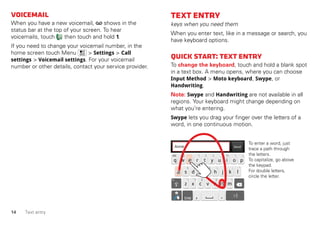
To change the keyboard, touch and hold a blank spot
in a text box. A menu opens, where you can choose
Input Method > Moto keyboard, Swype, or
Handwriting.
Note: Swype and Handwriting are not available in all
regions. Your keyboard might change depending on
what you’re entering.
Swype lets you drag your finger over the letters of a
word, in one continuous motion.
Send
:-)
a s d f g h j k l
q w e r t y u i o p
z x c v b n m
EN @ # 1 2 3 _ % ( )
! 7 8 9 0 / ?
& $ 4 5 6 + : ; “
, .SYM
To enter a word, just
trace a path through
the letters.
To capitalize, go above
the keypad.
For double letters,
circle the letter.
To enter a word, just
trace a path through
the letters.
To capitalize, go above
the keypad.
For double letters,
circle the letter.
AnneAnneAnne
a
e
n
a
e
n
15Text entry
• To move the cursor, touch and hold a word you
entered. This opens a magnifier where you can drag
the cursor.
• To copy and paste, double-tap a word to highlight it
(if needed, drag the ends of the highlight). Now
touch and hold a blank spot for the copy and paste
menu.
• To add a word to your dictionary, double-tap the
word to highlight it. Now touch and hold a blank
spot to open the menu where you can add the
word.
• To enter the small number or symbol at the top of
a key, touch and hold the key.
To enter several numbers or symbols, touch SYM.
• To enter apostrophes in common words (like “I’ll”)
in Swype, drag through the apostrophe key.
• If Swype doesn’t know a word, touch individual
letters to enter it. Swype remembers, so next time
you can just drag over the letters.
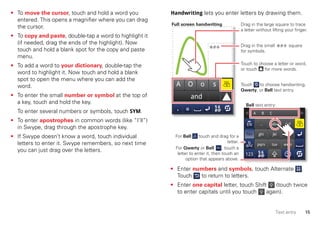
Handwriting lets you enter letters by drawing them.
• Enter numbers and symbols, touch Alternate .
Touch to return to letters.
• Enter one capital letter, touch Shift (touch twice
to enter capitals until you touch again).
and
A O o s
. ,
ghi
pqrs
abc
jkl
tuv
def
mno
wxyz
A B C
Touch to choose a letter or word,
or touch for more words.
Drag in the large square to trace
a letter without lifting your finger.
Drag in the small square
for symbols.
For Bell touch and drag for a
letter.
Full screen handwriting
Bell text entry:
For Qwerty or Bell , touch a
letter to enter it, then touch an
option that appears above.
Touch to choose handwriting,
Qwerty, or Bell text entry.
16 Text entry
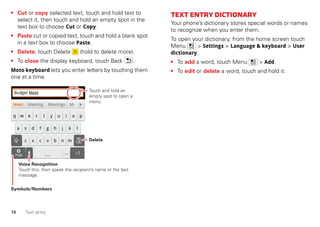
• Cut or copy selected text, touch and hold text to
select it, then touch and hold an empty spot in the
text box to choose Cut or Copy.
• Paste cut or copied text, touch and hold a blank spot
in a text box to choose Paste.
• Delete, touch Delete (hold to delete more).
• To close the display keyboard, touch Back .
Moto keyboard lets you enter letters by touching them
one at a time.
Budget Meet
Meeting Meetings MeMeet
a s d f g h j k l
q w e r t y u i o p
z x c v b n m
. ,
DEL
MMeeeeeeeeeeeeeeeeeeee
?123
Delete
Symbols/Numbers
Voice Recognition
Touch this, then speak the recipient’s name or the text
message.
Touch and hold an
empty spot to open a
menu.
Textentrydictionary
Your phone’s dictionary stores special words or names
to recognize when you enter them.
To open your dictionary, from the home screen touch
Menu > Settings > Language & keyboard > User
dictionary.
• To add a word, touch Menu > Add.
• To edit or delete a word, touch and hold it.
17Schedule
Schedule
helping you stay in control
Your Calendar events can synchronize with your
Google™ account, and the Clock can wake you up!
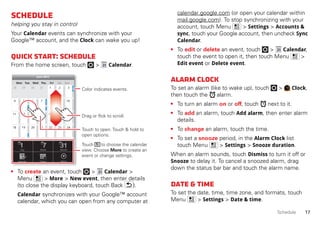
Quickstart:Schedule
From the home screen, touch > Calendar.
• To create an event, touch > Calendar >
Menu > More > New event, then enter details
(to close the display keyboard, touch Back ).
Calendar synchronizes with your Google™ account
calendar, which you can open from any computer at
SunMon Tue Wed Thu SatFri
28 29 30 31 1 2 3
4 5 6 8 9 10
11 12 13 15 16 17
18 19 20 22 23 24
25 26 27 29 30 31
1 2 3 5 6 7
7
14
21
28
4
June 2012
Day Week
Agenda Today More
Month
Touch to open. Touch & hold to
open options.
Drag or flick to scroll.
Color indicates events.
Touch to choose the calendar
view. Choose More to create an
event or change settings.
calendar.google.com (or open your calendar within
mail.google.com). To stop synchronizing with your
account, touch Menu > Settings > Accounts &
sync, touch your Google account, then uncheck Sync
Calendar.
• To edit or delete an event, touch > Calendar,
touch the event to open it, then touch Menu >
Edit event or Delete event.
Alarmclock
To set an alarm (like to wake up), touch > Clock,
then touch the alarm.
• To turn an alarm on or off, touch next to it.
• To add an alarm, touch Add alarm, then enter alarm
details.
• To change an alarm, touch the time.
• To set a snooze period, in the Alarm Clock list
touch Menu > Settings > Snooze duration.
When an alarm sounds, touch Dismiss to turn it off or
Snooze to delay it. To cancel a snoozed alarm, drag
down the status bar bar and touch the alarm name.
Date&time
To set the date, time, time zone, and formats, touch
Menu > Settings > Date & time.
18 Web
Web
surf the web with your phone
Open Browser or just touch Search to find a page,
then bookmark it, send it, or just explore.
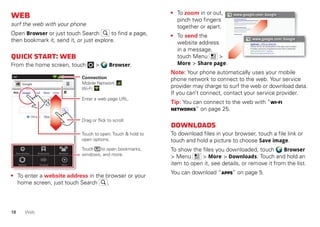
Quickstart:Web
From the home screen, touch > Browser.
• To enter a website address in the browser or your
home screen, just touch Search .
BookmarksNew window Windows
MoreRefresh
Web Images Local News more
Near me nowChicago
Google
11:19
Forward
Touch to open. Touch & hold to
open options.
Drag or flick to scroll.
Enter a web page URL.
Touch to open bookmarks,
windows, and more.
Connection
Mobile Network:
Wi-Fi:
• To zoom in or out,
pinch two fingers
together or apart.
• To send the
website address
in a message,
touch Menu >
More > Share page.
Note: Your phone automatically uses your mobile
phone network to connect to the web. Your service
provider may charge to surf the web or download data.
If you can’t connect, contact your service provider.
Tip: You can connect to the web with “Wi-Fi
networks” on page 25.
Downloads
To download files in your browser, touch a file link or
touch and hold a picture to choose Save image.
To show the files you downloaded, touch Browser
> Menu > More > Downloads. Touch and hold an
item to open it, see details, or remove it from the list.
You can download “Apps” on page 5.
www.google.com: Google
Android | Official Website
Official site for the development of the open source project.
Provides a directory of applications and links to download ..
www.android.com/ - Options
More from www.android.com »
19Location
Location
where you are, and where you’re going
Open Maps or just touch Search to find an
address, then get directions, check in, or save the
location.
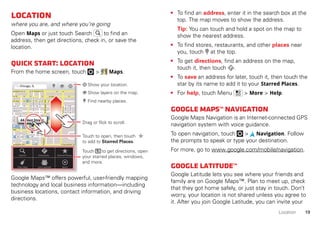
Quickstart:Location
From the home screen, touch > Maps.
Google Maps™ offers powerful, user-friendly mapping
technology and local business information—including
business locations, contact information, and driving
directions.
Chicago, IL
NClarkSt
Wacker Dr
M
E Ontario St
E Ohio St
NRushSt
NParkSt
NNewSt
NWabashAve
NDearbornSt
E Grand Ave
E Randolph St
NMiciganAve
NMiciganAve
rDsubmuloCN
W Lake St W Lake St
E Wacker Pl
State/Lake
Grand Red
Lake
Randolph
St Metra
Randolph/
Wabash
Washington-Blue
E S WaterSt
M
M
M
M
Ontario St
DDDeeeeeaaarrbbboorrnnSSSt
44 West Street
A
Search
Clear Map
Directions
Join Latitude
Starred Places
More
Touch to open, then touch
to add to Starred Places.
Drag or flick to scroll.
Find nearby places.
Show your location.
Show layers on the map.
Touch to get directions, open
your starred places, windows,
and more.
• To find an address, enter it in the search box at the
top. The map moves to show the address.
Tip: You can touch and hold a spot on the map to
show the nearest address.
• To find stores, restaurants, and other places near
you, touch at the top.
• To get directions, find an address on the map,
touch it, then touch .
• To save an address for later, touch it, then touch the
star by its name to add it to your Starred Places.
• For help, touch Menu > More > Help.
GoogleMaps™Navigation
Google Maps Navigation is an Internet-connected GPS
navigation system with voice guidance.
To open navigation, touch > Navigation. Follow
the prompts to speak or type your destination.
For more, go to www.google.com/mobile/navigation.
GoogleLatitude™
Google Latitude lets you see where your friends and
family are on Google Maps™. Plan to meet up, check
that they got home safely, or just stay in touch. Don’t
worry, your location is not shared unless you agree to
it. After you join Google Latitude, you can invite your
20 Photos & videos
friends to view your location, or accept their
invitations.
Touch > Maps and then:
• To join Google Latitude, touch Menu > Join
Latitude. Read the privacy policy and, if you agree
with it, choose to continue.
• To add friends, touch Menu > Latitude >
Menu > Add friends.
Touch Select from Contacts or Add via email
address, then touch a contact and Add friends. Your
friend will receive an email notice.
• To remove friends, touch Menu > Latitude to
show your friends list. Touch a name, then touch
Remove.
• To share your location when you receive a request,
you can choose Accept and share back (show your
location and see theirs), Accept, but hide my
location (hide your location, but see theirs), or Don’t
accept (hide both locations).
• To hide your location, touch Menu > Latitude to
show your friends list. Touch your contact name,
then touch Menu > Settings > Do not detect
your location.
• To sign out, touch Menu > Latitude to show
your friends list. Touch Menu > Settings > Sign
out of Latitude.
Photos&videos
see it, capture it, share it!
Capture photos and videos to send them to friends or
save them for later.
Quickstart:Photos&videos
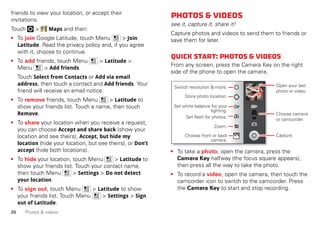
From any screen, press the Camera Key on the right
side of the phone to open the camera.
• To take a photo, open the camera, press the
Camera Key halfway (the focus square appears),
then press all the way to take the photo.
• To record a video, open the camera, then touch the
camcorder icon to switch to the camcorder. Press
the Camera Key to start and stop recording.
Open your last
photo or video.
Switch resolution & more.
Store photo location.
Set white balance for your
lighting.
Set flash for photos.
Zoom.
Choose front or back
camera.
Choose camera
or camcorder.
Capture.
21Photos & videos
• To open photos and videos, touch > My Gallery,
then touch a photo or video for options like Share.
Tip: For the clearest photos and videos, clean the lens
with a soft, dry cloth.
View&sharephotos&videos
From the home screen, touch > My Gallery.
Flick left and right to show folders. Touch a folder to
show its photos or videos, then touch a thumbnail
image to open, share, or delete it.
Tip: From the viewfinder, you can touch the thumbnail
in the top right to open your last photo or video.
• To zoom in, touch
the screen with
two fingers and
then drag them
apart. To zoom out,
drag your fingers
together.
• To send or post
the photo or video, touch Share.
To use a Bluetooth or cable connection, see
“Bluetooth™,Wi-Fi,&cable connections” on page 24.
• To delete the photo or video, touch Delete.
• To set a photo as your wallpaper or a contact photo,
touch More > Set as.
• To crop or rotate a photo, touch More.
• To play a video, touch .
Tip: Turn the phone sideways for a widescreen view.
YouTube™
The YouTube user-generated content website lets you
share videos with YouTube users everywhere. You
don’t need a YouTube account to browse and view
videos.
From the home screen, touch > YouTube.
• To watch videos, touch a category like Top rated or
touch Search to find a video. Touch a video to
watch it.
For more video categories, touch Menu >
Categories.
To watch a video in high quality, touch Menu >
Settings > High quality video.
• To share a video, touch it to open it, touch More at
the top, choose Share, then choose how you want
to share it.
• To upload a video from your phone to your YouTube
account, touch > YouTube > Menu >
Upload. Touch the video, then touch Upload.
22 Music
To sign into your YouTube account, touch >
YouTube > Menu > My account.
Note: If you don’t have an account, touch the link to
create one. For more, visit www.youtube.com.
Music
when music is what you need...
Keep your music with you! Put music on your phone
so you can listen and create playlists anytime.
Quickstart:Music
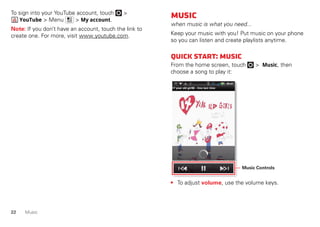
From the home screen, touch > Music, then
choose a song to play it:
• To adjust volume, use the volume keys.
Music Controls
23Music
• To edit, delete, or rename playlists, touch >
Music touch the Playlists tab, then touch and hold
the playlist name.
• To hide the player and use other apps,
touch Home . Your music keeps playing. To
return to the player, flick down the status bar and
touch .
Tip: For quick music player controls, touch and hold
an empty spot in your home screen, then choose
Widget > Music.
• To stop the player, touch .
• Before a flight, turn off network and wireless
connections so that you can keep listening to music:
Press and hold Power > Airplane mode.
Note: When you select airplane mode, all wireless
services are disabled. You can then turn Wi-Fi and/or
Bluetooth back on, if permitted by your airline. Other
wireless voice and data services (such as calls and
text messages) remain off in airplane mode.
Emergency calls to your region's emergency
number can still be made.
You can use your phone’s 3.5mm OMTP headset jack
to connect wired headphones, or go wireless with .
To listen to FM radio stations, Plug in a 3.5mm OMTP
headset and touch > FM Radio. Your phone uses
the headset wire as the radio antenna.
Musicfiles
To get songs for your music player, you can download
them from online services or copy them from your
computer. Your music player can play these file
formats: MP3, M4A, AAC, ACC+, MIDI, WAV, or OGG
Vorbis.
Note: Your phone does not support any DRM
protected files.
Note: Copyright—do you have the right? Always follow
the rules. See “Content Copyright” in your legal and
safety information.
To copy files from your computer to your phone, you
can use “Cableconnections” on page 26 or
“Bluetooth™devices” on page 24.
To save a CD on your computer (“rip” the CD), you can
use a program like Microsoft™ Windows™ Media
Player. First, make sure you change the format to MP3
(under Rip > Format in Windows Media Player).
24 Bluetooth™, Wi-Fi, & cable connections
Bluetooth™,Wi-Fi,&cable
connections
home, office, or hotspot
Connect your phone to Bluetooth headsets, fast Wi-Fi
networks, or right to your computer.
Quickstart:connections
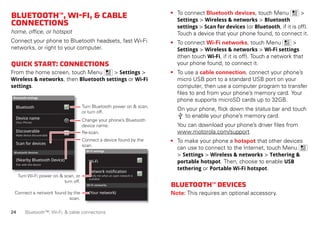
From the home screen, touch Menu > Settings >
Wireless & networks, then Bluetooth settings or Wi-Fi
settings.
Wi-Fi networks
Wi-Fi settings
Notify me when an open network is
available
Network notification
(Your network)
Wi-Fi
Bluetooth devices
Bluetooth settings
(Your Phone)
Device name
Scan for devices
Make device discoverable
Discoverable
Bluetooth
Pair with this device
(Nearby Bluetooth Device)
Turn Bluetooth power on & scan,
or turn off.
Change your phone’s Bluetooth
device name.
Turn Wi-Fi power on & scan, or
turn off.
Re-scan.
Connect a device found by the
scan.
Connect a network found by the
scan.
• To connect Bluetooth devices, touch Menu >
Settings > Wireless & networks > Bluetooth
settings > Scan for devices (or Bluetooth, if it is off).
Touch a device that your phone found, to connect it.
• To connect Wi-Fi networks, touch Menu >
Settings > Wireless & networks > Wi-Fi settings
(then touch Wi-Fi, if it is off). Touch a network that
your phone found, to connect it.
• To use a cable connection, connect your phone’s
micro USB port to a standard USB port on your
computer, then use a computer program to transfer
files to and from your phone’s memory card. Your
phone supports microSD cards up to 32GB.
On your phone, flick down the status bar and touch
to enable your phone’s memory card.
You can download your phone’s driver files from
www.motorola.com/support.
• To make your phone a hotspot that other devices
can use to connect to the Internet, touch Menu
> Settings > Wireless & networks > Tethering &
portable hotspot. Then, choose to enable USB
tethering or Portable Wi-Fi hotspot.
Bluetooth™devices
Note: This requires an optional accessory.
25Bluetooth™, Wi-Fi, & cable connections
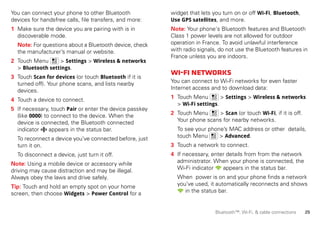
You can connect your phone to other Bluetooth
devices for handsfree calls, file transfers, and more:
1 Make sure the device you are pairing with is in
discoverable mode.
Note: For questions about a Bluetooth device, check
the manufacturer’s manual or website.
2 Touch Menu > Settings > Wireless & networks
> Bluetooth settings.
3 Touch Scan for devices (or touch Bluetooth if it is
turned off). Your phone scans, and lists nearby
devices.
4 Touch a device to connect.
5 If necessary, touch Pair or enter the device passkey
(like 0000) to connect to the device. When the
device is connected, the Bluetooth connected
indicator appears in the status bar.
To reconnect a device you’ve connected before, just
turn it on.
To disconnect a device, just turn it off.
Note: Using a mobile device or accessory while
driving may cause distraction and may be illegal.
Always obey the laws and drive safely.
Tip: Touch and hold an empty spot on your home
screen, then choose Widgets > Power Control for a
widget that lets you turn on or off Wi-Fi, Bluetooth,
Use GPS satellites, and more.
Note: Your phone's Bluetooth features and Bluetooth
Class 1 power levels are not allowed for outdoor
operation in France. To avoid unlawful interference
with radio signals, do not use the Bluetooth features in
France unless you are indoors.
Wi-Finetworks
You can connect to Wi-Fi networks for even faster
Internet access and to download data:
1 Touch Menu > Settings > Wireless & networks
> Wi-Fi settings.
2 Touch Menu > Scan (or touch Wi-Fi, if it is off.
Your phone scans for nearby networks.
To see your phone’s MAC address or other details,
touch Menu > Advanced.
3 Touch a network to connect.
4 If necessary, enter details from from the network
administrator. When your phone is connected, the
Wi-Fi indicator appears in the status bar.
When power is on and your phone finds a network
you’ve used, it automatically reconnects and shows
in the status bar.
26 Bluetooth™, Wi-Fi, & cable connections
Tip: Touch and hold an empty spot on your home
screen, then choose Widgets > Power Control for a
widget that lets you turn on or off Wi-Fi, Bluetooth,
Use GPS satellites, and more.
Note: Your phone's features and power levels are not
allowed for outdoor operation in France. To avoid
unlawful interference with radio signals, do not use the
features in France unless you are indoors.
Cableconnections
You can use a cable connection to transfer songs,
pictures, or other files between your phone and
computer. You will need a:
• Microsoft™ Windows™ PC or Apple™
Macintosh™.
• data cable with a standard USB connector on one
end and a micro USB connector on the other end.
• microSD memory card (up to 32GB) inserted in your
phone, as shown in “Assemble&charge” on page 3.
Tip: To see the available memory on your memory
card, from the home screen touch Menu >
Settings > SD card & phone storage.
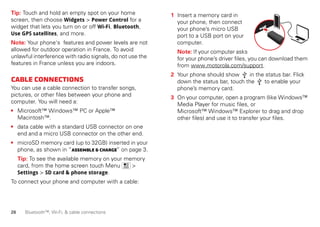
To connect your phone and computer with a cable:
1 Insert a memory card in
your phone, then connect
your phone’s micro USB
port to a USB port on your
computer.
Note: If your computer asks
for your phone’s driver files, you can download them
from www.motorola.com/support.
2 Your phone should show in the status bar. Flick
down the status bar, touch the to enable your
phone’s memory card.
3 On your computer, open a program (like Windows™
Media Player for music files, or
Microsoft™ Windows™ Explorer to drag and drop
other files) and use it to transfer your files.
27Security
Security
help keep your phone safe
Protect your information, in case your phone is lost or
stolen.
Quickstart:Security
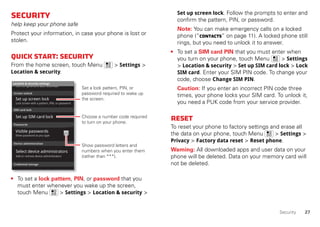
From the home screen, touch Menu > Settings >
Location & security.
• To set a lock pattern, PIN, or password that you
must enter whenever you wake up the screen,
touch Menu > Settings > Location & security >
Device administration
Lock screen with a pattern, PIN, or password
Set up screen lock
Show password as you type
Turn off ephemeris auto download
Visible passwords
Credential storage
Screen unlock
Passwords
Add or remove device administrators
Select device administrators
Location & security settings
Set up SIM card lock
SIM card lock
Show password letters and
numbers when you enter them
(rather than ***).
Choose a number code required
to turn on your phone.
Set a lock pattern, PIN, or
password required to wake up
the screen.
Set up screen lock. Follow the prompts to enter and
confirm the pattern, PIN, or password.
Note: You can make emergency calls on a locked
phone (“Contacts” on page 11). A locked phone still
rings, but you need to unlock it to answer.
• To set a SIM card PIN that you must enter when
you turn on your phone, touch Menu > Settings
> Location & security > Set up SIM card lock > Lock
SIM card. Enter your SIM PIN code. To change your
code, choose Change SIM PIN.
Caution: If you enter an incorrect PIN code three
times, your phone locks your SIM card. To unlock it,
you need a PUK code from your service provider.
Reset
To reset your phone to factory settings and erase all
the data on your phone, touch Menu > Settings >
Privacy > Factory data reset > Reset phone.
Warning: All downloaded apps and user data on your
phone will be deleted. Data on your memory card will
not be deleted.
28 Tips & tricks
Tips&tricks
a few handy hints
Make it faster and easier to get the most out of your
phone every day.
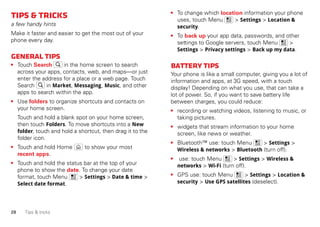
Generaltips
• Touch Search in the home screen to search
across your apps, contacts, web, and maps—or just
enter the address for a place or a web page. Touch
Search in Market, Messaging, Music, and other
apps to search within the app.
• Use folders to organize shortcuts and contacts on
your home screen.
Touch and hold a blank spot on your home screen,
then touch Folders. To move shortcuts into a New
folder, touch and hold a shortcut, then drag it to the
folder icon.
• Touch and hold Home to show your most
recent apps.
• Touch and hold the status bar at the top of your
phone to show the date. To change your date
format, touch Menu > Settings > Date & time >
Select date format.
• To change which location information your phone
uses, touch Menu > Settings > Location &
security.
• To back up your app data, passwords, and other
settings to Google servers, touch Menu >
Settings > Privacy settings > Back up my data.
Batterytips
Your phone is like a small computer, giving you a lot of
information and apps, at 3G speed, with a touch
display! Depending on what you use, that can take a
lot of power. So, if you want to save battery life
between charges, you could reduce:
• recording or watching videos, listening to music, or
taking pictures.
• widgets that stream information to your home
screen, like news or weather.
• Bluetooth™ use: touch Menu > Settings >
Wireless & networks > Bluetooth (turn off).
• use: touch Menu > Settings > Wireless &
networks > Wi-Fi (turn off).
• GPS use: touch Menu > Settings > Location &
security > Use GPS satellites (deselect).
29Tips & tricks
• network searching: if you are out of coverage, to
keep your phone from looking for networks, press
and hold Power > Airplane mode.
• display brightness: touch Menu > Settings >
Display > Brightness > (dimmer setting).
• display timeout delay: touch Menu > Settings >
Display > Screen timeout > (shorter setting).
Accessibility
See, hear, speak, feel, and use. Accessibility features
are there for everyone, helping to make things easier.
Voicerecognition
• Dialing and commands: Touch > Voice
Dialer. To dial, say “Call” and then a contact name
or phone number. You can also say a command from
the list shown, like “Open Calendar.”
• Search: Touch and hold Search to open voice
search, or touch on a search box, then say what
you want to search for, like “Motorola accessories”.
• Text entry: Touch a text entry field to open the
touchscreen keyboard. Touch , then say what you
want to type.
Note: There is no on the Swype keyboard. To
change the keyboard, touch and hold a blank spot in
the text box. A menu opens, where you can choose
Input Method > Multi-touch keyboard.
Tip: Speak naturally but clearly, like using a
speakerphone.
CallerID
When you want to hear who’s calling:
• Ringtones: Assign a unique ringtone to a contact—
touch > Contacts, touch the contact, then
touch Menu > Options.
Volume&vibrate
To set your ringer volume or vibration, touch Menu
> Settings > Sound > Vibrate or Volume.
Tip: To set separate volumes for calls and notifications
(like new messages), choose Volume and uncheck Use
incoming call volume for notifications.
Displaybrightness
To change display brightness, touch Menu >
Settings > Display > Brightness
Uncheck Automatic brightness to set your own level.
Touchscreen&keys
You can hear or feel when you touch the touchscreen:
Touch Menu > Settings > Sound:
30 Troubleshooting
• Touchscreen: To hear screen touches (click), select
Audible selection.
• Keys: To feel screen keyboard touches (vibrate),
select Haptic feedback.
Apps
Want more? No problem. Android Market™ provides
access to thousands of apps, and many provide useful
accessibility features: Touch > Market.
Troubleshooting
we’re here to help
Crashrecovery
In the unlikely event that your phone stops responding
to touchs and key presses, try a quick reset. Remove
the back cover and battery (“Assemble&charge” on
page 3), then replace and turn on your phone as usual.
Service&repairs
If you have questions or need assistance, we're here
to help.
Go to www.motorola.com/support, where you can
select from a number of customer care options. You
can also contact the Motorola Customer Support
Center at 1-800-331-6456 (United States),
1-888-390-6456 (TTY/TDD United States for hearing
impaired), or 1-800-461-4575 (Canada).
31
Safety, Regulatory & Legal
Battery Use & SafetyBattery Use & Safety
Important: Handle and store batteries properly to avoid injury or damage. Most
battery issues arise from improper handling of batteries, and particularly from the
continued use of damaged batteries.
DON’Ts
• Don’t disassemble, crush, puncture, shred, or otherwise attempt to change
the form of your battery.
• Don’t let the mobile device or battery come in contact with liquids.* Liquids
can get into the mobile device’s circuits, leading to corrosion.
• Don’t allow the battery to touch metal objects. If metal objects, such as jewelry,
stay in prolonged contact with the battery contact points, the battery could become
very hot.
• Don’t place your mobile device or battery near a heat source.* High
temperatures can cause the battery to swell, leak, or malfunction.
• Don’t dry a wet or damp battery with an appliance or heat source, such as a
hair dryer or microwave oven.
DOs
• Do avoid leaving your mobile device in your car in high temperatures.*
• Do avoid dropping the mobile device or battery.* Dropping these items,
especially on a hard surface, can potentially cause damage.*
• Do contact your service provider or Motorola if your mobile device or battery
has been damaged by dropping, liquidsor high temperatures.
* Note: Always make sure that the battery compartment and any connector covers are
closed and secure to avoid direct exposure of the battery to any of these conditions, even
if your product information states that your mobile device can resist damage from these
conditions.
Important: Motorola recommends you always use Motorola-branded batteries
and chargers for quality assurance and safeguards. Motorola’s warranty does not
cover damage to the mobile device caused by non-Motorola batteries and/or chargers. To
help you identify authentic Motorola batteries from non-original or counterfeit batteries
(that may not have adequate safety protection), Motorola provides holograms on its
batteries. You should confirm that any battery you purchase has a “Motorola Original”
hologram.
If you see a message on your display such as Invalid Battery or
Unable to Charge, take the following steps:
• Remove the battery and inspect it to confirm that it has a “Motorola Original”
hologram;
• If there is no hologram, the battery is not a Motorola battery;
• If there is a hologram, replace the battery and try charging it again;
• If the message remains, contact a Motorola authorized service center.
Warning: Use of a non-Motorola battery or charger may present a risk of fire, explosion,
leakage, or other hazard.
Proper and safe battery disposal and recycling: Proper battery disposal is not only
important for safety, it benefits the environment. You can recycle your used batteries in
many retail or service provider locations. Additional information on proper disposal and
recycling can be found at www.motorola.com/recycling.
Disposal: Promptly dispose of used batteries in accordance with local
regulations. Contact your local recycling center or national recycling
organizations for more information on how to dispose of batteries.
Warning: Never dispose of batteries in a fire because they may explode.
Battery ChargingBattery Charging
Notes for charging your product’s battery:
• During charging, keep your battery and charger near room temperature for efficient
battery charging.
• New batteries are not fully charged.
• New batteries or batteries stored for a long time may take more time to charge.
• Motorola batteries and charging systems have circuitry that protects the battery from
damage from overcharging.
Third Party Accessories
Use of third party accessories, including but not limited to batteries, chargers, headsets,
covers, cases, screen protectors and memory cards, may impact your mobile device’s
performance. In some circumstances, third party accessories can be dangerous and may
void your mobile device’s warranty. For a list of Motorola accessories, visit
www.motorola.com/products.
032375o
32
Driving Precautions
Responsible and safe driving is your primary responsibility when behind the wheel of a
vehicle. Using a mobile device or accessory for a call or other application while driving
may cause distraction. Using a mobile device or accessory may be prohibited or restricted
in certain areas, always obey the laws and regulations on the use of these products.
While driving, NEVER:
• Type or read texts.
• Enter or review written data.
• Surf the web.
• Input navigation information.
• Perform any other functions that divert your attention from driving.
While driving, ALWAYS:
• Keep your eyes on the road.
• Use a handsfree device if available or required by law in your area.
• Enter destination information into a navigation device before driving.
• Use voice activated features (such as voice dial) and speaking features (such as
audible directions), if available.
• Obey all local laws and regulations for the use of mobile devices and accessories in
the vehicle.
• End your call or other task if you cannot concentrate on driving.
Remember to follow the “Smart Practices While Driving” in this guide and at
www.motorola.com/callsmart (in English only).
Seizures/Blackouts
Some people may be susceptible to epileptic seizures or blackouts when exposed to
flashing lights, such as when playing videos or games. These may occur even if a person
has never had a previous seizure or blackout.
If you have experienced seizures or blackouts, or if you have a family history of such
occurrences, please consult with your physician before playing videos or games or
enabling a flashing-lights feature (if available) on your mobile device.
Discontinue use and consult a physician if any of the following symptoms occur:
convulsion, eye or muscle twitching, loss of awareness, involuntary movements, or
disorientation. It is always a good idea to hold the screen away from your eyes, leave the
lights on in the room, take a 15-minute break every hour, and stop use if you are tired.
Caution About High Volume Usage
Warning: Exposure to loud noise from any source for extended periods of
time may affect your hearing. The louder the volume sound level, the less
time is required before your hearing could be affected. To protect your
hearing:
• Limit the amount of time you use headsets or headphones at high
volume.
• Avoid turning up the volume to block out noisy surroundings.
• Turn the volume down if you can’t hear people speaking near you.
If you experience hearing discomfort, including the sensation of pressure or fullness in
your ears, ringing in your ears, or muffled speech, you should stop listening to the device
through your headset or headphones and have your hearing checked.
For more information about hearing, see our website at
direct.motorola.com/hellomoto/nss/AcousticSafety.asp (in English only).
Repetitive Motion
When you repetitively perform actions such as pressing keys or entering finger-written
characters, you may experience occasional discomfort in your hands, arms, shoulders,
neck, or other parts of your body. If you continue to have discomfort during or after such
use, stop use and see a physician.
Children
Keep your mobile device and its accessories away fromsmall children. These
products are not toys and may be hazardous to small children. For example:
• A choking hazard may exist for small, detachable parts.
• Improper use could result in loud sounds, possibly causing hearing injury.
• Improperly handled batteries could overheat and cause a burn.
Similar to a computer, if a child does use your mobile device, you may want to monitor
their access to help prevent exposure to inappropriate apps or content.
Glass Parts
Some parts of your mobile device may be made of glass. This glass could break if the
product receives a substantial impact. If glass breaks, do not touch or attempt to remove.
Stop using your mobile device until the glass is replaced by a qualified service center.
33
Operational Warnings
Obey all posted signs when using mobile devices in public areas.
Potentially Explosive Atmospheres
Areas with potentially explosive atmospheres are often, but not always, posted and can
include fueling areas, such as below decks on boats, fuel or chemical transfer or storage
facilities, or areas where the air contains chemicals or particles, such as grain dust, or
metal powders.
When you are in such an area, turn off your mobile device, and do not remove, install, or
charge batteries unless it is a radio product type especially qualified for use in such areas
as “Intrinsically Safe” (for example, Factory Mutual, CSA, or UL approved). In such areas,
sparks can occur and cause an explosion or fire.
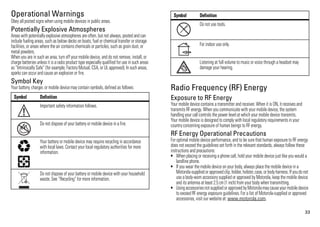
Symbol Key
Your battery, charger, or mobile device may contain symbols, defined as follows:
Symbol Definition
Important safety information follows.
Do not dispose of your battery or mobile device in a fire.
Your battery or mobile device may require recycling in accordance
with local laws. Contact your local regulatory authorities for more
information.
Do not dispose of your battery or mobile device with your household
waste. See “Recycling” for more information.
032374o
032376o
032375o
Radio Frequency (RF) Energy
Exposure to RF Energy
Your mobile device contains a transmitter and receiver. When it is ON, it receives and
transmits RF energy. When you communicate with your mobile device, the system
handling your call controls the power level at which your mobile device transmits.
Your mobile device is designed to comply with local regulatory requirements in your
country concerning exposure of human beings to RF energy.
RF Energy Operational Precautions
For optimal mobile device performance, and to be sure that human exposure to RF energy
does not exceed the guidelines set forth in the relevant standards, always follow these
instructions and precautions:
• When placing or receiving a phone call, hold your mobile device just like you would a
landline phone.
• If you wear the mobile device on your body, always place the mobile device in a
Motorola-supplied or approved clip, holder,holster,case, or bodyharness. If youdo not
use a body-worn accessory supplied or approved by Motorola, keep the mobile device
and its antenna at least 2.5 cm (1 inch) from your body when transmitting.
• Using accessoriesnot supplied or approved byMotorolamaycause your mobile device
to exceed RF energy exposure guidelines. For a list of Motorola-supplied or approved
accessories, visit our website at: www.motorola.com.
Do not use tools.
For indoor use only.
Listening at full volume to music or voice through a headset may
damage your hearing.
Symbol Definition
34
RF Energy Interference/Compatibility
Nearlyevery electronicdevice issubject to RF energyinterference fromexternalsourcesif
inadequately shielded, designed, or otherwise configured for RF energy compatibility. In
some circumstances, your mobile device may cause interference with other devices.
Follow Instructions to Avoid Interference Problems
Turn off your mobile device in any location where posted notices instruct you to do so.
In an aircraft, turn off your mobile device whenever instructed to do so by airline staff. If
your mobile device offers an airplane mode or similar feature, consult airline staff about
using it in flight.
Implantable Medical Devices
If you have an implantable medical device, such as a pacemaker or defibrillator, consult
your physician before using this mobile device.
Persons with implantable medical devices should observe the following precautions:
• ALWAYS keep the mobile device more than 20 centimeters (8 inches) from the
implantable medical device when the mobile device is turned ON.
• DO NOT carry the mobile device in the breast pocket.
• Use the ear opposite the implantable medical device to minimize the potential for
interference.
• Turn OFF the mobile device immediately if you have any reason to suspect that
interference is taking place.
Read and followthe directionsfrom the manufacturer of your implantable medical device.
If you have any questions about using your mobile device with your implantable medical
device, consult your healthcare provider.
Specific Absorption Rate (ICNIRP)SAR (ICNIRP)
YOUR MOBILE DEVICE MEETS INTERNATIONAL
GUIDELINES FOR EXPOSURE TO RADIO WAVES.
Your mobile device is a radio transmitter and receiver. It is designed not to exceed the
limits for exposure to radio waves (radio frequency electromagnetic fields) recommended
by international guidelines. The guidelines were developed by an independent scientific
organization (ICNIRP) and include a substantial safety margin designed to assure the
safety of all persons, regardless of age and health.
The radio wave exposure guidelines use a unit of measurement known as the Specific
Absorption Rate, or SAR. The SAR limit for mobile devices is 2 W/kg.
Tests for SAR are conducted using standard operating positions with the device
transmitting at its highest certified power level in all tested frequency bands. The highest
SAR values under the ICNIRP guidelines for your device model are listed below:
During use, the actual SAR values for your device are usually well below the values
stated. This is because, for purposes of system efficiency and to minimise interference on
the network, the operating power of your mobile device is automatically decreased when
full power is not needed for the call. The lower the power output of the device, the lower
its SAR value.
Body-worn SAR testing has been carried out using an approved accessory or at a
separation distance of 2.5 cm (1 inch). To meet RF exposure guidelines during body-worn
operation, the device should be in an approved accessory or positioned at least 2.5 cm
(1 inch) away from the body. If you are not using an approved accessory, ensure that
whatever product is used is free of any metal and that it positions the phone at least
2.5 cm (1 inch) away from the body.
The World Health Organization has stated that present scientific information does not
indicate the need for any special precautions for the use of mobile devices. They
recommend that if youareinterested in further reducingyour exposure then youcan easily
do so by limiting your usage or simply using a hands-free kit to keep the device away from
the head and body.
Additional information can be found at www.who.int/emf (World Health
Organization) or www.motorola.com/rfhealth (Motorola Mobility, Inc.).
Information from the World Health
OrganizationWHOInformation
“A large number of studies have been performed over the last two decades to assess
whether mobile phones pose a potential health risk. To date, no adverse health effects
have been established for mobile phone use.”
Source: WHO Fact Sheet 193
Further information: http://www.who.int/emf
Head SAR UMTS 900/2100, Wi-Fi, Bluetooth
UMTS 850/2100, Wi-Fi, Bluetooth
0.904 W/kg
1.08 W/kg
Body-worn SAR UMTS 900/2100, Wi-Fi, Bluetooth
UMTS 850/2100, Wi-Fi, Bluetooth
0.849 W/kg
0.903 W/kg
35
European Union Directives Conformance
StatementEU Conformance
The following CE compliance information is applicable to Motorola mobile devices that
carry one of the following CE marks:
Hereby, Motorola declares that this product is in compliance with:
• The essential requirements and other relevant provisions of Directive 1999/5/EC
• All other relevant EU Directives
The above gives an example of a typical Product Approval Number.
You can view your product’s Declaration of Conformity (DoC) to Directive 1999/5/EC (to
R&TTE Directive) at www.motorola.com/rtte. To find your DoC, enter the Product
Approval Number from your product’s label in the “Search” bar on the website.
FCC Notice to UsersFCC Notice
The following statement applies to all products that bear the FCC logo on the
product label.
This equipment has been tested and found to comply with the limits for a Class B digital
device, pursuant to part 15 of the FCC Rules. See 47 CFR Sec. 15.105(b). These limits are
designed to provide reasonable protection against harmful interference in a residential
installation. This equipment generates, uses and can radiate radio frequency energy and,
0168
[Only Indoor Use Allowed In France
for Bluetooth and/or Wi-Fi]0168
0168 Product
Approval
Number
if not installed and used in accordance with the instructions, may cause harmful
interference to radio communications. However, there is no guarantee that interference
will not occur in a particular installation. If this equipment does cause harmful
interference to radio or television reception, which can be determined by turning the
equipment off and on, the user is encouraged to try to correct the interference by one or
more of the following measures:
• Reorient or relocate the receiving antenna.
• Increase the separation between the equipment and the receiver.
• Connect the equipment to an outlet on a circuit different from that to which the
receiver is connected.
• Consult the dealer or an experienced radio/TV technician for help.
This device complies with part 15 of the FCC Rules. Operation is subject to the following
two conditions: (1) This device may not cause harmful interference, and (2) this device
must accept any interference received, including interference that may cause undesired
operation. See 47 CFR Sec. 15.19(a)(3).
Motorola has not approved any changes or modifications to this device by the user. Any
changes or modifications could void the user’s authority to operate the equipment. See 47
CFR Sec. 15.21.
For products that support Wi-Fi802.11a (as defined in the product specifications available
at www.motorola.com), the following information applies. This equipment has the
capability to operate Wi-Fi in the 5 GHz Unlicensed National Information Infrastructure
(U-NII) band. Because this band is shared with MSS (Mobile Satellite Service), the FCC
has restricted such devices to indoor use only (see 47 CFR 15.407(e)). Since wireless hot
spots operating in this band have the same restriction, outdoor services are not offered.
Nevertheless, please do not operate this device in Wi-Fi mode when outdoors.
Location Services (GPS & AGPS)GPS &AGPS
The following information is applicable to Motorola mobile devices that provide location-
based (GPS and/or AGPS) functionality.
Your mobile device can use Global Positioning System (GPS) signals for location-based
applications. GPS uses satellites controlled by the U.S. government that are subject to
changes implemented in accordance with the Department of Defense policy and the
Federal Radio Navigation Plan. These changes may affect the performance of location
technology on your mobile device.
Your mobile device can also use Assisted Global Positioning System (AGPS), which
obtains information from the cellular network to improve GPS performance. AGPS uses
36
your wireless service provider's network and therefore airtime, data charges, and/or
additional charges may apply in accordance with your service plan. Contact your wireless
service provider for details.
Your Location
Location-based information includes information that can be used to determine the
approximate location of a mobile device. Mobile devices which are connected to a
wirelessnetworktransmit location-basedinformation. Devices enabled with GPSor AGPS
technology also transmit location-based information. Additionally, if you use applications
that require location-based information (e.g.driving directions),such applicationstransmit
location-based information. This location-based information may be shared with third
parties, including your wireless service provider, applications providers, Motorola, and
other third parties providing services.
Emergency Calls
When you make an emergency call, the cellular network may activate the AGPS
technology in your mobile device to tell the emergency responders your approximate
location.
AGPS has limitations and might not work in your area. Therefore:
• Always tell the emergency responder your location to the best of your ability; and
• Remain on the phone for as long as the emergency responder instructs you.
NavigationNavigation
The following information is applicable to Motorola mobile devices that provide
navigation features.
When using navigation features, note that mapping information, directions and other
navigational data may contain inaccurate or incomplete data. In some countries, complete
information may not be available. Therefore, you should visually confirm that the
navigational instructions are consistent with what you see. All drivers should pay
attentionto roadconditions,closures, traffic, andall otherfactorsthat mayimpact driving.
Always obey posted road signs.
Smart Practices While DrivingDriving Safety
Check the laws and regulations on the use of mobile devices and their
accessories in the areas where you drive. Always obey them. The use of these
devices may be prohibited or restricted in certain areas—for example,
handsfree use only may be required. Go to www.motorola.com/callsmart
(in English only) for more information.
Your mobile device lets you communicate by voice and data—almost anywhere, anytime,
wherever wireless service is available and safe conditions allow. When driving a car,
driving is your first responsibility. If you choose to use your mobile device while driving,
remember the following tips:
• Getto knowyour Motorola mobile device and itsfeaturessuchas speed dial,
redial and voice dial. If available, these features help you to place your call without
taking your attention off the road.
• When available, use a handsfree device. If possible, add an additional layer of
convenience to your mobile device with one of the many Motorola Original handsfree
accessories available today.
• Position your mobile device within easy reach. Be able to access your mobile
device without removing your eyes from the road. If you receive an incoming call at an
inconvenient time, if possible, let your voicemail answer it for you.
• Let the person you are speaking with knowyou are driving; if necessary,
suspend the call in heavy traffic or hazardous weather conditions. Rain, sleet,
snow, ice, and even heavy traffic can be hazardous.
• Do not take notes or look up phone numbers while driving. Jotting down a “to
do” list or going through your address book takes attention away from your primary
responsibility—driving safely.
• Dial sensibly and assess the traffic; if possible, place calls when your car is
notmoving orbeforepullingintotraffic. If youmust make acall while moving, dial
only a few numbers, check the road and your mirrors, then continue.
• Do not engage in stressful or emotional conversations that may be
distracting. Make people you are talking with aware you are driving and suspend
conversations that can divert your attention away from the road.
• Use your mobile device to call for help. Dial 911 or other local emergency number
in the case of fire, traffic accident, or medical emergencies (wherever wireless phone
service is available).
• Use your mobile device to help others in emergencies. If you see an auto
accident, crime in progress, or other serious emergency where lives are in danger, call
37
911 or other local emergency number (wherever wireless phone service is available),
as you would want others to do for you.
• Call roadside assistance or a special non-emergency wireless assistance
number when necessary. If you see a broken-down vehicle posing no serious
hazard, a broken traffic signal, a minor traffic accident where no one appears injured,
or a vehicle you know to be stolen, call roadside assistance or other special
non-emergency wireless number (wherever wireless phone service is available).
Privacy & Data SecurityPrivacy & Data Security
Motorola understands that privacy and data security are important to everyone. Because
some features of your mobile device may affect your privacy or data security, please
follow these recommendations to enhance protection of your information:
• Monitor access—Keep your mobile devicewith youanddonot leave it where others
may have unmonitored access. Use your device’s security and lock features, where
available.
• Keep software up to date—If Motorola or a software/application vendor releasesa
patch or software fixfor your mobile device that updatesthedevice’s security, installit
as soon as possible.
• Secure Personal Information—Your mobile device can store personal information
in variouslocations including your SIM card, memory card,and phone memory. Be sure
to remove or clear all personal information before you recycle, return, or give away
your device. You can also backup your personal data to transfer to a new device.
Note: For information on how to backup or wipe data from your mobile device, go to
www.motorola.com/support
• Online accounts—Some mobile devices provide a Motorola online account (such as
MOTOBLUR). Go to your account for information on how to manage the account, and
how to use security features such as remote wipe and device location (where
available).
• Applications and updates—Choose your apps and updates carefully, and install
from trusted sources only. Some apps can impact your phone’s performance and/or
have access to private information including account details, call data, location details
and network resources.
• Wireless—For mobile devices with Wi-Fi features, only connect to trusted Wi-Fi
networks. Also, when using your device as a hotspot (where available) use network
security. These precautions will help prevent unauthorised access to your device.
• Location-basedinformation—Location-basedinformationincludesinformationthat
can be used to determine the approximate location of a mobile device. Mobile phones
which are connected to a wireless network transmit location-based information.
Devices enabled with GPS or AGPS technology also transmit location-based
information. Additionally, if you use applications that require location-based
information (e.g. driving directions), such applications transmit location-based
information. This location-based information may be shared with third parties,
including your wireless service provider, applications providers, Motorola, and other
third parties providing services.
• Other information your device may transmit—Your device may also transmit
testing and other diagnostic (including location-based) information, and other
non-personal information to Motorola or other third-party servers. This information is
used to help improve products and services offered by Motorola.
If youhavefurther questionsregarding howtheuse of your mobile devicemayimpact your
privacy or data security, please contact Motorola at privacy@motorola.com, or
contact your service provider.
Use & CareUse & Care
To care for your Motorola mobile device, please observe the following:
liquids
Don’t expose your mobile device to water, rain, extreme humidity, sweat, or
other liquids. If it doesget wet, don’t try to accelerate drying with the use of
an oven or dryer, as this may damage the mobile device.
extreme heat or cold
Don’t store or use your mobile device in temperatures below -10°C (14°F) or
above 60°C (140°F). Don’t recharge your mobile device in temperatures
below 0°C (32°F) or above 45°C (113°F).
microwaves
Don’t try to dry your mobile device in a microwave oven.
38
dust and dirt
Don’t expose your mobile device to dust, dirt, sand, food, or other
inappropriate materials.
cleaning solutions
To clean your mobile device, use only a dry soft cloth. Don’t use alcohol or
other cleaning solutions.
shock and vibration
Don’t drop your mobile device.
protection
To help protect your mobile device, always make sure that the battery
compartment and any connector covers are closed and secure.
RecyclingRecycling
Mobile Devices & Accessories
Please do not dispose of mobile devices or electrical accessories (such as
chargers, headsets, or batteries) with your household waste, or in a fire.
These items should be disposed of in accordance with the national collection
and recycling schemes operated by your local or regional authority.
Alternatively, you may return unwanted mobile devices and electrical accessories to any
Motorola Approved Service Center in your region. Details of Motorola approved national
recycling schemes, and further information on Motorola recycling activities can be found
at: www.motorola.com/recycling
Packaging & Product Guides
Product packaging and product guides should only be disposed of in accordance with
nationalcollectionand recyclingrequirements.Pleasecontactyourregionalauthoritiesfor
more details.
Software Copyright NoticeSoftware Copyright Notice
Motorola products may include copyrighted Motorola and third-party software stored in
semiconductor memories or other media. Laws in the United States and other countries
preserve for Motorola and third-party software providers certain exclusive rights for
copyrighted software, such as the exclusive rights to distribute or reproduce the
copyrighted software. Accordingly, any copyrighted software contained in Motorola
products may not be modified, reverse-engineered, distributed, or reproduced in any
manner to the extent allowed by law. Furthermore, the purchase of Motorola products
shall not be deemed to grant either directly or by implication, estoppel, or otherwise, any
license under the copyrights, patents, or patent applications of Motorola or anythird-party
software provider, except for the normal, non-exclusive, royalty-free license to use that
arises by operation of law in the sale of a product.
Content CopyrightContent Copyright
The unauthorized copying of copyrighted materials is contrary to the provisions of the
Copyright Laws of the United States and other countries. Thisdevice isintended solely for
copying non-copyrighted materials,materialsinwhich you own the copyright, or materials
which you are authorized or legally permitted to copy. If you are uncertain about your right
to copy any material, please contact your legal advisor.
Open Source Software InformationOSS Information
For instructions on how to obtain a copy of any source code being made publicly available
by Motorola related to software used in this Motorola mobile device, you may send your
request in writing to the address below. Please make sure that the request includes the
model number and the software version number.
MOTOROLA MOBILITY, INC.
OSS Management
600 North US Hwy 45
Libertyville, IL 60048
USA
The Motorola website opensource.motorola.com also contains information
regarding Motorola's use of open source.
Motorola hascreated the opensource.motorola.com website to serve as a portalfor
interaction with the software community-at-large.
39
To view additional information regarding licenses, acknowledgments and required
copyright notices for open source packages used in this Motorola mobile device, please
press Menu Key > Settings > About phone > Legal information
> Open source licenses. In addition, this Motorola device may include
self-contained applications that present supplemental notices for open source packages
used in those applications.
WARRANTY INFORMATION
Motorola guarantees to you, the original purchaser, the Personal Communicator and
accessories which you have purchased from an authorised Motorola dealer (the
"Products"), to be in conformance with the applicable Motorola specifications current at
the time of manufacture for a term of 1 year (2 years for South Africa and Portugal) from
date of purchase of the Product(s) (Warranty Term).
You must inform Motorola of the lack of conformity to the applicable specifications of any
of the Products within a period of two (2) months from the date on which you detect a
defect inmaterial,workmanship orlackof conformityand in anyevent withina termnotto
exceed the Warranty Term, and must immediately submit the Product for service to
Motorola's Authorised Repair or Service Centre. Motorola shall not be bound by Product
related statements not directly made by Motorola nor any warranty obligations applicable
to the seller.
During the Warranty term, Motorola will, at its discretion and without extra charge, as
your exclusive remedy, repair or replace your Product which does not comply with this
warranty; or failing this, to reimburse the price of the Product but reduced to take into
account the use you have had of the Product since it was delivered. This warranty will
expire at the end of the Warranty Term.
This is the complete and exclusive warranty for a Motorola Personal Communicator and
accessories and in lieu of all other warranties, terms and conditions, whether express or
implied.
Where you purchase the product other than as a consumer, Motorola disclaims all other
warranties, terms and conditions express or implied, such as fitness for purpose and
satisfactory quality.
In noevent shall Motorola be liable for damagesnor lossof datainexcessof the purchase
price nor for any incidental special or consequential damages* arising out of the use or
inability to use the Product, to the full extent such may be disclaimed by law.
This Warranty does not affect any statutory rights that you may have if you are a
consumer, such as a warranty of satisfactory quality and fit for the purpose for which
products of the same type are normally used under normal use and service, nor any rights
against the seller of the Products arising from your purchase and sales contract.
HOW TO GET WARRANTY SERVICE?
In most cases the authorised Motorola dealer which sold and/or installed your Motorola
Personal Communicator and original accessories will honour a warranty claim and/or
provide warranty service. Alternatively, for further information on how to get warranty
service, please contact either the customer service department of your service provider or
go to http://www.motorola.com/support/warrantyselector.
Where, in the Country of purchase, there is a statutory requirement to provide extended
repair service to consumers beyond the first year of purchase (South Africa and Portugal),
this warranty will be provided by Motorola Authorised Service Centres or Motorola
directly appointed dealers in the country of purchase according to the terms of this
warranty information document. However, please note that you will be referred back to
the place of purchase, if the Motorola Dealer has purchased the product directly from
Motorola, in the country of purchase or in a country where Motorola is not required to
support supplementary repair service during the second year of purchase because of the
statutory obligations that may apply to the seller or importer of the product, but not to the
manufacturer, to provide an extended warranty to consumers beyond the first year.
CLAIMING
In order to claim the warranty service, you must return the Personal Communicator and/or
accessories in question to Motorola's Authorised Repair or Service Centre in the original
configuration and packaging as supplied by Motorola. Please avoid leaving any
supplementary items like SIM cards. The Product should also be accompanied by a label
with your name, address, and telephone number; name of operator and a description of
the problem. In the case of vehicular installation, the vehicle in which the Personal
Communicator is installed should be driven to the Authorised Repair or Service Centre, as
analysis of any problem may require inspection of the entire vehicular installation.
In order to be eligible to receive warranty service, you must present your receipt of
purchase or a comparable substitute proof of purchase bearing the date of purchase. The
* including without limitation loss of use, loss of time, loss of data, inconvenience, commercial loss,
lost profits or savings.
40
phone should also clearly display the original compatible electronic serial number (IMEI)
and mechanic serial number [MSN]. Such information is contained with the Product.
You must ensure that any and all repairs or servicing is handled at all times by a Motorola
Authorised Service Centre in accordance with the Motorola Service requirements.
In some cases, you may be requested to provide additional information concerning the
maintenance of the Products by Motorola Authorised Service Centres only, therefore it is
important to keep a record of any previous repairs, and make them available if questions
arise concerning maintenance.
CONDITIONS
Thiswarrantywillnot applyif the type or serialnumberson the Producthavebeen altered,
deleted, duplicated, removed, or made illegible. Motorola reserves the right to refuse
free-of-charge warranty service if the requested documentation can not be presented or if
the information is incomplete, illegible or incompatible with the factory records.
Repair, at Motorola's option, may include reflashing of software, the replacement of parts
or boards with functionally equivalent, reconditioned or new parts or boards. Replaced
parts, accessories, batteries, or boards are warranted for the balance of the original
warranty time period. The Warranty Term will not be extended. All original accessories,
batteries, parts, and Personal Communicator equipment that have been replaced shall
become the property of Motorola. Motorola does not warrant the installation,
maintenance or service of the products, accessories, batteries or parts.
Motorola will not be responsible in any way for problems or damage caused by any
ancillary equipment not furnished by Motorola which is attached to or used in connection
with the Products, or for operation of Motorola equipment with any ancillary equipment
and all such equipment is expressly excluded from this warranty.
When the Product is used in conjunction with ancillary or peripheral equipment not
supplied by Motorola, Motorola does not warrant the operation of the Product/peripheral
combination and Motorola will not honour any warranty claim where the Product is used
in such a combination and it is determined by Motorola that there is no fault with the
Product.Motorolaspecificallydisclaimsanyresponsibilityfor any damage, whether or not
to Motorola equipment, caused in any way by the use of the Personal Communicator,
accessories, software applications and peripherals (specific examples include, but are not
limited to: batteries, chargers, adapters, and power supplies) when such accessories,
software applications and peripherals are not manufactured and supplied by Motorola.
WHAT IS NOT COVERED BY THE
WARRANTY
This warranty is not valid if the defects are due to damage, misuse, tampering, neglect or
lack of care and in case of alterations or repair carried out by unauthorised persons.
The following are examples of defects or damage not covered by this product warranty:
1 Defects or damage resulting from use of the Product in other than its normal and
customary manner.
2 Defects or damage from misuse, accessto incompatible sources, accident or neglect.
3 Defects or damage from improper testing, operation, maintenance, installation,
adjustment, unauthorised software applications or any alteration or modification of
any kind.
4 Breakage or damage to antennas unless caused directly by defects in material or
workmanship.
5 Products disassembled or repaired other than by Motorola in such a manner as to
adversely affect performance or prevent adequate inspection and testing to verify
any warranty claim.
6 Defectsor damage due to range, coverage,availability, gradeof service,or operation
of the cellular system by the cellular operator.
7 Defects or damage due to moisture, liquid or spills of food.
8 Control unit coil cords in the Product that are stretched or have the modular tab
broken.
9 All plastic surfaces and all other externally exposed parts that are scratched or
damaged due to customer normal use.
10 Leather cases (which are covered under separate manufacturer's warranties).
11 Products rented on a temporary basis.
12 Periodic maintenance and repair or replacement of parts due to normal wear and
tear.
Note: The talk-time, stand-by time and total life cycle of a Motorola rechargeable battery
for your Personal Communicator will depend on usage conditions and network
configurations. As a consumable product, the specifications indicate that you should be
able to obtain optimum performance for your Motorola Personal Communicator within the
first six months from date of purchase and up to (200) charges (Optimum Performance
Time).
The warranty for Motorola rechargeable batteries becomes void if (i) the batteries are
charged other than by Motorola approved battery chargers specified for the charging of
41
the battery, (ii) any of the seals on the battery are broken or show evidence of tampering,
(iii) the battery is used in equipment or service other than the cellular telephone
equipment for which it is specified.
Depending on operating conditions and your usage habits, wear and tear might take place
of components including mechanical problems related to Product housing, paint,
assembly, sub-assemblies,displays and keyboards and any accessorieswhich are not part
of the Product's in-box configuration. The rectification of faults generated through wear
and tear and the use of consumable items like batteries beyond their Optimum
Performance Time as indicated in the product manual is considered to be your
responsibility and therefore Motorola will not provide the free Warranty repair service for
these items.
INSTALLED DATA
Please make and retain a note of all data you have inserted into your Product for example
names, addresses, phone numbers, user and access codes, notes, etc. before submitting
your Product for a Warranty service as such data may be deleted or erased as part of the
repair or service process.
Please note if you have downloaded material onto your Product, for example, ring tones,
ring tunes,screensavers,wallpaper, games,etc.these may be deleted or erased as part of
the repair process or testing process. Motorola shall not be responsible for such matters.
The repair or testing process should not affect any such material that was installed by
Motorola on your Product as a standard feature.
OUT OF WARRANTY REPAIRS
If you request Motorola to repair your Product any time after the Warranty term or where
thiswarranty doesnot applydue to the nature of the defect or fault, then Motorola may at
its discretion carry out such repairs subject to you paying Motorola its fees for such a
repair or it may refer you to an authorised third party to carry out such repairs.
Service & Repairs
If you have questions or need assistance, we're here to help.
Go to www.motorola.com/support, where you can select from a number of
customer care options. You can also contact the Motorola Customer Support Center at
0870-9010-555 (United Kingdom), 1-888-390-6456 (TTY/TDD United States for hearing
impaired), or 1-800-461-4575 (Canada).
Copyright & Trademarks
Motorola Mobility, Inc.
Consumer Advocacy Office
600 N US Hwy 45
Libertyville, IL 60048
www.motorola.com
1-800-734-5870 (United States)
1-800-331-6456 (United States)
1-888-390-6456 (TTY/TDD United States for hearing impaired)
1-800-461-4575 (Canada)
Certain features, services and applications are network dependent and may not be
available in all areas; additional terms, conditions and/or charges mayapply. Contact your
service provider for details.
All features, functionality, and other product specifications, as well as the information
containedin thisguide,are based uponthe latest available information andbelieved tobe
accurate at the time of printing. Motorola reserves the right to change or modify any
information or specifications without notice or obligation.
Note: The images in this guide are examples only.
MOTOROLAand the Stylized M Logo are trademarks or registered trademarks of Motorola
Trademark Holdings, LLC. Google, the Google logo, Google Maps, Google Talk, Google
Latitude, Gmail, YouTube, Picasa, Android and Android Market are trademarks of Google,
Inc. All other product or service names are the property of their respective owners.
© 2011 Motorola Mobility, Inc. All rights reserved.
Caution: Motorola does not take responsibility for changes/modification to the
transceiver.
Product ID: Motorola FIRE™ XT (XT530/XT531)
Manual Number: 68016251001
68016251001

Motorola FIRE XT Manual / User Guide

  • 3.
    1Congratulations Congratulations MOTOROLAFIRE™XT Your MOTOROLA FIRE™XT phone delivers more for your work and play! • Search: Touch Search to search across your apps, contacts, web, and maps—or just enter the address for a place or a web page. • Apps: Open Market to download games for fun, social networking apps to keep in touch (like Facebook™ or Twitter), or find something else you like with “Apps” on page 5! • Touch Display: Browse the web and pinch to zoom on the 8.9cm HVGA touch display in “Web” on page 18. • Camera: Capture photos and videos with the 5MP auto-focus camera with flash in “Photos &videos” on page 20. Note: Some apps and features might not be available in all countries. Caution: Before assembling, charging, or using your phone for the first time, please read the important legal and safety information packaged with your product. More • Support: Phone updates, PC software, online help and more at www.motorola.com/support. • Accessories: Find accessories for your phone at www.motorola.com/products.
  • 4.
    2 Your phone Yourphone theimportant keys & connectors Note: Your phone might look a little different. Your phone requires OMTP headsets. 3.5mm OMTP Headset Jack Front Camera Notification Light Flash=missed call, new message, or other notification Micro USB Microphone Volume Keys Light Sensor Camera Key Power/Sleep Key Hold=power Press=sleep Menu Open options. Home Touch= home screen Hold= recent apps Search Touch=text Hold=voice Back Go back one screen. Contents Let’s go................................................. 3 Homescreen&apps .................................... 5 Personalize............................................ 7 Calls................................................... 8 Contacts............................................... 11 Messaging............................................. 12 Textentry ............................................ 14 Schedule.............................................. 17 Web ................................................... 18 Location .............................................. 19 Photos &videos ....................................... 20 Music.................................................. 22 Bluetooth™,Wi-Fi,&cableconnections................ 24 Security............................................... 27 Tips&tricks........................................... 28 Troubleshooting...................................... 30 Safety,Regulatory&Legal............................ 31
  • 5.
    3Let’s go Let’sgo let’s getyou up and running Assemble&charge 1 Cover off 2 SIM in 3 microSD in (may already be inserted) 4 Battery in 5 Cover on 6 Charge up 3-6H Caution: Please read “Battery Use&Safety” on page 31. Tip: To save battery life, see “Batterytips” on page 28. Setup&go Note: This phone supports data-intensive apps and services. It is strongly recommended that you purchase a data plan that meets your needs. Contact your service provider for details. When you turn on your new phone, you can create or enter a Google™ account so that you can download apps, use Gmail™, and much more: 1 Press and hold Power to turn on your phone. 2 Touch the Android™ image to begin setup. 3 Touch a button to Create a Google account, Sign in with one you have, or Skip. To create an account later, touch Menu > Settings > Accounts & sync > Add account > Google. You can log into your account from a computer at accounts.google.com. Power Key
  • 6.
    4 Let’s go 4Enter details to create or sign into your account. When your phone confirms the account, it shows account sync options. • To change whether your phone shows the Google account’s contacts, Gmail™, and calendar, touch the Google account name. • To add another account, touch Add account. For details, see “Email” on page 13. • To exit setup touch Home . If your phone cannot connect, you can touch Menu > Wireless settings to change mobile network settings. Power&sleep Your screen sleeps when you hold it to your ear during a call, or when it is inactive. To change the sleep delay, touch Menu > Settings > Display > Screen timeout. Silence Unlock Power/Sleep Key Hold=power Press=sleep or wake up Keys Use your phone’s keys to navigate and open options at any time. Press the volume keys to change the ringer volume (in the home screen), or the earpiece volume (during a call). From any screen, press the camera key on the right side of the phone to open the camera. Touch Home to return to the home screen. Touch and hold Home to see your recent apps. Camera Key Volume Keys Menu Open options. Home Touch= home screen Hold= recent apps Search Touch=text Hold=voice Back Go back one screen.
  • 7.
    5Home screen &apps Homescreen&apps a few essentials Use your home screen for quick access to apps, search, and more. Download social networking apps (like Facebook™ or Twitter) to keep in touch! Quickstart:Homescreen You’ll see the home screen when you turn on the phone or touch Home from a menu: 11:19 BrowserContacts Market Maps Notifications Flick down for details. Status Indicators Shortcuts Open the app menu. Widgets Touch to open. Touch & hold to move or delete. Drag or flick to open panels (or scroll in lists). • To open shortcuts or widgets, touch them. Touch Home to return to the home screen. When you open shortcuts or widgets, touch Menu for options. • To move or delete shortcuts or widgets, touch and hold them until you feel a vibration, then drag it to another spot, another panel, or at the bottom. In lists like Contacts, touch and hold list items for options. • To add shortcuts, widgets, or wallpaper, touch and hold an empty spot until you see the menu. You can also add a folder to organize your shortcuts. • To show more panels, drag or flick right or left. Touch and hold to show panel thumbnails. In lists like Contacts, drag or flick to scroll. To change your ringtone, display brightness, and more, touch Menu > Settings > Sound or Display. For details, see “Personalize” on page 7. Apps To show your app menu, touch . • To scroll through the menu, flick up or down. • To open an app, touch an icon.
  • 8.
    6 Home screen& apps • To group your apps, touch Menu > Manage groups > Add New Group, then enter the name (to close the display keyboard, touch Back ). In the app menu, touch and hold an app to drag it to the group’s tab. Touch the group’s tab to open it. • To close the app menu, touch Back . Tip: To show the last eight apps you opened, touch and hold Home . To download new apps from Android Market™, touch > Market. Touch Search to find an app, or touch Downloads to show or reinstall the apps you downloaded. To download apps from websites, you need to change your security settings: Touch Menu > Settings > Applications > Unknown sources. Warning: Apps downloaded from the web can be from unknown sources. To protect your phone and personal data, only download apps from sources you trust. To move or uninstall your apps, touch Menu > Settings > Applications > Manage applications. Touch an app in the list to show details and options. On your computer, you can browse and manage apps for all your devices powered by Android™ at market.android.com. Phonestatus&notifications In the status bar at the top of your screen, the right side shows phone status. The left side shows new messages or events (for details, flick the bar down). network strength battery strength new voicemail new text message Bluetooth™ on Bluetooth connected Wi-Fi connected airplane mode USB connected alarm set silent ringer silent ringer, vibrate on mute call speakerphone Clear Notifications 10:32 New voicemail Dial (Your Voicemail Number) 11:19
  • 9.
    7Personalize Personalize add your personaltouch Customize your phone’s sounds and appearance to make it unique to you! Quickstart:Personalize From the home screen, touch Menu > Settings > Sound or Display. Display settings Brightness Screen timeout All window animations are shown Animation Auto-rotate screen Adjust the delay before the screen automatically turns off Sound settings General Incoming calls Only in Silent mode Vibrate Volume Silent mode Silence all sounds except media & alarms Phone ringtone Notifications Notification ringtone Choose separate volume settings for incoming calls, media, alarms, and notifications. Call & Message Notifications Turn on or off menu animations. • To choose a ringtone or vibration for calls and messages, touch Menu > Settings > Sound, then choose Phone ringtone, Notification ringtone, or Vibrate. • To change the volume, touch Menu > Settings > Sound > Volume. • To turn dialpad sounds on or off, touch Menu > Settings > Sound > Audible touch tones. • To turn menu selection sounds on or off, touch Menu > Settings > Sound > Audible selection. • To change your wallpaper, touch and hold an empty spot on the home screen, then touch Wallpapers. • To change shortcuts and widgets on your home screen, touch and hold them. For details, see “Home screen&apps” on page 5. • To set display brightness, touch Menu > Settings > Display > Brightness. • To control whether some apps rotate the screen when you rotate your phone, touch Menu > Settings > Display> Auto-rotate screen. • To turn on or off animations that make your menus look smoother, touch Menu > Settings > Display > Animation. • To calibrate the sensors used by some games or navigation apps, touch Menu > Settings >
  • 10.
    8 Calls Display >G-Sensor Calibration (movement) or E-Compass Calibration (direction). Language&region To set your menu language and region, touch Menu > Settings > Language & keyboard > Select language Calls it’s good to talk Dial numbers, see recent calls, combine calls, or set up forwarding, restrictions, and more. Quickstart:Calls From the home screen, touch . Contacts FavoritesPhone Call log May, 31 2012 Christine Fanning 11:19 Dialling PadAdd call SpeakerMuteRecord End Christine Fanning Home 222-333-4444 Hold 05:32 Open a list, then touch an entry to call. Hide the dialer to show a list of both recent calls and Contacts. Use a connected Bluetooth™ device. Hang up. Start a conference call. Call.
  • 11.
    9Calls • To makea call, touch , enter a number, then touch . When dialing, touch Menu to add a pause (pauses two seconds), or wait (waits for your confirmation). To enter the international dialing code, touch and hold . • To voice dial, touch > Voice Dialer, say “Call,” and then a contact name or phone number. • To answer a call, drag to the right. • During a call, touch Menu to switch to a Bluetooth headset (see “Bluetooth™,Wi-Fi,&cable connections” on page 24). Touch Home or Back to hide the active call display (to reopen it, touch ). Note: Using a mobile device or accessory while driving may cause distraction and may be illegal. Always obey the laws and drive safely. • To end a call, touch . • To ignore an incoming call, drag to the left. Tip: For quick access to contacts, see “Favorites” on page 11. Recentcalls To show recent calls, touch > Call log 0 + End call • To call, text, open, or save an entry, touch and hold it. • To clear the list, touch Menu > Clear call log. Conferencecalls To start a conference call, call the first number. After they answer, touch Add call and call the next number. When the next number answers, touch Merge calls. To remove individual callers, touch Manage. Callwaiting If you are on a call and a new call arrives: • With call waiting on, you can drag to the right to answer the new call and put the old call on hold. Then, touch Swap to switch between calls, or Merge calls to combine them. • With call waiting off, the new call goes straight to your voicemail. To turn on call waiting, touch Menu > Settings > Call settings > Additional settings > Call waiting. Callforwarding To forward calls, touch Menu > Settings > Call settings > Call forwarding. You can forward calls all
  • 12.
    10 Calls the time,or only when your phone is busy, unanswered, or unreachable (not on the network) Restrictedcalls To restrict your phone so that it can only dial a few numbers, touch Menu > Settings > Call settings > Fixed Dialing Numbers. • To turn fixed dialing on, touch FDN activation. • To add or delete the allowed numbers, touch FDN list. Yourphonenumber To show your phone number, touch Menu > Settings > About phone > Status > My phone number. YourcallerID To hide your number from the people you call, touch Menu > Settings > Call settings > Additional settings > Caller ID. Cooldown In very limited circumstances, such as where your phone has been exposed to extreme heat, you may see “Cool Down” messages. To avoid possible damage to your battery and phone, you should follow these instructions until the phone is within its recommended temperature range. When your phone is in “Cool Down” mode, only emergency calls can be made. Emergencycalls Note: Your service provider programs one or more emergency phone numbers that you can call under any circumstances, even when your phone is locked. Emergency numbers vary by country. Your pre-programmed emergency number(s) may not work in all locations, and sometimes an emergency call cannot be placed due to network, environmental, or interference issues. 1 Open the phone, then touch (if your phone is locked, touch Emergency Call). 2 Enter the emergency number. 3 Touch Call to call the emergency number. Note: Your mobile device can use AGPS satellite signals to help emergency services find you (“Location Services (GPS &AGPS)” on page 35).
  • 13.
    11Contacts Contacts contacts like you’venever had before Keep each friend’s email, phone number, and even address all in your Contacts for quick access. Quickstart:Contacts From the home screen, touch > Contacts. • To create a contact, touch > Contacts > Menu > New contact, choose where you want Phone Displaying 20 contacts Contacts FavoritesCall log A B C Arthur Baudo Barry Smyth Cheyenne Medina Christine Fanning Search New contact Accounts Import/Export More Display options Touch to open and call or text. Touch & hold for options. Drag or flick to scroll. Switch to the dialer, recent calls, or favorites. Touch to search, create, and more. to store the contact, then enter details (to close the display keyboard, touch Back ). Contacts shows the contacts from your Google™ account, which you can open from any computer at contacts.google.com (or open your contacts within mail.google.com). To stop synchronizing with your account, touch > Contacts > Menu > Accounts, touch your Google account, then uncheck Sync Contacts. • To call, text, or email a contact, touch > Contacts, touch the contact, then touch (call), (text), or (email). • To edit or delete a contact, touch > Contacts, touch the contact, then touch Menu . Favorites For quick access to a favorite contact, open the contact, then touch the star next to their name. To show your favorites, touch and touch Favorites at the top. To add a shortcut to your favorites, touch and hold a blank spot on your home screen, then touch Folders > Starred contacts. You can also add a shortcut for an individual contact: Touch and hold a blank spot on your home screen, then choose Shortcuts > Contacts.
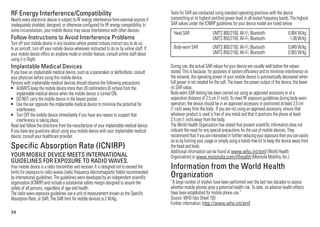
  • 14.
    12 Messaging Storage&transfer When youcreate a new contact, your phone asks if you want to store it in your Google™ account, phone memory, or SIM card. Contacts in all three places appear in your Contacts list, but if you change phones: • Contacts in your Google™ account can download when you log into your Google account on a new Android™ device. You can open these contacts from any computer at contacts.google.com. • Contacts on your SIM card can load to a new device when you insert your SIM card. • Contacts in your phone memory stay in your old phone, unless you export them. To import or export contacts between your phone memory and a SIM or memory card, touch > Contacts, then touch Menu > Import/Export. Messaging sometimes it’s best to text or email... Send and receive text with photos or other attachments, in quick text messages or full emails. Quickstart:Textmessaging From the home screen, touch > Messaging. Tip: To see more messages, flick or drag up. • To create a text message, touch > Messaging > New message. For options like attaching files, touch Menu . Messaging New message Compose new message 12254558787 14447772222 You had 1 missed call from 122545458787 ... 17 Aug Wanna catch something to eat tonight? How about ... 17 Aug 12223334545 Ha! Thanks. 16 Aug Settings Delete threads Search Compose Touch to open. Touch & hold to open options. Drag or flick to scroll. Touch to change settings and more.
  • 15.
    13Messaging • To opentext messages, touch > Messaging, then touch the sender’s name. When you see in the status bar at the top of your screen, flick down the status bar and touch the new message to open it. • To respond to a text message, just open it and enter your response in the text box at the bottom. • To forward, copy, and more, touch > Messaging, touch the sender’s name, then touch and hold the message. Attachments To send a file in a text message, touch > Messaging > New message, then touch Menu > Attach. When you open a message with an attachment, touch Download to download it. Touch the downloaded attachment to open it, then touch it again to save it, share it, and more. Tip: To send and receive large attachments faster, use “Wi-Finetworks” on page 25. Email • To set up Google or Corporate (Microsoft™ Exchange server) accounts, touch Menu > Settings > Accounts & sync > Add account. For details, contact the account provider. To set up standard email accounts (not Gmail™ or Microsoft™ Exchange), touch > Email and follow the wizard. To add more standard accounts, open Email and touch Menu > Accounts > Menu > Add account. For details, contact the account provider. • To open email, touch > Email or Gmail. Touch a message to open it. Tip: Touch Menu for options like Refresh or Search. • To create an email, touch > Email or Gmail, then touch Menu > Compose. Tip: Touch Menu for options, like Attach or Add Cc/Bcc. Gmail synchronizes with your Google™ account mail, which you can open from any computer at mail.google.com. To stop synchronizing with your account, touch Menu > Settings > Accounts & sync, touch your Google account, then uncheck Sync Gmail.
  • 16.
    14 Text entry Voicemail Whenyou have a new voicemail, shows in the status bar at the top of your screen. To hear voicemails, touch then touch and hold 1. If you need to change your voicemail number, in the home screen touch Menu > Settings > Call settings > Voicemail settings. For your voicemail number or other details, contact your service provider. Textentry keys when you need them When you enter text, like in a message or search, you have keyboard options. Quickstart:Textentry To change the keyboard, touch and hold a blank spot in a text box. A menu opens, where you can choose Input Method > Moto keyboard, Swype, or Handwriting. Note: Swype and Handwriting are not available in all regions. Your keyboard might change depending on what you’re entering. Swype lets you drag your finger over the letters of a word, in one continuous motion. Send :-) a s d f g h j k l q w e r t y u i o p z x c v b n m EN @ # 1 2 3 _ % ( ) ! 7 8 9 0 / ? & $ 4 5 6 + : ; “ , .SYM To enter a word, just trace a path through the letters. To capitalize, go above the keypad. For double letters, circle the letter. To enter a word, just trace a path through the letters. To capitalize, go above the keypad. For double letters, circle the letter. AnneAnneAnne a e n a e n
  • 17.
    15Text entry • Tomove the cursor, touch and hold a word you entered. This opens a magnifier where you can drag the cursor. • To copy and paste, double-tap a word to highlight it (if needed, drag the ends of the highlight). Now touch and hold a blank spot for the copy and paste menu. • To add a word to your dictionary, double-tap the word to highlight it. Now touch and hold a blank spot to open the menu where you can add the word. • To enter the small number or symbol at the top of a key, touch and hold the key. To enter several numbers or symbols, touch SYM. • To enter apostrophes in common words (like “I’ll”) in Swype, drag through the apostrophe key. • If Swype doesn’t know a word, touch individual letters to enter it. Swype remembers, so next time you can just drag over the letters. Handwriting lets you enter letters by drawing them. • Enter numbers and symbols, touch Alternate . Touch to return to letters. • Enter one capital letter, touch Shift (touch twice to enter capitals until you touch again). and A O o s . , ghi pqrs abc jkl tuv def mno wxyz A B C Touch to choose a letter or word, or touch for more words. Drag in the large square to trace a letter without lifting your finger. Drag in the small square for symbols. For Bell touch and drag for a letter. Full screen handwriting Bell text entry: For Qwerty or Bell , touch a letter to enter it, then touch an option that appears above. Touch to choose handwriting, Qwerty, or Bell text entry.
  • 18.
    16 Text entry •Cut or copy selected text, touch and hold text to select it, then touch and hold an empty spot in the text box to choose Cut or Copy. • Paste cut or copied text, touch and hold a blank spot in a text box to choose Paste. • Delete, touch Delete (hold to delete more). • To close the display keyboard, touch Back . Moto keyboard lets you enter letters by touching them one at a time. Budget Meet Meeting Meetings MeMeet a s d f g h j k l q w e r t y u i o p z x c v b n m . , DEL MMeeeeeeeeeeeeeeeeeeee ?123 Delete Symbols/Numbers Voice Recognition Touch this, then speak the recipient’s name or the text message. Touch and hold an empty spot to open a menu. Textentrydictionary Your phone’s dictionary stores special words or names to recognize when you enter them. To open your dictionary, from the home screen touch Menu > Settings > Language & keyboard > User dictionary. • To add a word, touch Menu > Add. • To edit or delete a word, touch and hold it.
  • 19.
    17Schedule Schedule helping you stayin control Your Calendar events can synchronize with your Google™ account, and the Clock can wake you up! Quickstart:Schedule From the home screen, touch > Calendar. • To create an event, touch > Calendar > Menu > More > New event, then enter details (to close the display keyboard, touch Back ). Calendar synchronizes with your Google™ account calendar, which you can open from any computer at SunMon Tue Wed Thu SatFri 28 29 30 31 1 2 3 4 5 6 8 9 10 11 12 13 15 16 17 18 19 20 22 23 24 25 26 27 29 30 31 1 2 3 5 6 7 7 14 21 28 4 June 2012 Day Week Agenda Today More Month Touch to open. Touch & hold to open options. Drag or flick to scroll. Color indicates events. Touch to choose the calendar view. Choose More to create an event or change settings. calendar.google.com (or open your calendar within mail.google.com). To stop synchronizing with your account, touch Menu > Settings > Accounts & sync, touch your Google account, then uncheck Sync Calendar. • To edit or delete an event, touch > Calendar, touch the event to open it, then touch Menu > Edit event or Delete event. Alarmclock To set an alarm (like to wake up), touch > Clock, then touch the alarm. • To turn an alarm on or off, touch next to it. • To add an alarm, touch Add alarm, then enter alarm details. • To change an alarm, touch the time. • To set a snooze period, in the Alarm Clock list touch Menu > Settings > Snooze duration. When an alarm sounds, touch Dismiss to turn it off or Snooze to delay it. To cancel a snoozed alarm, drag down the status bar bar and touch the alarm name. Date&time To set the date, time, time zone, and formats, touch Menu > Settings > Date & time.
  • 20.
    18 Web Web surf theweb with your phone Open Browser or just touch Search to find a page, then bookmark it, send it, or just explore. Quickstart:Web From the home screen, touch > Browser. • To enter a website address in the browser or your home screen, just touch Search . BookmarksNew window Windows MoreRefresh Web Images Local News more Near me nowChicago Google 11:19 Forward Touch to open. Touch & hold to open options. Drag or flick to scroll. Enter a web page URL. Touch to open bookmarks, windows, and more. Connection Mobile Network: Wi-Fi: • To zoom in or out, pinch two fingers together or apart. • To send the website address in a message, touch Menu > More > Share page. Note: Your phone automatically uses your mobile phone network to connect to the web. Your service provider may charge to surf the web or download data. If you can’t connect, contact your service provider. Tip: You can connect to the web with “Wi-Fi networks” on page 25. Downloads To download files in your browser, touch a file link or touch and hold a picture to choose Save image. To show the files you downloaded, touch Browser > Menu > More > Downloads. Touch and hold an item to open it, see details, or remove it from the list. You can download “Apps” on page 5. www.google.com: Google www.google.com: Google Android | Official Website Official site for the development of the open source project. Provides a directory of applications and links to download .. www.android.com/ - Options More from www.android.com »
  • 21.
    19Location Location where you are,and where you’re going Open Maps or just touch Search to find an address, then get directions, check in, or save the location. Quickstart:Location From the home screen, touch > Maps. Google Maps™ offers powerful, user-friendly mapping technology and local business information—including business locations, contact information, and driving directions. Chicago, IL NClarkSt Wacker Dr M E Ontario St E Ohio St NRushSt NParkSt NNewSt NWabashAve NDearbornSt E Grand Ave E Randolph St NMiciganAve NMiciganAve rDsubmuloCN W Lake St W Lake St E Wacker Pl State/Lake Grand Red Lake Randolph St Metra Randolph/ Wabash Washington-Blue E S WaterSt M M M M Ontario St DDDeeeeeaaarrbbboorrnnSSSt 44 West Street A Search Clear Map Directions Join Latitude Starred Places More Touch to open, then touch to add to Starred Places. Drag or flick to scroll. Find nearby places. Show your location. Show layers on the map. Touch to get directions, open your starred places, windows, and more. • To find an address, enter it in the search box at the top. The map moves to show the address. Tip: You can touch and hold a spot on the map to show the nearest address. • To find stores, restaurants, and other places near you, touch at the top. • To get directions, find an address on the map, touch it, then touch . • To save an address for later, touch it, then touch the star by its name to add it to your Starred Places. • For help, touch Menu > More > Help. GoogleMaps™Navigation Google Maps Navigation is an Internet-connected GPS navigation system with voice guidance. To open navigation, touch > Navigation. Follow the prompts to speak or type your destination. For more, go to www.google.com/mobile/navigation. GoogleLatitude™ Google Latitude lets you see where your friends and family are on Google Maps™. Plan to meet up, check that they got home safely, or just stay in touch. Don’t worry, your location is not shared unless you agree to it. After you join Google Latitude, you can invite your
  • 22.
    20 Photos &videos friends to view your location, or accept their invitations. Touch > Maps and then: • To join Google Latitude, touch Menu > Join Latitude. Read the privacy policy and, if you agree with it, choose to continue. • To add friends, touch Menu > Latitude > Menu > Add friends. Touch Select from Contacts or Add via email address, then touch a contact and Add friends. Your friend will receive an email notice. • To remove friends, touch Menu > Latitude to show your friends list. Touch a name, then touch Remove. • To share your location when you receive a request, you can choose Accept and share back (show your location and see theirs), Accept, but hide my location (hide your location, but see theirs), or Don’t accept (hide both locations). • To hide your location, touch Menu > Latitude to show your friends list. Touch your contact name, then touch Menu > Settings > Do not detect your location. • To sign out, touch Menu > Latitude to show your friends list. Touch Menu > Settings > Sign out of Latitude. Photos&videos see it, capture it, share it! Capture photos and videos to send them to friends or save them for later. Quickstart:Photos&videos From any screen, press the Camera Key on the right side of the phone to open the camera. • To take a photo, open the camera, press the Camera Key halfway (the focus square appears), then press all the way to take the photo. • To record a video, open the camera, then touch the camcorder icon to switch to the camcorder. Press the Camera Key to start and stop recording. Open your last photo or video. Switch resolution & more. Store photo location. Set white balance for your lighting. Set flash for photos. Zoom. Choose front or back camera. Choose camera or camcorder. Capture.
  • 23.
    21Photos & videos •To open photos and videos, touch > My Gallery, then touch a photo or video for options like Share. Tip: For the clearest photos and videos, clean the lens with a soft, dry cloth. View&sharephotos&videos From the home screen, touch > My Gallery. Flick left and right to show folders. Touch a folder to show its photos or videos, then touch a thumbnail image to open, share, or delete it. Tip: From the viewfinder, you can touch the thumbnail in the top right to open your last photo or video. • To zoom in, touch the screen with two fingers and then drag them apart. To zoom out, drag your fingers together. • To send or post the photo or video, touch Share. To use a Bluetooth or cable connection, see “Bluetooth™,Wi-Fi,&cable connections” on page 24. • To delete the photo or video, touch Delete. • To set a photo as your wallpaper or a contact photo, touch More > Set as. • To crop or rotate a photo, touch More. • To play a video, touch . Tip: Turn the phone sideways for a widescreen view. YouTube™ The YouTube user-generated content website lets you share videos with YouTube users everywhere. You don’t need a YouTube account to browse and view videos. From the home screen, touch > YouTube. • To watch videos, touch a category like Top rated or touch Search to find a video. Touch a video to watch it. For more video categories, touch Menu > Categories. To watch a video in high quality, touch Menu > Settings > High quality video. • To share a video, touch it to open it, touch More at the top, choose Share, then choose how you want to share it. • To upload a video from your phone to your YouTube account, touch > YouTube > Menu > Upload. Touch the video, then touch Upload.
  • 24.
    22 Music To signinto your YouTube account, touch > YouTube > Menu > My account. Note: If you don’t have an account, touch the link to create one. For more, visit www.youtube.com. Music when music is what you need... Keep your music with you! Put music on your phone so you can listen and create playlists anytime. Quickstart:Music From the home screen, touch > Music, then choose a song to play it: • To adjust volume, use the volume keys. Music Controls
  • 25.
    23Music • To edit,delete, or rename playlists, touch > Music touch the Playlists tab, then touch and hold the playlist name. • To hide the player and use other apps, touch Home . Your music keeps playing. To return to the player, flick down the status bar and touch . Tip: For quick music player controls, touch and hold an empty spot in your home screen, then choose Widget > Music. • To stop the player, touch . • Before a flight, turn off network and wireless connections so that you can keep listening to music: Press and hold Power > Airplane mode. Note: When you select airplane mode, all wireless services are disabled. You can then turn Wi-Fi and/or Bluetooth back on, if permitted by your airline. Other wireless voice and data services (such as calls and text messages) remain off in airplane mode. Emergency calls to your region's emergency number can still be made. You can use your phone’s 3.5mm OMTP headset jack to connect wired headphones, or go wireless with . To listen to FM radio stations, Plug in a 3.5mm OMTP headset and touch > FM Radio. Your phone uses the headset wire as the radio antenna. Musicfiles To get songs for your music player, you can download them from online services or copy them from your computer. Your music player can play these file formats: MP3, M4A, AAC, ACC+, MIDI, WAV, or OGG Vorbis. Note: Your phone does not support any DRM protected files. Note: Copyright—do you have the right? Always follow the rules. See “Content Copyright” in your legal and safety information. To copy files from your computer to your phone, you can use “Cableconnections” on page 26 or “Bluetooth™devices” on page 24. To save a CD on your computer (“rip” the CD), you can use a program like Microsoft™ Windows™ Media Player. First, make sure you change the format to MP3 (under Rip > Format in Windows Media Player).
  • 26.
    24 Bluetooth™, Wi-Fi,& cable connections Bluetooth™,Wi-Fi,&cable connections home, office, or hotspot Connect your phone to Bluetooth headsets, fast Wi-Fi networks, or right to your computer. Quickstart:connections From the home screen, touch Menu > Settings > Wireless & networks, then Bluetooth settings or Wi-Fi settings. Wi-Fi networks Wi-Fi settings Notify me when an open network is available Network notification (Your network) Wi-Fi Bluetooth devices Bluetooth settings (Your Phone) Device name Scan for devices Make device discoverable Discoverable Bluetooth Pair with this device (Nearby Bluetooth Device) Turn Bluetooth power on & scan, or turn off. Change your phone’s Bluetooth device name. Turn Wi-Fi power on & scan, or turn off. Re-scan. Connect a device found by the scan. Connect a network found by the scan. • To connect Bluetooth devices, touch Menu > Settings > Wireless & networks > Bluetooth settings > Scan for devices (or Bluetooth, if it is off). Touch a device that your phone found, to connect it. • To connect Wi-Fi networks, touch Menu > Settings > Wireless & networks > Wi-Fi settings (then touch Wi-Fi, if it is off). Touch a network that your phone found, to connect it. • To use a cable connection, connect your phone’s micro USB port to a standard USB port on your computer, then use a computer program to transfer files to and from your phone’s memory card. Your phone supports microSD cards up to 32GB. On your phone, flick down the status bar and touch to enable your phone’s memory card. You can download your phone’s driver files from www.motorola.com/support. • To make your phone a hotspot that other devices can use to connect to the Internet, touch Menu > Settings > Wireless & networks > Tethering & portable hotspot. Then, choose to enable USB tethering or Portable Wi-Fi hotspot. Bluetooth™devices Note: This requires an optional accessory.
  • 27.
    25Bluetooth™, Wi-Fi, &cable connections You can connect your phone to other Bluetooth devices for handsfree calls, file transfers, and more: 1 Make sure the device you are pairing with is in discoverable mode. Note: For questions about a Bluetooth device, check the manufacturer’s manual or website. 2 Touch Menu > Settings > Wireless & networks > Bluetooth settings. 3 Touch Scan for devices (or touch Bluetooth if it is turned off). Your phone scans, and lists nearby devices. 4 Touch a device to connect. 5 If necessary, touch Pair or enter the device passkey (like 0000) to connect to the device. When the device is connected, the Bluetooth connected indicator appears in the status bar. To reconnect a device you’ve connected before, just turn it on. To disconnect a device, just turn it off. Note: Using a mobile device or accessory while driving may cause distraction and may be illegal. Always obey the laws and drive safely. Tip: Touch and hold an empty spot on your home screen, then choose Widgets > Power Control for a widget that lets you turn on or off Wi-Fi, Bluetooth, Use GPS satellites, and more. Note: Your phone's Bluetooth features and Bluetooth Class 1 power levels are not allowed for outdoor operation in France. To avoid unlawful interference with radio signals, do not use the Bluetooth features in France unless you are indoors. Wi-Finetworks You can connect to Wi-Fi networks for even faster Internet access and to download data: 1 Touch Menu > Settings > Wireless & networks > Wi-Fi settings. 2 Touch Menu > Scan (or touch Wi-Fi, if it is off. Your phone scans for nearby networks. To see your phone’s MAC address or other details, touch Menu > Advanced. 3 Touch a network to connect. 4 If necessary, enter details from from the network administrator. When your phone is connected, the Wi-Fi indicator appears in the status bar. When power is on and your phone finds a network you’ve used, it automatically reconnects and shows in the status bar.
  • 28.
    26 Bluetooth™, Wi-Fi,& cable connections Tip: Touch and hold an empty spot on your home screen, then choose Widgets > Power Control for a widget that lets you turn on or off Wi-Fi, Bluetooth, Use GPS satellites, and more. Note: Your phone's features and power levels are not allowed for outdoor operation in France. To avoid unlawful interference with radio signals, do not use the features in France unless you are indoors. Cableconnections You can use a cable connection to transfer songs, pictures, or other files between your phone and computer. You will need a: • Microsoft™ Windows™ PC or Apple™ Macintosh™. • data cable with a standard USB connector on one end and a micro USB connector on the other end. • microSD memory card (up to 32GB) inserted in your phone, as shown in “Assemble&charge” on page 3. Tip: To see the available memory on your memory card, from the home screen touch Menu > Settings > SD card & phone storage. To connect your phone and computer with a cable: 1 Insert a memory card in your phone, then connect your phone’s micro USB port to a USB port on your computer. Note: If your computer asks for your phone’s driver files, you can download them from www.motorola.com/support. 2 Your phone should show in the status bar. Flick down the status bar, touch the to enable your phone’s memory card. 3 On your computer, open a program (like Windows™ Media Player for music files, or Microsoft™ Windows™ Explorer to drag and drop other files) and use it to transfer your files.
  • 29.
    27Security Security help keep yourphone safe Protect your information, in case your phone is lost or stolen. Quickstart:Security From the home screen, touch Menu > Settings > Location & security. • To set a lock pattern, PIN, or password that you must enter whenever you wake up the screen, touch Menu > Settings > Location & security > Device administration Lock screen with a pattern, PIN, or password Set up screen lock Show password as you type Turn off ephemeris auto download Visible passwords Credential storage Screen unlock Passwords Add or remove device administrators Select device administrators Location & security settings Set up SIM card lock SIM card lock Show password letters and numbers when you enter them (rather than ***). Choose a number code required to turn on your phone. Set a lock pattern, PIN, or password required to wake up the screen. Set up screen lock. Follow the prompts to enter and confirm the pattern, PIN, or password. Note: You can make emergency calls on a locked phone (“Contacts” on page 11). A locked phone still rings, but you need to unlock it to answer. • To set a SIM card PIN that you must enter when you turn on your phone, touch Menu > Settings > Location & security > Set up SIM card lock > Lock SIM card. Enter your SIM PIN code. To change your code, choose Change SIM PIN. Caution: If you enter an incorrect PIN code three times, your phone locks your SIM card. To unlock it, you need a PUK code from your service provider. Reset To reset your phone to factory settings and erase all the data on your phone, touch Menu > Settings > Privacy > Factory data reset > Reset phone. Warning: All downloaded apps and user data on your phone will be deleted. Data on your memory card will not be deleted.
  • 30.
    28 Tips &tricks Tips&tricks a few handy hints Make it faster and easier to get the most out of your phone every day. Generaltips • Touch Search in the home screen to search across your apps, contacts, web, and maps—or just enter the address for a place or a web page. Touch Search in Market, Messaging, Music, and other apps to search within the app. • Use folders to organize shortcuts and contacts on your home screen. Touch and hold a blank spot on your home screen, then touch Folders. To move shortcuts into a New folder, touch and hold a shortcut, then drag it to the folder icon. • Touch and hold Home to show your most recent apps. • Touch and hold the status bar at the top of your phone to show the date. To change your date format, touch Menu > Settings > Date & time > Select date format. • To change which location information your phone uses, touch Menu > Settings > Location & security. • To back up your app data, passwords, and other settings to Google servers, touch Menu > Settings > Privacy settings > Back up my data. Batterytips Your phone is like a small computer, giving you a lot of information and apps, at 3G speed, with a touch display! Depending on what you use, that can take a lot of power. So, if you want to save battery life between charges, you could reduce: • recording or watching videos, listening to music, or taking pictures. • widgets that stream information to your home screen, like news or weather. • Bluetooth™ use: touch Menu > Settings > Wireless & networks > Bluetooth (turn off). • use: touch Menu > Settings > Wireless & networks > Wi-Fi (turn off). • GPS use: touch Menu > Settings > Location & security > Use GPS satellites (deselect).
  • 31.
    29Tips & tricks •network searching: if you are out of coverage, to keep your phone from looking for networks, press and hold Power > Airplane mode. • display brightness: touch Menu > Settings > Display > Brightness > (dimmer setting). • display timeout delay: touch Menu > Settings > Display > Screen timeout > (shorter setting). Accessibility See, hear, speak, feel, and use. Accessibility features are there for everyone, helping to make things easier. Voicerecognition • Dialing and commands: Touch > Voice Dialer. To dial, say “Call” and then a contact name or phone number. You can also say a command from the list shown, like “Open Calendar.” • Search: Touch and hold Search to open voice search, or touch on a search box, then say what you want to search for, like “Motorola accessories”. • Text entry: Touch a text entry field to open the touchscreen keyboard. Touch , then say what you want to type. Note: There is no on the Swype keyboard. To change the keyboard, touch and hold a blank spot in the text box. A menu opens, where you can choose Input Method > Multi-touch keyboard. Tip: Speak naturally but clearly, like using a speakerphone. CallerID When you want to hear who’s calling: • Ringtones: Assign a unique ringtone to a contact— touch > Contacts, touch the contact, then touch Menu > Options. Volume&vibrate To set your ringer volume or vibration, touch Menu > Settings > Sound > Vibrate or Volume. Tip: To set separate volumes for calls and notifications (like new messages), choose Volume and uncheck Use incoming call volume for notifications. Displaybrightness To change display brightness, touch Menu > Settings > Display > Brightness Uncheck Automatic brightness to set your own level. Touchscreen&keys You can hear or feel when you touch the touchscreen: Touch Menu > Settings > Sound:
  • 32.
    30 Troubleshooting • Touchscreen:To hear screen touches (click), select Audible selection. • Keys: To feel screen keyboard touches (vibrate), select Haptic feedback. Apps Want more? No problem. Android Market™ provides access to thousands of apps, and many provide useful accessibility features: Touch > Market. Troubleshooting we’re here to help Crashrecovery In the unlikely event that your phone stops responding to touchs and key presses, try a quick reset. Remove the back cover and battery (“Assemble&charge” on page 3), then replace and turn on your phone as usual. Service&repairs If you have questions or need assistance, we're here to help. Go to www.motorola.com/support, where you can select from a number of customer care options. You can also contact the Motorola Customer Support Center at 1-800-331-6456 (United States), 1-888-390-6456 (TTY/TDD United States for hearing impaired), or 1-800-461-4575 (Canada).
  • 33.
    31 Safety, Regulatory &Legal Battery Use & SafetyBattery Use & Safety Important: Handle and store batteries properly to avoid injury or damage. Most battery issues arise from improper handling of batteries, and particularly from the continued use of damaged batteries. DON’Ts • Don’t disassemble, crush, puncture, shred, or otherwise attempt to change the form of your battery. • Don’t let the mobile device or battery come in contact with liquids.* Liquids can get into the mobile device’s circuits, leading to corrosion. • Don’t allow the battery to touch metal objects. If metal objects, such as jewelry, stay in prolonged contact with the battery contact points, the battery could become very hot. • Don’t place your mobile device or battery near a heat source.* High temperatures can cause the battery to swell, leak, or malfunction. • Don’t dry a wet or damp battery with an appliance or heat source, such as a hair dryer or microwave oven. DOs • Do avoid leaving your mobile device in your car in high temperatures.* • Do avoid dropping the mobile device or battery.* Dropping these items, especially on a hard surface, can potentially cause damage.* • Do contact your service provider or Motorola if your mobile device or battery has been damaged by dropping, liquidsor high temperatures. * Note: Always make sure that the battery compartment and any connector covers are closed and secure to avoid direct exposure of the battery to any of these conditions, even if your product information states that your mobile device can resist damage from these conditions. Important: Motorola recommends you always use Motorola-branded batteries and chargers for quality assurance and safeguards. Motorola’s warranty does not cover damage to the mobile device caused by non-Motorola batteries and/or chargers. To help you identify authentic Motorola batteries from non-original or counterfeit batteries (that may not have adequate safety protection), Motorola provides holograms on its batteries. You should confirm that any battery you purchase has a “Motorola Original” hologram. If you see a message on your display such as Invalid Battery or Unable to Charge, take the following steps: • Remove the battery and inspect it to confirm that it has a “Motorola Original” hologram; • If there is no hologram, the battery is not a Motorola battery; • If there is a hologram, replace the battery and try charging it again; • If the message remains, contact a Motorola authorized service center. Warning: Use of a non-Motorola battery or charger may present a risk of fire, explosion, leakage, or other hazard. Proper and safe battery disposal and recycling: Proper battery disposal is not only important for safety, it benefits the environment. You can recycle your used batteries in many retail or service provider locations. Additional information on proper disposal and recycling can be found at www.motorola.com/recycling. Disposal: Promptly dispose of used batteries in accordance with local regulations. Contact your local recycling center or national recycling organizations for more information on how to dispose of batteries. Warning: Never dispose of batteries in a fire because they may explode. Battery ChargingBattery Charging Notes for charging your product’s battery: • During charging, keep your battery and charger near room temperature for efficient battery charging. • New batteries are not fully charged. • New batteries or batteries stored for a long time may take more time to charge. • Motorola batteries and charging systems have circuitry that protects the battery from damage from overcharging. Third Party Accessories Use of third party accessories, including but not limited to batteries, chargers, headsets, covers, cases, screen protectors and memory cards, may impact your mobile device’s performance. In some circumstances, third party accessories can be dangerous and may void your mobile device’s warranty. For a list of Motorola accessories, visit www.motorola.com/products. 032375o
  • 34.
    32 Driving Precautions Responsible andsafe driving is your primary responsibility when behind the wheel of a vehicle. Using a mobile device or accessory for a call or other application while driving may cause distraction. Using a mobile device or accessory may be prohibited or restricted in certain areas, always obey the laws and regulations on the use of these products. While driving, NEVER: • Type or read texts. • Enter or review written data. • Surf the web. • Input navigation information. • Perform any other functions that divert your attention from driving. While driving, ALWAYS: • Keep your eyes on the road. • Use a handsfree device if available or required by law in your area. • Enter destination information into a navigation device before driving. • Use voice activated features (such as voice dial) and speaking features (such as audible directions), if available. • Obey all local laws and regulations for the use of mobile devices and accessories in the vehicle. • End your call or other task if you cannot concentrate on driving. Remember to follow the “Smart Practices While Driving” in this guide and at www.motorola.com/callsmart (in English only). Seizures/Blackouts Some people may be susceptible to epileptic seizures or blackouts when exposed to flashing lights, such as when playing videos or games. These may occur even if a person has never had a previous seizure or blackout. If you have experienced seizures or blackouts, or if you have a family history of such occurrences, please consult with your physician before playing videos or games or enabling a flashing-lights feature (if available) on your mobile device. Discontinue use and consult a physician if any of the following symptoms occur: convulsion, eye or muscle twitching, loss of awareness, involuntary movements, or disorientation. It is always a good idea to hold the screen away from your eyes, leave the lights on in the room, take a 15-minute break every hour, and stop use if you are tired. Caution About High Volume Usage Warning: Exposure to loud noise from any source for extended periods of time may affect your hearing. The louder the volume sound level, the less time is required before your hearing could be affected. To protect your hearing: • Limit the amount of time you use headsets or headphones at high volume. • Avoid turning up the volume to block out noisy surroundings. • Turn the volume down if you can’t hear people speaking near you. If you experience hearing discomfort, including the sensation of pressure or fullness in your ears, ringing in your ears, or muffled speech, you should stop listening to the device through your headset or headphones and have your hearing checked. For more information about hearing, see our website at direct.motorola.com/hellomoto/nss/AcousticSafety.asp (in English only). Repetitive Motion When you repetitively perform actions such as pressing keys or entering finger-written characters, you may experience occasional discomfort in your hands, arms, shoulders, neck, or other parts of your body. If you continue to have discomfort during or after such use, stop use and see a physician. Children Keep your mobile device and its accessories away fromsmall children. These products are not toys and may be hazardous to small children. For example: • A choking hazard may exist for small, detachable parts. • Improper use could result in loud sounds, possibly causing hearing injury. • Improperly handled batteries could overheat and cause a burn. Similar to a computer, if a child does use your mobile device, you may want to monitor their access to help prevent exposure to inappropriate apps or content. Glass Parts Some parts of your mobile device may be made of glass. This glass could break if the product receives a substantial impact. If glass breaks, do not touch or attempt to remove. Stop using your mobile device until the glass is replaced by a qualified service center.
  • 35.
    33 Operational Warnings Obey allposted signs when using mobile devices in public areas. Potentially Explosive Atmospheres Areas with potentially explosive atmospheres are often, but not always, posted and can include fueling areas, such as below decks on boats, fuel or chemical transfer or storage facilities, or areas where the air contains chemicals or particles, such as grain dust, or metal powders. When you are in such an area, turn off your mobile device, and do not remove, install, or charge batteries unless it is a radio product type especially qualified for use in such areas as “Intrinsically Safe” (for example, Factory Mutual, CSA, or UL approved). In such areas, sparks can occur and cause an explosion or fire. Symbol Key Your battery, charger, or mobile device may contain symbols, defined as follows: Symbol Definition Important safety information follows. Do not dispose of your battery or mobile device in a fire. Your battery or mobile device may require recycling in accordance with local laws. Contact your local regulatory authorities for more information. Do not dispose of your battery or mobile device with your household waste. See “Recycling” for more information. 032374o 032376o 032375o Radio Frequency (RF) Energy Exposure to RF Energy Your mobile device contains a transmitter and receiver. When it is ON, it receives and transmits RF energy. When you communicate with your mobile device, the system handling your call controls the power level at which your mobile device transmits. Your mobile device is designed to comply with local regulatory requirements in your country concerning exposure of human beings to RF energy. RF Energy Operational Precautions For optimal mobile device performance, and to be sure that human exposure to RF energy does not exceed the guidelines set forth in the relevant standards, always follow these instructions and precautions: • When placing or receiving a phone call, hold your mobile device just like you would a landline phone. • If you wear the mobile device on your body, always place the mobile device in a Motorola-supplied or approved clip, holder,holster,case, or bodyharness. If youdo not use a body-worn accessory supplied or approved by Motorola, keep the mobile device and its antenna at least 2.5 cm (1 inch) from your body when transmitting. • Using accessoriesnot supplied or approved byMotorolamaycause your mobile device to exceed RF energy exposure guidelines. For a list of Motorola-supplied or approved accessories, visit our website at: www.motorola.com. Do not use tools. For indoor use only. Listening at full volume to music or voice through a headset may damage your hearing. Symbol Definition
  • 36.
    34 RF Energy Interference/Compatibility Nearlyeveryelectronicdevice issubject to RF energyinterference fromexternalsourcesif inadequately shielded, designed, or otherwise configured for RF energy compatibility. In some circumstances, your mobile device may cause interference with other devices. Follow Instructions to Avoid Interference Problems Turn off your mobile device in any location where posted notices instruct you to do so. In an aircraft, turn off your mobile device whenever instructed to do so by airline staff. If your mobile device offers an airplane mode or similar feature, consult airline staff about using it in flight. Implantable Medical Devices If you have an implantable medical device, such as a pacemaker or defibrillator, consult your physician before using this mobile device. Persons with implantable medical devices should observe the following precautions: • ALWAYS keep the mobile device more than 20 centimeters (8 inches) from the implantable medical device when the mobile device is turned ON. • DO NOT carry the mobile device in the breast pocket. • Use the ear opposite the implantable medical device to minimize the potential for interference. • Turn OFF the mobile device immediately if you have any reason to suspect that interference is taking place. Read and followthe directionsfrom the manufacturer of your implantable medical device. If you have any questions about using your mobile device with your implantable medical device, consult your healthcare provider. Specific Absorption Rate (ICNIRP)SAR (ICNIRP) YOUR MOBILE DEVICE MEETS INTERNATIONAL GUIDELINES FOR EXPOSURE TO RADIO WAVES. Your mobile device is a radio transmitter and receiver. It is designed not to exceed the limits for exposure to radio waves (radio frequency electromagnetic fields) recommended by international guidelines. The guidelines were developed by an independent scientific organization (ICNIRP) and include a substantial safety margin designed to assure the safety of all persons, regardless of age and health. The radio wave exposure guidelines use a unit of measurement known as the Specific Absorption Rate, or SAR. The SAR limit for mobile devices is 2 W/kg. Tests for SAR are conducted using standard operating positions with the device transmitting at its highest certified power level in all tested frequency bands. The highest SAR values under the ICNIRP guidelines for your device model are listed below: During use, the actual SAR values for your device are usually well below the values stated. This is because, for purposes of system efficiency and to minimise interference on the network, the operating power of your mobile device is automatically decreased when full power is not needed for the call. The lower the power output of the device, the lower its SAR value. Body-worn SAR testing has been carried out using an approved accessory or at a separation distance of 2.5 cm (1 inch). To meet RF exposure guidelines during body-worn operation, the device should be in an approved accessory or positioned at least 2.5 cm (1 inch) away from the body. If you are not using an approved accessory, ensure that whatever product is used is free of any metal and that it positions the phone at least 2.5 cm (1 inch) away from the body. The World Health Organization has stated that present scientific information does not indicate the need for any special precautions for the use of mobile devices. They recommend that if youareinterested in further reducingyour exposure then youcan easily do so by limiting your usage or simply using a hands-free kit to keep the device away from the head and body. Additional information can be found at www.who.int/emf (World Health Organization) or www.motorola.com/rfhealth (Motorola Mobility, Inc.). Information from the World Health OrganizationWHOInformation “A large number of studies have been performed over the last two decades to assess whether mobile phones pose a potential health risk. To date, no adverse health effects have been established for mobile phone use.” Source: WHO Fact Sheet 193 Further information: http://www.who.int/emf Head SAR UMTS 900/2100, Wi-Fi, Bluetooth UMTS 850/2100, Wi-Fi, Bluetooth 0.904 W/kg 1.08 W/kg Body-worn SAR UMTS 900/2100, Wi-Fi, Bluetooth UMTS 850/2100, Wi-Fi, Bluetooth 0.849 W/kg 0.903 W/kg
  • 37.
    35 European Union DirectivesConformance StatementEU Conformance The following CE compliance information is applicable to Motorola mobile devices that carry one of the following CE marks: Hereby, Motorola declares that this product is in compliance with: • The essential requirements and other relevant provisions of Directive 1999/5/EC • All other relevant EU Directives The above gives an example of a typical Product Approval Number. You can view your product’s Declaration of Conformity (DoC) to Directive 1999/5/EC (to R&TTE Directive) at www.motorola.com/rtte. To find your DoC, enter the Product Approval Number from your product’s label in the “Search” bar on the website. FCC Notice to UsersFCC Notice The following statement applies to all products that bear the FCC logo on the product label. This equipment has been tested and found to comply with the limits for a Class B digital device, pursuant to part 15 of the FCC Rules. See 47 CFR Sec. 15.105(b). These limits are designed to provide reasonable protection against harmful interference in a residential installation. This equipment generates, uses and can radiate radio frequency energy and, 0168 [Only Indoor Use Allowed In France for Bluetooth and/or Wi-Fi]0168 0168 Product Approval Number if not installed and used in accordance with the instructions, may cause harmful interference to radio communications. However, there is no guarantee that interference will not occur in a particular installation. If this equipment does cause harmful interference to radio or television reception, which can be determined by turning the equipment off and on, the user is encouraged to try to correct the interference by one or more of the following measures: • Reorient or relocate the receiving antenna. • Increase the separation between the equipment and the receiver. • Connect the equipment to an outlet on a circuit different from that to which the receiver is connected. • Consult the dealer or an experienced radio/TV technician for help. This device complies with part 15 of the FCC Rules. Operation is subject to the following two conditions: (1) This device may not cause harmful interference, and (2) this device must accept any interference received, including interference that may cause undesired operation. See 47 CFR Sec. 15.19(a)(3). Motorola has not approved any changes or modifications to this device by the user. Any changes or modifications could void the user’s authority to operate the equipment. See 47 CFR Sec. 15.21. For products that support Wi-Fi802.11a (as defined in the product specifications available at www.motorola.com), the following information applies. This equipment has the capability to operate Wi-Fi in the 5 GHz Unlicensed National Information Infrastructure (U-NII) band. Because this band is shared with MSS (Mobile Satellite Service), the FCC has restricted such devices to indoor use only (see 47 CFR 15.407(e)). Since wireless hot spots operating in this band have the same restriction, outdoor services are not offered. Nevertheless, please do not operate this device in Wi-Fi mode when outdoors. Location Services (GPS & AGPS)GPS &AGPS The following information is applicable to Motorola mobile devices that provide location- based (GPS and/or AGPS) functionality. Your mobile device can use Global Positioning System (GPS) signals for location-based applications. GPS uses satellites controlled by the U.S. government that are subject to changes implemented in accordance with the Department of Defense policy and the Federal Radio Navigation Plan. These changes may affect the performance of location technology on your mobile device. Your mobile device can also use Assisted Global Positioning System (AGPS), which obtains information from the cellular network to improve GPS performance. AGPS uses
  • 38.
    36 your wireless serviceprovider's network and therefore airtime, data charges, and/or additional charges may apply in accordance with your service plan. Contact your wireless service provider for details. Your Location Location-based information includes information that can be used to determine the approximate location of a mobile device. Mobile devices which are connected to a wirelessnetworktransmit location-basedinformation. Devices enabled with GPSor AGPS technology also transmit location-based information. Additionally, if you use applications that require location-based information (e.g.driving directions),such applicationstransmit location-based information. This location-based information may be shared with third parties, including your wireless service provider, applications providers, Motorola, and other third parties providing services. Emergency Calls When you make an emergency call, the cellular network may activate the AGPS technology in your mobile device to tell the emergency responders your approximate location. AGPS has limitations and might not work in your area. Therefore: • Always tell the emergency responder your location to the best of your ability; and • Remain on the phone for as long as the emergency responder instructs you. NavigationNavigation The following information is applicable to Motorola mobile devices that provide navigation features. When using navigation features, note that mapping information, directions and other navigational data may contain inaccurate or incomplete data. In some countries, complete information may not be available. Therefore, you should visually confirm that the navigational instructions are consistent with what you see. All drivers should pay attentionto roadconditions,closures, traffic, andall otherfactorsthat mayimpact driving. Always obey posted road signs. Smart Practices While DrivingDriving Safety Check the laws and regulations on the use of mobile devices and their accessories in the areas where you drive. Always obey them. The use of these devices may be prohibited or restricted in certain areas—for example, handsfree use only may be required. Go to www.motorola.com/callsmart (in English only) for more information. Your mobile device lets you communicate by voice and data—almost anywhere, anytime, wherever wireless service is available and safe conditions allow. When driving a car, driving is your first responsibility. If you choose to use your mobile device while driving, remember the following tips: • Getto knowyour Motorola mobile device and itsfeaturessuchas speed dial, redial and voice dial. If available, these features help you to place your call without taking your attention off the road. • When available, use a handsfree device. If possible, add an additional layer of convenience to your mobile device with one of the many Motorola Original handsfree accessories available today. • Position your mobile device within easy reach. Be able to access your mobile device without removing your eyes from the road. If you receive an incoming call at an inconvenient time, if possible, let your voicemail answer it for you. • Let the person you are speaking with knowyou are driving; if necessary, suspend the call in heavy traffic or hazardous weather conditions. Rain, sleet, snow, ice, and even heavy traffic can be hazardous. • Do not take notes or look up phone numbers while driving. Jotting down a “to do” list or going through your address book takes attention away from your primary responsibility—driving safely. • Dial sensibly and assess the traffic; if possible, place calls when your car is notmoving orbeforepullingintotraffic. If youmust make acall while moving, dial only a few numbers, check the road and your mirrors, then continue. • Do not engage in stressful or emotional conversations that may be distracting. Make people you are talking with aware you are driving and suspend conversations that can divert your attention away from the road. • Use your mobile device to call for help. Dial 911 or other local emergency number in the case of fire, traffic accident, or medical emergencies (wherever wireless phone service is available). • Use your mobile device to help others in emergencies. If you see an auto accident, crime in progress, or other serious emergency where lives are in danger, call
  • 39.
    37 911 or otherlocal emergency number (wherever wireless phone service is available), as you would want others to do for you. • Call roadside assistance or a special non-emergency wireless assistance number when necessary. If you see a broken-down vehicle posing no serious hazard, a broken traffic signal, a minor traffic accident where no one appears injured, or a vehicle you know to be stolen, call roadside assistance or other special non-emergency wireless number (wherever wireless phone service is available). Privacy & Data SecurityPrivacy & Data Security Motorola understands that privacy and data security are important to everyone. Because some features of your mobile device may affect your privacy or data security, please follow these recommendations to enhance protection of your information: • Monitor access—Keep your mobile devicewith youanddonot leave it where others may have unmonitored access. Use your device’s security and lock features, where available. • Keep software up to date—If Motorola or a software/application vendor releasesa patch or software fixfor your mobile device that updatesthedevice’s security, installit as soon as possible. • Secure Personal Information—Your mobile device can store personal information in variouslocations including your SIM card, memory card,and phone memory. Be sure to remove or clear all personal information before you recycle, return, or give away your device. You can also backup your personal data to transfer to a new device. Note: For information on how to backup or wipe data from your mobile device, go to www.motorola.com/support • Online accounts—Some mobile devices provide a Motorola online account (such as MOTOBLUR). Go to your account for information on how to manage the account, and how to use security features such as remote wipe and device location (where available). • Applications and updates—Choose your apps and updates carefully, and install from trusted sources only. Some apps can impact your phone’s performance and/or have access to private information including account details, call data, location details and network resources. • Wireless—For mobile devices with Wi-Fi features, only connect to trusted Wi-Fi networks. Also, when using your device as a hotspot (where available) use network security. These precautions will help prevent unauthorised access to your device. • Location-basedinformation—Location-basedinformationincludesinformationthat can be used to determine the approximate location of a mobile device. Mobile phones which are connected to a wireless network transmit location-based information. Devices enabled with GPS or AGPS technology also transmit location-based information. Additionally, if you use applications that require location-based information (e.g. driving directions), such applications transmit location-based information. This location-based information may be shared with third parties, including your wireless service provider, applications providers, Motorola, and other third parties providing services. • Other information your device may transmit—Your device may also transmit testing and other diagnostic (including location-based) information, and other non-personal information to Motorola or other third-party servers. This information is used to help improve products and services offered by Motorola. If youhavefurther questionsregarding howtheuse of your mobile devicemayimpact your privacy or data security, please contact Motorola at privacy@motorola.com, or contact your service provider. Use & CareUse & Care To care for your Motorola mobile device, please observe the following: liquids Don’t expose your mobile device to water, rain, extreme humidity, sweat, or other liquids. If it doesget wet, don’t try to accelerate drying with the use of an oven or dryer, as this may damage the mobile device. extreme heat or cold Don’t store or use your mobile device in temperatures below -10°C (14°F) or above 60°C (140°F). Don’t recharge your mobile device in temperatures below 0°C (32°F) or above 45°C (113°F). microwaves Don’t try to dry your mobile device in a microwave oven.
  • 40.
    38 dust and dirt Don’texpose your mobile device to dust, dirt, sand, food, or other inappropriate materials. cleaning solutions To clean your mobile device, use only a dry soft cloth. Don’t use alcohol or other cleaning solutions. shock and vibration Don’t drop your mobile device. protection To help protect your mobile device, always make sure that the battery compartment and any connector covers are closed and secure. RecyclingRecycling Mobile Devices & Accessories Please do not dispose of mobile devices or electrical accessories (such as chargers, headsets, or batteries) with your household waste, or in a fire. These items should be disposed of in accordance with the national collection and recycling schemes operated by your local or regional authority. Alternatively, you may return unwanted mobile devices and electrical accessories to any Motorola Approved Service Center in your region. Details of Motorola approved national recycling schemes, and further information on Motorola recycling activities can be found at: www.motorola.com/recycling Packaging & Product Guides Product packaging and product guides should only be disposed of in accordance with nationalcollectionand recyclingrequirements.Pleasecontactyourregionalauthoritiesfor more details. Software Copyright NoticeSoftware Copyright Notice Motorola products may include copyrighted Motorola and third-party software stored in semiconductor memories or other media. Laws in the United States and other countries preserve for Motorola and third-party software providers certain exclusive rights for copyrighted software, such as the exclusive rights to distribute or reproduce the copyrighted software. Accordingly, any copyrighted software contained in Motorola products may not be modified, reverse-engineered, distributed, or reproduced in any manner to the extent allowed by law. Furthermore, the purchase of Motorola products shall not be deemed to grant either directly or by implication, estoppel, or otherwise, any license under the copyrights, patents, or patent applications of Motorola or anythird-party software provider, except for the normal, non-exclusive, royalty-free license to use that arises by operation of law in the sale of a product. Content CopyrightContent Copyright The unauthorized copying of copyrighted materials is contrary to the provisions of the Copyright Laws of the United States and other countries. Thisdevice isintended solely for copying non-copyrighted materials,materialsinwhich you own the copyright, or materials which you are authorized or legally permitted to copy. If you are uncertain about your right to copy any material, please contact your legal advisor. Open Source Software InformationOSS Information For instructions on how to obtain a copy of any source code being made publicly available by Motorola related to software used in this Motorola mobile device, you may send your request in writing to the address below. Please make sure that the request includes the model number and the software version number. MOTOROLA MOBILITY, INC. OSS Management 600 North US Hwy 45 Libertyville, IL 60048 USA The Motorola website opensource.motorola.com also contains information regarding Motorola's use of open source. Motorola hascreated the opensource.motorola.com website to serve as a portalfor interaction with the software community-at-large.
  • 41.
    39 To view additionalinformation regarding licenses, acknowledgments and required copyright notices for open source packages used in this Motorola mobile device, please press Menu Key > Settings > About phone > Legal information > Open source licenses. In addition, this Motorola device may include self-contained applications that present supplemental notices for open source packages used in those applications. WARRANTY INFORMATION Motorola guarantees to you, the original purchaser, the Personal Communicator and accessories which you have purchased from an authorised Motorola dealer (the "Products"), to be in conformance with the applicable Motorola specifications current at the time of manufacture for a term of 1 year (2 years for South Africa and Portugal) from date of purchase of the Product(s) (Warranty Term). You must inform Motorola of the lack of conformity to the applicable specifications of any of the Products within a period of two (2) months from the date on which you detect a defect inmaterial,workmanship orlackof conformityand in anyevent withina termnotto exceed the Warranty Term, and must immediately submit the Product for service to Motorola's Authorised Repair or Service Centre. Motorola shall not be bound by Product related statements not directly made by Motorola nor any warranty obligations applicable to the seller. During the Warranty term, Motorola will, at its discretion and without extra charge, as your exclusive remedy, repair or replace your Product which does not comply with this warranty; or failing this, to reimburse the price of the Product but reduced to take into account the use you have had of the Product since it was delivered. This warranty will expire at the end of the Warranty Term. This is the complete and exclusive warranty for a Motorola Personal Communicator and accessories and in lieu of all other warranties, terms and conditions, whether express or implied. Where you purchase the product other than as a consumer, Motorola disclaims all other warranties, terms and conditions express or implied, such as fitness for purpose and satisfactory quality. In noevent shall Motorola be liable for damagesnor lossof datainexcessof the purchase price nor for any incidental special or consequential damages* arising out of the use or inability to use the Product, to the full extent such may be disclaimed by law. This Warranty does not affect any statutory rights that you may have if you are a consumer, such as a warranty of satisfactory quality and fit for the purpose for which products of the same type are normally used under normal use and service, nor any rights against the seller of the Products arising from your purchase and sales contract. HOW TO GET WARRANTY SERVICE? In most cases the authorised Motorola dealer which sold and/or installed your Motorola Personal Communicator and original accessories will honour a warranty claim and/or provide warranty service. Alternatively, for further information on how to get warranty service, please contact either the customer service department of your service provider or go to http://www.motorola.com/support/warrantyselector. Where, in the Country of purchase, there is a statutory requirement to provide extended repair service to consumers beyond the first year of purchase (South Africa and Portugal), this warranty will be provided by Motorola Authorised Service Centres or Motorola directly appointed dealers in the country of purchase according to the terms of this warranty information document. However, please note that you will be referred back to the place of purchase, if the Motorola Dealer has purchased the product directly from Motorola, in the country of purchase or in a country where Motorola is not required to support supplementary repair service during the second year of purchase because of the statutory obligations that may apply to the seller or importer of the product, but not to the manufacturer, to provide an extended warranty to consumers beyond the first year. CLAIMING In order to claim the warranty service, you must return the Personal Communicator and/or accessories in question to Motorola's Authorised Repair or Service Centre in the original configuration and packaging as supplied by Motorola. Please avoid leaving any supplementary items like SIM cards. The Product should also be accompanied by a label with your name, address, and telephone number; name of operator and a description of the problem. In the case of vehicular installation, the vehicle in which the Personal Communicator is installed should be driven to the Authorised Repair or Service Centre, as analysis of any problem may require inspection of the entire vehicular installation. In order to be eligible to receive warranty service, you must present your receipt of purchase or a comparable substitute proof of purchase bearing the date of purchase. The * including without limitation loss of use, loss of time, loss of data, inconvenience, commercial loss, lost profits or savings.
  • 42.
    40 phone should alsoclearly display the original compatible electronic serial number (IMEI) and mechanic serial number [MSN]. Such information is contained with the Product. You must ensure that any and all repairs or servicing is handled at all times by a Motorola Authorised Service Centre in accordance with the Motorola Service requirements. In some cases, you may be requested to provide additional information concerning the maintenance of the Products by Motorola Authorised Service Centres only, therefore it is important to keep a record of any previous repairs, and make them available if questions arise concerning maintenance. CONDITIONS Thiswarrantywillnot applyif the type or serialnumberson the Producthavebeen altered, deleted, duplicated, removed, or made illegible. Motorola reserves the right to refuse free-of-charge warranty service if the requested documentation can not be presented or if the information is incomplete, illegible or incompatible with the factory records. Repair, at Motorola's option, may include reflashing of software, the replacement of parts or boards with functionally equivalent, reconditioned or new parts or boards. Replaced parts, accessories, batteries, or boards are warranted for the balance of the original warranty time period. The Warranty Term will not be extended. All original accessories, batteries, parts, and Personal Communicator equipment that have been replaced shall become the property of Motorola. Motorola does not warrant the installation, maintenance or service of the products, accessories, batteries or parts. Motorola will not be responsible in any way for problems or damage caused by any ancillary equipment not furnished by Motorola which is attached to or used in connection with the Products, or for operation of Motorola equipment with any ancillary equipment and all such equipment is expressly excluded from this warranty. When the Product is used in conjunction with ancillary or peripheral equipment not supplied by Motorola, Motorola does not warrant the operation of the Product/peripheral combination and Motorola will not honour any warranty claim where the Product is used in such a combination and it is determined by Motorola that there is no fault with the Product.Motorolaspecificallydisclaimsanyresponsibilityfor any damage, whether or not to Motorola equipment, caused in any way by the use of the Personal Communicator, accessories, software applications and peripherals (specific examples include, but are not limited to: batteries, chargers, adapters, and power supplies) when such accessories, software applications and peripherals are not manufactured and supplied by Motorola. WHAT IS NOT COVERED BY THE WARRANTY This warranty is not valid if the defects are due to damage, misuse, tampering, neglect or lack of care and in case of alterations or repair carried out by unauthorised persons. The following are examples of defects or damage not covered by this product warranty: 1 Defects or damage resulting from use of the Product in other than its normal and customary manner. 2 Defects or damage from misuse, accessto incompatible sources, accident or neglect. 3 Defects or damage from improper testing, operation, maintenance, installation, adjustment, unauthorised software applications or any alteration or modification of any kind. 4 Breakage or damage to antennas unless caused directly by defects in material or workmanship. 5 Products disassembled or repaired other than by Motorola in such a manner as to adversely affect performance or prevent adequate inspection and testing to verify any warranty claim. 6 Defectsor damage due to range, coverage,availability, gradeof service,or operation of the cellular system by the cellular operator. 7 Defects or damage due to moisture, liquid or spills of food. 8 Control unit coil cords in the Product that are stretched or have the modular tab broken. 9 All plastic surfaces and all other externally exposed parts that are scratched or damaged due to customer normal use. 10 Leather cases (which are covered under separate manufacturer's warranties). 11 Products rented on a temporary basis. 12 Periodic maintenance and repair or replacement of parts due to normal wear and tear. Note: The talk-time, stand-by time and total life cycle of a Motorola rechargeable battery for your Personal Communicator will depend on usage conditions and network configurations. As a consumable product, the specifications indicate that you should be able to obtain optimum performance for your Motorola Personal Communicator within the first six months from date of purchase and up to (200) charges (Optimum Performance Time). The warranty for Motorola rechargeable batteries becomes void if (i) the batteries are charged other than by Motorola approved battery chargers specified for the charging of
  • 43.
    41 the battery, (ii)any of the seals on the battery are broken or show evidence of tampering, (iii) the battery is used in equipment or service other than the cellular telephone equipment for which it is specified. Depending on operating conditions and your usage habits, wear and tear might take place of components including mechanical problems related to Product housing, paint, assembly, sub-assemblies,displays and keyboards and any accessorieswhich are not part of the Product's in-box configuration. The rectification of faults generated through wear and tear and the use of consumable items like batteries beyond their Optimum Performance Time as indicated in the product manual is considered to be your responsibility and therefore Motorola will not provide the free Warranty repair service for these items. INSTALLED DATA Please make and retain a note of all data you have inserted into your Product for example names, addresses, phone numbers, user and access codes, notes, etc. before submitting your Product for a Warranty service as such data may be deleted or erased as part of the repair or service process. Please note if you have downloaded material onto your Product, for example, ring tones, ring tunes,screensavers,wallpaper, games,etc.these may be deleted or erased as part of the repair process or testing process. Motorola shall not be responsible for such matters. The repair or testing process should not affect any such material that was installed by Motorola on your Product as a standard feature. OUT OF WARRANTY REPAIRS If you request Motorola to repair your Product any time after the Warranty term or where thiswarranty doesnot applydue to the nature of the defect or fault, then Motorola may at its discretion carry out such repairs subject to you paying Motorola its fees for such a repair or it may refer you to an authorised third party to carry out such repairs. Service & Repairs If you have questions or need assistance, we're here to help. Go to www.motorola.com/support, where you can select from a number of customer care options. You can also contact the Motorola Customer Support Center at 0870-9010-555 (United Kingdom), 1-888-390-6456 (TTY/TDD United States for hearing impaired), or 1-800-461-4575 (Canada). Copyright & Trademarks Motorola Mobility, Inc. Consumer Advocacy Office 600 N US Hwy 45 Libertyville, IL 60048 www.motorola.com 1-800-734-5870 (United States) 1-800-331-6456 (United States) 1-888-390-6456 (TTY/TDD United States for hearing impaired) 1-800-461-4575 (Canada) Certain features, services and applications are network dependent and may not be available in all areas; additional terms, conditions and/or charges mayapply. Contact your service provider for details. All features, functionality, and other product specifications, as well as the information containedin thisguide,are based uponthe latest available information andbelieved tobe accurate at the time of printing. Motorola reserves the right to change or modify any information or specifications without notice or obligation. Note: The images in this guide are examples only. MOTOROLAand the Stylized M Logo are trademarks or registered trademarks of Motorola Trademark Holdings, LLC. Google, the Google logo, Google Maps, Google Talk, Google Latitude, Gmail, YouTube, Picasa, Android and Android Market are trademarks of Google, Inc. All other product or service names are the property of their respective owners. © 2011 Motorola Mobility, Inc. All rights reserved. Caution: Motorola does not take responsibility for changes/modification to the transceiver. Product ID: Motorola FIRE™ XT (XT530/XT531) Manual Number: 68016251001
  • 46.