Getting Started Guide
ZN200
TM
MOTO
Downloaded from www.Manualslib.com manuals search engine
2
congratulations!
The Motorola ZN200 does it all. Take photos and video
clips, and send them to your friends. Or, use the music
player to listen to the newest, hottest tracks. All this
while you’re still connected — take or make calls or
exchange messages.
We’ve crammed all of the main features of your phone
into this handy guide, and in a matter of minutes we’ll
show you just how easy your phone is to use. So go on,
check it out. Browse the menus and press Options to see
more. You may be suprised at what you discover.
If you’d like even more information about how to use
your new ZN200, visit www.motorola.com/support/ZN200.
Note: Before using the phone for the first
time, review the Important Safety and
Legal Information in the back of this guide.
Periodically review this information so you
remember how to safely use your phone.
Downloaded from www.Manualslib.com manuals search engine
3
contents
your phone . . . . . . . . . . . . . . . . . . . . . . . . . . . . . . . . . 4
menu map. . . . . . . . . . . . . . . . . . . . . . . . . . . . . . . . . . 5
let’s go. . . . . . . . . . . . . . . . . . . . . . . . . . . . . . . . . . . . . 6
basics. . . . . . . . . . . . . . . . . . . . . . . . . . . . . . . . . . . . . . 7
calls . . . . . . . . . . . . . . . . . . . . . . . . . . . . . . . . . . . . . . . 8
contacts. . . . . . . . . . . . . . . . . . . . . . . . . . . . . . . . . . . 11
customise . . . . . . . . . . . . . . . . . . . . . . . . . . . . . . . . . 12
shortcuts . . . . . . . . . . . . . . . . . . . . . . . . . . . . . . . . . . 14
messages . . . . . . . . . . . . . . . . . . . . . . . . . . . . . . . . . 15
status indicators. . . . . . . . . . . . . . . . . . . . . . . . . . . . 17
photo . . . . . . . . . . . . . . . . . . . . . . . . . . . . . . . . . . . . . 18
video . . . . . . . . . . . . . . . . . . . . . . . . . . . . . . . . . . . . . 19
set up music . . . . . . . . . . . . . . . . . . . . . . . . . . . . . . . 20
get music. . . . . . . . . . . . . . . . . . . . . . . . . . . . . . . . . . 22
play music. . . . . . . . . . . . . . . . . . . . . . . . . . . . . . . . . 26
FM radio . . . . . . . . . . . . . . . . . . . . . . . . . . . . . . . . . . 31
Bluetooth® . . . . . . . . . . . . . . . . . . . . . . . . . . . . . . . . 32
personal organiser . . . . . . . . . . . . . . . . . . . . . . . . . . 34
USB & memory card . . . . . . . . . . . . . . . . . . . . . . . . 35
web access . . . . . . . . . . . . . . . . . . . . . . . . . . . . . . . . 37
security . . . . . . . . . . . . . . . . . . . . . . . . . . . . . . . . . . . 38
Downloaded from www.Manualslib.com manuals search engine
4
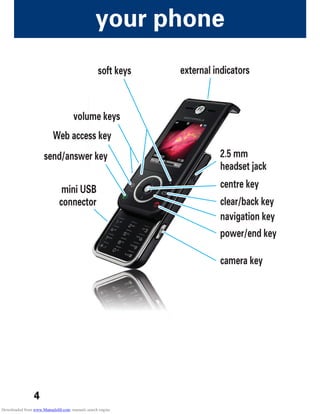
your phone
your phone
soft keys
2.5 mm
headset jack
navigation key
power/end key
camera key
centre key
volume keys
send/answer key
mini USB
connector clear/back key
external indicators
Web access key
Downloaded from www.Manualslib.com manuals search engine
5
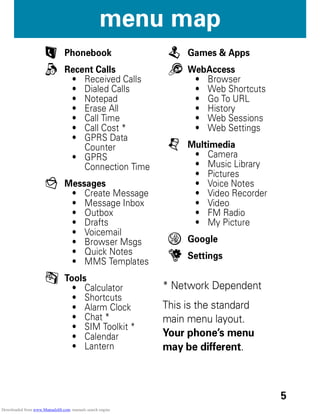
menu map
menu map
L Phonebook
q Recent Calls
• Received Calls
• Dialed Calls
• Notepad
• Erase All
• Call Time
• Call Cost *
• GPRS Data
Counter
• GPRS
Connection Time
g Messages
• Create Message
• Message Inbox
• Outbox
• Drafts
• Voicemail
• Browser Msgs
• Quick Notes
• MMS Templates
m Tools
• Calculator
• Shortcuts
• Alarm Clock
• Chat *
• SIM Toolkit *
• Calendar
• Lantern
T Games & Apps
1 WebAccess
• Browser
• Web Shortcuts
• Go To URL
• History
• Web Sessions
• Web Settings
j Multimedia
• Camera
• Music Library
• Pictures
• Voice Notes
• Video Recorder
• Video
• FM Radio
• My Picture
® Google
u Settings
* Network Dependent
This is the standard
main menu layout.
Your phone’s menu
may be different.
Downloaded from www.Manualslib.com manuals search engine
6
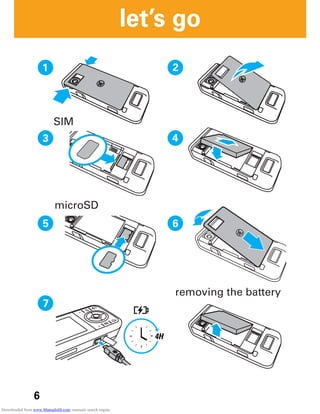
let’s go
let’s go
4H
1 2
3 4
5
7
6
removing the battery
microSD
SIM
Downloaded from www.Manualslib.com manuals search engine
7
basics
basics
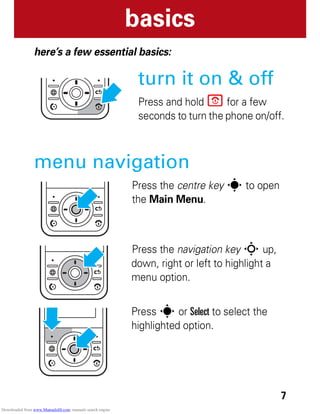
here’s a few essential basics:
turn it on & off
Press and hold P for a few
seconds to turn the phone on/off.
menu navigation
Press the centre key s to open
the Main Menu.
Press the navigation key S up,
down, right or left to highlight a
menu option.
Press s or Select to select the
highlighted option.
Downloaded from www.Manualslib.com manuals search engine
8
calls
calls
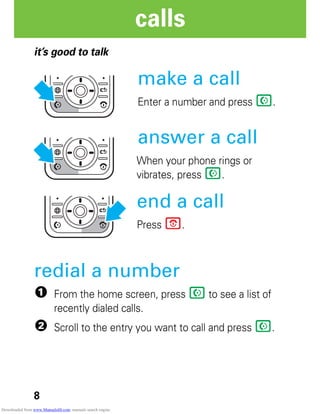
it’s good to talk
make a call
Enter a number and press N.
answer a call
When your phone rings or
vibrates, press N.
end a call
Press P.
redial a number
1 From the home screen, press N to see a list of
recently dialed calls.
2 Scroll to the entry you want to call and press N.
Downloaded from www.Manualslib.com manuals search engine
9
calls
emergency calls
To call an emergency number,
enter the emergency number
and press N.
Your service provider programs emergency phone
numbers, (such as 112 or 911), that you can call under
any circumstances, even when your phone is locked.
Emergency numbers vary by country. Your phone’s
pre-programmed emergency number(s) may not work
in all locations, and sometimes an emergency call cannot
be placed due to network, environmental, or interference
issues.
go handsfree
To turn the speaker on or off during a call, press Speaker.
Note: You can also use an optional 2.5 mm wired
headset to go handsfree.
Downloaded from www.Manualslib.com manuals search engine
10
calls
in call menu
During a call you can access the in call menu by pressing
Options:
• My Tel. Number - view your phone number.
• Hold or Resume - hold the call.
• Mute or Unmute - silence your microphone.
• Spkrphone On or Off - turn speakerphone on or off.
• Use Bluetooth or Use Handset - turn Bluetooth on or off.
• Phonebook - access list of contacts.
• New Call - make another call.
• Dialed Calls - view recently dialed calls.
• Received Calls - view recently received calls.
• Messages - access your messages menu.
• Calendar - view calendar.
Downloaded from www.Manualslib.com manuals search engine
11
contacts
contacts
made a new friend?
save a contact
1 Enter the number on the home screen and
press Save.
2 Enter the contact details and press Save again.
call a contact
1 Press s > L Phonebook.
2 Scroll through the list to highlight the contact.
3 Press N.
send a contact
1 Scroll through the list to highlight the contact.
2 Press Options > Send Business Card > Select.
3 Choose the phone number you want to send,
and press OK.
4 Select the message type, the person you are
sending the contact to, and press Send.
Downloaded from www.Manualslib.com manuals search engine
12
customise
customise
go ahead, add your personal touch...
home screen shortcuts
Find it: s > u Settings > Personalise > Home Screen >
Home Keys
set wallpaper, screensaver
& color style
Change the wallpaper, screensaver and colour style to
set the look and feel of your phone’s display.
Find it: s > u Settings > Personalise > Wallpaper, Screensaver
or Color Style
options
Show Icons Show or hide the home screen shortcut
icons.
Up, Down,
Left, Right
Choose the features that open when you
press the navigation key (S) up, down,
left, or right in the home screen.
Downloaded from www.Manualslib.com manuals search engine
13
customise
set ringtone & volume
There are times when you want to hear your ringtone,
and there are times when you don’t.
Find it: s > u Settings > Ring Styles
Choose from the pre-programmed styles, including
Vibrating and Silent.
set slide tone
Select a tone to play every time you slide your phone:
Find it: s > u Settings > Personalise > Slide Tone
anykey answer
Answer your phone by pressing any key on your keypad:
Find it: s > u Settings > In-Call Setup > Anykey Answer
Downloaded from www.Manualslib.com manuals search engine
14
shortcuts
shortcuts
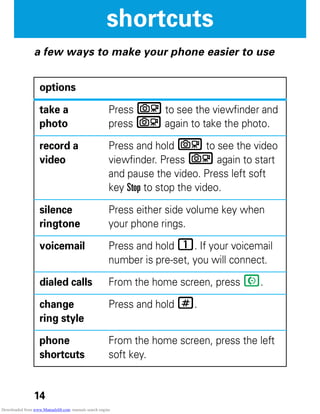
a few ways to make your phone easier to use
options
take a
photo
Press b to see the viewfinder and
press b again to take the photo.
record a
video
Press and hold b to see the video
viewfinder. Press b again to start
and pause the video. Press left soft
key Stop to stop the video.
silence
ringtone
Press either side volume key when
your phone rings.
voicemail Press and hold 1. If your voicemail
number is pre-set, you will connect.
dialed calls From the home screen, press N.
change
ring style
Press and hold #.
phone
shortcuts
From the home screen, press the left
soft key.
Downloaded from www.Manualslib.com manuals search engine
15
messages
messages
sometimes it’s better 2 say it in a message
create & send a message
1 Press s > g Messages > Create Message.
2 Select a message type and enter the message text
(see page 16).
3 To insert a picture, sound, or other object, press
Options > Insert.
4 When you finish the message, press Send. Choose
one or more people to send to and press Send.
receive a message
Press View to read the message immediately, or save it in
your message inbox for viewing later.
Find it: s > g Messages > Message Inbox
voicemail
When you receive a voicemail message, your
phone shows an indicator and New Voicemail. Press
Call to call your voicemail and follow the prompts.
Downloaded from www.Manualslib.com manuals search engine
16
messages
enter text
When you are in a text entry screen, press # to switch
text entry modes:
• tap (abc) - Standard method for entering text on
your phone. Regular Tap method cycles through
the letters and numbers of the key you press.
• iTAP™ (j) - Combines your single key presses
and predicts each word as you enter it. If the
word is not correct, press S right or left to
scroll through the possible combinations.
Press * to enter a space and move on the next word.
Press 1 to enter punctuation. Finally, press 0 to
switch capitalisation modes if you need to (although
in most cases this is done for you).
To assign default text entry modes:
In a text entry screen, press Options > Input Setup > Primary or
Secondary.
Downloaded from www.Manualslib.com manuals search engine
17
status indicators
status indicators
to keep you updated, whatever way you look at it
Status indicators can appear across the top of the home
screen (your phone’s home screen may be different than
the one shown):
Indicators can appear on the top of your phone:
Active Line
Bluetooth
New Message
Ring Style
Battery Level
Roaming Active
WAP Active
GPRS Active
changes to
when connected.
Signal Strength
Menu
Shortcut
2008/10/10 10:51am
&
&
&
&
] &
™
Bluetooth
Active
New
Message
Incoming/
Missed Call
Downloaded from www.Manualslib.com manuals search engine
18
photo
photo
see it, capture it, send it!
take & send a photo
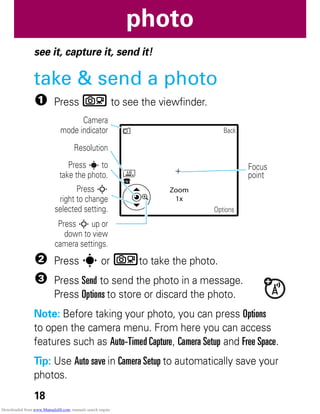
1 Press b to see the viewfinder.
2 Press s or bto take the photo.
3 Press Send to send the photo in a message.
Press Options to store or discard the photo.
Note: Before taking your photo, you can press Options
to open the camera menu. From here you can access
features such as Auto-Timed Capture, Camera Setup and Free Space.
Tip: Use Auto save in Camera Setup to automatically save your
photos.
Back
Options
Zoom
1x
LG
Press S up or
down to view
camera settings.
Focus
point
Resolution
Camera
mode indicator
Press s to
take the photo.
Press S
right to change
selected setting.
Downloaded from www.Manualslib.com manuals search engine
19
video
video
for those moments when you really had to be there
record & send a video
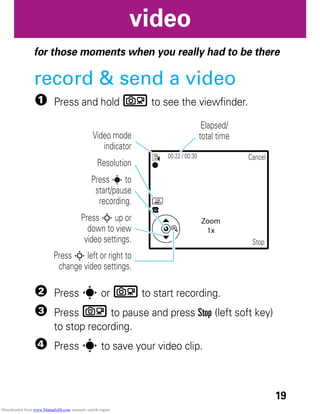
1 Press and hold b to see the viewfinder.
2 Press s or b to start recording.
3 Press b to pause and press Stop (left soft key)
to stop recording.
4 Press s to save your video clip.
LG
00:22 / 00:30 Cancel
Stop
Zoom
1x
Video mode
indicator
Elapsed/
total time
Resolution
Press s to
start/pause
recording.
Press S left or right to
change video settings.
Press S up or
down to view
video settings.
Downloaded from www.Manualslib.com manuals search engine
20
set up music
set up music
when music is what you need...
what music transfer tools
do I need?
To put music on your computer and then load it on your
phone, you need:
• A Microsoft® WindowsXP™ or Windows
Vista™ PC
• USB data cable (sold separately)
do I need a memory card?
Your phone does have 30 MB of internal memory, but it
also supports removable microSD memory cards with up
to 2 GB capacity, allowing you to store much more data.
Note: Motorola approved SanDisk cards are
recommended for cards greater than 1 GB.
See page 35 for more information on memory cards.
Downloaded from www.Manualslib.com manuals search engine
21
set up music
what music file formats can
I play?
Your phone can play many types of files:MP3, AAC,
AMR, WAV, MIDI and iMelody.
do I need a USB cable?
To load music from a computer to your phone, you must
use a USB data cable, which may be sold separately
from your phone.
Note: If you have a removable memory card and
a memory card reader, you don’t need a cable. See
page 24.
what headphones can I use?
Your phone has a 2.5 mm headset jack for wired stereo
listening. Or, go wireless and use optional Bluetooth
stereo headphones to listen to your music (see page 32
for more information).
Note: When listening to music using a Bluetooth stereo
device, use the volume keys (page 4) to increase and
decrease the music volume.
Downloaded from www.Manualslib.com manuals search engine
22
get music
get music
copy your favourite tunes...
rip a CD
Not literally — if you’re new to music this means
transferring music from an audio CD to your PC.
To rip an audio CD on your PC, you need Windows Media
Player version 10 or later. You can download Windows
Media Player from www.microsoft.com.
1 On your computer, launch Windows®
Media Player.
2 Insert an audio CD into your computer’s CD
ROM drive.
Note: Make sure you change the format to,
MP3, AAC, AMR, WAV, MIDI or iMelody in the
Rip Settings. (MP3 is the recommended format
for best performance.)
3 In the Windows Media Player window, click on the
“Rip” tab.
4 Highlight the songs you want to import and click
“Rip Music“.
Downloaded from www.Manualslib.com manuals search engine
23
get music
The songs are imported to the Windows Media Player
Library. Next, transfer the songs from your computer to
your phone.
transfer music to your
phone
Transfer files from a computer to your phone or
removable memory card.
PC to phone
To load files from a PC to your phone, you need a USB
cable.
1 With a memory card inserted and your phone
in the home screen, insert the USB cable in
your phone and your Windows PC.
Note: Your phone supports Microsoft® Windows®
XP™ and Windows Vista™. Other operating
systems may not be compatible with your phone.
2 Now that you’ve connected, use Windows Media
Player or USB drag and drop to copy your music.
Downloaded from www.Manualslib.com manuals search engine
24
get music
Windows Media Player
1 On your Windows PC, open Microsoft®
Windows® Media Player 10 or later.
2 On the Sync tab, select More Options. Under
Device, select ZN200 Mobile.
3 Select Properties, check the “Create folder
hierarchy on device” box, and click OK.
See page 35 for more information on transferring music
to your phone.
PC to memory card reader
Firstly, insert your memory card into the card reader (you
may first need to insert the card into an adapter that fits
into the card reader). Then, insert the card reader into an
available USB port on your computer.
1 On your Windows PC, open “My Computer” and
click on the “Removable Disk” icon to access your
phone’s memory card.
2 In the “Removable Disk” (memory card) window,
create one or more folders for the files you will copy
onto the memory card.
Downloaded from www.Manualslib.com manuals search engine
25
get music
A file name (including the path) must be less than
255 characters. For example, if you copy songs into
a folder you create that is named “MyMotoSongs,”
the name of any song PLUS the name of the folder
“MyMotoSongs” must be less than 255 characters.
Warning: The “MobileMusic”, “MobilePictures”
and “MobileVideos” folders are used by your
phone. Do not delete these folders.
3 Drag and drop desired files into the “Removable
Disk” (memory card) window into a folder you
created. Do not copy files to the main directory.
Note: Picture files must be copied to the
“mobilePicture” folders and Videos must be copied
to the “mobileVideo” folder. Music files can be
copied anywhere onto the memory card. To find
your picture and video files on your phone, press
s > j Multimedia > Pictures or Video, then press Options
> Switch Storage > Memory Card.
4 When finished, disconnect by clicking on the “Safely
Remove Hardware” icon in the system tray on your
computer screen, selecting “USB Mass Storage
Device,” and selecting “Stop.”
Downloaded from www.Manualslib.com manuals search engine
26
play music
play music
listen to your favourite tunes...
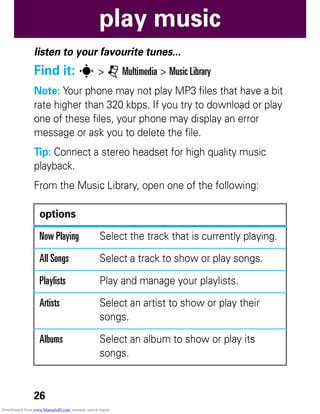
Find it: s > j Multimedia > Music Library
Note: Your phone may not play MP3 files that have a bit
rate higher than 320 kbps. If you try to download or play
one of these files, your phone may display an error
message or ask you to delete the file.
Tip: Connect a stereo headset for high quality music
playback.
From the Music Library, open one of the following:
options
Now Playing Select the track that is currently playing.
All Songs Select a track to show or play songs.
Playlists Play and manage your playlists.
Artists Select an artist to show or play their
songs.
Albums Select an album to show or play its
songs.
Downloaded from www.Manualslib.com manuals search engine
27
play music
Note: To refresh your music library settings, press Options
> Refresh.
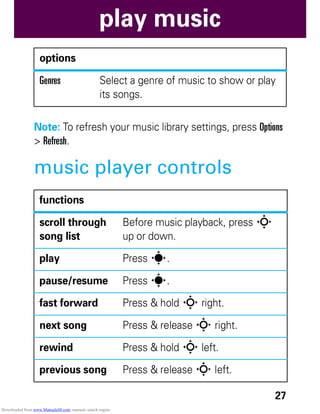
music player controls
Genres Select a genre of music to show or play
its songs.
functions
scroll through
song list
Before music playback, press S
up or down.
play Press s.
pause/resume Press s.
fast forward Press & hold S right.
next song Press & release S right.
rewind Press & hold S left.
previous song Press & release S left.
options
Downloaded from www.Manualslib.com manuals search engine
28
play music
Note: Pressing the up/down volume keys changes the
volmue of the song playing.
playlists
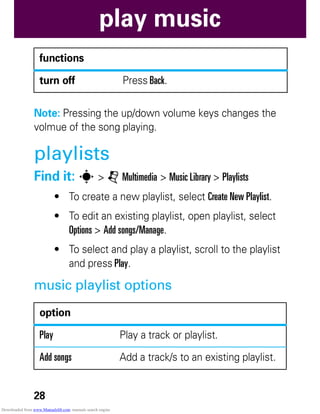
Find it: s > j Multimedia > Music Library > Playlists
• To create a new playlist, select Create New Playlist.
• To edit an existing playlist, open playlist, select
Options > Add songs/Manage.
• To select and play a playlist, scroll to the playlist
and press Play.
music playlist options
turn off Press Back.
option
Play Play a track or playlist.
Add songs Add a track/s to an existing playlist.
functions
Downloaded from www.Manualslib.com manuals search engine
29
play music
wake up music player
While the music player is active, your phone will
conserve battery power by turning off the display
and keypad backlights.
To turn display and backlights back on, press any key.
turn off music player
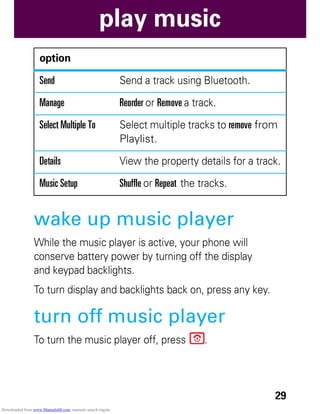
To turn the music player off, press P.
Send Send a track using Bluetooth.
Manage Reorder or Remove a track.
Select Multiple To Select multiple tracks to remove from
Playlist.
Details View the property details for a track.
Music Setup Shuffle or Repeat the tracks.
option
Downloaded from www.Manualslib.com manuals search engine
30
play music
music player tips
If you receive a call while playing music, the music
pauses. You can Ignore the call and send the caller to
voicemail or Answer the call. Playing resumes when you
end the call.
To hide your music player while a song is playing,
press s > Hide. If the music player is hidden, you can
use other phone features. Using applications like games
or FM radio turns the music player off.
Downloaded from www.Manualslib.com manuals search engine
31
FM radio
FMradio
listen to your favourite news or music programme
To use the FM Radio you need to connect a stereo headset
to the 2.5 mm headset jack.
• Press S up or down to change the frequency.
• Press S left or right to scan for preset radio
stations.
• Press the up or down volume keys on the side
of the phone to adjust the volume.
• Press s to mute the radio.
use the radio presets
1 Tune in the desired frequency by pressing S up or
down, or press Options > Scan to scan for all available
radio stations.
2 Press and hold a number key to save that number as
the preset.
3 To select the preset station, press the keypad
number.
Downloaded from www.Manualslib.com manuals search engine
32
Bluetooth®
Bluetooth®
lose the wires and go wireless
Your phone supports Bluetooth wireless connections
with audio devices, such as a handsfree headset or
music system.
Note: The use of wireless phones while driving
may cause distraction. Discontinue a call if you can’t
concentrate on driving. Additionally, the use of wireless
devices and their accessories may be prohibited or
restricted in certain areas. Always obey the laws and
regulations on the use of these products.
For maximum Bluetooth security, you should
always connect Bluetooth devices in a safe, private
environment.
use a headset or car kit
Before you try to connect your phone with a headset,
car kit or other audio device, make sure the device is
on and ready in pairing or bonding mode (see the user’s
guide for the device).
Find it: s > u Settings > Bluetooth Link > Add Audio
Device
Downloaded from www.Manualslib.com manuals search engine
33
Bluetooth®
If Bluetooth is switched off, you will be prompted to turn
it on. Your phone now lists the devices it finds within
range:
1 Scroll to a device in the list and press the
centre key s.
2 If necessary, press Yes or OK to connect to the
device.
3 If necessary, enter the device passkey (such as 0000)
and press OK.
When your phone is connected, the Bluetooth indicator
O is highlighted in the status bar and displayed on the
top of the phone.
Shortcut: When your phone’s Bluetooth power is on,
your phone can automatically connect to a handsfree
device you have used before. Just turn on the device,
or move it near the phone. If the device doesn’t connect,
turn it off and back on.
Downloaded from www.Manualslib.com manuals search engine
34
personal organiser
personal organiser
stay on top of things with these handy features
add & view calendar event
Find it: s > m Tools > Calendar
Scroll to the desired day and press s, then scroll to
[Add New] and press Select to add, or scroll to the event
and press Select to view.
Note: When an event reminder occurs, press s to
view it. Press Exit to dismiss it.
set alarm
Find it: s > m Tools > Alarm Clock
calculator
Find it: s > m Tools > Calculator
Tip: To convert currency, enter your currency figure
and press Options and select Excange Rate. Select Convert to
calculate your new currency figure.
Downloaded from www.Manualslib.com manuals search engine
35
USB & memory card
USB & memory card
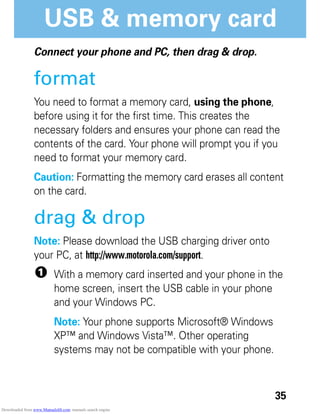
Connect your phone and PC, then drag & drop.
format
You need to format a memory card, using the phone,
before using it for the first time. This creates the
necessary folders and ensures your phone can read the
contents of the card. Your phone will prompt you if you
need to format your memory card.
Caution: Formatting the memory card erases all content
on the card.
drag & drop
Note: Please download the USB charging driver onto
your PC, at http://www.motorola.com/support.
1 With a memory card inserted and your phone in the
home screen, insert the USB cable in your phone
and your Windows PC.
Note: Your phone supports Microsoft® Windows
XP™ and Windows Vista™. Other operating
systems may not be compatible with your phone.
Downloaded from www.Manualslib.com manuals search engine
36
USB & memory card
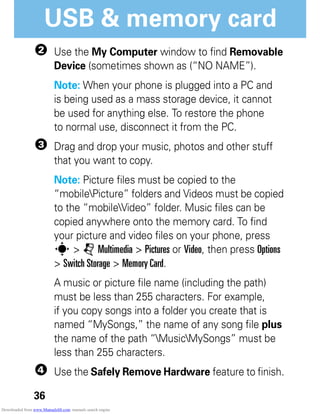
2 Use the My Computer window to find Removable
Device (sometimes shown as (“NO NAME”).
Note: When your phone is plugged into a PC and
is being used as a mass storage device, it cannot
be used for anything else. To restore the phone
to normal use, disconnect it from the PC.
3 Drag and drop your music, photos and other stuff
that you want to copy.
Note: Picture files must be copied to the
“mobilePicture” folders and Videos must be copied
to the “mobileVideo” folder. Music files can be
copied anywhere onto the memory card. To find
your picture and video files on your phone, press
s > j Multimedia > Pictures or Video, then press Options
> Switch Storage > Memory Card.
A music or picture file name (including the path)
must be less than 255 characters. For example,
if you copy songs into a folder you create that is
named “MySongs,” the name of any song file plus
the name of the path “MusicMySongs” must be
less than 255 characters.
4 Use the Safely Remove Hardware feature to finish.
Downloaded from www.Manualslib.com manuals search engine
37
web access
web access
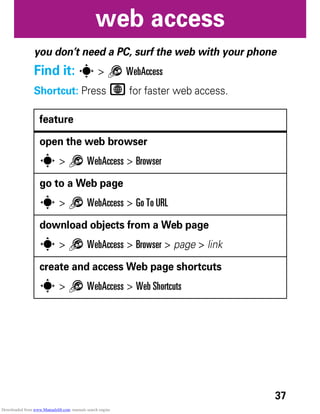
you don’t need a PC, surf the web with your phone
Find it: s > 1 WebAccess
Shortcut: Press L for faster web access.
feature
open the web browser
s > 1 WebAccess > Browser
go to a Web page
s > 1 WebAccess > Go To URL
download objects from a Web page
s > 1 WebAccess > Browser > page > link
create and access Web page shortcuts
s > 1 WebAccess > Web Shortcuts
Downloaded from www.Manualslib.com manuals search engine
38
security
security
help to keep your phone secure
codes & passwords
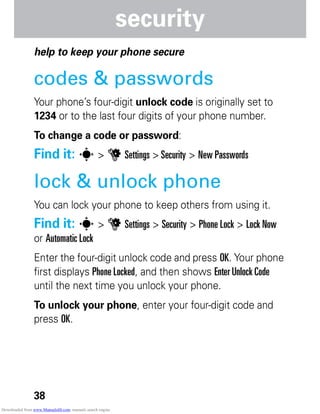
Your phone’s four-digit unlock code is originally set to
1234 or to the last four digits of your phone number.
To change a code or password:
Find it: s > u Settings > Security > New Passwords
lock & unlock phone
You can lock your phone to keep others from using it.
Find it: s > u Settings > Security > Phone Lock > Lock Now
or Automatic Lock
Enter the four-digit unlock code and press OK. Your phone
first displays Phone Locked, and then shows Enter Unlock Code
until the next time you unlock your phone.
To unlock your phone, enter your four-digit code and
press OK.
Downloaded from www.Manualslib.com manuals search engine
39
Legal and Safety Information
www.hellomoto.com
Certain mobile phone features are dependent on the capabilities and
settings of your service provider’s network. Additionally, certain features
may not be activated by your service provider, and/or the provider's
network settings may limit the feature’s functionality. Always contact your
service provider about feature availability and functionality. All features,
functionality, and other product specifications, as well as the information
contained in this user's guide are based upon the latest available
information and are believed to be accurate at the time of printing.
Motorola reserves the right to change or modify any information or
specifications without notice or obligation.
Software Copyright Notice
The Motorola products described in this manual may include copyrighted
Motorola and third-party software stored in semiconductor memories
or other media. Laws in the United States and other countries preserve
for Motorola and third-party software providers certain exclusive rights
for copyrighted software, such as the exclusive rights to distribute or
reproduce the copyrighted software. Accordingly, any copyrighted
software contained in the Motorola products may not be modified,
reverse-engineered, distributed, or reproduced in any manner to the
extent allowed bylaw. Furthermore, the purchaseof theMotorola products
shall not be deemed to grant either directly or by implication, estoppel,
or otherwise, any license under the copyrights, patents, or patent
applications of Motorola or any third-party software provider, except
for the normal, non-exclusive, royalty-free license to use that arises
by operation of law in the sale of a product.
Downloaded from www.Manualslib.com manuals search engine
40
battery use & safety
IMPORTANT: HANDLE AND STORE BATTERIES PROPERLY TO
AVOID INJURY OR DAMAGE. Most battery issues arise from improper
handling of batteries, and particularly from the continued use of damaged
batteries.
DON’Ts
• Don’t disassemble, crush, puncture, shred, or otherwise
attempt to change the form of your battery.
• Don’t let the phone or battery come in contact with water.
Water can get into the phone’s circuits, leading to corrosion.
If the phone and/or battery get wet, have them checked by your
carrier or contact Motorola, even if they appear to be working
properly.
• Don’t allow the battery to touch metal objects. If metal
objects, such as jewelry, stay in prolonged contact with the
battery contact points, the battery could become very hot.
• Don’t place your battery near a heat source. Excessive heat
can damage the phone or the battery. High temperatures can
cause the battery to swell, leak, or malfunction. Therefore:
• Do not dry a wet or damp battery with an appliance or heat
source, such as a hair dryer or microwave oven.
• Avoid leaving your phone in your car in high temperatures.
DOs
• Do avoid dropping the battery or phone. Dropping these
items, especially on a hard surface, can potentially cause
damage.
• Do contact your service provider or Motorola if your
phone or battery has been damaged from dropping or high
temperatures.
IMPORTANT: USE MOTOROLA ORIGINAL PRODUCTS FOR QUALITY
ASSURANCE AND SAFEGUARDS. To aid consumers in identifying
Downloaded from www.Manualslib.com manuals search engine
41
authentic Motorola batteries from non-original or counterfeit batteries
(that may not have adequate safety protection), Motorola provides
hologramsonitsbatteries. Consumersshouldconfirmthat any batterythey
purchase has a “Motorola Original” hologram.
Motorola recommends you always use Motorola-branded batteries
and chargers. Motorola mobile devices are designed to work with
Motorola batteries. If you see a message on your display such as
Invalid Battery or Unable to Charge, take the following steps:
• Remove the battery and inspect it to confirm that it has
a“Motorola Original” hologram;
• If there is no hologram, the battery is not a Motorola
battery;
• If there is a hologram, replace the battery and retry
charging it;
• If the message remains, contact a Motorola Authorized
Service Center.
Important: Motorola’s warranty does not cover damage to the phone
caused by non-Motorola batteries and/or chargers.
Warning: Use of a non-Motorola battery or charger may present a risk of
fire, explosion, leakage, or other hazard.
PROPER AND SAFE BATTERY DISPOSAL AND RECYCLING
Proper battery disposal is not only important for safety, it benefits the
environment. Consumers may recycle their used batteries in many retail
orserviceprovider locations.Additionalinformationonproper disposal and
recycling may be found on the Web:
• www.motorola.com/recycling
• www.rbrc.org/call2recycle/ (in English only)
Disposal: Promptly dispose of used batteries in accordance
with local regulations. Contact your local recycling center or
national recycling organizations for more information on
how to dispose of batteries.
Warning: Never dispose of batteries in a fire because they may explode.
Downloaded from www.Manualslib.com manuals search engine
42
Specific Absorption Rate Data
SAR Data
This model meets international guidelines for exposure to
radio waves.
Your mobile device is a radio transmitter and receiver. It is designed
not to exceed the limits for exposure to radio waves recommended
by international guidelines. These guidelines were developed by the
independent scientific organization ICNIRP and include safety margins
designed to assure the protection of all persons, regardless of age and
health.
The guidelines use a unit of measurement known as the Specific
Absorption Rate, or SAR. The ICNIRP SAR limit for mobile devices used
by the general public is 2 W/kg and the highest SAR value for this device
when tested at the ear is 0.59 W/kg.1
As mobile devices offer a range
of functions, they can be used in other positions, such as on the body as
described in this user’s guide.2
In this case, the highest tested SAR value
is 0.61 W/kg.1
As SAR is measured utilizing the device’s highest transmitting power, the
actual SAR of this device while operating is typically below that indicated
above. This is due to automatic changes to the power level of the device to
ensure it only uses the minimum level required to reach the network.
While there may be differences between the SAR levels of various phones
and at various positions, they all meet the governmental requirements for
safe exposure. Please note that improvements to this product model could
cause differencesin the SAR value for later products; in all cases, products
are designed to be within the guidelines.
The World Health Organization has stated that present scientific
information does not indicate the need for any special precautions for the
use of mobile devices. They note that if you want to reduce your exposure
then you can do so by limiting the length of calls or using a “handsfree”
device to keep the mobile phone away from the head and body.
Downloaded from www.Manualslib.com manuals search engine
43
Additional Information can be found on the websites of the World
Health Organization (http://www.who.int/emf) or Motorola,
Inc. (http://www.motorola.com/rfhealth).
1. The tests are carried out in accordance with international guidelines
for testing. The limit incorporates a substantial margin for safety to
give additional protection for the public and to account for any
variations in measurements. Additional related information includes
the Motorola testing protocol, assessment procedure, and
measurement uncertainty range for this product.
2. Please see the Safety and General Information section about body
worn operation.
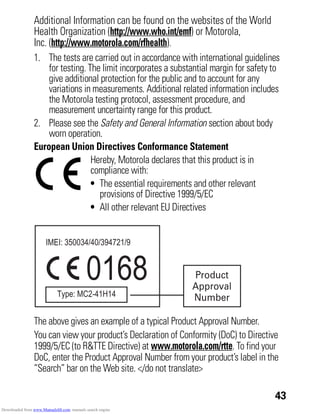
European Union Directives Conformance Statement
EU Conformance
Hereby, Motorola declares that this product is in
compliance with:
• The essential requirements and other relevant
provisions of Directive 1999/5/EC
• All other relevant EU Directives
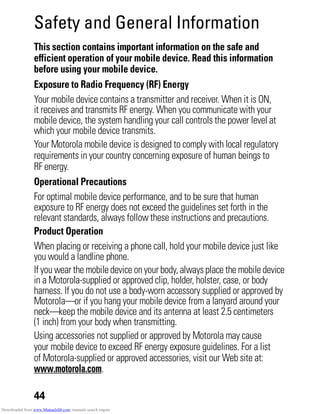
The above gives an example of a typical Product Approval Number.
You can view your product’s Declaration of Conformity (DoC) to Directive
1999/5/EC (to R&TTE Directive) at www.motorola.com/rtte. To find your
DoC, enter the Product Approval Number from your product’s label in the
“Search” bar on the Web site. </do not translate>
0168 Product
Approval
Number
Downloaded from www.Manualslib.com manuals search engine
44
Safety and General Information
Safety Information
This section contains important information on the safe and
efficient operation of your mobile device. Read this information
before using your mobile device.
Exposure to Radio Frequency (RF) Energy
Your mobile device contains a transmitter and receiver. When it is ON,
it receives and transmits RF energy. When you communicate with your
mobile device, the system handling your call controls the power level at
which your mobile device transmits.
Your Motorola mobile device is designed to comply with local regulatory
requirements in your country concerning exposure of human beings to
RF energy.
Operational Precautions
For optimal mobile device performance, and to be sure that human
exposure to RF energy does not exceed the guidelines set forth in the
relevant standards, always follow these instructions and precautions.
Product Operation
When placing or receiving a phone call, hold your mobile device just like
you would a landline phone.
If you wear the mobiledevice onyour body, alwaysplace the mobiledevice
in a Motorola-supplied or approved clip, holder, holster, case, or body
harness. If you do not use a body-worn accessory supplied or approved by
Motorola—or if you hang your mobile device from a lanyard around your
neck—keep the mobile device and its antenna at least 2.5 centimeters
(1 inch) from your body when transmitting.
Using accessories not supplied or approved by Motorola may cause
your mobile device to exceed RF energy exposure guidelines. For a list
of Motorola-supplied or approved accessories, visit our Web site at:
www.motorola.com.
Downloaded from www.Manualslib.com manuals search engine
45
RF Energy Interference/Compatibility
Nearly every electronic device is subject to RF energy interference
from external sources if inadequately shielded, designed, or otherwise
configured for RF energy compatibility. In some circumstances your
mobile device may cause interference with other devices.
Follow Instructions to Avoid Interference Problems
Turn off your mobile device in any location where posted notices instruct
you to do so.
In an aircraft, turn off your mobile device whenever instructed to do so
by airline staff. If your mobile device offers an airplane mode or similar
feature, consult airline staff about using it in flight.
Implantable Medical Devices
If you have an implantable medical device, such as a pacemaker or
defibrillator, consult your physician before using this mobile device.
Persons with implantable medical devices should observe the following
precautions:
• ALWAYS keep the mobile device more than 20 centimeters (8 inches)
from the implantable medical device when the mobile device is turned
ON.
• DO NOT carry the mobile device in the breast pocket.
• Use the ear opposite the implantable medical device to minimize the
potential for interference.
• Turn OFF the mobile device immediately if you have any reason to
suspect that interference is taking place.
Read and follow the directions from the manufacturer of your implantable
medical device. If you have any questions about using your mobile device
with your implantable medical device, consult your healthcare provider.
Downloaded from www.Manualslib.com manuals search engine
46
Driving Precautions
The use of wireless phones while driving may cause distraction.
Discontinue a call if you can’t concentrate on driving.
Additionally, the use of wireless devices and their accessories may
be prohibited or restricted in certain areas. Always obey the laws and
regulations on the use of these products.
Responsible driving practices can be found in the “Smart Practices While
Driving” section in this guide (or separate guide).
Operational Warnings
Obey all posted signs when using mobile devices in public areas.
Potentially Explosive Atmospheres
Areas with potentially explosive atmospheres are often, but not always,
posted and can include fueling areas, such as below decks on boats, fuel
or chemical transfer or storage facilities, or areas where the air contains
chemicals or particles, such as grain dust, or metal powders.
When you are in such an area, turn off your mobile device, and do not
remove, install, or charge batteries. In such areas, sparks can occur and
cause an explosion or fire.
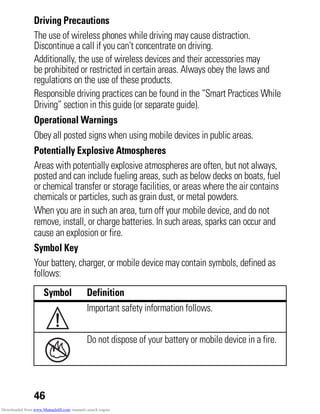
Symbol Key
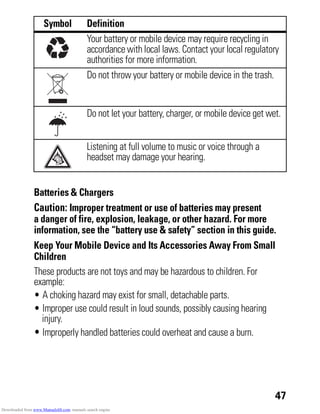
Your battery, charger, or mobile device may contain symbols, defined as
follows:
Symbol Definition
Important safety information follows.
Do not dispose of your battery or mobile device in a fire.
032374o
032376o
Downloaded from www.Manualslib.com manuals search engine
47
Batteries & Chargers
Caution: Improper treatment or use of batteries may present
a danger of fire, explosion, leakage, or other hazard. For more
information, see the “battery use & safety” section in this guide.
Keep Your Mobile Device and Its Accessories Away From Small
Children
These products are not toys and may be hazardous to children. For
example:
• A choking hazard may exist for small, detachable parts.
• Improper use could result in loud sounds, possibly causing hearing
injury.
• Improperly handled batteries could overheat and cause a burn.
Your battery or mobile device may require recycling in
accordance with local laws. Contact your local regulatory
authorities for more information.
Do not throw your battery or mobile device in the trash.
Do not let your battery, charger, or mobile device get wet.
Listening at full volume to music or voice through a
headset may damage your hearing.
Symbol Definition
032375o
Downloaded from www.Manualslib.com manuals search engine
48
Glass Parts
Some parts of your mobile device may be made of glass. This glass could
break if the product is dropped on a hard surface or receives a substantial
impact. If glass breaks, do not touch or attempt to remove. Stop using your
mobile device until the glass is replaced by a qualified service center.
Seizures/Blackouts
Some people may be susceptible to epileptic seizures or blackouts when
exposed to flashing lights, such as when playing video games. These may
occur even if a person has never had a previous seizure or blackout.
If you have experienced seizures or blackouts, or if you have a family
history of such occurrences, please consult with your physician before
playing video games or enabling a flashing-lights feature (if available) on
your mobile device.
Discontinue use and consult a physician if any of the following symptoms
occur: convulsion, eye or muscle twitching, loss of awareness, involuntary
movements, or disorientation. It is always a good idea to hold the screen
away from your eyes, leave the lights on in the room, take a 15-minute
break every hour, and stop use if you are tired.
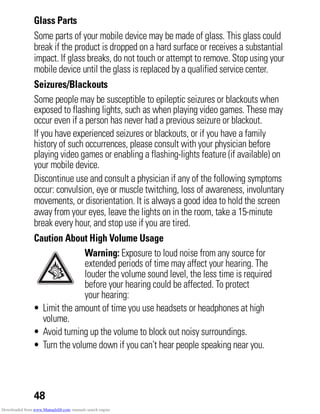
Caution About High Volume Usage
Warning: Exposure to loud noise from any source for
extended periods of time may affect your hearing. The
louder the volume sound level, the less time is required
before your hearing could be affected. To protect
your hearing:
• Limit the amount of time you use headsets or headphones at high
volume.
• Avoid turning up the volume to block out noisy surroundings.
• Turn the volume down if you can’t hear people speaking near you.
Downloaded from www.Manualslib.com manuals search engine
49
If you experience hearing discomfort, including the sensation of pressure
or fullness in your ears, ringing in your ears, or muffled speech, you should
stop listening to the device through your headset or headphones and have
your hearing checked.
For more information about hearing, see our Web site at
www.motorola.com/hearingsafety (in English only).
Repetitive Motion
When you repetitively perform actions such as pressing keys or entering
finger-written characters, you may experience occasional discomfort
in your hands, arms, shoulders, neck, or other parts of your body. If you
continue to have discomfort during or after such use, stop use and see
a physician.
[Mar0108]
Use and Care
Use and Care
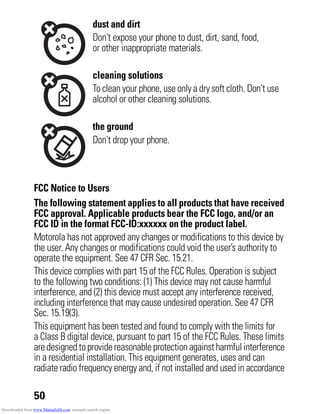
To care for your Motorola phone, please keep it away from:
liquids of any kind
Don’t expose your phone to water, rain, extreme
humidity, sweat, or other moisture. If it does get wet,
don’t try to accelerate drying with the use of an oven
or dryer, as this may damage the phone.
extreme heat or cold
Avoid temperatures below 0°C/32°F or above 45°C/
113°F.
microwaves
Don’t try to dry your phone in a microwave oven.
Downloaded from www.Manualslib.com manuals search engine
50
FCC Notice to Users
FCC Notice
The following statement applies to all products that have received
FCC approval. Applicable products bear the FCC logo, and/or an
FCC ID in the format FCC-ID:xxxxxx on the product label.
Motorola has not approved any changes or modifications to this device by
the user. Any changes or modifications could void the user’s authority to
operate the equipment. See 47 CFR Sec. 15.21.
This device complies with part 15 of the FCC Rules. Operation is subject
to the following two conditions: (1) This device may not cause harmful
interference, and (2) this device must accept any interference received,
including interference that may cause undesired operation. See 47 CFR
Sec. 15.19(3).
This equipment has been tested and found to comply with the limits for
a Class B digital device, pursuant to part 15 of the FCC Rules. These limits
aredesignedtoprovidereasonableprotectionagainst harmfulinterference
in a residential installation. This equipment generates, uses and can
radiate radio frequency energy and, if not installed and used in accordance
dust and dirt
Don’t expose your phone to dust, dirt, sand, food,
or other inappropriate materials.
cleaning solutions
To clean your phone, use only a dry soft cloth. Don’t use
alcohol or other cleaning solutions.
the ground
Don’t drop your phone.
Downloaded from www.Manualslib.com manuals search engine
51
with the instructions, may cause harmful interference to radio
communications. However, there is no guarantee that interference will
not occur in a particular installation. If this equipment does cause harmful
interference to radio or television reception, which can be determined by
turning the equipment off and on, the user is encouraged to try to correct
the interference by one or more of the following measures:
• Reorient or relocate the receiving antenna.
• Increase the separation between the equipment and the receiver.
• Connect the equipment to an outlet on a circuit different from that
to which the receiver is connected.
• Consult the dealer or an experienced radio/TV technician for help.
Information from the World Health Organization
WHO Information
Present scientific information does not indicate the need for any special
precautions for the use of mobile phones. If you are concerned, you may
want to limit your own or your children’s RF exposure by limiting the length
of calls or by using handsfree devices to keep mobile phones away from
your head and body.
Source: WHO Fact Sheet 193
Further information: http://www.who.int./peh-emf
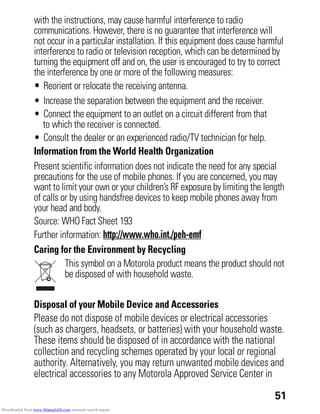
Caring for the Environment by Recycling
Recycling Information
This symbol on a Motorola product means the product should not
be disposed of with household waste.
Disposal of your Mobile Device and Accessories
Please do not dispose of mobile devices or electrical accessories
(such as chargers, headsets, or batteries) with your household waste.
These items should be disposed of in accordance with the national
collection and recycling schemes operated by your local or regional
authority. Alternatively, you may return unwanted mobile devices and
electrical accessories to any Motorola Approved Service Center in
Downloaded from www.Manualslib.com manuals search engine
52
your region. Details of Motorola approved national recycling schemes,
and further information on Motorola recycling activities can be found
at: www.motorola.com/recycling
Disposal of your Mobile Device Packaging and User’s Guide
Product packaging and user’s guides should only be disposed of in
accordance with national collection and recycling requirements.
Please contact your regional authorities for more details.
Privacy and Data Security
Motorola understands that privacy and data security are important to
everyone. Because some features of your mobile device may affect your
privacy or data security, please follow these recommendations to enhance
protection of your information:
• Monitor access—Keep your mobile device with you and do not leave
it where others may have unmonitored access. Lock your device’s
keypad where this feature is available.
• Keep software up to date—If Motorola or a software/application
vendor releases a patch or software fix for your mobile device that
updates the device’s security, install it as soon as possible.
• Erase before recycling—Delete personal information or data from
your mobile device prior to disposing of it or turning it in for recycling.
For step-by-step instructions on how to delete all personal information
from your device, see the section entitled “master clear” or “delete
data” in the user’s guide.
Note: For information on backing up your mobile device data before
erasing it, go to www.motorola.com and navigate to the “downloads”
section of the consumer Web page for “Motorola Backup” or “Motorola
Phone Tools.”
• Understanding AGPS—To provide location information for
emergency calls, certain Motorola mobile devices incorporate Assisted
Global Positioning System (AGPS) technology. AGPS technology also
canbeusedin non-emergencyapplicationsto track and monitor auser’s
Downloaded from www.Manualslib.com manuals search engine
53
location—for example, to provide driving directions. Users who prefer
not to permit such tracking and monitoring should avoid using such
applications.
If you have further questions regarding how the use of your mobile device
may impact your privacy or data security, please contact Motorola at
privacy@motorola.com, or contact your service provider.
Smart Practices While Driving
Driving Safety Drive Safe, Call Smart
Check the laws and regulations on the use of mobile devices
and their accessories in the areas where you drive. Always
obey them. The use of these devices may be prohibited or
restricted in certain areas—for example, handsfree use only. Go to
www.motorola.com/callsmart (in English only) for more information.
Your mobile device lets you communicate by voice and data—almost
anywhere, anytime, wherever wireless service is available and safe
conditions allow. When driving a car, driving is your first responsibility.
If you choose to use your mobile device while driving, remember the
following tips:
• Get to know your Motorola mobile device and its features such
as speed dial and redial. If available, these features help you to place
your call without taking your attention off the road.
• When available, use a handsfree device. If possible, add an
additional layer of convenience to your mobile device with one of
the many Motorola Original handsfree accessories available today.
• Position your mobile device within easy reach.
Be able to access your mobile device without removing your eyes
from the road. If you receive an incoming call at an inconvenient time,
if possible, let your voicemail answer it for you.
Downloaded from www.Manualslib.com manuals search engine
54
• Let the person you are speaking with know you are driving;
if necessary, suspend the call in heavy traffic or hazardous
weather conditions. Rain, sleet, snow, ice, and even heavy traffic
can be hazardous.
• Do not take notes or look up phone numbers while driving. Jotting
down a “to do” list or going through your address book takes attention
away from your primary responsibility—driving safely.
• Dial sensibly and assess the traffic; if possible, place calls when
your car is not moving or before pulling into traffic. If you must
make a call while moving, dial only a few numbers, check the road and
your mirrors, then continue.
• Do not engage in stressful or emotional conversations that may
be distracting. Make people you are talking with aware you are driving
and suspend conversations that can divert your attention away from the
road.
• Use your mobile device to call for help. Dial 911 or other local
emergency number in the case of fire, traffic accident, or medical
emergencies.*
• Use your mobile device to help others in emergencies. If you see
an auto accident, crime in progress, or other serious emergency where
lives are in danger, call 911 or other local emergency number, as you
would want others to do for you.*
• Call roadside assistance or a special non-emergency wireless
assistance number when necessary. If you see a broken-down
vehicle posing no serious hazard, a broken traffic signal, a minor traffic
accident where no one appears injured, or a vehicle you know to be
stolen, call roadside assistance or other special non-emergency wireless
number.*
* Wherever wireless phone service is available.
Downloaded from www.Manualslib.com manuals search engine
55
MOTOROLA and the Stylized M Logo are registered in the US Patent
& Trademark Office. The Bluetooth trademarks are owned by their
proprietor and used by Motorola, Inc. under license. Java and all other
Java-based marks are trademarks or registered trademarks of Sun
Microsystems, Inc. in the U.S. and other countries. Microsoft and
Windows are registered trademarks of Microsoft Corporation; and
Windows XP and Windows Media are trademarks of Microsoft
Corporation.
© 2008 Motorola, Inc. All rights reserved.
Caution: Changes or modifications made in the radio phone, not
expressly approved by Motorola, will void the user’s authority to
operate the equipment.
Downloaded from www.Manualslib.com manuals search engine
accessories
accessories: www.motorola.com
user’s guide: www.motorola.com/support
more information
GOTO
68002298001
Downloaded from www.Manualslib.com manuals search engine

Manual moto zn200.pdf

  • 1.
    Getting Started Guide ZN200 TM MOTO Downloadedfrom www.Manualslib.com manuals search engine
  • 2.
    2 congratulations! The Motorola ZN200does it all. Take photos and video clips, and send them to your friends. Or, use the music player to listen to the newest, hottest tracks. All this while you’re still connected — take or make calls or exchange messages. We’ve crammed all of the main features of your phone into this handy guide, and in a matter of minutes we’ll show you just how easy your phone is to use. So go on, check it out. Browse the menus and press Options to see more. You may be suprised at what you discover. If you’d like even more information about how to use your new ZN200, visit www.motorola.com/support/ZN200. Note: Before using the phone for the first time, review the Important Safety and Legal Information in the back of this guide. Periodically review this information so you remember how to safely use your phone. Downloaded from www.Manualslib.com manuals search engine
  • 3.
    3 contents your phone .. . . . . . . . . . . . . . . . . . . . . . . . . . . . . . . . 4 menu map. . . . . . . . . . . . . . . . . . . . . . . . . . . . . . . . . . 5 let’s go. . . . . . . . . . . . . . . . . . . . . . . . . . . . . . . . . . . . . 6 basics. . . . . . . . . . . . . . . . . . . . . . . . . . . . . . . . . . . . . . 7 calls . . . . . . . . . . . . . . . . . . . . . . . . . . . . . . . . . . . . . . . 8 contacts. . . . . . . . . . . . . . . . . . . . . . . . . . . . . . . . . . . 11 customise . . . . . . . . . . . . . . . . . . . . . . . . . . . . . . . . . 12 shortcuts . . . . . . . . . . . . . . . . . . . . . . . . . . . . . . . . . . 14 messages . . . . . . . . . . . . . . . . . . . . . . . . . . . . . . . . . 15 status indicators. . . . . . . . . . . . . . . . . . . . . . . . . . . . 17 photo . . . . . . . . . . . . . . . . . . . . . . . . . . . . . . . . . . . . . 18 video . . . . . . . . . . . . . . . . . . . . . . . . . . . . . . . . . . . . . 19 set up music . . . . . . . . . . . . . . . . . . . . . . . . . . . . . . . 20 get music. . . . . . . . . . . . . . . . . . . . . . . . . . . . . . . . . . 22 play music. . . . . . . . . . . . . . . . . . . . . . . . . . . . . . . . . 26 FM radio . . . . . . . . . . . . . . . . . . . . . . . . . . . . . . . . . . 31 Bluetooth® . . . . . . . . . . . . . . . . . . . . . . . . . . . . . . . . 32 personal organiser . . . . . . . . . . . . . . . . . . . . . . . . . . 34 USB & memory card . . . . . . . . . . . . . . . . . . . . . . . . 35 web access . . . . . . . . . . . . . . . . . . . . . . . . . . . . . . . . 37 security . . . . . . . . . . . . . . . . . . . . . . . . . . . . . . . . . . . 38 Downloaded from www.Manualslib.com manuals search engine
  • 4.
    4 your phone your phone softkeys 2.5 mm headset jack navigation key power/end key camera key centre key volume keys send/answer key mini USB connector clear/back key external indicators Web access key Downloaded from www.Manualslib.com manuals search engine
  • 5.
    5 menu map menu map LPhonebook q Recent Calls • Received Calls • Dialed Calls • Notepad • Erase All • Call Time • Call Cost * • GPRS Data Counter • GPRS Connection Time g Messages • Create Message • Message Inbox • Outbox • Drafts • Voicemail • Browser Msgs • Quick Notes • MMS Templates m Tools • Calculator • Shortcuts • Alarm Clock • Chat * • SIM Toolkit * • Calendar • Lantern T Games & Apps 1 WebAccess • Browser • Web Shortcuts • Go To URL • History • Web Sessions • Web Settings j Multimedia • Camera • Music Library • Pictures • Voice Notes • Video Recorder • Video • FM Radio • My Picture ® Google u Settings * Network Dependent This is the standard main menu layout. Your phone’s menu may be different. Downloaded from www.Manualslib.com manuals search engine
  • 6.
    6 let’s go let’s go 4H 12 3 4 5 7 6 removing the battery microSD SIM Downloaded from www.Manualslib.com manuals search engine
  • 7.
    7 basics basics here’s a fewessential basics: turn it on & off Press and hold P for a few seconds to turn the phone on/off. menu navigation Press the centre key s to open the Main Menu. Press the navigation key S up, down, right or left to highlight a menu option. Press s or Select to select the highlighted option. Downloaded from www.Manualslib.com manuals search engine
  • 8.
    8 calls calls it’s good totalk make a call Enter a number and press N. answer a call When your phone rings or vibrates, press N. end a call Press P. redial a number 1 From the home screen, press N to see a list of recently dialed calls. 2 Scroll to the entry you want to call and press N. Downloaded from www.Manualslib.com manuals search engine
  • 9.
    9 calls emergency calls To callan emergency number, enter the emergency number and press N. Your service provider programs emergency phone numbers, (such as 112 or 911), that you can call under any circumstances, even when your phone is locked. Emergency numbers vary by country. Your phone’s pre-programmed emergency number(s) may not work in all locations, and sometimes an emergency call cannot be placed due to network, environmental, or interference issues. go handsfree To turn the speaker on or off during a call, press Speaker. Note: You can also use an optional 2.5 mm wired headset to go handsfree. Downloaded from www.Manualslib.com manuals search engine
  • 10.
    10 calls in call menu Duringa call you can access the in call menu by pressing Options: • My Tel. Number - view your phone number. • Hold or Resume - hold the call. • Mute or Unmute - silence your microphone. • Spkrphone On or Off - turn speakerphone on or off. • Use Bluetooth or Use Handset - turn Bluetooth on or off. • Phonebook - access list of contacts. • New Call - make another call. • Dialed Calls - view recently dialed calls. • Received Calls - view recently received calls. • Messages - access your messages menu. • Calendar - view calendar. Downloaded from www.Manualslib.com manuals search engine
  • 11.
    11 contacts contacts made a newfriend? save a contact 1 Enter the number on the home screen and press Save. 2 Enter the contact details and press Save again. call a contact 1 Press s > L Phonebook. 2 Scroll through the list to highlight the contact. 3 Press N. send a contact 1 Scroll through the list to highlight the contact. 2 Press Options > Send Business Card > Select. 3 Choose the phone number you want to send, and press OK. 4 Select the message type, the person you are sending the contact to, and press Send. Downloaded from www.Manualslib.com manuals search engine
  • 12.
    12 customise customise go ahead, addyour personal touch... home screen shortcuts Find it: s > u Settings > Personalise > Home Screen > Home Keys set wallpaper, screensaver & color style Change the wallpaper, screensaver and colour style to set the look and feel of your phone’s display. Find it: s > u Settings > Personalise > Wallpaper, Screensaver or Color Style options Show Icons Show or hide the home screen shortcut icons. Up, Down, Left, Right Choose the features that open when you press the navigation key (S) up, down, left, or right in the home screen. Downloaded from www.Manualslib.com manuals search engine
  • 13.
    13 customise set ringtone &volume There are times when you want to hear your ringtone, and there are times when you don’t. Find it: s > u Settings > Ring Styles Choose from the pre-programmed styles, including Vibrating and Silent. set slide tone Select a tone to play every time you slide your phone: Find it: s > u Settings > Personalise > Slide Tone anykey answer Answer your phone by pressing any key on your keypad: Find it: s > u Settings > In-Call Setup > Anykey Answer Downloaded from www.Manualslib.com manuals search engine
  • 14.
    14 shortcuts shortcuts a few waysto make your phone easier to use options take a photo Press b to see the viewfinder and press b again to take the photo. record a video Press and hold b to see the video viewfinder. Press b again to start and pause the video. Press left soft key Stop to stop the video. silence ringtone Press either side volume key when your phone rings. voicemail Press and hold 1. If your voicemail number is pre-set, you will connect. dialed calls From the home screen, press N. change ring style Press and hold #. phone shortcuts From the home screen, press the left soft key. Downloaded from www.Manualslib.com manuals search engine
  • 15.
    15 messages messages sometimes it’s better2 say it in a message create & send a message 1 Press s > g Messages > Create Message. 2 Select a message type and enter the message text (see page 16). 3 To insert a picture, sound, or other object, press Options > Insert. 4 When you finish the message, press Send. Choose one or more people to send to and press Send. receive a message Press View to read the message immediately, or save it in your message inbox for viewing later. Find it: s > g Messages > Message Inbox voicemail When you receive a voicemail message, your phone shows an indicator and New Voicemail. Press Call to call your voicemail and follow the prompts. Downloaded from www.Manualslib.com manuals search engine
  • 16.
    16 messages enter text When youare in a text entry screen, press # to switch text entry modes: • tap (abc) - Standard method for entering text on your phone. Regular Tap method cycles through the letters and numbers of the key you press. • iTAP™ (j) - Combines your single key presses and predicts each word as you enter it. If the word is not correct, press S right or left to scroll through the possible combinations. Press * to enter a space and move on the next word. Press 1 to enter punctuation. Finally, press 0 to switch capitalisation modes if you need to (although in most cases this is done for you). To assign default text entry modes: In a text entry screen, press Options > Input Setup > Primary or Secondary. Downloaded from www.Manualslib.com manuals search engine
  • 17.
    17 status indicators status indicators tokeep you updated, whatever way you look at it Status indicators can appear across the top of the home screen (your phone’s home screen may be different than the one shown): Indicators can appear on the top of your phone: Active Line Bluetooth New Message Ring Style Battery Level Roaming Active WAP Active GPRS Active changes to when connected. Signal Strength Menu Shortcut 2008/10/10 10:51am & & & & ] & ™ Bluetooth Active New Message Incoming/ Missed Call Downloaded from www.Manualslib.com manuals search engine
  • 18.
    18 photo photo see it, captureit, send it! take & send a photo 1 Press b to see the viewfinder. 2 Press s or bto take the photo. 3 Press Send to send the photo in a message. Press Options to store or discard the photo. Note: Before taking your photo, you can press Options to open the camera menu. From here you can access features such as Auto-Timed Capture, Camera Setup and Free Space. Tip: Use Auto save in Camera Setup to automatically save your photos. Back Options Zoom 1x LG Press S up or down to view camera settings. Focus point Resolution Camera mode indicator Press s to take the photo. Press S right to change selected setting. Downloaded from www.Manualslib.com manuals search engine
  • 19.
    19 video video for those momentswhen you really had to be there record & send a video 1 Press and hold b to see the viewfinder. 2 Press s or b to start recording. 3 Press b to pause and press Stop (left soft key) to stop recording. 4 Press s to save your video clip. LG 00:22 / 00:30 Cancel Stop Zoom 1x Video mode indicator Elapsed/ total time Resolution Press s to start/pause recording. Press S left or right to change video settings. Press S up or down to view video settings. Downloaded from www.Manualslib.com manuals search engine
  • 20.
    20 set up music setup music when music is what you need... what music transfer tools do I need? To put music on your computer and then load it on your phone, you need: • A Microsoft® WindowsXP™ or Windows Vista™ PC • USB data cable (sold separately) do I need a memory card? Your phone does have 30 MB of internal memory, but it also supports removable microSD memory cards with up to 2 GB capacity, allowing you to store much more data. Note: Motorola approved SanDisk cards are recommended for cards greater than 1 GB. See page 35 for more information on memory cards. Downloaded from www.Manualslib.com manuals search engine
  • 21.
    21 set up music whatmusic file formats can I play? Your phone can play many types of files:MP3, AAC, AMR, WAV, MIDI and iMelody. do I need a USB cable? To load music from a computer to your phone, you must use a USB data cable, which may be sold separately from your phone. Note: If you have a removable memory card and a memory card reader, you don’t need a cable. See page 24. what headphones can I use? Your phone has a 2.5 mm headset jack for wired stereo listening. Or, go wireless and use optional Bluetooth stereo headphones to listen to your music (see page 32 for more information). Note: When listening to music using a Bluetooth stereo device, use the volume keys (page 4) to increase and decrease the music volume. Downloaded from www.Manualslib.com manuals search engine
  • 22.
    22 get music get music copyyour favourite tunes... rip a CD Not literally — if you’re new to music this means transferring music from an audio CD to your PC. To rip an audio CD on your PC, you need Windows Media Player version 10 or later. You can download Windows Media Player from www.microsoft.com. 1 On your computer, launch Windows® Media Player. 2 Insert an audio CD into your computer’s CD ROM drive. Note: Make sure you change the format to, MP3, AAC, AMR, WAV, MIDI or iMelody in the Rip Settings. (MP3 is the recommended format for best performance.) 3 In the Windows Media Player window, click on the “Rip” tab. 4 Highlight the songs you want to import and click “Rip Music“. Downloaded from www.Manualslib.com manuals search engine
  • 23.
    23 get music The songsare imported to the Windows Media Player Library. Next, transfer the songs from your computer to your phone. transfer music to your phone Transfer files from a computer to your phone or removable memory card. PC to phone To load files from a PC to your phone, you need a USB cable. 1 With a memory card inserted and your phone in the home screen, insert the USB cable in your phone and your Windows PC. Note: Your phone supports Microsoft® Windows® XP™ and Windows Vista™. Other operating systems may not be compatible with your phone. 2 Now that you’ve connected, use Windows Media Player or USB drag and drop to copy your music. Downloaded from www.Manualslib.com manuals search engine
  • 24.
    24 get music Windows MediaPlayer 1 On your Windows PC, open Microsoft® Windows® Media Player 10 or later. 2 On the Sync tab, select More Options. Under Device, select ZN200 Mobile. 3 Select Properties, check the “Create folder hierarchy on device” box, and click OK. See page 35 for more information on transferring music to your phone. PC to memory card reader Firstly, insert your memory card into the card reader (you may first need to insert the card into an adapter that fits into the card reader). Then, insert the card reader into an available USB port on your computer. 1 On your Windows PC, open “My Computer” and click on the “Removable Disk” icon to access your phone’s memory card. 2 In the “Removable Disk” (memory card) window, create one or more folders for the files you will copy onto the memory card. Downloaded from www.Manualslib.com manuals search engine
  • 25.
    25 get music A filename (including the path) must be less than 255 characters. For example, if you copy songs into a folder you create that is named “MyMotoSongs,” the name of any song PLUS the name of the folder “MyMotoSongs” must be less than 255 characters. Warning: The “MobileMusic”, “MobilePictures” and “MobileVideos” folders are used by your phone. Do not delete these folders. 3 Drag and drop desired files into the “Removable Disk” (memory card) window into a folder you created. Do not copy files to the main directory. Note: Picture files must be copied to the “mobilePicture” folders and Videos must be copied to the “mobileVideo” folder. Music files can be copied anywhere onto the memory card. To find your picture and video files on your phone, press s > j Multimedia > Pictures or Video, then press Options > Switch Storage > Memory Card. 4 When finished, disconnect by clicking on the “Safely Remove Hardware” icon in the system tray on your computer screen, selecting “USB Mass Storage Device,” and selecting “Stop.” Downloaded from www.Manualslib.com manuals search engine
  • 26.
    26 play music play music listento your favourite tunes... Find it: s > j Multimedia > Music Library Note: Your phone may not play MP3 files that have a bit rate higher than 320 kbps. If you try to download or play one of these files, your phone may display an error message or ask you to delete the file. Tip: Connect a stereo headset for high quality music playback. From the Music Library, open one of the following: options Now Playing Select the track that is currently playing. All Songs Select a track to show or play songs. Playlists Play and manage your playlists. Artists Select an artist to show or play their songs. Albums Select an album to show or play its songs. Downloaded from www.Manualslib.com manuals search engine
  • 27.
    27 play music Note: Torefresh your music library settings, press Options > Refresh. music player controls Genres Select a genre of music to show or play its songs. functions scroll through song list Before music playback, press S up or down. play Press s. pause/resume Press s. fast forward Press & hold S right. next song Press & release S right. rewind Press & hold S left. previous song Press & release S left. options Downloaded from www.Manualslib.com manuals search engine
  • 28.
    28 play music Note: Pressingthe up/down volume keys changes the volmue of the song playing. playlists Find it: s > j Multimedia > Music Library > Playlists • To create a new playlist, select Create New Playlist. • To edit an existing playlist, open playlist, select Options > Add songs/Manage. • To select and play a playlist, scroll to the playlist and press Play. music playlist options turn off Press Back. option Play Play a track or playlist. Add songs Add a track/s to an existing playlist. functions Downloaded from www.Manualslib.com manuals search engine
  • 29.
    29 play music wake upmusic player While the music player is active, your phone will conserve battery power by turning off the display and keypad backlights. To turn display and backlights back on, press any key. turn off music player To turn the music player off, press P. Send Send a track using Bluetooth. Manage Reorder or Remove a track. Select Multiple To Select multiple tracks to remove from Playlist. Details View the property details for a track. Music Setup Shuffle or Repeat the tracks. option Downloaded from www.Manualslib.com manuals search engine
  • 30.
    30 play music music playertips If you receive a call while playing music, the music pauses. You can Ignore the call and send the caller to voicemail or Answer the call. Playing resumes when you end the call. To hide your music player while a song is playing, press s > Hide. If the music player is hidden, you can use other phone features. Using applications like games or FM radio turns the music player off. Downloaded from www.Manualslib.com manuals search engine
  • 31.
    31 FM radio FMradio listen toyour favourite news or music programme To use the FM Radio you need to connect a stereo headset to the 2.5 mm headset jack. • Press S up or down to change the frequency. • Press S left or right to scan for preset radio stations. • Press the up or down volume keys on the side of the phone to adjust the volume. • Press s to mute the radio. use the radio presets 1 Tune in the desired frequency by pressing S up or down, or press Options > Scan to scan for all available radio stations. 2 Press and hold a number key to save that number as the preset. 3 To select the preset station, press the keypad number. Downloaded from www.Manualslib.com manuals search engine
  • 32.
    32 Bluetooth® Bluetooth® lose the wiresand go wireless Your phone supports Bluetooth wireless connections with audio devices, such as a handsfree headset or music system. Note: The use of wireless phones while driving may cause distraction. Discontinue a call if you can’t concentrate on driving. Additionally, the use of wireless devices and their accessories may be prohibited or restricted in certain areas. Always obey the laws and regulations on the use of these products. For maximum Bluetooth security, you should always connect Bluetooth devices in a safe, private environment. use a headset or car kit Before you try to connect your phone with a headset, car kit or other audio device, make sure the device is on and ready in pairing or bonding mode (see the user’s guide for the device). Find it: s > u Settings > Bluetooth Link > Add Audio Device Downloaded from www.Manualslib.com manuals search engine
  • 33.
    33 Bluetooth® If Bluetooth isswitched off, you will be prompted to turn it on. Your phone now lists the devices it finds within range: 1 Scroll to a device in the list and press the centre key s. 2 If necessary, press Yes or OK to connect to the device. 3 If necessary, enter the device passkey (such as 0000) and press OK. When your phone is connected, the Bluetooth indicator O is highlighted in the status bar and displayed on the top of the phone. Shortcut: When your phone’s Bluetooth power is on, your phone can automatically connect to a handsfree device you have used before. Just turn on the device, or move it near the phone. If the device doesn’t connect, turn it off and back on. Downloaded from www.Manualslib.com manuals search engine
  • 34.
    34 personal organiser personal organiser stayon top of things with these handy features add & view calendar event Find it: s > m Tools > Calendar Scroll to the desired day and press s, then scroll to [Add New] and press Select to add, or scroll to the event and press Select to view. Note: When an event reminder occurs, press s to view it. Press Exit to dismiss it. set alarm Find it: s > m Tools > Alarm Clock calculator Find it: s > m Tools > Calculator Tip: To convert currency, enter your currency figure and press Options and select Excange Rate. Select Convert to calculate your new currency figure. Downloaded from www.Manualslib.com manuals search engine
  • 35.
    35 USB & memorycard USB & memory card Connect your phone and PC, then drag & drop. format You need to format a memory card, using the phone, before using it for the first time. This creates the necessary folders and ensures your phone can read the contents of the card. Your phone will prompt you if you need to format your memory card. Caution: Formatting the memory card erases all content on the card. drag & drop Note: Please download the USB charging driver onto your PC, at http://www.motorola.com/support. 1 With a memory card inserted and your phone in the home screen, insert the USB cable in your phone and your Windows PC. Note: Your phone supports Microsoft® Windows XP™ and Windows Vista™. Other operating systems may not be compatible with your phone. Downloaded from www.Manualslib.com manuals search engine
  • 36.
    36 USB & memorycard 2 Use the My Computer window to find Removable Device (sometimes shown as (“NO NAME”). Note: When your phone is plugged into a PC and is being used as a mass storage device, it cannot be used for anything else. To restore the phone to normal use, disconnect it from the PC. 3 Drag and drop your music, photos and other stuff that you want to copy. Note: Picture files must be copied to the “mobilePicture” folders and Videos must be copied to the “mobileVideo” folder. Music files can be copied anywhere onto the memory card. To find your picture and video files on your phone, press s > j Multimedia > Pictures or Video, then press Options > Switch Storage > Memory Card. A music or picture file name (including the path) must be less than 255 characters. For example, if you copy songs into a folder you create that is named “MySongs,” the name of any song file plus the name of the path “MusicMySongs” must be less than 255 characters. 4 Use the Safely Remove Hardware feature to finish. Downloaded from www.Manualslib.com manuals search engine
  • 37.
    37 web access web access youdon’t need a PC, surf the web with your phone Find it: s > 1 WebAccess Shortcut: Press L for faster web access. feature open the web browser s > 1 WebAccess > Browser go to a Web page s > 1 WebAccess > Go To URL download objects from a Web page s > 1 WebAccess > Browser > page > link create and access Web page shortcuts s > 1 WebAccess > Web Shortcuts Downloaded from www.Manualslib.com manuals search engine
  • 38.
    38 security security help to keepyour phone secure codes & passwords Your phone’s four-digit unlock code is originally set to 1234 or to the last four digits of your phone number. To change a code or password: Find it: s > u Settings > Security > New Passwords lock & unlock phone You can lock your phone to keep others from using it. Find it: s > u Settings > Security > Phone Lock > Lock Now or Automatic Lock Enter the four-digit unlock code and press OK. Your phone first displays Phone Locked, and then shows Enter Unlock Code until the next time you unlock your phone. To unlock your phone, enter your four-digit code and press OK. Downloaded from www.Manualslib.com manuals search engine
  • 39.
    39 Legal and SafetyInformation www.hellomoto.com Certain mobile phone features are dependent on the capabilities and settings of your service provider’s network. Additionally, certain features may not be activated by your service provider, and/or the provider's network settings may limit the feature’s functionality. Always contact your service provider about feature availability and functionality. All features, functionality, and other product specifications, as well as the information contained in this user's guide are based upon the latest available information and are believed to be accurate at the time of printing. Motorola reserves the right to change or modify any information or specifications without notice or obligation. Software Copyright Notice The Motorola products described in this manual may include copyrighted Motorola and third-party software stored in semiconductor memories or other media. Laws in the United States and other countries preserve for Motorola and third-party software providers certain exclusive rights for copyrighted software, such as the exclusive rights to distribute or reproduce the copyrighted software. Accordingly, any copyrighted software contained in the Motorola products may not be modified, reverse-engineered, distributed, or reproduced in any manner to the extent allowed bylaw. Furthermore, the purchaseof theMotorola products shall not be deemed to grant either directly or by implication, estoppel, or otherwise, any license under the copyrights, patents, or patent applications of Motorola or any third-party software provider, except for the normal, non-exclusive, royalty-free license to use that arises by operation of law in the sale of a product. Downloaded from www.Manualslib.com manuals search engine
  • 40.
    40 battery use &safety IMPORTANT: HANDLE AND STORE BATTERIES PROPERLY TO AVOID INJURY OR DAMAGE. Most battery issues arise from improper handling of batteries, and particularly from the continued use of damaged batteries. DON’Ts • Don’t disassemble, crush, puncture, shred, or otherwise attempt to change the form of your battery. • Don’t let the phone or battery come in contact with water. Water can get into the phone’s circuits, leading to corrosion. If the phone and/or battery get wet, have them checked by your carrier or contact Motorola, even if they appear to be working properly. • Don’t allow the battery to touch metal objects. If metal objects, such as jewelry, stay in prolonged contact with the battery contact points, the battery could become very hot. • Don’t place your battery near a heat source. Excessive heat can damage the phone or the battery. High temperatures can cause the battery to swell, leak, or malfunction. Therefore: • Do not dry a wet or damp battery with an appliance or heat source, such as a hair dryer or microwave oven. • Avoid leaving your phone in your car in high temperatures. DOs • Do avoid dropping the battery or phone. Dropping these items, especially on a hard surface, can potentially cause damage. • Do contact your service provider or Motorola if your phone or battery has been damaged from dropping or high temperatures. IMPORTANT: USE MOTOROLA ORIGINAL PRODUCTS FOR QUALITY ASSURANCE AND SAFEGUARDS. To aid consumers in identifying Downloaded from www.Manualslib.com manuals search engine
  • 41.
    41 authentic Motorola batteriesfrom non-original or counterfeit batteries (that may not have adequate safety protection), Motorola provides hologramsonitsbatteries. Consumersshouldconfirmthat any batterythey purchase has a “Motorola Original” hologram. Motorola recommends you always use Motorola-branded batteries and chargers. Motorola mobile devices are designed to work with Motorola batteries. If you see a message on your display such as Invalid Battery or Unable to Charge, take the following steps: • Remove the battery and inspect it to confirm that it has a“Motorola Original” hologram; • If there is no hologram, the battery is not a Motorola battery; • If there is a hologram, replace the battery and retry charging it; • If the message remains, contact a Motorola Authorized Service Center. Important: Motorola’s warranty does not cover damage to the phone caused by non-Motorola batteries and/or chargers. Warning: Use of a non-Motorola battery or charger may present a risk of fire, explosion, leakage, or other hazard. PROPER AND SAFE BATTERY DISPOSAL AND RECYCLING Proper battery disposal is not only important for safety, it benefits the environment. Consumers may recycle their used batteries in many retail orserviceprovider locations.Additionalinformationonproper disposal and recycling may be found on the Web: • www.motorola.com/recycling • www.rbrc.org/call2recycle/ (in English only) Disposal: Promptly dispose of used batteries in accordance with local regulations. Contact your local recycling center or national recycling organizations for more information on how to dispose of batteries. Warning: Never dispose of batteries in a fire because they may explode. Downloaded from www.Manualslib.com manuals search engine
  • 42.
    42 Specific Absorption RateData SAR Data This model meets international guidelines for exposure to radio waves. Your mobile device is a radio transmitter and receiver. It is designed not to exceed the limits for exposure to radio waves recommended by international guidelines. These guidelines were developed by the independent scientific organization ICNIRP and include safety margins designed to assure the protection of all persons, regardless of age and health. The guidelines use a unit of measurement known as the Specific Absorption Rate, or SAR. The ICNIRP SAR limit for mobile devices used by the general public is 2 W/kg and the highest SAR value for this device when tested at the ear is 0.59 W/kg.1 As mobile devices offer a range of functions, they can be used in other positions, such as on the body as described in this user’s guide.2 In this case, the highest tested SAR value is 0.61 W/kg.1 As SAR is measured utilizing the device’s highest transmitting power, the actual SAR of this device while operating is typically below that indicated above. This is due to automatic changes to the power level of the device to ensure it only uses the minimum level required to reach the network. While there may be differences between the SAR levels of various phones and at various positions, they all meet the governmental requirements for safe exposure. Please note that improvements to this product model could cause differencesin the SAR value for later products; in all cases, products are designed to be within the guidelines. The World Health Organization has stated that present scientific information does not indicate the need for any special precautions for the use of mobile devices. They note that if you want to reduce your exposure then you can do so by limiting the length of calls or using a “handsfree” device to keep the mobile phone away from the head and body. Downloaded from www.Manualslib.com manuals search engine
  • 43.
    43 Additional Information canbe found on the websites of the World Health Organization (http://www.who.int/emf) or Motorola, Inc. (http://www.motorola.com/rfhealth). 1. The tests are carried out in accordance with international guidelines for testing. The limit incorporates a substantial margin for safety to give additional protection for the public and to account for any variations in measurements. Additional related information includes the Motorola testing protocol, assessment procedure, and measurement uncertainty range for this product. 2. Please see the Safety and General Information section about body worn operation. European Union Directives Conformance Statement EU Conformance Hereby, Motorola declares that this product is in compliance with: • The essential requirements and other relevant provisions of Directive 1999/5/EC • All other relevant EU Directives The above gives an example of a typical Product Approval Number. You can view your product’s Declaration of Conformity (DoC) to Directive 1999/5/EC (to R&TTE Directive) at www.motorola.com/rtte. To find your DoC, enter the Product Approval Number from your product’s label in the “Search” bar on the Web site. </do not translate> 0168 Product Approval Number Downloaded from www.Manualslib.com manuals search engine
  • 44.
    44 Safety and GeneralInformation Safety Information This section contains important information on the safe and efficient operation of your mobile device. Read this information before using your mobile device. Exposure to Radio Frequency (RF) Energy Your mobile device contains a transmitter and receiver. When it is ON, it receives and transmits RF energy. When you communicate with your mobile device, the system handling your call controls the power level at which your mobile device transmits. Your Motorola mobile device is designed to comply with local regulatory requirements in your country concerning exposure of human beings to RF energy. Operational Precautions For optimal mobile device performance, and to be sure that human exposure to RF energy does not exceed the guidelines set forth in the relevant standards, always follow these instructions and precautions. Product Operation When placing or receiving a phone call, hold your mobile device just like you would a landline phone. If you wear the mobiledevice onyour body, alwaysplace the mobiledevice in a Motorola-supplied or approved clip, holder, holster, case, or body harness. If you do not use a body-worn accessory supplied or approved by Motorola—or if you hang your mobile device from a lanyard around your neck—keep the mobile device and its antenna at least 2.5 centimeters (1 inch) from your body when transmitting. Using accessories not supplied or approved by Motorola may cause your mobile device to exceed RF energy exposure guidelines. For a list of Motorola-supplied or approved accessories, visit our Web site at: www.motorola.com. Downloaded from www.Manualslib.com manuals search engine
  • 45.
    45 RF Energy Interference/Compatibility Nearlyevery electronic device is subject to RF energy interference from external sources if inadequately shielded, designed, or otherwise configured for RF energy compatibility. In some circumstances your mobile device may cause interference with other devices. Follow Instructions to Avoid Interference Problems Turn off your mobile device in any location where posted notices instruct you to do so. In an aircraft, turn off your mobile device whenever instructed to do so by airline staff. If your mobile device offers an airplane mode or similar feature, consult airline staff about using it in flight. Implantable Medical Devices If you have an implantable medical device, such as a pacemaker or defibrillator, consult your physician before using this mobile device. Persons with implantable medical devices should observe the following precautions: • ALWAYS keep the mobile device more than 20 centimeters (8 inches) from the implantable medical device when the mobile device is turned ON. • DO NOT carry the mobile device in the breast pocket. • Use the ear opposite the implantable medical device to minimize the potential for interference. • Turn OFF the mobile device immediately if you have any reason to suspect that interference is taking place. Read and follow the directions from the manufacturer of your implantable medical device. If you have any questions about using your mobile device with your implantable medical device, consult your healthcare provider. Downloaded from www.Manualslib.com manuals search engine
  • 46.
    46 Driving Precautions The useof wireless phones while driving may cause distraction. Discontinue a call if you can’t concentrate on driving. Additionally, the use of wireless devices and their accessories may be prohibited or restricted in certain areas. Always obey the laws and regulations on the use of these products. Responsible driving practices can be found in the “Smart Practices While Driving” section in this guide (or separate guide). Operational Warnings Obey all posted signs when using mobile devices in public areas. Potentially Explosive Atmospheres Areas with potentially explosive atmospheres are often, but not always, posted and can include fueling areas, such as below decks on boats, fuel or chemical transfer or storage facilities, or areas where the air contains chemicals or particles, such as grain dust, or metal powders. When you are in such an area, turn off your mobile device, and do not remove, install, or charge batteries. In such areas, sparks can occur and cause an explosion or fire. Symbol Key Your battery, charger, or mobile device may contain symbols, defined as follows: Symbol Definition Important safety information follows. Do not dispose of your battery or mobile device in a fire. 032374o 032376o Downloaded from www.Manualslib.com manuals search engine
  • 47.
    47 Batteries & Chargers Caution:Improper treatment or use of batteries may present a danger of fire, explosion, leakage, or other hazard. For more information, see the “battery use & safety” section in this guide. Keep Your Mobile Device and Its Accessories Away From Small Children These products are not toys and may be hazardous to children. For example: • A choking hazard may exist for small, detachable parts. • Improper use could result in loud sounds, possibly causing hearing injury. • Improperly handled batteries could overheat and cause a burn. Your battery or mobile device may require recycling in accordance with local laws. Contact your local regulatory authorities for more information. Do not throw your battery or mobile device in the trash. Do not let your battery, charger, or mobile device get wet. Listening at full volume to music or voice through a headset may damage your hearing. Symbol Definition 032375o Downloaded from www.Manualslib.com manuals search engine
  • 48.
    48 Glass Parts Some partsof your mobile device may be made of glass. This glass could break if the product is dropped on a hard surface or receives a substantial impact. If glass breaks, do not touch or attempt to remove. Stop using your mobile device until the glass is replaced by a qualified service center. Seizures/Blackouts Some people may be susceptible to epileptic seizures or blackouts when exposed to flashing lights, such as when playing video games. These may occur even if a person has never had a previous seizure or blackout. If you have experienced seizures or blackouts, or if you have a family history of such occurrences, please consult with your physician before playing video games or enabling a flashing-lights feature (if available) on your mobile device. Discontinue use and consult a physician if any of the following symptoms occur: convulsion, eye or muscle twitching, loss of awareness, involuntary movements, or disorientation. It is always a good idea to hold the screen away from your eyes, leave the lights on in the room, take a 15-minute break every hour, and stop use if you are tired. Caution About High Volume Usage Warning: Exposure to loud noise from any source for extended periods of time may affect your hearing. The louder the volume sound level, the less time is required before your hearing could be affected. To protect your hearing: • Limit the amount of time you use headsets or headphones at high volume. • Avoid turning up the volume to block out noisy surroundings. • Turn the volume down if you can’t hear people speaking near you. Downloaded from www.Manualslib.com manuals search engine
  • 49.
    49 If you experiencehearing discomfort, including the sensation of pressure or fullness in your ears, ringing in your ears, or muffled speech, you should stop listening to the device through your headset or headphones and have your hearing checked. For more information about hearing, see our Web site at www.motorola.com/hearingsafety (in English only). Repetitive Motion When you repetitively perform actions such as pressing keys or entering finger-written characters, you may experience occasional discomfort in your hands, arms, shoulders, neck, or other parts of your body. If you continue to have discomfort during or after such use, stop use and see a physician. [Mar0108] Use and Care Use and Care To care for your Motorola phone, please keep it away from: liquids of any kind Don’t expose your phone to water, rain, extreme humidity, sweat, or other moisture. If it does get wet, don’t try to accelerate drying with the use of an oven or dryer, as this may damage the phone. extreme heat or cold Avoid temperatures below 0°C/32°F or above 45°C/ 113°F. microwaves Don’t try to dry your phone in a microwave oven. Downloaded from www.Manualslib.com manuals search engine
  • 50.
    50 FCC Notice toUsers FCC Notice The following statement applies to all products that have received FCC approval. Applicable products bear the FCC logo, and/or an FCC ID in the format FCC-ID:xxxxxx on the product label. Motorola has not approved any changes or modifications to this device by the user. Any changes or modifications could void the user’s authority to operate the equipment. See 47 CFR Sec. 15.21. This device complies with part 15 of the FCC Rules. Operation is subject to the following two conditions: (1) This device may not cause harmful interference, and (2) this device must accept any interference received, including interference that may cause undesired operation. See 47 CFR Sec. 15.19(3). This equipment has been tested and found to comply with the limits for a Class B digital device, pursuant to part 15 of the FCC Rules. These limits aredesignedtoprovidereasonableprotectionagainst harmfulinterference in a residential installation. This equipment generates, uses and can radiate radio frequency energy and, if not installed and used in accordance dust and dirt Don’t expose your phone to dust, dirt, sand, food, or other inappropriate materials. cleaning solutions To clean your phone, use only a dry soft cloth. Don’t use alcohol or other cleaning solutions. the ground Don’t drop your phone. Downloaded from www.Manualslib.com manuals search engine
  • 51.
    51 with the instructions,may cause harmful interference to radio communications. However, there is no guarantee that interference will not occur in a particular installation. If this equipment does cause harmful interference to radio or television reception, which can be determined by turning the equipment off and on, the user is encouraged to try to correct the interference by one or more of the following measures: • Reorient or relocate the receiving antenna. • Increase the separation between the equipment and the receiver. • Connect the equipment to an outlet on a circuit different from that to which the receiver is connected. • Consult the dealer or an experienced radio/TV technician for help. Information from the World Health Organization WHO Information Present scientific information does not indicate the need for any special precautions for the use of mobile phones. If you are concerned, you may want to limit your own or your children’s RF exposure by limiting the length of calls or by using handsfree devices to keep mobile phones away from your head and body. Source: WHO Fact Sheet 193 Further information: http://www.who.int./peh-emf Caring for the Environment by Recycling Recycling Information This symbol on a Motorola product means the product should not be disposed of with household waste. Disposal of your Mobile Device and Accessories Please do not dispose of mobile devices or electrical accessories (such as chargers, headsets, or batteries) with your household waste. These items should be disposed of in accordance with the national collection and recycling schemes operated by your local or regional authority. Alternatively, you may return unwanted mobile devices and electrical accessories to any Motorola Approved Service Center in Downloaded from www.Manualslib.com manuals search engine
  • 52.
    52 your region. Detailsof Motorola approved national recycling schemes, and further information on Motorola recycling activities can be found at: www.motorola.com/recycling Disposal of your Mobile Device Packaging and User’s Guide Product packaging and user’s guides should only be disposed of in accordance with national collection and recycling requirements. Please contact your regional authorities for more details. Privacy and Data Security Privacy and Data Security Motorola understands that privacy and data security are important to everyone. Because some features of your mobile device may affect your privacy or data security, please follow these recommendations to enhance protection of your information: • Monitor access—Keep your mobile device with you and do not leave it where others may have unmonitored access. Lock your device’s keypad where this feature is available. • Keep software up to date—If Motorola or a software/application vendor releases a patch or software fix for your mobile device that updates the device’s security, install it as soon as possible. • Erase before recycling—Delete personal information or data from your mobile device prior to disposing of it or turning it in for recycling. For step-by-step instructions on how to delete all personal information from your device, see the section entitled “master clear” or “delete data” in the user’s guide. Note: For information on backing up your mobile device data before erasing it, go to www.motorola.com and navigate to the “downloads” section of the consumer Web page for “Motorola Backup” or “Motorola Phone Tools.” • Understanding AGPS—To provide location information for emergency calls, certain Motorola mobile devices incorporate Assisted Global Positioning System (AGPS) technology. AGPS technology also canbeusedin non-emergencyapplicationsto track and monitor auser’s Downloaded from www.Manualslib.com manuals search engine
  • 53.
    53 location—for example, toprovide driving directions. Users who prefer not to permit such tracking and monitoring should avoid using such applications. If you have further questions regarding how the use of your mobile device may impact your privacy or data security, please contact Motorola at privacy@motorola.com, or contact your service provider. Smart Practices While Driving Driving Safety Drive Safe, Call Smart Check the laws and regulations on the use of mobile devices and their accessories in the areas where you drive. Always obey them. The use of these devices may be prohibited or restricted in certain areas—for example, handsfree use only. Go to www.motorola.com/callsmart (in English only) for more information. Your mobile device lets you communicate by voice and data—almost anywhere, anytime, wherever wireless service is available and safe conditions allow. When driving a car, driving is your first responsibility. If you choose to use your mobile device while driving, remember the following tips: • Get to know your Motorola mobile device and its features such as speed dial and redial. If available, these features help you to place your call without taking your attention off the road. • When available, use a handsfree device. If possible, add an additional layer of convenience to your mobile device with one of the many Motorola Original handsfree accessories available today. • Position your mobile device within easy reach. Be able to access your mobile device without removing your eyes from the road. If you receive an incoming call at an inconvenient time, if possible, let your voicemail answer it for you. Downloaded from www.Manualslib.com manuals search engine
  • 54.
    54 • Let theperson you are speaking with know you are driving; if necessary, suspend the call in heavy traffic or hazardous weather conditions. Rain, sleet, snow, ice, and even heavy traffic can be hazardous. • Do not take notes or look up phone numbers while driving. Jotting down a “to do” list or going through your address book takes attention away from your primary responsibility—driving safely. • Dial sensibly and assess the traffic; if possible, place calls when your car is not moving or before pulling into traffic. If you must make a call while moving, dial only a few numbers, check the road and your mirrors, then continue. • Do not engage in stressful or emotional conversations that may be distracting. Make people you are talking with aware you are driving and suspend conversations that can divert your attention away from the road. • Use your mobile device to call for help. Dial 911 or other local emergency number in the case of fire, traffic accident, or medical emergencies.* • Use your mobile device to help others in emergencies. If you see an auto accident, crime in progress, or other serious emergency where lives are in danger, call 911 or other local emergency number, as you would want others to do for you.* • Call roadside assistance or a special non-emergency wireless assistance number when necessary. If you see a broken-down vehicle posing no serious hazard, a broken traffic signal, a minor traffic accident where no one appears injured, or a vehicle you know to be stolen, call roadside assistance or other special non-emergency wireless number.* * Wherever wireless phone service is available. Downloaded from www.Manualslib.com manuals search engine
  • 55.
    55 MOTOROLA and theStylized M Logo are registered in the US Patent & Trademark Office. The Bluetooth trademarks are owned by their proprietor and used by Motorola, Inc. under license. Java and all other Java-based marks are trademarks or registered trademarks of Sun Microsystems, Inc. in the U.S. and other countries. Microsoft and Windows are registered trademarks of Microsoft Corporation; and Windows XP and Windows Media are trademarks of Microsoft Corporation. © 2008 Motorola, Inc. All rights reserved. Caution: Changes or modifications made in the radio phone, not expressly approved by Motorola, will void the user’s authority to operate the equipment. Downloaded from www.Manualslib.com manuals search engine
  • 56.
    accessories accessories: www.motorola.com user’s guide:www.motorola.com/support more information GOTO 68002298001 Downloaded from www.Manualslib.com manuals search engine