1
Motivation
• “Motivation is the willingness to exert high levels
of effort to achieve goals, conditioned by the
effort’s ability to satisfy some individual needs”.
• This definition has three key elements:
1. Effort
• (intensity or drive)
• quality of effort
2. Goals
3. Need
• some internal state that makes certain outcomes
attractive.
2
Motivation
Types of Motivation
• Extrinsic motivation
• Intrinsic motivation
Role of Feedback
• Controlling
• Informational
• Positive feedback causes low intrinsic
motivation but high extrinsic motivation.
3
Motivation
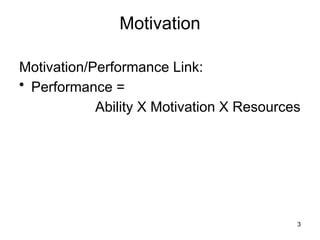
Motivation/Performance Link:
• Performance =
Ability X Motivation X Resources
4
Early theories of Motivation
1. Maslow’s Hierarchy of needs
2. McGregor’s Theory X and Theory Y:
• Theory X assumes that lower-order needs
dominate individuals and vice versa
3. Herzberg’s Motivation – Hygiene Theory:
• intrinsic factors (motivators) are related to
job satisfaction and motivation
• whereas extrinsic factors (hygiene factors)
are associated with job dissatisfaction
5
Maslow’s Hierarchy of Needs
6
Herzberg’s Motivation Factors
Motivators (their presence causes
motivation)
• Achievement
• Recognition
• Work itself
• Responsibility
• Advancement
• Growth
7
Herzberg’s Motivation Factors
HYGIENE FACTORS (their presence will lead to job
dissatisfaction)
• Supervision
• Policies
• Relationship with supervisor
• Working conditions
• Salary
• Relationship with peers
• Personal life
• Relationship with subordinates
• Status
• Security
8
Contemporary Theories of Motivation
1. Three Needs Theory:
• nAch, nPow and nAff
• Out of these nAch is well researched
2. Goal setting Theory:
• Specific goals increase performance
• Difficult goals, when accepted, result in higher
performance than do easy goals.
• Goals should be SMART
• Specific, Measurable, Achievable, Realistic,
and Time-bound.
9
Contemporary Theories of Motivation
1. Reinforcement Theory:
• Behavior is a function of its consequences i.e. behavior is
caused externally and what controls behavior are
Reinforcers/ consequences that, when given immediately
following a behavior, increase the probability that the
behavior will be repeated.
2. Equity Theory (Stacey Adams):
• a person compares his or her job’s inputs-outcomes ratio
with that of relevant others and then corrects any inequity.
3. Expectancy Theory (Victor Vroom):
• Based on three elements
• Expectancy – EFFORT will lead to PERFORMANCE
• Instrumentality – PERFORMANCE will lead to REWARD
• Valance – will this REWARD be enough to achieve a
GOAL
• Motivation = E X I X V

Motivation Vs performance and it's types

  • 1.
    1 Motivation • “Motivation isthe willingness to exert high levels of effort to achieve goals, conditioned by the effort’s ability to satisfy some individual needs”. • This definition has three key elements: 1. Effort • (intensity or drive) • quality of effort 2. Goals 3. Need • some internal state that makes certain outcomes attractive.
  • 2.
    2 Motivation Types of Motivation •Extrinsic motivation • Intrinsic motivation Role of Feedback • Controlling • Informational • Positive feedback causes low intrinsic motivation but high extrinsic motivation.
  • 3.
  • 4.
    4 Early theories ofMotivation 1. Maslow’s Hierarchy of needs 2. McGregor’s Theory X and Theory Y: • Theory X assumes that lower-order needs dominate individuals and vice versa 3. Herzberg’s Motivation – Hygiene Theory: • intrinsic factors (motivators) are related to job satisfaction and motivation • whereas extrinsic factors (hygiene factors) are associated with job dissatisfaction
  • 5.
  • 6.
    6 Herzberg’s Motivation Factors Motivators(their presence causes motivation) • Achievement • Recognition • Work itself • Responsibility • Advancement • Growth
  • 7.
    7 Herzberg’s Motivation Factors HYGIENEFACTORS (their presence will lead to job dissatisfaction) • Supervision • Policies • Relationship with supervisor • Working conditions • Salary • Relationship with peers • Personal life • Relationship with subordinates • Status • Security
  • 8.
    8 Contemporary Theories ofMotivation 1. Three Needs Theory: • nAch, nPow and nAff • Out of these nAch is well researched 2. Goal setting Theory: • Specific goals increase performance • Difficult goals, when accepted, result in higher performance than do easy goals. • Goals should be SMART • Specific, Measurable, Achievable, Realistic, and Time-bound.
  • 9.
    9 Contemporary Theories ofMotivation 1. Reinforcement Theory: • Behavior is a function of its consequences i.e. behavior is caused externally and what controls behavior are Reinforcers/ consequences that, when given immediately following a behavior, increase the probability that the behavior will be repeated. 2. Equity Theory (Stacey Adams): • a person compares his or her job’s inputs-outcomes ratio with that of relevant others and then corrects any inequity. 3. Expectancy Theory (Victor Vroom): • Based on three elements • Expectancy – EFFORT will lead to PERFORMANCE • Instrumentality – PERFORMANCE will lead to REWARD • Valance – will this REWARD be enough to achieve a GOAL • Motivation = E X I X V