MOTIVATION
INTRODUCTION
Motivation is an action that stimulates an individual to take a course of action, which will
result in an attainment of goals, or satisfaction of certain material or psychological needs of the
individual. Motivation is a powerful tool in the hands of leaders. It can persuade convince and
propel people to act.
TERMINOLOGY
1.Rigor- a sudden feeling of cold with shivering accompanied by a rise in temperature, often
with copious sweating, especially at the onset or height of a fever.
2. Affiliation – it is the act of becoming formally connected or joined
3. Job Enrichment - Job enrichment is a strategy used to motivate employees by giving them
increased responsibility and variety in their jobs.
4. Instrinsic motivation – it is defined as the motivation to engage in a behavior because of
the inherent satisfaction of the activity rather than the desire for a reward or specific outcome.
5. Extrinsic motivation - Extrinsic motivation is a catalyst for action that is driven by external
rewards. These can be tangible, such as money or grades, or intangible, such as praise or fame
6. Delegation - Delegation is the process by which a manager or a leader entrusts a member of
their staff with the responsibility and authority to complete a task.
DEFINITION
Motivation is defined as…
 Motivating force is a need that comes from within an individual, e.g. to make a living,
gain status and respect or to remove a source of frustration (Review of Maslow ‘s
Hierarchy of Needs).
1
 Motivation refers to the way in which urges, drives, desires, aspirations, striving or needs
direct, control or explain the behavior of human beings . -Dalton E. McFurland,
‖
TYPES OF MOTIVATORS
1) Intrinsic motivation: Refers to motivation that comes from within the person, driving
him or her to be productive. It is related to a person ‘s level of inspiration. The motivation
comes from the pleasure one gets from the task itself or from the sense of satisfaction in
completing or even working on the task rather than from external rewards.
2) Extrinsic motivation: It refers to motivation that comes from outside an individual, i.e.
enhanced by the work environment or external rewards such as money or grades. The
rewards provide a satisfaction and pleasure that the task itself may not provide. An
extrinsically motivated person will work on a task even when they have little interest in it
because of the anticipated satisfaction they will get from the reward. e.g.- reward for a
student would obtain good grade on an assignment or in the class.
OTHER TYPES OF MOTIVATION
1) Achievement motivation
It is the drive to peruse and attain goals. An individual with achievement motivation
wishes to achieve objectives and advance up the ladder of success. Hence, accomplishment
is important for his/her own sake and not for the rewards that accompany it.
2) Affiliation motivation
It is a drive to relate to people on a social basis. Individuals with affiliation
motivation perform work better when they are complimented for their favourable attitude
and co-operation.
3) Competence motivation
It is the drive to be good at something, allowing the individual to perform high
quality work. Competence/skill motivated individuals seek job mastery, take pride in
developing and in using their problem-solving skills and strive to be creative when
confronted with obstacles. They learn from their experiences.
2
4) Power motivation
It is the drive to influence people and change situations. Power motivated people
wish to create an impact on their organization and are willing to take risks.
5) Attitude motivation
Attitude motivation is how people think and feel. It is their self-confidence, their
belief in themselves and their attitude to life. It is how they feel about the future and how
they react to the past.
6) Incentive motivation
It is where the people are motivated through external rewards. Here, a person or
team reaps a reward from an activity. It is the type of rewards that drive people to work
harder.
7) Fear motivation
Fear motivation coercions a person to act against will. It is instantaneous and gets
the job done more quickly. Fear motivation is helpful in the short run.
MOTIVATIONAL APPROACHE
1. Be strong approach
 Traditionally, management has resorted to be strong. This form of motivation in enterprise
Emphasizes authority and economic rewards.
 This rewards strategy consists of forcing people to work by threatening to punish or
dismiss them or to cut their rewards, if they do not work.
2. Be goo or paternalistic approach
 This approach is a substituted for be strong approach.
 The essence of this approach is conferring of various rewards and the organization
members in hope of increasing the productivity due to gratitude or loyalty to the
organization.
 Be good approach or paternalism may fail to achieve its purpose. paternalism may create
resentment rather than gratitude because some people do not like to feel dependent on
others
3. Efford reward approach
 The third strategy tries to establish and relationship between efforts and rewards.
3
 Individual wage incentives and promoting individuals based on accomplishment of the
manifestations of this approach.
 This approach may also be called monistic approach because it assumes that people work
for money.
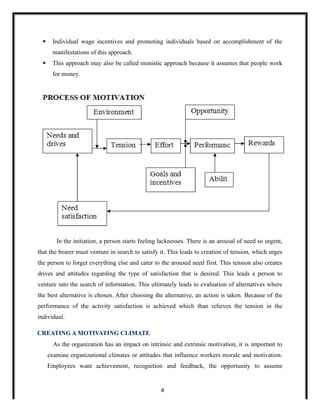
In the initiation, a person starts feeling lacknesses. There is an arousal of need so urgent,
that the bearer must venture in search to satisfy it. This leads to creation of tension, which urges
the person to forget everything else and cater to the aroused need first. This tension also creates
drives and attitudes regarding the type of satisfaction that is desired. This leads a person to
venture into the search of information. This ultimately leads to evaluation of alternatives where
the best alternative is chosen. After choosing the alternative, an action is taken. Because of the
performance of the activity satisfaction is achieved which than relieves the tension in the
individual.
CREATING A MOTIVATING CLIMATE
As the organization has an impact on intrinsic and extrinsic motivation, it is important to
examine organizational climates or attitudes that influence workers morale and motivation.
Employees want achievement, recognition and feedback, the opportunity to assume
4
responsibility, a chance for advancement, fairness, good leadership, job security and
acceptance and adequate monetary compensation. All these create a motivating climate and
lead to satisfaction in the work place.
e.g. nurses who experience satisfaction stay where they are, contributing to organization
‘s retention.
STRATEGIES TO CREATE A MOTIVATING CLIMATE
1. Have a clear expectation for workers and communicate effectively.
2. Be fair and consistent when dealing with all employees.
3. Be a firm decision maker.
4. Develop a team work/team spirit.
5. Integrate the staffs needs and wants with the organization ‘s interest and purpose.
6. Know the uniqueness of each employee.
7. Remove traditional blocks between the employee and the work to be done.
8. Provide opportunities for growth.
9. Encourage participation in decision-making.
10. Give recognition and credit.
11. Be certain that employees understand the reason behind decisions and actions.
12. Reward desirable behaviour.
13. Allow employees exercise individual judgement as much as possible.
14. Create a trustful and helping relation with employees.
15. Let employees exercise as much control as possible over their work environment.
FACTORS THAT INFLUENCES NURSES MOTIVATION
 Hygiene factors;
Hygiene factors are those factors whose presence need not motivate but whose absence will
demotivate.
Hygiene factors include organizational policy and administration, technical supervision, pay,
relationship with the superiors, relationship with the subordinates, relationship with the pears, job
security, personal life, status and working conditions.
 Motivational factors:
5
- Motivational factors are also known as satisfiers which motivate they are work itself,
achievement, recognition, advancement, growth and responsibility .
 Valence, expectancy and instrumentality:
Vroom (Fred Luthans 2005), views motivation as a product of three factors
 Valence – It denotes how much one wants to reward
 Expectancy- which is nothing but and employee’s estimate of the probability effort will
result in successful performance.
 Instrumentality - which defines an employee’s estimate that performance will result in
receiving the reward.
self esteem
 Treatment self estimate organizational levels breeds your population of motivated
individuals with the organizational commitment nurses who have managers who can
communicate to them that trust what the status and value in the organization will have high
levels of self esteem.
MEASURES TAKEN BY THE NURSE MANAGER TO FACILITATE NURSES
MOTIVATION: -
The nurse manager while managing the nursing unit will have to choose a combination of the
following measures to facilitate nurses ‘motivation.
1) Act as a Role model (Set a good example): -
a) Set high standards in the units.
b) Maintain a positive attitude towards the work and staff.
c) Be optimistic; in other words, be aware of how difficult the job is and how it can be done.
d) Ask for help when in need.
e) Admit mistakes.
2) Develop and maintain Good Personal Relations: -
a) Use two-way communication.
b) Be friendly, not to criticize staff in front of others and be fair.
c) Keep a sense of humor and avoid getting angry.
6
d) Try to understand nurses ‘attitudes, likes, dislike their experience, previous training,
problems in their work and needs.
These measures will help in understanding nurses ‘behavior. Understanding is the first step
toward motivating nurses. Trust comes with understanding and it develops slowly based on the
respect and acceptance of the manager. Motivation is based on understanding and trust.
Some guidelines for developing trust: -
a) Apply rules equally and consistently.
b) Avoid favoring some nurses over others, be fair.
c) Share information – show respect for ideas and opinions and confidentiality.
d) Always be supportive.
3) Post Each Nurse where she can work best: -
The nurse is more likely to succeed and be motivated if her/his interests and skills are
considered in the assignment. Success is the best motivator.
4) Use a participative style: -
Participation and sharing information will motivate nurses since they feel they are taking part
in decisions. Motivation requires more than physical involvement in a job. It also demands
mental and emotional involvement.
5) Guide, encourage and support continuously: -
Guidance means helping nurses in planning, evaluating their work and in solving work and
personal problems.
Encouragement means helping and reassuring nurses regardless of the type of problems.
Develop a supportive environment by reducing physical stresses associated with the job.
Support means removing obstructions and providing nurses with satisfying work
environment which include personnel and facilities and suitable learning materials needed to do
their job.
7
Reward Good work: -
a) Give recognition for successful achievement of the job. Praise frequently and informally.
It can be in front of other staff.
b) Reward includes: Pay increase, promotion, training for advancement to a higher level
within a job.
c) Thank you is a type of reward that helps to increase self-confidence.
6) Build team work (Team spirit)
a) Schedule regular meetings.
b) Make nurses feel that their job is important to the success of the team.
c) Integrate the needs and wants of the staff nurses with those of the nursing unit.
d) Think of nurses in the unit as a group and do what is best for them.
7) Provide continuing education: -
Nurses enjoy learning new knowledge and skills or updating the existing knowledge and
skills or taking new responsibilities through continuing education.
THEORIES OF MOTIVATION
There are two different categories of motivation theories- Individual or people centered
approaches and work oriented theory.
a) Individual or people centered approach
1) Abraham Maslow (1943)
Maslow ‘s theory included 5 basic needs in his theory, namely the- The physiological
needs, Safety and security needs, Love needs, self-esteem needs and self-actualization
needs. Maslow suggested that human needs are ordered in a hierarchy from simplex to
complex. Higher level needs do not emerge as motivators until lower needs are satisfied
and a satisfied need no longer motivates behaviour.
 Physiological needs: Food, water, warmth, shelter, sleep, medicine, and education, etc.
Once the physiological needs are met, the next level becomes predominant.
8
 Safety and security needs: These are the needs to be free of physical danger and of the
fear of losing a job, property, food, or shelter. It also includes protection against any
emotional harm.
 Social needs: Since people are social beings, they need to belong and be accepted by
others. People try to satisfy their need for affection, acceptance, and friendship. After the
lower needs are well satisfied, affiliation or acceptance will emerge as dominant and the
person strives for meaningful social relationship.
 Esteem needs: According to Maslow, once people begin to satisfy their need to belong,
they tend to want to be held in esteem both by themselves and by others. This kind of need
produces such satisfaction as power, prestige status and self-confidence.
 Need for self-actualization: Maslow regards this as the highest need in his hierarchy. It is
the drive to become what one can become; it includes growth, achieving one ‘s potential
and self-fulfillment. It is to maximize one ‘s potential and to accomplish something.
2) Alderfer ERG theory
ERG theory is like Maslow ‘s hierarchy of needs. The existence (E) needs are equivalent
to physiological and safety needs; relatedness (R) needs to belongingness, social and love
needs. The growth (G) needs to self-esteem and self-actualization- personal achievement
and self-actualization. The major conclusions of this theory are:
 In an individual, more than one need may be operative at the same time.
 If a higher need goes unsatisfied than the desire to satisfy a lower need intensifies.
 When the higher-level needs are frustrated; people will regress to the satisfaction of the
lower-level needs. This phenomenon is known as frustration-regression process
3) David McClelland (1961)
David McClelland has developed a theory on three types of motivating needs:
• Need for Power
• Need for Affiliation
• Need for Achievement
People with high need for power are inclined towards influence and control. They like to
be at the center and are good orators. They are demanding in nature, forceful in manners and
9
ambitious in life. They can be motivated to perform if they are given key positions or power
positions.
In the second category are the people who are social in nature. They try to affiliate
themselves with individuals and groups. They are driven by love and faith. They like to build
a friendly environment around themselves. Social recognition and affiliation with others
provide them motivation.
People in the third category are driven by the challenge of success and the fear of failure.
Their need for achievement is moderate and they set for themselves moderately difficult tasks.
They are analytical in nature and take calculated risks. Such people are motivated to perform
when they see at least some chances of success.
McClelland observed that with the advancement in hierarchy the need for power and
achievement increased rather than Affiliation. He also observed that people who were at the
top, later ceased to be motivated by these drives.
b) Work oriented theory
1) McGregor’s Theory X and Theory Y
Douglas McGregor proposed two different motivational theories- theory X and theory Y.
He states that people inside the organization can be managed in two ways. The first is
basically negative, which falls under the category X and the other is positive, which falls
under the category Y.
Assumptions of theory X:
• Employees inherently do not like work and whenever possible, will attempt to avoid it.
• Because employees dislike work, they must be forced, coerced, or threatened with
punishment to achieve goals.
• Employees avoid responsibilities and do not work until formal directions are issued.
• Most workers place a greater importance on security over all other factors and display little
ambition.
Assumptions of theory Y:
• Physical and mental effort at work is as natural as rest or play.
• People do exercise self-control and self-direction and if they are committed to those goals.
10
• Average human beings are willing to take responsibility and exercise imagination,
ingenuity, and creativity in solving the problems of the organization.
• That the way the things are organized, the average human being’s brainpower is only partly
used.
On analysis of the assumptions, it can be detected that theory X assumes that lower-order
needs dominate individuals and theory Y assumes that higher-order needs dominate
individuals. An organization that is run on Theory X lines tends to be authoritarian in nature-
―power to enforce obedience and the ―right to command. In contrast Theory Y
‖ ‖
organizations can be described as ―participative , where the aims of the organization and of
‖
the individuals in it are integrated; individuals can achieve their own goals best by directing
their efforts towards the success of the organization
2) Frederick Herzberg Two Factor need theory (1966)
Herzberg felt that job satisfaction and dissatisfaction exists on dual scales. Workers are
motivated by two types of needs/factors-
• Needs relating to the work itself called intrinsic/motivation factors (satisfiers):
challenging aspects of the work, achievement, added responsibility, opportunities for
growth and opportunities for advancement
• Needs relating to working conditions called extrinsic/hygiene factors (dissatisfiers):
salary, status, working conditions, quality of supervision, job security and agency policies.
According to Herzberg, the hygiene factors must be maintained in quantity and quality to
prevent dissatisfaction. They become dissatisfiers when not equitably administered,
causing low performance and negative attitudes.
The motivation factors create opportunities for high satisfaction, high motivation, and
high performance. Absence of motivation factors causes a lack of job satisfaction.
3) Expectancy theory of Vroom
This theory postulates that most behaviours are voluntarily controlled by a person and are
therefore motivated. It focuses on people ‘s effort-performance expectancy, or a person ‘s
belief that a chance exists for a certain effort to lead to a particular level of performance. This
theory states that motivation depends on three variables-
11
• Attractiveness: the person sees the outcome as desirable.
• Performance-reward linkage: the person perceives that a desired outcome will result
from a certain degree of performance.
• Effort-performance: the person believes that a certain amount of effort will lead to
performance.
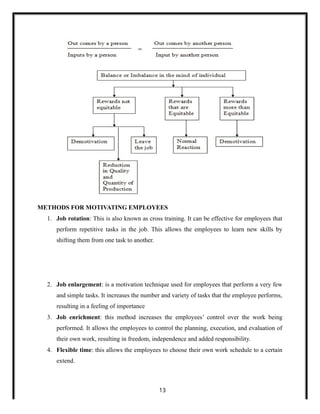
4) J. Stacy Adams Equity theory
Third process theory and focuses on fair treatment. Persons believe that they are being
treated with equity when the ratio of their efforts to rewards equals those of others. Equity
can be achieved or restored by changing outputs, attitudes, the reference person, inputs or
outputs of the reference person or the situation. People tend to use subjective judgment to
balance the outcomes and inputs in the relationship for comparisons between different
individuals. Accordingly,
12
METHODS FOR MOTIVATING EMPLOYEES
1. Job rotation: This is also known as cross training. It can be effective for employees that
perform repetitive tasks in the job. This allows the employees to learn new skills by
shifting them from one task to another.
2. Job enlargement: is a motivation technique used for employees that perform a very few
and simple tasks. It increases the number and variety of tasks that the employee performs,
resulting in a feeling of importance
3. Job enrichment: this method increases the employees’ control over the work being
performed. It allows the employees to control the planning, execution, and evaluation of
their own work, resulting in freedom, independence and added responsibility.
4. Flexible time: this allows the employees to choose their own work schedule to a certain
extend.
13
5. Job sharing: a less common method but very effective in preventing boredom. It allows
employees to share two different jobs
6. Employee involvement: people want to feel like they are a part of something. Letting the
employees to be more active in decision-making related to their job makes them feel
valued and important to the company and increases job motivation.
7. Variable pay programs: merit-based pay, bonuses, gain sharing, and stock ownership
plans are some good motivators for employees. They should be offered as an incentive or
reward for outstanding performance.
ROLE OF NURSE MANAGER TO MOTIVATES SAFF
1. Nurse managers play an essential part in motivating their staff. Staff needs to be motivated
to have quality patient care, to develop their efficiency.
2. Focus on needs and wants of individual staff.
3. Recognize each team as a unique individual and use accordingly appropriate strategy to
each group.
4. Act as a role model, active listener, supporter and encourager for demotivated team.
5. Recognize differences among staff and treat them well.
6. Throw A challenge.
7. Have Effective communication.
8. Create a climate for the Independent and motivating working environment, help them.
9. Use problem-solving approach.
CONFLICT MANAGEMENT
INTRODUCTION
Conflict is generally defined as the internal or external discord that results from
differences in ideas, values, or feelings between two or more people. Because managers have
interpersonal relationships with people having a variety of different values, beliefs, backgrounds,
14
and goals, conflict is an expected outcome. Conflict is also created when there are differences in
economic and professional values and when there is competition among professionals.
MEANING & DEFINITION OF CONFLICT
• Conflict can be defined as an expressed struggle between at least two interdependent
parties, who perceive that incompatible goals, scarce resources, or interference from
others are preventing them from achieving their goals (Wilmot & Hocker, 2001).
• Conflict management is the process of planning to avoid conflict where possible and
organizing to resolve conflict where it does happen, as rapidly and smoothly as possible.
TYPES OF CONFLICTS
Conflict has been described and studied from the standpoint of its context, or where it
occurs. 3 types of conflicts are
Intrapersonal conflict: an intrapersonal conflict occurs within an individual in situations in
which he or she must choose between two alternatives. Choosing one alternative means that he
or she cannot have the other; they are mutually exclusive. E.g. we might internally debate
whether to complete an assignment that is due the next day or watch a favorite television
Programme.
Interpersonal conflict: is conflict between two or more individuals. It occurs because of
differing values, goals, action, or perceptions. For e.g. when you want to go to a science fiction
movie, but your partner may prefer to attend an opera. Interpersonal conflict becomes more
difficult when we are involved in issues relating to racial, ethnic and life style values and norms.
Organizational conflicts: conflict also occurs in organization because of differing perceptions
or goals. Organizational conflicts may be intrapersonal or interpersonal, but they originate in the
structure and function of the organization. Typically, aspects of the organizations style of
management, rules, policies, and procedures give rise to conflict.
Two areas responsible for conflict in organizations are role ambiguity and role conflict.
15
• Role ambiguity occurs when employees do not know what to do, how to do it, or what
the outcomes must be. This frequently occurs when policies and rules are ambiguous and
unclear.
• Role conflict occurs when two or more individuals in different positions within the
organization believe that certain actions or responsibilities belong exclusively to them.
The conflict could relate to competition. E.g. In some hospitals, conflict have existed
between the nurse and the social workers about the responsibility for providing discharge
planning. Both groups see discharge planning as an important aspect of their own care of
the patients.
COMMON CAUSES OF CONFLICT
1. Vertical conflict: Occurs between hierarchical levels
2. Horizontal conflict: Occurs between persons or groups at the same hierarchical level.
3. Line-staff conflict: Involves disagreements over who has authority and control over
specific matters
4. Role conflict: Occurs when the communication of task expectations proves inadequate or
upsetting
5. Work-flow interdependencies: Occur when people or units are required to cooperate to
meet challenging goals.
6. Domain ambiguities: Occurs when individuals or groups are placed in ambiguous
situations where it difficult to determine who is responsible for what.
7. Recourse scarcity: When resources are scarce, working relationships are likely to suffer.
8. Power or value asymmetries: Occurs when interdependent people or groups differ
substantially from one another in status and influence or in values.
CHARACTERISTICS OF CONFLICT
The characteristics of a conflict situation are:
1) At least two parties (individuals or groups) are involved in some kind of interaction.
16
2) Mutually exclusive goals and mutually exclusive values exist, either in fact or as
perceived by the patients involved.
3) Interaction is characterized by behavior destined to defeat, reduce, or suppress the
opponent or to gain a mutually designated victory.
4) The parties face each other with mutually opposing actions and counteractions.
5) Each party attempts to create an imbalance or relatively favored position of power vis-
Avis the other.
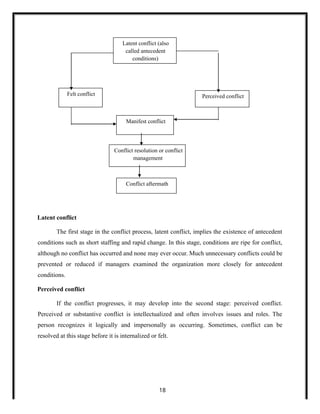
THE CONFLICT PROCESS
Before managers can or should attempt to intervene in conflict, they must be able to
assess its five stages accurately
1. Latent conflict (also called antecedent conditions).
2. Perceived conflict
3. Felt conflict
4. Manifest conflict
5. Conflict resolution
6. Conflict aftermath.
17
Latent conflict
The first stage in the conflict process, latent conflict, implies the existence of antecedent
conditions such as short staffing and rapid change. In this stage, conditions are ripe for conflict,
although no conflict has occurred and none may ever occur. Much unnecessary conflicts could be
prevented or reduced if managers examined the organization more closely for antecedent
conditions.
Perceived conflict
If the conflict progresses, it may develop into the second stage: perceived conflict.
Perceived or substantive conflict is intellectualized and often involves issues and roles. The
person recognizes it logically and impersonally as occurring. Sometimes, conflict can be
resolved at this stage before it is internalized or felt.
18
conditions)
called antecedent
Latent conflict (also
Conflict aftermath
Manifest conflict
management
Conflict resolution or conflict
Perceived conflict
Felt conflict
Felt conflict
The third stage, felt conflict, occurs when the conflict is emotionalized. Felt emotions
include hostility, fear, mistrust, and anger. It is also referred to as affective conflict. It is possible
to perceive conflict and not feel it. A person also can feel the conflict but not perceive the
problem. Manifest conflict
It is also called as overt conflict, action is taken. The action may be to withdraw, compete,
debate, or seek conflict resolution. People often learn pattern of dealing with manifest conflict
early in their lives, and family background and experiences often directly affect how conflict is
dealt with in adulthood.
Gender also may play a role in how we respond to conflict. Men are socialized to respond
more aggressively to conflict, while women are more apt to try to avoid conflicts or to pacify
them. Power also plays a role in conflict resolution. Therefore, the action an individual takes to
resolve conflict is often influenced by culture, gender, age, power position and upbringing.
Conflict aftermath
The final stage in the conflict process is conflict aftermath. There is always conflict
aftermath- positive or negative. If the conflict is managed well, people involved in the conflict
will believe that their position was given a fair hearing. If the conflict is managed poorly the
conflict issues frequently remain and may return later to cause more conflict.
Outcomes of conflict
We often hear people hear about conflict situation resulting in win-win, win-lose and lose.
Filley (1975) identified these 3 different positions or outcomes of conflict.
Win-lose outcome: occurs when one person obtains his or her desired ends in the situation
and the other individual fails to obtain what is desired. Often winning occurs because of
power and authority within the organization or situation.
Lose-lose outcome: in lose-lose situation, there is no winner. The resolution of the
conflict is unsatisfactory to both parties.
Win- win outcome: are of course the most desirable. In these situations, both parties walk
away from the conflict having achieved all or most of their goals or desires.
19
EFFECTS OF CONFLICT IN ORGANIZATIONS
• Stress
• Absenteeism
• Staff turnover
• De-motivation
• Non-productivity
SIGNS OF CONFLICT BETWEEN INDIVIDUALS
1. Colleagues not speaking to each other or ignoring each other
2. Contradicting and bad-mouthing one another
3. Deliberately undermining or not co-operating with each other, to the downfall of the team
CONFLICT MANAGEMENT
The optimal goal in resolving conflict is creating a win- win solution for all involved.
This outcome is not possible in every situation, and often the manager ‘s goal is to manage the
conflict in a way that lessens the perceptual differences that exist between the involved parties. A
leader recognizes which conflict management strategy is most appropriate for each situation. The
choice of most appropriate strategy depends on many variables, such as the situation itself, the
urgency of the decision, the power and status of the players, the importance of the issue, and the
maturity of the people involved in the conflict.
1. Discipline
2. Consider Life Stages
3. Communication
4. Active Listening
5. Assertiveness Training
6. Assessing the Dimensions of the Conflict
20
• Issues in Question
• Size of the Stakes
• Interdependence of the Parties
• Continuity of Interaction
• Structure of the Parities
• Involvement of Third Parties
Discipline: In using discipline to manage or prevent conflict, the nurse manager must know and
understand the organization ‘s rules and regulations on discipline. If they are not clear, the nurse
manager should seek help to clarify them.
Consider Life Stages: Most organizations will have nurses at all life stages in their employ.
Conflict can be managed by supporting individual nurses in attaining goals that pertain to their
life stages. Three developmental stages are as follow. ‖
1. In general, in the young adult stage, nurses are establishing careers. Nurses at this stage
may be pursuing knowledge, skills, and upward mobility. Conflict may be prevented or
managed by facilitating career advancement.
2. In general, during middle age, nurses become reconciled with achievement of their life
goals. These nurses often help develop the careers of younger nurses.
3. In general, after age 55 years, nurses think in terms of completing their work and retiring.
Egos and ideals are integrated with accomplishments.
Communication: Communication is an art that is essential to maintaining a therapeutic
environment. It is necessary in accomplishing work and resolving emotional and social issues.
Supervisors prevent conflict with effective communication and should make it a way of life. To
promote communication that prevents conflict, do the following.
1. Teach nursing staff members their role in effective communication.
2. Provide information to everyone: be inclusive, not exclusive.
3. Consider all the aspects of situations: emotions, environmental considerations, and verbal
and nonverbal messages.
21
4. Develop these basic skills;
a. Reality orientation, by direct involvement and acceptance of responsibility in
resolving conflict.
b. Physical and emotional composure.
c. Positive expectations that generate positive responses.
d. Active listening.
e. Giving and receiving information.
Active Listening: Active or assertive listening is essential to managing conflict.
Active assertive listening is sometimes called stress listening. Powell suggest these techniques
for stress listening.
1. Do not share anger; it adds to the problem. Remain calm and matter-of-fact.
2. Respond constructively in both verbal and nonverbal language. Be cheerful but sober.
Maintain eye contact. Prevent interruptions. Bring problems into the open. Make the
employee comfortable. Act serous. Always be courteous and respectful.
3. Ask questions and listen to the answers. Determine the reasons for the anger.
4. Separate fact from opinion, including your own.
5. Do not respond hastily. Plan a response.
6. Consider the employee’s perspective first.
7. Help the employee find the solution. Ask questions and listen to responses. Do not be
paternalistic.
Assertiveness Training: Assertive nurse, including managers, will stand up for their rights while
recognizing the rights of others. They are straightforward and know that they are responsible for
their thoughts, feelings, and actions. Assertive nurses also know their strengths and limitations.
22
Assertiveness can be taught through staff development programs. In these programs
nurses are taught to make learned, thoughtful responses and to know when to say no, even to
boss.
When they finish their training, assertive nurses will use positive comments to reinforce
expectations that others do their jobs. They will use praise and consideration to promote wellness
and positive individual behaviour. Nurse Managers learn that direct communication of support to
staff members increases staff job satisfaction.
Assertive nurses focus on data and issues when offering constructive cretinism to the boss
or constructive feedback to the staff, which encourages dialogue and produces solutions to
problems rather than conflict. They ask for assistance or delay when it needed.
People generally respond positively to assertion and negatively to aggression; however,
some people respond negatively to assertion.
Assessing the dimensions of the conflict
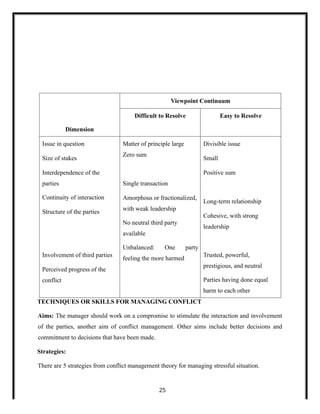
Greenhalgh has developed a system for assessing the dimensions of conflict. His view is
that conflict may be managed when it does not interfere with ongoing functional relationships.
Participants in a conflict must be persuaded to rethink their views. A third party must understand
the situation empathetically from the participants ‘viewpoints. The conflict may be the result of a
deeply rooted antagonistic relationship.
Greenhalgh ‘s Conflict Diagnostic Model has seven dimensions, each with a continuum from
―difficult to resolve to ―easy to resolve. Once the dimensions of the conflict have been
‖ ‖
assessed, those should be shifted to the easy-to-resolve domain.
 The issue in question
It has already been stated that values, beliefs, and goals are difficult issues to bring to a
reasonable compromise. Principles fall into the same category, since they involve integrity and
ethical imperatives. The third party must persuade the conflicting parties to acknowledge each
other ‘s legitimate point of view. How can principles be maintained and the organization and
employees be saved?
23
 The size of the stakes
The size of the stakes can make conflict hard to manage. If change threatens somebody ‘s
job or income, the stakes are high. The third party must try to keep egos from being hunt,
postponing action if necessary. What will the parties settle for? Precedents create potential for
future conflicts: If I give in now, what will I have to give up in the future?
 Interdependence of the parities
People must view resources in terms of interdependence. If one group sees no benefits
from the distribution of resources, they will be antagonistic. A positive-sum interdependence of
mutual gain is needed.
 Continuity of interaction
Long-term relationships reduce conflict. Managers should opt for continuous, not
episodic, interaction.
 Structure of the parties
Strong leaders who unify constituents to accept and implement agreements reduce conflict.
When informal coalitions occur, involve their representatives to find and implement agreements.
 Involvement of third parties
Conflicts are difficult to resolve when participants are highly emotional and resort to
distorting nonrational arguments, unreasonable stances, impaired communication, or personal
attacks. Such conflicts can be solved with a prestigious, powerful, trusted, and neutral third
mediator, or arbitrator. The inside manager who acts as judge or arbitrator polarizes; inviting a
third party makes it public. Third parties must be involved when the nurse manager, as party to a
conflict, cannot resolve it.
24
Dimension
Viewpoint Continuum
Difficult to Resolve Easy to Resolve
Issue in question
Size of stakes
Interdependence of the
parties
Continuity of interaction
Structure of the parties
Involvement of third parties
Perceived progress of the
conflict
Matter of principle large
Zero sum
Single transaction
Amorphous or fractionalized,
with weak leadership
No neutral third party
available
Unbalanced: One party
feeling the more harmed
Divisible issue
Small
Positive sum
Long-term relationship
Cohesive, with strong
leadership
Trusted, powerful,
prestigious, and neutral
Parties having done equal
harm to each other
TECHNIQUES OR SKILLS FOR MANAGING CONFLICT
Aims: The manager should work on a compromise to stimulate the interaction and involvement
of the parties, another aim of conflict management. Other aims include better decisions and
commitment to decisions that have been made.
Strategies:
There are 5 strategies from conflict management theory for managing stressful situation.
25
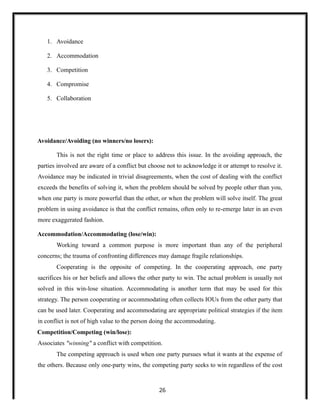
1. Avoidance
2. Accommodation
3. Competition
4. Compromise
5. Collaboration
Avoidance/Avoiding (no winners/no losers):
This is not the right time or place to address this issue. In the avoiding approach, the
parties involved are aware of a conflict but choose not to acknowledge it or attempt to resolve it.
Avoidance may be indicated in trivial disagreements, when the cost of dealing with the conflict
exceeds the benefits of solving it, when the problem should be solved by people other than you,
when one party is more powerful than the other, or when the problem will solve itself. The great
problem in using avoidance is that the conflict remains, often only to re-emerge later in an even
more exaggerated fashion.
Accommodation/Accommodating (lose/win):
Working toward a common purpose is more important than any of the peripheral
concerns; the trauma of confronting differences may damage fragile relationships.
Cooperating is the opposite of competing. In the cooperating approach, one party
sacrifices his or her beliefs and allows the other party to win. The actual problem is usually not
solved in this win-lose situation. Accommodating is another term that may be used for this
strategy. The person cooperating or accommodating often collects IOUs from the other party that
can be used later. Cooperating and accommodating are appropriate political strategies if the item
in conflict is not of high value to the person doing the accommodating.
Competition/Competing (win/lose):
Associates "winning" a conflict with competition.
The competing approach is used when one party pursues what it wants at the expense of
the others. Because only one-party wins, the competing party seeks to win regardless of the cost
26
to others. Win-lose conflict resolution strategies leave the loser angry, frustrated, and wanting to
get even in the future.
Compromise/Compromising (winsome/lose some):
Winning something while losing a little is OK. In compromising, each party gives up
something it wants for compromising not to result in a lose-lose situation, both parties must be
willing to give up something of equal value. It is important that parties in conflict do not adopt
compromise prematurely if collaboration is both possible and feasible.
Collaboration/Collaborating (win/win): Teamwork and cooperation help everyone achieve
their goals while also maintaining relationships.
Collaborating is an assertive and cooperative means of conflict resolution that results
in a win-win solution. In collaboration, all parties set aside their original goals and work together
to establish a supraordinate or priority common goal. In doing so, all parties accept mutual
responsibility for reaching the supraordinate goal. Although it is very difficult for people truly to
set aside original goals, collaborating cannot occur if this doesn ‘t happens.
For example, a nurse who is unhappy that she did not receive requested days off might
meet with her superior and jointly establish the supraordinate goal that staffing will be adequate
to meet the patient safety criteria. If the new goal is truly a jointly set goal, each party will
perceive that an important goal has been achieved and that the supraordinate goal is most
important. In doing so, the focus remains on problem solving and not on defeating the other
party.
MANAGE AND RESOLVE CONFLICT SITUATIONS
1. Collective bargaining
Especially in workplace situations, it is necessary to have agreed mechanisms in place for
groups of people who may be antagonistic (e.g. management and workers) to collectively discuss
and resolve issues. This process is often called "collective bargaining", because representatives
of each group come together with a mandate to work out a solution collectively.
27
2. Conciliation he dictionaries defines conciliation as "the act of procuring good will or
inducing a friendly feeling". It is the synonymous terms that refer to the activity of a third party
to help disputants reach an agreement.
3. Negotiation:
This is the process where mandated representatives of groups in a conflict situation meet to
resolve their differences and to reach agreement. It is a deliberate process, conducted by
representatives of groups, designed to reconcile differences and to reach agreements by
consensus. The outcome is often dependent on the power relationship between the groups.
4. Mediation:
When negotiations fail or get stuck, parties often call in and independent mediator. This
person or group will try to facilitate settlement of the conflict. The mediator plays an active part
in the process, advises both or all groups, acts as intermediary and suggests possible solution.
5. Arbitration:
Means the appointment of an independent person to act as an adjudicator (or judge) in a
dispute, to decide on the terms of a settlement. Both parties in a conflict must agree about who
the arbitrator should be, and that the decision of the arbitrator will be binding on them all.
HOW TO PREVENT CONFLICTS IN MEDICAL PROFESSIONALS
• Frequent meeting of your team
• Allow your team to express openly
• Sharing objectives
• Having a clear and detailed job description
• Distributing task fairly
• Never criticize team members publicly
• Always be fair and just with your team
• Being a role model
NEGOTIATION
28
Negotiation in its most creative form is like collaboration and in its most poorly managed
form may resemble a competing approach. Negotiation frequently resembles compromise when
it is used as a conflict resolution strategy. During negotiation, each party gives up something, and
the emphasis is on accommodating differences between the parties. Because we live in a world
with others, we have conflicting needs, wants, and desires that must be constantly compromised.
Steps in negotiation process
• Before the Negotiation
For managers to be successful, they must systematically prepare for the negotiation.
As the negotiator, the manager begins by gathering as much information as possible regarding
the issue to be negotiated.
Adequate preparation
Tate (2005) suggests that managers should initially focus on seeking a bigger pie instead of
dividing the pie up.
• During the Negotiation
Negotiation is psychological and verbal.
The effective negotiator always looks calm and self-assured.
There are many types of personalities, and it is necessary to negotiate with most of them.
Preparation, however, is not enough. In the end, the negotiator must have clarity in his or her
communication, assertiveness, good listening skills, the ability to regroup quickly, and flexibility.
Tactics Not to Use During Negotiation
• Ridicule or Belittling- The goal in using ridicule is to intimidate others involved in the
negotiation. If you are negotiating with someone who uses ridicule, maintain a relaxed
body posture, steady gaze, and patient smile. Body language must also remain relaxed and
non-threatening
• Inappropriate Questioning or ambiguous
• Flattery. The person who has been flattered may be more reluctant to disagree with the
other party in the negotiation, and thus his or her attention and focus are diverted.
Closure and Follow-Up to Negotiation
• State what has been agreed to
• Close on a friendly note
29
• Send a memo regarding what has been agreed to
CONSENSUS
Consensus is always an appropriate goal in resolving conflicts and in negotiation.
Consensus means that negotiating parties can reach an agreement that all parties can
support, even though it does not represent everyone is first priorities (Rowland & Rowland,
1997). Consensus decision making does not provide complete satisfaction for everyone
involved in the negotiation, as an initially unanimous decision would, but it does indicate
willingness by all parties to accept the agreed-upon conditions.
Role of Nurse Leaders and Managers in Addressing Conflict
Nurse leaders and managers need to mediate when interpersonal or intergroup conflict occurs to
avoid negative effects on nursing care and patient outcomes. Elements that should be explored
include the following (Porter-O'Grady & Malloch, 2013):
• Mutual respect: Those involved in the conflict may need a reminder to be respectful and focus
on the issue and not the other person
• Needs versus wants: The nurse leader and manager must help those involved differentiate
between what they need and what they want.
• Compassion and empathy: Those involved in the conflict may need assistance understanding
each other and hearing the other person's position.
• Staying in the "I": The nurse leader and manager reminds those involved to focus on "I"
statements. and avoid using "you" statements and avoid blaming.
30
The rapidly changing health-care environment today requires nurse leaders and managers to
develop knowledge and skills in leading and managing change and innovation. Nurse leaders and
managers must be skilled in understanding change theory, serving as change agents, and
supporting staff during the change process. Regardless of how important a change or innovation
is, nurse leaders and managers must consider human response and include strategies to help staff
members cope with change in the overall plan. Further, nurse leaders and managers must
understand that conflict can result from change and be willing to apply strategies to manage
change as needed. Nurses at all levels must also understand that conflict is part of change, it can
be healthy, and it allows for new ideas to emerge
Summary
Motivation and conflict management are essential elements in nursing management that significantly
influence both team performance and patient care. Effective motivation strategies, grounded in
theories like Maslow's hierarchy of needs, help enhance job satisfaction and performance among
nurses. Conversely, conflicts can arise from various sources such as interpersonal relationships and
workload pressures. Addressing these conflicts promptly through open communication and conflict
resolution techniques is crucial for fostering a positive work environment.
Conclusion
In conclusion, the interplay between motivation and conflict resolution is critical for successful
nursing management. By prioritizing motivational strategies and actively managing conflicts, nurse
leaders can cultivate a supportive atmosphere that enhances collaboration and professionalism. This
not only boosts staff morale but also leads to improved patient outcomes, ultimately creating a more
resilient and effective nursing workforce in the healthcare system.
31
Journal Abstract
1. Saredi, Parvizy (2019), “Strategies to promote academic motivation in nursing students”
Journal of education and health promotion
Nurses experience conflict as a regular event in their work. This study aimed to review
prior research to explore conflict management styles used by nurses in the workplace. The
searching was conducted in different Electronic databases: CINAHL, Google Scholar,
ASCOs and EBSCO. This review paper illustrated that nurses and managers used different
styles of conflict management in their workplace. There are a variety of factors that played
a role in the nurse’s decision to adopt the style of choice for conflict management. Skills
training for conflict management is needed. Future studies need to address all the complex
and multifaceted circumstances of the individual personal qualities, type of work
relationships, the specifics of the work environment that may influence cumstances of the
individual personal qualities, type of work relationships, the specifics of the work
environment that may influence the occurrence of conflicts in hospital
2. Makableh, Khraisat (2020),” Conflict management in nursing: a short review paper”, EC
Psychology and psychiatry.
Academic motivation is highly important in nursing education. Providing high-quality
nursing care requires students who have motivation to acquire information and skills. However,
nursing students lose their motivation gradually during their program. Thus, the present study is
aimed at elaborating on the strategies to improve academic motivation in nursing students. A
32
qualitative study was conducted in Saveh University of Medical Sciences. The data were
collected through focus groups and individual semi-structured interviews with forty nursing
students, professors, and lecturers of nursing and midwifery school. The participants were
selected through purposeful sampling method. This method is used for the selection of people
who have had experience with or are part of the culture or phenomenon of interest. Data analysis
was done as a continuous process through conventional qualitative content analysis.The
strategies to promote academic motivation of nursing students were categorized into four main
categories including strategies pertinent to professors (empowering and motivating to improve
the quality of teaching), strategies pertinent to students (creating positive attitude toward nursing,
empowering, and encouraging academic achievement), strategies pertinent to clinical education
(improvement of the quality of clinical training and optimization of the academic and clinical
relationships), and strategies pertinent to faculty (providing extracurricular activities, proper
curriculum programming, and educational and welfare facilities).The strategies to improve
academic motivation are available in different areas including professors, students, faculty, and
clinical education. In general, improving the quality of education and creating positive attitude in
nursing students increase their academic motivation.
33
Bibliography
Textbooks
• Linda Roussel (2016), “Management and Leadership for nurse’s administrator’s”, 5th
edition, Canada, Jones and Bardett publishers, page no: 414-419, 280-283
• Elakkuvana Bhaskara Raj (2012), “Management if Nursing Services and education”, 2nd
edition, Banglore, EMMESS medical publishers, page no: 342-352, 389-395.
• BT Basvanthappa (2009), “Nursing Administration”,2nd
edition, New Delhi, Jaypee
publications, Page No; 534-538,212-227.
• Dr. Elizabeth Christman (2022), “Nursing Management and professional concepts” by
chipperva valley technical college, page no: 321-339.
• Elizebeth Murrary (2017), “Nursing leadership and management for patient safety and
quality care” 1st
edition, Philadelphia, Davis company publishers, Page No: 294-302.
• Diane, Weiss, Tappen (2010), “Essentials of Nursing leadership and management” 5th
edition, Philadelphia, Published by Davis company, Page No: 91-102.
• Porter-O'Grady, T., & Malloch, K. (2013). Leadership in nursing practice: Changing the
landscape of health care (2nd ed.). Jones & Bartlett Learning.
Electronic version
• http://www.open.umn.edu
• http://www.pdfcoffee.com
• http://www.tpaz.info
• http://www.google.com
Journal
Saredi, Parvizy (2019), “Strategies to promote academic motivation in nursing students”
Journal of education and health promotion
Makableh, Khraisat (2020),” Conflict management in nursing: a short review paper”, EC
Psychology and psychiatry.
34

motivation and conflicts. nursing managementdocx

  • 1.
    MOTIVATION INTRODUCTION Motivation is anaction that stimulates an individual to take a course of action, which will result in an attainment of goals, or satisfaction of certain material or psychological needs of the individual. Motivation is a powerful tool in the hands of leaders. It can persuade convince and propel people to act. TERMINOLOGY 1.Rigor- a sudden feeling of cold with shivering accompanied by a rise in temperature, often with copious sweating, especially at the onset or height of a fever. 2. Affiliation – it is the act of becoming formally connected or joined 3. Job Enrichment - Job enrichment is a strategy used to motivate employees by giving them increased responsibility and variety in their jobs. 4. Instrinsic motivation – it is defined as the motivation to engage in a behavior because of the inherent satisfaction of the activity rather than the desire for a reward or specific outcome. 5. Extrinsic motivation - Extrinsic motivation is a catalyst for action that is driven by external rewards. These can be tangible, such as money or grades, or intangible, such as praise or fame 6. Delegation - Delegation is the process by which a manager or a leader entrusts a member of their staff with the responsibility and authority to complete a task. DEFINITION Motivation is defined as…  Motivating force is a need that comes from within an individual, e.g. to make a living, gain status and respect or to remove a source of frustration (Review of Maslow ‘s Hierarchy of Needs). 1
  • 2.
     Motivation refersto the way in which urges, drives, desires, aspirations, striving or needs direct, control or explain the behavior of human beings . -Dalton E. McFurland, ‖ TYPES OF MOTIVATORS 1) Intrinsic motivation: Refers to motivation that comes from within the person, driving him or her to be productive. It is related to a person ‘s level of inspiration. The motivation comes from the pleasure one gets from the task itself or from the sense of satisfaction in completing or even working on the task rather than from external rewards. 2) Extrinsic motivation: It refers to motivation that comes from outside an individual, i.e. enhanced by the work environment or external rewards such as money or grades. The rewards provide a satisfaction and pleasure that the task itself may not provide. An extrinsically motivated person will work on a task even when they have little interest in it because of the anticipated satisfaction they will get from the reward. e.g.- reward for a student would obtain good grade on an assignment or in the class. OTHER TYPES OF MOTIVATION 1) Achievement motivation It is the drive to peruse and attain goals. An individual with achievement motivation wishes to achieve objectives and advance up the ladder of success. Hence, accomplishment is important for his/her own sake and not for the rewards that accompany it. 2) Affiliation motivation It is a drive to relate to people on a social basis. Individuals with affiliation motivation perform work better when they are complimented for their favourable attitude and co-operation. 3) Competence motivation It is the drive to be good at something, allowing the individual to perform high quality work. Competence/skill motivated individuals seek job mastery, take pride in developing and in using their problem-solving skills and strive to be creative when confronted with obstacles. They learn from their experiences. 2
  • 3.
    4) Power motivation Itis the drive to influence people and change situations. Power motivated people wish to create an impact on their organization and are willing to take risks. 5) Attitude motivation Attitude motivation is how people think and feel. It is their self-confidence, their belief in themselves and their attitude to life. It is how they feel about the future and how they react to the past. 6) Incentive motivation It is where the people are motivated through external rewards. Here, a person or team reaps a reward from an activity. It is the type of rewards that drive people to work harder. 7) Fear motivation Fear motivation coercions a person to act against will. It is instantaneous and gets the job done more quickly. Fear motivation is helpful in the short run. MOTIVATIONAL APPROACHE 1. Be strong approach  Traditionally, management has resorted to be strong. This form of motivation in enterprise Emphasizes authority and economic rewards.  This rewards strategy consists of forcing people to work by threatening to punish or dismiss them or to cut their rewards, if they do not work. 2. Be goo or paternalistic approach  This approach is a substituted for be strong approach.  The essence of this approach is conferring of various rewards and the organization members in hope of increasing the productivity due to gratitude or loyalty to the organization.  Be good approach or paternalism may fail to achieve its purpose. paternalism may create resentment rather than gratitude because some people do not like to feel dependent on others 3. Efford reward approach  The third strategy tries to establish and relationship between efforts and rewards. 3
  • 4.
     Individual wageincentives and promoting individuals based on accomplishment of the manifestations of this approach.  This approach may also be called monistic approach because it assumes that people work for money. In the initiation, a person starts feeling lacknesses. There is an arousal of need so urgent, that the bearer must venture in search to satisfy it. This leads to creation of tension, which urges the person to forget everything else and cater to the aroused need first. This tension also creates drives and attitudes regarding the type of satisfaction that is desired. This leads a person to venture into the search of information. This ultimately leads to evaluation of alternatives where the best alternative is chosen. After choosing the alternative, an action is taken. Because of the performance of the activity satisfaction is achieved which than relieves the tension in the individual. CREATING A MOTIVATING CLIMATE As the organization has an impact on intrinsic and extrinsic motivation, it is important to examine organizational climates or attitudes that influence workers morale and motivation. Employees want achievement, recognition and feedback, the opportunity to assume 4
  • 5.
    responsibility, a chancefor advancement, fairness, good leadership, job security and acceptance and adequate monetary compensation. All these create a motivating climate and lead to satisfaction in the work place. e.g. nurses who experience satisfaction stay where they are, contributing to organization ‘s retention. STRATEGIES TO CREATE A MOTIVATING CLIMATE 1. Have a clear expectation for workers and communicate effectively. 2. Be fair and consistent when dealing with all employees. 3. Be a firm decision maker. 4. Develop a team work/team spirit. 5. Integrate the staffs needs and wants with the organization ‘s interest and purpose. 6. Know the uniqueness of each employee. 7. Remove traditional blocks between the employee and the work to be done. 8. Provide opportunities for growth. 9. Encourage participation in decision-making. 10. Give recognition and credit. 11. Be certain that employees understand the reason behind decisions and actions. 12. Reward desirable behaviour. 13. Allow employees exercise individual judgement as much as possible. 14. Create a trustful and helping relation with employees. 15. Let employees exercise as much control as possible over their work environment. FACTORS THAT INFLUENCES NURSES MOTIVATION  Hygiene factors; Hygiene factors are those factors whose presence need not motivate but whose absence will demotivate. Hygiene factors include organizational policy and administration, technical supervision, pay, relationship with the superiors, relationship with the subordinates, relationship with the pears, job security, personal life, status and working conditions.  Motivational factors: 5
  • 6.
    - Motivational factorsare also known as satisfiers which motivate they are work itself, achievement, recognition, advancement, growth and responsibility .  Valence, expectancy and instrumentality: Vroom (Fred Luthans 2005), views motivation as a product of three factors  Valence – It denotes how much one wants to reward  Expectancy- which is nothing but and employee’s estimate of the probability effort will result in successful performance.  Instrumentality - which defines an employee’s estimate that performance will result in receiving the reward. self esteem  Treatment self estimate organizational levels breeds your population of motivated individuals with the organizational commitment nurses who have managers who can communicate to them that trust what the status and value in the organization will have high levels of self esteem. MEASURES TAKEN BY THE NURSE MANAGER TO FACILITATE NURSES MOTIVATION: - The nurse manager while managing the nursing unit will have to choose a combination of the following measures to facilitate nurses ‘motivation. 1) Act as a Role model (Set a good example): - a) Set high standards in the units. b) Maintain a positive attitude towards the work and staff. c) Be optimistic; in other words, be aware of how difficult the job is and how it can be done. d) Ask for help when in need. e) Admit mistakes. 2) Develop and maintain Good Personal Relations: - a) Use two-way communication. b) Be friendly, not to criticize staff in front of others and be fair. c) Keep a sense of humor and avoid getting angry. 6
  • 7.
    d) Try tounderstand nurses ‘attitudes, likes, dislike their experience, previous training, problems in their work and needs. These measures will help in understanding nurses ‘behavior. Understanding is the first step toward motivating nurses. Trust comes with understanding and it develops slowly based on the respect and acceptance of the manager. Motivation is based on understanding and trust. Some guidelines for developing trust: - a) Apply rules equally and consistently. b) Avoid favoring some nurses over others, be fair. c) Share information – show respect for ideas and opinions and confidentiality. d) Always be supportive. 3) Post Each Nurse where she can work best: - The nurse is more likely to succeed and be motivated if her/his interests and skills are considered in the assignment. Success is the best motivator. 4) Use a participative style: - Participation and sharing information will motivate nurses since they feel they are taking part in decisions. Motivation requires more than physical involvement in a job. It also demands mental and emotional involvement. 5) Guide, encourage and support continuously: - Guidance means helping nurses in planning, evaluating their work and in solving work and personal problems. Encouragement means helping and reassuring nurses regardless of the type of problems. Develop a supportive environment by reducing physical stresses associated with the job. Support means removing obstructions and providing nurses with satisfying work environment which include personnel and facilities and suitable learning materials needed to do their job. 7
  • 8.
    Reward Good work:- a) Give recognition for successful achievement of the job. Praise frequently and informally. It can be in front of other staff. b) Reward includes: Pay increase, promotion, training for advancement to a higher level within a job. c) Thank you is a type of reward that helps to increase self-confidence. 6) Build team work (Team spirit) a) Schedule regular meetings. b) Make nurses feel that their job is important to the success of the team. c) Integrate the needs and wants of the staff nurses with those of the nursing unit. d) Think of nurses in the unit as a group and do what is best for them. 7) Provide continuing education: - Nurses enjoy learning new knowledge and skills or updating the existing knowledge and skills or taking new responsibilities through continuing education. THEORIES OF MOTIVATION There are two different categories of motivation theories- Individual or people centered approaches and work oriented theory. a) Individual or people centered approach 1) Abraham Maslow (1943) Maslow ‘s theory included 5 basic needs in his theory, namely the- The physiological needs, Safety and security needs, Love needs, self-esteem needs and self-actualization needs. Maslow suggested that human needs are ordered in a hierarchy from simplex to complex. Higher level needs do not emerge as motivators until lower needs are satisfied and a satisfied need no longer motivates behaviour.  Physiological needs: Food, water, warmth, shelter, sleep, medicine, and education, etc. Once the physiological needs are met, the next level becomes predominant. 8
  • 9.
     Safety andsecurity needs: These are the needs to be free of physical danger and of the fear of losing a job, property, food, or shelter. It also includes protection against any emotional harm.  Social needs: Since people are social beings, they need to belong and be accepted by others. People try to satisfy their need for affection, acceptance, and friendship. After the lower needs are well satisfied, affiliation or acceptance will emerge as dominant and the person strives for meaningful social relationship.  Esteem needs: According to Maslow, once people begin to satisfy their need to belong, they tend to want to be held in esteem both by themselves and by others. This kind of need produces such satisfaction as power, prestige status and self-confidence.  Need for self-actualization: Maslow regards this as the highest need in his hierarchy. It is the drive to become what one can become; it includes growth, achieving one ‘s potential and self-fulfillment. It is to maximize one ‘s potential and to accomplish something. 2) Alderfer ERG theory ERG theory is like Maslow ‘s hierarchy of needs. The existence (E) needs are equivalent to physiological and safety needs; relatedness (R) needs to belongingness, social and love needs. The growth (G) needs to self-esteem and self-actualization- personal achievement and self-actualization. The major conclusions of this theory are:  In an individual, more than one need may be operative at the same time.  If a higher need goes unsatisfied than the desire to satisfy a lower need intensifies.  When the higher-level needs are frustrated; people will regress to the satisfaction of the lower-level needs. This phenomenon is known as frustration-regression process 3) David McClelland (1961) David McClelland has developed a theory on three types of motivating needs: • Need for Power • Need for Affiliation • Need for Achievement People with high need for power are inclined towards influence and control. They like to be at the center and are good orators. They are demanding in nature, forceful in manners and 9
  • 10.
    ambitious in life.They can be motivated to perform if they are given key positions or power positions. In the second category are the people who are social in nature. They try to affiliate themselves with individuals and groups. They are driven by love and faith. They like to build a friendly environment around themselves. Social recognition and affiliation with others provide them motivation. People in the third category are driven by the challenge of success and the fear of failure. Their need for achievement is moderate and they set for themselves moderately difficult tasks. They are analytical in nature and take calculated risks. Such people are motivated to perform when they see at least some chances of success. McClelland observed that with the advancement in hierarchy the need for power and achievement increased rather than Affiliation. He also observed that people who were at the top, later ceased to be motivated by these drives. b) Work oriented theory 1) McGregor’s Theory X and Theory Y Douglas McGregor proposed two different motivational theories- theory X and theory Y. He states that people inside the organization can be managed in two ways. The first is basically negative, which falls under the category X and the other is positive, which falls under the category Y. Assumptions of theory X: • Employees inherently do not like work and whenever possible, will attempt to avoid it. • Because employees dislike work, they must be forced, coerced, or threatened with punishment to achieve goals. • Employees avoid responsibilities and do not work until formal directions are issued. • Most workers place a greater importance on security over all other factors and display little ambition. Assumptions of theory Y: • Physical and mental effort at work is as natural as rest or play. • People do exercise self-control and self-direction and if they are committed to those goals. 10
  • 11.
    • Average humanbeings are willing to take responsibility and exercise imagination, ingenuity, and creativity in solving the problems of the organization. • That the way the things are organized, the average human being’s brainpower is only partly used. On analysis of the assumptions, it can be detected that theory X assumes that lower-order needs dominate individuals and theory Y assumes that higher-order needs dominate individuals. An organization that is run on Theory X lines tends to be authoritarian in nature- ―power to enforce obedience and the ―right to command. In contrast Theory Y ‖ ‖ organizations can be described as ―participative , where the aims of the organization and of ‖ the individuals in it are integrated; individuals can achieve their own goals best by directing their efforts towards the success of the organization 2) Frederick Herzberg Two Factor need theory (1966) Herzberg felt that job satisfaction and dissatisfaction exists on dual scales. Workers are motivated by two types of needs/factors- • Needs relating to the work itself called intrinsic/motivation factors (satisfiers): challenging aspects of the work, achievement, added responsibility, opportunities for growth and opportunities for advancement • Needs relating to working conditions called extrinsic/hygiene factors (dissatisfiers): salary, status, working conditions, quality of supervision, job security and agency policies. According to Herzberg, the hygiene factors must be maintained in quantity and quality to prevent dissatisfaction. They become dissatisfiers when not equitably administered, causing low performance and negative attitudes. The motivation factors create opportunities for high satisfaction, high motivation, and high performance. Absence of motivation factors causes a lack of job satisfaction. 3) Expectancy theory of Vroom This theory postulates that most behaviours are voluntarily controlled by a person and are therefore motivated. It focuses on people ‘s effort-performance expectancy, or a person ‘s belief that a chance exists for a certain effort to lead to a particular level of performance. This theory states that motivation depends on three variables- 11
  • 12.
    • Attractiveness: theperson sees the outcome as desirable. • Performance-reward linkage: the person perceives that a desired outcome will result from a certain degree of performance. • Effort-performance: the person believes that a certain amount of effort will lead to performance. 4) J. Stacy Adams Equity theory Third process theory and focuses on fair treatment. Persons believe that they are being treated with equity when the ratio of their efforts to rewards equals those of others. Equity can be achieved or restored by changing outputs, attitudes, the reference person, inputs or outputs of the reference person or the situation. People tend to use subjective judgment to balance the outcomes and inputs in the relationship for comparisons between different individuals. Accordingly, 12
  • 13.
    METHODS FOR MOTIVATINGEMPLOYEES 1. Job rotation: This is also known as cross training. It can be effective for employees that perform repetitive tasks in the job. This allows the employees to learn new skills by shifting them from one task to another. 2. Job enlargement: is a motivation technique used for employees that perform a very few and simple tasks. It increases the number and variety of tasks that the employee performs, resulting in a feeling of importance 3. Job enrichment: this method increases the employees’ control over the work being performed. It allows the employees to control the planning, execution, and evaluation of their own work, resulting in freedom, independence and added responsibility. 4. Flexible time: this allows the employees to choose their own work schedule to a certain extend. 13
  • 14.
    5. Job sharing:a less common method but very effective in preventing boredom. It allows employees to share two different jobs 6. Employee involvement: people want to feel like they are a part of something. Letting the employees to be more active in decision-making related to their job makes them feel valued and important to the company and increases job motivation. 7. Variable pay programs: merit-based pay, bonuses, gain sharing, and stock ownership plans are some good motivators for employees. They should be offered as an incentive or reward for outstanding performance. ROLE OF NURSE MANAGER TO MOTIVATES SAFF 1. Nurse managers play an essential part in motivating their staff. Staff needs to be motivated to have quality patient care, to develop their efficiency. 2. Focus on needs and wants of individual staff. 3. Recognize each team as a unique individual and use accordingly appropriate strategy to each group. 4. Act as a role model, active listener, supporter and encourager for demotivated team. 5. Recognize differences among staff and treat them well. 6. Throw A challenge. 7. Have Effective communication. 8. Create a climate for the Independent and motivating working environment, help them. 9. Use problem-solving approach. CONFLICT MANAGEMENT INTRODUCTION Conflict is generally defined as the internal or external discord that results from differences in ideas, values, or feelings between two or more people. Because managers have interpersonal relationships with people having a variety of different values, beliefs, backgrounds, 14
  • 15.
    and goals, conflictis an expected outcome. Conflict is also created when there are differences in economic and professional values and when there is competition among professionals. MEANING & DEFINITION OF CONFLICT • Conflict can be defined as an expressed struggle between at least two interdependent parties, who perceive that incompatible goals, scarce resources, or interference from others are preventing them from achieving their goals (Wilmot & Hocker, 2001). • Conflict management is the process of planning to avoid conflict where possible and organizing to resolve conflict where it does happen, as rapidly and smoothly as possible. TYPES OF CONFLICTS Conflict has been described and studied from the standpoint of its context, or where it occurs. 3 types of conflicts are Intrapersonal conflict: an intrapersonal conflict occurs within an individual in situations in which he or she must choose between two alternatives. Choosing one alternative means that he or she cannot have the other; they are mutually exclusive. E.g. we might internally debate whether to complete an assignment that is due the next day or watch a favorite television Programme. Interpersonal conflict: is conflict between two or more individuals. It occurs because of differing values, goals, action, or perceptions. For e.g. when you want to go to a science fiction movie, but your partner may prefer to attend an opera. Interpersonal conflict becomes more difficult when we are involved in issues relating to racial, ethnic and life style values and norms. Organizational conflicts: conflict also occurs in organization because of differing perceptions or goals. Organizational conflicts may be intrapersonal or interpersonal, but they originate in the structure and function of the organization. Typically, aspects of the organizations style of management, rules, policies, and procedures give rise to conflict. Two areas responsible for conflict in organizations are role ambiguity and role conflict. 15
  • 16.
    • Role ambiguityoccurs when employees do not know what to do, how to do it, or what the outcomes must be. This frequently occurs when policies and rules are ambiguous and unclear. • Role conflict occurs when two or more individuals in different positions within the organization believe that certain actions or responsibilities belong exclusively to them. The conflict could relate to competition. E.g. In some hospitals, conflict have existed between the nurse and the social workers about the responsibility for providing discharge planning. Both groups see discharge planning as an important aspect of their own care of the patients. COMMON CAUSES OF CONFLICT 1. Vertical conflict: Occurs between hierarchical levels 2. Horizontal conflict: Occurs between persons or groups at the same hierarchical level. 3. Line-staff conflict: Involves disagreements over who has authority and control over specific matters 4. Role conflict: Occurs when the communication of task expectations proves inadequate or upsetting 5. Work-flow interdependencies: Occur when people or units are required to cooperate to meet challenging goals. 6. Domain ambiguities: Occurs when individuals or groups are placed in ambiguous situations where it difficult to determine who is responsible for what. 7. Recourse scarcity: When resources are scarce, working relationships are likely to suffer. 8. Power or value asymmetries: Occurs when interdependent people or groups differ substantially from one another in status and influence or in values. CHARACTERISTICS OF CONFLICT The characteristics of a conflict situation are: 1) At least two parties (individuals or groups) are involved in some kind of interaction. 16
  • 17.
    2) Mutually exclusivegoals and mutually exclusive values exist, either in fact or as perceived by the patients involved. 3) Interaction is characterized by behavior destined to defeat, reduce, or suppress the opponent or to gain a mutually designated victory. 4) The parties face each other with mutually opposing actions and counteractions. 5) Each party attempts to create an imbalance or relatively favored position of power vis- Avis the other. THE CONFLICT PROCESS Before managers can or should attempt to intervene in conflict, they must be able to assess its five stages accurately 1. Latent conflict (also called antecedent conditions). 2. Perceived conflict 3. Felt conflict 4. Manifest conflict 5. Conflict resolution 6. Conflict aftermath. 17
  • 18.
    Latent conflict The firststage in the conflict process, latent conflict, implies the existence of antecedent conditions such as short staffing and rapid change. In this stage, conditions are ripe for conflict, although no conflict has occurred and none may ever occur. Much unnecessary conflicts could be prevented or reduced if managers examined the organization more closely for antecedent conditions. Perceived conflict If the conflict progresses, it may develop into the second stage: perceived conflict. Perceived or substantive conflict is intellectualized and often involves issues and roles. The person recognizes it logically and impersonally as occurring. Sometimes, conflict can be resolved at this stage before it is internalized or felt. 18 conditions) called antecedent Latent conflict (also Conflict aftermath Manifest conflict management Conflict resolution or conflict Perceived conflict Felt conflict
  • 19.
    Felt conflict The thirdstage, felt conflict, occurs when the conflict is emotionalized. Felt emotions include hostility, fear, mistrust, and anger. It is also referred to as affective conflict. It is possible to perceive conflict and not feel it. A person also can feel the conflict but not perceive the problem. Manifest conflict It is also called as overt conflict, action is taken. The action may be to withdraw, compete, debate, or seek conflict resolution. People often learn pattern of dealing with manifest conflict early in their lives, and family background and experiences often directly affect how conflict is dealt with in adulthood. Gender also may play a role in how we respond to conflict. Men are socialized to respond more aggressively to conflict, while women are more apt to try to avoid conflicts or to pacify them. Power also plays a role in conflict resolution. Therefore, the action an individual takes to resolve conflict is often influenced by culture, gender, age, power position and upbringing. Conflict aftermath The final stage in the conflict process is conflict aftermath. There is always conflict aftermath- positive or negative. If the conflict is managed well, people involved in the conflict will believe that their position was given a fair hearing. If the conflict is managed poorly the conflict issues frequently remain and may return later to cause more conflict. Outcomes of conflict We often hear people hear about conflict situation resulting in win-win, win-lose and lose. Filley (1975) identified these 3 different positions or outcomes of conflict. Win-lose outcome: occurs when one person obtains his or her desired ends in the situation and the other individual fails to obtain what is desired. Often winning occurs because of power and authority within the organization or situation. Lose-lose outcome: in lose-lose situation, there is no winner. The resolution of the conflict is unsatisfactory to both parties. Win- win outcome: are of course the most desirable. In these situations, both parties walk away from the conflict having achieved all or most of their goals or desires. 19
  • 20.
    EFFECTS OF CONFLICTIN ORGANIZATIONS • Stress • Absenteeism • Staff turnover • De-motivation • Non-productivity SIGNS OF CONFLICT BETWEEN INDIVIDUALS 1. Colleagues not speaking to each other or ignoring each other 2. Contradicting and bad-mouthing one another 3. Deliberately undermining or not co-operating with each other, to the downfall of the team CONFLICT MANAGEMENT The optimal goal in resolving conflict is creating a win- win solution for all involved. This outcome is not possible in every situation, and often the manager ‘s goal is to manage the conflict in a way that lessens the perceptual differences that exist between the involved parties. A leader recognizes which conflict management strategy is most appropriate for each situation. The choice of most appropriate strategy depends on many variables, such as the situation itself, the urgency of the decision, the power and status of the players, the importance of the issue, and the maturity of the people involved in the conflict. 1. Discipline 2. Consider Life Stages 3. Communication 4. Active Listening 5. Assertiveness Training 6. Assessing the Dimensions of the Conflict 20
  • 21.
    • Issues inQuestion • Size of the Stakes • Interdependence of the Parties • Continuity of Interaction • Structure of the Parities • Involvement of Third Parties Discipline: In using discipline to manage or prevent conflict, the nurse manager must know and understand the organization ‘s rules and regulations on discipline. If they are not clear, the nurse manager should seek help to clarify them. Consider Life Stages: Most organizations will have nurses at all life stages in their employ. Conflict can be managed by supporting individual nurses in attaining goals that pertain to their life stages. Three developmental stages are as follow. ‖ 1. In general, in the young adult stage, nurses are establishing careers. Nurses at this stage may be pursuing knowledge, skills, and upward mobility. Conflict may be prevented or managed by facilitating career advancement. 2. In general, during middle age, nurses become reconciled with achievement of their life goals. These nurses often help develop the careers of younger nurses. 3. In general, after age 55 years, nurses think in terms of completing their work and retiring. Egos and ideals are integrated with accomplishments. Communication: Communication is an art that is essential to maintaining a therapeutic environment. It is necessary in accomplishing work and resolving emotional and social issues. Supervisors prevent conflict with effective communication and should make it a way of life. To promote communication that prevents conflict, do the following. 1. Teach nursing staff members their role in effective communication. 2. Provide information to everyone: be inclusive, not exclusive. 3. Consider all the aspects of situations: emotions, environmental considerations, and verbal and nonverbal messages. 21
  • 22.
    4. Develop thesebasic skills; a. Reality orientation, by direct involvement and acceptance of responsibility in resolving conflict. b. Physical and emotional composure. c. Positive expectations that generate positive responses. d. Active listening. e. Giving and receiving information. Active Listening: Active or assertive listening is essential to managing conflict. Active assertive listening is sometimes called stress listening. Powell suggest these techniques for stress listening. 1. Do not share anger; it adds to the problem. Remain calm and matter-of-fact. 2. Respond constructively in both verbal and nonverbal language. Be cheerful but sober. Maintain eye contact. Prevent interruptions. Bring problems into the open. Make the employee comfortable. Act serous. Always be courteous and respectful. 3. Ask questions and listen to the answers. Determine the reasons for the anger. 4. Separate fact from opinion, including your own. 5. Do not respond hastily. Plan a response. 6. Consider the employee’s perspective first. 7. Help the employee find the solution. Ask questions and listen to responses. Do not be paternalistic. Assertiveness Training: Assertive nurse, including managers, will stand up for their rights while recognizing the rights of others. They are straightforward and know that they are responsible for their thoughts, feelings, and actions. Assertive nurses also know their strengths and limitations. 22
  • 23.
    Assertiveness can betaught through staff development programs. In these programs nurses are taught to make learned, thoughtful responses and to know when to say no, even to boss. When they finish their training, assertive nurses will use positive comments to reinforce expectations that others do their jobs. They will use praise and consideration to promote wellness and positive individual behaviour. Nurse Managers learn that direct communication of support to staff members increases staff job satisfaction. Assertive nurses focus on data and issues when offering constructive cretinism to the boss or constructive feedback to the staff, which encourages dialogue and produces solutions to problems rather than conflict. They ask for assistance or delay when it needed. People generally respond positively to assertion and negatively to aggression; however, some people respond negatively to assertion. Assessing the dimensions of the conflict Greenhalgh has developed a system for assessing the dimensions of conflict. His view is that conflict may be managed when it does not interfere with ongoing functional relationships. Participants in a conflict must be persuaded to rethink their views. A third party must understand the situation empathetically from the participants ‘viewpoints. The conflict may be the result of a deeply rooted antagonistic relationship. Greenhalgh ‘s Conflict Diagnostic Model has seven dimensions, each with a continuum from ―difficult to resolve to ―easy to resolve. Once the dimensions of the conflict have been ‖ ‖ assessed, those should be shifted to the easy-to-resolve domain.  The issue in question It has already been stated that values, beliefs, and goals are difficult issues to bring to a reasonable compromise. Principles fall into the same category, since they involve integrity and ethical imperatives. The third party must persuade the conflicting parties to acknowledge each other ‘s legitimate point of view. How can principles be maintained and the organization and employees be saved? 23
  • 24.
     The sizeof the stakes The size of the stakes can make conflict hard to manage. If change threatens somebody ‘s job or income, the stakes are high. The third party must try to keep egos from being hunt, postponing action if necessary. What will the parties settle for? Precedents create potential for future conflicts: If I give in now, what will I have to give up in the future?  Interdependence of the parities People must view resources in terms of interdependence. If one group sees no benefits from the distribution of resources, they will be antagonistic. A positive-sum interdependence of mutual gain is needed.  Continuity of interaction Long-term relationships reduce conflict. Managers should opt for continuous, not episodic, interaction.  Structure of the parties Strong leaders who unify constituents to accept and implement agreements reduce conflict. When informal coalitions occur, involve their representatives to find and implement agreements.  Involvement of third parties Conflicts are difficult to resolve when participants are highly emotional and resort to distorting nonrational arguments, unreasonable stances, impaired communication, or personal attacks. Such conflicts can be solved with a prestigious, powerful, trusted, and neutral third mediator, or arbitrator. The inside manager who acts as judge or arbitrator polarizes; inviting a third party makes it public. Third parties must be involved when the nurse manager, as party to a conflict, cannot resolve it. 24
  • 25.
    Dimension Viewpoint Continuum Difficult toResolve Easy to Resolve Issue in question Size of stakes Interdependence of the parties Continuity of interaction Structure of the parties Involvement of third parties Perceived progress of the conflict Matter of principle large Zero sum Single transaction Amorphous or fractionalized, with weak leadership No neutral third party available Unbalanced: One party feeling the more harmed Divisible issue Small Positive sum Long-term relationship Cohesive, with strong leadership Trusted, powerful, prestigious, and neutral Parties having done equal harm to each other TECHNIQUES OR SKILLS FOR MANAGING CONFLICT Aims: The manager should work on a compromise to stimulate the interaction and involvement of the parties, another aim of conflict management. Other aims include better decisions and commitment to decisions that have been made. Strategies: There are 5 strategies from conflict management theory for managing stressful situation. 25
  • 26.
    1. Avoidance 2. Accommodation 3.Competition 4. Compromise 5. Collaboration Avoidance/Avoiding (no winners/no losers): This is not the right time or place to address this issue. In the avoiding approach, the parties involved are aware of a conflict but choose not to acknowledge it or attempt to resolve it. Avoidance may be indicated in trivial disagreements, when the cost of dealing with the conflict exceeds the benefits of solving it, when the problem should be solved by people other than you, when one party is more powerful than the other, or when the problem will solve itself. The great problem in using avoidance is that the conflict remains, often only to re-emerge later in an even more exaggerated fashion. Accommodation/Accommodating (lose/win): Working toward a common purpose is more important than any of the peripheral concerns; the trauma of confronting differences may damage fragile relationships. Cooperating is the opposite of competing. In the cooperating approach, one party sacrifices his or her beliefs and allows the other party to win. The actual problem is usually not solved in this win-lose situation. Accommodating is another term that may be used for this strategy. The person cooperating or accommodating often collects IOUs from the other party that can be used later. Cooperating and accommodating are appropriate political strategies if the item in conflict is not of high value to the person doing the accommodating. Competition/Competing (win/lose): Associates "winning" a conflict with competition. The competing approach is used when one party pursues what it wants at the expense of the others. Because only one-party wins, the competing party seeks to win regardless of the cost 26
  • 27.
    to others. Win-loseconflict resolution strategies leave the loser angry, frustrated, and wanting to get even in the future. Compromise/Compromising (winsome/lose some): Winning something while losing a little is OK. In compromising, each party gives up something it wants for compromising not to result in a lose-lose situation, both parties must be willing to give up something of equal value. It is important that parties in conflict do not adopt compromise prematurely if collaboration is both possible and feasible. Collaboration/Collaborating (win/win): Teamwork and cooperation help everyone achieve their goals while also maintaining relationships. Collaborating is an assertive and cooperative means of conflict resolution that results in a win-win solution. In collaboration, all parties set aside their original goals and work together to establish a supraordinate or priority common goal. In doing so, all parties accept mutual responsibility for reaching the supraordinate goal. Although it is very difficult for people truly to set aside original goals, collaborating cannot occur if this doesn ‘t happens. For example, a nurse who is unhappy that she did not receive requested days off might meet with her superior and jointly establish the supraordinate goal that staffing will be adequate to meet the patient safety criteria. If the new goal is truly a jointly set goal, each party will perceive that an important goal has been achieved and that the supraordinate goal is most important. In doing so, the focus remains on problem solving and not on defeating the other party. MANAGE AND RESOLVE CONFLICT SITUATIONS 1. Collective bargaining Especially in workplace situations, it is necessary to have agreed mechanisms in place for groups of people who may be antagonistic (e.g. management and workers) to collectively discuss and resolve issues. This process is often called "collective bargaining", because representatives of each group come together with a mandate to work out a solution collectively. 27
  • 28.
    2. Conciliation hedictionaries defines conciliation as "the act of procuring good will or inducing a friendly feeling". It is the synonymous terms that refer to the activity of a third party to help disputants reach an agreement. 3. Negotiation: This is the process where mandated representatives of groups in a conflict situation meet to resolve their differences and to reach agreement. It is a deliberate process, conducted by representatives of groups, designed to reconcile differences and to reach agreements by consensus. The outcome is often dependent on the power relationship between the groups. 4. Mediation: When negotiations fail or get stuck, parties often call in and independent mediator. This person or group will try to facilitate settlement of the conflict. The mediator plays an active part in the process, advises both or all groups, acts as intermediary and suggests possible solution. 5. Arbitration: Means the appointment of an independent person to act as an adjudicator (or judge) in a dispute, to decide on the terms of a settlement. Both parties in a conflict must agree about who the arbitrator should be, and that the decision of the arbitrator will be binding on them all. HOW TO PREVENT CONFLICTS IN MEDICAL PROFESSIONALS • Frequent meeting of your team • Allow your team to express openly • Sharing objectives • Having a clear and detailed job description • Distributing task fairly • Never criticize team members publicly • Always be fair and just with your team • Being a role model NEGOTIATION 28
  • 29.
    Negotiation in itsmost creative form is like collaboration and in its most poorly managed form may resemble a competing approach. Negotiation frequently resembles compromise when it is used as a conflict resolution strategy. During negotiation, each party gives up something, and the emphasis is on accommodating differences between the parties. Because we live in a world with others, we have conflicting needs, wants, and desires that must be constantly compromised. Steps in negotiation process • Before the Negotiation For managers to be successful, they must systematically prepare for the negotiation. As the negotiator, the manager begins by gathering as much information as possible regarding the issue to be negotiated. Adequate preparation Tate (2005) suggests that managers should initially focus on seeking a bigger pie instead of dividing the pie up. • During the Negotiation Negotiation is psychological and verbal. The effective negotiator always looks calm and self-assured. There are many types of personalities, and it is necessary to negotiate with most of them. Preparation, however, is not enough. In the end, the negotiator must have clarity in his or her communication, assertiveness, good listening skills, the ability to regroup quickly, and flexibility. Tactics Not to Use During Negotiation • Ridicule or Belittling- The goal in using ridicule is to intimidate others involved in the negotiation. If you are negotiating with someone who uses ridicule, maintain a relaxed body posture, steady gaze, and patient smile. Body language must also remain relaxed and non-threatening • Inappropriate Questioning or ambiguous • Flattery. The person who has been flattered may be more reluctant to disagree with the other party in the negotiation, and thus his or her attention and focus are diverted. Closure and Follow-Up to Negotiation • State what has been agreed to • Close on a friendly note 29
  • 30.
    • Send amemo regarding what has been agreed to CONSENSUS Consensus is always an appropriate goal in resolving conflicts and in negotiation. Consensus means that negotiating parties can reach an agreement that all parties can support, even though it does not represent everyone is first priorities (Rowland & Rowland, 1997). Consensus decision making does not provide complete satisfaction for everyone involved in the negotiation, as an initially unanimous decision would, but it does indicate willingness by all parties to accept the agreed-upon conditions. Role of Nurse Leaders and Managers in Addressing Conflict Nurse leaders and managers need to mediate when interpersonal or intergroup conflict occurs to avoid negative effects on nursing care and patient outcomes. Elements that should be explored include the following (Porter-O'Grady & Malloch, 2013): • Mutual respect: Those involved in the conflict may need a reminder to be respectful and focus on the issue and not the other person • Needs versus wants: The nurse leader and manager must help those involved differentiate between what they need and what they want. • Compassion and empathy: Those involved in the conflict may need assistance understanding each other and hearing the other person's position. • Staying in the "I": The nurse leader and manager reminds those involved to focus on "I" statements. and avoid using "you" statements and avoid blaming. 30
  • 31.
    The rapidly changinghealth-care environment today requires nurse leaders and managers to develop knowledge and skills in leading and managing change and innovation. Nurse leaders and managers must be skilled in understanding change theory, serving as change agents, and supporting staff during the change process. Regardless of how important a change or innovation is, nurse leaders and managers must consider human response and include strategies to help staff members cope with change in the overall plan. Further, nurse leaders and managers must understand that conflict can result from change and be willing to apply strategies to manage change as needed. Nurses at all levels must also understand that conflict is part of change, it can be healthy, and it allows for new ideas to emerge Summary Motivation and conflict management are essential elements in nursing management that significantly influence both team performance and patient care. Effective motivation strategies, grounded in theories like Maslow's hierarchy of needs, help enhance job satisfaction and performance among nurses. Conversely, conflicts can arise from various sources such as interpersonal relationships and workload pressures. Addressing these conflicts promptly through open communication and conflict resolution techniques is crucial for fostering a positive work environment. Conclusion In conclusion, the interplay between motivation and conflict resolution is critical for successful nursing management. By prioritizing motivational strategies and actively managing conflicts, nurse leaders can cultivate a supportive atmosphere that enhances collaboration and professionalism. This not only boosts staff morale but also leads to improved patient outcomes, ultimately creating a more resilient and effective nursing workforce in the healthcare system. 31
  • 32.
    Journal Abstract 1. Saredi,Parvizy (2019), “Strategies to promote academic motivation in nursing students” Journal of education and health promotion Nurses experience conflict as a regular event in their work. This study aimed to review prior research to explore conflict management styles used by nurses in the workplace. The searching was conducted in different Electronic databases: CINAHL, Google Scholar, ASCOs and EBSCO. This review paper illustrated that nurses and managers used different styles of conflict management in their workplace. There are a variety of factors that played a role in the nurse’s decision to adopt the style of choice for conflict management. Skills training for conflict management is needed. Future studies need to address all the complex and multifaceted circumstances of the individual personal qualities, type of work relationships, the specifics of the work environment that may influence cumstances of the individual personal qualities, type of work relationships, the specifics of the work environment that may influence the occurrence of conflicts in hospital 2. Makableh, Khraisat (2020),” Conflict management in nursing: a short review paper”, EC Psychology and psychiatry. Academic motivation is highly important in nursing education. Providing high-quality nursing care requires students who have motivation to acquire information and skills. However, nursing students lose their motivation gradually during their program. Thus, the present study is aimed at elaborating on the strategies to improve academic motivation in nursing students. A 32
  • 33.
    qualitative study wasconducted in Saveh University of Medical Sciences. The data were collected through focus groups and individual semi-structured interviews with forty nursing students, professors, and lecturers of nursing and midwifery school. The participants were selected through purposeful sampling method. This method is used for the selection of people who have had experience with or are part of the culture or phenomenon of interest. Data analysis was done as a continuous process through conventional qualitative content analysis.The strategies to promote academic motivation of nursing students were categorized into four main categories including strategies pertinent to professors (empowering and motivating to improve the quality of teaching), strategies pertinent to students (creating positive attitude toward nursing, empowering, and encouraging academic achievement), strategies pertinent to clinical education (improvement of the quality of clinical training and optimization of the academic and clinical relationships), and strategies pertinent to faculty (providing extracurricular activities, proper curriculum programming, and educational and welfare facilities).The strategies to improve academic motivation are available in different areas including professors, students, faculty, and clinical education. In general, improving the quality of education and creating positive attitude in nursing students increase their academic motivation. 33
  • 34.
    Bibliography Textbooks • Linda Roussel(2016), “Management and Leadership for nurse’s administrator’s”, 5th edition, Canada, Jones and Bardett publishers, page no: 414-419, 280-283 • Elakkuvana Bhaskara Raj (2012), “Management if Nursing Services and education”, 2nd edition, Banglore, EMMESS medical publishers, page no: 342-352, 389-395. • BT Basvanthappa (2009), “Nursing Administration”,2nd edition, New Delhi, Jaypee publications, Page No; 534-538,212-227. • Dr. Elizabeth Christman (2022), “Nursing Management and professional concepts” by chipperva valley technical college, page no: 321-339. • Elizebeth Murrary (2017), “Nursing leadership and management for patient safety and quality care” 1st edition, Philadelphia, Davis company publishers, Page No: 294-302. • Diane, Weiss, Tappen (2010), “Essentials of Nursing leadership and management” 5th edition, Philadelphia, Published by Davis company, Page No: 91-102. • Porter-O'Grady, T., & Malloch, K. (2013). Leadership in nursing practice: Changing the landscape of health care (2nd ed.). Jones & Bartlett Learning. Electronic version • http://www.open.umn.edu • http://www.pdfcoffee.com • http://www.tpaz.info • http://www.google.com Journal Saredi, Parvizy (2019), “Strategies to promote academic motivation in nursing students” Journal of education and health promotion Makableh, Khraisat (2020),” Conflict management in nursing: a short review paper”, EC Psychology and psychiatry. 34