Universidad Técnica de Ambato 
Facultad de Ciencias Humanas y de La 
Educación 
Carrea de Idiomas 
TKT Glossary 
Mónica Moreta 
9th “B” 
Element 1
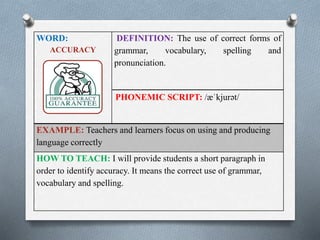
WORD: 
ACCURACY 
DEFINITION: The use of correct forms of 
grammar, vocabulary, spelling and 
pronunciation. 
PHONEMIC SCRIPT: /ӕˈkjurət/ 
EXAMPLE: Teachers and learners focus on using and producing 
language correctly 
HOW TO TEACH: I will provide students a short paragraph in 
order to identify accuracy. It means the correct use of grammar, 
vocabulary and spelling.
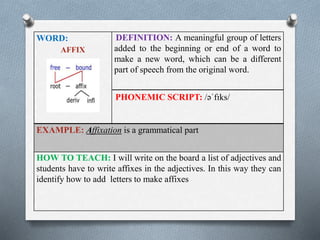
WORD: 
AFFIX 
DEFINITION: A meaningful group of letters 
added to the beginning or end of a word to 
make a new word, which can be a different 
part of speech from the original word. 
PHONEMIC SCRIPT: /əˈfɪks/ 
EXAMPLE: Affixation is a grammatical part 
HOW TO TEACH: I will write on the board a list of adjectives and 
students have to write affixes in the adjectives. In this way they can 
identify how to add letters to make affixes
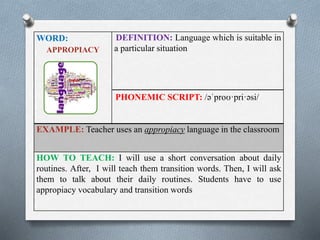
WORD: 
APPROPIACY 
DEFINITION: Language which is suitable in 
a particular situation 
PHONEMIC SCRIPT: /əˈproʊ·pri·əsi/ 
EXAMPLE: Teacher uses an appropiacy language in the classroom 
HOW TO TEACH: I will use a short conversation about daily 
routines. After, I will teach them transition words. Then, I will ask 
them to talk about their daily routines. Students have to use 
appropiacy vocabulary and transition words
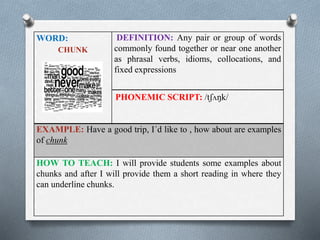
WORD: 
CHUNK 
DEFINITION: Any pair or group of words 
commonly found together or near one another 
as phrasal verbs, idioms, collocations, and 
fixed expressions 
PHONEMIC SCRIPT: /tʃʌŋk/ 
EXAMPLE: Have a good trip, I´d like to , how about are examples 
of chunk 
HOW TO TEACH: I will provide students some examples about 
chunks and after I will provide them a short reading in where they 
can underline chunks.
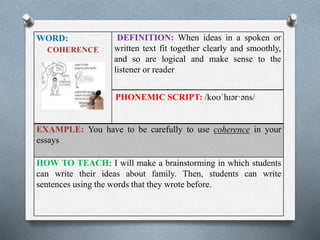
WORD: 
COHERENCE 
DEFINITION: When ideas in a spoken or 
written text fit together clearly and smoothly, 
and so are logical and make sense to the 
listener or reader 
PHONEMIC SCRIPT: /koʊˈhɪər·əns/ 
EXAMPLE: You have to be carefully to use coherence in your 
essays 
HOW TO TEACH: I will make a brainstorming in which students 
can write their ideas about family. Then, students can write 
sentences using the words that they wrote before.
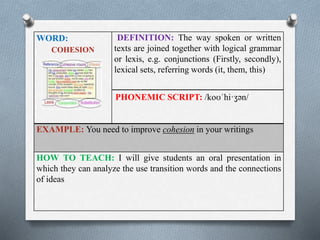
WORD: 
COHESION 
DEFINITION: The way spoken or written 
texts are joined together with logical grammar 
or lexis, e.g. conjunctions (Firstly, secondly), 
lexical sets, referring words (it, them, this) 
PHONEMIC SCRIPT: /koʊˈhi·ʒən/ 
EXAMPLE: You need to improve cohesion in your writings 
HOW TO TEACH: I will give students an oral presentation in 
which they can analyze the use transition words and the connections 
of ideas
WORD: 
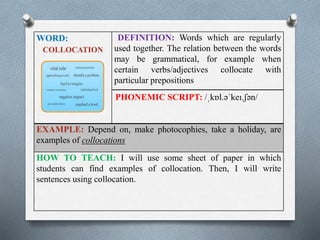
COLLOCATION 
DEFINITION: Words which are regularly 
used together. The relation between the words 
may be grammatical, for example when 
certain verbs/adjectives collocate with 
particular prepositions 
PHONEMIC SCRIPT: /ˌkɒl.əˈkeɪ.ʃən/ 
EXAMPLE: Depend on, make photocophies, take a holiday, are 
examples of collocations 
HOW TO TEACH: I will use some sheet of paper in which 
students can find examples of collocation. Then, I will write 
sentences using collocation.
WORD: 
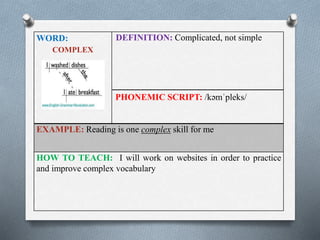
COMPLEX 
DEFINITION: Complicated, not simple 
PHONEMIC SCRIPT: /kəmˈpleks/ 
EXAMPLE: Reading is one complex skill for me 
HOW TO TEACH: I will work on websites in order to practice 
and improve complex vocabulary
WORD: 
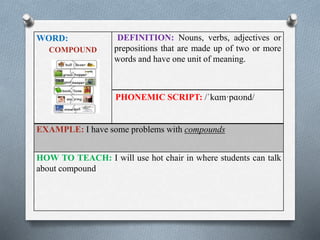
COMPOUND 
DEFINITION: Nouns, verbs, adjectives or 
prepositions that are made up of two or more 
words and have one unit of meaning. 
PHONEMIC SCRIPT: /ˈkɑm·pɑʊnd/ 
EXAMPLE: I have some problems with compounds 
HOW TO TEACH: I will use hot chair in where students can talk 
about compound
WORD: 
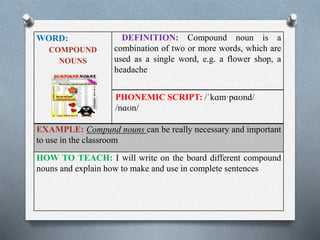
COMPOUND 
NOUNS 
DEFINITION: Compound noun is a 
combination of two or more words, which are 
used as a single word, e.g. a flower shop, a 
headache 
PHONEMIC SCRIPT: /ˈkɑm·pɑʊnd/ 
/nɑʊn/ 
EXAMPLE: Compund nouns can be really necessary and important 
to use in the classroom 
HOW TO TEACH: I will write on the board different compound 
nouns and explain how to make and use in complete sentences
WORD: 
CONFIDENCE 
DEFINITION: The feeling someone has 
when they are sure of their ability to do 
something well. 
PHONEMIC SCRIPT: /ˈkɑm·pɑʊnd/ 
EXAMPLE: Teachers must find activities in order to have 
confidence in students because they are so shy 
HOW TO TEACH: I will teach students the most important values 
as responsibility, respect, and confidence in themselves.
WORD: 
CONSOLIDATE 
DEFINITION: To return to something in 
order to allow learners to understand and 
remember it more completely. 
PHONEMIC SCRIPT: /kənˈsɑl·əˌdeɪt/ 
EXAMPLE: Students can consolidate grammar part practicing 
extra exercises 
HOW TO TEACH: I will provide exercises about simple present in 
order to help students to consolidate their knowledge about it
WORD: 
CONJUNCTION 
DEFINITION: A conjunction (or connector) 
is used to connect words, phrases, clauses or 
sentences 
PHONEMIC SCRIPT: /kənˈdʒʌŋk·ʃən/ 
EXAMPLE: My mother and my father are very happy 
HOW TO TEACH: I will provide students a power point 
presentation in which they can learn conjunction and how to use it in 
paragraphs or essays
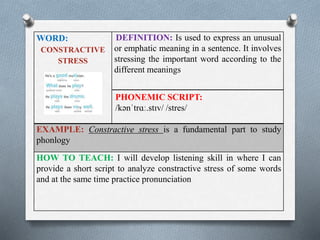
WORD: 
CONSTRACTIVE 
STRESS 
DEFINITION: Is used to express an unusual 
or emphatic meaning in a sentence. It involves 
stressing the important word according to the 
different meanings 
PHONEMIC SCRIPT: 
/kənˈtrɑː.stɪv/ /stres/ 
EXAMPLE: Constractive stress is a fundamental part to study 
phonlogy 
HOW TO TEACH: I will develop listening skill in where I can 
provide a short script to analyze constractive stress of some words 
and at the same time practice pronunciation
WORD: 
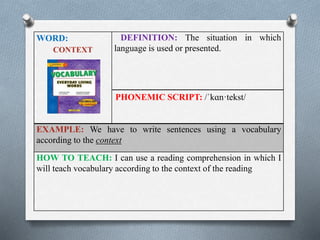
CONTEXT 
DEFINITION: The situation in which 
language is used or presented. 
PHONEMIC SCRIPT: /ˈkɑn·tekst/ 
EXAMPLE: We have to write sentences using a vocabulary 
according to the context 
HOW TO TEACH: I can use a reading comprehension in which I 
will teach vocabulary according to the context of the reading
WORD: 
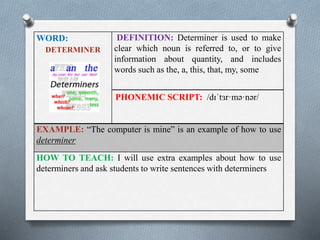
DETERMINER 
DEFINITION: Determiner is used to make 
clear which noun is referred to, or to give 
information about quantity, and includes 
words such as the, a, this, that, my, some 
PHONEMIC SCRIPT: /dɪˈtɜr·mə·nər/ 
EXAMPLE: “The computer is mine” is an example of how to use 
determiner 
HOW TO TEACH: I will use extra examples about how to use 
determiners and ask students to write sentences with determiners
WORD: 
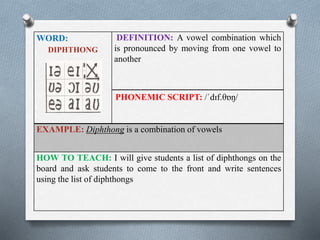
DIPHTHONG 
DEFINITION: A vowel combination which 
is pronounced by moving from one vowel to 
another 
PHONEMIC SCRIPT: /ˈdɪf.θɒŋ/ 
EXAMPLE: Diphthong is a combination of vowels 
HOW TO TEACH: I will give students a list of diphthongs on the 
board and ask students to come to the front and write sentences 
using the list of diphthongs
WORD: 
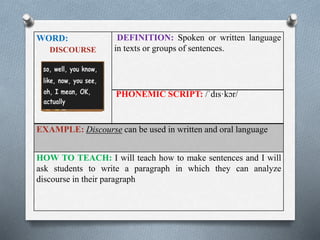
DISCOURSE 
DEFINITION: Spoken or written language 
in texts or groups of sentences. 
PHONEMIC SCRIPT: /ˈdɪs·kɔr/ 
EXAMPLE: Discourse can be used in written and oral language 
HOW TO TEACH: I will teach how to make sentences and I will 
ask students to write a paragraph in which they can analyze 
discourse in their paragraph
WORD: 
DRAFT 
DEFINITION: A draft is a piece of writing 
that is not yet finished, and may be changed. 
PHONEMIC SCRIPT: /dræft/ 
EXAMPLE: Draft is when students write for the first time and it 
could be edited and changed 
HOW TO TEACH: I will provide some models of draft using 
recycled paper.
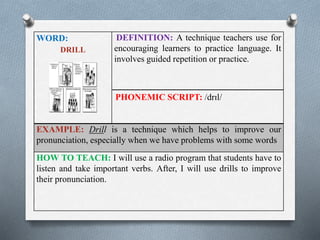
WORD: 
DRILL 
DEFINITION: A technique teachers use for 
encouraging learners to practice language. It 
involves guided repetition or practice. 
PHONEMIC SCRIPT: /drɪl/ 
EXAMPLE: Drill is a technique which helps to improve our 
pronunciation, especially when we have problems with some words 
HOW TO TEACH: I will use a radio program that students have to 
listen and take important verbs. After, I will use drills to improve 
their pronunciation.
WORD: 
ENCOURAGE 
DEFINITION: When a teacher helps 
learners to succeed by giving them confidence 
PHONEMIC SCRIPT: /ɪnˈkɜr·ɪdʒ/ 
EXAMPLE: Teacher can have find some activities to encourage 
students 
HOW TO TEACH: I will do “ABC” activity to encourage 
students.
WORD: 
ERROR 
DEFINITION: A mistake that a learner 
makes when trying to say something above 
their level of language or language processing 
PHONEMIC SCRIPT: /ˈer·ər/ 
EXAMPLE: Students have some errors in their compositions. 
HOW TO TEACH: : I will ask students to talk about their family in 
front of the class. Students have to pay attention to the errors after I 
will give them feedback
WORD: 
EXPONENT 
DEFINITION: An example of a grammar 
point, function or lexical set 
PHONEMIC SCRIPT: /ɪkˈspoʊ·nənt/ 
EXAMPLE: Exponent can express different functions at the same 
time. 
HOW TO TEACH: I will ask students personal information about 
their lives and then, we will analyze how to use exponent in real life
WORD: 
FALSE FRIENDS 
DEFINITION: Word in the target language 
which looks or sounds as if it has the same 
meaning as a similar word in the learners’ first 
language but does not 
PHONEMIC SCRIPT: /fɔls/ /frend/ 
EXAMPLE: False friends are very useful and important in 
language teaching and learning 
HOW TO TEACH: I will use a web page in where students find 
examples of false friends. I will give a short explanation about how 
to use it
WORD: 
FEATURE 
DEFINITION: A feature of something is an 
interesting or important part or characteristic 
of it 
PHONEMIC SCRIPT: /ˈfi·tʃər/ 
EXAMPLE: English has different features that can be very 
interesting 
HOW TO TEACH: Students can have the opportunity to learn 
some functions about English language through role plays
WORD: 
FORMAL 
LANGUAGE 
DEFINITION: Language used in formal 
conversations or writing 
PHONEMIC SCRIPT: 
/ˈfɔr·məl//ˈlæŋ·ɡwɪdʒ/ 
EXAMPLE: When we have to talk with important authorities we 
must use formal language 
HOW TO TEACH: I will use flashcards to use some expressions 
about formal language
WORD: 
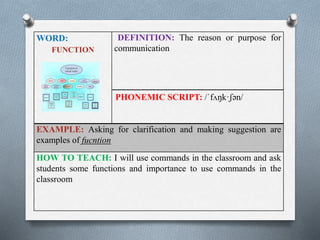
FUNCTION 
DEFINITION: The reason or purpose for 
communication 
PHONEMIC SCRIPT: /ˈfʌŋk·ʃən/ 
EXAMPLE: Asking for clarification and making suggestion are 
examples of fucntion 
HOW TO TEACH: I will use commands in the classroom and ask 
students some functions and importance to use commands in the 
classroom
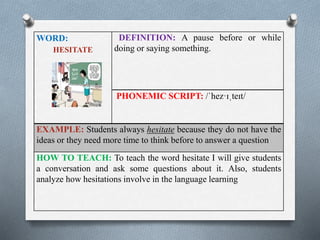
WORD: 
HESITATE 
DEFINITION: A pause before or while 
doing or saying something. 
PHONEMIC SCRIPT: /ˈhez·ɪˌteɪt/ 
EXAMPLE: Students always hesitate because they do not have the 
ideas or they need more time to think before to answer a question 
HOW TO TEACH: To teach the word hesitate I will give students 
a conversation and ask some questions about it. Also, students 
analyze how hesitations involve in the language learning
WORD: 
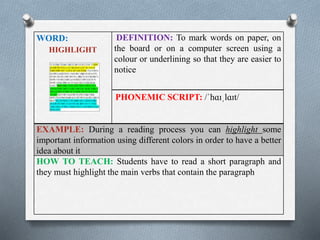
HIGHLIGHT 
DEFINITION: To mark words on paper, on 
the board or on a computer screen using a 
colour or underlining so that they are easier to 
notice 
PHONEMIC SCRIPT: /ˈhɑɪˌlɑɪt/ 
EXAMPLE: During a reading process you can highlight some 
important information using different colors in order to have a better 
idea about it 
HOW TO TEACH: Students have to read a short paragraph and 
they must highlight the main verbs that contain the paragraph
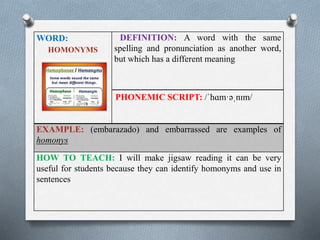
WORD: 
HOMONYMS 
DEFINITION: A word with the same 
spelling and pronunciation as another word, 
but which has a different meaning 
PHONEMIC SCRIPT: /ˈhɑm·əˌnɪm/ 
EXAMPLE: (embarazado) and embarrassed are examples of 
homonys 
HOW TO TEACH: I will make jigsaw reading it can be very 
useful for students because they can identify homonyms and use in 
sentences
WORD: 
HOMOPHONES 
DEFINITION: A word which sounds the 
same as another word, but has a different 
meaning or spelling 
PHONEMIC SCRIPT: /ˈhɑm·əˌfoʊn/ 
EXAMPLE: We use homophones to refer the words that have the 
same pronunciation, but different spelling and meaning 
HOW TO TEACH: I will use write sentences using homophones. 
Then, I will use short role play in where they can identify 
homophones
WORD: 
INFORMAL 
LANGUAGE 
DEFINITION: Informal language. Language 
used in informal conversations or writing 
PHONEMIC SCRIPT: /ɪnˈfɔr·məl/ 
/ˈlæŋ·ɡwɪdʒ/ 
EXAMPLE: When we are with our closed friend we usually use 
informal language 
HOW TO TEACH: I will use some expression that are used in 
informal situations so students can know how to use informal 
language between them
WORD: 
INTERACTION 
DEFINITION: The different ways learners 
and the teacher work together in class 
PHONEMIC SCRIPT: /ˌɪn·tərˈækt/ 
EXAMPLE: Interaction is a useful tool to practice speaking skill 
HOW TO TEACH: I will use a short conversation and ask students 
to discuss about the conversation in pairs
WORD: 
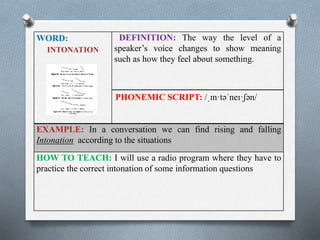
INTONATION 
DEFINITION: The way the level of a 
speaker’s voice changes to show meaning 
such as how they feel about something. 
PHONEMIC SCRIPT: /ˌɪn·təˈneɪ·ʃən/ 
EXAMPLE: In a conversation we can find rising and falling 
Intonation according to the situations 
HOW TO TEACH: I will use a radio program where they have to 
practice the correct intonation of some information questions
WORD: 
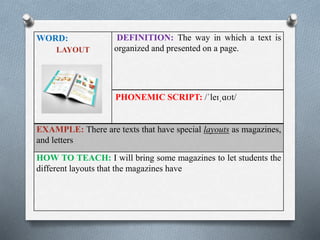
LAYOUT 
DEFINITION: The way in which a text is 
organized and presented on a page. 
PHONEMIC SCRIPT: /ˈleɪˌɑʊt/ 
EXAMPLE: There are texts that have special layouts as magazines, 
and letters 
HOW TO TEACH: I will bring some magazines to let students the 
different layouts that the magazines have
WORD: 
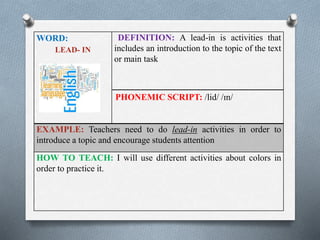
LEAD- IN 
DEFINITION: A lead-in is activities that 
includes an introduction to the topic of the text 
or main task 
PHONEMIC SCRIPT: /lid/ /ɪn/ 
EXAMPLE: Teachers need to do lead-in activities in order to 
introduce a topic and encourage students attention 
HOW TO TEACH: I will use different activities about colors in 
order to practice it.
WORD: 
LEARN BY HEART 
DEFINITION: To learn something so that 
you can remember it perfectly 
PHONEMIC SCRIPT: /lɜrn/ /bɑɪ/ /hɑrt/ 
EXAMPLE: Learn by heart is a strategy or activity that help to 
remember something you learned before 
HOW TO TEACH: I will give students a continuously feedback 
about animals that they have been studying during all week
WORD: 
LEXICAL SET 
DEFINITION: A group of words or phrases 
that are about the same content topic or 
subject. 
PHONEMIC SCRIPT: /ˈlek.sɪ.kəl/ /set/ 
EXAMPLE: Lexical set is a group of words or phrases that share a 
similar feature 
HOW TO TEACH: I will give a reading in which students have to 
practice and match lexical sets. After, students have to write 
examples using lexical sets from the reading
WORD: 
LEXIS 
DEFINITION: Individual words or sets of 
words 
PHONEMIC SCRIPT: /ˈlek.sɪs/ 
EXAMPLE: Homework, study, whiteboard, get dressed, be on time 
are example of lexis 
HOW TO TEACH: I will used a warm up “the alphabet”. Students 
have to write nouns using 10 letters of the alphabet
WORD: 
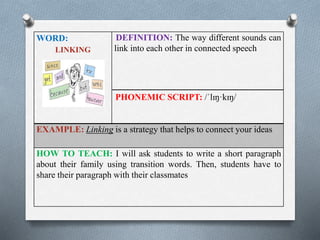
LINKING 
DEFINITION: The way different sounds can 
link into each other in connected speech 
PHONEMIC SCRIPT: /ˈlɪŋ·kɪŋ/ 
EXAMPLE: Linking is a strategy that helps to connect your ideas 
HOW TO TEACH: I will ask students to write a short paragraph 
about their family using transition words. Then, students have to 
share their paragraph with their classmates
WORD: 
MEANINGFUL 
DEFINITION: Something which shows the 
meaning of language 
PHONEMIC SCRIPT: /ˈmi·nɪŋ·fəl/ 
EXAMPLE: An activity can be very meaningful if it is useful for 
students in real life 
HOW TO TEACH: I will give students sheet of paper in order to 
practice some exercises about can and can´t. This activity can be 
very meaningful for students
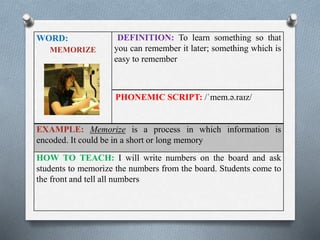
WORD: 
MEMORIZE 
DEFINITION: To learn something so that 
you can remember it later; something which is 
easy to remember 
PHONEMIC SCRIPT: /ˈmem.ə.raɪz/ 
EXAMPLE: Memorize is a process in which information is 
encoded. It could be in a short or long memory 
HOW TO TEACH: I will write numbers on the board and ask 
students to memorize the numbers from the board. Students come to 
the front and tell all numbers
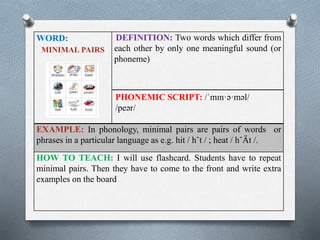
WORD: 
MINIMAL PAIRS 
DEFINITION: Two words which differ from 
each other by only one meaningful sound (or 
phoneme) 
PHONEMIC SCRIPT: /ˈmɪn·ə·məl/ 
/peər/ 
EXAMPLE: In phonology, minimal pairs are pairs of words or 
phrases in a particular language as e.g. hit / hˆt / ; heat / hˆÄt /. 
HOW TO TEACH: I will use flashcard. Students have to repeat 
minimal pairs. Then they have to come to the front and write extra 
examples on the board
WORD: 
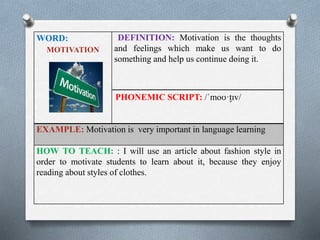
MOTIVATION 
DEFINITION: Motivation is the thoughts 
and feelings which make us want to do 
something and help us continue doing it. 
PHONEMIC SCRIPT: /ˈmoʊ·t̬ɪv/ 
EXAMPLE: Motivation is very important in language learning 
HOW TO TEACH: : I will use an article about fashion style in 
order to motivate students to learn about it, because they enjoy 
reading about styles of clothes.
WORD: 
NEUTRAL 
DEFINITION: A style of speaking or writing 
that is neither formal nor informal, but in 
between. 
PHONEMIC SCRIPT: /ˈnu·trəl/ 
EXAMPLE: There are neutral exponents that we use when we 
want to show a great respect. 
HOW TO TEACH: I will develop a debate about wild animals and 
ask students who are against, favor or neutral about reason to protect 
wild animals
WORD: 
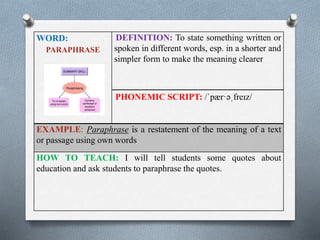
PARAPHRASE 
DEFINITION: To state something written or 
spoken in different words, esp. in a shorter and 
simpler form to make the meaning clearer 
PHONEMIC SCRIPT: /ˈpær·əˌfreɪz/ 
EXAMPLE: Paraphrase is a restatement of the meaning of a text 
or passage using own words 
HOW TO TEACH: I will tell students some quotes about 
education and ask students to paraphrase the quotes.
WORD: 
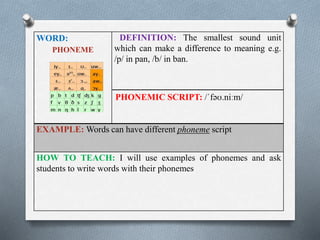
PHONEME 
DEFINITION: The smallest sound unit 
which can make a difference to meaning e.g. 
/p/ in pan, /b/ in ban. 
PHONEMIC SCRIPT: /ˈfəʊ.niːm/ 
EXAMPLE:Words can have different phoneme script 
HOW TO TEACH: I will use examples of phonemes and ask 
students to write words with their phonemes
WORD: 
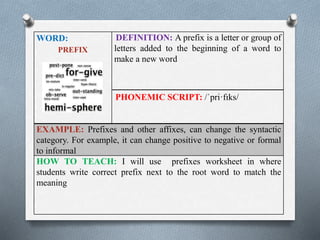
PREFIX 
DEFINITION: A prefix is a letter or group of 
letters added to the beginning of a word to 
make a new word 
PHONEMIC SCRIPT: /ˈpri·fɪks/ 
EXAMPLE: Prefixes and other affixes, can change the syntactic 
category. For example, it can change positive to negative or formal 
to informal 
HOW TO TEACH: I will use prefixes worksheet in where 
students write correct prefix next to the root word to match the 
meaning
WORD: 
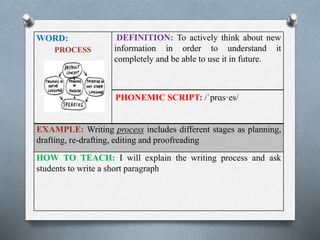
PROCESS 
DEFINITION: To actively think about new 
information in order to understand it 
completely and be able to use it in future. 
PHONEMIC SCRIPT: /ˈprɑs·es/ 
EXAMPLE: Writing process includes different stages as planning, 
drafting, re-drafting, editing and proofreading 
HOW TO TEACH: I will explain the writing process and ask 
students to write a short paragraph
WORD: 
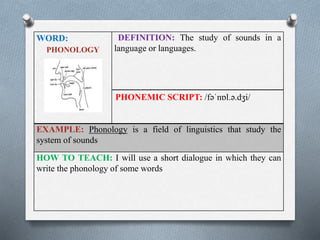
PHONOLOGY 
DEFINITION: The study of sounds in a 
language or languages. 
PHONEMIC SCRIPT: /fəˈnɒl.ə.dʒi/ 
EXAMPLE: Phonology is a field of linguistics that study the 
system of sounds 
HOW TO TEACH: I will use a short dialogue in which they can 
write the phonology of some words
WORD: 
READING 
DEFINITION: The skill or activity of getting 
information from written words 
PHONEMIC SCRIPT: /ˈri·dɪŋ/ 
EXAMPLE: Reading has some stages in order to help learners and 
people 
HOW TO TEACH: I will provide a reading about animals and 
students have to answer some questions about it
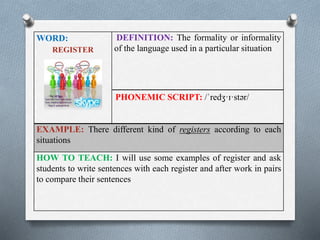
WORD: 
REGISTER 
DEFINITION: The formality or informality 
of the language used in a particular situation 
PHONEMIC SCRIPT: /ˈredʒ·ɪ·stər/ 
EXAMPLE: There different kind of registers according to each 
situations 
HOW TO TEACH: I will use some examples of register and ask 
students to write sentences with each register and after work in pairs 
to compare their sentences
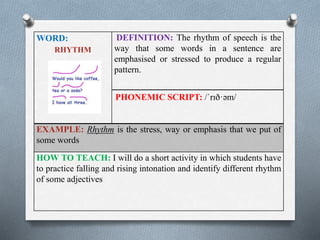
WORD: 
RHYTHM 
DEFINITION: The rhythm of speech is the 
way that some words in a sentence are 
emphasised or stressed to produce a regular 
pattern. 
PHONEMIC SCRIPT: /ˈrɪð·əm/ 
EXAMPLE: Rhythm is the stress, way or emphasis that we put of 
some words 
HOW TO TEACH: I will do a short activity in which students have 
to practice falling and rising intonation and identify different rhythm 
of some adjectives
WORD: 
SCAN 
DEFINITION: To read a text quickly to pick 
out specific information, e.g. finding a phone 
number in a phone book 
PHONEMIC SCRIPT: /skæn/ 
EXAMPLE: Scan is a strategy for reading 
HOW TO TEACH: Teacher ask students to scan the text and after 
answer some questions about the reading
WORD: 
SILENT PERIOD 
DEFINITION: The time when learners who 
are beginning to learn a first (or second) 
language prefer to listen (or read) before 
producing the language 
PHONEMIC SCRIPT: 
/ˈsɑɪ·lənt/ /ˈpɪər·i·əd/ 
EXAMPLE: Silent period is very necessary and useful during 
reading process 
HOW TO TEACH: I will ask students to read an article in silent 
and understand the text.
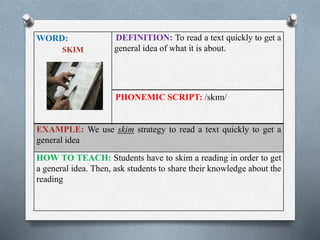
WORD: 
SKIM 
DEFINITION: To read a text quickly to get a 
general idea of what it is about. 
PHONEMIC SCRIPT: /skɪm/ 
EXAMPLE: We use skim strategy to read a text quickly to get a 
general idea 
HOW TO TEACH: Students have to skim a reading in order to get 
a general idea. Then, ask students to share their knowledge about the 
reading
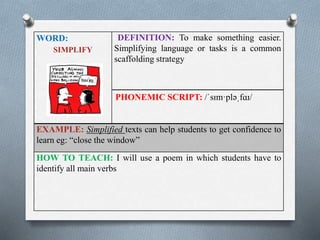
WORD: 
SIMPLIFY 
DEFINITION: To make something easier. 
Simplifying language or tasks is a common 
scaffolding strategy 
PHONEMIC SCRIPT: /ˈsɪm·pləˌfɑɪ/ 
EXAMPLE: Simplified texts can help students to get confidence to 
learn eg: “close the window” 
HOW TO TEACH: I will use a poem in which students have to 
identify all main verbs
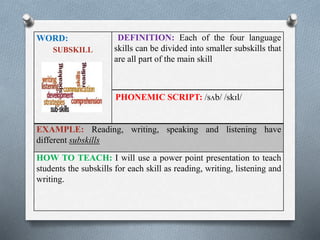
WORD: 
SUBSKILL 
DEFINITION: Each of the four language 
skills can be divided into smaller subskills that 
are all part of the main skill 
PHONEMIC SCRIPT: /sʌb/ /skɪl/ 
EXAMPLE: Reading, writing, speaking and listening have 
different subskills 
HOW TO TEACH: I will use a power point presentation to teach 
students the subskills for each skill as reading, writing, listening and 
writing.
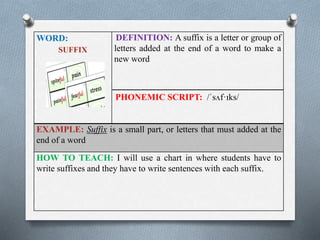
WORD: 
SUFFIX 
DEFINITION: A suffix is a letter or group of 
letters added at the end of a word to make a 
new word 
PHONEMIC SCRIPT: /ˈsʌf·ɪks/ 
EXAMPLE: Suffix is a small part, or letters that must added at the 
end of a word 
HOW TO TEACH: I will use a chart in where students have to 
write suffixes and they have to write sentences with each suffix.
WORD: 
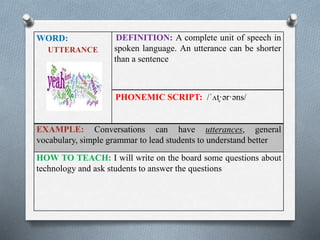
UTTERANCE 
DEFINITION: A complete unit of speech in 
spoken language. An utterance can be shorter 
than a sentence 
PHONEMIC SCRIPT: /ˈʌt̬·ər·əns/ 
EXAMPLE: Conversations can have utterances, general 
vocabulary, simple grammar to lead students to understand better 
HOW TO TEACH: I will write on the board some questions about 
technology and ask students to answer the questions
WORD: 
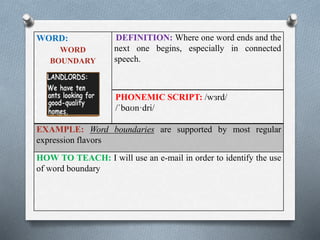
WORD 
BOUNDARY 
DEFINITION: Where one word ends and the 
next one begins, especially in connected 
speech. 
PHONEMIC SCRIPT: /wɜrd/ 
/ˈbɑʊn·dri/ 
EXAMPLE: Word boundaries are supported by most regular 
expression flavors 
HOW TO TEACH: I will use an e-mail in order to identify the use 
of word boundary
WORD: 
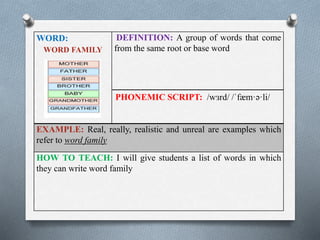
WORD FAMILY 
DEFINITION: A group of words that come 
from the same root or base word 
PHONEMIC SCRIPT: /wɜrd/ /ˈfæm·ə·li/ 
EXAMPLE: Real, really, realistic and unreal are examples which 
refer to word family 
HOW TO TEACH: I will give students a list of words in which 
they can write word family
WORD: 
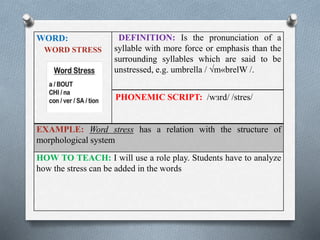
WORD STRESS 
DEFINITION: Is the pronunciation of a 
syllable with more force or emphasis than the 
surrounding syllables which are said to be 
unstressed, e.g. umbrella / √m«brelW /. 
PHONEMIC SCRIPT: /wɜrd/ /stres/ 
EXAMPLE: Word stress has a relation with the structure of 
morphological system 
HOW TO TEACH: I will use a role play. Students have to analyze 
how the stress can be added in the words
WORD: 
WRITING 
DEFINITION: A person’s style of forming 
letters and words with a pen or pencil, or 
something written 
PHONEMIC SCRIPT: /ˈrɑɪ·t̬ɪŋ/ 
EXAMPLE: Writing is a skill in which students have some 
problems with the punctuation 
HOW TO TEACH: I will give them a sheet of paper in which 
students have to write a short paragraph about their last vacation

Moreta, mònica evidence 1

  • 1.
    Universidad Técnica deAmbato Facultad de Ciencias Humanas y de La Educación Carrea de Idiomas TKT Glossary Mónica Moreta 9th “B” Element 1
  • 2.
    WORD: ACCURACY DEFINITION:The use of correct forms of grammar, vocabulary, spelling and pronunciation. PHONEMIC SCRIPT: /ӕˈkjurət/ EXAMPLE: Teachers and learners focus on using and producing language correctly HOW TO TEACH: I will provide students a short paragraph in order to identify accuracy. It means the correct use of grammar, vocabulary and spelling.
  • 3.
    WORD: AFFIX DEFINITION:A meaningful group of letters added to the beginning or end of a word to make a new word, which can be a different part of speech from the original word. PHONEMIC SCRIPT: /əˈfɪks/ EXAMPLE: Affixation is a grammatical part HOW TO TEACH: I will write on the board a list of adjectives and students have to write affixes in the adjectives. In this way they can identify how to add letters to make affixes
  • 4.
    WORD: APPROPIACY DEFINITION:Language which is suitable in a particular situation PHONEMIC SCRIPT: /əˈproʊ·pri·əsi/ EXAMPLE: Teacher uses an appropiacy language in the classroom HOW TO TEACH: I will use a short conversation about daily routines. After, I will teach them transition words. Then, I will ask them to talk about their daily routines. Students have to use appropiacy vocabulary and transition words
  • 5.
    WORD: CHUNK DEFINITION:Any pair or group of words commonly found together or near one another as phrasal verbs, idioms, collocations, and fixed expressions PHONEMIC SCRIPT: /tʃʌŋk/ EXAMPLE: Have a good trip, I´d like to , how about are examples of chunk HOW TO TEACH: I will provide students some examples about chunks and after I will provide them a short reading in where they can underline chunks.
  • 6.
    WORD: COHERENCE DEFINITION:When ideas in a spoken or written text fit together clearly and smoothly, and so are logical and make sense to the listener or reader PHONEMIC SCRIPT: /koʊˈhɪər·əns/ EXAMPLE: You have to be carefully to use coherence in your essays HOW TO TEACH: I will make a brainstorming in which students can write their ideas about family. Then, students can write sentences using the words that they wrote before.
  • 7.
    WORD: COHESION DEFINITION:The way spoken or written texts are joined together with logical grammar or lexis, e.g. conjunctions (Firstly, secondly), lexical sets, referring words (it, them, this) PHONEMIC SCRIPT: /koʊˈhi·ʒən/ EXAMPLE: You need to improve cohesion in your writings HOW TO TEACH: I will give students an oral presentation in which they can analyze the use transition words and the connections of ideas
  • 8.
    WORD: COLLOCATION DEFINITION:Words which are regularly used together. The relation between the words may be grammatical, for example when certain verbs/adjectives collocate with particular prepositions PHONEMIC SCRIPT: /ˌkɒl.əˈkeɪ.ʃən/ EXAMPLE: Depend on, make photocophies, take a holiday, are examples of collocations HOW TO TEACH: I will use some sheet of paper in which students can find examples of collocation. Then, I will write sentences using collocation.
  • 9.
    WORD: COMPLEX DEFINITION:Complicated, not simple PHONEMIC SCRIPT: /kəmˈpleks/ EXAMPLE: Reading is one complex skill for me HOW TO TEACH: I will work on websites in order to practice and improve complex vocabulary
  • 10.
    WORD: COMPOUND DEFINITION:Nouns, verbs, adjectives or prepositions that are made up of two or more words and have one unit of meaning. PHONEMIC SCRIPT: /ˈkɑm·pɑʊnd/ EXAMPLE: I have some problems with compounds HOW TO TEACH: I will use hot chair in where students can talk about compound
  • 11.
    WORD: COMPOUND NOUNS DEFINITION: Compound noun is a combination of two or more words, which are used as a single word, e.g. a flower shop, a headache PHONEMIC SCRIPT: /ˈkɑm·pɑʊnd/ /nɑʊn/ EXAMPLE: Compund nouns can be really necessary and important to use in the classroom HOW TO TEACH: I will write on the board different compound nouns and explain how to make and use in complete sentences
  • 12.
    WORD: CONFIDENCE DEFINITION:The feeling someone has when they are sure of their ability to do something well. PHONEMIC SCRIPT: /ˈkɑm·pɑʊnd/ EXAMPLE: Teachers must find activities in order to have confidence in students because they are so shy HOW TO TEACH: I will teach students the most important values as responsibility, respect, and confidence in themselves.
  • 13.
    WORD: CONSOLIDATE DEFINITION:To return to something in order to allow learners to understand and remember it more completely. PHONEMIC SCRIPT: /kənˈsɑl·əˌdeɪt/ EXAMPLE: Students can consolidate grammar part practicing extra exercises HOW TO TEACH: I will provide exercises about simple present in order to help students to consolidate their knowledge about it
  • 14.
    WORD: CONJUNCTION DEFINITION:A conjunction (or connector) is used to connect words, phrases, clauses or sentences PHONEMIC SCRIPT: /kənˈdʒʌŋk·ʃən/ EXAMPLE: My mother and my father are very happy HOW TO TEACH: I will provide students a power point presentation in which they can learn conjunction and how to use it in paragraphs or essays
  • 15.
    WORD: CONSTRACTIVE STRESS DEFINITION: Is used to express an unusual or emphatic meaning in a sentence. It involves stressing the important word according to the different meanings PHONEMIC SCRIPT: /kənˈtrɑː.stɪv/ /stres/ EXAMPLE: Constractive stress is a fundamental part to study phonlogy HOW TO TEACH: I will develop listening skill in where I can provide a short script to analyze constractive stress of some words and at the same time practice pronunciation
  • 16.
    WORD: CONTEXT DEFINITION:The situation in which language is used or presented. PHONEMIC SCRIPT: /ˈkɑn·tekst/ EXAMPLE: We have to write sentences using a vocabulary according to the context HOW TO TEACH: I can use a reading comprehension in which I will teach vocabulary according to the context of the reading
  • 17.
    WORD: DETERMINER DEFINITION:Determiner is used to make clear which noun is referred to, or to give information about quantity, and includes words such as the, a, this, that, my, some PHONEMIC SCRIPT: /dɪˈtɜr·mə·nər/ EXAMPLE: “The computer is mine” is an example of how to use determiner HOW TO TEACH: I will use extra examples about how to use determiners and ask students to write sentences with determiners
  • 18.
    WORD: DIPHTHONG DEFINITION:A vowel combination which is pronounced by moving from one vowel to another PHONEMIC SCRIPT: /ˈdɪf.θɒŋ/ EXAMPLE: Diphthong is a combination of vowels HOW TO TEACH: I will give students a list of diphthongs on the board and ask students to come to the front and write sentences using the list of diphthongs
  • 19.
    WORD: DISCOURSE DEFINITION:Spoken or written language in texts or groups of sentences. PHONEMIC SCRIPT: /ˈdɪs·kɔr/ EXAMPLE: Discourse can be used in written and oral language HOW TO TEACH: I will teach how to make sentences and I will ask students to write a paragraph in which they can analyze discourse in their paragraph
  • 20.
    WORD: DRAFT DEFINITION:A draft is a piece of writing that is not yet finished, and may be changed. PHONEMIC SCRIPT: /dræft/ EXAMPLE: Draft is when students write for the first time and it could be edited and changed HOW TO TEACH: I will provide some models of draft using recycled paper.
  • 21.
    WORD: DRILL DEFINITION:A technique teachers use for encouraging learners to practice language. It involves guided repetition or practice. PHONEMIC SCRIPT: /drɪl/ EXAMPLE: Drill is a technique which helps to improve our pronunciation, especially when we have problems with some words HOW TO TEACH: I will use a radio program that students have to listen and take important verbs. After, I will use drills to improve their pronunciation.
  • 22.
    WORD: ENCOURAGE DEFINITION:When a teacher helps learners to succeed by giving them confidence PHONEMIC SCRIPT: /ɪnˈkɜr·ɪdʒ/ EXAMPLE: Teacher can have find some activities to encourage students HOW TO TEACH: I will do “ABC” activity to encourage students.
  • 23.
    WORD: ERROR DEFINITION:A mistake that a learner makes when trying to say something above their level of language or language processing PHONEMIC SCRIPT: /ˈer·ər/ EXAMPLE: Students have some errors in their compositions. HOW TO TEACH: : I will ask students to talk about their family in front of the class. Students have to pay attention to the errors after I will give them feedback
  • 24.
    WORD: EXPONENT DEFINITION:An example of a grammar point, function or lexical set PHONEMIC SCRIPT: /ɪkˈspoʊ·nənt/ EXAMPLE: Exponent can express different functions at the same time. HOW TO TEACH: I will ask students personal information about their lives and then, we will analyze how to use exponent in real life
  • 25.
    WORD: FALSE FRIENDS DEFINITION: Word in the target language which looks or sounds as if it has the same meaning as a similar word in the learners’ first language but does not PHONEMIC SCRIPT: /fɔls/ /frend/ EXAMPLE: False friends are very useful and important in language teaching and learning HOW TO TEACH: I will use a web page in where students find examples of false friends. I will give a short explanation about how to use it
  • 26.
    WORD: FEATURE DEFINITION:A feature of something is an interesting or important part or characteristic of it PHONEMIC SCRIPT: /ˈfi·tʃər/ EXAMPLE: English has different features that can be very interesting HOW TO TEACH: Students can have the opportunity to learn some functions about English language through role plays
  • 27.
    WORD: FORMAL LANGUAGE DEFINITION: Language used in formal conversations or writing PHONEMIC SCRIPT: /ˈfɔr·məl//ˈlæŋ·ɡwɪdʒ/ EXAMPLE: When we have to talk with important authorities we must use formal language HOW TO TEACH: I will use flashcards to use some expressions about formal language
  • 28.
    WORD: FUNCTION DEFINITION:The reason or purpose for communication PHONEMIC SCRIPT: /ˈfʌŋk·ʃən/ EXAMPLE: Asking for clarification and making suggestion are examples of fucntion HOW TO TEACH: I will use commands in the classroom and ask students some functions and importance to use commands in the classroom
  • 29.
    WORD: HESITATE DEFINITION:A pause before or while doing or saying something. PHONEMIC SCRIPT: /ˈhez·ɪˌteɪt/ EXAMPLE: Students always hesitate because they do not have the ideas or they need more time to think before to answer a question HOW TO TEACH: To teach the word hesitate I will give students a conversation and ask some questions about it. Also, students analyze how hesitations involve in the language learning
  • 30.
    WORD: HIGHLIGHT DEFINITION:To mark words on paper, on the board or on a computer screen using a colour or underlining so that they are easier to notice PHONEMIC SCRIPT: /ˈhɑɪˌlɑɪt/ EXAMPLE: During a reading process you can highlight some important information using different colors in order to have a better idea about it HOW TO TEACH: Students have to read a short paragraph and they must highlight the main verbs that contain the paragraph
  • 31.
    WORD: HOMONYMS DEFINITION:A word with the same spelling and pronunciation as another word, but which has a different meaning PHONEMIC SCRIPT: /ˈhɑm·əˌnɪm/ EXAMPLE: (embarazado) and embarrassed are examples of homonys HOW TO TEACH: I will make jigsaw reading it can be very useful for students because they can identify homonyms and use in sentences
  • 32.
    WORD: HOMOPHONES DEFINITION:A word which sounds the same as another word, but has a different meaning or spelling PHONEMIC SCRIPT: /ˈhɑm·əˌfoʊn/ EXAMPLE: We use homophones to refer the words that have the same pronunciation, but different spelling and meaning HOW TO TEACH: I will use write sentences using homophones. Then, I will use short role play in where they can identify homophones
  • 33.
    WORD: INFORMAL LANGUAGE DEFINITION: Informal language. Language used in informal conversations or writing PHONEMIC SCRIPT: /ɪnˈfɔr·məl/ /ˈlæŋ·ɡwɪdʒ/ EXAMPLE: When we are with our closed friend we usually use informal language HOW TO TEACH: I will use some expression that are used in informal situations so students can know how to use informal language between them
  • 34.
    WORD: INTERACTION DEFINITION:The different ways learners and the teacher work together in class PHONEMIC SCRIPT: /ˌɪn·tərˈækt/ EXAMPLE: Interaction is a useful tool to practice speaking skill HOW TO TEACH: I will use a short conversation and ask students to discuss about the conversation in pairs
  • 35.
    WORD: INTONATION DEFINITION:The way the level of a speaker’s voice changes to show meaning such as how they feel about something. PHONEMIC SCRIPT: /ˌɪn·təˈneɪ·ʃən/ EXAMPLE: In a conversation we can find rising and falling Intonation according to the situations HOW TO TEACH: I will use a radio program where they have to practice the correct intonation of some information questions
  • 36.
    WORD: LAYOUT DEFINITION:The way in which a text is organized and presented on a page. PHONEMIC SCRIPT: /ˈleɪˌɑʊt/ EXAMPLE: There are texts that have special layouts as magazines, and letters HOW TO TEACH: I will bring some magazines to let students the different layouts that the magazines have
  • 37.
    WORD: LEAD- IN DEFINITION: A lead-in is activities that includes an introduction to the topic of the text or main task PHONEMIC SCRIPT: /lid/ /ɪn/ EXAMPLE: Teachers need to do lead-in activities in order to introduce a topic and encourage students attention HOW TO TEACH: I will use different activities about colors in order to practice it.
  • 38.
    WORD: LEARN BYHEART DEFINITION: To learn something so that you can remember it perfectly PHONEMIC SCRIPT: /lɜrn/ /bɑɪ/ /hɑrt/ EXAMPLE: Learn by heart is a strategy or activity that help to remember something you learned before HOW TO TEACH: I will give students a continuously feedback about animals that they have been studying during all week
  • 39.
    WORD: LEXICAL SET DEFINITION: A group of words or phrases that are about the same content topic or subject. PHONEMIC SCRIPT: /ˈlek.sɪ.kəl/ /set/ EXAMPLE: Lexical set is a group of words or phrases that share a similar feature HOW TO TEACH: I will give a reading in which students have to practice and match lexical sets. After, students have to write examples using lexical sets from the reading
  • 40.
    WORD: LEXIS DEFINITION:Individual words or sets of words PHONEMIC SCRIPT: /ˈlek.sɪs/ EXAMPLE: Homework, study, whiteboard, get dressed, be on time are example of lexis HOW TO TEACH: I will used a warm up “the alphabet”. Students have to write nouns using 10 letters of the alphabet
  • 41.
    WORD: LINKING DEFINITION:The way different sounds can link into each other in connected speech PHONEMIC SCRIPT: /ˈlɪŋ·kɪŋ/ EXAMPLE: Linking is a strategy that helps to connect your ideas HOW TO TEACH: I will ask students to write a short paragraph about their family using transition words. Then, students have to share their paragraph with their classmates
  • 42.
    WORD: MEANINGFUL DEFINITION:Something which shows the meaning of language PHONEMIC SCRIPT: /ˈmi·nɪŋ·fəl/ EXAMPLE: An activity can be very meaningful if it is useful for students in real life HOW TO TEACH: I will give students sheet of paper in order to practice some exercises about can and can´t. This activity can be very meaningful for students
  • 43.
    WORD: MEMORIZE DEFINITION:To learn something so that you can remember it later; something which is easy to remember PHONEMIC SCRIPT: /ˈmem.ə.raɪz/ EXAMPLE: Memorize is a process in which information is encoded. It could be in a short or long memory HOW TO TEACH: I will write numbers on the board and ask students to memorize the numbers from the board. Students come to the front and tell all numbers
  • 44.
    WORD: MINIMAL PAIRS DEFINITION: Two words which differ from each other by only one meaningful sound (or phoneme) PHONEMIC SCRIPT: /ˈmɪn·ə·məl/ /peər/ EXAMPLE: In phonology, minimal pairs are pairs of words or phrases in a particular language as e.g. hit / hˆt / ; heat / hˆÄt /. HOW TO TEACH: I will use flashcard. Students have to repeat minimal pairs. Then they have to come to the front and write extra examples on the board
  • 45.
    WORD: MOTIVATION DEFINITION:Motivation is the thoughts and feelings which make us want to do something and help us continue doing it. PHONEMIC SCRIPT: /ˈmoʊ·t̬ɪv/ EXAMPLE: Motivation is very important in language learning HOW TO TEACH: : I will use an article about fashion style in order to motivate students to learn about it, because they enjoy reading about styles of clothes.
  • 46.
    WORD: NEUTRAL DEFINITION:A style of speaking or writing that is neither formal nor informal, but in between. PHONEMIC SCRIPT: /ˈnu·trəl/ EXAMPLE: There are neutral exponents that we use when we want to show a great respect. HOW TO TEACH: I will develop a debate about wild animals and ask students who are against, favor or neutral about reason to protect wild animals
  • 47.
    WORD: PARAPHRASE DEFINITION:To state something written or spoken in different words, esp. in a shorter and simpler form to make the meaning clearer PHONEMIC SCRIPT: /ˈpær·əˌfreɪz/ EXAMPLE: Paraphrase is a restatement of the meaning of a text or passage using own words HOW TO TEACH: I will tell students some quotes about education and ask students to paraphrase the quotes.
  • 48.
    WORD: PHONEME DEFINITION:The smallest sound unit which can make a difference to meaning e.g. /p/ in pan, /b/ in ban. PHONEMIC SCRIPT: /ˈfəʊ.niːm/ EXAMPLE:Words can have different phoneme script HOW TO TEACH: I will use examples of phonemes and ask students to write words with their phonemes
  • 49.
    WORD: PREFIX DEFINITION:A prefix is a letter or group of letters added to the beginning of a word to make a new word PHONEMIC SCRIPT: /ˈpri·fɪks/ EXAMPLE: Prefixes and other affixes, can change the syntactic category. For example, it can change positive to negative or formal to informal HOW TO TEACH: I will use prefixes worksheet in where students write correct prefix next to the root word to match the meaning
  • 50.
    WORD: PROCESS DEFINITION:To actively think about new information in order to understand it completely and be able to use it in future. PHONEMIC SCRIPT: /ˈprɑs·es/ EXAMPLE: Writing process includes different stages as planning, drafting, re-drafting, editing and proofreading HOW TO TEACH: I will explain the writing process and ask students to write a short paragraph
  • 51.
    WORD: PHONOLOGY DEFINITION:The study of sounds in a language or languages. PHONEMIC SCRIPT: /fəˈnɒl.ə.dʒi/ EXAMPLE: Phonology is a field of linguistics that study the system of sounds HOW TO TEACH: I will use a short dialogue in which they can write the phonology of some words
  • 52.
    WORD: READING DEFINITION:The skill or activity of getting information from written words PHONEMIC SCRIPT: /ˈri·dɪŋ/ EXAMPLE: Reading has some stages in order to help learners and people HOW TO TEACH: I will provide a reading about animals and students have to answer some questions about it
  • 53.
    WORD: REGISTER DEFINITION:The formality or informality of the language used in a particular situation PHONEMIC SCRIPT: /ˈredʒ·ɪ·stər/ EXAMPLE: There different kind of registers according to each situations HOW TO TEACH: I will use some examples of register and ask students to write sentences with each register and after work in pairs to compare their sentences
  • 54.
    WORD: RHYTHM DEFINITION:The rhythm of speech is the way that some words in a sentence are emphasised or stressed to produce a regular pattern. PHONEMIC SCRIPT: /ˈrɪð·əm/ EXAMPLE: Rhythm is the stress, way or emphasis that we put of some words HOW TO TEACH: I will do a short activity in which students have to practice falling and rising intonation and identify different rhythm of some adjectives
  • 55.
    WORD: SCAN DEFINITION:To read a text quickly to pick out specific information, e.g. finding a phone number in a phone book PHONEMIC SCRIPT: /skæn/ EXAMPLE: Scan is a strategy for reading HOW TO TEACH: Teacher ask students to scan the text and after answer some questions about the reading
  • 56.
    WORD: SILENT PERIOD DEFINITION: The time when learners who are beginning to learn a first (or second) language prefer to listen (or read) before producing the language PHONEMIC SCRIPT: /ˈsɑɪ·lənt/ /ˈpɪər·i·əd/ EXAMPLE: Silent period is very necessary and useful during reading process HOW TO TEACH: I will ask students to read an article in silent and understand the text.
  • 57.
    WORD: SKIM DEFINITION:To read a text quickly to get a general idea of what it is about. PHONEMIC SCRIPT: /skɪm/ EXAMPLE: We use skim strategy to read a text quickly to get a general idea HOW TO TEACH: Students have to skim a reading in order to get a general idea. Then, ask students to share their knowledge about the reading
  • 58.
    WORD: SIMPLIFY DEFINITION:To make something easier. Simplifying language or tasks is a common scaffolding strategy PHONEMIC SCRIPT: /ˈsɪm·pləˌfɑɪ/ EXAMPLE: Simplified texts can help students to get confidence to learn eg: “close the window” HOW TO TEACH: I will use a poem in which students have to identify all main verbs
  • 59.
    WORD: SUBSKILL DEFINITION:Each of the four language skills can be divided into smaller subskills that are all part of the main skill PHONEMIC SCRIPT: /sʌb/ /skɪl/ EXAMPLE: Reading, writing, speaking and listening have different subskills HOW TO TEACH: I will use a power point presentation to teach students the subskills for each skill as reading, writing, listening and writing.
  • 60.
    WORD: SUFFIX DEFINITION:A suffix is a letter or group of letters added at the end of a word to make a new word PHONEMIC SCRIPT: /ˈsʌf·ɪks/ EXAMPLE: Suffix is a small part, or letters that must added at the end of a word HOW TO TEACH: I will use a chart in where students have to write suffixes and they have to write sentences with each suffix.
  • 61.
    WORD: UTTERANCE DEFINITION:A complete unit of speech in spoken language. An utterance can be shorter than a sentence PHONEMIC SCRIPT: /ˈʌt̬·ər·əns/ EXAMPLE: Conversations can have utterances, general vocabulary, simple grammar to lead students to understand better HOW TO TEACH: I will write on the board some questions about technology and ask students to answer the questions
  • 62.
    WORD: WORD BOUNDARY DEFINITION: Where one word ends and the next one begins, especially in connected speech. PHONEMIC SCRIPT: /wɜrd/ /ˈbɑʊn·dri/ EXAMPLE: Word boundaries are supported by most regular expression flavors HOW TO TEACH: I will use an e-mail in order to identify the use of word boundary
  • 63.
    WORD: WORD FAMILY DEFINITION: A group of words that come from the same root or base word PHONEMIC SCRIPT: /wɜrd/ /ˈfæm·ə·li/ EXAMPLE: Real, really, realistic and unreal are examples which refer to word family HOW TO TEACH: I will give students a list of words in which they can write word family
  • 64.
    WORD: WORD STRESS DEFINITION: Is the pronunciation of a syllable with more force or emphasis than the surrounding syllables which are said to be unstressed, e.g. umbrella / √m«brelW /. PHONEMIC SCRIPT: /wɜrd/ /stres/ EXAMPLE: Word stress has a relation with the structure of morphological system HOW TO TEACH: I will use a role play. Students have to analyze how the stress can be added in the words
  • 65.
    WORD: WRITING DEFINITION:A person’s style of forming letters and words with a pen or pencil, or something written PHONEMIC SCRIPT: /ˈrɑɪ·t̬ɪŋ/ EXAMPLE: Writing is a skill in which students have some problems with the punctuation HOW TO TEACH: I will give them a sheet of paper in which students have to write a short paragraph about their last vacation