www.pdst . ie 
The Moon Landing, 1969 
Exploring evidence - drawing inferences 
from historical sources 
http://pdst.ie/postprimary
www.pdst . ie 
The documents-based study 
• There will be much greater use of source 
materials especially in the teaching of the 
case studies 
• It is important that there should be variety 
in the selection of historical sources to be 
used (G12)
www.pdst . ie 
Case studies 
• Case studies involve an in-depth 
investigation of a particularly significant or 
representative aspect of an element of the 
topic (S11) 
• What makes a particular event historically 
significant?
www.pdst . ie 
Five R’s for dealing with historical 
significance 
• Remarkable 
• Remembered 
• Resonant 
• Resulting in change 
• Revealing
www.pdst . ie 
Topic 6: The Moon Landing, 1969 
Associated elements 
• Advances in military, space and information 
technology 
• US foreign policy, 1945-1972: Berlin, Korea, 
Cuba, Vietnam 
Associated key concepts 
• Technological development; the military 
industrial complex 
Associated key personality 
• Lyndon Johnson, Norman Mailer
www.pdst . ie 
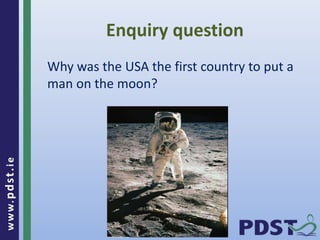
Enquiry question 
Why was the USA the first country to put a 
man on the moon?
www.pdst . ie 
Syllabus Learning Outcome 
Students should be able to draw conclusions 
from historical sources and use these 
conclusions to help form judgements on 
historical issues (S10)
www.pdst . ie 
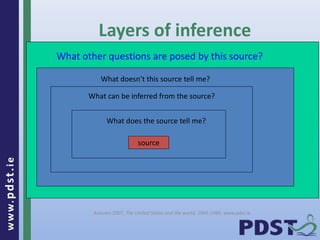
Layers of inference 
• Documents can be very revealing of the events, 
attitudes and mores of a period. 
• There are layers of meaning in documents, some 
of which may not be immediately obvious to 
students. 
• This exercise invites students to climb into a 
source to search not only for what the source tells 
us but what can be inferred from the source.
www.pdst . ie 
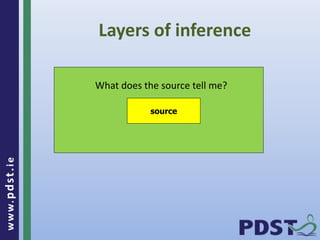
Layers of inference 
What does the source tell me? 
source
www.pdst . ie 
What can be inferred from the source? 
What does the source tell me? 
Autumn 2007, The United States and the world, 1945-1989,www.pdst.ie 
10 
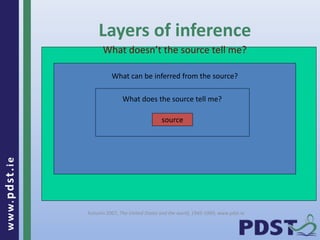
Layers of inference 
source
www.pdst . ie 
What doesn’t the source tell me? 
What can be inferred from the source? 
What does the source tell me? 
Autumn 2007, The United States and the world, 1945-1989, www.pdst.ie 
11 
Layers of inference 
source
www.pdst . ie 
What other questions are posed by this source? 
What doesn’t this source tell me? 
What can be inferred from the source? 
What does the source tell me? 
Autumn 2007, The United States and the world, 1945-1989, www.pdst.ie 
12 
Layers of inference 
source
www.pdst . ie 
13 
Inferring from photographs 
• Comprehension – list all you see in the 
photograph/diagram 
• Interpretation – list three things that could be 
inferred from this photograph 
• Wider context 
– Decisions made by the photographer 
– Events surrounding the scene 
– Any questions raised
www.pdst . ie 
14 
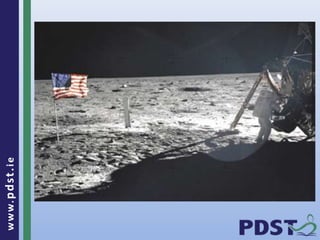
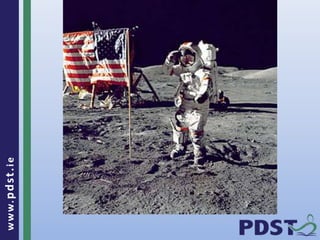
Use of photographs (see worksheet)
www.pdst . ie 
15
www.pdst . ie 
16 
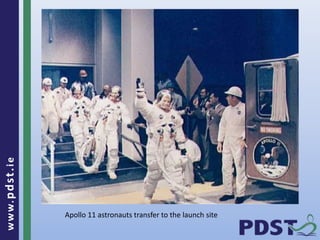
Apollo 11 astronauts transfer to the launch site
www.pdst . ie 
17 
Task 
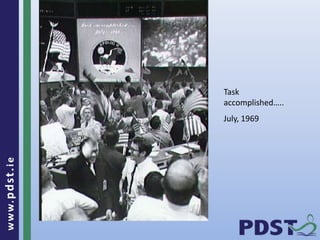
accomplished….. 
July, 1969
www.pdst . ie 
18 
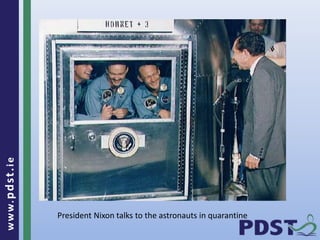
President Nixon talks to the astronauts in quarantine
www.pdst . ie 
19 
“American Know- 
How” 
July 17 1969 
“Louisville Courier 
Journal” 
Cartoonist: 
Hugh Haynie
www.pdst . ie 
20 
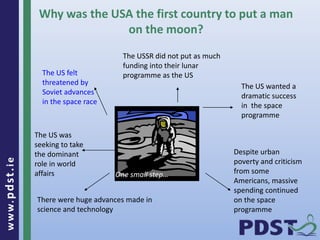
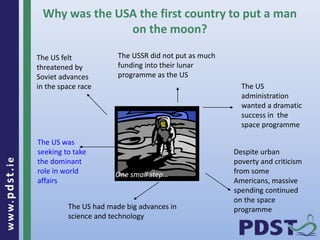
Why was the USA the first country to put a man 
on the moon? 
The US felt 
threatened by 
Soviet advances 
in the space race 
Despite urban 
poverty and criticism 
from some 
Americans, massive 
spending continued 
on the space 
programme 
The US was 
seeking to take 
the dominant 
role in world 
affairs 
There were huge advances made in 
science and technology 
The US wanted a 
dramatic success 
in the space 
programme 
The USSR did not put as much 
funding into their lunar 
programme as the US 
One small step…
www.pdst . ie 
21 
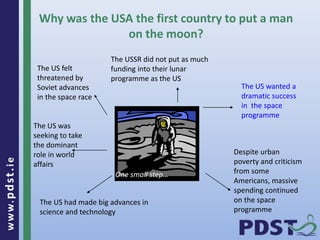
Why was the USA the first country to put a man 
on the moon? 
The US felt 
threatened by 
Soviet advances 
in the space race 
Despite urban 
poverty and criticism 
from some 
Americans, massive 
spending continued 
on the space 
programme 
The US was 
seeking to take 
the dominant 
role in world 
affairs 
The US had made big advances in 
science and technology 
The US 
administration 
wanted a dramatic 
success in the 
space programme 
The USSR did not put as much 
funding into their lunar 
programme as the US 
One small step…
www.pdst . ie 
22 
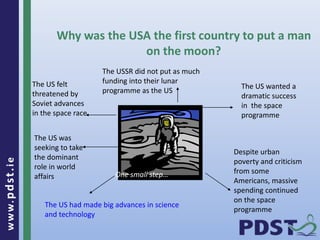
Why was the USA the first country to put a man 
on the moon? 
The US felt 
threatened by 
Soviet advances 
in the space race 
Despite urban 
poverty and criticism 
from some 
Americans, massive 
spending continued 
on the space 
programme 
The US was 
seeking to take 
the dominant 
role in world 
affairs 
The US had made big advances in 
science and technology 
The US wanted a 
dramatic success 
in the space 
programme 
The USSR did not put as much 
funding into their lunar 
programme as the US 
One small step…
www.pdst . ie 
Why was the USA the first country to put a man 
23 
on the moon? 
The US felt 
threatened by 
Soviet advances 
in the space race 
Despite urban 
poverty and criticism 
from some 
Americans, massive 
spending continued 
on the space 
programme 
The US was 
seeking to take 
the dominant 
role in world 
affairs 
The US had made big advances in science 
and technology 
The US wanted a 
dramatic success 
in the space 
programme 
The USSR did not put as much 
funding into their lunar 
programme as the US 
One small step…
www.pdst . ie 
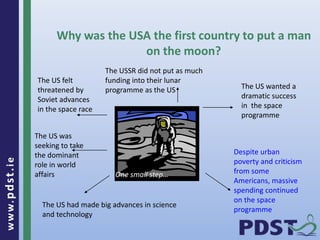
Why was the USA the first country to put a man 
24 
on the moon? 
The US felt 
threatened by 
Soviet advances 
in the space race 
Despite urban 
poverty and criticism 
from some 
Americans, massive 
spending continued 
on the space 
programme 
The US was 
seeking to take 
the dominant 
role in world 
affairs 
The US had made big advances in science 
and technology 
The US wanted a 
dramatic success 
in the space 
programme 
The USSR did not put as much 
funding into their lunar 
programme as the US 
One small step…
www.pdst . ie 
25 
www.pdst.ie 
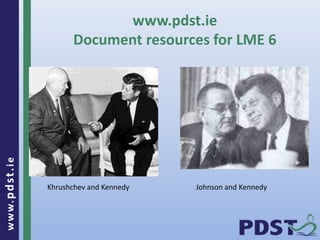
Document resources for LME 6 
Khrushchev and Kennedy Johnson and Kennedy
www.pdst . ie 
26 
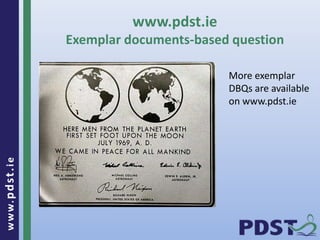
www.pdst.ie 
Exemplar documents-based question 
More exemplar 
DBQs are available 
on www.pdst.ie
www.pdst . ie 
27 
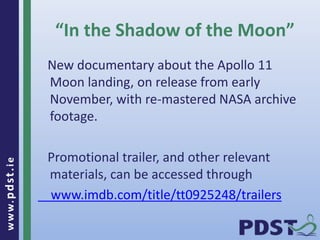
“In the Shadow of the Moon” 
New documentary about the Apollo 11 
Moon landing, on release from early 
November, with re-mastered NASA archive 
footage. 
Promotional trailer, and other relevant 
materials, can be accessed through 
www.imdb.com/title/tt0925248/trailers
Fí s Foghlaim Fo rbai r t 
www.pdst.ie 
© P D S T 2 0 1 4 
This work is made available under the terms of the Creative Commons Attribution Share Alike 3.0 
Licence http://creativecommons.org/licenses/by-sa/3.0/ie/. You may use and re-use this material 
(not including images and logos) free of charge in any format or medium, under the terms of the 
Creative Commons Attribution Share Alike Licence.

The Moon Landing, 1969

  • 1.
    www.pdst . ie The Moon Landing, 1969 Exploring evidence - drawing inferences from historical sources http://pdst.ie/postprimary
  • 2.
    www.pdst . ie The documents-based study • There will be much greater use of source materials especially in the teaching of the case studies • It is important that there should be variety in the selection of historical sources to be used (G12)
  • 3.
    www.pdst . ie Case studies • Case studies involve an in-depth investigation of a particularly significant or representative aspect of an element of the topic (S11) • What makes a particular event historically significant?
  • 4.
    www.pdst . ie Five R’s for dealing with historical significance • Remarkable • Remembered • Resonant • Resulting in change • Revealing
  • 5.
    www.pdst . ie Topic 6: The Moon Landing, 1969 Associated elements • Advances in military, space and information technology • US foreign policy, 1945-1972: Berlin, Korea, Cuba, Vietnam Associated key concepts • Technological development; the military industrial complex Associated key personality • Lyndon Johnson, Norman Mailer
  • 6.
    www.pdst . ie Enquiry question Why was the USA the first country to put a man on the moon?
  • 7.
    www.pdst . ie Syllabus Learning Outcome Students should be able to draw conclusions from historical sources and use these conclusions to help form judgements on historical issues (S10)
  • 8.
    www.pdst . ie Layers of inference • Documents can be very revealing of the events, attitudes and mores of a period. • There are layers of meaning in documents, some of which may not be immediately obvious to students. • This exercise invites students to climb into a source to search not only for what the source tells us but what can be inferred from the source.
  • 9.
    www.pdst . ie Layers of inference What does the source tell me? source
  • 10.
    www.pdst . ie What can be inferred from the source? What does the source tell me? Autumn 2007, The United States and the world, 1945-1989,www.pdst.ie 10 Layers of inference source
  • 11.
    www.pdst . ie What doesn’t the source tell me? What can be inferred from the source? What does the source tell me? Autumn 2007, The United States and the world, 1945-1989, www.pdst.ie 11 Layers of inference source
  • 12.
    www.pdst . ie What other questions are posed by this source? What doesn’t this source tell me? What can be inferred from the source? What does the source tell me? Autumn 2007, The United States and the world, 1945-1989, www.pdst.ie 12 Layers of inference source
  • 13.
    www.pdst . ie 13 Inferring from photographs • Comprehension – list all you see in the photograph/diagram • Interpretation – list three things that could be inferred from this photograph • Wider context – Decisions made by the photographer – Events surrounding the scene – Any questions raised
  • 14.
    www.pdst . ie 14 Use of photographs (see worksheet)
  • 15.
  • 16.
    www.pdst . ie 16 Apollo 11 astronauts transfer to the launch site
  • 17.
    www.pdst . ie 17 Task accomplished….. July, 1969
  • 18.
    www.pdst . ie 18 President Nixon talks to the astronauts in quarantine
  • 19.
    www.pdst . ie 19 “American Know- How” July 17 1969 “Louisville Courier Journal” Cartoonist: Hugh Haynie
  • 20.
    www.pdst . ie 20 Why was the USA the first country to put a man on the moon? The US felt threatened by Soviet advances in the space race Despite urban poverty and criticism from some Americans, massive spending continued on the space programme The US was seeking to take the dominant role in world affairs There were huge advances made in science and technology The US wanted a dramatic success in the space programme The USSR did not put as much funding into their lunar programme as the US One small step…
  • 21.
    www.pdst . ie 21 Why was the USA the first country to put a man on the moon? The US felt threatened by Soviet advances in the space race Despite urban poverty and criticism from some Americans, massive spending continued on the space programme The US was seeking to take the dominant role in world affairs The US had made big advances in science and technology The US administration wanted a dramatic success in the space programme The USSR did not put as much funding into their lunar programme as the US One small step…
  • 22.
    www.pdst . ie 22 Why was the USA the first country to put a man on the moon? The US felt threatened by Soviet advances in the space race Despite urban poverty and criticism from some Americans, massive spending continued on the space programme The US was seeking to take the dominant role in world affairs The US had made big advances in science and technology The US wanted a dramatic success in the space programme The USSR did not put as much funding into their lunar programme as the US One small step…
  • 23.
    www.pdst . ie Why was the USA the first country to put a man 23 on the moon? The US felt threatened by Soviet advances in the space race Despite urban poverty and criticism from some Americans, massive spending continued on the space programme The US was seeking to take the dominant role in world affairs The US had made big advances in science and technology The US wanted a dramatic success in the space programme The USSR did not put as much funding into their lunar programme as the US One small step…
  • 24.
    www.pdst . ie Why was the USA the first country to put a man 24 on the moon? The US felt threatened by Soviet advances in the space race Despite urban poverty and criticism from some Americans, massive spending continued on the space programme The US was seeking to take the dominant role in world affairs The US had made big advances in science and technology The US wanted a dramatic success in the space programme The USSR did not put as much funding into their lunar programme as the US One small step…
  • 25.
    www.pdst . ie 25 www.pdst.ie Document resources for LME 6 Khrushchev and Kennedy Johnson and Kennedy
  • 26.
    www.pdst . ie 26 www.pdst.ie Exemplar documents-based question More exemplar DBQs are available on www.pdst.ie
  • 27.
    www.pdst . ie 27 “In the Shadow of the Moon” New documentary about the Apollo 11 Moon landing, on release from early November, with re-mastered NASA archive footage. Promotional trailer, and other relevant materials, can be accessed through www.imdb.com/title/tt0925248/trailers
  • 28.
    Fí s FoghlaimFo rbai r t www.pdst.ie © P D S T 2 0 1 4 This work is made available under the terms of the Creative Commons Attribution Share Alike 3.0 Licence http://creativecommons.org/licenses/by-sa/3.0/ie/. You may use and re-use this material (not including images and logos) free of charge in any format or medium, under the terms of the Creative Commons Attribution Share Alike Licence.