ﺍﻝﻤﺭﺍﺠﻊ ﺍﻷﺠﻨﺒﻴﺔ
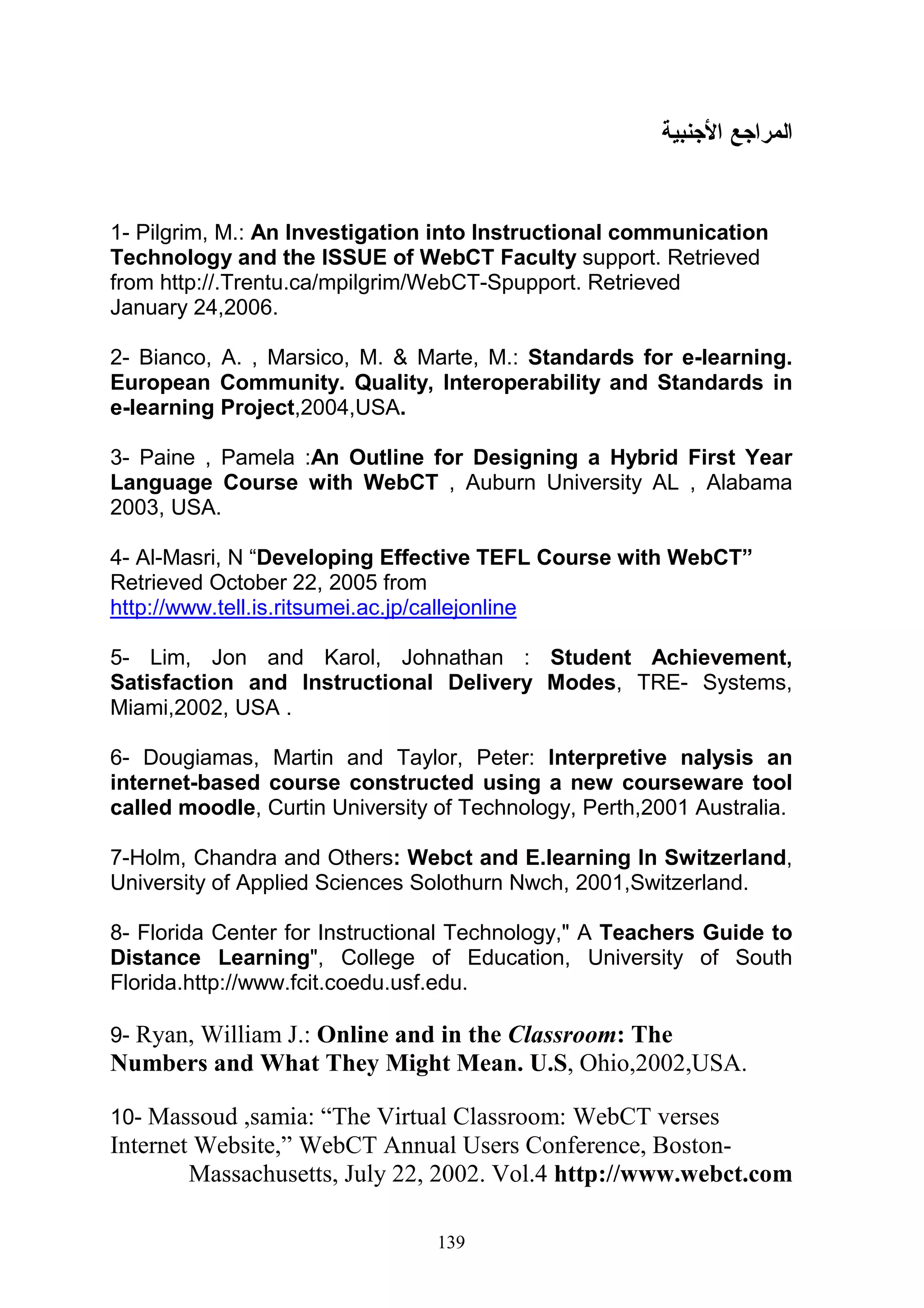
1- Pilgrim,M.: An Investigation into Instructional communication
Technology and the ISSUE of WebCT Faculty support. Retrieved
from http://.Trentu.ca/mpilgrim/WebCT-Spupport. Retrieved
January 24,2006.
2- Bianco, A. , Marsico, M. Marte, M.: Standards for e-learning.
European Community. Quality, Interoperability and Standards in
e-learning Project,2004,USA.
3- Paine , Pamela :An Outline for Designing a Hybrid First Year
Language Course with WebCT , Auburn University AL , Alabama
2003, USA.
4- Al-Masri, N “Developing Effective TEFL Course with WebCT”
Retrieved October 22, 2005 from
http://www.tell.is.ritsumei.ac.jp/callejonline
5- Lim, Jon and Karol, Johnathan : Student Achievement,
Satisfaction and Instructional Delivery Modes, TRE- Systems,
Miami,2002, USA .
6- Dougiamas, Martin and Taylor, Peter: Interpretive nalysis an
internet-based course constructed using a new courseware tool
called moodle, Curtin University of Technology, Perth,2001 Australia.
7-Holm, Chandra and Others: Webct and E.learning In Switzerland,
University of Applied Sciences Solothurn Nwch, 2001,Switzerland.
8- Florida Center for Instructional Technology, A Teachers Guide to
Distance Learning, College of Education, University of South
Florida.http://www.fcit.coedu.usf.edu.
9- Ryan, William J.: Online and in the Classroom: The
Numbers and What They Might Mean. U.S, Ohio,2002,USA.
10- Massoud ,samia: “The Virtual Classroom: WebCT verses
Internet Website,” WebCT Annual Users Conference, Boston-
Massachusetts, July 22, 2002. Vol.4 http://www.webct.com
139
195.
11- Feldmann, Birgit;Schlageter, Gunter: Five Years Virtual
University - Review and Preview,2001, Germany.
12- Evans, Ruby : Providing a Learning-Centered Instructional
Environment,2000, Florida, U.S.A.
140
Abstract
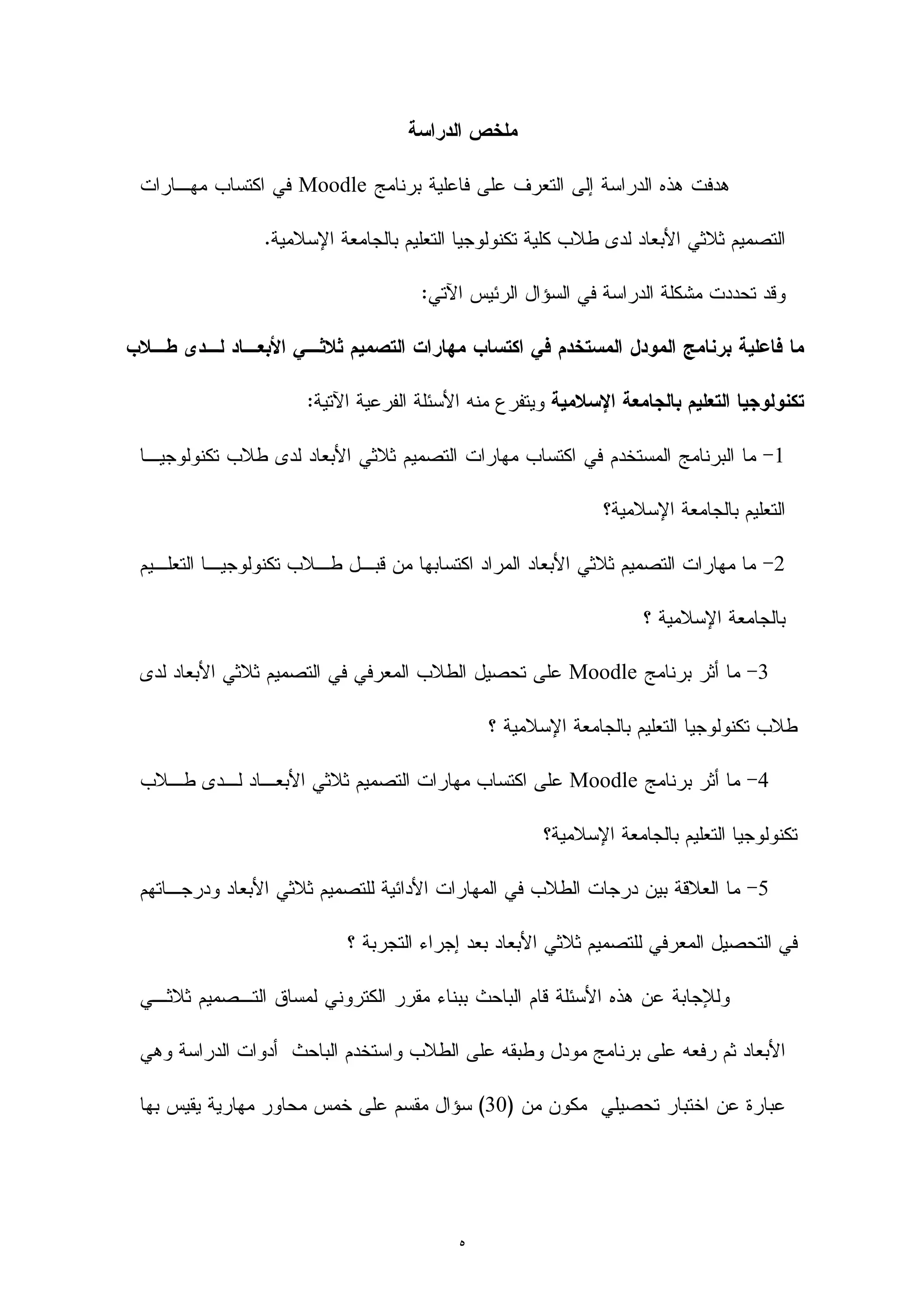
This study aimedto identify the effectiveness of Moodle in the
program acquire the skills to design three-dimensional
technology education students as the Faculty of Islamic
University.
The study identified the problem in the President the following
question:
Moodle the effectiveness of the program used to acquire three-
dimensional design skills of students at the Islamic University of
Technology Education and the Sub-branch of which the following
questions:
1- What is the effect of the program Moodle to collect the knowledge of
students in the three-dimensional design technology education of
students at Islamic University?
2- What is the effect of the program Moodle skills to design three-
dimensional technology education of students at Islamic University?
3- What is the relationship between the skill levels of students in the
performance of the three-dimensional design and their ranking in the
collection of knowledge of the design after the three-dimensional
experience?
To answer these questions by the decision to build an electronic three-
dimensional design course and then lifted to the program model and
applied it to the students and the tools used by the study is a test a
(30) is divided on five axes measure the skills of the researcher level
of knowledge for students, and a note composed of (25), paragraph
divided on five axes measure the skills of the researcher-level
performance of students.
155
211.
The researcher chosea sample of a deliberate (35) students who are
studying in the Division of multimedia at the Islamic University, a
researcher and used according to the nature of the pilot study
approach
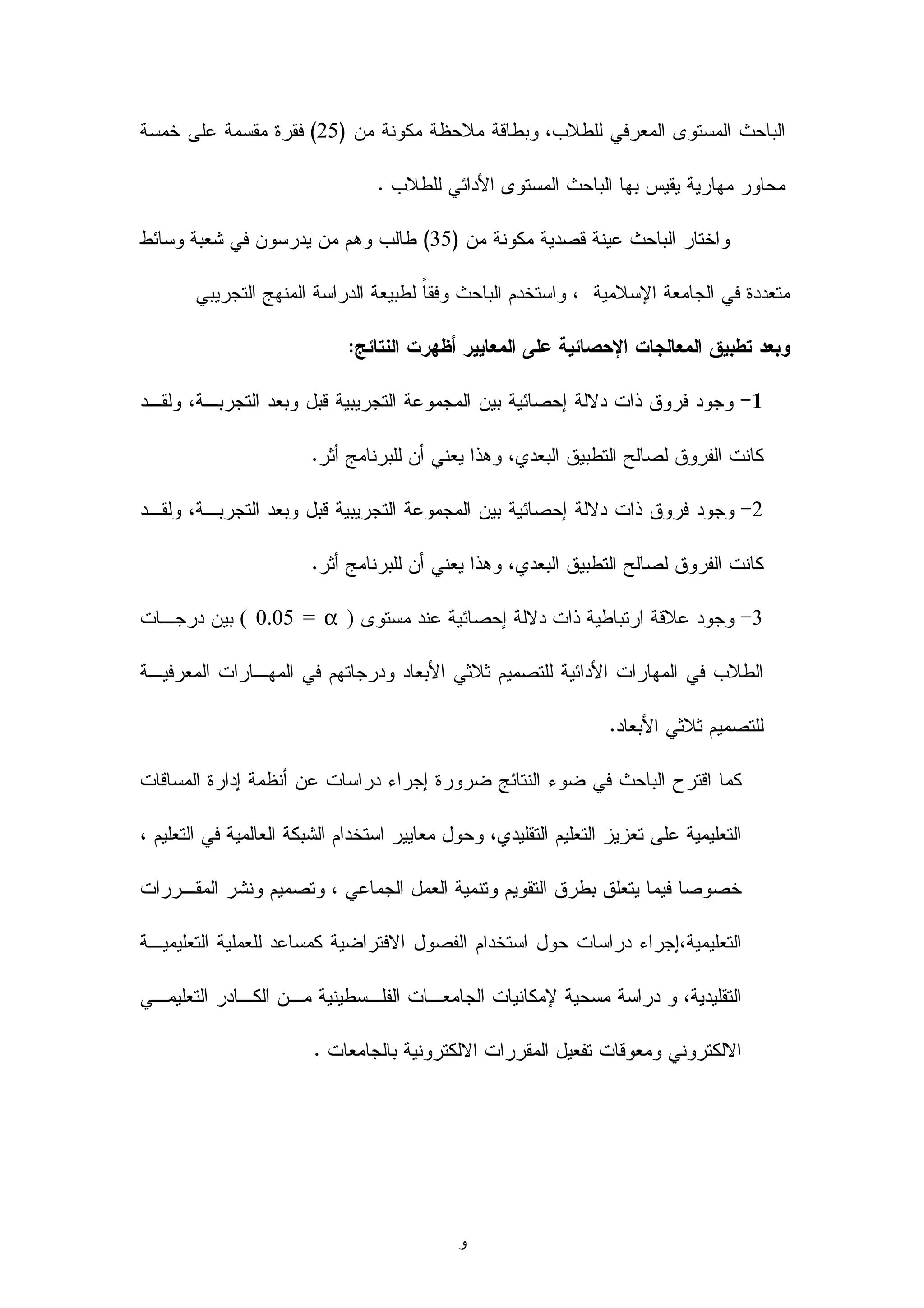
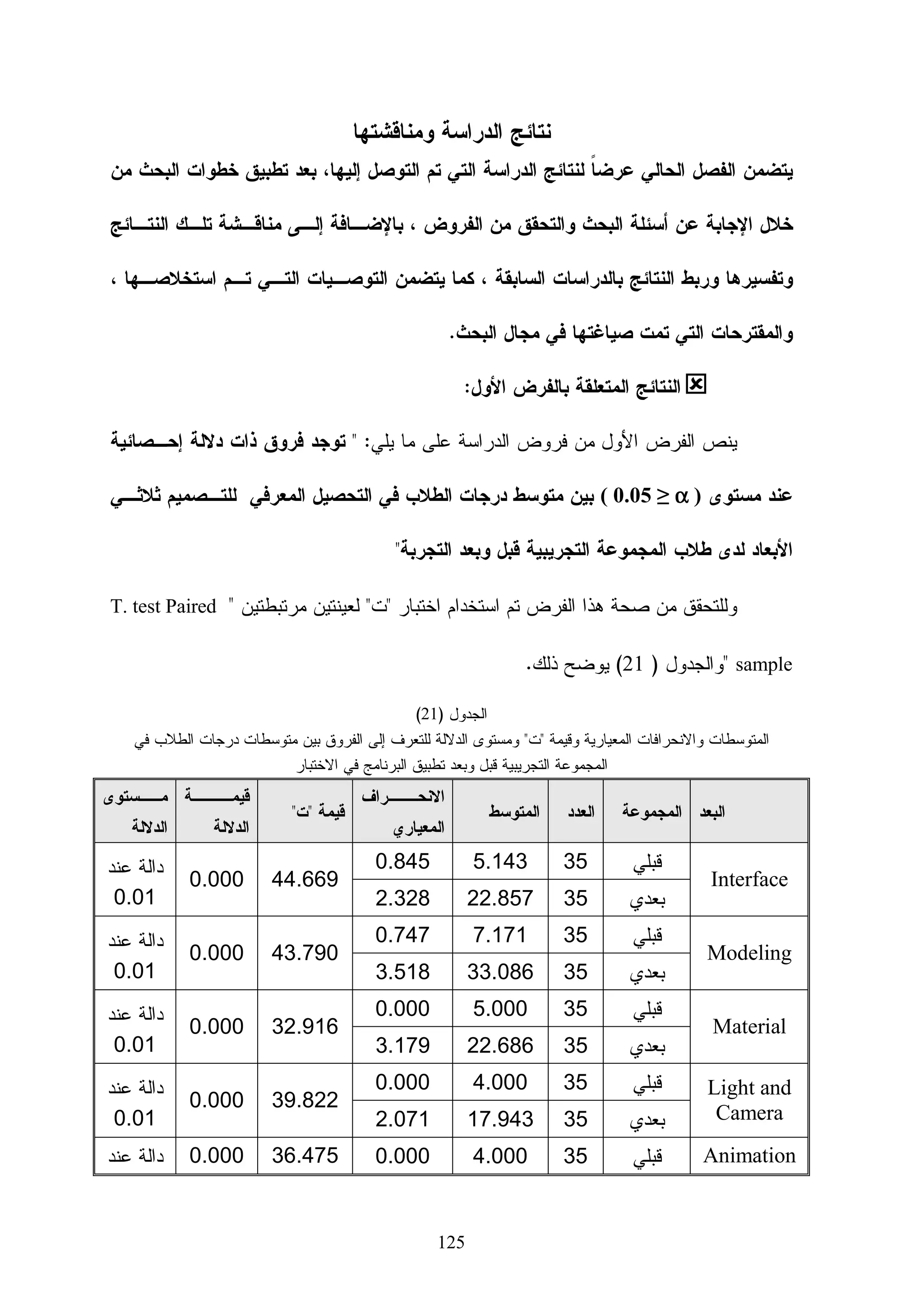
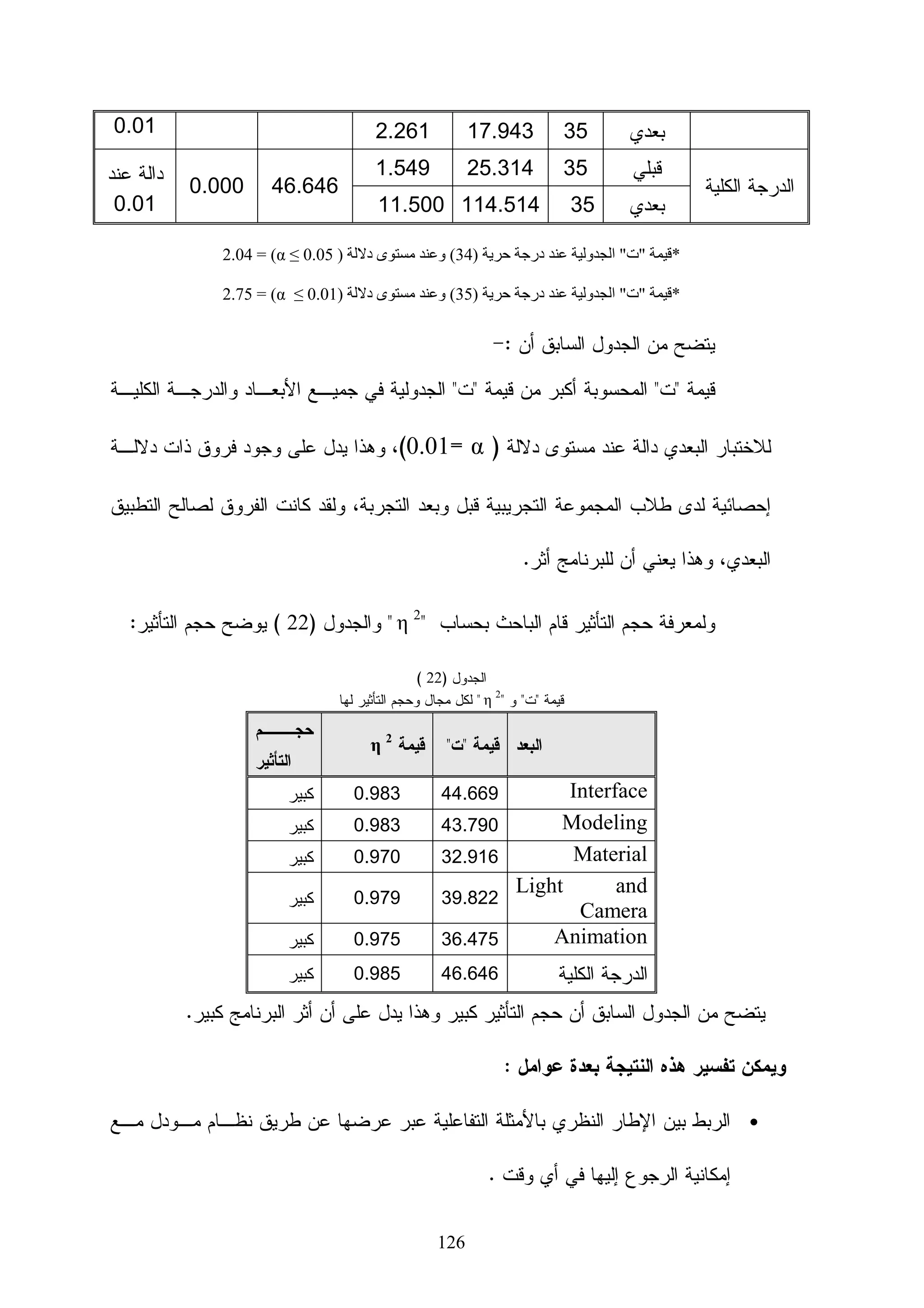
After the application of statistical criteria, results showed:
1- The presence of statistically significant differences between the
experimental group before and after the experiment, and the
differences for the benefit of dimensional application, and this means
that the impact of the program.
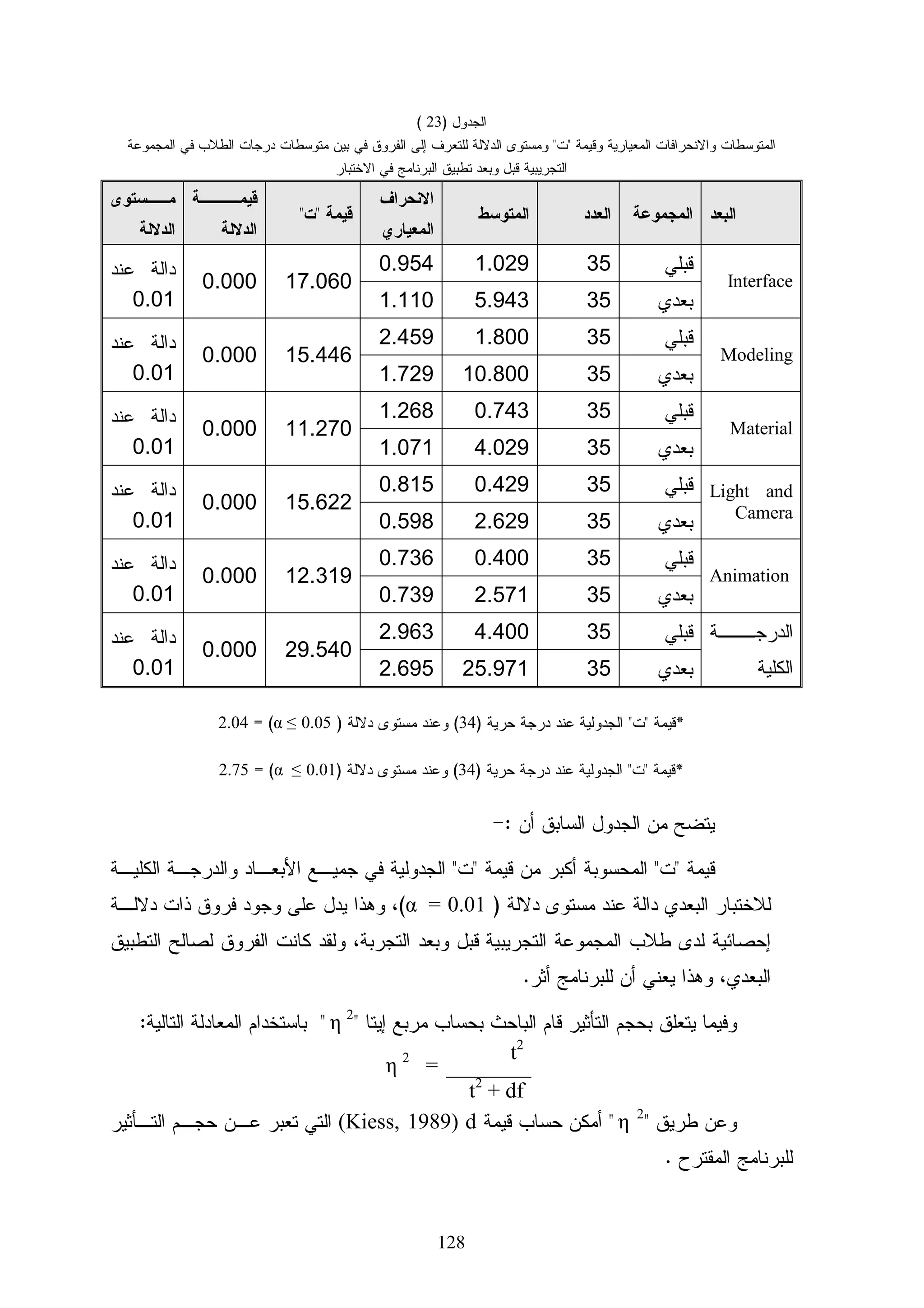
2- The presence of statistically significant differences between the
experimental group before and after the experience in performing
skills, and the differences for the benefit of dimensional application,
and this means that the impact of the program
3- There is a statistically significant correlation at the level (0.05 =α)
degrees between the performance of students in the skills of the
three-dimensional design and their ranking in the collection of
knowledge of the three-dimensional design.
As suggested by the results in the light of the need for studies on
management systems to enhance the educational courses of
traditional education, and on the criteria for the use of the World Wide
Web in education, particularly with regard to ways of evaluation and
development of collective action, and the design and dissemination of
curricula, conducting studies on the use of virtual classrooms as
assistant to the educational process traditional, and a survey of the
potential of the Palestinian universities in the educational staff of
electronic activation of the decisions and constraints of electronic
universities.
156

![] @](https://image.slidesharecdn.com/moodle-110511204430-phpapp02/75/Moodle-23-2048.jpg)

![]](https://image.slidesharecdn.com/moodle-110511204430-phpapp02/75/Moodle-34-2048.jpg)



















![التميز في ادارة الذات [Compatibility mode]](https://cdn.slidesharecdn.com/ss_thumbnails/compatibilitymode-130819150046-phpapp02-thumbnail.jpg?width=640&height=640&fit=bounds)


