Mood Stabilizers
In
Pregnancy
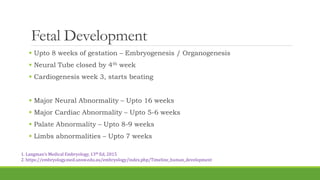
Fetal Development
 Upto 8 weeks of gestation – Embryogenesis / Organogenesis
 Neural Tube closed by 4th week
 Cardiogenesis week 3, starts beating
 Major Neural Abnormality – Upto 16 weeks
 Major Cardiac Abnormality – Upto 5-6 weeks
 Palate Abnormality – Upto 8-9 weeks
 Limbs abnormalities – Upto 7 weeks
1. Langman’s Medical Embryology, 13th Ed, 2015
2. https://embryology.med.unsw.edu.au/embryology/index.php/Timeline_human_development
Drug-Effects on Pregnancy
 Blood volume ↑ towards later stage of gestation ( around 30%)
 GFR increases - Drug elimination ↑ - ↓ steady-state concentrations
 Hepatic enzyme activity alters.
 Activity of CYP2D6 ↑ by 50% (Metabolizes SSRIs: HPL is Inhibitor)
 Activity of CYP1A2 ↓ by 70% (metabolizes TCA, SNRI: CBZ is Inducer)
 Mean ↑ of 8 L in TBW- decreased peak serum
 Pregnancy-related hypoalbuminaemia - ↓ protein binding - ↑ free drug fraction.
 Placental passage of Drugs (Lithium) – Drug action on Fetus
 Overall ↑ dosage in Pregnancy
Ref: The Maudsley Prescribing Guidelines in Psychiatry, 13th Ed, 2018
What is a Mood Stabilizer?
USFDA does not officially recognize the term
No consensus definition.
An agent is considered a mood stabilizer if it has efficacy in treating acute
manic and depressive symptoms and in prophylaxis of manic and depressive
symptoms in bipolar disorder.
Bauer M, Mitchner L. What Is a “Mood Stabilizer”? An Evidence-Based Response. American Journal of Psychiatry. 2004;161(1):3-18.
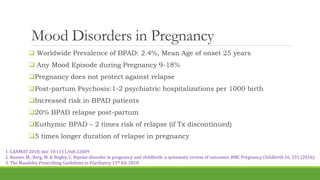
Mood Disorders in Pregnancy
 Worldwide Prevalence of BPAD: 2.4%, Mean Age of onset 25 years
 Any Mood Episode during Pregnancy 9-18%
Pregnancy does not protect against relapse
Post-partum Psychosis:1-2 psychiatric hospitalizations per 1000 birth
Increased risk in BPAD patients
20% BPAD relapse post-partum
Euthymic BPAD – 2 times risk of relapse (if Tx discontinued)
5 times longer duration of relapse in pregnancy
1. CANMAT 2018; doi: 10.1111/bdi.12609
2. Rusner, M., Berg, M. & Begley, C. Bipolar disorder in pregnancy and childbirth: a systematic review of outcomes. BMC Pregnancy Childbirth 16, 331 (2016).
3. The Maudsley Prescribing Guidelines in Psychiatry, 13th Ed, 2018
Untreated Mood-Disorder: Consequences
MATERNAL
High postpartum risk for 1st onset and recurrent BPAD episodes, &
hospitalization
Substance use, poor prenatal care, poor obstetric care
Poor self care, self harm, maternal suicide
FETAL
Low birthweight, SGA, preterm birth
Increased risk of cesarean birth, small head circumference, hypoglycemia
Increased risk for long-term neurocognitive, behavioral and social deficits
Neglect by mother, Infanticide
Creeley, Denton. Use of Prescribed Psychotropics during Pregnancy: A Systematic Review of Pregnancy, Neonatal, and Childhood Outcomes.
Brain Sciences. 2019;9(9):235.
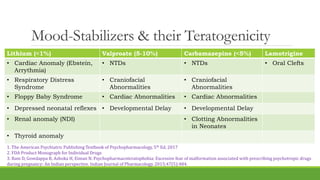
Mood-Stabilizers & their Teratogenicity
1. The American Psychiatric Publishing Textbook of Psychopharmacology, 5th Ed, 2017
2. FDA Product Monograph for Individual Drugs
3. Ram D, Gowdappa B, Ashoka H, Eiman N. Psychopharmacoteratophobia: Excessive fear of malformation associated with prescribing psychotropic drugs
during pregnancy: An Indian perspective. Indian Journal of Pharmacology. 2015;47(5):484.
Lithium (<1%) Valproate (5-10%) Carbamazepine (<5%) Lamotrigine
• Cardiac Anomaly (Ebstein,
Arrythmia)
• NTDs • NTDs • Oral Clefts
• Respiratory Distress
Syndrome
• Craniofacial
Abnormalities
• Craniofacial
Abnormalities
• Floppy Baby Syndrome • Cardiac Abnormalities • Cardiac Abnormalities
• Depressed neonatal reflexes • Developmental Delay • Developmental Delay
• Renal anomaly (NDI) • Clotting Abnormalities
in Neonates
• Thyroid anomaly
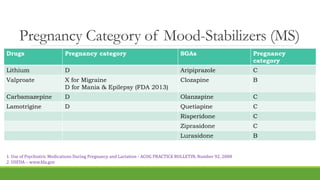
Pregnancy Category of Mood-Stabilizers (MS)
Drugs Pregnancy category SGAs Pregnancy
category
Lithium D Aripiprazole C
Valproate X for Migraine
D for Mania & Epilepsy (FDA 2013)
Clozapine B
Carbamazepine D Olanzapine C
Lamotrigine D Quetiapine C
Risperidone C
Ziprasidone C
Lurasidone B
1. Use of Psychiatric Medications During Pregnancy and Lactation - ACOG PRACTICE BULLETIN, Number 92, 2008
2. USFDA – www.fda.gov
Use of Mood Stabilizers (MS) in Pregnancy
1st Episode of Bipolar Disorder
On Maintenance Therapy for BPAD
Relapse of BPAD
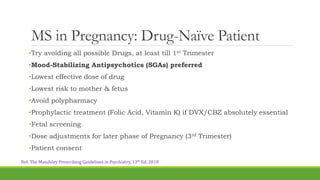
MS in Pregnancy: Drug-Naïve Patient
•Try avoiding all possible Drugs, at least till 1st Trimester
•Mood-Stabilizing Antipsychotics (SGAs) preferred
•Lowest effective dose of drug
•Lowest risk to mother & fetus
•Avoid polypharmacy
•Prophylactic treatment (Folic Acid, Vitamin K) if DVX/CBZ absolutely essential
•Fetal screening
•Dose adjustments for later phase of Pregnancy (3rd Trimester)
•Patient consent
Ref: The Maudsley Prescribing Guidelines in Psychiatry, 13th Ed, 2018
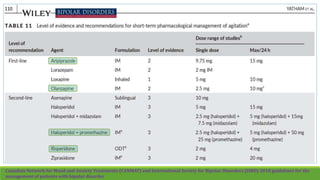
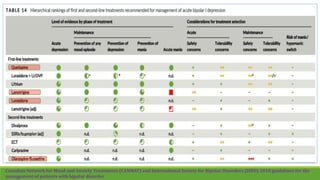
Canadian Network for Mood and Anxiety Treatments (CANMAT) and International Society for Bipolar Disorders (ISBD) 2018 guidelines for the
management of patients with bipolar disorder
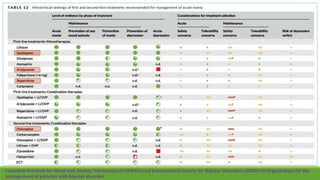
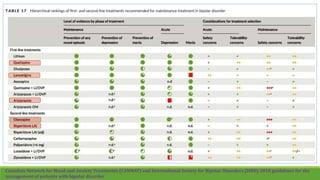
Canadian Network for Mood and Anxiety Treatments (CANMAT) and International Society for Bipolar Disorders (ISBD) 2018 guidelines for the
management of patients with bipolar disorder
Canadian Network for Mood and Anxiety Treatments (CANMAT) and International Society for Bipolar Disorders (ISBD) 2018 guidelines for the
management of patients with bipolar disorder
Canadian Network for Mood and Anxiety Treatments (CANMAT) and International Society for Bipolar Disorders (ISBD) 2018 guidelines for the
management of patients with bipolar disorder
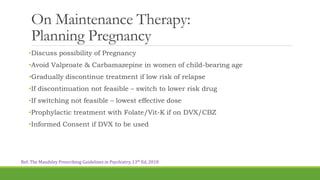
On Maintenance Therapy:
Planning Pregnancy
•Discuss possibility of Pregnancy
•Avoid Valproate & Carbamazepine in women of child-bearing age
•Gradually discontinue treatment if low risk of relapse
•If discontinuation not feasible – switch to lower risk drug
•If switching not feasible – lowest effective dose
•Prophylactic treatment with Folate/Vit-K if on DVX/CBZ
•Informed Consent if DVX to be used
Ref: The Maudsley Prescribing Guidelines in Psychiatry, 13th Ed, 2018
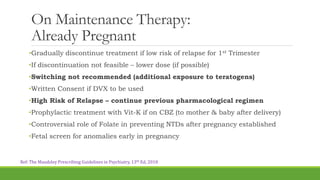
On Maintenance Therapy:
Already Pregnant
•Gradually discontinue treatment if low risk of relapse for 1st Trimester
•If discontinuation not feasible – lower dose (if possible)
•Switching not recommended (additional exposure to teratogens)
•Written Consent if DVX to be used
•High Risk of Relapse – continue previous pharmacological regimen
•Prophylactic treatment with Vit-K if on CBZ (to mother & baby after delivery)
•Controversial role of Folate in preventing NTDs after pregnancy established
•Fetal screen for anomalies early in pregnancy
Ref: The Maudsley Prescribing Guidelines in Psychiatry, 13th Ed, 2018
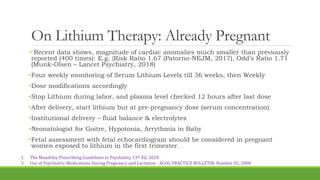
On Lithium Therapy: Already Pregnant
Recent data shows, magnitude of cardiac anomalies much smaller than previously
reported (400 times): E.g. {Risk Ratio 1.67 (Patorno-NEJM, 2017), Odd’s Ratio 1.71
(Munk-Olsen – Lancet Psychiatry, 2018)
•Four weekly monitoring of Serum Lithium Levels till 36 weeks, then Weekly
•Dose modifications accordingly
•Stop Lithium during labor, and plasma level checked 12 hours after last dose
•After delivery, start lithium but at pre-pregnancy dose (serum concentration)
•Institutional delivery – fluid balance & electrolytes
•Neonatologist for Goitre, Hypotonia, Arrythmia in Baby
•Fetal assessment with fetal echocardiogram should be considered in pregnant
women exposed to lithium in the first trimester.
1. The Maudsley Prescribing Guidelines in Psychiatry, 13th Ed, 2018
2. Use of Psychiatric Medications During Pregnancy and Lactation - ACOG PRACTICE BULLETIN, Number 92, 2008
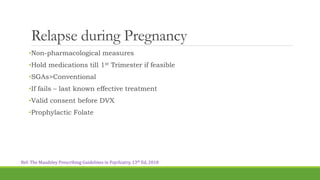
Relapse during Pregnancy
•Non-pharmacological measures
•Hold medications till 1st Trimester if feasible
•SGAs>Conventional
•If fails – last known effective treatment
•Valid consent before DVX
•Prophylactic Folate
Ref: The Maudsley Prescribing Guidelines in Psychiatry, 13th Ed, 2018
Tests for Detection of Anomaly
USG
Fetal Echo & doppler
Amniocentesis, CVS etc.: α-fetoprotein
Cord blood sampling
Fetal anomaly scan
Fetal thyroid scan
Maternal & Fetal blood testing for clotting factor deficiency
Fetal serum drug levels generally not recommended
Use of Psychiatric Medications During Pregnancy and Lactation - ACOG PRACTICE BULLETIN, Number 92, 2008
Preventive Measures against use of MS:
What Psychiatrists Can Do?
Discuss the Risk vs Benefit
Decide best possible Treatment after discussion with Patient and/or Family
Obtain Written consent about treatment where necessary
Documentation of relevant clinical information
Advice Folic Acid Supplementation to all women of child-bearing potential 0.4-
4mg/day (AAN, 1998)
Advice on Vit-K injection to Mother and Baby post delivery of Patient was on
CBZ
Monitor serum Lithium level frequently
Early Referral to Obstetrician/Neonatologist/Concerned Specialists for
screening, early detection & management of Teratogenic changes
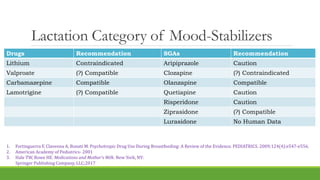
Lactation Category of Mood-Stabilizers
Drugs Recommendation SGAs Recommendation
Lithium Contraindicated Aripiprazole Caution
Valproate (?) Compatible Clozapine (?) Contraindicated
Carbamazepine Compatible Olanzapine Compatible
Lamotrigine (?) Compatible Quetiapine Caution
Risperidone Caution
Ziprasidone (?) Compatible
Lurasidone No Human Data
1. Fortinguerra F, Clavenna A, Bonati M. Psychotropic Drug Use During Breastfeeding: A Review of the Evidence. PEDIATRICS. 2009;124(4):e547-e556.
2. American Academy of Pediatrics- 2001
3. Hale TW, Rowe HE. Medications and Mother’s Milk. New York, NY:
Springer Publishing Company, LLC;2017
Legal Concerns:
 Consumer Protection Act 1986
 Indian Penal Code – Medical Negligence
The Medical Termination of Pregnancy Act, 1971
Mental Health Care Act – 2017
No clear guidelines
Psychopharmacoteratophobia (?)
Ram D, Gowdappa B, Ashoka H, Eiman N. Psychopharmacoteratophobia: Excessive fear of malformation associated with prescribing psychotropic drugs
during pregnancy: An Indian perspective. Indian Journal of Pharmacology. 2015;47(5):484.
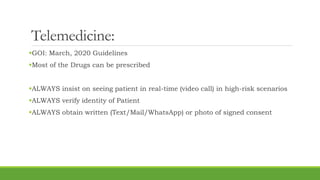
Telemedicine:
GOI: March, 2020 Guidelines
Most of the Drugs can be prescribed
ALWAYS insist on seeing patient in real-time (video call) in high-risk scenarios
ALWAYS verify identity of Patient
ALWAYS obtain written (Text/Mail/WhatsApp) or photo of signed consent
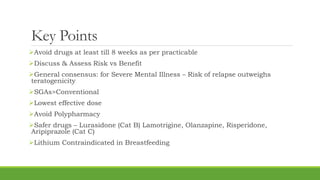
Key Points
Avoid drugs at least till 8 weeks as per practicable
Discuss & Assess Risk vs Benefit
General consensus: for Severe Mental Illness – Risk of relapse outweighs
teratogenicity
SGAs>Conventional
Lowest effective dose
Avoid Polypharmacy
Safer drugs – Lurasidone (Cat B) Lamotrigine, Olanzapine, Risperidone,
Aripiprazole (Cat C)
Lithium Contraindicated in Breastfeeding
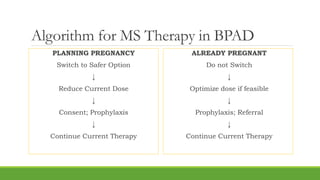
Algorithm for MS Therapy in BPAD
PLANNING PREGNANCY
Switch to Safer Option
↓
Reduce Current Dose
↓
Consent; Prophylaxis
↓
Continue Current Therapy
ALREADY PREGNANT
Do not Switch
↓
Optimize dose if feasible
↓
Prophylaxis; Referral
↓
Continue Current Therapy
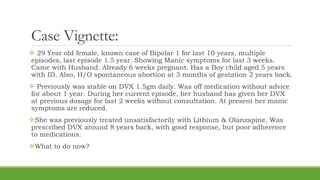
Case Vignette:
 29 Year old female, known case of Bipolar 1 for last 10 years, multiple
episodes, last episode 1.5 year. Showing Manic symptoms for last 3 weeks.
Came with Husband. Already 6 weeks pregnant. Has a Boy child aged 5 years
with ID. Also, H/O spontaneous abortion at 3 months of gestation 2 years back.
 Previously was stable on DVX 1.5gm daily. Was off medication without advice
for about 1 year. During her current episode, her husband has given her DVX
at previous dosage for last 2 weeks without consultation. At present her manic
symptoms are reduced.
She was previously treated unsatisfactorily with Lithium & Olanzapine. Was
prescribed DVX around 8 years back, with good response, but poor adherence
to medications.
What to do now?

Mood Stabilizers in Pregnancy.pptx

  • 1.
  • 2.
    Fetal Development  Upto8 weeks of gestation – Embryogenesis / Organogenesis  Neural Tube closed by 4th week  Cardiogenesis week 3, starts beating  Major Neural Abnormality – Upto 16 weeks  Major Cardiac Abnormality – Upto 5-6 weeks  Palate Abnormality – Upto 8-9 weeks  Limbs abnormalities – Upto 7 weeks 1. Langman’s Medical Embryology, 13th Ed, 2015 2. https://embryology.med.unsw.edu.au/embryology/index.php/Timeline_human_development
  • 3.
    Drug-Effects on Pregnancy Blood volume ↑ towards later stage of gestation ( around 30%)  GFR increases - Drug elimination ↑ - ↓ steady-state concentrations  Hepatic enzyme activity alters.  Activity of CYP2D6 ↑ by 50% (Metabolizes SSRIs: HPL is Inhibitor)  Activity of CYP1A2 ↓ by 70% (metabolizes TCA, SNRI: CBZ is Inducer)  Mean ↑ of 8 L in TBW- decreased peak serum  Pregnancy-related hypoalbuminaemia - ↓ protein binding - ↑ free drug fraction.  Placental passage of Drugs (Lithium) – Drug action on Fetus  Overall ↑ dosage in Pregnancy Ref: The Maudsley Prescribing Guidelines in Psychiatry, 13th Ed, 2018
  • 4.
    What is aMood Stabilizer? USFDA does not officially recognize the term No consensus definition. An agent is considered a mood stabilizer if it has efficacy in treating acute manic and depressive symptoms and in prophylaxis of manic and depressive symptoms in bipolar disorder. Bauer M, Mitchner L. What Is a “Mood Stabilizer”? An Evidence-Based Response. American Journal of Psychiatry. 2004;161(1):3-18.
  • 5.
    Mood Disorders inPregnancy  Worldwide Prevalence of BPAD: 2.4%, Mean Age of onset 25 years  Any Mood Episode during Pregnancy 9-18% Pregnancy does not protect against relapse Post-partum Psychosis:1-2 psychiatric hospitalizations per 1000 birth Increased risk in BPAD patients 20% BPAD relapse post-partum Euthymic BPAD – 2 times risk of relapse (if Tx discontinued) 5 times longer duration of relapse in pregnancy 1. CANMAT 2018; doi: 10.1111/bdi.12609 2. Rusner, M., Berg, M. & Begley, C. Bipolar disorder in pregnancy and childbirth: a systematic review of outcomes. BMC Pregnancy Childbirth 16, 331 (2016). 3. The Maudsley Prescribing Guidelines in Psychiatry, 13th Ed, 2018
  • 6.
    Untreated Mood-Disorder: Consequences MATERNAL Highpostpartum risk for 1st onset and recurrent BPAD episodes, & hospitalization Substance use, poor prenatal care, poor obstetric care Poor self care, self harm, maternal suicide FETAL Low birthweight, SGA, preterm birth Increased risk of cesarean birth, small head circumference, hypoglycemia Increased risk for long-term neurocognitive, behavioral and social deficits Neglect by mother, Infanticide Creeley, Denton. Use of Prescribed Psychotropics during Pregnancy: A Systematic Review of Pregnancy, Neonatal, and Childhood Outcomes. Brain Sciences. 2019;9(9):235.
  • 7.
    Mood-Stabilizers & theirTeratogenicity 1. The American Psychiatric Publishing Textbook of Psychopharmacology, 5th Ed, 2017 2. FDA Product Monograph for Individual Drugs 3. Ram D, Gowdappa B, Ashoka H, Eiman N. Psychopharmacoteratophobia: Excessive fear of malformation associated with prescribing psychotropic drugs during pregnancy: An Indian perspective. Indian Journal of Pharmacology. 2015;47(5):484. Lithium (<1%) Valproate (5-10%) Carbamazepine (<5%) Lamotrigine • Cardiac Anomaly (Ebstein, Arrythmia) • NTDs • NTDs • Oral Clefts • Respiratory Distress Syndrome • Craniofacial Abnormalities • Craniofacial Abnormalities • Floppy Baby Syndrome • Cardiac Abnormalities • Cardiac Abnormalities • Depressed neonatal reflexes • Developmental Delay • Developmental Delay • Renal anomaly (NDI) • Clotting Abnormalities in Neonates • Thyroid anomaly
  • 8.
    Pregnancy Category ofMood-Stabilizers (MS) Drugs Pregnancy category SGAs Pregnancy category Lithium D Aripiprazole C Valproate X for Migraine D for Mania & Epilepsy (FDA 2013) Clozapine B Carbamazepine D Olanzapine C Lamotrigine D Quetiapine C Risperidone C Ziprasidone C Lurasidone B 1. Use of Psychiatric Medications During Pregnancy and Lactation - ACOG PRACTICE BULLETIN, Number 92, 2008 2. USFDA – www.fda.gov
  • 9.
    Use of MoodStabilizers (MS) in Pregnancy 1st Episode of Bipolar Disorder On Maintenance Therapy for BPAD Relapse of BPAD
  • 10.
    MS in Pregnancy:Drug-Naïve Patient •Try avoiding all possible Drugs, at least till 1st Trimester •Mood-Stabilizing Antipsychotics (SGAs) preferred •Lowest effective dose of drug •Lowest risk to mother & fetus •Avoid polypharmacy •Prophylactic treatment (Folic Acid, Vitamin K) if DVX/CBZ absolutely essential •Fetal screening •Dose adjustments for later phase of Pregnancy (3rd Trimester) •Patient consent Ref: The Maudsley Prescribing Guidelines in Psychiatry, 13th Ed, 2018
  • 11.
    Canadian Network forMood and Anxiety Treatments (CANMAT) and International Society for Bipolar Disorders (ISBD) 2018 guidelines for the management of patients with bipolar disorder
  • 12.
    Canadian Network forMood and Anxiety Treatments (CANMAT) and International Society for Bipolar Disorders (ISBD) 2018 guidelines for the management of patients with bipolar disorder
  • 13.
    Canadian Network forMood and Anxiety Treatments (CANMAT) and International Society for Bipolar Disorders (ISBD) 2018 guidelines for the management of patients with bipolar disorder
  • 14.
    Canadian Network forMood and Anxiety Treatments (CANMAT) and International Society for Bipolar Disorders (ISBD) 2018 guidelines for the management of patients with bipolar disorder
  • 15.
    On Maintenance Therapy: PlanningPregnancy •Discuss possibility of Pregnancy •Avoid Valproate & Carbamazepine in women of child-bearing age •Gradually discontinue treatment if low risk of relapse •If discontinuation not feasible – switch to lower risk drug •If switching not feasible – lowest effective dose •Prophylactic treatment with Folate/Vit-K if on DVX/CBZ •Informed Consent if DVX to be used Ref: The Maudsley Prescribing Guidelines in Psychiatry, 13th Ed, 2018
  • 16.
    On Maintenance Therapy: AlreadyPregnant •Gradually discontinue treatment if low risk of relapse for 1st Trimester •If discontinuation not feasible – lower dose (if possible) •Switching not recommended (additional exposure to teratogens) •Written Consent if DVX to be used •High Risk of Relapse – continue previous pharmacological regimen •Prophylactic treatment with Vit-K if on CBZ (to mother & baby after delivery) •Controversial role of Folate in preventing NTDs after pregnancy established •Fetal screen for anomalies early in pregnancy Ref: The Maudsley Prescribing Guidelines in Psychiatry, 13th Ed, 2018
  • 17.
    On Lithium Therapy:Already Pregnant Recent data shows, magnitude of cardiac anomalies much smaller than previously reported (400 times): E.g. {Risk Ratio 1.67 (Patorno-NEJM, 2017), Odd’s Ratio 1.71 (Munk-Olsen – Lancet Psychiatry, 2018) •Four weekly monitoring of Serum Lithium Levels till 36 weeks, then Weekly •Dose modifications accordingly •Stop Lithium during labor, and plasma level checked 12 hours after last dose •After delivery, start lithium but at pre-pregnancy dose (serum concentration) •Institutional delivery – fluid balance & electrolytes •Neonatologist for Goitre, Hypotonia, Arrythmia in Baby •Fetal assessment with fetal echocardiogram should be considered in pregnant women exposed to lithium in the first trimester. 1. The Maudsley Prescribing Guidelines in Psychiatry, 13th Ed, 2018 2. Use of Psychiatric Medications During Pregnancy and Lactation - ACOG PRACTICE BULLETIN, Number 92, 2008
  • 18.
    Relapse during Pregnancy •Non-pharmacologicalmeasures •Hold medications till 1st Trimester if feasible •SGAs>Conventional •If fails – last known effective treatment •Valid consent before DVX •Prophylactic Folate Ref: The Maudsley Prescribing Guidelines in Psychiatry, 13th Ed, 2018
  • 19.
    Tests for Detectionof Anomaly USG Fetal Echo & doppler Amniocentesis, CVS etc.: α-fetoprotein Cord blood sampling Fetal anomaly scan Fetal thyroid scan Maternal & Fetal blood testing for clotting factor deficiency Fetal serum drug levels generally not recommended Use of Psychiatric Medications During Pregnancy and Lactation - ACOG PRACTICE BULLETIN, Number 92, 2008
  • 20.
    Preventive Measures againstuse of MS: What Psychiatrists Can Do? Discuss the Risk vs Benefit Decide best possible Treatment after discussion with Patient and/or Family Obtain Written consent about treatment where necessary Documentation of relevant clinical information Advice Folic Acid Supplementation to all women of child-bearing potential 0.4- 4mg/day (AAN, 1998) Advice on Vit-K injection to Mother and Baby post delivery of Patient was on CBZ Monitor serum Lithium level frequently Early Referral to Obstetrician/Neonatologist/Concerned Specialists for screening, early detection & management of Teratogenic changes
  • 21.
    Lactation Category ofMood-Stabilizers Drugs Recommendation SGAs Recommendation Lithium Contraindicated Aripiprazole Caution Valproate (?) Compatible Clozapine (?) Contraindicated Carbamazepine Compatible Olanzapine Compatible Lamotrigine (?) Compatible Quetiapine Caution Risperidone Caution Ziprasidone (?) Compatible Lurasidone No Human Data 1. Fortinguerra F, Clavenna A, Bonati M. Psychotropic Drug Use During Breastfeeding: A Review of the Evidence. PEDIATRICS. 2009;124(4):e547-e556. 2. American Academy of Pediatrics- 2001 3. Hale TW, Rowe HE. Medications and Mother’s Milk. New York, NY: Springer Publishing Company, LLC;2017
  • 22.
    Legal Concerns:  ConsumerProtection Act 1986  Indian Penal Code – Medical Negligence The Medical Termination of Pregnancy Act, 1971 Mental Health Care Act – 2017 No clear guidelines Psychopharmacoteratophobia (?) Ram D, Gowdappa B, Ashoka H, Eiman N. Psychopharmacoteratophobia: Excessive fear of malformation associated with prescribing psychotropic drugs during pregnancy: An Indian perspective. Indian Journal of Pharmacology. 2015;47(5):484.
  • 23.
    Telemedicine: GOI: March, 2020Guidelines Most of the Drugs can be prescribed ALWAYS insist on seeing patient in real-time (video call) in high-risk scenarios ALWAYS verify identity of Patient ALWAYS obtain written (Text/Mail/WhatsApp) or photo of signed consent
  • 24.
    Key Points Avoid drugsat least till 8 weeks as per practicable Discuss & Assess Risk vs Benefit General consensus: for Severe Mental Illness – Risk of relapse outweighs teratogenicity SGAs>Conventional Lowest effective dose Avoid Polypharmacy Safer drugs – Lurasidone (Cat B) Lamotrigine, Olanzapine, Risperidone, Aripiprazole (Cat C) Lithium Contraindicated in Breastfeeding
  • 25.
    Algorithm for MSTherapy in BPAD PLANNING PREGNANCY Switch to Safer Option ↓ Reduce Current Dose ↓ Consent; Prophylaxis ↓ Continue Current Therapy ALREADY PREGNANT Do not Switch ↓ Optimize dose if feasible ↓ Prophylaxis; Referral ↓ Continue Current Therapy
  • 26.
    Case Vignette:  29Year old female, known case of Bipolar 1 for last 10 years, multiple episodes, last episode 1.5 year. Showing Manic symptoms for last 3 weeks. Came with Husband. Already 6 weeks pregnant. Has a Boy child aged 5 years with ID. Also, H/O spontaneous abortion at 3 months of gestation 2 years back.  Previously was stable on DVX 1.5gm daily. Was off medication without advice for about 1 year. During her current episode, her husband has given her DVX at previous dosage for last 2 weeks without consultation. At present her manic symptoms are reduced. She was previously treated unsatisfactorily with Lithium & Olanzapine. Was prescribed DVX around 8 years back, with good response, but poor adherence to medications. What to do now?