The dictionary of Cultural
Heritage Patterns
Author: Franciszek Jędruszek
C
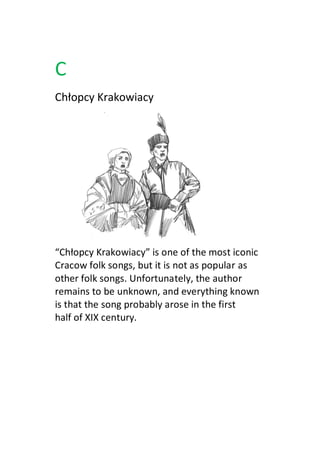
Chłopcy Krakowiacy
“Chłopcy Krakowiacy” is one of the most iconic
Cracow folk songs, but it is not as popular as
other folk songs. Unfortunately, the author
remains to be unknown, and everything known
is that the song probably arose in the first
half of XIX century.
K
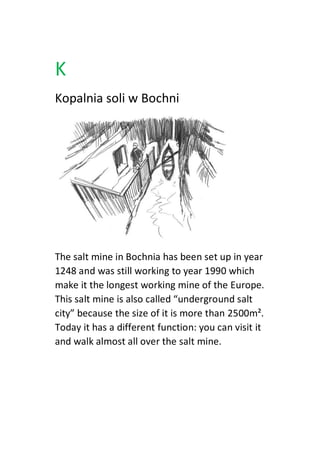
Kopalnia soli w Bochni
The salt mine in Bochnia has been set up in year
1248 and was still working to year 1990 which
make it the longest working mine of the Europe.
This salt mine is also called “underground salt
city” because the size of it is more than 2500m².
Today it has a different function: you can visit it
and walk almost all over the salt mine.
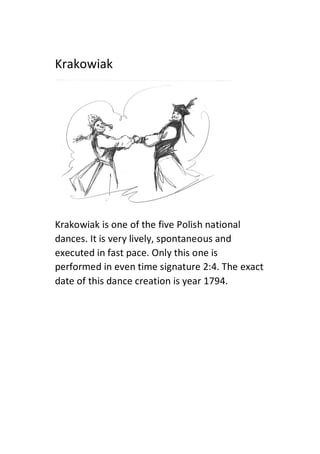
Krakowiak
Krakowiak is one of the five Polish national
dances. It is very lively, spontaneous and
executed in fast pace. Only this one is
performed in even time signature 2:4. The exact
date of this dance creation is year 1794.
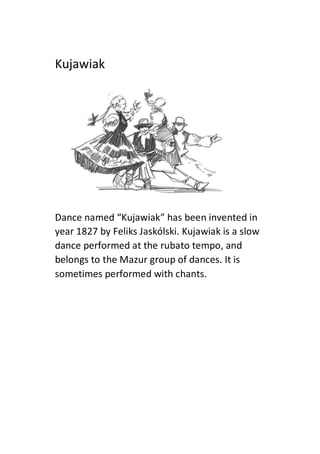
Kujawiak
Dance named “Kujawiak” has been invented in
year 1827 by Feliks Jaskólski. Kujawiak is a slow
dance performed at the rubato tempo, and
belongs to the Mazur group of dances. It is
sometimes performed with chants.
M
Malbork
The Malbork castle is situated in the
Pomeranian voivodeship. Since year 1309 the
Malbork castle was a headquarter of the
Teutonic Order. It’s also the world biggest castle
built in the gothic style and it covers the area of
21 hectares. In the year 1961 the government
decided to create a museum in this castle and it
performs this function to this day.
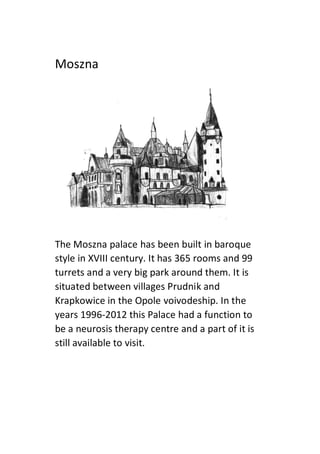
Moszna
The Moszna palace has been built in baroque
style in XVIII century. It has 365 rooms and 99
turrets and a very big park around them. It is
situated between villages Prudnik and
Krapkowice in the Opole voivodeship. In the
years 1996-2012 this Palace had a function to
be a neurosis therapy centre and a part of it is
still available to visit.
O
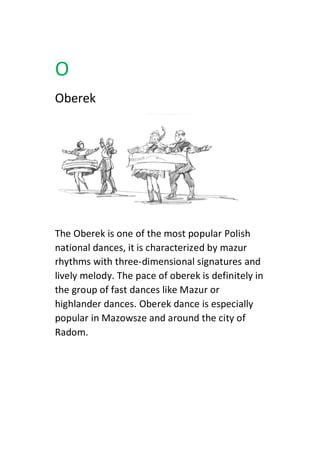
Oberek
The Oberek is one of the most popular Polish
national dances, it is characterized by mazur
rhythms with three-dimensional signatures and
lively melody. The pace of oberek is definitely in
the group of fast dances like Mazur or
highlander dances. Oberek dance is especially
popular in Mazowsze and around the city of
Radom.
P
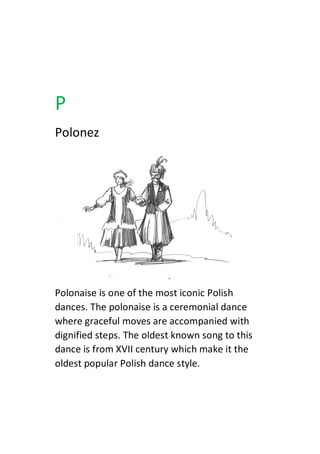
Polonez
Polonaise is one of the most iconic Polish
dances. The polonaise is a ceremonial dance
where graceful moves are accompanied with
dignified steps. The oldest known song to this
dance is from XVII century which make it the
oldest popular Polish dance style.
T
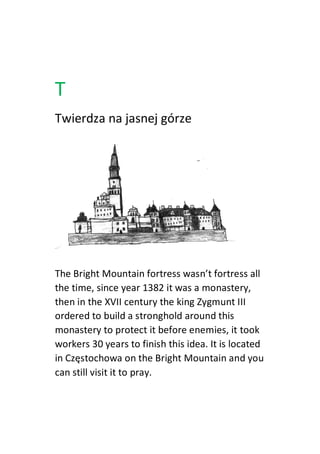
Twierdza na jasnej górze
The Bright Mountain fortress wasn’t fortress all
the time, since year 1382 it was a monastery,
then in the XVII century the king Zygmunt III
ordered to build a stronghold around this
monastery to protect it before enemies, it took
workers 30 years to finish this idea. It is located
in Częstochowa on the Bright Mountain and you
can still visit it to pray.
W
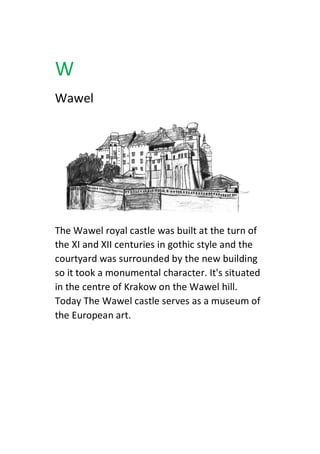
Wawel
The Wawel royal castle was built at the turn of
the XI and XII centuries in gothic style and the
courtyard was surrounded by the new building
so it took a monumental character. It's situated
in the centre of Krakow on the Wawel hill.
Today The Wawel castle serves as a museum of
the European art.

cultural_Jedruszek.pdf

  • 1.
    The dictionary ofCultural Heritage Patterns Author: Franciszek Jędruszek
  • 2.
    C Chłopcy Krakowiacy “Chłopcy Krakowiacy”is one of the most iconic Cracow folk songs, but it is not as popular as other folk songs. Unfortunately, the author remains to be unknown, and everything known is that the song probably arose in the first half of XIX century.
  • 3.
    K Kopalnia soli wBochni The salt mine in Bochnia has been set up in year 1248 and was still working to year 1990 which make it the longest working mine of the Europe. This salt mine is also called “underground salt city” because the size of it is more than 2500m². Today it has a different function: you can visit it and walk almost all over the salt mine.
  • 4.
    Krakowiak Krakowiak is oneof the five Polish national dances. It is very lively, spontaneous and executed in fast pace. Only this one is performed in even time signature 2:4. The exact date of this dance creation is year 1794.
  • 5.
    Kujawiak Dance named “Kujawiak”has been invented in year 1827 by Feliks Jaskólski. Kujawiak is a slow dance performed at the rubato tempo, and belongs to the Mazur group of dances. It is sometimes performed with chants.
  • 6.
    M Malbork The Malbork castleis situated in the Pomeranian voivodeship. Since year 1309 the Malbork castle was a headquarter of the Teutonic Order. It’s also the world biggest castle built in the gothic style and it covers the area of 21 hectares. In the year 1961 the government decided to create a museum in this castle and it performs this function to this day.
  • 7.
    Moszna The Moszna palacehas been built in baroque style in XVIII century. It has 365 rooms and 99 turrets and a very big park around them. It is situated between villages Prudnik and Krapkowice in the Opole voivodeship. In the years 1996-2012 this Palace had a function to be a neurosis therapy centre and a part of it is still available to visit.
  • 8.
    O Oberek The Oberek isone of the most popular Polish national dances, it is characterized by mazur rhythms with three-dimensional signatures and lively melody. The pace of oberek is definitely in the group of fast dances like Mazur or highlander dances. Oberek dance is especially popular in Mazowsze and around the city of Radom.
  • 9.
    P Polonez Polonaise is oneof the most iconic Polish dances. The polonaise is a ceremonial dance where graceful moves are accompanied with dignified steps. The oldest known song to this dance is from XVII century which make it the oldest popular Polish dance style.
  • 10.
    T Twierdza na jasnejgórze The Bright Mountain fortress wasn’t fortress all the time, since year 1382 it was a monastery, then in the XVII century the king Zygmunt III ordered to build a stronghold around this monastery to protect it before enemies, it took workers 30 years to finish this idea. It is located in Częstochowa on the Bright Mountain and you can still visit it to pray.
  • 11.
    W Wawel The Wawel royalcastle was built at the turn of the XI and XII centuries in gothic style and the courtyard was surrounded by the new building so it took a monumental character. It's situated in the centre of Krakow on the Wawel hill. Today The Wawel castle serves as a museum of the European art.