Monitory Policy
By : Abhishek Dubey
?1. What is monetary policy?
2. Why should a country need a monetary policy?
3. Who makes it?
4. What is the purpose of a monetary policy?
5. What are the instruments used for it?
History
Monetary Policy Committee. The Reserve Bank of
India Act, 1934 (RBI Act) was amended by the
Finance Act, 2016, to provide for a statutory and
institutionalised framework for a Monetary
Policy Committee, for maintaining price stability,
while keeping in mind the objective of growth.
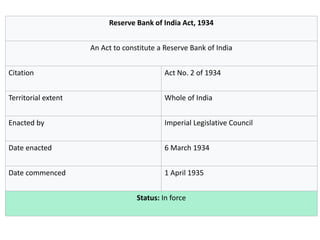
Reserve Bank of India Act, 1934
An Act to constitute a Reserve Bank of India
Citation Act No. 2 of 1934
Territorial extent Whole of India
Enacted by Imperial Legislative Council
Date enacted 6 March 1934
Date commenced 1 April 1935
Status: In force
Definitions
"A policy employing the central banks control of the supply of
money as an instrument for achieving the objectives of general
economic policy is a monetary policy."
According to Prof. Harry Johnson,
"A policy which influences the public stock of money substitute of
public demand for such assets of both that is policy which
influences public liquidity position is known as a monetary policy."
According to A.G. Hart,
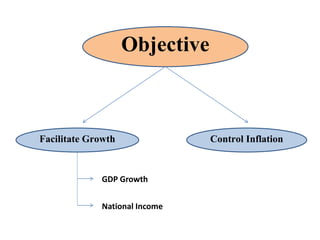
Objective
Facilitate Growth Control Inflation
GDP Growth
National Income
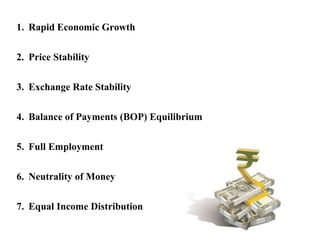
1. Rapid Economic Growth
2. Price Stability
3. Exchange Rate Stability
4. Balance of Payments (BOP) Equilibrium
5. Full Employment
6. Neutrality of Money
7. Equal Income Distribution
Elements of Monetary policy
1. It regulates the stocks and the growth rate of money supply.
2. It regulates the entire banking system of the economy.
3. It determines the allocation of loans among different sectors.
4. It provides incentives to promote savings and to raise the savings-
income ratio.
5. It ensures adequate availability of credit for growth and tries to achieve
price stability.
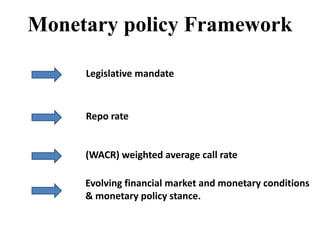
Monetary policy Framework
Legislative mandate
Repo rate
(WACR) weighted average call rate
Evolving financial market and monetary conditions
& monetary policy stance.
FITF
• Flexible Inflation Targeting Framework: Now there is a flexible inflation targeting
framework in India (after the 2016 amendment to the Reserve Bank of India (RBI)
Act, 1934).
• Who sets inflation target in India: The amended RBI Act provides for the inflation
target to be set by the Government of India, in consultation with the Reserve Bank,
once in every fiveyears.
• Current Inflation Target: The Central Government has notified 4 percent Consumer
Price Index (CPI) inflation as the target with the upper tolerance limit of 6 percent
and the lower tolerance limit of 2 percent.
• Factors that constitute a failure to achieve the inflation target: (1) the average
inflation is more than the upper tolerance level of the inflation target for any three
consecutive quarters, OR (2) the average inflation is less than the lower tolerance
level for any three consecutive quarters.
Present MPC
• Governor of the Reserve Bank of India – Chairperson, ex officio;
• Deputy Governor of the Reserve Bank of India, in charge of Monetary Policy –
Member, ex officio;
• One officer of the Reserve Bank of India to be nominated by the Central Board
– Member, ex officio;
• Shri Chetan Ghate, Professor, Indian Statistical Institute (ISI) – Member;
• Professor Pami Dua, Director, Delhi School of Economics – Member; and
• Dr. Ravindra H. Dholakia, Professor, Indian Institute of Management,
Ahmedabad – Member.(Members referred to at 4 to 6 above, will hold office
for a period of four years or until further orders, whichever is earlier.
MPP
• The Monetary Policy Committee (MPC) determines the policy interest rate
required to achieve the inflation target.
• The Reserve Bank’s Monetary Policy Department (MPD) assists the MPC in
formulating the monetary policy. Views of key stakeholders in the economy and
analytical work of the Reserve Bank contribute to the process for arriving at the
decision on the policy repo rate.
• The Financial Markets Operations Department (FMOD) operationalises the
monetary policy, mainly through day-to-day liquidity management operations.
• The Financial Market Committee (FMC) meets daily to review the liquidity
conditions so as to ensure that the operating target of monetary policy (weighted
average lending rate) is kept close to the policy repo rate. This parameter is also
known as weighted average call money rate (WACR).
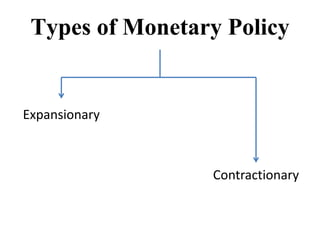
Types of Monetary Policy
Expansionary
Contractionary
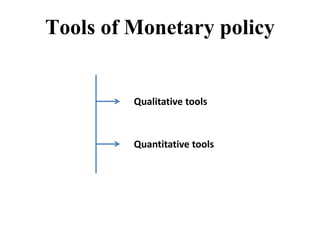
Tools of Monetary policy
Qualitative tools
Quantitative tools
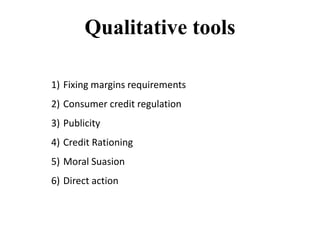
Qualitative tools
1) Fixing margins requirements
2) Consumer credit regulation
3) Publicity
4) Credit Rationing
5) Moral Suasion
6) Direct action
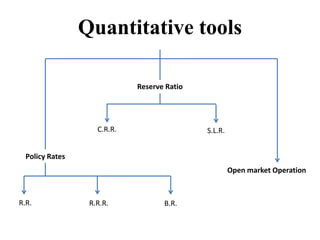
Quantitative tools
Policy Rates
Reserve Ratio
R.R.
S.L.R.C.R.R.
B.R.R.R.R.
Open market Operation
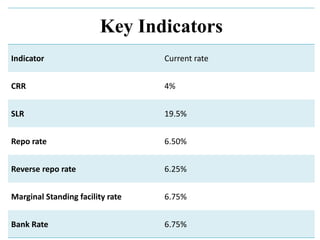
Key Indicators
Indicator Current rate
CRR 4%
SLR 19.5%
Repo rate 6.50%
Reverse repo rate 6.25%
Marginal Standing facility rate 6.75%
Bank Rate 6.75%
1. https://businessjargons.com/types-of-monetary-policy.html
2. http://kalyan-city.blogspot.com/2010/09/monetary-policy-its-meaning-
definitions.html
3. https://www.bankbazaar.com/finance-tools/emi-calculator/monetary-
policy.html?ck=Y%2BziX71XnZjIM9ZwEflsyDYlRL7gaN4W0xhuJSr9Iq7aMYwRm2IP
ACTQB2XBBtGG&rc=1
4. https://www.rbi.org.in/scripts/fs_overview.aspx?fn=2752
5. https://www.clearias.com/monetary-policy/
Sources
Thank you

Monitory policy

  • 1.
    Monitory Policy By :Abhishek Dubey
  • 2.
    ?1. What ismonetary policy? 2. Why should a country need a monetary policy? 3. Who makes it? 4. What is the purpose of a monetary policy? 5. What are the instruments used for it?
  • 3.
    History Monetary Policy Committee.The Reserve Bank of India Act, 1934 (RBI Act) was amended by the Finance Act, 2016, to provide for a statutory and institutionalised framework for a Monetary Policy Committee, for maintaining price stability, while keeping in mind the objective of growth.
  • 4.
    Reserve Bank ofIndia Act, 1934 An Act to constitute a Reserve Bank of India Citation Act No. 2 of 1934 Territorial extent Whole of India Enacted by Imperial Legislative Council Date enacted 6 March 1934 Date commenced 1 April 1935 Status: In force
  • 5.
    Definitions "A policy employingthe central banks control of the supply of money as an instrument for achieving the objectives of general economic policy is a monetary policy." According to Prof. Harry Johnson, "A policy which influences the public stock of money substitute of public demand for such assets of both that is policy which influences public liquidity position is known as a monetary policy." According to A.G. Hart,
  • 6.
    Objective Facilitate Growth ControlInflation GDP Growth National Income
  • 7.
    1. Rapid EconomicGrowth 2. Price Stability 3. Exchange Rate Stability 4. Balance of Payments (BOP) Equilibrium 5. Full Employment 6. Neutrality of Money 7. Equal Income Distribution
  • 8.
    Elements of Monetarypolicy 1. It regulates the stocks and the growth rate of money supply. 2. It regulates the entire banking system of the economy. 3. It determines the allocation of loans among different sectors. 4. It provides incentives to promote savings and to raise the savings- income ratio. 5. It ensures adequate availability of credit for growth and tries to achieve price stability.
  • 9.
    Monetary policy Framework Legislativemandate Repo rate (WACR) weighted average call rate Evolving financial market and monetary conditions & monetary policy stance.
  • 10.
    FITF • Flexible InflationTargeting Framework: Now there is a flexible inflation targeting framework in India (after the 2016 amendment to the Reserve Bank of India (RBI) Act, 1934). • Who sets inflation target in India: The amended RBI Act provides for the inflation target to be set by the Government of India, in consultation with the Reserve Bank, once in every fiveyears. • Current Inflation Target: The Central Government has notified 4 percent Consumer Price Index (CPI) inflation as the target with the upper tolerance limit of 6 percent and the lower tolerance limit of 2 percent. • Factors that constitute a failure to achieve the inflation target: (1) the average inflation is more than the upper tolerance level of the inflation target for any three consecutive quarters, OR (2) the average inflation is less than the lower tolerance level for any three consecutive quarters.
  • 11.
    Present MPC • Governorof the Reserve Bank of India – Chairperson, ex officio; • Deputy Governor of the Reserve Bank of India, in charge of Monetary Policy – Member, ex officio; • One officer of the Reserve Bank of India to be nominated by the Central Board – Member, ex officio; • Shri Chetan Ghate, Professor, Indian Statistical Institute (ISI) – Member; • Professor Pami Dua, Director, Delhi School of Economics – Member; and • Dr. Ravindra H. Dholakia, Professor, Indian Institute of Management, Ahmedabad – Member.(Members referred to at 4 to 6 above, will hold office for a period of four years or until further orders, whichever is earlier.
  • 12.
    MPP • The MonetaryPolicy Committee (MPC) determines the policy interest rate required to achieve the inflation target. • The Reserve Bank’s Monetary Policy Department (MPD) assists the MPC in formulating the monetary policy. Views of key stakeholders in the economy and analytical work of the Reserve Bank contribute to the process for arriving at the decision on the policy repo rate. • The Financial Markets Operations Department (FMOD) operationalises the monetary policy, mainly through day-to-day liquidity management operations. • The Financial Market Committee (FMC) meets daily to review the liquidity conditions so as to ensure that the operating target of monetary policy (weighted average lending rate) is kept close to the policy repo rate. This parameter is also known as weighted average call money rate (WACR).
  • 13.
    Types of MonetaryPolicy Expansionary Contractionary
  • 14.
    Tools of Monetarypolicy Qualitative tools Quantitative tools
  • 15.
    Qualitative tools 1) Fixingmargins requirements 2) Consumer credit regulation 3) Publicity 4) Credit Rationing 5) Moral Suasion 6) Direct action
  • 16.
    Quantitative tools Policy Rates ReserveRatio R.R. S.L.R.C.R.R. B.R.R.R.R. Open market Operation
  • 17.
    Key Indicators Indicator Currentrate CRR 4% SLR 19.5% Repo rate 6.50% Reverse repo rate 6.25% Marginal Standing facility rate 6.75% Bank Rate 6.75%
  • 18.
    1. https://businessjargons.com/types-of-monetary-policy.html 2. http://kalyan-city.blogspot.com/2010/09/monetary-policy-its-meaning- definitions.html 3.https://www.bankbazaar.com/finance-tools/emi-calculator/monetary- policy.html?ck=Y%2BziX71XnZjIM9ZwEflsyDYlRL7gaN4W0xhuJSr9Iq7aMYwRm2IP ACTQB2XBBtGG&rc=1 4. https://www.rbi.org.in/scripts/fs_overview.aspx?fn=2752 5. https://www.clearias.com/monetary-policy/ Sources
  • 19.