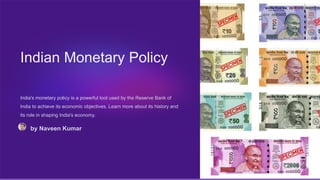
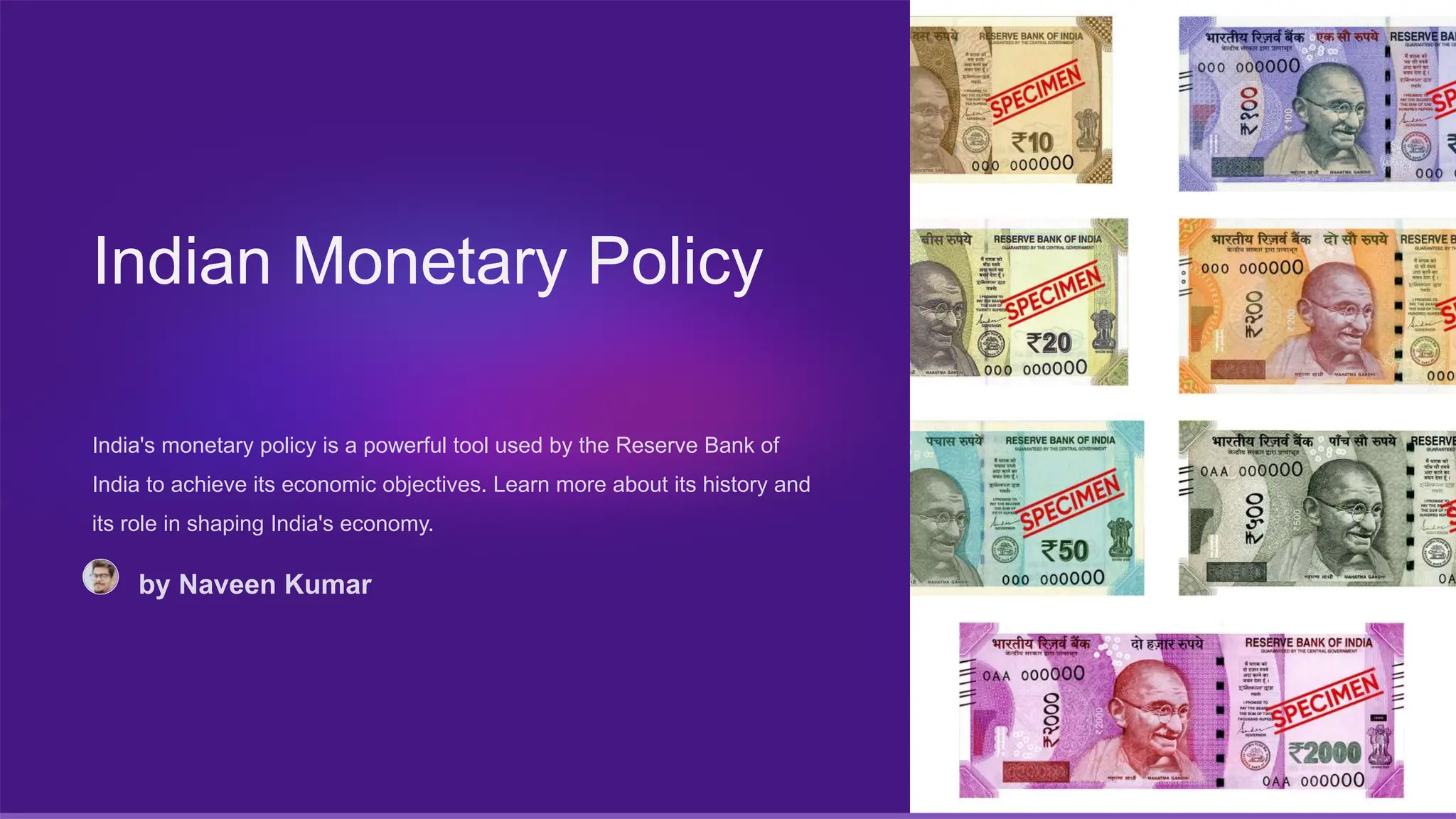
Indian Monetary Policy
India's monetary policy is a powerful tool used by the Reserve Bank of
India to achieve its economic objectives. Learn more about its history and
its role in shaping India's economy.
by Naveen Kumar
Background on India's Monetary Policy
Pre-Independence
Before gaining independence in
1947, India was under British rule.
The British Raj established a fixed
exchange rate system and paper
currency.
Post-Independence
After independence, the
government of India established the
Reserve Bank of India (RBI) in
1935 to improve the country's
monetary system.
Modern Era
The 1991 economic liberalization
policy ushered in a new era of
market-oriented economic policy,
including the gradual deregulation
of interest rates.
Objectives and Goals of Monetary Policy
1
Price Stability
The RBI aims to achieve
an inflation target of 4%
while keeping a 2%
margin on either side.
Achieving price stability
is critical for economic
growth.
2
Economic Growth
The monetary policy
aims to stimulate
economic growth while
maintaining financial
stability. Growth is the
primary objective of the
country.
3
Regulating the
Money Supply
The RBI regulates the
money supply to
maintain economic
equilibrium. It achieves it
through various tools
like CRR and SLR.
4
Exchange Rate
Management
The RBI manages the
exchange rate of Indian
currency and aims to
maintain its long-term
external value in the
world market.
Key Players in Implementing the Policy
Reserve Bank of India
The RBI's role is to formulate the
monetary policy and make sure that it is
implemented effectively.
Finance Ministry
The Finance Ministry, through the
Economic Affairs Department,
collaborates with the RBI to formulate
and implement monetary policy.
Bankers
Commercial bankers, who operate in
the money market, play a vital role in
the monetary policy's effectiveness.
They implement the policy and transmit
its impact on the economy.
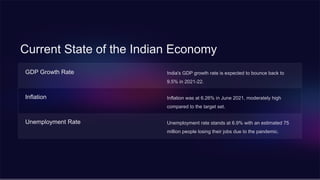
Current State of the Indian Economy
GDP Growth Rate India's GDP growth rate is expected to bounce back to
9.5% in 2021-22.
Inflation Inflation was at 6.26% in June 2021, moderately high
compared to the target set.
Unemployment Rate Unemployment rate stands at 6.9% with an estimated 75
million people losing their jobs due to the pandemic.
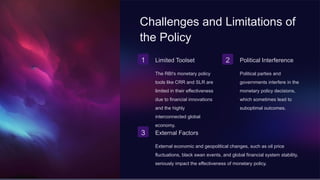
Challenges and Limitations of
the Policy
1 Limited Toolset
The RBI's monetary policy
tools like CRR and SLR are
limited in their effectiveness
due to financial innovations
and the highly
interconnected global
economy.
2 Political Interference
Political parties and
governments interfere in the
monetary policy decisions,
which sometimes lead to
suboptimal outcomes.
3 External Factors
External economic and geopolitical changes, such as oil price
fluctuations, black swan events, and global financial system stability,
seriously impact the effectiveness of monetary policy.
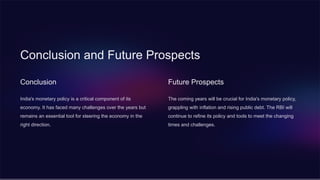
Conclusion and Future Prospects
Conclusion
India's monetary policy is a critical component of its
economy. It has faced many challenges over the years but
remains an essential tool for steering the economy in the
right direction.
Future Prospects
The coming years will be crucial for India's monetary policy,
grappling with inflation and rising public debt. The RBI will
continue to refine its policy and tools to meet the changing
times and challenges.

Indian-Monetary-Policy. diffrent time resoruce

  • 1.
    Indian Monetary Policy India'smonetary policy is a powerful tool used by the Reserve Bank of India to achieve its economic objectives. Learn more about its history and its role in shaping India's economy. by Naveen Kumar
  • 2.
    Background on India'sMonetary Policy Pre-Independence Before gaining independence in 1947, India was under British rule. The British Raj established a fixed exchange rate system and paper currency. Post-Independence After independence, the government of India established the Reserve Bank of India (RBI) in 1935 to improve the country's monetary system. Modern Era The 1991 economic liberalization policy ushered in a new era of market-oriented economic policy, including the gradual deregulation of interest rates.
  • 3.
    Objectives and Goalsof Monetary Policy 1 Price Stability The RBI aims to achieve an inflation target of 4% while keeping a 2% margin on either side. Achieving price stability is critical for economic growth. 2 Economic Growth The monetary policy aims to stimulate economic growth while maintaining financial stability. Growth is the primary objective of the country. 3 Regulating the Money Supply The RBI regulates the money supply to maintain economic equilibrium. It achieves it through various tools like CRR and SLR. 4 Exchange Rate Management The RBI manages the exchange rate of Indian currency and aims to maintain its long-term external value in the world market.
  • 4.
    Key Players inImplementing the Policy Reserve Bank of India The RBI's role is to formulate the monetary policy and make sure that it is implemented effectively. Finance Ministry The Finance Ministry, through the Economic Affairs Department, collaborates with the RBI to formulate and implement monetary policy. Bankers Commercial bankers, who operate in the money market, play a vital role in the monetary policy's effectiveness. They implement the policy and transmit its impact on the economy.
  • 5.
    Current State ofthe Indian Economy GDP Growth Rate India's GDP growth rate is expected to bounce back to 9.5% in 2021-22. Inflation Inflation was at 6.26% in June 2021, moderately high compared to the target set. Unemployment Rate Unemployment rate stands at 6.9% with an estimated 75 million people losing their jobs due to the pandemic.
  • 6.
    Challenges and Limitationsof the Policy 1 Limited Toolset The RBI's monetary policy tools like CRR and SLR are limited in their effectiveness due to financial innovations and the highly interconnected global economy. 2 Political Interference Political parties and governments interfere in the monetary policy decisions, which sometimes lead to suboptimal outcomes. 3 External Factors External economic and geopolitical changes, such as oil price fluctuations, black swan events, and global financial system stability, seriously impact the effectiveness of monetary policy.
  • 7.
    Conclusion and FutureProspects Conclusion India's monetary policy is a critical component of its economy. It has faced many challenges over the years but remains an essential tool for steering the economy in the right direction. Future Prospects The coming years will be crucial for India's monetary policy, grappling with inflation and rising public debt. The RBI will continue to refine its policy and tools to meet the changing times and challenges.