participatory  – engage a wide range of stakeholders minimum and cost-effective  – don’t overcomplicate,  not  too technical gender aware  – disaggregated data collection… builds capacity  – develops the understanding of participants Monitoring Systems: Principles 1 Adapted from INTRAC (2008)
1.  Stakeholder Engagement:   Has there been adequate  consultation  with those who collect or use the information? (staff, donors, beneficiaries, others) Is there appropriate  buy-in , ownership and balance of power between these key stakeholders? 2 Adapted from Ausaid 2006 Monitoring Systems: Checklist 2
2. Theory of Change: Are stakeholders clear on what the programme is trying to achieve? Is there a clear theory / logic on how it is going to get there (activities-outcomes link)? Monitoring Systems: Checklist
3. Information Requirements:  Is it clear what information is to be collected,  when, where from and how?  Will the system capture info on the major changes – the  outcomes  that the programme seeks to make? How will the system capture info on  unintended  outcomes and consequences? Monitoring Systems: Checklist
4. Responsibilities and Resourcing:  Who  will contribute to what and when? (operations plan) How  will all monitoring activities be  paid for  and resourced? (budget checklist) Monitoring Systems: Checklist
5. Partner Capacity:   Is the M&E framework  proportional  to the activity expenditure and complexity? Does the framework  build on existing knowledge  and practice?  What is the  capacity of individuals  at each level to use the system? Is there a monitoring  capacity-building plan ?  Monitoring Systems: Checklist
6. Learning:  Are the sufficient mechanisms and incentives for  sharing  information? Will  ‘failures’  be safely admitted and analysed? Monitoring Systems: Checklist
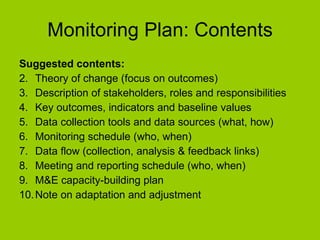
Monitoring Plan: Contents Suggested contents: Theory of change (focus on outcomes) Description of stakeholders, roles and responsibilities Key outcomes, indicators and baseline values Data collection tools and data sources (what, how) Monitoring schedule (who, when) Data flow (collection, analysis & feedback links) Meeting and reporting schedule (who, when) M&E capacity-building plan Note on adaptation and adjustment
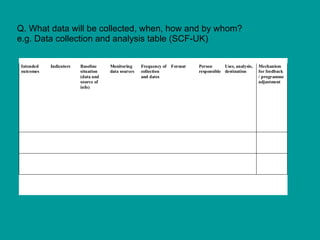
Q. What data will be collected, when, how and by whom? e.g. Data collection and analysis table (SCF-UK)
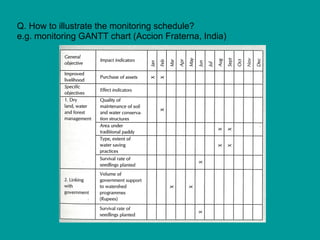
Q. How to illustrate the monitoring schedule? e.g. monitoring GANTT chart (Accion Fraterna, India)
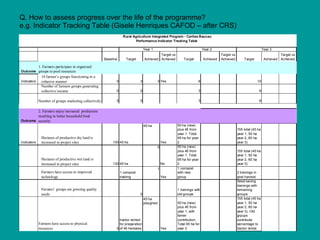
Q. How to assess progress over the life of the programme? e.g. Indicator Tracking Table (Gisele Henriques CAFOD – after CRS)
Q. How to develop an M&E capacity-building plan? e.g. M&E capacity assessment (HIV AIDS alliance)

Monitoring Systems Cafod

  • 1.
    participatory –engage a wide range of stakeholders minimum and cost-effective – don’t overcomplicate, not too technical gender aware – disaggregated data collection… builds capacity – develops the understanding of participants Monitoring Systems: Principles 1 Adapted from INTRAC (2008)
  • 2.
    1. StakeholderEngagement: Has there been adequate consultation with those who collect or use the information? (staff, donors, beneficiaries, others) Is there appropriate buy-in , ownership and balance of power between these key stakeholders? 2 Adapted from Ausaid 2006 Monitoring Systems: Checklist 2
  • 3.
    2. Theory ofChange: Are stakeholders clear on what the programme is trying to achieve? Is there a clear theory / logic on how it is going to get there (activities-outcomes link)? Monitoring Systems: Checklist
  • 4.
    3. Information Requirements: Is it clear what information is to be collected, when, where from and how? Will the system capture info on the major changes – the outcomes that the programme seeks to make? How will the system capture info on unintended outcomes and consequences? Monitoring Systems: Checklist
  • 5.
    4. Responsibilities andResourcing: Who will contribute to what and when? (operations plan) How will all monitoring activities be paid for and resourced? (budget checklist) Monitoring Systems: Checklist
  • 6.
    5. Partner Capacity: Is the M&E framework proportional to the activity expenditure and complexity? Does the framework build on existing knowledge and practice? What is the capacity of individuals at each level to use the system? Is there a monitoring capacity-building plan ? Monitoring Systems: Checklist
  • 7.
    6. Learning: Are the sufficient mechanisms and incentives for sharing information? Will ‘failures’ be safely admitted and analysed? Monitoring Systems: Checklist
  • 8.
    Monitoring Plan: ContentsSuggested contents: Theory of change (focus on outcomes) Description of stakeholders, roles and responsibilities Key outcomes, indicators and baseline values Data collection tools and data sources (what, how) Monitoring schedule (who, when) Data flow (collection, analysis & feedback links) Meeting and reporting schedule (who, when) M&E capacity-building plan Note on adaptation and adjustment
  • 9.
    Q. What datawill be collected, when, how and by whom? e.g. Data collection and analysis table (SCF-UK)
  • 10.
    Q. How toillustrate the monitoring schedule? e.g. monitoring GANTT chart (Accion Fraterna, India)
  • 11.
    Q. How toassess progress over the life of the programme? e.g. Indicator Tracking Table (Gisele Henriques CAFOD – after CRS)
  • 12.
    Q. How todevelop an M&E capacity-building plan? e.g. M&E capacity assessment (HIV AIDS alliance)