Ger Hartnett & Alan Spencer 
MongoDB Dublin
Overview 
• Fictional story of a startup using MongoDB & 
MEAN stack to build IoT application 
• We’ll take a devops perspective - show you what 
to watch out for a framework like MEAN 
• Tips you can use to help development team focus 
on the right things when close to production 
• Questions 
• How many from operations? 
• How many from development? 
2
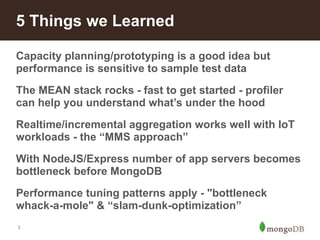
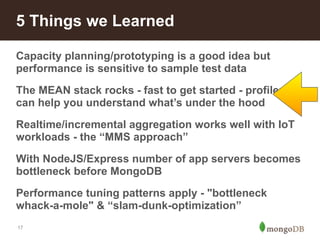
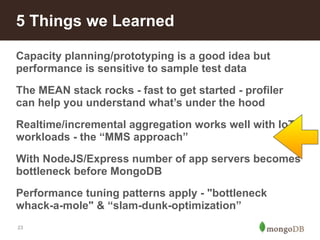
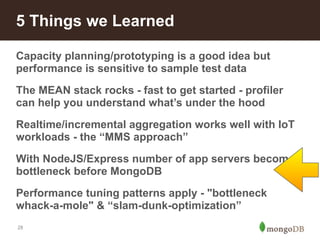
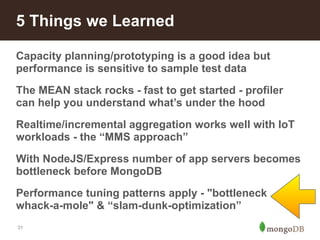
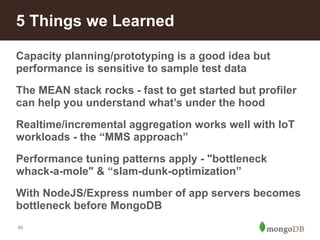
5 Things we Learned 
Capacity planning/prototyping is a good idea but 
performance is sensitive to sample test data 
The MEAN stack rocks - fast to get started - profiler 
can help you understand what’s under the hood 
Realtime/incremental aggregation works well with IoT 
workloads - the “MMS approach” 
With NodeJS/Express number of app servers becomes 
bottleneck before MongoDB 
Performance tuning patterns apply - "bottleneck 
whack-a-mole" & “slam-dunk-optimization” 
3
Context: IoT & MEAN
Internet of Things 
Big Data => Humongous Data 
“The rise of device oriented development … 
new architectural and workflow challenges 
… distinctly different from … web and 
mobile development so far.” - Morten Bagai
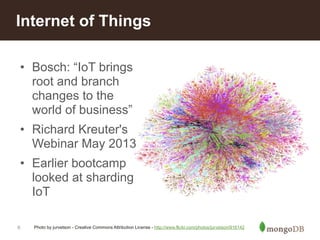
Internet of Things 
• Bosch: “IoT brings 
root and branch 
changes to the 
world of business” 
• Richard Kreuter's 
Webinar May 2013 
• Earlier bootcamp 
looked at sharding 
IoT 
6 
Photo by jurvetson - Creative Commons Attribution License - http://www.flickr.com/photos/jurvetson/916142
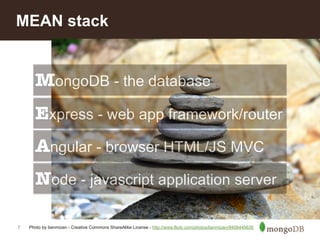
MEAN stack 
7 
MongoDB - the database 
Express - web app framework/router 
Angular - browser HTML/JS MVC 
Node - javascript application server 
Photo by benmizen - Creative Commons ShareAlike License - http://www.flickr.com/photos/benmizen/9456440635
Learn more about MEAN 
Valeri Karpov - MongoDB Kernel Tools Team 
http://thecodebarbarian.wordpress.com/2013/07/22/ 
introduction-to-the-mean-stack-part-one-setting-up-your-tools/ 
MEAN.io 
http://mean.io 
8
About MongoDB Bootcamp 
We invest in technical new hires 
Everyone does “bootcamp” 
NYC for 2 weeks - product internals 
Then work on a longer project 3-4 weeks 
In our case: wanted to do a bit of everything, 
capacity planning, iterate user-stories, MongoDB 
a component 
9
The Application
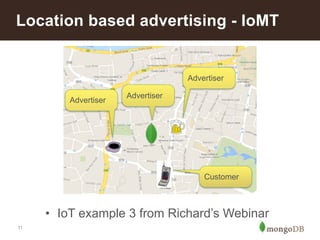
Location based advertising - IoMT 
11 
! 
! 
Advertiser 
! 
Advertiser Advertiser 
! 
! 
! 
! 
Customer 
! 
• IoT example 3 from Richard’s Webinar
User Stories - for the application 
US1 - customer looks 
for advertisers near 
US2 - advertiser wants 
to see how many 
customers saw offer 
US3 - find hot spots 
where many customers 
but few advertisers 
12 
Photo by consumerist - Creative Commons Attribution License - http://www.flickr.com/photos/consumerist/2158190589
Document / Model / Controller 
Model (advertiser.js) Document 
Haystack examples sent us in 
wrong direction initially 
exports.all = function(req, res) {! 
! findQuery = { near: [ Number(req.query.lng), Number(req.query.lat) ],! 
! ! maxDistance: Number(req.query.dist) };! 
! Advertiser.geoSearch({kind:"pub"}, findQuery, ! 
! ! function (err, advertisers) {! 
// error handling! 
! !! res.jsonp(advertisers);! 
! ! });! 
} 
13 
{ 
name: ‘Long Hall’, 
pos: [-6.265535, 53.3418364], 
kind: “pub” 
} 
AdvertiserSchema = new Schema({! 
name: { type: String,! 
default: ‘’},! 
pos: [Number],! 
kind: { type: String,! 
default: ‘place’},! 
}); Controller (advertisers.js)
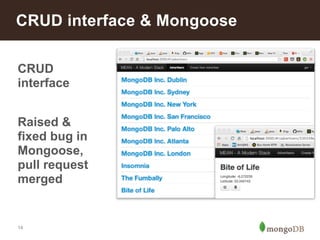
CRUD interface & Mongoose 
CRUD 
interface 
! 
Raised & 
fixed bug in 
Mongoose, 
pull request 
merged 
14
5 Things we Learned 
Capacity planning/prototyping is a good idea but 
performance is sensitive to sample test data 
The MEAN stack rocks - fast to get started - profiler 
can help you understand what’s under the hood 
Realtime/incremental aggregation works well with IoT 
workloads - the “MMS approach” 
With NodeJS/Express number of app servers becomes 
bottleneck before MongoDB 
Performance tuning patterns apply - "bottleneck 
whack-a-mole" & “slam-dunk-optimization” 
15
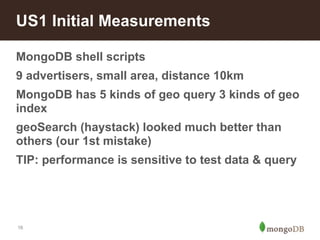
US1 Initial Measurements 
MongoDB shell scripts 
9 advertisers, small area, distance 10km 
MongoDB has 5 kinds of geo query 3 kinds of geo 
index 
geoSearch (haystack) looked much better than 
others (our 1st mistake) 
TIP: performance is sensitive to test data & query 
16
5 Things we Learned 
Capacity planning/prototyping is a good idea but 
performance is sensitive to sample test data 
The MEAN stack rocks - fast to get started - profiler 
can help you understand what’s under the hood 
Realtime/incremental aggregation works well with IoT 
workloads - the “MMS approach” 
With NodeJS/Express number of app servers becomes 
bottleneck before MongoDB 
Performance tuning patterns apply - "bottleneck 
whack-a-mole" & “slam-dunk-optimization” 
17
The good thing about frameworks is… 
! 
they do lot’s of things for developers 
! 
! 
! 
…and the bad thing about frameworks? 
! 
they do lot’s of things for developers
To find out what’s happening - debug 
We used Express passport-http to add Basic- 
Digest auth (client id lookup) 
It can be hard to figure out what a framework like 
express/mongoose really does 
Tip: mongoose.set('debug', true) - detailed logging 
Console 
Mongoose: clients.findOne({ _id: ObjectId(“…”) })! 
Mongoose: advertisers.geoHaystack({…[-6.267765, 53.34087]})! 
19
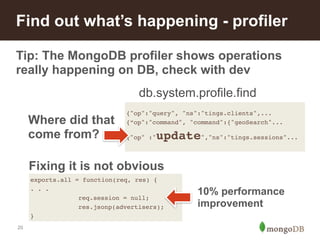
Find out what’s happening - profiler 
Tip: The MongoDB profiler shows operations 
really happening on DB, check with dev 
20 
db.system.profile.find 
{"op":"query", "ns":"tings.clients",...! 
{“op":"command", "command":{"geoSearch"...! 
{"op" :"update","ns":"tings.sessions"...! 
exports.all = function(req, res) {! 
. . .! 
! ! ! req.session = null;! 
! !! res.jsonp(advertisers);! 
} 
10% performance 
improvement 
Where did that 
come from? 
Fixing it is not obvious
Back to the application
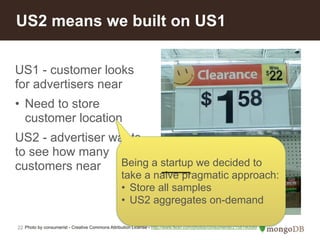
US2 means we built on US1 
US1 - customer looks 
for advertisers near 
• Need to store 
customer location 
US2 - advertiser wants 
to see how many 
customers near 
22 
Being a startup we decided to 
take a naive pragmatic approach: 
• Store all samples 
• US2 aggregates on-demand 
Photo by consumerist - Creative Commons Attribution License - http://www.flickr.com/photos/consumerist/2158190589
5 Things we Learned 
Capacity planning/prototyping is a good idea but 
performance is sensitive to sample test data 
The MEAN stack rocks - fast to get started - profiler 
can help you understand what’s under the hood 
Realtime/incremental aggregation works well with IoT 
workloads - the “MMS approach” 
With NodeJS/Express number of app servers becomes 
bottleneck before MongoDB 
Performance tuning patterns apply - "bottleneck 
whack-a-mole" & “slam-dunk-optimization” 
23
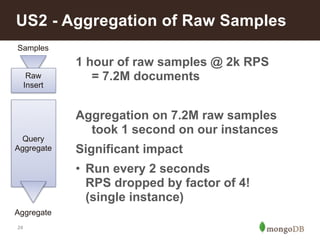
US2 - Aggregation of Raw Samples 
1 hour of raw samples @ 2k RPS 
= 7.2M documents 
! 
Aggregation on 7.2M raw samples 
took 1 second on our instances 
Significant impact 
• Run every 2 seconds 
RPS dropped by factor of 4! 
(single instance) 
Samples 
Query 
Aggregate 
24 
Raw 
Insert 
Aggregate
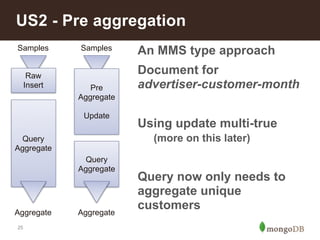
US2 - Pre aggregation 
Samples 
Query 
Aggregate 
25 
Raw 
Insert 
Samples 
Pre 
Aggregate 
! 
Update 
Query 
Aggregate 
Aggregate Aggregate 
An MMS type approach 
Document for 
advertiser-customer-month 
! 
Using update multi-true 
(more on this later) 
! 
Query now only needs to 
aggregate unique 
customers
US1 measurements revisited 
MongoDB shell scripts 
More realistic data - old measurements repeated 
locations 
110k advertisers with clusters in DUB and NYC 
Performance best for near and nearSphere (2x 
better than Haystack) 
26
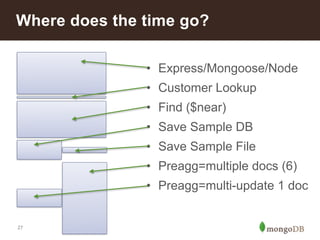
Where does the time go? 
27 
• Express/Mongoose/Node 
• Customer Lookup 
• Find ($near) 
• Save Sample DB 
• Save Sample File 
• Preagg=multiple docs (6) 
• Preagg=multi-update 1 doc
5 Things we Learned 
Capacity planning/prototyping is a good idea but 
performance is sensitive to sample test data 
The MEAN stack rocks - fast to get started - profiler 
can help you understand what’s under the hood 
Realtime/incremental aggregation works well with IoT 
workloads - the “MMS approach” 
With NodeJS/Express number of app servers becomes 
bottleneck before MongoDB 
Performance tuning patterns apply - "bottleneck 
whack-a-mole" & “slam-dunk-optimization” 
28
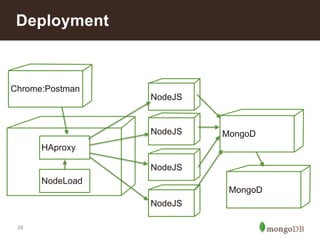
NodeJS MongoD 
MongoD 
Deployment 
Chrome:Postman 
29 
NodeJS 
HAproxy 
NodeLoad 
NodeJS 
NodeJS
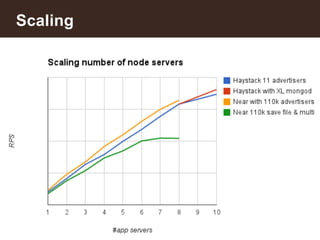
Scaling 
30
5 Things we Learned 
Capacity planning/prototyping is a good idea but 
performance is sensitive to sample test data 
The MEAN stack rocks - fast to get started - profiler 
can help you understand what’s under the hood 
Realtime/incremental aggregation works well with IoT 
workloads - the “MMS approach” 
With NodeJS/Express number of app servers becomes 
bottleneck before MongoDB 
Performance tuning patterns apply - "bottleneck 
whack-a-mole" & “slam-dunk-optimization” 
31
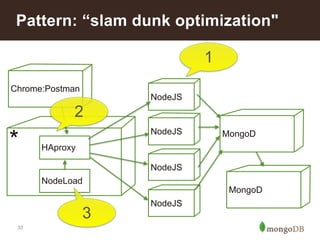
1 - number of Node.JS 
2 - HAproxy 
3 - load gen threads/BW
Pattern: “slam dunk optimization" 
2 
* NodeJS MongoD 
MongoD 
Chrome:Postman 
33 
NodeJS 
HAproxy 
NodeLoad 
NodeJS 
NodeJS 
3 
1
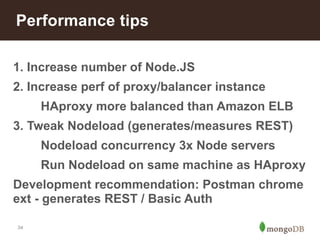
Performance tips 
1. Increase number of Node.JS 
2. Increase perf of proxy/balancer instance 
34 
HAproxy more balanced than Amazon ELB 
3. Tweak Nodeload (generates/measures REST) 
Nodeload concurrency 3x Node servers 
Run Nodeload on same machine as HAproxy 
Development recommendation: Postman chrome 
ext - generates REST / Basic Auth
Back to the application
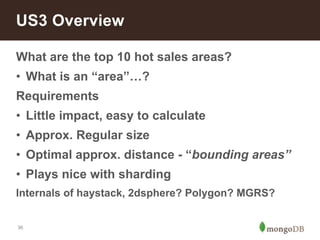
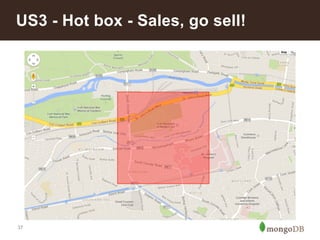
US3 Overview 
What are the top 10 hot sales areas? 
• What is an “area”…? 
Requirements 
• Little impact, easy to calculate 
• Approx. Regular size 
• Optimal approx. distance - “bounding areas” 
• Plays nice with sharding 
Internals of haystack, 2dsphere? Polygon? MGRS? 
36
US3 - Hot box - Sales, go sell! 
37
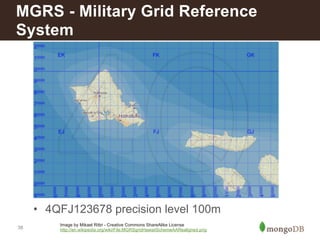
MGRS - Military Grid Reference 
System 
38 
• 4QFJ123678 precision level 100m 
Image by Mikael Rittri - Creative Commons ShareAlike License 
http://en.wikipedia.org/wiki/File:MGRSgridHawaiiSchemeAARealigned.png
MGRS - But at the poles… 
39 
Image by Mikael Rittri - Creative Commons ShareAlike License 
http://en.wikipedia.org/wiki/File:MGRSgridNorthPole.png
Introducing the ‘box’
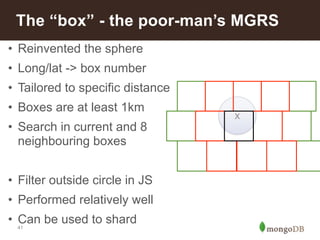
The “box” - the poor-man’s MGRS 
x 
• Reinvented the sphere 
• Long/lat -> box number 
• Tailored to specific distance 
• Boxes are at least 1km 
• Search in current and 8 
neighbouring boxes 
! 
• Filter outside circle in JS 
• Performed relatively well 
• Can be used to shard 
41
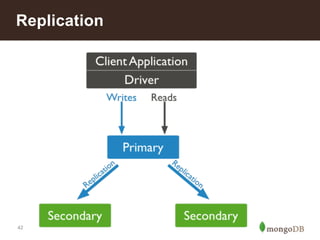
Replication 
42
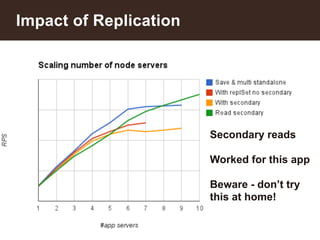
Impact of Replication 
43 
Secondary reads 
! 
Worked for this app 
! 
Beware - don’t try 
this at home!
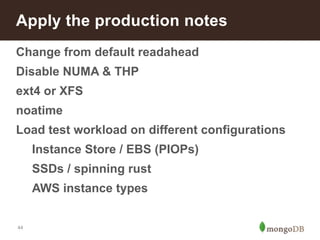
Apply the production notes 
Change from default readahead 
Disable NUMA & THP 
ext4 or XFS 
noatime 
Load test workload on different configurations 
Instance Store / EBS (PIOPs) 
SSDs / spinning rust 
AWS instance types 
44
Recap
5 Things we Learned 
Capacity planning/prototyping is a good idea but 
performance is sensitive to sample test data 
The MEAN stack rocks - fast to get started but profiler 
can help you understand what’s under the hood 
Realtime/incremental aggregation works well with IoT 
workloads - the “MMS approach” 
Performance tuning patterns apply - "bottleneck 
whack-a-mole" & “slam-dunk-optimization” 
With NodeJS/Express number of app servers becomes 
bottleneck before MongoDB 
46
Next Steps
Next Steps 
Plan to publish as blog post series and github 
project 
! 
Check blog.mongodb.org 
! 
Continue to explore… 
48
Next Steps - continuation 
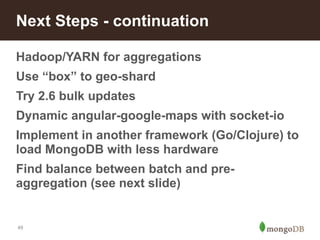
Hadoop/YARN for aggregations 
Use “box” to geo-shard 
Try 2.6 bulk updates 
Dynamic angular-google-maps with socket-io 
Implement in another framework (Go/Clojure) to 
load MongoDB with less hardware 
Find balance between batch and pre-aggregation 
49 
(see next slide)
Learn More & Thank You 
Introduction to MEAN - Valeri Karpov 
http://thecodebarbarian.wordpress.com/2013/07/22/introduction-to-the-mean-stack-part-one-setting-up-your- 
tools/ 
MEAN.io 
http://mean.io 
Richard Kreuter's webinar - M2M 
http://www.mongodb.com/presentations/webinar-realizing-promise-machine-machine-m2m-mongodb 
Building MongoDB Into Your Internet of Things 
http://blog.mongohq.com/building-mongodb-into-your-internet-of-things-a-tutorial/ 
Schema design for time series data (MMS) 
http://blog.mongodb.org/post/65517193370/schema-design-for-time-series-data-in-mongodb 
50
MongoDB and the MEAN Stack

MongoDB and the MEAN Stack

  • 1.
    Ger Hartnett &Alan Spencer MongoDB Dublin
  • 2.
    Overview • Fictionalstory of a startup using MongoDB & MEAN stack to build IoT application • We’ll take a devops perspective - show you what to watch out for a framework like MEAN • Tips you can use to help development team focus on the right things when close to production • Questions • How many from operations? • How many from development? 2
  • 3.
    5 Things weLearned Capacity planning/prototyping is a good idea but performance is sensitive to sample test data The MEAN stack rocks - fast to get started - profiler can help you understand what’s under the hood Realtime/incremental aggregation works well with IoT workloads - the “MMS approach” With NodeJS/Express number of app servers becomes bottleneck before MongoDB Performance tuning patterns apply - "bottleneck whack-a-mole" & “slam-dunk-optimization” 3
  • 4.
  • 5.
    Internet of Things Big Data => Humongous Data “The rise of device oriented development … new architectural and workflow challenges … distinctly different from … web and mobile development so far.” - Morten Bagai
  • 6.
    Internet of Things • Bosch: “IoT brings root and branch changes to the world of business” • Richard Kreuter's Webinar May 2013 • Earlier bootcamp looked at sharding IoT 6 Photo by jurvetson - Creative Commons Attribution License - http://www.flickr.com/photos/jurvetson/916142
  • 7.
    MEAN stack 7 MongoDB - the database Express - web app framework/router Angular - browser HTML/JS MVC Node - javascript application server Photo by benmizen - Creative Commons ShareAlike License - http://www.flickr.com/photos/benmizen/9456440635
  • 8.
    Learn more aboutMEAN Valeri Karpov - MongoDB Kernel Tools Team http://thecodebarbarian.wordpress.com/2013/07/22/ introduction-to-the-mean-stack-part-one-setting-up-your-tools/ MEAN.io http://mean.io 8
  • 9.
    About MongoDB Bootcamp We invest in technical new hires Everyone does “bootcamp” NYC for 2 weeks - product internals Then work on a longer project 3-4 weeks In our case: wanted to do a bit of everything, capacity planning, iterate user-stories, MongoDB a component 9
  • 10.
  • 11.
    Location based advertising- IoMT 11 ! ! Advertiser ! Advertiser Advertiser ! ! ! ! Customer ! • IoT example 3 from Richard’s Webinar
  • 12.
    User Stories -for the application US1 - customer looks for advertisers near US2 - advertiser wants to see how many customers saw offer US3 - find hot spots where many customers but few advertisers 12 Photo by consumerist - Creative Commons Attribution License - http://www.flickr.com/photos/consumerist/2158190589
  • 13.
    Document / Model/ Controller Model (advertiser.js) Document Haystack examples sent us in wrong direction initially exports.all = function(req, res) {! ! findQuery = { near: [ Number(req.query.lng), Number(req.query.lat) ],! ! ! maxDistance: Number(req.query.dist) };! ! Advertiser.geoSearch({kind:"pub"}, findQuery, ! ! ! function (err, advertisers) {! // error handling! ! !! res.jsonp(advertisers);! ! ! });! } 13 { name: ‘Long Hall’, pos: [-6.265535, 53.3418364], kind: “pub” } AdvertiserSchema = new Schema({! name: { type: String,! default: ‘’},! pos: [Number],! kind: { type: String,! default: ‘place’},! }); Controller (advertisers.js)
  • 14.
    CRUD interface &Mongoose CRUD interface ! Raised & fixed bug in Mongoose, pull request merged 14
  • 15.
    5 Things weLearned Capacity planning/prototyping is a good idea but performance is sensitive to sample test data The MEAN stack rocks - fast to get started - profiler can help you understand what’s under the hood Realtime/incremental aggregation works well with IoT workloads - the “MMS approach” With NodeJS/Express number of app servers becomes bottleneck before MongoDB Performance tuning patterns apply - "bottleneck whack-a-mole" & “slam-dunk-optimization” 15
  • 16.
    US1 Initial Measurements MongoDB shell scripts 9 advertisers, small area, distance 10km MongoDB has 5 kinds of geo query 3 kinds of geo index geoSearch (haystack) looked much better than others (our 1st mistake) TIP: performance is sensitive to test data & query 16
  • 17.
    5 Things weLearned Capacity planning/prototyping is a good idea but performance is sensitive to sample test data The MEAN stack rocks - fast to get started - profiler can help you understand what’s under the hood Realtime/incremental aggregation works well with IoT workloads - the “MMS approach” With NodeJS/Express number of app servers becomes bottleneck before MongoDB Performance tuning patterns apply - "bottleneck whack-a-mole" & “slam-dunk-optimization” 17
  • 18.
    The good thingabout frameworks is… ! they do lot’s of things for developers ! ! ! …and the bad thing about frameworks? ! they do lot’s of things for developers
  • 19.
    To find outwhat’s happening - debug We used Express passport-http to add Basic- Digest auth (client id lookup) It can be hard to figure out what a framework like express/mongoose really does Tip: mongoose.set('debug', true) - detailed logging Console Mongoose: clients.findOne({ _id: ObjectId(“…”) })! Mongoose: advertisers.geoHaystack({…[-6.267765, 53.34087]})! 19
  • 20.
    Find out what’shappening - profiler Tip: The MongoDB profiler shows operations really happening on DB, check with dev 20 db.system.profile.find {"op":"query", "ns":"tings.clients",...! {“op":"command", "command":{"geoSearch"...! {"op" :"update","ns":"tings.sessions"...! exports.all = function(req, res) {! . . .! ! ! ! req.session = null;! ! !! res.jsonp(advertisers);! } 10% performance improvement Where did that come from? Fixing it is not obvious
  • 21.
    Back to theapplication
  • 22.
    US2 means webuilt on US1 US1 - customer looks for advertisers near • Need to store customer location US2 - advertiser wants to see how many customers near 22 Being a startup we decided to take a naive pragmatic approach: • Store all samples • US2 aggregates on-demand Photo by consumerist - Creative Commons Attribution License - http://www.flickr.com/photos/consumerist/2158190589
  • 23.
    5 Things weLearned Capacity planning/prototyping is a good idea but performance is sensitive to sample test data The MEAN stack rocks - fast to get started - profiler can help you understand what’s under the hood Realtime/incremental aggregation works well with IoT workloads - the “MMS approach” With NodeJS/Express number of app servers becomes bottleneck before MongoDB Performance tuning patterns apply - "bottleneck whack-a-mole" & “slam-dunk-optimization” 23
  • 24.
    US2 - Aggregationof Raw Samples 1 hour of raw samples @ 2k RPS = 7.2M documents ! Aggregation on 7.2M raw samples took 1 second on our instances Significant impact • Run every 2 seconds RPS dropped by factor of 4! (single instance) Samples Query Aggregate 24 Raw Insert Aggregate
  • 25.
    US2 - Preaggregation Samples Query Aggregate 25 Raw Insert Samples Pre Aggregate ! Update Query Aggregate Aggregate Aggregate An MMS type approach Document for advertiser-customer-month ! Using update multi-true (more on this later) ! Query now only needs to aggregate unique customers
  • 26.
    US1 measurements revisited MongoDB shell scripts More realistic data - old measurements repeated locations 110k advertisers with clusters in DUB and NYC Performance best for near and nearSphere (2x better than Haystack) 26
  • 27.
    Where does thetime go? 27 • Express/Mongoose/Node • Customer Lookup • Find ($near) • Save Sample DB • Save Sample File • Preagg=multiple docs (6) • Preagg=multi-update 1 doc
  • 28.
    5 Things weLearned Capacity planning/prototyping is a good idea but performance is sensitive to sample test data The MEAN stack rocks - fast to get started - profiler can help you understand what’s under the hood Realtime/incremental aggregation works well with IoT workloads - the “MMS approach” With NodeJS/Express number of app servers becomes bottleneck before MongoDB Performance tuning patterns apply - "bottleneck whack-a-mole" & “slam-dunk-optimization” 28
  • 29.
    NodeJS MongoD MongoD Deployment Chrome:Postman 29 NodeJS HAproxy NodeLoad NodeJS NodeJS
  • 30.
  • 31.
    5 Things weLearned Capacity planning/prototyping is a good idea but performance is sensitive to sample test data The MEAN stack rocks - fast to get started - profiler can help you understand what’s under the hood Realtime/incremental aggregation works well with IoT workloads - the “MMS approach” With NodeJS/Express number of app servers becomes bottleneck before MongoDB Performance tuning patterns apply - "bottleneck whack-a-mole" & “slam-dunk-optimization” 31
  • 32.
    1 - numberof Node.JS 2 - HAproxy 3 - load gen threads/BW
  • 33.
    Pattern: “slam dunkoptimization" 2 * NodeJS MongoD MongoD Chrome:Postman 33 NodeJS HAproxy NodeLoad NodeJS NodeJS 3 1
  • 34.
    Performance tips 1.Increase number of Node.JS 2. Increase perf of proxy/balancer instance 34 HAproxy more balanced than Amazon ELB 3. Tweak Nodeload (generates/measures REST) Nodeload concurrency 3x Node servers Run Nodeload on same machine as HAproxy Development recommendation: Postman chrome ext - generates REST / Basic Auth
  • 35.
    Back to theapplication
  • 36.
    US3 Overview Whatare the top 10 hot sales areas? • What is an “area”…? Requirements • Little impact, easy to calculate • Approx. Regular size • Optimal approx. distance - “bounding areas” • Plays nice with sharding Internals of haystack, 2dsphere? Polygon? MGRS? 36
  • 37.
    US3 - Hotbox - Sales, go sell! 37
  • 38.
    MGRS - MilitaryGrid Reference System 38 • 4QFJ123678 precision level 100m Image by Mikael Rittri - Creative Commons ShareAlike License http://en.wikipedia.org/wiki/File:MGRSgridHawaiiSchemeAARealigned.png
  • 39.
    MGRS - Butat the poles… 39 Image by Mikael Rittri - Creative Commons ShareAlike License http://en.wikipedia.org/wiki/File:MGRSgridNorthPole.png
  • 40.
  • 41.
    The “box” -the poor-man’s MGRS x • Reinvented the sphere • Long/lat -> box number • Tailored to specific distance • Boxes are at least 1km • Search in current and 8 neighbouring boxes ! • Filter outside circle in JS • Performed relatively well • Can be used to shard 41
  • 42.
  • 43.
    Impact of Replication 43 Secondary reads ! Worked for this app ! Beware - don’t try this at home!
  • 44.
    Apply the productionnotes Change from default readahead Disable NUMA & THP ext4 or XFS noatime Load test workload on different configurations Instance Store / EBS (PIOPs) SSDs / spinning rust AWS instance types 44
  • 45.
  • 46.
    5 Things weLearned Capacity planning/prototyping is a good idea but performance is sensitive to sample test data The MEAN stack rocks - fast to get started but profiler can help you understand what’s under the hood Realtime/incremental aggregation works well with IoT workloads - the “MMS approach” Performance tuning patterns apply - "bottleneck whack-a-mole" & “slam-dunk-optimization” With NodeJS/Express number of app servers becomes bottleneck before MongoDB 46
  • 47.
  • 48.
    Next Steps Planto publish as blog post series and github project ! Check blog.mongodb.org ! Continue to explore… 48
  • 49.
    Next Steps -continuation Hadoop/YARN for aggregations Use “box” to geo-shard Try 2.6 bulk updates Dynamic angular-google-maps with socket-io Implement in another framework (Go/Clojure) to load MongoDB with less hardware Find balance between batch and pre-aggregation 49 (see next slide)
  • 50.
    Learn More &Thank You Introduction to MEAN - Valeri Karpov http://thecodebarbarian.wordpress.com/2013/07/22/introduction-to-the-mean-stack-part-one-setting-up-your- tools/ MEAN.io http://mean.io Richard Kreuter's webinar - M2M http://www.mongodb.com/presentations/webinar-realizing-promise-machine-machine-m2m-mongodb Building MongoDB Into Your Internet of Things http://blog.mongohq.com/building-mongodb-into-your-internet-of-things-a-tutorial/ Schema design for time series data (MMS) http://blog.mongodb.org/post/65517193370/schema-design-for-time-series-data-in-mongodb 50