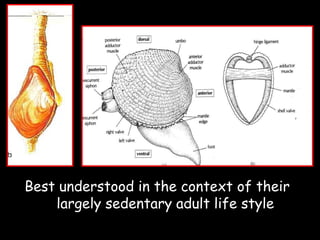
Best understood in the context of their
largely sedentary adult life style
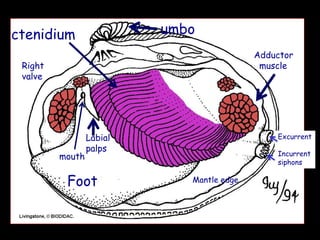
ctenidium umbo
Excurrent
Incurrent
siphons
Adductor
muscle
Foot Mantle edge
Labial
palps
mouth
Right
valve
Ctenidia of Bivalves are modified for feeding
except in one group: the Protobranchs
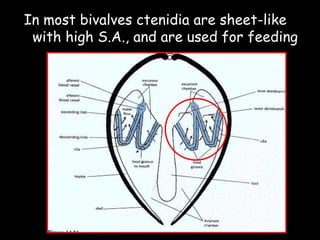
In most bivalves ctenidia are sheet-like
with high S.A., and are used for feeding
The sheetlike, arrangement of ctenidia in most
bivalves is known as the Llamellibranch condition
Summary of Water Flow and Feeding
http://web.uconn.edu/jevanward/video/musselsum.MPG
There are two basic type of
Llamellibranch ctenidia in bivalves
Filibranch
(in mussels)
Eullamellibranch
(most clams)
Living Cephalopods
Octopods
Cuttlefish
Nautilus
--The class as a whole is adapted for
swimming, suspended in the water by
buoyancy mechanisms.
Squid
-- all are carnivores, occupying the same niche as fishes
Ammonites
Largest is 3 m in
diameter
Sub Class Nautiloidea
5-6 species remain from
diversity in geologic past
Live in the last chamber of
a multi-chambered shell
Move by forcing water
through a siphon.
Sub Class Nautiloidea
How does a Nautilus adjust and maintain
its buoyancy in water?
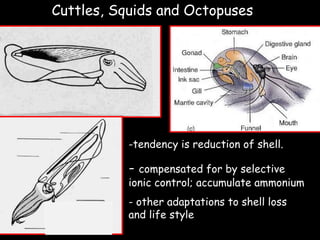
Cuttles, Squids and Octopuses
-tendency is reduction of shell.
- compensated for by selective
ionic control; accumulate ammonium
- other adaptations to shell loss
and life style
Specifically, compensation takes the
following forms:
Stealth and other defenses
Acute sensory structures
Speed
Cunning
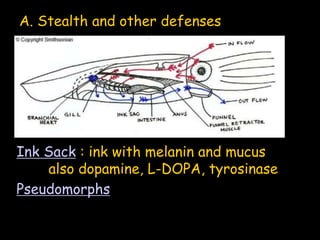
Ink Sack : ink with melanin and mucus
also dopamine, L-DOPA, tyrosinase
A. Stealth and other defenses
Pseudomorphs
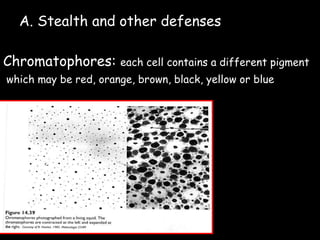
A. Stealth and other defenses
Chromatophores: each cell contains a different pigment
which may be red, orange, brown, black, yellow or blue
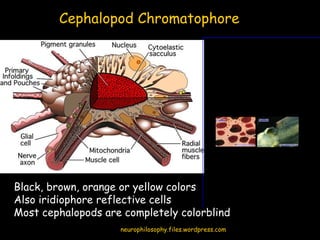
Cephalopod Chromatophore
neurophilosophy.files.wordpress.com
Black, brown, orange or yellow colors
Also iridiophore reflective cells
Most cephalopods are completely colorblind
9/16/2004 11:42 AM
The most well known of these cells is the chromatophore. Chromatophores are
groups of cells that include an elastic saccule that holds a pigment, as well as 15-25
muscles attached to this saccule (Hanlon and Messenger 1996). These cells are located
directly under the skin of cephalopods. When the muscles contract, they stretch the
saccule allowing the pigment inside to cover a larger surface area. When the muscles
relax, the saccule shrinks and hides the pigment. Unlike other animals, the
chromatophores in cephalopods are neurally controlled, with each chromatophore being
attached to a nerve ending (Messenger 2001). In some squid, each chromatophor muscle
is innervated by 2 to 6 nerves that directly link to the animals brain (Messenger et al
2001).
In this way the animal can increase the size of one saccule while decreasing the
size of another one right next to it. This allows the cephalopods to produce complex
patterns (Messenger 2001, Messenger et al 2001), such as the zebra stripes seen in
aggressive displays by male cuttlefish. The speed at which this can be controlled allows
the animal to manipulate these patterns in a way that makes them appear to move across
the body. In some species of cuttlefish, it has been noted that while hunting, the cuttlefish
may produce a series of stripes that move down their bodies and arms. Some scientists
have suggested that this could be used to mesmerize prey before striking, but the purpose
of this behavior has yet to be proven. The pigments in chromatophores can be black,
brown, red, orange or yellow. They are not responsible for producing the blue and green
colors seen in some species. Interestingly, many deep water forms possess fewer
chromatophores as they are less useful in an environment in little or no light.
Figure 2. A) Chromatophores on skin of Loligo. (CephBase image No. 280 by Roger T. Hanlon) B)
Chromatophores visible on Lolliguncula brevis (CephBase image No. 263 from UTMB).
Iridophores are found in the next layer under the chromatopphores (Hanlon et al
1990, Cooper et al 1990). Iridophores are layered stacks of platelets that are chitinous in
some species and protein based in others. They are responsible for producing the metallic
looking greens, blues and golds seen in some species, as well as the silver color around
the eyes and ink sac of others (Hanlon and Messenger 1996). Iridophores work by
reflecting light and can be used to conceal organs, as is often the case with the silver
coloration around the eyes and ink sacs. Additonally they assist in concealment and
communication. Previously, it was thought that these colors were permanent and
unchanging unlike the colors produced by chromatophores. New studies on some species
of squid suggest that the colors may change in response to changing levels of certain
hormones (Hanlon et al 1990, Cooper et al 1990). However, these changes are obviously
slower than neurally controlled chromatophore changes. Iridophores can be found in
cuttlefish, some squid and some species of octopus.
-- Vision
-- Lateral line analogs
B. Acute sensory structures
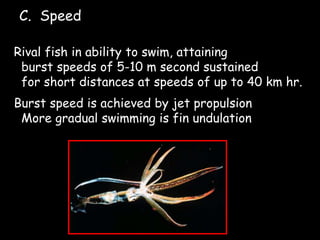
Rival fish in ability to swim, attaining
burst speeds of 5-10 m second sustained
for short distances at speeds of up to 40 km hr.
Burst speed is achieved by jet propulsion
More gradual swimming is fin undulation
C. Speed
complex nerve control
of locomotion
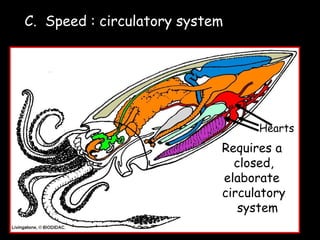
C. Speed :
Assures synchronized contraction of mantle muscles
Requires a
closed,
elaborate
circulatory
system
Hearts
C. Speed : circulatory system
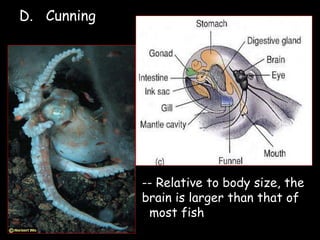
D. Cunning
-- Relative to body size, the
brain is larger than that of
most fish

Mollusca sub classes including gastropods

  • 1.
    Best understood inthe context of their largely sedentary adult life style
  • 2.
  • 3.
    Ctenidia of Bivalvesare modified for feeding except in one group: the Protobranchs
  • 4.
    In most bivalvesctenidia are sheet-like with high S.A., and are used for feeding
  • 5.
    The sheetlike, arrangementof ctenidia in most bivalves is known as the Llamellibranch condition Summary of Water Flow and Feeding http://web.uconn.edu/jevanward/video/musselsum.MPG
  • 6.
    There are twobasic type of Llamellibranch ctenidia in bivalves Filibranch (in mussels) Eullamellibranch (most clams)
  • 7.
    Living Cephalopods Octopods Cuttlefish Nautilus --The classas a whole is adapted for swimming, suspended in the water by buoyancy mechanisms. Squid -- all are carnivores, occupying the same niche as fishes
  • 8.
  • 9.
    Sub Class Nautiloidea 5-6species remain from diversity in geologic past Live in the last chamber of a multi-chambered shell Move by forcing water through a siphon.
  • 10.
    Sub Class Nautiloidea Howdoes a Nautilus adjust and maintain its buoyancy in water?
  • 11.
    Cuttles, Squids andOctopuses -tendency is reduction of shell. - compensated for by selective ionic control; accumulate ammonium - other adaptations to shell loss and life style
  • 12.
    Specifically, compensation takesthe following forms: Stealth and other defenses Acute sensory structures Speed Cunning
  • 13.
    Ink Sack :ink with melanin and mucus also dopamine, L-DOPA, tyrosinase A. Stealth and other defenses Pseudomorphs
  • 14.
    A. Stealth andother defenses Chromatophores: each cell contains a different pigment which may be red, orange, brown, black, yellow or blue
  • 15.
    Cephalopod Chromatophore neurophilosophy.files.wordpress.com Black, brown,orange or yellow colors Also iridiophore reflective cells Most cephalopods are completely colorblind 9/16/2004 11:42 AM The most well known of these cells is the chromatophore. Chromatophores are groups of cells that include an elastic saccule that holds a pigment, as well as 15-25 muscles attached to this saccule (Hanlon and Messenger 1996). These cells are located directly under the skin of cephalopods. When the muscles contract, they stretch the saccule allowing the pigment inside to cover a larger surface area. When the muscles relax, the saccule shrinks and hides the pigment. Unlike other animals, the chromatophores in cephalopods are neurally controlled, with each chromatophore being attached to a nerve ending (Messenger 2001). In some squid, each chromatophor muscle is innervated by 2 to 6 nerves that directly link to the animals brain (Messenger et al 2001). In this way the animal can increase the size of one saccule while decreasing the size of another one right next to it. This allows the cephalopods to produce complex patterns (Messenger 2001, Messenger et al 2001), such as the zebra stripes seen in aggressive displays by male cuttlefish. The speed at which this can be controlled allows the animal to manipulate these patterns in a way that makes them appear to move across the body. In some species of cuttlefish, it has been noted that while hunting, the cuttlefish may produce a series of stripes that move down their bodies and arms. Some scientists have suggested that this could be used to mesmerize prey before striking, but the purpose of this behavior has yet to be proven. The pigments in chromatophores can be black, brown, red, orange or yellow. They are not responsible for producing the blue and green colors seen in some species. Interestingly, many deep water forms possess fewer chromatophores as they are less useful in an environment in little or no light. Figure 2. A) Chromatophores on skin of Loligo. (CephBase image No. 280 by Roger T. Hanlon) B) Chromatophores visible on Lolliguncula brevis (CephBase image No. 263 from UTMB). Iridophores are found in the next layer under the chromatopphores (Hanlon et al 1990, Cooper et al 1990). Iridophores are layered stacks of platelets that are chitinous in some species and protein based in others. They are responsible for producing the metallic looking greens, blues and golds seen in some species, as well as the silver color around the eyes and ink sac of others (Hanlon and Messenger 1996). Iridophores work by reflecting light and can be used to conceal organs, as is often the case with the silver coloration around the eyes and ink sacs. Additonally they assist in concealment and communication. Previously, it was thought that these colors were permanent and unchanging unlike the colors produced by chromatophores. New studies on some species of squid suggest that the colors may change in response to changing levels of certain hormones (Hanlon et al 1990, Cooper et al 1990). However, these changes are obviously slower than neurally controlled chromatophore changes. Iridophores can be found in cuttlefish, some squid and some species of octopus.
  • 16.
    -- Vision -- Lateralline analogs B. Acute sensory structures
  • 17.
    Rival fish inability to swim, attaining burst speeds of 5-10 m second sustained for short distances at speeds of up to 40 km hr. Burst speed is achieved by jet propulsion More gradual swimming is fin undulation C. Speed
  • 18.
    complex nerve control oflocomotion C. Speed : Assures synchronized contraction of mantle muscles
  • 19.
  • 20.
    D. Cunning -- Relativeto body size, the brain is larger than that of most fish