Ab	
  Ini'o	
  Hartree-­‐Fock	
  Theory	
  
Basis	
  Sets	
  and	
  LCAO	
  Wave	
  Func'ons	
  
Video	
  IV.i	
  
A One-Slide Summary of Quantum Mechanics
Fundamental Postulate:
O ! = a !
operator
wave function
(scalar)
observable
What is !? ! is an oracle!
Where does ! come from? ! is refined
Variational Process
H! = E !
Energy (cannot go
lower than "true" energy)
Hamiltonian operator
(systematically improvable)
electronic road map: systematically
improvable by going to higher resolution convergence of E
truth
What if I can't converge E ? Test your oracle with a question to which you
already know the right answer...
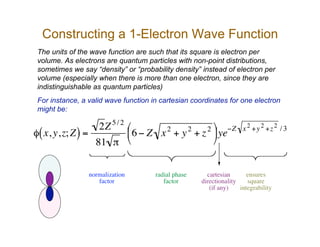
Constructing a 1-Electron Wave Function
The units of the wave function are such that its square is electron per
volume. As electrons are quantum particles with non-point distributions,
sometimes we say “density” or “probability density” instead of electron per
volume (especially when there is more than one electron, since they are
indistinguishable as quantum particles)
For instance, a valid wave function in cartesian coordinates for one electron
might be:
" x,y,z;Z
( ) =
2Z5/2
81 #
6 $ Z x2
+ y2
+ z2
%
&
'
(
)
*ye
$Z x2
+y2
+z2
/ 3
normalization
factor
radial phase
factor
cartesian
directionality
(if any)
ensures
square
integrability
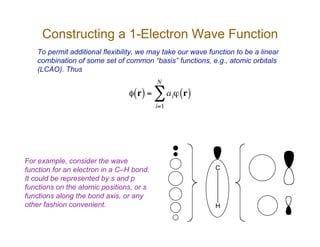
Constructing a 1-Electron Wave Function
To permit additional flexibility, we may take our wave function to be a linear
combination of some set of common “basis” functions, e.g., atomic orbitals
(LCAO). Thus
!
" r
( ) = ai# r
( )
i=1
N
$
For example, consider the wave
function for an electron in a C–H bond.
It could be represented by s and p
functions on the atomic positions, or s
functions along the bond axis, or any
other fashion convenient. H
C
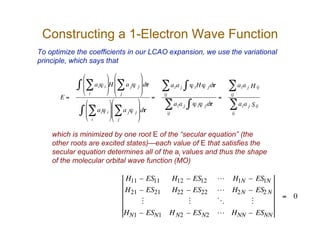
Constructing a 1-Electron Wave Function
To optimize the coefficients in our LCAO expansion, we use the variational
principle, which says that
!
E =
ai"i
i
#
$
%
&
&
'
(
)
)
* H a j" j
j
#
$
%
&
&
'
(
)
)
dr
ai"i
i
#
$
%
&
&
'
(
)
)
* a j" j
j
#
$
%
&
&
'
(
)
)
dr
=
aia j
ij
# "i
* H" j dr
aia j
ij
# "i
* " j dr
=
aia j
ij
# ij
H
aia j
ij
# ij
S
which is minimized by one root E of the “secular equation” (the
other roots are excited states)—each value of E that satisfies the
secular equation determines all of the ai values and thus the shape
of the molecular orbital wave function (MO)
H11 – ES11 H12 – ES12 L H1N – ES1N
H21 – ES21 H22 – ES22 L H2N – ES2 N
M M O M
HN1 – ESN1 HN2 – ESN2 L HNN – ESNN
= 0
What Are These Integrals H?
The electronic Hamiltonian includes kinetic energy, nuclear attraction, and,
if there is more than one electron, electron-electron repulsion
The final term is problematic. Solving for all electrons at once is a
many-body problem that has not been solved even for classical
particles. An approximation is to ignore the correlated motion of the
electrons, and treat each electron as independent, but even then, if
each MO depends on all of the other MOs, how can we determine
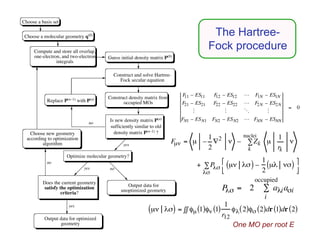
even one of them? The Hartree-Fock approach accomplishes this
for a many-electron wave function expressed as an
antisymmetrized product of one-electron MOs (a so-called Slater
determinant)
!
Hij = "i #
1
2
$2
" j # "i
Zk
rk
k
nuclei
% " j + "i
&
2
rn
n
electrons
% " j
Choose a basis set
Choose a molecular geometry q(0)
Compute and store all overlap,
one-electron, and two-electron
integrals
Guess initial density matrix P(0)
Construct and solve Hartree-
Fock secular equation
Construct density matrix from
occupied MOs
Is new density matrix P(n)
sufficiently similar to old
density matrix P(n–1) ?
Optimize molecular geometry?
Does the current geometry
satisfy the optimization
criteria?
Output data for optimized
geometry
Output data for
unoptimized geometry
yes
Replace P(n–1) with P(n)
no
yes no
Choose new geometry
according to optimization
algorithm
no
yes
Fµ! = µ –
1
2
"2 ! – Zk
k
nuclei
# µ
1
rk
!
+ P$%
$%
# µ! $%
( ) –
1
2
µ$ !%
( )
&
'
(
)
µ! "#
( ) = $µ
%% 1
( )$! 1
( )
1
r12
$" 2
( )$# 2
( )dr 1
( )dr 2
( )
P!" = 2 a!i
i
occupied
# a"i
The Hartree-
Fock procedure
F
11 – ES11 F
12 – ES12 L F1N – ES1N
F21 – ES21 F22 – ES22 L F2N – ES2N
M M O M
FN1 – ESN1 FN2 – ESN2 L FNN – ESNN
= 0
One MO per root E
• Slater Type Orbitals (STO)
– Can’t do 2 electron integrals analytically
!
1s
" =
#
$
%
&
'
(
)
*
1
2
e#+r
( ) ( ) ( ) ( ) 2
1
12
2
2
1
1
1 dr
dr
r
!
"
#
µ $
$
$
$
%%
What functions to use?
• 1950s
– Replace with something similar that is
analytical: a gaussian function
!
1s
" =
#
$
%
&
'
(
)
*
1
2
e# +r
!
"1s"
" =
2#
$
%
&
'
(
)
*
3
4
e+#r2
VS.
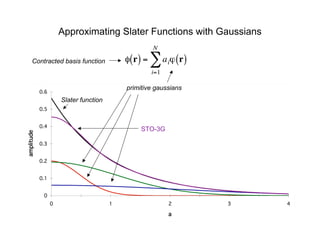
Approximating Slater Functions with Gaussians
!
" r
( ) = ai# r
( )
i=1
N
$
primitive gaussians
STO-3G
Slater function
Contracted basis function
"1s"
" = ai
i
N
#
2$i
%
&
'
(
)
*
+
3
4
e,$i
r2
Contracted Basis Set
• STO-#G - minimal basis
• Pople - optimized a and α values
• What do you about very different bonding
situations?
– Have more than one 1s orbital
• Multiple-ζ(zeta) basis set
– Multiple functions for the same atomic orbital
H F vs. H H
• Double-ζ – one loose, one tight
– Adds flexibility
• Triple-ζ – one loose, one medium, one tight
• Only for valence
• Decontraction
– Allow ai to vary
• Pople - #-##G
– 3-21G
!
"1sH
STO#3G
= ai
i
3
$
2%i
&
'
(
)
*
+
,
3
4
e#%i
r2
locked in STO-3G
primitive gaussians
primitives in all core functions
valence: 2 tight, 1 loose
gaussian
How many basis functions are for NH3 using 3-21G?
NH3 3-21G
atom # atoms AO degeneracy basis fxns primitives total basis fxns total primitives
N 1 1s(core) 1 1 3 1 3
2s(val) 1 2 2 + 1 = 3 2 3
2p(val) 3 2 2 + 1 = 3 6 9
H 3 1s(val) 1 2 2 + 1 = 3 6 9
total = 15 24
Polarization Functions
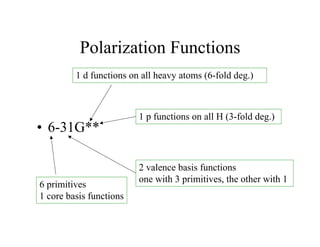
• 6-31G**
6 primitives
1 core basis functions
2 valence basis functions
one with 3 primitives, the other with 1
1 d functions on all heavy atoms (6-fold deg.)
1 p functions on all H (3-fold deg.)
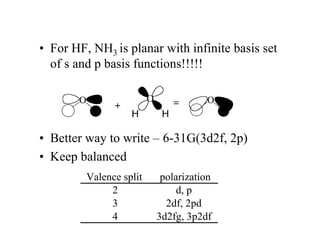
• For HF, NH3 is planar with infinite basis set
of s and p basis functions!!!!!
• Better way to write – 6-31G(3d2f, 2p)
• Keep balanced
Valence split polarization
2 d, p
3 2df, 2pd
4 3d2fg, 3p2df
O
+
O
H H
= O
Dunning basis set
cc-pVNZ
correlation consistent
polarized
N = D, T, Q, 5, 6
Diffuse functions
• “loose” electrons
– anions
– excited states
– Rydberg states
• Dunning - aug-cc-pVNZ
– Augmented
• Pople
– 6-31+G - heavy atoms/only with valence
– 6-31++G - hydrogens
• Not too useful
How many basis functions in H2POH
using 6-31G(d, p)?

AI_HF_6.pdf

  • 1.
    Ab  Ini'o  Hartree-­‐Fock  Theory   Basis  Sets  and  LCAO  Wave  Func'ons   Video  IV.i  
  • 2.
    A One-Slide Summaryof Quantum Mechanics Fundamental Postulate: O ! = a ! operator wave function (scalar) observable What is !? ! is an oracle! Where does ! come from? ! is refined Variational Process H! = E ! Energy (cannot go lower than "true" energy) Hamiltonian operator (systematically improvable) electronic road map: systematically improvable by going to higher resolution convergence of E truth What if I can't converge E ? Test your oracle with a question to which you already know the right answer...
  • 3.
    Constructing a 1-ElectronWave Function The units of the wave function are such that its square is electron per volume. As electrons are quantum particles with non-point distributions, sometimes we say “density” or “probability density” instead of electron per volume (especially when there is more than one electron, since they are indistinguishable as quantum particles) For instance, a valid wave function in cartesian coordinates for one electron might be: " x,y,z;Z ( ) = 2Z5/2 81 # 6 $ Z x2 + y2 + z2 % & ' ( ) *ye $Z x2 +y2 +z2 / 3 normalization factor radial phase factor cartesian directionality (if any) ensures square integrability
  • 4.
    Constructing a 1-ElectronWave Function To permit additional flexibility, we may take our wave function to be a linear combination of some set of common “basis” functions, e.g., atomic orbitals (LCAO). Thus ! " r ( ) = ai# r ( ) i=1 N $ For example, consider the wave function for an electron in a C–H bond. It could be represented by s and p functions on the atomic positions, or s functions along the bond axis, or any other fashion convenient. H C
  • 5.
    Constructing a 1-ElectronWave Function To optimize the coefficients in our LCAO expansion, we use the variational principle, which says that ! E = ai"i i # $ % & & ' ( ) ) * H a j" j j # $ % & & ' ( ) ) dr ai"i i # $ % & & ' ( ) ) * a j" j j # $ % & & ' ( ) ) dr = aia j ij # "i * H" j dr aia j ij # "i * " j dr = aia j ij # ij H aia j ij # ij S which is minimized by one root E of the “secular equation” (the other roots are excited states)—each value of E that satisfies the secular equation determines all of the ai values and thus the shape of the molecular orbital wave function (MO) H11 – ES11 H12 – ES12 L H1N – ES1N H21 – ES21 H22 – ES22 L H2N – ES2 N M M O M HN1 – ESN1 HN2 – ESN2 L HNN – ESNN = 0
  • 6.
    What Are TheseIntegrals H? The electronic Hamiltonian includes kinetic energy, nuclear attraction, and, if there is more than one electron, electron-electron repulsion The final term is problematic. Solving for all electrons at once is a many-body problem that has not been solved even for classical particles. An approximation is to ignore the correlated motion of the electrons, and treat each electron as independent, but even then, if each MO depends on all of the other MOs, how can we determine even one of them? The Hartree-Fock approach accomplishes this for a many-electron wave function expressed as an antisymmetrized product of one-electron MOs (a so-called Slater determinant) ! Hij = "i # 1 2 $2 " j # "i Zk rk k nuclei % " j + "i & 2 rn n electrons % " j
  • 7.
    Choose a basisset Choose a molecular geometry q(0) Compute and store all overlap, one-electron, and two-electron integrals Guess initial density matrix P(0) Construct and solve Hartree- Fock secular equation Construct density matrix from occupied MOs Is new density matrix P(n) sufficiently similar to old density matrix P(n–1) ? Optimize molecular geometry? Does the current geometry satisfy the optimization criteria? Output data for optimized geometry Output data for unoptimized geometry yes Replace P(n–1) with P(n) no yes no Choose new geometry according to optimization algorithm no yes Fµ! = µ – 1 2 "2 ! – Zk k nuclei # µ 1 rk ! + P$% $% # µ! $% ( ) – 1 2 µ$ !% ( ) & ' ( ) µ! "# ( ) = $µ %% 1 ( )$! 1 ( ) 1 r12 $" 2 ( )$# 2 ( )dr 1 ( )dr 2 ( ) P!" = 2 a!i i occupied # a"i The Hartree- Fock procedure F 11 – ES11 F 12 – ES12 L F1N – ES1N F21 – ES21 F22 – ES22 L F2N – ES2N M M O M FN1 – ESN1 FN2 – ESN2 L FNN – ESNN = 0 One MO per root E
  • 8.
    • Slater TypeOrbitals (STO) – Can’t do 2 electron integrals analytically ! 1s " = # $ % & ' ( ) * 1 2 e#+r ( ) ( ) ( ) ( ) 2 1 12 2 2 1 1 1 dr dr r ! " # µ $ $ $ $ %% What functions to use?
  • 9.
    • 1950s – Replacewith something similar that is analytical: a gaussian function ! 1s " = # $ % & ' ( ) * 1 2 e# +r ! "1s" " = 2# $ % & ' ( ) * 3 4 e+#r2 VS.
  • 10.
    Approximating Slater Functionswith Gaussians ! " r ( ) = ai# r ( ) i=1 N $ primitive gaussians STO-3G Slater function Contracted basis function
  • 11.
    "1s" " = ai i N # 2$i % & ' ( ) * + 3 4 e,$i r2 ContractedBasis Set • STO-#G - minimal basis • Pople - optimized a and α values
  • 12.
    • What doyou about very different bonding situations? – Have more than one 1s orbital • Multiple-ζ(zeta) basis set – Multiple functions for the same atomic orbital H F vs. H H
  • 13.
    • Double-ζ –one loose, one tight – Adds flexibility • Triple-ζ – one loose, one medium, one tight • Only for valence
  • 14.
    • Decontraction – Allowai to vary • Pople - #-##G – 3-21G ! "1sH STO#3G = ai i 3 $ 2%i & ' ( ) * + , 3 4 e#%i r2 locked in STO-3G primitive gaussians primitives in all core functions valence: 2 tight, 1 loose gaussian
  • 15.
    How many basisfunctions are for NH3 using 3-21G? NH3 3-21G atom # atoms AO degeneracy basis fxns primitives total basis fxns total primitives N 1 1s(core) 1 1 3 1 3 2s(val) 1 2 2 + 1 = 3 2 3 2p(val) 3 2 2 + 1 = 3 6 9 H 3 1s(val) 1 2 2 + 1 = 3 6 9 total = 15 24
  • 16.
    Polarization Functions • 6-31G** 6primitives 1 core basis functions 2 valence basis functions one with 3 primitives, the other with 1 1 d functions on all heavy atoms (6-fold deg.) 1 p functions on all H (3-fold deg.)
  • 17.
    • For HF,NH3 is planar with infinite basis set of s and p basis functions!!!!! • Better way to write – 6-31G(3d2f, 2p) • Keep balanced Valence split polarization 2 d, p 3 2df, 2pd 4 3d2fg, 3p2df O + O H H = O
  • 18.
    Dunning basis set cc-pVNZ correlationconsistent polarized N = D, T, Q, 5, 6
  • 19.
    Diffuse functions • “loose”electrons – anions – excited states – Rydberg states • Dunning - aug-cc-pVNZ – Augmented • Pople – 6-31+G - heavy atoms/only with valence – 6-31++G - hydrogens • Not too useful
  • 20.
    How many basisfunctions in H2POH using 6-31G(d, p)?