Molecular Genetic Methods
1. Polymerase Chain Reaction (PCR)
2. DNA sequencing (manual/automated)
3. DNA Fingerprinting (DNA
typing/profiling)
4. Single nucleotide polymorphisms (SNPs)
Genetics from Mendel to microchip
array Molecular Genetics
Genetics from Mendel to microchip
array Molecular Genetics
Genetics from Mendel to microchip
array Molecular Genetics
Molecular genetics is a subfield of
genetics that focuses on
the structure and function of genes
on a molecular level,
including genetic variation, gene
expression, and DNA replication and
repair.
This field aims to understand how
genes are transmitted from one
generation to the next and how they
influence human behavior, health,
and disease. Research in molecular
genetics relies heavily on laboratory
methods and technologies, such as DNA sequencing,
PCR, and gene editing techniques.
Practical applications
Amplify DNA for Cloning (PCR)
✓ Amplify DNA for sequencing without cloning (PCR)
✓ DNA sequencing reaction (PCR)
✓ Mapping genes and regulatory sequences
✓ Linkage analysis (identify genes for traits/diseases)
✓ Diagnose disease
✓ Pathogen screening
✓ Sex determination
✓ Forensic analysis
✓ Paternity/maternity (relatedness)
✓ Behavioral ecology studies (relatedness)
✓ Molecular systematics and evolution (comparing homologous
sequences in different organisms)
✓ Population genetics (theoretical and applied)
✓ Physiological genetics (studying basis of adaptation)
✓ Livestock pedigrees (optimize breeding)
✓ Wildlife management (stock identification/assessment)
✓ Detection of Genetically Modified Food (GMOs)
Genetics from Mendel to microchip
array Molecular Genetics
Background on the Polymerase Chain Reaction (PCR)
✓ Ability to generate identical high copy number DNAs made possible
in the 1970s by recombinant DNA technology (i.e., cloning).
✓ Cloning DNA is time consuming and expensive (>>$15/sample).
✓ Probing libraries can be like hunting for a needle in a haystack.
✓ PCR, “discovered” in 1983 by Kary Mullis, enables the amplification
(or duplication) of millions of copies of any DNA sequence with
known flanking sequences.
✓ Requires only simple, inexpensive ingredients and a couple hours.
DNA template
Primers (anneal to flanking sequences)
DNA polymerase
dNTPs
Mg2+
Buffer
✓ Can be performed by hand or in a machine called a thermal cycler.
✓ 1993: Nobel Prize for Chemistry
Genetics from Mendel to microchip
array Molecular Genetics
How PCR works:
1. Begins with DNA containing a sequence to be amplified and a pair
of synthetic oligonucleotide primers that flank the sequence.
2. Next, denature the DNA to single strands at 94˚C.
3. Rapidly cool the DNA (37-65˚C) and anneal primers to
complementary s.s. sequences flanking the target DNA.
4. Extend primers at 70-75˚C using a heat-resistant DNA
polymerase such as Taq polymerase derived from Thermus
aquaticus.
5. Repeat the cycle of denaturing, annealing, and extension 20-45
times to produce 1 million (220)to 35 trillion copies (245) of the
target DNA.
6. Extend the primers at 70-75˚C once more to allow incomplete
extension products in the reaction mixture to extend completely.
7. Cool to 4˚C and store or use amplified PCR product for analysis.
Genetics from Mendel to microchip
array Molecular Genetics
Hot water bacteria:
Thermus aquaticus
Taq DNA polymerase
Life at High Temperatures
by Thomas D. Brock
Biotechnology in Yellowstone
Genetics from Mendel to microchip
array Molecular Genetics
Denature
Anneal PCR Primers
Extend PCR Primers
w/Taq
Repeat…
Genetics from Mendel to microchip
array Molecular Genetics
Example thermal cycler protocol used in lab:
Step 17 min at 94˚C Initial Denature
Step 245 cycles of:
20 sec at 94˚C Denature
20 sec at 52˚C Anneal
1 min at 72˚C Extension
Step 37 min at 72˚C Final Extension
Step 4Infinite hold at 4˚C Storage
Genetics from Mendel to microchip
array Molecular Genetics
DNA Sequencing
✓ DNA sequencing = determining the nucleotide sequence of
DNA.
✓ Developed by Frederick Sanger in the 1970s.
1980: Walter Gilbert (Biol. Labs) & Frederick Sanger (MRC Labs)
Genetics from Mendel to microchip
array Molecular Genetics
Manual Dideoxy DNA sequencing-How it works:
1. DNA template is denatured to single strands.
2. DNA primer (with 3’ end near sequence of interest) is annealed to
the template DNA and extended with DNA polymerase.
3. Four reactions are set up, each containing:
1. DNA template
2. Primer annealed to template DNA
3. DNA polymerase
4. dNTPS (dATP, dTTP, dCTP, and dGTP)
4. Next, a different radio-labeled dideoxynucleotide (ddATP, ddTTP,
ddCTP, or ddGTP) is added to each of the four reaction tubes at
1/100th the concentration of normal dNTPs.
5. ddNTPs possess a 3’-H instead of 3’-OH, compete in the reaction with
normal dNTPS, and produce no phosphodiester bond.
6. Whenever the radio-labeled ddNTPs are incorporated in the chain,
DNA synthesis terminates.
7. Each of the four reaction mixtures produces a population of DNA
molecules with DNA chains terminating at all possible positions.
Genetics from Mendel to microchip
array Molecular Genetics
Manual Dideoxy DNA sequencing-How it works (cont.):
8. Extension products in each of the four reaction mixutes
also end with a different radio-labeled ddNTP
(depending on the base).
9. Next, each reaction mixture is electrophoresed in a
separate lane (4 lanes) at high voltage on a
polyacrylamide gel.
10.Pattern of bands in each of the four lanes is visualized
on X-ray film.
11.Location of “bands” in each of the four lanes indicate
the size of the fragment terminating with a respective
radio-labeled ddNTP.
12.DNA sequence is deduced from the pattern of bands in
the 4 lanes.
Genetics from Mendel to microchip
array Molecular Genetics
Fig. 7.20
Vigilant et al. 1989
PNAS 86:9350-9354
Genetics from Mendel to microchip
array Molecular Genetics
Short products
Long products
Radio-labeled ddNTPs (4 rxns)
Sequence (5’ to 3’)
G
G
A
T
A
T
A
A
C
C
C
C
T
G
T
Genetics from Mendel to microchip
array Molecular Genetics
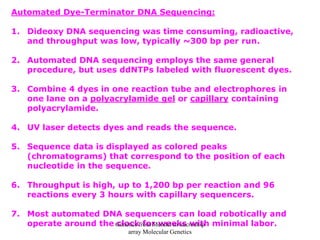
Automated Dye-Terminator DNA Sequencing:
1. Dideoxy DNA sequencing was time consuming, radioactive,
and throughput was low, typically ~300 bp per run.
2. Automated DNA sequencing employs the same general
procedure, but uses ddNTPs labeled with fluorescent dyes.
3. Combine 4 dyes in one reaction tube and electrophores in
one lane on a polyacrylamide gel or capillary containing
polyacrylamide.
4. UV laser detects dyes and reads the sequence.
5. Sequence data is displayed as colored peaks
(chromatograms) that correspond to the position of each
nucleotide in the sequence.
6. Throughput is high, up to 1,200 bp per reaction and 96
reactions every 3 hours with capillary sequencers.
7. Most automated DNA sequencers can load robotically and
operate around the clock for weeks with minimal labor.
Genetics from Mendel to microchip
array Molecular Genetics
Applied Biosystems PRISM 377
(Gel, 34-96 lanes)
Applied Biosystems PRISM 3100
(Capillary, 16 capillaries)
Applied Biosystems PRISM 3700
(Capillary, 96 capillaries)
Genetics from Mendel to microchip
array Molecular Genetics
“virtual autorad” - real-time DNA sequence output from ABI 377
1. Trace files (dye signals) are analyzed and bases
called to create chromatograms.
2. Chromatograms from opposite strands are
reconciled with software to create double-
stranded sequence data.
Genetics from Mendel to microchip
array Molecular Genetics
DNA Fingerprinting (DNA typing/profiling)
✓ No two individuals produced by sexually reproducing organisms
(except identical twins) have exactly the same genotype.
Why?
✓ Crossing-over of chromosomes in meiosis prophase I.
✓ Random alignment of maternal/paternal chromosomes in
meiosis metaphase I.
✓ Mutation
✓ DNA replication errors (same effect as mutation)
Genetics from Mendel to microchip
array Molecular Genetics
DNA Fingerprinting (DNA typing/profiling)
Types of markers:
✓ RFLPs (restriction sites)
✓ Length polymorphism detected by PCR
✓ Allele specific oligonucleotide probes
✓ Repeated DNA
✓ Minisatellites (VNTRs = variable number tandem repeats)
Repeated units of 5 to several 10 bp
Discovered by A. J. Jeffreys in 1985
✓ Microsatellites (STRs = short tandem repeats)
Repeated units of 2-6 bp
5’-TAATAATAATAATAATAA-3’
3’-ATTATTATTATTATTATT-5’
Genetics from Mendel to microchip
array Molecular Genetics
Fig. 9.1, minisatellite repeat (VNTR)
Genetics from Mendel to microchip
array Molecular Genetics
Four criteria for selecting useful DNA fingerprinting markers:
1. Markers should be polymorphic.
(so that they are informative)
2. Markers should be single locus.
(so that they occur in only one location in the genome
and there is no ambiguity about their number or
position)
3. Markers should be neutral.
(so that they are not correlated with selection or
adaptation; unless selection of adaptation are to be
studied)
4. Markers should be located on different chromosomes.
(so that the markers are independent)
Genetics from Mendel to microchip
array Molecular Genetics
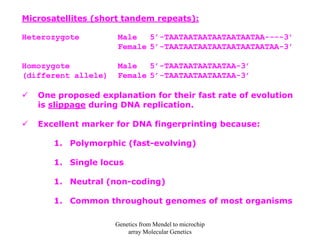
Microsatellites (short tandem repeats):
Heterozygote Male 5’-TAATAATAATAATAATAATAA----3’
Female 5’-TAATAATAATAATAATAATAATAA-3’
Homozygote Male 5’-TAATAATAATAATAA-3’
(different allele) Female 5’-TAATAATAATAATAA-3’
✓ One proposed explanation for their fast rate of evolution
is slippage during DNA replication.
✓ Excellent marker for DNA fingerprinting because:
1. Polymorphic (fast-evolving)
1. Single locus
1. Neutral (non-coding)
1. Common throughout genomes of most organisms
Genetics from Mendel to microchip
array Molecular Genetics
How to fingerprint alleged paternity using microsatellites:
1. Extract DNA from mother, baby, and alleged father.
2. Synthesize oligonucleotide microsatellite primers and label one
primer with fluorescent dye (2 primers per microsatellite).
3. Amplify microsatellites using PCR from mother, baby, father.
4. Electrophores microsatellite PCR products on a DNA sequencer
(w/polyacrylamide) with a flourescent size standard loaded in
the same lane or capillary.
5. 3-4 different microsatellites can be multiplexed in each lane or
capillary by using 3-4 different fluorescent dyes.
6. Calculate size of each microsatellite relative to size standard
(this size standard also can be run in the same gel lane or
capillary using a 4th or 5th colored dye).
7. Sequence at least one copy of each allele to verify allele sizes.
Genetics from Mendel to microchip
array Molecular Genetics
Size Mother Baby “Father”
Hypothetical gel pattern
for microsatellite heterozygous
for all individuals.
Genetics from Mendel to microchip
array Molecular Genetics
Paternity Analyses & Conclusions:
1. Baby and mother are expected to share on allele, and the
baby and father the other allele.
2. If baby and father do not share a common allele, the
“father” is not the father.
3. If the baby and father do share a common allele, paternity is
possible, but not proven, because other men in the
population also carry the allele at some frequency.
4. Frequency of alleles that are shared in common by chance
can be calculated, and an appropriate number of
microsatellites analyzed to calculate probability of paternity.
5. To achieve high probability, 6-12 loci should be assayed
(exact number depends on variation in population for each
marker).
6. If each locus has few alleles, more loci are required. If
allelic diversity if high, fewer loci can be analyzed.
Genetics from Mendel to microchip
array Molecular Genetics
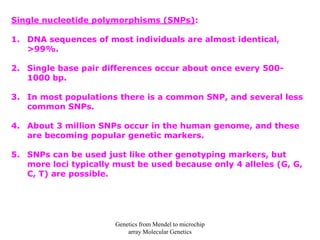
Single nucleotide polymorphisms (SNPs):
1. DNA sequences of most individuals are almost identical,
>99%.
2. Single base pair differences occur about once every 500-
1000 bp.
3. In most populations there is a common SNP, and several less
common SNPs.
4. About 3 million SNPs occur in the human genome, and these
are becoming popular genetic markers.
5. SNPs can be used just like other genotyping markers, but
more loci typically must be used because only 4 alleles (G, G,
C, T) are possible.
Genetics from Mendel to microchip
array Molecular Genetics
How to type SNPs:
1. SNPs can be typed by hybridizing a complementary oligonucleotide
(e.g., single-base extension assay).
2. If the stringency is high (i.e., temperature), the oligonucleotide will
fail to bind to DNAs showing polymorphism.
3. Many hundreds of SNPs can be tested simultaneously using:
DNA microarrays (DNA-chips, Gene-Chips, SNP-chips)
✓ First developed in the early 1990s.
✓ Ordered grid of short, complementary, known sequence
oligonucleotides placed at fixed positions on silicon, glass, or
nylon substrate.
✓ Oligonucleotides are experimentally determined and are either
(1) microspotted or (2) synthesized on the chip.
✓ User defined SNP chips are available commercially, and can
contain >400,000 different probes.
Genetics from Mendel to microchip
array Molecular Genetics
Typing a SNP with an oligonucleotide.
Genetics from Mendel to microchip
array Molecular Genetics
How to type SNPs (cont.):
1. SNP chip is designed with an array of user defined
oligonucleotides attached to the substrate (the SNP chip is
the probe).
2. Oligonucleotides match each of the common and variant
alleles in the population (all alleles of interest).
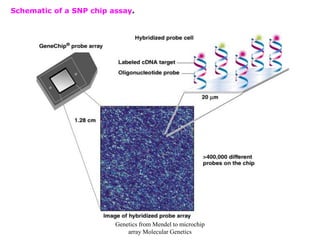
3. Target DNAs are labeled with a fluorescent tag and
hybridized (or not) to the chip.
4. Fluorescence pattern is detected by a laser.
5. Because the oligonucleotides are known, the pattern
indicates the type of alleles the individual possesses.
6. Many different alleles at thousands of different loci can be
screened simultaneously in the same experiment.
Genetics from Mendel to microchip
array Molecular Genetics
Schematic of a SNP chip assay.
Genetics from Mendel to microchip
array Molecular Genetics

molecular genetics1.pdf

  • 1.
    Molecular Genetic Methods 1.Polymerase Chain Reaction (PCR) 2. DNA sequencing (manual/automated) 3. DNA Fingerprinting (DNA typing/profiling) 4. Single nucleotide polymorphisms (SNPs) Genetics from Mendel to microchip array Molecular Genetics
  • 2.
    Genetics from Mendelto microchip array Molecular Genetics
  • 3.
    Genetics from Mendelto microchip array Molecular Genetics Molecular genetics is a subfield of genetics that focuses on the structure and function of genes on a molecular level, including genetic variation, gene expression, and DNA replication and repair. This field aims to understand how genes are transmitted from one generation to the next and how they influence human behavior, health, and disease. Research in molecular genetics relies heavily on laboratory methods and technologies, such as DNA sequencing, PCR, and gene editing techniques.
  • 4.
    Practical applications Amplify DNAfor Cloning (PCR) ✓ Amplify DNA for sequencing without cloning (PCR) ✓ DNA sequencing reaction (PCR) ✓ Mapping genes and regulatory sequences ✓ Linkage analysis (identify genes for traits/diseases) ✓ Diagnose disease ✓ Pathogen screening ✓ Sex determination ✓ Forensic analysis ✓ Paternity/maternity (relatedness) ✓ Behavioral ecology studies (relatedness) ✓ Molecular systematics and evolution (comparing homologous sequences in different organisms) ✓ Population genetics (theoretical and applied) ✓ Physiological genetics (studying basis of adaptation) ✓ Livestock pedigrees (optimize breeding) ✓ Wildlife management (stock identification/assessment) ✓ Detection of Genetically Modified Food (GMOs) Genetics from Mendel to microchip array Molecular Genetics
  • 5.
    Background on thePolymerase Chain Reaction (PCR) ✓ Ability to generate identical high copy number DNAs made possible in the 1970s by recombinant DNA technology (i.e., cloning). ✓ Cloning DNA is time consuming and expensive (>>$15/sample). ✓ Probing libraries can be like hunting for a needle in a haystack. ✓ PCR, “discovered” in 1983 by Kary Mullis, enables the amplification (or duplication) of millions of copies of any DNA sequence with known flanking sequences. ✓ Requires only simple, inexpensive ingredients and a couple hours. DNA template Primers (anneal to flanking sequences) DNA polymerase dNTPs Mg2+ Buffer ✓ Can be performed by hand or in a machine called a thermal cycler. ✓ 1993: Nobel Prize for Chemistry Genetics from Mendel to microchip array Molecular Genetics
  • 6.
    How PCR works: 1.Begins with DNA containing a sequence to be amplified and a pair of synthetic oligonucleotide primers that flank the sequence. 2. Next, denature the DNA to single strands at 94˚C. 3. Rapidly cool the DNA (37-65˚C) and anneal primers to complementary s.s. sequences flanking the target DNA. 4. Extend primers at 70-75˚C using a heat-resistant DNA polymerase such as Taq polymerase derived from Thermus aquaticus. 5. Repeat the cycle of denaturing, annealing, and extension 20-45 times to produce 1 million (220)to 35 trillion copies (245) of the target DNA. 6. Extend the primers at 70-75˚C once more to allow incomplete extension products in the reaction mixture to extend completely. 7. Cool to 4˚C and store or use amplified PCR product for analysis. Genetics from Mendel to microchip array Molecular Genetics
  • 7.
    Hot water bacteria: Thermusaquaticus Taq DNA polymerase Life at High Temperatures by Thomas D. Brock Biotechnology in Yellowstone Genetics from Mendel to microchip array Molecular Genetics
  • 8.
    Denature Anneal PCR Primers ExtendPCR Primers w/Taq Repeat… Genetics from Mendel to microchip array Molecular Genetics
  • 9.
    Example thermal cyclerprotocol used in lab: Step 17 min at 94˚C Initial Denature Step 245 cycles of: 20 sec at 94˚C Denature 20 sec at 52˚C Anneal 1 min at 72˚C Extension Step 37 min at 72˚C Final Extension Step 4Infinite hold at 4˚C Storage Genetics from Mendel to microchip array Molecular Genetics
  • 10.
    DNA Sequencing ✓ DNAsequencing = determining the nucleotide sequence of DNA. ✓ Developed by Frederick Sanger in the 1970s. 1980: Walter Gilbert (Biol. Labs) & Frederick Sanger (MRC Labs) Genetics from Mendel to microchip array Molecular Genetics
  • 11.
    Manual Dideoxy DNAsequencing-How it works: 1. DNA template is denatured to single strands. 2. DNA primer (with 3’ end near sequence of interest) is annealed to the template DNA and extended with DNA polymerase. 3. Four reactions are set up, each containing: 1. DNA template 2. Primer annealed to template DNA 3. DNA polymerase 4. dNTPS (dATP, dTTP, dCTP, and dGTP) 4. Next, a different radio-labeled dideoxynucleotide (ddATP, ddTTP, ddCTP, or ddGTP) is added to each of the four reaction tubes at 1/100th the concentration of normal dNTPs. 5. ddNTPs possess a 3’-H instead of 3’-OH, compete in the reaction with normal dNTPS, and produce no phosphodiester bond. 6. Whenever the radio-labeled ddNTPs are incorporated in the chain, DNA synthesis terminates. 7. Each of the four reaction mixtures produces a population of DNA molecules with DNA chains terminating at all possible positions. Genetics from Mendel to microchip array Molecular Genetics
  • 12.
    Manual Dideoxy DNAsequencing-How it works (cont.): 8. Extension products in each of the four reaction mixutes also end with a different radio-labeled ddNTP (depending on the base). 9. Next, each reaction mixture is electrophoresed in a separate lane (4 lanes) at high voltage on a polyacrylamide gel. 10.Pattern of bands in each of the four lanes is visualized on X-ray film. 11.Location of “bands” in each of the four lanes indicate the size of the fragment terminating with a respective radio-labeled ddNTP. 12.DNA sequence is deduced from the pattern of bands in the 4 lanes. Genetics from Mendel to microchip array Molecular Genetics
  • 13.
    Fig. 7.20 Vigilant etal. 1989 PNAS 86:9350-9354 Genetics from Mendel to microchip array Molecular Genetics
  • 14.
    Short products Long products Radio-labeledddNTPs (4 rxns) Sequence (5’ to 3’) G G A T A T A A C C C C T G T Genetics from Mendel to microchip array Molecular Genetics
  • 15.
    Automated Dye-Terminator DNASequencing: 1. Dideoxy DNA sequencing was time consuming, radioactive, and throughput was low, typically ~300 bp per run. 2. Automated DNA sequencing employs the same general procedure, but uses ddNTPs labeled with fluorescent dyes. 3. Combine 4 dyes in one reaction tube and electrophores in one lane on a polyacrylamide gel or capillary containing polyacrylamide. 4. UV laser detects dyes and reads the sequence. 5. Sequence data is displayed as colored peaks (chromatograms) that correspond to the position of each nucleotide in the sequence. 6. Throughput is high, up to 1,200 bp per reaction and 96 reactions every 3 hours with capillary sequencers. 7. Most automated DNA sequencers can load robotically and operate around the clock for weeks with minimal labor. Genetics from Mendel to microchip array Molecular Genetics
  • 16.
    Applied Biosystems PRISM377 (Gel, 34-96 lanes) Applied Biosystems PRISM 3100 (Capillary, 16 capillaries) Applied Biosystems PRISM 3700 (Capillary, 96 capillaries) Genetics from Mendel to microchip array Molecular Genetics
  • 17.
    “virtual autorad” -real-time DNA sequence output from ABI 377 1. Trace files (dye signals) are analyzed and bases called to create chromatograms. 2. Chromatograms from opposite strands are reconciled with software to create double- stranded sequence data. Genetics from Mendel to microchip array Molecular Genetics
  • 18.
    DNA Fingerprinting (DNAtyping/profiling) ✓ No two individuals produced by sexually reproducing organisms (except identical twins) have exactly the same genotype. Why? ✓ Crossing-over of chromosomes in meiosis prophase I. ✓ Random alignment of maternal/paternal chromosomes in meiosis metaphase I. ✓ Mutation ✓ DNA replication errors (same effect as mutation) Genetics from Mendel to microchip array Molecular Genetics
  • 19.
    DNA Fingerprinting (DNAtyping/profiling) Types of markers: ✓ RFLPs (restriction sites) ✓ Length polymorphism detected by PCR ✓ Allele specific oligonucleotide probes ✓ Repeated DNA ✓ Minisatellites (VNTRs = variable number tandem repeats) Repeated units of 5 to several 10 bp Discovered by A. J. Jeffreys in 1985 ✓ Microsatellites (STRs = short tandem repeats) Repeated units of 2-6 bp 5’-TAATAATAATAATAATAA-3’ 3’-ATTATTATTATTATTATT-5’ Genetics from Mendel to microchip array Molecular Genetics
  • 20.
    Fig. 9.1, minisatelliterepeat (VNTR) Genetics from Mendel to microchip array Molecular Genetics
  • 21.
    Four criteria forselecting useful DNA fingerprinting markers: 1. Markers should be polymorphic. (so that they are informative) 2. Markers should be single locus. (so that they occur in only one location in the genome and there is no ambiguity about their number or position) 3. Markers should be neutral. (so that they are not correlated with selection or adaptation; unless selection of adaptation are to be studied) 4. Markers should be located on different chromosomes. (so that the markers are independent) Genetics from Mendel to microchip array Molecular Genetics
  • 22.
    Microsatellites (short tandemrepeats): Heterozygote Male 5’-TAATAATAATAATAATAATAA----3’ Female 5’-TAATAATAATAATAATAATAATAA-3’ Homozygote Male 5’-TAATAATAATAATAA-3’ (different allele) Female 5’-TAATAATAATAATAA-3’ ✓ One proposed explanation for their fast rate of evolution is slippage during DNA replication. ✓ Excellent marker for DNA fingerprinting because: 1. Polymorphic (fast-evolving) 1. Single locus 1. Neutral (non-coding) 1. Common throughout genomes of most organisms Genetics from Mendel to microchip array Molecular Genetics
  • 23.
    How to fingerprintalleged paternity using microsatellites: 1. Extract DNA from mother, baby, and alleged father. 2. Synthesize oligonucleotide microsatellite primers and label one primer with fluorescent dye (2 primers per microsatellite). 3. Amplify microsatellites using PCR from mother, baby, father. 4. Electrophores microsatellite PCR products on a DNA sequencer (w/polyacrylamide) with a flourescent size standard loaded in the same lane or capillary. 5. 3-4 different microsatellites can be multiplexed in each lane or capillary by using 3-4 different fluorescent dyes. 6. Calculate size of each microsatellite relative to size standard (this size standard also can be run in the same gel lane or capillary using a 4th or 5th colored dye). 7. Sequence at least one copy of each allele to verify allele sizes. Genetics from Mendel to microchip array Molecular Genetics
  • 24.
    Size Mother Baby“Father” Hypothetical gel pattern for microsatellite heterozygous for all individuals. Genetics from Mendel to microchip array Molecular Genetics
  • 25.
    Paternity Analyses &Conclusions: 1. Baby and mother are expected to share on allele, and the baby and father the other allele. 2. If baby and father do not share a common allele, the “father” is not the father. 3. If the baby and father do share a common allele, paternity is possible, but not proven, because other men in the population also carry the allele at some frequency. 4. Frequency of alleles that are shared in common by chance can be calculated, and an appropriate number of microsatellites analyzed to calculate probability of paternity. 5. To achieve high probability, 6-12 loci should be assayed (exact number depends on variation in population for each marker). 6. If each locus has few alleles, more loci are required. If allelic diversity if high, fewer loci can be analyzed. Genetics from Mendel to microchip array Molecular Genetics
  • 26.
    Single nucleotide polymorphisms(SNPs): 1. DNA sequences of most individuals are almost identical, >99%. 2. Single base pair differences occur about once every 500- 1000 bp. 3. In most populations there is a common SNP, and several less common SNPs. 4. About 3 million SNPs occur in the human genome, and these are becoming popular genetic markers. 5. SNPs can be used just like other genotyping markers, but more loci typically must be used because only 4 alleles (G, G, C, T) are possible. Genetics from Mendel to microchip array Molecular Genetics
  • 27.
    How to typeSNPs: 1. SNPs can be typed by hybridizing a complementary oligonucleotide (e.g., single-base extension assay). 2. If the stringency is high (i.e., temperature), the oligonucleotide will fail to bind to DNAs showing polymorphism. 3. Many hundreds of SNPs can be tested simultaneously using: DNA microarrays (DNA-chips, Gene-Chips, SNP-chips) ✓ First developed in the early 1990s. ✓ Ordered grid of short, complementary, known sequence oligonucleotides placed at fixed positions on silicon, glass, or nylon substrate. ✓ Oligonucleotides are experimentally determined and are either (1) microspotted or (2) synthesized on the chip. ✓ User defined SNP chips are available commercially, and can contain >400,000 different probes. Genetics from Mendel to microchip array Molecular Genetics
  • 28.
    Typing a SNPwith an oligonucleotide. Genetics from Mendel to microchip array Molecular Genetics
  • 29.
    How to typeSNPs (cont.): 1. SNP chip is designed with an array of user defined oligonucleotides attached to the substrate (the SNP chip is the probe). 2. Oligonucleotides match each of the common and variant alleles in the population (all alleles of interest). 3. Target DNAs are labeled with a fluorescent tag and hybridized (or not) to the chip. 4. Fluorescence pattern is detected by a laser. 5. Because the oligonucleotides are known, the pattern indicates the type of alleles the individual possesses. 6. Many different alleles at thousands of different loci can be screened simultaneously in the same experiment. Genetics from Mendel to microchip array Molecular Genetics
  • 30.
    Schematic of aSNP chip assay. Genetics from Mendel to microchip array Molecular Genetics