COMPUTER COMMUNICATION
NETWORKS
Module-2
1
MITE-Moodabidri
CO-Identify the Media Access Control and Evolution of Ethernet
2
MITE-Moodabidri
Module-2
Media Access Control: Random Access: ALOHA, CSMA, CSMA/CD, CSMA/CA. Controlled
Access: Reservation, Polling, Token Passing.
Wired LANs: Ethernet: Ethernet Protocol: IEEE802, Ethernet Evolution, Standard Ethernet:
Characteristics, Addressing, Access Method, Efficiency, Implementation, Fast Ethernet: Access
Method, Physical Layer, Gigabit Ethernet: MAC Sublayer, Physical Layer, 10 Gigabit Ethernet.
Total lecture hours- 10
2.1 RANDOM ACCESS
3
MITE-Moodabidri
In random access or contention methods, no station is superior to another
station and none is assigned the control over another. No station permits, or
does not permit, another station to send. At each instance, a station that has
data to send uses a procedure defined by the protocol to make a decision on
whether or not to send.
ALOHA
Carrier Sense Multiple Access
Carrier Sense Multiple Access with Collision Detection
Carrier Sense Multiple Access with Collision Avoidance
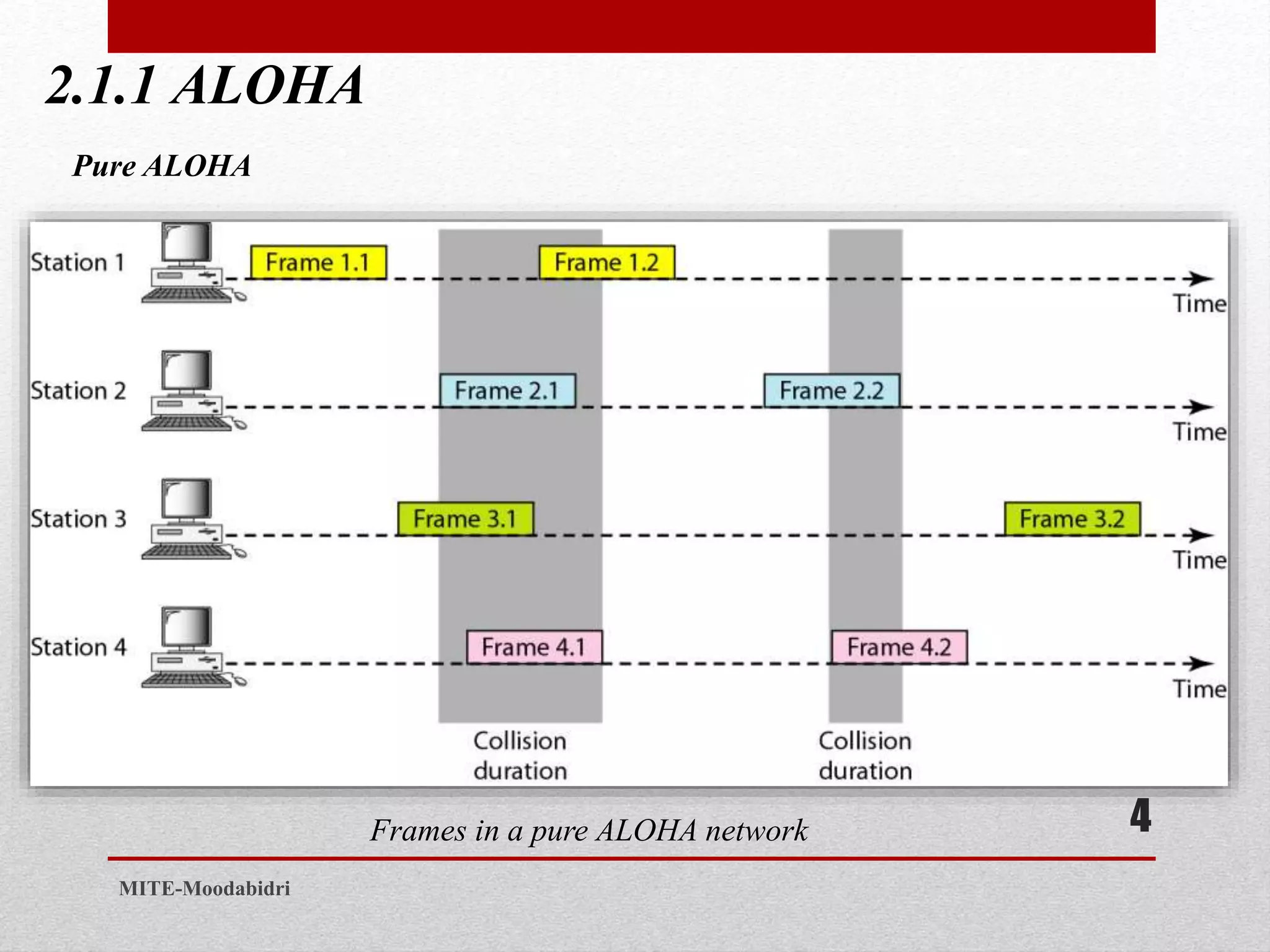
2.1.1 ALOHA
4
MITE-Moodabidri
Pure ALOHA
Frames in a pure ALOHA network
2.1.1 ALOHA
5
MITE-Moodabidri
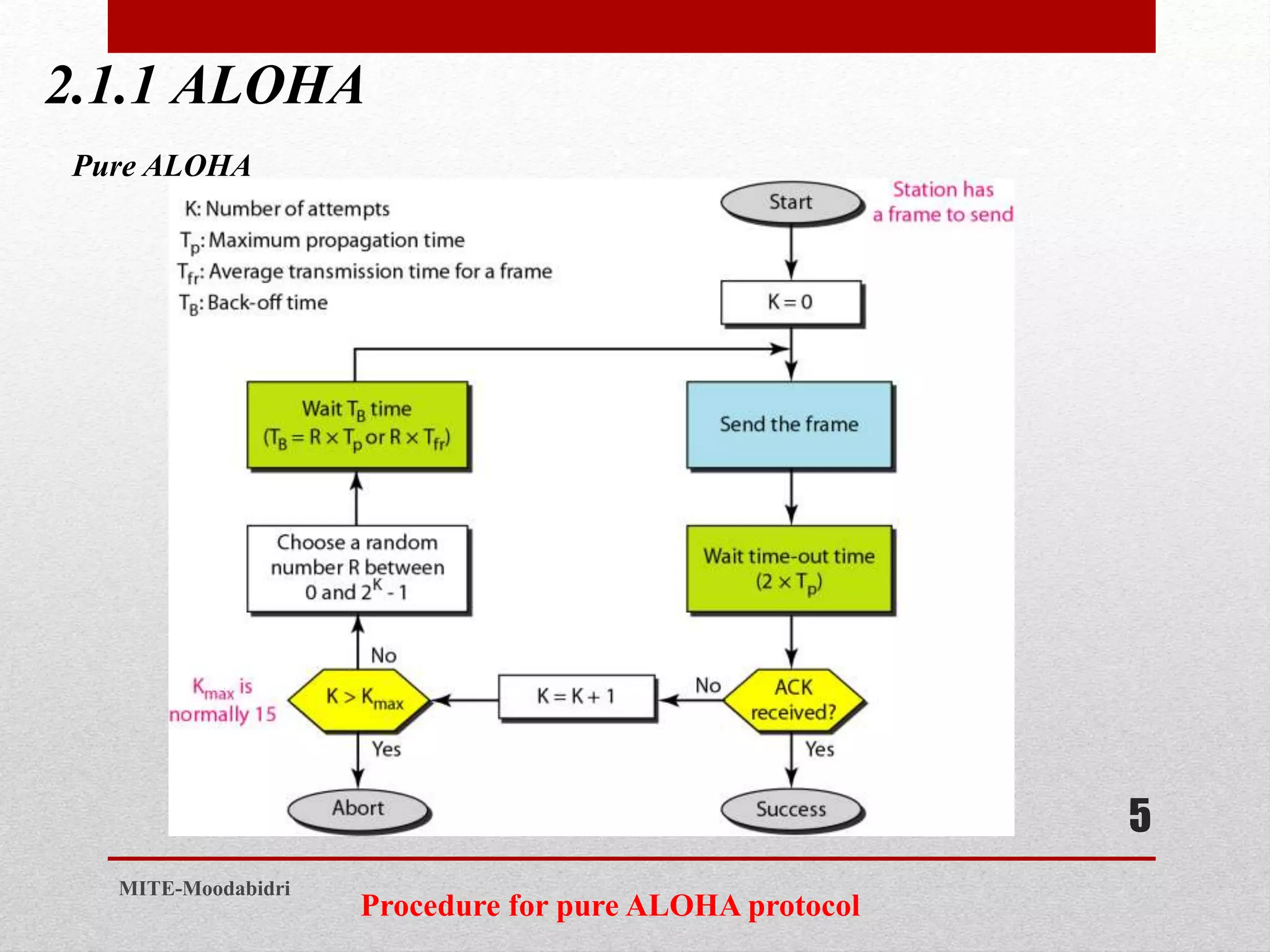
Pure ALOHA
Procedure for pure ALOHA protocol
2.1.1 ALOHA
6
MITE-Moodabidri
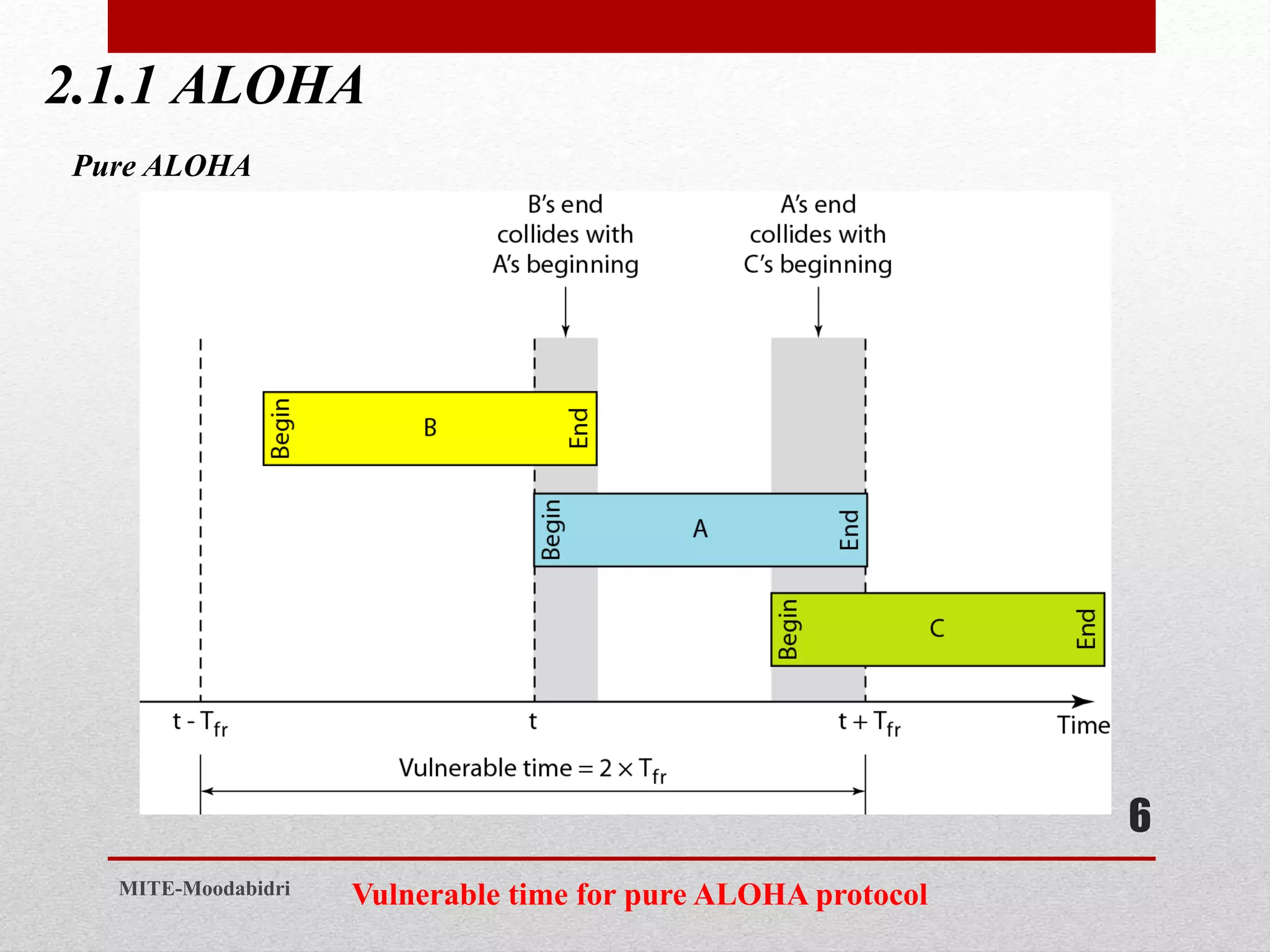
Pure ALOHA
Vulnerable time for pure ALOHA protocol
2.1.1 ALOHA
7
MITE-Moodabidri
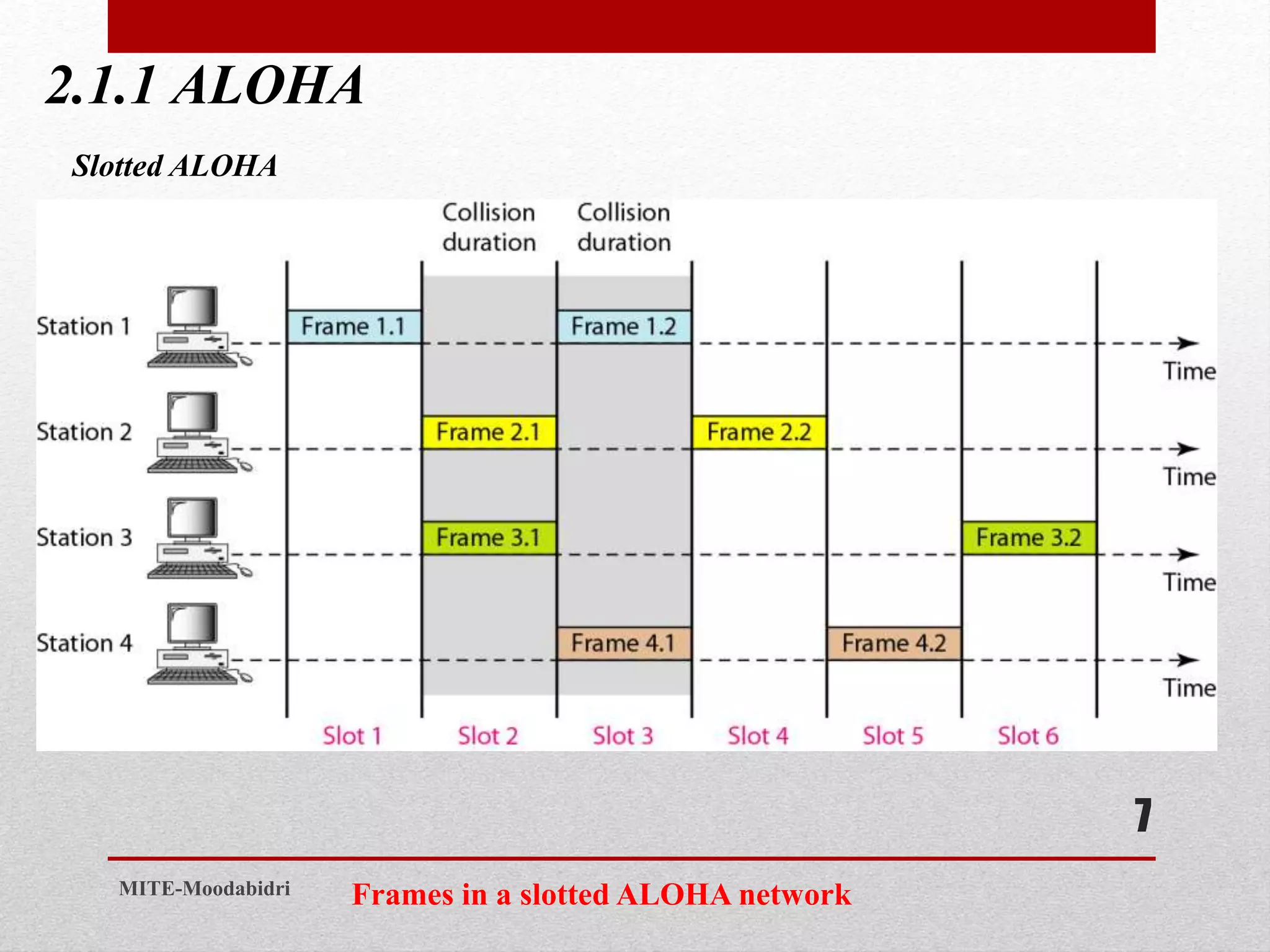
Slotted ALOHA
Frames in a slotted ALOHA network
2.1.1 ALOHA
8
MITE-Moodabidri
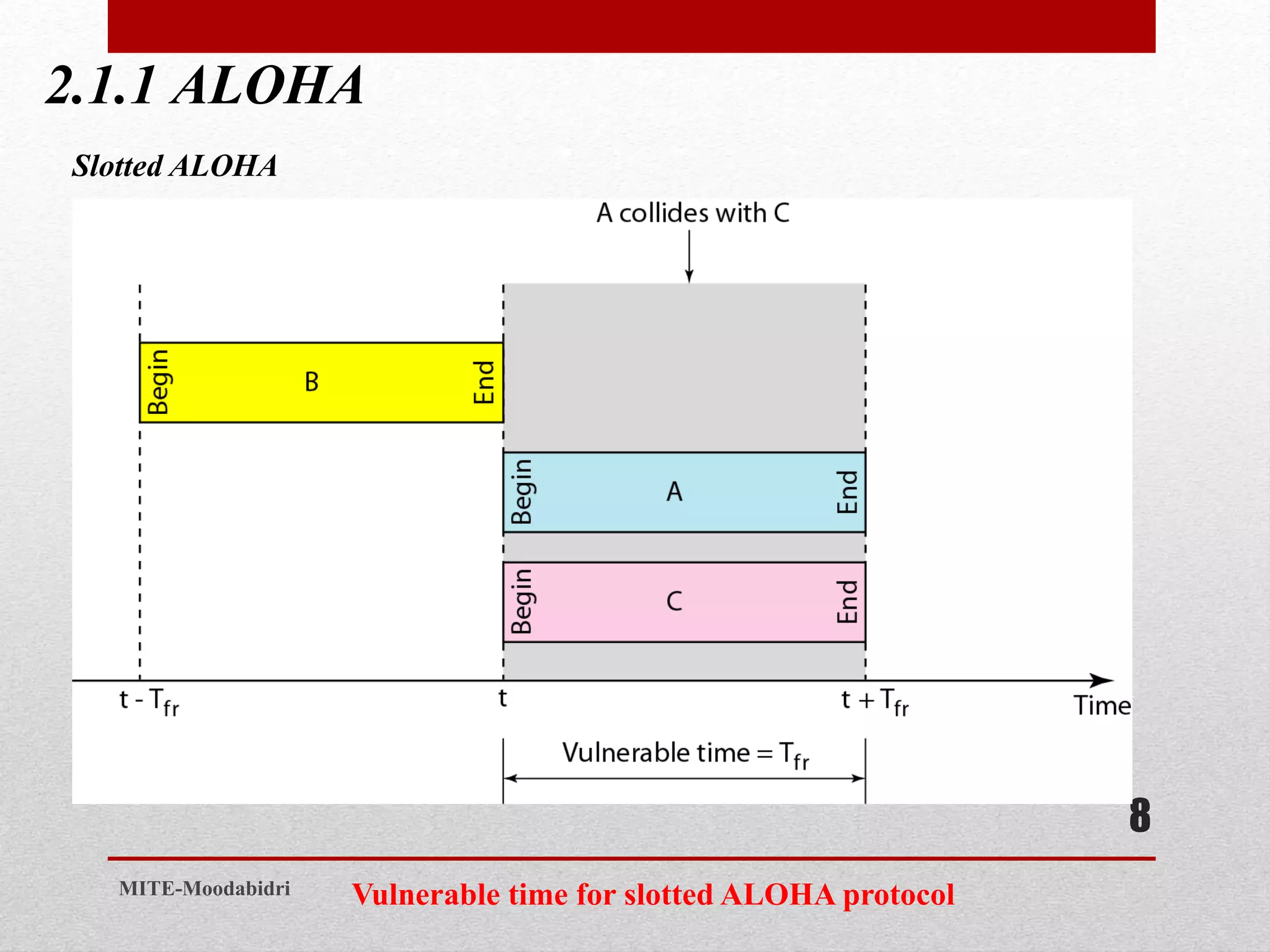
Slotted ALOHA
Vulnerable time for slotted ALOHA protocol
2.1.1 ALOHA
9
MITE-Moodabidri
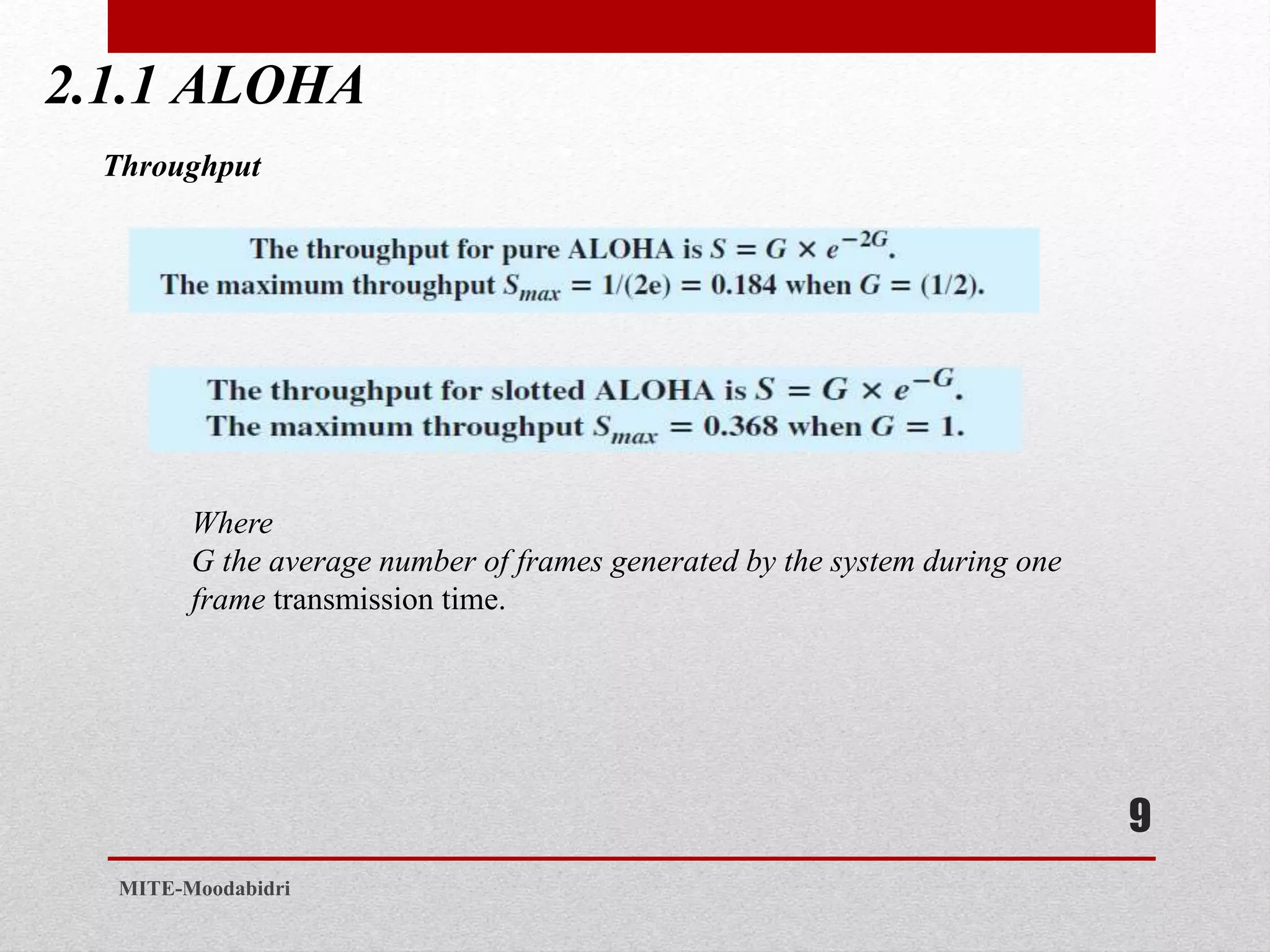
Throughput
Where
G the average number of frames generated by the system during one
frame transmission time.
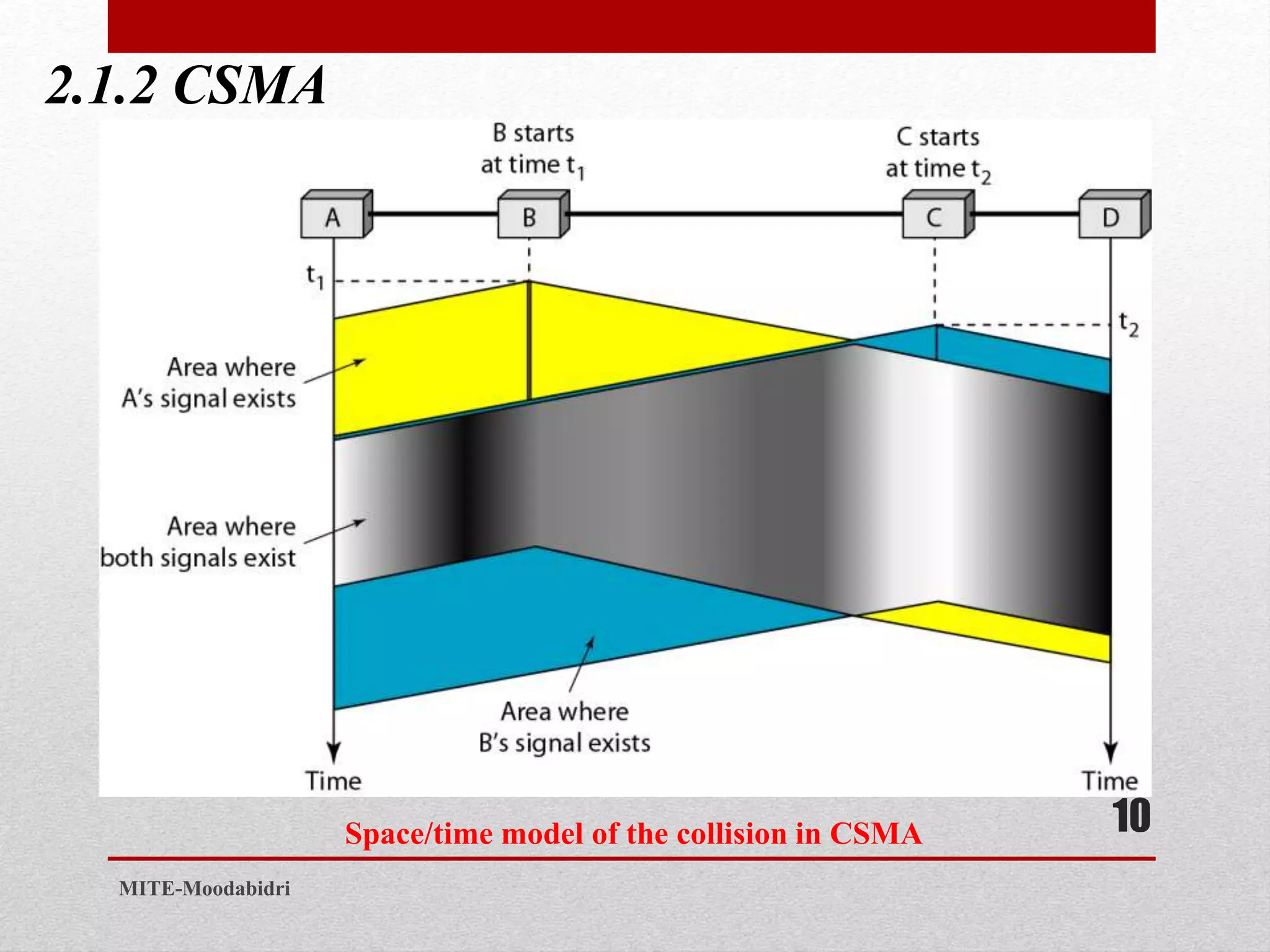
2.1.2 CSMA
10
MITE-Moodabidri
Space/time model of the collision in CSMA
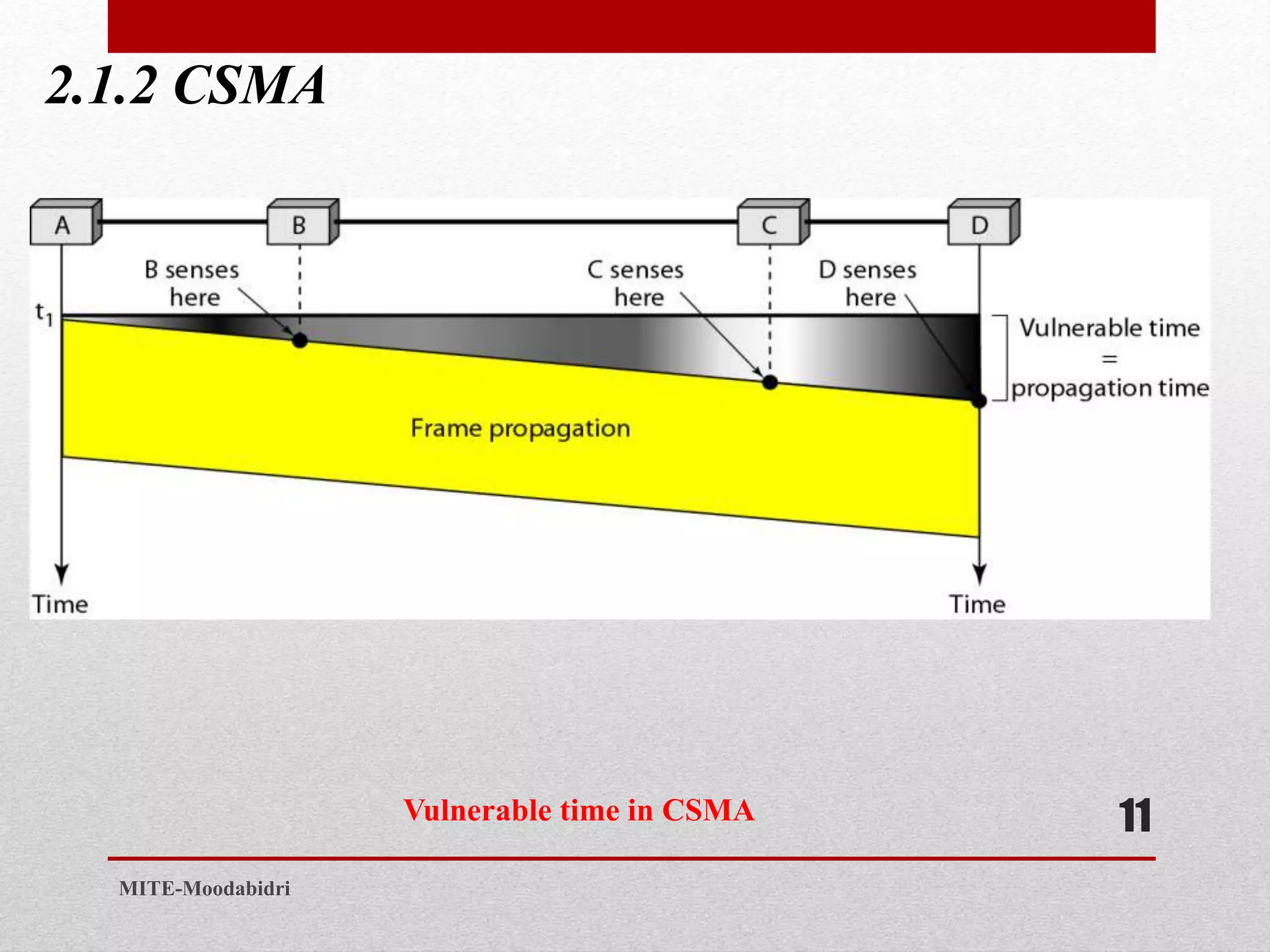
2.1.2 CSMA
11
MITE-Moodabidri
Vulnerable time in CSMA
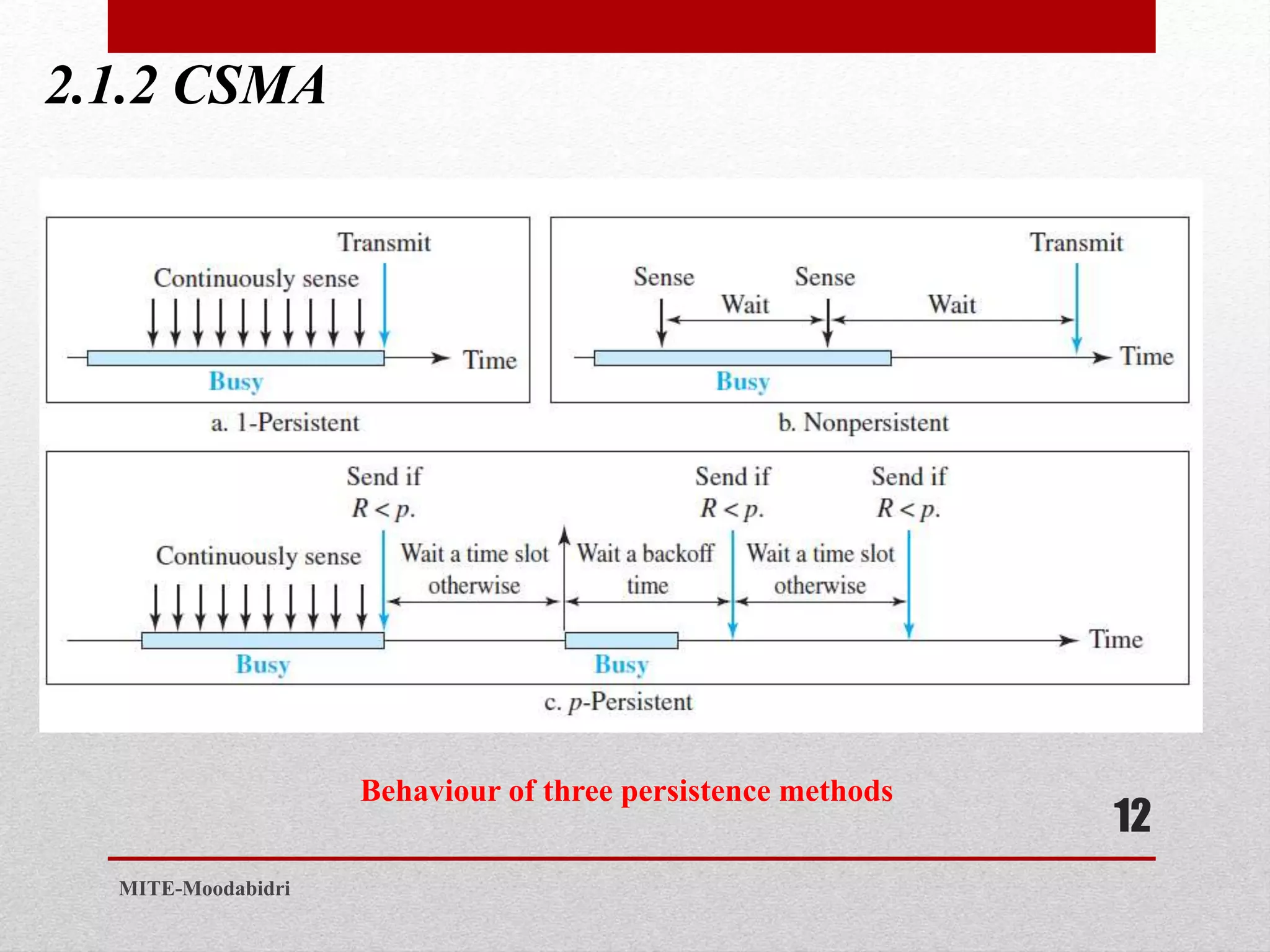
2.1.2 CSMA
12
MITE-Moodabidri
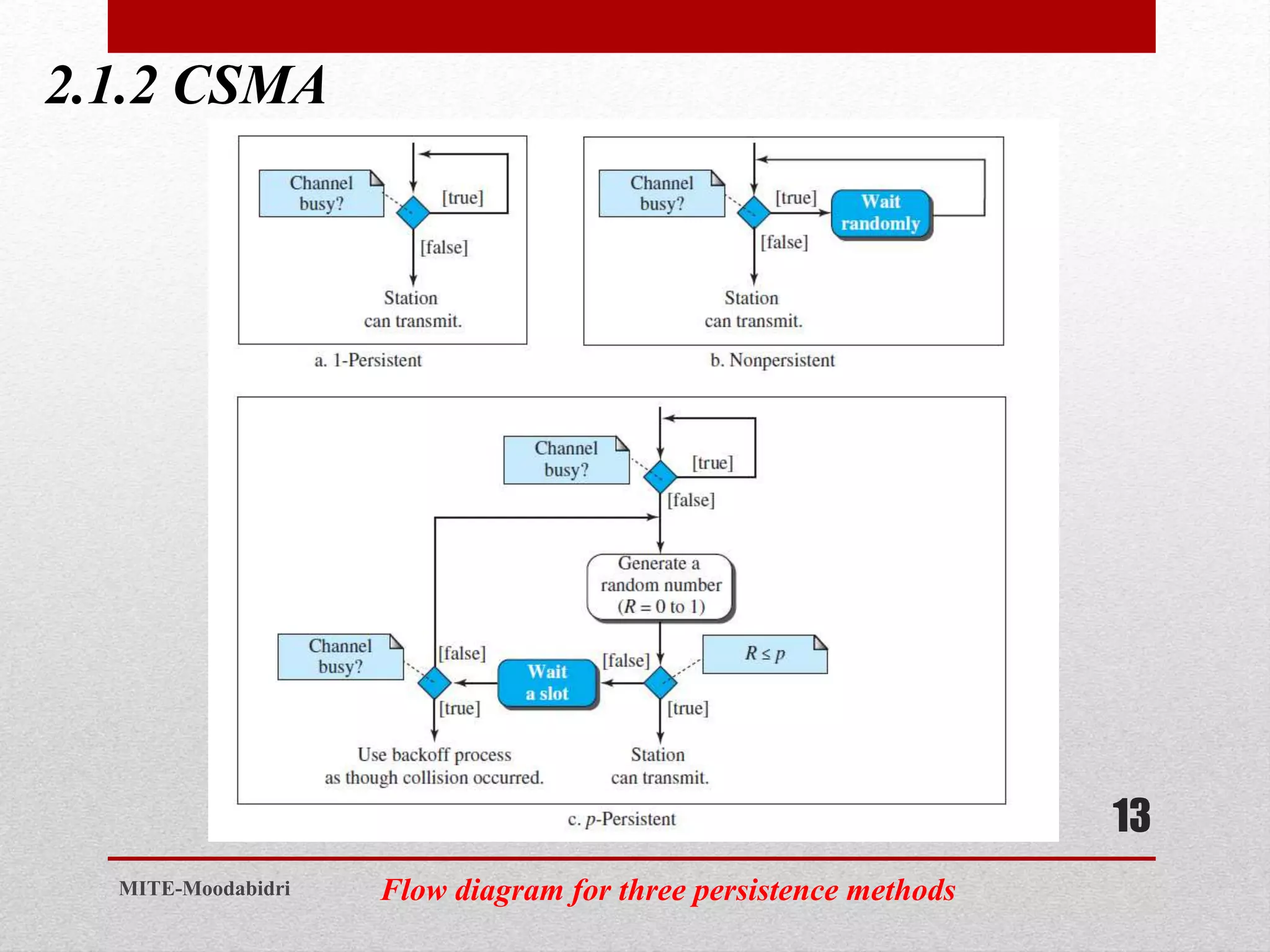
Behaviour of three persistence methods
2.1.2 CSMA
13
MITE-Moodabidri Flow diagram for three persistence methods
2.1.3 CSMS/CD
14
MITE-Moodabidri
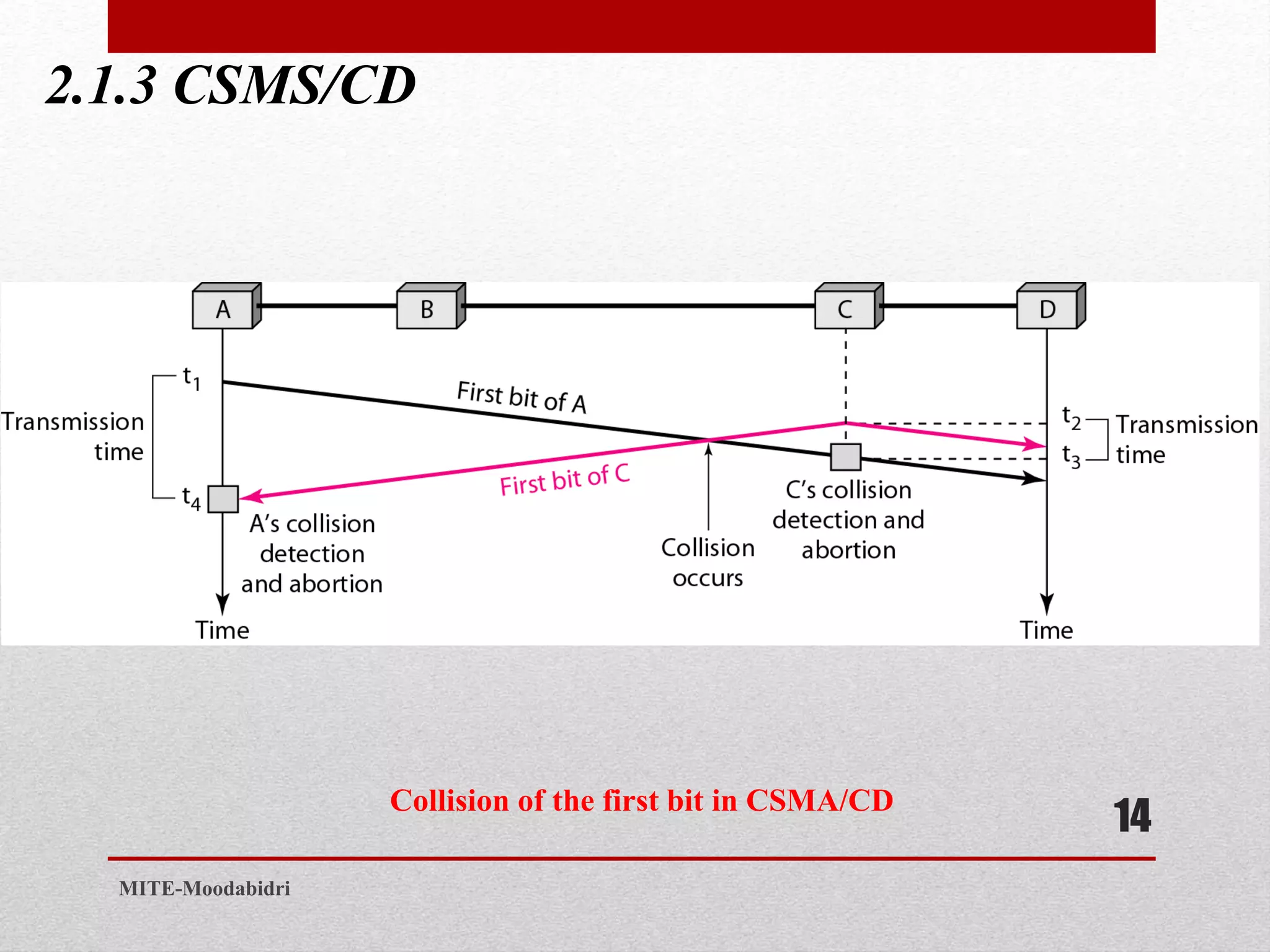
Collision of the first bit in CSMA/CD
2.1.3 CSMS/CD
15
MITE-Moodabidri
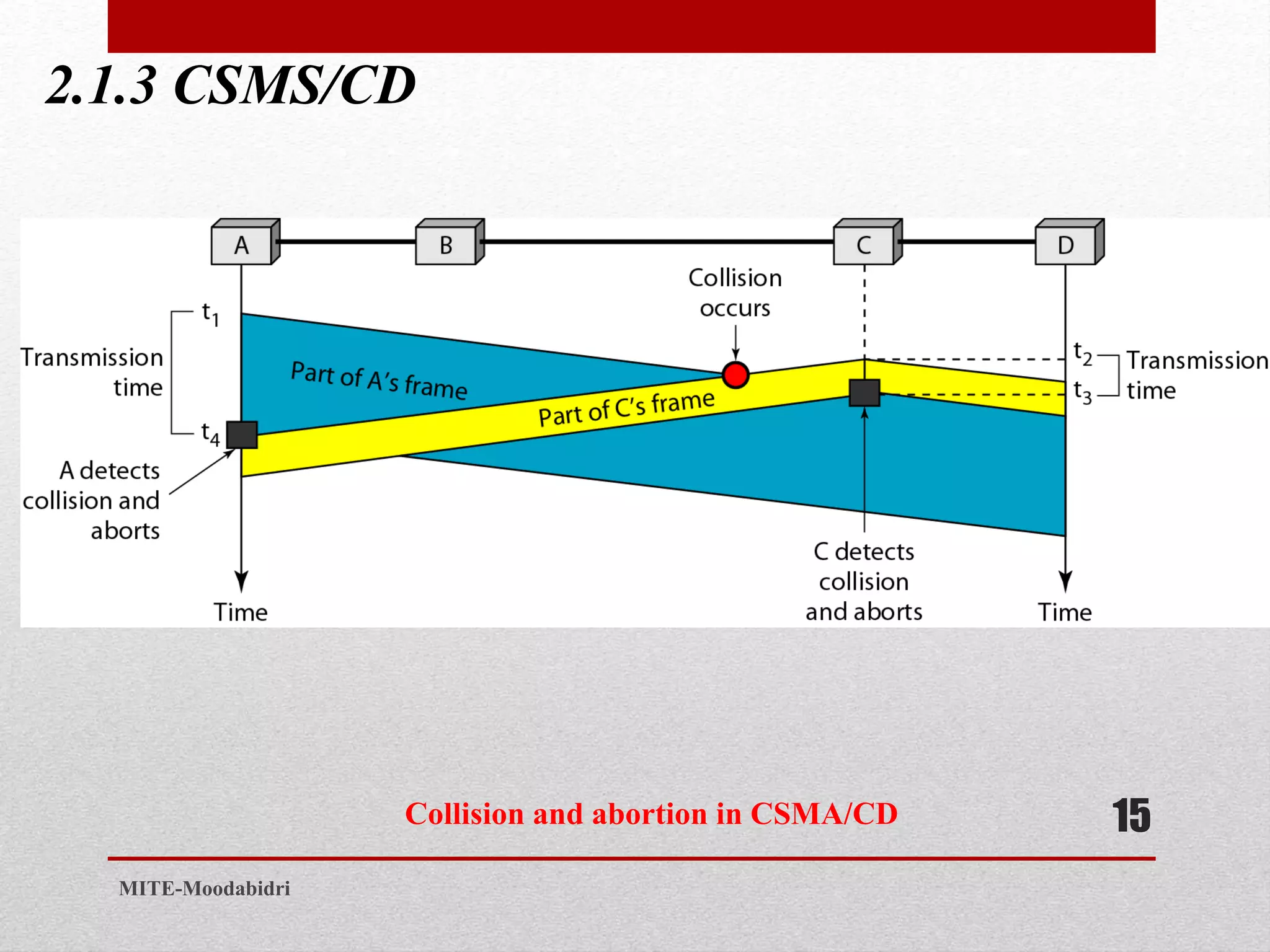
Collision and abortion in CSMA/CD
2.1.3 CSMS/CD
16
MITE-Moodabidri
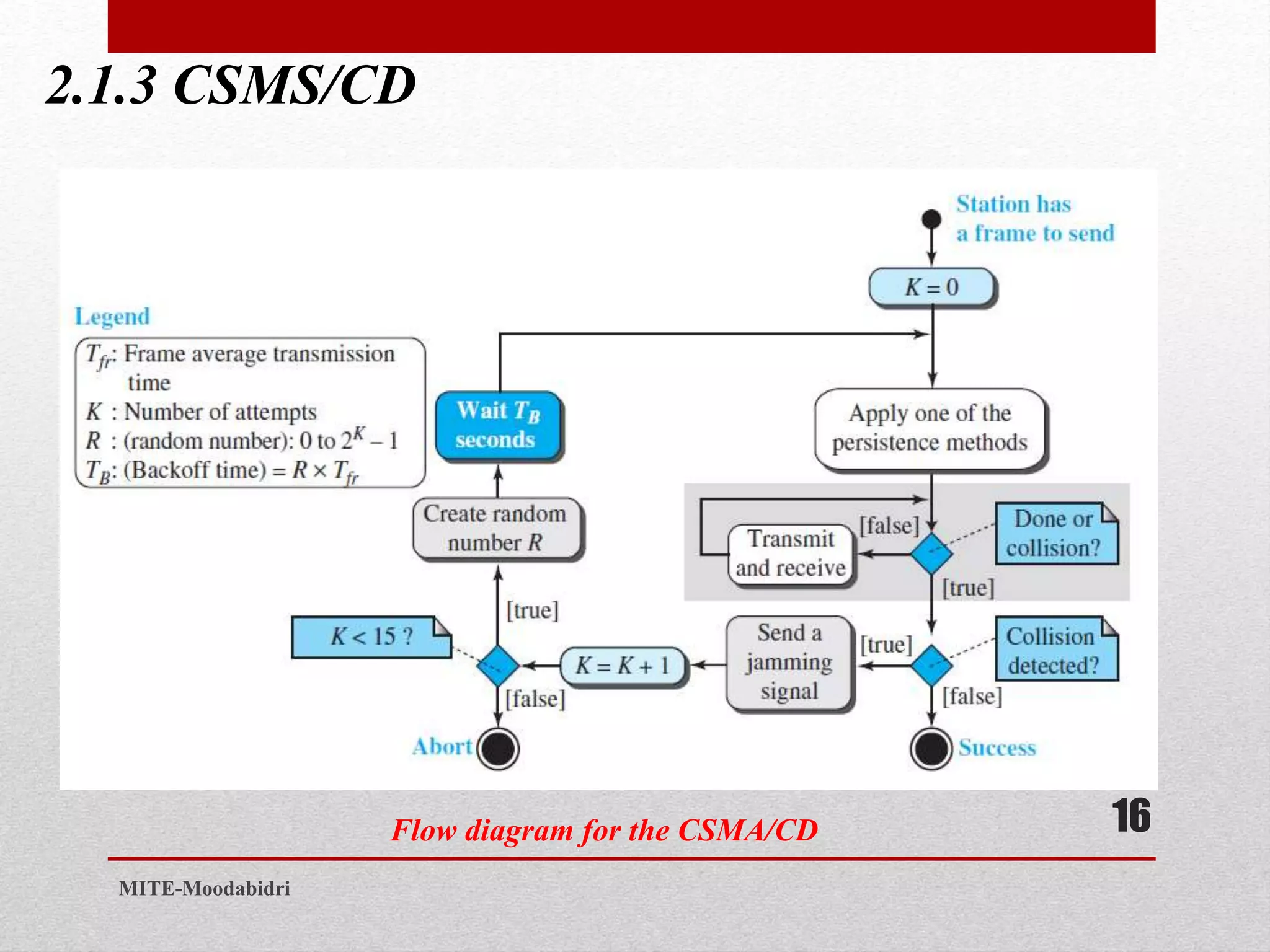
Flow diagram for the CSMA/CD
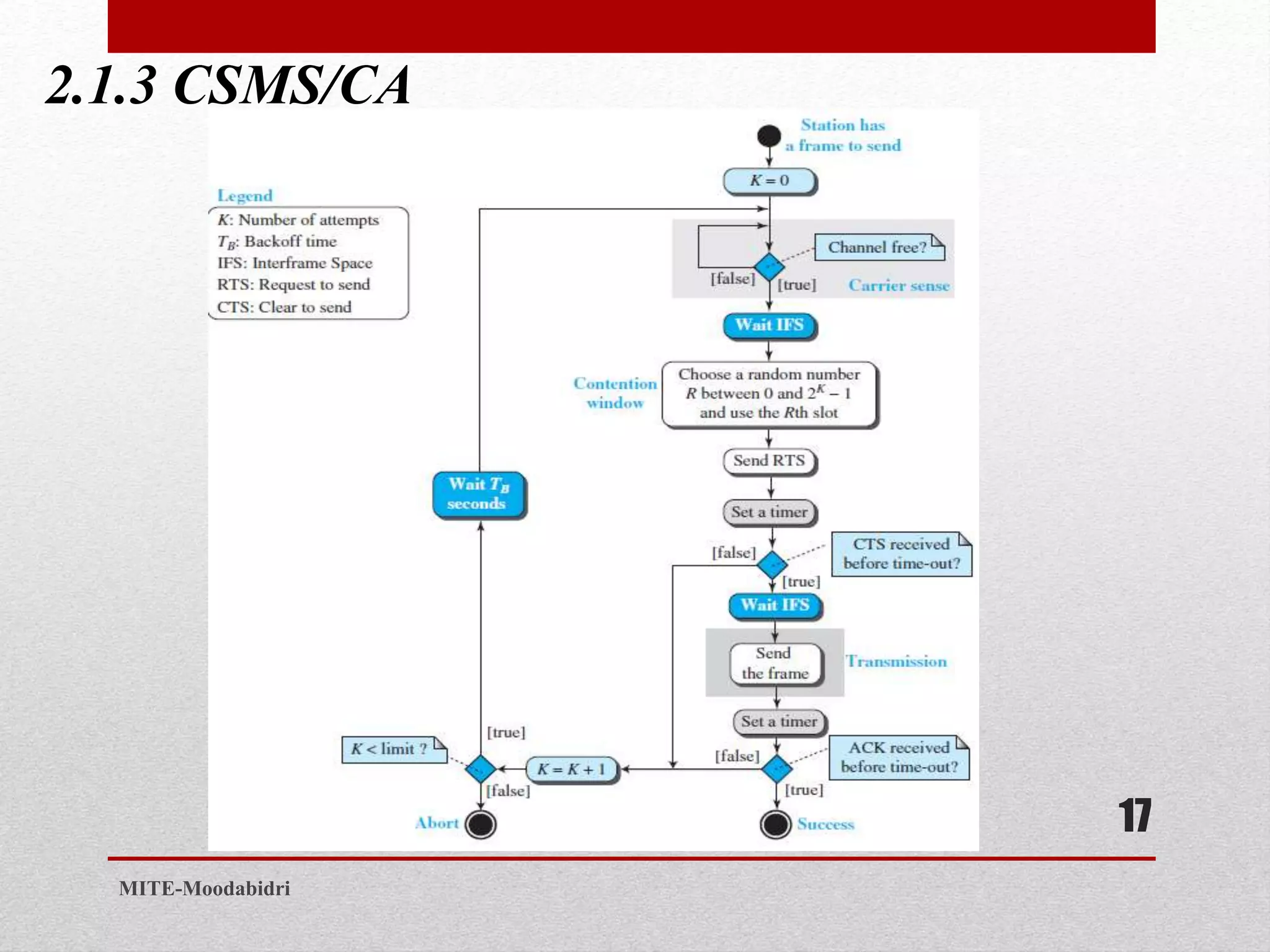
2.1.3 CSMS/CA
17
MITE-Moodabidri
2.1.3 CSMS/CA
18
MITE-Moodabidri
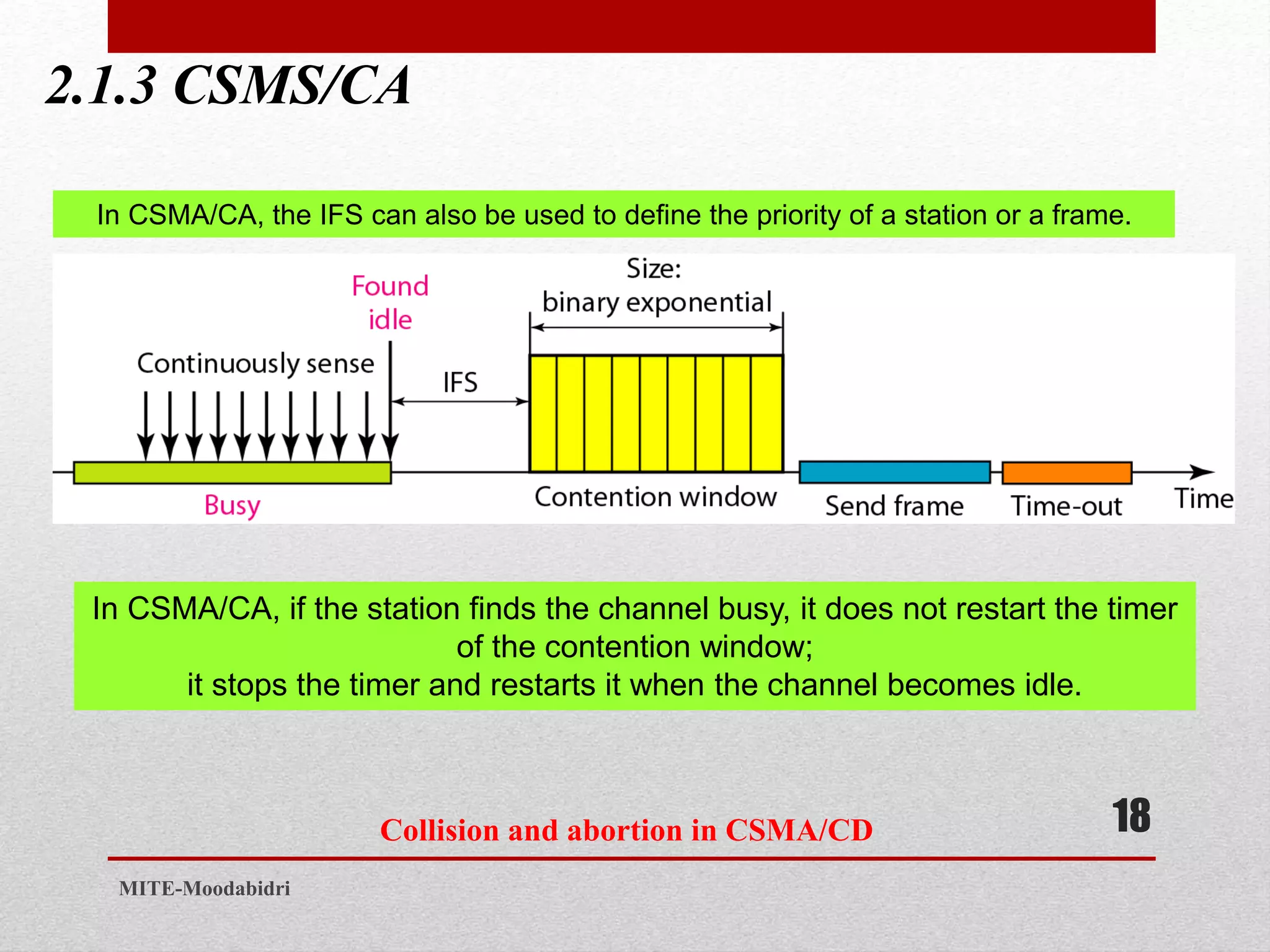
In CSMA/CA, the IFS can also be used to define the priority of a station or a frame.
In CSMA/CA, if the station finds the channel busy, it does not restart the timer
of the contention window;
it stops the timer and restarts it when the channel becomes idle.
Collision and abortion in CSMA/CD
2.1.3 CSMS/CA
19
MITE-Moodabidri
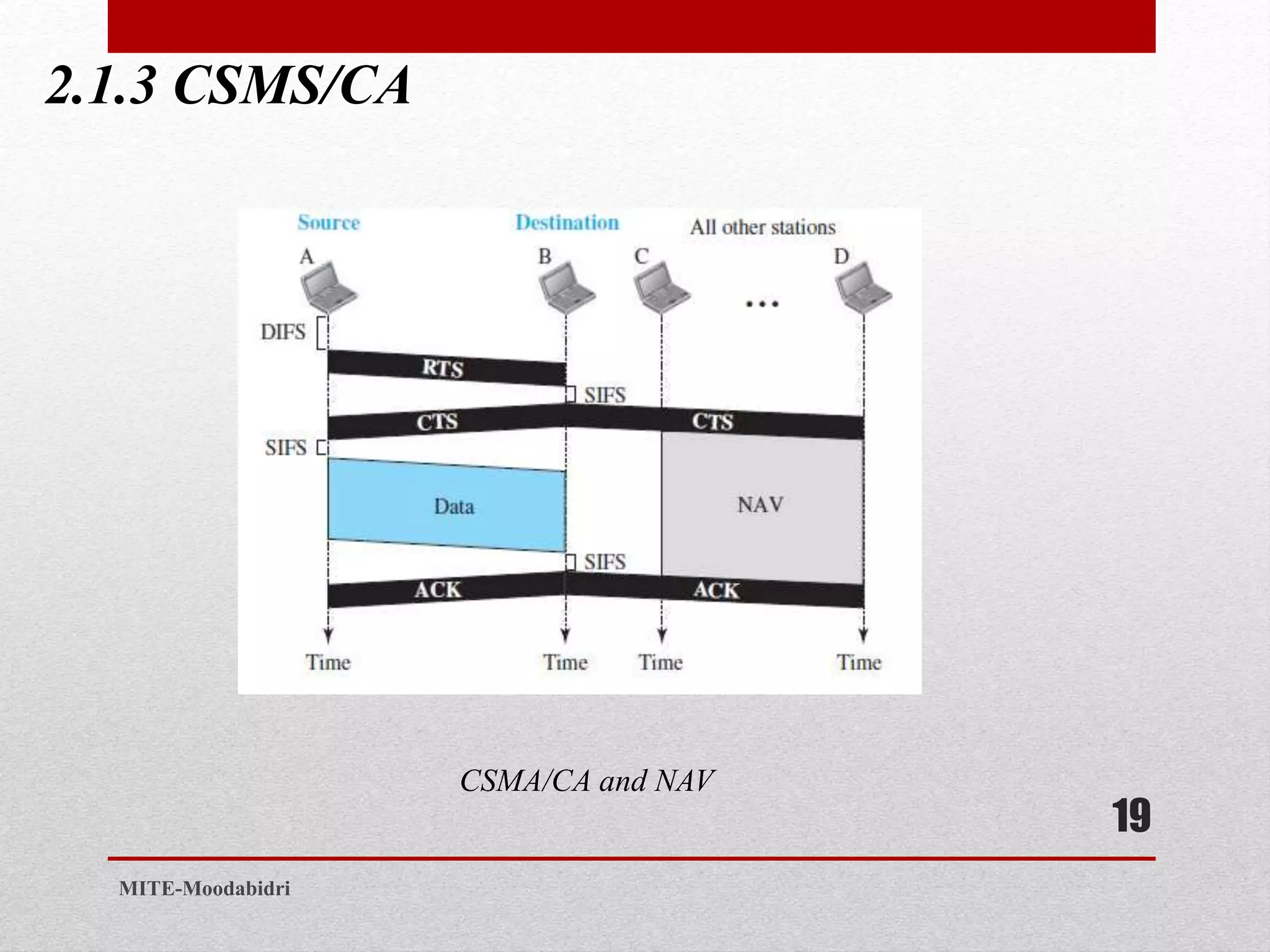
CSMA/CA and NAV
2.2 CONTROLLED ACCESS
20
MITE-Moodabidri
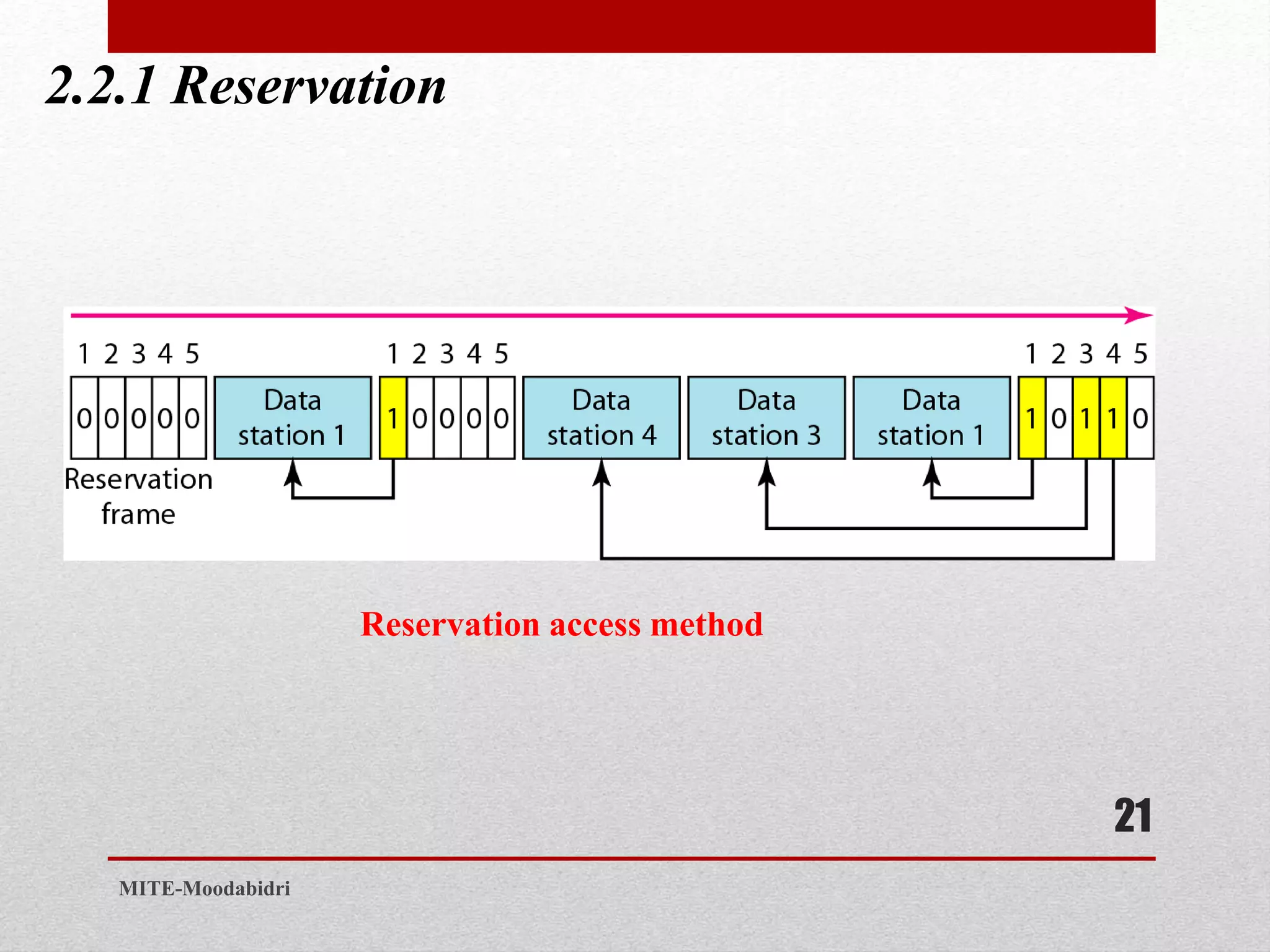
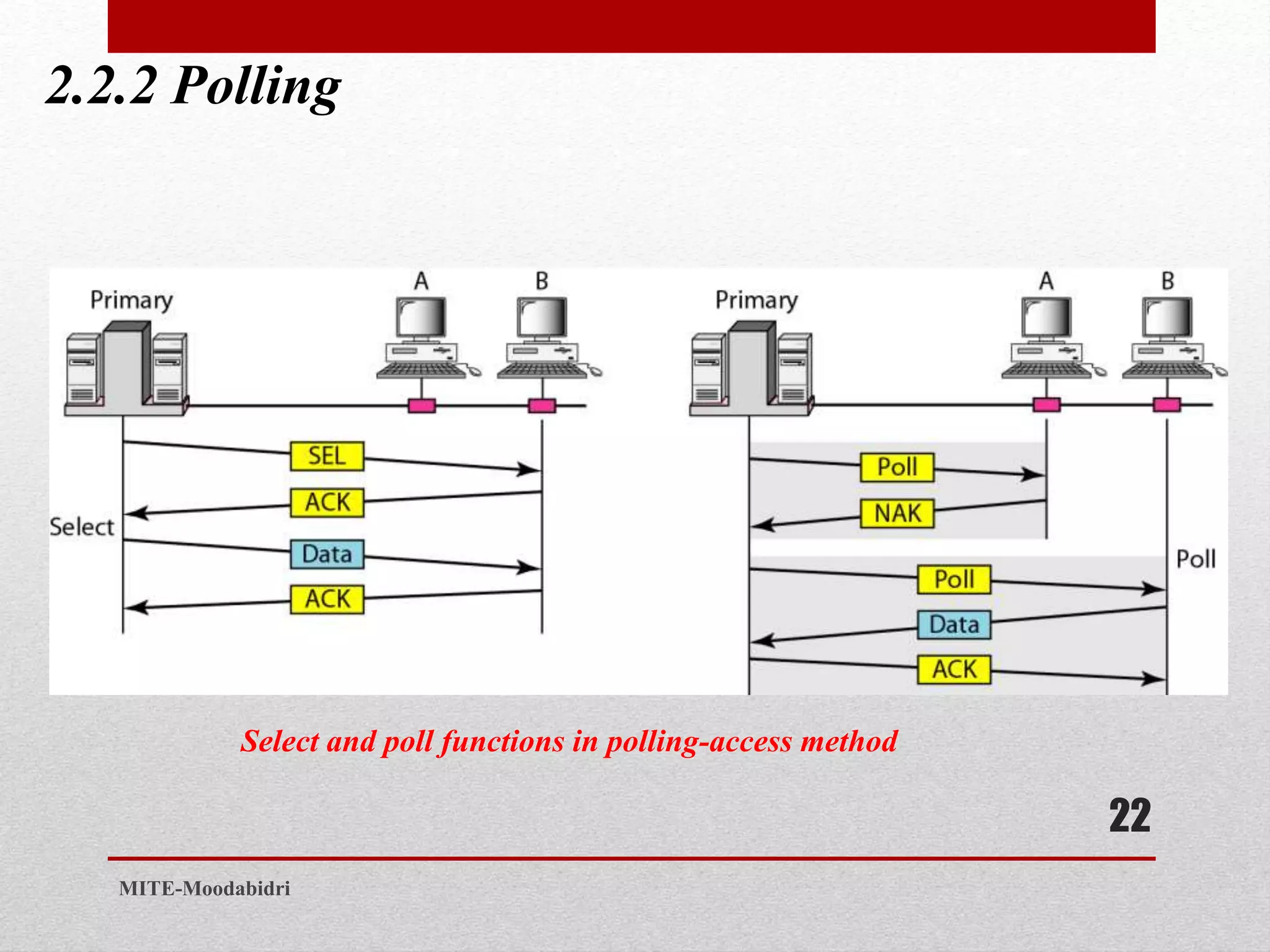
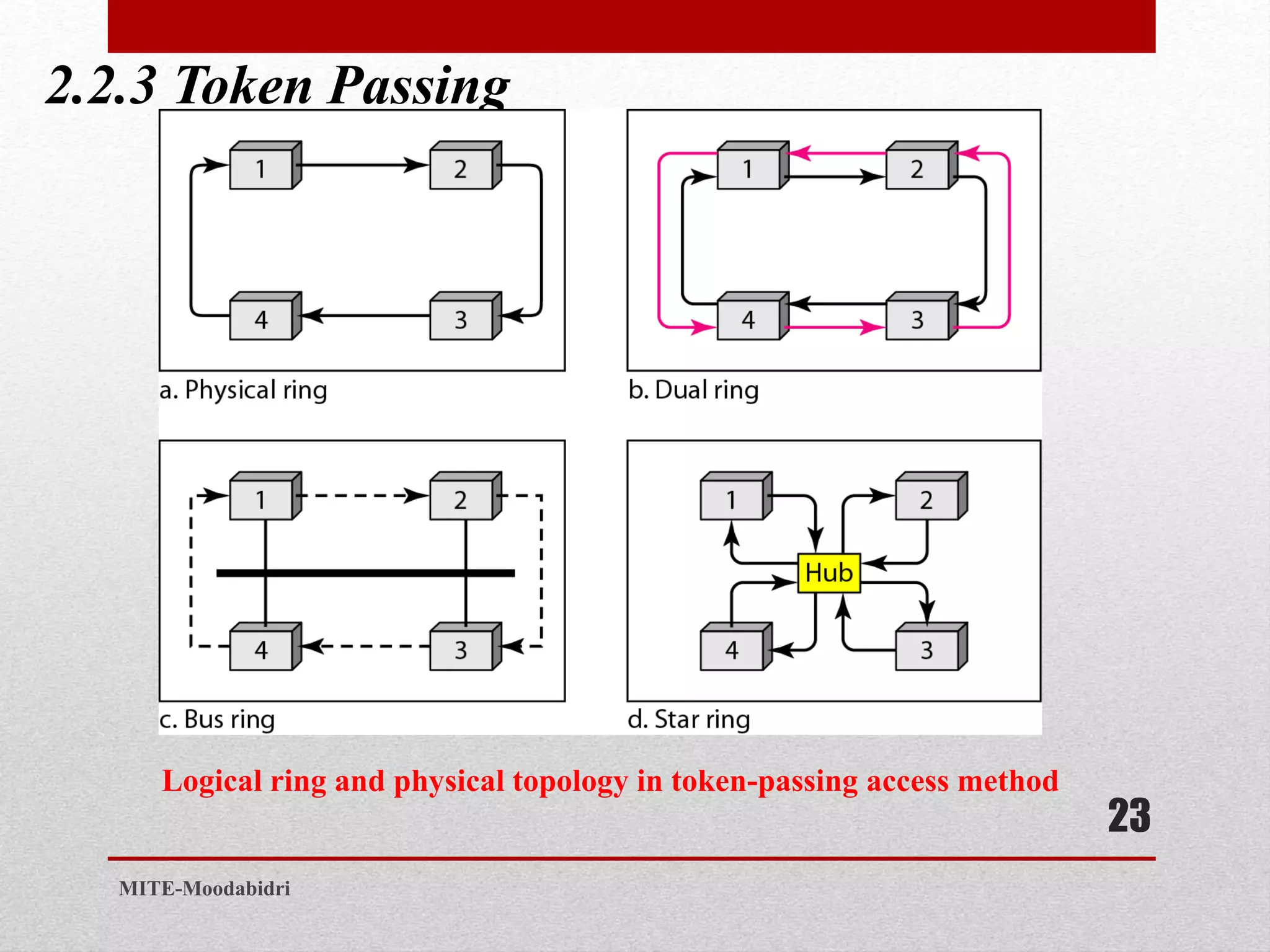
In controlled access, the stations consult one another to find which station has
the right to send. A station cannot send unless it has been authorized by other
stations. We discuss three popular controlled-access methods.
Reservation
Polling
Token Passing
2.2.1 Reservation
21
MITE-Moodabidri
Reservation access method
2.2.2 Polling
22
MITE-Moodabidri
Select and poll functions in polling-access method
2.2.3 Token Passing
23
MITE-Moodabidri
Logical ring and physical topology in token-passing access method
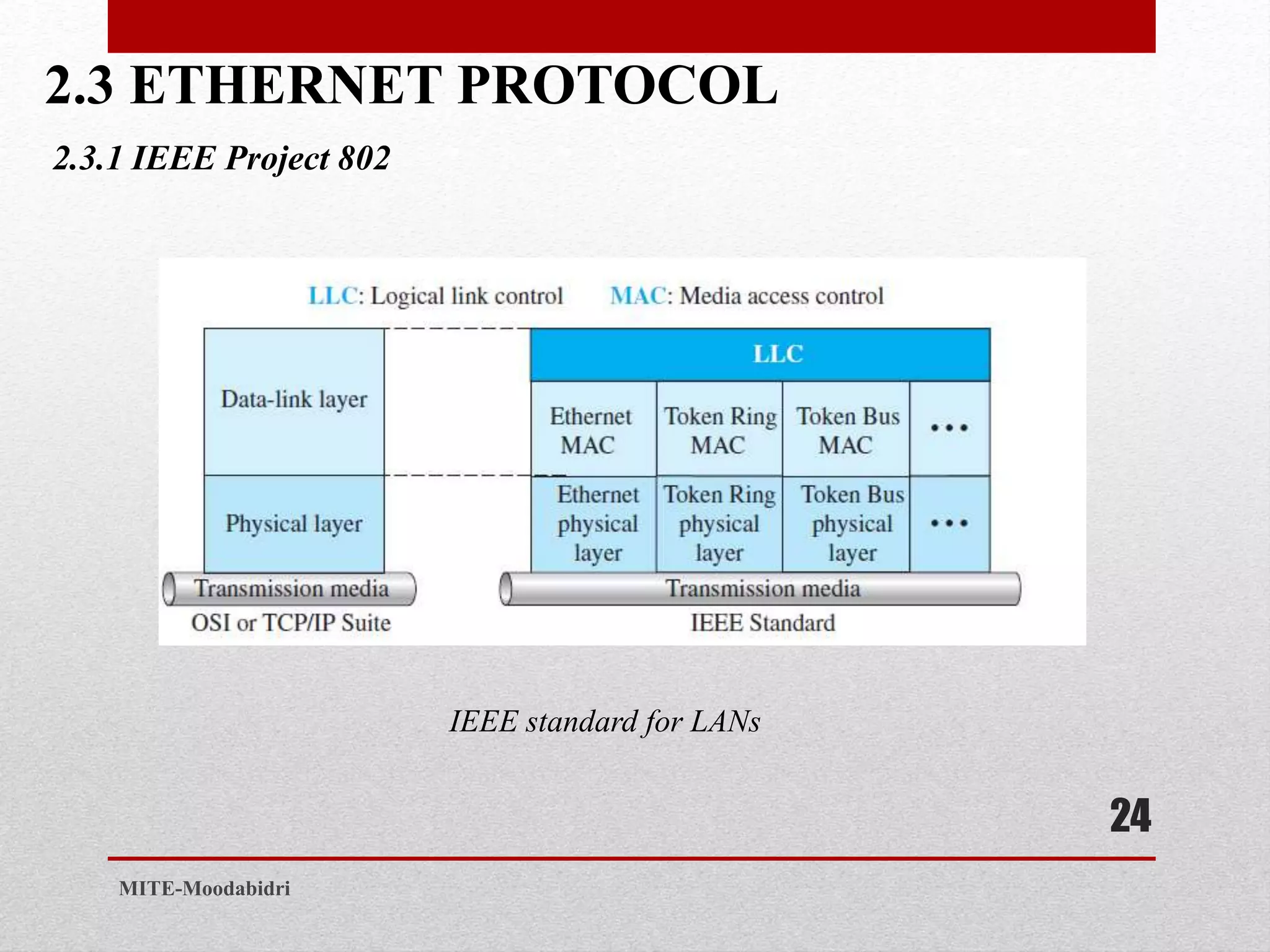
2.3 ETHERNET PROTOCOL
24
MITE-Moodabidri
2.3.1 IEEE Project 802
IEEE standard for LANs
25
MITE-Moodabidri
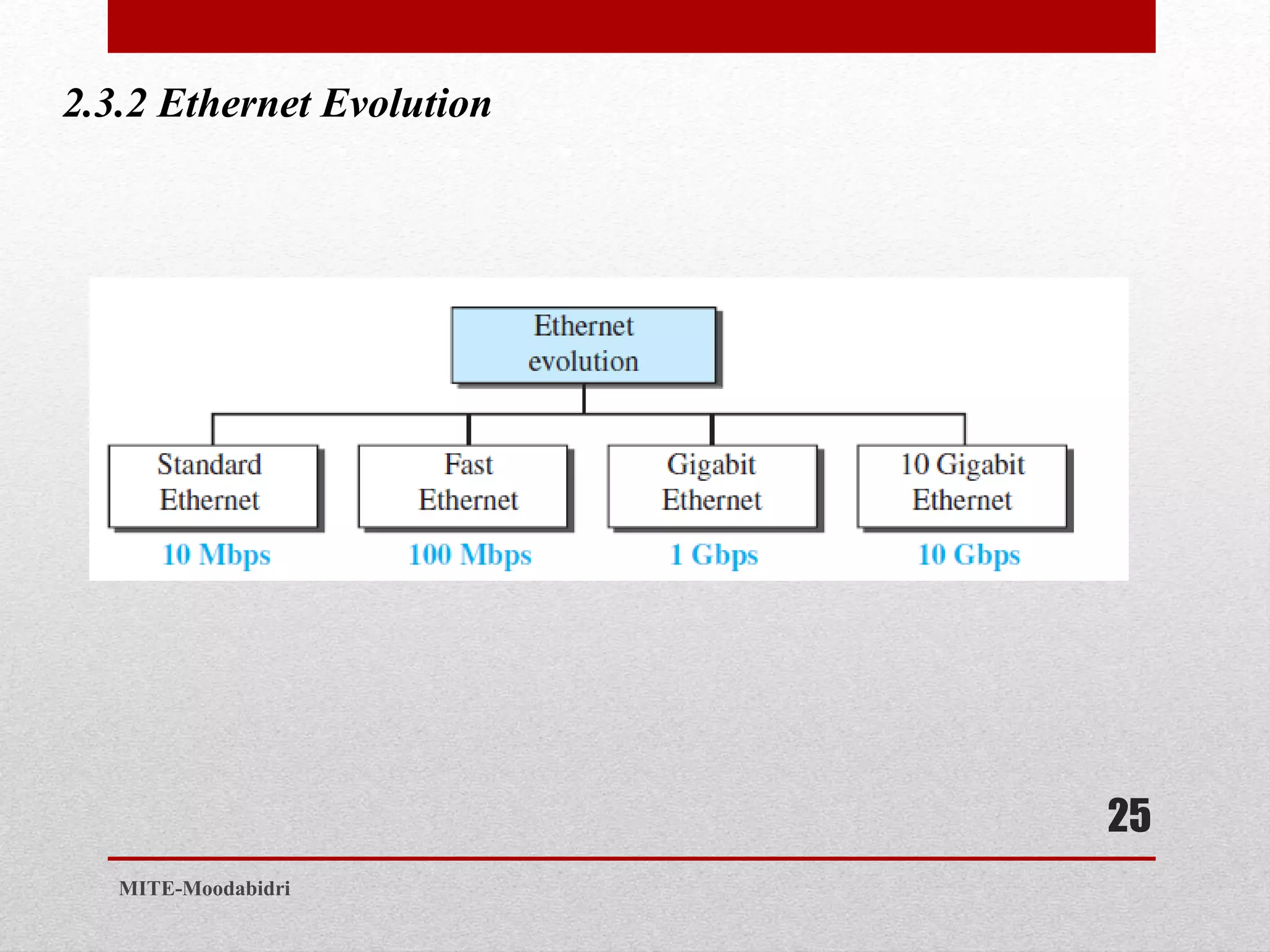
2.3.2 Ethernet Evolution
2.4 STANDARD ETHERNET
26
MITE-Moodabidri
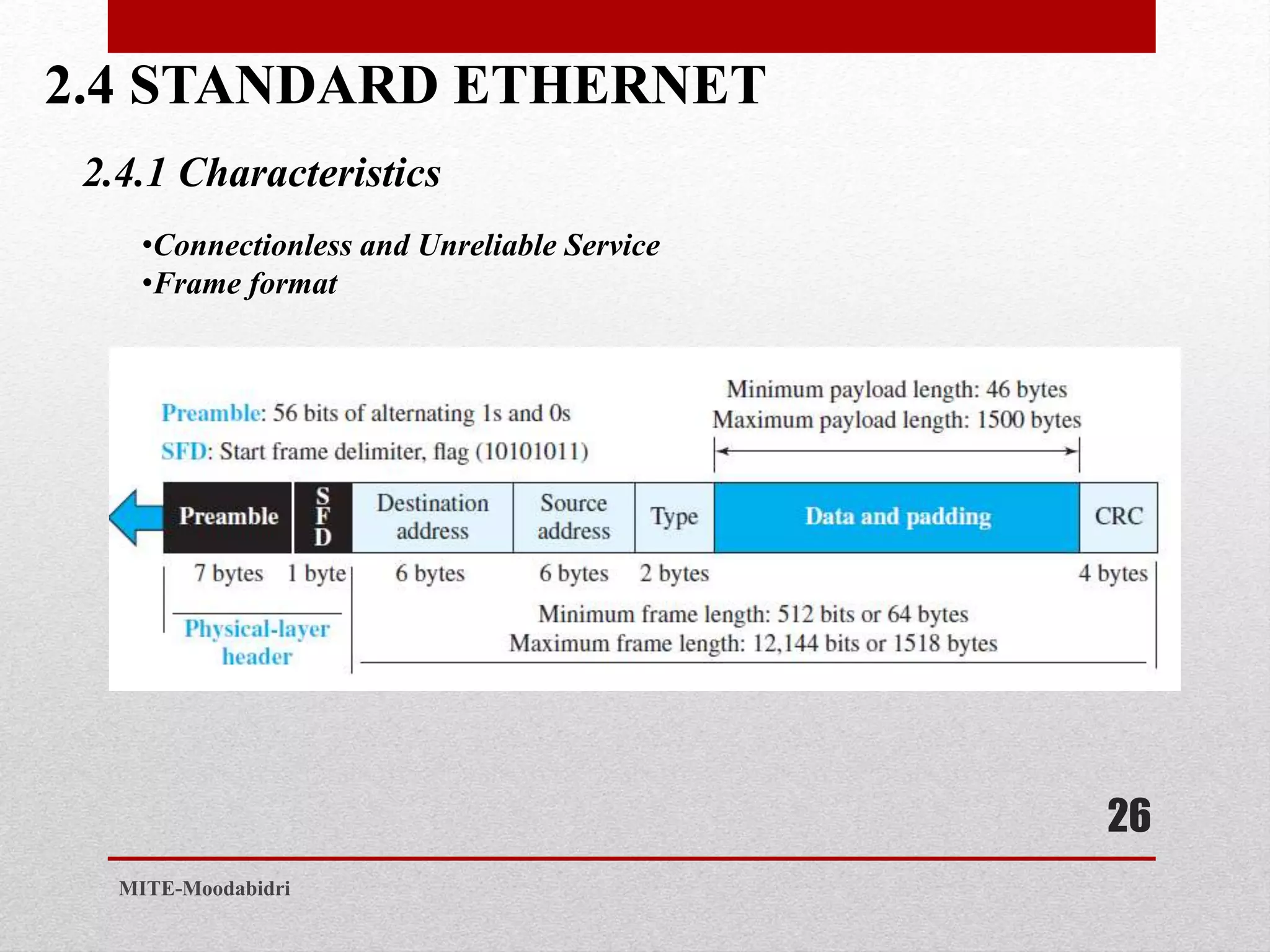
2.4.1 Characteristics
•Connectionless and Unreliable Service
•Frame format
2.4.2 Addressing
27
MITE-Moodabidri
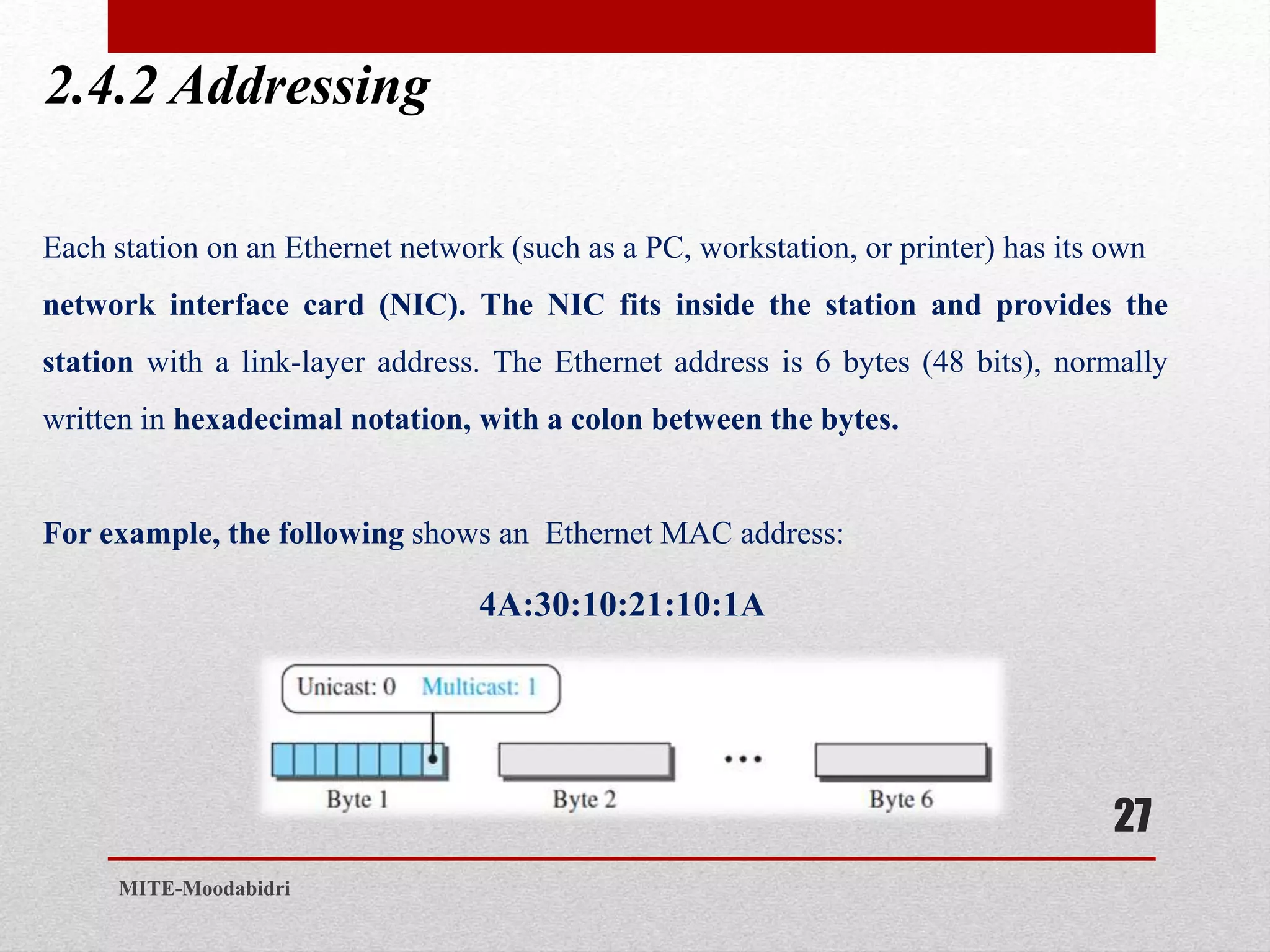
Each station on an Ethernet network (such as a PC, workstation, or printer) has its own
network interface card (NIC). The NIC fits inside the station and provides the
station with a link-layer address. The Ethernet address is 6 bytes (48 bits), normally
written in hexadecimal notation, with a colon between the bytes.
For example, the following shows an Ethernet MAC address:
4A:30:10:21:10:1A
2.4.2 Addressing
28
MITE-Moodabidri
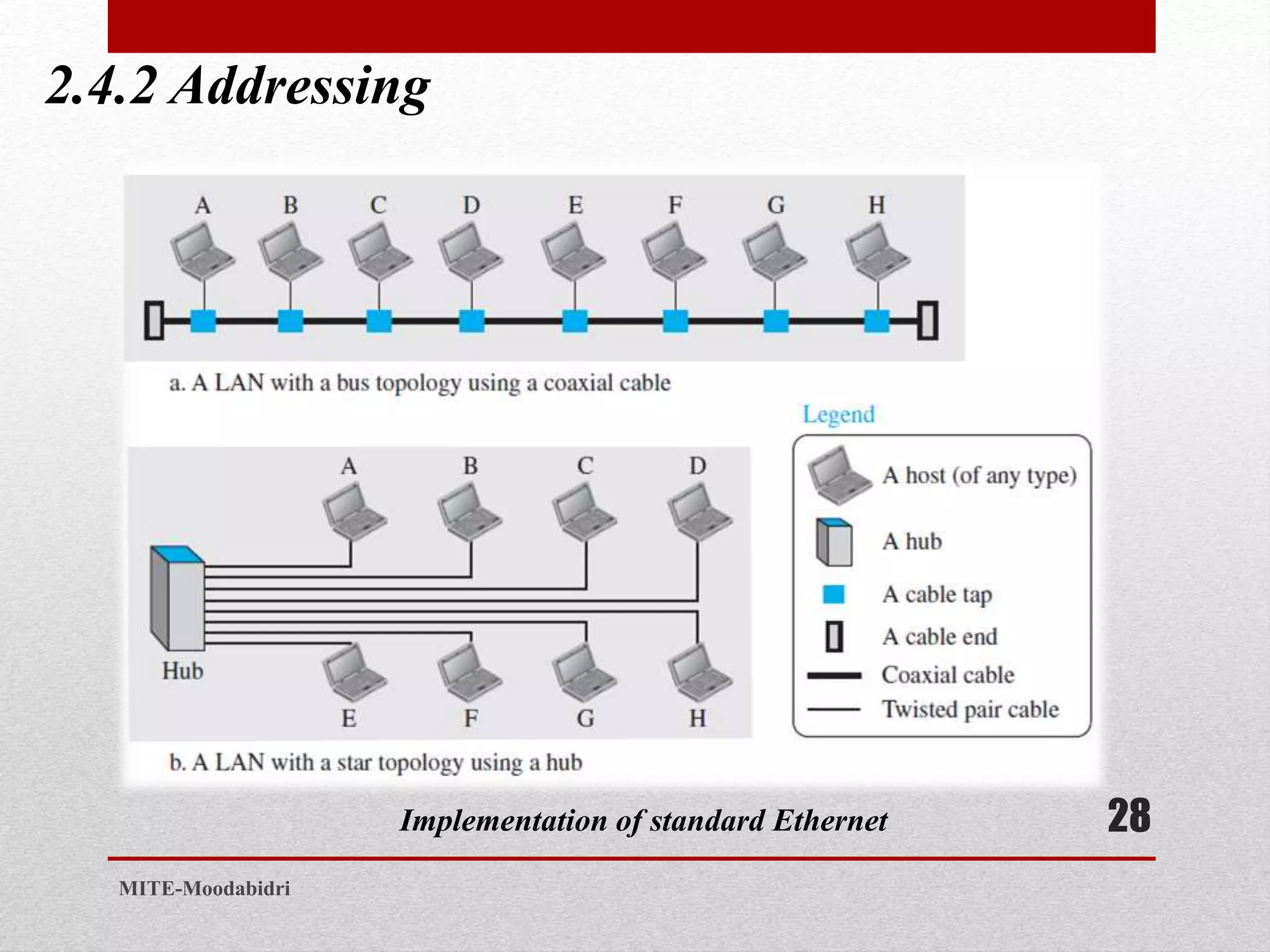
Implementation of standard Ethernet
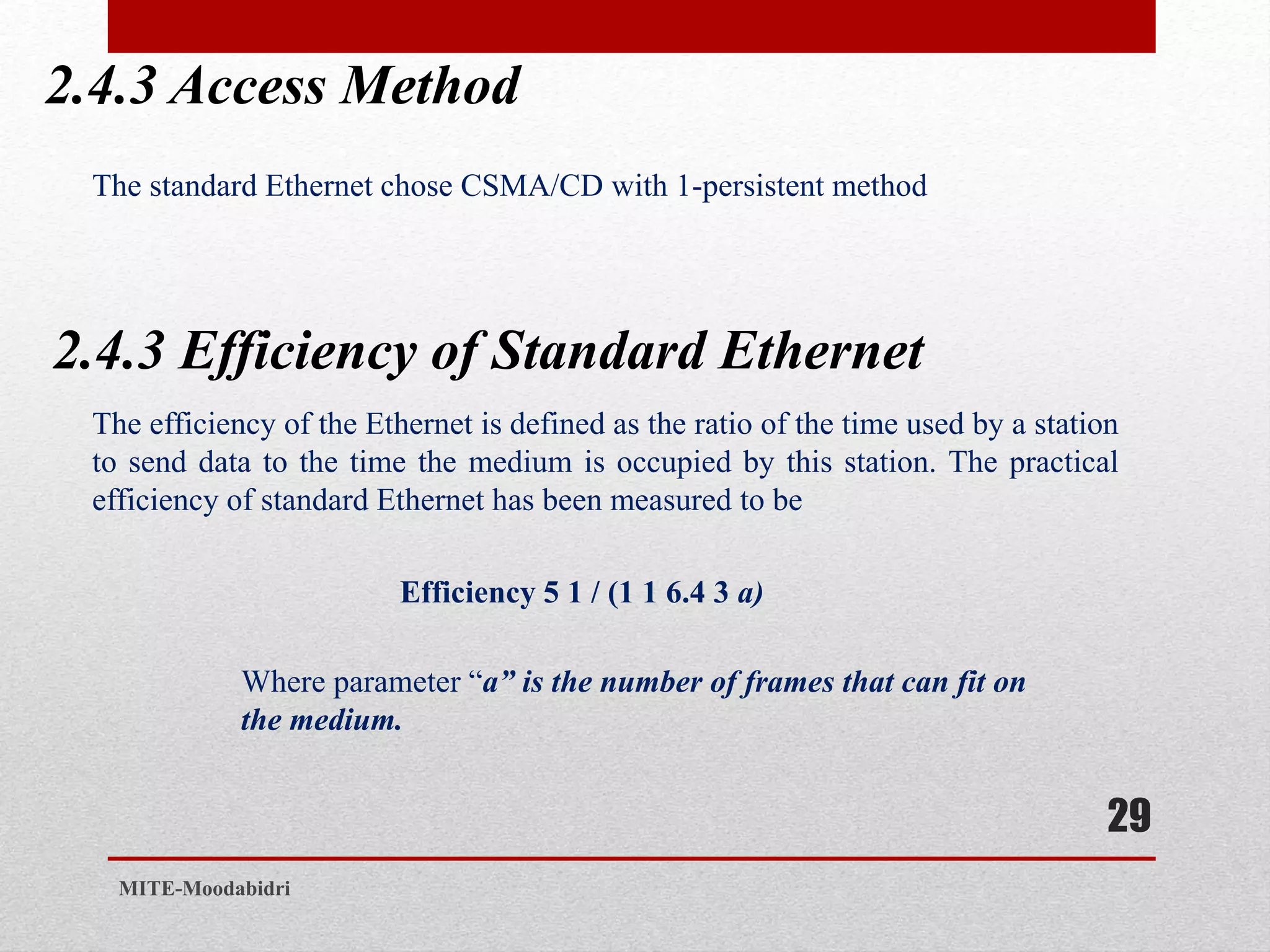
2.4.3 Access Method
29
MITE-Moodabidri
The standard Ethernet chose CSMA/CD with 1-persistent method
2.4.3 Efficiency of Standard Ethernet
The efficiency of the Ethernet is defined as the ratio of the time used by a station
to send data to the time the medium is occupied by this station. The practical
efficiency of standard Ethernet has been measured to be
Efficiency 5 1 / (1 1 6.4 3 a)
Where parameter “a” is the number of frames that can fit on
the medium.
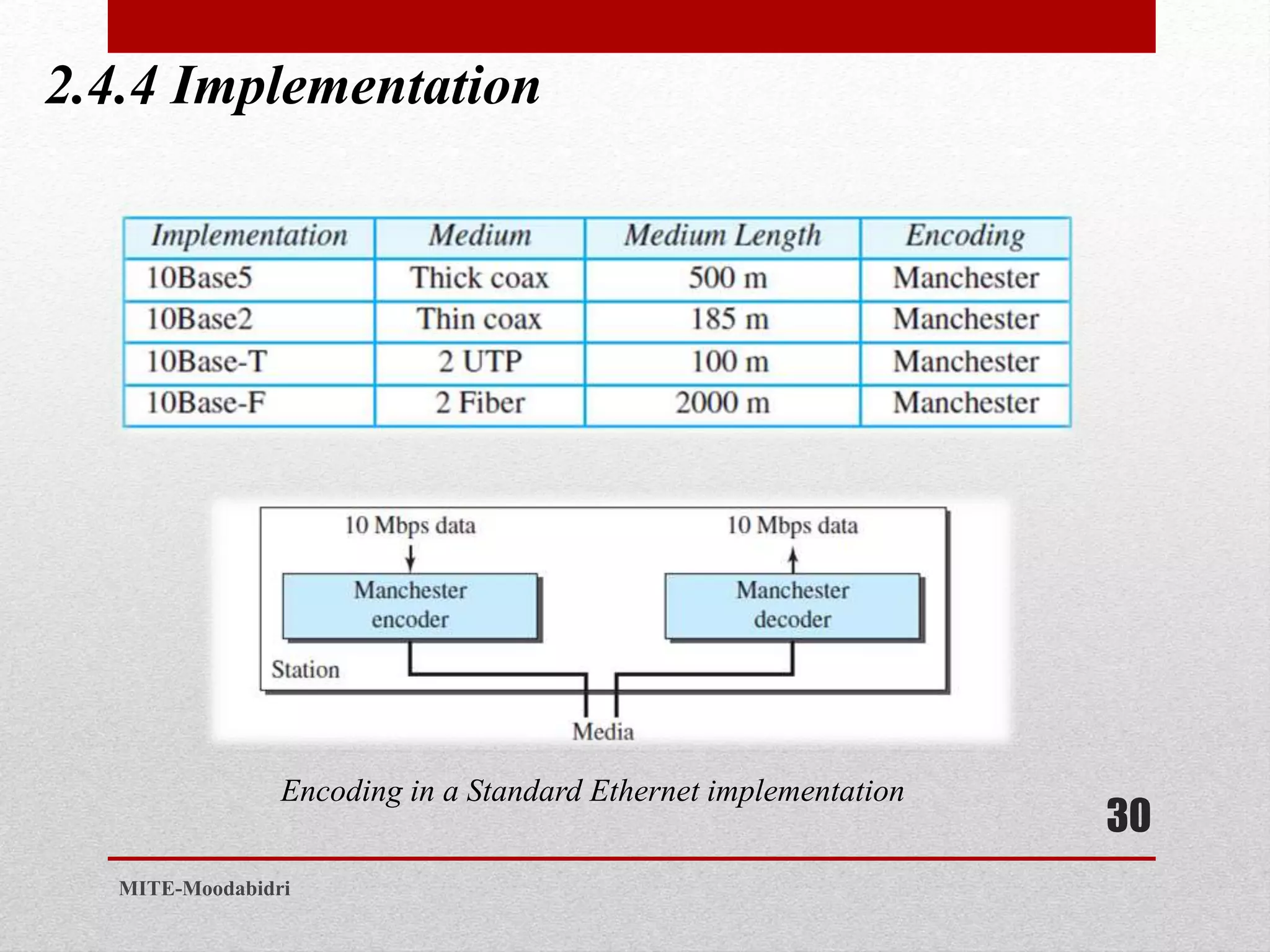
2.4.4 Implementation
30
MITE-Moodabidri
Encoding in a Standard Ethernet implementation
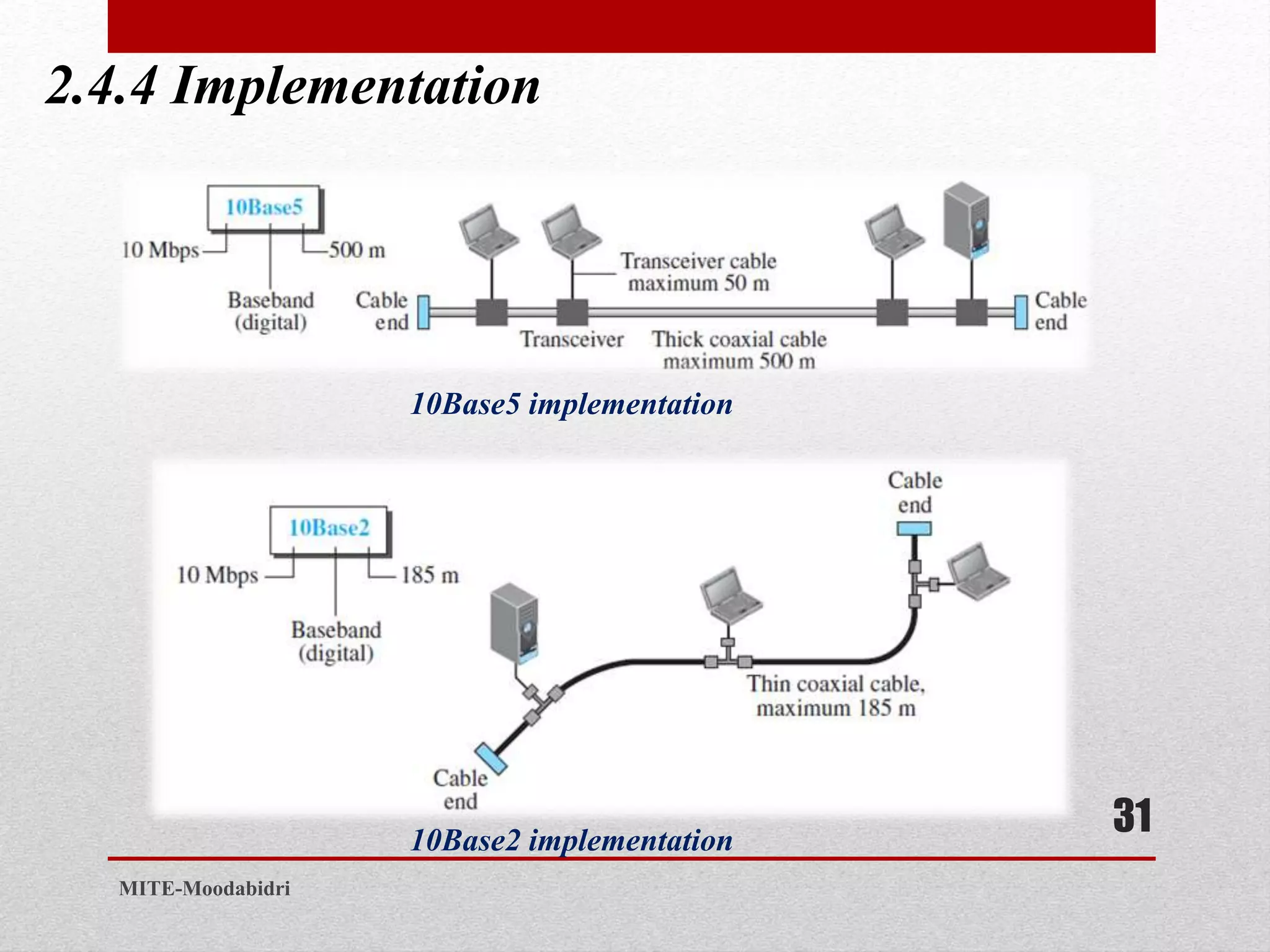
2.4.4 Implementation
31
MITE-Moodabidri
10Base5 implementation
10Base2 implementation
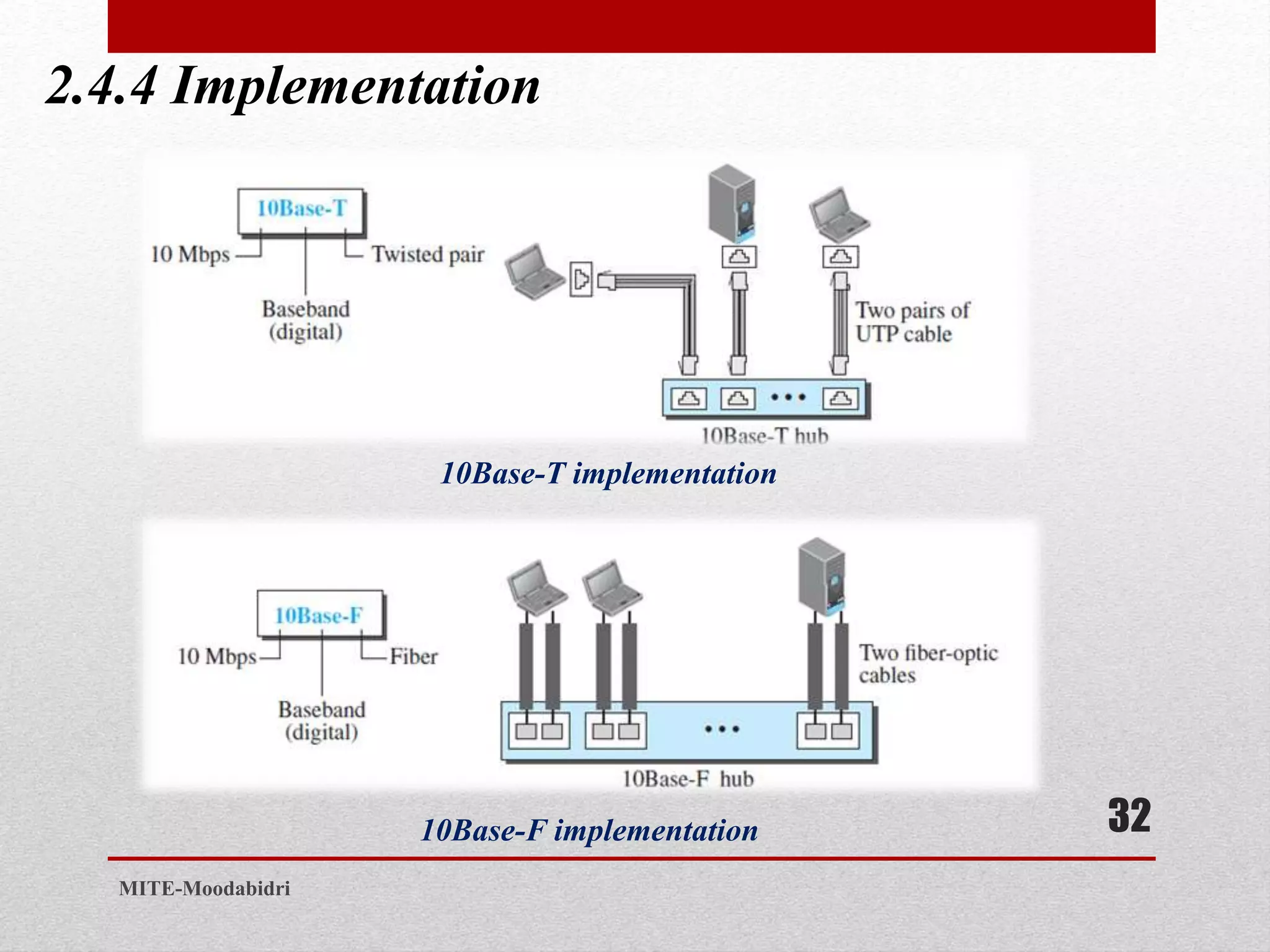
2.4.4 Implementation
32
MITE-Moodabidri
10Base-T implementation
10Base-F implementation
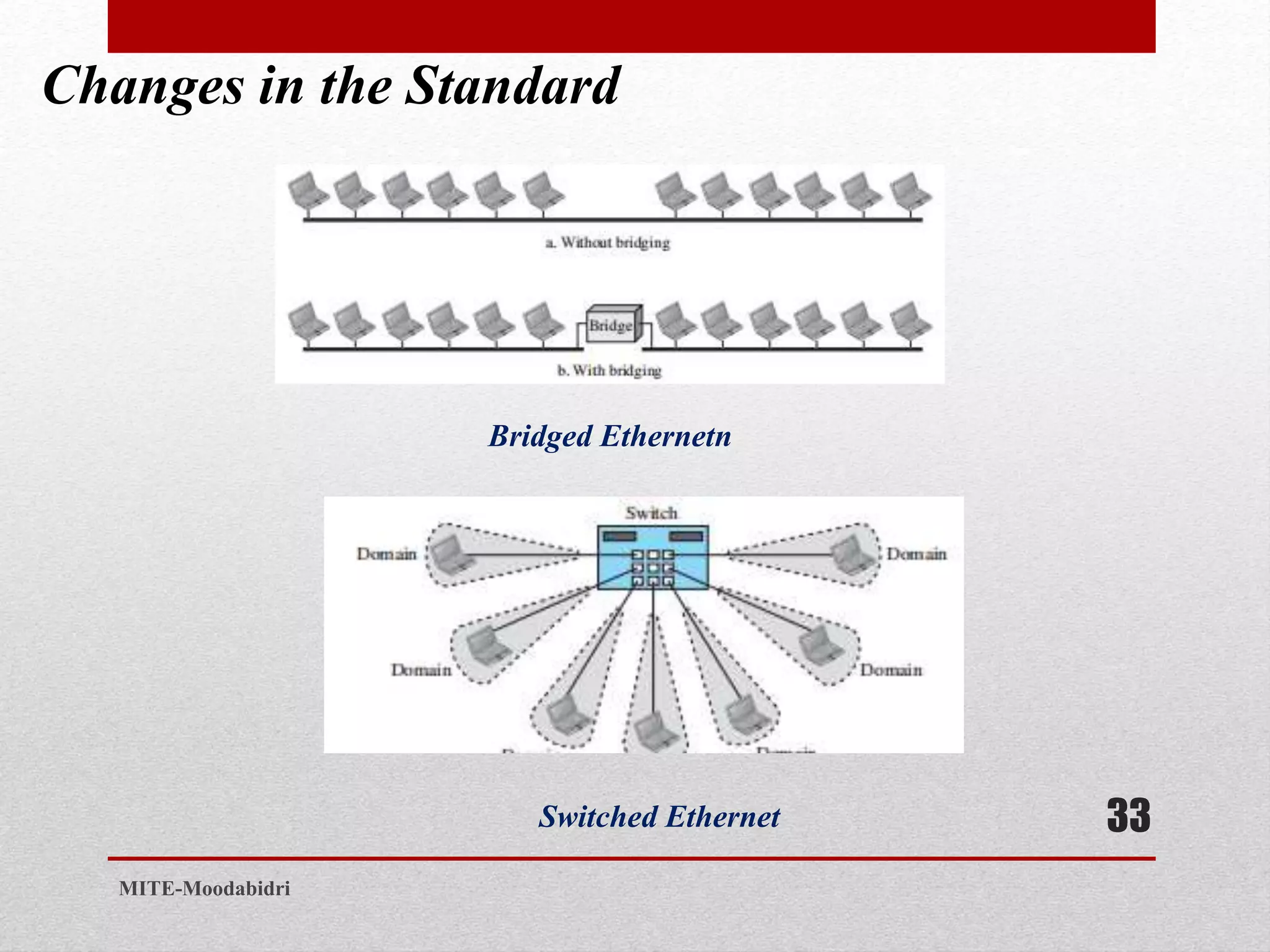
Changes in the Standard
33
MITE-Moodabidri
Bridged Ethernetn
Switched Ethernet
2.5FAST ETHERNET (100 MBPS)
34
MITE-Moodabidri
The goals of Fast Ethernet can be summarized as follows:
1. Upgrade the data rate to 100 Mbps.
2. Make it compatible with Standard Ethernet.
3. Keep the same 48-bit address.
4. Keep the same frame format.
2.5.1Access Method
35
MITE-Moodabidri
Autonegotiation
❑ To allow incompatible devices to connect to one another. For example, a
device with a maximum capacity of 10 Mbps can communicate with
a device with a 100 Mbps capacity (but which can work at a lower rate).
❑ To allow one device to have multiple capabilities.
❑ To allow a station to check a hub’s capabilities.
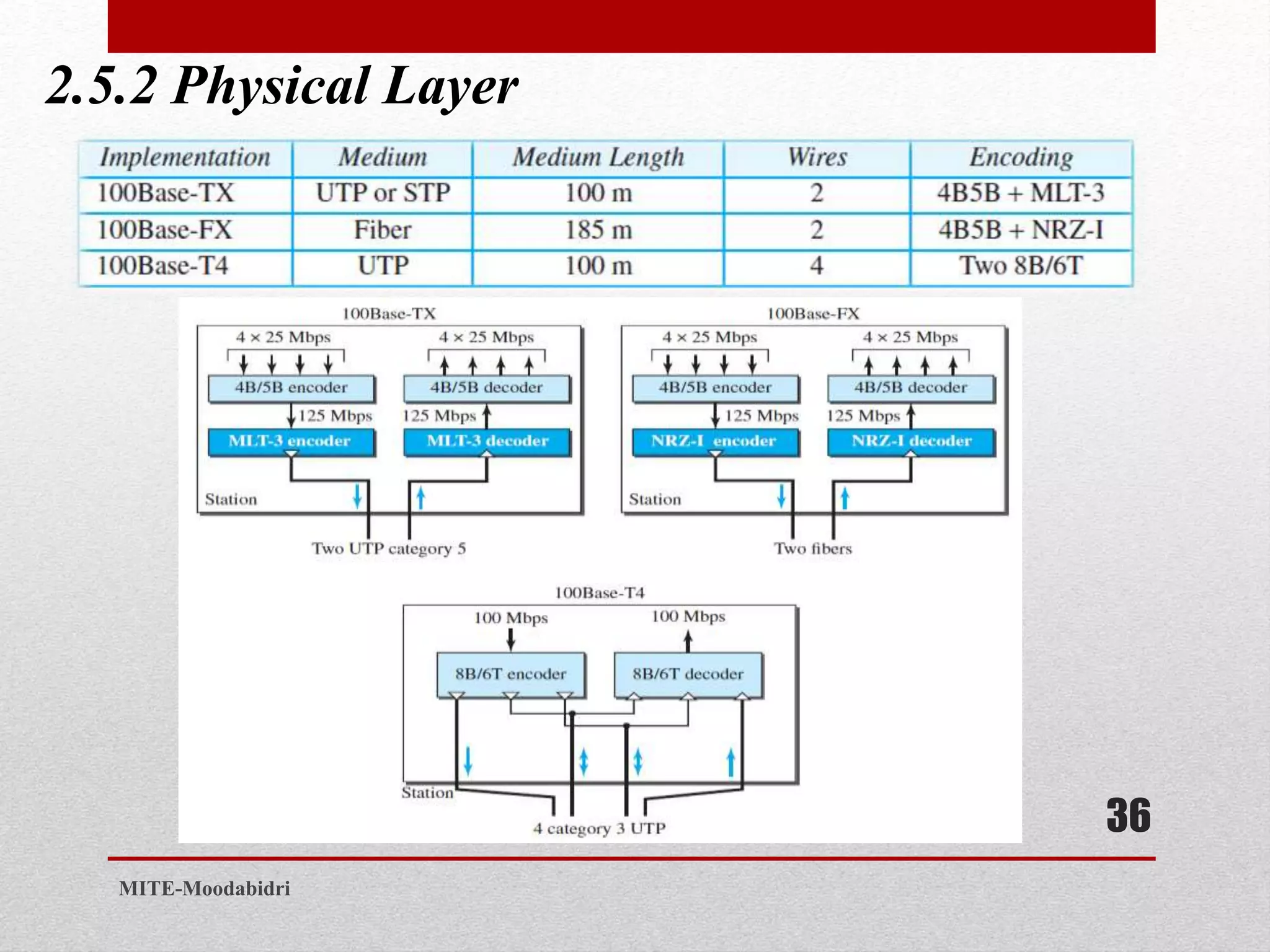
2.5.2 Physical Layer
36
MITE-Moodabidri
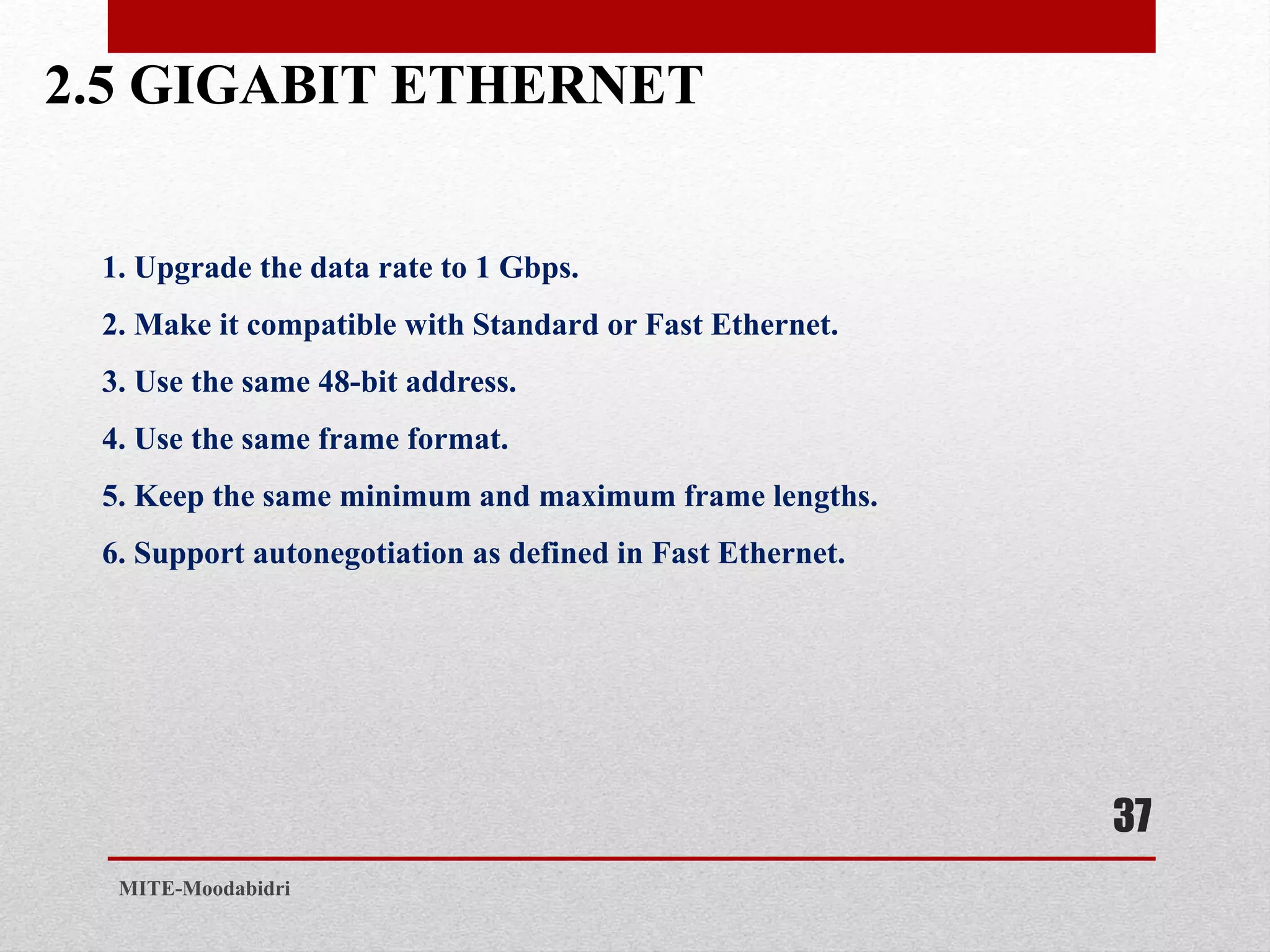
2.5 GIGABIT ETHERNET
37
MITE-Moodabidri
1. Upgrade the data rate to 1 Gbps.
2. Make it compatible with Standard or Fast Ethernet.
3. Use the same 48-bit address.
4. Use the same frame format.
5. Keep the same minimum and maximum frame lengths.
6. Support autonegotiation as defined in Fast Ethernet.
2.5 GIGABIT ETHERNET
38
MITE-Moodabidri
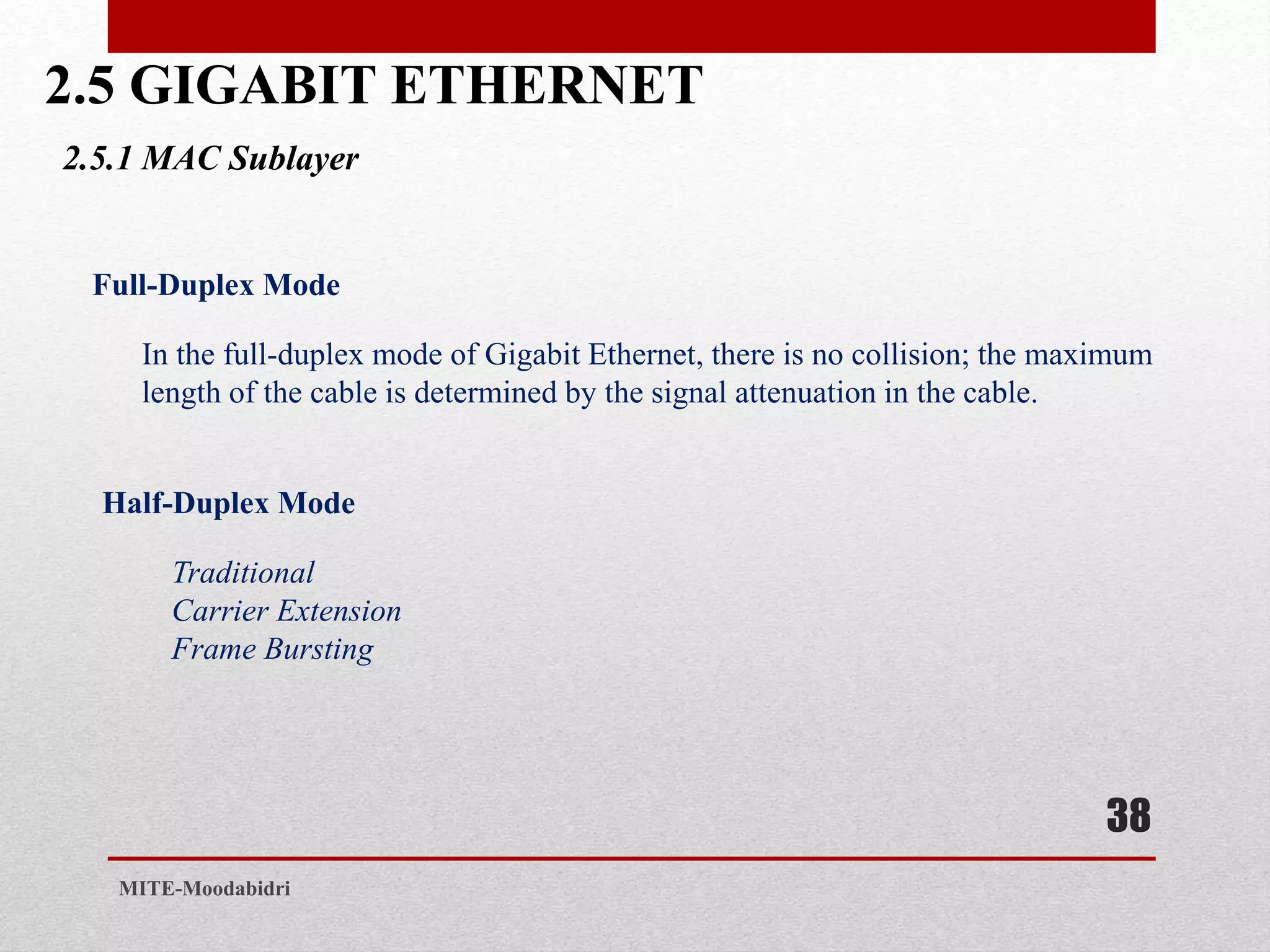
2.5.1 MAC Sublayer
Full-Duplex Mode
In the full-duplex mode of Gigabit Ethernet, there is no collision; the maximum
length of the cable is determined by the signal attenuation in the cable.
Half-Duplex Mode
Traditional
Carrier Extension
Frame Bursting
2.5 GIGABIT ETHERNET
39
MITE-Moodabidri
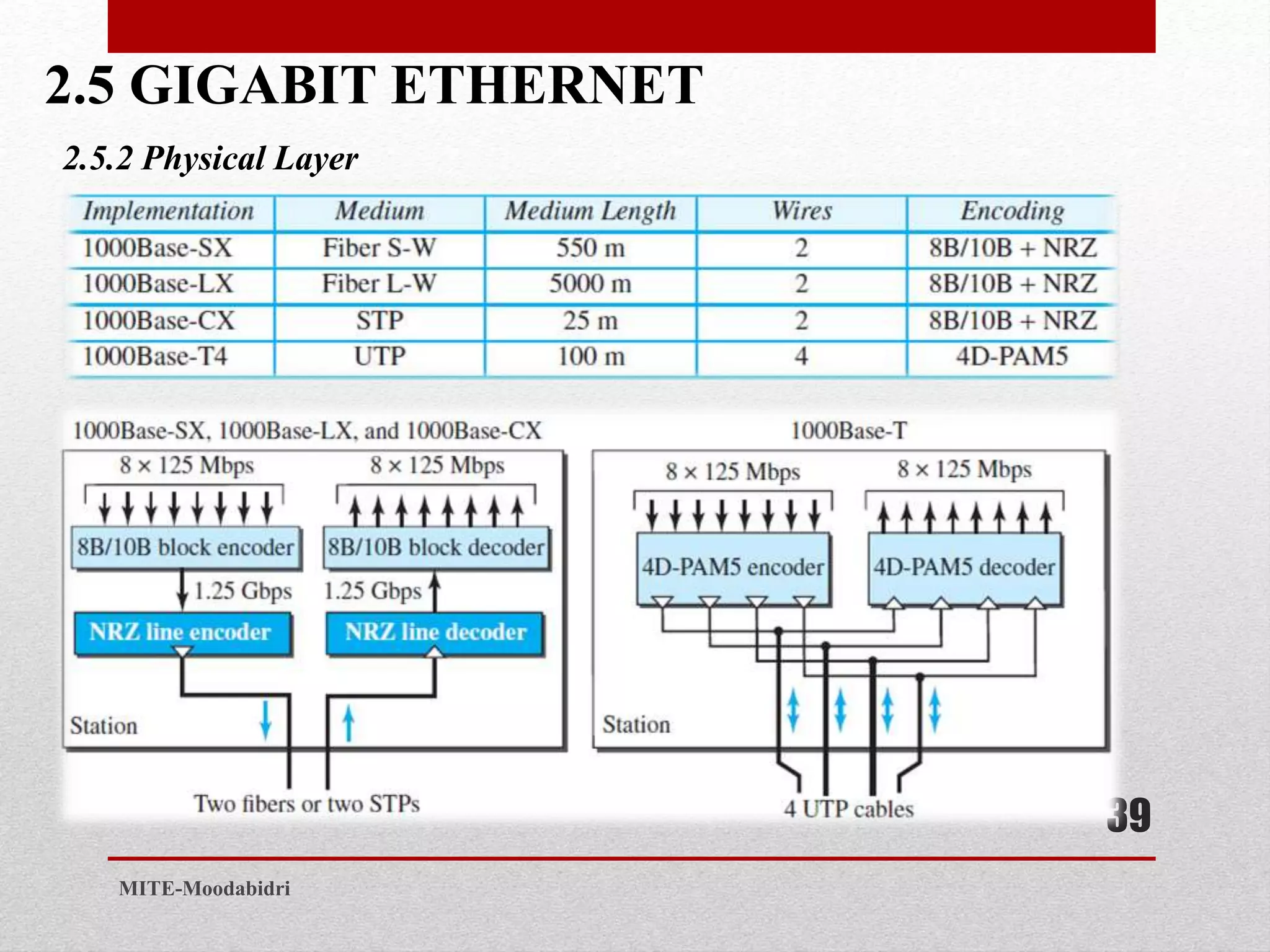
2.5.2 Physical Layer
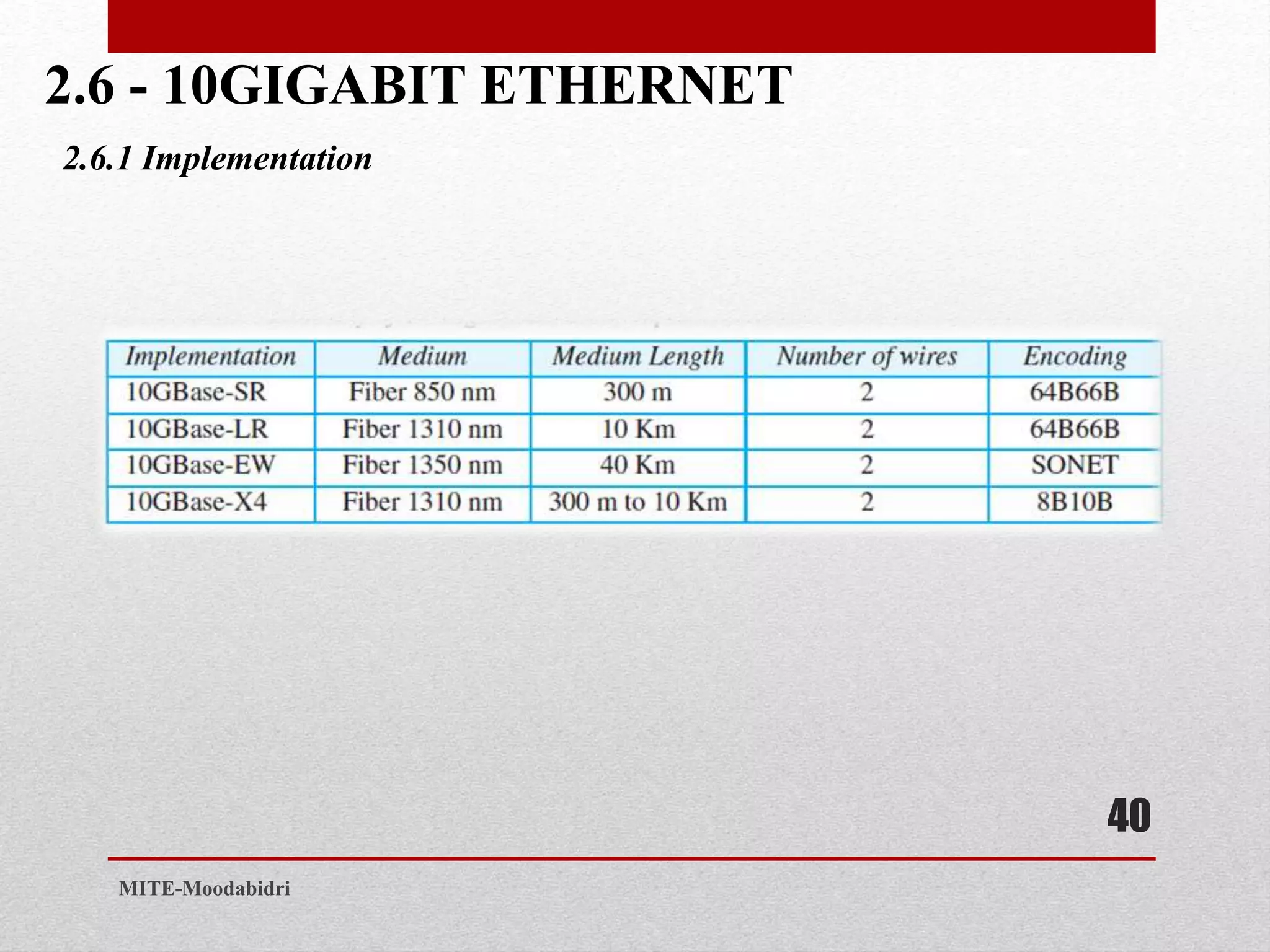
2.6 - 10GIGABIT ETHERNET
40
MITE-Moodabidri
2.6.1 Implementation
MITE-Moodabidri
41
Assignment-2
Problems on CSMA/CA, CSMA/CD

Module-2.pptx