MONITORING, EVALUATION,
AND LEARNING
“How to Work with USAID” Training Series
Visit WorkwithUSAID.org to learn more.
● Review how your MEL
system informs your activities and
supports USAID.
● Discover how MEL relates to
effective activity management.
● Determine the key elements to
include in your MEL plan.
● Develop best practices for a strong
tracking process.
LEARNING OBJECTIVES
WHY MEL IS IMPORTANT
Strong MEL facilitates effective implementation by:
● Systematically collecting and analyzing information to
support evidence-based decision-making; and
● Generating learning to inform the adaptation of an activity
based on evidence.
It also helps you maintain accountability by:
● Ensuring compliance with USAID policies and federal
regulations;
● Promoting transparency and accountability; and
● Providing a basis for sound documentation and reporting.
SUPPORTS IMPLEMENTATION & DECISION-MAKING
Once an activity is awarded, the partner develops a MEL plan to assess progress toward the
program’s objectives.
● Monitoring data helps USAID and its partners understand whether the activity is on track
or adjustments are needed.
● Evaluations answer key questions related to the implementation or outcomes of the
activity.
● Learning means analyzing a variety of information to inform possible adaptations needed
to achieve programmatic objectives.
FACILITATES LEARNING TO IMPROVE ACTIVITY
Apply lessons learned to:
● Streamline processes;
● More efficiently collect, analyze, and use data
and other information;
● Engage regional actors to understand results
from a local perspective;
● Adjust reporting processes; and
● Adapt your programming to enhance its
effectiveness.
ENSURES COMPLIANCE
Being compliant means that the implementation
of your activity follows USAID policies and
standard practices.
With a strong MEL plan, you can deliver evidence
that you are fulfilling key management
requirements and meeting objectives.
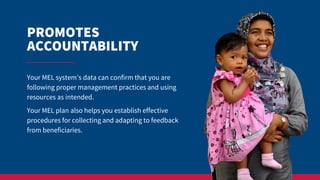
PROMOTES
ACCOUNTABILITY
Your MEL system’s data can confirm that you are
following proper management practices and using
resources as intended.
Your MEL plan also helps you establish effective
procedures for collecting and adapting to feedback
from beneficiaries.
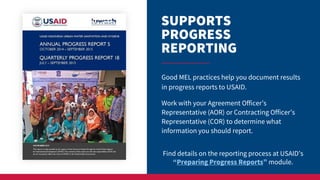
Good MEL practices help you document results
in progress reports to USAID.
Work with your Agreement Officer’s
Representative (AOR) or Contracting Officer’s
Representative (COR) to determine what
information you should report.
SUPPORTS
PROGRESS
REPORTING
Find details on the reporting process at USAID’s
“Preparing Progress Reports” module.
MEL REQUIREMENTS
REVIEW
EXPECTATIONS
● Develop your MEL plan within
90 days of signing a USAID award
agreement.
● Update the plan as programming needs
or operating conditions change.
You need an approved MEL plan in place before you implement
any major aspects of your activity.
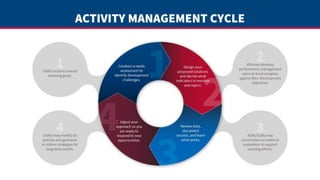
ACTIVITY MANAGEMENT CYCLE
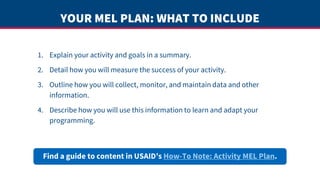
YOUR MEL PLAN: WHAT TO INCLUDE
1. Explain your activity and goals in a summary.
2. Detail how you will measure the success of your activity.
3. Outline how you will collect, monitor, and maintain data and other
information.
4. Describe how you will use this information to learn and adapt your
programming.
Find a guide to content in USAID’s How-To Note: Activity MEL Plan.
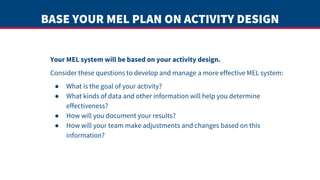
BASE YOUR MEL PLAN ON ACTIVITY DESIGN
Your MEL system will be based on your activity design.
Consider these questions to develop and manage a more effective MEL system:
● What is the goal of your activity?
● What kinds of data and other information will help you determine
effectiveness?
● How will you document your results?
● How will your team make adjustments and changes based on this
information?
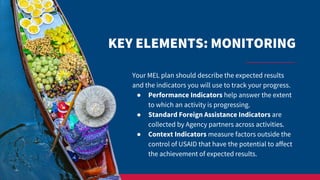
KEY ELEMENTS: MONITORING
Your MEL plan should describe the expected results
and the indicators you will use to track your progress.
● Performance Indicators help answer the extent
to which an activity is progressing.
● Standard Foreign Assistance Indicators are
collected by Agency partners across activities.
● Context Indicators measure factors outside the
control of USAID that have the potential to affect
the achievement of expected results.
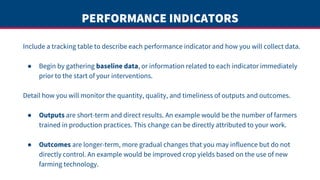
PERFORMANCE INDICATORS
Include a tracking table to describe each performance indicator and how you will collect data.
● Begin by gathering baseline data, or information related to each indicator immediately
prior to the start of your interventions.
Detail how you will monitor the quantity, quality, and timeliness of outputs and outcomes.
● Outputs are short-term and direct results. An example would be the number of farmers
trained in production practices. This change can be directly attributed to your work.
● Outcomes are longer-term, more gradual changes that you may influence but do not
directly control. An example would be improved crop yields based on the use of new
farming technology.
TYPES OF DATA
Your activity’s MEL system should generate two types of data:
● Quantitative data is represented in the form of numbers, such as workshop
participation rates or number of households reached.
● Qualitative data is in the form of words and pictures. It includes feedback such
as stakeholder interviews and staff insights about activities.
When handling data tied to personal identifiable information, ensure
confidentiality through secure data storage and access controls.
ENSURE DATA QUALITY
Use the following criteria to ensure data quality:
● Validity: Data should clearly represent the intended result.
● Integrity: There should be safeguards to minimize the risk of bias, errors, or data
manipulation.
● Precision: Data should have a sufficient level of detail to inform decision-making.
● Reliability: Data should reflect stable, consistent collection and analysis methods.
● Timeliness: Data should be current, available often, and timely enough to inform decisions.
Work with your AOR/COR to determine whether and when USAID will conduct a data quality
assessment.
Use USAID’s guide to Conduct a Data Quality Assessment.
KEY ELEMENTS:
EVALUATION
● An evaluation generates information on the
extent to which an activity is being implemented
as planned and achieving desired results.
● It provides information for long-term planning
and decision-making.
Evaluations are posted to the Development Experience Clearinghouse.
KEY ELEMENTS:
LEARNING
Improve the effectiveness of your activity by
incorporating the collaborating, learning, and
adapting (CLA) process:
● Collaborate with the right partners;
● Plan to learn by asking questions; and
● Prepare to adapt.
Learn more at USAID’s Learning Lab.
MEL PERSONNEL AND PROCESS
STAFF AND SKILL SETS
You will need to devote staff time to:
● Manage the overall MEL approach for your
USAID award.
● Coordinate the actions, from design to
evaluation, that make up your MEL system.
● Ensure data are properly organized, entered
accurately, and stored securely.
● Incorporate CLA practices across the full
activity management cycle.
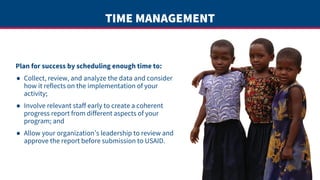
TIME MANAGEMENT
Plan for success by scheduling enough time to:
● Collect, review, and analyze the data and consider
how it reflects on the implementation of your
activity;
● Involve relevant staff early to create a coherent
progress report from different aspects of your
program; and
● Allow your organization’s leadership to review and
approve the report before submission to USAID.
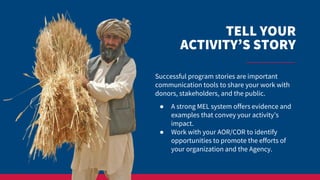
TELL YOUR
ACTIVITY’S STORY
Successful program stories are important
communication tools to share your work with
donors, stakeholders, and the public.
● A strong MEL system offers evidence and
examples that convey your activity’s
impact.
● Work with your AOR/COR to identify
opportunities to promote the efforts of
your organization and the Agency.
KEY POINTS
● Develop indicators to monitor progress and measure the direct
results of your work.
● Confirm the quality of your data so that decisions and progress
reports are based on accurate information.
● Be prepared to support and collaborate with external
evaluators commissioned by USAID.
● Use the CLA approach to continue to adapt your activity so it
remains relevant and effective.
● When preparing progress reports, give your team time to
collect and analyze data and consider lessons learned.
RESOURCES
Questions? Ask your AOR/COR.
● USAID Evaluation and Monitoring Terms (PDF)
● Learning Labs:
○ MEL Plan Template
○ Evaluation Toolkit
○ Monitoring Toolkit
○ CLA Toolkit
● USAID Compliance Division
● ADS 201: Monitoring (201.3.5), Learning (201.3.6),
and CLA (201.3.7)
● Training modules at WorkwithUSAID.org:
○ “Preparing Progress Reports”
● How-To Notes:
○ Activity Monitoring, Evaluation
& Learning (MEL) Plan (PDF)
○ Conduct a Data Quality Assessment (PDF)
● Development Experience Clearinghouse
Thank You
This module was produced by the United States Agency for International Development.
The presentation team includes staff from both USAID and the Partnerships Incubator.
USAID thanks all of the individuals who contributed their time and ideas toward the
development of this training module.
Email questions and feedback: IndustryLiaison@usaid.gov
Module slide for evaluation and learning

Module slide for evaluation and learning

  • 1.
    MONITORING, EVALUATION, AND LEARNING “Howto Work with USAID” Training Series Visit WorkwithUSAID.org to learn more.
  • 2.
    ● Review howyour MEL system informs your activities and supports USAID. ● Discover how MEL relates to effective activity management. ● Determine the key elements to include in your MEL plan. ● Develop best practices for a strong tracking process. LEARNING OBJECTIVES
  • 3.
    WHY MEL ISIMPORTANT Strong MEL facilitates effective implementation by: ● Systematically collecting and analyzing information to support evidence-based decision-making; and ● Generating learning to inform the adaptation of an activity based on evidence. It also helps you maintain accountability by: ● Ensuring compliance with USAID policies and federal regulations; ● Promoting transparency and accountability; and ● Providing a basis for sound documentation and reporting.
  • 4.
    SUPPORTS IMPLEMENTATION &DECISION-MAKING Once an activity is awarded, the partner develops a MEL plan to assess progress toward the program’s objectives. ● Monitoring data helps USAID and its partners understand whether the activity is on track or adjustments are needed. ● Evaluations answer key questions related to the implementation or outcomes of the activity. ● Learning means analyzing a variety of information to inform possible adaptations needed to achieve programmatic objectives.
  • 5.
    FACILITATES LEARNING TOIMPROVE ACTIVITY Apply lessons learned to: ● Streamline processes; ● More efficiently collect, analyze, and use data and other information; ● Engage regional actors to understand results from a local perspective; ● Adjust reporting processes; and ● Adapt your programming to enhance its effectiveness.
  • 6.
    ENSURES COMPLIANCE Being compliantmeans that the implementation of your activity follows USAID policies and standard practices. With a strong MEL plan, you can deliver evidence that you are fulfilling key management requirements and meeting objectives.
  • 7.
    PROMOTES ACCOUNTABILITY Your MEL system’sdata can confirm that you are following proper management practices and using resources as intended. Your MEL plan also helps you establish effective procedures for collecting and adapting to feedback from beneficiaries.
  • 8.
    Good MEL practiceshelp you document results in progress reports to USAID. Work with your Agreement Officer’s Representative (AOR) or Contracting Officer’s Representative (COR) to determine what information you should report. SUPPORTS PROGRESS REPORTING Find details on the reporting process at USAID’s “Preparing Progress Reports” module.
  • 9.
  • 10.
    REVIEW EXPECTATIONS ● Develop yourMEL plan within 90 days of signing a USAID award agreement. ● Update the plan as programming needs or operating conditions change. You need an approved MEL plan in place before you implement any major aspects of your activity.
  • 11.
  • 12.
    YOUR MEL PLAN:WHAT TO INCLUDE 1. Explain your activity and goals in a summary. 2. Detail how you will measure the success of your activity. 3. Outline how you will collect, monitor, and maintain data and other information. 4. Describe how you will use this information to learn and adapt your programming. Find a guide to content in USAID’s How-To Note: Activity MEL Plan.
  • 13.
    BASE YOUR MELPLAN ON ACTIVITY DESIGN Your MEL system will be based on your activity design. Consider these questions to develop and manage a more effective MEL system: ● What is the goal of your activity? ● What kinds of data and other information will help you determine effectiveness? ● How will you document your results? ● How will your team make adjustments and changes based on this information?
  • 14.
    KEY ELEMENTS: MONITORING YourMEL plan should describe the expected results and the indicators you will use to track your progress. ● Performance Indicators help answer the extent to which an activity is progressing. ● Standard Foreign Assistance Indicators are collected by Agency partners across activities. ● Context Indicators measure factors outside the control of USAID that have the potential to affect the achievement of expected results.
  • 15.
    PERFORMANCE INDICATORS Include atracking table to describe each performance indicator and how you will collect data. ● Begin by gathering baseline data, or information related to each indicator immediately prior to the start of your interventions. Detail how you will monitor the quantity, quality, and timeliness of outputs and outcomes. ● Outputs are short-term and direct results. An example would be the number of farmers trained in production practices. This change can be directly attributed to your work. ● Outcomes are longer-term, more gradual changes that you may influence but do not directly control. An example would be improved crop yields based on the use of new farming technology.
  • 16.
    TYPES OF DATA Youractivity’s MEL system should generate two types of data: ● Quantitative data is represented in the form of numbers, such as workshop participation rates or number of households reached. ● Qualitative data is in the form of words and pictures. It includes feedback such as stakeholder interviews and staff insights about activities. When handling data tied to personal identifiable information, ensure confidentiality through secure data storage and access controls.
  • 17.
    ENSURE DATA QUALITY Usethe following criteria to ensure data quality: ● Validity: Data should clearly represent the intended result. ● Integrity: There should be safeguards to minimize the risk of bias, errors, or data manipulation. ● Precision: Data should have a sufficient level of detail to inform decision-making. ● Reliability: Data should reflect stable, consistent collection and analysis methods. ● Timeliness: Data should be current, available often, and timely enough to inform decisions. Work with your AOR/COR to determine whether and when USAID will conduct a data quality assessment. Use USAID’s guide to Conduct a Data Quality Assessment.
  • 18.
    KEY ELEMENTS: EVALUATION ● Anevaluation generates information on the extent to which an activity is being implemented as planned and achieving desired results. ● It provides information for long-term planning and decision-making. Evaluations are posted to the Development Experience Clearinghouse.
  • 19.
    KEY ELEMENTS: LEARNING Improve theeffectiveness of your activity by incorporating the collaborating, learning, and adapting (CLA) process: ● Collaborate with the right partners; ● Plan to learn by asking questions; and ● Prepare to adapt. Learn more at USAID’s Learning Lab.
  • 20.
  • 21.
    STAFF AND SKILLSETS You will need to devote staff time to: ● Manage the overall MEL approach for your USAID award. ● Coordinate the actions, from design to evaluation, that make up your MEL system. ● Ensure data are properly organized, entered accurately, and stored securely. ● Incorporate CLA practices across the full activity management cycle.
  • 22.
    TIME MANAGEMENT Plan forsuccess by scheduling enough time to: ● Collect, review, and analyze the data and consider how it reflects on the implementation of your activity; ● Involve relevant staff early to create a coherent progress report from different aspects of your program; and ● Allow your organization’s leadership to review and approve the report before submission to USAID.
  • 23.
    TELL YOUR ACTIVITY’S STORY Successfulprogram stories are important communication tools to share your work with donors, stakeholders, and the public. ● A strong MEL system offers evidence and examples that convey your activity’s impact. ● Work with your AOR/COR to identify opportunities to promote the efforts of your organization and the Agency.
  • 24.
    KEY POINTS ● Developindicators to monitor progress and measure the direct results of your work. ● Confirm the quality of your data so that decisions and progress reports are based on accurate information. ● Be prepared to support and collaborate with external evaluators commissioned by USAID. ● Use the CLA approach to continue to adapt your activity so it remains relevant and effective. ● When preparing progress reports, give your team time to collect and analyze data and consider lessons learned.
  • 25.
    RESOURCES Questions? Ask yourAOR/COR. ● USAID Evaluation and Monitoring Terms (PDF) ● Learning Labs: ○ MEL Plan Template ○ Evaluation Toolkit ○ Monitoring Toolkit ○ CLA Toolkit ● USAID Compliance Division ● ADS 201: Monitoring (201.3.5), Learning (201.3.6), and CLA (201.3.7) ● Training modules at WorkwithUSAID.org: ○ “Preparing Progress Reports” ● How-To Notes: ○ Activity Monitoring, Evaluation & Learning (MEL) Plan (PDF) ○ Conduct a Data Quality Assessment (PDF) ● Development Experience Clearinghouse
  • 26.
  • 27.
    This module wasproduced by the United States Agency for International Development. The presentation team includes staff from both USAID and the Partnerships Incubator. USAID thanks all of the individuals who contributed their time and ideas toward the development of this training module. Email questions and feedback: IndustryLiaison@usaid.gov