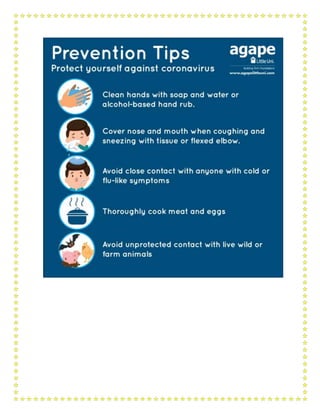
MODULE FOR TRAINING
OF
HEALTH CARE WORKERS
ON
COVID-19 CASE
MANAGEMENT
TRAINNING SCHEDULE
PEROID FROM 2019-2021
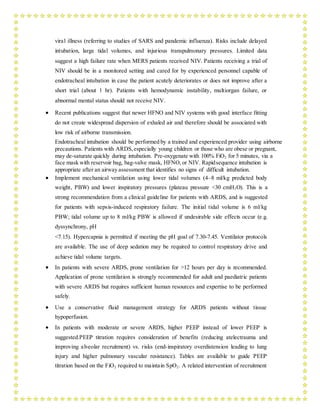
TRAINNING MODULE FOR HEALTH CARE WORKERS
S.NO: DATE/TIME TOPIC TO BE LEARN TO WHOM SPEAKERS
BY
1. Hand Washing Techniques And
Material Used For Hand Wash
All HCW
2. Description about COVID-19 case
management
All HCW
3. Description about Triage system Doctors
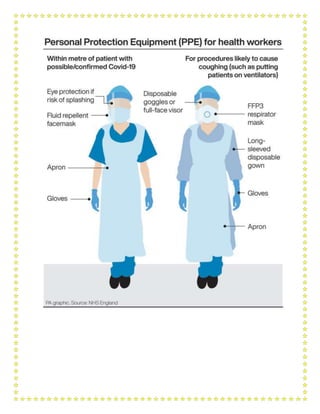
4. PPE description and its importance
(donning /doffing techniques)
All HCW
5. List of nursing care to be performed Nursing
6. Dietary management Dietician
7. House keeping management (daily
cleaning /disinfection techniques in
ward )
House keeping
staff
8. Blood sample collection, and
transportation guidelines
Technician
9. Nasaland throat sample collection
and transportation guidelines
Technician
10. General waste management House keeping
staff
11. Biomedical waste management BMW staff
12. Linen management Ward aya /boy
13. Infection control management Ensure by staff
nurses
Monitor by ICT
14. Discharge policy/follow up
instruction to the patients
Doctors
15. First aid management (if happened
any sign/symptom)
Doctors
16. Dead body handling guidelines Ensure by staff
Perform by ward
boy/aya
17. Terminal disinfection guidelines Ensure by staff
Perform by ward
boy/aya
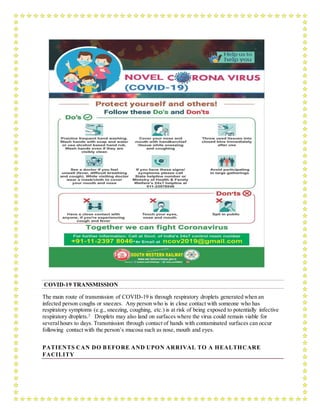
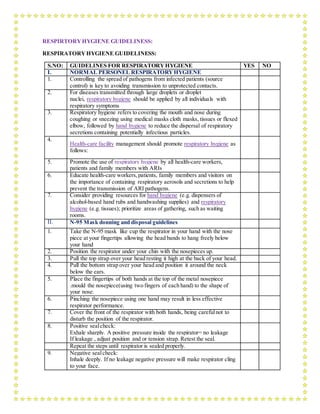
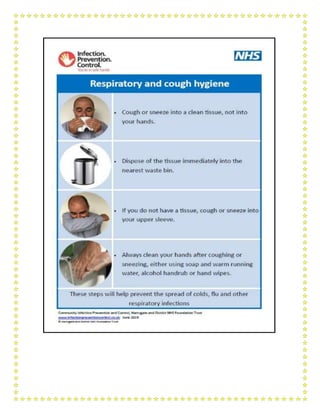
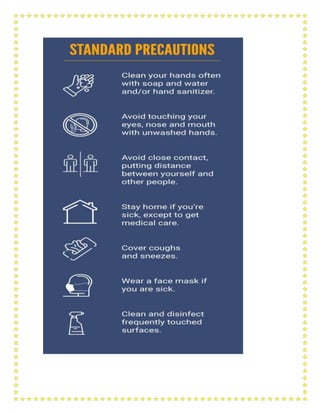
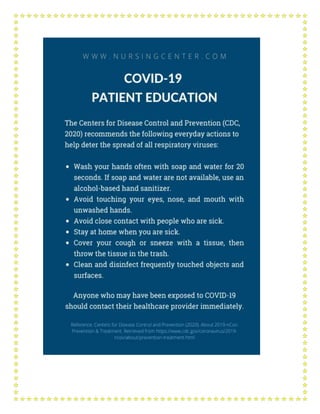
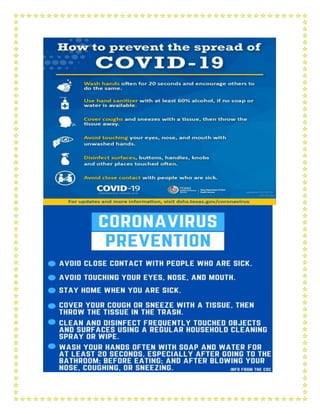
18. Respiratory hygiene etiquette
Patient health education
All HCW
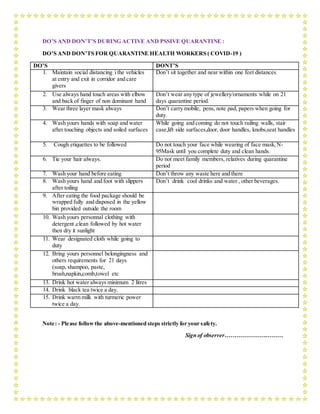
19. Do’s and Don’t during active and
passive quarantine
All HCW
20. Guidelines for handling of equipment
and devices used in covid-19 cases.
All HCW
NURSING SUPERINTENDENT ,ELMCH
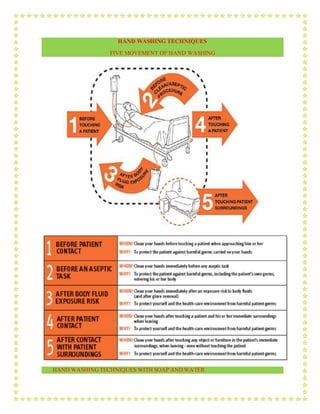
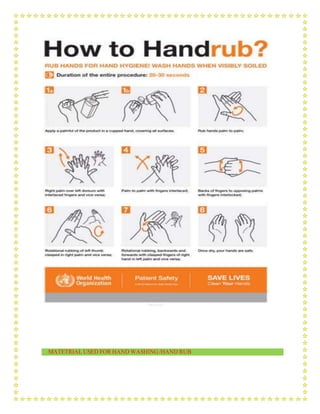
HAND WASHING TECHNIQUES
FIVE MOVEMENT OF HAND WASHING
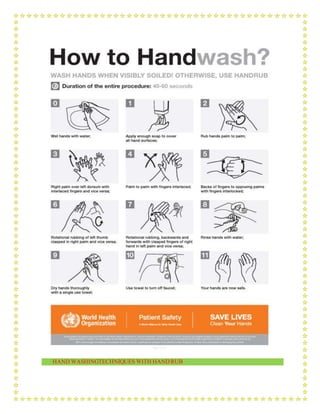
HAND WASHINGTECHNIQUES WITH SOAP ANDWATER
HAND WASHINGTECHNIQUES WITH HANDRUB
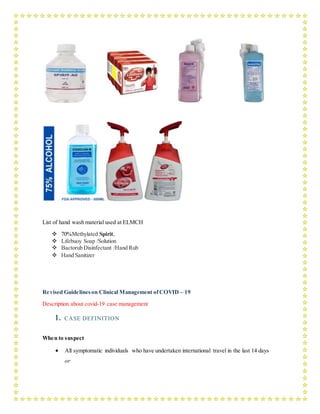
MATETRIAL USED FOR HAND WASHING/HAND RUB
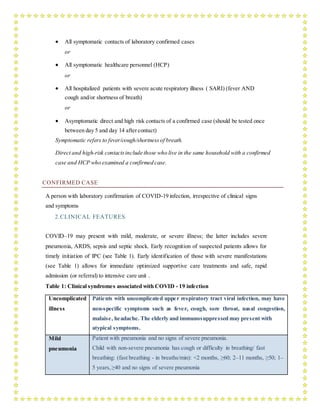
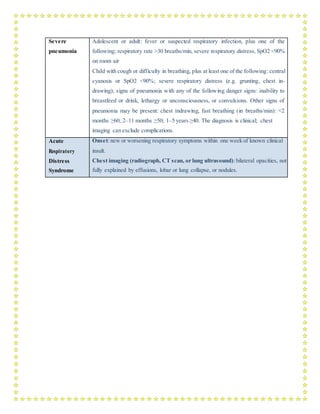
List of hand wash material used at ELMCH
 70%Methylated Spirit,
 Lifebuoy Soap /Solution
 Bactorub Disinfectant /Hand Rub
 Hand Sanitizer
Revised Guidelineson Clinical Management ofCOVID – 19
Description about covid-19 case management
1. CASE DEFINITION
When to suspect
 All symptomatic individuals who have undertaken international travel in the last 14 days
or
 All symptomatic contacts of laboratory confirmed cases
or
 All symptomatic healthcare personnel (HCP)
or
 All hospitalized patients with severe acute respiratory illness ( SARI) (fever AND
cough and/or shortness of breath)
or
 Asymptomatic direct and high risk contacts of a confirmed case (should be tested once
between day 5 and day 14 after contact)
Symptomatic refers to fever/cough/shortnessof breath.
Direct and high-risk contactsinclude those who live in the same household with a confirmed
case and HCP who examined a confirmed case.
CONFIRMED CASE
A person with laboratory confirmation of COVID-19 infection, irrespective of clinical signs
and symptoms
2.CLINICAL FEATURES
COVID–19 may present with mild, moderate, or severe illness; the latter includes severe
pneumonia, ARDS, sepsis and septic shock. Early recognition of suspected patients allows for
timely initiation of IPC (see Table 1). Early identification of those with severe manifestations
(see Table 1) allows for immediate optimized supportive care treatments and safe, rapid
admission (or referral) to intensive care unit .
Table 1: Clinical syndromes associated with COVID - 19 infection
Uncomplicated
illness
Patients with uncomplicated upper respiratory tract viral infection, may have
non-specific symptoms such as fever, cough, sore throat, nasal congestion,
malaise, headache. The elderly and immunosuppressed may present with
atypical symptoms.
Mild
pneumonia
Patient with pneumonia and no signs of severe pneumonia.
Child with non-severe pneumonia has cough or difficulty in breathing/ fast
breathing: (fast breathing - in breaths/min): <2 months, ≥60; 2–11 months, ≥50; 1–
5 years,≥40 and no signs of severe pneumonia
Severe
pneumonia
Adolescent or adult: fever or suspected respiratory infection, plus one of the
following; respiratory rate >30 breaths/min, severe respiratory distress, SpO2 <90%
on room air
Child with cough or difficulty in breathing, plus at least one of the following: central
cyanosis or SpO2 <90%; severe respiratory distress (e.g. grunting, chest in-
drawing); signs of pneumonia with any of the following danger signs: inability to
breastfeed or drink, lethargy or unconsciousness, or convulsions. Other signs of
pneumonia may be present: chest indrawing, fast breathing (in breaths/min): <2
months ≥60; 2–11 months ≥50; 1–5 years ≥40. The diagnosis is clinical; chest
imaging can exclude complications.
Acute
Respiratory
Distress
Syndrome
Onset:new or worsening respiratory symptoms within one week of known clinical
insult.
Chest imaging (radiograph, CT scan, or lung ultrasound):bilateral opacities, not
fully explained by effusions, lobar or lung collapse, or nodules.
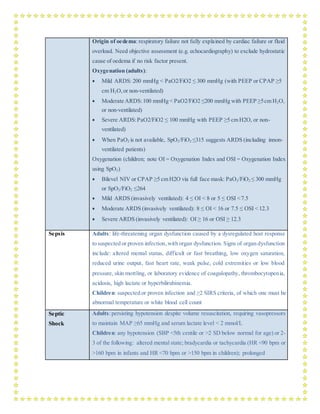
Origin of oedema: respiratory failure not fully explained by cardiac failure or fluid
overload. Need objective assessment (e.g. echocardiography) to exclude hydrostatic
cause of oedema if no risk factor present.
Oxygenation (adults):
 Mild ARDS: 200 mmHg < PaO2/FiO2 ≤ 300 mmHg (with PEEP or CPAP ≥5
cm H2O,or non-ventilated)
 Moderate ARDS:100 mmHg < PaO2/FiO2 ≤200 mmHg with PEEP ≥5cm H2O,
or non-ventilated)
 Severe ARDS:PaO2/FiO2 ≤ 100 mmHg with PEEP ≥5 cm H2O, or non-
ventilated)
 When PaO2 is not available, SpO2/FiO2 ≤315 suggests ARDS (including innon-
ventilated patients)
Oxygenation (children; note OI = Oxygenation Index and OSI = Oxygenation Index
using SpO2)
 Bilevel NIV or CPAP ≥5 cm H2O via full face mask: PaO2/FiO2 ≤ 300 mmHg
or SpO2/FiO2 ≤264
 Mild ARDS (invasively ventilated): 4 ≤ OI < 8 or 5 ≤ OSI <7.5
 Moderate ARDS (invasively ventilated): 8 ≤ OI < 16 or 7.5 ≤ OSI < 12.3
 Severe ARDS (invasively ventilated): OI ≥ 16 or OSI ≥ 12.3
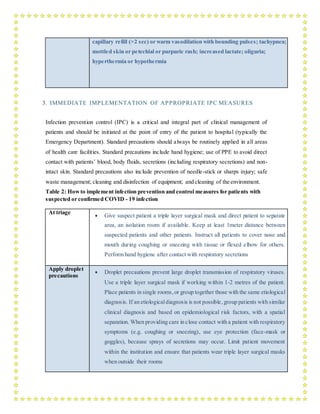
Sepsis Adults: life-threatening organ dysfunction caused by a dysregulated host response
to suspected or proven infection, with organ dysfunction. Signs of organ dysfunction
include: altered mental status, difficult or fast breathing, low oxygen saturation,
reduced urine output, fast heart rate, weak pulse, cold extremities or low blood
pressure, skin mottling, or laboratory evidence of coagulopathy, thrombocytopenia,
acidosis, high lactate or hyperbilirubinemia.
Children: suspected or proven infection and ≥2 SIRS criteria, of which one must be
abnormal temperature or white blood cell count
Septic
Shock
Adults:persisting hypotension despite volume resuscitation, requiring vasopressors
to maintain MAP ≥65 mmHg and serum lactate level < 2 mmol/L
Children: any hypotension (SBP <5th centile or >2 SD below normal for age) or 2-
3 of the following: altered mental state; bradycardia or tachycardia (HR <90 bpm or
>160 bpm in infants and HR <70 bpm or >150 bpm in children); prolonged
capillary refill (>2 sec) or warm vasodilation with bounding pulses; tachypnea;
mottled skin or petechial or purpuric rash; increased lactate; oliguria;
hyperthermia or hypothermia
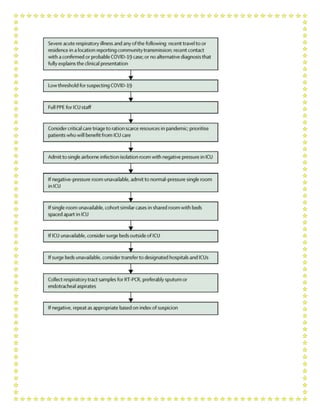
3. IMMEDIATE IMPLEMENTATION OF APPROPRIATE IPC MEASURES
Infection prevention control (IPC) is a critical and integral part of clinical management of
patients and should be initiated at the point of entry of the patient to hospital (typically the
Emergency Department). Standard precautions should always be routinely applied in all areas
of health care facilities. Standard precautions include hand hygiene; use of PPE to avoid direct
contact with patients’ blood, body fluids, secretions (including respiratory secretions) and non-
intact skin. Standard precautions also include prevention of needle-stick or sharps injury; safe
waste management; cleaning and disinfection of equipment; and cleaning of the environment.
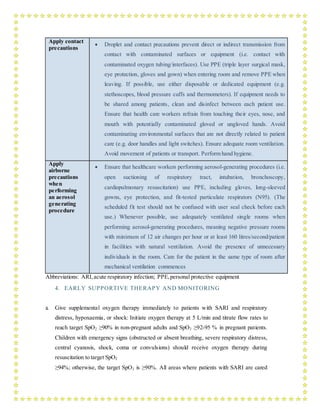
Table 2: Howto implement infection prevention and control measures for patients with
suspected or confirmed COVID - 19 infection
At triage
 Give suspect patient a triple layer surgical mask and direct patient to separate
area, an isolation room if available. Keep at least 1meter distance between
suspected patients and other patients. Instruct all patients to cover nose and
mouth during coughing or sneezing with tissue or flexed elbow for others.
Perform hand hygiene after contact with respiratory secretions
Apply droplet
precautions
 Droplet precautions prevent large droplet transmission of respiratory viruses.
Use a triple layer surgical mask if working within 1-2 metres of the patient.
Place patients in single rooms, or group together those with the same etiological
diagnosis. If an etiologicaldiagnosis is not possible, group patients with similar
clinical diagnosis and based on epidemiological risk factors, with a spatial
separation. When providing care in close contact with a patient with respiratory
symptoms (e.g. coughing or sneezing), use eye protection (face-mask or
goggles), because sprays of secretions may occur. Limit patient movement
within the institution and ensure that patients wear triple layer surgical masks
when outside their rooms
Apply contact
precautions
 Droplet and contact precautions prevent direct or indirect transmission from
contact with contaminated surfaces or equipment (i.e. contact with
contaminated oxygen tubing/interfaces). Use PPE (triple layer surgical mask,
eye protection, gloves and gown) when entering room and remove PPE when
leaving. If possible, use either disposable or dedicated equipment (e.g.
stethoscopes, blood pressure cuffs and thermometers). If equipment needs to
be shared among patients, clean and disinfect between each patient use.
Ensure that health care workers refrain from touching their eyes, nose, and
mouth with potentially contaminated gloved or ungloved hands. Avoid
contaminating environmental surfaces that are not directly related to patient
care (e.g. door handles and light switches). Ensure adequate room ventilation.
Avoid movement of patients or transport. Perform hand hygiene.
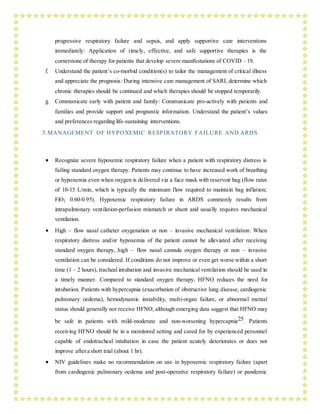
Apply
airborne
precautions
when
performing
an aerosol
generating
procedure
 Ensure that healthcare workers performing aerosol-generating procedures (i.e.
open suctioning of respiratory tract, intubation, bronchoscopy,
cardiopulmonary resuscitation) use PPE, including gloves, long-sleeved
gowns, eye protection, and fit-tested particulate respirators (N95). (The
scheduled fit test should not be confused with user seal check before each
use.) Whenever possible, use adequately ventilated single rooms when
performing aerosol-generating procedures, meaning negative pressure rooms
with minimum of 12 air changes per hour or at least 160 litres/second/patient
in facilities with natural ventilation. Avoid the presence of unnecessary
individuals in the room. Care for the patient in the same type of room after
mechanical ventilation commences
Abbreviations: ARI,acute respiratory infection; PPE,personal protective equipment
4. EARLY SUPPORTIVE THERAPY AND MONITORING
a. Give supplemental oxygen therapy immediately to patients with SARI and respiratory
distress, hypoxaemia, or shock: Initiate oxygen therapy at 5 L/min and titrate flow rates to
reach target SpO2 ≥90% in non-pregnant adults and SpO2 ≥92-95 % in pregnant patients.
Children with emergency signs (obstructed or absent breathing, severe respiratory distress,
central cyanosis, shock, coma or convulsions) should receive oxygen therapy during
resuscitation to target SpO2
≥94%; otherwise, the target SpO2 is ≥90%. All areas where patients with SARI are cared
for should be equipped with pulse oximeters, functioning oxygen systems and disposable,
single- use, oxygen-delivering interfaces (nasal cannula, simple face mask, and mask with
reservoir bag). Use contact precautions when handling contaminated oxygen interfaces of
patients with COVID – 19.
b. Use conservative fluid management in patients with SARI when there is no evidence of
shock: Patients with SARI should be treated cautiously with intravenous fluids, because
aggressive fluid resuscitation may worsen oxygenation, especially in settings where there is
limited availability of mechanical ventilation.
c. Give empiric antimicrobials to treat all likely pathogens causing SARI. Give antimicrobials
within one hour of initial patient assessment for patients with sepsis: Although the patient
may be suspected to have COVID - 19, Administer appropriate empiric antimicrobials
within ONE hour of identification of sepsis. Empirical antibiotic treatment should be based
on the clinical diagnosis (community-acquired pneumonia, health care-associated
pneumonia [if infection was acquired in healthcare setting], or sepsis), local epidemiology
and susceptibility data, and treatment guidelines. Empirical therapy includes a
neuraminidase inhibitor for treatment of influenza when there is local circulation or other
risk factors, including travel history or exposure to animal influenza viruses. Empirical
therapy should be de-escalated on the basis of microbiology results and clinical judgment
d. Do not routinely give systemic corticosteroids for treatment of viral pneumonia or ARDS outside
of clinical trials unless they are indicated for another reason: A systematic review of observational
studies of corticosteroids administered to patients with SARS reported no survival benefit and
possible harms (avascular necrosis, psychosis, diabetes, and delayedviral clearance). A systematic
review of observational studies in influenza found a higher risk of mortality and secondary
infections with corticosteroids;
The evidence was judged very slow to low quality due to confounding by indication. A
subsequent study that addressed this limitation by adjusting for time-varying confounders
found no effect on mortality. Finally, a recent study of patients receiving corticosteroids for
MERS used a similar statistical approach and found no effect of corticosteroids on mortality
but delayed lower respiratory tract (LRT) clearance of MERS-CoV. Given lack of
effectiveness and possible harm, routine corticosteroids should be avoided unless they are
indicated for another reason. See section F for the use of corticosteroids in sepsis.
e. Closely monitor patients with SARI for signs of clinical deterioration, such as rapidly
progressive respiratory failure and sepsis, and apply supportive care interventions
immediately: Application of timely, effective, and safe supportive therapies is the
cornerstone of therapy for patients that develop severe manifestations of COVID – 19.
f. Understand the patient’s co-morbid condition(s) to tailor the management of critical illness
and appreciate the prognosis: During intensive care management of SARI, determine which
chronic therapies should be continued and which therapies should be stopped temporarily.
g. Communicate early with patient and family: Communicate pro-actively with patients and
families and provide support and prognostic information. Understand the patient’s values
and preferences regarding life-sustaining interventions.
5.MANAGEMENT OF HYPOXEMIC RESPIRATORY FAILURE AND ARDS
 Recognize severe hypoxemic respiratory failure when a patient with respiratory distress is
failing standard oxygen therapy. Patients may continue to have increased work of breathing
or hypoxemia even when oxygen is delivered via a face mask with reservoir bag (flow rates
of 10-15 L/min, which is typically the minimum flow required to maintain bag inflation;
FiO2 0.60-0.95). Hypoxemic respiratory failure in ARDS commonly results from
intrapulmonary ventilation-perfusion mismatch or shunt and usually requires mechanical
ventilation.
 High – flow nasal catheter oxygenation or non – invasive mechanical ventilation: When
respiratory distress and/or hypoxemia of the patient cannot be alleviated after receiving
standard oxygen therapy, high – flow nasal cannula oxygen therapy or non – invasive
ventilation can be considered. If conditions do not improve or even get worse within a short
time (1 – 2 hours), tracheal intubation and invasive mechanical ventilation should be used in
a timely manner. Compared to standard oxygen therapy, HFNO reduces the need for
intubation. Patients with hypercapnia (exacerbation of obstructive lung disease, cardiogenic
pulmonary oedema), hemodynamic instability, multi-organ failure, or abnormal mental
status should generally not receive HFNO, although emerging data suggest that HFNO may
be safe in patients with mild-moderate and non-worsening hypercapnia25. Patients
receiving HFNO should be in a monitored setting and cared for by experienced personnel
capable of endotracheal intubation in case the patient acutely deteriorates or does not
improve aftera short trial (about 1 hr).
 NIV guidelines make no recommendation on use in hypoxemic respiratory failure (apart
from cardiogenic pulmonary oedema and post-operative respiratory failure) or pandemic
viral illness (referring to studies of SARS and pandemic influenza). Risks include delayed
intubation, large tidal volumes, and injurious transpulmonary pressures. Limited data
suggest a high failure rate when MERS patients received NIV. Patients receiving a trial of
NIV should be in a monitored setting and cared for by experienced personnel capable of
endotracheal intubation in case the patient acutely deteriorates or does not improve after a
short trial (about 1 hr). Patients with hemodynamic instability, multiorgan failure, or
abnormal mental status should not receive NIV.
 Recent publications suggest that newer HFNO and NIV systems with good interface fitting
do not create widespread dispersion of exhaled air and therefore should be associated with
low risk of airborne transmission.
Endotracheal intubation should be performed by a trained and experienced provider using airborne
precautions. Patients with ARDS,especially young children or those who are obese or pregnant,
may de-saturate quickly during intubation. Pre-oxygenate with 100% FiO2 for 5 minutes, via a
face mask with reservoir bag, bag-valve mask, HFNO, or NIV. Rapidsequence intubation is
appropriate after an airway assessment that identifies no signs of difficult intubation.
 Implement mechanical ventilation using lower tidal volumes (4–8 ml/kg predicted body
weight, PBW) and lower inspiratory pressures (plateau pressure <30 cmH2O). This is a
strong recommendation from a clinical guideline for patients with ARDS, and is suggested
for patients with sepsis-induced respiratory failure. The initial tidal volume is 6 ml/kg
PBW; tidal volume up to 8 ml/kg PBW is allowed if undesirable side effects occur (e.g.
dyssynchrony, pH
<7.15). Hypercapnia is permitted if meeting the pH goal of 7.30-7.45. Ventilator protocols
are available. The use of deep sedation may be required to control respiratory drive and
achieve tidal volume targets.
 In patients with severe ARDS, prone ventilation for >12 hours per day is recommended.
Application of prone ventilation is strongly recommended for adult and paediatric patients
with severe ARDS but requires sufficient human resources and expertise to be performed
safely.
 Use a conservative fluid management strategy for ARDS patients without tissue
hypoperfusion.
 In patients with moderate or severe ARDS, higher PEEP instead of lower PEEP is
suggested.PEEP titration requires consideration of benefits (reducing atelectrauma and
improving alveolar recruitment) vs. risks (end-inspiratory overdistension leading to lung
injury and higher pulmonary vascular resistance). Tables are available to guide PEEP
titration based on the FiO2 required to maintain SpO2. A related intervention of recruitment
manoeuvres (RMs) is delivered as episodic periods of high continuous positive airway
pressure [30–40 cm H2O], progressive incremental increases in PEEP with constant driving
pressure, or high driving pressure; considerations of benefits vs. risks are similar. Higher
PEEP and RMs were both conditionally recommended in a clinical practice guideline.
In patient with moderate or severe ARDS (PaO2/FiO2<150), neuromuscular blockade by
continuous infusion should not be routinely used.
 In settings with access to expertise in extracorporeal life support (ECLS), consider referral
of patients with refractory hypoxemia despite lung protective ventilation. ECLS should
only be offered in expert centres with a sufficient case volume to maintain expertise and that
can apply the IPC measures required for COVID – 19 patients
 Avoid disconnecting the patient from the ventilator, which results in loss of PEEP and
atelectasis. Use in-line catheters for airway suctioning and clamp endotracheal tube when
disconnection is required (for example, transfer to a transport ventilator)
6.PREVENTION OF COMPLICATIONS
Implement the following interventions (Table 3) to prevent complications associated with
critical illness. These interventions are based on Surviving Sepsis or other guidelines, and are
generally limited to feasible recommendations based on high quality evidence.
TABLE 3: PREVENTION OF COMPLICATIONS
Anticipated
Outcome
Interventions
Reduce days of
invasive
mechanical
ventilation
 Use weaning protocols that include daily assessment for readiness to
breathe spontaneously
 Minimize continuous or intermittent sedation, targeting specific titration
endpoints (light sedation unless contraindicated) or with daily interruption
of continuous sedative infusions
Reduce incidence
of ventilator
associated
pneumonia
 Oral intubation is preferable to nasalintubation in adolescents andadults
 Keep patient in semi-recumbent position (head of bed elevation 30-45º)
 Use a closed suctioning system; periodically drain and discard condensate
in tubing
 Use a new ventilator circuit for each patient; once patient is ventilated,
change circuit if it is soiled or damaged but not routinely
 Change heat moisture exchanger when it malfunctions, when soiled, or
every 5–7 days
Reduce incidence
of venous
thromboembolism
 Use pharmacological prophylaxis (low molecular-weight heparin[preferred
if available] or heparin 5000 units subcutaneously twice daily) in
adolescents and adults without contraindications. For those with
contraindications, use mechanical prophylaxis (intermittent pneumatic
compression devices).
Reduce incidence
of catheter related
bloodstream
infection
 Use a checklist with completion verified by a real-time observer as reminder
of each step needed for sterile insertion and as a daily reminder to remove
catheter if no longer needed
Reduce incidence
of pressure
 Turn patient every two hours
Ulcers
Reduce incidence
of stress ulcers and
gastrointestinal
bleeding
 Give early enteral nutrition (within 24–48 hours of admission)
 Administer histamine-2 receptor blockers or proton-pump inhibitors in
patients with risk factors for GI bleeding. Risk factors for gastrointestinal
bleeding include mechanical ventilation for ≥48 hours, coagulopathy, renal
replacement therapy, liver disease, multiple co-morbidities, and higher
organ failure score
Reduce incidence
of ICU-related
weakness
 Actively mobilize the patient early in the course of illness when safe to
do so
Ulcers
Reduce incidence
of stress ulcers and
gastrointestinal
bleeding
 Give early enteral nutrition (within 24–48 hours of admission)
 Administer histamine-2 receptor blockers or proton-pump inhibitors in
patients with risk factors for GI bleeding. Risk factors for gastrointestinal
bleeding include mechanical ventilation for ≥48 hours, coagulopathy, renal
replacement therapy, liver disease, multiple co-morbidities, and higher
organ failure score
Reduce incidence
of ICU-related
weakness
 Actively mobilize the patient early in the course of illness when safe to
do so
Sources : Revised guidelinesfor management ofcovid-19 case,MOH&FM,GOI
DRUGMANAGEMENT OF COVID -19 CASES IN WARD/CRITICAL
AREA/ISOLATION
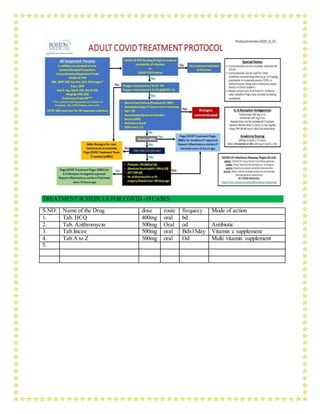
1. TAB. AZITHROMYCIN500 MG /BD/FOR 7 DAYS
2. TAB. HCQ 400 MG /BD/FOR 5 DAYS
3. CAP.BECOUSLES /OD/ FOR
4. TAB.ATOZ 500mg for OD for one month
DESCRIPTION ABOUT TRIAGE SYSTEM
Introduction :
The sorting out and classificationexternal icon of patientsexternal icon or casualties to
determine priority of need and proper place of treatmentexternal icon. During infectious
disease outbreaks, triage is particularly important to separate patients likely to be infected with
the pathogen of concern. This triage SOP is developed in the context of the COVID-19
pandemic and does not replace any routine clinical triage already in place in healthcare
facilities (e.g. Manchester triage system or equivalent) to categorize patients into different
urgency categories.
COVID-19 TRANSMISSION
The main route of transmission of COVID-19 is through respiratory droplets generated when an
infected person coughs or sneezes. Any person who is in close contact with someone who has
respiratory symptoms (e.g., sneezing, coughing, etc.) is at risk of being exposed to potentially infective
respiratory droplets.2
Droplets may also land on surfaces where the virus could remain viable for
severalhours to days. Transmission through contact of hands with contaminated surfaces can occur
following contact with the person’s mucosa such as nose, mouth and eyes.
PATIENTS CAN DO BEFORE AND UPON ARRIVAL TO A HEALTHCARE
FACILITY
 Inform healthcare providers if they are seeking care for respiratory symptoms (e.g. cough,
fever,shortness of breath) by calling ahead of time
 Wear a facemask,if available, during transport and while at triage in the healthcare facility
 Notify triage registration desk about respiratory symptoms as soon as they arrive
 Wash hands at healthcare facility entrance with soap and water or alcohol-based hand rub
 Carry paper or fabric tissues to cover mouth or nose when coughing or sneezing. Dispose paper
tissues in a trash can immediately after use
 Maintain social distance by staying at least one meter away, whenever possible, from anyone,
including anyone that is with the patient (e.g., companion or caregiver)
HEALTHCARE FACILITIES CAN DO TO MINIMIZE RISK OF INFECTION
AMONG PATIENTS AND HEALTHCARE WORKERS
COMMUNICATEWITH PATIENTS BEFORE ARRIVING FOR TRIAGE
 Establish a hotline that:
o Patients can call or text notifying the facility that they are seeking care due to
respiratory symptoms
o Can be used, if possible, as telephone consultation for patients to determine the need to
visit a healthcare facility.
o Serves to inform patients of preventive measures to take as they come to the facility
(e.g.,wearing mask, having tissues to cover cough or sneeze).
 Provide information to the general public through local mass media such as radio, television,
newspapers,and social media platforms about availability of a hotline and the signs and
symptoms of COVID-19.
 Healthcare facilities, in conjunction with national authorities, should consider telemedicine
(e.g.,cell phone videoconference or teleconference) to provide clinical support without direct
contact with the patient.
SET UP AND EQUIP TRIAGE
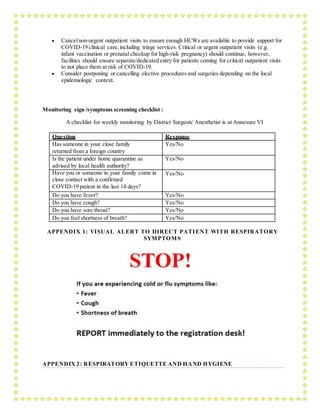
 Have clear signs at the entrance of the facility directing patients with respiratory symptoms to
immediately report to the registration desk in the emergency department or at the unit they are
seeking care (e.g.,maternity, pediatric, HIV clinic) (Appendix 1). Facilities should consider
having a separate registration desk for patients coming in with respiratory symptoms, especially
at the emergency departments, and clear signs at the entrance directing patients to the
designated registration desk.
 Ensure availability of facemasks and paper tissue at registration desk, as well as nearby hand
hygiene stations. A bin with lid should be available at triage where patients can discard used
paper tissues.
 Install physical barriers (e.g., glass or plastic screens) for registration desk (i.e., reception area)
to limit close contact between registration desk personnel and potentially infectious patients.
 Ensure availability of hand hygiene stations in triage area,including waiting areas.
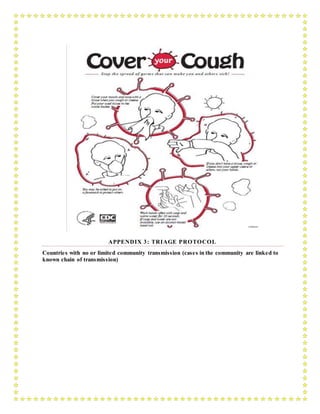
 Post visual alerts at the entrance of the facility and in strategic areas (e.g.,waiting areas or
elevators) about respiratory hygiene and cough etiquette and social distancing. This includes
how to cover nose and mouth when coughing or sneezing and disposal of contaminated items in
trash cans. (Appendix 2)
 Assign dedicated clinical staff (e.g. physicians or nurses) for physical evaluation of patients
presenting with respiratory symptoms at triage. These staff should be trained on triage
procedures, COVID-19 case definition, and appropriate personal protective equipment (PPE)
use (i.e., mask, eye protection, gown and gloves).
 Train administrative personnel working in the reception of patients on how to perform hand
hygiene, maintain appropriate distance, and on how to advice patients properly on the use of
facemask,hand hygiene, and separation from other patients.
 A standardized triage algorithm/questionnaire should be available for use and should include
questions that will determine if the patient meets the COVID-19 case definition4
(Appendix 3).
HCWs should be encouraged to have a high level of clinical suspicion of COVID-19 given the
global pandemic.
SET UP A “RESPIRATORY WAITING AREA” FOR SUSPECTED COVID-19 PATIENTS
 Healthcare facilities without enough single isolation rooms or those located in areas with high
community transmission should designate a separate,well-ventilated area where patients at
high risk* for COVID-19 can wait. This area should have benches,stalls or chairs separated by
at least one meter distance. Respiratory waiting areas should have dedicated toilets and hand
hygiene stations.
 Post clear signs informing patients of the location of “respiratory waiting areas.” Train the
registration desk staff to direct patients immediately to these areas after registration.
 Provide paper tissues, alcohol-based hand rub, and trash bin with lid for the “respiratory
waiting area.”
 Develop a process to reduce the amount of time patients are in the “respiratory waiting area,”
which may include:
o Allocation of additional staff to triage patients at high risk for COVID-19
o Setting up a notification system that allows patients to wait in a personal vehicle or
outside of the facility (if medically appropriate) in a place that social distance can be
maintained and be notified by phone or other remote methods when it is their turn to be
evaluated.
TRIAGE PROCESS
 A facemask should be given to patients with respiratory symptoms as soon as they get to the
facility if they do not already have one. All patients in the “respiratory waiting area” should
wear a facemask.
 If facemasks are not available, provide paper tissues or request the patient to cover their nose
and mouth with a scarf, bandana, or T-shirt during the entire triage process, including while in
the “respiratory waiting area”. A homemade mask with cloth can also be used as source control,
if the patient has one. Caution should be exercised as these items will become contaminated and
can serve as a source of transmission to other patients or even family members. WHO’s
guidance should be followed by patients and family members to clean these items.
(https://www.who.int/news-room/q-a-detail/q-a-on-infection-prevention-and-control-for-health-
care-workers-caring-for-patients-with-suspected-or-confirmed-2019-ncovexternal icon).
 Follow triage protocol (Appendix 3) and immediately isolate/separate patients at high risk* for
COVID-19 in single-person rooms with doors closed or designated “respiratory waiting areas.”
 Limit the number of accompanying family members in the waiting area for suspected COVID-
19 patients (no one less than 18 years old unless a patient or a parent). Anyone in the
“respiratory waiting area” should wear a facemask.
 Triage area,including “respiratory waiting areas,” should be cleaned at least twice a day with a
focus on frequently touched surfaces. Cleaning can be done with 0.5% (5000ppm) chlorine or
70% alcohol for surfaces that do not tolerate chlorine (Appendix 4).
*definition of patients at high risk for covid-19 will change depending on where countries
are in the stage of outbreak (e.g. no or limited community transmission vs. wides pread
community transmission). see appendix 2 for the different epidemiologic scenarios.
HEALTHCARE WORKERS (HCWS) CAN DO TO PROTECT THEMSELVES AND
THEIR PATIENTS DURING TRIAGE
 All HCWs should adhere to Standard Precautions,which includes hand hygiene, selection of
PPE based risk assessment,respiratory hygiene, clean and disinfection and injection safety
practices.
 All HCWs should be trained on and familiar with IPC precautions (e.g. contact and droplet
precautions, appropriate hand hygiene, donning and doffing of PPE) related to COVID-19.
o Follow appropriate PPE donning and doffing steps (Appendix 5).
o Perform hand hygiene frequently with an alcohol-based hand rub if your hands are not
visibly dirty or with soap and water if hands are dirty.
 HCWs who come in contact with suspected or confirmed COVID-19 patients should wear
appropriate PPE:
o HCWs in triage area who are conducting preliminary screening do not require PPE if
they DO NOT have direct contact with the patient and MAINTAIN distance of at least
one meter. Examples:
 HCWs at the registration desk that are asking limited questions based on triage
protocol. Installation of physical barriers (e.g.,glass or plastic screens) are
encouraged if possible.
 HCWs providing facemasks or taking temperatures with infrared thermometers
as long as spatial distance can be safely maintained.
 When physical distance is NOT feasible and yet NO direct contact with
patients, use mask and eye protection (face shield or goggles).
o HCWs conducing physical examination of patients with respiratory symptoms should
wear gowns, gloves, medical mask and eye protection (goggles or face shield).
o Cleaners in triage, waiting and examination areas should wear gown, heavy duty
gloves, medical mask, eye protection (if risk of splash from organic material or
chemical), boots or closed work shoes.
 HCWs who develop respiratory symptoms (e.g.,cough, shortness of breath) should stay home
and not perform triage or any other duties at the healthcare facility.
 Ensure that environmental cleaning and disinfection procedures are followed consistently and
correctly (https://www.who.int/publications-detail/water-sanitation-hygiene-and-waste-
management-for-covid-19) .
CONSIDERATIONS FOR TRIAGE DURING PERIODS OF COMMUNITY
TRANSMISSION
 Begin or reinforce existing alternatives to face-to-face triage and visits such as telemedicine3
.
 Designate an area near the facility (e.g.,an ancillary building or temporary structure) or identify
a location in the area to be a “respiratory virus evaluation center” where patients with fever or
respiratory symptoms can seek evaluation and care.
 Expand hours of operation, if possible, to limit crowding at triage during peak hours.
 Cancelnon-urgent outpatient visits to ensure enough HCWs are available to provide support for
COVID-19 clinical care,including triage services. Critical or urgent outpatient visits (e.g.
infant vaccination or prenatal checkup for high-risk pregnancy) should continue, however,
facilities should ensure separate/dedicated entry for patients coming for critical outpatient visits
to not place them at risk of COVID-19.
 Consider postponing or cancelling elective procedures and surgeries depending on the local
epidemiologic context.
Monitoring sign /symptoms screening checklist :
A checklist for weekly monitoring by District Surgeon/ Anesthetist is at Annexure VI
Question Response
Has someone in your close family
returned from a foreign country
Yes/No
Is the patient under home quarantine as
advised by local health authority?
Yes/No
Have you or someone in your family come in
close contact with a confirmed
COVID-19 patient in the last 14 days?
Yes/No
Do you have fever? Yes/No
Do you have cough? Yes/No
Do you have sore throat? Yes/No
Do you feel shortness of breath? Yes/No
APPENDIX 1: VISUAL ALERT TO DIRECT PATIENT WITH RESPIRATORY
SYMPTOMS
APPENDIX 2: RESPIRATORY ETIQUETTE AND HAND HYGIENE
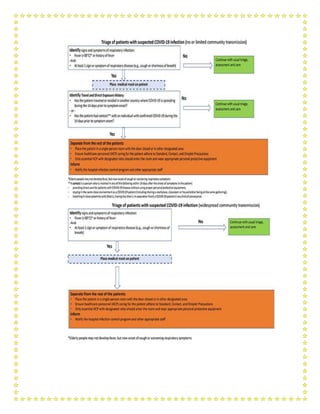
APPENDIX 3: TRIAGE PROTOCOL
Countries with no or limited community transmission (cases in the community are linked to
known chain of transmission)
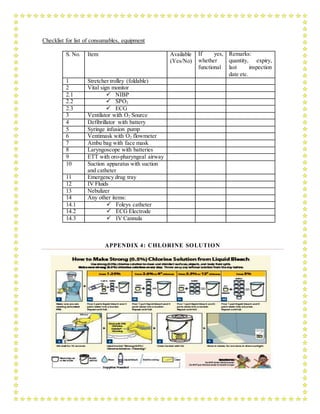
Checklist for list of consumables, equipment
S. No. Item Available
(Yes/No)
If yes,
whether
functional
Remarks:
quantity, expiry,
last inspection
date etc.
1 Stretcher trolley (foldable)
2 Vital sign monitor
2.1  NIBP
2.2  SPO2
2.3  ECG
3 Ventilator with O2 Source
4 Defibrillator with battery
5 Syringe infusion pump
6 Ventimask with O2 flowmeter
7 Ambu bag with face mask
8 Laryngoscope with batteries
9 ETT with oro-pharyngeal airway
10 Suction apparatus with suction
and catheter
11 Emergency drug tray
12 IV Fluids
13 Nebulizer
14 Any other items:
14.1  Foleys catheter
14.2  ECG Electrode
14.3  IV Cannula
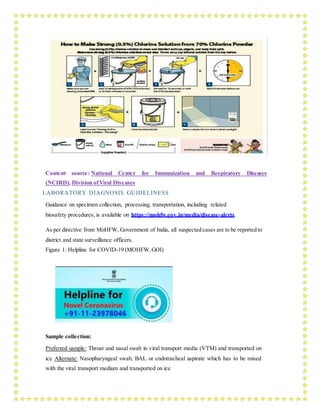
APPENDIX 4: CHLORINE SOLUTION
Content source: National Center for Immunization and Respiratory Diseases
(NCIRD), Division ofViral Diseases
LABORATORY DIAGNOSIS GUIDELINESS
Guidance on specimen collection, processing, transportation, including related
biosafety procedures, is available on https://mohfw.gov.in/media/disease-alerts.
As per directive from MoHFW, Government of India, all suspected cases are to be reported to
district and state surveillance officers.
Figure 1: Helpline for COVID-19 (MOHFW,GOI)
Sample collection:
Preferred sample: Throat and nasal swab in viral transport media (VTM) and transported on
ice Alternate: Nasopharyngeal swab, BAL or endotracheal aspirate which has to be mixed
with the viral transport medium and transported on ice
General guidelines:
 Trained health care professionals to wear appropriate PPE with latex free purple nitrile
gloves while collecting the sample from the patient. Maintain proper infection
control when collecting specimens
 Restricted entry to visitors or attendants during sample collection
 Complete the requisition form for each specimen submitted
Proper disposal of all waste generated
Respiratory specimen collection methods:
a. Lower respiratory tract
i. Bronchoalveolar lavage, trachealaspirate, sputum
ii. Collect 2-3 mL into a sterile, leak-proof, screw-capsputum collection
cup or sterile dry container.
b. Upper respiratory tract
i. Nasopharyngeal swab AND oropharyngeal swab
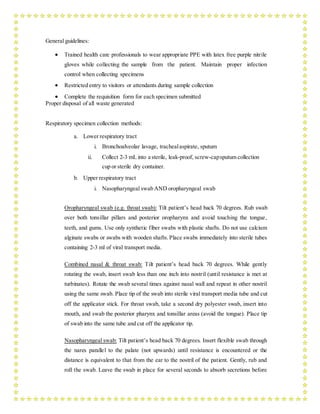
Oropharyngeal swab (e.g. throat swab): Tilt patient’s head back 70 degrees. Rub swab
over both tonsillar pillars and posterior oropharynx and avoid touching the tongue,
teeth, and gums. Use only synthetic fiber swabs with plastic shafts. Do not use calcium
alginate swabs or swabs with wooden shafts. Place swabs immediately into sterile tubes
containing 2-3 ml of viral transport media.
Combined nasal & throat swab: Tilt patient’s head back 70 degrees. While gently
rotating the swab, insert swab less than one inch into nostril (until resistance is met at
turbinates). Rotate the swab several times against nasal wall and repeat in other nostril
using the same swab. Place tip of the swab into sterile viral transport media tube and cut
off the applicator stick. For throat swab, take a second dry polyester swab, insert into
mouth, and swab the posterior pharynx and tonsillar areas (avoid the tongue). Place tip
of swab into the same tube and cut off the applicator tip.
Nasopharyngeal swab: Tilt patient’s head back 70 degrees. Insert flexible swab through
the nares parallel to the palate (not upwards) until resistance is encountered or the
distance is equivalent to that from the ear to the nostril of the patient. Gently, rub and
roll the swab. Leave the swab in place for several seconds to absorb secretions before
removing.
Clinicians may also collect lower respiratory tract samples when these are readily
available (for example, in mechanically ventilated patients). In hospitalized patients
with confirmed COVID - 19 infection, repeat upper respiratory tract samples should be
collected to demonstrate viral clearance.
PRIORITIES FOR COVID-19 TESTING
(Nucleic Acid or Antigen)
High Priority
 Hospitalized patients with symptoms
 Healthcare facility workers, workers in congregate living settings, and first
responders with symptoms
 Residents in long-term care facilities or other congregate living settings, including prisons and
shelters, with symptoms
Priority
 Persons with symptoms of potential COVID-19 infection, including: fever, cough, shortness of
breath, chills, muscle pain, new loss of taste or smell, vomiting or diarrhea, and/or sore throat.
 Persons without symptoms who are prioritized by health departments or clinicians, for any
reason, including but not limited to: public health monitoring, sentinel surveillance, or
screening of other asymptomatic individuals according to state and local plans.
SPECIMEN TYPE AND PRIORITY
All testing for SARS-CoV-2 should be conducted in consultation with a healthcare provider. Specimens
should be collected as soon as possible once a decision has been made to pursue testing, regardless of
the time of symptom onset. The guidance below addresses options for collection of specimens.
For initial diagnostic testing for SARS-CoV-2,CDC recommends collecting and testing an upper
respiratory specimen. The following are acceptable specimens:
 A nasopharyngeal (NP) specimen collected by a healthcare professional; or
 An oropharyngeal (OP) specimen collected by a healthcare professional; or
 A nasal mid-turbinate swab collected by a healthcare professional or by a supervised onsite
self-collection (using a flocked tapered swab); or
 An anterior nares (nasalswab) specimen collected by a healthcare professional or by onsite or
home self-collection (using a flocked or spun polyester swab); or
 Nasopharyngeal wash/aspirate or nasal wash/aspirate (NW) specimen collected by a healthcare
professional.
Swabs should be placed immediately into a sterile transport tube containing 2-3mL of either viral
transport medium (VTM),Amies transport medium, or sterile saline, unless using a test designed to
analyze a specimen directly, (i.e., without placement in VTM), such as some point-of-care testsexternal
icon. If VTM is not available, see the standard operating procedure for public health labs to create viral
transport mediumpdf icon in accordance with CDC’s protocol.
The NW specimen and the non-bacteriostatic saline used to collect the specimen should be placed
immediately into a sterile transport tube.
Testing lower respiratory tract specimens is also an option. For patients who develop a productive
cough, sputum should be collected and tested for SARS-CoV-2. The induction of sputum is not
recommended. When under certain clinical circumstances (e.g.,those receiving invasive mechanical
ventilation), a lower respiratory tract aspirate or bronchoalveolar lavage sample should be collected and
tested as a lower respiratory tract specimen.
Collecting and Handling Specimens Safely
For providers collecting specimens or within 6 feet of patients suspected to be infected with SARS-
CoV-2, maintain proper infection control and use recommended personal protective equipment, which
includes an N95 or higher-level respirator (or facemask if a respirator is not available), eye protection,
gloves, and a gown, when collecting specimens.
For providers who are handling specimens, but are not directly involved in collection (e.g. self-
collection) and not working within 6 feet of the patient, follow Standard Precautions; gloves are
recommended. Healthcare personnel are recommended to wear a form of source control (facemask or
cloth face covering) at all times while in the healthcare facility.
PPE use can be minimized through patient self-collection while the healthcare provider maintains at
least 6 feet of separation.
Handling Bulk-Packaged Sterile Swabs Properly for Upper Respiratory Sample Collection
Sterile swabs for upper respiratory specimen collection may be packaged in one of two ways:
 Individually wrapped (preferred when possible)
 Bulk packaged
Bulk-packaged swabs may be used for sample collection; however, care must be exercised to avoid
SARS-CoV-2 contamination of any of the swabs in the bulk-packaged container.
 Before engaging with patients and while wearing a clean set of protective gloves, distribute
individual swabs from the bulk container into individual disposable plastic bags.
 If bulk-packaged swabs cannot be individually packaged:
o Use only fresh, clean gloves to retrieve a single new swab from the bulk container.
o Close the bulk swab container after each swab removaland leave it closed when not in
use to avoid inadvertent contamination.
o Store opened packages in a closed, airtight container to minimize contamination.
o Keep all used swabs away from the bulk swab container to avoid contamination.
 As with all swabs,only grasp the swab by the distal end of the handle, using gloved hands only.
 When patients are self-collecting their swabs under clinical supervision:
o Hand a swab to the patient only while wearing a clean set of protective gloves.
o The patient can then self-swab and place the swab in transport media or sterile transport
device and seal.
o If the patient needs assistance,you can help the patient place the swab into transport
media or a transport device and seal it.
GENERAL GUIDELINES
Proper collection of specimens is the most important step in the laboratory diagnosis of
infectious diseases. A specimen that is not collected correctly may lead to false negative test
results. The following specimen collection guidelines follow standard recommended
procedures. For more information, including illustrations and step-by-step guidance, see the
CDC Influenza Specimen Collectionpdf icon instructions. Note that these instructions are applicable for
respiratory viruses in general, and not specific for only influenza virus.
I. RESPIRATORY SPECIMENS
A. UPPER RESPIRATORY TRACT
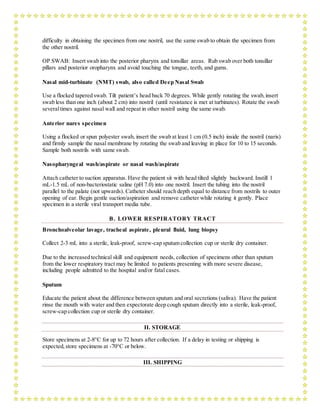
Nasopharyngeal swab/Oropharyngeal (Throat) swab
Use only synthetic fiber swabs with plastic or wire shafts. Do not use calcium alginate swabs or swabs
with wooden shafts,as they may contain substances that inactivate some viruses and inhibit PCR
testing. CDC is now recommending collecting only the NP swab,although OP swabs remain an
acceptable specimen type. If both NP and OP swabs are collected, they should be combined in a single
tube to maximize test sensitivity and limit use of testing resources.
NP SWAB: Insert minitip swab with a flexible shaft (wire or plastic) through the nostril parallel to the
palate (not upwards) until resistance is encountered or the distance is equivalent to that from the ear to
the nostril of the patient, indicating contact with the nasopharynx. Swab should reach depth equal to
distance from nostrils to outer opening of the ear. Gently rub and roll the swab. Leave swab in place for
severalseconds to absorb secretions. Slowly remove swab while rotating it. Specimens can be collected
from both sides using the same swab,but it is not necessary to collect specimens from both sides if the
minitip is saturated with fluid from the first collection. If a deviated septum or blockage create
difficulty in obtaining the specimen from one nostril, use the same swab to obtain the specimen from
the other nostril.
OP SWAB: Insert swab into the posterior pharynx and tonsillar areas. Rub swab over both tonsillar
pillars and posterior oropharynx and avoid touching the tongue, teeth, and gums.
Nasal mid-turbinate (NMT) swab, also called Deep Nasal Swab
Use a flocked tapered swab. Tilt patient’s head back 70 degrees. While gently rotating the swab,insert
swab less than one inch (about 2 cm) into nostril (until resistance is met at turbinates). Rotate the swab
severaltimes against nasal wall and repeat in other nostril using the same swab.
Anterior nares specimen
Using a flocked or spun polyester swab, insert the swab at least 1 cm (0.5 inch) inside the nostril (naris)
and firmly sample the nasal membrane by rotating the swab and leaving in place for 10 to 15 seconds.
Sample both nostrils with same swab.
Nasopharyngeal wash/aspirate or nasal wash/aspirate
Attach catheter to suction apparatus. Have the patient sit with head tilted slightly backward. Instill 1
mL-1.5 mL of non-bacteriostatic saline (pH 7.0) into one nostril. Insert the tubing into the nostril
parallel to the palate (not upwards). Catheter should reach depth equal to distance from nostrils to outer
opening of ear. Begin gentle suction/aspiration and remove catheter while rotating it gently. Place
specimen in a sterile viral transport media tube.
B. LOWER RESPIRATORY TRACT
Bronchoalveolar lavage, tracheal aspirate, pleural fluid, lung biopsy
Collect 2-3 mL into a sterile, leak-proof, screw-cap sputum collection cup or sterile dry container.
Due to the increased technical skill and equipment needs, collection of specimens other than sputum
from the lower respiratory tract may be limited to patients presenting with more severe disease,
including people admitted to the hospital and/or fatal cases.
Sputum
Educate the patient about the difference between sputum and oral secretions (saliva). Have the patient
rinse the mouth with water and then expectorate deep cough sputum directly into a sterile, leak-proof,
screw-cap collection cup or sterile dry container.
II. STORAGE
Store specimens at 2-8°C for up to 72 hours after collection. If a delay in testing or shipping is
expected,store specimens at -70°C or below.
III. SHIPPING
Samples may be shipped to CDC if repeated testing results remain inconclusive or if other unusual
results are obtained. Please contact CDC at respvirus@cdc.gov prior to submitting samples.
If shipping samples to CDC: If specimens will ship without delay, store specimens at 2-8°C, and ship
overnight to CDC on ice pack. If a delay in shipping will result in receipt at CDC more than 72 hours
after collection, store specimens at -70°C or below and ship overnight to CDC on dry ice. Additional
useful and detailed information on packing, shipping, and transporting specimens can be found
at Interim Laboratory Biosafety Guidelines for Handling and Processing Specimens Associated with
Coronavirus Disease 2019 (COVID-19).
Specimens must be packaged, shipped, and transported according to the current edition of
the International Air Transport Association (IATA) Dangerous Goods Regulations external iconexternal
icon.
Label each specimen container with the patient’s ID number (e.g., medical record number), unique
CDC or state-generated nCov specimen ID (e.g.,laboratory requisition number), specimen type (e.g.,
serum) and the date the sample was collected. Complete a CDC Form 50.34 for each specimen
submitted. In the upper left box of the form, 1) for TEST REQUESTED select “Respiratory virus
molecular detection (non-influenza) CDC-10401” and 2) for AT CDC, BRING TO THE
ATTENTION OF enter “Stephen Lindstrom: 2019-nCoV PUI.”
Please refer to our instruction guidance for submitting CDC Form 50.34 found here: Guidelines For
Submitting Specimens to CDCpdf icon.
FOR ADDITIONAL INFORMATION, CONSULTATION, OR THE CDC SHIPPING ADDRESS,
CONTACT THE CDC EMERGENCY OPERATIONS CENTER (EOC) AT 770-488-7100.
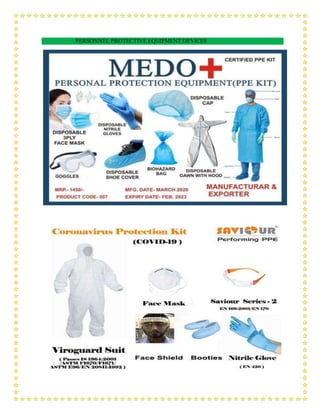
PERSONAL PROTECTIVE EQUIPMENT (PPE)
Introduction
Coronaviruses (CoV) belong to a family of viruses that cause illness ranging from the common
cold to more severe diseases. A novel coronavirus (2019-nCoV) is a new strain that has not been
previously identified in humans. The infection is spread through respiratory route i.e. respiratory
droplets and direct human contact. Healthcare personnel (HCP) are at risk of infection through
respiratory routes and direct contact with infectious patients.
In view the current situation regarding COVID -19 disease in India, we need to be prepared for the
handling of suspect and confirmed cases,who might present to the AIIMS hospital.
These guidelines are supplementary to the existing Hospital Infection control Manual of AIIMS.
The guidelines have been adapted from the existing WHO & CDC recommendations.
STANDARD RECOMMENDATIONS TO PREVENT INFECTION SPREAD INCLUDE
STANDARD PRECAUTIONS, CONTACT PRECAUTIONS AND RESPIRATORY
PRECAUTIONS.
Patients suspected of having 2019-nCoV infection should be shifted to the isolation facility from
the triage area as soon as possible. The HCP should do this after donning appropriate PPE. The
patient should wear mask/respirator.
STANDARD PRECAUTIONS
Health-care workers caring for PUI (Patient under investigation) patients should implement
standard infection control precautions. These include basic hand hygiene, use of personal
protective equipment, respiratory etiquettes, and environmental disinfection.
PATIENT PLACEMENT
 The PUI has to be admitted in an isolation room with negative pressure and at least 6 air
changes per hour.
 Only essential personnel should enter the room. Implement staffing policies to minimize
the number of HCP who enter the room.
 Facilities should keep a log of all persons who care for or enter the rooms or care area of
these patients.
 Use dedicated or disposable noncritical patient-care equipment (e.g., blood pressure cuffs).
If equipment will be used for more than one patient, clean and disinfect such equipment
before use on another patient according to manufacturer’s instructions.
 HCP entering the room soon after a patient vacates the room should use respiratory
protection.
ADVICE ON THE USAGE OF PPE IN THE CONTEXT OF COVID-19
The following are recommendations for the rational use of personal protective equipment (PPE) at
health care facilities. PPE includes gloves, medical masks, goggles or a face shield, and gowns, as
well as for specific procedures, respirators (i.e., N95) and aprons. It is intended for HCPs, infection
prevention and control (IPC) professionals and health care managers.
GENERAL ADVICE
Hand hygiene remains one of the most important measures for all persons for the prevention
and control of majority of the respiratory viral infections -, including 2019-nCoV infections or
COVID-19. This can be performed with soap and water or alcohol-based hand rubs. Wearing a
medical mask is one of the prevention measures to limit spread of certain respiratory diseases,
including 2019-nCoV, is useful when worn by the persons suffering from the disease or contacts of
the patients. These measures must be combined with other IPC measures to prevent the human-to-
human transmission of COVID-19, depending on the specific situation.
Community setting (Applicable to all staff)
INDIVIDUALS WITHOUT RESPIRATORY SYMPTOMS SHOULD:
i. avoid agglomerations and frequency of closed crowded spaces;
ii. maintain distance of at least 1 meter from any individual with 2019-nCoV
respiratory symptoms (e.g., coughing, sneezing);
iii. perform hand hygiene frequently, using alcohol-based hand rub if hands are not
visibly soiled or soap and water when hands are visibly soiled;
iv. if coughing or sneezing, cover nose and mouth with flexed elbow or paper
tissue, dispose-off tissue immediately after use and perform hand hygiene;
v. refrain from touching mouth and nose;
vi. a medical mask is not required, as no evidence is available on its usefulness to
protect non-sick persons. However, masks might be worn according to local
cultural habits. If masks are used, best practices should be followed on how to
wear, remove, and dispose of them and on hand hygiene action after removal
(see below advice regarding appropriate mask management).
INDIVIDUALS WITH RESPIRATORY SYMPTOMS SHOULD:
i. wear a medical mask and seek medical care if experiencing fever, cough and
difficulty breathing, as soon as possible or in accordance with to local protocols;
ii. follow the below advice regarding appropriate mask management.
HEALTH CARE FACILITIES
INDIVIDUALS WITH RESPIRATORY SYMPTOMS SHOULD:
i. wear a medical mask while waiting in triage or waiting areas or during
transportation within the facility;
ii. wear a medical mask when staying in cohorting areas dedicated to suspected or
confirmed cases;
iii. do not wear a medical mask when isolated in single rooms but cover mouth and
nose when coughing or sneezing with disposable paper tissues. Dispose them
appropriately and perform hand hygiene immediately afterwards.
HEALTH CARE WORKERS SHOULD:
a. wear a medical mask when entering a room where patients suspected or
confirmed of being infected with 2019-nCoV are admitted and in any situation
of care provided to a suspected or confirmed case;
b. use a particulate respirator at least as protective as a US National Institute for
Occupational Safety and Health (NIOSH)-certified N95, European Union (EU)
standard FFP2, or equivalent, when performing aerosol-generating procedures
such as:
 trachealintubation
 non-invasive ventilation
 tracheotomy
 cardiopulmonary resuscitation
 manual ventilation before intubation and
 bronchoscopy
MASKS MANAGEMENT
If medical masks are worn, appropriate use and disposal is essential to ensure they are effective
and to avoid any increase in risk of transmission associated with the incorrect use and disposal of
masks.
The following information on correct use of medical masks derives from the practices in health-
care settings:
a. place mask carefully to cover mouth and nose and tie securely to minimise any
gaps between the face and the mask;
b. while in use, avoid touching the mask;
c. remove the mask by using appropriate technique (i.e. do not touch the front but
remove the lace from behind);
d. after removal or whenever you inadvertently touch a used mask, clean hands by
using an alcohol-based hand rub or soap and water if visibly soiled
e. replace masks with a new clean, dry mask as soon as they become damp/humid;
f. do not re-use single-use masks;
g. discard single-use masks after each use and dispose-off them immediately upon
removal.
RATIONAL USE OF PERSONAL PROTECTIVE EQUIPMENT
 PPE use is based on the risk of exposure (e.g., type of activity) and the transmission
dynamics of the pathogen (e.g., contact, droplet or aerosol). Observing the following
recommendations will ensure rational use of PPE.
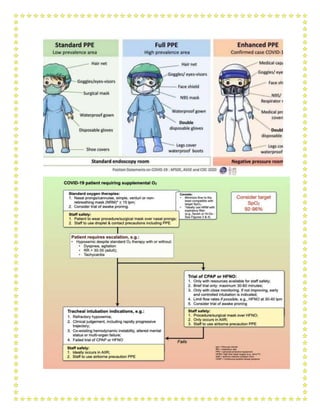
 The type of PPE used when caring for COVID-19 patients will vary according to the
setting and type of personnel and activity (Below Table).
 Healthcare workers involved in the direct care of patients should use the following PPE:
o gowns,
o gloves,
o medical mask and
o eye protection (goggles or face shield).
 Specifically, for aerosol-generating procedures (e.g., tracheal intubation, non-invasive
ventilation, tracheostomy, cardiopulmonary resuscitation, manual ventilation before
intubation, bronchoscopy) healthcare workers should use respirators (N95), eye protection,
gloves and gowns; aprons should also be used if gowns are not fluid resistant.
 Respirators (e.g., N95, FFP2 or equivalent standard) have been used for an extended time
during previous public health emergencies involving acute respiratory illness when PPE
was in short supply. This refers to wearing the same respirator while caring for multiple
patients who have the same diagnosis without removing it, and evidence indicates that
respirators maintain their protection when used for extended periods. However, using one
respirator for longer than 4 hours can lead to discomfort and should be avoided.
 Among the general public, persons with respiratory symptoms or those caring for COVID-
19 patients at home should receive medical masks.
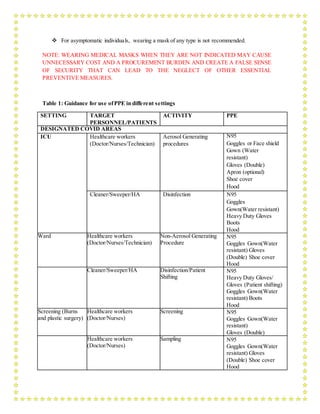
 For asymptomatic individuals, wearing a mask of any type is not recommended.
NOTE: WEARING MEDICAL MASKS WHEN THEY ARE NOT INDICATED MAY CAUSE
UNNECESSARY COST AND A PROCUREMENT BURDEN AND CREATE A FALSE SENSE
OF SECURITY THAT CAN LEAD TO THE NEGLECT OF OTHER ESSENTIAL
PREVENTIVE MEASURES.
Table 1: Guidance for use ofPPE in different settings
SETTING TARGET
PERSONNEL/PATIENTS
ACTIVITY PPE
DESIGNATED COVID AREAS
ICU Healthcare workers Aerosol Generating N95
(Doctor/Nurses/Technician) procedures Goggles or Face shield
Gown (Water
resistant)
Gloves (Double)
Apron (optional)
Shoe cover
Hood
Cleaner/Sweeper/HA Disinfection N95
Goggles
Gown(Water resistant)
Heavy Duty Gloves
Boots
Hood
Ward Healthcare workers
(Doctor/Nurses/Technician)
Non-Aerosol Generating
Procedure
N95
Goggles Gown(Water
resistant) Gloves
(Double) Shoe cover
Hood
Cleaner/Sweeper/HA Disinfection/Patient
Shifting
N95
Heavy Duty Gloves/
Gloves (Patient shifting)
Goggles Gown(Water
resistant) Boots
Hood
Screening (Burns
and plastic surgery)
Healthcare workers
(Doctor/Nurses)
Screening N95
Goggles Gown(Water
resistant)
Gloves (Double)
Healthcare workers
(Doctor/Nurses)
Sampling N95
Goggles Gown(Water
resistant) Gloves
(Double) Shoe cover
Hood
Cleaner/Sweeper/HA Disinfection/Patient
Shifting
Triple layer mask
Gloves(Patient shifting)
Heavy Duty Gloves
DESIGNATED SCREENING AREAS
Screening (NewRAK
OPD)
Healthcare
workers
(Doctor/Nurses)
Screening N95
Gloves (Single)
Cleaner/Sweeper/
HA
Disinfection Triple layer mask
Gloves(Patient shifting)
Heavy Duty Gloves
Screening (Emergency Healthcare
workers
(Doctor/Nurses)
Screening N95
Goggles
medicine; pediatrics OPD) Gown(Surgical Linen
Gown)use with an apron
Gloves (Double)
Cleaner/Sweeper/
HA
Disinfection Triple layer mask
Heavy Duty Gloves
TRANSPORT ofCOVID SUSPECT / CONFIRMEDCASE IN AMBULANCE
Ambulance (HCW
travelling in patient
compartment)
Healthcar
e workers
(Doctor/
Nurses)
Attending patient (Direct
contact >15 min)
N95
Goggles
Gown(Wat
er resistant)
Gloves (Double)
Cleaner/Sweeper/H
A
Disinfection Triple layer mask
Heavy Duty Gloves
Driver No Direct contact Triple layer mask
Emergency Medicine
(NewEmergency;
Pediatric Emergency;
Surgical Emergency
Healthcare workers
(Doctor/Nurses/Tec
hnician)
Non-
Aerosolgene
rate
Non-Aerosol generating
procedure
Triple layer
mask* Gown (In
Red area only)
Gloves (Double)
*N95 [Red
area only]
Cleaner/Sweeper/H
A
Disinfection/Patient Shifting Triple layer mask
Gloves (Patient
Shifting)
Heavy Duty Gloves
General OPD/EHS OPD Healthcare workers
(Doctor/Nurses)
Non-Aerosol
generating procedure
Triple layer mask
Cleaner/Sweeper/H
A
Disinfection Triple layer mask
Heavy Duty Gloves
General Ward/Private
Wards
Healthcare workers
(Doctor/Nurses)
Non-Aerosol
generating procedure
Triple layer mask
Cleaner/Sweeper/H
A
Disinfection/ Patient Shifting Triple layer mask
Gloves (Patient
Shifting)
Heavy Duty Gloves
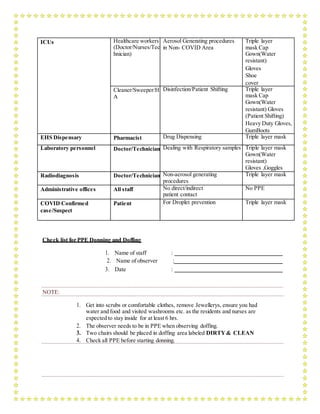
ICUs Healthcare workers
(Doctor/Nurses/Tec
hnician)
Aerosol Generating procedures
in Non- COVID Area
Triple layer
mask Cap
Gown(Water
resistant)
Gloves
Shoe
cover
Cleaner/Sweeper/H
A
Disinfection/Patient Shifting Triple layer
mask Cap
Gown(Water
resistant) Gloves
(Patient Shifting)
Heavy Duty Gloves,
GumBoots
EHS Dispensary Pharmacist Drug Dispensing Triple layer mask
Laboratory personnel Doctor/Technician Dealing with Respiratory samples Triple layer mask
Gown(Water
resistant)
Gloves ,Goggles
Radiodiagnosis Doctor/Technician Non-aerosol generating
procedures
Triple layer mask
Administrative offices All staff No direct/indirect
patient contact
No PPE
COVID Confirmed
case/Suspect
Patient For Droplet prevention Triple layer mask
Check list for PPE Donning and Doffing
1. Name of staff :
2. Name of observer :
3. Date :
NOTE:
1. Get into scrubs or comfortable clothes, remove Jewellerys, ensure you had
water and food and visited washrooms etc. as the residents and nurses are
expected to stay inside for at least 6 hrs.
2. The observer needs to be in PPE when observing doffing.
3. Two chairs should be placed in doffing area labeled DIRTY& CLEAN
4. Check all PPE before starting donning.
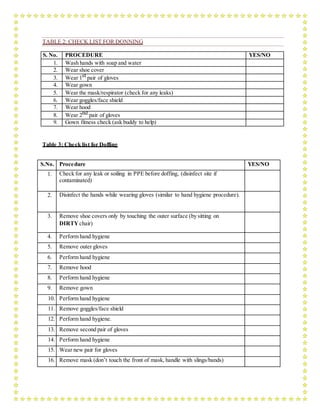
TABLE 2: CHECK LIST FOR DONNING
S. No. PROCEDURE YES/NO
1. Wash hands with soap and water
2. Wear shoe cover
3. Wear 1st pair of gloves
4. Wear gown
5. Wear the mask/respirator (check for any leaks)
6. Wear goggles/face shield
7. Wear hood
8. Wear 2nd pair of gloves
9. Gown fitness check (ask buddy to help)
Table 3: Check list for Doffing
S.No. Procedure YES/NO
1. Check for any leak or soiling in PPE before doffing, (disinfect site if
contaminated)
2. Disinfect the hands while wearing gloves (similar to hand hygiene procedure).
3. Remove shoe covers only by touching the outer surface (by sitting on
DIRTY chair)
4. Perform hand hygiene
5. Remove outer gloves
6. Perform hand hygiene
7. Remove hood
8. Perform hand hygiene
9. Remove gown
10. Perform hand hygiene
11. Remove goggles/face shield
12. Perform hand hygiene.
13. Remove second pair of gloves
14. Perform hand hygiene
15. Wear new pair for gloves
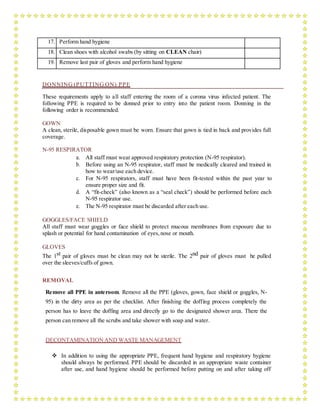
16. Remove mask (don’t touch the front of mask, handle with slings/bands)
17. Perform hand hygiene
18. Clean shoes with alcohol swabs (by sitting on CLEAN chair)
19. Remove last pair of gloves and perform hand hygiene
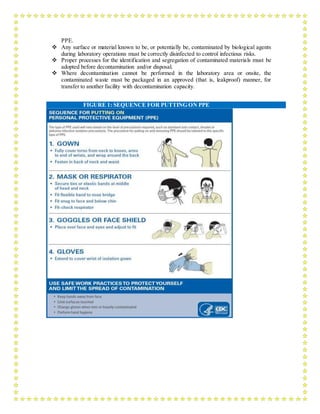
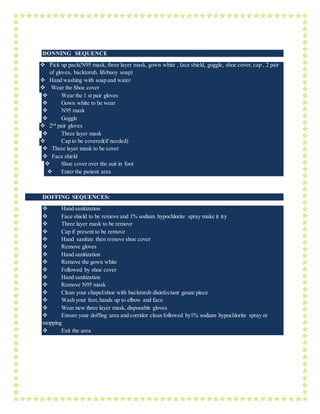
DONNING (PUTTING ON) PPE
These requirements apply to all staff entering the room of a corona virus infected patient. The
following PPE is required to be donned prior to entry into the patient room. Donning in the
following order is recommended.
GOWN
A clean, sterile, disposable gown must be worn. Ensure that gown is tied in back and provides full
coverage.
N-95 RESPIRATOR
a. All staff must wear approved respiratory protection (N-95 respirator).
b. Before using an N-95 respirator, staff must be medically cleared and trained in
how to wear/use each device.
c. For N-95 respirators, staff must have been fit-tested within the past year to
ensure proper size and fit.
d. A “fit-check” (also known as a “seal check”) should be performed before each
N-95 respirator use.
e. The N-95 respirator must be discarded after each use.
GOGGLES/FACE SHIELD
All staff must wear goggles or face shield to protect mucous membranes from exposure due to
splash or potential for hand contamination of eyes,nose or mouth.
GLOVES
The 1st pair of gloves must be clean may not be sterile. The 2nd pair of gloves must be pulled
over the sleeves/cuffs of gown.
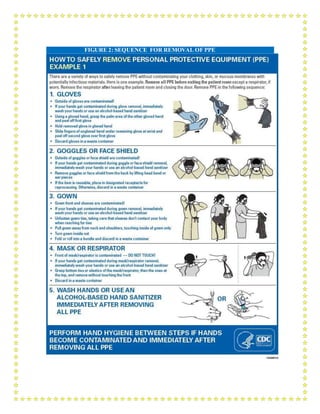
REMOVAL
Remove all PPE in anteroom. Remove all the PPE (gloves, gown, face shield or goggles, N-
95) in the dirty area as per the checklist. After finishing the doffing process completely the
person has to leave the doffing area and directly go to the designated shower area. There the
person can remove all the scrubs and take shower with soap and water.
DECONTAMINATIONAND WASTE MANAGEMENT
 In addition to using the appropriate PPE, frequent hand hygiene and respiratory hygiene
should always be performed. PPE should be discarded in an appropriate waste container
after use, and hand hygiene should be performed before putting on and after taking off
PPE.
 Any surface or material known to be, or potentially be, contaminated by biological agents
during laboratory operations must be correctly disinfected to control infectious risks.
 Proper processes for the identification and segregation of contaminated materials must be
adopted before decontamination and/or disposal.
 Where decontamination cannot be performed in the laboratory area or onsite, the
contaminated waste must be packaged in an approved (that is, leakproof) manner, for
transfer to another facility with decontamination capacity.
FIGURE 1: SEQUENCE FOR PUTTING ON PPE
FIGURE 2: SEQUENCE FOR REMOVAL OF PPE
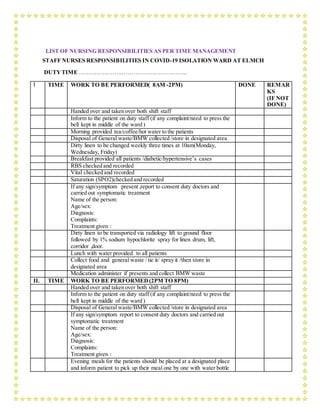
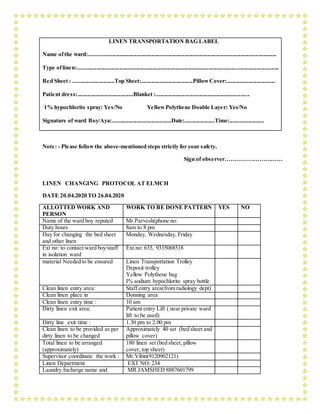
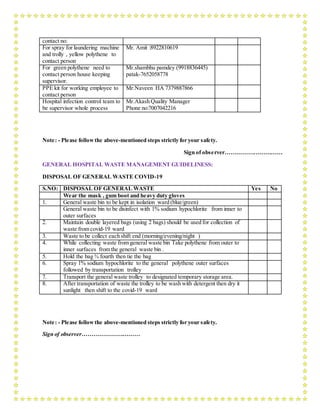
LIST OF NURSING RESPONSIBILITIES AS PER TIME MANAGEMENT
STAFF NURSES RESPONSIBILITIES IN COVID-19 ISOLATION WARD AT ELMCH
DUTYTIME ………………………………………………..
I TIME WORK TO BE PERFORMED( 8AM -2PM) DONE REMAR
KS
(IF NOT
DONE)
Handed over and taken over both shift staff
Inform to the patient on duty staff (if any complaint/need to press the
bell kept in middle of the ward )
Morning provided tea/coffee/hot water to the patients
Disposal of General waste/BMW collected /store in designated area
Dirty linen to be changed weekly three times at 10am(Monday,
Wednesday, Friday)
Breakfast provided all patients /diabetic/hypertensive’s cases
RBS checked and recorded
Vital checked and recorded
Saturation (SPO2)checked and recorded
If any sign/symptom present ,report to consent duty doctors and
carried out symptomatic treatment
Name of the person:
Age/sex:
Diagnosis:
Complaints:
Treatment given :
Dirty linen to be transported via radiology lift to ground floor
followed by 1% sodium hypochlorite spray for linen drum, lift,
corridor ,door.
Lunch with water provided to all patients
Collect food and general waste / tie it/ spray it /then store in
designated area
Medication administer if presents and collect BMW waste
II. TIME WORK TO BE PERFORMED(2PM TO 8PM)
Handed over and taken over both shift staff
Inform to the patient on duty staff (if any complaint/need to press the
bell kept in middle of the ward )
Disposal of General waste/BMW collected /store in designated area
If any sign/symptom report to consent duty doctors and carried out
symptomatic treatment
Name of the person:
Age/sex:
Diagnosis:
Complaints:
Treatment given :
Evening meals for the patients should be placed at a designated place
and inform patient to pick up their meal one by one with water bottle
After they finish their meals used plate, cup, water bottle and tray
may be placed at the given place which can then be disposed off.
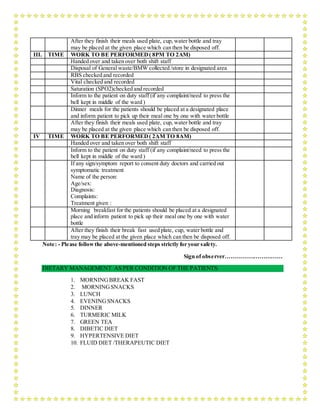
III. TIME WORK TO BE PERFORMED( 8PM TO 2AM)
Handed over and taken over both shift staff
Disposal of General waste/BMW collected /store in designated area
RBS checked and recorded
Vital checked and recorded
Saturation (SPO2)checked and recorded
Inform to the patient on duty staff (if any complaint/need to press the
bell kept in middle of the ward )
Dinner meals for the patients should be placed at a designated place
and inform patient to pick up their meal one by one with water bottle
After they finish their meals used plate, cup, water bottle and tray
may be placed at the given place which can then be disposed off.
IV TIME WORK TO BE PERFORMED( 2AM TO 8AM)
Handed over and taken over both shift staff
Inform to the patient on duty staff (if any complaint/need to press the
bell kept in middle of the ward )
If any sign/symptom report to consent duty doctors and carried out
symptomatic treatment
Name of the person:
Age/sex:
Diagnosis:
Complaints:
Treatment given :
Morning breakfast for the patients should be placed at a designated
place and inform patient to pick up their meal one by one with water
bottle
After they finish their break fast used plate, cup, water bottle and
tray may be placed at the given place which can then be disposed off.
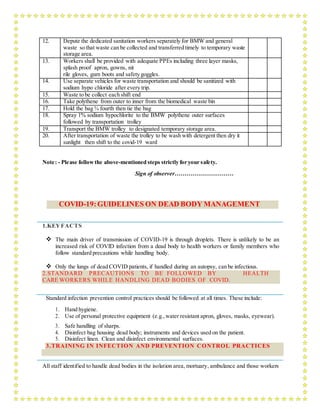
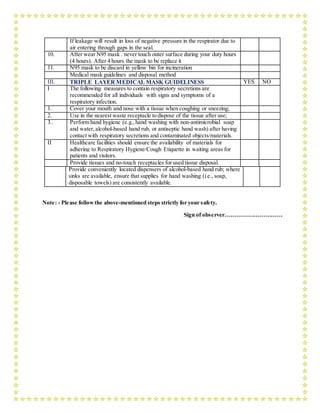
Note: - Please followthe above-mentioned steps strictly for your safety.
Sign of observer…………………………
DIETARY MANAGEMENT AS PER CONDITION OF THE PATIENTS:
1. MORNINGBREAK FAST
2. MORNINGSNACKS
3. LUNCH
4. EVENINGSNACKS
5. DINNER
6. TURMERIC MILK
7. GREEN TEA
8. DIBETIC DIET
9. HYPERTENSIVE DIET
10. FLUID DIET /THERAPEUTIC DIET
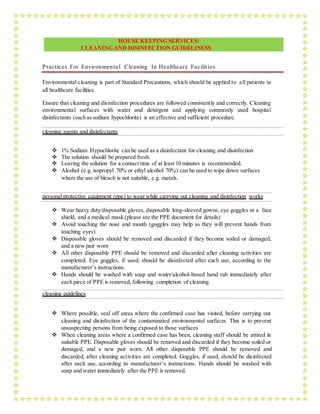
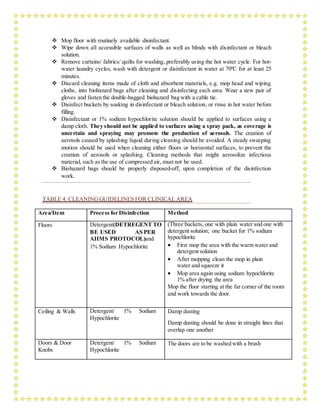
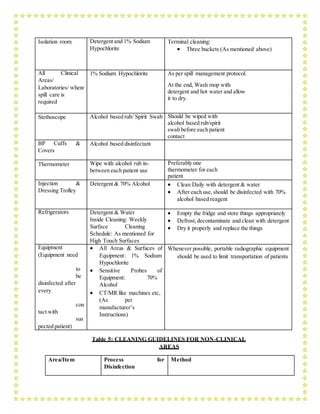
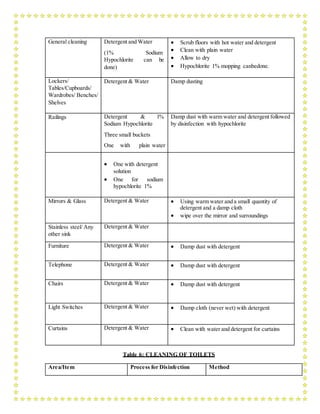
HOUSE KEEPING SERVICES:
CLEANING AND DISINFECTION GUIDELINESS
Practices For Environmenta l Cleaning In Healthcare Facilities
Environmental cleaning is part of Standard Precautions, which should be applied to all patients in
all healthcare facilities
Ensure that cleaning and disinfection procedures are followed consistently and correctly. Cleaning
environmental surfaces with water and detergent and applying commonly used hospital
disinfectants (such as sodium hypochlorite) is an effective and sufficient procedure.
cleaning agents and disinfectants
 1% Sodium Hypochlorite can be used as a disinfectant for cleaning and disinfection
 The solution should be prepared fresh.
 Leaving the solution for a contact time of at least 10 minutes is recommended.
 Alcohol (e.g. isopropyl 70% or ethyl alcohol 70%) can be used to wipe down surfaces
where the use of bleach is not suitable, e.g. metals.
personal protective equipment (ppe) to wear while carrying out cleaning and disinfection works
 Wear heavy duty/disposable gloves, disposable long-sleeved gowns, eye goggles or a face
shield, and a medical mask (please see the PPE document for details)
 Avoid touching the nose and mouth (goggles may help as they will prevent hands from
touching eyes)
 Disposable gloves should be removed and discarded if they become soiled or damaged,
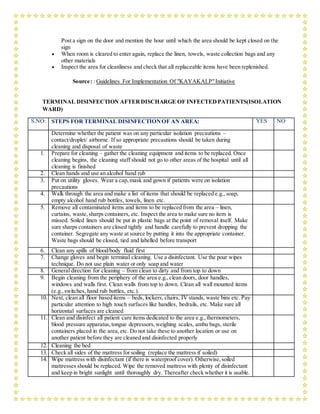
and a new pair worn
 All other disposable PPE should be removed and discarded after cleaning activities are
completed. Eye goggles, if used, should be disinfected after each use, according to the
manufacturer’s instructions.
 Hands should be washed with soap and water/alcohol-based hand rub immediately after
each piece of PPE is removed, following completion of cleaning.
cleaning guidelines
 Where possible, seal off areas where the confirmed case has visited, before carrying out
cleaning and disinfection of the contaminated environmental surfaces. This is to prevent
unsuspecting persons from being exposed to those surfaces
 When cleaning areas where a confirmed case has been, cleaning staff should be attired in
suitable PPE. Disposable gloves should be removed and discarded if they become soiled or
damaged, and a new pair worn. All other disposable PPE should be removed and
discarded, after cleaning activities are completed. Goggles, if used, should be disinfected
after each use, according to manufacturer’s instructions. Hands should be washed with
soap and water immediately after the PPE is removed.
 Mop floor with routinely available disinfectant.
 Wipe down all accessible surfaces of walls as well as blinds with disinfectant or bleach
solution.
 Remove curtains/ fabrics/ quilts for washing, preferably using the hot water cycle. For hot-
water laundry cycles, wash with detergent or disinfectant in water at 70ºC for at least 25
minutes.
 Discard cleaning items made of cloth and absorbent materials, e.g. mop head and wiping
cloths, into biohazard bags after cleaning and disinfecting each area. Wear a new pair of
gloves and fasten the double-bagged biohazard bag with a cable tie.
 Disinfect buckets by soaking in disinfectant or bleach solution, or rinse in hot water before
filling.
 Disinfectant or 1% sodium hypochlorite solution should be applied to surfaces using a
damp cloth. They should not be applied to surfaces using a spray pack, as coverage is
uncertain and spraying may promote the production of aerosols. The creation of
aerosols caused by splashing liquid during cleaning should be avoided. A steady sweeping
motion should be used when cleaning either floors or horizontal surfaces, to prevent the
creation of aerosols or splashing. Cleaning methods that might aerosolize infectious
material, such as the use of compressed air, must not be used.
 Biohazard bags should be properly disposed-off, upon completion of the disinfection
work.
TABLE 4: CLEANINGGUIDELINES FOR CLINICAL AREA
Area/Item Process for Disinfection Method
Floors Detergent(DETREGENT TO
BE USED AS PER
AIIMS PROTOCOL)and
1% Sodium Hypochlorite
(Three buckets, one with plain water and one with
detergent solution; one bucket for 1% sodium
hypochlorite
 First mop the area with the warm water and
detergent solution
 After mopping clean the mop in plain
water and squeeze it
 Mop area again using sodium hypochlorite
1% after drying the area
Mop the floor starting at the far corner of the room
and work towards the door.
Ceiling & Walls Detergent/ 1% Sodium
Hypochlorite
Damp dusting
Damp dusting should be done in straight lines that
overlap one another
Doors & Door
Knobs
Detergent/ 1% Sodium
Hypochlorite
The doors are to be washed with a brush
Isolation room Detergent and 1% Sodium
Hypochlorite
Terminal cleaning:
 Three buckets (As mentioned above)
All Clinical
Areas/
Laboratories/ where
spill care is
required
1% Sodium Hypochlorite As per spill management protocol.
At the end, Wash mop with
detergent and hot water and allow
it to dry.
Stethoscope Alcohol based rub/ Spirit Swab Should be wiped with
alcohol based rub/spirit
swab before each patient
contact
BP Cuffs &
Covers
Alcohol based disinfectant
Thermometer Wipe with alcohol rub in-
between each patient use
Preferably one
thermometer for each
patient
Injection &
Dressing Trolley
Detergent & 70% Alcohol  Clean Daily with detergent & water
 After each use,should be disinfected with 70%
alcohol based reagent
Refrigerators Detergent & Water
Inside Cleaning: Weekly
Surface Cleaning
Schedule: As mentioned for
High Touch Surfaces
 Empty the fridge and store things appropriately
 Defrost,decontaminate and clean with detergent
 Dry it properly and replace the things
Equipment
(Equipment need
to
be
disinfected after
every
con
tact with
sus
pected patient)
 All Areas & Surfaces of
Equipment: 1% Sodium
Hypochlorite
 Sensitive Probes of
Equipment: 70%
Alcohol
 CT/MR like machines etc,
(As per
manufacturer’s
Instructions)
Whenever possible, portable radiographic equipment
should be used to limit transportation of patients
Table 5: CLEANING GUIDELINES FOR NON-CLINICAL
AREAS
Area/Item Process for
Disinfection
Method
General cleaning Detergent and Water
(1% Sodium
Hypochlorite can be
done)
 Scrub floors with hot water and detergent
 Clean with plain water
 Allow to dry
 Hypochlorite 1% mopping canbedone.
Lockers/
Tables/Cupboards/
Wardrobes/ Benches/
Shelves
Detergent & Water Damp dusting
Railings Detergent & 1%
Sodium Hypochlorite
Three small buckets
One with plain water
Damp dust with warm water and detergent followed
by disinfection with hypochlorite
 One with detergent
solution
 One for sodium
hypochlorite 1%
Mirrors & Glass Detergent & Water  Using warm water and a small quantity of
detergent and a damp cloth
 wipe over the mirror and surroundings
Stainless steel/ Any
other sink
Detergent & Water
Furniture Detergent & Water  Damp dust with detergent
Telephone Detergent & Water  Damp dust with detergent
Chairs Detergent & Water  Damp dust with detergent
Light Switches Detergent & Water  Damp cloth (never wet) with detergent
Curtains Detergent & Water  Clean with water and detergent for curtains
Table 6: CLEANING OF TOILETS
Area/Item Process for Disinfection Method
 Toilet Pot & Floor  1% Sodium Hypochlorite Scrub with the recommended agents
andthe long handle angular brush.
 Rest all areas of Toilets like
o Taps & Fittings
o Outside Sink
o Soap
Dispensers etc.
 Detergent & Water Scrub
Frequency of cleaning of surfaces
High touch surfaces: Disinfection of high touch surfaces like (doorknobs, telephone, call
bells, bedrails, stair rails, light switches, wall areas around the toilet) should be done:
CLINICAL
AREAS
NON-CLINICAL
AREAS
Where Suspected or Confirmed
COVID-19 Case is kept
Other areas,where no Suspected or
Confirmed COVID-19 Case is kept
1-2 Hourly 2-3 Hourly 3-4 Hourly
Low-touch surfaces: For Low-touch surfaces (walls,mirrors, etc.) mopping should be done:
CLINICAL
AREAS
NON-
CLINICAL
AREAS
Where Suspected or
Confirmed COVID-19 Case is
kept
Other areas,where no Suspected or
Confirmed COVID-19 Case is kept
2-3 Hourly 3-4 Hourly Once Per Shift
(Reference:Best Practices for Environmental Cleaning in Healthcare Facilities
in Resource-Limited Settings. CDC. November, 2019)
PRECAUTIONS TO TAKE AFTER COMPLETINGTHE CLEAN-UP ANDDISINFECTION
 Staff should wash their hands with soap and water immediately after removing
the PPE,and when cleaning and disinfection work is completed.
 Discard all used PPE in a double-bagged biohazard bag, which should then be
securely sealed and labeled.
 The staff should be aware of the symptoms, and should report to their
occupational health service if they develop symptoms.
Figure 3: Disinfection Checklist for Operation Theatre
CHECKLIST FOR DISINFECTIONOF ENTRYAND EXIT OF STAFF/ OTHERSUPPLY
DATE: TIME:
S.NO: TIME STAFF
ENTRY
FOOD
ENTRY
EACH
MOVEMENT
LINEN
ENTRY
STAFF
EXIT
WASTE
EXIT
LINEN
EXIT
DAY 1
1. 8AM
2. 10AM
3. 12PM
4. 2PM
5. 4PM
6. 6PM
7. 8PM
8. 10PM
9. 12AM
10. 2AM
11. 4AM
12. 6AM
13. 8AM
DAY 2
1. 8AM
2. 10AM
3. 12PM
4. 2PM
5. 4PM
6. 6PM
7. 8PM
8. 10PM
9. 12AM
10. 2AM
11. 4AM
12. 6AM
13. 8AM
DAY 3
1. 8AM
2. 10AM
3. 12PM
4. 2PM
5. 4PM
6. 6PM
7. 8PM
8. 10PM
9. 12AM
10. 2AM
11. 4AM
12. 6AM
13. 8AM
Note: - Please followthe above-mentioned steps strictly for your safety.
Sign of observer…………………………
BIOMEDICAL WASTE MANAGEMENT GUIDELINESS :
1. Keep separate color coded bins/bags/containers and maintain proper
segregation of waste as per existing rules.
2. As precaution double layered bags (using 2 bags) should be used for
collection of waste from COVID-19 isolation wards so as to ensure adequate
strength and preventleakage.
3. Use a dedicated collection bin labelled as “COVID-19” to store COVID-19
waste and keep separately in temporary storage room prior to handing over to
authorized staff.
4. Bags/containers used for collecting biomedical waste from COVID-19 wards,
should be labelled as “COVID-19 Waste”. This marking would enable
CBWTFs to identify the waste easily for priority treatment and disposal
immediately upon the receipt.
5. Maintain separate record of waste generated from COVID-19 isolation wards/ICUs.
6. Use dedicated trolleys and collection bins in COVID -19 isolation wards/ICUs.
A label “COVID-19 Waste” to be pasted on these items also.
7. The (inner and outer) surface of containers/bins/trolleys used for storage of
COVID-19 waste should be disinfected with 1% sodium hypochlorite solution.
8. General waste not having contamination should be disposed as solid waste as
per SWM Rules, 2016.
9. Depute dedicated sanitation workers separately for BMW and general solid
waste so that waste can be collected and transferred timely to temporary waste
storage area.
10. Guidelines followed for isolation wards/ICUs, as mentioned above should be
applied suitably in case of Screening areas, Sample collection centres and
Laboratories for COVID-19 suspected patients.
11. Sanitary Inspectors/Facility Managers Operator shall ensure regular sanitization
of workers involved in handling and collection of biomedical waste.
12. Workers involved in handling and collection of COVID-19 biomedical waste
shall be provided with adequate PPEs including three layer masks, splash proof
aprons/gowns, nitrile gloves, gum boots and safety goggles.
13. Do not allow any worker showing symptoms of illness to work at the facility.
DISPOSAL OF BIO- MEDICALWASTE GUIDELINESS IN COVID-19 CASE
S.NO: GUIDELINESS FOR DISPOSAL OF BMWM YES NO
1. Keep separate colour coded bags/bin/containers in the ward
2. Maintain proper segregation of waste as per BMWM colour codes
3. Maintain double layered bags (using 2 bags) should be used for collection of
waste from covid-19 ward
4. Mandatory for labelling , bag/container used for collecting biomedical waste
from covid-19 wards
5. Use a dedicated collection bin labelled as “COVID-19” to store waste
6. Keep separately in temporary storage prior to handling over to authorized
staff of CBWTF.
7. BMW collected from isolation ward can be lifted directly from ward into
CBMWTF collection van.
8. Marking would be enable CBMWTF to identify the waste easily for priority
treatment and disposal immediately upon the receipt.
9. Maintain separate record of waste generated from COVID-19 isolation wards.
10. Use dedicated trolley and collection bin in COVID-19 isolation wards and
label to be paste on theses items also.
11. The inner and outer surfaces of containers/bin/trolleys used for storage of
COVID-19 waste should be disinfected with 1% sodium hypochlorite solution.
12. Depute the dedicated sanitation workers separately for BMW and general
waste so that waste can be collected and transferred timely to temporary waste
storage area.
13. Workers shall be provided with adequate PPEs including three layer masks,
splash proof apron, gowns, nit
rile gloves, gum boots and safety goggles.
14. Use separate vehicles for waste transportation and should be sanitized with
sodium hypo chloride after every trip.
15. Waste to be collect each shift end
16. Take polythene from outer to inner from the biomedical waste bin
17. Hold the bag ¾ fourth then tie the bag
18. Spray 1% sodium hypochlorite to the BMW polythene outer surfaces
followed by transportation trolley
19. Transport the BMW trolley to designated temporary storage area.
20. After transportation of waste the trolley to be wash with detergent then dry it
sunlight then shift to the covid-19 ward
Note: - Please followthe above-mentioned steps strictly for your safety.
Sign of observer…………………………
COVID-19:GUIDELINES ON DEAD BODY MANAGEMENT
1.KEYFACTS
 The main driver of transmission of COVID-19 is through droplets. There is unlikely to be an
increased risk of COVID infection from a dead body to health workers or family members who
follow standard precautions while handling body.
 Only the lungs of dead COVID patients, if handled during an autopsy, can be infectious.
2.STANDARD PRECAUTIONS TO BE FOLLOWED BY HEALTH
CARE WORKERS WHILE HANDLING DEAD BODIES OF COVID.
Standard infection prevention control practices should be followed at all times. These include:
1. Hand hygiene.
2. Use of personal protective equipment (e.g.,water resistant apron, gloves, masks, eyewear).
3. Safe handling of sharps.
4. Disinfect bag housing dead body; instruments and devices used on the patient.
5. Disinfect linen. Clean and disinfect environmental surfaces.
3.TRAINING IN INFECTION AND PREVENTION CONTROL PRACTICES
All staff identified to handle dead bodies in the isolation area, mortuary, ambulance and those workers
in the crematorium / burial ground should be trained in the infection prevention control practices.
4.REMOVAL OF THE BODY FROM THE ISOLATION ROOM OR AREA
 The health worker attending to the dead body should perform hand hygiene, ensure proper
use of PPE (water resistant apron, goggles, N95 mask, gloves).
 All tubes, drains and catheters on the dead body should be removed.
 Any puncture holes or wounds (resulting from removal of catheter, drains, tubes, or
otherwise) should be disinfected with 1% hypochlorite and dressed with impermeable
material.
 Apply caution while handling sharps such as intravenous catheters and other sharp devices.
They should be disposed into a sharps container.
 Plug Oral, nasal orifices of the dead body to prevent leakage of body fluids.
 If the family of the patient wishes to view the body at the time of removal from the isolation
room or area,they may be allowed to do so with the application of Standard Precautions.
Place the dead body in leak-proof plastic body bag. The exterior of the body bag can be
decontaminated with 1% hypochlorite. The body bag can be wrapped with a mortuary sheet or sheet
provided by the family members
 The body will be either handed over to the relatives or taken to mortuary.
 All used/ soiled linen should be handled with standard precautions, put in bio- hazard bag and
the outer surface of the bag disinfected with hypochlorite solution.
 Used equipment should be autoclaved or decontaminated with disinfectant solutions in
accordance with established infection prevention control practices.
 All medical waste must be handled and disposed of in accordance with Bio- medical waste
management rules.
 The health staff who handled the body will remove personal protective equipment and will
perform hand hygiene.
 Provide counseling to the family members and respect their sentiments.
6.ENVIRONMENTAL CLEANING AND DISINFECTION
All surfaces of the isolation area (floors, bed, railings, side tables, IV stand, etc.) should be wiped with
1% Sodium Hypochlorite solution; allow a contact time of 30 minutes, and then allowed to air dry.
7.HANDLING OF DEAD B ODY IN MORTUARY
 Mortuary staff handling COVID dead body should observe
standard precautions.
 Dead bodies should be stored in cold chambers maintained at approximately 4°C.
 The mortuary must be kept clean. Environmental surfaces,instruments and transport trolleys
should be properly disinfected with 1% Hypochlorite solution.
 After removing the body, the chamber door, handles and floor should be cleaned with sodium
hypochlorite 1% solution.
8.EMBALMING
 Embalming of dead body should not be allowed.
9.AUTOPSIES ON COVID-19 DEAD BODIES
Autopsies should be avoided. If autopsy is to be performed for special reasons, the following
infection prevention control practices should be adopted:
 The Team should be well trained in infection prevention control practices.
 The number of forensic experts and support staff in the autopsy room should be limited.
 The Team should use full complement of PPE (coveralls, head cover, shoe cover, N 95 mask,
goggles / face shield).
 Round ended scissors should be used
 PM40 or any other heavy duty blades with blunted points to be used to reduce prick injuries
 Only one body cavity at a time should be dissected
 Unfixed organs must be held firm on the table and sliced with a sponge – care should be taken to
protect the hand
 Negative pressure to be maintained in mortuary. An oscillator saw with suction extraction of the
bone aerosol into a removable chamber should be used for sawing skull, otherwise a hand saw
with a chain-mail glove may be used
 Needles should not be re-sheathed after fluid sampling – needles and syringes should be placed
in a sharps bucket.
 Reduce aerosol generation during autopsy using appropriate techniques especially while
handling lung tissue.
 After the procedure, body should be disinfected with 1% Sodium Hypochlorite and placed in a
body bag, the exterior of which will again be decontaminated with 1% Sodium Hypochlorite
solution.
 The body thereafter can be handed over to the relatives.
 Autopsy table to be disinfected as per standardprotocol.
10.TRANSPORTATION
 The body, secured in a body bag, exterior of which is decontaminated poses no additional risk to
the staff transporting the dead body.
 The personnel handling the body may follow standard precautions (surgical mask, gloves).
 The vehicle, after the transfer of the body to cremation/ burial staff, will be decontaminated with
1% Sodium Hypochlorite.
11.AT THE CREMATORIUM/ BURIAL GROUND
 The Crematorium/ burial Ground staff should be sensitized that COVID 19 does not pose
additional risk.
 The staff will practice standard precautions of hand hygiene, use of masks and gloves.
 Viewing of the dead body by unzipping the face end of the body bag (by the staff using standard
precautions) may be allowed, for the relatives to see the body for one last time.
 Religious rituals such as reading from religious scripts, sprinkling holy water and any other last
rites that does not require touching of the body can be allowed.
 Bathing, kissing, hugging, etc. of the dead body should not be allowed.
PRECAUTIONS FOR HANDLING AND DISPOSAL OF DEAD BODIES
VACCINATION:
Hepatitis B vaccination is recommended for all personnel who are likely to come into contact
with dead bodies, such as health care worker,mortuary staff, funeral workers,and etc.
PERSONAL HYGIENIC MEASURES AND PROTECTIVE EQUIPMENT
 All staff should be trained in the prevention of infections. A high standard of personal
hygiene should be adopted.
 When handling of deadbodies:
 Avoid direct contact with blood or body fluids from the dead body.
 Put on personal protective equipment (PPE) including : Gloves, water resistant gown/
plastic apron over water repellent gown, and surgical mask. Use goggles or face shield to
protect eyes,if there may be splashes.
 Make sure any wounds, cuts and abrasions, are covered with waterproof bandages or
dressings.
 Do NOT smoke, drink or eat. Do NOT touch your eyes, mouth or nose.
 Observe strict personal hygiene. Hand hygiene could be achieved by washing hands with
liquid soap and water or proper use of alcohol-based hand rub.
 Avoid sharps injury, both in the course of examination of dead body and afterwards in
dealing with waste disposal and decontamination.
 Remove personal protective equipment after handling of the dead body. Then, wash hands
with liquid soap and water immediately
ACCIDENTAL EXPOSURE TO BLOOD ORBODY FLUIDS
 In case of per-cutaneous injury or muco-cutaneous exposure to blood or body fluids of the
dead body, the injured or exposed areas should be washed with copious amount of water.
 All incidents of percutaneous or mucocutaneous exposure should be reported to the
supervisor. The injured person should immediately seek medical advice for proper wound
care and post-exposure management
RECOMMENDATIONS FOR HEALTH CARE WORKER
 Staff should put on appropriate personal protective equipment before handling the dead
body. Gloves, water resistant gown/ plastic apron over water repellent gown, and surgical
mask. Use goggles or face shield to protect eyes, if there may be splashes.
 All tubes, drains and catheters on the dead body should be removed.
 Extreme caution should be exercised when removing intravenous catheters and other sharp
devices. They should be directly disposed into a sharps container.
 Wound drainage and needle puncture holes should be disinfected and dressed with
impermeable material.
 Secretions in oral and nasalorifices can be cleared by gentle suction if needed.
 Oral, nasal and rectalorifices of the dead body have to be plugged to prevent leakage of
body fluids.
 The body should be cleaned and dried.
 The dead body should be first placed in a robust and leak-proof zxztransparent plastic bag
of not less than 150 μm thick, which should be zippered closed. Pins are NOT to be used.
 A second layer of cover is required. The bagged body should be either wrapped with a
mortuary sheet or placed in an opaque body bag.
 The outside of the body bag should be wiped with 1 in 4 diluted household bleach (mixing
1 part of 5.25% bleach with 4 parts of water) and allow to air dry.
 Remove personal protective equipment after handling of the dead body. Then, perform
hand hygiene immediately.
ENVIRONMENTAL CONTROL
 Items classified as clinical waste must be handled and disposed of properly according to
the legal requirements.
 All used linen should be handled with standard precautions. Used linen should be handled
as little as possible with minimum agitation to prevent possible contamination of the
person handling the linen and generation of potentially contaminated lint aerosols in the
areas. Laundry bag should be securely tied up. Staff should follow their hospital guidelines
on handling of soiled linen.
 Used equipment should be autoclaved or decontaminated with disinfectant solutions in
accordance with established disinfectant policy.
 All surfaces which may be contaminated should be wiped with “1 in 49 diluted household
bleach”* (mixing 1 part of 5.25% bleach with 49 parts of water), leave it for 15-30
minutes, and then rinse with water. Metalsurfaces could be wiped with 70% alcohol.
 Surfaces visibly contaminated with blood and body fluids should be wiped with “1 in 4
diluted household bleach”*(mixing 1 part of 5.25% bleach with 4 parts of water), leave it
for 10 minutes, and then rinse with water.
* Bleach solution should be freshly diluted.
AUTOPSY
Autopsies on dead bodies which have died with COVID-19 expose staff to unwarranted risk and
should generally not be performed. However, if autopsy is to be carried out because of special
reasons,the following practices should be adopted:
a) It should be performed by a pathologist using recommended barrier techniques and
procedures to reduce the risk of infection.
b) The number of people allowed in the autopsy room should be limited to those directly
involved in the operation.
c) After completion of examination and local disinfection of skin with “1 in 49 diluted
household bleach” (mixing 1 part of 5.25% bleach with 49 parts of water), the dead body
should be placed in a robust and leak-proof transparent bag of not less than 150 μm thick.
The bagged body should be placed in another opaque bag and zippered closed.
d) The outside of the dead body bags should be wiped with “1 in 4 diluted household
bleach”(mixing 1 part of 5.25% bleach with 4 parts of water) and allow to airdry.
e) The appropriate warning tag indicating Category 2 or Category 3 should be attached on the
outside of the body bag.
PRECAUTIONS SPECIFIC FOR DEAD BODIES OF COVID-19
 Viewing in funeral parlour and hygienic preparation are allowed.
 Embalming is NOT allowed.
 Cremation is advisable
CHECKLIST FOR DEADBODY HANDLING, DISINFECTIONAND TRANSPORTATION
FOLLWED BYCREMATION GUIDELINESS FORCOVID-19 CASES FOR HEALTH
WORKER/RELAIVES
S.NO: HANDLING,DISINFECTION ANDTRANSPORTATION COVID-19 DEAD
BODIES
YES NO
I
PRECAUTIONS FOR HEALTH CARE WORKERS
1. These are some standard precautions to be followed by health care workers while
handling dead bodies of COVID as per the directions of the ministry guidelines.
2. Maintaining hand hygiene.
3. Use of personal protective equipment (e.g.,water-resistant apron, gloves, masks,
eyewear).
4. Safe handling of sharps.
5. Disinfect bag housing dead body; instruments and devices used on the patient.
6. Disinfect linen. Clean and disinfect environmental surfaces.
II. Material need for handling, disinfection, package and transportation ofdead
bodies
 1%sodium hypochlorite solution in container(dilusion500ml)-01 bottle
 Cotton pack-5 pack
 Biomedical bin as per guidelines set-01
 PPE-((water-resistant apron,goggles, N95 mask, gloves)-2 set
 leak-proof plastic body bag(5ft,5.5ft,6ft,6.5ft)-01
 mortuary sheet (or )sheet-02
 biohazard bag for linen-01
 Transportation mortuary trolly-01
III. TRAINING IN INFECTION AND PREVENTION CONTROL PRACTICES
All staff identified to handle dead bodies in the isolation area,mortuary, ambulance
and those workers in the crematorium/burial ground should be trained in the
infection prevention control practices.
IV. BODY REMOVAL FROM ISOLATION ROOM OR AREA
1. The health worker attending to the dead body should perform hand hygiene, ensure
proper use of ppe (water-resistant apron, goggles, n95 mask, gloves).
2. All tubes, drains and catheters on the dead body should be removed.
3. Any puncture holes or wounds (resulting from the removal of the catheter, drains,
tubes, or otherwise) should be disinfected with 1 per cent hypochlorite and dressed
with impermeable material.
4. Apply caution while handling sharps such as intravenous catheters and other sharp
devices. they should be disposed into a sharps container.
5. Plug oral, nasal orifices of the dead body to prevent leakage of body fluids followed
by disinfected with 1 per cent hypochlorite
6. If the family of the patient wishes to view the body at the time of removal from the
isolation room or area,they may be allowed to do so with the application of
standard precautions.
7. Place the dead body in a leak-proof plastic body bag. the exterior of the body bag
can be decontaminated with 1 per cent hypochlorite. the body bag can be wrapped
with a mortuary sheet or sheet provided by the family members.
8. The body will be either handed over to the relatives or taken to a mortuary.
9. All used or soiled linen should be handled with standard precautions, put in a
biohazard bag and the outer surface of the bag disinfected with hypochlorite
solution.
10. Used equipment should be autoclaved or decontaminated with disinfectant solutions
in accordance with established infection prevention control practices.
11. All medical waste must be handled and disposed of in accordance with biomedical
waste management rules.
12. The health staff who handled the body will remove personal protective equipment
and will perform hand hygiene.
13. Provide counselling to the family members and respect their sentiments.
V. ENVIRONMENTAL CLEANING AND DISINFECTION
All surfaces of the isolation area (floors, bed, railings, side tables, iv stand, etc.)
should be wiped with 1 per cent sodium hypochlorite solution; allow a contact time
of 30 minutes, and then allowed to air dry.
1. Mortuary staff handling covid dead body should observe standard precautions.
2. Dead bodies should be stored in cold chambers maintained at approximately 4°c.
3. The mortuary must be kept clean. environmental surfaces,instruments and transport
trolleys should be properly disinfected with 1 per cent hypochlorite solution.
4. After removing the body, the chamber door, handles and floor should be cleaned
with sodium hypochlorite 1 per cent solution.
VI. EMBALMING-EMBALMING OF THE DEAD BODY SHOULD NOT BE
ALLOWED.
VII. AUTOPSIES ON COVID-19 DEAD BODIES
Autopsies should be avoided. if autopsy is to be performed for special reasons, the
following infection prevention control practices should be adopted.
1. The team should be well trained in infection prevention control practices.
2. The number of forensic experts and support staff in the autopsy room should be
limited.
3. The team should use the full complement of ppe (coveralls, head cover,shoe cover,
n 95 mask, goggles/face shield).
4. Round ended scissors should be used.
5. pm40 or any other heavy-duty blades with blunted points to be used to reduce prick
injuries.
6. Only one body cavity at a time should be dissected.
7. Unfixed organs must be held firm on the table and sliced with a sponge care should
be taken to protect the hand.
8. Negative pressure to be maintained in the mortuary. an oscillator saw with suction
extraction of the bone aerosol into a removable chamber should be used for sawing
skull, otherwise, a hand saw with a chain-mail glove may be used.
9. Needles should not be re-sheathed after fluid sampling needles and syringes should
be placed in a sharps bucket.
10. Reduce aerosol generation during autopsy using appropriate techniques especially
while handling lung tissue.
11. After the procedure, the body should be disinfected with 1 per cent sodium
hypochlorite and placed in a body bag, the exterior of which will again be
decontaminated with 1 per cent sodium hypochlorite solution.
12. The body thereafter can be handed over to the relatives.
13. Autopsy table to be disinfected as per standard protocol.
VIII. TRANSPORTATION
1. The body, secured in a body bag, the exterior of which is decontaminated poses no
additional risk to the staff transporting the dead body.
2. The personnel handling the body may follow standard precautions (surgical mask,
gloves).
3. The vehicle, after the transfer of the body to cremation/ burial staff, will be
decontaminated with 1 per cent sodium hypochlorite.
IX. AT CREMATORIUM OR BURIAL GROUND
1. The crematorium or burial ground staff should be sensitised that covid-19 does not
pose additional risk.
2. The staff will practice standard precautions of hand hygiene, use of masks and
gloves.
3. Viewing of the dead body by unzipping the face end of the body bag (by the staff
using standard precautions) may be allowed, for the relatives to see the body for one
last time.
4. Religious rituals such as reading from religious scripts, sprinkling holy water and
any other last rites that do not require touching of the body can be allowed.
5. Bathing, kissing, hugging, etc. of the dead body should not be allowed.
6. the funeral or burial staff and family members should perform hand hygiene after
cremation or burial.
7. The ash does not pose any risk and can be collected to perform the last rites.
8. The large gathering at the crematorium or burial ground should be avoided as a
social distancing measure as it is possible that close family contacts may be
symptomatic and/or shedding the virus.
Source: According to the Covid-19 dead body management guidelines released by Ministry of
Health & Family Welfare in India
Note: - Please followthe above-mentioned steps strictly for your safety.
Sign of observer…………………………
INFECTIOUS DISEASE WARDS TERMINALCLEANING CHECKLIST
CLEANING TIPS
1. The room is to be washed with soap and water followed by cleaning with 0.5% chlorine
solution. The walls if tiled is also washed with soap and water followed by disinfection with
0.5% chlorine and left to dry with the doors and window open.
2. The room can be fumigated with formaldehyde and kept sealed for at least 12 hours before
opening the windows and doors to let the vapours evaporate. During fumigation the bed,
mattress and pillow can be left inside the room.
3. The bed linen to be cleaned with 0.5% bleaching solution followed by cleaning with plain water
& detergent or laundered in hot water (70-80 degree C) to remove bleach and sent separately
for washing/ dry cleaned.
4. The blanket, mattress and pillow can be washed with detergent and water and then kept in the
sun to dry before reuse.
5. The housekeeping staff working in the isolation ward must wear personal protection gear and
take all the necessary precautions to prevent contracting disease.
CLEANING PROCESS OF ISOLATIONWARDS
 Cleaning of this area should preferably be done after cleaning other areas
 Additional PPE – disposable cap, mask, linen gown and if required, goggles - should be used
during cleaning. These items should be put on just before entering the area and should be
removed immediately after coming out. They should not be taken to other areas of the hospital
without putting them in plastic bag first
 Prepare all cleaning equipment and chemicals before starting cleaning. All cleaning should be
completed in one session. Use an HLD
 Wear cap,mask, gown and rubber gloves
 Enter the area. Keep door closed to prevent traffic. If patient has a respiratory infection, keep
windows open
 Clean blood and body fluid spills first
 Remove all contaminated items and items to be replaced from the area – linen, curtains, waste,
sharps containers, etc. Inspect the area to make sure no item is missed. Soiled linen should be
put in plastic bags at the point of removal itself. Make sure sharps containers are closed tightly
and handle carefully to prevent dropping the container. Segregate any waste at source by
putting it into the appropriate container. Waste bags should be closed, tied and labelled before
transport
 Change gloves and begin cleaning
 First clean and disinfect all patient care items dedicated to the area e.g.,thermometers, blood
pressure apparatus,tongue depressors,weighing scales, ambu bags, sterile containers placed in
the area,etc. Do not take these to another location or use on another patient before they are
cleaned and disinfected properly
 Begin cleaning the environment after this. General direction for cleaning – from clean to dirty
and from top to down
 Begin cleaning from the periphery of the area e.g.,clean doors, door handles, windows and
walls first. Clean walls from top to down. Clean all wall mounted items (switches, hand rub
bottles etc.). Wall cleaning may be done on alternate days unless soiling is frequent
 Next clean all floor based items – lockers, chairs, IV stands, waste bins etc. Pay particular
attention to high touch surfaces like handles, bedrails. Make sure all horizontal surfaces are
cleaned
 Clean the bed last
 Clean any attached toilets next
 Lastly clean the floor
 Gather used mops in a plastic bag to transport them to the cleaning and disinfection area. Mops
and buckets used to clean this area should be cleaned and disinfected before using them in
another area. Disinfectant bottles should be dedicated to the infected ward/rooms only and not
used in other area
 Disposable cap and masks should be removed immediately and discarded in the correct bio-
medical waste container. Linen gown should be removed without touching the outer side and
bagged as soiled linen
 Wash and remove the utility gloves; wash hands with soap and water; disinfect them using an
alcohol hand rub
 If any items are to be replaced in the area,do it now. Wear fresh PPE before entering the area
 Disinfect footwear by immersion in chlorine solution with 500-1000ppm chlorine for 5-10
minutes before using again. If they are soiled with blood and/or body fluids, first disinfect with
chlorine solution before washing with soap and water using a brush.
TERMINAL DISINFECTION AFTER DISCHARGE OF INFECTED PATIENTS
Terminal disinfection of the room/ward should be done after discharge of infected patients. The aim of
this procedure is to thoroughly clean and disinfect all items and surfaces in the room/ward (eliminate
any reservoirs of infection) and prevent further transmission to patients admitted there and staff
working in the area. Detailed cleaning and disinfection of all surfaces and removal/disinfection of all
potentially infected patient care items (thermometers, stethoscopes, tongue depressors etc.) is very
critical to reduce the risk.
Steps for terminal disinfection ofan area:
 Determine whether the patient was on any particular isolation precautions – contact/droplet/
airborne. If so appropriate precautions should be taken during cleaning and disposal of waste
 Prepare for cleaning – gather the cleaning equipment and items to be replaced. Once cleaning
begins, the cleaning staff should not go to other areas of the hospital until all cleaning is
finished
 Clean hands and use an alcohol hand rub
 Put on utility gloves. Wear a cap,mask and gown if patients were on isolation precautions
 Walk through the area and make a list of items that should be replaced e.g., soap, empty alcohol
hand rub bottles, towels, linen etc.
 Remove all contaminated items and items to be replaced from the area – linen, curtains, waste,
sharps containers, etc. Inspect the area to make sure no item is missed. Soiled linen should be
put in plastic bags at the point of removal itself. Make sure sharps containers are closed tightly
and handle carefully to prevent dropping the container. Segregate any waste at source by
putting it into the appropriate container. Waste bags should be closed, tied and labelled before
transport
 Clean any spills of blood/body fluid first
 Change gloves and begin terminal cleaning. Use a disinfectant. Use the pour wipes technique.
Do not use plain water or only soap and water
 General direction for cleaning – from clean to dirty and from top to down
 Begin cleaning from the periphery of the area e.g.,clean doors, door handles, windows and
walls first. Clean walls from top to down. Clean all wall mounted items (e.g., switches, hand
rub bottles, etc.).
 Next, clean all floor based items – beds, lockers, chairs, IV stands, waste bins etc. Pay
particular attention to high touch surfaces like handles, bedrails, etc. Make sure all horizontal
surfaces are cleaned
 Clean and disinfect all patient care items dedicated to the area e.g.,thermometers, blood
pressure apparatus,tongue depressors,weighing scales, ambu bags, sterile containers placed in
the area,etc. Do not take these to another location or use on another patient before they are
cleaned and disinfected properly
 Cleaning the bed
 Check all sides of the mattress for soiling (replace the mattress if soiled)
 Wipe mattress with disinfectant (if there is waterproof cover). Otherwise,soiled mattresses
should be replaced. Wipe the removed mattress with plenty of disinfectant and keep in bright
sunlight until thoroughly dry. Thereafter check whether it is usable. If not discard the mattress
 Clean the entire bed (i.e., frame,side rails, wheels, etc.)
 Clean any attached toilets next
 Lastly clean the floor
 If possible, clean and disinfect the used mops now. If not possible, keep them aside for later
cleaning and disinfection. Mops and cleaning equipment used to clean an infected area should
be cleaned and disinfected before using them in another area
 Cap, masks and gown used for infected area cleaning should be removed using proper
technique and bagged as soiled line
 Wash and remove the utility gloves and wash hands with soap and water
 Disinfect hands with an alcohol hand rub
 If fogging is to be done, go to the next step; otherwise proceed to one step after that
 Use the same OT HLD to fog the area. In case of aldehyde based chemical, use double
concentration than what is used for routine OT fumigation. Close all doors and windows and
cover electrical equipment with plastic covers. Run the fogger until a fog is seen in the air.
Then turn off the machine, remove from the area and keep the area closed for at least one hour.
Post a sign on the door and mention the hour until which the area should be kept closed on the
sign
 When room is cleared to enter again, replace the linen, towels, waste collection bags and any
other materials
 Inspect the area for cleanliness and check that all replaceable items have been replenished.
Source: : Guidelines For Implementation Of "KAYAKALP"Initiative
TERMINAL DISINFECTION AFTERDISCHARGE OF INFECTEDPATIENTS(ISOLATION
WARD)
S.NO: STEPS FOR TERMINAL DISINFECTIONOF AN AREA: YES NO
Determine whether the patient was on any particular isolation precautions –
contact/droplet/ airborne. If so appropriate precautions should be taken during
cleaning and disposal of waste
1. Prepare for cleaning – gather the cleaning equipment and items to be replaced. Once
cleaning begins, the cleaning staff should not go to other areas of the hospital until all
cleaning is finished
2. Clean hands and use an alcohol hand rub
3. Put on utility gloves. Wear a cap,mask and gown if patients were on isolation
precautions
4. Walk through the area and make a list of items that should be replaced e.g., soap,
empty alcohol hand rub bottles, towels, linen etc.
5. Remove all contaminated items and items to be replaced from the area – linen,
curtains, waste,sharps containers, etc. Inspect the area to make sure no item is
missed. Soiled linen should be put in plastic bags at the point of removal itself. Make
sure sharps containers are closed tightly and handle carefully to prevent dropping the
container. Segregate any waste at source by putting it into the appropriate container.
Waste bags should be closed, tied and labelled before transport
6. Clean any spills of blood/body fluid first
7. Change gloves and begin terminal cleaning. Use a disinfectant. Use the pour wipes
technique. Do not use plain water or only soap and water
8. General direction for cleaning – from clean to dirty and from top to down
9. Begin cleaning from the periphery of the area e.g.,clean doors, door handles,
windows and walls first. Clean walls from top to down. Clean all wall mounted items
(e.g.,switches, hand rub bottles, etc.).
10. Next, clean all floor based items – beds, lockers, chairs, IV stands, waste bins etc. Pay
particular attention to high touch surfaces like handles, bedrails, etc. Make sure all
horizontal surfaces are cleaned
11. Clean and disinfect all patient care items dedicated to the area e.g.,thermometers,
blood pressure apparatus,tongue depressors,weighing scales, ambu bags, sterile
containers placed in the area,etc. Do not take these to another location or use on
another patient before they are cleaned and disinfected properly
12. Cleaning the bed
13. Check all sides of the mattress for soiling (replace the mattress if soiled)
14. Wipe mattress with disinfectant (if there is waterproof cover). Otherwise,soiled
mattresses should be replaced. Wipe the removed mattress with plenty of disinfectant
and keep in bright sunlight until thoroughly dry. Thereafter check whether it is usable.
If not discard the mattress
15. Clean the entire bed (i.e., frame,side rails, wheels, etc.)
16. Clean any attached toilets next
17. Lastly clean the floor
18. If possible, clean and disinfect the used mops now. If not possible, keep them aside
for later cleaning and disinfection. Mops and cleaning equipment used to clean an
infected area should be cleaned and disinfected before using them in another area
19. Cap, masks and gown used for infected area cleaning should be removed using proper
technique and bagged as soiled line
20. Wash and remove the utility gloves and wash hands with soap and water
21. Disinfect hands with an alcohol hand rub
22. If fogging is to be done, go to the next step; otherwise proceed to one step after that
23.  Use the same OT HLD to fog the area. In case of aldehyde based chemical,
use double concentration than what is used for routine fumigation. Close all
doors and windows and cover electrical equipment with plastic covers.
 Use the chemicals Fogging with 7.35 % H2O2 + 0.23% Peroxy acetic acid is
to be done.
 Run the fogger until a fog is seen in the air. Then turn off the machine,
remove from the area and keep the area closed for at least one hour. Post a
sign on the door and mention the hour until which the area should be kept
closed on the sign
24. Fogging of wards/rooms:
Important: wards and rooms need not be fogged on a routine basis.
Fogging of wards and rooms should be done in the following situations:
 After an isolation ward/room is emptied at the end of an outbreak
 After an infected patient is discharged from a room (in absence of an
outbreak)
 When an outbreak of infection occurs in a ward.
The general steps for cleaning and fogging of a ward/room are as follows:
 Wear cap,mask, gown and utility gloves. Arrange all cleaning material
before beginning
 Perform thorough cleaning as mentioned for terminal disinfection
 First remove contaminated items, waste,linen, instruments to be cleaned
 Change the gloves and begin cleaning from periphery to centre. Move from
clean to unclean areas and top to down. The generalorder would be doors,
walls, windows and wall mounted objects, floor-based furniture and patient
care items, attached toilets and lastly, floor
 After cleaning is over, close the windows and doors and fog the area with "an
aldehyde based product containing Glutaraldehyde and chemically bound
formaldehyde as principal disinfecting agents" e.g. Bacillocid* until a good
fog is seen in the air
 Stop fogging, remove the fogger machine and keep the area closed for at least
one hour**. It can be used after this.
25. When room is cleared to enter again, replace the linen, towels, waste collection bags
and any other materials
26. Inspect the area for cleanliness and check that all replaceable items have been
replenished.
27. Complete the work Checklist base and ensure return to utility room
Note: - Please followthe above-mentioned steps strictly for your safety.
Sign of observer…………………………
LINEN MANAGEMENT GUIDELINESS :
SAFE HANDLING , CLEANING,DISINFECTION AND TRANSPORTATION OF COVID-19
LINEN GUIDELINESS
S.N
O:
SAFE HANDLING OF LINEN MANAGEMENT OF COVID-19 YES N
O
I LINEN AND LAUNDRY GUIDELINES
1. LAUNDERING PATIENT CLOTHES
2. Remove Large Amounts Of Solid Material (E.G. Faeces) From Heavily Soiled Linen
(While Wearing Appropriate Ppe),And Dispose Of The Solid Waste In A Toilet To Wash
With 0.5% Bleaching (Solution Drain Off In Etp Plant)Before Placing The Linen In The
Laundry Bag
3. Do Not Shake The Clothes. Avoid Sorting Linen In Patient-Care Areas
4. Place Contaminated Linen Directly Into A Laundry Bag(1% Sodium Hypochlorite Yellow
Polythene Bag) In The Isolation Room Or Area With Minimal Manipulation Or Agitation,
To Avoid Contamination Of Air, Surfaces And People
5. Place Soiled Cloths In Designated Container (Yellow Polythene Cover)1% Sodium
Hypochlorite Spray For Laundering
6. Patient Clothes Laundry Is To Be Done By Dipping In 0.5% Hypochlorite Solution For 30
Minutes Followed By Washing With Detergent And Hot Water (70 O
c)(Or) The Patient
Clothes May Dispose In Yellow Bins For Incineration
7. Proper use of Temperature,Detergent,and Laundry Additives.
8. Soaps and detergents function to suspend soils and also exhibit some microbiocidal
properties. Hot water provides an effective means of destroying microorganisms.
9. Wash and dry linen according to routine standards and procedures of the health-care
facility. For hot-water laundry cycles, wash with detergent or disinfectant in water at 70 °C
(160 °F) for at least 25 minutes. If low-temperature (i.e. < 70 °C; < 160 °F) laundry cycles
are used, choose a chemical that is suitable for low-temperature washing when used at the
proper concentration
10. A temperature of at least 160°F (71°C) for a minimum of 25 minutes is commonly
recommended for hot-water washing.2
11. The use of chlorine bleach assures an extra margin of safety. A total available chlorine
residual of 50–150 ppm is usually achieved during the bleach cycle.
12. Chlorine bleach becomes activated at water temperatures of 135°F–145°F (57.2°C–
62.7°C).
13. Disinfection of the tubs and tumblers of these machines is unnecessary when proper laundry
procedures are followed;
II. PACKING AND TRANSPORTING SOILEDLINEN FROM ISOLATIONWARD
TO LAUNDRYAREA
1. Place used soiled linen directly into containers or bags in the isolation room or area
2. Contain the used linen and soiled linen in a manner that prevents the containers or bags
from opening or bursting during transport.
3. Two layer of packing is adequate,provided that the used linen and soiled linen can be
placed in the bag without contaminating the outside of the bag. (Double-bagging necessary
with 1% sodium hypochlorite spray )
4. Ensure that all personnel handling the used equipment and soiled linen and waste use
Standard Precautions, and perform hand hygiene after removing PPE. Heavy-duty tasks
(e.g. cleaning of the environment) require more resistant PPE (e.g. rubber gloves and apron,
and resistant closed shoes).
5. After washing, cleaned and dried textiles, fabrics, and clothing are pressed, folded, and
packaged for transport, distribution, and storage by methods that ensure their cleanliness
until use
Note: - Please followthe above-mentioned steps strictly for your safety.
Sign of observer…………………………
Needed material:(as per quantity of clean linen supply and soiled linen removed from patient
area based on that material to be calculated )
1. Yellowpolythene –
2. Spray bottle (1% sodium hypochlorite )500ml bottle
3. Linen trolley
4. Face shield
5. N-95 mask
6. Apron plastic
7. Heavy duty gloves
8. Shoe cover /gum boot
9. Linen transportation trolley
10. Dilution of beaching solution (5-10 litre as per soil linen)
LINEN TRANSPORTATION BAG LABEL
Name ofthe ward:..................................................................................................................................
Type oflinen:............................................................................................................................................
Bed Sheet : .............................Top Sheet:....................................PillowCover:..................................
Patient dress:.......................................Blanket :.................................................................
1% hypochlorite spray: Yes/No YellowPolythene Double Layer: Yes/No
Signature of ward Boy/Aya:.........................................Date:.....................Time:........................
Note: - Please followthe above-mentioned steps strictly for your safety.
Sign of observer…………………………
LINEN CHANGING PROTOCOL AT ELMCH
DATE 20.04.2020 TO 26.04.2020
ALLOTTED WORK AND
PERSON
WORK TO BE DONE PATTERN YES NO
Name of the ward boy reputed Mr.Parvesh(phone no:
Duty hours 8am to 8 pm
Day for changing the bed sheet
and other linen
Monday, Wednesday, Friday
Ext no: to contact ward boy/staff
in isolation ward
Ext.no: 635, 9335068518
material Needed to be ensured Linen Transportation Trolley
Deposit trolley
Yellow Polythene bag
I% sodium hypochlorite spray bottle
Clean linen entry area: Staff entry area(from radiology dept)
Clean linen place in Donning area
Clean linen entry time : 10 am
Dirty linen exit area: Patient entry Lift ( near private ward
lift to be used)
Dirty line exit time : 1.30 pm to 2.00 pm
Clean linen to be provided as per
dirty linen to be changed
Approximately 40 set (bed sheet and
pillow cover)
Total linen to be arranged
(approximately)
180 linen set (bed sheet, pillow
cover, top sheet)
Supervisor coordinate the work : Mr.Vibin(9120902121)
Linen Department EXT NO: 234
Laundry Incharge name and MR JAMSHED 8887601799
contact no:
For spray for laundering machine
and trolly , yellow polythene to
contact person
Mr. Amit :8922810619
For green polythene need to
contact person house keeping
supervisor.
Mr.shambhu pamdey (9918836445)
patak-7652058778
PPE kit for working employee to
contact person
Mr.Naveen HA 7379887866
Hospital infection control team to
be supervisor whole process
Mr.Akash Quality Manager
Phone no:7007042216
Note: - Please followthe above-mentioned steps strictly for your safety.
Sign of observer…………………………
GENERAL HOSPITAL WASTE MANAGEMENT GUIDELINESS:
DISPOSAL OF GENERAL WASTE COVID-19
S.NO: DISPOSAL OF GENERAL WASTE Yes No
Wear the mask , gum boot and heavy duty gloves
1. General waste bin to be kept in isolation ward (blue/green)
General waste bin to be disinfect with 1% sodium hypochlorite from inner to
outer surfaces
2. Maintain double layered bags (using 2 bags) should be used for collection of
waste from covid-19 ward
3. Waste to be collect each shift end (morning/evening/night )
4. While collecting waste from general waste bin Take polythene from outer to
inner surfaces from the general waste bin .
5. Hold the bag ¾ fourth then tie the bag
6. Spray 1% sodium hypochlorite to the general polythene outer surfaces
followed by transportation trolley
7. Transport the general waste trolley to designated temporary storage area.
8. After transportation of waste the trolley to be wash with detergent then dry it
sunlight then shift to the covid-19 ward
Note: - Please followthe above-mentioned steps strictly for your safety.
Sign of observer…………………………
DO’S AND DON’T’S DURING ACTIVE AND PSSIVE QUARANTINE :
DO’S AND DON’TS FOR QUARANTINE HEALTH WORKERS ( COVID-19 )
DO’S DONT’S
1. Maintain social distancing i the vehicles
at entry and exit in corridor and care
givers
Don’t sit together and near within one feet distances
2. Use always hand touch areas with elbow
and back of finger of non dominant hand
Don’t wear any type of jewellery/ornaments while on 21
days quarantine period.
3. Wear three layer mask always Don’t carry mobile, pens, note pad, papers when going for
duty.
4. Wash yours hands with soap and water
after touching objects and soiled surfaces
While going and coming do not touch railing walls, stair
case,lift side surfaces,door, door handles, knobs,seat handles
5. Cough etiquettes to be followed Do not touch your face while wearing of face mask,N-
95Mask until you complete duty and clean hands.
6. Tie your hair always. Do not meet family members, relatives during quarantine
period
7. Wash your hand before eating Don’t throw any waste here and there
8. Wash yours hand and foot with slippers
after toiling
Don’t drink cool drinks and water , other beverages.
9. After eating the food package should be
wrapped fully and disposed in the yellow
bin provided outside the room
10. Wash yours personnal clothing with
detergent ,clean followed by hot water
then dry it sunlight
11. Wear designated cloth while going to
duty
12. Bring yours personnel belongingness and
others requirements for 21 days
(soap, shampoo, paste,
brush,napkin,comb,towel etc
13. Drink hot water always minimum 2 litres
14. Drink black tea twice a day.
15. Drink warm milk with turmeric power
twice a day.
Note: - Please followthe above-mentioned steps strictly for your safety.
Sign of observer…………………………
RESPIRTORYHYGIENE GUIDELINESS:
RESPIRATORYHYGIENE GUIDELINESS:
S.NO: GUIDELINES FOR RESPIRATORYHYGIENE YES NO
I. NORMAL PERSONEL RESPIRATORYHYGIENE
1. Controlling the spread of pathogens from infected patients (source
control) is key to avoiding transmission to unprotected contacts.
2. For diseases transmitted through large droplets or droplet
nuclei, respiratory hygiene should be applied by all individuals with
respiratory symptoms
3. Respiratory hygiene refers to covering the mouth and nose during
coughing or sneezing using medical masks cloth masks, tissues or flexed
elbow, followed by hand hygiene to reduce the dispersal of respiratory
secretions containing potentially infectious particles.
4.
Health-care facility management should promote respiratory hygiene as
follows:
5. Promote the use of respiratory hygiene by all health-care workers,
patients and family members with ARIs
6. Educate health-care workers,patients, family members and visitors on
the importance of containing respiratory aerosols and secretions to help
prevent the transmission of ARI pathogens.
7. Consider providing resources for hand hygiene (e.g. dispensers of
alcohol-based hand rubs and handwashing supplies) and respiratory
hygiene (e.g. tissues); prioritize areas of gathering, such as waiting
rooms.
II. N-95 Mask donning and disposal guidelines
1. Take the N-95 mask like cup the respirator in your hand with the nose
piece at your fingertips allowing the head bands to hang freely below
your hand
2. Position the respirator under your chin with the nosepieces up.
3. Pull the top strap over your head resting it high at the back of your head.
4. Pull the bottom strap over your head and position it around the neck
below the ears.
5. Place the fingertips of both hands at the top of the metal nosepiece
.mould the nosepiece(using two fingers of each hand) to the shape of
your nose.
6. Pinching the nosepiece using one hand may result in less effective
respirator performance.
7. Cover the front of the respirator with both hands, being carefulnot to
disturb the position of the respirator.
8. Positive sealcheck:
Exhale sharply. A positive pressure inside the respirator= no leakage
If leakage , adjust position and or tension strap. Retest the seal.
Repeat the steps until respirator is sealed properly.
9. Negative sealcheck:
Inhale deeply. If no leakage negative pressure will make respirator cling
to your face.
If leakage will result in loss of negative pressure in the respirator due to
air entering through gaps in the seal.
10. After wear N95 mask . never touch outer surface during your duty hours
(4 hours). After 4 hours the mask to be replace it
11. N95 mask to be discard in yellow bin for incineration
Medical mask guidelines and disposal method
III. TRIPLE LAYER MEDICAL MASK GUIDELINESS YES NO
I The following measures to contain respiratory secretions are
recommended for all individuals with signs and symptoms of a
respiratory infection.
1. Cover your mouth and nose with a tissue when coughing or sneezing;
2. Use in the nearest waste receptacle to dispose of the tissue after use;
3.. Perform hand hygiene (e.g.,hand washing with non-antimicrobial soap
and water,alcohol-based hand rub, or antiseptic hand wash) after having
contact with respiratory secretions and contaminated objects/materials.
II Healthcare facilities should ensure the availability of materials for
adhering to Respiratory Hygiene/Cough Etiquette in waiting areas for
patients and visitors.
Provide tissues and no-touch receptacles for used tissue disposal.
Provide conveniently located dispensers of alcohol-based hand rub; where
sinks are available, ensure that supplies for hand washing (i.e., soap,
disposable towels) are consistently available.
Note: - Please followthe above-mentioned steps strictly for your safety.
Sign of observer…………………………
DISCHARGE POLICYAND INSTRUCTIONTO THE PATIENTS:
CORONA VIRUS DISEASE 2019 (COVID-19) DISCHARGE INSTRUCTIONS
S.NO: GUIDELINESS TO BE FOLLOWED YES NO
What care is needed at home?
1. Ask your doctor what you need to do when you go home. Make sure you ask
questions if you do not understand what the doctor says.
2. Drink lots of water,juice, or broth to replace fluids lost from a fever.
3. You may use cool mist humidifiers to help ease congestion and coughing
4. Use 2 to 3 pillows to prop yourself up when you lie down to make it easier to
breathe and sleep.
5. Do not smoke and do not drink beer, wine, and mixed drinks (alcohol).
6. To lower the chance of passing the infection to others:
o Wash your hands often.
o Do not make food for others.
o Stay home in a separate room, except to get medical care.
o Wear a mask if you are around others who are not sick.
o Use a separate bathroom if possible.
7. What follow-up care is needed?
8. Your doctor may ask you to make visits to the office to check on your
progress. Be sure to keep these visits
9. Make sure you wear a mask at these visits. If you can, tell the staff you have
COVID-19 ahead of time so they can take extra care to stop the disease from
spreading.
10. It may take a few weeks before your health returns to normal.
11. What drugs may be needed?
12. The doctor may order drugs to:
• Help with breathing
• Help with fever
• Help with swelling in your airways and lungs
• Control coughing
• Ease a sore throat
• Help a runny or stuffy nose
13. Will physical activity be limited? You may have to limit your physical
activity. Talk to your doctor about the right amount of activity for you
14. What problems could happen?
• Fluid loss. This is dehydration.
• Short-term or long-term lung damage
• Heart problems
• Death
15. What can be done to prevent this health problem?
16. Wash your hands often with soap and water for at least 20 seconds, especially
after coughing or sneezing. Alcohol-based hand sanitizers with at least 60
percent alcohol also work to kill the virus. Rub your hands with the sanitizer
for at least 20 seconds
17. Avoid crowds. Try to stay home as much as you can. If you do need to be in a
group of other people, wash your hands often. Try to stay at least 6 feet (1.8
meters) apart. Avoid handshakes, hugs, and high fives.
18. If you must travel, check for alerts on what countries and places are affected
by COVID-19 and stay away from those areas
19. Cover your mouth and nose with a tissue when you cough or sneeze. You can
also cough into your elbow. Throw away tissues in the trash and wash your
hands after touching used tissues
20. Avoid touching your own face with your hands, especially around your nose
and mouth.
21. Wipe down often touched objects and surfaces with a household cleaning
wipe or spray. Check the label to make sure it works to kill viruses.
22. Wear a gown, face mask,and gloves if you will come in contact with blood,
mucus, or other body fluids from someone who has COVID-19.
23. • Masks are NOT NEEDED if you:
o Do not have symptoms of COVID-19
o Have not been in close contact with someone who has COVID-19 or is at
high risk of it
24. • Masks ARE NEEDED if you:
o Are sick with COVID-19 and in the same room with other people
o Are taking care of someone with COVID-19 o Have symptoms of COVID-
19 and have been in a high-risk place
o Are in close contact with someone who is at high risk for COVID-19
25. When do I need to call the doctor?
26. Signs of infection. These include a fever of 100.4°F (38°C) or higher, chills,
cough, more sputum, or change in color of sputum
27. Breathing is getting worse - harder or faster than before or you feellike you
are getting less air
28. Trouble breathing while lying down flat on your back
29. You need to lean forward to help you breathe when sitting
30. Fingertips, fingernails, skin, or lips are blue
Equipment disinfection:
Equipment and surfaces are contaminated if they have come in contact with patient’s
skin, blood or body fluids. These can spread infection. Therefore, it is mandatory that
these are cleaned and disinfected using 1% sodium hypochlorite or alcohol based
disinfectants at least once daily and after every patient contact. Patient care items and
surfaces that can contribute to the spread of infection include:
 Stethoscopes
 Blood pressure cuffs
 Monitors
 Stretchers,backboards, and immobilization devices
 Laryngoscope blades
 Radios/mobiles
 Shelves
 Door handles
 Other items and surfaces in ambulance or transport vehicle
Decontamination of ambulance:
 Decontamination of ambulance needs to be performed every time a
suspect/confirmed case is transported in the ambulance. The following procedure
must be followed while decontaminating the ambulance.
 Gloves and N-95 masks are recommended for sanitation staff cleaning the
ambulance.
 Disinfect (damp wipe) all horizontal, vertical and contact surfaces with a cotton
cloth saturated (or microfiber) with a 1% sodium hypochlorite solution. These
surfaces include, but are not limited to: stretcher, Bed rails, Infusion pumps, IV
poles/Hanging IV poles, Monitor cables, telephone, Countertops, sharps
container. Spot clean walls (when visually soiled) with disinfectant-detergent and
windows with glass cleaner. Allow contact time of 30 minutes and allow air dry.
 Damp mop floor with 1% sodium hypochlorite disinfectant.
 Discard disposable items and Infectious waste in a Bio/Hazard bag. The interior
is sprayed with 1% sodium hypochlorite. The bag is tied and exterior is also
decontaminated with 1% sodium hypochlorite and should be given to the
hospitals to dispose of according to their policy.
 Change cotton mop water containing disinfectant after each cleaning cycle.
 Do not place cleaning cloth back into the disinfectant solution after using it to
wipe a surface.Remove gloves and wash hands.
Guidelines for Preparation of1% sodium hypochlorite solution
Product Available chlorine 1percent
Sodium hypochlorite – liquid bleach 3.5% 1 part bleach to 2.5 parts water
Sodium hypochlorite – liquid 5% 1 part bleach to 4 parts water
NaDCC (sodium dichloro-
isocyanurate) powder
60% 17 grams to 1 litre water
NaDCC (1.5 g/ tablet) – tablets 60% 11 tablets to 1 litre water
Chloramine – powder 25% 80 g to 1 litre water
Bleaching powder 70% 7g g to 1 litre water
Any other As per manufacturer’s Instructions
Disinfection ofambulance
 All surfaces that may have come in contact with the patient or materials
contaminated during patient care (e.g., stretcher, rails, control panels, floors,
walls and work surfaces) should be thoroughly cleaned and disinfected using 1%
Sodium Hypochlorite solution. (see Annexure – IV for preparation of 1%
Sodium hypochlorite solution)
 Clean and disinfect reusable patient-care equipment before use on another
patient with alcohol based rub.
 Cleaning of all surfaces and equipment should be done morning, evening and
after every use with soap/detergent and water.
Rational use of PPE by ambulance staff*
Activity Risk Recommended
PPE
Remarks
Transporting
patients not on
any assisted
ventilation
Moderate
risk
N-95 mask
Gloves
Management of
SARI patient
while transporting
High risk Full complement of
PPE
When aerosol
generating
procedures are
anticipated
Driving the
ambulance
Low risk Triple layer medical
mask
Gloves
* The training of EMTs on COVID-19 will strictly adhere to the above
mentioned rational use of PPE (the above recommendation is by an expert
group (including WHO) and recommended by Joint Monitoring Group under
DGHS available at www.mohfw.gov.in)
CHECKLIST FOR MONITORING
Weekly monitoring by District Surgeon/ Anesthetist to be ensured. Following parameters
to be monitored:
 Daily stock-check & functionality test of critical equipment (Oxygen, Suction,
etc.)
 Decontamination & Disinfection Protocols – before and after transporting COVID
patients
 Waste Management – Segregation, General Waste,BMW, Liquid Waste, etc.
 Spill Management
 Linen Management
 Patients’property
 ‘End of Life’ care
 Fire Safety
 Outcome –
1. Deaths while transporting
2. Death after reaching the facility
3. No. of successfulresuscitation (return to spontaneous
circulation after cardiac arrest)
4. IV Fluid Usage Rate – Number of Units (1 unit = 500 ml)
transfused/ Patients transported
5. Percentage of cases,reporting more than 95% Oxygen
Saturation level on arrival
6. Incidence of Aspiration Pneumonia
7. Service Experience (Feed-back Score on Likert scale 1-5)
COVID -19 ISOLATION HEALTH CARE WORKER PROPHYLAXIS TREATMENT
SCHEDULE
TEAM OF THE EMPLOYEE:-
TOTAL NO.OF. STAFF:
PERIOD OF POSTING:-FROM:………………………………TO:…………………………
PREVIOUS MEDICAL EXAMINATIONS TEST:-
TREATMENT SCHEDULE:- TAB.HCQ 800MG STAT/BD FOLLOWED BY400MG/ODFOR
7 WEEKS
S.N
O:
Date: Name Of
Employee
1st
Day
(Bd)
Dose
Ist
Week
Single
Dose
2nd
Week
Single
Dose
3rd
Week
Single
Dose
4th
Week
Single
Dose
5th
Week
Single
Dose
6th
Wee
k
Singl
e
Dose
7th
Week
Single
Dose
Sign
1
2
3
4
5
6
7
8
9
10
11
12
sign
:
SIGNATURE OF THE EMPLOYEE:
NOTE: DRUG NEVER TAKE IN EMPTYSTOMACH,DRUG TO BEADMINISTERIN
AFTER LUNCH AND AFTERDINNER.
PERSONNEL PROTECTIVE EQUIPMENT DEVICES
DONNING SEQUENCE
 Pick up pack(N95 mask, three layer mask, gown white , face shield, goggle, shoe cover, cap , 2 pair
of gloves, backtorub, lifebuoy soap)
 Hand washing with soap and water
 Wear the Shoe cover
 Wear the 1 st pair gloves
 Gown white to be wear
 N95 mask
 Goggle
 2nd
pair gloves
 Three layer mask
 Cap to be covered(if needed)
 Three layer mask to be cover
 Face shield
 Shoe cover over the suit in foot
 Enter the patient area
DOFFING SEQUENCES:
 Hand sanitization
 Face shield to be remove and 1% sodium hypochlorite spray make it try
 Three layer mask to be remove
 Cap if present to be remove
 Hand sanitize then remove shoe cover
 Remove gloves
 Hand sanitization
 Remove the gown white
 Followed by shoe cover
 Hand sanitization
 Remove N95 mask
 Clean your chapel/shoe with backtorub disinfectant gauze piece
 Wash your feet,hands up to elbow and face
 Wear new three layer mask, disposable gloves
 Ensure your doffing area and corridor clean followed by1% sodium hypochlorite spray or
mopping
 Exit the area
TREATMENT SCHEDULE FOR COVID -19 CASES
S.NO: Name of the Drug dose route frequecy Mode of action
1. Tab. HCQ 400mg oral bd
2. Tab. Azithromycin 500mg Oral od Antibiotic
3. Tab.lincee 500mg oral Bdx15day Vitamin c supplement
4. Tab.A to Z 500mg oral Od Multi vitamin supplement
5.
Module for training during covid-19 case management

Module for training during covid-19 case management

  • 1.
    MODULE FOR TRAINING OF HEALTHCARE WORKERS ON COVID-19 CASE MANAGEMENT TRAINNING SCHEDULE PEROID FROM 2019-2021 TRAINNING MODULE FOR HEALTH CARE WORKERS S.NO: DATE/TIME TOPIC TO BE LEARN TO WHOM SPEAKERS BY 1. Hand Washing Techniques And Material Used For Hand Wash All HCW 2. Description about COVID-19 case management All HCW 3. Description about Triage system Doctors 4. PPE description and its importance (donning /doffing techniques) All HCW 5. List of nursing care to be performed Nursing 6. Dietary management Dietician 7. House keeping management (daily cleaning /disinfection techniques in ward ) House keeping staff 8. Blood sample collection, and transportation guidelines Technician 9. Nasaland throat sample collection and transportation guidelines Technician 10. General waste management House keeping
  • 2.
    staff 11. Biomedical wastemanagement BMW staff 12. Linen management Ward aya /boy 13. Infection control management Ensure by staff nurses Monitor by ICT 14. Discharge policy/follow up instruction to the patients Doctors 15. First aid management (if happened any sign/symptom) Doctors 16. Dead body handling guidelines Ensure by staff Perform by ward boy/aya 17. Terminal disinfection guidelines Ensure by staff Perform by ward boy/aya 18. Respiratory hygiene etiquette Patient health education All HCW 19. Do’s and Don’t during active and passive quarantine All HCW 20. Guidelines for handling of equipment and devices used in covid-19 cases. All HCW NURSING SUPERINTENDENT ,ELMCH
  • 3.
    HAND WASHING TECHNIQUES FIVEMOVEMENT OF HAND WASHING HAND WASHINGTECHNIQUES WITH SOAP ANDWATER
  • 4.
  • 5.
    MATETRIAL USED FORHAND WASHING/HAND RUB
  • 6.
    List of handwash material used at ELMCH  70%Methylated Spirit,  Lifebuoy Soap /Solution  Bactorub Disinfectant /Hand Rub  Hand Sanitizer Revised Guidelineson Clinical Management ofCOVID – 19 Description about covid-19 case management 1. CASE DEFINITION When to suspect  All symptomatic individuals who have undertaken international travel in the last 14 days or
  • 7.
     All symptomaticcontacts of laboratory confirmed cases or  All symptomatic healthcare personnel (HCP) or  All hospitalized patients with severe acute respiratory illness ( SARI) (fever AND cough and/or shortness of breath) or  Asymptomatic direct and high risk contacts of a confirmed case (should be tested once between day 5 and day 14 after contact) Symptomatic refers to fever/cough/shortnessof breath. Direct and high-risk contactsinclude those who live in the same household with a confirmed case and HCP who examined a confirmed case. CONFIRMED CASE A person with laboratory confirmation of COVID-19 infection, irrespective of clinical signs and symptoms 2.CLINICAL FEATURES COVID–19 may present with mild, moderate, or severe illness; the latter includes severe pneumonia, ARDS, sepsis and septic shock. Early recognition of suspected patients allows for timely initiation of IPC (see Table 1). Early identification of those with severe manifestations (see Table 1) allows for immediate optimized supportive care treatments and safe, rapid admission (or referral) to intensive care unit . Table 1: Clinical syndromes associated with COVID - 19 infection Uncomplicated illness Patients with uncomplicated upper respiratory tract viral infection, may have non-specific symptoms such as fever, cough, sore throat, nasal congestion, malaise, headache. The elderly and immunosuppressed may present with atypical symptoms. Mild pneumonia Patient with pneumonia and no signs of severe pneumonia. Child with non-severe pneumonia has cough or difficulty in breathing/ fast breathing: (fast breathing - in breaths/min): <2 months, ≥60; 2–11 months, ≥50; 1– 5 years,≥40 and no signs of severe pneumonia
  • 8.
    Severe pneumonia Adolescent or adult:fever or suspected respiratory infection, plus one of the following; respiratory rate >30 breaths/min, severe respiratory distress, SpO2 <90% on room air Child with cough or difficulty in breathing, plus at least one of the following: central cyanosis or SpO2 <90%; severe respiratory distress (e.g. grunting, chest in- drawing); signs of pneumonia with any of the following danger signs: inability to breastfeed or drink, lethargy or unconsciousness, or convulsions. Other signs of pneumonia may be present: chest indrawing, fast breathing (in breaths/min): <2 months ≥60; 2–11 months ≥50; 1–5 years ≥40. The diagnosis is clinical; chest imaging can exclude complications. Acute Respiratory Distress Syndrome Onset:new or worsening respiratory symptoms within one week of known clinical insult. Chest imaging (radiograph, CT scan, or lung ultrasound):bilateral opacities, not fully explained by effusions, lobar or lung collapse, or nodules.
  • 9.
    Origin of oedema:respiratory failure not fully explained by cardiac failure or fluid overload. Need objective assessment (e.g. echocardiography) to exclude hydrostatic cause of oedema if no risk factor present. Oxygenation (adults):  Mild ARDS: 200 mmHg < PaO2/FiO2 ≤ 300 mmHg (with PEEP or CPAP ≥5 cm H2O,or non-ventilated)  Moderate ARDS:100 mmHg < PaO2/FiO2 ≤200 mmHg with PEEP ≥5cm H2O, or non-ventilated)  Severe ARDS:PaO2/FiO2 ≤ 100 mmHg with PEEP ≥5 cm H2O, or non- ventilated)  When PaO2 is not available, SpO2/FiO2 ≤315 suggests ARDS (including innon- ventilated patients) Oxygenation (children; note OI = Oxygenation Index and OSI = Oxygenation Index using SpO2)  Bilevel NIV or CPAP ≥5 cm H2O via full face mask: PaO2/FiO2 ≤ 300 mmHg or SpO2/FiO2 ≤264  Mild ARDS (invasively ventilated): 4 ≤ OI < 8 or 5 ≤ OSI <7.5  Moderate ARDS (invasively ventilated): 8 ≤ OI < 16 or 7.5 ≤ OSI < 12.3  Severe ARDS (invasively ventilated): OI ≥ 16 or OSI ≥ 12.3 Sepsis Adults: life-threatening organ dysfunction caused by a dysregulated host response to suspected or proven infection, with organ dysfunction. Signs of organ dysfunction include: altered mental status, difficult or fast breathing, low oxygen saturation, reduced urine output, fast heart rate, weak pulse, cold extremities or low blood pressure, skin mottling, or laboratory evidence of coagulopathy, thrombocytopenia, acidosis, high lactate or hyperbilirubinemia. Children: suspected or proven infection and ≥2 SIRS criteria, of which one must be abnormal temperature or white blood cell count Septic Shock Adults:persisting hypotension despite volume resuscitation, requiring vasopressors to maintain MAP ≥65 mmHg and serum lactate level < 2 mmol/L Children: any hypotension (SBP <5th centile or >2 SD below normal for age) or 2- 3 of the following: altered mental state; bradycardia or tachycardia (HR <90 bpm or >160 bpm in infants and HR <70 bpm or >150 bpm in children); prolonged
  • 10.
    capillary refill (>2sec) or warm vasodilation with bounding pulses; tachypnea; mottled skin or petechial or purpuric rash; increased lactate; oliguria; hyperthermia or hypothermia 3. IMMEDIATE IMPLEMENTATION OF APPROPRIATE IPC MEASURES Infection prevention control (IPC) is a critical and integral part of clinical management of patients and should be initiated at the point of entry of the patient to hospital (typically the Emergency Department). Standard precautions should always be routinely applied in all areas of health care facilities. Standard precautions include hand hygiene; use of PPE to avoid direct contact with patients’ blood, body fluids, secretions (including respiratory secretions) and non- intact skin. Standard precautions also include prevention of needle-stick or sharps injury; safe waste management; cleaning and disinfection of equipment; and cleaning of the environment. Table 2: Howto implement infection prevention and control measures for patients with suspected or confirmed COVID - 19 infection At triage  Give suspect patient a triple layer surgical mask and direct patient to separate area, an isolation room if available. Keep at least 1meter distance between suspected patients and other patients. Instruct all patients to cover nose and mouth during coughing or sneezing with tissue or flexed elbow for others. Perform hand hygiene after contact with respiratory secretions Apply droplet precautions  Droplet precautions prevent large droplet transmission of respiratory viruses. Use a triple layer surgical mask if working within 1-2 metres of the patient. Place patients in single rooms, or group together those with the same etiological diagnosis. If an etiologicaldiagnosis is not possible, group patients with similar clinical diagnosis and based on epidemiological risk factors, with a spatial separation. When providing care in close contact with a patient with respiratory symptoms (e.g. coughing or sneezing), use eye protection (face-mask or goggles), because sprays of secretions may occur. Limit patient movement within the institution and ensure that patients wear triple layer surgical masks when outside their rooms
  • 11.
    Apply contact precautions  Dropletand contact precautions prevent direct or indirect transmission from contact with contaminated surfaces or equipment (i.e. contact with contaminated oxygen tubing/interfaces). Use PPE (triple layer surgical mask, eye protection, gloves and gown) when entering room and remove PPE when leaving. If possible, use either disposable or dedicated equipment (e.g. stethoscopes, blood pressure cuffs and thermometers). If equipment needs to be shared among patients, clean and disinfect between each patient use. Ensure that health care workers refrain from touching their eyes, nose, and mouth with potentially contaminated gloved or ungloved hands. Avoid contaminating environmental surfaces that are not directly related to patient care (e.g. door handles and light switches). Ensure adequate room ventilation. Avoid movement of patients or transport. Perform hand hygiene. Apply airborne precautions when performing an aerosol generating procedure  Ensure that healthcare workers performing aerosol-generating procedures (i.e. open suctioning of respiratory tract, intubation, bronchoscopy, cardiopulmonary resuscitation) use PPE, including gloves, long-sleeved gowns, eye protection, and fit-tested particulate respirators (N95). (The scheduled fit test should not be confused with user seal check before each use.) Whenever possible, use adequately ventilated single rooms when performing aerosol-generating procedures, meaning negative pressure rooms with minimum of 12 air changes per hour or at least 160 litres/second/patient in facilities with natural ventilation. Avoid the presence of unnecessary individuals in the room. Care for the patient in the same type of room after mechanical ventilation commences Abbreviations: ARI,acute respiratory infection; PPE,personal protective equipment 4. EARLY SUPPORTIVE THERAPY AND MONITORING a. Give supplemental oxygen therapy immediately to patients with SARI and respiratory distress, hypoxaemia, or shock: Initiate oxygen therapy at 5 L/min and titrate flow rates to reach target SpO2 ≥90% in non-pregnant adults and SpO2 ≥92-95 % in pregnant patients. Children with emergency signs (obstructed or absent breathing, severe respiratory distress, central cyanosis, shock, coma or convulsions) should receive oxygen therapy during resuscitation to target SpO2 ≥94%; otherwise, the target SpO2 is ≥90%. All areas where patients with SARI are cared
  • 12.
    for should beequipped with pulse oximeters, functioning oxygen systems and disposable, single- use, oxygen-delivering interfaces (nasal cannula, simple face mask, and mask with reservoir bag). Use contact precautions when handling contaminated oxygen interfaces of patients with COVID – 19. b. Use conservative fluid management in patients with SARI when there is no evidence of shock: Patients with SARI should be treated cautiously with intravenous fluids, because aggressive fluid resuscitation may worsen oxygenation, especially in settings where there is limited availability of mechanical ventilation. c. Give empiric antimicrobials to treat all likely pathogens causing SARI. Give antimicrobials within one hour of initial patient assessment for patients with sepsis: Although the patient may be suspected to have COVID - 19, Administer appropriate empiric antimicrobials within ONE hour of identification of sepsis. Empirical antibiotic treatment should be based on the clinical diagnosis (community-acquired pneumonia, health care-associated pneumonia [if infection was acquired in healthcare setting], or sepsis), local epidemiology and susceptibility data, and treatment guidelines. Empirical therapy includes a neuraminidase inhibitor for treatment of influenza when there is local circulation or other risk factors, including travel history or exposure to animal influenza viruses. Empirical therapy should be de-escalated on the basis of microbiology results and clinical judgment d. Do not routinely give systemic corticosteroids for treatment of viral pneumonia or ARDS outside of clinical trials unless they are indicated for another reason: A systematic review of observational studies of corticosteroids administered to patients with SARS reported no survival benefit and possible harms (avascular necrosis, psychosis, diabetes, and delayedviral clearance). A systematic review of observational studies in influenza found a higher risk of mortality and secondary infections with corticosteroids; The evidence was judged very slow to low quality due to confounding by indication. A subsequent study that addressed this limitation by adjusting for time-varying confounders found no effect on mortality. Finally, a recent study of patients receiving corticosteroids for MERS used a similar statistical approach and found no effect of corticosteroids on mortality but delayed lower respiratory tract (LRT) clearance of MERS-CoV. Given lack of effectiveness and possible harm, routine corticosteroids should be avoided unless they are indicated for another reason. See section F for the use of corticosteroids in sepsis. e. Closely monitor patients with SARI for signs of clinical deterioration, such as rapidly
  • 13.
    progressive respiratory failureand sepsis, and apply supportive care interventions immediately: Application of timely, effective, and safe supportive therapies is the cornerstone of therapy for patients that develop severe manifestations of COVID – 19. f. Understand the patient’s co-morbid condition(s) to tailor the management of critical illness and appreciate the prognosis: During intensive care management of SARI, determine which chronic therapies should be continued and which therapies should be stopped temporarily. g. Communicate early with patient and family: Communicate pro-actively with patients and families and provide support and prognostic information. Understand the patient’s values and preferences regarding life-sustaining interventions. 5.MANAGEMENT OF HYPOXEMIC RESPIRATORY FAILURE AND ARDS  Recognize severe hypoxemic respiratory failure when a patient with respiratory distress is failing standard oxygen therapy. Patients may continue to have increased work of breathing or hypoxemia even when oxygen is delivered via a face mask with reservoir bag (flow rates of 10-15 L/min, which is typically the minimum flow required to maintain bag inflation; FiO2 0.60-0.95). Hypoxemic respiratory failure in ARDS commonly results from intrapulmonary ventilation-perfusion mismatch or shunt and usually requires mechanical ventilation.  High – flow nasal catheter oxygenation or non – invasive mechanical ventilation: When respiratory distress and/or hypoxemia of the patient cannot be alleviated after receiving standard oxygen therapy, high – flow nasal cannula oxygen therapy or non – invasive ventilation can be considered. If conditions do not improve or even get worse within a short time (1 – 2 hours), tracheal intubation and invasive mechanical ventilation should be used in a timely manner. Compared to standard oxygen therapy, HFNO reduces the need for intubation. Patients with hypercapnia (exacerbation of obstructive lung disease, cardiogenic pulmonary oedema), hemodynamic instability, multi-organ failure, or abnormal mental status should generally not receive HFNO, although emerging data suggest that HFNO may be safe in patients with mild-moderate and non-worsening hypercapnia25. Patients receiving HFNO should be in a monitored setting and cared for by experienced personnel capable of endotracheal intubation in case the patient acutely deteriorates or does not improve aftera short trial (about 1 hr).  NIV guidelines make no recommendation on use in hypoxemic respiratory failure (apart from cardiogenic pulmonary oedema and post-operative respiratory failure) or pandemic
  • 14.
    viral illness (referringto studies of SARS and pandemic influenza). Risks include delayed intubation, large tidal volumes, and injurious transpulmonary pressures. Limited data suggest a high failure rate when MERS patients received NIV. Patients receiving a trial of NIV should be in a monitored setting and cared for by experienced personnel capable of endotracheal intubation in case the patient acutely deteriorates or does not improve after a short trial (about 1 hr). Patients with hemodynamic instability, multiorgan failure, or abnormal mental status should not receive NIV.  Recent publications suggest that newer HFNO and NIV systems with good interface fitting do not create widespread dispersion of exhaled air and therefore should be associated with low risk of airborne transmission. Endotracheal intubation should be performed by a trained and experienced provider using airborne precautions. Patients with ARDS,especially young children or those who are obese or pregnant, may de-saturate quickly during intubation. Pre-oxygenate with 100% FiO2 for 5 minutes, via a face mask with reservoir bag, bag-valve mask, HFNO, or NIV. Rapidsequence intubation is appropriate after an airway assessment that identifies no signs of difficult intubation.  Implement mechanical ventilation using lower tidal volumes (4–8 ml/kg predicted body weight, PBW) and lower inspiratory pressures (plateau pressure <30 cmH2O). This is a strong recommendation from a clinical guideline for patients with ARDS, and is suggested for patients with sepsis-induced respiratory failure. The initial tidal volume is 6 ml/kg PBW; tidal volume up to 8 ml/kg PBW is allowed if undesirable side effects occur (e.g. dyssynchrony, pH <7.15). Hypercapnia is permitted if meeting the pH goal of 7.30-7.45. Ventilator protocols are available. The use of deep sedation may be required to control respiratory drive and achieve tidal volume targets.  In patients with severe ARDS, prone ventilation for >12 hours per day is recommended. Application of prone ventilation is strongly recommended for adult and paediatric patients with severe ARDS but requires sufficient human resources and expertise to be performed safely.  Use a conservative fluid management strategy for ARDS patients without tissue hypoperfusion.  In patients with moderate or severe ARDS, higher PEEP instead of lower PEEP is suggested.PEEP titration requires consideration of benefits (reducing atelectrauma and improving alveolar recruitment) vs. risks (end-inspiratory overdistension leading to lung injury and higher pulmonary vascular resistance). Tables are available to guide PEEP titration based on the FiO2 required to maintain SpO2. A related intervention of recruitment
  • 15.
    manoeuvres (RMs) isdelivered as episodic periods of high continuous positive airway pressure [30–40 cm H2O], progressive incremental increases in PEEP with constant driving pressure, or high driving pressure; considerations of benefits vs. risks are similar. Higher PEEP and RMs were both conditionally recommended in a clinical practice guideline. In patient with moderate or severe ARDS (PaO2/FiO2<150), neuromuscular blockade by continuous infusion should not be routinely used.  In settings with access to expertise in extracorporeal life support (ECLS), consider referral of patients with refractory hypoxemia despite lung protective ventilation. ECLS should only be offered in expert centres with a sufficient case volume to maintain expertise and that can apply the IPC measures required for COVID – 19 patients  Avoid disconnecting the patient from the ventilator, which results in loss of PEEP and atelectasis. Use in-line catheters for airway suctioning and clamp endotracheal tube when disconnection is required (for example, transfer to a transport ventilator) 6.PREVENTION OF COMPLICATIONS Implement the following interventions (Table 3) to prevent complications associated with critical illness. These interventions are based on Surviving Sepsis or other guidelines, and are generally limited to feasible recommendations based on high quality evidence. TABLE 3: PREVENTION OF COMPLICATIONS Anticipated Outcome Interventions Reduce days of invasive mechanical ventilation  Use weaning protocols that include daily assessment for readiness to breathe spontaneously  Minimize continuous or intermittent sedation, targeting specific titration endpoints (light sedation unless contraindicated) or with daily interruption of continuous sedative infusions
  • 16.
    Reduce incidence of ventilator associated pneumonia Oral intubation is preferable to nasalintubation in adolescents andadults  Keep patient in semi-recumbent position (head of bed elevation 30-45º)  Use a closed suctioning system; periodically drain and discard condensate in tubing  Use a new ventilator circuit for each patient; once patient is ventilated, change circuit if it is soiled or damaged but not routinely  Change heat moisture exchanger when it malfunctions, when soiled, or every 5–7 days Reduce incidence of venous thromboembolism  Use pharmacological prophylaxis (low molecular-weight heparin[preferred if available] or heparin 5000 units subcutaneously twice daily) in adolescents and adults without contraindications. For those with contraindications, use mechanical prophylaxis (intermittent pneumatic compression devices). Reduce incidence of catheter related bloodstream infection  Use a checklist with completion verified by a real-time observer as reminder of each step needed for sterile insertion and as a daily reminder to remove catheter if no longer needed Reduce incidence of pressure  Turn patient every two hours Ulcers Reduce incidence of stress ulcers and gastrointestinal bleeding  Give early enteral nutrition (within 24–48 hours of admission)  Administer histamine-2 receptor blockers or proton-pump inhibitors in patients with risk factors for GI bleeding. Risk factors for gastrointestinal bleeding include mechanical ventilation for ≥48 hours, coagulopathy, renal replacement therapy, liver disease, multiple co-morbidities, and higher organ failure score Reduce incidence of ICU-related weakness  Actively mobilize the patient early in the course of illness when safe to do so Ulcers Reduce incidence of stress ulcers and gastrointestinal bleeding  Give early enteral nutrition (within 24–48 hours of admission)  Administer histamine-2 receptor blockers or proton-pump inhibitors in
  • 17.
    patients with riskfactors for GI bleeding. Risk factors for gastrointestinal bleeding include mechanical ventilation for ≥48 hours, coagulopathy, renal replacement therapy, liver disease, multiple co-morbidities, and higher organ failure score Reduce incidence of ICU-related weakness  Actively mobilize the patient early in the course of illness when safe to do so Sources : Revised guidelinesfor management ofcovid-19 case,MOH&FM,GOI DRUGMANAGEMENT OF COVID -19 CASES IN WARD/CRITICAL AREA/ISOLATION 1. TAB. AZITHROMYCIN500 MG /BD/FOR 7 DAYS 2. TAB. HCQ 400 MG /BD/FOR 5 DAYS 3. CAP.BECOUSLES /OD/ FOR 4. TAB.ATOZ 500mg for OD for one month DESCRIPTION ABOUT TRIAGE SYSTEM Introduction : The sorting out and classificationexternal icon of patientsexternal icon or casualties to determine priority of need and proper place of treatmentexternal icon. During infectious disease outbreaks, triage is particularly important to separate patients likely to be infected with the pathogen of concern. This triage SOP is developed in the context of the COVID-19 pandemic and does not replace any routine clinical triage already in place in healthcare facilities (e.g. Manchester triage system or equivalent) to categorize patients into different urgency categories.
  • 18.
    COVID-19 TRANSMISSION The mainroute of transmission of COVID-19 is through respiratory droplets generated when an infected person coughs or sneezes. Any person who is in close contact with someone who has respiratory symptoms (e.g., sneezing, coughing, etc.) is at risk of being exposed to potentially infective respiratory droplets.2 Droplets may also land on surfaces where the virus could remain viable for severalhours to days. Transmission through contact of hands with contaminated surfaces can occur following contact with the person’s mucosa such as nose, mouth and eyes. PATIENTS CAN DO BEFORE AND UPON ARRIVAL TO A HEALTHCARE FACILITY
  • 19.
     Inform healthcareproviders if they are seeking care for respiratory symptoms (e.g. cough, fever,shortness of breath) by calling ahead of time  Wear a facemask,if available, during transport and while at triage in the healthcare facility  Notify triage registration desk about respiratory symptoms as soon as they arrive  Wash hands at healthcare facility entrance with soap and water or alcohol-based hand rub  Carry paper or fabric tissues to cover mouth or nose when coughing or sneezing. Dispose paper tissues in a trash can immediately after use  Maintain social distance by staying at least one meter away, whenever possible, from anyone, including anyone that is with the patient (e.g., companion or caregiver) HEALTHCARE FACILITIES CAN DO TO MINIMIZE RISK OF INFECTION AMONG PATIENTS AND HEALTHCARE WORKERS COMMUNICATEWITH PATIENTS BEFORE ARRIVING FOR TRIAGE  Establish a hotline that: o Patients can call or text notifying the facility that they are seeking care due to respiratory symptoms o Can be used, if possible, as telephone consultation for patients to determine the need to visit a healthcare facility. o Serves to inform patients of preventive measures to take as they come to the facility (e.g.,wearing mask, having tissues to cover cough or sneeze).  Provide information to the general public through local mass media such as radio, television, newspapers,and social media platforms about availability of a hotline and the signs and symptoms of COVID-19.  Healthcare facilities, in conjunction with national authorities, should consider telemedicine (e.g.,cell phone videoconference or teleconference) to provide clinical support without direct contact with the patient. SET UP AND EQUIP TRIAGE  Have clear signs at the entrance of the facility directing patients with respiratory symptoms to immediately report to the registration desk in the emergency department or at the unit they are seeking care (e.g.,maternity, pediatric, HIV clinic) (Appendix 1). Facilities should consider having a separate registration desk for patients coming in with respiratory symptoms, especially at the emergency departments, and clear signs at the entrance directing patients to the designated registration desk.  Ensure availability of facemasks and paper tissue at registration desk, as well as nearby hand hygiene stations. A bin with lid should be available at triage where patients can discard used paper tissues.  Install physical barriers (e.g., glass or plastic screens) for registration desk (i.e., reception area) to limit close contact between registration desk personnel and potentially infectious patients.  Ensure availability of hand hygiene stations in triage area,including waiting areas.  Post visual alerts at the entrance of the facility and in strategic areas (e.g.,waiting areas or elevators) about respiratory hygiene and cough etiquette and social distancing. This includes how to cover nose and mouth when coughing or sneezing and disposal of contaminated items in trash cans. (Appendix 2)  Assign dedicated clinical staff (e.g. physicians or nurses) for physical evaluation of patients presenting with respiratory symptoms at triage. These staff should be trained on triage
  • 20.
    procedures, COVID-19 casedefinition, and appropriate personal protective equipment (PPE) use (i.e., mask, eye protection, gown and gloves).  Train administrative personnel working in the reception of patients on how to perform hand hygiene, maintain appropriate distance, and on how to advice patients properly on the use of facemask,hand hygiene, and separation from other patients.  A standardized triage algorithm/questionnaire should be available for use and should include questions that will determine if the patient meets the COVID-19 case definition4 (Appendix 3). HCWs should be encouraged to have a high level of clinical suspicion of COVID-19 given the global pandemic. SET UP A “RESPIRATORY WAITING AREA” FOR SUSPECTED COVID-19 PATIENTS  Healthcare facilities without enough single isolation rooms or those located in areas with high community transmission should designate a separate,well-ventilated area where patients at high risk* for COVID-19 can wait. This area should have benches,stalls or chairs separated by at least one meter distance. Respiratory waiting areas should have dedicated toilets and hand hygiene stations.  Post clear signs informing patients of the location of “respiratory waiting areas.” Train the registration desk staff to direct patients immediately to these areas after registration.  Provide paper tissues, alcohol-based hand rub, and trash bin with lid for the “respiratory waiting area.”  Develop a process to reduce the amount of time patients are in the “respiratory waiting area,” which may include: o Allocation of additional staff to triage patients at high risk for COVID-19 o Setting up a notification system that allows patients to wait in a personal vehicle or outside of the facility (if medically appropriate) in a place that social distance can be maintained and be notified by phone or other remote methods when it is their turn to be evaluated. TRIAGE PROCESS  A facemask should be given to patients with respiratory symptoms as soon as they get to the facility if they do not already have one. All patients in the “respiratory waiting area” should wear a facemask.  If facemasks are not available, provide paper tissues or request the patient to cover their nose and mouth with a scarf, bandana, or T-shirt during the entire triage process, including while in the “respiratory waiting area”. A homemade mask with cloth can also be used as source control, if the patient has one. Caution should be exercised as these items will become contaminated and can serve as a source of transmission to other patients or even family members. WHO’s guidance should be followed by patients and family members to clean these items. (https://www.who.int/news-room/q-a-detail/q-a-on-infection-prevention-and-control-for-health- care-workers-caring-for-patients-with-suspected-or-confirmed-2019-ncovexternal icon).  Follow triage protocol (Appendix 3) and immediately isolate/separate patients at high risk* for COVID-19 in single-person rooms with doors closed or designated “respiratory waiting areas.”  Limit the number of accompanying family members in the waiting area for suspected COVID- 19 patients (no one less than 18 years old unless a patient or a parent). Anyone in the “respiratory waiting area” should wear a facemask.  Triage area,including “respiratory waiting areas,” should be cleaned at least twice a day with a focus on frequently touched surfaces. Cleaning can be done with 0.5% (5000ppm) chlorine or 70% alcohol for surfaces that do not tolerate chlorine (Appendix 4).
  • 21.
    *definition of patientsat high risk for covid-19 will change depending on where countries are in the stage of outbreak (e.g. no or limited community transmission vs. wides pread community transmission). see appendix 2 for the different epidemiologic scenarios. HEALTHCARE WORKERS (HCWS) CAN DO TO PROTECT THEMSELVES AND THEIR PATIENTS DURING TRIAGE  All HCWs should adhere to Standard Precautions,which includes hand hygiene, selection of PPE based risk assessment,respiratory hygiene, clean and disinfection and injection safety practices.  All HCWs should be trained on and familiar with IPC precautions (e.g. contact and droplet precautions, appropriate hand hygiene, donning and doffing of PPE) related to COVID-19. o Follow appropriate PPE donning and doffing steps (Appendix 5). o Perform hand hygiene frequently with an alcohol-based hand rub if your hands are not visibly dirty or with soap and water if hands are dirty.  HCWs who come in contact with suspected or confirmed COVID-19 patients should wear appropriate PPE: o HCWs in triage area who are conducting preliminary screening do not require PPE if they DO NOT have direct contact with the patient and MAINTAIN distance of at least one meter. Examples:  HCWs at the registration desk that are asking limited questions based on triage protocol. Installation of physical barriers (e.g.,glass or plastic screens) are encouraged if possible.  HCWs providing facemasks or taking temperatures with infrared thermometers as long as spatial distance can be safely maintained.  When physical distance is NOT feasible and yet NO direct contact with patients, use mask and eye protection (face shield or goggles). o HCWs conducing physical examination of patients with respiratory symptoms should wear gowns, gloves, medical mask and eye protection (goggles or face shield). o Cleaners in triage, waiting and examination areas should wear gown, heavy duty gloves, medical mask, eye protection (if risk of splash from organic material or chemical), boots or closed work shoes.  HCWs who develop respiratory symptoms (e.g.,cough, shortness of breath) should stay home and not perform triage or any other duties at the healthcare facility.  Ensure that environmental cleaning and disinfection procedures are followed consistently and correctly (https://www.who.int/publications-detail/water-sanitation-hygiene-and-waste- management-for-covid-19) . CONSIDERATIONS FOR TRIAGE DURING PERIODS OF COMMUNITY TRANSMISSION  Begin or reinforce existing alternatives to face-to-face triage and visits such as telemedicine3 .  Designate an area near the facility (e.g.,an ancillary building or temporary structure) or identify a location in the area to be a “respiratory virus evaluation center” where patients with fever or respiratory symptoms can seek evaluation and care.  Expand hours of operation, if possible, to limit crowding at triage during peak hours.
  • 22.
     Cancelnon-urgent outpatientvisits to ensure enough HCWs are available to provide support for COVID-19 clinical care,including triage services. Critical or urgent outpatient visits (e.g. infant vaccination or prenatal checkup for high-risk pregnancy) should continue, however, facilities should ensure separate/dedicated entry for patients coming for critical outpatient visits to not place them at risk of COVID-19.  Consider postponing or cancelling elective procedures and surgeries depending on the local epidemiologic context. Monitoring sign /symptoms screening checklist : A checklist for weekly monitoring by District Surgeon/ Anesthetist is at Annexure VI Question Response Has someone in your close family returned from a foreign country Yes/No Is the patient under home quarantine as advised by local health authority? Yes/No Have you or someone in your family come in close contact with a confirmed COVID-19 patient in the last 14 days? Yes/No Do you have fever? Yes/No Do you have cough? Yes/No Do you have sore throat? Yes/No Do you feel shortness of breath? Yes/No APPENDIX 1: VISUAL ALERT TO DIRECT PATIENT WITH RESPIRATORY SYMPTOMS APPENDIX 2: RESPIRATORY ETIQUETTE AND HAND HYGIENE
  • 23.
    APPENDIX 3: TRIAGEPROTOCOL Countries with no or limited community transmission (cases in the community are linked to known chain of transmission)
  • 25.
    Checklist for listof consumables, equipment S. No. Item Available (Yes/No) If yes, whether functional Remarks: quantity, expiry, last inspection date etc. 1 Stretcher trolley (foldable) 2 Vital sign monitor 2.1  NIBP 2.2  SPO2 2.3  ECG 3 Ventilator with O2 Source 4 Defibrillator with battery 5 Syringe infusion pump 6 Ventimask with O2 flowmeter 7 Ambu bag with face mask 8 Laryngoscope with batteries 9 ETT with oro-pharyngeal airway 10 Suction apparatus with suction and catheter 11 Emergency drug tray 12 IV Fluids 13 Nebulizer 14 Any other items: 14.1  Foleys catheter 14.2  ECG Electrode 14.3  IV Cannula APPENDIX 4: CHLORINE SOLUTION
  • 26.
    Content source: NationalCenter for Immunization and Respiratory Diseases (NCIRD), Division ofViral Diseases LABORATORY DIAGNOSIS GUIDELINESS Guidance on specimen collection, processing, transportation, including related biosafety procedures, is available on https://mohfw.gov.in/media/disease-alerts. As per directive from MoHFW, Government of India, all suspected cases are to be reported to district and state surveillance officers. Figure 1: Helpline for COVID-19 (MOHFW,GOI) Sample collection: Preferred sample: Throat and nasal swab in viral transport media (VTM) and transported on ice Alternate: Nasopharyngeal swab, BAL or endotracheal aspirate which has to be mixed with the viral transport medium and transported on ice
  • 27.
    General guidelines:  Trainedhealth care professionals to wear appropriate PPE with latex free purple nitrile gloves while collecting the sample from the patient. Maintain proper infection control when collecting specimens  Restricted entry to visitors or attendants during sample collection  Complete the requisition form for each specimen submitted Proper disposal of all waste generated Respiratory specimen collection methods: a. Lower respiratory tract i. Bronchoalveolar lavage, trachealaspirate, sputum ii. Collect 2-3 mL into a sterile, leak-proof, screw-capsputum collection cup or sterile dry container. b. Upper respiratory tract i. Nasopharyngeal swab AND oropharyngeal swab Oropharyngeal swab (e.g. throat swab): Tilt patient’s head back 70 degrees. Rub swab over both tonsillar pillars and posterior oropharynx and avoid touching the tongue, teeth, and gums. Use only synthetic fiber swabs with plastic shafts. Do not use calcium alginate swabs or swabs with wooden shafts. Place swabs immediately into sterile tubes containing 2-3 ml of viral transport media. Combined nasal & throat swab: Tilt patient’s head back 70 degrees. While gently rotating the swab, insert swab less than one inch into nostril (until resistance is met at turbinates). Rotate the swab several times against nasal wall and repeat in other nostril using the same swab. Place tip of the swab into sterile viral transport media tube and cut off the applicator stick. For throat swab, take a second dry polyester swab, insert into mouth, and swab the posterior pharynx and tonsillar areas (avoid the tongue). Place tip of swab into the same tube and cut off the applicator tip. Nasopharyngeal swab: Tilt patient’s head back 70 degrees. Insert flexible swab through the nares parallel to the palate (not upwards) until resistance is encountered or the distance is equivalent to that from the ear to the nostril of the patient. Gently, rub and roll the swab. Leave the swab in place for several seconds to absorb secretions before
  • 28.
    removing. Clinicians may alsocollect lower respiratory tract samples when these are readily available (for example, in mechanically ventilated patients). In hospitalized patients with confirmed COVID - 19 infection, repeat upper respiratory tract samples should be collected to demonstrate viral clearance. PRIORITIES FOR COVID-19 TESTING (Nucleic Acid or Antigen) High Priority  Hospitalized patients with symptoms  Healthcare facility workers, workers in congregate living settings, and first responders with symptoms  Residents in long-term care facilities or other congregate living settings, including prisons and shelters, with symptoms Priority  Persons with symptoms of potential COVID-19 infection, including: fever, cough, shortness of breath, chills, muscle pain, new loss of taste or smell, vomiting or diarrhea, and/or sore throat.  Persons without symptoms who are prioritized by health departments or clinicians, for any reason, including but not limited to: public health monitoring, sentinel surveillance, or screening of other asymptomatic individuals according to state and local plans. SPECIMEN TYPE AND PRIORITY All testing for SARS-CoV-2 should be conducted in consultation with a healthcare provider. Specimens should be collected as soon as possible once a decision has been made to pursue testing, regardless of the time of symptom onset. The guidance below addresses options for collection of specimens. For initial diagnostic testing for SARS-CoV-2,CDC recommends collecting and testing an upper respiratory specimen. The following are acceptable specimens:  A nasopharyngeal (NP) specimen collected by a healthcare professional; or  An oropharyngeal (OP) specimen collected by a healthcare professional; or  A nasal mid-turbinate swab collected by a healthcare professional or by a supervised onsite self-collection (using a flocked tapered swab); or  An anterior nares (nasalswab) specimen collected by a healthcare professional or by onsite or home self-collection (using a flocked or spun polyester swab); or  Nasopharyngeal wash/aspirate or nasal wash/aspirate (NW) specimen collected by a healthcare professional. Swabs should be placed immediately into a sterile transport tube containing 2-3mL of either viral transport medium (VTM),Amies transport medium, or sterile saline, unless using a test designed to analyze a specimen directly, (i.e., without placement in VTM), such as some point-of-care testsexternal
  • 29.
    icon. If VTMis not available, see the standard operating procedure for public health labs to create viral transport mediumpdf icon in accordance with CDC’s protocol. The NW specimen and the non-bacteriostatic saline used to collect the specimen should be placed immediately into a sterile transport tube. Testing lower respiratory tract specimens is also an option. For patients who develop a productive cough, sputum should be collected and tested for SARS-CoV-2. The induction of sputum is not recommended. When under certain clinical circumstances (e.g.,those receiving invasive mechanical ventilation), a lower respiratory tract aspirate or bronchoalveolar lavage sample should be collected and tested as a lower respiratory tract specimen. Collecting and Handling Specimens Safely For providers collecting specimens or within 6 feet of patients suspected to be infected with SARS- CoV-2, maintain proper infection control and use recommended personal protective equipment, which includes an N95 or higher-level respirator (or facemask if a respirator is not available), eye protection, gloves, and a gown, when collecting specimens. For providers who are handling specimens, but are not directly involved in collection (e.g. self- collection) and not working within 6 feet of the patient, follow Standard Precautions; gloves are recommended. Healthcare personnel are recommended to wear a form of source control (facemask or cloth face covering) at all times while in the healthcare facility. PPE use can be minimized through patient self-collection while the healthcare provider maintains at least 6 feet of separation. Handling Bulk-Packaged Sterile Swabs Properly for Upper Respiratory Sample Collection Sterile swabs for upper respiratory specimen collection may be packaged in one of two ways:  Individually wrapped (preferred when possible)  Bulk packaged Bulk-packaged swabs may be used for sample collection; however, care must be exercised to avoid SARS-CoV-2 contamination of any of the swabs in the bulk-packaged container.  Before engaging with patients and while wearing a clean set of protective gloves, distribute individual swabs from the bulk container into individual disposable plastic bags.  If bulk-packaged swabs cannot be individually packaged: o Use only fresh, clean gloves to retrieve a single new swab from the bulk container. o Close the bulk swab container after each swab removaland leave it closed when not in use to avoid inadvertent contamination. o Store opened packages in a closed, airtight container to minimize contamination. o Keep all used swabs away from the bulk swab container to avoid contamination.  As with all swabs,only grasp the swab by the distal end of the handle, using gloved hands only.  When patients are self-collecting their swabs under clinical supervision: o Hand a swab to the patient only while wearing a clean set of protective gloves. o The patient can then self-swab and place the swab in transport media or sterile transport device and seal.
  • 30.
    o If thepatient needs assistance,you can help the patient place the swab into transport media or a transport device and seal it. GENERAL GUIDELINES Proper collection of specimens is the most important step in the laboratory diagnosis of infectious diseases. A specimen that is not collected correctly may lead to false negative test results. The following specimen collection guidelines follow standard recommended procedures. For more information, including illustrations and step-by-step guidance, see the CDC Influenza Specimen Collectionpdf icon instructions. Note that these instructions are applicable for respiratory viruses in general, and not specific for only influenza virus. I. RESPIRATORY SPECIMENS A. UPPER RESPIRATORY TRACT Nasopharyngeal swab/Oropharyngeal (Throat) swab Use only synthetic fiber swabs with plastic or wire shafts. Do not use calcium alginate swabs or swabs with wooden shafts,as they may contain substances that inactivate some viruses and inhibit PCR testing. CDC is now recommending collecting only the NP swab,although OP swabs remain an acceptable specimen type. If both NP and OP swabs are collected, they should be combined in a single tube to maximize test sensitivity and limit use of testing resources. NP SWAB: Insert minitip swab with a flexible shaft (wire or plastic) through the nostril parallel to the palate (not upwards) until resistance is encountered or the distance is equivalent to that from the ear to the nostril of the patient, indicating contact with the nasopharynx. Swab should reach depth equal to distance from nostrils to outer opening of the ear. Gently rub and roll the swab. Leave swab in place for severalseconds to absorb secretions. Slowly remove swab while rotating it. Specimens can be collected from both sides using the same swab,but it is not necessary to collect specimens from both sides if the minitip is saturated with fluid from the first collection. If a deviated septum or blockage create
  • 31.
    difficulty in obtainingthe specimen from one nostril, use the same swab to obtain the specimen from the other nostril. OP SWAB: Insert swab into the posterior pharynx and tonsillar areas. Rub swab over both tonsillar pillars and posterior oropharynx and avoid touching the tongue, teeth, and gums. Nasal mid-turbinate (NMT) swab, also called Deep Nasal Swab Use a flocked tapered swab. Tilt patient’s head back 70 degrees. While gently rotating the swab,insert swab less than one inch (about 2 cm) into nostril (until resistance is met at turbinates). Rotate the swab severaltimes against nasal wall and repeat in other nostril using the same swab. Anterior nares specimen Using a flocked or spun polyester swab, insert the swab at least 1 cm (0.5 inch) inside the nostril (naris) and firmly sample the nasal membrane by rotating the swab and leaving in place for 10 to 15 seconds. Sample both nostrils with same swab. Nasopharyngeal wash/aspirate or nasal wash/aspirate Attach catheter to suction apparatus. Have the patient sit with head tilted slightly backward. Instill 1 mL-1.5 mL of non-bacteriostatic saline (pH 7.0) into one nostril. Insert the tubing into the nostril parallel to the palate (not upwards). Catheter should reach depth equal to distance from nostrils to outer opening of ear. Begin gentle suction/aspiration and remove catheter while rotating it gently. Place specimen in a sterile viral transport media tube. B. LOWER RESPIRATORY TRACT Bronchoalveolar lavage, tracheal aspirate, pleural fluid, lung biopsy Collect 2-3 mL into a sterile, leak-proof, screw-cap sputum collection cup or sterile dry container. Due to the increased technical skill and equipment needs, collection of specimens other than sputum from the lower respiratory tract may be limited to patients presenting with more severe disease, including people admitted to the hospital and/or fatal cases. Sputum Educate the patient about the difference between sputum and oral secretions (saliva). Have the patient rinse the mouth with water and then expectorate deep cough sputum directly into a sterile, leak-proof, screw-cap collection cup or sterile dry container. II. STORAGE Store specimens at 2-8°C for up to 72 hours after collection. If a delay in testing or shipping is expected,store specimens at -70°C or below. III. SHIPPING
  • 32.
    Samples may beshipped to CDC if repeated testing results remain inconclusive or if other unusual results are obtained. Please contact CDC at respvirus@cdc.gov prior to submitting samples. If shipping samples to CDC: If specimens will ship without delay, store specimens at 2-8°C, and ship overnight to CDC on ice pack. If a delay in shipping will result in receipt at CDC more than 72 hours after collection, store specimens at -70°C or below and ship overnight to CDC on dry ice. Additional useful and detailed information on packing, shipping, and transporting specimens can be found at Interim Laboratory Biosafety Guidelines for Handling and Processing Specimens Associated with Coronavirus Disease 2019 (COVID-19). Specimens must be packaged, shipped, and transported according to the current edition of the International Air Transport Association (IATA) Dangerous Goods Regulations external iconexternal icon. Label each specimen container with the patient’s ID number (e.g., medical record number), unique CDC or state-generated nCov specimen ID (e.g.,laboratory requisition number), specimen type (e.g., serum) and the date the sample was collected. Complete a CDC Form 50.34 for each specimen submitted. In the upper left box of the form, 1) for TEST REQUESTED select “Respiratory virus molecular detection (non-influenza) CDC-10401” and 2) for AT CDC, BRING TO THE ATTENTION OF enter “Stephen Lindstrom: 2019-nCoV PUI.” Please refer to our instruction guidance for submitting CDC Form 50.34 found here: Guidelines For Submitting Specimens to CDCpdf icon. FOR ADDITIONAL INFORMATION, CONSULTATION, OR THE CDC SHIPPING ADDRESS, CONTACT THE CDC EMERGENCY OPERATIONS CENTER (EOC) AT 770-488-7100. PERSONAL PROTECTIVE EQUIPMENT (PPE) Introduction Coronaviruses (CoV) belong to a family of viruses that cause illness ranging from the common cold to more severe diseases. A novel coronavirus (2019-nCoV) is a new strain that has not been previously identified in humans. The infection is spread through respiratory route i.e. respiratory droplets and direct human contact. Healthcare personnel (HCP) are at risk of infection through respiratory routes and direct contact with infectious patients. In view the current situation regarding COVID -19 disease in India, we need to be prepared for the handling of suspect and confirmed cases,who might present to the AIIMS hospital. These guidelines are supplementary to the existing Hospital Infection control Manual of AIIMS. The guidelines have been adapted from the existing WHO & CDC recommendations.
  • 33.
    STANDARD RECOMMENDATIONS TOPREVENT INFECTION SPREAD INCLUDE STANDARD PRECAUTIONS, CONTACT PRECAUTIONS AND RESPIRATORY PRECAUTIONS. Patients suspected of having 2019-nCoV infection should be shifted to the isolation facility from the triage area as soon as possible. The HCP should do this after donning appropriate PPE. The patient should wear mask/respirator. STANDARD PRECAUTIONS Health-care workers caring for PUI (Patient under investigation) patients should implement standard infection control precautions. These include basic hand hygiene, use of personal protective equipment, respiratory etiquettes, and environmental disinfection. PATIENT PLACEMENT  The PUI has to be admitted in an isolation room with negative pressure and at least 6 air changes per hour.  Only essential personnel should enter the room. Implement staffing policies to minimize the number of HCP who enter the room.  Facilities should keep a log of all persons who care for or enter the rooms or care area of these patients.  Use dedicated or disposable noncritical patient-care equipment (e.g., blood pressure cuffs). If equipment will be used for more than one patient, clean and disinfect such equipment before use on another patient according to manufacturer’s instructions.  HCP entering the room soon after a patient vacates the room should use respiratory protection. ADVICE ON THE USAGE OF PPE IN THE CONTEXT OF COVID-19 The following are recommendations for the rational use of personal protective equipment (PPE) at health care facilities. PPE includes gloves, medical masks, goggles or a face shield, and gowns, as well as for specific procedures, respirators (i.e., N95) and aprons. It is intended for HCPs, infection prevention and control (IPC) professionals and health care managers. GENERAL ADVICE Hand hygiene remains one of the most important measures for all persons for the prevention and control of majority of the respiratory viral infections -, including 2019-nCoV infections or COVID-19. This can be performed with soap and water or alcohol-based hand rubs. Wearing a medical mask is one of the prevention measures to limit spread of certain respiratory diseases, including 2019-nCoV, is useful when worn by the persons suffering from the disease or contacts of the patients. These measures must be combined with other IPC measures to prevent the human-to- human transmission of COVID-19, depending on the specific situation. Community setting (Applicable to all staff)
  • 34.
    INDIVIDUALS WITHOUT RESPIRATORYSYMPTOMS SHOULD: i. avoid agglomerations and frequency of closed crowded spaces; ii. maintain distance of at least 1 meter from any individual with 2019-nCoV respiratory symptoms (e.g., coughing, sneezing); iii. perform hand hygiene frequently, using alcohol-based hand rub if hands are not visibly soiled or soap and water when hands are visibly soiled; iv. if coughing or sneezing, cover nose and mouth with flexed elbow or paper tissue, dispose-off tissue immediately after use and perform hand hygiene; v. refrain from touching mouth and nose; vi. a medical mask is not required, as no evidence is available on its usefulness to protect non-sick persons. However, masks might be worn according to local cultural habits. If masks are used, best practices should be followed on how to wear, remove, and dispose of them and on hand hygiene action after removal (see below advice regarding appropriate mask management). INDIVIDUALS WITH RESPIRATORY SYMPTOMS SHOULD: i. wear a medical mask and seek medical care if experiencing fever, cough and difficulty breathing, as soon as possible or in accordance with to local protocols; ii. follow the below advice regarding appropriate mask management. HEALTH CARE FACILITIES INDIVIDUALS WITH RESPIRATORY SYMPTOMS SHOULD: i. wear a medical mask while waiting in triage or waiting areas or during transportation within the facility; ii. wear a medical mask when staying in cohorting areas dedicated to suspected or confirmed cases; iii. do not wear a medical mask when isolated in single rooms but cover mouth and nose when coughing or sneezing with disposable paper tissues. Dispose them appropriately and perform hand hygiene immediately afterwards. HEALTH CARE WORKERS SHOULD: a. wear a medical mask when entering a room where patients suspected or confirmed of being infected with 2019-nCoV are admitted and in any situation of care provided to a suspected or confirmed case; b. use a particulate respirator at least as protective as a US National Institute for Occupational Safety and Health (NIOSH)-certified N95, European Union (EU) standard FFP2, or equivalent, when performing aerosol-generating procedures such as:  trachealintubation  non-invasive ventilation
  • 35.
     tracheotomy  cardiopulmonaryresuscitation  manual ventilation before intubation and  bronchoscopy MASKS MANAGEMENT If medical masks are worn, appropriate use and disposal is essential to ensure they are effective and to avoid any increase in risk of transmission associated with the incorrect use and disposal of masks. The following information on correct use of medical masks derives from the practices in health- care settings: a. place mask carefully to cover mouth and nose and tie securely to minimise any gaps between the face and the mask; b. while in use, avoid touching the mask; c. remove the mask by using appropriate technique (i.e. do not touch the front but remove the lace from behind); d. after removal or whenever you inadvertently touch a used mask, clean hands by using an alcohol-based hand rub or soap and water if visibly soiled e. replace masks with a new clean, dry mask as soon as they become damp/humid; f. do not re-use single-use masks; g. discard single-use masks after each use and dispose-off them immediately upon removal. RATIONAL USE OF PERSONAL PROTECTIVE EQUIPMENT  PPE use is based on the risk of exposure (e.g., type of activity) and the transmission dynamics of the pathogen (e.g., contact, droplet or aerosol). Observing the following recommendations will ensure rational use of PPE.  The type of PPE used when caring for COVID-19 patients will vary according to the setting and type of personnel and activity (Below Table).  Healthcare workers involved in the direct care of patients should use the following PPE: o gowns, o gloves, o medical mask and o eye protection (goggles or face shield).  Specifically, for aerosol-generating procedures (e.g., tracheal intubation, non-invasive ventilation, tracheostomy, cardiopulmonary resuscitation, manual ventilation before intubation, bronchoscopy) healthcare workers should use respirators (N95), eye protection, gloves and gowns; aprons should also be used if gowns are not fluid resistant.  Respirators (e.g., N95, FFP2 or equivalent standard) have been used for an extended time during previous public health emergencies involving acute respiratory illness when PPE was in short supply. This refers to wearing the same respirator while caring for multiple patients who have the same diagnosis without removing it, and evidence indicates that respirators maintain their protection when used for extended periods. However, using one respirator for longer than 4 hours can lead to discomfort and should be avoided.  Among the general public, persons with respiratory symptoms or those caring for COVID- 19 patients at home should receive medical masks.
  • 36.
     For asymptomaticindividuals, wearing a mask of any type is not recommended. NOTE: WEARING MEDICAL MASKS WHEN THEY ARE NOT INDICATED MAY CAUSE UNNECESSARY COST AND A PROCUREMENT BURDEN AND CREATE A FALSE SENSE OF SECURITY THAT CAN LEAD TO THE NEGLECT OF OTHER ESSENTIAL PREVENTIVE MEASURES. Table 1: Guidance for use ofPPE in different settings SETTING TARGET PERSONNEL/PATIENTS ACTIVITY PPE DESIGNATED COVID AREAS ICU Healthcare workers Aerosol Generating N95 (Doctor/Nurses/Technician) procedures Goggles or Face shield Gown (Water resistant) Gloves (Double) Apron (optional) Shoe cover Hood Cleaner/Sweeper/HA Disinfection N95 Goggles Gown(Water resistant) Heavy Duty Gloves Boots Hood Ward Healthcare workers (Doctor/Nurses/Technician) Non-Aerosol Generating Procedure N95 Goggles Gown(Water resistant) Gloves (Double) Shoe cover Hood Cleaner/Sweeper/HA Disinfection/Patient Shifting N95 Heavy Duty Gloves/ Gloves (Patient shifting) Goggles Gown(Water resistant) Boots Hood Screening (Burns and plastic surgery) Healthcare workers (Doctor/Nurses) Screening N95 Goggles Gown(Water resistant) Gloves (Double) Healthcare workers (Doctor/Nurses) Sampling N95 Goggles Gown(Water resistant) Gloves (Double) Shoe cover Hood
  • 37.
    Cleaner/Sweeper/HA Disinfection/Patient Shifting Triple layermask Gloves(Patient shifting) Heavy Duty Gloves DESIGNATED SCREENING AREAS Screening (NewRAK OPD) Healthcare workers (Doctor/Nurses) Screening N95 Gloves (Single) Cleaner/Sweeper/ HA Disinfection Triple layer mask Gloves(Patient shifting) Heavy Duty Gloves Screening (Emergency Healthcare workers (Doctor/Nurses) Screening N95 Goggles medicine; pediatrics OPD) Gown(Surgical Linen Gown)use with an apron Gloves (Double) Cleaner/Sweeper/ HA Disinfection Triple layer mask Heavy Duty Gloves TRANSPORT ofCOVID SUSPECT / CONFIRMEDCASE IN AMBULANCE Ambulance (HCW travelling in patient compartment) Healthcar e workers (Doctor/ Nurses) Attending patient (Direct contact >15 min) N95 Goggles Gown(Wat er resistant) Gloves (Double) Cleaner/Sweeper/H A Disinfection Triple layer mask Heavy Duty Gloves Driver No Direct contact Triple layer mask Emergency Medicine (NewEmergency; Pediatric Emergency; Surgical Emergency Healthcare workers (Doctor/Nurses/Tec hnician) Non- Aerosolgene rate Non-Aerosol generating procedure Triple layer mask* Gown (In Red area only) Gloves (Double) *N95 [Red area only] Cleaner/Sweeper/H A Disinfection/Patient Shifting Triple layer mask Gloves (Patient Shifting) Heavy Duty Gloves General OPD/EHS OPD Healthcare workers (Doctor/Nurses) Non-Aerosol generating procedure Triple layer mask Cleaner/Sweeper/H A Disinfection Triple layer mask Heavy Duty Gloves General Ward/Private Wards Healthcare workers (Doctor/Nurses) Non-Aerosol generating procedure Triple layer mask Cleaner/Sweeper/H A Disinfection/ Patient Shifting Triple layer mask Gloves (Patient Shifting) Heavy Duty Gloves
  • 38.
    ICUs Healthcare workers (Doctor/Nurses/Tec hnician) AerosolGenerating procedures in Non- COVID Area Triple layer mask Cap Gown(Water resistant) Gloves Shoe cover Cleaner/Sweeper/H A Disinfection/Patient Shifting Triple layer mask Cap Gown(Water resistant) Gloves (Patient Shifting) Heavy Duty Gloves, GumBoots EHS Dispensary Pharmacist Drug Dispensing Triple layer mask Laboratory personnel Doctor/Technician Dealing with Respiratory samples Triple layer mask Gown(Water resistant) Gloves ,Goggles Radiodiagnosis Doctor/Technician Non-aerosol generating procedures Triple layer mask Administrative offices All staff No direct/indirect patient contact No PPE COVID Confirmed case/Suspect Patient For Droplet prevention Triple layer mask Check list for PPE Donning and Doffing 1. Name of staff : 2. Name of observer : 3. Date : NOTE: 1. Get into scrubs or comfortable clothes, remove Jewellerys, ensure you had water and food and visited washrooms etc. as the residents and nurses are expected to stay inside for at least 6 hrs. 2. The observer needs to be in PPE when observing doffing. 3. Two chairs should be placed in doffing area labeled DIRTY& CLEAN 4. Check all PPE before starting donning.
  • 39.
    TABLE 2: CHECKLIST FOR DONNING S. No. PROCEDURE YES/NO 1. Wash hands with soap and water 2. Wear shoe cover 3. Wear 1st pair of gloves 4. Wear gown 5. Wear the mask/respirator (check for any leaks) 6. Wear goggles/face shield 7. Wear hood 8. Wear 2nd pair of gloves 9. Gown fitness check (ask buddy to help) Table 3: Check list for Doffing S.No. Procedure YES/NO 1. Check for any leak or soiling in PPE before doffing, (disinfect site if contaminated) 2. Disinfect the hands while wearing gloves (similar to hand hygiene procedure). 3. Remove shoe covers only by touching the outer surface (by sitting on DIRTY chair) 4. Perform hand hygiene 5. Remove outer gloves 6. Perform hand hygiene 7. Remove hood 8. Perform hand hygiene 9. Remove gown 10. Perform hand hygiene 11. Remove goggles/face shield 12. Perform hand hygiene. 13. Remove second pair of gloves 14. Perform hand hygiene 15. Wear new pair for gloves 16. Remove mask (don’t touch the front of mask, handle with slings/bands)
  • 40.
    17. Perform handhygiene 18. Clean shoes with alcohol swabs (by sitting on CLEAN chair) 19. Remove last pair of gloves and perform hand hygiene DONNING (PUTTING ON) PPE These requirements apply to all staff entering the room of a corona virus infected patient. The following PPE is required to be donned prior to entry into the patient room. Donning in the following order is recommended. GOWN A clean, sterile, disposable gown must be worn. Ensure that gown is tied in back and provides full coverage. N-95 RESPIRATOR a. All staff must wear approved respiratory protection (N-95 respirator). b. Before using an N-95 respirator, staff must be medically cleared and trained in how to wear/use each device. c. For N-95 respirators, staff must have been fit-tested within the past year to ensure proper size and fit. d. A “fit-check” (also known as a “seal check”) should be performed before each N-95 respirator use. e. The N-95 respirator must be discarded after each use. GOGGLES/FACE SHIELD All staff must wear goggles or face shield to protect mucous membranes from exposure due to splash or potential for hand contamination of eyes,nose or mouth. GLOVES The 1st pair of gloves must be clean may not be sterile. The 2nd pair of gloves must be pulled over the sleeves/cuffs of gown. REMOVAL Remove all PPE in anteroom. Remove all the PPE (gloves, gown, face shield or goggles, N- 95) in the dirty area as per the checklist. After finishing the doffing process completely the person has to leave the doffing area and directly go to the designated shower area. There the person can remove all the scrubs and take shower with soap and water. DECONTAMINATIONAND WASTE MANAGEMENT  In addition to using the appropriate PPE, frequent hand hygiene and respiratory hygiene should always be performed. PPE should be discarded in an appropriate waste container after use, and hand hygiene should be performed before putting on and after taking off
  • 41.
    PPE.  Any surfaceor material known to be, or potentially be, contaminated by biological agents during laboratory operations must be correctly disinfected to control infectious risks.  Proper processes for the identification and segregation of contaminated materials must be adopted before decontamination and/or disposal.  Where decontamination cannot be performed in the laboratory area or onsite, the contaminated waste must be packaged in an approved (that is, leakproof) manner, for transfer to another facility with decontamination capacity. FIGURE 1: SEQUENCE FOR PUTTING ON PPE
  • 42.
    FIGURE 2: SEQUENCEFOR REMOVAL OF PPE
  • 43.
    LIST OF NURSINGRESPONSIBILITIES AS PER TIME MANAGEMENT STAFF NURSES RESPONSIBILITIES IN COVID-19 ISOLATION WARD AT ELMCH DUTYTIME ……………………………………………….. I TIME WORK TO BE PERFORMED( 8AM -2PM) DONE REMAR KS (IF NOT DONE) Handed over and taken over both shift staff Inform to the patient on duty staff (if any complaint/need to press the bell kept in middle of the ward ) Morning provided tea/coffee/hot water to the patients Disposal of General waste/BMW collected /store in designated area Dirty linen to be changed weekly three times at 10am(Monday, Wednesday, Friday) Breakfast provided all patients /diabetic/hypertensive’s cases RBS checked and recorded Vital checked and recorded Saturation (SPO2)checked and recorded If any sign/symptom present ,report to consent duty doctors and carried out symptomatic treatment Name of the person: Age/sex: Diagnosis: Complaints: Treatment given : Dirty linen to be transported via radiology lift to ground floor followed by 1% sodium hypochlorite spray for linen drum, lift, corridor ,door. Lunch with water provided to all patients Collect food and general waste / tie it/ spray it /then store in designated area Medication administer if presents and collect BMW waste II. TIME WORK TO BE PERFORMED(2PM TO 8PM) Handed over and taken over both shift staff Inform to the patient on duty staff (if any complaint/need to press the bell kept in middle of the ward ) Disposal of General waste/BMW collected /store in designated area If any sign/symptom report to consent duty doctors and carried out symptomatic treatment Name of the person: Age/sex: Diagnosis: Complaints: Treatment given : Evening meals for the patients should be placed at a designated place and inform patient to pick up their meal one by one with water bottle
  • 44.
    After they finishtheir meals used plate, cup, water bottle and tray may be placed at the given place which can then be disposed off. III. TIME WORK TO BE PERFORMED( 8PM TO 2AM) Handed over and taken over both shift staff Disposal of General waste/BMW collected /store in designated area RBS checked and recorded Vital checked and recorded Saturation (SPO2)checked and recorded Inform to the patient on duty staff (if any complaint/need to press the bell kept in middle of the ward ) Dinner meals for the patients should be placed at a designated place and inform patient to pick up their meal one by one with water bottle After they finish their meals used plate, cup, water bottle and tray may be placed at the given place which can then be disposed off. IV TIME WORK TO BE PERFORMED( 2AM TO 8AM) Handed over and taken over both shift staff Inform to the patient on duty staff (if any complaint/need to press the bell kept in middle of the ward ) If any sign/symptom report to consent duty doctors and carried out symptomatic treatment Name of the person: Age/sex: Diagnosis: Complaints: Treatment given : Morning breakfast for the patients should be placed at a designated place and inform patient to pick up their meal one by one with water bottle After they finish their break fast used plate, cup, water bottle and tray may be placed at the given place which can then be disposed off. Note: - Please followthe above-mentioned steps strictly for your safety. Sign of observer………………………… DIETARY MANAGEMENT AS PER CONDITION OF THE PATIENTS: 1. MORNINGBREAK FAST 2. MORNINGSNACKS 3. LUNCH 4. EVENINGSNACKS 5. DINNER 6. TURMERIC MILK 7. GREEN TEA 8. DIBETIC DIET 9. HYPERTENSIVE DIET 10. FLUID DIET /THERAPEUTIC DIET
  • 45.
    HOUSE KEEPING SERVICES: CLEANINGAND DISINFECTION GUIDELINESS Practices For Environmenta l Cleaning In Healthcare Facilities Environmental cleaning is part of Standard Precautions, which should be applied to all patients in all healthcare facilities Ensure that cleaning and disinfection procedures are followed consistently and correctly. Cleaning environmental surfaces with water and detergent and applying commonly used hospital disinfectants (such as sodium hypochlorite) is an effective and sufficient procedure. cleaning agents and disinfectants  1% Sodium Hypochlorite can be used as a disinfectant for cleaning and disinfection  The solution should be prepared fresh.  Leaving the solution for a contact time of at least 10 minutes is recommended.  Alcohol (e.g. isopropyl 70% or ethyl alcohol 70%) can be used to wipe down surfaces where the use of bleach is not suitable, e.g. metals. personal protective equipment (ppe) to wear while carrying out cleaning and disinfection works  Wear heavy duty/disposable gloves, disposable long-sleeved gowns, eye goggles or a face shield, and a medical mask (please see the PPE document for details)  Avoid touching the nose and mouth (goggles may help as they will prevent hands from touching eyes)  Disposable gloves should be removed and discarded if they become soiled or damaged, and a new pair worn  All other disposable PPE should be removed and discarded after cleaning activities are completed. Eye goggles, if used, should be disinfected after each use, according to the manufacturer’s instructions.  Hands should be washed with soap and water/alcohol-based hand rub immediately after each piece of PPE is removed, following completion of cleaning. cleaning guidelines  Where possible, seal off areas where the confirmed case has visited, before carrying out cleaning and disinfection of the contaminated environmental surfaces. This is to prevent unsuspecting persons from being exposed to those surfaces  When cleaning areas where a confirmed case has been, cleaning staff should be attired in suitable PPE. Disposable gloves should be removed and discarded if they become soiled or damaged, and a new pair worn. All other disposable PPE should be removed and discarded, after cleaning activities are completed. Goggles, if used, should be disinfected after each use, according to manufacturer’s instructions. Hands should be washed with soap and water immediately after the PPE is removed.
  • 46.
     Mop floorwith routinely available disinfectant.  Wipe down all accessible surfaces of walls as well as blinds with disinfectant or bleach solution.  Remove curtains/ fabrics/ quilts for washing, preferably using the hot water cycle. For hot- water laundry cycles, wash with detergent or disinfectant in water at 70ºC for at least 25 minutes.  Discard cleaning items made of cloth and absorbent materials, e.g. mop head and wiping cloths, into biohazard bags after cleaning and disinfecting each area. Wear a new pair of gloves and fasten the double-bagged biohazard bag with a cable tie.  Disinfect buckets by soaking in disinfectant or bleach solution, or rinse in hot water before filling.  Disinfectant or 1% sodium hypochlorite solution should be applied to surfaces using a damp cloth. They should not be applied to surfaces using a spray pack, as coverage is uncertain and spraying may promote the production of aerosols. The creation of aerosols caused by splashing liquid during cleaning should be avoided. A steady sweeping motion should be used when cleaning either floors or horizontal surfaces, to prevent the creation of aerosols or splashing. Cleaning methods that might aerosolize infectious material, such as the use of compressed air, must not be used.  Biohazard bags should be properly disposed-off, upon completion of the disinfection work. TABLE 4: CLEANINGGUIDELINES FOR CLINICAL AREA Area/Item Process for Disinfection Method Floors Detergent(DETREGENT TO BE USED AS PER AIIMS PROTOCOL)and 1% Sodium Hypochlorite (Three buckets, one with plain water and one with detergent solution; one bucket for 1% sodium hypochlorite  First mop the area with the warm water and detergent solution  After mopping clean the mop in plain water and squeeze it  Mop area again using sodium hypochlorite 1% after drying the area Mop the floor starting at the far corner of the room and work towards the door. Ceiling & Walls Detergent/ 1% Sodium Hypochlorite Damp dusting Damp dusting should be done in straight lines that overlap one another Doors & Door Knobs Detergent/ 1% Sodium Hypochlorite The doors are to be washed with a brush
  • 47.
    Isolation room Detergentand 1% Sodium Hypochlorite Terminal cleaning:  Three buckets (As mentioned above) All Clinical Areas/ Laboratories/ where spill care is required 1% Sodium Hypochlorite As per spill management protocol. At the end, Wash mop with detergent and hot water and allow it to dry. Stethoscope Alcohol based rub/ Spirit Swab Should be wiped with alcohol based rub/spirit swab before each patient contact BP Cuffs & Covers Alcohol based disinfectant Thermometer Wipe with alcohol rub in- between each patient use Preferably one thermometer for each patient Injection & Dressing Trolley Detergent & 70% Alcohol  Clean Daily with detergent & water  After each use,should be disinfected with 70% alcohol based reagent Refrigerators Detergent & Water Inside Cleaning: Weekly Surface Cleaning Schedule: As mentioned for High Touch Surfaces  Empty the fridge and store things appropriately  Defrost,decontaminate and clean with detergent  Dry it properly and replace the things Equipment (Equipment need to be disinfected after every con tact with sus pected patient)  All Areas & Surfaces of Equipment: 1% Sodium Hypochlorite  Sensitive Probes of Equipment: 70% Alcohol  CT/MR like machines etc, (As per manufacturer’s Instructions) Whenever possible, portable radiographic equipment should be used to limit transportation of patients Table 5: CLEANING GUIDELINES FOR NON-CLINICAL AREAS Area/Item Process for Disinfection Method
  • 48.
    General cleaning Detergentand Water (1% Sodium Hypochlorite can be done)  Scrub floors with hot water and detergent  Clean with plain water  Allow to dry  Hypochlorite 1% mopping canbedone. Lockers/ Tables/Cupboards/ Wardrobes/ Benches/ Shelves Detergent & Water Damp dusting Railings Detergent & 1% Sodium Hypochlorite Three small buckets One with plain water Damp dust with warm water and detergent followed by disinfection with hypochlorite  One with detergent solution  One for sodium hypochlorite 1% Mirrors & Glass Detergent & Water  Using warm water and a small quantity of detergent and a damp cloth  wipe over the mirror and surroundings Stainless steel/ Any other sink Detergent & Water Furniture Detergent & Water  Damp dust with detergent Telephone Detergent & Water  Damp dust with detergent Chairs Detergent & Water  Damp dust with detergent Light Switches Detergent & Water  Damp cloth (never wet) with detergent Curtains Detergent & Water  Clean with water and detergent for curtains Table 6: CLEANING OF TOILETS Area/Item Process for Disinfection Method
  • 49.
     Toilet Pot& Floor  1% Sodium Hypochlorite Scrub with the recommended agents andthe long handle angular brush.  Rest all areas of Toilets like o Taps & Fittings o Outside Sink o Soap Dispensers etc.  Detergent & Water Scrub Frequency of cleaning of surfaces High touch surfaces: Disinfection of high touch surfaces like (doorknobs, telephone, call bells, bedrails, stair rails, light switches, wall areas around the toilet) should be done: CLINICAL AREAS NON-CLINICAL AREAS Where Suspected or Confirmed COVID-19 Case is kept Other areas,where no Suspected or Confirmed COVID-19 Case is kept 1-2 Hourly 2-3 Hourly 3-4 Hourly Low-touch surfaces: For Low-touch surfaces (walls,mirrors, etc.) mopping should be done: CLINICAL AREAS NON- CLINICAL AREAS Where Suspected or Confirmed COVID-19 Case is kept Other areas,where no Suspected or Confirmed COVID-19 Case is kept 2-3 Hourly 3-4 Hourly Once Per Shift (Reference:Best Practices for Environmental Cleaning in Healthcare Facilities in Resource-Limited Settings. CDC. November, 2019) PRECAUTIONS TO TAKE AFTER COMPLETINGTHE CLEAN-UP ANDDISINFECTION  Staff should wash their hands with soap and water immediately after removing the PPE,and when cleaning and disinfection work is completed.  Discard all used PPE in a double-bagged biohazard bag, which should then be
  • 50.
    securely sealed andlabeled.  The staff should be aware of the symptoms, and should report to their occupational health service if they develop symptoms. Figure 3: Disinfection Checklist for Operation Theatre
  • 51.
    CHECKLIST FOR DISINFECTIONOFENTRYAND EXIT OF STAFF/ OTHERSUPPLY DATE: TIME: S.NO: TIME STAFF ENTRY FOOD ENTRY EACH MOVEMENT LINEN ENTRY STAFF EXIT WASTE EXIT LINEN EXIT DAY 1 1. 8AM 2. 10AM 3. 12PM 4. 2PM 5. 4PM 6. 6PM 7. 8PM 8. 10PM 9. 12AM 10. 2AM 11. 4AM 12. 6AM 13. 8AM DAY 2 1. 8AM 2. 10AM
  • 52.
    3. 12PM 4. 2PM 5.4PM 6. 6PM 7. 8PM 8. 10PM 9. 12AM 10. 2AM 11. 4AM 12. 6AM 13. 8AM DAY 3 1. 8AM 2. 10AM 3. 12PM 4. 2PM 5. 4PM 6. 6PM 7. 8PM 8. 10PM 9. 12AM 10. 2AM 11. 4AM 12. 6AM 13. 8AM Note: - Please followthe above-mentioned steps strictly for your safety. Sign of observer………………………… BIOMEDICAL WASTE MANAGEMENT GUIDELINESS : 1. Keep separate color coded bins/bags/containers and maintain proper segregation of waste as per existing rules. 2. As precaution double layered bags (using 2 bags) should be used for collection of waste from COVID-19 isolation wards so as to ensure adequate strength and preventleakage. 3. Use a dedicated collection bin labelled as “COVID-19” to store COVID-19 waste and keep separately in temporary storage room prior to handing over to authorized staff. 4. Bags/containers used for collecting biomedical waste from COVID-19 wards, should be labelled as “COVID-19 Waste”. This marking would enable CBWTFs to identify the waste easily for priority treatment and disposal
  • 53.
    immediately upon thereceipt. 5. Maintain separate record of waste generated from COVID-19 isolation wards/ICUs. 6. Use dedicated trolleys and collection bins in COVID -19 isolation wards/ICUs. A label “COVID-19 Waste” to be pasted on these items also. 7. The (inner and outer) surface of containers/bins/trolleys used for storage of COVID-19 waste should be disinfected with 1% sodium hypochlorite solution. 8. General waste not having contamination should be disposed as solid waste as per SWM Rules, 2016. 9. Depute dedicated sanitation workers separately for BMW and general solid waste so that waste can be collected and transferred timely to temporary waste storage area. 10. Guidelines followed for isolation wards/ICUs, as mentioned above should be applied suitably in case of Screening areas, Sample collection centres and Laboratories for COVID-19 suspected patients. 11. Sanitary Inspectors/Facility Managers Operator shall ensure regular sanitization of workers involved in handling and collection of biomedical waste. 12. Workers involved in handling and collection of COVID-19 biomedical waste shall be provided with adequate PPEs including three layer masks, splash proof aprons/gowns, nitrile gloves, gum boots and safety goggles. 13. Do not allow any worker showing symptoms of illness to work at the facility. DISPOSAL OF BIO- MEDICALWASTE GUIDELINESS IN COVID-19 CASE S.NO: GUIDELINESS FOR DISPOSAL OF BMWM YES NO 1. Keep separate colour coded bags/bin/containers in the ward 2. Maintain proper segregation of waste as per BMWM colour codes 3. Maintain double layered bags (using 2 bags) should be used for collection of waste from covid-19 ward 4. Mandatory for labelling , bag/container used for collecting biomedical waste from covid-19 wards 5. Use a dedicated collection bin labelled as “COVID-19” to store waste 6. Keep separately in temporary storage prior to handling over to authorized staff of CBWTF. 7. BMW collected from isolation ward can be lifted directly from ward into CBMWTF collection van. 8. Marking would be enable CBMWTF to identify the waste easily for priority treatment and disposal immediately upon the receipt. 9. Maintain separate record of waste generated from COVID-19 isolation wards. 10. Use dedicated trolley and collection bin in COVID-19 isolation wards and label to be paste on theses items also. 11. The inner and outer surfaces of containers/bin/trolleys used for storage of COVID-19 waste should be disinfected with 1% sodium hypochlorite solution.
  • 54.
    12. Depute thededicated sanitation workers separately for BMW and general waste so that waste can be collected and transferred timely to temporary waste storage area. 13. Workers shall be provided with adequate PPEs including three layer masks, splash proof apron, gowns, nit rile gloves, gum boots and safety goggles. 14. Use separate vehicles for waste transportation and should be sanitized with sodium hypo chloride after every trip. 15. Waste to be collect each shift end 16. Take polythene from outer to inner from the biomedical waste bin 17. Hold the bag ¾ fourth then tie the bag 18. Spray 1% sodium hypochlorite to the BMW polythene outer surfaces followed by transportation trolley 19. Transport the BMW trolley to designated temporary storage area. 20. After transportation of waste the trolley to be wash with detergent then dry it sunlight then shift to the covid-19 ward Note: - Please followthe above-mentioned steps strictly for your safety. Sign of observer………………………… COVID-19:GUIDELINES ON DEAD BODY MANAGEMENT 1.KEYFACTS  The main driver of transmission of COVID-19 is through droplets. There is unlikely to be an increased risk of COVID infection from a dead body to health workers or family members who follow standard precautions while handling body.  Only the lungs of dead COVID patients, if handled during an autopsy, can be infectious. 2.STANDARD PRECAUTIONS TO BE FOLLOWED BY HEALTH CARE WORKERS WHILE HANDLING DEAD BODIES OF COVID. Standard infection prevention control practices should be followed at all times. These include: 1. Hand hygiene. 2. Use of personal protective equipment (e.g.,water resistant apron, gloves, masks, eyewear). 3. Safe handling of sharps. 4. Disinfect bag housing dead body; instruments and devices used on the patient. 5. Disinfect linen. Clean and disinfect environmental surfaces. 3.TRAINING IN INFECTION AND PREVENTION CONTROL PRACTICES All staff identified to handle dead bodies in the isolation area, mortuary, ambulance and those workers
  • 55.
    in the crematorium/ burial ground should be trained in the infection prevention control practices. 4.REMOVAL OF THE BODY FROM THE ISOLATION ROOM OR AREA  The health worker attending to the dead body should perform hand hygiene, ensure proper use of PPE (water resistant apron, goggles, N95 mask, gloves).  All tubes, drains and catheters on the dead body should be removed.  Any puncture holes or wounds (resulting from removal of catheter, drains, tubes, or otherwise) should be disinfected with 1% hypochlorite and dressed with impermeable material.  Apply caution while handling sharps such as intravenous catheters and other sharp devices. They should be disposed into a sharps container.  Plug Oral, nasal orifices of the dead body to prevent leakage of body fluids.  If the family of the patient wishes to view the body at the time of removal from the isolation room or area,they may be allowed to do so with the application of Standard Precautions. Place the dead body in leak-proof plastic body bag. The exterior of the body bag can be decontaminated with 1% hypochlorite. The body bag can be wrapped with a mortuary sheet or sheet provided by the family members  The body will be either handed over to the relatives or taken to mortuary.  All used/ soiled linen should be handled with standard precautions, put in bio- hazard bag and the outer surface of the bag disinfected with hypochlorite solution.  Used equipment should be autoclaved or decontaminated with disinfectant solutions in accordance with established infection prevention control practices.  All medical waste must be handled and disposed of in accordance with Bio- medical waste management rules.  The health staff who handled the body will remove personal protective equipment and will perform hand hygiene.  Provide counseling to the family members and respect their sentiments. 6.ENVIRONMENTAL CLEANING AND DISINFECTION All surfaces of the isolation area (floors, bed, railings, side tables, IV stand, etc.) should be wiped with 1% Sodium Hypochlorite solution; allow a contact time of 30 minutes, and then allowed to air dry. 7.HANDLING OF DEAD B ODY IN MORTUARY
  • 56.
     Mortuary staffhandling COVID dead body should observe standard precautions.  Dead bodies should be stored in cold chambers maintained at approximately 4°C.  The mortuary must be kept clean. Environmental surfaces,instruments and transport trolleys should be properly disinfected with 1% Hypochlorite solution.  After removing the body, the chamber door, handles and floor should be cleaned with sodium hypochlorite 1% solution. 8.EMBALMING  Embalming of dead body should not be allowed. 9.AUTOPSIES ON COVID-19 DEAD BODIES Autopsies should be avoided. If autopsy is to be performed for special reasons, the following infection prevention control practices should be adopted:  The Team should be well trained in infection prevention control practices.  The number of forensic experts and support staff in the autopsy room should be limited.  The Team should use full complement of PPE (coveralls, head cover, shoe cover, N 95 mask, goggles / face shield).  Round ended scissors should be used  PM40 or any other heavy duty blades with blunted points to be used to reduce prick injuries  Only one body cavity at a time should be dissected  Unfixed organs must be held firm on the table and sliced with a sponge – care should be taken to protect the hand  Negative pressure to be maintained in mortuary. An oscillator saw with suction extraction of the bone aerosol into a removable chamber should be used for sawing skull, otherwise a hand saw with a chain-mail glove may be used  Needles should not be re-sheathed after fluid sampling – needles and syringes should be placed in a sharps bucket.  Reduce aerosol generation during autopsy using appropriate techniques especially while handling lung tissue.
  • 57.
     After theprocedure, body should be disinfected with 1% Sodium Hypochlorite and placed in a body bag, the exterior of which will again be decontaminated with 1% Sodium Hypochlorite solution.  The body thereafter can be handed over to the relatives.  Autopsy table to be disinfected as per standardprotocol. 10.TRANSPORTATION  The body, secured in a body bag, exterior of which is decontaminated poses no additional risk to the staff transporting the dead body.  The personnel handling the body may follow standard precautions (surgical mask, gloves).  The vehicle, after the transfer of the body to cremation/ burial staff, will be decontaminated with 1% Sodium Hypochlorite. 11.AT THE CREMATORIUM/ BURIAL GROUND  The Crematorium/ burial Ground staff should be sensitized that COVID 19 does not pose additional risk.  The staff will practice standard precautions of hand hygiene, use of masks and gloves.  Viewing of the dead body by unzipping the face end of the body bag (by the staff using standard precautions) may be allowed, for the relatives to see the body for one last time.  Religious rituals such as reading from religious scripts, sprinkling holy water and any other last rites that does not require touching of the body can be allowed.  Bathing, kissing, hugging, etc. of the dead body should not be allowed. PRECAUTIONS FOR HANDLING AND DISPOSAL OF DEAD BODIES VACCINATION: Hepatitis B vaccination is recommended for all personnel who are likely to come into contact with dead bodies, such as health care worker,mortuary staff, funeral workers,and etc. PERSONAL HYGIENIC MEASURES AND PROTECTIVE EQUIPMENT  All staff should be trained in the prevention of infections. A high standard of personal
  • 58.
    hygiene should beadopted.  When handling of deadbodies:  Avoid direct contact with blood or body fluids from the dead body.  Put on personal protective equipment (PPE) including : Gloves, water resistant gown/ plastic apron over water repellent gown, and surgical mask. Use goggles or face shield to protect eyes,if there may be splashes.  Make sure any wounds, cuts and abrasions, are covered with waterproof bandages or dressings.  Do NOT smoke, drink or eat. Do NOT touch your eyes, mouth or nose.  Observe strict personal hygiene. Hand hygiene could be achieved by washing hands with liquid soap and water or proper use of alcohol-based hand rub.  Avoid sharps injury, both in the course of examination of dead body and afterwards in dealing with waste disposal and decontamination.  Remove personal protective equipment after handling of the dead body. Then, wash hands with liquid soap and water immediately ACCIDENTAL EXPOSURE TO BLOOD ORBODY FLUIDS  In case of per-cutaneous injury or muco-cutaneous exposure to blood or body fluids of the dead body, the injured or exposed areas should be washed with copious amount of water.  All incidents of percutaneous or mucocutaneous exposure should be reported to the supervisor. The injured person should immediately seek medical advice for proper wound care and post-exposure management RECOMMENDATIONS FOR HEALTH CARE WORKER  Staff should put on appropriate personal protective equipment before handling the dead body. Gloves, water resistant gown/ plastic apron over water repellent gown, and surgical mask. Use goggles or face shield to protect eyes, if there may be splashes.  All tubes, drains and catheters on the dead body should be removed.  Extreme caution should be exercised when removing intravenous catheters and other sharp devices. They should be directly disposed into a sharps container.  Wound drainage and needle puncture holes should be disinfected and dressed with impermeable material.  Secretions in oral and nasalorifices can be cleared by gentle suction if needed.  Oral, nasal and rectalorifices of the dead body have to be plugged to prevent leakage of body fluids.  The body should be cleaned and dried.  The dead body should be first placed in a robust and leak-proof zxztransparent plastic bag of not less than 150 μm thick, which should be zippered closed. Pins are NOT to be used.  A second layer of cover is required. The bagged body should be either wrapped with a mortuary sheet or placed in an opaque body bag.  The outside of the body bag should be wiped with 1 in 4 diluted household bleach (mixing 1 part of 5.25% bleach with 4 parts of water) and allow to air dry.  Remove personal protective equipment after handling of the dead body. Then, perform hand hygiene immediately. ENVIRONMENTAL CONTROL  Items classified as clinical waste must be handled and disposed of properly according to the legal requirements.  All used linen should be handled with standard precautions. Used linen should be handled
  • 59.
    as little aspossible with minimum agitation to prevent possible contamination of the person handling the linen and generation of potentially contaminated lint aerosols in the areas. Laundry bag should be securely tied up. Staff should follow their hospital guidelines on handling of soiled linen.  Used equipment should be autoclaved or decontaminated with disinfectant solutions in accordance with established disinfectant policy.  All surfaces which may be contaminated should be wiped with “1 in 49 diluted household bleach”* (mixing 1 part of 5.25% bleach with 49 parts of water), leave it for 15-30 minutes, and then rinse with water. Metalsurfaces could be wiped with 70% alcohol.  Surfaces visibly contaminated with blood and body fluids should be wiped with “1 in 4 diluted household bleach”*(mixing 1 part of 5.25% bleach with 4 parts of water), leave it for 10 minutes, and then rinse with water. * Bleach solution should be freshly diluted. AUTOPSY Autopsies on dead bodies which have died with COVID-19 expose staff to unwarranted risk and should generally not be performed. However, if autopsy is to be carried out because of special reasons,the following practices should be adopted: a) It should be performed by a pathologist using recommended barrier techniques and procedures to reduce the risk of infection. b) The number of people allowed in the autopsy room should be limited to those directly involved in the operation. c) After completion of examination and local disinfection of skin with “1 in 49 diluted household bleach” (mixing 1 part of 5.25% bleach with 49 parts of water), the dead body should be placed in a robust and leak-proof transparent bag of not less than 150 μm thick. The bagged body should be placed in another opaque bag and zippered closed. d) The outside of the dead body bags should be wiped with “1 in 4 diluted household bleach”(mixing 1 part of 5.25% bleach with 4 parts of water) and allow to airdry. e) The appropriate warning tag indicating Category 2 or Category 3 should be attached on the outside of the body bag. PRECAUTIONS SPECIFIC FOR DEAD BODIES OF COVID-19  Viewing in funeral parlour and hygienic preparation are allowed.  Embalming is NOT allowed.  Cremation is advisable CHECKLIST FOR DEADBODY HANDLING, DISINFECTIONAND TRANSPORTATION FOLLWED BYCREMATION GUIDELINESS FORCOVID-19 CASES FOR HEALTH WORKER/RELAIVES S.NO: HANDLING,DISINFECTION ANDTRANSPORTATION COVID-19 DEAD BODIES YES NO I PRECAUTIONS FOR HEALTH CARE WORKERS 1. These are some standard precautions to be followed by health care workers while handling dead bodies of COVID as per the directions of the ministry guidelines.
  • 60.
    2. Maintaining handhygiene. 3. Use of personal protective equipment (e.g.,water-resistant apron, gloves, masks, eyewear). 4. Safe handling of sharps. 5. Disinfect bag housing dead body; instruments and devices used on the patient. 6. Disinfect linen. Clean and disinfect environmental surfaces. II. Material need for handling, disinfection, package and transportation ofdead bodies  1%sodium hypochlorite solution in container(dilusion500ml)-01 bottle  Cotton pack-5 pack  Biomedical bin as per guidelines set-01  PPE-((water-resistant apron,goggles, N95 mask, gloves)-2 set  leak-proof plastic body bag(5ft,5.5ft,6ft,6.5ft)-01  mortuary sheet (or )sheet-02  biohazard bag for linen-01  Transportation mortuary trolly-01 III. TRAINING IN INFECTION AND PREVENTION CONTROL PRACTICES All staff identified to handle dead bodies in the isolation area,mortuary, ambulance and those workers in the crematorium/burial ground should be trained in the infection prevention control practices. IV. BODY REMOVAL FROM ISOLATION ROOM OR AREA 1. The health worker attending to the dead body should perform hand hygiene, ensure proper use of ppe (water-resistant apron, goggles, n95 mask, gloves). 2. All tubes, drains and catheters on the dead body should be removed. 3. Any puncture holes or wounds (resulting from the removal of the catheter, drains, tubes, or otherwise) should be disinfected with 1 per cent hypochlorite and dressed with impermeable material. 4. Apply caution while handling sharps such as intravenous catheters and other sharp devices. they should be disposed into a sharps container. 5. Plug oral, nasal orifices of the dead body to prevent leakage of body fluids followed by disinfected with 1 per cent hypochlorite 6. If the family of the patient wishes to view the body at the time of removal from the isolation room or area,they may be allowed to do so with the application of standard precautions. 7. Place the dead body in a leak-proof plastic body bag. the exterior of the body bag can be decontaminated with 1 per cent hypochlorite. the body bag can be wrapped with a mortuary sheet or sheet provided by the family members. 8. The body will be either handed over to the relatives or taken to a mortuary. 9. All used or soiled linen should be handled with standard precautions, put in a biohazard bag and the outer surface of the bag disinfected with hypochlorite solution. 10. Used equipment should be autoclaved or decontaminated with disinfectant solutions in accordance with established infection prevention control practices. 11. All medical waste must be handled and disposed of in accordance with biomedical waste management rules. 12. The health staff who handled the body will remove personal protective equipment and will perform hand hygiene. 13. Provide counselling to the family members and respect their sentiments. V. ENVIRONMENTAL CLEANING AND DISINFECTION
  • 61.
    All surfaces ofthe isolation area (floors, bed, railings, side tables, iv stand, etc.) should be wiped with 1 per cent sodium hypochlorite solution; allow a contact time of 30 minutes, and then allowed to air dry. 1. Mortuary staff handling covid dead body should observe standard precautions. 2. Dead bodies should be stored in cold chambers maintained at approximately 4°c. 3. The mortuary must be kept clean. environmental surfaces,instruments and transport trolleys should be properly disinfected with 1 per cent hypochlorite solution. 4. After removing the body, the chamber door, handles and floor should be cleaned with sodium hypochlorite 1 per cent solution. VI. EMBALMING-EMBALMING OF THE DEAD BODY SHOULD NOT BE ALLOWED. VII. AUTOPSIES ON COVID-19 DEAD BODIES Autopsies should be avoided. if autopsy is to be performed for special reasons, the following infection prevention control practices should be adopted. 1. The team should be well trained in infection prevention control practices. 2. The number of forensic experts and support staff in the autopsy room should be limited. 3. The team should use the full complement of ppe (coveralls, head cover,shoe cover, n 95 mask, goggles/face shield). 4. Round ended scissors should be used. 5. pm40 or any other heavy-duty blades with blunted points to be used to reduce prick injuries. 6. Only one body cavity at a time should be dissected. 7. Unfixed organs must be held firm on the table and sliced with a sponge care should be taken to protect the hand. 8. Negative pressure to be maintained in the mortuary. an oscillator saw with suction extraction of the bone aerosol into a removable chamber should be used for sawing skull, otherwise, a hand saw with a chain-mail glove may be used. 9. Needles should not be re-sheathed after fluid sampling needles and syringes should be placed in a sharps bucket. 10. Reduce aerosol generation during autopsy using appropriate techniques especially while handling lung tissue. 11. After the procedure, the body should be disinfected with 1 per cent sodium hypochlorite and placed in a body bag, the exterior of which will again be decontaminated with 1 per cent sodium hypochlorite solution. 12. The body thereafter can be handed over to the relatives. 13. Autopsy table to be disinfected as per standard protocol. VIII. TRANSPORTATION 1. The body, secured in a body bag, the exterior of which is decontaminated poses no additional risk to the staff transporting the dead body. 2. The personnel handling the body may follow standard precautions (surgical mask, gloves). 3. The vehicle, after the transfer of the body to cremation/ burial staff, will be decontaminated with 1 per cent sodium hypochlorite. IX. AT CREMATORIUM OR BURIAL GROUND 1. The crematorium or burial ground staff should be sensitised that covid-19 does not pose additional risk. 2. The staff will practice standard precautions of hand hygiene, use of masks and
  • 62.
    gloves. 3. Viewing ofthe dead body by unzipping the face end of the body bag (by the staff using standard precautions) may be allowed, for the relatives to see the body for one last time. 4. Religious rituals such as reading from religious scripts, sprinkling holy water and any other last rites that do not require touching of the body can be allowed. 5. Bathing, kissing, hugging, etc. of the dead body should not be allowed. 6. the funeral or burial staff and family members should perform hand hygiene after cremation or burial. 7. The ash does not pose any risk and can be collected to perform the last rites. 8. The large gathering at the crematorium or burial ground should be avoided as a social distancing measure as it is possible that close family contacts may be symptomatic and/or shedding the virus. Source: According to the Covid-19 dead body management guidelines released by Ministry of Health & Family Welfare in India Note: - Please followthe above-mentioned steps strictly for your safety. Sign of observer………………………… INFECTIOUS DISEASE WARDS TERMINALCLEANING CHECKLIST CLEANING TIPS 1. The room is to be washed with soap and water followed by cleaning with 0.5% chlorine solution. The walls if tiled is also washed with soap and water followed by disinfection with 0.5% chlorine and left to dry with the doors and window open. 2. The room can be fumigated with formaldehyde and kept sealed for at least 12 hours before opening the windows and doors to let the vapours evaporate. During fumigation the bed, mattress and pillow can be left inside the room. 3. The bed linen to be cleaned with 0.5% bleaching solution followed by cleaning with plain water & detergent or laundered in hot water (70-80 degree C) to remove bleach and sent separately for washing/ dry cleaned. 4. The blanket, mattress and pillow can be washed with detergent and water and then kept in the sun to dry before reuse. 5. The housekeeping staff working in the isolation ward must wear personal protection gear and take all the necessary precautions to prevent contracting disease. CLEANING PROCESS OF ISOLATIONWARDS  Cleaning of this area should preferably be done after cleaning other areas  Additional PPE – disposable cap, mask, linen gown and if required, goggles - should be used during cleaning. These items should be put on just before entering the area and should be removed immediately after coming out. They should not be taken to other areas of the hospital without putting them in plastic bag first
  • 63.
     Prepare allcleaning equipment and chemicals before starting cleaning. All cleaning should be completed in one session. Use an HLD  Wear cap,mask, gown and rubber gloves  Enter the area. Keep door closed to prevent traffic. If patient has a respiratory infection, keep windows open  Clean blood and body fluid spills first  Remove all contaminated items and items to be replaced from the area – linen, curtains, waste, sharps containers, etc. Inspect the area to make sure no item is missed. Soiled linen should be put in plastic bags at the point of removal itself. Make sure sharps containers are closed tightly and handle carefully to prevent dropping the container. Segregate any waste at source by putting it into the appropriate container. Waste bags should be closed, tied and labelled before transport  Change gloves and begin cleaning  First clean and disinfect all patient care items dedicated to the area e.g.,thermometers, blood pressure apparatus,tongue depressors,weighing scales, ambu bags, sterile containers placed in the area,etc. Do not take these to another location or use on another patient before they are cleaned and disinfected properly  Begin cleaning the environment after this. General direction for cleaning – from clean to dirty and from top to down  Begin cleaning from the periphery of the area e.g.,clean doors, door handles, windows and walls first. Clean walls from top to down. Clean all wall mounted items (switches, hand rub bottles etc.). Wall cleaning may be done on alternate days unless soiling is frequent  Next clean all floor based items – lockers, chairs, IV stands, waste bins etc. Pay particular attention to high touch surfaces like handles, bedrails. Make sure all horizontal surfaces are cleaned  Clean the bed last  Clean any attached toilets next  Lastly clean the floor  Gather used mops in a plastic bag to transport them to the cleaning and disinfection area. Mops and buckets used to clean this area should be cleaned and disinfected before using them in another area. Disinfectant bottles should be dedicated to the infected ward/rooms only and not used in other area  Disposable cap and masks should be removed immediately and discarded in the correct bio- medical waste container. Linen gown should be removed without touching the outer side and bagged as soiled linen  Wash and remove the utility gloves; wash hands with soap and water; disinfect them using an alcohol hand rub  If any items are to be replaced in the area,do it now. Wear fresh PPE before entering the area  Disinfect footwear by immersion in chlorine solution with 500-1000ppm chlorine for 5-10 minutes before using again. If they are soiled with blood and/or body fluids, first disinfect with chlorine solution before washing with soap and water using a brush. TERMINAL DISINFECTION AFTER DISCHARGE OF INFECTED PATIENTS Terminal disinfection of the room/ward should be done after discharge of infected patients. The aim of this procedure is to thoroughly clean and disinfect all items and surfaces in the room/ward (eliminate any reservoirs of infection) and prevent further transmission to patients admitted there and staff working in the area. Detailed cleaning and disinfection of all surfaces and removal/disinfection of all potentially infected patient care items (thermometers, stethoscopes, tongue depressors etc.) is very critical to reduce the risk.
  • 64.
    Steps for terminaldisinfection ofan area:  Determine whether the patient was on any particular isolation precautions – contact/droplet/ airborne. If so appropriate precautions should be taken during cleaning and disposal of waste  Prepare for cleaning – gather the cleaning equipment and items to be replaced. Once cleaning begins, the cleaning staff should not go to other areas of the hospital until all cleaning is finished  Clean hands and use an alcohol hand rub  Put on utility gloves. Wear a cap,mask and gown if patients were on isolation precautions  Walk through the area and make a list of items that should be replaced e.g., soap, empty alcohol hand rub bottles, towels, linen etc.  Remove all contaminated items and items to be replaced from the area – linen, curtains, waste, sharps containers, etc. Inspect the area to make sure no item is missed. Soiled linen should be put in plastic bags at the point of removal itself. Make sure sharps containers are closed tightly and handle carefully to prevent dropping the container. Segregate any waste at source by putting it into the appropriate container. Waste bags should be closed, tied and labelled before transport  Clean any spills of blood/body fluid first  Change gloves and begin terminal cleaning. Use a disinfectant. Use the pour wipes technique. Do not use plain water or only soap and water  General direction for cleaning – from clean to dirty and from top to down  Begin cleaning from the periphery of the area e.g.,clean doors, door handles, windows and walls first. Clean walls from top to down. Clean all wall mounted items (e.g., switches, hand rub bottles, etc.).  Next, clean all floor based items – beds, lockers, chairs, IV stands, waste bins etc. Pay particular attention to high touch surfaces like handles, bedrails, etc. Make sure all horizontal surfaces are cleaned  Clean and disinfect all patient care items dedicated to the area e.g.,thermometers, blood pressure apparatus,tongue depressors,weighing scales, ambu bags, sterile containers placed in the area,etc. Do not take these to another location or use on another patient before they are cleaned and disinfected properly  Cleaning the bed  Check all sides of the mattress for soiling (replace the mattress if soiled)  Wipe mattress with disinfectant (if there is waterproof cover). Otherwise,soiled mattresses should be replaced. Wipe the removed mattress with plenty of disinfectant and keep in bright sunlight until thoroughly dry. Thereafter check whether it is usable. If not discard the mattress  Clean the entire bed (i.e., frame,side rails, wheels, etc.)  Clean any attached toilets next  Lastly clean the floor  If possible, clean and disinfect the used mops now. If not possible, keep them aside for later cleaning and disinfection. Mops and cleaning equipment used to clean an infected area should be cleaned and disinfected before using them in another area  Cap, masks and gown used for infected area cleaning should be removed using proper technique and bagged as soiled line  Wash and remove the utility gloves and wash hands with soap and water  Disinfect hands with an alcohol hand rub  If fogging is to be done, go to the next step; otherwise proceed to one step after that  Use the same OT HLD to fog the area. In case of aldehyde based chemical, use double concentration than what is used for routine OT fumigation. Close all doors and windows and cover electrical equipment with plastic covers. Run the fogger until a fog is seen in the air. Then turn off the machine, remove from the area and keep the area closed for at least one hour.
  • 65.
    Post a signon the door and mention the hour until which the area should be kept closed on the sign  When room is cleared to enter again, replace the linen, towels, waste collection bags and any other materials  Inspect the area for cleanliness and check that all replaceable items have been replenished. Source: : Guidelines For Implementation Of "KAYAKALP"Initiative TERMINAL DISINFECTION AFTERDISCHARGE OF INFECTEDPATIENTS(ISOLATION WARD) S.NO: STEPS FOR TERMINAL DISINFECTIONOF AN AREA: YES NO Determine whether the patient was on any particular isolation precautions – contact/droplet/ airborne. If so appropriate precautions should be taken during cleaning and disposal of waste 1. Prepare for cleaning – gather the cleaning equipment and items to be replaced. Once cleaning begins, the cleaning staff should not go to other areas of the hospital until all cleaning is finished 2. Clean hands and use an alcohol hand rub 3. Put on utility gloves. Wear a cap,mask and gown if patients were on isolation precautions 4. Walk through the area and make a list of items that should be replaced e.g., soap, empty alcohol hand rub bottles, towels, linen etc. 5. Remove all contaminated items and items to be replaced from the area – linen, curtains, waste,sharps containers, etc. Inspect the area to make sure no item is missed. Soiled linen should be put in plastic bags at the point of removal itself. Make sure sharps containers are closed tightly and handle carefully to prevent dropping the container. Segregate any waste at source by putting it into the appropriate container. Waste bags should be closed, tied and labelled before transport 6. Clean any spills of blood/body fluid first 7. Change gloves and begin terminal cleaning. Use a disinfectant. Use the pour wipes technique. Do not use plain water or only soap and water 8. General direction for cleaning – from clean to dirty and from top to down 9. Begin cleaning from the periphery of the area e.g.,clean doors, door handles, windows and walls first. Clean walls from top to down. Clean all wall mounted items (e.g.,switches, hand rub bottles, etc.). 10. Next, clean all floor based items – beds, lockers, chairs, IV stands, waste bins etc. Pay particular attention to high touch surfaces like handles, bedrails, etc. Make sure all horizontal surfaces are cleaned 11. Clean and disinfect all patient care items dedicated to the area e.g.,thermometers, blood pressure apparatus,tongue depressors,weighing scales, ambu bags, sterile containers placed in the area,etc. Do not take these to another location or use on another patient before they are cleaned and disinfected properly 12. Cleaning the bed 13. Check all sides of the mattress for soiling (replace the mattress if soiled) 14. Wipe mattress with disinfectant (if there is waterproof cover). Otherwise,soiled mattresses should be replaced. Wipe the removed mattress with plenty of disinfectant and keep in bright sunlight until thoroughly dry. Thereafter check whether it is usable.
  • 66.
    If not discardthe mattress 15. Clean the entire bed (i.e., frame,side rails, wheels, etc.) 16. Clean any attached toilets next 17. Lastly clean the floor 18. If possible, clean and disinfect the used mops now. If not possible, keep them aside for later cleaning and disinfection. Mops and cleaning equipment used to clean an infected area should be cleaned and disinfected before using them in another area 19. Cap, masks and gown used for infected area cleaning should be removed using proper technique and bagged as soiled line 20. Wash and remove the utility gloves and wash hands with soap and water 21. Disinfect hands with an alcohol hand rub 22. If fogging is to be done, go to the next step; otherwise proceed to one step after that 23.  Use the same OT HLD to fog the area. In case of aldehyde based chemical, use double concentration than what is used for routine fumigation. Close all doors and windows and cover electrical equipment with plastic covers.  Use the chemicals Fogging with 7.35 % H2O2 + 0.23% Peroxy acetic acid is to be done.  Run the fogger until a fog is seen in the air. Then turn off the machine, remove from the area and keep the area closed for at least one hour. Post a sign on the door and mention the hour until which the area should be kept closed on the sign 24. Fogging of wards/rooms: Important: wards and rooms need not be fogged on a routine basis. Fogging of wards and rooms should be done in the following situations:  After an isolation ward/room is emptied at the end of an outbreak  After an infected patient is discharged from a room (in absence of an outbreak)  When an outbreak of infection occurs in a ward. The general steps for cleaning and fogging of a ward/room are as follows:  Wear cap,mask, gown and utility gloves. Arrange all cleaning material before beginning  Perform thorough cleaning as mentioned for terminal disinfection  First remove contaminated items, waste,linen, instruments to be cleaned  Change the gloves and begin cleaning from periphery to centre. Move from clean to unclean areas and top to down. The generalorder would be doors, walls, windows and wall mounted objects, floor-based furniture and patient care items, attached toilets and lastly, floor  After cleaning is over, close the windows and doors and fog the area with "an aldehyde based product containing Glutaraldehyde and chemically bound formaldehyde as principal disinfecting agents" e.g. Bacillocid* until a good fog is seen in the air  Stop fogging, remove the fogger machine and keep the area closed for at least one hour**. It can be used after this. 25. When room is cleared to enter again, replace the linen, towels, waste collection bags
  • 67.
    and any othermaterials 26. Inspect the area for cleanliness and check that all replaceable items have been replenished. 27. Complete the work Checklist base and ensure return to utility room Note: - Please followthe above-mentioned steps strictly for your safety. Sign of observer………………………… LINEN MANAGEMENT GUIDELINESS : SAFE HANDLING , CLEANING,DISINFECTION AND TRANSPORTATION OF COVID-19 LINEN GUIDELINESS S.N O: SAFE HANDLING OF LINEN MANAGEMENT OF COVID-19 YES N O I LINEN AND LAUNDRY GUIDELINES 1. LAUNDERING PATIENT CLOTHES 2. Remove Large Amounts Of Solid Material (E.G. Faeces) From Heavily Soiled Linen (While Wearing Appropriate Ppe),And Dispose Of The Solid Waste In A Toilet To Wash With 0.5% Bleaching (Solution Drain Off In Etp Plant)Before Placing The Linen In The Laundry Bag 3. Do Not Shake The Clothes. Avoid Sorting Linen In Patient-Care Areas 4. Place Contaminated Linen Directly Into A Laundry Bag(1% Sodium Hypochlorite Yellow Polythene Bag) In The Isolation Room Or Area With Minimal Manipulation Or Agitation, To Avoid Contamination Of Air, Surfaces And People 5. Place Soiled Cloths In Designated Container (Yellow Polythene Cover)1% Sodium Hypochlorite Spray For Laundering 6. Patient Clothes Laundry Is To Be Done By Dipping In 0.5% Hypochlorite Solution For 30 Minutes Followed By Washing With Detergent And Hot Water (70 O c)(Or) The Patient Clothes May Dispose In Yellow Bins For Incineration 7. Proper use of Temperature,Detergent,and Laundry Additives. 8. Soaps and detergents function to suspend soils and also exhibit some microbiocidal properties. Hot water provides an effective means of destroying microorganisms. 9. Wash and dry linen according to routine standards and procedures of the health-care facility. For hot-water laundry cycles, wash with detergent or disinfectant in water at 70 °C (160 °F) for at least 25 minutes. If low-temperature (i.e. < 70 °C; < 160 °F) laundry cycles are used, choose a chemical that is suitable for low-temperature washing when used at the proper concentration 10. A temperature of at least 160°F (71°C) for a minimum of 25 minutes is commonly recommended for hot-water washing.2 11. The use of chlorine bleach assures an extra margin of safety. A total available chlorine residual of 50–150 ppm is usually achieved during the bleach cycle.
  • 68.
    12. Chlorine bleachbecomes activated at water temperatures of 135°F–145°F (57.2°C– 62.7°C). 13. Disinfection of the tubs and tumblers of these machines is unnecessary when proper laundry procedures are followed; II. PACKING AND TRANSPORTING SOILEDLINEN FROM ISOLATIONWARD TO LAUNDRYAREA 1. Place used soiled linen directly into containers or bags in the isolation room or area 2. Contain the used linen and soiled linen in a manner that prevents the containers or bags from opening or bursting during transport. 3. Two layer of packing is adequate,provided that the used linen and soiled linen can be placed in the bag without contaminating the outside of the bag. (Double-bagging necessary with 1% sodium hypochlorite spray ) 4. Ensure that all personnel handling the used equipment and soiled linen and waste use Standard Precautions, and perform hand hygiene after removing PPE. Heavy-duty tasks (e.g. cleaning of the environment) require more resistant PPE (e.g. rubber gloves and apron, and resistant closed shoes). 5. After washing, cleaned and dried textiles, fabrics, and clothing are pressed, folded, and packaged for transport, distribution, and storage by methods that ensure their cleanliness until use Note: - Please followthe above-mentioned steps strictly for your safety. Sign of observer………………………… Needed material:(as per quantity of clean linen supply and soiled linen removed from patient area based on that material to be calculated ) 1. Yellowpolythene – 2. Spray bottle (1% sodium hypochlorite )500ml bottle 3. Linen trolley 4. Face shield 5. N-95 mask 6. Apron plastic 7. Heavy duty gloves 8. Shoe cover /gum boot 9. Linen transportation trolley 10. Dilution of beaching solution (5-10 litre as per soil linen)
  • 69.
    LINEN TRANSPORTATION BAGLABEL Name ofthe ward:.................................................................................................................................. Type oflinen:............................................................................................................................................ Bed Sheet : .............................Top Sheet:....................................PillowCover:.................................. Patient dress:.......................................Blanket :................................................................. 1% hypochlorite spray: Yes/No YellowPolythene Double Layer: Yes/No Signature of ward Boy/Aya:.........................................Date:.....................Time:........................ Note: - Please followthe above-mentioned steps strictly for your safety. Sign of observer………………………… LINEN CHANGING PROTOCOL AT ELMCH DATE 20.04.2020 TO 26.04.2020 ALLOTTED WORK AND PERSON WORK TO BE DONE PATTERN YES NO Name of the ward boy reputed Mr.Parvesh(phone no: Duty hours 8am to 8 pm Day for changing the bed sheet and other linen Monday, Wednesday, Friday Ext no: to contact ward boy/staff in isolation ward Ext.no: 635, 9335068518 material Needed to be ensured Linen Transportation Trolley Deposit trolley Yellow Polythene bag I% sodium hypochlorite spray bottle Clean linen entry area: Staff entry area(from radiology dept) Clean linen place in Donning area Clean linen entry time : 10 am Dirty linen exit area: Patient entry Lift ( near private ward lift to be used) Dirty line exit time : 1.30 pm to 2.00 pm Clean linen to be provided as per dirty linen to be changed Approximately 40 set (bed sheet and pillow cover) Total linen to be arranged (approximately) 180 linen set (bed sheet, pillow cover, top sheet) Supervisor coordinate the work : Mr.Vibin(9120902121) Linen Department EXT NO: 234 Laundry Incharge name and MR JAMSHED 8887601799
  • 70.
    contact no: For sprayfor laundering machine and trolly , yellow polythene to contact person Mr. Amit :8922810619 For green polythene need to contact person house keeping supervisor. Mr.shambhu pamdey (9918836445) patak-7652058778 PPE kit for working employee to contact person Mr.Naveen HA 7379887866 Hospital infection control team to be supervisor whole process Mr.Akash Quality Manager Phone no:7007042216 Note: - Please followthe above-mentioned steps strictly for your safety. Sign of observer………………………… GENERAL HOSPITAL WASTE MANAGEMENT GUIDELINESS: DISPOSAL OF GENERAL WASTE COVID-19 S.NO: DISPOSAL OF GENERAL WASTE Yes No Wear the mask , gum boot and heavy duty gloves 1. General waste bin to be kept in isolation ward (blue/green) General waste bin to be disinfect with 1% sodium hypochlorite from inner to outer surfaces 2. Maintain double layered bags (using 2 bags) should be used for collection of waste from covid-19 ward 3. Waste to be collect each shift end (morning/evening/night ) 4. While collecting waste from general waste bin Take polythene from outer to inner surfaces from the general waste bin . 5. Hold the bag ¾ fourth then tie the bag 6. Spray 1% sodium hypochlorite to the general polythene outer surfaces followed by transportation trolley 7. Transport the general waste trolley to designated temporary storage area. 8. After transportation of waste the trolley to be wash with detergent then dry it sunlight then shift to the covid-19 ward Note: - Please followthe above-mentioned steps strictly for your safety. Sign of observer…………………………
  • 71.
    DO’S AND DON’T’SDURING ACTIVE AND PSSIVE QUARANTINE : DO’S AND DON’TS FOR QUARANTINE HEALTH WORKERS ( COVID-19 ) DO’S DONT’S 1. Maintain social distancing i the vehicles at entry and exit in corridor and care givers Don’t sit together and near within one feet distances 2. Use always hand touch areas with elbow and back of finger of non dominant hand Don’t wear any type of jewellery/ornaments while on 21 days quarantine period. 3. Wear three layer mask always Don’t carry mobile, pens, note pad, papers when going for duty. 4. Wash yours hands with soap and water after touching objects and soiled surfaces While going and coming do not touch railing walls, stair case,lift side surfaces,door, door handles, knobs,seat handles 5. Cough etiquettes to be followed Do not touch your face while wearing of face mask,N- 95Mask until you complete duty and clean hands. 6. Tie your hair always. Do not meet family members, relatives during quarantine period 7. Wash your hand before eating Don’t throw any waste here and there 8. Wash yours hand and foot with slippers after toiling Don’t drink cool drinks and water , other beverages. 9. After eating the food package should be wrapped fully and disposed in the yellow bin provided outside the room 10. Wash yours personnal clothing with detergent ,clean followed by hot water then dry it sunlight 11. Wear designated cloth while going to duty 12. Bring yours personnel belongingness and others requirements for 21 days (soap, shampoo, paste, brush,napkin,comb,towel etc 13. Drink hot water always minimum 2 litres 14. Drink black tea twice a day. 15. Drink warm milk with turmeric power twice a day. Note: - Please followthe above-mentioned steps strictly for your safety. Sign of observer…………………………
  • 72.
    RESPIRTORYHYGIENE GUIDELINESS: RESPIRATORYHYGIENE GUIDELINESS: S.NO:GUIDELINES FOR RESPIRATORYHYGIENE YES NO I. NORMAL PERSONEL RESPIRATORYHYGIENE 1. Controlling the spread of pathogens from infected patients (source control) is key to avoiding transmission to unprotected contacts. 2. For diseases transmitted through large droplets or droplet nuclei, respiratory hygiene should be applied by all individuals with respiratory symptoms 3. Respiratory hygiene refers to covering the mouth and nose during coughing or sneezing using medical masks cloth masks, tissues or flexed elbow, followed by hand hygiene to reduce the dispersal of respiratory secretions containing potentially infectious particles. 4. Health-care facility management should promote respiratory hygiene as follows: 5. Promote the use of respiratory hygiene by all health-care workers, patients and family members with ARIs 6. Educate health-care workers,patients, family members and visitors on the importance of containing respiratory aerosols and secretions to help prevent the transmission of ARI pathogens. 7. Consider providing resources for hand hygiene (e.g. dispensers of alcohol-based hand rubs and handwashing supplies) and respiratory hygiene (e.g. tissues); prioritize areas of gathering, such as waiting rooms. II. N-95 Mask donning and disposal guidelines 1. Take the N-95 mask like cup the respirator in your hand with the nose piece at your fingertips allowing the head bands to hang freely below your hand 2. Position the respirator under your chin with the nosepieces up. 3. Pull the top strap over your head resting it high at the back of your head. 4. Pull the bottom strap over your head and position it around the neck below the ears. 5. Place the fingertips of both hands at the top of the metal nosepiece .mould the nosepiece(using two fingers of each hand) to the shape of your nose. 6. Pinching the nosepiece using one hand may result in less effective respirator performance. 7. Cover the front of the respirator with both hands, being carefulnot to disturb the position of the respirator. 8. Positive sealcheck: Exhale sharply. A positive pressure inside the respirator= no leakage If leakage , adjust position and or tension strap. Retest the seal. Repeat the steps until respirator is sealed properly. 9. Negative sealcheck: Inhale deeply. If no leakage negative pressure will make respirator cling to your face.
  • 73.
    If leakage willresult in loss of negative pressure in the respirator due to air entering through gaps in the seal. 10. After wear N95 mask . never touch outer surface during your duty hours (4 hours). After 4 hours the mask to be replace it 11. N95 mask to be discard in yellow bin for incineration Medical mask guidelines and disposal method III. TRIPLE LAYER MEDICAL MASK GUIDELINESS YES NO I The following measures to contain respiratory secretions are recommended for all individuals with signs and symptoms of a respiratory infection. 1. Cover your mouth and nose with a tissue when coughing or sneezing; 2. Use in the nearest waste receptacle to dispose of the tissue after use; 3.. Perform hand hygiene (e.g.,hand washing with non-antimicrobial soap and water,alcohol-based hand rub, or antiseptic hand wash) after having contact with respiratory secretions and contaminated objects/materials. II Healthcare facilities should ensure the availability of materials for adhering to Respiratory Hygiene/Cough Etiquette in waiting areas for patients and visitors. Provide tissues and no-touch receptacles for used tissue disposal. Provide conveniently located dispensers of alcohol-based hand rub; where sinks are available, ensure that supplies for hand washing (i.e., soap, disposable towels) are consistently available. Note: - Please followthe above-mentioned steps strictly for your safety. Sign of observer…………………………
  • 74.
    DISCHARGE POLICYAND INSTRUCTIONTOTHE PATIENTS: CORONA VIRUS DISEASE 2019 (COVID-19) DISCHARGE INSTRUCTIONS S.NO: GUIDELINESS TO BE FOLLOWED YES NO What care is needed at home? 1. Ask your doctor what you need to do when you go home. Make sure you ask questions if you do not understand what the doctor says. 2. Drink lots of water,juice, or broth to replace fluids lost from a fever. 3. You may use cool mist humidifiers to help ease congestion and coughing 4. Use 2 to 3 pillows to prop yourself up when you lie down to make it easier to breathe and sleep. 5. Do not smoke and do not drink beer, wine, and mixed drinks (alcohol). 6. To lower the chance of passing the infection to others: o Wash your hands often. o Do not make food for others. o Stay home in a separate room, except to get medical care. o Wear a mask if you are around others who are not sick. o Use a separate bathroom if possible. 7. What follow-up care is needed? 8. Your doctor may ask you to make visits to the office to check on your progress. Be sure to keep these visits 9. Make sure you wear a mask at these visits. If you can, tell the staff you have COVID-19 ahead of time so they can take extra care to stop the disease from spreading. 10. It may take a few weeks before your health returns to normal. 11. What drugs may be needed? 12. The doctor may order drugs to: • Help with breathing • Help with fever • Help with swelling in your airways and lungs • Control coughing • Ease a sore throat • Help a runny or stuffy nose 13. Will physical activity be limited? You may have to limit your physical activity. Talk to your doctor about the right amount of activity for you 14. What problems could happen? • Fluid loss. This is dehydration. • Short-term or long-term lung damage • Heart problems • Death 15. What can be done to prevent this health problem? 16. Wash your hands often with soap and water for at least 20 seconds, especially after coughing or sneezing. Alcohol-based hand sanitizers with at least 60 percent alcohol also work to kill the virus. Rub your hands with the sanitizer for at least 20 seconds 17. Avoid crowds. Try to stay home as much as you can. If you do need to be in a group of other people, wash your hands often. Try to stay at least 6 feet (1.8 meters) apart. Avoid handshakes, hugs, and high fives. 18. If you must travel, check for alerts on what countries and places are affected
  • 75.
    by COVID-19 andstay away from those areas 19. Cover your mouth and nose with a tissue when you cough or sneeze. You can also cough into your elbow. Throw away tissues in the trash and wash your hands after touching used tissues 20. Avoid touching your own face with your hands, especially around your nose and mouth. 21. Wipe down often touched objects and surfaces with a household cleaning wipe or spray. Check the label to make sure it works to kill viruses. 22. Wear a gown, face mask,and gloves if you will come in contact with blood, mucus, or other body fluids from someone who has COVID-19. 23. • Masks are NOT NEEDED if you: o Do not have symptoms of COVID-19 o Have not been in close contact with someone who has COVID-19 or is at high risk of it 24. • Masks ARE NEEDED if you: o Are sick with COVID-19 and in the same room with other people o Are taking care of someone with COVID-19 o Have symptoms of COVID- 19 and have been in a high-risk place o Are in close contact with someone who is at high risk for COVID-19 25. When do I need to call the doctor? 26. Signs of infection. These include a fever of 100.4°F (38°C) or higher, chills, cough, more sputum, or change in color of sputum 27. Breathing is getting worse - harder or faster than before or you feellike you are getting less air 28. Trouble breathing while lying down flat on your back 29. You need to lean forward to help you breathe when sitting 30. Fingertips, fingernails, skin, or lips are blue Equipment disinfection: Equipment and surfaces are contaminated if they have come in contact with patient’s skin, blood or body fluids. These can spread infection. Therefore, it is mandatory that these are cleaned and disinfected using 1% sodium hypochlorite or alcohol based disinfectants at least once daily and after every patient contact. Patient care items and surfaces that can contribute to the spread of infection include:  Stethoscopes  Blood pressure cuffs  Monitors  Stretchers,backboards, and immobilization devices  Laryngoscope blades
  • 76.
     Radios/mobiles  Shelves Door handles  Other items and surfaces in ambulance or transport vehicle Decontamination of ambulance:  Decontamination of ambulance needs to be performed every time a suspect/confirmed case is transported in the ambulance. The following procedure must be followed while decontaminating the ambulance.  Gloves and N-95 masks are recommended for sanitation staff cleaning the ambulance.  Disinfect (damp wipe) all horizontal, vertical and contact surfaces with a cotton cloth saturated (or microfiber) with a 1% sodium hypochlorite solution. These surfaces include, but are not limited to: stretcher, Bed rails, Infusion pumps, IV poles/Hanging IV poles, Monitor cables, telephone, Countertops, sharps container. Spot clean walls (when visually soiled) with disinfectant-detergent and windows with glass cleaner. Allow contact time of 30 minutes and allow air dry.  Damp mop floor with 1% sodium hypochlorite disinfectant.  Discard disposable items and Infectious waste in a Bio/Hazard bag. The interior is sprayed with 1% sodium hypochlorite. The bag is tied and exterior is also decontaminated with 1% sodium hypochlorite and should be given to the hospitals to dispose of according to their policy.  Change cotton mop water containing disinfectant after each cleaning cycle.  Do not place cleaning cloth back into the disinfectant solution after using it to wipe a surface.Remove gloves and wash hands. Guidelines for Preparation of1% sodium hypochlorite solution Product Available chlorine 1percent Sodium hypochlorite – liquid bleach 3.5% 1 part bleach to 2.5 parts water Sodium hypochlorite – liquid 5% 1 part bleach to 4 parts water NaDCC (sodium dichloro- isocyanurate) powder 60% 17 grams to 1 litre water NaDCC (1.5 g/ tablet) – tablets 60% 11 tablets to 1 litre water Chloramine – powder 25% 80 g to 1 litre water Bleaching powder 70% 7g g to 1 litre water Any other As per manufacturer’s Instructions Disinfection ofambulance  All surfaces that may have come in contact with the patient or materials contaminated during patient care (e.g., stretcher, rails, control panels, floors, walls and work surfaces) should be thoroughly cleaned and disinfected using 1% Sodium Hypochlorite solution. (see Annexure – IV for preparation of 1% Sodium hypochlorite solution)  Clean and disinfect reusable patient-care equipment before use on another patient with alcohol based rub.
  • 77.
     Cleaning ofall surfaces and equipment should be done morning, evening and after every use with soap/detergent and water. Rational use of PPE by ambulance staff* Activity Risk Recommended PPE Remarks Transporting patients not on any assisted ventilation Moderate risk N-95 mask Gloves Management of SARI patient while transporting High risk Full complement of PPE When aerosol generating procedures are anticipated Driving the ambulance Low risk Triple layer medical mask Gloves * The training of EMTs on COVID-19 will strictly adhere to the above mentioned rational use of PPE (the above recommendation is by an expert group (including WHO) and recommended by Joint Monitoring Group under DGHS available at www.mohfw.gov.in) CHECKLIST FOR MONITORING Weekly monitoring by District Surgeon/ Anesthetist to be ensured. Following parameters to be monitored:  Daily stock-check & functionality test of critical equipment (Oxygen, Suction, etc.)  Decontamination & Disinfection Protocols – before and after transporting COVID patients  Waste Management – Segregation, General Waste,BMW, Liquid Waste, etc.  Spill Management  Linen Management  Patients’property  ‘End of Life’ care  Fire Safety  Outcome – 1. Deaths while transporting 2. Death after reaching the facility 3. No. of successfulresuscitation (return to spontaneous
  • 78.
    circulation after cardiacarrest) 4. IV Fluid Usage Rate – Number of Units (1 unit = 500 ml) transfused/ Patients transported 5. Percentage of cases,reporting more than 95% Oxygen Saturation level on arrival 6. Incidence of Aspiration Pneumonia 7. Service Experience (Feed-back Score on Likert scale 1-5) COVID -19 ISOLATION HEALTH CARE WORKER PROPHYLAXIS TREATMENT SCHEDULE TEAM OF THE EMPLOYEE:- TOTAL NO.OF. STAFF: PERIOD OF POSTING:-FROM:………………………………TO:………………………… PREVIOUS MEDICAL EXAMINATIONS TEST:- TREATMENT SCHEDULE:- TAB.HCQ 800MG STAT/BD FOLLOWED BY400MG/ODFOR 7 WEEKS S.N O: Date: Name Of Employee 1st Day (Bd) Dose Ist Week Single Dose 2nd Week Single Dose 3rd Week Single Dose 4th Week Single Dose 5th Week Single Dose 6th Wee k Singl e Dose 7th Week Single Dose Sign 1 2 3 4 5 6
  • 79.
    7 8 9 10 11 12 sign : SIGNATURE OF THEEMPLOYEE: NOTE: DRUG NEVER TAKE IN EMPTYSTOMACH,DRUG TO BEADMINISTERIN AFTER LUNCH AND AFTERDINNER.
  • 88.
  • 89.
    DONNING SEQUENCE  Pickup pack(N95 mask, three layer mask, gown white , face shield, goggle, shoe cover, cap , 2 pair of gloves, backtorub, lifebuoy soap)  Hand washing with soap and water  Wear the Shoe cover  Wear the 1 st pair gloves  Gown white to be wear  N95 mask  Goggle  2nd pair gloves  Three layer mask  Cap to be covered(if needed)  Three layer mask to be cover  Face shield  Shoe cover over the suit in foot  Enter the patient area DOFFING SEQUENCES:  Hand sanitization  Face shield to be remove and 1% sodium hypochlorite spray make it try  Three layer mask to be remove  Cap if present to be remove  Hand sanitize then remove shoe cover  Remove gloves  Hand sanitization  Remove the gown white  Followed by shoe cover  Hand sanitization  Remove N95 mask  Clean your chapel/shoe with backtorub disinfectant gauze piece  Wash your feet,hands up to elbow and face  Wear new three layer mask, disposable gloves  Ensure your doffing area and corridor clean followed by1% sodium hypochlorite spray or mopping  Exit the area
  • 96.
    TREATMENT SCHEDULE FORCOVID -19 CASES S.NO: Name of the Drug dose route frequecy Mode of action 1. Tab. HCQ 400mg oral bd 2. Tab. Azithromycin 500mg Oral od Antibiotic 3. Tab.lincee 500mg oral Bdx15day Vitamin c supplement 4. Tab.A to Z 500mg oral Od Multi vitamin supplement 5.