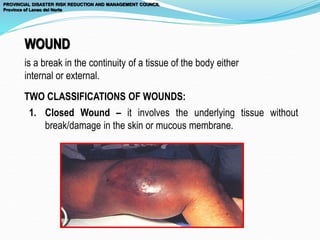
TWO CLASSIFICATIONS OF WOUNDS:
is a break in the continuity of a tissue of the body either
internal or external.
1. Closed Wound – it involves the underlying tissue without
break/damage in the skin or mucous membrane.
WOUND
PROVINCIAL DISASTER RISK REDUCTION AND MANAGEMENT COUNCIL
Province of Lanao del Norte
Causes:
Blunt object result in contusion or bruises. Application of external forces
such as motor vehicle accidents and falls.
Signs and Symptoms:
Pain and Tenderness
Swelling
Discoloration
Hematoma
Uncontrolled restlessness
Blood in the urine and feces
Sign of blood along the mouth, nose ear canal
Thirst
Vomiting or cough up blood
FIRST AID MANAGEMENT:
I - Ice application
C - Compression
E - Elevation
S - Splinting
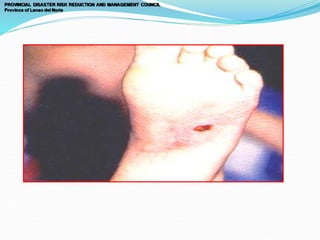
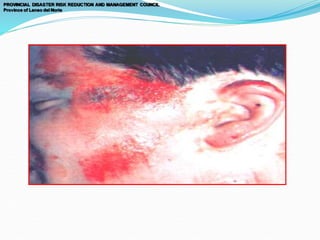
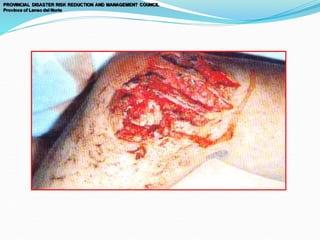
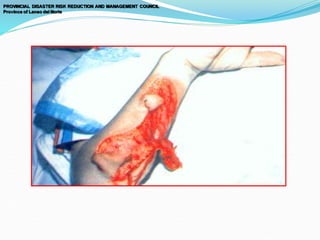
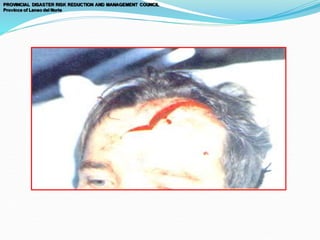
2. Open Wound – it is a break in the skin or mucus membrane; or
the protective skin layer is damage.
Classification of OPEN WOUND
P - Puncture
A - Abrasion
L - Laceration
A - Avulsion
I - Incision
PROVINCIAL DISASTER RISK REDUCTION AND MANAGEMENT COUNCIL
Province of Lanao del Norte
FIRST AID MANAGEMENT(wound with severe bleeding)
 Control Bleeding
 Cover the wound with dressing and secure with bandage
 Care for shock
 Consult or refer to physician
First Aid Management(wound with bleeding not severe)
 Clean the wound with soap and water
 Apply mild antiseptics
 Cover the wound with dressing and bandage
Dangers:
 Haemorrhage
 Infection
 Shock
Kinds of Bleeding:
 Arterial Bleeding
 Venous Bleeding
 Capillary Bleeding
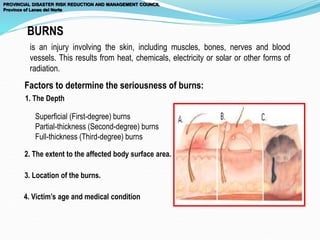
Factors to determine the seriousness of burns:
1. The Depth
Superficial (First-degree) burns
Partial-thickness (Second-degree) burns
Full-thickness (Third-degree) burns
is an injury involving the skin, including muscles, bones, nerves and blood
vessels. This results from heat, chemicals, electricity or solar or other forms of
radiation.
2. The extent to the affected body surface area.
3. Location of the burns.
4. Victim’s age and medical condition
BURNS
PROVINCIAL DISASTER RISK REDUCTION AND MANAGEMENT COUNCIL
Province of Lanao del Norte
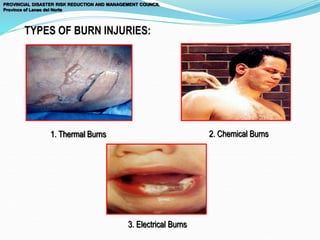
TYPES OF BURN INJURIES:
1. Thermal Burns 2. Chemical Burns
3. Electrical Burns
PROVINCIAL DISASTER RISK REDUCTION AND MANAGEMENT COUNCIL
Province of Lanao del Norte
Common Causes:
1. Carelessness with match and cigarette smoking.
2. Scald from hot liquid.
3. Defective heating, cooking and electrical equipment
4. Immersion in overheated bath water.
5. Use of such chemicals as lye, strong acids and detergents
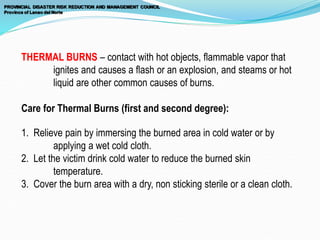
THERMAL BURNS – contact with hot objects, flammable vapor that
ignites and causes a flash or an explosion, and steams or hot
liquid are other common causes of burns.
Care for Thermal Burns (first and second degree):
1. Relieve pain by immersing the burned area in cold water or by
applying a wet cold cloth.
2. Let the victim drink cold water to reduce the burned skin
temperature.
3. Cover the burn area with a dry, non sticking sterile or a clean cloth.
Care for Thermal Burn (third degree)
1. Cover the burn with a dry, non sticking, sterile dressing or a clean
cloth.
2. Treat the victim for shock by elevating the legs and keeping the
victim warm with a clean sheet or blanket.
CHEMICAL BURNS – chemicals will continue to cause tissue
destruction until the chemical agents is removed
Care for Chemical Burns:
1. Immediately remove the chemical by flushing with water.
2. Remove the victim’s contaminated clothing while flushing with
water.
3. Flush for 20 minutes or longer. Let the victim wash with mild
soap before a final rinse.
4. Cover the burn area with a dry dressing or for large areas, a
clean pillow.
5. If the chemical is in the eyes, flush it for at least 20 minutes,
using low pressure.
6. Seek medical attention immediately for all chemical burns.
ELECTRICAL BURNS – the injury severity from exposure to electrical
current depends on the type of current (direct or alternating), the voltage,
the area of the body exposed, and the duration of contact.
Care for Electrical Burns:
1. Unplug, disconnect, or turn off the power.
2. Check CABs, provide rescue breathing or CPR
3. If the victim fell, check for spine injury.
4. Treat the victim for shock.
5. Seek medical attention immediately.
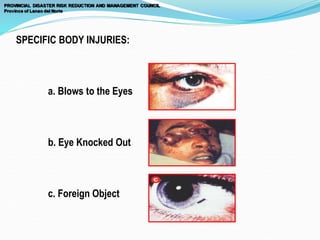
SPECIFIC BODY INJURIES:
a. Blows to the Eyes
b. Eye Knocked Out
c. Foreign Object
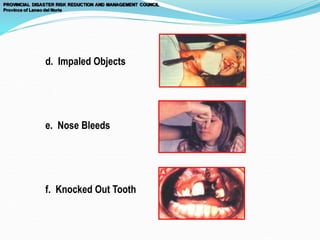
d. Impaled Objects
e. Nose Bleeds
f. Knocked Out Tooth
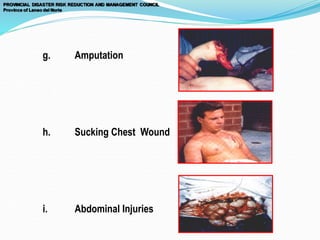
g. Amputation
h. Sucking Chest Wound
i. Abdominal Injuries
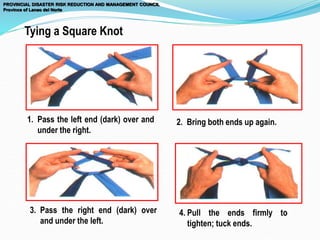
1. Pass the left end (dark) over and
under the right.
2. Bring both ends up again.
3. Pass the right end (dark) over
and under the left.
4. Pull the ends firmly to
tighten; tuck ends.
Tying a Square Knot
PROVINCIAL DISASTER RISK REDUCTION AND MANAGEMENT COUNCIL
Province of Lanao del Norte
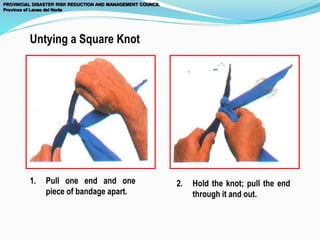
2. Hold the knot; pull the end
through it and out.
1. Pull one end and one
piece of bandage apart.
Untying a Square Knot
PROVINCIAL DISASTER RISK REDUCTION AND MANAGEMENT COUNCIL
Province of Lanao del Norte
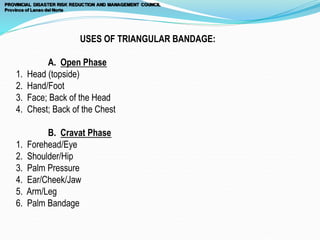
USES OF TRIANGULAR BANDAGE:
A. Open Phase
1. Head (topside)
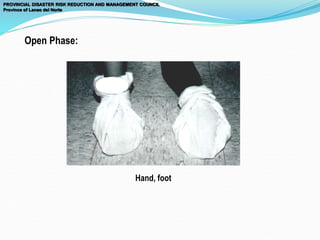
2. Hand/Foot
3. Face; Back of the Head
4. Chest; Back of the Chest
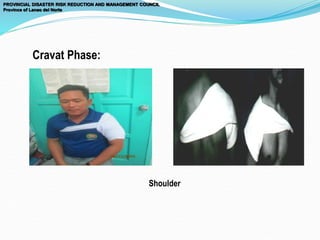
B. Cravat Phase
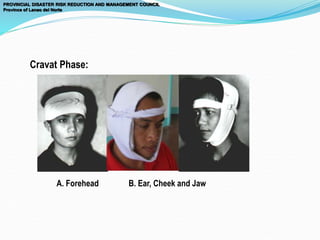
1. Forehead/Eye
2. Shoulder/Hip
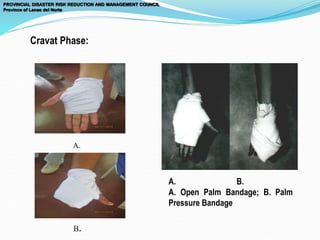
3. Palm Pressure
4. Ear/Cheek/Jaw
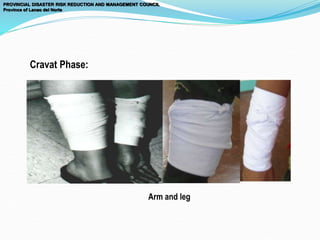
5. Arm/Leg
6. Palm Bandage
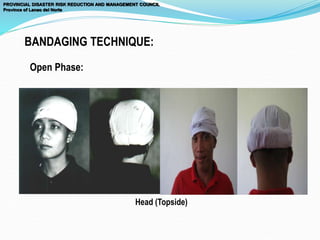
BANDAGING TECHNIQUE:
Open Phase:
PROVINCIAL DISASTER RISK REDUCTION AND MANAGEMENT COUNCIL
Province of Lanao del Norte
Head (Topside)
PROVINCIAL DISASTER RISK REDUCTION AND MANAGEMENT COUNCIL
Province of Lanao del Norte
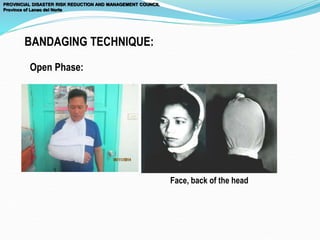
BANDAGING TECHNIQUE:
Open Phase:
Face, back of the head
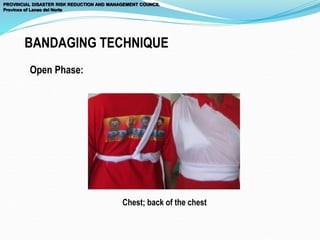
BANDAGING TECHNIQUE
Open Phase:
PROVINCIAL DISASTER RISK REDUCTION AND MANAGEMENT COUNCIL
Province of Lanao del Norte
Chest; back of the chest
PROVINCIAL DISASTER RISK REDUCTION AND MANAGEMENT COUNCIL
Province of Lanao del Norte
Open Phase:
Hand, foot
Cravat Phase:
PROVINCIAL DISASTER RISK REDUCTION AND MANAGEMENT COUNCIL
Province of Lanao del Norte
A. Forehead B. Ear, Cheek and Jaw
PROVINCIAL DISASTER RISK REDUCTION AND MANAGEMENT COUNCIL
Province of Lanao del Norte
Cravat Phase:
Shoulder
Cravat Phase:
Arm and leg
PROVINCIAL DISASTER RISK REDUCTION AND MANAGEMENT COUNCIL
Province of Lanao del Norte
PROVINCIAL DISASTER RISK REDUCTION AND MANAGEMENT COUNCIL
Province of Lanao del Norte
Cravat Phase:
A. B.
A. Open Palm Bandage; B. Palm
Pressure Bandage
A.
B.
End of Module 4
Thank you…

Module 6 Soft Tissue Injuries first aid training

  • 2.
    TWO CLASSIFICATIONS OFWOUNDS: is a break in the continuity of a tissue of the body either internal or external. 1. Closed Wound – it involves the underlying tissue without break/damage in the skin or mucous membrane. WOUND PROVINCIAL DISASTER RISK REDUCTION AND MANAGEMENT COUNCIL Province of Lanao del Norte
  • 3.
    Causes: Blunt object resultin contusion or bruises. Application of external forces such as motor vehicle accidents and falls. Signs and Symptoms: Pain and Tenderness Swelling Discoloration Hematoma Uncontrolled restlessness Blood in the urine and feces Sign of blood along the mouth, nose ear canal Thirst Vomiting or cough up blood
  • 4.
    FIRST AID MANAGEMENT: I- Ice application C - Compression E - Elevation S - Splinting
  • 5.
    2. Open Wound– it is a break in the skin or mucus membrane; or the protective skin layer is damage. Classification of OPEN WOUND P - Puncture A - Abrasion L - Laceration A - Avulsion I - Incision PROVINCIAL DISASTER RISK REDUCTION AND MANAGEMENT COUNCIL Province of Lanao del Norte
  • 11.
    FIRST AID MANAGEMENT(woundwith severe bleeding)  Control Bleeding  Cover the wound with dressing and secure with bandage  Care for shock  Consult or refer to physician
  • 12.
    First Aid Management(woundwith bleeding not severe)  Clean the wound with soap and water  Apply mild antiseptics  Cover the wound with dressing and bandage
  • 13.
    Dangers:  Haemorrhage  Infection Shock Kinds of Bleeding:  Arterial Bleeding  Venous Bleeding  Capillary Bleeding
  • 14.
    Factors to determinethe seriousness of burns: 1. The Depth Superficial (First-degree) burns Partial-thickness (Second-degree) burns Full-thickness (Third-degree) burns is an injury involving the skin, including muscles, bones, nerves and blood vessels. This results from heat, chemicals, electricity or solar or other forms of radiation. 2. The extent to the affected body surface area. 3. Location of the burns. 4. Victim’s age and medical condition BURNS PROVINCIAL DISASTER RISK REDUCTION AND MANAGEMENT COUNCIL Province of Lanao del Norte
  • 15.
    TYPES OF BURNINJURIES: 1. Thermal Burns 2. Chemical Burns 3. Electrical Burns PROVINCIAL DISASTER RISK REDUCTION AND MANAGEMENT COUNCIL Province of Lanao del Norte
  • 16.
    Common Causes: 1. Carelessnesswith match and cigarette smoking. 2. Scald from hot liquid. 3. Defective heating, cooking and electrical equipment 4. Immersion in overheated bath water. 5. Use of such chemicals as lye, strong acids and detergents
  • 17.
    THERMAL BURNS –contact with hot objects, flammable vapor that ignites and causes a flash or an explosion, and steams or hot liquid are other common causes of burns. Care for Thermal Burns (first and second degree): 1. Relieve pain by immersing the burned area in cold water or by applying a wet cold cloth. 2. Let the victim drink cold water to reduce the burned skin temperature. 3. Cover the burn area with a dry, non sticking sterile or a clean cloth.
  • 18.
    Care for ThermalBurn (third degree) 1. Cover the burn with a dry, non sticking, sterile dressing or a clean cloth. 2. Treat the victim for shock by elevating the legs and keeping the victim warm with a clean sheet or blanket. CHEMICAL BURNS – chemicals will continue to cause tissue destruction until the chemical agents is removed Care for Chemical Burns: 1. Immediately remove the chemical by flushing with water. 2. Remove the victim’s contaminated clothing while flushing with water.
  • 19.
    3. Flush for20 minutes or longer. Let the victim wash with mild soap before a final rinse. 4. Cover the burn area with a dry dressing or for large areas, a clean pillow. 5. If the chemical is in the eyes, flush it for at least 20 minutes, using low pressure. 6. Seek medical attention immediately for all chemical burns.
  • 20.
    ELECTRICAL BURNS –the injury severity from exposure to electrical current depends on the type of current (direct or alternating), the voltage, the area of the body exposed, and the duration of contact. Care for Electrical Burns: 1. Unplug, disconnect, or turn off the power. 2. Check CABs, provide rescue breathing or CPR 3. If the victim fell, check for spine injury. 4. Treat the victim for shock. 5. Seek medical attention immediately.
  • 21.
    SPECIFIC BODY INJURIES: a.Blows to the Eyes b. Eye Knocked Out c. Foreign Object
  • 22.
    d. Impaled Objects e.Nose Bleeds f. Knocked Out Tooth
  • 23.
    g. Amputation h. SuckingChest Wound i. Abdominal Injuries
  • 24.
    1. Pass theleft end (dark) over and under the right. 2. Bring both ends up again. 3. Pass the right end (dark) over and under the left. 4. Pull the ends firmly to tighten; tuck ends. Tying a Square Knot PROVINCIAL DISASTER RISK REDUCTION AND MANAGEMENT COUNCIL Province of Lanao del Norte
  • 25.
    2. Hold theknot; pull the end through it and out. 1. Pull one end and one piece of bandage apart. Untying a Square Knot PROVINCIAL DISASTER RISK REDUCTION AND MANAGEMENT COUNCIL Province of Lanao del Norte
  • 26.
    USES OF TRIANGULARBANDAGE: A. Open Phase 1. Head (topside) 2. Hand/Foot 3. Face; Back of the Head 4. Chest; Back of the Chest B. Cravat Phase 1. Forehead/Eye 2. Shoulder/Hip 3. Palm Pressure 4. Ear/Cheek/Jaw 5. Arm/Leg 6. Palm Bandage
  • 27.
    BANDAGING TECHNIQUE: Open Phase: PROVINCIALDISASTER RISK REDUCTION AND MANAGEMENT COUNCIL Province of Lanao del Norte Head (Topside)
  • 28.
    PROVINCIAL DISASTER RISKREDUCTION AND MANAGEMENT COUNCIL Province of Lanao del Norte BANDAGING TECHNIQUE: Open Phase: Face, back of the head
  • 29.
    BANDAGING TECHNIQUE Open Phase: PROVINCIALDISASTER RISK REDUCTION AND MANAGEMENT COUNCIL Province of Lanao del Norte Chest; back of the chest
  • 30.
    PROVINCIAL DISASTER RISKREDUCTION AND MANAGEMENT COUNCIL Province of Lanao del Norte Open Phase: Hand, foot
  • 31.
    Cravat Phase: PROVINCIAL DISASTERRISK REDUCTION AND MANAGEMENT COUNCIL Province of Lanao del Norte A. Forehead B. Ear, Cheek and Jaw
  • 32.
    PROVINCIAL DISASTER RISKREDUCTION AND MANAGEMENT COUNCIL Province of Lanao del Norte Cravat Phase: Shoulder
  • 33.
    Cravat Phase: Arm andleg PROVINCIAL DISASTER RISK REDUCTION AND MANAGEMENT COUNCIL Province of Lanao del Norte
  • 34.
    PROVINCIAL DISASTER RISKREDUCTION AND MANAGEMENT COUNCIL Province of Lanao del Norte Cravat Phase: A. B. A. Open Palm Bandage; B. Palm Pressure Bandage A. B.
  • 35.
    End of Module4 Thank you…