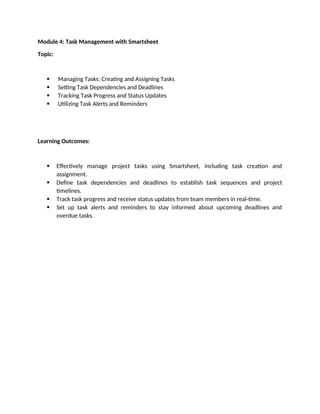
Module 4: Task Management with Smartsheet
Topic:
 Managing Tasks: Creating and Assigning Tasks
 Setting Task Dependencies and Deadlines
 Tracking Task Progress and Status Updates
 Utilizing Task Alerts and Reminders
Learning Outcomes:
 Effectively manage project tasks using Smartsheet, including task creation and
assignment.
 Define task dependencies and deadlines to establish task sequences and project
timelines.
 Track task progress and receive status updates from team members in real-time.
 Set up task alerts and reminders to stay informed about upcoming deadlines and
overdue tasks.
Module 4
Task Management with Smartsheet
Best Practices for Task Creation in Smartsheet
Managing Tasks: Creating and Assigning Tasks
Smartsheet is a powerful tool for task management, offering flexibility and control over various
project elements. To maximise its potential, adhering to best practices for task creation and
assignment is essential. These practices not only enhance productivity but also ensure that
tasks are managed efficiently and effectively. Below we discuss in detail about this topic:
1. Define Clear Task Objectives
When creating a task in Smartsheet, it is crucial to define its objective clearly. Every task should
have a specific purpose that aligns with the overall project goals. This involves setting out the
deliverables, expected outcomes, and any relevant criteria for completion. A clear objective
helps team members understand what is expected, reducing ambiguity and the risk of
miscommunication.
2. Use Descriptive Task Names
Task names should be concise yet descriptive enough to convey the essence of the task. This
clarity aids in quick identification and reference, especially when managing large projects with
multiple tasks. For example, instead of naming a task “Report,” consider “Draft Q2 Financial
Report.” This practice minimises confusion and ensures that team members are immediately
aware of the task's nature.
3. Set Realistic Deadlines
Deadlines are vital for keeping projects on track. When setting deadlines in Smartsheet, it’s
important to ensure they are realistic and achievable. This involves considering the task's
complexity, available resources, and team workload. Unrealistic deadlines can lead to rushed
work, poor quality, and stress among team members. By setting attainable deadlines, you foster
a more productive and less pressured work environment.
4. Prioritise Tasks Appropriately
Not all tasks hold the same level of importance or urgency. Smartsheet allows for prioritisation,
which helps in managing workload effectively. By assigning priority levels (e.g., High, Medium,
Low), you can ensure that critical tasks are completed first, preventing bottlenecks and ensuring
that essential project milestones are met.
5. Assign Tasks to the Right Team Members
Task assignment is more than just delegation; it involves strategically matching tasks with team
members’ skills, experience, and availability. In Smartsheet, tasks can be assigned to specific
individuals, ensuring accountability and clarity. By assigning tasks to those best suited to handle
them, you optimise the team’s strengths and improve task completion rates.
6. Include Detailed Instructions and Resources
Providing detailed instructions and attaching relevant resources to tasks within Smartsheet can
significantly improve the accuracy and efficiency of task completion. This may include links to
documents, detailed checklists, or notes on specific requirements. The more information a
team member has, the better equipped they are to complete the task correctly.
7. Regularly Update Task Status
Smartsheet provides a platform for tracking task progress. It is good practice to regularly
update the status of tasks to reflect their current state (e.g., Not Started, In Progress,
Completed). This ensures that all team members and stakeholders are kept informed of the
project’s progress, allowing for better planning and adjustment where necessary.
8. Utilise Automation Where Possible
Automation in Smartsheet can streamline task management by reducing manual work. For
example, setting up automated reminders or alerts for approaching deadlines ensures that
nothing falls through the cracks. Automating routine processes allows team members to focus
on more complex tasks, improving overall efficiency.
By implementing these best practices in task creation and assignment within Smartsheet, you
can enhance project management efficiency, ensuring tasks are completed on time, within
scope, and to the desired quality standard.
Assigning Tasks to Team Members Effectively
Effective task assignment is crucial for the success of any project. In Smartsheet, the process of
assigning tasks goes beyond simply designating a name to a task. It involves strategic
considerations that can significantly impact the project’s outcome. Below are key principles and
practices for assigning tasks effectively:
1. Understand Team Members’ Strengths and Skills
Before assigning tasks, it’s essential to have a comprehensive understanding of each team
member’s strengths, skills, and areas of expertise. Smartsheet allows you to create detailed
profiles or notes that outline team members' capabilities. By matching tasks with the right skills,
you enhance the likelihood of successful task completion and overall project efficiency. For
example, assigning a complex analytical task to a team member with strong analytical skills
ensures the task is completed with a higher degree of accuracy.
2. Assess Workload and Availability
Another crucial factor in task assignment is the current workload and availability of team
members. Overloading a team member with too many tasks can lead to burnout, reduced
productivity, and missed deadlines. Smartsheet provides visibility into team members'
assignments and workload, allowing you to distribute tasks evenly and avoid overburdening
anyone. This practice not only helps in managing the team’s capacity but also ensures that all
tasks receive the necessary attention for timely completion.
3. Align Tasks with Development Goals
Assigning tasks can also be an opportunity for professional development. By aligning tasks with
individual development goals, you can help team members acquire new skills or enhance
existing ones. For instance, if a team member is aiming to improve their project management
skills, you might assign them a task that involves coordinating a small project or leading a
meeting. Smartsheet’s ability to track progress and provide feedback can support this
development, making it a valuable tool for both task management and employee growth.
4. Ensure Clear Communication
Effective task assignment requires clear and unambiguous communication. When assigning a
task in Smartsheet, it is important to include detailed instructions, deadlines, and any relevant
resources or information. Clearly defined expectations reduce the likelihood of
misunderstandings and ensure that team members know exactly what is required of them.
Smartsheet’s comments and notes features can be utilised to clarify any doubts or provide
additional context, fostering a transparent and supportive work environment.
5. Use Smartsheet’s Assignment Features Wisely
Smartsheet offers various features that make task assignment more efficient and organised. For
example, the use of automated reminders and notifications can ensure that team members are
aware of upcoming deadlines or changes to their tasks. Additionally, Smartsheet’s ability to
assign tasks to multiple team members is useful for collaborative efforts, enabling seamless
cooperation and communication within the team. However, it’s essential to use these features
judiciously to avoid overwhelming team members with unnecessary alerts.
6. Monitor and Adjust Assignments as Needed
Task assignment is not a one-time activity; it requires ongoing monitoring and adjustment. As
the project progresses, you may find that some tasks need to be reassigned due to changes in
priorities, unforeseen challenges, or team members' evolving availability. Smartsheet’s
dashboard and reporting features allow for real-time monitoring of task progress, enabling you
to make informed decisions and adjustments to assignments as necessary. This proactive
approach helps in maintaining project momentum and addressing any issues before they
escalate.
By following these practices, task assignment in Smartsheet can be more strategic, equitable,
and aligned with both project goals and individual team members' strengths. This approach not
only improves task completion rates but also contributes to a more motivated and capable
team.
Setting Task Dependencies and Deadlines
How to Link Tasks Using Dependencies
In project management, tasks are often interrelated, meaning the completion of one task may
depend on the start or finish of another. Smartsheet allows you to manage these
interdependencies effectively through its task dependency features. Understanding how to link
tasks using dependencies is essential for ensuring a smooth workflow and meeting project
deadlines. Below we discuss in detail about this topic:
1. Understanding Task Dependencies
Task dependencies define the relationship between tasks, indicating how one task relies on
another. There are four primary types of dependencies in Smartsheet:
 Finish-to-Start (FS): The most common type, where Task B cannot start until Task A is
completed.
 Start-to-Start (SS): Task B cannot start until Task A starts.
 Finish-to-Finish (FF): Task B cannot finish until Task A finishes.
 Start-to-Finish (SF): The rarest type, where Task B cannot finish until Task A starts.
These dependency types help in organising tasks logically, ensuring that they are completed in
the correct sequence.
2. Setting Up Dependencies in Smartsheet
To link tasks using dependencies in Smartsheet, you need to follow a systematic approach:
 Enable Dependencies: Before linking tasks, ensure that dependency settings are
enabled in your Smartsheet project. This can be done by going to the Project Settings
and turning on the 'Dependencies Enabled' option.
 Identify Predecessor Tasks: In the sheet, each task that another task depends on is
known as a predecessor. The Predecessor column is where you will specify the task(s)
that must be completed before the dependent task can begin or end.
 Linking Tasks: In the Predecessor column, enter the row number of the predecessor task
for the task you wish to link. For example, if Task B (in row 5) cannot start until Task A
(in row 4) is finished, you would enter “4” in the Predecessor column of row 5.
 Defining Dependency Type: By default, Smartsheet uses Finish-to-Start (FS)
dependencies. However, you can modify the dependency type by adding a suffix to the
predecessor number. For instance, “4SS” would indicate a Start-to-Start dependency.
3. Incorporating Lag and Lead Time
In addition to basic dependencies, Smartsheet allows you to add lag or lead time between
tasks:
 Lag Time: A delay between the predecessor task’s completion and the start of the
dependent task. For example, if you want Task B to start two days after Task A finishes,
you would enter “4FS+2d” in the Predecessor column.
 Lead Time: A negative lag, where the dependent task can start before the predecessor
task finishes. For example, entering “4FS-2d” would start Task B two days before Task A
is expected to finish.
4. Adjusting Schedules Automatically
Once dependencies are set, Smartsheet automatically adjusts the schedule when changes are
made to a predecessor task. For instance, if Task A is delayed, Smartsheet will automatically
push back Task B’s start date to maintain the dependency. This feature ensures that your
project timeline remains accurate and reflects any changes instantly, allowing for proactive
management of deadlines.
5. Visualising Dependencies with Gantt Charts
Smartsheet’s Gantt chart view is an excellent way to visualise task dependencies. When tasks
are linked, the Gantt chart displays arrows between tasks, showing the flow and relationship
between them. This visual representation helps in quickly identifying potential bottlenecks and
understanding the project’s critical path.
By effectively linking tasks using dependencies in Smartsheet, you can create a more organised,
responsive, and manageable project schedule. Dependencies ensure that tasks are completed
in the correct order and help in forecasting potential delays, ultimately contributing to the
timely and successful completion of your projects.
Managing and Adjusting Deadlines in Smartsheet
Deadlines are a crucial element in project management, guiding the timing of tasks and
ensuring that the project progresses on schedule. Smartsheet provides robust tools for
managing and adjusting deadlines, enabling project managers to respond to changes and keep
the project on track. Understanding how to effectively manage and adjust deadlines within
Smartsheet is key to maintaining control over your project timeline. Below we discuss in detail
about this topic:
1. Setting Initial Deadlines
The first step in managing deadlines in Smartsheet is setting them accurately at the beginning
of the project. When creating tasks, you can specify start and end dates directly within the
relevant columns. It’s important to ensure these dates are realistic, considering the task’s
complexity, available resources, and potential dependencies. Establishing a well-planned
timeline from the outset helps in preventing unnecessary adjustments later.
2. Utilising Dependencies to Auto-Adjust Deadlines
One of the most powerful features in Smartsheet is its ability to automatically adjust deadlines
when task dependencies are in place. When you link tasks using dependencies (e.g., Finish-to-
Start), Smartsheet recalculates the deadlines of dependent tasks if the predecessor task’s
timeline changes. This dynamic adjustment ensures that your project timeline remains
consistent and that dependent tasks are not scheduled to start before their prerequisites are
completed.
3. Monitoring Progress and Identifying Risks
Regular monitoring of task progress is essential for managing deadlines effectively.
Smartsheet’s real-time dashboards and reporting tools allow you to track the status of tasks,
identify potential delays, and assess their impact on overall project deadlines. By keeping a
close eye on task progress, you can quickly identify risks and make necessary adjustments to
the timeline before they become critical issues.
4. Adjusting Deadlines Manually
There are situations where deadlines need to be adjusted manually, such as when there are
changes in project scope, resource availability, or external factors. In Smartsheet, you can
adjust deadlines directly in the sheet by changing the start or end date of a task. It’s important
to communicate any changes clearly to all stakeholders to ensure that everyone is aware of the
updated timeline. Additionally, consider the ripple effect on dependent tasks and whether
those deadlines need to be adjusted as well.
5. Using Baselines to Track Changes
Smartsheet allows you to set a baseline for your project schedule, which acts as a reference
point for tracking changes in deadlines. By comparing the current schedule against the baseline,
you can easily see how the timeline has shifted over time and assess the impact of deadline
adjustments. This feature is particularly useful for identifying trends in project delays and
making data-driven decisions to keep the project on track.
6. Leveraging Conditional Formatting for Deadline Management
Conditional formatting in Smartsheet can be used to highlight approaching deadlines or
overdue tasks. By setting up rules that colour-code tasks based on their proximity to deadlines,
you can quickly identify which tasks require immediate attention. This visual aid is especially
helpful for large projects with numerous tasks, ensuring that nothing slips through the cracks.
7. Communicating Deadline Changes
Effective communication is critical when adjusting deadlines. Smartsheet offers collaboration
features such as automated alerts, notifications, and comments, which can be used to inform
team members and stakeholders of any changes. By ensuring that everyone is kept in the loop,
you reduce the risk of confusion and ensure that the project continues to move forward
smoothly.
8. Using Smartsheet’s Gantt Chart for Visual Deadline Management
Smartsheet’s Gantt chart view provides a visual representation of task deadlines and their
relationships. When deadlines are adjusted, the Gantt chart automatically updates, allowing
you to see the impact on the project timeline instantly. This visual tool is invaluable for
understanding how changes to one task’s deadline affect the overall project and for planning
future adjustments.
By mastering the management and adjustment of deadlines in Smartsheet, you can maintain a
flexible yet controlled approach to project scheduling. This ensures that your project remains
on track, even in the face of unexpected changes, and that all tasks are completed within the
required timeframe.
Tracking Task Progress and Status Updates
Methods for Monitoring Task Progress in Real-Time
Monitoring task progress in real-time is crucial for ensuring that projects stay on schedule and
any potential issues are identified and addressed promptly. Smartsheet offers several powerful
features that allow project managers and teams to track the status of tasks as they happen,
providing the insights needed to keep the project on course. This section provides a detailed
look at the methods for monitoring task progress in real-time using Smartsheet.
1. Real-Time Dashboards
Smartsheet’s dashboards are one of the most effective tools for real-time task monitoring.
Dashboards can be customised to display key metrics, charts, and reports that give an instant
overview of task progress. You can set up widgets that track the percentage of tasks completed,
pending tasks, and those that are at risk of missing deadlines. Dashboards update automatically
as data in the underlying sheets is modified, providing an up-to-date view of project status at all
times. This visual approach helps project managers quickly assess the health of the project and
make informed decisions.
2. Status Columns
Using status columns within Smartsheet sheets allows for easy tracking of task progress. Each
task can be assigned a status, such as “Not Started,” “In Progress,” “Completed,” or “Blocked.”
These status updates can be manually updated by team members or automated based on
specific criteria. The status column provides a clear, at-a-glance understanding of where each
task stands, making it easier to identify tasks that may require additional attention or resources.
3. Automated Alerts and Notifications
Smartsheet’s automation capabilities enable the creation of alerts and notifications based on
changes in task status. For instance, you can set up automated alerts that notify you when a
task is marked as “Completed” or if it remains “In Progress” past its deadline. These alerts can
be sent via email or within the Smartsheet platform, ensuring that project managers and team
members are always aware of critical updates. Automation reduces the need for manual follow-
up, allowing for more efficient monitoring of task progress.
4. Gantt Chart View
The Gantt chart view in Smartsheet is another powerful tool for real-time task monitoring.
Gantt charts provide a visual timeline of tasks, showing how they are progressing relative to
their deadlines. As tasks are updated, the Gantt chart adjusts in real-time, providing an
immediate visual indication of whether the project is on track. Gantt charts are particularly
useful for identifying potential bottlenecks and understanding the impact of delays on the
overall project timeline.
5. Reports
Smartsheet’s reporting features allow you to create custom reports that compile data from
multiple sheets into a single, consolidated view. Reports can be set to update in real-time,
pulling the latest task status and progress information. This is particularly useful for project
managers overseeing multiple projects or large teams, as it provides a centralised overview of
progress across all tasks. Reports can also be shared with stakeholders, ensuring transparency
and keeping everyone aligned with the project’s progress.
6. Cell Linking and Cross-Sheet References
For projects that span multiple sheets, Smartsheet’s cell linking and cross-sheet referencing
features enable real-time monitoring across different parts of the project. By linking cells, you
can create a master sheet that pulls in task progress from various sheets, providing a holistic
view of the project. Cross-sheet references allow for data to be aggregated and displayed in
real-time, ensuring that all relevant task progress is monitored, even if it’s spread across
multiple sheets.
7. Conditional Formatting
Conditional formatting in Smartsheet allows you to highlight tasks based on specific criteria,
such as approaching deadlines or incomplete tasks that are past due. By applying rules that
automatically change the colour of cells based on their status, conditional formatting makes it
easier to spot issues quickly. This visual cue is especially helpful in large projects where manual
tracking of every task may not be feasible.
By leveraging these real-time monitoring methods in Smartsheet, project managers can
maintain a clear and accurate understanding of task progress, allowing for timely interventions
and ensuring that projects remain on track. These tools not only enhance visibility but also
enable proactive management, reducing the risk of delays and improving overall project
outcomes.
Updating Task Status and Communicating Changes
In project management, keeping task statuses up-to-date and effectively communicating
changes are critical for ensuring that all team members and stakeholders remain aligned with
the project's progress. Smartsheet offers various tools and features that facilitate the process of
updating task statuses and communicating these changes in real-time. Below is a detailed
exploration of the best practices and methods for managing this aspect of task management in
Smartsheet:
1. Updating Task Status in Real-Time
Updating task status in real-time is essential for maintaining an accurate and current view of
project progress. In Smartsheet, each task can be assigned a status using a designated status
column. Common statuses include “Not Started,” “In Progress,” “Completed,” and “Blocked,”
but these can be customised to fit the specific needs of your project.
 Manual Updates: Team members can manually update the status of their assigned tasks
directly within the sheet. This practice is particularly useful for tasks that require regular
check-ins or milestones, as it allows the team to track incremental progress.
 Automated Status Updates: Smartsheet also allows for automation, where task statuses
can be updated based on certain triggers or conditions. For example, you can automate
the change of a task’s status to “Completed” once all subtasks are marked as finished.
Automation reduces the administrative burden on team members and ensures that
statuses are consistently updated.
2. Communicating Changes through Alerts and Notifications
Once a task’s status is updated, it’s crucial to communicate these changes to relevant
stakeholders promptly. Smartsheet’s alert and notification features are designed to ensure that
everyone is kept informed:
 Automated Alerts: You can set up automated alerts that notify specific team members
or stakeholders whenever a task’s status is updated. For example, if a critical task is
marked as “Blocked,” the project manager and relevant team members can be
immediately notified, allowing for quick action to resolve the issue.
 Notification Settings: Alerts can be customised to be sent via email, Smartsheet
notifications, or mobile push notifications, depending on the preferences of the team.
These alerts can include detailed information about the change, such as the task name,
the previous status, the new status, and any relevant comments or notes.
3. Using Comments for Contextual Communication
When updating a task’s status, it’s often necessary to provide additional context or
explanations. Smartsheet’s comments feature allows team members to add notes or
explanations directly within the task row. This is particularly useful for clarifying why a task was
delayed, why a status was changed, or what steps are being taken to address any issues.
 Threaded Conversations: Comments in Smartsheet are organised in a threaded format,
allowing for ongoing discussions and clarifications related to the task. This feature helps
in maintaining a clear record of communications and decisions related to task updates.
4. Integrating with External Communication Tools
Smartsheet can be integrated with various external communication tools, such as Slack,
Microsoft Teams, or email systems, to streamline the communication of task updates. For
instance, an update in Smartsheet can automatically trigger a message in a Slack channel,
informing the team of the change without requiring them to check Smartsheet directly. This
integration ensures that communication flows seamlessly across platforms and that all team
members are kept in the loop.
5. Visualising Status Changes with Conditional Formatting
Conditional formatting can be used to visually highlight tasks based on their status. For
example, tasks marked as “Blocked” can be coloured red, while completed tasks might turn
green. This visual cue helps project managers and team members quickly identify the status of
tasks at a glance, making it easier to prioritise and address any issues that arise.
6. Tracking and Reporting on Status Updates
Smartsheet’s reporting features allow project managers to generate reports that summarise
task statuses across the project. These reports can be scheduled to run automatically and
shared with stakeholders on a regular basis, providing a comprehensive overview of the
project’s progress and any changes that have occurred. This level of transparency helps in
building trust and ensuring that everyone is aligned with the project’s goals.
By following these practices for updating task status and communicating changes in
Smartsheet, you can maintain clear and effective communication throughout the project
lifecycle. This not only keeps the team aligned but also ensures that potential issues are
addressed promptly, contributing to the overall success of the project.
Utilizing Task Alerts and Reminders
Setting Up Alerts for Critical Task Deadlines
In project management, staying ahead of critical deadlines is paramount to ensuring the timely
completion of tasks and the overall success of the project. Smartsheet provides robust tools for
setting up alerts and reminders that keep project teams informed of upcoming deadlines and
any potential risks. These alerts are highly customisable and can be tailored to fit the specific
needs of your project, ensuring that nothing slips through the cracks. Below we discuss in detail
about this topic:
1. Understanding the Importance of Alerts
Alerts in Smartsheet are designed to notify team members when certain conditions are met,
such as an approaching deadline or a change in task status. For critical tasks, these alerts serve
as a proactive measure to prevent delays and ensure that team members are aware of key
deadlines. By setting up alerts, you can reduce the likelihood of missed deadlines and keep the
project on track.
2. Creating Automated Alerts for Deadlines
Smartsheet allows you to create automated alerts that trigger when a task’s deadline is
approaching or has been reached. To set up an alert for a critical task deadline:
 Select the Task: Begin by identifying the task or tasks that are critical to your project’s
timeline. These are often tasks on the critical path, where any delay could impact the
overall project schedule.
 Set Up the Alert: Navigate to the Automation menu in Smartsheet and select “Create a
Workflow.” Choose the condition “When a date is reached” and select the deadline date
column for the task. You can specify when the alert should be triggered, such as one
week, two days, or even a few hours before the deadline.
 Customise the Alert: You can customise the alert message to include specific details
about the task, such as the task name, its deadline, and any additional instructions. This
ensures that the recipient has all the information they need to take appropriate action.
3. Assigning Alerts to Specific Team Members
Alerts can be assigned to specific team members or groups, ensuring that the right people are
notified when a critical deadline is approaching. This can be done by selecting the appropriate
recipients during the alert setup process. Smartsheet allows you to choose from individual
users, contact groups, or even dynamic contacts, where the alert is sent to whoever is assigned
to the task.
 Role-Based Alerts: For projects involving multiple roles, such as project managers, team
members, and external stakeholders, you can set up role-based alerts. This ensures that
each role receives relevant notifications tailored to their responsibilities.
4. Utilising Recurring Alerts for Ongoing Deadlines
For tasks with recurring deadlines, such as weekly reports or monthly reviews, Smartsheet
allows you to set up recurring alerts. These alerts can be configured to trigger at regular
intervals, keeping team members reminded of their obligations on a consistent basis. To set up
a recurring alert, use the “Recurring” option within the workflow setup, specifying the
frequency and duration of the alerts.
5. Integrating Alerts with External Communication Tools
Smartsheet can be integrated with external communication tools such as Slack, Microsoft
Teams, or email systems to extend the reach of alerts. For example, an approaching deadline in
Smartsheet can trigger a message in a designated Slack channel, ensuring that all relevant team
members are informed, even if they are not actively monitoring Smartsheet. This integration
helps maintain seamless communication across platforms.
6. Monitoring and Adjusting Alerts
Once alerts are set up, it’s important to monitor their effectiveness and make adjustments as
needed. Smartsheet allows you to track the history of triggered alerts, giving you insight into
how often they are being used and whether they are effectively preventing missed deadlines. If
necessary, you can adjust the timing, frequency, or recipients of the alerts to better suit the
project’s needs.
7. Ensuring Compliance and Accountability
Alerts also play a role in ensuring compliance with project schedules and accountability among
team members. By setting up alerts that notify both the task owner and the project manager of
an approaching deadline, you create a dual-layer of oversight. This not only helps in keeping
tasks on schedule but also ensures that any potential issues are escalated promptly.
By effectively setting up alerts for critical task deadlines in Smartsheet, you can enhance your
project management capabilities, ensuring that deadlines are met and that the project remains
on track. These alerts serve as an essential tool for proactive management, helping to mitigate
risks and maintain a clear line of communication throughout the project lifecycle.
Automating Reminders for Ongoing Tasks
In project management, keeping track of ongoing tasks can be challenging, especially when
these tasks recur regularly or require continuous attention. Automating reminders for these
tasks in Smartsheet ensures that they stay on the radar of team members and are completed
on time. By leveraging Smartsheet’s automation features, you can set up customised reminders
that help maintain momentum and prevent tasks from slipping through the cracks. Below we
discuss in detail about this topic:
1. Identifying Ongoing Tasks
Ongoing tasks are those that require repeated or continuous attention, such as weekly status
reports, monthly maintenance checks, or regular client updates. The first step in automating
reminders is to identify these tasks within your project. In Smartsheet, you can tag these tasks
with specific labels or place them in a dedicated sheet to streamline the automation process.
Clearly defining these tasks ensures that the reminders are set up accurately and targeted to
the right activities.
2. Creating Automated Reminders
Smartsheet’s automation capabilities allow you to create reminders that trigger based on
specific criteria. For ongoing tasks, you can set up recurring reminders that notify team
members at regular intervals.
 Setting Up the Workflow: Navigate to the Automation menu in Smartsheet and select
“Create a Workflow.” Choose the condition “When a date is reached” and select the
appropriate date column for the task. To automate reminders, set the trigger to occur at
your desired interval, such as daily, weekly, or monthly.
 Customising the Reminder: The reminder can be customised to include essential details
such as the task name, due date, and any specific instructions or links to resources. This
ensures that team members receive all the information needed to complete the task
without having to search for additional details.
3. Utilising Recurrence for Ongoing Tasks
For tasks that need to be completed regularly, you can set the reminder to recur automatically.
Smartsheet allows you to specify how often the reminder should recur and for how long.
 Setting Recurrence: In the automation setup, select the “Recurring” option and define
the frequency (e.g., every Monday at 9 AM). You can also specify an end date for the
recurrence or allow it to continue indefinitely. This feature is particularly useful for tasks
like regular team meetings, where reminders need to be sent on a consistent basis.
 Flexibility in Recurrence: Smartsheet offers flexibility in setting up recurrence, allowing
you to adjust the frequency or pause the reminders if the task’s schedule changes. This
adaptability is crucial for aligning the reminders with the evolving needs of the project.
4. Assigning Reminders to the Right Team Members
Ensuring that reminders reach the appropriate individuals is key to their effectiveness.
Smartsheet allows you to assign reminders to specific team members or groups.
 Role-Based Assignment: Reminders can be assigned based on roles within the project,
such as sending a reminder to the project manager for a task review or to a specific
team member responsible for a deliverable. By targeting the right people, you increase
the likelihood that the task will be completed on time.
 Dynamic Assignments: For tasks that rotate between team members, you can use
dynamic assignments in Smartsheet. This ensures that the reminder is sent to whoever
is currently assigned to the task, reducing the need for manual updates and ensuring
continuity.
5. Integrating with External Tools
Smartsheet’s ability to integrate with external communication tools like Slack, Microsoft Teams,
or email systems enhances the reach of automated reminders. For instance, a reminder set in
Smartsheet can automatically trigger a message in a Slack channel, ensuring that team
members are reminded of ongoing tasks, even if they are not actively monitoring Smartsheet.
 Cross-Platform Consistency: Integrations ensure that reminders are consistent across
different platforms, making it easier for team members to stay informed regardless of
where they are working.
6. Monitoring and Adjusting Reminders
It’s important to regularly monitor the effectiveness of your reminders and make adjustments
as necessary. Smartsheet provides insights into the history of triggered reminders, allowing you
to assess whether they are functioning as intended and making an impact on task completion
rates.
 Adjusting Timing and Frequency: Based on feedback and results, you may need to
adjust the timing or frequency of reminders to better align with team members'
workflows. For example, if a weekly reminder is too frequent, it might be adjusted to bi-
weekly or monthly.
7. Ensuring Compliance and Accountability
Automated reminders help enforce compliance with project timelines and foster accountability
among team members. By sending reminders at regular intervals, Smartsheet ensures that
tasks are consistently revisited and that team members remain focused on their
responsibilities. This systematic approach helps in maintaining the project’s momentum and
reducing the risk of delays.
By automating reminders for ongoing tasks in Smartsheet, you can enhance efficiency, reduce
the likelihood of missed deadlines, and ensure that tasks are completed consistently. This
automation not only streamlines project management but also helps in maintaining continuous
progress towards project goals.
Mastering task management with Smartsheet enables you to effectively organise and oversee
your projects. By creating and assigning tasks, you can clearly define responsibilities within your
team, ensuring everyone knows what they need to do. Setting task dependencies and deadlines
helps you manage the sequence of activities and keep your project on track, avoiding delays
and bottlenecks.
Tracking task progress and providing status updates allow you to monitor the work as it
progresses, ensuring that everyone stays informed and any issues can be addressed promptly.
Additionally, utilising task alerts and reminders ensures that no important deadlines are missed,
keeping everyone aligned with the project schedule.
Together, these tools and techniques within Smartsheet empower you to manage tasks
efficiently, leading to more successful project outcomes. By staying organised and proactive,
you can confidently handle the complexities of any project, ensuring that tasks are completed
on time and to the desired standard.

Module 4 Task Management with Smartsheet.docx new.docx

  • 1.
    Module 4: TaskManagement with Smartsheet Topic:  Managing Tasks: Creating and Assigning Tasks  Setting Task Dependencies and Deadlines  Tracking Task Progress and Status Updates  Utilizing Task Alerts and Reminders Learning Outcomes:  Effectively manage project tasks using Smartsheet, including task creation and assignment.  Define task dependencies and deadlines to establish task sequences and project timelines.  Track task progress and receive status updates from team members in real-time.  Set up task alerts and reminders to stay informed about upcoming deadlines and overdue tasks.
  • 2.
    Module 4 Task Managementwith Smartsheet Best Practices for Task Creation in Smartsheet Managing Tasks: Creating and Assigning Tasks Smartsheet is a powerful tool for task management, offering flexibility and control over various project elements. To maximise its potential, adhering to best practices for task creation and assignment is essential. These practices not only enhance productivity but also ensure that tasks are managed efficiently and effectively. Below we discuss in detail about this topic: 1. Define Clear Task Objectives When creating a task in Smartsheet, it is crucial to define its objective clearly. Every task should have a specific purpose that aligns with the overall project goals. This involves setting out the deliverables, expected outcomes, and any relevant criteria for completion. A clear objective helps team members understand what is expected, reducing ambiguity and the risk of miscommunication. 2. Use Descriptive Task Names Task names should be concise yet descriptive enough to convey the essence of the task. This clarity aids in quick identification and reference, especially when managing large projects with multiple tasks. For example, instead of naming a task “Report,” consider “Draft Q2 Financial Report.” This practice minimises confusion and ensures that team members are immediately aware of the task's nature. 3. Set Realistic Deadlines Deadlines are vital for keeping projects on track. When setting deadlines in Smartsheet, it’s important to ensure they are realistic and achievable. This involves considering the task's complexity, available resources, and team workload. Unrealistic deadlines can lead to rushed work, poor quality, and stress among team members. By setting attainable deadlines, you foster a more productive and less pressured work environment. 4. Prioritise Tasks Appropriately Not all tasks hold the same level of importance or urgency. Smartsheet allows for prioritisation, which helps in managing workload effectively. By assigning priority levels (e.g., High, Medium,
  • 3.
    Low), you canensure that critical tasks are completed first, preventing bottlenecks and ensuring that essential project milestones are met. 5. Assign Tasks to the Right Team Members Task assignment is more than just delegation; it involves strategically matching tasks with team members’ skills, experience, and availability. In Smartsheet, tasks can be assigned to specific individuals, ensuring accountability and clarity. By assigning tasks to those best suited to handle them, you optimise the team’s strengths and improve task completion rates. 6. Include Detailed Instructions and Resources Providing detailed instructions and attaching relevant resources to tasks within Smartsheet can significantly improve the accuracy and efficiency of task completion. This may include links to documents, detailed checklists, or notes on specific requirements. The more information a team member has, the better equipped they are to complete the task correctly. 7. Regularly Update Task Status Smartsheet provides a platform for tracking task progress. It is good practice to regularly update the status of tasks to reflect their current state (e.g., Not Started, In Progress, Completed). This ensures that all team members and stakeholders are kept informed of the project’s progress, allowing for better planning and adjustment where necessary. 8. Utilise Automation Where Possible Automation in Smartsheet can streamline task management by reducing manual work. For example, setting up automated reminders or alerts for approaching deadlines ensures that nothing falls through the cracks. Automating routine processes allows team members to focus on more complex tasks, improving overall efficiency. By implementing these best practices in task creation and assignment within Smartsheet, you can enhance project management efficiency, ensuring tasks are completed on time, within scope, and to the desired quality standard. Assigning Tasks to Team Members Effectively Effective task assignment is crucial for the success of any project. In Smartsheet, the process of assigning tasks goes beyond simply designating a name to a task. It involves strategic considerations that can significantly impact the project’s outcome. Below are key principles and practices for assigning tasks effectively:
  • 4.
    1. Understand TeamMembers’ Strengths and Skills Before assigning tasks, it’s essential to have a comprehensive understanding of each team member’s strengths, skills, and areas of expertise. Smartsheet allows you to create detailed profiles or notes that outline team members' capabilities. By matching tasks with the right skills, you enhance the likelihood of successful task completion and overall project efficiency. For example, assigning a complex analytical task to a team member with strong analytical skills ensures the task is completed with a higher degree of accuracy. 2. Assess Workload and Availability Another crucial factor in task assignment is the current workload and availability of team members. Overloading a team member with too many tasks can lead to burnout, reduced productivity, and missed deadlines. Smartsheet provides visibility into team members' assignments and workload, allowing you to distribute tasks evenly and avoid overburdening anyone. This practice not only helps in managing the team’s capacity but also ensures that all tasks receive the necessary attention for timely completion. 3. Align Tasks with Development Goals Assigning tasks can also be an opportunity for professional development. By aligning tasks with individual development goals, you can help team members acquire new skills or enhance existing ones. For instance, if a team member is aiming to improve their project management skills, you might assign them a task that involves coordinating a small project or leading a meeting. Smartsheet’s ability to track progress and provide feedback can support this development, making it a valuable tool for both task management and employee growth. 4. Ensure Clear Communication Effective task assignment requires clear and unambiguous communication. When assigning a task in Smartsheet, it is important to include detailed instructions, deadlines, and any relevant resources or information. Clearly defined expectations reduce the likelihood of misunderstandings and ensure that team members know exactly what is required of them. Smartsheet’s comments and notes features can be utilised to clarify any doubts or provide additional context, fostering a transparent and supportive work environment. 5. Use Smartsheet’s Assignment Features Wisely Smartsheet offers various features that make task assignment more efficient and organised. For example, the use of automated reminders and notifications can ensure that team members are aware of upcoming deadlines or changes to their tasks. Additionally, Smartsheet’s ability to assign tasks to multiple team members is useful for collaborative efforts, enabling seamless cooperation and communication within the team. However, it’s essential to use these features judiciously to avoid overwhelming team members with unnecessary alerts.
  • 5.
    6. Monitor andAdjust Assignments as Needed Task assignment is not a one-time activity; it requires ongoing monitoring and adjustment. As the project progresses, you may find that some tasks need to be reassigned due to changes in priorities, unforeseen challenges, or team members' evolving availability. Smartsheet’s dashboard and reporting features allow for real-time monitoring of task progress, enabling you to make informed decisions and adjustments to assignments as necessary. This proactive approach helps in maintaining project momentum and addressing any issues before they escalate. By following these practices, task assignment in Smartsheet can be more strategic, equitable, and aligned with both project goals and individual team members' strengths. This approach not only improves task completion rates but also contributes to a more motivated and capable team. Setting Task Dependencies and Deadlines How to Link Tasks Using Dependencies In project management, tasks are often interrelated, meaning the completion of one task may depend on the start or finish of another. Smartsheet allows you to manage these interdependencies effectively through its task dependency features. Understanding how to link tasks using dependencies is essential for ensuring a smooth workflow and meeting project deadlines. Below we discuss in detail about this topic: 1. Understanding Task Dependencies Task dependencies define the relationship between tasks, indicating how one task relies on another. There are four primary types of dependencies in Smartsheet:  Finish-to-Start (FS): The most common type, where Task B cannot start until Task A is completed.  Start-to-Start (SS): Task B cannot start until Task A starts.  Finish-to-Finish (FF): Task B cannot finish until Task A finishes.  Start-to-Finish (SF): The rarest type, where Task B cannot finish until Task A starts. These dependency types help in organising tasks logically, ensuring that they are completed in the correct sequence. 2. Setting Up Dependencies in Smartsheet To link tasks using dependencies in Smartsheet, you need to follow a systematic approach:
  • 6.
     Enable Dependencies:Before linking tasks, ensure that dependency settings are enabled in your Smartsheet project. This can be done by going to the Project Settings and turning on the 'Dependencies Enabled' option.  Identify Predecessor Tasks: In the sheet, each task that another task depends on is known as a predecessor. The Predecessor column is where you will specify the task(s) that must be completed before the dependent task can begin or end.  Linking Tasks: In the Predecessor column, enter the row number of the predecessor task for the task you wish to link. For example, if Task B (in row 5) cannot start until Task A (in row 4) is finished, you would enter “4” in the Predecessor column of row 5.  Defining Dependency Type: By default, Smartsheet uses Finish-to-Start (FS) dependencies. However, you can modify the dependency type by adding a suffix to the predecessor number. For instance, “4SS” would indicate a Start-to-Start dependency. 3. Incorporating Lag and Lead Time In addition to basic dependencies, Smartsheet allows you to add lag or lead time between tasks:  Lag Time: A delay between the predecessor task’s completion and the start of the dependent task. For example, if you want Task B to start two days after Task A finishes, you would enter “4FS+2d” in the Predecessor column.  Lead Time: A negative lag, where the dependent task can start before the predecessor task finishes. For example, entering “4FS-2d” would start Task B two days before Task A is expected to finish. 4. Adjusting Schedules Automatically Once dependencies are set, Smartsheet automatically adjusts the schedule when changes are made to a predecessor task. For instance, if Task A is delayed, Smartsheet will automatically push back Task B’s start date to maintain the dependency. This feature ensures that your project timeline remains accurate and reflects any changes instantly, allowing for proactive management of deadlines. 5. Visualising Dependencies with Gantt Charts Smartsheet’s Gantt chart view is an excellent way to visualise task dependencies. When tasks are linked, the Gantt chart displays arrows between tasks, showing the flow and relationship between them. This visual representation helps in quickly identifying potential bottlenecks and understanding the project’s critical path. By effectively linking tasks using dependencies in Smartsheet, you can create a more organised, responsive, and manageable project schedule. Dependencies ensure that tasks are completed in the correct order and help in forecasting potential delays, ultimately contributing to the timely and successful completion of your projects.
  • 7.
    Managing and AdjustingDeadlines in Smartsheet Deadlines are a crucial element in project management, guiding the timing of tasks and ensuring that the project progresses on schedule. Smartsheet provides robust tools for managing and adjusting deadlines, enabling project managers to respond to changes and keep the project on track. Understanding how to effectively manage and adjust deadlines within Smartsheet is key to maintaining control over your project timeline. Below we discuss in detail about this topic: 1. Setting Initial Deadlines The first step in managing deadlines in Smartsheet is setting them accurately at the beginning of the project. When creating tasks, you can specify start and end dates directly within the relevant columns. It’s important to ensure these dates are realistic, considering the task’s complexity, available resources, and potential dependencies. Establishing a well-planned timeline from the outset helps in preventing unnecessary adjustments later. 2. Utilising Dependencies to Auto-Adjust Deadlines One of the most powerful features in Smartsheet is its ability to automatically adjust deadlines when task dependencies are in place. When you link tasks using dependencies (e.g., Finish-to- Start), Smartsheet recalculates the deadlines of dependent tasks if the predecessor task’s timeline changes. This dynamic adjustment ensures that your project timeline remains consistent and that dependent tasks are not scheduled to start before their prerequisites are completed. 3. Monitoring Progress and Identifying Risks Regular monitoring of task progress is essential for managing deadlines effectively. Smartsheet’s real-time dashboards and reporting tools allow you to track the status of tasks, identify potential delays, and assess their impact on overall project deadlines. By keeping a close eye on task progress, you can quickly identify risks and make necessary adjustments to the timeline before they become critical issues. 4. Adjusting Deadlines Manually There are situations where deadlines need to be adjusted manually, such as when there are changes in project scope, resource availability, or external factors. In Smartsheet, you can adjust deadlines directly in the sheet by changing the start or end date of a task. It’s important to communicate any changes clearly to all stakeholders to ensure that everyone is aware of the updated timeline. Additionally, consider the ripple effect on dependent tasks and whether those deadlines need to be adjusted as well.
  • 8.
    5. Using Baselinesto Track Changes Smartsheet allows you to set a baseline for your project schedule, which acts as a reference point for tracking changes in deadlines. By comparing the current schedule against the baseline, you can easily see how the timeline has shifted over time and assess the impact of deadline adjustments. This feature is particularly useful for identifying trends in project delays and making data-driven decisions to keep the project on track. 6. Leveraging Conditional Formatting for Deadline Management Conditional formatting in Smartsheet can be used to highlight approaching deadlines or overdue tasks. By setting up rules that colour-code tasks based on their proximity to deadlines, you can quickly identify which tasks require immediate attention. This visual aid is especially helpful for large projects with numerous tasks, ensuring that nothing slips through the cracks. 7. Communicating Deadline Changes Effective communication is critical when adjusting deadlines. Smartsheet offers collaboration features such as automated alerts, notifications, and comments, which can be used to inform team members and stakeholders of any changes. By ensuring that everyone is kept in the loop, you reduce the risk of confusion and ensure that the project continues to move forward smoothly. 8. Using Smartsheet’s Gantt Chart for Visual Deadline Management Smartsheet’s Gantt chart view provides a visual representation of task deadlines and their relationships. When deadlines are adjusted, the Gantt chart automatically updates, allowing you to see the impact on the project timeline instantly. This visual tool is invaluable for understanding how changes to one task’s deadline affect the overall project and for planning future adjustments. By mastering the management and adjustment of deadlines in Smartsheet, you can maintain a flexible yet controlled approach to project scheduling. This ensures that your project remains on track, even in the face of unexpected changes, and that all tasks are completed within the required timeframe.
  • 9.
    Tracking Task Progressand Status Updates Methods for Monitoring Task Progress in Real-Time Monitoring task progress in real-time is crucial for ensuring that projects stay on schedule and any potential issues are identified and addressed promptly. Smartsheet offers several powerful features that allow project managers and teams to track the status of tasks as they happen, providing the insights needed to keep the project on course. This section provides a detailed look at the methods for monitoring task progress in real-time using Smartsheet. 1. Real-Time Dashboards Smartsheet’s dashboards are one of the most effective tools for real-time task monitoring. Dashboards can be customised to display key metrics, charts, and reports that give an instant overview of task progress. You can set up widgets that track the percentage of tasks completed, pending tasks, and those that are at risk of missing deadlines. Dashboards update automatically as data in the underlying sheets is modified, providing an up-to-date view of project status at all times. This visual approach helps project managers quickly assess the health of the project and make informed decisions. 2. Status Columns Using status columns within Smartsheet sheets allows for easy tracking of task progress. Each task can be assigned a status, such as “Not Started,” “In Progress,” “Completed,” or “Blocked.” These status updates can be manually updated by team members or automated based on specific criteria. The status column provides a clear, at-a-glance understanding of where each task stands, making it easier to identify tasks that may require additional attention or resources. 3. Automated Alerts and Notifications Smartsheet’s automation capabilities enable the creation of alerts and notifications based on changes in task status. For instance, you can set up automated alerts that notify you when a task is marked as “Completed” or if it remains “In Progress” past its deadline. These alerts can be sent via email or within the Smartsheet platform, ensuring that project managers and team members are always aware of critical updates. Automation reduces the need for manual follow- up, allowing for more efficient monitoring of task progress. 4. Gantt Chart View The Gantt chart view in Smartsheet is another powerful tool for real-time task monitoring. Gantt charts provide a visual timeline of tasks, showing how they are progressing relative to
  • 10.
    their deadlines. Astasks are updated, the Gantt chart adjusts in real-time, providing an immediate visual indication of whether the project is on track. Gantt charts are particularly useful for identifying potential bottlenecks and understanding the impact of delays on the overall project timeline. 5. Reports Smartsheet’s reporting features allow you to create custom reports that compile data from multiple sheets into a single, consolidated view. Reports can be set to update in real-time, pulling the latest task status and progress information. This is particularly useful for project managers overseeing multiple projects or large teams, as it provides a centralised overview of progress across all tasks. Reports can also be shared with stakeholders, ensuring transparency and keeping everyone aligned with the project’s progress. 6. Cell Linking and Cross-Sheet References For projects that span multiple sheets, Smartsheet’s cell linking and cross-sheet referencing features enable real-time monitoring across different parts of the project. By linking cells, you can create a master sheet that pulls in task progress from various sheets, providing a holistic view of the project. Cross-sheet references allow for data to be aggregated and displayed in real-time, ensuring that all relevant task progress is monitored, even if it’s spread across multiple sheets. 7. Conditional Formatting Conditional formatting in Smartsheet allows you to highlight tasks based on specific criteria, such as approaching deadlines or incomplete tasks that are past due. By applying rules that automatically change the colour of cells based on their status, conditional formatting makes it easier to spot issues quickly. This visual cue is especially helpful in large projects where manual tracking of every task may not be feasible. By leveraging these real-time monitoring methods in Smartsheet, project managers can maintain a clear and accurate understanding of task progress, allowing for timely interventions and ensuring that projects remain on track. These tools not only enhance visibility but also enable proactive management, reducing the risk of delays and improving overall project outcomes. Updating Task Status and Communicating Changes In project management, keeping task statuses up-to-date and effectively communicating changes are critical for ensuring that all team members and stakeholders remain aligned with the project's progress. Smartsheet offers various tools and features that facilitate the process of updating task statuses and communicating these changes in real-time. Below is a detailed
  • 11.
    exploration of thebest practices and methods for managing this aspect of task management in Smartsheet: 1. Updating Task Status in Real-Time Updating task status in real-time is essential for maintaining an accurate and current view of project progress. In Smartsheet, each task can be assigned a status using a designated status column. Common statuses include “Not Started,” “In Progress,” “Completed,” and “Blocked,” but these can be customised to fit the specific needs of your project.  Manual Updates: Team members can manually update the status of their assigned tasks directly within the sheet. This practice is particularly useful for tasks that require regular check-ins or milestones, as it allows the team to track incremental progress.  Automated Status Updates: Smartsheet also allows for automation, where task statuses can be updated based on certain triggers or conditions. For example, you can automate the change of a task’s status to “Completed” once all subtasks are marked as finished. Automation reduces the administrative burden on team members and ensures that statuses are consistently updated. 2. Communicating Changes through Alerts and Notifications Once a task’s status is updated, it’s crucial to communicate these changes to relevant stakeholders promptly. Smartsheet’s alert and notification features are designed to ensure that everyone is kept informed:  Automated Alerts: You can set up automated alerts that notify specific team members or stakeholders whenever a task’s status is updated. For example, if a critical task is marked as “Blocked,” the project manager and relevant team members can be immediately notified, allowing for quick action to resolve the issue.  Notification Settings: Alerts can be customised to be sent via email, Smartsheet notifications, or mobile push notifications, depending on the preferences of the team. These alerts can include detailed information about the change, such as the task name, the previous status, the new status, and any relevant comments or notes. 3. Using Comments for Contextual Communication When updating a task’s status, it’s often necessary to provide additional context or explanations. Smartsheet’s comments feature allows team members to add notes or explanations directly within the task row. This is particularly useful for clarifying why a task was delayed, why a status was changed, or what steps are being taken to address any issues.
  • 12.
     Threaded Conversations:Comments in Smartsheet are organised in a threaded format, allowing for ongoing discussions and clarifications related to the task. This feature helps in maintaining a clear record of communications and decisions related to task updates. 4. Integrating with External Communication Tools Smartsheet can be integrated with various external communication tools, such as Slack, Microsoft Teams, or email systems, to streamline the communication of task updates. For instance, an update in Smartsheet can automatically trigger a message in a Slack channel, informing the team of the change without requiring them to check Smartsheet directly. This integration ensures that communication flows seamlessly across platforms and that all team members are kept in the loop. 5. Visualising Status Changes with Conditional Formatting Conditional formatting can be used to visually highlight tasks based on their status. For example, tasks marked as “Blocked” can be coloured red, while completed tasks might turn green. This visual cue helps project managers and team members quickly identify the status of tasks at a glance, making it easier to prioritise and address any issues that arise. 6. Tracking and Reporting on Status Updates Smartsheet’s reporting features allow project managers to generate reports that summarise task statuses across the project. These reports can be scheduled to run automatically and shared with stakeholders on a regular basis, providing a comprehensive overview of the project’s progress and any changes that have occurred. This level of transparency helps in building trust and ensuring that everyone is aligned with the project’s goals. By following these practices for updating task status and communicating changes in Smartsheet, you can maintain clear and effective communication throughout the project lifecycle. This not only keeps the team aligned but also ensures that potential issues are addressed promptly, contributing to the overall success of the project. Utilizing Task Alerts and Reminders Setting Up Alerts for Critical Task Deadlines In project management, staying ahead of critical deadlines is paramount to ensuring the timely completion of tasks and the overall success of the project. Smartsheet provides robust tools for setting up alerts and reminders that keep project teams informed of upcoming deadlines and any potential risks. These alerts are highly customisable and can be tailored to fit the specific
  • 13.
    needs of yourproject, ensuring that nothing slips through the cracks. Below we discuss in detail about this topic: 1. Understanding the Importance of Alerts Alerts in Smartsheet are designed to notify team members when certain conditions are met, such as an approaching deadline or a change in task status. For critical tasks, these alerts serve as a proactive measure to prevent delays and ensure that team members are aware of key deadlines. By setting up alerts, you can reduce the likelihood of missed deadlines and keep the project on track. 2. Creating Automated Alerts for Deadlines Smartsheet allows you to create automated alerts that trigger when a task’s deadline is approaching or has been reached. To set up an alert for a critical task deadline:  Select the Task: Begin by identifying the task or tasks that are critical to your project’s timeline. These are often tasks on the critical path, where any delay could impact the overall project schedule.  Set Up the Alert: Navigate to the Automation menu in Smartsheet and select “Create a Workflow.” Choose the condition “When a date is reached” and select the deadline date column for the task. You can specify when the alert should be triggered, such as one week, two days, or even a few hours before the deadline.  Customise the Alert: You can customise the alert message to include specific details about the task, such as the task name, its deadline, and any additional instructions. This ensures that the recipient has all the information they need to take appropriate action. 3. Assigning Alerts to Specific Team Members Alerts can be assigned to specific team members or groups, ensuring that the right people are notified when a critical deadline is approaching. This can be done by selecting the appropriate recipients during the alert setup process. Smartsheet allows you to choose from individual users, contact groups, or even dynamic contacts, where the alert is sent to whoever is assigned to the task.  Role-Based Alerts: For projects involving multiple roles, such as project managers, team members, and external stakeholders, you can set up role-based alerts. This ensures that each role receives relevant notifications tailored to their responsibilities. 4. Utilising Recurring Alerts for Ongoing Deadlines
  • 14.
    For tasks withrecurring deadlines, such as weekly reports or monthly reviews, Smartsheet allows you to set up recurring alerts. These alerts can be configured to trigger at regular intervals, keeping team members reminded of their obligations on a consistent basis. To set up a recurring alert, use the “Recurring” option within the workflow setup, specifying the frequency and duration of the alerts. 5. Integrating Alerts with External Communication Tools Smartsheet can be integrated with external communication tools such as Slack, Microsoft Teams, or email systems to extend the reach of alerts. For example, an approaching deadline in Smartsheet can trigger a message in a designated Slack channel, ensuring that all relevant team members are informed, even if they are not actively monitoring Smartsheet. This integration helps maintain seamless communication across platforms. 6. Monitoring and Adjusting Alerts Once alerts are set up, it’s important to monitor their effectiveness and make adjustments as needed. Smartsheet allows you to track the history of triggered alerts, giving you insight into how often they are being used and whether they are effectively preventing missed deadlines. If necessary, you can adjust the timing, frequency, or recipients of the alerts to better suit the project’s needs. 7. Ensuring Compliance and Accountability Alerts also play a role in ensuring compliance with project schedules and accountability among team members. By setting up alerts that notify both the task owner and the project manager of an approaching deadline, you create a dual-layer of oversight. This not only helps in keeping tasks on schedule but also ensures that any potential issues are escalated promptly. By effectively setting up alerts for critical task deadlines in Smartsheet, you can enhance your project management capabilities, ensuring that deadlines are met and that the project remains on track. These alerts serve as an essential tool for proactive management, helping to mitigate risks and maintain a clear line of communication throughout the project lifecycle. Automating Reminders for Ongoing Tasks In project management, keeping track of ongoing tasks can be challenging, especially when these tasks recur regularly or require continuous attention. Automating reminders for these tasks in Smartsheet ensures that they stay on the radar of team members and are completed on time. By leveraging Smartsheet’s automation features, you can set up customised reminders that help maintain momentum and prevent tasks from slipping through the cracks. Below we discuss in detail about this topic:
  • 15.
    1. Identifying OngoingTasks Ongoing tasks are those that require repeated or continuous attention, such as weekly status reports, monthly maintenance checks, or regular client updates. The first step in automating reminders is to identify these tasks within your project. In Smartsheet, you can tag these tasks with specific labels or place them in a dedicated sheet to streamline the automation process. Clearly defining these tasks ensures that the reminders are set up accurately and targeted to the right activities. 2. Creating Automated Reminders Smartsheet’s automation capabilities allow you to create reminders that trigger based on specific criteria. For ongoing tasks, you can set up recurring reminders that notify team members at regular intervals.  Setting Up the Workflow: Navigate to the Automation menu in Smartsheet and select “Create a Workflow.” Choose the condition “When a date is reached” and select the appropriate date column for the task. To automate reminders, set the trigger to occur at your desired interval, such as daily, weekly, or monthly.  Customising the Reminder: The reminder can be customised to include essential details such as the task name, due date, and any specific instructions or links to resources. This ensures that team members receive all the information needed to complete the task without having to search for additional details. 3. Utilising Recurrence for Ongoing Tasks For tasks that need to be completed regularly, you can set the reminder to recur automatically. Smartsheet allows you to specify how often the reminder should recur and for how long.  Setting Recurrence: In the automation setup, select the “Recurring” option and define the frequency (e.g., every Monday at 9 AM). You can also specify an end date for the recurrence or allow it to continue indefinitely. This feature is particularly useful for tasks like regular team meetings, where reminders need to be sent on a consistent basis.  Flexibility in Recurrence: Smartsheet offers flexibility in setting up recurrence, allowing you to adjust the frequency or pause the reminders if the task’s schedule changes. This adaptability is crucial for aligning the reminders with the evolving needs of the project. 4. Assigning Reminders to the Right Team Members Ensuring that reminders reach the appropriate individuals is key to their effectiveness. Smartsheet allows you to assign reminders to specific team members or groups.  Role-Based Assignment: Reminders can be assigned based on roles within the project, such as sending a reminder to the project manager for a task review or to a specific
  • 16.
    team member responsiblefor a deliverable. By targeting the right people, you increase the likelihood that the task will be completed on time.  Dynamic Assignments: For tasks that rotate between team members, you can use dynamic assignments in Smartsheet. This ensures that the reminder is sent to whoever is currently assigned to the task, reducing the need for manual updates and ensuring continuity. 5. Integrating with External Tools Smartsheet’s ability to integrate with external communication tools like Slack, Microsoft Teams, or email systems enhances the reach of automated reminders. For instance, a reminder set in Smartsheet can automatically trigger a message in a Slack channel, ensuring that team members are reminded of ongoing tasks, even if they are not actively monitoring Smartsheet.  Cross-Platform Consistency: Integrations ensure that reminders are consistent across different platforms, making it easier for team members to stay informed regardless of where they are working. 6. Monitoring and Adjusting Reminders It’s important to regularly monitor the effectiveness of your reminders and make adjustments as necessary. Smartsheet provides insights into the history of triggered reminders, allowing you to assess whether they are functioning as intended and making an impact on task completion rates.  Adjusting Timing and Frequency: Based on feedback and results, you may need to adjust the timing or frequency of reminders to better align with team members' workflows. For example, if a weekly reminder is too frequent, it might be adjusted to bi- weekly or monthly. 7. Ensuring Compliance and Accountability Automated reminders help enforce compliance with project timelines and foster accountability among team members. By sending reminders at regular intervals, Smartsheet ensures that tasks are consistently revisited and that team members remain focused on their responsibilities. This systematic approach helps in maintaining the project’s momentum and reducing the risk of delays. By automating reminders for ongoing tasks in Smartsheet, you can enhance efficiency, reduce the likelihood of missed deadlines, and ensure that tasks are completed consistently. This automation not only streamlines project management but also helps in maintaining continuous progress towards project goals.
  • 17.
    Mastering task managementwith Smartsheet enables you to effectively organise and oversee your projects. By creating and assigning tasks, you can clearly define responsibilities within your team, ensuring everyone knows what they need to do. Setting task dependencies and deadlines helps you manage the sequence of activities and keep your project on track, avoiding delays and bottlenecks. Tracking task progress and providing status updates allow you to monitor the work as it progresses, ensuring that everyone stays informed and any issues can be addressed promptly. Additionally, utilising task alerts and reminders ensures that no important deadlines are missed, keeping everyone aligned with the project schedule. Together, these tools and techniques within Smartsheet empower you to manage tasks efficiently, leading to more successful project outcomes. By staying organised and proactive, you can confidently handle the complexities of any project, ensuring that tasks are completed on time and to the desired standard.