Multimedia in the EFL ClassroomModule 4: Evaluating Websites
Module ObjectivesBy the end of this module participants willbe able to…Describe the purpose of a critical evaluation survey;describe the important aspects to consider when evaluating a website; describe in detail the integrity, operative and pedagogical value of one specific ESL learning website.
Module 4: Evaluating WebsitesPart 1: A framework for constructing a critical evaluation survey.
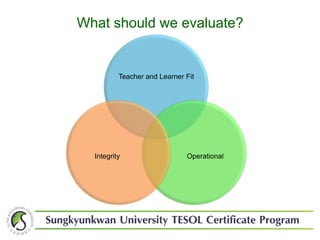
What should we evaluate?
Why should we evaluate?
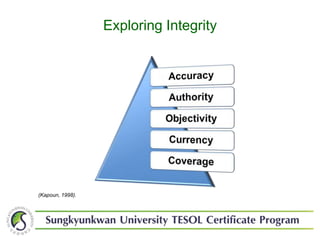
Exploring IntegrityWhy think about the integrity of websites?Google Search for the word ‘English’ reveals about 1,730,000,000 results.
Anyone can produce internet content.
You want high quality and valid content when using internet resources.Exploring Integrity(Kapoun, 1998).
Exploring IntegrityIn groups of three or four:Browse the Five criteria for evaluating the integrity of web pages (Kapoun, 1998).Discuss and make a list of the ‘Top 10’ aspects that you think are important for establishing website integrity.Remember: You are finding websites for ESL learners.
Exploring the OperationalL2 learner read websites differently from L1 Learners:79% of proficient English learners scan web text in a non-linear fashion (Morkes & Nielsen, 1997).Nielsen’s (2005) study that reveals how low literacy readers, tend to ‘plow’ text word-by-word and line-by-line, often taking time to comprehend unfamiliar multi-syllabic words.Tseng (2008) found 36% of ESL encountered eyestrain and blurred vision after reading the screen for extended amounts of time…this had a major effect on ESL students’ ability to focus on the screen.
Exploring the Operational(Hubbard,1998)
Exploring operationalIn you groups:Browse the Follett Criteria for Site & Grade-Level Evaluation (Navigation and Design, Technical Aspects).Discuss and highlight the points that relate directly to the operational aspects of a website.Discuss and make a list of the ‘Top 10’ aspects that you think are important for evaluating the operational aspects of an EFL website.
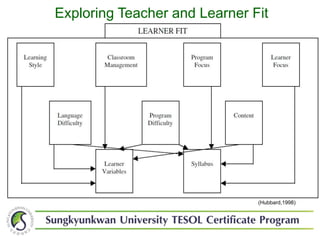
Exploring Teacher and Learner FitIt is important for language teachers to at least have educated opinions on the nature of language and to have those opinions activated during the evaluation process…Along with linguistic assumptions, an evaluator needs to be in touch with his or her assumptions about learning in general and language learning in particular.A teacher normally pursues the task of evaluation with a particular target group of users in mind. In the ideal case this would be a specific group of students in a specific class, all of whose relevant individual learning characteristics are known to the evaluator…the more the evaluator can specify about the target audience, the better.Hubbard,1998
Exploring Teacher and Learner FitSetting SpecificTeacher Autonomy
Exploring Teacher and Learner Fit(Hubbard,1998)
Exploring Teacher and Learner FitIn your groups discuss:What aspects of the language learning setting do you have control over?What aspects of language learning setting do you have no control over?What are your assumptions of how learners best acquire their second language?
Exploring Teacher and Learner FitIn your groups:Create a list of the ‘Top Five’ characteristics that you think should be included in a website to optimally develop learners’ second language.Example:Learners are provided with feedback so they recognize their mistakes and provided with opportunities to correct them.
Summing up the evaluation frameworkThink about:Who are my learners?What are their interests and learning styles?What are my understandings about language teaching and SLA?What are my preferred teaching styles?What resources and time do I have available?What standard of integrity do I require from a website resource?What standard of organization do I require from a website resource?
Module 4: Evaluating WebsitesPart 2: Evaluating an EFL website
Website EvaluationIn your groups of three:Each group will evaluate one website and collaboratively write an evaluation for that website (700- 1000 words).Choose one site from the list provided on the course blog (Module 4) or choose your own site if you know of one.  Inform your instructor of the site you will evaluate.Together, within your group, utilize the critical evaluation survey to evaluate your site carefully.In your group decide who will write which part of your website evaluation.  Use the ‘Evaluation Template’ to help you write up your aspect of your formal website evaluation. You must write this in MSWord 2003.Collate, edit, and revise all portions of the evaluation. Write the introduction and conclusion.
Website EvaluationHmm…Learner FitOperationalIntegritytype..type...
Website EvaluationPost your group’s evaluation on your blog page (Website Evaluation).E-mail your class members the address to your evaluation.Create hyperlinks to other groups’ evaluations on your blog page.Leave comments on three other evaluations.
ConclusionIn this module you have explored a framework for evaluating websites.  You have also put the process of evaluating a website into practice. Take time to carefully consider the understandings and ideas in this module the next time you choose a website for use in your teaching setting.In the next module you will be creating sound files and embedding them on your blog.  You will also learn about the benefits of podcasts and RSS feeds.  You can make a start by reading p. 98 – 102 in your course book.

Module 4 ppt

  • 1.
    Multimedia in theEFL ClassroomModule 4: Evaluating Websites
  • 2.
    Module ObjectivesBy theend of this module participants willbe able to…Describe the purpose of a critical evaluation survey;describe the important aspects to consider when evaluating a website; describe in detail the integrity, operative and pedagogical value of one specific ESL learning website.
  • 3.
    Module 4: EvaluatingWebsitesPart 1: A framework for constructing a critical evaluation survey.
  • 4.
  • 5.
    Why should weevaluate?
  • 6.
    Exploring IntegrityWhy thinkabout the integrity of websites?Google Search for the word ‘English’ reveals about 1,730,000,000 results.
  • 7.
    Anyone can produceinternet content.
  • 8.
    You want highquality and valid content when using internet resources.Exploring Integrity(Kapoun, 1998).
  • 9.
    Exploring IntegrityIn groupsof three or four:Browse the Five criteria for evaluating the integrity of web pages (Kapoun, 1998).Discuss and make a list of the ‘Top 10’ aspects that you think are important for establishing website integrity.Remember: You are finding websites for ESL learners.
  • 10.
    Exploring the OperationalL2learner read websites differently from L1 Learners:79% of proficient English learners scan web text in a non-linear fashion (Morkes & Nielsen, 1997).Nielsen’s (2005) study that reveals how low literacy readers, tend to ‘plow’ text word-by-word and line-by-line, often taking time to comprehend unfamiliar multi-syllabic words.Tseng (2008) found 36% of ESL encountered eyestrain and blurred vision after reading the screen for extended amounts of time…this had a major effect on ESL students’ ability to focus on the screen.
  • 11.
  • 12.
    Exploring operationalIn yougroups:Browse the Follett Criteria for Site & Grade-Level Evaluation (Navigation and Design, Technical Aspects).Discuss and highlight the points that relate directly to the operational aspects of a website.Discuss and make a list of the ‘Top 10’ aspects that you think are important for evaluating the operational aspects of an EFL website.
  • 13.
    Exploring Teacher andLearner FitIt is important for language teachers to at least have educated opinions on the nature of language and to have those opinions activated during the evaluation process…Along with linguistic assumptions, an evaluator needs to be in touch with his or her assumptions about learning in general and language learning in particular.A teacher normally pursues the task of evaluation with a particular target group of users in mind. In the ideal case this would be a specific group of students in a specific class, all of whose relevant individual learning characteristics are known to the evaluator…the more the evaluator can specify about the target audience, the better.Hubbard,1998
  • 14.
    Exploring Teacher andLearner FitSetting SpecificTeacher Autonomy
  • 15.
    Exploring Teacher andLearner Fit(Hubbard,1998)
  • 16.
    Exploring Teacher andLearner Fit(Hubbard,1998)
  • 17.
    Exploring Teacher andLearner FitIn your groups discuss:What aspects of the language learning setting do you have control over?What aspects of language learning setting do you have no control over?What are your assumptions of how learners best acquire their second language?
  • 18.
    Exploring Teacher andLearner FitIn your groups:Create a list of the ‘Top Five’ characteristics that you think should be included in a website to optimally develop learners’ second language.Example:Learners are provided with feedback so they recognize their mistakes and provided with opportunities to correct them.
  • 19.
    Summing up theevaluation frameworkThink about:Who are my learners?What are their interests and learning styles?What are my understandings about language teaching and SLA?What are my preferred teaching styles?What resources and time do I have available?What standard of integrity do I require from a website resource?What standard of organization do I require from a website resource?
  • 20.
    Module 4: EvaluatingWebsitesPart 2: Evaluating an EFL website
  • 21.
    Website EvaluationIn yourgroups of three:Each group will evaluate one website and collaboratively write an evaluation for that website (700- 1000 words).Choose one site from the list provided on the course blog (Module 4) or choose your own site if you know of one. Inform your instructor of the site you will evaluate.Together, within your group, utilize the critical evaluation survey to evaluate your site carefully.In your group decide who will write which part of your website evaluation. Use the ‘Evaluation Template’ to help you write up your aspect of your formal website evaluation. You must write this in MSWord 2003.Collate, edit, and revise all portions of the evaluation. Write the introduction and conclusion.
  • 22.
  • 23.
    Website EvaluationPost yourgroup’s evaluation on your blog page (Website Evaluation).E-mail your class members the address to your evaluation.Create hyperlinks to other groups’ evaluations on your blog page.Leave comments on three other evaluations.
  • 24.
    ConclusionIn this moduleyou have explored a framework for evaluating websites.  You have also put the process of evaluating a website into practice. Take time to carefully consider the understandings and ideas in this module the next time you choose a website for use in your teaching setting.In the next module you will be creating sound files and embedding them on your blog.  You will also learn about the benefits of podcasts and RSS feeds.  You can make a start by reading p. 98 – 102 in your course book.