Copyright
©
2012
Brooks/Cole,
a
division
of
Cengage
Learning,
Inc.
Planning
©2016.
Cengage
Learning.
All
rights
reserved.
Copyright
©
2012
Brooks/Cole,
a
division
of
Cengage
Learning,
Inc.
Pre-group Planning
Many groups are not successful
due to too little emphasis on pre-
group planning
Pre-group planning:
How many sessions will the
group meet?
When will the group meet?
Who should the members be?
This should be carefully
thought out
©2016.
Cengage
Learning.
All
rights
reserved.
Copyright
©
2012
Brooks/Cole,
a
division
of
Cengage
Learning,
Inc.
HowWilltheMembersBeScreened?
The Personal Interview
Written Screening
Screening By Referral Sources
Screening By Using a Comprehensive Group Program
Screening AfterThe Group Has Begun
Screening is essential because not everyone is appropriate for
every group.
©2016.
Cengage
Learning.
All
rights
reserved.
Copyright
©
2012
Brooks/Cole,
a
division
of
Cengage
Learning,
Inc.
Big Picture Planning
Big picture planning entails considering all possible
topics that need to be covered and all possible topics
that could be covered.
By doing this, the leader thinks through the purpose
and the topics to be covered and how the group may
evolve over the life of the group.
©2016.
Cengage
Learning.
All
rights
reserved.
Copyright
©
2012
Brooks/Cole,
a
division
of
Cengage
Learning,
Inc.
Session Planning
When planning a session, the leader should
always consider the stage of the group.
Plan the Format For the Session
Some groups have the same format each session
Some groups have a varied format
Anticipate ProblemsWhen Planning
Members not following through on outside activities
Members being absent
Unanticipated issues arising in the group
©2016.
Cengage
Learning.
All
rights
reserved.
Copyright
©
2012
Brooks/Cole,
a
division
of
Cengage
Learning,
Inc.
Phases of theSession
Every group has 3 phases:
The Beginning orWarm-up Phase
Middle orWorking Phase
Closing Phase
©2016.
Cengage
Learning.
All
rights
reserved.
Copyright
©
2012
Brooks/Cole,
a
division
of
Cengage
Learning,
Inc.
The Beginning or
Warm-up Phase
Always have a warm-up phase.
Make sure it is not too long
Make it relevant
Let members check-in; give progress reports.
Check to see if any member has something they want to
bring up.
Be aware of unanticipated issues distractions among
members
©2016.
Cengage
Learning.
All
rights
reserved.
Copyright
©
2012
Brooks/Cole,
a
division
of
Cengage
Learning,
Inc.
The Beginning or
Warm-up Phase
continued
For open groups, the leader needs to plan for
introducing a new member
Don’t let this dominate--let the new member
come up to speed
Focus mainly on the old members
The leader should give thought to whether the
warm-up is high energy to get members excited, or
medium energy.
©2016.
Cengage
Learning.
All
rights
reserved.
Copyright
©
2012
Brooks/Cole,
a
division
of
Cengage
Learning,
Inc.
TheMiddleorWorkingPhase
Planning the middle phase is important since this is when
groups do meaningful and lasting work. Planning this
phase depends on the kind of group and the makeup of
members.
counseling or therapy
education
support
task exploration and resolution
values exploration/personal growth
©2016.
Cengage
Learning.
All
rights
reserved.
Copyright
©
2012
Brooks/Cole,
a
division
of
Cengage
Learning,
Inc.
TheClosing Phase
A common mistake is to not plan the closing of a session.
A closing should:
highlight or summarize issues or information
allow leader to check for confusion or unfinished business
enhance members’ commitment to the purpose of the
group
©2016.
Cengage
Learning.
All
rights
reserved.
Copyright
©
2012
Brooks/Cole,
a
division
of
Cengage
Learning,
Inc.
Closing Phase of
the First and Last
Sessions
Give extra thought to the closing phase of the first and last
session, especially with counseling/therapy groups, personal
growth groups, and support groups.
When closing a first session-watch for:
commitment of members
comfort and trust issues
negative energy
emerging member issues
©2016.
Cengage
Learning.
All
rights
reserved.
Copyright
©
2012
Brooks/Cole,
a
division
of
Cengage
Learning,
Inc.
Goals of closing final
session:
1. Hearing from individual members regarding the overall
group experience
2. Strengthening decisions, commitments, and/or behavior
changes
3. Feedback of members to the leader
4. Feedback of members to each other
©2016.
Cengage
Learning.
All
rights
reserved.
Copyright
©
2012
Brooks/Cole,
a
division
of
Cengage
Learning,
Inc.
Session Plans
Estimate the time for each phase of the group
Develop enough detail so that you can see the flow of the
session
©2016.
Cengage
Learning.
All
rights
reserved.
Copyright
©
2012
Brooks/Cole,
a
division
of
Cengage
Learning,
Inc.
Sample Plan
The first session of a parenting group consisting of ten
members:
3 min. (7:00) Introductions—round (name, age of
children, why they came to the group).
5 min. Discuss the group—format, purpose (stress that it
is mainly an educational and support group and not a
therapy group). Have members share their needs and
any fears or questions about the group. Have them share
cultural differences. (Sandwich in the group rules of
confidentiality, attendance, no attacking of others.)
©2016.
Cengage
Learning.
All
rights
reserved.
Copyright
©
2012
Brooks/Cole,
a
division
of
Cengage
Learning,
Inc.
BriefSentencecompletion
This activity provides material with which to begin a
discussion:
1. I get most upset as a parent when
_______________________
2. The thing I like most about being a parent
is__________________________
3. The hardest thing about parenting
is__________________________
©2016.
Cengage
Learning.
All
rights
reserved.
Copyright
©
2012
Brooks/Cole,
a
division
of
Cengage
Learning,
Inc.
Sample Plan
continued
10 min. Have members share their answers in
large group (use their examples in discussion
below).
15 min. Discuss Adlerian principles of child
behavior (use charts and handouts)
All behavior is purposeful.
Children are not bad—they
are discouraged.
Four goals of misbehavior.
©2016.
Cengage
Learning.
All
rights
reserved.
Copyright
©
2012
Brooks/Cole,
a
division
of
Cengage
Learning,
Inc.
Sample Plan
continued
5 min. (7:35) Have members share in groups of three their
thoughts about the Adlerian principles.
10 min. Discuss in large group, then continue overview of
principles: Parent’s reaction to each of the four goals of
misbehavior.
©2016.
Cengage
Learning.
All
rights
reserved.
Copyright
©
2012
Brooks/Cole,
a
division
of
Cengage
Learning,
Inc.
Sample Plan
continued
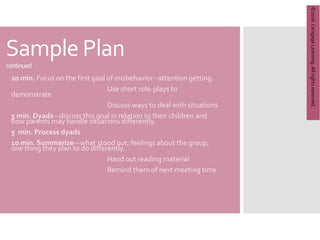
20 min. Focus on the first goal of misbehavior--attention getting.
Use short role-plays to
demonstrate
Discuss ways to deal with situations
5 min. Dyads—discuss this goal in relation to their children and
how parents may handle situations differently.
5 min. Process dyads
10 min. Summarize—what stood out, feelings about the group,
one thing they plan to do differently.
Hand out reading material
Remind them of next meeting time
©2016.
Cengage
Learning.
All
rights
reserved.
Copyright
©
2012
Brooks/Cole,
a
division
of
Cengage
Learning,
Inc.
Frequent Mistakes
in Planning
Not Planning
PlanningToo Much
Irrelevant or MeaninglessContent
NotAllowing EnoughTime For the Group to Have Any
Significant Meaning
©2016.
Cengage
Learning.
All
rights
reserved.
Copyright
©
2012
Brooks/Cole,
a
division
of
Cengage
Learning,
Inc.
FrequentMistakesin
Planning
continued
Inappropriate Exercises
Too Many Exercises
Poor Planning ofTime
Poor Planning ofOrder
Not Planning an Interesting Beginning
©2016.
Cengage
Learning.
All
rights
reserved.
Copyright
©
2012
Brooks/Cole,
a
division
of
Cengage
Learning,
Inc.
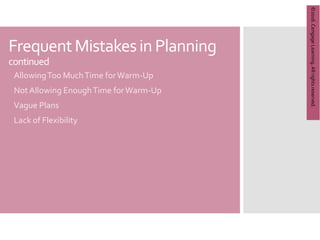
FrequentMistakesin Planning
continued
AllowingToo MuchTime forWarm-Up
NotAllowing EnoughTime forWarm-Up
Vague Plans
Lack of Flexibility
©2016.
Cengage
Learning.
All
rights
reserved.
Copyright
©
2012
Brooks/Cole,
a
division
of
Cengage
Learning,
Inc.
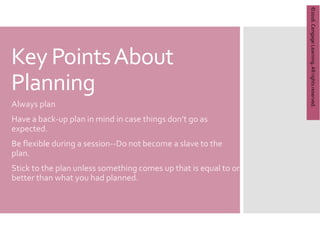
Key PointsAbout
Planning
Always plan
Have a back-up plan in mind in case things don’t go as
expected.
Be flexible during a session--Do not become a slave to the
plan.
Stick to the plan unless something comes up that is equal to or
better than what you had planned.
©2016.
Cengage
Learning.
All
rights
reserved.

Module 4 planning