UNIT – 4
INDIRECT TAX REGIME - II
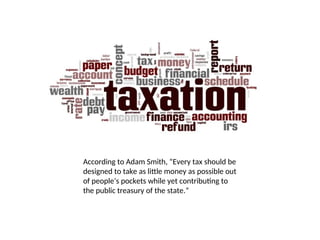
According to Adam Smith, “Every tax should be
designed to take as little money as possible out
of people’s pockets while yet contributing to
the public treasury of the state.”
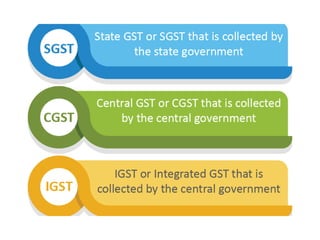
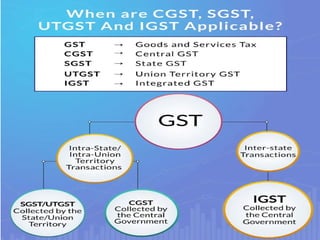
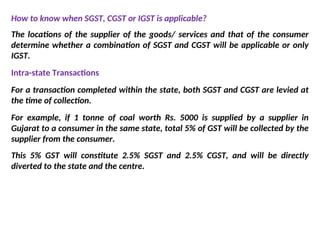
How to know when SGST, CGST or IGST is applicable?
The locations of the supplier of the goods/ services and that of the consumer
determine whether a combination of SGST and CGST will be applicable or only
IGST.
Intra-state Transactions
For a transaction completed within the state, both SGST and CGST are levied at
the time of collection.
For example, if 1 tonne of coal worth Rs. 5000 is supplied by a supplier in
Gujarat to a consumer in the same state, total 5% of GST will be collected by the
supplier from the consumer.
This 5% GST will constitute 2.5% SGST and 2.5% CGST, and will be directly
diverted to the state and the centre.
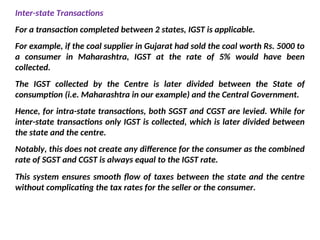
Inter-state Transactions
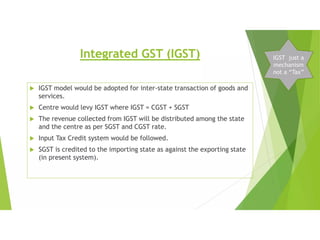
For a transaction completed between 2 states, IGST is applicable.
For example, if the coal supplier in Gujarat had sold the coal worth Rs. 5000 to
a consumer in Maharashtra, IGST at the rate of 5% would have been
collected.
The IGST collected by the Centre is later divided between the State of
consumption (i.e. Maharashtra in our example) and the Central Government.
Hence, for intra-state transactions, both SGST and CGST are levied. While for
inter-state transactions only IGST is collected, which is later divided between
the state and the centre.
Notably, this does not create any difference for the consumer as the combined
rate of SGST and CGST is always equal to the IGST rate.
This system ensures smooth flow of taxes between the state and the centre
without complicating the tax rates for the seller or the consumer.
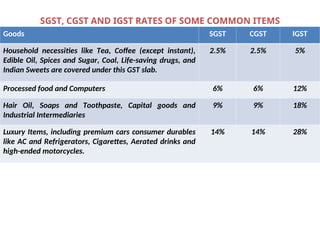
Goods SGST CGST IGST
Household necessities like Tea, Coffee (except instant),
Edible Oil, Spices and Sugar, Coal, Life-saving drugs, and
Indian Sweets are covered under this GST slab.
2.5% 2.5% 5%
Processed food and Computers 6% 6% 12%
Hair Oil, Soaps and Toothpaste, Capital goods and
Industrial Intermediaries
9% 9% 18%
Luxury Items, including premium cars consumer durables
like AC and Refrigerators, Cigarettes, Aerated drinks and
high-ended motorcycles.
14% 14% 28%
SGST, CGST AND IGST RATES OF SOME COMMON ITEMS
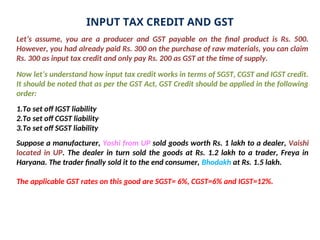
INPUT TAX CREDIT AND GST
Let’s assume, you are a producer and GST payable on the final product is Rs. 500.
However, you had already paid Rs. 300 on the purchase of raw materials, you can claim
Rs. 300 as input tax credit and only pay Rs. 200 as GST at the time of supply.
Now let’s understand how input tax credit works in terms of SGST, CGST and IGST credit.
It should be noted that as per the GST Act, GST Credit should be applied in the following
order:
1.To set off IGST liability
2.To set off CGST liability
3.To set off SGST liability
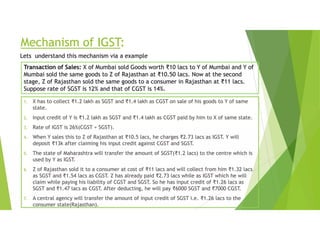
Suppose a manufacturer, Yoshi from UP sold goods worth Rs. 1 lakh to a dealer, Vaishi
located in UP. The dealer in turn sold the goods at Rs. 1.2 lakh to a trader, Freya in
Haryana. The trader finally sold it to the end consumer, Bhodakh at Rs. 1.5 lakh.
The applicable GST rates on this good are SGST= 6%, CGST=6% and IGST=12%.
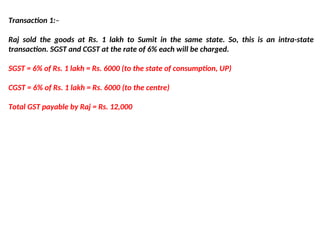
Transaction 1:–
Raj sold the goods at Rs. 1 lakh to Sumit in the same state. So, this is an intra-state
transaction. SGST and CGST at the rate of 6% each will be charged.
SGST = 6% of Rs. 1 lakh = Rs. 6000 (to the state of consumption, UP)
CGST = 6% of Rs. 1 lakh = Rs. 6000 (to the centre)
Total GST payable by Raj = Rs. 12,000
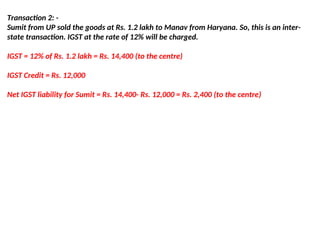
Transaction 2: -
Sumit from UP sold the goods at Rs. 1.2 lakh to Manav from Haryana. So, this is an inter-
state transaction. IGST at the rate of 12% will be charged.
IGST = 12% of Rs. 1.2 lakh = Rs. 14,400 (to the centre)
IGST Credit = Rs. 12,000
Net IGST liability for Sumit = Rs. 14,400- Rs. 12,000 = Rs. 2,400 (to the centre)
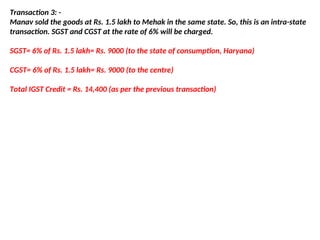
Transaction 3: -
Manav sold the goods at Rs. 1.5 lakh to Mehak in the same state. So, this is an intra-state
transaction. SGST and CGST at the rate of 6% will be charged.
SGST= 6% of Rs. 1.5 lakh= Rs. 9000 (to the state of consumption, Haryana)
CGST= 6% of Rs. 1.5 lakh= Rs. 9000 (to the centre)
Total IGST Credit = Rs. 14,400 (as per the previous transaction)
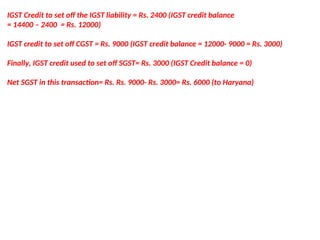
IGST Credit to set off the IGST liability = Rs. 2400 (IGST credit balance
= 14400 – 2400 = Rs. 12000)
IGST credit to set off CGST = Rs. 9000 (IGST credit balance = 12000- 9000 = Rs. 3000)
Finally, IGST credit used to set off SGST= Rs. 3000 (IGST Credit balance = 0)
Net SGST in this transaction= Rs. Rs. 9000- Rs. 3000= Rs. 6000 (to Haryana)
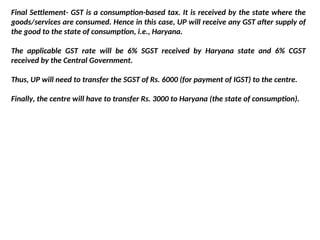
Final Settlement- GST is a consumption-based tax. It is received by the state where the
goods/services are consumed. Hence in this case, UP will receive any GST after supply of
the good to the state of consumption, i.e., Haryana.
The applicable GST rate will be 6% SGST received by Haryana state and 6% CGST
received by the Central Government.
Thus, UP will need to transfer the SGST of Rs. 6000 (for payment of IGST) to the centre.
Finally, the centre will have to transfer Rs. 3000 to Haryana (the state of consumption).
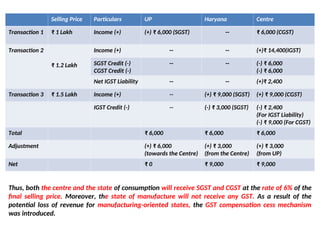
Selling Price Particulars UP Haryana Centre
Transaction 1 ₹ 1 Lakh Income (+) (+) ₹ 6,000 (SGST) -- ₹ 6,000 (CGST)
Transaction 2
₹ 1.2 Lakh
Income (+) -- -- (+)₹ 14,400(IGST)
SGST Credit (-)
CGST Credit (-)
-- -- (-) ₹ 6,000
(-) ₹ 6,000
Net IGST Liability -- -- (+)₹ 2,400
Transaction 3 ₹ 1.5 Lakh Income (+) -- (+) ₹ 9,000 (SGST) (+) ₹ 9,000 (CGST)
IGST Credit (-) -- (-) ₹ 3,000 (SGST) (-) ₹ 2,400
(For IGST Liability)
(-) ₹ 9,000 (For CGST)
Total ₹ 6,000 ₹ 6,000 ₹ 6,000
Adjustment (+) ₹ 6,000
(towards the Centre)
(+) ₹ 3,000
(from the Centre)
(+) ₹ 3,000
(from UP)
Net ₹ 0 ₹ 9,000 ₹ 9,000
Thus, both the centre and the state of consumption will receive SGST and CGST at the rate of 6% of the
final selling price. Moreover, the state of manufacture will not receive any GST. As a result of the
potential loss of revenue for manufacturing-oriented states, the GST compensation cess mechanism
was introduced.
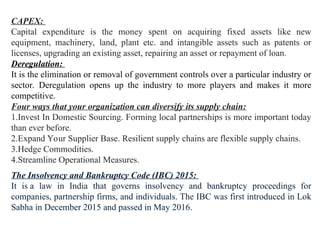
CAPEX:
Capital expenditure is the money spent on acquiring fixed assets like new
equipment, machinery, land, plant etc. and intangible assets such as patents or
licenses, upgrading an existing asset, repairing an asset or repayment of loan.
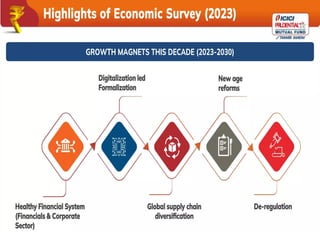
Deregulation:
It is the elimination or removal of government controls over a particular industry or
sector. Deregulation opens up the industry to more players and makes it more
competitive.
Four ways that your organization can diversify its supply chain:
1.Invest In Domestic Sourcing. Forming local partnerships is more important today
than ever before.
2.Expand Your Supplier Base. Resilient supply chains are flexible supply chains.
3.Hedge Commodities.
4.Streamline Operational Measures.
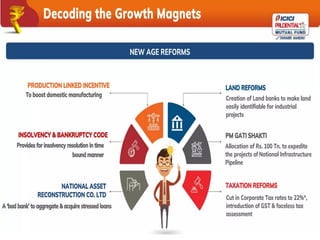
The Insolvency and Bankruptcy Code (IBC) 2015:
It is a law in India that governs insolvency and bankruptcy proceedings for
companies, partnership firms, and individuals. The IBC was first introduced in Lok
Sabha in December 2015 and passed in May 2016.
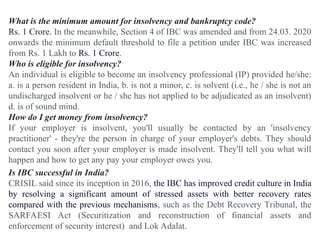
What is the minimum amount for insolvency and bankruptcy code?
Rs. 1 Crore. In the meanwhile, Section 4 of IBC was amended and from 24.03. 2020
onwards the minimum default threshold to file a petition under IBC was increased
from Rs. 1 Lakh to Rs. 1 Crore.
Who is eligible for insolvency?
An individual is eligible to become an insolvency professional (IP) provided he/she:
a. is a person resident in India, b. is not a minor, c. is solvent (i.e., he / she is not an
undischarged insolvent or he / she has not applied to be adjudicated as an insolvent)
d. is of sound mind.
How do I get money from insolvency?
If your employer is insolvent, you'll usually be contacted by an 'insolvency
practitioner' - they're the person in charge of your employer's debts. They should
contact you soon after your employer is made insolvent. They'll tell you what will
happen and how to get any pay your employer owes you.
Is IBC successful in India?
CRISIL said since its inception in 2016, the IBC has improved credit culture in India
by resolving a significant amount of stressed assets with better recovery rates
compared with the previous mechanisms, such as the Debt Recovery Tribunal, the
SARFAESI Act (Securitization and reconstruction of financial assets and
enforcement of security interest) and Lok Adalat.
LANDMARK CASE LAWS IN INDIRECT TAXATION
1. M/s BSNL vs. UOI (2006):
•Issue: The case revolved around the service tax liability on the receipts of the
BSNL (Bharat Sanchar Nigam Limited) for providing telecom services.
•Outcome: The Supreme Court held that the receipts of BSNL are not subject to
service tax, as the activities performed by it do not fall within the definition of
"commercial or industrial construction service."
2. Union of India v. Bombay Tyre International Ltd. (1984):
•Issue: The case dealt with the question of whether a sale was completed within
the territory of a single state or involved inter-state sales.
•Outcome: The Supreme Court clarified the principles governing inter-state sales
and the concept of the "sale of goods" under the Central Sales Tax Act, 1956.
3. J.K. Synthetics Ltd. v. Commercial Taxes Officer (1994):
•Issue: The case discussed the scope of the term "manufacture" under the Central
Excise Act, 1944.
•Outcome: The Supreme Court held that the mere cutting of raw materials into
suitable sizes for being used in the manufacture of final products does not amount
to manufacture under the Act.
LANDMARK CASE LAWS IN INDIRECT TAXATION
4. All India Federation of Tax Practitioners v. UOI (2007):
•Issue: The case challenged the constitutionality of service tax on legal
consultancy services.
•Outcome: The Supreme Court upheld the validity of the levy of service tax on
legal consultancy services, stating that it falls within the legislative competence
of the central government.
5.Gannon Dunkerley & Co. vs. State of Rajasthan (1993):
•Issue: The case dealt with the constitutional validity of the tax imposed on the
transfer of property involved in the execution of works contracts.
•Outcome: The Supreme Court held that the tax on works contracts is a tax on
the sale of goods and is within the legislative competence of the State.
Reverse Charge means the liability to pay tax is on the recipient of supply of
goods or services instead of the supplier of such goods or services in respect of
notified categories of supply.
But in some cases, GST is to be collected by the purchaser of goods/service
and not by seller. This is called Reverse Charge Mechanism, RCM in short.
In some cases of sale through E-commerce operator such as Uber, ola etc the
tax is not collected and deposited by seller but collected by e-commerce
operator.
Can we claim RCM refund?
Yes. You can claim refund. See Section 54 (8)(e) of CGST ACT. Ensure that it
is within the 2 years time limit.
Module  – 4 Indirect Tax Regime - II.ppt

Module – 4 Indirect Tax Regime - II.ppt

  • 1.
    UNIT – 4 INDIRECTTAX REGIME - II
  • 2.
    According to AdamSmith, “Every tax should be designed to take as little money as possible out of people’s pockets while yet contributing to the public treasury of the state.”
  • 6.
    How to knowwhen SGST, CGST or IGST is applicable? The locations of the supplier of the goods/ services and that of the consumer determine whether a combination of SGST and CGST will be applicable or only IGST. Intra-state Transactions For a transaction completed within the state, both SGST and CGST are levied at the time of collection. For example, if 1 tonne of coal worth Rs. 5000 is supplied by a supplier in Gujarat to a consumer in the same state, total 5% of GST will be collected by the supplier from the consumer. This 5% GST will constitute 2.5% SGST and 2.5% CGST, and will be directly diverted to the state and the centre.
  • 7.
    Inter-state Transactions For atransaction completed between 2 states, IGST is applicable. For example, if the coal supplier in Gujarat had sold the coal worth Rs. 5000 to a consumer in Maharashtra, IGST at the rate of 5% would have been collected. The IGST collected by the Centre is later divided between the State of consumption (i.e. Maharashtra in our example) and the Central Government. Hence, for intra-state transactions, both SGST and CGST are levied. While for inter-state transactions only IGST is collected, which is later divided between the state and the centre. Notably, this does not create any difference for the consumer as the combined rate of SGST and CGST is always equal to the IGST rate. This system ensures smooth flow of taxes between the state and the centre without complicating the tax rates for the seller or the consumer.
  • 8.
    Goods SGST CGSTIGST Household necessities like Tea, Coffee (except instant), Edible Oil, Spices and Sugar, Coal, Life-saving drugs, and Indian Sweets are covered under this GST slab. 2.5% 2.5% 5% Processed food and Computers 6% 6% 12% Hair Oil, Soaps and Toothpaste, Capital goods and Industrial Intermediaries 9% 9% 18% Luxury Items, including premium cars consumer durables like AC and Refrigerators, Cigarettes, Aerated drinks and high-ended motorcycles. 14% 14% 28% SGST, CGST AND IGST RATES OF SOME COMMON ITEMS
  • 9.
    INPUT TAX CREDITAND GST Let’s assume, you are a producer and GST payable on the final product is Rs. 500. However, you had already paid Rs. 300 on the purchase of raw materials, you can claim Rs. 300 as input tax credit and only pay Rs. 200 as GST at the time of supply. Now let’s understand how input tax credit works in terms of SGST, CGST and IGST credit. It should be noted that as per the GST Act, GST Credit should be applied in the following order: 1.To set off IGST liability 2.To set off CGST liability 3.To set off SGST liability Suppose a manufacturer, Yoshi from UP sold goods worth Rs. 1 lakh to a dealer, Vaishi located in UP. The dealer in turn sold the goods at Rs. 1.2 lakh to a trader, Freya in Haryana. The trader finally sold it to the end consumer, Bhodakh at Rs. 1.5 lakh. The applicable GST rates on this good are SGST= 6%, CGST=6% and IGST=12%.
  • 10.
    Transaction 1:– Raj soldthe goods at Rs. 1 lakh to Sumit in the same state. So, this is an intra-state transaction. SGST and CGST at the rate of 6% each will be charged. SGST = 6% of Rs. 1 lakh = Rs. 6000 (to the state of consumption, UP) CGST = 6% of Rs. 1 lakh = Rs. 6000 (to the centre) Total GST payable by Raj = Rs. 12,000
  • 11.
    Transaction 2: - Sumitfrom UP sold the goods at Rs. 1.2 lakh to Manav from Haryana. So, this is an inter- state transaction. IGST at the rate of 12% will be charged. IGST = 12% of Rs. 1.2 lakh = Rs. 14,400 (to the centre) IGST Credit = Rs. 12,000 Net IGST liability for Sumit = Rs. 14,400- Rs. 12,000 = Rs. 2,400 (to the centre)
  • 12.
    Transaction 3: - Manavsold the goods at Rs. 1.5 lakh to Mehak in the same state. So, this is an intra-state transaction. SGST and CGST at the rate of 6% will be charged. SGST= 6% of Rs. 1.5 lakh= Rs. 9000 (to the state of consumption, Haryana) CGST= 6% of Rs. 1.5 lakh= Rs. 9000 (to the centre) Total IGST Credit = Rs. 14,400 (as per the previous transaction)
  • 13.
    IGST Credit toset off the IGST liability = Rs. 2400 (IGST credit balance = 14400 – 2400 = Rs. 12000) IGST credit to set off CGST = Rs. 9000 (IGST credit balance = 12000- 9000 = Rs. 3000) Finally, IGST credit used to set off SGST= Rs. 3000 (IGST Credit balance = 0) Net SGST in this transaction= Rs. Rs. 9000- Rs. 3000= Rs. 6000 (to Haryana)
  • 14.
    Final Settlement- GSTis a consumption-based tax. It is received by the state where the goods/services are consumed. Hence in this case, UP will receive any GST after supply of the good to the state of consumption, i.e., Haryana. The applicable GST rate will be 6% SGST received by Haryana state and 6% CGST received by the Central Government. Thus, UP will need to transfer the SGST of Rs. 6000 (for payment of IGST) to the centre. Finally, the centre will have to transfer Rs. 3000 to Haryana (the state of consumption).
  • 15.
    Selling Price ParticularsUP Haryana Centre Transaction 1 ₹ 1 Lakh Income (+) (+) ₹ 6,000 (SGST) -- ₹ 6,000 (CGST) Transaction 2 ₹ 1.2 Lakh Income (+) -- -- (+)₹ 14,400(IGST) SGST Credit (-) CGST Credit (-) -- -- (-) ₹ 6,000 (-) ₹ 6,000 Net IGST Liability -- -- (+)₹ 2,400 Transaction 3 ₹ 1.5 Lakh Income (+) -- (+) ₹ 9,000 (SGST) (+) ₹ 9,000 (CGST) IGST Credit (-) -- (-) ₹ 3,000 (SGST) (-) ₹ 2,400 (For IGST Liability) (-) ₹ 9,000 (For CGST) Total ₹ 6,000 ₹ 6,000 ₹ 6,000 Adjustment (+) ₹ 6,000 (towards the Centre) (+) ₹ 3,000 (from the Centre) (+) ₹ 3,000 (from UP) Net ₹ 0 ₹ 9,000 ₹ 9,000 Thus, both the centre and the state of consumption will receive SGST and CGST at the rate of 6% of the final selling price. Moreover, the state of manufacture will not receive any GST. As a result of the potential loss of revenue for manufacturing-oriented states, the GST compensation cess mechanism was introduced.
  • 18.
    CAPEX: Capital expenditure isthe money spent on acquiring fixed assets like new equipment, machinery, land, plant etc. and intangible assets such as patents or licenses, upgrading an existing asset, repairing an asset or repayment of loan. Deregulation: It is the elimination or removal of government controls over a particular industry or sector. Deregulation opens up the industry to more players and makes it more competitive. Four ways that your organization can diversify its supply chain: 1.Invest In Domestic Sourcing. Forming local partnerships is more important today than ever before. 2.Expand Your Supplier Base. Resilient supply chains are flexible supply chains. 3.Hedge Commodities. 4.Streamline Operational Measures. The Insolvency and Bankruptcy Code (IBC) 2015: It is a law in India that governs insolvency and bankruptcy proceedings for companies, partnership firms, and individuals. The IBC was first introduced in Lok Sabha in December 2015 and passed in May 2016.
  • 19.
    What is theminimum amount for insolvency and bankruptcy code? Rs. 1 Crore. In the meanwhile, Section 4 of IBC was amended and from 24.03. 2020 onwards the minimum default threshold to file a petition under IBC was increased from Rs. 1 Lakh to Rs. 1 Crore. Who is eligible for insolvency? An individual is eligible to become an insolvency professional (IP) provided he/she: a. is a person resident in India, b. is not a minor, c. is solvent (i.e., he / she is not an undischarged insolvent or he / she has not applied to be adjudicated as an insolvent) d. is of sound mind. How do I get money from insolvency? If your employer is insolvent, you'll usually be contacted by an 'insolvency practitioner' - they're the person in charge of your employer's debts. They should contact you soon after your employer is made insolvent. They'll tell you what will happen and how to get any pay your employer owes you. Is IBC successful in India? CRISIL said since its inception in 2016, the IBC has improved credit culture in India by resolving a significant amount of stressed assets with better recovery rates compared with the previous mechanisms, such as the Debt Recovery Tribunal, the SARFAESI Act (Securitization and reconstruction of financial assets and enforcement of security interest) and Lok Adalat.
  • 30.
    LANDMARK CASE LAWSIN INDIRECT TAXATION 1. M/s BSNL vs. UOI (2006): •Issue: The case revolved around the service tax liability on the receipts of the BSNL (Bharat Sanchar Nigam Limited) for providing telecom services. •Outcome: The Supreme Court held that the receipts of BSNL are not subject to service tax, as the activities performed by it do not fall within the definition of "commercial or industrial construction service." 2. Union of India v. Bombay Tyre International Ltd. (1984): •Issue: The case dealt with the question of whether a sale was completed within the territory of a single state or involved inter-state sales. •Outcome: The Supreme Court clarified the principles governing inter-state sales and the concept of the "sale of goods" under the Central Sales Tax Act, 1956. 3. J.K. Synthetics Ltd. v. Commercial Taxes Officer (1994): •Issue: The case discussed the scope of the term "manufacture" under the Central Excise Act, 1944. •Outcome: The Supreme Court held that the mere cutting of raw materials into suitable sizes for being used in the manufacture of final products does not amount to manufacture under the Act.
  • 31.
    LANDMARK CASE LAWSIN INDIRECT TAXATION 4. All India Federation of Tax Practitioners v. UOI (2007): •Issue: The case challenged the constitutionality of service tax on legal consultancy services. •Outcome: The Supreme Court upheld the validity of the levy of service tax on legal consultancy services, stating that it falls within the legislative competence of the central government. 5.Gannon Dunkerley & Co. vs. State of Rajasthan (1993): •Issue: The case dealt with the constitutional validity of the tax imposed on the transfer of property involved in the execution of works contracts. •Outcome: The Supreme Court held that the tax on works contracts is a tax on the sale of goods and is within the legislative competence of the State.
  • 32.
    Reverse Charge meansthe liability to pay tax is on the recipient of supply of goods or services instead of the supplier of such goods or services in respect of notified categories of supply. But in some cases, GST is to be collected by the purchaser of goods/service and not by seller. This is called Reverse Charge Mechanism, RCM in short. In some cases of sale through E-commerce operator such as Uber, ola etc the tax is not collected and deposited by seller but collected by e-commerce operator. Can we claim RCM refund? Yes. You can claim refund. See Section 54 (8)(e) of CGST ACT. Ensure that it is within the 2 years time limit.