Yoga and its use in
complementary and alternative
medicine
Medejine Charles, Katie
Matwiejaw, Julian Abby,
Sandra Frimpomaa, Monique
Watson
This Photo by Unknown Author is licensed under CC BY-NC-NDThis Photo by Unknown Author is licensed under CC BY-SAThis Photo by Unknown Author is licensed under CC BY
Objectives
• History of Yoga and its use in complementary and alternative medicine (Medejine
Charles)
• Similarity of Yoga and its use in complementary and alternative medicine (Katie
Matwiejaw)
• Differences of Yoga and its use in complementary and alternative medicine (Julian
Abbey)
• issues and concern yoga and it’s use in complementary and alternative (Sandra
Frimpomaa)
• cost-effectiveness, benefits and it’s use in complementary and alternative medicine
(Monique Watson)
History ofYoga and its use in
Complementary and Alternative
medicine
by Medejine Charles
Yoga
• The wordYoga comes from the root word
“Yug” which means to join together.There
are numerous interpretations ofYoga.The
most appropriate interpretation ofYoga is
believed to be a spiritual union within the
individual. (Micozzi, 2015, p.332)
Yoga • According to the book titled Fundamentals of
complementary and alternative medicine by Marc S.
Micozzi indicates “Yoga as practiced in the west in modern
times often has less emphasis on spiritual union and more
emphasis on simply performing physicalYoga postures”
(Micozzi, 2015, p. 332)
Yoga
• The beginning ofYoga stems from the Indus valley
Civilization.The first period ofYoga is referred to
as theVedic age which started between 4500-2500
BC.This period contains the 4 vedas which is the
book of knowledge in the literature of Hinduism.
Yoga
• The most important pillars in the history ofYoga is
the “Bhagavad-Gita” which is considered to be
skilled in action.
Yoga
According to an article by the science daily indicates
that, “Yoga was the 5th commonly used CAM therapy
in the United States by 2002.”The article also
indicates that “Yoga is considered a mind-body
intervention that is used to reduce the health effects
of generalized stress” lastly,Yoga is believed to calm
the nervous system and balance the body, mind and
spirit while also reducing blood pressure, improve
coordination and flexibility.”Yoga (Alternative
medicine by science daily)
Similarities in Yoga and Their Use in
Complementary and Alternative Medicine
By: Katie Matwiejow
Philosophy ofYoga
• Patanjali’s Yoga Sutra
• Provides the guidelines for the goals, philosophy, and structure of
meditation and yoga
The Eight Limbs ofYoga
• Ashtanga (eight limbs)
1. Discipline (Yama)- 5 Yamas include Non-harming and non-violence (Ahimsa), truthfulness
(Satya), Non-stealing (Asteya), Continence (Brahmacarya) and Non-possessivness (Aparigrha)
2. Restraint (Niyama)- 5 Niyamas include Purity (Shauca), Contentment (Samtosha), Austerity
(Tapas), Study (Syvadhyana), and Surrender and devotion to God (Ishvara-Pranihana)
3. Posture (Asana)
4. Breath Control (Pranayama)
5. Sense –withdrawal (Pratyahara)
6. Concentration (Dharana)
7. Meditation (Dhyana)
8. Ecstasy (Samadhi)
Elements of PhysicalYoga Practice
• Controlled breathing
• Prana is the life force in yoga
• Long deep breathing lets the breath all the way into the lungs and all the way out of the
lungs
• Individual nostril breathing stimulates different energy channels
• Left nostril breathing helps reduce sympathetic activity
• Right nostril breathing is energizing and improves alertness and focus
• Fast breathing raises energy levels, increases alertness and balances the nervous system
Meditation in Addition toYoga
• Seventh of the eight limbs of yoga
• The sixth limb is also related to meditation as concentration means “holding
of the mind in a motionless state” which is a part of meditation
• FA Meditation- focusing on an object
• OM Meditation- being attentive to each moment
Uses in Complementary and Alternative
Medicine
• Yoga is becoming incorporated in cancer centers as well as institutions like
theVA as treatment for PTSD
• Physical and mental benefits are now being recognized
• Yoga therapy still in the early stages
• Strongest research for benefits in areas of cardiovascular disease and
hypertension
• Pain disorders, depression and anxiety have also shown benefit from yoga
Differences in Yoga and Their use in complementary
and alternative medicine
JulianAbbey
The tradition and teachings of yoga were passed down by word of
mouth through thousands of years. This resulted in some teachings left
out and other new teachings added, resulting in different schools of yoga
each with distinct teachings. Despite the diversity of the schools, they
all had the same common goal. center, self-transcendence (Samadhi)
common goal. (Feuerstein, 2001)
The Yoga Tradition, written by George Feuerstein, describes the
schools of yoga as spokes on a wheel; the rim resembles Yamas
and Niyamas with the hub a single center, self-transcendence
(Samadhi) common goal. (Feuerstein, 2001)
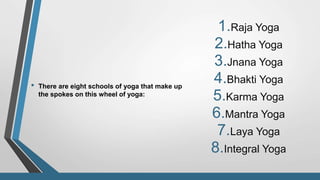
• There are eight schools of yoga that make up
the spokes on this wheel of yoga:
1.Raja Yoga
2.Hatha Yoga
3.Jnana Yoga
4.Bhakti Yoga
5.Karma Yoga
6.Mantra Yoga
7.Laya Yoga
8.Integral Yoga
1.) RAJA YOGA: ‘Royal’ or ‘kingly’ is the name given to Patanjali’s system of classical yoga.
2.) HATHA YOGA: The well-known and loved as the transcendence through movement provides
self-realization through the medium of the body. This benefits the cultivation of whole body
health and allows practitioners to withstand the experience of transcendental realization.
3.) JNANA Yoga: Meaning ‘wisdom’ or ‘knowledge’ with the goal of wisdom to improve our
ability to discern that which is real from what is not and to liberate us from the binds of the ego.
4.) BHAKTI YOGA: Approaches transcendence through the medium of the heart.
5.) KARMA YOGA: This is best described as ‘freedom in action’ where to exist is to act.
6.) MANTRA YOGA: Based on the premise the universe is in a state of constant vibration, sound has
the power to affect our state of consciousness.
7.) LAYA YOGA: The word ‘li’, means to ‘dissolve’ or ‘vanish’, but also to ‘cling’. Laya Yoga is
the process of dissolving the egoic self and clinging to the transcendental self.
8.) INTEGRAL YOGA: Attempts to create a bridge between ancient yoga and modern mind and
its sensibilities; this stresses to downgrade the material world and focus on the body-mind.
Issues and concerns
By Sandra Frimpomaa
Issues about yoga
But despite the benefits, yoga can be risky if you push yourself too hard or practice difficult poses
unsupervised, says Cohen.The 2012 Yoga in Australia survey found 1 in 5 survey respondents had
incurred some sort of injury (or exacerbated an existing injury) in the previous 12 months by practicing
yoga. The pose most commonly associated with injuries was the head stand, followed by shoulder
stands, lotus and half lotus (seated cross-legged position), forward bends, backward bends and hand
stands."People doing shoulder stands and head stands – inversions – can come down hard, they can
fall," says Cohen."These poses need some level of expertise and guidance, and when you're doing them,
you have to stay within your comfort range and ability."If yoga class fires up your competitive streak, or
your yoga instructor encourages you to do something that doesn't feel right, Cohen suggests you should
listen closely to your body. “You need to ask yourself, does this feel right for me,what I'm doing now?
Part of yoga is being very attuned to the feelings that are coming from your body," he says.Be aware of
your breathing
. A simple way to listen to your body, says Cohen, is to pay
attention to how you are breathing. “The breath is the link
between the mind and the body. The breath gives you an
indication of whether you're pushing yourself too hard. You
shouldn't be holding your breath or catching your breath," he
says. It’s also important, says physiotherapist Dr Neil Tuttle
from Griffith University, to pace yourself – particularly if you're
new to yoga. "If you don't allow sufficient time for your body
to accommodate changes [from a new activity], then you can
be almost certain that you're going to have an injury," he says.
People who end up injuring themselves "do activities that are
at the extreme of their ability, in awkward positions, and
repeat those activities frequently, building them up as quickly
as they can rather than building up slowly", he says. Alarm
bells should ring, says Tuttle, if pain or discomfort
progressively increases either during the activity or when you
repeat the activity on subsequent days. If you still feel the
urge to push yourself to your limits, just remember that
flexibility is not the be all and end all, says Tuttle. "It's not
necessarily better to be more flexible than less flexible
Bone Damages
People who are more flexible have a higher incidence of back and neck symptoms
than people who are less flexible," he says.This is because flexible people are more
likely to control a pose or a movement by locking themselves in to the end of range
of movement where it's easier to become injured, he say. And while injuries may
seem more common in certain styles of yoga, Cohen says this is possibly because
these styles appeal to people who want to push themselves and are therefore
already at more at risk of injury."The more physical styles, such as Ashtanga and
power yoga, that focus on the body may be considered to be more risky, but if they
are done properly, they're probably not," says Cohen
Like any exercise, though, yoga can have risks. People with
herniated disks or osteoporosis, for example, should avoid
deep forward bends, and anyone with neck problems should
steer clear of headstands, Loren Fishman, a New York City
physician who is also a yoga instructor, told LiveScience in
2012. Talking to a doctor about specific issues before starting a
practice is recommended, as is letting your yoga teacher know
of any limitations.
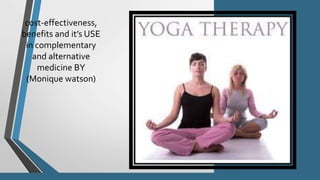
cost-effectiveness,
benefits and it’s USE
in complementary
and alternative
medicine BY
(Monique watson)
The Cost-effectiveness ofYogaTherapy
Kutch (2016) report that “ this
observational study indicates for
patients with anxiety disorders CAM
users have improved outcomes and
slightly lower costs with a high
probability of cost-effectiveness”.
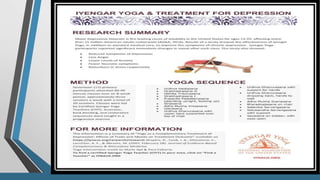
Care New England (2017 ) reportthat
“New researchindicates that the benefits
of hatha yogain treating depression are
less pronouncedin early treatment, but
mayaccumulate overtime”.
The Cost –
Effectiveness
ofYoga
Therapy
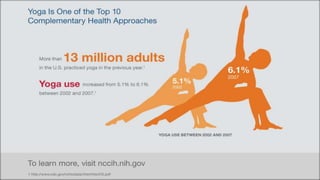
• The Cost-effectiveness and the benefits of yoga therapy in the
United States healthcare system have been using successfully for
the prevention and treatment of health conditions. Besides for the
physical aspects of yoga therapy, “which are important and
effective for strengthening the body, medical yoga also
incorporates appropriate breathing techniques, mindfulness, and
meditation in order to achieve the maximum benefits” (Stephens,
2017. p.1.) In this case, using yoga as a medical therapy have
several benefits for the human anatomy based on research studies
for all types of various health conditions especially for heart
disease and hypertension. Stephens, (2017) report that “multiple
studies have shown that yoga can positively impact the body in
many ways, including helping to regulate blood glucose levels,
improve musculoskeletal ailments and keeping the cardiovascular
system in tune” (p.1). In other words, based on multiples research
that was complete on medical yoga therapy actual shown proof
that it's very beneficial for maintaining diabetes patients blood
sugar levels and make a major improvement on
the musculoskeletal disorders of the human body.
Benefits of usingYoga therapy
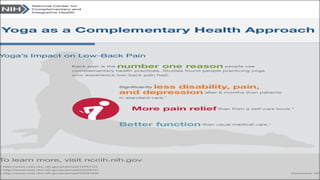
• These are the benefits of using yoga therapy in complementary and
alternative medicine which have been shown in numerous studies to be very
effective on medical conditions such as “back pain, chronic pain, diabetes,
depression, fibromyalgia, osteoarthritis, and rheumatoid arthritis”
(Micozzi, 2015, p.339). Also, yoga therapy has been made known to the
general population in the United States to have important psychological
benefits when using effectively.These are the psychological benefits of
yoga therapy which includes “increase mental energy and positive feelings,
and decrease negative feelings of aggressiveness, depression, and anxiety”
(Stephens, 2017. p.1).
References
Micozzi, M. S. (2015). Fundamentals of Complementary
and Alternative Medicine (Vol. 4th). (Saunders,
Ed.) Washington D.C, MA: Elsevier.
Yoga (alternative medicine). (n.d.). Retrieved December
02, 2017, From
https://www.sciencedaily.com/terms/yoga_(alternative_m
edicine).htm
Why We Breathe. A Yoga Documentary. (2015, July 04).
Retrieved December 02, 2017, from
https://www.youtube.com/watch?v=PvqvrD9h2n
U
References:
G, F. (2001). The yoga tradition: its history, literature, philosophy, and practice. Prescott, AZ:
Hohm Press.
Micozzi, M.,Weintraub, M., & Gehl, J. (2015). Biophysics, Electricity, Light, Magnetism, and
Sound. In M. Micozzi, Fundamentals of Complementary and Alternative Medicine (pp. 213-
239). St. Louis, Missouri: Elsevier Saunders.
Trainers,Y. (2016,April 30). 8 Approaches toYoga. Retrieved from Shades ofYoga:
https://shadesofyoga.com
References
Corporation, A. B. (2013, May 01). ABC Health &Wellbeing.
http://www.abc.net.au/health/talkinghealth/factbuster/stories/2013/05/02/3
750102.htm
University suspends yoga class, citing 'cultural issues' that may offend students. (n.d.).
Retrieved November 29, 2017, from http://www.foxnews.com/world/2015/11/23/university-
suspends-yoga-class-fearing-its-cultural-issues-could-offend.html
Yoga as a Complementary Health Approach. (2017, September 24). Retrieved
December 02, 2017, from https://nccih.nih.gov/news/multimedia/infographics/yoga
References
Kutch M (2016) Cost-Effectiveness Analysis of Complementary and Alternative
Medicine inTreating Anxiety Disorders.Altern Integr Med 5:218.
doi:10.4172/2327-5162.1000218
Care New England. (2017, May 8). Effectiveness of yoga in treating major
depression evaluated. ScienceDaily. Retrieved December 3, 2017 from
www.sciencedaily.com/releases/2017/05/170508130918.htm
IyengarYoga for Depression. (n.d.). Retrieved December 03, 2017, from
http://iyengaryogalamesa.com/about/iyengar-yoga-depression

Module 5 Group 4: Yoga Therapy

  • 1.
    Yoga and itsuse in complementary and alternative medicine Medejine Charles, Katie Matwiejaw, Julian Abby, Sandra Frimpomaa, Monique Watson This Photo by Unknown Author is licensed under CC BY-NC-NDThis Photo by Unknown Author is licensed under CC BY-SAThis Photo by Unknown Author is licensed under CC BY
  • 2.
    Objectives • History ofYoga and its use in complementary and alternative medicine (Medejine Charles) • Similarity of Yoga and its use in complementary and alternative medicine (Katie Matwiejaw) • Differences of Yoga and its use in complementary and alternative medicine (Julian Abbey) • issues and concern yoga and it’s use in complementary and alternative (Sandra Frimpomaa) • cost-effectiveness, benefits and it’s use in complementary and alternative medicine (Monique Watson)
  • 3.
    History ofYoga andits use in Complementary and Alternative medicine by Medejine Charles
  • 4.
    Yoga • The wordYogacomes from the root word “Yug” which means to join together.There are numerous interpretations ofYoga.The most appropriate interpretation ofYoga is believed to be a spiritual union within the individual. (Micozzi, 2015, p.332)
  • 5.
    Yoga • Accordingto the book titled Fundamentals of complementary and alternative medicine by Marc S. Micozzi indicates “Yoga as practiced in the west in modern times often has less emphasis on spiritual union and more emphasis on simply performing physicalYoga postures” (Micozzi, 2015, p. 332)
  • 6.
    Yoga • The beginningofYoga stems from the Indus valley Civilization.The first period ofYoga is referred to as theVedic age which started between 4500-2500 BC.This period contains the 4 vedas which is the book of knowledge in the literature of Hinduism.
  • 7.
    Yoga • The mostimportant pillars in the history ofYoga is the “Bhagavad-Gita” which is considered to be skilled in action.
  • 8.
    Yoga According to anarticle by the science daily indicates that, “Yoga was the 5th commonly used CAM therapy in the United States by 2002.”The article also indicates that “Yoga is considered a mind-body intervention that is used to reduce the health effects of generalized stress” lastly,Yoga is believed to calm the nervous system and balance the body, mind and spirit while also reducing blood pressure, improve coordination and flexibility.”Yoga (Alternative medicine by science daily)
  • 9.
    Similarities in Yogaand Their Use in Complementary and Alternative Medicine By: Katie Matwiejow
  • 10.
    Philosophy ofYoga • Patanjali’sYoga Sutra • Provides the guidelines for the goals, philosophy, and structure of meditation and yoga
  • 11.
    The Eight LimbsofYoga • Ashtanga (eight limbs) 1. Discipline (Yama)- 5 Yamas include Non-harming and non-violence (Ahimsa), truthfulness (Satya), Non-stealing (Asteya), Continence (Brahmacarya) and Non-possessivness (Aparigrha) 2. Restraint (Niyama)- 5 Niyamas include Purity (Shauca), Contentment (Samtosha), Austerity (Tapas), Study (Syvadhyana), and Surrender and devotion to God (Ishvara-Pranihana) 3. Posture (Asana) 4. Breath Control (Pranayama) 5. Sense –withdrawal (Pratyahara) 6. Concentration (Dharana) 7. Meditation (Dhyana) 8. Ecstasy (Samadhi)
  • 12.
    Elements of PhysicalYogaPractice • Controlled breathing • Prana is the life force in yoga • Long deep breathing lets the breath all the way into the lungs and all the way out of the lungs • Individual nostril breathing stimulates different energy channels • Left nostril breathing helps reduce sympathetic activity • Right nostril breathing is energizing and improves alertness and focus • Fast breathing raises energy levels, increases alertness and balances the nervous system
  • 13.
    Meditation in AdditiontoYoga • Seventh of the eight limbs of yoga • The sixth limb is also related to meditation as concentration means “holding of the mind in a motionless state” which is a part of meditation • FA Meditation- focusing on an object • OM Meditation- being attentive to each moment
  • 14.
    Uses in Complementaryand Alternative Medicine • Yoga is becoming incorporated in cancer centers as well as institutions like theVA as treatment for PTSD • Physical and mental benefits are now being recognized • Yoga therapy still in the early stages • Strongest research for benefits in areas of cardiovascular disease and hypertension • Pain disorders, depression and anxiety have also shown benefit from yoga
  • 15.
    Differences in Yogaand Their use in complementary and alternative medicine JulianAbbey
  • 16.
    The tradition andteachings of yoga were passed down by word of mouth through thousands of years. This resulted in some teachings left out and other new teachings added, resulting in different schools of yoga each with distinct teachings. Despite the diversity of the schools, they all had the same common goal. center, self-transcendence (Samadhi) common goal. (Feuerstein, 2001)
  • 17.
    The Yoga Tradition,written by George Feuerstein, describes the schools of yoga as spokes on a wheel; the rim resembles Yamas and Niyamas with the hub a single center, self-transcendence (Samadhi) common goal. (Feuerstein, 2001)
  • 18.
    • There areeight schools of yoga that make up the spokes on this wheel of yoga: 1.Raja Yoga 2.Hatha Yoga 3.Jnana Yoga 4.Bhakti Yoga 5.Karma Yoga 6.Mantra Yoga 7.Laya Yoga 8.Integral Yoga
  • 19.
    1.) RAJA YOGA:‘Royal’ or ‘kingly’ is the name given to Patanjali’s system of classical yoga. 2.) HATHA YOGA: The well-known and loved as the transcendence through movement provides self-realization through the medium of the body. This benefits the cultivation of whole body health and allows practitioners to withstand the experience of transcendental realization. 3.) JNANA Yoga: Meaning ‘wisdom’ or ‘knowledge’ with the goal of wisdom to improve our ability to discern that which is real from what is not and to liberate us from the binds of the ego. 4.) BHAKTI YOGA: Approaches transcendence through the medium of the heart. 5.) KARMA YOGA: This is best described as ‘freedom in action’ where to exist is to act. 6.) MANTRA YOGA: Based on the premise the universe is in a state of constant vibration, sound has the power to affect our state of consciousness. 7.) LAYA YOGA: The word ‘li’, means to ‘dissolve’ or ‘vanish’, but also to ‘cling’. Laya Yoga is the process of dissolving the egoic self and clinging to the transcendental self. 8.) INTEGRAL YOGA: Attempts to create a bridge between ancient yoga and modern mind and its sensibilities; this stresses to downgrade the material world and focus on the body-mind.
  • 20.
    Issues and concerns BySandra Frimpomaa
  • 21.
    Issues about yoga Butdespite the benefits, yoga can be risky if you push yourself too hard or practice difficult poses unsupervised, says Cohen.The 2012 Yoga in Australia survey found 1 in 5 survey respondents had incurred some sort of injury (or exacerbated an existing injury) in the previous 12 months by practicing yoga. The pose most commonly associated with injuries was the head stand, followed by shoulder stands, lotus and half lotus (seated cross-legged position), forward bends, backward bends and hand stands."People doing shoulder stands and head stands – inversions – can come down hard, they can fall," says Cohen."These poses need some level of expertise and guidance, and when you're doing them, you have to stay within your comfort range and ability."If yoga class fires up your competitive streak, or your yoga instructor encourages you to do something that doesn't feel right, Cohen suggests you should listen closely to your body. “You need to ask yourself, does this feel right for me,what I'm doing now? Part of yoga is being very attuned to the feelings that are coming from your body," he says.Be aware of your breathing
  • 22.
    . A simpleway to listen to your body, says Cohen, is to pay attention to how you are breathing. “The breath is the link between the mind and the body. The breath gives you an indication of whether you're pushing yourself too hard. You shouldn't be holding your breath or catching your breath," he says. It’s also important, says physiotherapist Dr Neil Tuttle from Griffith University, to pace yourself – particularly if you're new to yoga. "If you don't allow sufficient time for your body to accommodate changes [from a new activity], then you can be almost certain that you're going to have an injury," he says. People who end up injuring themselves "do activities that are at the extreme of their ability, in awkward positions, and repeat those activities frequently, building them up as quickly as they can rather than building up slowly", he says. Alarm bells should ring, says Tuttle, if pain or discomfort progressively increases either during the activity or when you repeat the activity on subsequent days. If you still feel the urge to push yourself to your limits, just remember that flexibility is not the be all and end all, says Tuttle. "It's not necessarily better to be more flexible than less flexible
  • 24.
  • 26.
    People who aremore flexible have a higher incidence of back and neck symptoms than people who are less flexible," he says.This is because flexible people are more likely to control a pose or a movement by locking themselves in to the end of range of movement where it's easier to become injured, he say. And while injuries may seem more common in certain styles of yoga, Cohen says this is possibly because these styles appeal to people who want to push themselves and are therefore already at more at risk of injury."The more physical styles, such as Ashtanga and power yoga, that focus on the body may be considered to be more risky, but if they are done properly, they're probably not," says Cohen
  • 27.
    Like any exercise,though, yoga can have risks. People with herniated disks or osteoporosis, for example, should avoid deep forward bends, and anyone with neck problems should steer clear of headstands, Loren Fishman, a New York City physician who is also a yoga instructor, told LiveScience in 2012. Talking to a doctor about specific issues before starting a practice is recommended, as is letting your yoga teacher know of any limitations.
  • 28.
    cost-effectiveness, benefits and it’sUSE in complementary and alternative medicine BY (Monique watson)
  • 29.
    The Cost-effectiveness ofYogaTherapy Kutch(2016) report that “ this observational study indicates for patients with anxiety disorders CAM users have improved outcomes and slightly lower costs with a high probability of cost-effectiveness”.
  • 30.
    Care New England(2017 ) reportthat “New researchindicates that the benefits of hatha yogain treating depression are less pronouncedin early treatment, but mayaccumulate overtime”.
  • 32.
    The Cost – Effectiveness ofYoga Therapy •The Cost-effectiveness and the benefits of yoga therapy in the United States healthcare system have been using successfully for the prevention and treatment of health conditions. Besides for the physical aspects of yoga therapy, “which are important and effective for strengthening the body, medical yoga also incorporates appropriate breathing techniques, mindfulness, and meditation in order to achieve the maximum benefits” (Stephens, 2017. p.1.) In this case, using yoga as a medical therapy have several benefits for the human anatomy based on research studies for all types of various health conditions especially for heart disease and hypertension. Stephens, (2017) report that “multiple studies have shown that yoga can positively impact the body in many ways, including helping to regulate blood glucose levels, improve musculoskeletal ailments and keeping the cardiovascular system in tune” (p.1). In other words, based on multiples research that was complete on medical yoga therapy actual shown proof that it's very beneficial for maintaining diabetes patients blood sugar levels and make a major improvement on the musculoskeletal disorders of the human body.
  • 33.
    Benefits of usingYogatherapy • These are the benefits of using yoga therapy in complementary and alternative medicine which have been shown in numerous studies to be very effective on medical conditions such as “back pain, chronic pain, diabetes, depression, fibromyalgia, osteoarthritis, and rheumatoid arthritis” (Micozzi, 2015, p.339). Also, yoga therapy has been made known to the general population in the United States to have important psychological benefits when using effectively.These are the psychological benefits of yoga therapy which includes “increase mental energy and positive feelings, and decrease negative feelings of aggressiveness, depression, and anxiety” (Stephens, 2017. p.1).
  • 37.
    References Micozzi, M. S.(2015). Fundamentals of Complementary and Alternative Medicine (Vol. 4th). (Saunders, Ed.) Washington D.C, MA: Elsevier. Yoga (alternative medicine). (n.d.). Retrieved December 02, 2017, From https://www.sciencedaily.com/terms/yoga_(alternative_m edicine).htm Why We Breathe. A Yoga Documentary. (2015, July 04). Retrieved December 02, 2017, from https://www.youtube.com/watch?v=PvqvrD9h2n U
  • 38.
    References: G, F. (2001).The yoga tradition: its history, literature, philosophy, and practice. Prescott, AZ: Hohm Press. Micozzi, M.,Weintraub, M., & Gehl, J. (2015). Biophysics, Electricity, Light, Magnetism, and Sound. In M. Micozzi, Fundamentals of Complementary and Alternative Medicine (pp. 213- 239). St. Louis, Missouri: Elsevier Saunders. Trainers,Y. (2016,April 30). 8 Approaches toYoga. Retrieved from Shades ofYoga: https://shadesofyoga.com
  • 39.
    References Corporation, A. B.(2013, May 01). ABC Health &Wellbeing. http://www.abc.net.au/health/talkinghealth/factbuster/stories/2013/05/02/3 750102.htm University suspends yoga class, citing 'cultural issues' that may offend students. (n.d.). Retrieved November 29, 2017, from http://www.foxnews.com/world/2015/11/23/university- suspends-yoga-class-fearing-its-cultural-issues-could-offend.html Yoga as a Complementary Health Approach. (2017, September 24). Retrieved December 02, 2017, from https://nccih.nih.gov/news/multimedia/infographics/yoga
  • 40.
    References Kutch M (2016)Cost-Effectiveness Analysis of Complementary and Alternative Medicine inTreating Anxiety Disorders.Altern Integr Med 5:218. doi:10.4172/2327-5162.1000218 Care New England. (2017, May 8). Effectiveness of yoga in treating major depression evaluated. ScienceDaily. Retrieved December 3, 2017 from www.sciencedaily.com/releases/2017/05/170508130918.htm IyengarYoga for Depression. (n.d.). Retrieved December 03, 2017, from http://iyengaryogalamesa.com/about/iyengar-yoga-depression