INTRODUCTIONTO
ELECTRONICS
ENGINEERING
(BESCK104C/BESCK204C)
Bhatkal, Karnataka, India
ANJUMAN
Institute of Technology
and Management
Mr. Shrishail Bhat
Assistant Professor
Department of Electronics and Communication Engineering
03
Hardware + Firmware
Specific Task
04
05
Definition, Embedded systems vs general computing systems, Classification of Embedded Systems,
Major application areas of Embedded Systems, Elements of an Embedded System, Core of the
Embedded System, Microprocessor vs Microcontroller, RISC vs CISC.
Instrumentation and control systems, Transducers, Sensors, Actuators, LED, 7-Segment LED Display.
Mike Tooley
Elsevier
4th Edition, 2015
Shibu K V
Tata McGraw Hill
Education Private Limited
2nd Edition, 2017
6
Introduction
7
Shrishail Bhat, Dept. of ECE, AITM Bhatkal
What is an Embedded System?
• An embedded system is an electronic/electro-mechanical
system designed to perform a specific function and is a
combination of both hardware and firmware (software).
• Every embedded system is unique and the hardware as
well as the firmware is highly specialised to the application
domain.
8
Shrishail Bhat, Dept. of ECE, AITM Bhatkal
Embedded Systems vs. General
Computing Systems
• The computing revolution began with the general purpose
computing requirements. Later it was realised that the
general computing requirements are not sufficient for the
embedded computing requirements.
• The embedded computing requirements demand
‘something special’ in terms of response to stimuli,
meeting the computational deadlines, power efficiency,
limited memory capability, etc.
9
Shrishail Bhat, Dept. of ECE, AITM Bhatkal
General Purpose Computing System Embedded System
A system which is a combination of a generic hardware
and a General Purpose Operating System for executing a
variety of applications
A system which is a combination of special purpose
hardware and embedded OS for executing a specific set of
applications
Contains a General Purpose Operating System (GPOS) May or may not contain an operating system for
functioning
Applications are alterable (programmable) by the user (It
is possible for the end user to re-install the operating
system, and also add or remove user applications)
The firmware of the embedded system is pre-programmed
and it is non-alterable by the end-user (There may be
exceptions for system supporting OS kernel image flashing
through special hardware settings)
Performance is the key deciding factor in the selection of
the system. Always, ‘Faster is Better’
Application-specific requirements (like performance,
power requirements, memory usage, etc.) are the key
deciding factors
Less/not at all tailored towards reduced operating power
requirements, options for different levels of power
management
Highly tailored to take advantage of the power saving
modes supported by the hardware and the operating
system
Response requirements are not time-critical For certain category of embedded systems like mission
critical systems, the response time requirement is highly
critical
Need not be deterministic in execution behaviour Execution behaviour is deterministic for certain types of
embedded systems like ‘Hard Real Time’ systems
10
Shrishail Bhat, Dept. of ECE, AITM Bhatkal
Classification of Embedded Systems
• Some of the criteria used in the classification of embedded
systems are:
1. Based on generation
2. Based on complexity and performance requirements
3. Based on deterministic behaviour
4. Based on triggering
11
Shrishail Bhat, Dept. of ECE, AITM Bhatkal
Classification Based on Generation
• First Generation
• Second Generation
• Third Generation
• Fourth Generation
• Next Generation
12
Shrishail Bhat, Dept. of ECE, AITM Bhatkal
Classification Based on Generation
(continued)
• First Generation
• Early embedded systems were built around 8-bit microprocessors
like 8085 and Z80 and 4-bit microcontrollers.
• Simple in hardware circuits with firmware developed in assembly
code.
• E.g.: Digital telephone keypads, stepper motor control units, etc.
13
Shrishail Bhat, Dept. of ECE, AITM Bhatkal
Classification Based on Generation
(continued)
• Second Generation
• Embedded systems built around 16-bit microprocessors and 8-bit
or 16-bit microcontrollers.
• Instruction set were much more complex and powerful than the
first generation.
• Some of the second generation embedded systems contained
embedded operating systems for their operation.
• E.g.: Data acquisition systems, SCADA systems, etc.
14
Shrishail Bhat, Dept. of ECE, AITM Bhatkal
Classification Based on Generation
(continued)
• Third Generation
• Embedded systems built around 32-bit microprocessors and 16-bit
microcontrollers.
• Application and domain specific processors/controllers like Digital
Signal Processors (DSP) and Application Specific Integrated Circuits
(ASICs) came into picture.
• The instruction set of processors became more complex and powerful
and the concept of instruction pipelining also evolved.
• Dedicated embedded real time and general purpose operating systems
entered into the embedded market.
• Embedded systems spread its ground to areas like robotics, media,
industrial process control, networking, etc.
15
Shrishail Bhat, Dept. of ECE, AITM Bhatkal
Classification Based on Generation
(continued)
• Fourth Generation
• The advent of System on Chips (SoC), reconfigurable processors
and multicore processors are bringing high performance, tight
integration and miniaturisation into the embedded device
market.
• The SoC technique implements a total system on a chip by
implementing different functionalities with a processor core on
an integrated circuit.
• They make use of high performance real time embedded
operating systems for their functioning.
• E.g.: Smart phone devices, Mobile Internet Devices (MIDs), etc.
16
Shrishail Bhat, Dept. of ECE, AITM Bhatkal
Classification Based on Generation
(continued)
• Next Generation
• The processor and embedded market is highly dynamic and
demanding.
• The next generation embedded systems are expected to meet
growing demands in the market.
17
Shrishail Bhat, Dept. of ECE, AITM Bhatkal
Classification Based on Complexity and
Performance
• Small-Scale Embedded Systems
• Medium-Scale Embedded Systems
• Large-Scale Embedded Systems/Complex Systems
18
Shrishail Bhat, Dept. of ECE, AITM Bhatkal
Classification Based on Complexity and
Performance (continued)
• Small-Scale Embedded Systems
• Simple in application needs and the performance requirements
are not time critical.
• E.g.: An electronic toy
• Usually built around low performance and low cost 8-bit or 16-bit
microprocessors/microcontrollers.
• May or may not contain an operating system for its functioning.
19
Shrishail Bhat, Dept. of ECE, AITM Bhatkal
Classification Based on Complexity and
Performance (continued)
• Medium-Scale Embedded Systems
• Slightly complex in hardware and firmware (software)
requirements.
• Usually built around medium performance, low cost 16-bit or 32-
bit microprocessors/microcontrollers or digital signal processors.
• Usually contain an embedded operating system (either general
purpose or real time operating system) for functioning.
20
Shrishail Bhat, Dept. of ECE, AITM Bhatkal
Classification Based on Complexity and
Performance (continued)
• Large-Scale Embedded Systems/Complex Systems
• Highly complex in hardware and firmware (software) requirements.
• They are employed in mission critical applications demanding high
performance.
• Usually built around high performance 32-bit or 64-bit RISC
processors/controllers or Reconfigurable System on Chip (RSoC) or multi-
core processors and programmable logic devices.
• May contain multiple processors/controllers and co-units/hardware
accelerators for offloading the processing requirements from the main
processor of the system.
• Decoding/encoding of media, cryptographic function implementation, etc.
are examples of processing requirements which can be implemented using a
co-processor/hardware accelerator.
• Usually contain a high performance real time operating system (RTOS) for
task scheduling, prioritization and management.
21
Shrishail Bhat, Dept. of ECE, AITM Bhatkal
Classification Based on Deterministic
Behaviour
• Applicable for ‘Real Time’ systems.
• The application/task execution behaviour can be either
deterministic or non-deterministic.
• Based on the execution behaviour, real time embedded systems are
classified into Hard Real Time and Soft Real Time systems.
22
Shrishail Bhat, Dept. of ECE, AITM Bhatkal
Classification Based on Triggering
• Embedded systems which are ‘Reactive’ in nature (like process
control systems in industrial control applications) can be classified
based on the trigger.
• Reactive systems can be either event-triggered or time-triggered.
23
Shrishail Bhat, Dept. of ECE, AITM Bhatkal
Major Application Areas of Embedded
Systems
1. Consumer electronics: Camcorders, cameras, etc.
2. Household appliances: Television, DVD players, washing machine,
refrigerators, microwave oven, etc.
3. Home automation and security systems: Air conditioners,
sprinklers, intruder detection alarms, closed circuit television
(CCTV) cameras, fire alarms, etc.
4. Automotive industry: Anti-lock braking systems (ABS), engine
control, ignition systems, automatic navigation systems, etc.
5. Telecom: Cellular telephones, telephone switches, handset
multimedia applications, etc.
24
Shrishail Bhat, Dept. of ECE, AITM Bhatkal
Major Application Areas of Embedded
Systems (continued)
6. Computer peripherals: Printers, scanners, fax machines, etc.
7. Computer networking systems: Network routers, switches, hubs,
firewalls, etc.
8. Healthcare: Different kinds of scanners, EEG, ECG machines, etc.
9. Measurements & Instrumentation: Digital multimeters, digital
CROs, logic analyzers, PLC systems, etc.
10. Banking & Retail: Automated teller machines (ATM) and currency
counters, point of sales (POS), etc.
11. Card readers: Barcode, smart card readers, hand held devices, etc.
25
Shrishail Bhat, Dept. of ECE, AITM Bhatkal
Major Application Areas of Embedded
Systems (continued)
12. Wearable Devices: Health and fitness trackers, Smartphone
screen extension for notifications, etc.
13. Cloud Computing and Internet of Things (IoT)
26
Shrishail Bhat, Dept. of ECE, AITM Bhatkal
The Typical Embedded
System
ELEMENTS OF AN EMBEDDED SYSTEM
27
Shrishail Bhat, Dept. of ECE, AITM Bhatkal
The Typical Embedded System
Fig: Elements of an Embedded System
28
Shrishail Bhat, Dept. of ECE, AITM Bhatkal
The Typical Embedded System
(continued)
29
Shrishail Bhat, Dept. of ECE, AITM Bhatkal
• It contains a single chip controller, which acts as the master brain of
the system.
• The controller can be
✓ A microprocessor or
✓ A microcontroller or
✓ A Field Programmable Gate Array (FPGA) device or
✓ A Digital Signal Processor (DSP) or
✓ An Application Specific Integrated Circuit (ASIC)/Application Specific
Standard Product (ASSP)
The Typical Embedded System
(continued)
30
Shrishail Bhat, Dept. of ECE, AITM Bhatkal
• An embedded system can be viewed as a reactive system.
• The control is achieved by processing the information coming from
the sensors and user interfaces, and controlling some actuators
that regulate the physical variable.
• Key boards, push button switches, etc. are examples for common
user interface input devices.
• LEDs, liquid crystal displays, piezoelectric buzzers, etc. are examples
for common user interface output devices for a typical embedded
system.
The Typical Embedded System
(continued)
31
Shrishail Bhat, Dept. of ECE, AITM Bhatkal
• The memory of the system is responsible for holding the control algorithm and other
important configuration details.
• For most of embedded systems, the memory for storing the algorithm or configuration data is
of fixed type, which is a kind of Read Only Memory (ROM).
• It is not available for the end user for modifications
• The memory is protected from unwanted user interaction by implementing some kind of
memory protection mechanism.
• The most common types of memories used in embedded systems for control algorithm
storage are OTP, PROM, UVEPROM, EEPROM and FLASH.
• Sometimes the system requires temporary memory for performing arithmetic operations or
control algorithm execution and this type of memory is known as "working memory".
• Random Access Memory (RAM) is used in most of the systems as the working memory.
• Various types of RAM like SRAM, DRAM and NVRAM are used for this purpose.
The Typical Embedded System
(continued)
32
Shrishail Bhat, Dept. of ECE, AITM Bhatkal
• Apart from these, communication interface is essential for
communicating with various subsystems of the embedded system
and with the external world.
• The communication interfaces may be used to achieve onboard
(I2C, SPI, UART, parallel bus interface, etc.) or external
communication (wireless interfaces like Infrared, Bluetooth, Wi-Fi,
etc.)
Core of the Embedded System
• Embedded systems are domain and application specific and are built around a
central core.
• The core of the embedded system falls into any one of the following
categories:
1.General Purpose and Domain Specific Processors
1.1 Microprocessors
1.2 Microcontrollers
1.3 Digital Signal Processors
2.Application Specific Integrated Circuits (ASICs)
3.Programmable Logic Devices (PLDs)
4.Commercial off-the-shelf Components (COTS)
33
Shrishail Bhat, Dept. of ECE, AITM Bhatkal
Microprocessor vs. Microcontroller
• A Microprocessor is a silicon chip representing a central processing
unit (CPU), which is capable of performing arithmetic as well as
logical operations according to a pre-defined set of instructions.
• A Microcontroller is a highly integrated chip that contains a CPU,
scratch pad RAM, special and general purpose register arrays, on
chip ROM/FLASH memory for program storage, timer and interrupt
control units and dedicated I/O ports.
34
Shrishail Bhat, Dept. of ECE, AITM Bhatkal
Microprocessor vs. Microcontroller
(continued)
Microprocessor Microcontroller
A silicon chip representing a central processing unit (CPU), which is
capable of performing arithmetic as well as logical operations
according to a pre-defined set of instructions
A microcontroller is a highly integrated chip that contains a CPU,
scratchpad RAM, special and general purpose register arrays, on
chip ROM/ FLASH memory for program storage, timer and
interrupt control units and dedicated I/O ports
It is a dependent unit. It requires the combination of other chips
like timers, program and data memory chips, interrupt controllers,
etc. for functioning
It is a self-contained unit and it doesn't require external interrupt
controller, timer, UART, etc. for its functioning
Most of the time, general purpose in design and operation Mostly application-oriented or domain-specific
Doesn't contain a built in I/O port. The I/O port functionality needs
to be implemented with the help of external programmable
peripheral interface chips like 8255
Most of the processors contain multiple built-in I/O ports which
can be operated as a single 8 or 16 or 32 bit port or as individual
port pins
Targeted for high end market where performance is important Targeted for embedded market where performance is not so
critical
Limited power saving options compared to microcontrollers Includes lot of power saving features
35
Shrishail Bhat, Dept. of ECE, AITM Bhatkal
Microprocessor vs. Microcontroller
(continued)
36
Shrishail Bhat, Dept. of ECE, AITM Bhatkal
Microprocessor-based system Microcontroller
RISC vs. CISC Processors/Controllers
• RISC stands for Reduced Instruction Set Computing.
• All RISC processors/controllers possess lesser number of instructions,
typically in the range of 30 to 40.
• E.g.: Atmel AVR microcontroller – its instruction set contains only 32
instructions.
• CISC stands for Complex Instruction Set Computing.
• The instruction set is complex and instructions are high in number.
• E.g.: 8051 microcontroller – its instruction set contains 255
instructions.
37
Shrishail Bhat, Dept. of ECE, AITM Bhatkal
RISC CISC
Lesser number of instructions Greater number of instructions
Instruction pipelining and increased execution speed Generally no instruction pipelining feature
Orthogonal instruction set (Allows each instruction to operate on
any register and use any addressing mode)
Non-orthogonal instruction set (All instructions are not allowed to
operate on any register and use any addressing mode. It is
instruction-specific)
Operations are performed on registers only, the only memory
operations are load and store
Operations are performed on registers or memory depending on the
instruction
A large number of registers are available Limited number of general purpose registers
Programmer needs to write more code to execute a task since the
instructions are simpler ones
Instructions are like macros in C language. A programmer can
achieve the desired functionality with a single instruction which in
turn provides the effect of using more simpler single instructions in
RISC
Single, fixed length instructions Variable length instructions
Less silicon usage and pin count More silicon usage since more additional decoder logic is required
to implement the complex instruction decoding
With Harvard Architecture Can be Harvard or Von-Neumann Architecture
38
Shrishail Bhat, Dept. of ECE, AITM Bhatkal
Harvard vs. Von-Neumann
Processor/ControIIer Architecture
• Von-Neumann Architecture
• Microprocessors/controllers based on the Von-Neumann architecture
share a single common bus for fetching both instructions and data.
• Program instructions and data are stored in a common main memory.
• They first fetch an instruction and then fetch the data to support the
instruction from code memory.
• The two separate fetches slows down the controller's operation.
• Von-Neumann architecture is also referred as Princeton architecture,
since it was developed by the Princeton University.
39
Shrishail Bhat, Dept. of ECE, AITM Bhatkal
Harvard vs. Von-Neumann
Processor/ControIIer Architecture (continued)
• Harvard Architecture
• Microprocessors/controllers based on the Harvard architecture will
have separate data bus and instruction bus.
• This allows the data transfer and program fetching to occur simultaneously on
both buses.
• The data memory can be read and written while the program memory
is being accessed.
• These separated data memory and code memory buses allow one
instruction to execute while the next instruction is fetched ("pre-
fetching").
• The pre-fetch theoretically allows much faster execution than Von-Neumann
architecture.
40
Shrishail Bhat, Dept. of ECE, AITM Bhatkal
Harvard vs. Von-Neumann
Processor/ControIIer Architecture (continued)
Harvard Architecture Von-Neumann Architecture
Separate buses for instruction and data fetching Single shared bus for instruction and data fetching
Easier to pipeline, so high performance can be
achieved
Low performance compared to Harvard
architecture
Comparatively high cost Cheaper
No memory alignment problems Allows self modifying codes
Since data memory and program memory are
stored physically in different locations, no chances
for accidental corruption of program memory
Since data memory and program memory are
stored physically in the same chip, chances for
accidental corruption of program memory
41
Shrishail Bhat, Dept. of ECE, AITM Bhatkal
Sensors and Actuators
42
Shrishail Bhat, Dept. of ECE, AITM Bhatkal
Sensors and Actuators
• An embedded system is in constant interaction with the real world
and the controlling/monitoring functions executed by the embedded
system is achieved in accordance with the changes happening to the
real world.
• The changes in system environment or variables are detected by the
sensors connected to the input port of the embedded system.
• If the embedded system is designed for any controlling purpose, the
system will produce some changes in the controlling variable to bring
the controlled variable to the desired value.
• It is achieved through an actuator connected to the output port of the
embedded system.
43
Shrishail Bhat, Dept. of ECE, AITM Bhatkal
Sensors and Actuators (continued)
• A sensor is a transducer device that converts energy from one form
to another for any measurement or control purpose.
• E.g.: Temperature sensor, magnetic hall effect sensor, humidity sensor,
etc.
• An actuator is a form of transducer device (mechanical or electrical)
which converts signals to corresponding physical action (motion).
• Actuator acts as an output device.
• E.g.: Stepper motor
44
Shrishail Bhat, Dept. of ECE, AITM Bhatkal
Sensors and Interfacing
45
Shrishail Bhat, Dept. of ECE, AITM Bhatkal
Instrumentation and Control
Systems
46
Shrishail Bhat, Dept. of ECE, AITM Bhatkal
Fig: An Instrumentation System
• Fig. shows the arrangement of an instrumentation system.
Instrumentation and Control
Systems (continued)
• The physical quantity to be measured (e.g. temperature) acts upon a
sensor that produces an electrical output signal.
• This signal is an electrical analogue of the physical input but there may
not be a linear relationship between the physical quantity and its
electrical equivalent.
• Because of this and since the output produced by the sensor may be
small or may suffer from the presence of noise (i.e. unwanted signals),
further signal conditioning will be required before the signal will be at an
acceptable level and in an acceptable form for signal processing, display
and recording.
• Furthermore, because the signal processing may use digital rather than
analogue signals an additional stage of analogue-to-digital conversion
may be required.
47
Shrishail Bhat, Dept. of ECE, AITM Bhatkal
Instrumentation and Control
Systems (continued)
• Fig. shows the arrangement of a control system.
48
Shrishail Bhat, Dept. of ECE, AITM Bhatkal
Fig: A Control System
Instrumentation and Control
Systems (continued)
• The control system uses negative feedback in order to regulate and
stabilize the output.
• It thus becomes possible to set the input or demand (i.e. what we
desire the output to be) and leave the system to regulate itself by
comparing it with a signal derived from the output (via a sensor and
appropriate signal conditioning).
• A comparator is used to sense the difference in these two signals and
where any discrepancy is detected the input to the power amplifier is
adjusted accordingly.
49
Shrishail Bhat, Dept. of ECE, AITM Bhatkal
Instrumentation and Control
Systems (continued)
• This signal is referred to as an error signal (it should be zero when
the output exactly matches the demand).
• The input (demand) is often derived from a simple potentiometer
connected across a stable d.c. voltage source while the controlled
device can take many forms (e.g. a d.c. motor, linear actuator,
heater, etc.).
50
Shrishail Bhat, Dept. of ECE, AITM Bhatkal
Transducers
• Transducers are devices that convert energy in the form of
sound, light, heat, etc., into an equivalent electrical signal,
or vice versa.
• For example, a loudspeaker is a transducer that converts low-
frequency electric current into audible sounds.
• A microphone, on the other hand, is a transducer that performs
the reverse function, i.e. that of converting sound pressure
variations into voltage or current.
• Loudspeakers and microphones can thus be considered as
complementary transducers.
51
Shrishail Bhat, Dept. of ECE, AITM Bhatkal
Transducers (continued)
• Transducers may be used both as inputs to electronic
circuits and outputs from them.
• For example, a loudspeaker is an output transducer designed
for use in conjunction with an audio system.
• A microphone is an input transducer designed for use with a
recording or sound reinforcing system.
52
Shrishail Bhat, Dept. of ECE, AITM Bhatkal
Transducers (continued)
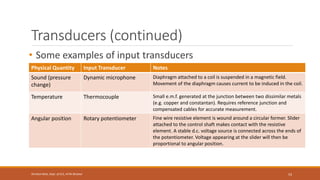
• Some examples of input transducers
53
Shrishail Bhat, Dept. of ECE, AITM Bhatkal
Physical Quantity Input Transducer Notes
Sound (pressure
change)
Dynamic microphone Diaphragm attached to a coil is suspended in a magnetic field.
Movement of the diaphragm causes current to be induced in the coil.
Temperature Thermocouple Small e.m.f. generated at the junction between two dissimilar metals
(e.g. copper and constantan). Requires reference junction and
compensated cables for accurate measurement.
Angular position Rotary potentiometer Fine wire resistive element is wound around a circular former. Slider
attached to the control shaft makes contact with the resistive
element. A stable d.c. voltage source is connected across the ends of
the potentiometer. Voltage appearing at the slider will then be
proportional to angular position.
Transducers (continued)
54
Shrishail Bhat, Dept. of ECE, AITM Bhatkal
A selection of thermocouple probes A selection of audible transducers
Transducers (continued)
• Some examples of output transducers
55
Shrishail Bhat, Dept. of ECE, AITM Bhatkal
Physical Quantity Output Transducer Notes
Sound (pressure
change)
Loudspeaker Diaphragm attached to a coil is suspended in a magnetic field.
Current in the coil causes movement of the diaphragm which
alternately compresses and rarefies the air mass in front of it.
Temperature Heating element (resistor) Metallic conductor is wound onto a ceramic or mica former. Current
flowing in the conductor produces heat.
Angular position Rotary potentiometer Multi-phase motor provides precise rotation in discrete steps of 15°
(24 steps per revolution), 7.5° (48 steps per revolution) and 1.8° (200
steps per revolution).
Sensors
• A sensor is a special kind of transducer that is used to generate
an input signal to a measurement, instrumentation or control
system.
• The signal produced by a sensor is an electrical analogy of a
physical quantity, such as distance, velocity, acceleration,
temperature, pressure, light level, etc.
• The signals returned from a sensor, together with control inputs
from the user or controller (as appropriate) will subsequently be
used to determine the output from the system.
• The choice of sensor is governed by a number of factors including
accuracy, resolution, cost and physical size.
56
Shrishail Bhat, Dept. of ECE, AITM Bhatkal
Sensors (continued)
• Sensors can be categorized as either active or passive.
• An active sensor generates a current or voltage output.
• A passive transducer requires a source of current or voltage
and it modifies this in some way (e.g. by virtue of a change in
the sensor’s resistance).
• The result may still be a voltage or current but it is not generated by
the sensor on its own.
57
Shrishail Bhat, Dept. of ECE, AITM Bhatkal
Sensors (continued)
• Sensors can also be classed as either digital or analogue.
• The output of a digital sensor can exist in only two discrete
states, either ‘on’ or ‘off’, ‘low’ or ‘high’, ‘logic 1’ or ‘logic 0’,
etc.
• The output of an analogue sensor can take any one of an
infinite number of voltage or current levels. It is thus said to
be continuously variable.
58
Shrishail Bhat, Dept. of ECE, AITM Bhatkal
Sensors (continued)
• Some examples of input transducers (sensors)
59
Shrishail Bhat, Dept. of ECE, AITM Bhatkal
Physical Quantity Input Transducer (Sensor) Notes
Angular position Resistive rotary position
sensor
Rotary track potentiometer with linear law produces analogue
voltage proportional to angular position.
Optical shaft encoder Encoded disk interposed between optical transmitter and receiver
(infrared LED and photodiode or photo-transistor).
Angular velocity Tachogenerator Small d.c. generator with linear output characteristic. Analogue
output voltage proportional to shaft speed.
Toothed rotor tachometer Magnetic pick-up responds to the movement of a toothed ferrous
disk. The pulse repetition frequency of the output is proportional to
the angular velocity.
Flow Rotating vane flow sensor Turbine rotor driven by fluid. Turbine interrupts infra-red beam. Pulse
repetition frequency of output is proportional to flow rate.
Sensors (continued)
60
Shrishail Bhat, Dept. of ECE, AITM Bhatkal
Resistive linear position sensor Liquid flow sensor (digital output)
Sensors (continued)
61
Shrishail Bhat, Dept. of ECE, AITM Bhatkal
Physical Quantity Input Transducer (Sensor) Notes
Linear position Resistive linear position
sensor
Linear track potentiometer with linear law produces analogue
voltage proportional to linear position. Limited linear range.
Linear variable differential
transformer (LVDT)
Miniature transformer with split secondary windings and moving
core attached to a plunger. Requires a.c. excitation and phase-
sensitive detector.
Magnetic linear position
sensor
Magnetic pick-up responds to movement of a toothed ferrous track.
Pulses are counted as the sensor moves along the track.
Sensors (continued)
62
Shrishail Bhat, Dept. of ECE, AITM Bhatkal
Physical Quantity Input Transducer (Sensor) Notes
Light level Photocell Voltage-generating device. The analogue output voltage produced is
proportional to light level.
Light-dependent resistor
(LDR)
An analogue output voltage results from a change of resistance
within a cadmium sulphide (CdS) sensing element. Usually connected
as part of a potential divider or bridge.
Photodiode Two-terminal device connected as a current source. An analogue
output voltage is developed across a series resistor of appropriate
value.
Phototransistor Three-terminal device connected as a current source. An analogue
output voltage is developed across a series resistor of appropriate
value.
Sensors (continued)
63
Shrishail Bhat, Dept. of ECE, AITM Bhatkal
Various optical and light sensors
Sensors (continued)
64
Shrishail Bhat, Dept. of ECE, AITM Bhatkal
Physical Quantity Input Transducer (Sensor) Notes
Liquid level Float switch Simple switch element which operates when a particular level is
detected.
Capacitive proximity
switch
Switching device which operates when a particular level is detected.
Ineffective with some liquids.
Diffuse scan proximity
switch
Switching device which operates when a particular level is detected.
Ineffective with some liquids.
Sensors (continued)
65
Shrishail Bhat, Dept. of ECE, AITM Bhatkal
Liquid level float switch
Sensors (continued)
66
Shrishail Bhat, Dept. of ECE, AITM Bhatkal
Physical Quantity Input Transducer (Sensor) Notes
Pressure Microswitch pressure
sensor
Microswitch fitted with actuator mechanism and range-setting
springs. Suitable for high-pressure applications.
Differential pressure
vacuum switch
Microswitch with actuator driven by a diaphragm. May be used to
sense differential pressure. Alternatively, one chamber may be
evacuated and the sensed pressure applied to a second input.
Piezo-resistive pressure
sensor
Pressure exerted on diaphragm causes changes of resistance in
attached piezo-resistive transducers. Transducers are usually
arranged in the form of a four active element bridge which produces
an analogue output voltage.
Sensors (continued)
67
Shrishail Bhat, Dept. of ECE, AITM Bhatkal
Various switch sensors
Sensors (continued)
68
Shrishail Bhat, Dept. of ECE, AITM Bhatkal
Physical Quantity Input Transducer (Sensor) Notes
Proximity Reed switch Reed switch and permanent magnet actuator. Only effective over
short distances.
Inductive proximity switch Target object modifies magnetic field generated by the sensor. Only
suitable for metals (non-ferrous metals with reduced sensitivity).
Capacitive proximity
switch
Target object modifies electric field generated by the sensor. Suitable
for metals, plastics, wood and some liquids and powders.
Optical proximity switch Available in diffuse and through scan types. Diffuse scan types
require reflective targets. Both types employ optical transmitters and
receivers (usually infra-red emitting LEDs and photo-diodes or photo-
transistors). Digital input port required.
Sensors (continued)
69
Shrishail Bhat, Dept. of ECE, AITM Bhatkal
Physical Quantity Input Transducer (Sensor) Notes
Strain Resistive strain gauge Foil type resistive element with polyester backing for attachment to
body under stress. Normally connected in full bridge configuration
with temperature-compensating gauges to provide an analogue
output voltage.
Semiconductor strain
gauge
Piezo-resistive elements provide greater outputs than comparable
resistive foil types. More prone to temperature changes and also
inherently non-linear.
Sensors (continued)
70
Shrishail Bhat, Dept. of ECE, AITM Bhatkal
Physical Quantity Input Transducer (Sensor) Notes
Temperature Thermocouple Small e.m.f. generated by a junction between two dissimilar metals.
For accurate measurement, requires compensated connecting cables
and specialized interface.
Thermistor Usually connected as part of a potential divider or bridge. An
analogue output voltage results from resistance changes within the
sensing element.
Semiconductor
temperature sensor
Two-terminal device connected as a current source. An analogue
output voltage is developed across a series resistor of appropriate
value.
Sensors (continued)
71
Shrishail Bhat, Dept. of ECE, AITM Bhatkal
Various temperature and gas sensors
Sensors (continued)
72
Shrishail Bhat, Dept. of ECE, AITM Bhatkal
Physical Quantity Input Transducer (Sensor) Notes
Weight Load cell Usually comprises four strain gauges attached to a metal frame. This
assembly is then loaded and the analogue output voltage produced
is proportional to the weight of the load.
Vibration Electromagnetic vibration
sensor
Permanent magnet seismic mass suspended by springs within a
cylindrical coil. The frequency and amplitude of the analogue output
voltage are respectively proportional to the frequency and amplitude
of vibration.
Actuators
• An actuator is a form of transducer device (mechanical or electrical)
which converts signals to corresponding physical action (motion).
73
Shrishail Bhat, Dept. of ECE, AITM Bhatkal
The I/O Subsystem
• The I/O subsystem of the embedded system facilitates the interaction
of the embedded system with the external world.
• The interaction happens through the sensors and actuators
connected to the input and output ports respectively of the
embedded system.
• The sensors may not be directly interfaced to the input ports, instead
they may be interfaced through signal conditioning and translating
systems like ADC, optocouplers, etc.
74
Shrishail Bhat, Dept. of ECE, AITM Bhatkal
Light Emitting Diode (LED)
• Light Emitting Diode (LED) is an important output device for visual
indication in any embedded system.
• LED can be used as an indicator for the status of various signals or
situations.
• E.g.: 'Device ON', 'Battery low' or 'Charging of battery’ conditions
• Light Emitting Diode is a p-n junction diode and it contains an
anode and a cathode.
• For proper functioning of the LED, the anode is connected to +ve
terminal of the supply voltage and cathode to the -ve terminal of
supply voltage.
• The current flowing through the LED must be limited to a value
below the maximum current that it can conduct.
• A resister is used in series to limit the current through the LED.
• The ideal LED interfacing circuit is shown in the figure.
Fig: LED interfacing
75
Shrishail Bhat, Dept. of ECE, AITM Bhatkal
Light Emitting Diode (LED) (continued)
• LEDs can be interfaced to the port pin of a processor/controller in
two ways:
• In the first method, the anode is directly connected to the port pin and
the port pin drives the LED.
• The port pin 'sources' current to the LED when the port pin is at logic High (Logic
‘1’).
• In the second method, the cathode of the LED is connected to the port
pin of the processor/controller and the anode to the supply voltage
through a current limiting resistor.
• The LED is turned on when the port pin is at logic Low (Logic '0’).
• Here the port pin 'sinks' current.
76
Shrishail Bhat, Dept. of ECE, AITM Bhatkal
7-Segment LED Display
• The 7-segment LED display is an output device
for displaying alpha numeric characters.
• It contains 7 LED segments arranged in a special
form used for displaying alpha numeric
characters and 1 LED used for representing
'decimal point' in decimal number display.
• The LED segments are named A to G and the
decimal point LED segment is named as DP.
• The LED segments A to G and DP should be lit
accordingly to display numbers and characters.
77
Shrishail Bhat, Dept. of ECE, AITM Bhatkal
Fig: 7-Segment LED Display
7-Segment LED Display (continued)
• The 7-segment LED displays are available in two different configurations,
namely; Common Anode and Common Cathode.
• In the common anode configuration, the anodes of the 8 segments are
connected commonly whereas in the common cathode configuration,
the cathodes of 8 LED segments are connected commonly.
• Figure illustrates the Common Anode and Cathode configurations.
78
Shrishail Bhat, Dept. of ECE, AITM Bhatkal
7-Segment LED Display (continued)
• Based on the configuration of the 7-segment LED unit, the LED segment's
anode or cathode is connected to the port of the processor/controller in
the order 'A' segment to the least significant port pin and DP segment to
the most significant port pin.
• The current flow through each of the LED segments should be limited to
the maximum value supported by the LED display unit.
• The typical value is 20mA.
• The current can be limited by connecting a current limiting resistor to the
anode or cathode of each segment.
• 7-segment LED display is used in low cost embedded applications like
Public telephone call monitoring devices, point of sale terminals, etc.
79
Shrishail Bhat, Dept. of ECE, AITM Bhatkal

Module 4 Electronics and communication.ppt

  • 1.
    INTRODUCTIONTO ELECTRONICS ENGINEERING (BESCK104C/BESCK204C) Bhatkal, Karnataka, India ANJUMAN Instituteof Technology and Management Mr. Shrishail Bhat Assistant Professor Department of Electronics and Communication Engineering
  • 3.
  • 4.
  • 5.
    05 Definition, Embedded systemsvs general computing systems, Classification of Embedded Systems, Major application areas of Embedded Systems, Elements of an Embedded System, Core of the Embedded System, Microprocessor vs Microcontroller, RISC vs CISC. Instrumentation and control systems, Transducers, Sensors, Actuators, LED, 7-Segment LED Display.
  • 6.
    Mike Tooley Elsevier 4th Edition,2015 Shibu K V Tata McGraw Hill Education Private Limited 2nd Edition, 2017 6
  • 7.
  • 8.
    What is anEmbedded System? • An embedded system is an electronic/electro-mechanical system designed to perform a specific function and is a combination of both hardware and firmware (software). • Every embedded system is unique and the hardware as well as the firmware is highly specialised to the application domain. 8 Shrishail Bhat, Dept. of ECE, AITM Bhatkal
  • 9.
    Embedded Systems vs.General Computing Systems • The computing revolution began with the general purpose computing requirements. Later it was realised that the general computing requirements are not sufficient for the embedded computing requirements. • The embedded computing requirements demand ‘something special’ in terms of response to stimuli, meeting the computational deadlines, power efficiency, limited memory capability, etc. 9 Shrishail Bhat, Dept. of ECE, AITM Bhatkal
  • 10.
    General Purpose ComputingSystem Embedded System A system which is a combination of a generic hardware and a General Purpose Operating System for executing a variety of applications A system which is a combination of special purpose hardware and embedded OS for executing a specific set of applications Contains a General Purpose Operating System (GPOS) May or may not contain an operating system for functioning Applications are alterable (programmable) by the user (It is possible for the end user to re-install the operating system, and also add or remove user applications) The firmware of the embedded system is pre-programmed and it is non-alterable by the end-user (There may be exceptions for system supporting OS kernel image flashing through special hardware settings) Performance is the key deciding factor in the selection of the system. Always, ‘Faster is Better’ Application-specific requirements (like performance, power requirements, memory usage, etc.) are the key deciding factors Less/not at all tailored towards reduced operating power requirements, options for different levels of power management Highly tailored to take advantage of the power saving modes supported by the hardware and the operating system Response requirements are not time-critical For certain category of embedded systems like mission critical systems, the response time requirement is highly critical Need not be deterministic in execution behaviour Execution behaviour is deterministic for certain types of embedded systems like ‘Hard Real Time’ systems 10 Shrishail Bhat, Dept. of ECE, AITM Bhatkal
  • 11.
    Classification of EmbeddedSystems • Some of the criteria used in the classification of embedded systems are: 1. Based on generation 2. Based on complexity and performance requirements 3. Based on deterministic behaviour 4. Based on triggering 11 Shrishail Bhat, Dept. of ECE, AITM Bhatkal
  • 12.
    Classification Based onGeneration • First Generation • Second Generation • Third Generation • Fourth Generation • Next Generation 12 Shrishail Bhat, Dept. of ECE, AITM Bhatkal
  • 13.
    Classification Based onGeneration (continued) • First Generation • Early embedded systems were built around 8-bit microprocessors like 8085 and Z80 and 4-bit microcontrollers. • Simple in hardware circuits with firmware developed in assembly code. • E.g.: Digital telephone keypads, stepper motor control units, etc. 13 Shrishail Bhat, Dept. of ECE, AITM Bhatkal
  • 14.
    Classification Based onGeneration (continued) • Second Generation • Embedded systems built around 16-bit microprocessors and 8-bit or 16-bit microcontrollers. • Instruction set were much more complex and powerful than the first generation. • Some of the second generation embedded systems contained embedded operating systems for their operation. • E.g.: Data acquisition systems, SCADA systems, etc. 14 Shrishail Bhat, Dept. of ECE, AITM Bhatkal
  • 15.
    Classification Based onGeneration (continued) • Third Generation • Embedded systems built around 32-bit microprocessors and 16-bit microcontrollers. • Application and domain specific processors/controllers like Digital Signal Processors (DSP) and Application Specific Integrated Circuits (ASICs) came into picture. • The instruction set of processors became more complex and powerful and the concept of instruction pipelining also evolved. • Dedicated embedded real time and general purpose operating systems entered into the embedded market. • Embedded systems spread its ground to areas like robotics, media, industrial process control, networking, etc. 15 Shrishail Bhat, Dept. of ECE, AITM Bhatkal
  • 16.
    Classification Based onGeneration (continued) • Fourth Generation • The advent of System on Chips (SoC), reconfigurable processors and multicore processors are bringing high performance, tight integration and miniaturisation into the embedded device market. • The SoC technique implements a total system on a chip by implementing different functionalities with a processor core on an integrated circuit. • They make use of high performance real time embedded operating systems for their functioning. • E.g.: Smart phone devices, Mobile Internet Devices (MIDs), etc. 16 Shrishail Bhat, Dept. of ECE, AITM Bhatkal
  • 17.
    Classification Based onGeneration (continued) • Next Generation • The processor and embedded market is highly dynamic and demanding. • The next generation embedded systems are expected to meet growing demands in the market. 17 Shrishail Bhat, Dept. of ECE, AITM Bhatkal
  • 18.
    Classification Based onComplexity and Performance • Small-Scale Embedded Systems • Medium-Scale Embedded Systems • Large-Scale Embedded Systems/Complex Systems 18 Shrishail Bhat, Dept. of ECE, AITM Bhatkal
  • 19.
    Classification Based onComplexity and Performance (continued) • Small-Scale Embedded Systems • Simple in application needs and the performance requirements are not time critical. • E.g.: An electronic toy • Usually built around low performance and low cost 8-bit or 16-bit microprocessors/microcontrollers. • May or may not contain an operating system for its functioning. 19 Shrishail Bhat, Dept. of ECE, AITM Bhatkal
  • 20.
    Classification Based onComplexity and Performance (continued) • Medium-Scale Embedded Systems • Slightly complex in hardware and firmware (software) requirements. • Usually built around medium performance, low cost 16-bit or 32- bit microprocessors/microcontrollers or digital signal processors. • Usually contain an embedded operating system (either general purpose or real time operating system) for functioning. 20 Shrishail Bhat, Dept. of ECE, AITM Bhatkal
  • 21.
    Classification Based onComplexity and Performance (continued) • Large-Scale Embedded Systems/Complex Systems • Highly complex in hardware and firmware (software) requirements. • They are employed in mission critical applications demanding high performance. • Usually built around high performance 32-bit or 64-bit RISC processors/controllers or Reconfigurable System on Chip (RSoC) or multi- core processors and programmable logic devices. • May contain multiple processors/controllers and co-units/hardware accelerators for offloading the processing requirements from the main processor of the system. • Decoding/encoding of media, cryptographic function implementation, etc. are examples of processing requirements which can be implemented using a co-processor/hardware accelerator. • Usually contain a high performance real time operating system (RTOS) for task scheduling, prioritization and management. 21 Shrishail Bhat, Dept. of ECE, AITM Bhatkal
  • 22.
    Classification Based onDeterministic Behaviour • Applicable for ‘Real Time’ systems. • The application/task execution behaviour can be either deterministic or non-deterministic. • Based on the execution behaviour, real time embedded systems are classified into Hard Real Time and Soft Real Time systems. 22 Shrishail Bhat, Dept. of ECE, AITM Bhatkal
  • 23.
    Classification Based onTriggering • Embedded systems which are ‘Reactive’ in nature (like process control systems in industrial control applications) can be classified based on the trigger. • Reactive systems can be either event-triggered or time-triggered. 23 Shrishail Bhat, Dept. of ECE, AITM Bhatkal
  • 24.
    Major Application Areasof Embedded Systems 1. Consumer electronics: Camcorders, cameras, etc. 2. Household appliances: Television, DVD players, washing machine, refrigerators, microwave oven, etc. 3. Home automation and security systems: Air conditioners, sprinklers, intruder detection alarms, closed circuit television (CCTV) cameras, fire alarms, etc. 4. Automotive industry: Anti-lock braking systems (ABS), engine control, ignition systems, automatic navigation systems, etc. 5. Telecom: Cellular telephones, telephone switches, handset multimedia applications, etc. 24 Shrishail Bhat, Dept. of ECE, AITM Bhatkal
  • 25.
    Major Application Areasof Embedded Systems (continued) 6. Computer peripherals: Printers, scanners, fax machines, etc. 7. Computer networking systems: Network routers, switches, hubs, firewalls, etc. 8. Healthcare: Different kinds of scanners, EEG, ECG machines, etc. 9. Measurements & Instrumentation: Digital multimeters, digital CROs, logic analyzers, PLC systems, etc. 10. Banking & Retail: Automated teller machines (ATM) and currency counters, point of sales (POS), etc. 11. Card readers: Barcode, smart card readers, hand held devices, etc. 25 Shrishail Bhat, Dept. of ECE, AITM Bhatkal
  • 26.
    Major Application Areasof Embedded Systems (continued) 12. Wearable Devices: Health and fitness trackers, Smartphone screen extension for notifications, etc. 13. Cloud Computing and Internet of Things (IoT) 26 Shrishail Bhat, Dept. of ECE, AITM Bhatkal
  • 27.
    The Typical Embedded System ELEMENTSOF AN EMBEDDED SYSTEM 27 Shrishail Bhat, Dept. of ECE, AITM Bhatkal
  • 28.
    The Typical EmbeddedSystem Fig: Elements of an Embedded System 28 Shrishail Bhat, Dept. of ECE, AITM Bhatkal
  • 29.
    The Typical EmbeddedSystem (continued) 29 Shrishail Bhat, Dept. of ECE, AITM Bhatkal • It contains a single chip controller, which acts as the master brain of the system. • The controller can be ✓ A microprocessor or ✓ A microcontroller or ✓ A Field Programmable Gate Array (FPGA) device or ✓ A Digital Signal Processor (DSP) or ✓ An Application Specific Integrated Circuit (ASIC)/Application Specific Standard Product (ASSP)
  • 30.
    The Typical EmbeddedSystem (continued) 30 Shrishail Bhat, Dept. of ECE, AITM Bhatkal • An embedded system can be viewed as a reactive system. • The control is achieved by processing the information coming from the sensors and user interfaces, and controlling some actuators that regulate the physical variable. • Key boards, push button switches, etc. are examples for common user interface input devices. • LEDs, liquid crystal displays, piezoelectric buzzers, etc. are examples for common user interface output devices for a typical embedded system.
  • 31.
    The Typical EmbeddedSystem (continued) 31 Shrishail Bhat, Dept. of ECE, AITM Bhatkal • The memory of the system is responsible for holding the control algorithm and other important configuration details. • For most of embedded systems, the memory for storing the algorithm or configuration data is of fixed type, which is a kind of Read Only Memory (ROM). • It is not available for the end user for modifications • The memory is protected from unwanted user interaction by implementing some kind of memory protection mechanism. • The most common types of memories used in embedded systems for control algorithm storage are OTP, PROM, UVEPROM, EEPROM and FLASH. • Sometimes the system requires temporary memory for performing arithmetic operations or control algorithm execution and this type of memory is known as "working memory". • Random Access Memory (RAM) is used in most of the systems as the working memory. • Various types of RAM like SRAM, DRAM and NVRAM are used for this purpose.
  • 32.
    The Typical EmbeddedSystem (continued) 32 Shrishail Bhat, Dept. of ECE, AITM Bhatkal • Apart from these, communication interface is essential for communicating with various subsystems of the embedded system and with the external world. • The communication interfaces may be used to achieve onboard (I2C, SPI, UART, parallel bus interface, etc.) or external communication (wireless interfaces like Infrared, Bluetooth, Wi-Fi, etc.)
  • 33.
    Core of theEmbedded System • Embedded systems are domain and application specific and are built around a central core. • The core of the embedded system falls into any one of the following categories: 1.General Purpose and Domain Specific Processors 1.1 Microprocessors 1.2 Microcontrollers 1.3 Digital Signal Processors 2.Application Specific Integrated Circuits (ASICs) 3.Programmable Logic Devices (PLDs) 4.Commercial off-the-shelf Components (COTS) 33 Shrishail Bhat, Dept. of ECE, AITM Bhatkal
  • 34.
    Microprocessor vs. Microcontroller •A Microprocessor is a silicon chip representing a central processing unit (CPU), which is capable of performing arithmetic as well as logical operations according to a pre-defined set of instructions. • A Microcontroller is a highly integrated chip that contains a CPU, scratch pad RAM, special and general purpose register arrays, on chip ROM/FLASH memory for program storage, timer and interrupt control units and dedicated I/O ports. 34 Shrishail Bhat, Dept. of ECE, AITM Bhatkal
  • 35.
    Microprocessor vs. Microcontroller (continued) MicroprocessorMicrocontroller A silicon chip representing a central processing unit (CPU), which is capable of performing arithmetic as well as logical operations according to a pre-defined set of instructions A microcontroller is a highly integrated chip that contains a CPU, scratchpad RAM, special and general purpose register arrays, on chip ROM/ FLASH memory for program storage, timer and interrupt control units and dedicated I/O ports It is a dependent unit. It requires the combination of other chips like timers, program and data memory chips, interrupt controllers, etc. for functioning It is a self-contained unit and it doesn't require external interrupt controller, timer, UART, etc. for its functioning Most of the time, general purpose in design and operation Mostly application-oriented or domain-specific Doesn't contain a built in I/O port. The I/O port functionality needs to be implemented with the help of external programmable peripheral interface chips like 8255 Most of the processors contain multiple built-in I/O ports which can be operated as a single 8 or 16 or 32 bit port or as individual port pins Targeted for high end market where performance is important Targeted for embedded market where performance is not so critical Limited power saving options compared to microcontrollers Includes lot of power saving features 35 Shrishail Bhat, Dept. of ECE, AITM Bhatkal
  • 36.
    Microprocessor vs. Microcontroller (continued) 36 ShrishailBhat, Dept. of ECE, AITM Bhatkal Microprocessor-based system Microcontroller
  • 37.
    RISC vs. CISCProcessors/Controllers • RISC stands for Reduced Instruction Set Computing. • All RISC processors/controllers possess lesser number of instructions, typically in the range of 30 to 40. • E.g.: Atmel AVR microcontroller – its instruction set contains only 32 instructions. • CISC stands for Complex Instruction Set Computing. • The instruction set is complex and instructions are high in number. • E.g.: 8051 microcontroller – its instruction set contains 255 instructions. 37 Shrishail Bhat, Dept. of ECE, AITM Bhatkal
  • 38.
    RISC CISC Lesser numberof instructions Greater number of instructions Instruction pipelining and increased execution speed Generally no instruction pipelining feature Orthogonal instruction set (Allows each instruction to operate on any register and use any addressing mode) Non-orthogonal instruction set (All instructions are not allowed to operate on any register and use any addressing mode. It is instruction-specific) Operations are performed on registers only, the only memory operations are load and store Operations are performed on registers or memory depending on the instruction A large number of registers are available Limited number of general purpose registers Programmer needs to write more code to execute a task since the instructions are simpler ones Instructions are like macros in C language. A programmer can achieve the desired functionality with a single instruction which in turn provides the effect of using more simpler single instructions in RISC Single, fixed length instructions Variable length instructions Less silicon usage and pin count More silicon usage since more additional decoder logic is required to implement the complex instruction decoding With Harvard Architecture Can be Harvard or Von-Neumann Architecture 38 Shrishail Bhat, Dept. of ECE, AITM Bhatkal
  • 39.
    Harvard vs. Von-Neumann Processor/ControIIerArchitecture • Von-Neumann Architecture • Microprocessors/controllers based on the Von-Neumann architecture share a single common bus for fetching both instructions and data. • Program instructions and data are stored in a common main memory. • They first fetch an instruction and then fetch the data to support the instruction from code memory. • The two separate fetches slows down the controller's operation. • Von-Neumann architecture is also referred as Princeton architecture, since it was developed by the Princeton University. 39 Shrishail Bhat, Dept. of ECE, AITM Bhatkal
  • 40.
    Harvard vs. Von-Neumann Processor/ControIIerArchitecture (continued) • Harvard Architecture • Microprocessors/controllers based on the Harvard architecture will have separate data bus and instruction bus. • This allows the data transfer and program fetching to occur simultaneously on both buses. • The data memory can be read and written while the program memory is being accessed. • These separated data memory and code memory buses allow one instruction to execute while the next instruction is fetched ("pre- fetching"). • The pre-fetch theoretically allows much faster execution than Von-Neumann architecture. 40 Shrishail Bhat, Dept. of ECE, AITM Bhatkal
  • 41.
    Harvard vs. Von-Neumann Processor/ControIIerArchitecture (continued) Harvard Architecture Von-Neumann Architecture Separate buses for instruction and data fetching Single shared bus for instruction and data fetching Easier to pipeline, so high performance can be achieved Low performance compared to Harvard architecture Comparatively high cost Cheaper No memory alignment problems Allows self modifying codes Since data memory and program memory are stored physically in different locations, no chances for accidental corruption of program memory Since data memory and program memory are stored physically in the same chip, chances for accidental corruption of program memory 41 Shrishail Bhat, Dept. of ECE, AITM Bhatkal
  • 42.
    Sensors and Actuators 42 ShrishailBhat, Dept. of ECE, AITM Bhatkal
  • 43.
    Sensors and Actuators •An embedded system is in constant interaction with the real world and the controlling/monitoring functions executed by the embedded system is achieved in accordance with the changes happening to the real world. • The changes in system environment or variables are detected by the sensors connected to the input port of the embedded system. • If the embedded system is designed for any controlling purpose, the system will produce some changes in the controlling variable to bring the controlled variable to the desired value. • It is achieved through an actuator connected to the output port of the embedded system. 43 Shrishail Bhat, Dept. of ECE, AITM Bhatkal
  • 44.
    Sensors and Actuators(continued) • A sensor is a transducer device that converts energy from one form to another for any measurement or control purpose. • E.g.: Temperature sensor, magnetic hall effect sensor, humidity sensor, etc. • An actuator is a form of transducer device (mechanical or electrical) which converts signals to corresponding physical action (motion). • Actuator acts as an output device. • E.g.: Stepper motor 44 Shrishail Bhat, Dept. of ECE, AITM Bhatkal
  • 45.
    Sensors and Interfacing 45 ShrishailBhat, Dept. of ECE, AITM Bhatkal
  • 46.
    Instrumentation and Control Systems 46 ShrishailBhat, Dept. of ECE, AITM Bhatkal Fig: An Instrumentation System • Fig. shows the arrangement of an instrumentation system.
  • 47.
    Instrumentation and Control Systems(continued) • The physical quantity to be measured (e.g. temperature) acts upon a sensor that produces an electrical output signal. • This signal is an electrical analogue of the physical input but there may not be a linear relationship between the physical quantity and its electrical equivalent. • Because of this and since the output produced by the sensor may be small or may suffer from the presence of noise (i.e. unwanted signals), further signal conditioning will be required before the signal will be at an acceptable level and in an acceptable form for signal processing, display and recording. • Furthermore, because the signal processing may use digital rather than analogue signals an additional stage of analogue-to-digital conversion may be required. 47 Shrishail Bhat, Dept. of ECE, AITM Bhatkal
  • 48.
    Instrumentation and Control Systems(continued) • Fig. shows the arrangement of a control system. 48 Shrishail Bhat, Dept. of ECE, AITM Bhatkal Fig: A Control System
  • 49.
    Instrumentation and Control Systems(continued) • The control system uses negative feedback in order to regulate and stabilize the output. • It thus becomes possible to set the input or demand (i.e. what we desire the output to be) and leave the system to regulate itself by comparing it with a signal derived from the output (via a sensor and appropriate signal conditioning). • A comparator is used to sense the difference in these two signals and where any discrepancy is detected the input to the power amplifier is adjusted accordingly. 49 Shrishail Bhat, Dept. of ECE, AITM Bhatkal
  • 50.
    Instrumentation and Control Systems(continued) • This signal is referred to as an error signal (it should be zero when the output exactly matches the demand). • The input (demand) is often derived from a simple potentiometer connected across a stable d.c. voltage source while the controlled device can take many forms (e.g. a d.c. motor, linear actuator, heater, etc.). 50 Shrishail Bhat, Dept. of ECE, AITM Bhatkal
  • 51.
    Transducers • Transducers aredevices that convert energy in the form of sound, light, heat, etc., into an equivalent electrical signal, or vice versa. • For example, a loudspeaker is a transducer that converts low- frequency electric current into audible sounds. • A microphone, on the other hand, is a transducer that performs the reverse function, i.e. that of converting sound pressure variations into voltage or current. • Loudspeakers and microphones can thus be considered as complementary transducers. 51 Shrishail Bhat, Dept. of ECE, AITM Bhatkal
  • 52.
    Transducers (continued) • Transducersmay be used both as inputs to electronic circuits and outputs from them. • For example, a loudspeaker is an output transducer designed for use in conjunction with an audio system. • A microphone is an input transducer designed for use with a recording or sound reinforcing system. 52 Shrishail Bhat, Dept. of ECE, AITM Bhatkal
  • 53.
    Transducers (continued) • Someexamples of input transducers 53 Shrishail Bhat, Dept. of ECE, AITM Bhatkal Physical Quantity Input Transducer Notes Sound (pressure change) Dynamic microphone Diaphragm attached to a coil is suspended in a magnetic field. Movement of the diaphragm causes current to be induced in the coil. Temperature Thermocouple Small e.m.f. generated at the junction between two dissimilar metals (e.g. copper and constantan). Requires reference junction and compensated cables for accurate measurement. Angular position Rotary potentiometer Fine wire resistive element is wound around a circular former. Slider attached to the control shaft makes contact with the resistive element. A stable d.c. voltage source is connected across the ends of the potentiometer. Voltage appearing at the slider will then be proportional to angular position.
  • 54.
    Transducers (continued) 54 Shrishail Bhat,Dept. of ECE, AITM Bhatkal A selection of thermocouple probes A selection of audible transducers
  • 55.
    Transducers (continued) • Someexamples of output transducers 55 Shrishail Bhat, Dept. of ECE, AITM Bhatkal Physical Quantity Output Transducer Notes Sound (pressure change) Loudspeaker Diaphragm attached to a coil is suspended in a magnetic field. Current in the coil causes movement of the diaphragm which alternately compresses and rarefies the air mass in front of it. Temperature Heating element (resistor) Metallic conductor is wound onto a ceramic or mica former. Current flowing in the conductor produces heat. Angular position Rotary potentiometer Multi-phase motor provides precise rotation in discrete steps of 15° (24 steps per revolution), 7.5° (48 steps per revolution) and 1.8° (200 steps per revolution).
  • 56.
    Sensors • A sensoris a special kind of transducer that is used to generate an input signal to a measurement, instrumentation or control system. • The signal produced by a sensor is an electrical analogy of a physical quantity, such as distance, velocity, acceleration, temperature, pressure, light level, etc. • The signals returned from a sensor, together with control inputs from the user or controller (as appropriate) will subsequently be used to determine the output from the system. • The choice of sensor is governed by a number of factors including accuracy, resolution, cost and physical size. 56 Shrishail Bhat, Dept. of ECE, AITM Bhatkal
  • 57.
    Sensors (continued) • Sensorscan be categorized as either active or passive. • An active sensor generates a current or voltage output. • A passive transducer requires a source of current or voltage and it modifies this in some way (e.g. by virtue of a change in the sensor’s resistance). • The result may still be a voltage or current but it is not generated by the sensor on its own. 57 Shrishail Bhat, Dept. of ECE, AITM Bhatkal
  • 58.
    Sensors (continued) • Sensorscan also be classed as either digital or analogue. • The output of a digital sensor can exist in only two discrete states, either ‘on’ or ‘off’, ‘low’ or ‘high’, ‘logic 1’ or ‘logic 0’, etc. • The output of an analogue sensor can take any one of an infinite number of voltage or current levels. It is thus said to be continuously variable. 58 Shrishail Bhat, Dept. of ECE, AITM Bhatkal
  • 59.
    Sensors (continued) • Someexamples of input transducers (sensors) 59 Shrishail Bhat, Dept. of ECE, AITM Bhatkal Physical Quantity Input Transducer (Sensor) Notes Angular position Resistive rotary position sensor Rotary track potentiometer with linear law produces analogue voltage proportional to angular position. Optical shaft encoder Encoded disk interposed between optical transmitter and receiver (infrared LED and photodiode or photo-transistor). Angular velocity Tachogenerator Small d.c. generator with linear output characteristic. Analogue output voltage proportional to shaft speed. Toothed rotor tachometer Magnetic pick-up responds to the movement of a toothed ferrous disk. The pulse repetition frequency of the output is proportional to the angular velocity. Flow Rotating vane flow sensor Turbine rotor driven by fluid. Turbine interrupts infra-red beam. Pulse repetition frequency of output is proportional to flow rate.
  • 60.
    Sensors (continued) 60 Shrishail Bhat,Dept. of ECE, AITM Bhatkal Resistive linear position sensor Liquid flow sensor (digital output)
  • 61.
    Sensors (continued) 61 Shrishail Bhat,Dept. of ECE, AITM Bhatkal Physical Quantity Input Transducer (Sensor) Notes Linear position Resistive linear position sensor Linear track potentiometer with linear law produces analogue voltage proportional to linear position. Limited linear range. Linear variable differential transformer (LVDT) Miniature transformer with split secondary windings and moving core attached to a plunger. Requires a.c. excitation and phase- sensitive detector. Magnetic linear position sensor Magnetic pick-up responds to movement of a toothed ferrous track. Pulses are counted as the sensor moves along the track.
  • 62.
    Sensors (continued) 62 Shrishail Bhat,Dept. of ECE, AITM Bhatkal Physical Quantity Input Transducer (Sensor) Notes Light level Photocell Voltage-generating device. The analogue output voltage produced is proportional to light level. Light-dependent resistor (LDR) An analogue output voltage results from a change of resistance within a cadmium sulphide (CdS) sensing element. Usually connected as part of a potential divider or bridge. Photodiode Two-terminal device connected as a current source. An analogue output voltage is developed across a series resistor of appropriate value. Phototransistor Three-terminal device connected as a current source. An analogue output voltage is developed across a series resistor of appropriate value.
  • 63.
    Sensors (continued) 63 Shrishail Bhat,Dept. of ECE, AITM Bhatkal Various optical and light sensors
  • 64.
    Sensors (continued) 64 Shrishail Bhat,Dept. of ECE, AITM Bhatkal Physical Quantity Input Transducer (Sensor) Notes Liquid level Float switch Simple switch element which operates when a particular level is detected. Capacitive proximity switch Switching device which operates when a particular level is detected. Ineffective with some liquids. Diffuse scan proximity switch Switching device which operates when a particular level is detected. Ineffective with some liquids.
  • 65.
    Sensors (continued) 65 Shrishail Bhat,Dept. of ECE, AITM Bhatkal Liquid level float switch
  • 66.
    Sensors (continued) 66 Shrishail Bhat,Dept. of ECE, AITM Bhatkal Physical Quantity Input Transducer (Sensor) Notes Pressure Microswitch pressure sensor Microswitch fitted with actuator mechanism and range-setting springs. Suitable for high-pressure applications. Differential pressure vacuum switch Microswitch with actuator driven by a diaphragm. May be used to sense differential pressure. Alternatively, one chamber may be evacuated and the sensed pressure applied to a second input. Piezo-resistive pressure sensor Pressure exerted on diaphragm causes changes of resistance in attached piezo-resistive transducers. Transducers are usually arranged in the form of a four active element bridge which produces an analogue output voltage.
  • 67.
    Sensors (continued) 67 Shrishail Bhat,Dept. of ECE, AITM Bhatkal Various switch sensors
  • 68.
    Sensors (continued) 68 Shrishail Bhat,Dept. of ECE, AITM Bhatkal Physical Quantity Input Transducer (Sensor) Notes Proximity Reed switch Reed switch and permanent magnet actuator. Only effective over short distances. Inductive proximity switch Target object modifies magnetic field generated by the sensor. Only suitable for metals (non-ferrous metals with reduced sensitivity). Capacitive proximity switch Target object modifies electric field generated by the sensor. Suitable for metals, plastics, wood and some liquids and powders. Optical proximity switch Available in diffuse and through scan types. Diffuse scan types require reflective targets. Both types employ optical transmitters and receivers (usually infra-red emitting LEDs and photo-diodes or photo- transistors). Digital input port required.
  • 69.
    Sensors (continued) 69 Shrishail Bhat,Dept. of ECE, AITM Bhatkal Physical Quantity Input Transducer (Sensor) Notes Strain Resistive strain gauge Foil type resistive element with polyester backing for attachment to body under stress. Normally connected in full bridge configuration with temperature-compensating gauges to provide an analogue output voltage. Semiconductor strain gauge Piezo-resistive elements provide greater outputs than comparable resistive foil types. More prone to temperature changes and also inherently non-linear.
  • 70.
    Sensors (continued) 70 Shrishail Bhat,Dept. of ECE, AITM Bhatkal Physical Quantity Input Transducer (Sensor) Notes Temperature Thermocouple Small e.m.f. generated by a junction between two dissimilar metals. For accurate measurement, requires compensated connecting cables and specialized interface. Thermistor Usually connected as part of a potential divider or bridge. An analogue output voltage results from resistance changes within the sensing element. Semiconductor temperature sensor Two-terminal device connected as a current source. An analogue output voltage is developed across a series resistor of appropriate value.
  • 71.
    Sensors (continued) 71 Shrishail Bhat,Dept. of ECE, AITM Bhatkal Various temperature and gas sensors
  • 72.
    Sensors (continued) 72 Shrishail Bhat,Dept. of ECE, AITM Bhatkal Physical Quantity Input Transducer (Sensor) Notes Weight Load cell Usually comprises four strain gauges attached to a metal frame. This assembly is then loaded and the analogue output voltage produced is proportional to the weight of the load. Vibration Electromagnetic vibration sensor Permanent magnet seismic mass suspended by springs within a cylindrical coil. The frequency and amplitude of the analogue output voltage are respectively proportional to the frequency and amplitude of vibration.
  • 73.
    Actuators • An actuatoris a form of transducer device (mechanical or electrical) which converts signals to corresponding physical action (motion). 73 Shrishail Bhat, Dept. of ECE, AITM Bhatkal
  • 74.
    The I/O Subsystem •The I/O subsystem of the embedded system facilitates the interaction of the embedded system with the external world. • The interaction happens through the sensors and actuators connected to the input and output ports respectively of the embedded system. • The sensors may not be directly interfaced to the input ports, instead they may be interfaced through signal conditioning and translating systems like ADC, optocouplers, etc. 74 Shrishail Bhat, Dept. of ECE, AITM Bhatkal
  • 75.
    Light Emitting Diode(LED) • Light Emitting Diode (LED) is an important output device for visual indication in any embedded system. • LED can be used as an indicator for the status of various signals or situations. • E.g.: 'Device ON', 'Battery low' or 'Charging of battery’ conditions • Light Emitting Diode is a p-n junction diode and it contains an anode and a cathode. • For proper functioning of the LED, the anode is connected to +ve terminal of the supply voltage and cathode to the -ve terminal of supply voltage. • The current flowing through the LED must be limited to a value below the maximum current that it can conduct. • A resister is used in series to limit the current through the LED. • The ideal LED interfacing circuit is shown in the figure. Fig: LED interfacing 75 Shrishail Bhat, Dept. of ECE, AITM Bhatkal
  • 76.
    Light Emitting Diode(LED) (continued) • LEDs can be interfaced to the port pin of a processor/controller in two ways: • In the first method, the anode is directly connected to the port pin and the port pin drives the LED. • The port pin 'sources' current to the LED when the port pin is at logic High (Logic ‘1’). • In the second method, the cathode of the LED is connected to the port pin of the processor/controller and the anode to the supply voltage through a current limiting resistor. • The LED is turned on when the port pin is at logic Low (Logic '0’). • Here the port pin 'sinks' current. 76 Shrishail Bhat, Dept. of ECE, AITM Bhatkal
  • 77.
    7-Segment LED Display •The 7-segment LED display is an output device for displaying alpha numeric characters. • It contains 7 LED segments arranged in a special form used for displaying alpha numeric characters and 1 LED used for representing 'decimal point' in decimal number display. • The LED segments are named A to G and the decimal point LED segment is named as DP. • The LED segments A to G and DP should be lit accordingly to display numbers and characters. 77 Shrishail Bhat, Dept. of ECE, AITM Bhatkal Fig: 7-Segment LED Display
  • 78.
    7-Segment LED Display(continued) • The 7-segment LED displays are available in two different configurations, namely; Common Anode and Common Cathode. • In the common anode configuration, the anodes of the 8 segments are connected commonly whereas in the common cathode configuration, the cathodes of 8 LED segments are connected commonly. • Figure illustrates the Common Anode and Cathode configurations. 78 Shrishail Bhat, Dept. of ECE, AITM Bhatkal
  • 79.
    7-Segment LED Display(continued) • Based on the configuration of the 7-segment LED unit, the LED segment's anode or cathode is connected to the port of the processor/controller in the order 'A' segment to the least significant port pin and DP segment to the most significant port pin. • The current flow through each of the LED segments should be limited to the maximum value supported by the LED display unit. • The typical value is 20mA. • The current can be limited by connecting a current limiting resistor to the anode or cathode of each segment. • 7-segment LED display is used in low cost embedded applications like Public telephone call monitoring devices, point of sale terminals, etc. 79 Shrishail Bhat, Dept. of ECE, AITM Bhatkal