@ McGraw-Hill Education
1
PROPRIETARY MATERIAL. © 2009 The McGraw-Hill Companies, Inc. All rights reserved. No part of this PowerPoint slide may be displayed, reproduced or
distributed in any form or by any means, without the prior written permission of the publisher, or used beyond the limited distribution to teachers and educators
permitted by McGraw-Hill for their individual course preparation. If you are a student using this PowerPoint slide, you are using it without permission.
@ McGraw-Hill Education
2
Introduction to Embedded System
What is Embedded System?
An Electronic/Electro mechanical system which is designed to perform a specific
function and is a combination of both hardware and firmware (Software)
E.g. Electronic Toys, Mobile Handsets, Washing Machines, Air Conditioners,
Automotive Control Units, Set Top Box, DVD Player etc…
Embedded Systems are:
 Unique in character and behavior
 With specialized hardware and software
@ McGraw-Hill Education
3
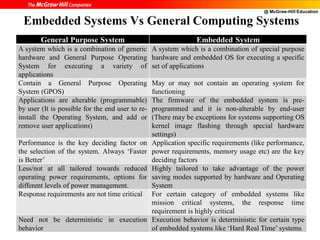
Embedded Systems Vs General Computing Systems
General Purpose System Embedded System
A system which is a combination of generic
hardware and General Purpose Operating
System for executing a variety of
applications
A system which is a combination of special purpose
hardware and embedded OS for executing a specific
set of applications
Contain a General Purpose Operating
System (GPOS)
May or may not contain an operating system for
functioning
Applications are alterable (programmable)
by user (It is possible for the end user to re-
install the Operating System, and add or
remove user applications)
The firmware of the embedded system is pre-
programmed and it is non-alterable by end-user
(There may be exceptions for systems supporting OS
kernel image flashing through special hardware
settings)
Performance is the key deciding factor on
the selection of the system. Always ‘Faster
is Better’
Application specific requirements (like performance,
power requirements, memory usage etc) are the key
deciding factors
Less/not at all tailored towards reduced
operating power requirements, options for
different levels of power management.
Highly tailored to take advantage of the power
saving modes supported by hardware and Operating
System
Response requirements are not time critical For certain category of embedded systems like
mission critical systems, the response time
requirement is highly critical
Need not be deterministic in execution
behavior
Execution behavior is deterministic for certain type
of embedded systems like ‘Hard Real Time’ systems
@ McGraw-Hill Education
4
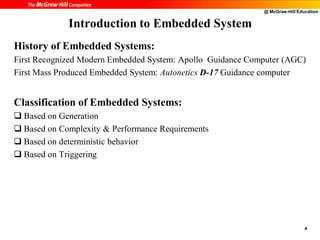
History of Embedded Systems:
First Recognized Modern Embedded System: Apollo Guidance Computer (AGC)
First Mass Produced Embedded System: Autonetics D-17 Guidance computer
Classification of Embedded Systems:
 Based on Generation
 Based on Complexity & Performance Requirements
 Based on deterministic behavior
 Based on Triggering
Introduction to Embedded System
@ McGraw-Hill Education
5
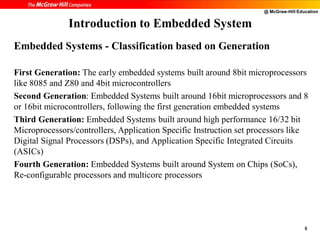
Embedded Systems - Classification based on Generation
First Generation: The early embedded systems built around 8bit microprocessors
like 8085 and Z80 and 4bit microcontrollers
Second Generation: Embedded Systems built around 16bit microprocessors and 8
or 16bit microcontrollers, following the first generation embedded systems
Third Generation: Embedded Systems built around high performance 16/32 bit
Microprocessors/controllers, Application Specific Instruction set processors like
Digital Signal Processors (DSPs), and Application Specific Integrated Circuits
(ASICs)
Fourth Generation: Embedded Systems built around System on Chips (SoCs),
Re-configurable processors and multicore processors
Introduction to Embedded System
@ McGraw-Hill Education
6
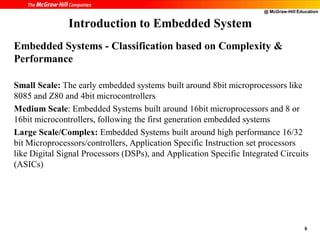
Embedded Systems - Classification based on Complexity &
Performance
Small Scale: The early embedded systems built around 8bit microprocessors like
8085 and Z80 and 4bit microcontrollers
Medium Scale: Embedded Systems built around 16bit microprocessors and 8 or
16bit microcontrollers, following the first generation embedded systems
Large Scale/Complex: Embedded Systems built around high performance 16/32
bit Microprocessors/controllers, Application Specific Instruction set processors
like Digital Signal Processors (DSPs), and Application Specific Integrated Circuits
(ASICs)
Introduction to Embedded System
@ McGraw-Hill Education
7
Classification based on deterministic behaviour
• It is applicable for Real time systems
• Soft real time systems: Missing a deadline may not be critical
and can be tolerated to a certain degree.
• Hard real time systems: Missing a program/task execution time
deadline can have catastrophic consequences(financial, human
loss of life etc)
@ McGraw-Hill Education
8
Based on Triggering
• Event Triggered: Activities within the system are dynamic and
depend upon the occurrence of different events
• Time triggered: Activities within the system follow statically
computed schedule(ie they are allocated time slots during which
they can takes place)
@ McGraw-Hill Education
9
Major Application Areas of Embedded Systems
 Consumer Electronics: Camcorders, Cameras etc.
 Household Appliances: Television, DVD players, Washing machine, Fridge, Microwave
Oven etc.
 Home Automation and Security Systems: Air conditioners, sprinklers, Intruder detection
alarms, Closed Circuit Television Cameras, Fire alarms etc.
 Automotive Industry: Anti-lock breaking systems (ABS), Engine Control, Ignition
Systems, Automatic Navigation Systems etc.
 Telecom: Cellular Telephones, Telephone switches, Handset Multimedia Applications
etc.
 Computer Peripherals: Printers, Scanners, Fax machines etc.
 Computer Networking Systems: Network Routers, Switches, Hubs, Firewalls etc.
 Health Care: Different Kinds of Scanners, EEG, ECG Machines etc.
 Measurement & Instrumentation: Digital multi meters, Digital CROs, Logic Analyzers
PLC systems etc.
 Banking & Retail: Automatic Teller Machines (ATM) and Currency counters, Point of
Sales (POS)
 Card Readers: Barcode, Smart Card Readers, Hand held Devices etc.
Introduction to Embedded System
@ McGraw-Hill Education
10
Purpose of Embedded Systems
Each Embedded Systems is designed to serve the purpose of any one
or a combination of the following tasks.
 Data Collection/Storage/Representation
 Data Communication
 Data (Signal) Processing
 Monitoring
 Control
 Application Specific User Interface
Introduction to Embedded System
@ McGraw-Hill Education
11
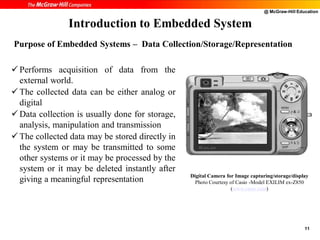
 Performs acquisition of data from the
external world.
 The collected data can be either analog or
digital
 Data collection is usually done for storage,
analysis, manipulation and transmission
 The collected data may be stored directly in
the system or may be transmitted to some
other systems or it may be processed by the
system or it may be deleted instantly after
giving a meaningful representation
Introduction to Embedded System
Digital Camera for Image capturing/storage/display
Photo Courtesy of Casio -Model EXILIM ex-Z850
(www.casio.com)
Purpose of Embedded Systems – Data Collection/Storage/Representation
@ McGraw-Hill Education
12
 Embedded Data communication systems are
deployed in applications ranging from complex
satellite communication systems to simple home
networking systems
 Embedded Data communication systems are
dedicated for data communication
 The data communication can happen through a
wired interface (like Ethernet, RS-
232C/USB/IEEE1394 etc) or wireless interface
(like Wi-Fi, GSM,/GPRS, Bluetooth, ZigBee etc)
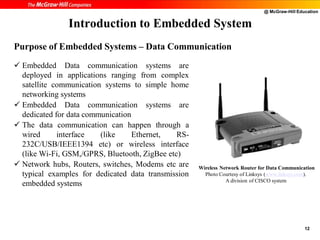
 Network hubs, Routers, switches, Modems etc are
typical examples for dedicated data transmission
embedded systems
Introduction to Embedded System
Wireless Network Router for Data Communication
Photo Courtesy of Linksys (www.linksys.com).
A division of CISCO system
Purpose of Embedded Systems – Data Communication
@ McGraw-Hill Education
13
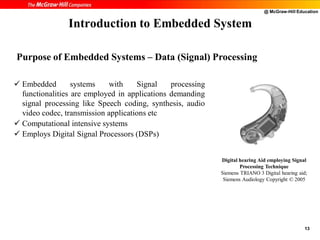
 Embedded systems with Signal processing
functionalities are employed in applications demanding
signal processing like Speech coding, synthesis, audio
video codec, transmission applications etc
 Computational intensive systems
 Employs Digital Signal Processors (DSPs)
Introduction to Embedded System
Digital hearing Aid employing Signal
Processing Technique
Siemens TRIANO 3 Digital hearing aid;
Siemens Audiology Copyright © 2005
Purpose of Embedded Systems – Data (Signal) Processing
@ McGraw-Hill Education
14
 Embedded systems coming under this category are
specifically designed for monitoring purpose
 They are used for determining the state of some
variables using input sensors
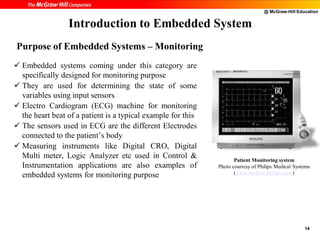
 Electro Cardiogram (ECG) machine for monitoring
the heart beat of a patient is a typical example for this
 The sensors used in ECG are the different Electrodes
connected to the patient’s body
 Measuring instruments like Digital CRO, Digital
Multi meter, Logic Analyzer etc used in Control &
Instrumentation applications are also examples of
embedded systems for monitoring purpose
Introduction to Embedded System
Patient Monitoring system
Photo courtesy of Philips Medical Systems
(www.medical.philips.com/)
Purpose of Embedded Systems – Monitoring
@ McGraw-Hill Education
15
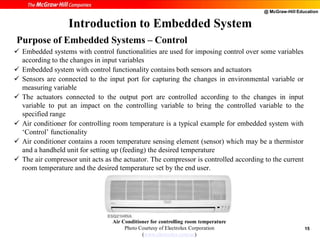
 Embedded systems with control functionalities are used for imposing control over some variables
according to the changes in input variables
 Embedded system with control functionality contains both sensors and actuators
 Sensors are connected to the input port for capturing the changes in environmental variable or
measuring variable
 The actuators connected to the output port are controlled according to the changes in input
variable to put an impact on the controlling variable to bring the controlled variable to the
specified range
 Air conditioner for controlling room temperature is a typical example for embedded system with
‘Control’ functionality
 Air conditioner contains a room temperature sensing element (sensor) which may be a thermistor
and a handheld unit for setting up (feeding) the desired temperature
 The air compressor unit acts as the actuator. The compressor is controlled according to the current
room temperature and the desired temperature set by the end user.
Introduction to Embedded System
Air Conditioner for controlling room temperature
Photo Courtesy of Electrolux Corporation
(www.electrolux.com/au)
Purpose of Embedded Systems – Control
@ McGraw-Hill Education
16
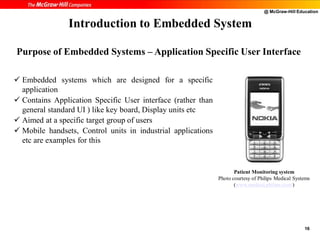
 Embedded systems which are designed for a specific
application
 Contains Application Specific User interface (rather than
general standard UI ) like key board, Display units etc
 Aimed at a specific target group of users
 Mobile handsets, Control units in industrial applications
etc are examples for this
Introduction to Embedded System
Patient Monitoring system
Photo courtesy of Philips Medical Systems
(www.medical.philips.com/)
Purpose of Embedded Systems – Application Specific User Interface
@ McGraw-Hill Education
17
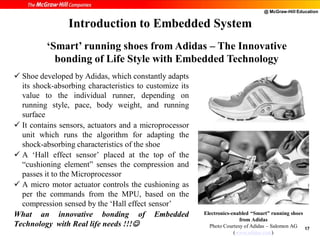
 Shoe developed by Adidas, which constantly adapts
its shock-absorbing characteristics to customize its
value to the individual runner, depending on
running style, pace, body weight, and running
surface
 It contains sensors, actuators and a microprocessor
unit which runs the algorithm for adapting the
shock-absorbing characteristics of the shoe
 A ‘Hall effect sensor’ placed at the top of the
“cushioning element” senses the compression and
passes it to the Microprocessor
 A micro motor actuator controls the cushioning as
per the commands from the MPU, based on the
compression sensed by the ‘Hall effect sensor’
What an innovative bonding of Embedded
Technology with Real life needs !!!
Introduction to Embedded System
Electronics-enabled “Smart” running shoes
from Adidas
Photo Courtesy of Adidas – Salomon AG
(www.adidas.com)
‘Smart’ running shoes from Adidas – The Innovative
bonding of Life Style with Embedded Technology
Chapter_01_MODULE1-PPT.pdf..............

  • 1.
    @ McGraw-Hill Education 1 PROPRIETARYMATERIAL. © 2009 The McGraw-Hill Companies, Inc. All rights reserved. No part of this PowerPoint slide may be displayed, reproduced or distributed in any form or by any means, without the prior written permission of the publisher, or used beyond the limited distribution to teachers and educators permitted by McGraw-Hill for their individual course preparation. If you are a student using this PowerPoint slide, you are using it without permission.
  • 2.
    @ McGraw-Hill Education 2 Introductionto Embedded System What is Embedded System? An Electronic/Electro mechanical system which is designed to perform a specific function and is a combination of both hardware and firmware (Software) E.g. Electronic Toys, Mobile Handsets, Washing Machines, Air Conditioners, Automotive Control Units, Set Top Box, DVD Player etc… Embedded Systems are:  Unique in character and behavior  With specialized hardware and software
  • 3.
    @ McGraw-Hill Education 3 EmbeddedSystems Vs General Computing Systems General Purpose System Embedded System A system which is a combination of generic hardware and General Purpose Operating System for executing a variety of applications A system which is a combination of special purpose hardware and embedded OS for executing a specific set of applications Contain a General Purpose Operating System (GPOS) May or may not contain an operating system for functioning Applications are alterable (programmable) by user (It is possible for the end user to re- install the Operating System, and add or remove user applications) The firmware of the embedded system is pre- programmed and it is non-alterable by end-user (There may be exceptions for systems supporting OS kernel image flashing through special hardware settings) Performance is the key deciding factor on the selection of the system. Always ‘Faster is Better’ Application specific requirements (like performance, power requirements, memory usage etc) are the key deciding factors Less/not at all tailored towards reduced operating power requirements, options for different levels of power management. Highly tailored to take advantage of the power saving modes supported by hardware and Operating System Response requirements are not time critical For certain category of embedded systems like mission critical systems, the response time requirement is highly critical Need not be deterministic in execution behavior Execution behavior is deterministic for certain type of embedded systems like ‘Hard Real Time’ systems
  • 4.
    @ McGraw-Hill Education 4 Historyof Embedded Systems: First Recognized Modern Embedded System: Apollo Guidance Computer (AGC) First Mass Produced Embedded System: Autonetics D-17 Guidance computer Classification of Embedded Systems:  Based on Generation  Based on Complexity & Performance Requirements  Based on deterministic behavior  Based on Triggering Introduction to Embedded System
  • 5.
    @ McGraw-Hill Education 5 EmbeddedSystems - Classification based on Generation First Generation: The early embedded systems built around 8bit microprocessors like 8085 and Z80 and 4bit microcontrollers Second Generation: Embedded Systems built around 16bit microprocessors and 8 or 16bit microcontrollers, following the first generation embedded systems Third Generation: Embedded Systems built around high performance 16/32 bit Microprocessors/controllers, Application Specific Instruction set processors like Digital Signal Processors (DSPs), and Application Specific Integrated Circuits (ASICs) Fourth Generation: Embedded Systems built around System on Chips (SoCs), Re-configurable processors and multicore processors Introduction to Embedded System
  • 6.
    @ McGraw-Hill Education 6 EmbeddedSystems - Classification based on Complexity & Performance Small Scale: The early embedded systems built around 8bit microprocessors like 8085 and Z80 and 4bit microcontrollers Medium Scale: Embedded Systems built around 16bit microprocessors and 8 or 16bit microcontrollers, following the first generation embedded systems Large Scale/Complex: Embedded Systems built around high performance 16/32 bit Microprocessors/controllers, Application Specific Instruction set processors like Digital Signal Processors (DSPs), and Application Specific Integrated Circuits (ASICs) Introduction to Embedded System
  • 7.
    @ McGraw-Hill Education 7 Classificationbased on deterministic behaviour • It is applicable for Real time systems • Soft real time systems: Missing a deadline may not be critical and can be tolerated to a certain degree. • Hard real time systems: Missing a program/task execution time deadline can have catastrophic consequences(financial, human loss of life etc)
  • 8.
    @ McGraw-Hill Education 8 Basedon Triggering • Event Triggered: Activities within the system are dynamic and depend upon the occurrence of different events • Time triggered: Activities within the system follow statically computed schedule(ie they are allocated time slots during which they can takes place)
  • 9.
    @ McGraw-Hill Education 9 MajorApplication Areas of Embedded Systems  Consumer Electronics: Camcorders, Cameras etc.  Household Appliances: Television, DVD players, Washing machine, Fridge, Microwave Oven etc.  Home Automation and Security Systems: Air conditioners, sprinklers, Intruder detection alarms, Closed Circuit Television Cameras, Fire alarms etc.  Automotive Industry: Anti-lock breaking systems (ABS), Engine Control, Ignition Systems, Automatic Navigation Systems etc.  Telecom: Cellular Telephones, Telephone switches, Handset Multimedia Applications etc.  Computer Peripherals: Printers, Scanners, Fax machines etc.  Computer Networking Systems: Network Routers, Switches, Hubs, Firewalls etc.  Health Care: Different Kinds of Scanners, EEG, ECG Machines etc.  Measurement & Instrumentation: Digital multi meters, Digital CROs, Logic Analyzers PLC systems etc.  Banking & Retail: Automatic Teller Machines (ATM) and Currency counters, Point of Sales (POS)  Card Readers: Barcode, Smart Card Readers, Hand held Devices etc. Introduction to Embedded System
  • 10.
    @ McGraw-Hill Education 10 Purposeof Embedded Systems Each Embedded Systems is designed to serve the purpose of any one or a combination of the following tasks.  Data Collection/Storage/Representation  Data Communication  Data (Signal) Processing  Monitoring  Control  Application Specific User Interface Introduction to Embedded System
  • 11.
    @ McGraw-Hill Education 11 Performs acquisition of data from the external world.  The collected data can be either analog or digital  Data collection is usually done for storage, analysis, manipulation and transmission  The collected data may be stored directly in the system or may be transmitted to some other systems or it may be processed by the system or it may be deleted instantly after giving a meaningful representation Introduction to Embedded System Digital Camera for Image capturing/storage/display Photo Courtesy of Casio -Model EXILIM ex-Z850 (www.casio.com) Purpose of Embedded Systems – Data Collection/Storage/Representation
  • 12.
    @ McGraw-Hill Education 12 Embedded Data communication systems are deployed in applications ranging from complex satellite communication systems to simple home networking systems  Embedded Data communication systems are dedicated for data communication  The data communication can happen through a wired interface (like Ethernet, RS- 232C/USB/IEEE1394 etc) or wireless interface (like Wi-Fi, GSM,/GPRS, Bluetooth, ZigBee etc)  Network hubs, Routers, switches, Modems etc are typical examples for dedicated data transmission embedded systems Introduction to Embedded System Wireless Network Router for Data Communication Photo Courtesy of Linksys (www.linksys.com). A division of CISCO system Purpose of Embedded Systems – Data Communication
  • 13.
    @ McGraw-Hill Education 13 Embedded systems with Signal processing functionalities are employed in applications demanding signal processing like Speech coding, synthesis, audio video codec, transmission applications etc  Computational intensive systems  Employs Digital Signal Processors (DSPs) Introduction to Embedded System Digital hearing Aid employing Signal Processing Technique Siemens TRIANO 3 Digital hearing aid; Siemens Audiology Copyright © 2005 Purpose of Embedded Systems – Data (Signal) Processing
  • 14.
    @ McGraw-Hill Education 14 Embedded systems coming under this category are specifically designed for monitoring purpose  They are used for determining the state of some variables using input sensors  Electro Cardiogram (ECG) machine for monitoring the heart beat of a patient is a typical example for this  The sensors used in ECG are the different Electrodes connected to the patient’s body  Measuring instruments like Digital CRO, Digital Multi meter, Logic Analyzer etc used in Control & Instrumentation applications are also examples of embedded systems for monitoring purpose Introduction to Embedded System Patient Monitoring system Photo courtesy of Philips Medical Systems (www.medical.philips.com/) Purpose of Embedded Systems – Monitoring
  • 15.
    @ McGraw-Hill Education 15 Embedded systems with control functionalities are used for imposing control over some variables according to the changes in input variables  Embedded system with control functionality contains both sensors and actuators  Sensors are connected to the input port for capturing the changes in environmental variable or measuring variable  The actuators connected to the output port are controlled according to the changes in input variable to put an impact on the controlling variable to bring the controlled variable to the specified range  Air conditioner for controlling room temperature is a typical example for embedded system with ‘Control’ functionality  Air conditioner contains a room temperature sensing element (sensor) which may be a thermistor and a handheld unit for setting up (feeding) the desired temperature  The air compressor unit acts as the actuator. The compressor is controlled according to the current room temperature and the desired temperature set by the end user. Introduction to Embedded System Air Conditioner for controlling room temperature Photo Courtesy of Electrolux Corporation (www.electrolux.com/au) Purpose of Embedded Systems – Control
  • 16.
    @ McGraw-Hill Education 16 Embedded systems which are designed for a specific application  Contains Application Specific User interface (rather than general standard UI ) like key board, Display units etc  Aimed at a specific target group of users  Mobile handsets, Control units in industrial applications etc are examples for this Introduction to Embedded System Patient Monitoring system Photo courtesy of Philips Medical Systems (www.medical.philips.com/) Purpose of Embedded Systems – Application Specific User Interface
  • 17.
    @ McGraw-Hill Education 17 Shoe developed by Adidas, which constantly adapts its shock-absorbing characteristics to customize its value to the individual runner, depending on running style, pace, body weight, and running surface  It contains sensors, actuators and a microprocessor unit which runs the algorithm for adapting the shock-absorbing characteristics of the shoe  A ‘Hall effect sensor’ placed at the top of the “cushioning element” senses the compression and passes it to the Microprocessor  A micro motor actuator controls the cushioning as per the commands from the MPU, based on the compression sensed by the ‘Hall effect sensor’ What an innovative bonding of Embedded Technology with Real life needs !!! Introduction to Embedded System Electronics-enabled “Smart” running shoes from Adidas Photo Courtesy of Adidas – Salomon AG (www.adidas.com) ‘Smart’ running shoes from Adidas – The Innovative bonding of Life Style with Embedded Technology