Evaluating
Information
It is important to evaluate information critically. You should
not believe everything you read. You should be able to reject
or accept information based on the characteristics of the
information and the source.
by Speciality Mc
Criteria for Evaluating Information
1 Refereed Publications
Articles in scholarly journals go through a rigorous process of peer evaluation. This
means that articles in refereed publications are more likely to be acceptable.
2 Level of Scholarship
Scholarly publications are intended for a specific audience and may lack a more in-depth
analysis. Consider the intended audience when evaluating information.
3 Specificity and Relevance
Newspaper articles are generally intended for a general audience and may not be
specific enough for research purposes. Carefully examine the title, preface, table of
contents, and abstracts to determine relevance.
4 Authority of the Author
Authors associated with reputable organizations are usually more authoritative on the
subject. Consider the author's expertise, publications, and affiliations.
Evaluating Information (Continued)
1 Familiarity with Literature
An authoritative publication will contain references to other publications. Determine
whether the publication contains a bibliography and if the author displays knowledge of
theories and techniques in the field.
2 Accuracy of the Publication
Compare the publication with other publications to determine accuracy. Are the data
presented comparable to those in other publications?
3 Timeliness of Information
Timeliness is extremely relevant in the evaluation of information. Publications that
appeared early in the century may be extremely relevant for historical research.
4 Objectivity of the Information
Whether to reject subjective information depends on the research topic. Empirical
scientific research should rely primarily on objective information.
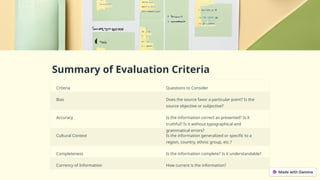
Summary of Evaluation Criteria
Criteria Questions to Consider
Bias Does the source favor a particular point? Is the
source objective or subjective?
Accuracy Is the information correct as presented? Is it
truthful? Is it without typographical and
grammatical errors?
Cultural Context Is the information generalized or specific to a
region, country, ethnic group, etc.?
Completeness Is the information complete? Is it understandable?
Currency of Information How current is the information?
Evaluating Information
on the Internet
Many of the considerations discussed earlier must be applied
to information obtained from the Internet. The Internet poses
additional challenges due to the ease with which one can
publish information.
Internet Information: Additional
Considerations
Decoding URLs
The URL will tell whether the
Web page was part of the
pages hosted by an academic
organization, a commercial
organization, or hosted by a
private individual.
Refereed Information
Some organizations only allow
their members to publish Web
pages after some form of
refereeing by the organization
itself. Any Web page with such a
policy will contain a reference
to it.
Webmasters
Many organizations appoint
Webmasters. If one can contact
a Webmaster directly from a
page, then the page has
probably obtained some sort of
approval from the organization.
Internet Information:
Currency and Links
1 Currency
It is usually important to determine the last date on which the
page was updated. Good Web pages tend to contain the name
of the author, together with the copyright sign as well as an
indication of the date on which the page was last updated.
2 Links
If the page contains links to other pages that one already has
decided to accept as reliable, then the author of the page
shows a good understanding of the literature. Links to the
page from other pages that have already been judged to be
reliable are also important.
Evaluating Information: Key Takeaways
Evaluating information is crucial for making informed decisions. Consider the source, the author, the content,
and the context. Be critical and skeptical, and always strive to verify information from multiple sources.
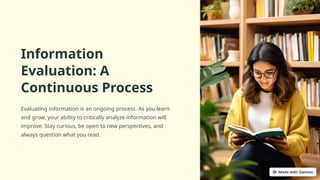
Information
Evaluation: A
Continuous Process
Evaluating information is an ongoing process. As you learn
and grow, your ability to critically analyze information will
improve. Stay curious, be open to new perspectives, and
always question what you read.
Information Literacy: A
Lifelong Skill
Information literacy is a valuable skill that will serve you well
throughout your life. By developing your ability to evaluate
information critically, you can become a more informed and
discerning individual.

Module 3 FDFFBBBBBBBBFGFDFGFDGDGDFGFGFSSFDS

  • 1.
    Evaluating Information It is importantto evaluate information critically. You should not believe everything you read. You should be able to reject or accept information based on the characteristics of the information and the source. by Speciality Mc
  • 2.
    Criteria for EvaluatingInformation 1 Refereed Publications Articles in scholarly journals go through a rigorous process of peer evaluation. This means that articles in refereed publications are more likely to be acceptable. 2 Level of Scholarship Scholarly publications are intended for a specific audience and may lack a more in-depth analysis. Consider the intended audience when evaluating information. 3 Specificity and Relevance Newspaper articles are generally intended for a general audience and may not be specific enough for research purposes. Carefully examine the title, preface, table of contents, and abstracts to determine relevance. 4 Authority of the Author Authors associated with reputable organizations are usually more authoritative on the subject. Consider the author's expertise, publications, and affiliations.
  • 3.
    Evaluating Information (Continued) 1Familiarity with Literature An authoritative publication will contain references to other publications. Determine whether the publication contains a bibliography and if the author displays knowledge of theories and techniques in the field. 2 Accuracy of the Publication Compare the publication with other publications to determine accuracy. Are the data presented comparable to those in other publications? 3 Timeliness of Information Timeliness is extremely relevant in the evaluation of information. Publications that appeared early in the century may be extremely relevant for historical research. 4 Objectivity of the Information Whether to reject subjective information depends on the research topic. Empirical scientific research should rely primarily on objective information.
  • 4.
    Summary of EvaluationCriteria Criteria Questions to Consider Bias Does the source favor a particular point? Is the source objective or subjective? Accuracy Is the information correct as presented? Is it truthful? Is it without typographical and grammatical errors? Cultural Context Is the information generalized or specific to a region, country, ethnic group, etc.? Completeness Is the information complete? Is it understandable? Currency of Information How current is the information?
  • 5.
    Evaluating Information on theInternet Many of the considerations discussed earlier must be applied to information obtained from the Internet. The Internet poses additional challenges due to the ease with which one can publish information.
  • 6.
    Internet Information: Additional Considerations DecodingURLs The URL will tell whether the Web page was part of the pages hosted by an academic organization, a commercial organization, or hosted by a private individual. Refereed Information Some organizations only allow their members to publish Web pages after some form of refereeing by the organization itself. Any Web page with such a policy will contain a reference to it. Webmasters Many organizations appoint Webmasters. If one can contact a Webmaster directly from a page, then the page has probably obtained some sort of approval from the organization.
  • 7.
    Internet Information: Currency andLinks 1 Currency It is usually important to determine the last date on which the page was updated. Good Web pages tend to contain the name of the author, together with the copyright sign as well as an indication of the date on which the page was last updated. 2 Links If the page contains links to other pages that one already has decided to accept as reliable, then the author of the page shows a good understanding of the literature. Links to the page from other pages that have already been judged to be reliable are also important.
  • 8.
    Evaluating Information: KeyTakeaways Evaluating information is crucial for making informed decisions. Consider the source, the author, the content, and the context. Be critical and skeptical, and always strive to verify information from multiple sources.
  • 9.
    Information Evaluation: A Continuous Process Evaluatinginformation is an ongoing process. As you learn and grow, your ability to critically analyze information will improve. Stay curious, be open to new perspectives, and always question what you read.
  • 10.
    Information Literacy: A LifelongSkill Information literacy is a valuable skill that will serve you well throughout your life. By developing your ability to evaluate information critically, you can become a more informed and discerning individual.