MODULE 3
LINKED LISTS
CONTENTS
 Definition
 Representation of linked lists in Memory
 Linked list operations
 Traversing
 Searching
 Insertion
 Deletion
 Doubly Linked lists
 Circular linked lists
 Header linked lists
 Linked Stacks and Queues
 Applications of Linked lists
 Polynomials
 Sparse matrix representation
INTRODUCTION
 One way by which we can store a list of items is using arrays,
in which every item is stored in consecutive memory locations.
 However, the disadvantage of arrays is operations like
insertion and deletion are expensive to perform.
 Also changing the size of an array is not a straightforward task.
 An alternate way of storing a list of items in the memory is by
considering each item as an individual entity and storing it.
 Also every item will have a field called link, that contains the
address of the next item in the list.
INTRODUCTION
 This means, we need not store successive items of the list in
successive memory locations.
 Such an arrangement also makes insertion and deletion of items
very easy. This is accomplished using a data structure called Linked
List.
“A Linked List or One-Way List is a linear collection of data
elements, called nodes, where the linear order is given by means of
pointers.”
 Hence, for a given list of items, if array is used to store the items,
then the sequence of items in the array must be same as the
sequence mentioned in the list.
 However, with linked list, the sequence need not be the same as
mentioned.
INTRODUCTION
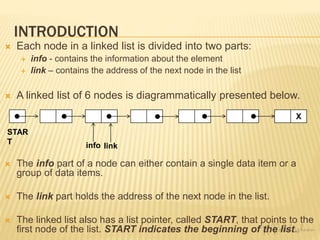
 Each node in a linked list is divided into two parts:
 info - contains the information about the element
 link – contains the address of the next node in the list
 A linked list of 6 nodes is diagrammatically presented below.
X
STAR
T info link
 The info part of a node can either contain a single data item or a
group of data items.
 The link part holds the address of the next node in the list.
 The linked list also has a list pointer, called START, that points to the
first node of the list. START indicates the beginning of the list.
REPRESENTATION OF LINKED LISTS IN MEMORY
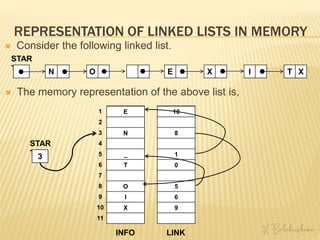
 Since a simple linked list is made up of two parts(info and link), a
linked list is maintained using two linear arrays in the memory.
 One array is called the INFO array and it contains the information of
all linked list nodes.
 The second array is called the LINK array and it contains the
addresses of next nodes in the linked list.
 The index positions in the array correspond to the list nodes.
 For an index position k, INFO[k] and LINK[k] will contain the data in
node k and address of next node to k respectively.
 The list also requires a variable, called START, that points to the first
node of the list.
REPRESENTATION OF LINKED LISTS IN MEMORY
 Consider the following linked list.
N O E X I
STAR
T T X
 The memory representation of the above list is,
1
2
3
4
5
6
7
8
9
10
11
INFO LINK
E
N
_
T
O
I
X
10
8
1
0
5
6
9
STAR
T 3
REPRESENTATION OF LINKED LISTS IN MEMORY
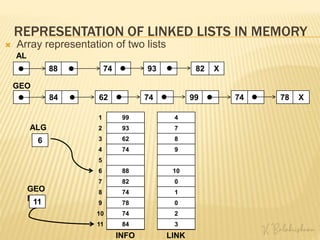
 Array representation of two lists
88 74 93 82 X
AL
G
84 62 74 99 74 78 X
GEO
M
1
2
3
4
5
6
7
8
9
10
11
INFO LINK
93
88
82
74
7
10
0
2
ALG
6
99
93
62
74
88
82
74
78
74
84
4
7
8
9
10
0
1
0
2
3
GEO
M11
REPRESENTATION OF LINKED LISTS IN MEMORY
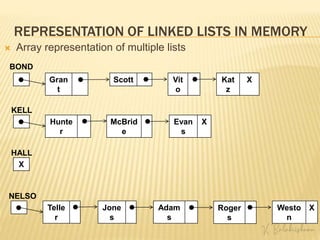
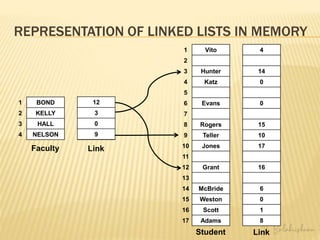
 Array representation of multiple lists
Gran
t
Scott Vit
o
Kat
z
X
BOND
Hunte
r
McBrid
e
Evan
s
X
KELL
Y
HALL
X
Telle
r
Jone
s
Adam
s
NELSO
N Roger
s
Westo
n
X
REPRESENTATION OF LINKED LISTS IN MEMORY
1
2
3
4
5
6
7
8
9
10
11
12
13
14
15
16
17
Student Link
1
2
3
4
Faculty Link
BOND
KELLY
HALL
NELSON
Vito
Katz
Grant
Scott
4
0
16
1
12
Vito
Hunter
Katz
Evans
Grant
McBride
Scott
4
14
0
0
16
6
1
12
3
12
3
0
Vito
Hunter
Katz
Evans
Rogers
Teller
Jones
Grant
McBride
Weston
Scott
Adams
4
14
0
0
15
10
17
16
6
0
1
8
12
3
0
9
REPRESENTATION OF LINKED LISTS IN MEMORY
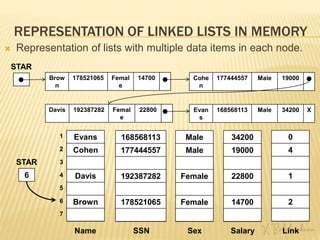
 Representation of lists with multiple data items in each node.
Brow
n
178521065 Femal
e
14700
STAR
T Cohe
n
177444557 Male 19000
Davis 192387282 Femal
e
22800 Evan
s
168568113 Male 34200 X
1
2
3
4
5
6
7
Evans
Cohen
Davis
Brown
168568113
177444557
192387282
178521065
Male
Male
Female
Female
34200
19000
22800
14700
0
4
1
2
Name SSN Sex Salary Link
STAR
T
6
REPRESENTATION OF LINKED LISTS IN MEMORY
Defining a linked list node
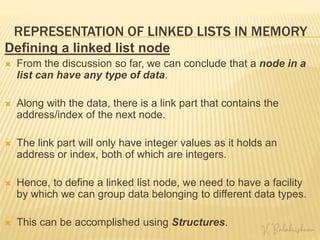
 From the discussion so far, we can conclude that a node in a
list can have any type of data.
 Along with the data, there is a link part that contains the
address/index of the next node.
 The link part will only have integer values as it holds an
address or index, both of which are integers.
 Hence, to define a linked list node, we need to have a facility
by which we can group data belonging to different data types.
 This can be accomplished using Structures.
REPRESENTATION OF LINKED LISTS IN MEMORY
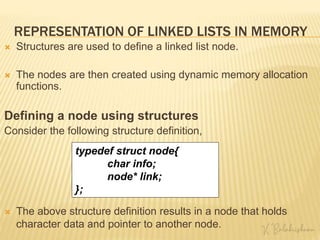
 Structures are used to define a linked list node.
 The nodes are then created using dynamic memory allocation
functions.
Defining a node using structures
Consider the following structure definition,
typedef struct node{
char info;
node* link;
};
 The above structure definition results in a node that holds
character data and pointer to another node.
REPRESENTATION OF LINKED LISTS IN MEMORY
Node creation using malloc()
 With the node definition ready, we can now create a linked list
node.
 For this, we first declare a pointer variable as follows,
node* ptr;
 We then use dynamic memory allocation functions to create a
node.
ptr = (node*)malloc(sizeof(node));
1000 1001 1002 1003 1004 1005 1006
Info link
1000 1001 1002 1003 1004 1005 1006
1002
ptr
REPRESENTATION OF LINKED LISTS IN MEMORY
Assigning values to a node
 Once a node has been created, we next need to fill the node
with appropriate values.
 The node that we have created can hold a character in the info
field and address in the link field.
 Here the info and link fields are members of a structure.
 Hence, to assign values to info and link fields, we need to
access these structure members.
 We know that a structure member can be accessed using a
structure variable and the DOT operator.
REPRESENTATION OF LINKED LISTS IN MEMORY
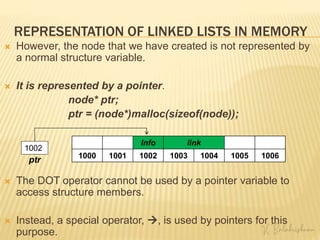
 However, the node that we have created is not represented by
a normal structure variable.
 It is represented by a pointer.
node* ptr;
ptr = (node*)malloc(sizeof(node));
1000 1001 1002 1003 1004 1005 1006
Info link
1000 1001 1002 1003 1004 1005 1006
1002
ptr
 The DOT operator cannot be used by a pointer variable to
access structure members.
 Instead, a special operator, , is used by pointers for this
purpose.
REPRESENTATION OF LINKED LISTS IN MEMORY
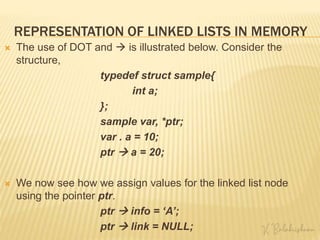
 The use of DOT and  is illustrated below. Consider the
structure,
typedef struct sample{
int a;
};
sample var, *ptr;
var . a = 10;
ptr  a = 20;
 We now see how we assign values for the linked list node
using the pointer ptr.
ptr  info = ‘A’;
ptr  link = NULL;
REPRESENTATION OF LINKED LISTS IN MEMORY
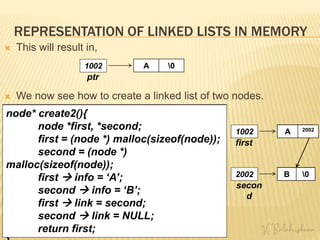
 This will result in,
ptr
A 0
1002
 We now see how to create a linked list of two nodes.
node* create2(){
node *first, *second;
} first
1002
node* create2(){
node *first, *second;
first = (node *) malloc(sizeof(node));
}
node* create2(){
node *first, *second;
first = (node *) malloc(sizeof(node));
second = (node *)
malloc(sizeof(node));
}
secon
d
2002
node* create2(){
node *first, *second;
first = (node *) malloc(sizeof(node));
second = (node *)
malloc(sizeof(node));
first  info = ‘A’;
second  info = ‘B’;
}
A
B
node* create2(){
node *first, *second;
first = (node *) malloc(sizeof(node));
second = (node *)
malloc(sizeof(node));
first  info = ‘A’;
second  info = ‘B’;
first  link = second;
}
A 2002
node* create2(){
node *first, *second;
first = (node *) malloc(sizeof(node));
second = (node *)
malloc(sizeof(node));
first  info = ‘A’;
second  info = ‘B’;
first  link = second;
second  link = NULL;
return first;
B 0
LINKED LIST OPERATIONS
Traversing
Traversing a list involves visiting all the linked list nodes.
A 78 B 32 C 19 D 66 E 21 F 0
STAR
T
05
PTR
Algorithm: (Traversing a Linked List) This algorithm visits all nodes of a
linked list, applying an operation PROCESS on each node of the list. The
variable PTR points to the node currently being processed.
1. Set PTR := START.
2. Repeat steps 3 and 4 while PTR ≠ NULL:
3. Apply PROCESS to PTR  info.
4. Set PTR := PTR  link.
[End of Step 2 loop.]
5. Exit
PTR PTR
05 78 32 19 66 21
PTR PTR PTR
LINKED LIST OPERATIONS
Algorithm: PRINT(START) This algorithm prints the information at each node
of the list.
1. Set PTR := START.
2. Repeat steps 3 and 4 while PTR ≠ NULL:
3. Write : PTR  info.
4. Set PTR := PTR  link.
[End of Step 2 loop.]
5. Exit
Algorithm: COUNT(START, NUM) This algorithm finds the number of
elements in the list.
1. Set NUM := 0.
2. Set PTR := START.
3. Repeat steps 4 and 5 while PTR ≠ NULL:
4. Set NUM := NUM + 1.
5. Set PTR := PTR  link.
[End of Step 3 loop.]
5. Exit
LINKED LIST OPERATIONS
Searching
Here we will see how a search for an item can be performed in an
ordered and unordered list.
Algorithm: SEARCH(START, ITEM, LOC) This algorithm finds the location
LOC of the node where ITEM first appears in an unordered linked list, or
sets LOC = NULL.
1. Set PTR := START.
2.Repeat steps 3 and 4 while PTR ≠ NULL:
3. If ITEM = PTR  info, then:
Set LOC := PTR and Exit.
Else
Set PTR := PTR  link.
[End of If structure.]
[End of Step 2 loop.]
4. Set LOC := NULL.
5. Exit
LINKED LIST OPERATIONS
Algorithm: SEARCH(START, ITEM, LOC) This algorithm finds the location
LOC of the node where ITEM first appears in an ordered linked list, or sets
LOC = NULL. The list elements are arranged in descending order.
1. Set PTR := START.
2.Repeat step 3 while PTR ≠ NULL:
3. If ITEM < PTR  info, then:
Set PTR := PTR  link.
Else if ITEM = PTR  info, then:
Set LOC := PTR and Exit.
Else
Set LOC := NULL, and Exit.
[End of If structure.]
[End of Step 2 loop.]
4. Set LOC := NULL.
5. Exit
LINKED LIST OPERATIONS
Insertion
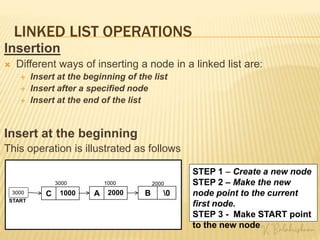
 Different ways of inserting a node in a linked list are:
 Insert at the beginning of the list
 Insert after a specified node
 Insert at the end of the list
Insert at the beginning
This operation is illustrated as follows
A 2000 B 0
1000
STAR
T
1000 2000
STEP 1 – Create a new node
A 2000 B 0
1000
STAR
T
1000 2000
C 0
3000
NEW
3000
STEP 1 – Create a new node
STEP 2 – Make the new
node point to the current
first node.
A 2000 B 0
1000
STAR
T
C 1000
3000
NEW
3000
1000 2000 STEP 1 – Create a new node
STEP 2 – Make the new
node point to the current
first node.
STEP 3 - Make START point
to the new node
A 2000 B 0
3000
STAR
T
C 1000
3000
NEW
3000
1000 2000
C 1000 A 2000 B 0
3000
START
3000 1000 2000
LINKED LIST OPERATIONS
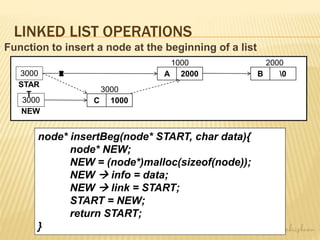
Function to insert a node at the beginning of a list
3000
STAR
T
A 2000 B 0
1000 2000
3000
NEW
C 1000
3000
node* insertBeg(node* START, char data){
}
node* insertBeg(node* START, char data){
node* NEW;
NEW = (node*)malloc(sizeof(node));
NEW  info = data;
}
node* insertBeg(node* START, char data){
node* NEW;
NEW = (node*)malloc(sizeof(node));
NEW  info = data;
NEW  link = START;
}
node* insertBeg(node* START, char data){
node* NEW;
NEW = (node*)malloc(sizeof(node));
NEW  info = data;
NEW  link = START;
START = NEW;
return START;
}
LINKED LIST OPERATIONS
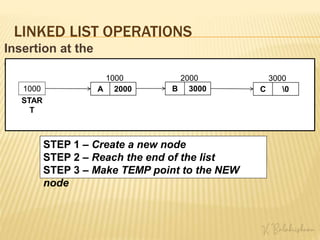
Insertion at the
end
A 2000 B 0
1000
1000 2000
STAR
T
STEP 1 – Create a new node
C 0
3000
3000
NEW
STEP 1 – Create a new node
STEP 2 – Reach the end of the list
A 2000 B 0
1000
1000 2000
STAR
T
C 0
3000
3000
NEW
TEMP
A 2000 B 0
1000
1000 2000
STAR
T
C 0
3000
3000
NEW
TEMP
A 2000 B 0
1000
1000 2000
STAR
T
C 0
3000
3000
NEW
TEMP
STEP 1 – Create a new node
STEP 2 – Reach the end of the list
STEP 3 – Make TEMP point to the NEW
node
A 2000 B 3000
1000
1000 2000
STAR
T
C 0
3000
3000
NEW
TEMP
A 2000 B 3000
1000
1000 2000
STAR
T
C 0
3000
LINKED LIST OPERATIONS
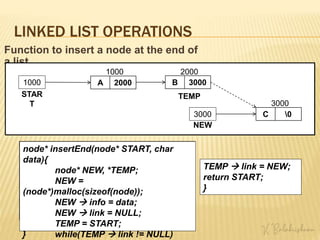
Function to insert a node at the end of
a list
A 2000 B 3000
1000
1000 2000
STAR
T
C 0
3000
3000
NEW
TEMP
node* insertEnd(node* START, char
data){
}
node* insertEnd(node* START, char
data){
node* NEW;
NEW =
(node*)malloc(sizeof(node));
NEW  info = data;
NEW  link = NULL;
}
node* insertEnd(node* START, char
data){
node* NEW, *TEMP;
NEW =
(node*)malloc(sizeof(node));
NEW  info = data;
NEW  link = NULL;
TEMP = START;
while(TEMP  link != NULL)
TEMP  link = NEW;
return START;
}
LINKED LIST OPERATIONS
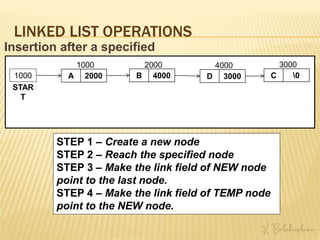
Insertion after a specified
node
A 2000 B 3000
1000
1000 2000
STAR
T
C 0
3000
4000
NEW
TEMP
STEP 1 – Create a new node
D 0
4000
STEP 1 – Create a new node
STEP 2 – Reach the specified node
A 2000 B 3000
1000
1000 2000
STAR
T
C 0
3000
4000
NEW
TEMP
D 0
4000
A 2000 B 3000
1000
1000 2000
STAR
T
C 0
3000
4000
NEW
TEMP
D 0
4000
STEP 1 – Create a new node
STEP 2 – Reach the specified node
STEP 3 – Make the link field of NEW node
point to the last node.
A 2000 B 3000
1000
1000 2000
STAR
T
C 0
3000
4000
NEW
TEMP
D 3000
4000
STEP 1 – Create a new node
STEP 2 – Reach the specified node
STEP 3 – Make the link field of NEW node
point to the last node.
STEP 4 – Make the link field of TEMP node
point to the NEW node.
A 2000 B 4000
1000
1000 2000
STAR
T
C 0
3000
4000
NEW
TEMP
D 3000
4000
A 2000 B 4000
1000
1000 2000
STAR
T
C 0
3000
D 3000
4000
LINKED LIST OPERATIONS
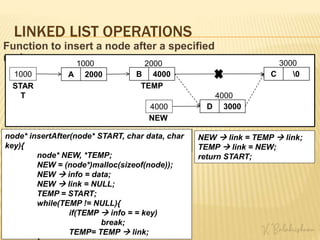
Function to insert a node after a specified
node
A 2000 B 4000
1000
1000 2000
STAR
T
C 0
3000
D 3000
4000
TEMP
NEW
4000
NEW  link = TEMP  link;
node* insertAfter(node* START, char data, char
key){
}
node* insertAfter(node* START, char data, char
key){
node* NEW, *TEMP;
NEW = (node*)malloc(sizeof(node));
NEW  info = data;
NEW  link = NULL;
}
node* insertAfter(node* START, char data, char
key){
node* NEW, *TEMP;
NEW = (node*)malloc(sizeof(node));
NEW  info = data;
NEW  link = NULL;
TEMP = START;
while(TEMP != NULL){
if(TEMP  info = = key)
break;
TEMP= TEMP  link;
NEW  link = TEMP  link;
TEMP  link = NEW;
return START;
LINKED LIST OPERATIONS
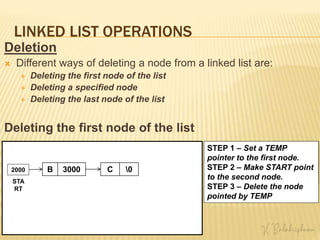
Deletion
 Different ways of deleting a node from a linked list are:
 Deleting the first node of the list
 Deleting a specified node
 Deleting the last node of the list
Deleting the first node of the list
A 2000 B 3000 C 0
1000
STA
RT
STEP 1 – Set a TEMP
pointer to the first node.
TEM
P
STEP 1 – Set a TEMP
pointer to the first node.
STEP 2 – Make START point
to the second node.
A 2000 B 3000 C 0
2000
STA
RT
TEM
P
STEP 1 – Set a TEMP
pointer to the first node.
STEP 2 – Make START point
to the second node.
STEP 3 – Delete the node
pointed by TEMP
B 3000 C 0
2000
STA
RT
LINKED LIST OPERATIONS
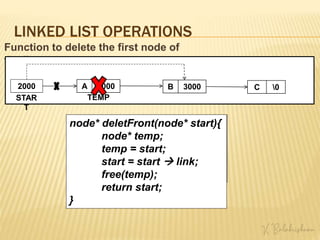
Function to delete the first node of
the list
B 3000 C 0
1000
STAR
T
A 2000
TEMP
node* deletFront(node* start){
}
node* deletFront(node* start){
node* temp;
temp = start;
}
node* deletFront(node* start){
node* temp;
temp = start;
start = start  link;
}
2000
node* deletFront(node* start){
node* temp;
temp = start;
start = start  link;
free(temp);
return start;
}
LINKED LIST OPERATIONS
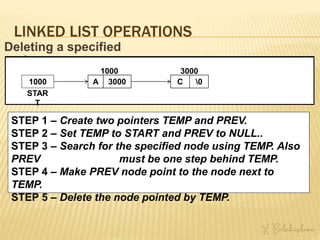
Deleting a specified
node
STAR
T
1000
1000
A 2000
2000
B 3000
3000
C 0
STEP 1 – Create two pointers TEMP and PREV.
STEP 2 – Set TEMP to START and PREV to NULL..
TEMP
STEP 1 – Create two pointers TEMP and PREV.
STEP 2 – Set TEMP to START and PREV to NULL..
STEP 3 – Search for the specified node using TEMP. Also
PREV must be one step behind TEMP.
TEMP
PREV
STEP 1 – Create two pointers TEMP and PREV.
STEP 2 – Set TEMP to START and PREV to NULL..
STEP 3 – Search for the specified node using TEMP. Also
PREV must be one step behind TEMP.
STEP 4 – Make PREV node point to the node next to
TEMP.
A 3000
STEP 1 – Create two pointers TEMP and PREV.
STEP 2 – Set TEMP to START and PREV to NULL..
STEP 3 – Search for the specified node using TEMP. Also
PREV must be one step behind TEMP.
STEP 4 – Make PREV node point to the node next to
TEMP.
STEP 5 – Delete the node pointed by TEMP.
STAR
T
1000
1000 3000
C 0
A 3000
LINKED LIST OPERATIONS
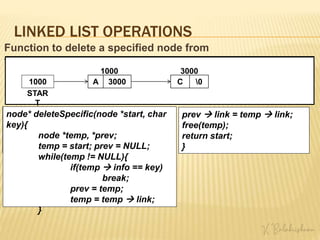
Function to delete a specified node from
the list
STAR
T
1000
1000 2000
B 3000
3000
C 0
node* deleteSpecific(node* start, char
key){
}
node* deleteSpecific(node *start, char
key){
node *temp, *prev;
temp = start; prev = NULL;
}
TEMP
node* deleteSpecific(node *start, char
key){
node *temp, *prev;
temp = start; prev = NULL;
while(temp != NULL){
if(temp  info == key)
break;
prev = temp;
temp = temp  link;
}
PREV TEMP
A 2000
prev  link = temp  link;
A 3000
prev  link = temp  link;
free(temp);
prev  link = temp  link;
free(temp);
return start;
}
STAR
T
1000
1000 3000
C 0
A 3000
LINKED LIST OPERATIONS
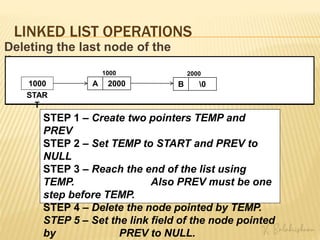
Deleting the last node of the
list
B 3000 C 0
STAR
T
A 2000
1000
1000 2000 3000
STEP 1 – Create two pointers TEMP and
PREV
STEP 2 – Set TEMP to START and PREV to
NULL
TEMP
STEP 1 – Create two pointers TEMP and
PREV
STEP 2 – Set TEMP to START and PREV to
NULL
STEP 3 – Reach the end of the list using
TEMP. Also PREV must be one
step before TEMP.
B 3000 C 0
STAR
T
A 2000
1000
1000 2000 3000
TEMP
PREV
STEP 1 – Create two pointers TEMP and
PREV
STEP 2 – Set TEMP to START and PREV to
NULL
STEP 3 – Reach the end of the list using
TEMP. Also PREV must be one
step before TEMP.
STEP 4 – Delete the node pointed by TEMP.
STEP 1 – Create two pointers TEMP and
PREV
STEP 2 – Set TEMP to START and PREV to
NULL
STEP 3 – Reach the end of the list using
TEMP. Also PREV must be one
step before TEMP.
STEP 4 – Delete the node pointed by TEMP.
STEP 5 – Set the link field of the node pointed
by PREV to NULL.
B 0
STAR
T
A 2000
1000
1000 2000
B 0
LINKED LIST OPERATIONS
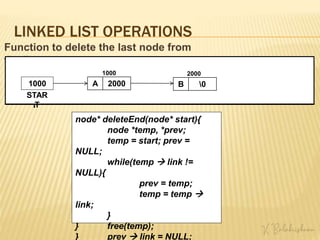
Function to delete the last node from
the list
C 0
STAR
T
1000
1000 2000 3000
node* deleteEnd(node*
start){
}
node* deleteEnd(node* start){
node *temp, *prev;
temp = start; prev =
NULL;
}
TEMP
node* deleteEnd(node* start){
node *temp, *prev;
temp = start; prev =
NULL;
while(temp  link !=
NULL){
prev = temp;
temp = temp 
link;
}
}
PREV
A 2000
TEMP
B 3000
STAR
T
1000
1000 2000 3000
PREV
A 2000
TEMP
B 3000 C 0
node* deleteEnd(node* start){
node *temp, *prev;
temp = start; prev =
NULL;
while(temp  link !=
NULL){
prev = temp;
temp = temp 
link;
}
free(temp);
}
node* deleteEnd(node* start){
node *temp, *prev;
temp = start; prev =
NULL;
while(temp  link !=
NULL){
prev = temp;
temp = temp 
link;
}
free(temp);
prev  link = NULL;
B 0
STAR
T
A 2000
1000
1000 2000
B 0
LINKED LIST OPERATIONS
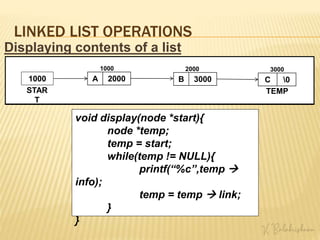
Displaying contents of a list
B 3000 C 0
STAR
T
A 2000
TEMP
1000
1000 2000 3000
void display(node
*start){
}
void display(node
*start){
node *temp;
temp = start;
}
void display(node *start){
node *temp;
temp = start;
while(temp != NULL){
printf(“%c”,temp 
info);
temp = temp  link;
}
}
B 3000 C 0
STAR
T
A 2000
TEMP
1000
1000 2000 3000
B 3000 C 0
STAR
T
A 2000
TEMP
1000
1000 2000 3000

Module 3 Dara structure notes

  • 1.
  • 2.
    CONTENTS  Definition  Representationof linked lists in Memory  Linked list operations  Traversing  Searching  Insertion  Deletion  Doubly Linked lists  Circular linked lists  Header linked lists  Linked Stacks and Queues  Applications of Linked lists  Polynomials  Sparse matrix representation
  • 3.
    INTRODUCTION  One wayby which we can store a list of items is using arrays, in which every item is stored in consecutive memory locations.  However, the disadvantage of arrays is operations like insertion and deletion are expensive to perform.  Also changing the size of an array is not a straightforward task.  An alternate way of storing a list of items in the memory is by considering each item as an individual entity and storing it.  Also every item will have a field called link, that contains the address of the next item in the list.
  • 4.
    INTRODUCTION  This means,we need not store successive items of the list in successive memory locations.  Such an arrangement also makes insertion and deletion of items very easy. This is accomplished using a data structure called Linked List. “A Linked List or One-Way List is a linear collection of data elements, called nodes, where the linear order is given by means of pointers.”  Hence, for a given list of items, if array is used to store the items, then the sequence of items in the array must be same as the sequence mentioned in the list.  However, with linked list, the sequence need not be the same as mentioned.
  • 5.
    INTRODUCTION  Each nodein a linked list is divided into two parts:  info - contains the information about the element  link – contains the address of the next node in the list  A linked list of 6 nodes is diagrammatically presented below. X STAR T info link  The info part of a node can either contain a single data item or a group of data items.  The link part holds the address of the next node in the list.  The linked list also has a list pointer, called START, that points to the first node of the list. START indicates the beginning of the list.
  • 6.
    REPRESENTATION OF LINKEDLISTS IN MEMORY  Since a simple linked list is made up of two parts(info and link), a linked list is maintained using two linear arrays in the memory.  One array is called the INFO array and it contains the information of all linked list nodes.  The second array is called the LINK array and it contains the addresses of next nodes in the linked list.  The index positions in the array correspond to the list nodes.  For an index position k, INFO[k] and LINK[k] will contain the data in node k and address of next node to k respectively.  The list also requires a variable, called START, that points to the first node of the list.
  • 7.
    REPRESENTATION OF LINKEDLISTS IN MEMORY  Consider the following linked list. N O E X I STAR T T X  The memory representation of the above list is, 1 2 3 4 5 6 7 8 9 10 11 INFO LINK E N _ T O I X 10 8 1 0 5 6 9 STAR T 3
  • 8.
    REPRESENTATION OF LINKEDLISTS IN MEMORY  Array representation of two lists 88 74 93 82 X AL G 84 62 74 99 74 78 X GEO M 1 2 3 4 5 6 7 8 9 10 11 INFO LINK 93 88 82 74 7 10 0 2 ALG 6 99 93 62 74 88 82 74 78 74 84 4 7 8 9 10 0 1 0 2 3 GEO M11
  • 9.
    REPRESENTATION OF LINKEDLISTS IN MEMORY  Array representation of multiple lists Gran t Scott Vit o Kat z X BOND Hunte r McBrid e Evan s X KELL Y HALL X Telle r Jone s Adam s NELSO N Roger s Westo n X
  • 10.
    REPRESENTATION OF LINKEDLISTS IN MEMORY 1 2 3 4 5 6 7 8 9 10 11 12 13 14 15 16 17 Student Link 1 2 3 4 Faculty Link BOND KELLY HALL NELSON Vito Katz Grant Scott 4 0 16 1 12 Vito Hunter Katz Evans Grant McBride Scott 4 14 0 0 16 6 1 12 3 12 3 0 Vito Hunter Katz Evans Rogers Teller Jones Grant McBride Weston Scott Adams 4 14 0 0 15 10 17 16 6 0 1 8 12 3 0 9
  • 11.
    REPRESENTATION OF LINKEDLISTS IN MEMORY  Representation of lists with multiple data items in each node. Brow n 178521065 Femal e 14700 STAR T Cohe n 177444557 Male 19000 Davis 192387282 Femal e 22800 Evan s 168568113 Male 34200 X 1 2 3 4 5 6 7 Evans Cohen Davis Brown 168568113 177444557 192387282 178521065 Male Male Female Female 34200 19000 22800 14700 0 4 1 2 Name SSN Sex Salary Link STAR T 6
  • 12.
    REPRESENTATION OF LINKEDLISTS IN MEMORY Defining a linked list node  From the discussion so far, we can conclude that a node in a list can have any type of data.  Along with the data, there is a link part that contains the address/index of the next node.  The link part will only have integer values as it holds an address or index, both of which are integers.  Hence, to define a linked list node, we need to have a facility by which we can group data belonging to different data types.  This can be accomplished using Structures.
  • 13.
    REPRESENTATION OF LINKEDLISTS IN MEMORY  Structures are used to define a linked list node.  The nodes are then created using dynamic memory allocation functions. Defining a node using structures Consider the following structure definition, typedef struct node{ char info; node* link; };  The above structure definition results in a node that holds character data and pointer to another node.
  • 14.
    REPRESENTATION OF LINKEDLISTS IN MEMORY Node creation using malloc()  With the node definition ready, we can now create a linked list node.  For this, we first declare a pointer variable as follows, node* ptr;  We then use dynamic memory allocation functions to create a node. ptr = (node*)malloc(sizeof(node)); 1000 1001 1002 1003 1004 1005 1006 Info link 1000 1001 1002 1003 1004 1005 1006 1002 ptr
  • 15.
    REPRESENTATION OF LINKEDLISTS IN MEMORY Assigning values to a node  Once a node has been created, we next need to fill the node with appropriate values.  The node that we have created can hold a character in the info field and address in the link field.  Here the info and link fields are members of a structure.  Hence, to assign values to info and link fields, we need to access these structure members.  We know that a structure member can be accessed using a structure variable and the DOT operator.
  • 16.
    REPRESENTATION OF LINKEDLISTS IN MEMORY  However, the node that we have created is not represented by a normal structure variable.  It is represented by a pointer. node* ptr; ptr = (node*)malloc(sizeof(node)); 1000 1001 1002 1003 1004 1005 1006 Info link 1000 1001 1002 1003 1004 1005 1006 1002 ptr  The DOT operator cannot be used by a pointer variable to access structure members.  Instead, a special operator, , is used by pointers for this purpose.
  • 17.
    REPRESENTATION OF LINKEDLISTS IN MEMORY  The use of DOT and  is illustrated below. Consider the structure, typedef struct sample{ int a; }; sample var, *ptr; var . a = 10; ptr  a = 20;  We now see how we assign values for the linked list node using the pointer ptr. ptr  info = ‘A’; ptr  link = NULL;
  • 18.
    REPRESENTATION OF LINKEDLISTS IN MEMORY  This will result in, ptr A 0 1002  We now see how to create a linked list of two nodes. node* create2(){ node *first, *second; } first 1002 node* create2(){ node *first, *second; first = (node *) malloc(sizeof(node)); } node* create2(){ node *first, *second; first = (node *) malloc(sizeof(node)); second = (node *) malloc(sizeof(node)); } secon d 2002 node* create2(){ node *first, *second; first = (node *) malloc(sizeof(node)); second = (node *) malloc(sizeof(node)); first  info = ‘A’; second  info = ‘B’; } A B node* create2(){ node *first, *second; first = (node *) malloc(sizeof(node)); second = (node *) malloc(sizeof(node)); first  info = ‘A’; second  info = ‘B’; first  link = second; } A 2002 node* create2(){ node *first, *second; first = (node *) malloc(sizeof(node)); second = (node *) malloc(sizeof(node)); first  info = ‘A’; second  info = ‘B’; first  link = second; second  link = NULL; return first; B 0
  • 19.
    LINKED LIST OPERATIONS Traversing Traversinga list involves visiting all the linked list nodes. A 78 B 32 C 19 D 66 E 21 F 0 STAR T 05 PTR Algorithm: (Traversing a Linked List) This algorithm visits all nodes of a linked list, applying an operation PROCESS on each node of the list. The variable PTR points to the node currently being processed. 1. Set PTR := START. 2. Repeat steps 3 and 4 while PTR ≠ NULL: 3. Apply PROCESS to PTR  info. 4. Set PTR := PTR  link. [End of Step 2 loop.] 5. Exit PTR PTR 05 78 32 19 66 21 PTR PTR PTR
  • 20.
    LINKED LIST OPERATIONS Algorithm:PRINT(START) This algorithm prints the information at each node of the list. 1. Set PTR := START. 2. Repeat steps 3 and 4 while PTR ≠ NULL: 3. Write : PTR  info. 4. Set PTR := PTR  link. [End of Step 2 loop.] 5. Exit Algorithm: COUNT(START, NUM) This algorithm finds the number of elements in the list. 1. Set NUM := 0. 2. Set PTR := START. 3. Repeat steps 4 and 5 while PTR ≠ NULL: 4. Set NUM := NUM + 1. 5. Set PTR := PTR  link. [End of Step 3 loop.] 5. Exit
  • 21.
    LINKED LIST OPERATIONS Searching Herewe will see how a search for an item can be performed in an ordered and unordered list. Algorithm: SEARCH(START, ITEM, LOC) This algorithm finds the location LOC of the node where ITEM first appears in an unordered linked list, or sets LOC = NULL. 1. Set PTR := START. 2.Repeat steps 3 and 4 while PTR ≠ NULL: 3. If ITEM = PTR  info, then: Set LOC := PTR and Exit. Else Set PTR := PTR  link. [End of If structure.] [End of Step 2 loop.] 4. Set LOC := NULL. 5. Exit
  • 22.
    LINKED LIST OPERATIONS Algorithm:SEARCH(START, ITEM, LOC) This algorithm finds the location LOC of the node where ITEM first appears in an ordered linked list, or sets LOC = NULL. The list elements are arranged in descending order. 1. Set PTR := START. 2.Repeat step 3 while PTR ≠ NULL: 3. If ITEM < PTR  info, then: Set PTR := PTR  link. Else if ITEM = PTR  info, then: Set LOC := PTR and Exit. Else Set LOC := NULL, and Exit. [End of If structure.] [End of Step 2 loop.] 4. Set LOC := NULL. 5. Exit
  • 23.
    LINKED LIST OPERATIONS Insertion Different ways of inserting a node in a linked list are:  Insert at the beginning of the list  Insert after a specified node  Insert at the end of the list Insert at the beginning This operation is illustrated as follows A 2000 B 0 1000 STAR T 1000 2000 STEP 1 – Create a new node A 2000 B 0 1000 STAR T 1000 2000 C 0 3000 NEW 3000 STEP 1 – Create a new node STEP 2 – Make the new node point to the current first node. A 2000 B 0 1000 STAR T C 1000 3000 NEW 3000 1000 2000 STEP 1 – Create a new node STEP 2 – Make the new node point to the current first node. STEP 3 - Make START point to the new node A 2000 B 0 3000 STAR T C 1000 3000 NEW 3000 1000 2000 C 1000 A 2000 B 0 3000 START 3000 1000 2000
  • 24.
    LINKED LIST OPERATIONS Functionto insert a node at the beginning of a list 3000 STAR T A 2000 B 0 1000 2000 3000 NEW C 1000 3000 node* insertBeg(node* START, char data){ } node* insertBeg(node* START, char data){ node* NEW; NEW = (node*)malloc(sizeof(node)); NEW  info = data; } node* insertBeg(node* START, char data){ node* NEW; NEW = (node*)malloc(sizeof(node)); NEW  info = data; NEW  link = START; } node* insertBeg(node* START, char data){ node* NEW; NEW = (node*)malloc(sizeof(node)); NEW  info = data; NEW  link = START; START = NEW; return START; }
  • 25.
    LINKED LIST OPERATIONS Insertionat the end A 2000 B 0 1000 1000 2000 STAR T STEP 1 – Create a new node C 0 3000 3000 NEW STEP 1 – Create a new node STEP 2 – Reach the end of the list A 2000 B 0 1000 1000 2000 STAR T C 0 3000 3000 NEW TEMP A 2000 B 0 1000 1000 2000 STAR T C 0 3000 3000 NEW TEMP A 2000 B 0 1000 1000 2000 STAR T C 0 3000 3000 NEW TEMP STEP 1 – Create a new node STEP 2 – Reach the end of the list STEP 3 – Make TEMP point to the NEW node A 2000 B 3000 1000 1000 2000 STAR T C 0 3000 3000 NEW TEMP A 2000 B 3000 1000 1000 2000 STAR T C 0 3000
  • 26.
    LINKED LIST OPERATIONS Functionto insert a node at the end of a list A 2000 B 3000 1000 1000 2000 STAR T C 0 3000 3000 NEW TEMP node* insertEnd(node* START, char data){ } node* insertEnd(node* START, char data){ node* NEW; NEW = (node*)malloc(sizeof(node)); NEW  info = data; NEW  link = NULL; } node* insertEnd(node* START, char data){ node* NEW, *TEMP; NEW = (node*)malloc(sizeof(node)); NEW  info = data; NEW  link = NULL; TEMP = START; while(TEMP  link != NULL) TEMP  link = NEW; return START; }
  • 27.
    LINKED LIST OPERATIONS Insertionafter a specified node A 2000 B 3000 1000 1000 2000 STAR T C 0 3000 4000 NEW TEMP STEP 1 – Create a new node D 0 4000 STEP 1 – Create a new node STEP 2 – Reach the specified node A 2000 B 3000 1000 1000 2000 STAR T C 0 3000 4000 NEW TEMP D 0 4000 A 2000 B 3000 1000 1000 2000 STAR T C 0 3000 4000 NEW TEMP D 0 4000 STEP 1 – Create a new node STEP 2 – Reach the specified node STEP 3 – Make the link field of NEW node point to the last node. A 2000 B 3000 1000 1000 2000 STAR T C 0 3000 4000 NEW TEMP D 3000 4000 STEP 1 – Create a new node STEP 2 – Reach the specified node STEP 3 – Make the link field of NEW node point to the last node. STEP 4 – Make the link field of TEMP node point to the NEW node. A 2000 B 4000 1000 1000 2000 STAR T C 0 3000 4000 NEW TEMP D 3000 4000 A 2000 B 4000 1000 1000 2000 STAR T C 0 3000 D 3000 4000
  • 28.
    LINKED LIST OPERATIONS Functionto insert a node after a specified node A 2000 B 4000 1000 1000 2000 STAR T C 0 3000 D 3000 4000 TEMP NEW 4000 NEW  link = TEMP  link; node* insertAfter(node* START, char data, char key){ } node* insertAfter(node* START, char data, char key){ node* NEW, *TEMP; NEW = (node*)malloc(sizeof(node)); NEW  info = data; NEW  link = NULL; } node* insertAfter(node* START, char data, char key){ node* NEW, *TEMP; NEW = (node*)malloc(sizeof(node)); NEW  info = data; NEW  link = NULL; TEMP = START; while(TEMP != NULL){ if(TEMP  info = = key) break; TEMP= TEMP  link; NEW  link = TEMP  link; TEMP  link = NEW; return START;
  • 29.
    LINKED LIST OPERATIONS Deletion Different ways of deleting a node from a linked list are:  Deleting the first node of the list  Deleting a specified node  Deleting the last node of the list Deleting the first node of the list A 2000 B 3000 C 0 1000 STA RT STEP 1 – Set a TEMP pointer to the first node. TEM P STEP 1 – Set a TEMP pointer to the first node. STEP 2 – Make START point to the second node. A 2000 B 3000 C 0 2000 STA RT TEM P STEP 1 – Set a TEMP pointer to the first node. STEP 2 – Make START point to the second node. STEP 3 – Delete the node pointed by TEMP B 3000 C 0 2000 STA RT
  • 30.
    LINKED LIST OPERATIONS Functionto delete the first node of the list B 3000 C 0 1000 STAR T A 2000 TEMP node* deletFront(node* start){ } node* deletFront(node* start){ node* temp; temp = start; } node* deletFront(node* start){ node* temp; temp = start; start = start  link; } 2000 node* deletFront(node* start){ node* temp; temp = start; start = start  link; free(temp); return start; }
  • 31.
    LINKED LIST OPERATIONS Deletinga specified node STAR T 1000 1000 A 2000 2000 B 3000 3000 C 0 STEP 1 – Create two pointers TEMP and PREV. STEP 2 – Set TEMP to START and PREV to NULL.. TEMP STEP 1 – Create two pointers TEMP and PREV. STEP 2 – Set TEMP to START and PREV to NULL.. STEP 3 – Search for the specified node using TEMP. Also PREV must be one step behind TEMP. TEMP PREV STEP 1 – Create two pointers TEMP and PREV. STEP 2 – Set TEMP to START and PREV to NULL.. STEP 3 – Search for the specified node using TEMP. Also PREV must be one step behind TEMP. STEP 4 – Make PREV node point to the node next to TEMP. A 3000 STEP 1 – Create two pointers TEMP and PREV. STEP 2 – Set TEMP to START and PREV to NULL.. STEP 3 – Search for the specified node using TEMP. Also PREV must be one step behind TEMP. STEP 4 – Make PREV node point to the node next to TEMP. STEP 5 – Delete the node pointed by TEMP. STAR T 1000 1000 3000 C 0 A 3000
  • 32.
    LINKED LIST OPERATIONS Functionto delete a specified node from the list STAR T 1000 1000 2000 B 3000 3000 C 0 node* deleteSpecific(node* start, char key){ } node* deleteSpecific(node *start, char key){ node *temp, *prev; temp = start; prev = NULL; } TEMP node* deleteSpecific(node *start, char key){ node *temp, *prev; temp = start; prev = NULL; while(temp != NULL){ if(temp  info == key) break; prev = temp; temp = temp  link; } PREV TEMP A 2000 prev  link = temp  link; A 3000 prev  link = temp  link; free(temp); prev  link = temp  link; free(temp); return start; } STAR T 1000 1000 3000 C 0 A 3000
  • 33.
    LINKED LIST OPERATIONS Deletingthe last node of the list B 3000 C 0 STAR T A 2000 1000 1000 2000 3000 STEP 1 – Create two pointers TEMP and PREV STEP 2 – Set TEMP to START and PREV to NULL TEMP STEP 1 – Create two pointers TEMP and PREV STEP 2 – Set TEMP to START and PREV to NULL STEP 3 – Reach the end of the list using TEMP. Also PREV must be one step before TEMP. B 3000 C 0 STAR T A 2000 1000 1000 2000 3000 TEMP PREV STEP 1 – Create two pointers TEMP and PREV STEP 2 – Set TEMP to START and PREV to NULL STEP 3 – Reach the end of the list using TEMP. Also PREV must be one step before TEMP. STEP 4 – Delete the node pointed by TEMP. STEP 1 – Create two pointers TEMP and PREV STEP 2 – Set TEMP to START and PREV to NULL STEP 3 – Reach the end of the list using TEMP. Also PREV must be one step before TEMP. STEP 4 – Delete the node pointed by TEMP. STEP 5 – Set the link field of the node pointed by PREV to NULL. B 0 STAR T A 2000 1000 1000 2000 B 0
  • 34.
    LINKED LIST OPERATIONS Functionto delete the last node from the list C 0 STAR T 1000 1000 2000 3000 node* deleteEnd(node* start){ } node* deleteEnd(node* start){ node *temp, *prev; temp = start; prev = NULL; } TEMP node* deleteEnd(node* start){ node *temp, *prev; temp = start; prev = NULL; while(temp  link != NULL){ prev = temp; temp = temp  link; } } PREV A 2000 TEMP B 3000 STAR T 1000 1000 2000 3000 PREV A 2000 TEMP B 3000 C 0 node* deleteEnd(node* start){ node *temp, *prev; temp = start; prev = NULL; while(temp  link != NULL){ prev = temp; temp = temp  link; } free(temp); } node* deleteEnd(node* start){ node *temp, *prev; temp = start; prev = NULL; while(temp  link != NULL){ prev = temp; temp = temp  link; } free(temp); prev  link = NULL; B 0 STAR T A 2000 1000 1000 2000 B 0
  • 35.
    LINKED LIST OPERATIONS Displayingcontents of a list B 3000 C 0 STAR T A 2000 TEMP 1000 1000 2000 3000 void display(node *start){ } void display(node *start){ node *temp; temp = start; } void display(node *start){ node *temp; temp = start; while(temp != NULL){ printf(“%c”,temp  info); temp = temp  link; } } B 3000 C 0 STAR T A 2000 TEMP 1000 1000 2000 3000 B 3000 C 0 STAR T A 2000 TEMP 1000 1000 2000 3000