Module 3. Containment Requirements
Learning Outcomes
By the end of this module, you should be able to:
1. Define the terms used in biocontainment.
2. Explain the 3 elements of biocontainment.
3. Describe containment levels.
4. Select appropriate facility and equipment by applying the risk based
approach.
Outline
1. Definition of terms
2. Elements of containment
3. Graded protection and balanced security
4. Facility design
1. Definition of terms
Containment: The combination of physical design parameters, safety equipment &
operational practices that protect personnel, the immediate work environment and the
community from exposure to hazardous material.
Biocontainment: The combination of physical design parameters and operational
practices to protect personnel, the immediate work environment and the community
from exposure to biological agents.
Primary containment: Protection of personnel & immediate laboratory environment
and is facilitated by good microbiological techniques and the use of appropriate safety
equipment.
Secondary containment: Protection of the environment external to the laboratory
and is facilitated by facility design.
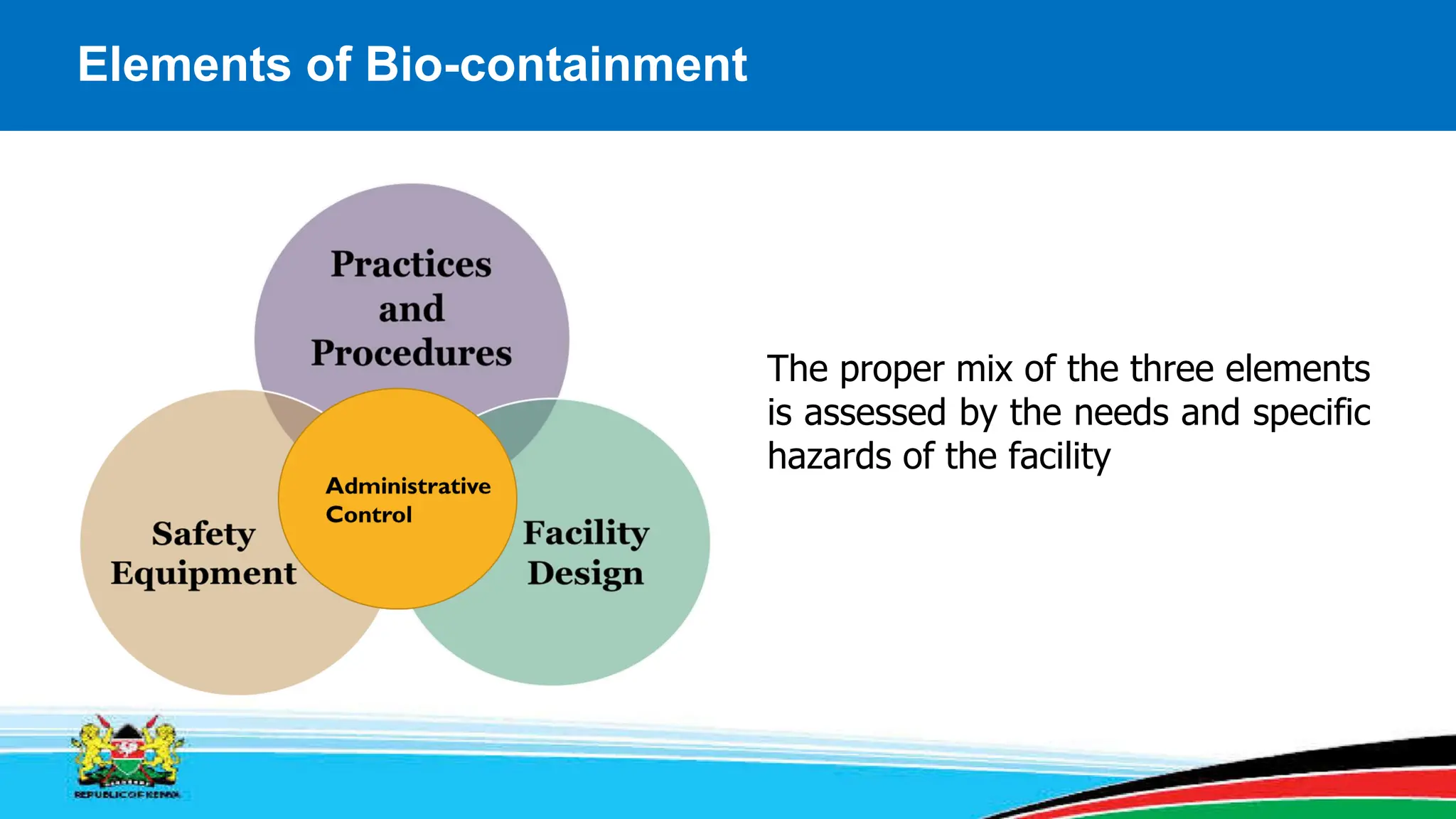
Elements of Bio-containment
The proper mix of the three elements
is assessed by the needs and specific
hazards of the facility
Elements of Bio-containment
• Containment barriers are put into place to protect the worker, community, and the
environment from exposure.
• Appropriate facility features for bio-containment are chosen based on a thorough
risk assessment of identified activities.
• Administrative control facilitates smooth implementation of the 3 mitigation
categories.
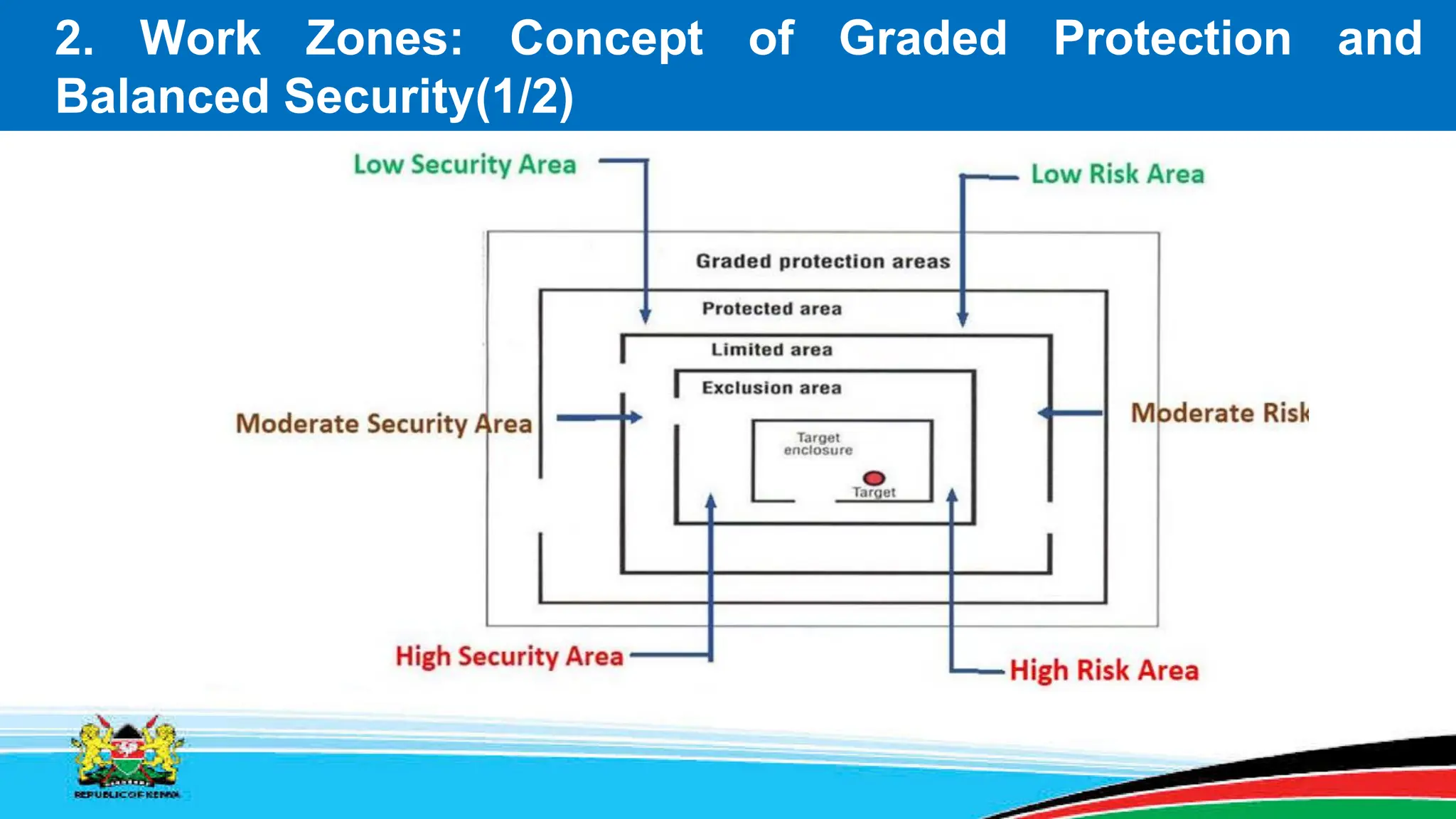
2. Work Zones: Concept of Graded Protection and
Balanced Security(1/2)
Work Zones: Concept of Graded Protection and
Balanced Security(2/2)
• Graded Protection is manifested in concentric rings of increasing security spanning
from outside to inside the facility and is relative to risk of loss, theft, misuse,
diversion, unauthorized access or release.
● Not all biological agents need the same level of protection
● Not all locations need the same level of protection for biosecurity.
• In biosafety, work is from an areas of least infectious activities to most infectious.
• Graded protection MUST be considered with balanced security.
• Balanced security: Protection should be balanced equally among the 5 pillars of
biosecurity.
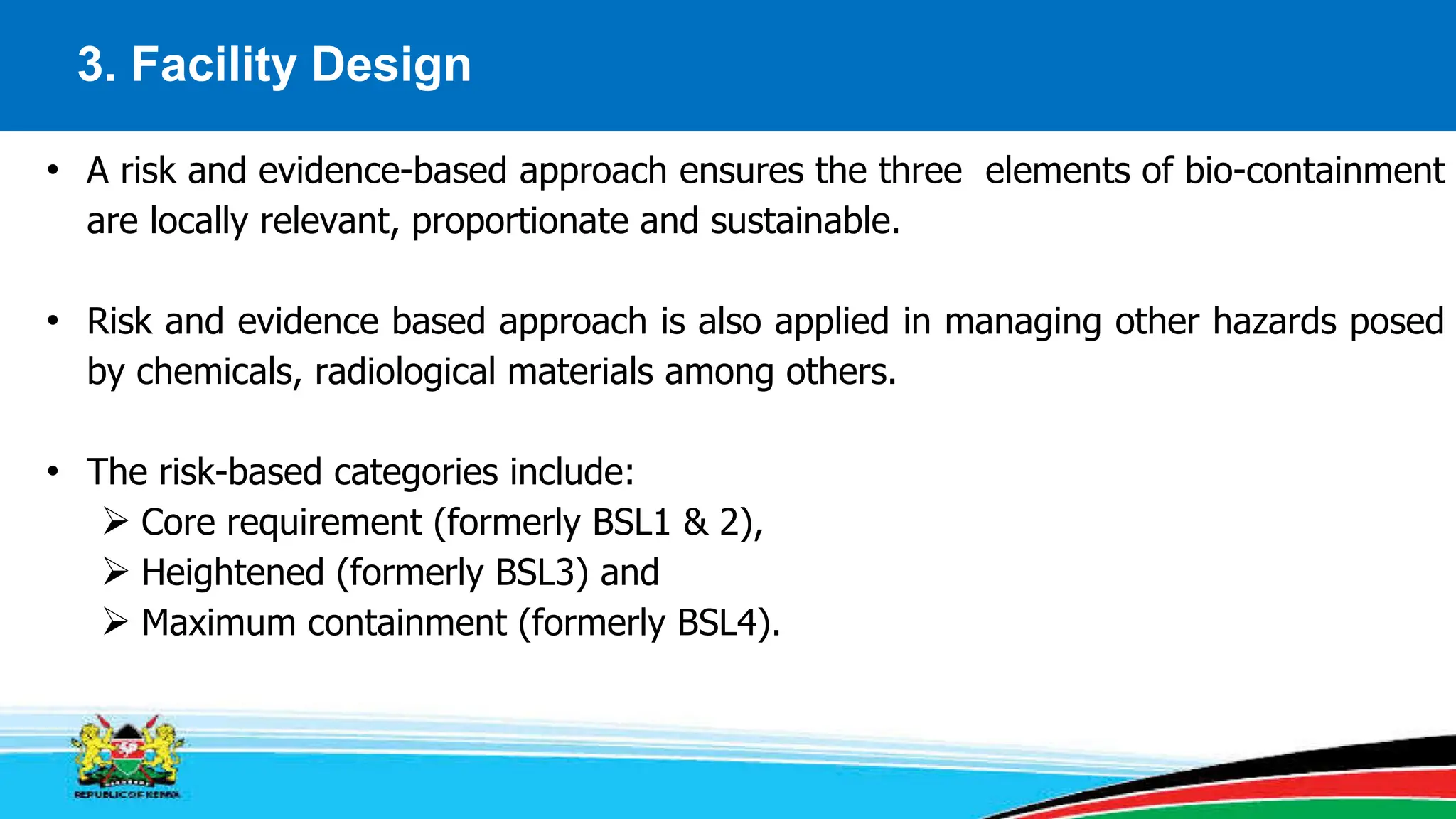
3. Facility Design
• A risk and evidence-based approach ensures the three elements of bio-containment
are locally relevant, proportionate and sustainable.
• Risk and evidence based approach is also applied in managing other hazards posed
by chemicals, radiological materials among others.
• The risk-based categories include:
 Core requirement (formerly BSL1 & 2),
 Heightened (formerly BSL3) and
 Maximum containment (formerly BSL4).
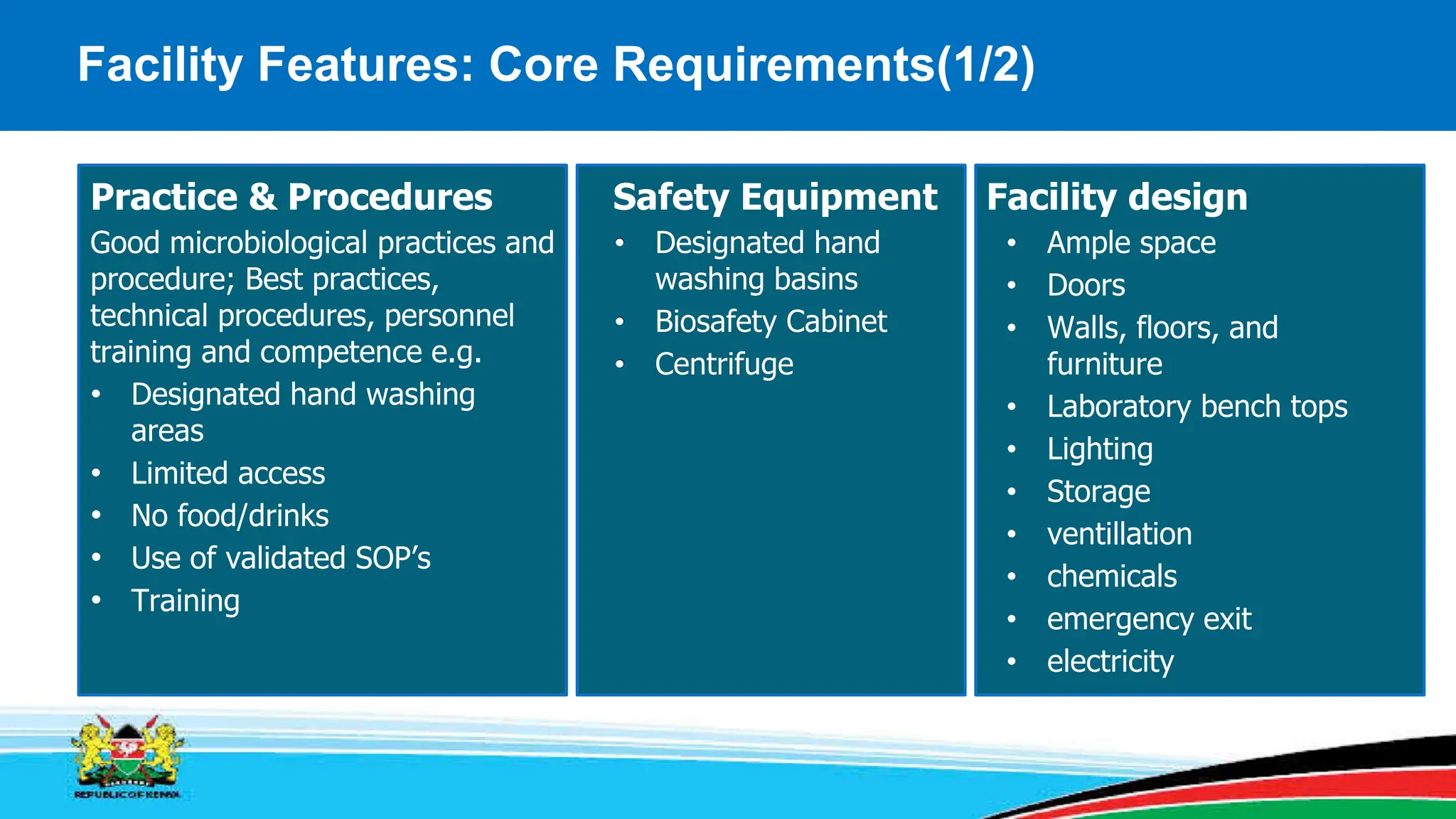
Facility Features: Core Requirements(1/2)
Good microbiological practices and
procedure; Best practices,
technical procedures, personnel
training and competence e.g.
• Designated hand washing
areas
• Limited access
• No food/drinks
• Use of validated SOP’s
• Training
• Designated hand
washing basins
• Biosafety Cabinet
• Centrifuge
• Ample space
• Doors
• Walls, floors, and
furniture
• Laboratory bench tops
• Lighting
• Storage
• ventillation
• chemicals
• emergency exit
• electricity
Safety Equipment Facility design
Practice & Procedures
• Designated hand
washing basins
• Biosafety Cabinet
• Centrifuge
Safety Equipment
Facility Features: Core Requirements(2/2)
• Core requirements is the term used to describe a combination of risk control
measures that are both the foundation for, and an integral part of, laboratory
biosafety.
• They are set of minimum requirements defined in the fourth edition of the WHO
Laboratory biosafety manual. These measures include standards and best
practice in biosafety that are necessary to work safely with biological agents,
even where the associated risks are minimal.
Facility Features: Heightened Control Measures(1/2)
Core Requirements Plus based on risk assessment
• Isolation from high traffic areas
 Ante room (double-door access)
 Restricted access
• Closing and sealing windows
• Sealed openings in walls, floors, and ceilings
• Inward airflow into the laboratory
• Dispersed exhaust air (with consideration of HEPA filtration)
 To minimize likelihood of exposure to humans, animals, or the environment
 Isolators component of HVAC System
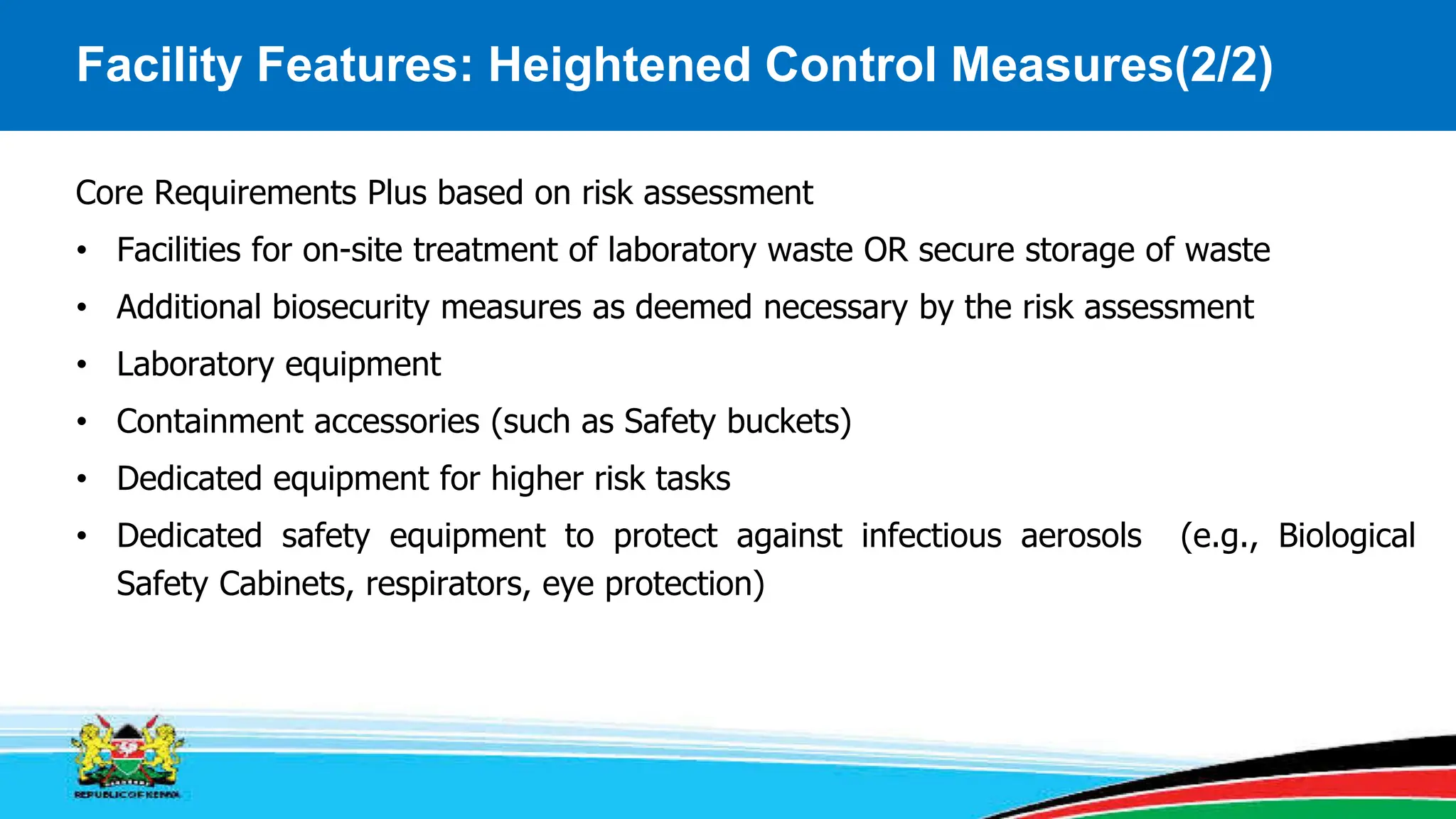
Facility Features: Heightened Control Measures(2/2)
Core Requirements Plus based on risk assessment
• Facilities for on-site treatment of laboratory waste OR secure storage of waste
• Additional biosecurity measures as deemed necessary by the risk assessment
• Laboratory equipment
• Containment accessories (such as Safety buckets)
• Dedicated equipment for higher risk tasks
• Dedicated safety equipment to protect against infectious aerosols (e.g., Biological
Safety Cabinets, respirators, eye protection)
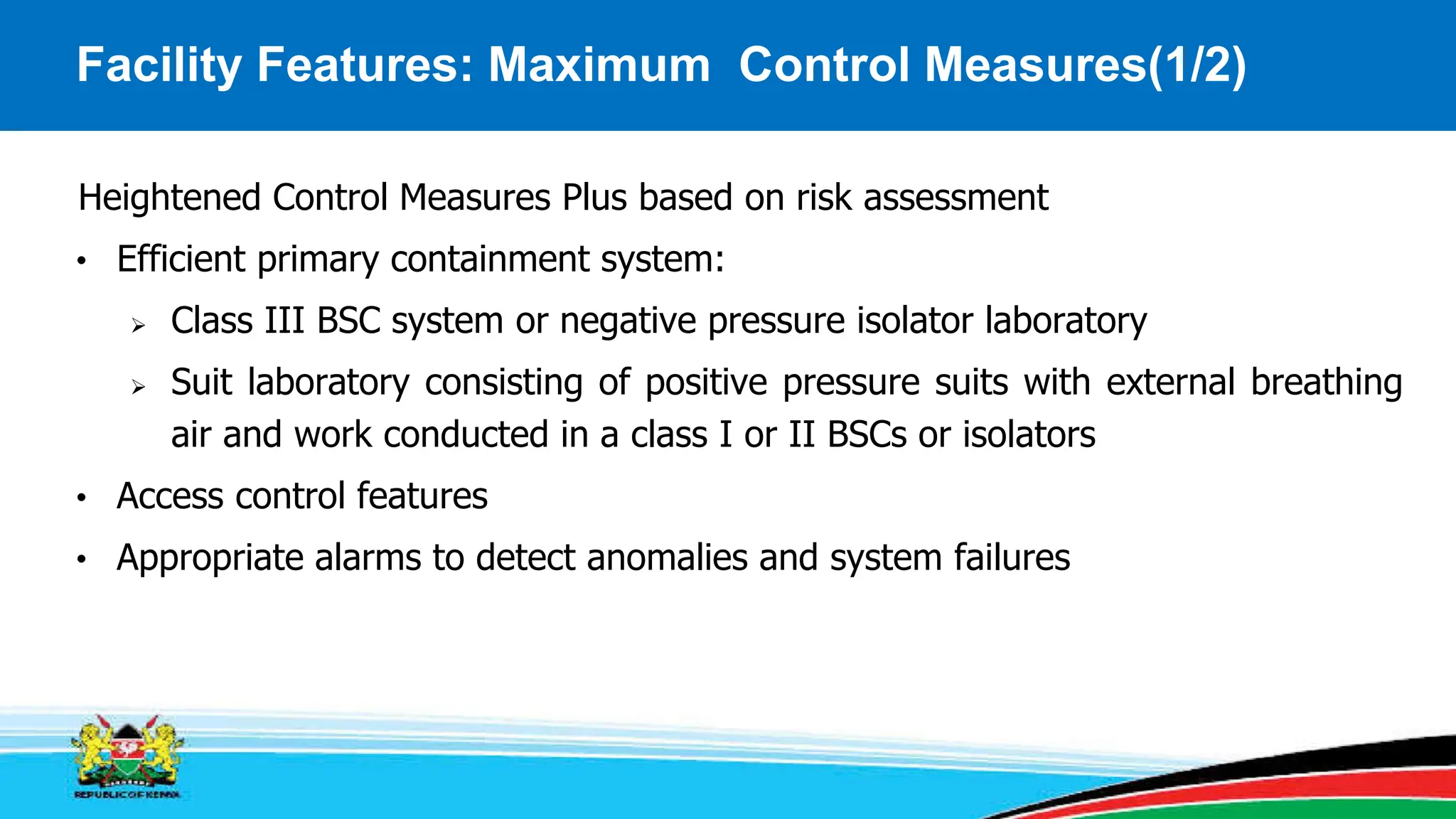
Facility Features: Maximum Control Measures(1/2)
Heightened Control Measures Plus based on risk assessment
• Efficient primary containment system:
 Class III BSC system or negative pressure isolator laboratory
 Suit laboratory consisting of positive pressure suits with external breathing
air and work conducted in a class I or II BSCs or isolators
• Access control features
• Appropriate alarms to detect anomalies and system failures
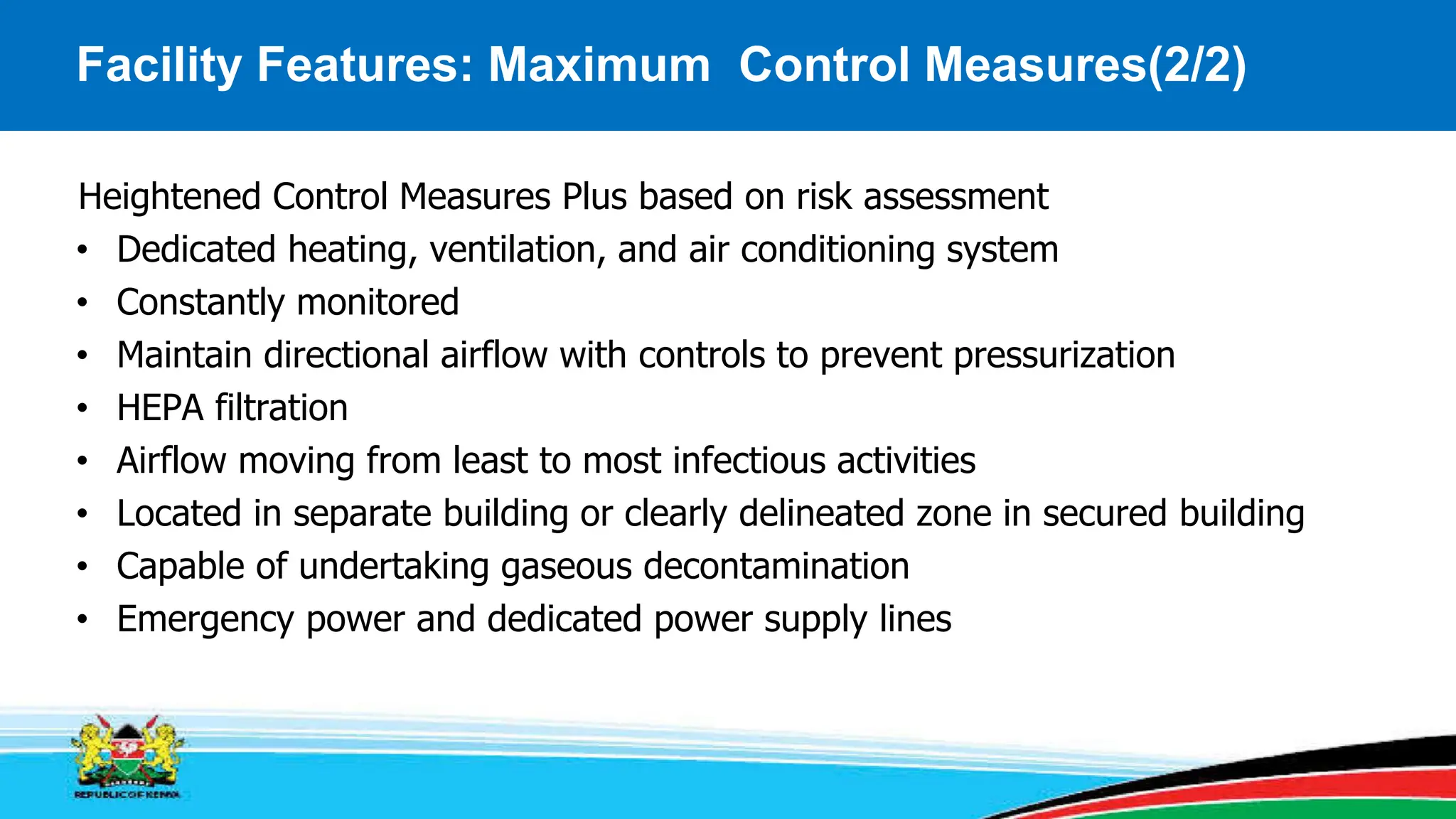
Facility Features: Maximum Control Measures(2/2)
Heightened Control Measures Plus based on risk assessment
• Dedicated heating, ventilation, and air conditioning system
• Constantly monitored
• Maintain directional airflow with controls to prevent pressurization
• HEPA filtration
• Airflow moving from least to most infectious activities
• Located in separate building or clearly delineated zone in secured building
• Capable of undertaking gaseous decontamination
• Emergency power and dedicated power supply lines
4. Key Messages
1. Appropriate facility features are chosen based on risk assessment.
2. Risk control measures are broken into 3 categories of core, heightened and
maximum control measures.
The End
You have come to the end of this Module. Kindly attempt the module quiz and
aim to attain a pass mark of 80%. Please participate in the discussion forum
before proceeding to module 4.

Module 3 Containment Requirements .pdf

  • 1.
  • 2.
    Learning Outcomes By theend of this module, you should be able to: 1. Define the terms used in biocontainment. 2. Explain the 3 elements of biocontainment. 3. Describe containment levels. 4. Select appropriate facility and equipment by applying the risk based approach.
  • 3.
    Outline 1. Definition ofterms 2. Elements of containment 3. Graded protection and balanced security 4. Facility design
  • 4.
    1. Definition ofterms Containment: The combination of physical design parameters, safety equipment & operational practices that protect personnel, the immediate work environment and the community from exposure to hazardous material. Biocontainment: The combination of physical design parameters and operational practices to protect personnel, the immediate work environment and the community from exposure to biological agents. Primary containment: Protection of personnel & immediate laboratory environment and is facilitated by good microbiological techniques and the use of appropriate safety equipment. Secondary containment: Protection of the environment external to the laboratory and is facilitated by facility design.
  • 5.
    Elements of Bio-containment Theproper mix of the three elements is assessed by the needs and specific hazards of the facility
  • 6.
    Elements of Bio-containment •Containment barriers are put into place to protect the worker, community, and the environment from exposure. • Appropriate facility features for bio-containment are chosen based on a thorough risk assessment of identified activities. • Administrative control facilitates smooth implementation of the 3 mitigation categories.
  • 7.
    2. Work Zones:Concept of Graded Protection and Balanced Security(1/2)
  • 8.
    Work Zones: Conceptof Graded Protection and Balanced Security(2/2) • Graded Protection is manifested in concentric rings of increasing security spanning from outside to inside the facility and is relative to risk of loss, theft, misuse, diversion, unauthorized access or release. ● Not all biological agents need the same level of protection ● Not all locations need the same level of protection for biosecurity. • In biosafety, work is from an areas of least infectious activities to most infectious. • Graded protection MUST be considered with balanced security. • Balanced security: Protection should be balanced equally among the 5 pillars of biosecurity.
  • 9.
    3. Facility Design •A risk and evidence-based approach ensures the three elements of bio-containment are locally relevant, proportionate and sustainable. • Risk and evidence based approach is also applied in managing other hazards posed by chemicals, radiological materials among others. • The risk-based categories include:  Core requirement (formerly BSL1 & 2),  Heightened (formerly BSL3) and  Maximum containment (formerly BSL4).
  • 10.
    Facility Features: CoreRequirements(1/2) Good microbiological practices and procedure; Best practices, technical procedures, personnel training and competence e.g. • Designated hand washing areas • Limited access • No food/drinks • Use of validated SOP’s • Training • Designated hand washing basins • Biosafety Cabinet • Centrifuge • Ample space • Doors • Walls, floors, and furniture • Laboratory bench tops • Lighting • Storage • ventillation • chemicals • emergency exit • electricity Safety Equipment Facility design Practice & Procedures • Designated hand washing basins • Biosafety Cabinet • Centrifuge Safety Equipment
  • 11.
    Facility Features: CoreRequirements(2/2) • Core requirements is the term used to describe a combination of risk control measures that are both the foundation for, and an integral part of, laboratory biosafety. • They are set of minimum requirements defined in the fourth edition of the WHO Laboratory biosafety manual. These measures include standards and best practice in biosafety that are necessary to work safely with biological agents, even where the associated risks are minimal.
  • 12.
    Facility Features: HeightenedControl Measures(1/2) Core Requirements Plus based on risk assessment • Isolation from high traffic areas  Ante room (double-door access)  Restricted access • Closing and sealing windows • Sealed openings in walls, floors, and ceilings • Inward airflow into the laboratory • Dispersed exhaust air (with consideration of HEPA filtration)  To minimize likelihood of exposure to humans, animals, or the environment  Isolators component of HVAC System
  • 13.
    Facility Features: HeightenedControl Measures(2/2) Core Requirements Plus based on risk assessment • Facilities for on-site treatment of laboratory waste OR secure storage of waste • Additional biosecurity measures as deemed necessary by the risk assessment • Laboratory equipment • Containment accessories (such as Safety buckets) • Dedicated equipment for higher risk tasks • Dedicated safety equipment to protect against infectious aerosols (e.g., Biological Safety Cabinets, respirators, eye protection)
  • 14.
    Facility Features: MaximumControl Measures(1/2) Heightened Control Measures Plus based on risk assessment • Efficient primary containment system:  Class III BSC system or negative pressure isolator laboratory  Suit laboratory consisting of positive pressure suits with external breathing air and work conducted in a class I or II BSCs or isolators • Access control features • Appropriate alarms to detect anomalies and system failures
  • 15.
    Facility Features: MaximumControl Measures(2/2) Heightened Control Measures Plus based on risk assessment • Dedicated heating, ventilation, and air conditioning system • Constantly monitored • Maintain directional airflow with controls to prevent pressurization • HEPA filtration • Airflow moving from least to most infectious activities • Located in separate building or clearly delineated zone in secured building • Capable of undertaking gaseous decontamination • Emergency power and dedicated power supply lines
  • 16.
    4. Key Messages 1.Appropriate facility features are chosen based on risk assessment. 2. Risk control measures are broken into 3 categories of core, heightened and maximum control measures.
  • 17.
    The End You havecome to the end of this Module. Kindly attempt the module quiz and aim to attain a pass mark of 80%. Please participate in the discussion forum before proceeding to module 4.