HE 211: COOKERY
This class must achieve to Observe Safety and Hygiene in your workplace and
preparing/cookingfood, must achieve a skill in preparing dishes from hot meals to cold
meals.
What are the Hazard and Risks?
HAZARDS - is a source of potential harm in human injury/ ill health from food or
from thecarrier (cook/server) transmitted to food.
Why? - to minimize or eliminate risk to co-workers, workplace and environment in
accordance with organization procedures.
Module 1
Week 2: August 31- September 3, 2021 | 1st
Semester, S.Y. 2021-2022
Introduction
The course consists of skills that a student must achieve in the following areas of competencies.
The underlying principles in occupational health and safety procedures, workplace hygiene
procedures, effective customer’s service. It also consists values on real-world aspects such as
preparation of stocks and sauces, appetizers, salads and dressings, sandwiches, meat, vegetable,
egg, starch, poultryand game,seafood dishes, desserts, and packaging and labelling of the prepared
foods.
Intended Learning Outcomes
 Determine the Hygiene Procedures
 Identify Hygiene Risks
 Determine procedures in minimizing or removing risks
Lesson 1: OBSERVE WORKPLACE HYGIENE PROCEDURES
COURSE
MODULE
*In this course, there are 3 Competencies compose of…
1.Basic Competencies – (Focusing only to Occupational Health and Safety)
2.Common Competencies - (Focusing only to Workplace Hygiene and Safety
Procedures)
3.Core Competencies
*Principles /Methods/classification of Preparation of Stocks And Sauces;
*Appetizers, Salads and variety;
* Poultry and Game, and Egg dishes;
* Vegetables Dishes; Starch Dishes;
*Meat Dishes; *Seafood Dishes; *Dessert; and * Labeling and Packaging of Prepared Foods
Identify Hazard and Risk
HE 211: COOKERY
What are examples of hazards?
Workplace hazards also include practices or conditions that release uncontrolled
energy like:
an object that could fall from a height (potential or gravitational energy),
a run-away chemical reaction (chemical energy),
the release of compressed gas or steam (pressure; high temperature),
entanglement of hair or clothing in rotating equipment (kinetic energy), or
contact with electrodes of a battery or capacitor (electrical energy)
What Are the Most Common Hazards in a Workplace?
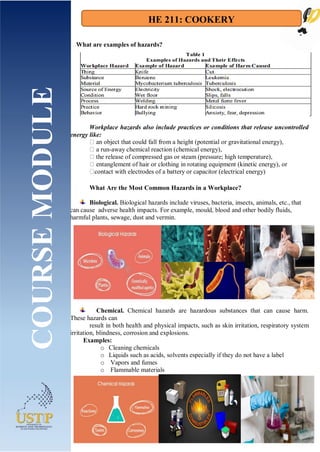
Biological. Biological hazards include viruses, bacteria, insects, animals, etc., that
can cause adverse health impacts. For example, mould, blood and other bodily fluids,
harmful plants, sewage, dust and vermin.
Chemical. Chemical hazards are hazardous substances that can cause harm.
These hazards can
result in both health and physical impacts, such as skin irritation, respiratory system
irritation, blindness, corrosion and explosions.
Examples:
o Cleaning chemicals
o Liquids such as acids, solvents especially if they do not have a label
o Vapors and fumes
o Flammable materials
COURSE
MODULE
HE 211: COOKERY
Examples:
Physical. Physical hazards are environmental factors that can harm an
employee without necessarily touching them, including heights, noise,
radiation and pressure.
o Electricity
o Fires
o Confined Spaces
Ergonomic hazards
- are a result of physical factors that can result in musculoskeletal injuries. They
can be found in every workplace and, if not managed correctly, can have significant
long and short term impacts on your employees health and wellbeing. Musculoskeletal
injuries are those that affect the musculoskeletal system, including damage to muscles,
tendons, bones, joints, ligaments, nerves, and blood vessels.
Psychosocial. Psychosocial hazards include those that can have an adverse
effect on an employee’s mental health or wellbeing. For example, sexual
harassment, victimization, stress and workplace violence.
COURSE
MODULE
HE 211: COOKERY
What is Risk Assessment?
Safety Regulations
COURSE
MODULE RISKS- is a chance/probability that a person will be harmed or experienced
adverse health effects if exposed to a hazard.
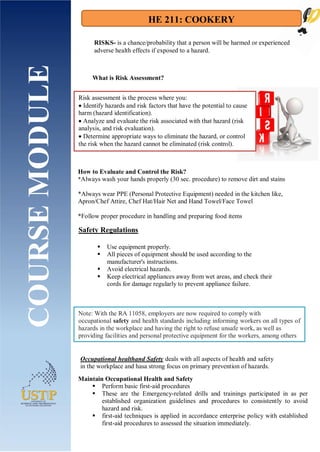
Risk assessment is the process where you:
 Identify hazards and risk factors that have the potential to cause
harm (hazard identification).
 Analyze and evaluate the risk associated with that hazard (risk
analysis, and risk evaluation).
 Determine appropriate ways to eliminate the hazard, or control
the risk when the hazard cannot be eliminated (risk control).
How to Evaluate and Control the Risk?
*Always wash your hands properly (30 sec. procedure) to remove dirt and stains
*Always wear PPE (Personal Protective Equipment) needed in the kitchen like,
Apron/Chef Attire, Chef Hat/Hair Net and Hand Towel/Face Towel
*Follow proper procedure in handling and preparing food items
 Use equipment properly.
 All pieces of equipment should be used according to the
manufacturer's instructions.
 Avoid electrical hazards.
 Keep electrical appliances away from wet areas, and check their
cords for damage regularly to prevent appliance failure.
Note: With the RA 11058, employers are now required to comply with
occupational safety and health standards including informing workers on all types of
hazards in the workplace and having the right to refuse unsafe work, as well as
providing facilities and personal protective equipment for the workers, among others
Occupational healthand Safety deals with all aspects of health and safety
in the workplace and hasa strong focus on primary prevention of hazards.
Maintain Occupational Health and Safety
 Perform basic first-aid procedures
 These are the Emergency-related drills and trainings participated in as per
established organization guidelines and procedures to consistently to avoid
hazard and risk.
 first-aid techniques is applied in accordance enterprise policy with established
first-aid procedures to assessed the situation immediately.
HE 211: COOKERY
Contingency Measures

COURSE
MODULE
A contingency plan is a written emergency procedures plan which describes what
actions must be taken to minimize hazards from fires, explosions or unplanned releases
of hazardous waste or hazardous waste.
Key Principles of Contingency Planning
Practical
Simple and easy to do
Realistic and feasible
Needs based and efficient, ensuring
fair use of resources
Process driven for effective
operationalization
regularly tested through exercises
•,monitored and updated.
HE 211: COOKERY
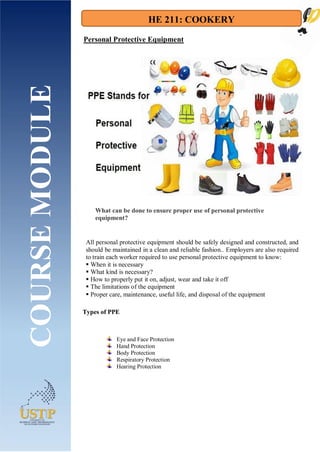
Types of PPE
COURSE
MODULE Personal Protective Equipment
All personal protective equipment should be safely designed and constructed, and
should be maintained in a clean and reliable fashion.. Employers are also required
to train each worker required to use personal protective equipment to know:
 When it is necessary
 What kind is necessary?
 How to properly put it on, adjust, wear and take it off
 The limitations of the equipment
 Proper care, maintenance, useful life, and disposal of the equipment
What can be done to ensure proper use of personal protective
equipment?
Eye and Face Protection
Hand Protection
Body Protection
Respiratory Protection
Hearing Protection
HE 211: COOKERY
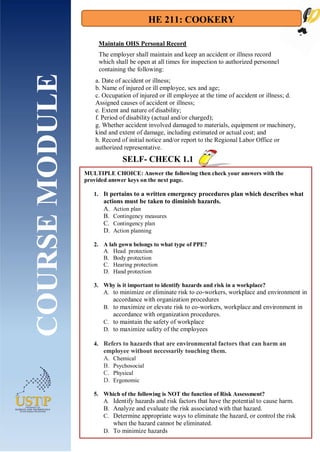
Maintain OHS Personal Record
SELF- CHECK 1.1
a. Date of accident or illness;
b. Name of injured or ill employee, sex and age;
c. Occupation of injured or ill employee at the time of accident or illness; d.
Assigned causes of accident or illness;
e. Extent and nature of disability;
f. Period of disability (actual and/or charged);
g. Whether accident involved damaged to materials, equipment or machinery,
kind and extent of damage, including estimated or actual cost; and
h. Record of initial notice and/or report to the Regional Labor Office or
authorized representative.
The employer shall maintain and keep an accident or illness record
which shall be open at all times for inspection to authorized personnel
containing the following:
COURSE
MODULE
MULTIPLE CHOICE: Answer the following then check your answers with the
provided answer keys on the next page.
1. It pertains to a written emergency procedures plan which describes what
actions must be taken to diminish hazards.
A. Action plan
B. Contingency measures
C. Contingency plan
D. Action planning
2. A lab gown belongs to what type of PPE?
A. Head protection
B. Body protection
C. Hearing protection
D. Hand protection
3. Why is it important to identify hazards and risk in a workplace?
A. to minimize or eliminate risk to co-workers, workplace and environment in
accordance with organization procedures
B. to maximize or elevate risk to co-workers, workplace and environment in
accordance with organization procedures.
C. to maintain the safety of workplace
D. to maximize safety of the employees
4. Refers to hazards that are environmental factors that can harm an
employee without necessarily touching them.
A. Chemical
B. Psychosocial
C. Physical
D. Ergonomic
5. Which of the following is NOT the function of Risk Assessment?
A. Identify hazards and risk factors that have the potential to cause harm.
B. Analyze and evaluate the risk associated with that hazard.
C. Determine appropriate ways to eliminate the hazard, or control the risk
when the hazard cannot be eliminated.
D. To minimize hazards
HE 211: COOKERY
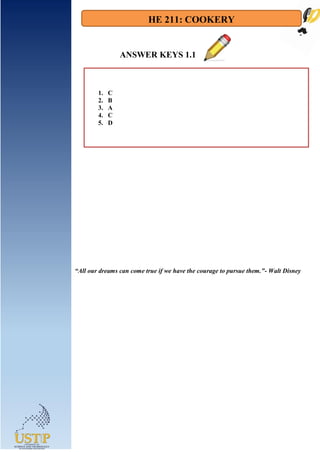
ANSWER KEYS 1.1
“All our dreams can come true if we have the courage to pursue them.”- Walt Disney
1. C
2. B
3. A
4. C
5. D
HE 211: COOKERY
References
 TESDA TR
 Housekeeping Management Revised edition 2010 by Amelia Samson
Roldan and Amelia Malapitan Crespo
 Housekeeping Made Easy 2 by Ma. Aurora L. Sicat
 https://www.slideshare .net /yongChong 20/organizing-the-
housekeeping-job
COURSE
MODULE
HE 211: COOKERY
COURSE
COURSE

Module 1_Week 1 Cookery.pdf

  • 1.
    HE 211: COOKERY Thisclass must achieve to Observe Safety and Hygiene in your workplace and preparing/cookingfood, must achieve a skill in preparing dishes from hot meals to cold meals. What are the Hazard and Risks? HAZARDS - is a source of potential harm in human injury/ ill health from food or from thecarrier (cook/server) transmitted to food. Why? - to minimize or eliminate risk to co-workers, workplace and environment in accordance with organization procedures. Module 1 Week 2: August 31- September 3, 2021 | 1st Semester, S.Y. 2021-2022 Introduction The course consists of skills that a student must achieve in the following areas of competencies. The underlying principles in occupational health and safety procedures, workplace hygiene procedures, effective customer’s service. It also consists values on real-world aspects such as preparation of stocks and sauces, appetizers, salads and dressings, sandwiches, meat, vegetable, egg, starch, poultryand game,seafood dishes, desserts, and packaging and labelling of the prepared foods. Intended Learning Outcomes  Determine the Hygiene Procedures  Identify Hygiene Risks  Determine procedures in minimizing or removing risks Lesson 1: OBSERVE WORKPLACE HYGIENE PROCEDURES COURSE MODULE *In this course, there are 3 Competencies compose of… 1.Basic Competencies – (Focusing only to Occupational Health and Safety) 2.Common Competencies - (Focusing only to Workplace Hygiene and Safety Procedures) 3.Core Competencies *Principles /Methods/classification of Preparation of Stocks And Sauces; *Appetizers, Salads and variety; * Poultry and Game, and Egg dishes; * Vegetables Dishes; Starch Dishes; *Meat Dishes; *Seafood Dishes; *Dessert; and * Labeling and Packaging of Prepared Foods Identify Hazard and Risk
  • 2.
    HE 211: COOKERY Whatare examples of hazards? Workplace hazards also include practices or conditions that release uncontrolled energy like: an object that could fall from a height (potential or gravitational energy), a run-away chemical reaction (chemical energy), the release of compressed gas or steam (pressure; high temperature), entanglement of hair or clothing in rotating equipment (kinetic energy), or contact with electrodes of a battery or capacitor (electrical energy) What Are the Most Common Hazards in a Workplace? Biological. Biological hazards include viruses, bacteria, insects, animals, etc., that can cause adverse health impacts. For example, mould, blood and other bodily fluids, harmful plants, sewage, dust and vermin. Chemical. Chemical hazards are hazardous substances that can cause harm. These hazards can result in both health and physical impacts, such as skin irritation, respiratory system irritation, blindness, corrosion and explosions. Examples: o Cleaning chemicals o Liquids such as acids, solvents especially if they do not have a label o Vapors and fumes o Flammable materials COURSE MODULE
  • 3.
    HE 211: COOKERY Examples: Physical.Physical hazards are environmental factors that can harm an employee without necessarily touching them, including heights, noise, radiation and pressure. o Electricity o Fires o Confined Spaces Ergonomic hazards - are a result of physical factors that can result in musculoskeletal injuries. They can be found in every workplace and, if not managed correctly, can have significant long and short term impacts on your employees health and wellbeing. Musculoskeletal injuries are those that affect the musculoskeletal system, including damage to muscles, tendons, bones, joints, ligaments, nerves, and blood vessels. Psychosocial. Psychosocial hazards include those that can have an adverse effect on an employee’s mental health or wellbeing. For example, sexual harassment, victimization, stress and workplace violence. COURSE MODULE
  • 4.
    HE 211: COOKERY Whatis Risk Assessment? Safety Regulations COURSE MODULE RISKS- is a chance/probability that a person will be harmed or experienced adverse health effects if exposed to a hazard. Risk assessment is the process where you:  Identify hazards and risk factors that have the potential to cause harm (hazard identification).  Analyze and evaluate the risk associated with that hazard (risk analysis, and risk evaluation).  Determine appropriate ways to eliminate the hazard, or control the risk when the hazard cannot be eliminated (risk control). How to Evaluate and Control the Risk? *Always wash your hands properly (30 sec. procedure) to remove dirt and stains *Always wear PPE (Personal Protective Equipment) needed in the kitchen like, Apron/Chef Attire, Chef Hat/Hair Net and Hand Towel/Face Towel *Follow proper procedure in handling and preparing food items  Use equipment properly.  All pieces of equipment should be used according to the manufacturer's instructions.  Avoid electrical hazards.  Keep electrical appliances away from wet areas, and check their cords for damage regularly to prevent appliance failure. Note: With the RA 11058, employers are now required to comply with occupational safety and health standards including informing workers on all types of hazards in the workplace and having the right to refuse unsafe work, as well as providing facilities and personal protective equipment for the workers, among others Occupational healthand Safety deals with all aspects of health and safety in the workplace and hasa strong focus on primary prevention of hazards. Maintain Occupational Health and Safety  Perform basic first-aid procedures  These are the Emergency-related drills and trainings participated in as per established organization guidelines and procedures to consistently to avoid hazard and risk.  first-aid techniques is applied in accordance enterprise policy with established first-aid procedures to assessed the situation immediately.
  • 5.
    HE 211: COOKERY ContingencyMeasures  COURSE MODULE A contingency plan is a written emergency procedures plan which describes what actions must be taken to minimize hazards from fires, explosions or unplanned releases of hazardous waste or hazardous waste. Key Principles of Contingency Planning Practical Simple and easy to do Realistic and feasible Needs based and efficient, ensuring fair use of resources Process driven for effective operationalization regularly tested through exercises •,monitored and updated.
  • 6.
    HE 211: COOKERY Typesof PPE COURSE MODULE Personal Protective Equipment All personal protective equipment should be safely designed and constructed, and should be maintained in a clean and reliable fashion.. Employers are also required to train each worker required to use personal protective equipment to know:  When it is necessary  What kind is necessary?  How to properly put it on, adjust, wear and take it off  The limitations of the equipment  Proper care, maintenance, useful life, and disposal of the equipment What can be done to ensure proper use of personal protective equipment? Eye and Face Protection Hand Protection Body Protection Respiratory Protection Hearing Protection
  • 7.
    HE 211: COOKERY MaintainOHS Personal Record SELF- CHECK 1.1 a. Date of accident or illness; b. Name of injured or ill employee, sex and age; c. Occupation of injured or ill employee at the time of accident or illness; d. Assigned causes of accident or illness; e. Extent and nature of disability; f. Period of disability (actual and/or charged); g. Whether accident involved damaged to materials, equipment or machinery, kind and extent of damage, including estimated or actual cost; and h. Record of initial notice and/or report to the Regional Labor Office or authorized representative. The employer shall maintain and keep an accident or illness record which shall be open at all times for inspection to authorized personnel containing the following: COURSE MODULE MULTIPLE CHOICE: Answer the following then check your answers with the provided answer keys on the next page. 1. It pertains to a written emergency procedures plan which describes what actions must be taken to diminish hazards. A. Action plan B. Contingency measures C. Contingency plan D. Action planning 2. A lab gown belongs to what type of PPE? A. Head protection B. Body protection C. Hearing protection D. Hand protection 3. Why is it important to identify hazards and risk in a workplace? A. to minimize or eliminate risk to co-workers, workplace and environment in accordance with organization procedures B. to maximize or elevate risk to co-workers, workplace and environment in accordance with organization procedures. C. to maintain the safety of workplace D. to maximize safety of the employees 4. Refers to hazards that are environmental factors that can harm an employee without necessarily touching them. A. Chemical B. Psychosocial C. Physical D. Ergonomic 5. Which of the following is NOT the function of Risk Assessment? A. Identify hazards and risk factors that have the potential to cause harm. B. Analyze and evaluate the risk associated with that hazard. C. Determine appropriate ways to eliminate the hazard, or control the risk when the hazard cannot be eliminated. D. To minimize hazards
  • 8.
    HE 211: COOKERY ANSWERKEYS 1.1 “All our dreams can come true if we have the courage to pursue them.”- Walt Disney 1. C 2. B 3. A 4. C 5. D
  • 9.
    HE 211: COOKERY References TESDA TR  Housekeeping Management Revised edition 2010 by Amelia Samson Roldan and Amelia Malapitan Crespo  Housekeeping Made Easy 2 by Ma. Aurora L. Sicat  https://www.slideshare .net /yongChong 20/organizing-the- housekeeping-job COURSE MODULE
  • 10.