Module 1
Food
In this module you will learn…
to say and write about food preferences
To talk about your eating habits
To ask and answer about quantity
To offer something
To accept and refuse an offer
To order food
To take an order
To talk about prices
To write about your and other people’s eating habits
5a What do you eat?
Vegetables
Lettuce
Onion
Potato
Tomato
Carrot
Mushroom
Fruits
Apple
Strawberry Orange Peach
Banana
Dairy products
Yogurt
Cheese
Milk
Meat
Sausage
Ham
Steak
Write 5 sentences about the foot you like or
dislike
• Examples:
I don’t eat oranges.
I like vegetables.
Vegetables aren’t my favorite food.
I eat bananas every day.
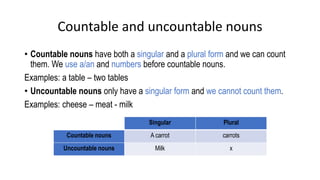
Countable and uncountable nouns
• Countable nouns have both a singular and a plural form and we can count
them. We use a/an and numbers before countable nouns.
Examples: a table – two tables
• Uncountable nouns only have a singular form and we cannot count them.
Examples: cheese – meat - milk
Singular Plural
Countable nouns A carrot carrots
Uncountable nouns Milk x
Student
Uncountable
Countable
Milk
Uncountable
Countable
Ant
 Uncountable
 Countable
Apple
Uncountable
Countable
Coffee
Uncountable
 Countable
Ball
Uncountable
Countable
Air
Uncountable
 Countable
Sand
Uncountable
 Countable
Hair
Uncountable
 Countable
Ink
Uncountable
 Countable
• If the first letter makes a vowel-type sound, you use "an"; if the first letter
would make a consonant-type sound, you use "a."
Some/any
We use some with uncountable and plural countable nouns in affirmative
sentences and offers.
There are some carrots in the refrigerator.
Would you like some tea?
We use any with uncountable and plural countable nouns in questions and
negative sentences.
Is there any milk in the refrigerator?
There aren´t any apples in the refrigerator.
Quantifiers
A quantifier is a word that usually goes before a noun to express the quantity
oftheobject.
Somequantifiersexpressasmallorlargequantity:
• Small:Ihaveafewthingstodobeforefinishingwork.
• Large:Ihavemanythingstodobeforefinishingwork.
The position of quantifiers
We put quantifiers at the beginning of noun phrases.
quantifier + noun
Ex: some people
quantifier + adjective + noun
Ex: many old books
5b Can I take your order?
Would like
• We use would you like…? When we offer something.
Would you like some coffee?
• We use I would like or I’d like when we ask for something politely.
I’d like some coffee, please.
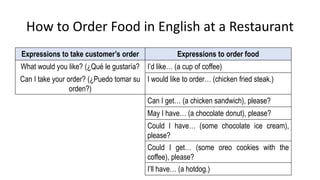
How to Order Food in English at a Restaurant
Expressions to take customer’s order Expressions to order food
What would you like? (¿Qué le gustaría? I’d like… (a cup of coffee)
Can I take your order? (¿Puedo tomar su
orden?)
I would like to order… (chicken fried steak.)
Can I get… (a chicken sandwich), please?
May I have… (a chocolate donut), please?
Could I have… (some chocolate ice cream),
please?
Could I get… (some oreo cookies with the
coffee), please?
I’ll have… (a hotdog.)
5c At the supermarket
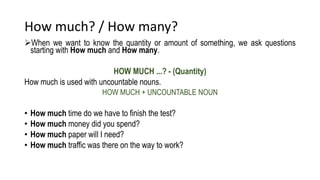
How much? / How many?
When we want to know the quantity or amount of something, we ask questions
starting with How much and How many.
HOW MUCH ...? - (Quantity)
How much is used with uncountable nouns.
HOW MUCH + UNCOUNTABLE NOUN
• How much time do we have to finish the test?
• How much money did you spend?
• How much paper will I need?
• How much traffic was there on the way to work?
HOW MUCH ...? - (Price)
How much can also be used when we want to know the PRICE of something.
In this case, we can use How much with countable nouns (both singular and plural
nouns).
• How much is that painting?
• How much are those shoes?
• How much did your jacket cost?
• How much is the dress on display in the window?
• How much will it cost me?
• How much does it cost ?
HOW MANY ...? - (Quantity)
How many is used when we want to know the QUANTITY of something.
It is only used with plural countable nouns.
HOW MANY + PLURAL NOUN
How many days are there in January?
How many people work in your company?
How many cousins do you have?
How many countries are there in the world?
How many pieces of chocolate would you like?
5d Fast food
5e Eating habits
Linking words
• We use and to join similar ideas
• We use but to join opposite ideas.
• We use or to show that there’s a choice or alternative

Module 1.pptx

  • 1.
  • 2.
    In this moduleyou will learn… to say and write about food preferences To talk about your eating habits To ask and answer about quantity To offer something To accept and refuse an offer To order food To take an order To talk about prices To write about your and other people’s eating habits
  • 3.
    5a What doyou eat? Vegetables Lettuce Onion Potato Tomato Carrot Mushroom
  • 4.
  • 5.
  • 6.
  • 7.
    Write 5 sentencesabout the foot you like or dislike • Examples: I don’t eat oranges. I like vegetables. Vegetables aren’t my favorite food. I eat bananas every day.
  • 9.
    Countable and uncountablenouns • Countable nouns have both a singular and a plural form and we can count them. We use a/an and numbers before countable nouns. Examples: a table – two tables • Uncountable nouns only have a singular form and we cannot count them. Examples: cheese – meat - milk Singular Plural Countable nouns A carrot carrots Uncountable nouns Milk x
  • 10.
    Student Uncountable Countable Milk Uncountable Countable Ant  Uncountable  Countable Apple Uncountable Countable Coffee Uncountable Countable Ball Uncountable Countable Air Uncountable  Countable Sand Uncountable  Countable Hair Uncountable  Countable Ink Uncountable  Countable
  • 11.
    • If thefirst letter makes a vowel-type sound, you use "an"; if the first letter would make a consonant-type sound, you use "a."
  • 14.
    Some/any We use somewith uncountable and plural countable nouns in affirmative sentences and offers. There are some carrots in the refrigerator. Would you like some tea? We use any with uncountable and plural countable nouns in questions and negative sentences. Is there any milk in the refrigerator? There aren´t any apples in the refrigerator.
  • 16.
    Quantifiers A quantifier isa word that usually goes before a noun to express the quantity oftheobject. Somequantifiersexpressasmallorlargequantity: • Small:Ihaveafewthingstodobeforefinishingwork. • Large:Ihavemanythingstodobeforefinishingwork.
  • 17.
    The position ofquantifiers We put quantifiers at the beginning of noun phrases. quantifier + noun Ex: some people quantifier + adjective + noun Ex: many old books
  • 20.
    5b Can Itake your order?
  • 21.
    Would like • Weuse would you like…? When we offer something. Would you like some coffee? • We use I would like or I’d like when we ask for something politely. I’d like some coffee, please.
  • 22.
    How to OrderFood in English at a Restaurant Expressions to take customer’s order Expressions to order food What would you like? (¿Qué le gustaría? I’d like… (a cup of coffee) Can I take your order? (¿Puedo tomar su orden?) I would like to order… (chicken fried steak.) Can I get… (a chicken sandwich), please? May I have… (a chocolate donut), please? Could I have… (some chocolate ice cream), please? Could I get… (some oreo cookies with the coffee), please? I’ll have… (a hotdog.)
  • 23.
    5c At thesupermarket
  • 24.
    How much? /How many? When we want to know the quantity or amount of something, we ask questions starting with How much and How many. HOW MUCH ...? - (Quantity) How much is used with uncountable nouns. HOW MUCH + UNCOUNTABLE NOUN • How much time do we have to finish the test? • How much money did you spend? • How much paper will I need? • How much traffic was there on the way to work?
  • 25.
    HOW MUCH ...?- (Price) How much can also be used when we want to know the PRICE of something. In this case, we can use How much with countable nouns (both singular and plural nouns). • How much is that painting? • How much are those shoes? • How much did your jacket cost? • How much is the dress on display in the window? • How much will it cost me? • How much does it cost ?
  • 26.
    HOW MANY ...?- (Quantity) How many is used when we want to know the QUANTITY of something. It is only used with plural countable nouns. HOW MANY + PLURAL NOUN How many days are there in January? How many people work in your company? How many cousins do you have? How many countries are there in the world? How many pieces of chocolate would you like?
  • 27.
  • 28.
    5e Eating habits Linkingwords • We use and to join similar ideas
  • 29.
    • We usebut to join opposite ideas.
  • 30.
    • We useor to show that there’s a choice or alternative