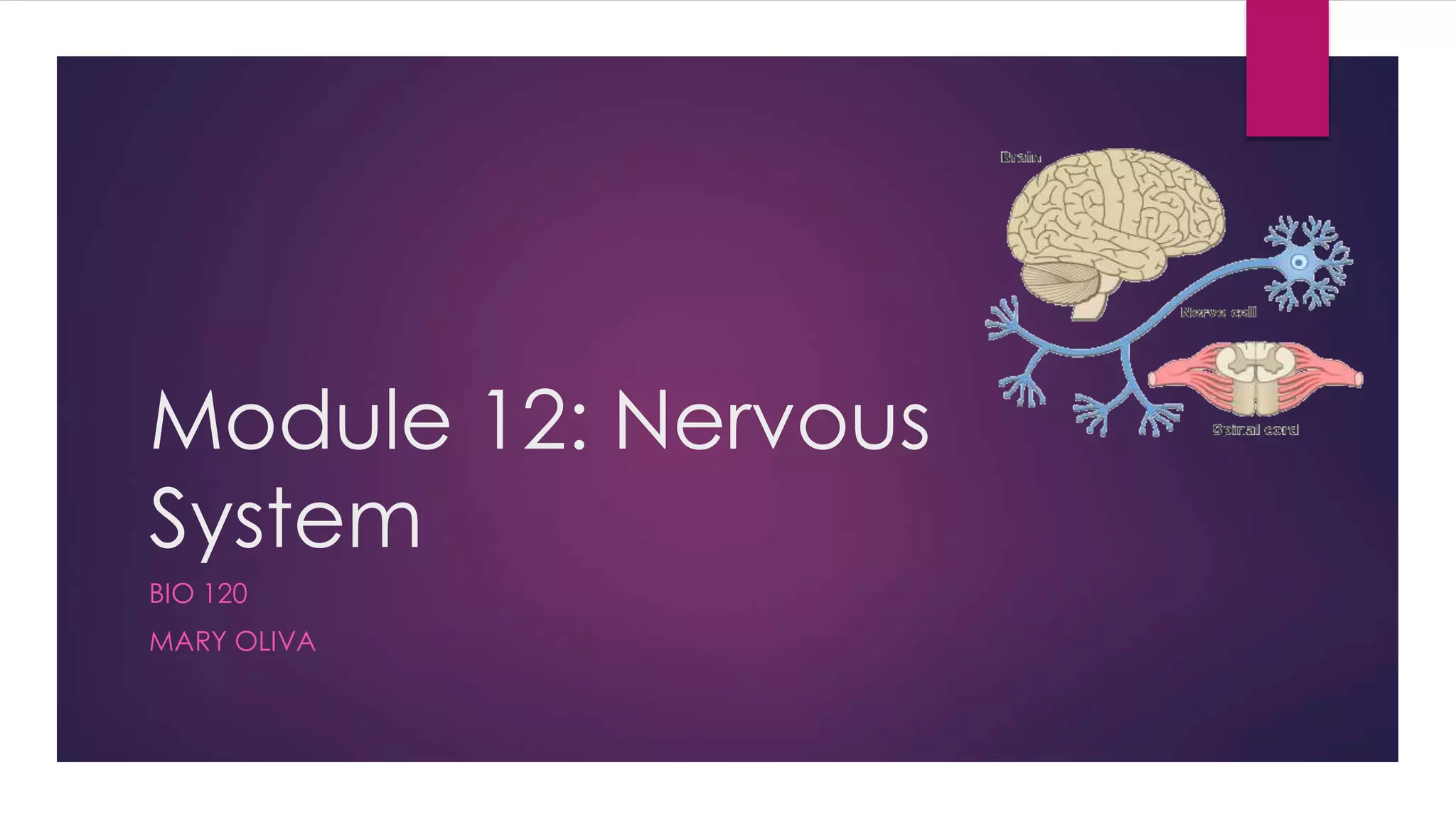
Module 12: Nervous
System
BIO 120
MARY OLIVA
Nervous System Suffixes
 -plegia
 -phasia
Nervous System Suffixes
 -plegia
Suffix meaning “paralysis”
 Paralysis: temporary or permanent loss of function or
voluntary movement
 Paralysis most often occurs when there is damage in
the nervous system, especially the spinal cord, stroke
(CVA), multiple sclerosis, Gullain-Barre syndrome,
Parkinson’s disease, spina bifida
Examples: monoplegia, paraplegia, quadriplegia,
hemiplegia
Nervous System Suffixes
Monoplegia: paralysis of one
extremity
“Mono-” – one, “-plegia” – paralysis
Nervous System Suffixes
 Paraplegia: paralysis of the lower
portion of the body and both legs
 “Para-” – two like parts of a pair, “-
plegia” - paralysis
Nervous System Suffixes
 Quadriplegia: paralysis of all four
limbs
 “Quadri-” – four; “-plegia” - paralysis
Hemiplegia: paralysis on only one
side of the body
 hemi- “half”; -plegia “paralysis”
Nervous System Suffixes
 -phasia:
 Suffix meaning “speech”
 Speech: vocalized form of human
language
 Examples: aphasia, dysphasia
Nervous System Suffixes
 Cerebrum: largest section of the
brain and is the area that processes
thoughts, judgment, memory,
problem solving and language
 Frontal lobe: most anterior portion of
cerebrum; controls motor function,
personality and speech
Nervous System Suffixes
Aphasia: inability to communicate
verbally or in writing due to damage of
the speech or language centers in the
brain
a- “without”; -phasia “speech”
 symptom of brain damage; can be
caused by stroke (CVA)
Nervous System Suffixes
 Dysphagia: difficulty communicating
verbally or in writing due to damage
of the speech or language centers in
the brain
 dys- “difficult”; -phagia “speech”
 result of brain lesion
Nervous System Suffixes
 CVA: cardiovascular accident
 Development of an infarct due to loss in the blood
supply to an area of the brain
 Blood flow can be interrupted by a ruptured blood
vessel (hemorrhage), a floating clot (embolus), a
stationary clot (thrombosis), or compression
 The extent of damage depends on the size and
location of the infarct and often includes dysphagia
and hemiplegia
Nervous System Suffixes
 Multiple sclerosis: inflammatory disease of the
central nervous system in which there is extreme
weakness and numbness due to loss of myelin
insulation from nerves
 Gullain-Barre syndrome: disease of the nervous
system in which nerves lose their myelin
covering
 Characterized by loss of sensation and/or muscle
control starting in the legs
Nervous System Suffixes
 Parkinson’s disease: chronic disorder of the
nervous system with fine tremors, muscular
weakness, rigidity, and a shuffling gait
 Spina bifida: congenital defect in the walls
of the spinal canal in which the laminae of
the vertebra do not meet or close

Module 12

  • 1.
  • 2.
    Nervous System Suffixes -plegia  -phasia
  • 3.
    Nervous System Suffixes -plegia Suffix meaning “paralysis”  Paralysis: temporary or permanent loss of function or voluntary movement  Paralysis most often occurs when there is damage in the nervous system, especially the spinal cord, stroke (CVA), multiple sclerosis, Gullain-Barre syndrome, Parkinson’s disease, spina bifida Examples: monoplegia, paraplegia, quadriplegia, hemiplegia
  • 4.
    Nervous System Suffixes Monoplegia:paralysis of one extremity “Mono-” – one, “-plegia” – paralysis
  • 5.
    Nervous System Suffixes Paraplegia: paralysis of the lower portion of the body and both legs  “Para-” – two like parts of a pair, “- plegia” - paralysis
  • 6.
    Nervous System Suffixes Quadriplegia: paralysis of all four limbs  “Quadri-” – four; “-plegia” - paralysis
  • 7.
    Hemiplegia: paralysis ononly one side of the body  hemi- “half”; -plegia “paralysis”
  • 8.
    Nervous System Suffixes -phasia:  Suffix meaning “speech”  Speech: vocalized form of human language  Examples: aphasia, dysphasia
  • 9.
    Nervous System Suffixes Cerebrum: largest section of the brain and is the area that processes thoughts, judgment, memory, problem solving and language  Frontal lobe: most anterior portion of cerebrum; controls motor function, personality and speech
  • 10.
    Nervous System Suffixes Aphasia:inability to communicate verbally or in writing due to damage of the speech or language centers in the brain a- “without”; -phasia “speech”  symptom of brain damage; can be caused by stroke (CVA)
  • 11.
    Nervous System Suffixes Dysphagia: difficulty communicating verbally or in writing due to damage of the speech or language centers in the brain  dys- “difficult”; -phagia “speech”  result of brain lesion
  • 12.
    Nervous System Suffixes CVA: cardiovascular accident  Development of an infarct due to loss in the blood supply to an area of the brain  Blood flow can be interrupted by a ruptured blood vessel (hemorrhage), a floating clot (embolus), a stationary clot (thrombosis), or compression  The extent of damage depends on the size and location of the infarct and often includes dysphagia and hemiplegia
  • 13.
    Nervous System Suffixes Multiple sclerosis: inflammatory disease of the central nervous system in which there is extreme weakness and numbness due to loss of myelin insulation from nerves  Gullain-Barre syndrome: disease of the nervous system in which nerves lose their myelin covering  Characterized by loss of sensation and/or muscle control starting in the legs
  • 14.
    Nervous System Suffixes Parkinson’s disease: chronic disorder of the nervous system with fine tremors, muscular weakness, rigidity, and a shuffling gait  Spina bifida: congenital defect in the walls of the spinal canal in which the laminae of the vertebra do not meet or close