EET 435 RenewableEnergy Systems
Prepared By
Savitha KP, AP, EEE
07-07-2025 EET 435 Renewable Energy Systems 1
2.
Syllabus
Module 1
• Introduction,Classification of Energy Resources- Conventional Energy
Resources -Availability and their limitations- Non-Conventional Energy
Resources –Classification, Advantages, Limitations, Comparison.
• SOLAR THERMAL SYSTEMS - Principle of Conversion of Solar Radiation into
Heat – Solar thermal collectors. – Flat plate collectors. Solar
concentrators(parabolic trough, parabolic dish, Central Tower Collector).
• SOLAR ELECTRIC SYSTEMS - Solar Thermal Electric Power Generation – Solar
Photovoltaic – Solar Cell fundamentals - characteristics, classification,
construction. Solar PV Systems – stand-alone and grid-connected-
Applications
07-07-2025 EET 435 Renewable Energy Systems 2
3.
World Energy Scenario
•Global energy demand continues to rise with industrial growth and
population increase.
• Energy consumption is dominated by:
• China, USA, India – top consumers and emitters.
• Around 75% of global energy still comes from fossil fuels (coal, oil, gas),
leading to climate change, resource depletion, and energy insecurity
• Renewable energy (solar, wind etc.) is rapidly expanding worldwide.
• Climate goals (e.g., Net Zero by 2050) are transforming energy policies
• Countries aim to reduce greenhouse gas emissions to zero (net).
• Innovation in hydrogen, battery storage, and carbon capture is rising.
• International cooperation under the Paris Agreement is driving global
change.
07-07-2025 EET 435 Renewable Energy Systems 3
4.
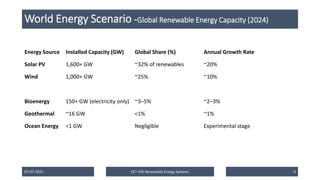
World Energy Scenario-Global Renewable Energy Capacity (2024)
Energy Source Installed Capacity (GW) Global Share (%) Annual Growth Rate
Solar PV 1,600+ GW ~32% of renewables ~20%
Wind 1,000+ GW ~25% ~10%
Bioenergy 150+ GW (electricity only) ~3–5% ~2–3%
Geothermal ~16 GW <1% ~1%
Ocean Energy <1 GW Negligible Experimental stage
07-07-2025 EET 435 Renewable Energy Systems 4
5.
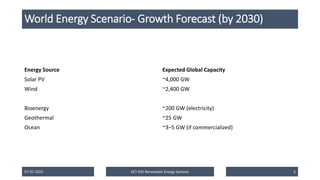
World Energy Scenario-Growth Forecast (by 2030)
07-07-2025 EET 435 Renewable Energy Systems 5
Energy Source Expected Global Capacity
Solar PV ~4,000 GW
Wind ~2,400 GW
Bioenergy ~200 GW (electricity)
Geothermal ~25 GW
Ocean ~3–5 GW (if commercialized)
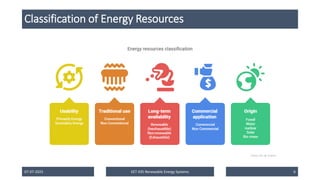
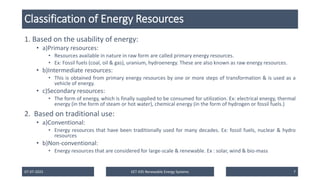
Classification of EnergyResources
1. Based on the usability of energy:
• a)Primary resources:
• Resources available in nature in raw form are called primary energy resources.
• Ex: Fossil fuels (coal, oil & gas), uranium, hydroenergy. These are also known as raw energy resources.
• b)Intermediate resources:
• This is obtained from primary energy resources by one or more steps of transformation & is used as a
vehicle of energy.
• c)Secondary resources:
• The form of energy, which is finally supplied to be consumed for utilization. Ex: electrical energy, thermal
energy (in the form of steam or hot water), chemical energy (in the form of hydrogen or fossil fuels.)
2. Based on traditional use:
• a)Conventional:
• Energy resources that have been traditionally used for many decades. Ex: fossil fuels, nuclear & hydro
resources
• b)Non-conventional:
• Energy resources that are considered for large-scale & renewable. Ex : solar, wind & bio-mass
07-07-2025 EET 435 Renewable Energy Systems 7
8.
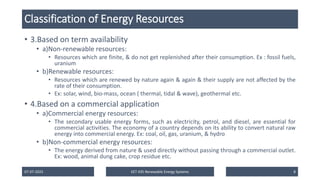
Classification of EnergyResources
• 3.Based on term availability
• a)Non-renewable resources:
• Resources which are finite, & do not get replenished after their consumption. Ex : fossil fuels,
uranium
• b)Renewable resources:
• Resources which are renewed by nature again & again & their supply are not affected by the
rate of their consumption.
• Ex: solar, wind, bio-mass, ocean ( thermal, tidal & wave), geothermal etc.
• 4.Based on a commercial application
• a)Commercial energy resources:
• The secondary usable energy forms, such as electricity, petrol, and diesel, are essential for
commercial activities. The economy of a country depends on its ability to convert natural raw
energy into commercial energy. Ex: coal, oil, gas, uranium, & hydro
• b)Non-commercial energy resources:
• The energy derived from nature & used directly without passing through a commercial outlet.
Ex: wood, animal dung cake, crop residue etc.
07-07-2025 EET 435 Renewable Energy Systems 8
9.
Classification of EnergyResources
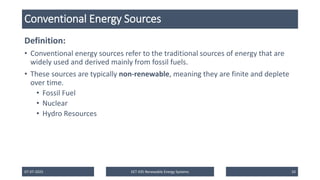
• Based on origin :
• Fossil fuel energy
• Nuclear energy
• Hydro energy
• Solar energy
• Wind energy
• Biomass energy
• Geothermal energy
07-07-2025 EET 435 Renewable Energy Systems 9
10.
Conventional Energy Sources
Definition:
•Conventional energy sources refer to the traditional sources of energy that are
widely used and derived mainly from fossil fuels.
• These sources are typically non-renewable, meaning they are finite and deplete
over time.
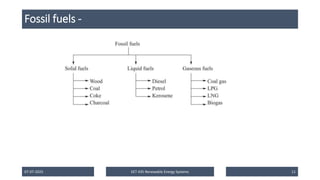
• Fossil Fuel
• Nuclear
• Hydro Resources
07-07-2025 EET 435 Renewable Energy Systems 10
Fossil Fuel- Coal,Petroleum, Oil, Gas
• Coal
• These are formed by the decomposition of the remains of dead plants and animals buried under
the earth for a long time.
• These are non-renewable sources of energy, which, if exhausted, can not be replenished in a
short time.
• Their reserves are limited and are considered very precious.
• These are also contributing to the global environmental pollution.
• Coal is a complex mixture of compounds of carbon, hydrogen, and oxygen. Small amounts of
nitrogen and Sulphur compounds are also present in coal.
• It is mainly available in Bihar, West Bengal, Orissa, and Madhya Pradesh.
• The big coal mines in our country are at Jharia and Bokaro in Bihar and at Raniganj in West Bengal
• It is considered as the backbone of the energy sector for its use in industry, transportation, and
electric power generation.
• In the last three decades, the world switched over from coal to oil as a major source of energy
because it is simpler and cleaner to obtain useful energy from oil.
07-07-2025 EET 435 Renewable Energy Systems 12
13.
Fossil Fuel- Coal,Petroleum, Oil, Gas
• Petroleum or Oil
• It is a premier energy source with a wide range of applications.
• Formed from ancient organic matter under heat and pressure.
• Extracted from oil fields and refined into fuels (petrol, diesel,
kerosene)
• It is a dark coloured, viscous, and foul-smelling crude oil.
• It is normally found under the crust of the Earth, trapped in rocks.
• It is a complex mixture of several solid, liquid gaseous hydrocarbons
mixed with water, salt, and earth particles.
• It is a natural product obtained from oil wells.
07-07-2025 EET 435 Renewable Energy Systems 13
14.
Fossil Fuel- Coal,Petroleum, Oil, Gas
• The products obtained from crude petroleum as follows:
• Petroleum gas (below 40oC) used as LPG.
• Petrol (40oC to 170oC) for light vehicles.
• Kerosene (170 to 250 °C) for household and industrial use.
• Diesel oil (250 to 350 °C) for heavy vehicles.
• Residual oil:
• (a) Lubrication oils
• (b) paraffin wax
• Fuel oil (350 °C to 400 °C) for boilers and furnaces.
07-07-2025 EET 435 Renewable Energy Systems 14
15.
Fossil Fuel- Coal,Petroleum, Oil, Gas
• Natural gas
• It consists of about 95% Methane rest is ethane and propane.
• It occurs deep under the crust of the Earth, either alone or along with oil
above the petroleum deposits.
• It is a product of petroleum mining.
• It is used as a domestic and industrial fuel.
• The natural gas is now also available as CNG(Compressed Natural
Gas)a substitute for petrol in automobiles.
07-07-2025 EET 435 Renewable Energy Systems 15
16.
Nuclear Energy
• Energyreleased by splitting atoms (nuclear fission), mainly uranium-
235 (occurs in nature)
• Controlled in nuclear reactors to generate heat and electricity.
• The energy released by the complete fission of one Kg of Uranium (U
235 is equal to the heat energy obtained by burning 4500 tones of
coal ( 220 tons of oil
• The heat produced by the nuclear fission of the atoms of fissionable
material is utilized in special heat exchangers for the production of
steam, which is then used to drive turbo generators as in
conventional power plants.
07-07-2025 EET 435 Renewable Energy Systems 16
17.
Nuclear Energy
limitations inthe use of nuclear energy
• High capital cost of nuclear power plants
• limited availability of raw materials
• Difficulties associated with the disposal of radioactive waste
• Shortage of well-trained personnel to handle the nuclear power plants
• The Uranium reserves in the world at present are small
• These reserves are recoverable but are expensive
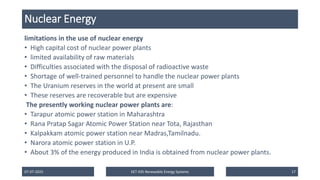
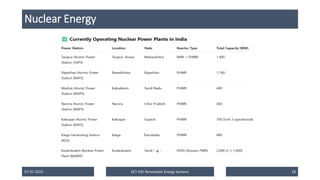
The presently working nuclear power plants are:
• Tarapur atomic power station in Maharashtra
• Rana Pratap Sagar Atomic Power Station near Tota, Rajasthan
• Kalpakkam atomic power station near Madras,Tamilnadu.
• Narora atomic power station in U.P.
• About 3% of the energy produced in India is obtained from nuclear power plants.
07-07-2025 EET 435 Renewable Energy Systems 17
Hydraulic energy (or)Water power
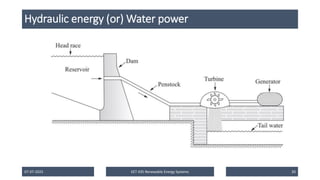
• Water power is developed by allowing water to fall under the force of
gravity
• It is used almost exclusively for electric power generation
• The potential energy of water is converted into Mechanical energy by
using prime movers known as hydraulic turbines
• Water power is quite cheap where water is available in abundance.
• Although the capital cost of hydroelectric power plants is higher as
compared to other types of power plants but their operating Costs
are quite low, as no fuel is required in this case.
07-07-2025 EET 435 Renewable Energy Systems 19
Hydraulic energy (or)Water power
• The development rate of hydropower is still low, due to the following
problems:
• In developing a project, it will take about 6 to 10 years for planning,
investigation, and construction.
• High capital investment is needed, and some parts of the investment have to
be designed from foreign sources.
• There are growing problems with the relocation of villages, involved
compensation for damage, selecting a suitable resettlement area, and
environmental impact.
07-07-2025 EET 435 Renewable Energy Systems 21
22.
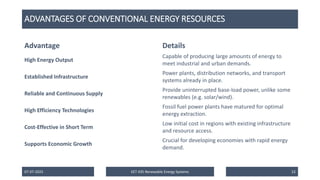
ADVANTAGES OF CONVENTIONALENERGY RESOURCES
07-07-2025 EET 435 Renewable Energy Systems 22
Advantage Details
High Energy Output
Capable of producing large amounts of energy to
meet industrial and urban demands.
Established Infrastructure
Power plants, distribution networks, and transport
systems already in place.
Reliable and Continuous Supply
Provide uninterrupted base-load power, unlike some
renewables (e.g. solar/wind).
High Efficiency Technologies
Fossil fuel power plants have matured for optimal
energy extraction.
Cost-Effective in Short Term
Low initial cost in regions with existing infrastructure
and resource access.
Supports Economic Growth
Crucial for developing economies with rapid energy
demand.
23.
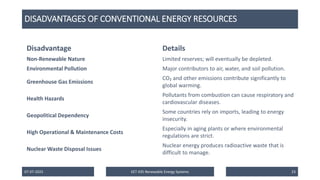
DISADVANTAGES OF CONVENTIONALENERGY RESOURCES
07-07-2025 EET 435 Renewable Energy Systems 23
Disadvantage Details
Non-Renewable Nature Limited reserves; will eventually be depleted.
Environmental Pollution Major contributors to air, water, and soil pollution.
Greenhouse Gas Emissions
CO₂ and other emissions contribute significantly to
global warming.
Health Hazards
Pollutants from combustion can cause respiratory and
cardiovascular diseases.
Geopolitical Dependency
Some countries rely on imports, leading to energy
insecurity.
High Operational & Maintenance Costs
Especially in aging plants or where environmental
regulations are strict.
Nuclear Waste Disposal Issues
Nuclear energy produces radioactive waste that is
difficult to manage.
24.
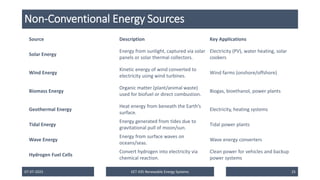
Non-Conventional Energy Sources
•The sources of energy that are being produced continuously in nature
and are inexhaustible are called renewable sources of energy (non-
conventional energy
• These are more environment friendly compared to conventional
(fossil fuel-based) sources.
07-07-2025 EET 435 Renewable Energy Systems 24
25.
Non-Conventional Energy Sources
SourceDescription Key Applications
Solar Energy
Energy from sunlight, captured via solar
panels or solar thermal collectors.
Electricity (PV), water heating, solar
cookers
Wind Energy
Kinetic energy of wind converted to
electricity using wind turbines.
Wind farms (onshore/offshore)
Biomass Energy
Organic matter (plant/animal waste)
used for biofuel or direct combustion.
Biogas, bioethanol, power plants
Geothermal Energy
Heat energy from beneath the Earth’s
surface.
Electricity, heating systems
Tidal Energy
Energy generated from tides due to
gravitational pull of moon/sun.
Tidal power plants
Wave Energy
Energy from surface waves on
oceans/seas.
Wave energy converters
Hydrogen Fuel Cells
Convert hydrogen into electricity via
chemical reaction.
Clean power for vehicles and backup
power systems
07-07-2025 EET 435 Renewable Energy Systems 25
26.
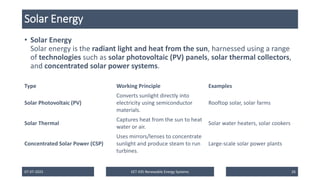
Solar Energy
• SolarEnergy
Solar energy is the radiant light and heat from the sun, harnessed using a range
of technologies such as solar photovoltaic (PV) panels, solar thermal collectors,
and concentrated solar power systems.
07-07-2025 EET 435 Renewable Energy Systems 26
Type Working Principle Examples
Solar Photovoltaic (PV)
Converts sunlight directly into
electricity using semiconductor
materials.
Rooftop solar, solar farms
Solar Thermal
Captures heat from the sun to heat
water or air.
Solar water heaters, solar cookers
Concentrated Solar Power (CSP)
Uses mirrors/lenses to concentrate
sunlight and produce steam to run
turbines.
Large-scale solar power plants
27.
Solar Energy
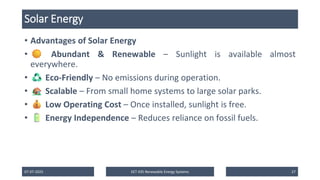
• Advantagesof Solar Energy
• Abundant & Renewable – Sunlight is available almost
everywhere.
• Eco-Friendly – No emissions during operation.
• Scalable – From small home systems to large solar parks.
• Low Operating Cost – Once installed, sunlight is free.
• Energy Independence – Reduces reliance on fossil fuels.
07-07-2025 EET 435 Renewable Energy Systems 27
28.
Solar Energy
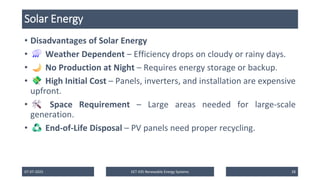
• Disadvantagesof Solar Energy
• Weather Dependent – Efficiency drops on cloudy or rainy days.
• No Production at Night – Requires energy storage or backup.
• High Initial Cost – Panels, inverters, and installation are expensive
upfront.
• Space Requirement – Large areas needed for large-scale
generation.
• End-of-Life Disposal – PV panels need proper recycling.
07-07-2025 EET 435 Renewable Energy Systems 28
29.
Wind Energy
• Windenergy is the kinetic energy of moving air (wind), converted
into mechanical or electrical energy using wind turbines. It is one of
the cleanest and most sustainable forms of energy generation.
How It Works
• Wind turns the blades of a wind turbine.
• The rotor spins a generator to produce electricity.
• Power is sent to the grid or stored in batteries.
07-07-2025 EET 435 Renewable Energy Systems 29
30.
Wind Energy
• Advantagesof Wind Energy
• Clean and Renewable – No emissions or fuel needed.
• Abundant – Especially in coastal, plain, and high-altitude areas.
• Low Operating Cost – Once installed, the wind is free.
• Scalable – Suitable for both large grids and standalone systems.
• Land Friendly – Land beneath turbines can still be used (e.g.,
farming).
07-07-2025 EET 435 Renewable Energy Systems 30
31.
Wind Energy
• Disadvantagesof Wind Energy
• Inconsistent Wind – Power generation depends on wind speed.
• Location Specific – Needs open, windy areas to be effective.
• Noise and Aesthetics – Some consider turbines noisy or
unsightly.
• Impact on Wildlife – Potential threat to birds and bats.
• High Initial Investment – Infrastructure and grid connection
costs.
07-07-2025 EET 435 Renewable Energy Systems 31
32.
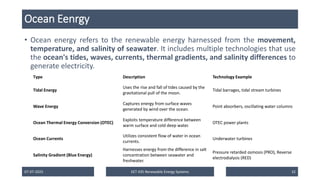
Ocean Eenrgy
• Oceanenergy refers to the renewable energy harnessed from the movement,
temperature, and salinity of seawater. It includes multiple technologies that use
the ocean's tides, waves, currents, thermal gradients, and salinity differences to
generate electricity.
07-07-2025 EET 435 Renewable Energy Systems 32
Type Description Technology Example
Tidal Energy
Uses the rise and fall of tides caused by the
gravitational pull of the moon.
Tidal barrages, tidal stream turbines
Wave Energy
Captures energy from surface waves
generated by wind over the ocean.
Point absorbers, oscillating water columns
Ocean Thermal Energy Conversion (OTEC)
Exploits temperature difference between
warm surface and cold deep water.
OTEC power plants
Ocean Currents
Utilizes consistent flow of water in ocean
currents.
Underwater turbines
Salinity Gradient (Blue Energy)
Harnesses energy from the difference in salt
concentration between seawater and
freshwater.
Pressure retarded osmosis (PRO), Reverse
electrodialysis (RED)
33.
Ocean Energy
• Advantagesof Ocean Energy
• Vast Potential – Oceans cover 70% of Earth; enormous untapped
energy.
• Clean and Renewable – Zero emissions during operation.
• Predictable – Tides and currents follow consistent natural cycles.
• Low Visual Impact – Mostly underwater installations.
• Base-load Power – Especially tidal energy, which is regular and
reliable.
07-07-2025 EET 435 Renewable Energy Systems 33
34.
Ocean Energy
• Disadvantagesof Ocean Energy
• High Initial Cost – Complex engineering and marine installation.
• Technological Immaturity – Many systems still in pilot or R&D
stage.
• Environmental Impact – May affect marine ecosystems and
navigation.
• Site Specific – Requires specific oceanographic and coastal
conditions.
• Transmission Losses – Often located far from land-based grids.
07-07-2025 EET 435 Renewable Energy Systems 34
35.
Biomass Energy
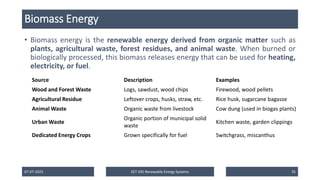
• Biomassenergy is the renewable energy derived from organic matter such as
plants, agricultural waste, forest residues, and animal waste. When burned or
biologically processed, this biomass releases energy that can be used for heating,
electricity, or fuel.
07-07-2025 EET 435 Renewable Energy Systems 35
Source Description Examples
Wood and Forest Waste Logs, sawdust, wood chips Firewood, wood pellets
Agricultural Residue Leftover crops, husks, straw, etc. Rice husk, sugarcane bagasse
Animal Waste Organic waste from livestock Cow dung (used in biogas plants)
Urban Waste
Organic portion of municipal solid
waste
Kitchen waste, garden clippings
Dedicated Energy Crops Grown specifically for fuel Switchgrass, miscanthus
36.
Biomass Energy
• Advantagesof Biomass Energy
• Renewable – Biomass can be replanted and regrown.
• Waste Utilization – Converts waste to useful energy.
• Multiple Products – Electricity, heat, gas, and liquid fuels.
• Rural Employment – Promotes farming and agro-based industry.
07-07-2025 EET 435 Renewable Energy Systems 36
37.
Biomass Energy
• Disadvantagesof Biomass Energy
• Air Pollution – Incomplete combustion releases smoke and
pollutants.
• Land Use Pressure – Competes with food production if crops are
diverted.
• Water Usage – Energy crops may require irrigation.
• Inefficiency – Lower energy density than fossil fuels.
• Deforestation Risk – If not managed sustainably.
07-07-2025 EET 435 Renewable Energy Systems 37
38.
Geothermal Energy
• Geothermalenergy is the heat stored beneath the Earth’s surface, which can be
harnessed for electricity generation, direct heating, or industrial uses. This
energy comes from the Earth's molten core, hot rocks, and underground
reservoirs of steam and hot water.
07-07-2025 EET 435 Renewable Energy Systems 38
39.
Advantages of GeothermalEnergy
• Renewable & Sustainable – Heat is continuously produced inside
the Earth.
• Low Emissions – Minimal greenhouse gases emitted compared to
fossil fuels.
• Base-load Power – Available 24/7 regardless of weather.
• Efficient – High capacity factor; consistent output.
• Small Land Footprint – Requires less space than solar/wind
installations.
07-07-2025 EET 435 Renewable Energy Systems 39
40.
Disadvantages of GeothermalEnergy
• Location Specific – Viable only in tectonically active regions.
• High Initial Cost – Drilling and exploration are expensive and
risky.
• Potential for Depletion – If water is not reinjected properly.
• Risk of Gases & Contamination – May release hydrogen sulfide
or pollute groundwater.
• Earthquakes – Deep drilling may induce seismic activity (e.g., in
Enhanced Geothermal Systems).
07-07-2025 EET 435 Renewable Energy Systems 40
41.
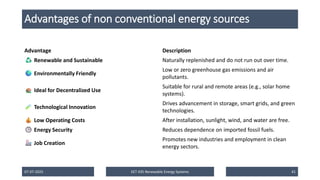
Advantages of nonconventional energy sources
Advantage Description
Renewable and Sustainable Naturally replenished and do not run out over time.
Environmentally Friendly
Low or zero greenhouse gas emissions and air
pollutants.
Ideal for Decentralized Use
Suitable for rural and remote areas (e.g., solar home
systems).
Technological Innovation
Drives advancement in storage, smart grids, and green
technologies.
Low Operating Costs After installation, sunlight, wind, and water are free.
Energy Security Reduces dependence on imported fossil fuels.
Job Creation
Promotes new industries and employment in clean
energy sectors.
07-07-2025 EET 435 Renewable Energy Systems 41
42.
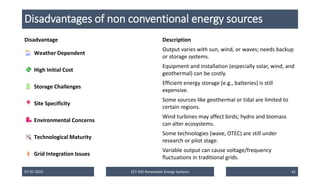
Disadvantages of nonconventional energy sources
Disadvantage Description
Weather Dependent
Output varies with sun, wind, or waves; needs backup
or storage systems.
High Initial Cost
Equipment and installation (especially solar, wind, and
geothermal) can be costly.
Storage Challenges
Efficient energy storage (e.g., batteries) is still
expensive.
Site Specificity
Some sources like geothermal or tidal are limited to
certain regions.
Environmental Concerns
Wind turbines may affect birds; hydro and biomass
can alter ecosystems.
Technological Maturity
Some technologies (wave, OTEC) are still under
research or pilot stage.
Grid Integration Issues
Variable output can cause voltage/frequency
fluctuations in traditional grids.
07-07-2025 EET 435 Renewable Energy Systems 42