Optical Fiber Structures,
Attenuation and Dispersion
By
Bavana B N
Assistant Professor
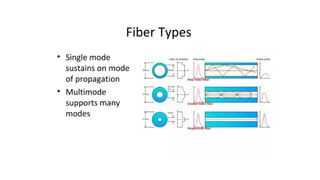
3.Single mode fibers
• Propagation in single mode fiber is advantageous because
signal dispersion due to delay differences amongst various
modes in multimode is avoided.
• Multimode step index fibers cannot be used for single mode
propagation due to difficulties in maintaining single mode
operation.
• Transmission of single mode the fiber is designed to allow
propagation in one mode only, while all other modes are
attenuated by leakage or absorption.
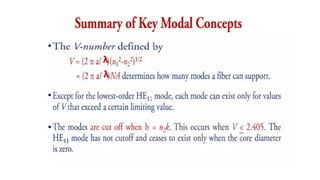
• The normalized frequency for the fiber can be adjusted within
the range by reducing core radius and refractive index
difference < 1%. In order to obtain single mode operation with
maximum V number (2.4), the single mode fiber must have
smaller core diameter than the equivalent multimode step
index fiber.
• But smaller core diameter has problem of launching light into
the fiber, jointing fibers and reduced relative index difference.
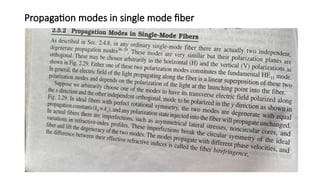
• It must be noted that there are in fact two modes with orthogonal
polarization over this range, and the term single-mode applies to
propagation of light of a particular polarization. Also, it is apparent that
the normalized frequency for the fiber may be adjusted to within the
range 0 <V <2.405 by reduction of the core radius.
3.1Mode Field Diameter
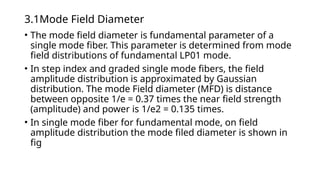
• The mode field diameter is fundamental parameter of a
single mode fiber. This parameter is determined from mode
field distributions of fundamental LP01 mode.
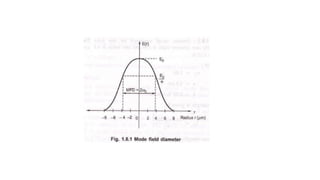
• In step index and graded single mode fibers, the field
amplitude distribution is approximated by Gaussian
distribution. The mode Field diameter (MFD) is distance
between opposite 1/e = 0.37 times the near field strength
(amplitude) and power is 1/e2 = 0.135 times.
• In single mode fiber for fundamental mode, on field
amplitude distribution the mode filed diameter is shown in
fig
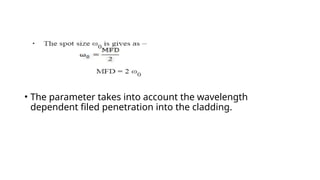
• The parameter takes into account the wavelength
dependent filed penetration into the cladding.
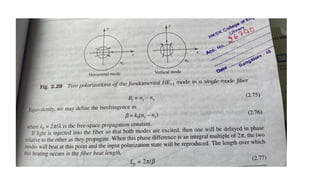
Propagation modes in single mode fiber
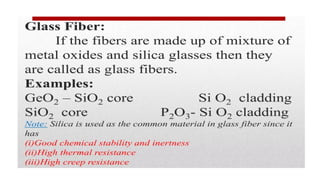
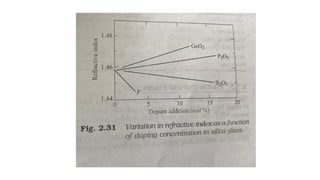
Fiber Materials
Attenuation and Dispersion:
• One of the important property of optical fiber is signal attenuation. It
is also known as fiber loss or signal loss. The signal attenuation of
fiber determines the maximum distance between transmitter and
receiver. The attenuation also determines the number of repeaters
required, maintaining repeater is a costly affair.
• Another important property of optical fiber is distortion mechanism.
As the signal pulse travels along the fiber length it becomes more
broader. After sufficient length the broad pulses starts overlapping
with adjacent pulses. This creates error in the receiver. Hence the
distortion limits the information carrying capacity of fiber
Attenuation
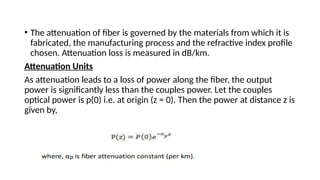
• Attenuation is a measure of decay of signal strength or loss of light power
that occurs as light pulses propagate through the length of the fiber.
• In optical fibers the attenuation is mainly caused by two physical factors
absorption and scattering losses. Absorption is because of fiber material and
scattering due to structural imperfection within the fiber. Nearly 90 % of total
attenuation is caused by Rayleigh scattering only. Micro bending of optical
fiber also contributes to the attenuation of signal.
• The rate at which light is absorbed is dependent on the wavelength of the
light and the characteristics of particular glass. Glass is a silicon compound,
by adding different additional chemicals to the basic silicon dioxide the
optical properties of the glass can be changed.
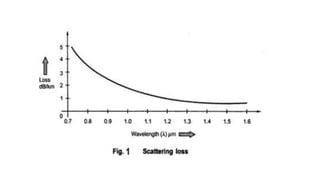
• The Rayleigh scattering is wavelength dependent and reduces rapidly as
the wavelength of the incident radiation increases
• The attenuation of fiber is governed by the materials from which it is
fabricated, the manufacturing process and the refractive index profile
chosen. Attenuation loss is measured in dB/km.
Attenuation Units
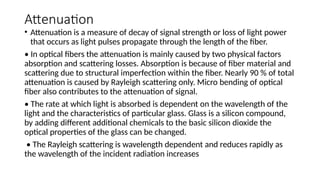
As attenuation leads to a loss of power along the fiber, the output
power is significantly less than the couples power. Let the couples
optical power is p(0) i.e. at origin (z = 0). Then the power at distance z is
given by,
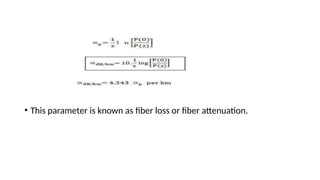
• This parameter is known as fiber loss or fiber attenuation.
Absorption
• Absorption loss is related to the material composition and fabrication
process of fiber. Absorption loss results in dissipation of some optical
power as hear in the fiber cable. Although glass fibers are extremely
pure, some impurities still remain as residue after purification. The
amount of absorption by these impurities depends on their
concentration and light wavelength.
• Absorption in optical fiber is caused by these three mechanisms.
• 1. Absorption by atomic defects in the glass composition
• 2. Extrinsic absorption by impurity atoms in the glass material
• 3. Intrinsic absorption by the basic constituent atoms of the fiber
material.
Absorption by Atomic Defects
• Atomic defects are imperfections in the atomic structure of the fiber
materials such as missing molecules, high density clusters of atom
groups. These absorption losses are negligible compared with intrinsic
and extrinsic losses.
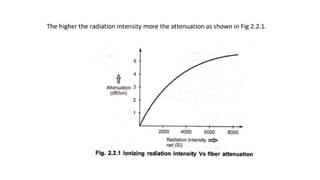
• The absorption effect is most significant when fiber is exposed to
ionizing radiation in nuclear reactor, medical therapies, space missions
etc. The radiation dames the internal structure of fiber. The damages are
proportional to the intensity of ionizing particles. This results in increasing
attenuation due to atomic defects and absorbing optical energy.
• The total dose a material receives is expressed in rad (Si), this is the unit
for measuring radiation absorbed in bulk silicon.
1 rad (Si) = 0.01 J.kg
Extrinsic Absorption
• Extrinsic absorption occurs due to electronic transitions between the
energy level and because of charge transitions from one ion to
another. A major source of attenuation is from transition of metal
impurity ions such as iron, chromium, cobalt and copper. These losses
can be upto 1 to 10 dB/km. The effect of metallic impurities can be
reduced by glass refining techniques.
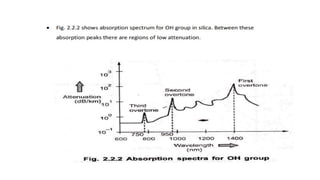
• • Another major extrinsic loss is caused by absorption due to OH
(Hydroxil) ions impurities dissolved in glass. Vibrations occur at
wavelengths between 2.7 and 4.2 µm. The absorption peaks occurs at
1400, 950 and 750 nm. These are first, second and third overtones
respectively
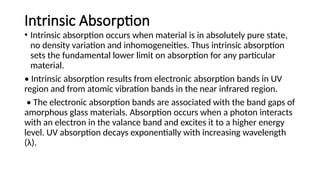
Intrinsic Absorption
• Intrinsic absorption occurs when material is in absolutely pure state,
no density variation and inhomogeneities. Thus intrinsic absorption
sets the fundamental lower limit on absorption for any particular
material.
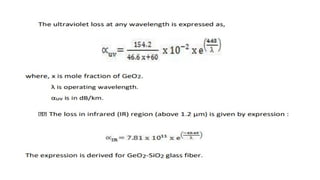
• Intrinsic absorption results from electronic absorption bands in UV
region and from atomic vibration bands in the near infrared region.
• The electronic absorption bands are associated with the band gaps of
amorphous glass materials. Absorption occurs when a photon interacts
with an electron in the valance band and excites it to a higher energy
level. UV absorption decays exponentially with increasing wavelength
(λ).
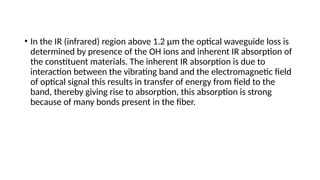
• In the IR (infrared) region above 1.2 µm the optical waveguide loss is
determined by presence of the OH ions and inherent IR absorption of
the constituent materials. The inherent IR absorption is due to
interaction between the vibrating band and the electromagnetic field
of optical signal this results in transfer of energy from field to the
band, thereby giving rise to absorption, this absorption is strong
because of many bonds present in the fiber.
Scattering Losses
• Scattering losses exists in optical fibers because of microscopic
variations in the material density and composition.
• As glass is composed by randomly connected network of molecules
and several oxides (e.g. SiO2, GeO2 and P2O5), these are the major
cause of compositional structure fluctuation. These two effects results
to variation in refractive index and Rayleigh type scattering of light.
• Rayleigh scattering of light is due to small localized changes in the
refractive index of the core and cladding material.
There are two causes during the manufacturing of fiber.
1. The first is due to slight fluctuation in mixing of ingredients. The
random changes because of this are impossible to eliminate
completely.
2. The other cause is slight change in density as the silica cools and
solidifies. When light ray strikes such zones it gets scattered in all
directions. The amount of scatter depends on the size of the
discontinuity compared with the wavelength of the light so the shortest
wavelength (highest frequency) suffers most scattering.
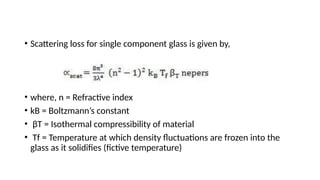
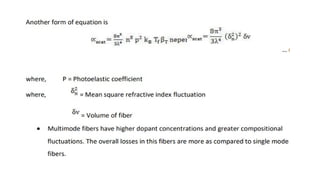
• Scattering loss for single component glass is given by,
• where, n = Refractive index
• kB = Boltzmann’s constant
• βT = Isothermal compressibility of material
• Tf = Temperature at which density fluctuations are frozen into the
glass as it solidifies (fictive temperature)
Bending Loss
Radiative losses occur whenever an optical fiber undergoes a bend of
finite radius of curvature. Fibers can be subjected to two types of
bends:
a)Macroscopic bends (having radii that are large as compared with
the fiber diameter)
b) Random microscopic bends of fiber axis
Losses due to curvature and losses caused by an abrupt change in
radius of curvature are referred to as ‘bending losses.’
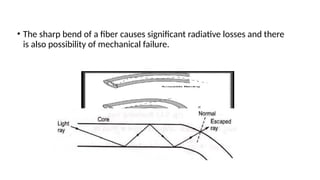
• The sharp bend of a fiber causes significant radiative losses and there
is also possibility of mechanical failure.
• As the core bends the normal will follow it and the ray will now find
itself on the wrong side of critical angle and will escape. The sharp
bends are therefore avoided.
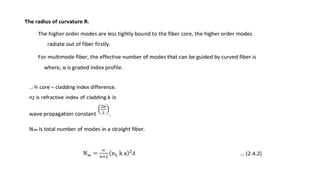
• The radiation loss from a bent fiber depends on –Field strength of
certain critical distance xc from fiber axis where power is lost through
radiation.
Module 1 optical.pptx which includes all module 1 contents

Module 1 optical.pptx which includes all module 1 contents

  • 1.
    Optical Fiber Structures, Attenuationand Dispersion By Bavana B N Assistant Professor
  • 23.
    3.Single mode fibers •Propagation in single mode fiber is advantageous because signal dispersion due to delay differences amongst various modes in multimode is avoided. • Multimode step index fibers cannot be used for single mode propagation due to difficulties in maintaining single mode operation. • Transmission of single mode the fiber is designed to allow propagation in one mode only, while all other modes are attenuated by leakage or absorption.
  • 24.
    • The normalizedfrequency for the fiber can be adjusted within the range by reducing core radius and refractive index difference < 1%. In order to obtain single mode operation with maximum V number (2.4), the single mode fiber must have smaller core diameter than the equivalent multimode step index fiber. • But smaller core diameter has problem of launching light into the fiber, jointing fibers and reduced relative index difference. • It must be noted that there are in fact two modes with orthogonal polarization over this range, and the term single-mode applies to propagation of light of a particular polarization. Also, it is apparent that the normalized frequency for the fiber may be adjusted to within the range 0 <V <2.405 by reduction of the core radius.
  • 25.
    3.1Mode Field Diameter •The mode field diameter is fundamental parameter of a single mode fiber. This parameter is determined from mode field distributions of fundamental LP01 mode. • In step index and graded single mode fibers, the field amplitude distribution is approximated by Gaussian distribution. The mode Field diameter (MFD) is distance between opposite 1/e = 0.37 times the near field strength (amplitude) and power is 1/e2 = 0.135 times. • In single mode fiber for fundamental mode, on field amplitude distribution the mode filed diameter is shown in fig
  • 27.
    • The parametertakes into account the wavelength dependent filed penetration into the cladding.
  • 28.
    Propagation modes insingle mode fiber
  • 30.
  • 36.
    Attenuation and Dispersion: •One of the important property of optical fiber is signal attenuation. It is also known as fiber loss or signal loss. The signal attenuation of fiber determines the maximum distance between transmitter and receiver. The attenuation also determines the number of repeaters required, maintaining repeater is a costly affair. • Another important property of optical fiber is distortion mechanism. As the signal pulse travels along the fiber length it becomes more broader. After sufficient length the broad pulses starts overlapping with adjacent pulses. This creates error in the receiver. Hence the distortion limits the information carrying capacity of fiber
  • 37.
    Attenuation • Attenuation isa measure of decay of signal strength or loss of light power that occurs as light pulses propagate through the length of the fiber. • In optical fibers the attenuation is mainly caused by two physical factors absorption and scattering losses. Absorption is because of fiber material and scattering due to structural imperfection within the fiber. Nearly 90 % of total attenuation is caused by Rayleigh scattering only. Micro bending of optical fiber also contributes to the attenuation of signal. • The rate at which light is absorbed is dependent on the wavelength of the light and the characteristics of particular glass. Glass is a silicon compound, by adding different additional chemicals to the basic silicon dioxide the optical properties of the glass can be changed. • The Rayleigh scattering is wavelength dependent and reduces rapidly as the wavelength of the incident radiation increases
  • 38.
    • The attenuationof fiber is governed by the materials from which it is fabricated, the manufacturing process and the refractive index profile chosen. Attenuation loss is measured in dB/km. Attenuation Units As attenuation leads to a loss of power along the fiber, the output power is significantly less than the couples power. Let the couples optical power is p(0) i.e. at origin (z = 0). Then the power at distance z is given by,
  • 39.
    • This parameteris known as fiber loss or fiber attenuation.
  • 40.
    Absorption • Absorption lossis related to the material composition and fabrication process of fiber. Absorption loss results in dissipation of some optical power as hear in the fiber cable. Although glass fibers are extremely pure, some impurities still remain as residue after purification. The amount of absorption by these impurities depends on their concentration and light wavelength. • Absorption in optical fiber is caused by these three mechanisms. • 1. Absorption by atomic defects in the glass composition • 2. Extrinsic absorption by impurity atoms in the glass material • 3. Intrinsic absorption by the basic constituent atoms of the fiber material.
  • 41.
    Absorption by AtomicDefects • Atomic defects are imperfections in the atomic structure of the fiber materials such as missing molecules, high density clusters of atom groups. These absorption losses are negligible compared with intrinsic and extrinsic losses. • The absorption effect is most significant when fiber is exposed to ionizing radiation in nuclear reactor, medical therapies, space missions etc. The radiation dames the internal structure of fiber. The damages are proportional to the intensity of ionizing particles. This results in increasing attenuation due to atomic defects and absorbing optical energy. • The total dose a material receives is expressed in rad (Si), this is the unit for measuring radiation absorbed in bulk silicon. 1 rad (Si) = 0.01 J.kg
  • 43.
    Extrinsic Absorption • Extrinsicabsorption occurs due to electronic transitions between the energy level and because of charge transitions from one ion to another. A major source of attenuation is from transition of metal impurity ions such as iron, chromium, cobalt and copper. These losses can be upto 1 to 10 dB/km. The effect of metallic impurities can be reduced by glass refining techniques. • • Another major extrinsic loss is caused by absorption due to OH (Hydroxil) ions impurities dissolved in glass. Vibrations occur at wavelengths between 2.7 and 4.2 µm. The absorption peaks occurs at 1400, 950 and 750 nm. These are first, second and third overtones respectively
  • 45.
    Intrinsic Absorption • Intrinsicabsorption occurs when material is in absolutely pure state, no density variation and inhomogeneities. Thus intrinsic absorption sets the fundamental lower limit on absorption for any particular material. • Intrinsic absorption results from electronic absorption bands in UV region and from atomic vibration bands in the near infrared region. • The electronic absorption bands are associated with the band gaps of amorphous glass materials. Absorption occurs when a photon interacts with an electron in the valance band and excites it to a higher energy level. UV absorption decays exponentially with increasing wavelength (λ).
  • 46.
    • In theIR (infrared) region above 1.2 µm the optical waveguide loss is determined by presence of the OH ions and inherent IR absorption of the constituent materials. The inherent IR absorption is due to interaction between the vibrating band and the electromagnetic field of optical signal this results in transfer of energy from field to the band, thereby giving rise to absorption, this absorption is strong because of many bonds present in the fiber.
  • 48.
    Scattering Losses • Scatteringlosses exists in optical fibers because of microscopic variations in the material density and composition. • As glass is composed by randomly connected network of molecules and several oxides (e.g. SiO2, GeO2 and P2O5), these are the major cause of compositional structure fluctuation. These two effects results to variation in refractive index and Rayleigh type scattering of light. • Rayleigh scattering of light is due to small localized changes in the refractive index of the core and cladding material.
  • 49.
    There are twocauses during the manufacturing of fiber. 1. The first is due to slight fluctuation in mixing of ingredients. The random changes because of this are impossible to eliminate completely. 2. The other cause is slight change in density as the silica cools and solidifies. When light ray strikes such zones it gets scattered in all directions. The amount of scatter depends on the size of the discontinuity compared with the wavelength of the light so the shortest wavelength (highest frequency) suffers most scattering.
  • 51.
    • Scattering lossfor single component glass is given by, • where, n = Refractive index • kB = Boltzmann’s constant • βT = Isothermal compressibility of material • Tf = Temperature at which density fluctuations are frozen into the glass as it solidifies (fictive temperature)
  • 53.
    Bending Loss Radiative lossesoccur whenever an optical fiber undergoes a bend of finite radius of curvature. Fibers can be subjected to two types of bends: a)Macroscopic bends (having radii that are large as compared with the fiber diameter) b) Random microscopic bends of fiber axis Losses due to curvature and losses caused by an abrupt change in radius of curvature are referred to as ‘bending losses.’
  • 54.
    • The sharpbend of a fiber causes significant radiative losses and there is also possibility of mechanical failure.
  • 55.
    • As thecore bends the normal will follow it and the ray will now find itself on the wrong side of critical angle and will escape. The sharp bends are therefore avoided. • The radiation loss from a bent fiber depends on –Field strength of certain critical distance xc from fiber axis where power is lost through radiation.