ELECTION COMMISSION
MAHIMA SAINI
LLM ONE YEAR (2020-21)
NEW LAW COLLEGE, PUNE
BHARATI VIDYAPEETH DEEMED UNIVERSITY
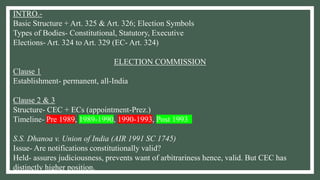
INTRO.-
Basic Structure + Art. 325 & Art. 326; Election Symbols
Types of Bodies- Constitutional, Statutory, Executive
Elections- Art. 324 to Art. 329 (EC- Art. 324)
ELECTION COMMISSION
Clause 1
Establishment- permanent, all-India
Clause 2 & 3
Structure- CEC + ECs (appointment-Prez.)
Timeline- Pre 1989, 1989-1990, 1990-1993, Post 1993
S.S. Dhanoa v. Union of India (AIR 1991 SC 1745)
Issue- Are notifications constitutionally valid?
Held- assures judiciousness, prevents want of arbitrariness hence, valid. But CEC has
distinctly higher position.
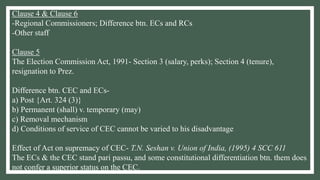
Clause 4 & Clause 6
-Regional Commissioners; Difference btn. ECs and RCs
-Other staff
Clause 5
The Election Commission Act, 1991- Section 3 (salary, perks); Section 4 (tenure),
resignation to Prez.
Difference btn. CEC and ECs-
a) Post {Art. 324 (3)}
b) Permanent (shall) v. temporary (may)
c) Removal mechanism
d) Conditions of service of CEC cannot be varied to his disadvantage
Effect of Act on supremacy of CEC- T.N. Seshan v. Union of India, (1995) 4 SCC 611
The ECs & the CEC stand pari passu, and some constitutional differentiation btn. them does
not confer a superior status on the CEC.
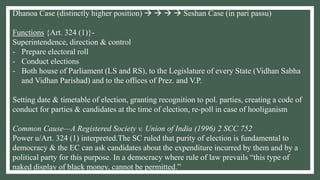
Dhanoa Case (distinctly higher position)     Seshan Case (in pari passu)
Functions {Art. 324 (1)}-
Superintendence, direction & control
- Prepare electoral roll
- Conduct elections
- Both house of Parliament (LS and RS), to the Legislature of every State (Vidhan Sabha
and Vidhan Parishad) and to the offices of Prez. and V.P.
Setting date & timetable of election, granting recognition to pol. parties, creating a code of
conduct for parties & candidates at the time of election, re-poll in case of hooliganism
Common Cause—A Registered Society v. Union of India (1996) 2 SCC 752
Power u/Art. 324 (1) interpreted.The SC ruled that purity of election is fundamental to
democracy & the EC can ask candidates about the expenditure incurred by them and by a
political party for this purpose. In a democracy where rule of law prevails “this type of
naked display of black money, cannot be permitted.”
Kanhaiya Lal Omar v. R.K. Trivedi, AIR 1986 SC 111 (Symbols Order, 1968)
“Any part of the Symbols Order which cannot be traced to Rules 5 and 10 of the Rules can
easily be traced in this case to the reservoir of power under Art. 324(1) which empowers the
Commission to issue all directions necessary for the purpose of conducting smooth, free and
fair elections”
Limitations on functions-
• Subject to Art. 327 & 328 (D.C. Act, R.P. Act, P. & V.P. Election Act)
• SC has cautioned that u/Art. 324(1), EC doesn’t exercise untrammeled powers otherwise
it will become an imperium in imperio which no one is under the Constitution.
Duties
Act bona-fide
Follow principles of NJ
Ensure fair play in action
Exercise review of decision where necessary
Digvijay Mote v. Union of India, (1993) 4 SCC 175
The power conferred on the EC by Art. 324 has to be exercised not mindlessly nor mala fide
nor arbitrarily nor with partiality but in keeping with the guidelines of the Rule of Law and
not stultifying the presidential notification nor existing legislation.
Nature of EC’s orders- They’re directions not law, the violation of which could result in
invalidation of the election. (eg.-Model Code of Conduct)
Lakshmi Charan Sen v. A.K.M. Hussain Ujjaman, AIR 1985 SC 1233
“The directions issued by the EC to the electoral officers are binding upon such officers but
such directions have no force of law so as to create rights & liab. between the contestants of
election…”
EC v. SC
Election Commission of India v. A.I.A.D.M.K., 1994 Supp (2) SCC 689 (use of loudspeakers
in electioneering order challenged; order held too restrictive & modified by SC)
N. Krishnappa v. Chief Election Commissioner, AIR 1995 AP 212 (order of casting votes by
machines held to be beyond EC’s jurisdiction)
Other powers- advising Prez./ Gov. on Q. of disqualification of any MP [Art. 103(2)] or
member of S.L. [Art. 192(2)]
Is it also a Tribunal?
Art. 324, r/w Symbols Order, 1968- EC has power to allot symbols for purposes of elections
to pol. parties & to adjudicate upon disputes relating to-
-recognition of pol. parties
-rival claims to a symbol for election purposes
A.P.H.L Conference, Shillong, v. W.A. Sangma, AIR 1977 SC 2155
Yes, it is. Other cases held-exercises quasi-judicial functions.
Gujarat Legislative Assembly Election matter, (2002) 8 SCC 237
Gujarat L.A. was dissolved prematurely on 19-7-2002. Acc. to Art. 174(1), 6 months shall
not intervene between the last sitting of one session & the date appointed for the first
meeting of the next session. EC was of the view that since the law & order situation in Guj.
was delicate, election could not be held before 3-10-2002 & it would take a few more
months thereafter to hold the election.
Art. 174(1) relates to an existing, live & functional Assembly. It regulates frequencies of
sessions of existing Houses. It is mandatory so far as time period between 2 sessions of a
living & functional House is concerned. But it doesn’t relate to a dissolved House. Hence,
Art. 174(1) doesn’t provide for any period for holding election for constituting fresh
legislative Assembly.
From various constitutional & statutory provisions, it can be inferred that on premature
dissolution of a House, election ought to be held within 6 months from the date of the
Assembly’s dissolution. On the premature dissolution of Assembly, the EC is required to
initiate immediate steps for holding election for constituting legislative assembly on the first
occasion & in any case within 6 months from the date of assembly’s premature dissolution.
Effort should be to hold election & not to defer it; ‘act of God’- postpone beyond 6 months
but man-made obstructions- no deferring. propositions to apply mutatis mutandis to L.S.
elections (Art. 85)
Interference of courts in electoral matters (Art. 329)
Art. 329 (a)
Art. 329 (b)
No suit/ writ petition
Object- let elections complete as per schedule
Notification to declaration- whole process covered
Ponnuswami N.P. v. Returning Officer, AIR 1952 SC 64
“It does not require much argument to show that in a country with a democratic Constitution
in which the legislatures have to play a very important role, it will lead to serious
consequences if the elections are unduly protracted or obstructed.”
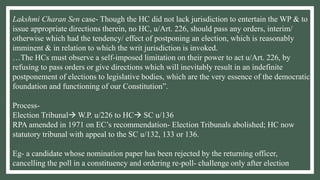
Lakshmi Charan Sen case- Though the HC did not lack jurisdiction to entertain the WP & to
issue appropriate directions therein, no HC, u/Art. 226, should pass any orders, interim/
otherwise which had the tendency/ effect of postponing an election, which is reasonably
imminent & in relation to which the writ jurisdiction is invoked.
…The HCs must observe a self-imposed limitation on their power to act u/Art. 226, by
refusing to pass orders or give directions which will inevitably result in an indefinite
postponement of elections to legislative bodies, which are the very essence of the democratic
foundation and functioning of our Constitution”.
Process-
Election Tribunal W.P. u/226 to HC SC u/136
RPA amended in 1971 on EC’s recommendation- Election Tribunals abolished; HC now
statutory tribunal with appeal to the SC u/132, 133 or 136.
Eg- a candidate whose nomination paper has been rejected by the returning officer,
cancelling the poll in a constituency and ordering re-poll- challenge only after election
THANK YOU!

Election Commission

  • 1.
    ELECTION COMMISSION MAHIMA SAINI LLMONE YEAR (2020-21) NEW LAW COLLEGE, PUNE BHARATI VIDYAPEETH DEEMED UNIVERSITY
  • 2.
    INTRO.- Basic Structure +Art. 325 & Art. 326; Election Symbols Types of Bodies- Constitutional, Statutory, Executive Elections- Art. 324 to Art. 329 (EC- Art. 324) ELECTION COMMISSION Clause 1 Establishment- permanent, all-India Clause 2 & 3 Structure- CEC + ECs (appointment-Prez.) Timeline- Pre 1989, 1989-1990, 1990-1993, Post 1993 S.S. Dhanoa v. Union of India (AIR 1991 SC 1745) Issue- Are notifications constitutionally valid? Held- assures judiciousness, prevents want of arbitrariness hence, valid. But CEC has distinctly higher position.
  • 3.
    Clause 4 &Clause 6 -Regional Commissioners; Difference btn. ECs and RCs -Other staff Clause 5 The Election Commission Act, 1991- Section 3 (salary, perks); Section 4 (tenure), resignation to Prez. Difference btn. CEC and ECs- a) Post {Art. 324 (3)} b) Permanent (shall) v. temporary (may) c) Removal mechanism d) Conditions of service of CEC cannot be varied to his disadvantage Effect of Act on supremacy of CEC- T.N. Seshan v. Union of India, (1995) 4 SCC 611 The ECs & the CEC stand pari passu, and some constitutional differentiation btn. them does not confer a superior status on the CEC.
  • 4.
    Dhanoa Case (distinctlyhigher position)     Seshan Case (in pari passu) Functions {Art. 324 (1)}- Superintendence, direction & control - Prepare electoral roll - Conduct elections - Both house of Parliament (LS and RS), to the Legislature of every State (Vidhan Sabha and Vidhan Parishad) and to the offices of Prez. and V.P. Setting date & timetable of election, granting recognition to pol. parties, creating a code of conduct for parties & candidates at the time of election, re-poll in case of hooliganism Common Cause—A Registered Society v. Union of India (1996) 2 SCC 752 Power u/Art. 324 (1) interpreted.The SC ruled that purity of election is fundamental to democracy & the EC can ask candidates about the expenditure incurred by them and by a political party for this purpose. In a democracy where rule of law prevails “this type of naked display of black money, cannot be permitted.”
  • 5.
    Kanhaiya Lal Omarv. R.K. Trivedi, AIR 1986 SC 111 (Symbols Order, 1968) “Any part of the Symbols Order which cannot be traced to Rules 5 and 10 of the Rules can easily be traced in this case to the reservoir of power under Art. 324(1) which empowers the Commission to issue all directions necessary for the purpose of conducting smooth, free and fair elections” Limitations on functions- • Subject to Art. 327 & 328 (D.C. Act, R.P. Act, P. & V.P. Election Act) • SC has cautioned that u/Art. 324(1), EC doesn’t exercise untrammeled powers otherwise it will become an imperium in imperio which no one is under the Constitution. Duties Act bona-fide Follow principles of NJ Ensure fair play in action Exercise review of decision where necessary
  • 6.
    Digvijay Mote v.Union of India, (1993) 4 SCC 175 The power conferred on the EC by Art. 324 has to be exercised not mindlessly nor mala fide nor arbitrarily nor with partiality but in keeping with the guidelines of the Rule of Law and not stultifying the presidential notification nor existing legislation. Nature of EC’s orders- They’re directions not law, the violation of which could result in invalidation of the election. (eg.-Model Code of Conduct) Lakshmi Charan Sen v. A.K.M. Hussain Ujjaman, AIR 1985 SC 1233 “The directions issued by the EC to the electoral officers are binding upon such officers but such directions have no force of law so as to create rights & liab. between the contestants of election…” EC v. SC Election Commission of India v. A.I.A.D.M.K., 1994 Supp (2) SCC 689 (use of loudspeakers in electioneering order challenged; order held too restrictive & modified by SC)
  • 7.
    N. Krishnappa v.Chief Election Commissioner, AIR 1995 AP 212 (order of casting votes by machines held to be beyond EC’s jurisdiction) Other powers- advising Prez./ Gov. on Q. of disqualification of any MP [Art. 103(2)] or member of S.L. [Art. 192(2)] Is it also a Tribunal? Art. 324, r/w Symbols Order, 1968- EC has power to allot symbols for purposes of elections to pol. parties & to adjudicate upon disputes relating to- -recognition of pol. parties -rival claims to a symbol for election purposes A.P.H.L Conference, Shillong, v. W.A. Sangma, AIR 1977 SC 2155 Yes, it is. Other cases held-exercises quasi-judicial functions.
  • 8.
    Gujarat Legislative AssemblyElection matter, (2002) 8 SCC 237 Gujarat L.A. was dissolved prematurely on 19-7-2002. Acc. to Art. 174(1), 6 months shall not intervene between the last sitting of one session & the date appointed for the first meeting of the next session. EC was of the view that since the law & order situation in Guj. was delicate, election could not be held before 3-10-2002 & it would take a few more months thereafter to hold the election. Art. 174(1) relates to an existing, live & functional Assembly. It regulates frequencies of sessions of existing Houses. It is mandatory so far as time period between 2 sessions of a living & functional House is concerned. But it doesn’t relate to a dissolved House. Hence, Art. 174(1) doesn’t provide for any period for holding election for constituting fresh legislative Assembly. From various constitutional & statutory provisions, it can be inferred that on premature dissolution of a House, election ought to be held within 6 months from the date of the Assembly’s dissolution. On the premature dissolution of Assembly, the EC is required to initiate immediate steps for holding election for constituting legislative assembly on the first occasion & in any case within 6 months from the date of assembly’s premature dissolution.
  • 9.
    Effort should beto hold election & not to defer it; ‘act of God’- postpone beyond 6 months but man-made obstructions- no deferring. propositions to apply mutatis mutandis to L.S. elections (Art. 85) Interference of courts in electoral matters (Art. 329) Art. 329 (a) Art. 329 (b) No suit/ writ petition Object- let elections complete as per schedule Notification to declaration- whole process covered Ponnuswami N.P. v. Returning Officer, AIR 1952 SC 64 “It does not require much argument to show that in a country with a democratic Constitution in which the legislatures have to play a very important role, it will lead to serious consequences if the elections are unduly protracted or obstructed.”
  • 10.
    Lakshmi Charan Sencase- Though the HC did not lack jurisdiction to entertain the WP & to issue appropriate directions therein, no HC, u/Art. 226, should pass any orders, interim/ otherwise which had the tendency/ effect of postponing an election, which is reasonably imminent & in relation to which the writ jurisdiction is invoked. …The HCs must observe a self-imposed limitation on their power to act u/Art. 226, by refusing to pass orders or give directions which will inevitably result in an indefinite postponement of elections to legislative bodies, which are the very essence of the democratic foundation and functioning of our Constitution”. Process- Election Tribunal W.P. u/226 to HC SC u/136 RPA amended in 1971 on EC’s recommendation- Election Tribunals abolished; HC now statutory tribunal with appeal to the SC u/132, 133 or 136. Eg- a candidate whose nomination paper has been rejected by the returning officer, cancelling the poll in a constituency and ordering re-poll- challenge only after election
  • 11.