Module 1:
DATA AROUND US
What is
DATA?
Image or icon
What is
DATA?
IMPORTANCE OF DATA
IMPORTANCE OF DATA
B C
A
IMPORTANCE OF DATA
E
D
IMPORTANCE OF DATA
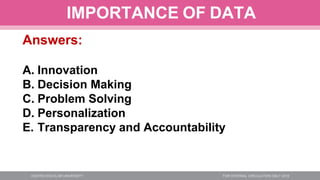
Answers:
A. Innovation
B. Decision Making
C. Problem Solving
D. Personalization
E. Transparency and Accountability
EVOLUTION OF DATA STORAGE
1960 1965
Lots of master
files
- Complexity
of
Maintenance
&
Development
-
Synchronization
of data
-Hardware
“a single
source of
data for all
1970 1975
Database – Online,
high-
performan
ce
processing
1980
• The single-
database-
serving-all-
purposes
paradigm
• PC’s, 4GL
processing” transaction technology
EVOLUTION OF DATA STORAGE
1960s
Punch card
Magnetic tape
Disk drive
EVOLUTION OF DATA STORAGE
1960s
Tabulation
Machine
EVOLUTION OF DATA STORAGE
Mid - 1960s
Signetics 8-bit RAM
EVOLUTION OF DATA STORAGE
Mid-60’s Floppy disk
Disk drive
Transformer Read Only
Storage (TROS)
EVOLUTION OF DATA STORAGE
1960s
EVOLUTION OF DATA STORAGE
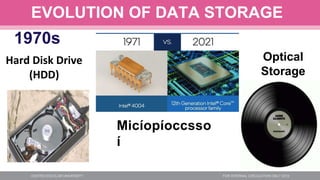
1970s
Hard Disk Drive
(HDD)
Micíopíoccsso
í
Optical
Storage
EVOLUTION OF DATA STORAGE
Mid-1970s
Laserdisc
Japanese
manufactured
dynamic
random-access
memory
(DRAM)
5.25-inch floppy disk
SRAM
EVOLUTION OF DATA STORAGE
1980s
EVOLUTION OF DATA STORAGE
1980s
IBM 3480 cartridge tape
system
3.5-inch floppy disks
CD-ROM
EVOLUTION OF DATA STORAGE
Mid-1980s
Redundant Array of Independent Disks
EVOLUTION OF DATA STORAGE
USB Flash drive
(2000) Cloud-based
network-attached
storage solutions
(2009)
Compact
Flash
(1994)
Data Source
A data source, in the context of
computer science and computer
applications, is the location
where data that is being used come
from. In a database management
system, the primary data source is
the database, which can be located
in a disk or a remote server.
THE DATA SOURCE
Internal
include data that exists
and is stored inside your
organization.
External
is data that was not
collected by your
organization
Sources
of Data
THE SOURCES OF DATA
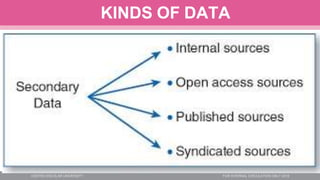
KINDS OF DATA
PRIMARY DATA
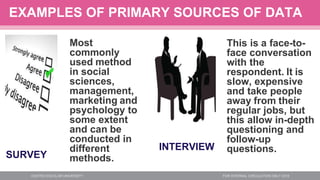
SURVEY
Most
commonly
used method
in social
sciences,
management,
marketing and
psychology to
some extent
and can be
conducted in
different
methods.
This is a face-to-
face conversation
with the
respondent. It is
slow, expensive
and take people
away from their
regular jobs, but
this allow in-depth
questioning and
follow-up
questions.
EXAMPLES OF PRIMARY SOURCES OF DATA
INTERVIEW
QUESTIONNAIRE
Most commonly used
method in survey. These
are a list of questions
either an open-ended or
close-ended for whichIc
t
o
h
n
e
respondent give answers.
These can be conducted
via telephone, mail, live in
a public area, or in an
institute, through
electronic mail or through
fax and other methods.
These can be done while letting
the observing person know that
he is being observed or without
letting him know. These can
also be made in natural setting
as well as in artificially created
environment.
EXAMPLES OF PRIMARY SOURCES OF DATA
OBSERVATIONS
ADVANTAGES AND DISADVANTAGES OF PRIMARY DATA
ADVANTAGES OF
PRIMARY DATA
DISADVANTAGES OF
PRIMARY DATA
KINDS OF DATA
SECONDARY DATA
KINDS OF DATA
PUBLISHED
PRINTED SOURCES
EXAMPLES OF SECONDARY DATA
BOOKS
PUBLISHED
ELECTRONIC SOURCES
JOURNALS &
PERIODICALS
GENERAL
MAGAZINES & WEBSITES
NEWSPAPERS
E-JOURNALS WEBLOGS
ADVANTAGES AND DISADVANTAGES OF SECONDARY DATA
ADVANTAGES OF
SECONDARY DATA
DISADVANTAGES OF
SECONDARY DATA
Primary vs. Secondary Data
PRIMARY DATA SECONDARY DATA
Discipline Primary Secondary
Art 1) Article critiquing the work
Engineering Experimental data 2)
History
World War II personal
narrative
3)
Literature Shakespeare’s Hamlet 4)
Science 5)
Analysis of oceans’ changes
over the past 20 years
Theatre 6) Review of the performance
Psychology 7) Monograph on autism
Some comparative examples of primary and secondary sources:
Discipline Primary Secondary
Art Original artwork Article critiquing the work
Engineering Experimental data Journal article analyzing data
History
World War II personal
narrative
Book analyzing military
strategies of the War
Literature Shakespeare’s Hamlet
Critique and analysis of
characters in Hamlet
Science
Data reporting oceans’
temperature
Analysis of oceans’ changes
over the past 20 years
Theatre DVD of a performance Review of the performance
Psychology
Notes about a client with
autism
Monograph on autism
Some comparative examples of primary and secondary sources:
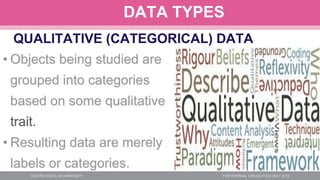
DATA TYPES
QUALITATIVE (CATEGORICAL) DATA
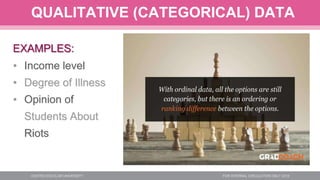
EXAMPLES:
QUALITATIVE (CATEGORICAL) DATA
EXAMPLES:
DATA TYPES
QUANTITATIVE (MEASUREMENT) DATA
DISCRETE DATA CONTINUOUS DATA
QUANTITATIVE (MEASUREMENT) DATA
DISCRETE DATA
EXAMPLES:
CONTINUOUS DATA
EXAMPLES:
CONTINUOUS DATA
EXAMPLES:
CONTINUOUS DATA
EXAMPLES:
DATA
Quantitative data
Continuous
variable
Discrete
Attribute
Nominal
Ordinal
‘Open’
Qualitative data
Interval Ratio
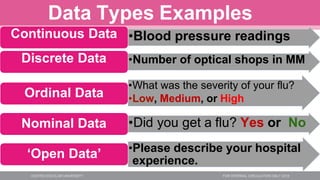
Data Types Examples
•Blood pressure readings
•Number of optical shops in MM
Continuous Data
Discrete Data
•What was the severity of your flu?
•Low, Medium, or High
Ordinal Data
Nominal Data •Did you get a flu? Yes or No
•Please describe your hospital
experience.
‘Open Data’
Understanding Discrete vs. Continuous Growth
The key question: When does growth happen?
Discrete growth: change happens at specific intervals: eyeglass level
Continuous growth: change happens at every instant: bacteria colony
EXAMPLES OF CONVERSION OF
DISCRETE TO CONTINUOUS DATA
Measuring Attribute/Discrete Continuous
Gas Tank Empty/Full Gas Volume
Tree Heights Tall/Short Meters
Performance Poor/Average/Good Points/Pieces
Temperature # Days of Cold Average Temp.
Delivery No. of Late Time per Delivery
Scrap # of Pieces > Max Length Average Length
IMPORTANCE OF DATA
1. Improve People’s Lives
2. Make Informed Decisions
3. Stop Molehills From Turning Into
Mountains
4. Get The Results You Want
5. Find Solutions To Problems
https://www.c-q-l.org/resources/guides/12-reasons-why-data-is-important/
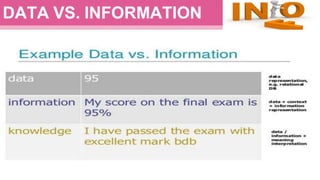
Difference between Data and Information
DATA VS. INFORMATION
COMPARISON CHART
BASIS FOR
COMPARISON
DATA INFORMATION
Meaning Unorganized information Processed data
What is it? It is just text and numbers. It is refined data.
Based on Records and Observations Analysis
Form Unorganized Organized
Useful May or may not be useful. Always
Specific No Yes
Dependency Does not depend on
information.
Without data,
information cannot be
processed.
DATA VS. INFORMATION
Examples of Data and Information
Data Information
1. The history of temperature readings all over
the world for the past 100 years
2. The number of visitors to a website by
country
3. The number of likes CEU has on Facebook
4. To create a NIC (National Identification
Card), first you get token/slip then take
pictures and step by step provide all the
details
Examples of Data and Information
Data Information
1. The history of
visitors to
past 100 years
2. The number of
website by country
Facebook
details
temperature 1. The data is organized and analyzed to
readings all over the world for the find that global temperature is rising.
a 2. Finding out that traffic in the Philippines
is increasing while that in Thailand is
decreasing.
3. The number of likes CEU has on 3. Demographic analysis of the data —
which age groups like CEU and where are
4. To create a NIC (National Identification they?
Card), first you get token/slip then take 4. They process all you’re details and
pictures and step by step provide all the issue you a card. And that card is the
information that you are a citizen of a
particular country.
CHAPTER 1: DATA AROUND US
References
Buendia, M. (2016). Introduction to Data Warehousing. Special Training in Business Analytics (Module 2) for Teachers of HEI
(pp. 1-5). Manila: University of the East.
Campaign, D. Q. (2011, June 24). Data Is Power. Retrieved from Youtube: https://www.youtube.com/watch?v=77UPUxB2b7o
Data vs. Information vs. Insight. (2018). Retrieved from Benedictine University:
https://online.ben.edu/programs/mba/resources/data-vs-information-vs-insight
Data, Information and Statistics. (2013, July 23). Retrieved from Statistics Canada: https://www.statcan.gc.ca/edu/power-
pouvoir/ch1/definitions/5214853-eng.htm
Donges, N. (2018, March 18). Data Types in Statistics. Retrieved from Towards Data Science:
https://towardsdatascience.com/data-types-in-statistics-347e152e8bee
Hinglish, T. (2018, January 22). What is Data | What is Information | Difference Between Data and Information. Retrieved
from Youtube: https://www.youtube.com/watch?v=F20qEwXBQaE
M, M. K. (2013, May 9). Source of Data in Research. Retrieved from SlideShare:
https://www.slideshare.net/manukumarkm/source-of-data-in-research
Roberts, T. (2015, December 6). Data vs. Information. Retrieved from YouTube:
https://www.youtube.com/watch?v=bitUrAmXTnI
Smith, P. (n.d.). Types of Data, Descriptive Statistics, and Statistical Tests for Nominal Data. Retrieved from University at
Buffalo: https://www.accp.com/docs/bookstore/biosampl.pdf
Sridhar, M. S. (2014, November 25). Types of data. Retrieved from Slideshare: https://www.slideshare.net/mssridhar/types-
of-data-42010881
Types of Data. (n.d.). Retrieved from Albany: https://www.albany.edu/~msz03/sta552/pennstate/types_of_data.pdf
VelactionVideos. (2013, April 24). Data Collection: Understanding the Types of Data. Retrieved from YouTube:
https://www.youtube.com/watch?v=Coe0N2xb8kk
What is Data. (2018). Retrieved from University of Minnesota: https://www.lib.umn.edu/datamanagement/whatdata
CHAPTER 1: DATA AROUND US
References:
https://examples.yourdictionary.com/independent-and-dependent-variable-examples.html
https://blog.prepscholar.com/independent-and-dependent-variables
https://studiousguy.com/sources-of-data-collection/
https://www.library.rochester.edu/Primary-secondary%20sources
https://www.diffen.com/difference/Data_vs_Information
https://keydifferences.com/difference-between-data-and-information.html
https://www.google.com.ph/search?q=examples+of+data+vs+information&hl=en-
PH&authuser=0&rlz=1C1CHBD_enPH822PH822&tbm=isch&source=iu&ictx=1&fir=DGwfETsf jWmM%253A%252C30bHKLwIqu4PiM%252C_&usg=AI
4_-kQTmAwmCPiH9ZT7EqTgASkoN98paw&sa=X&ved=2ahUKEwjnhqX_2-LeAhUMMd4KHZAADxEQ9QEwDnoECAQQBg#imgrc=DGwfETsf jWmM:
https://www.computerhistory.org/timeline/memory-storage/
CHAPTER 1: DATA AROUND US
THANK YOU!

Module 1 - Data Around Us .pptx

  • 1.
  • 2.
  • 3.
  • 4.
  • 5.
  • 6.
  • 7.
    IMPORTANCE OF DATA Answers: A.Innovation B. Decision Making C. Problem Solving D. Personalization E. Transparency and Accountability
  • 8.
    EVOLUTION OF DATASTORAGE 1960 1965 Lots of master files - Complexity of Maintenance & Development - Synchronization of data -Hardware “a single source of data for all 1970 1975 Database – Online, high- performan ce processing 1980 • The single- database- serving-all- purposes paradigm • PC’s, 4GL processing” transaction technology
  • 9.
    EVOLUTION OF DATASTORAGE 1960s Punch card Magnetic tape Disk drive
  • 10.
    EVOLUTION OF DATASTORAGE 1960s Tabulation Machine
  • 11.
    EVOLUTION OF DATASTORAGE Mid - 1960s Signetics 8-bit RAM
  • 12.
    EVOLUTION OF DATASTORAGE Mid-60’s Floppy disk Disk drive Transformer Read Only Storage (TROS)
  • 13.
    EVOLUTION OF DATASTORAGE 1960s
  • 14.
    EVOLUTION OF DATASTORAGE 1970s Hard Disk Drive (HDD) Micíopíoccsso í Optical Storage
  • 15.
    EVOLUTION OF DATASTORAGE Mid-1970s Laserdisc Japanese manufactured dynamic random-access memory (DRAM) 5.25-inch floppy disk SRAM
  • 16.
    EVOLUTION OF DATASTORAGE 1980s
  • 17.
    EVOLUTION OF DATASTORAGE 1980s IBM 3480 cartridge tape system 3.5-inch floppy disks CD-ROM
  • 18.
    EVOLUTION OF DATASTORAGE Mid-1980s Redundant Array of Independent Disks
  • 19.
    EVOLUTION OF DATASTORAGE USB Flash drive (2000) Cloud-based network-attached storage solutions (2009) Compact Flash (1994)
  • 20.
    Data Source A datasource, in the context of computer science and computer applications, is the location where data that is being used come from. In a database management system, the primary data source is the database, which can be located in a disk or a remote server.
  • 21.
    THE DATA SOURCE Internal includedata that exists and is stored inside your organization. External is data that was not collected by your organization Sources of Data
  • 22.
  • 23.
  • 24.
    SURVEY Most commonly used method in social sciences, management, marketingand psychology to some extent and can be conducted in different methods. This is a face-to- face conversation with the respondent. It is slow, expensive and take people away from their regular jobs, but this allow in-depth questioning and follow-up questions. EXAMPLES OF PRIMARY SOURCES OF DATA INTERVIEW
  • 25.
    QUESTIONNAIRE Most commonly used methodin survey. These are a list of questions either an open-ended or close-ended for whichIc t o h n e respondent give answers. These can be conducted via telephone, mail, live in a public area, or in an institute, through electronic mail or through fax and other methods. These can be done while letting the observing person know that he is being observed or without letting him know. These can also be made in natural setting as well as in artificially created environment. EXAMPLES OF PRIMARY SOURCES OF DATA OBSERVATIONS
  • 26.
    ADVANTAGES AND DISADVANTAGESOF PRIMARY DATA ADVANTAGES OF PRIMARY DATA DISADVANTAGES OF PRIMARY DATA
  • 27.
  • 28.
  • 29.
    PUBLISHED PRINTED SOURCES EXAMPLES OFSECONDARY DATA BOOKS PUBLISHED ELECTRONIC SOURCES JOURNALS & PERIODICALS GENERAL MAGAZINES & WEBSITES NEWSPAPERS E-JOURNALS WEBLOGS
  • 30.
    ADVANTAGES AND DISADVANTAGESOF SECONDARY DATA ADVANTAGES OF SECONDARY DATA DISADVANTAGES OF SECONDARY DATA
  • 31.
    Primary vs. SecondaryData PRIMARY DATA SECONDARY DATA
  • 32.
    Discipline Primary Secondary Art1) Article critiquing the work Engineering Experimental data 2) History World War II personal narrative 3) Literature Shakespeare’s Hamlet 4) Science 5) Analysis of oceans’ changes over the past 20 years Theatre 6) Review of the performance Psychology 7) Monograph on autism Some comparative examples of primary and secondary sources:
  • 33.
    Discipline Primary Secondary ArtOriginal artwork Article critiquing the work Engineering Experimental data Journal article analyzing data History World War II personal narrative Book analyzing military strategies of the War Literature Shakespeare’s Hamlet Critique and analysis of characters in Hamlet Science Data reporting oceans’ temperature Analysis of oceans’ changes over the past 20 years Theatre DVD of a performance Review of the performance Psychology Notes about a client with autism Monograph on autism Some comparative examples of primary and secondary sources:
  • 34.
  • 35.
  • 36.
  • 37.
  • 38.
  • 39.
    QUANTITATIVE (MEASUREMENT) DATA DISCRETEDATA EXAMPLES: CONTINUOUS DATA EXAMPLES:
  • 40.
  • 41.
  • 42.
  • 43.
    Data Types Examples •Bloodpressure readings •Number of optical shops in MM Continuous Data Discrete Data •What was the severity of your flu? •Low, Medium, or High Ordinal Data Nominal Data •Did you get a flu? Yes or No •Please describe your hospital experience. ‘Open Data’
  • 44.
    Understanding Discrete vs.Continuous Growth The key question: When does growth happen? Discrete growth: change happens at specific intervals: eyeglass level Continuous growth: change happens at every instant: bacteria colony
  • 45.
    EXAMPLES OF CONVERSIONOF DISCRETE TO CONTINUOUS DATA Measuring Attribute/Discrete Continuous Gas Tank Empty/Full Gas Volume Tree Heights Tall/Short Meters Performance Poor/Average/Good Points/Pieces Temperature # Days of Cold Average Temp. Delivery No. of Late Time per Delivery Scrap # of Pieces > Max Length Average Length
  • 46.
    IMPORTANCE OF DATA 1.Improve People’s Lives 2. Make Informed Decisions 3. Stop Molehills From Turning Into Mountains 4. Get The Results You Want 5. Find Solutions To Problems https://www.c-q-l.org/resources/guides/12-reasons-why-data-is-important/
  • 47.
    Difference between Dataand Information
  • 48.
  • 49.
    COMPARISON CHART BASIS FOR COMPARISON DATAINFORMATION Meaning Unorganized information Processed data What is it? It is just text and numbers. It is refined data. Based on Records and Observations Analysis Form Unorganized Organized Useful May or may not be useful. Always Specific No Yes Dependency Does not depend on information. Without data, information cannot be processed.
  • 50.
  • 51.
  • 52.
  • 54.
    Examples of Dataand Information Data Information 1. The history of temperature readings all over the world for the past 100 years 2. The number of visitors to a website by country 3. The number of likes CEU has on Facebook 4. To create a NIC (National Identification Card), first you get token/slip then take pictures and step by step provide all the details
  • 55.
    Examples of Dataand Information Data Information 1. The history of visitors to past 100 years 2. The number of website by country Facebook details temperature 1. The data is organized and analyzed to readings all over the world for the find that global temperature is rising. a 2. Finding out that traffic in the Philippines is increasing while that in Thailand is decreasing. 3. The number of likes CEU has on 3. Demographic analysis of the data — which age groups like CEU and where are 4. To create a NIC (National Identification they? Card), first you get token/slip then take 4. They process all you’re details and pictures and step by step provide all the issue you a card. And that card is the information that you are a citizen of a particular country.
  • 56.
    CHAPTER 1: DATAAROUND US References Buendia, M. (2016). Introduction to Data Warehousing. Special Training in Business Analytics (Module 2) for Teachers of HEI (pp. 1-5). Manila: University of the East. Campaign, D. Q. (2011, June 24). Data Is Power. Retrieved from Youtube: https://www.youtube.com/watch?v=77UPUxB2b7o Data vs. Information vs. Insight. (2018). Retrieved from Benedictine University: https://online.ben.edu/programs/mba/resources/data-vs-information-vs-insight Data, Information and Statistics. (2013, July 23). Retrieved from Statistics Canada: https://www.statcan.gc.ca/edu/power- pouvoir/ch1/definitions/5214853-eng.htm Donges, N. (2018, March 18). Data Types in Statistics. Retrieved from Towards Data Science: https://towardsdatascience.com/data-types-in-statistics-347e152e8bee Hinglish, T. (2018, January 22). What is Data | What is Information | Difference Between Data and Information. Retrieved from Youtube: https://www.youtube.com/watch?v=F20qEwXBQaE M, M. K. (2013, May 9). Source of Data in Research. Retrieved from SlideShare: https://www.slideshare.net/manukumarkm/source-of-data-in-research Roberts, T. (2015, December 6). Data vs. Information. Retrieved from YouTube: https://www.youtube.com/watch?v=bitUrAmXTnI Smith, P. (n.d.). Types of Data, Descriptive Statistics, and Statistical Tests for Nominal Data. Retrieved from University at Buffalo: https://www.accp.com/docs/bookstore/biosampl.pdf Sridhar, M. S. (2014, November 25). Types of data. Retrieved from Slideshare: https://www.slideshare.net/mssridhar/types- of-data-42010881 Types of Data. (n.d.). Retrieved from Albany: https://www.albany.edu/~msz03/sta552/pennstate/types_of_data.pdf VelactionVideos. (2013, April 24). Data Collection: Understanding the Types of Data. Retrieved from YouTube: https://www.youtube.com/watch?v=Coe0N2xb8kk What is Data. (2018). Retrieved from University of Minnesota: https://www.lib.umn.edu/datamanagement/whatdata
  • 57.
    CHAPTER 1: DATAAROUND US References: https://examples.yourdictionary.com/independent-and-dependent-variable-examples.html https://blog.prepscholar.com/independent-and-dependent-variables https://studiousguy.com/sources-of-data-collection/ https://www.library.rochester.edu/Primary-secondary%20sources https://www.diffen.com/difference/Data_vs_Information https://keydifferences.com/difference-between-data-and-information.html https://www.google.com.ph/search?q=examples+of+data+vs+information&hl=en- PH&authuser=0&rlz=1C1CHBD_enPH822PH822&tbm=isch&source=iu&ictx=1&fir=DGwfETsf jWmM%253A%252C30bHKLwIqu4PiM%252C_&usg=AI 4_-kQTmAwmCPiH9ZT7EqTgASkoN98paw&sa=X&ved=2ahUKEwjnhqX_2-LeAhUMMd4KHZAADxEQ9QEwDnoECAQQBg#imgrc=DGwfETsf jWmM: https://www.computerhistory.org/timeline/memory-storage/
  • 58.
    CHAPTER 1: DATAAROUND US THANK YOU!