

Model-Driven Physical-Design for
Future Nanoscale Architectures
         Ciprian TEODOROV
                    Lab-STICC MOCS


            November, 28th 2011
Thesis statement


Generic physical-design framework
based on a common vocabulary
is the key to taming
        nanoscale architectures.
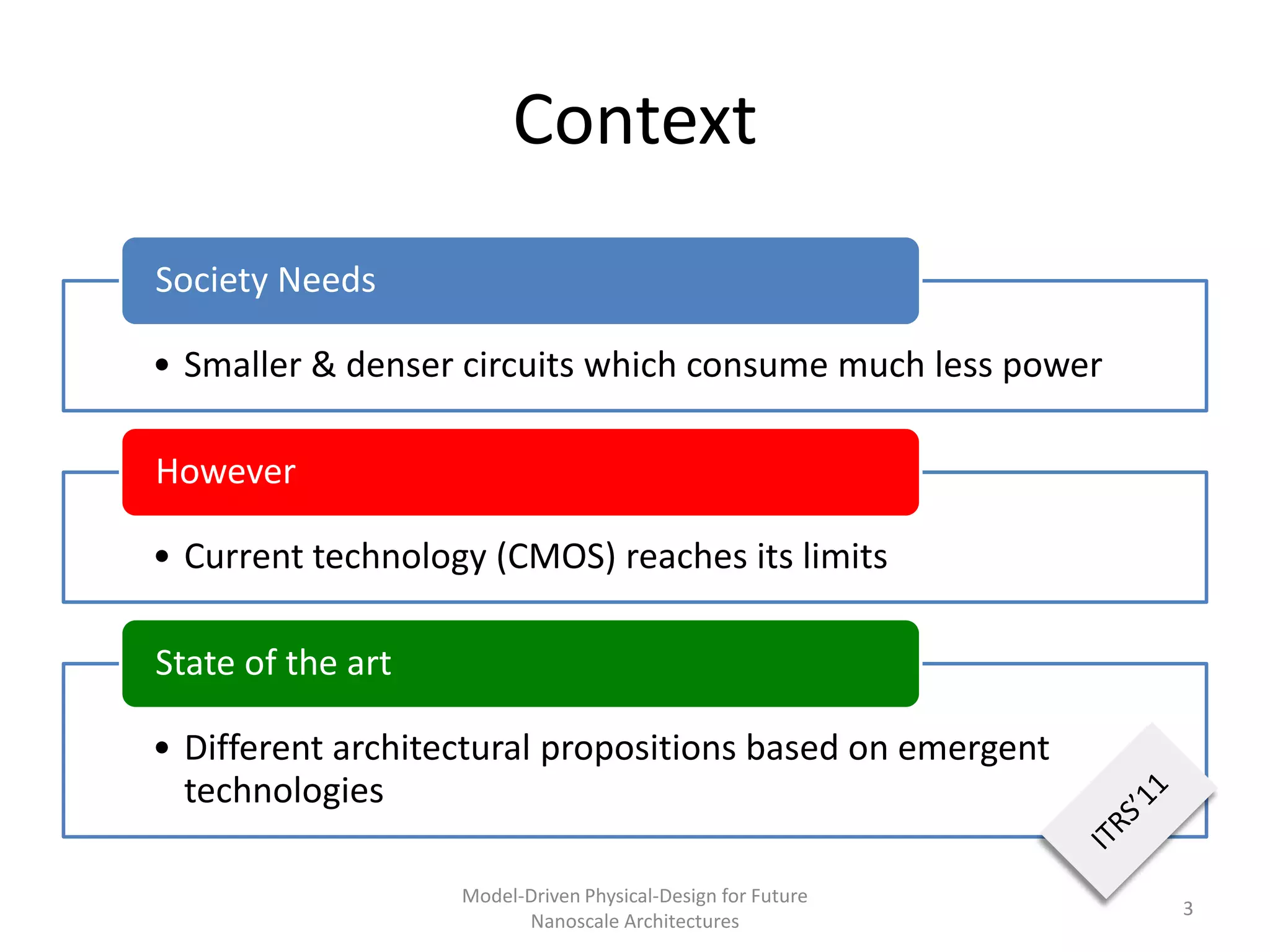
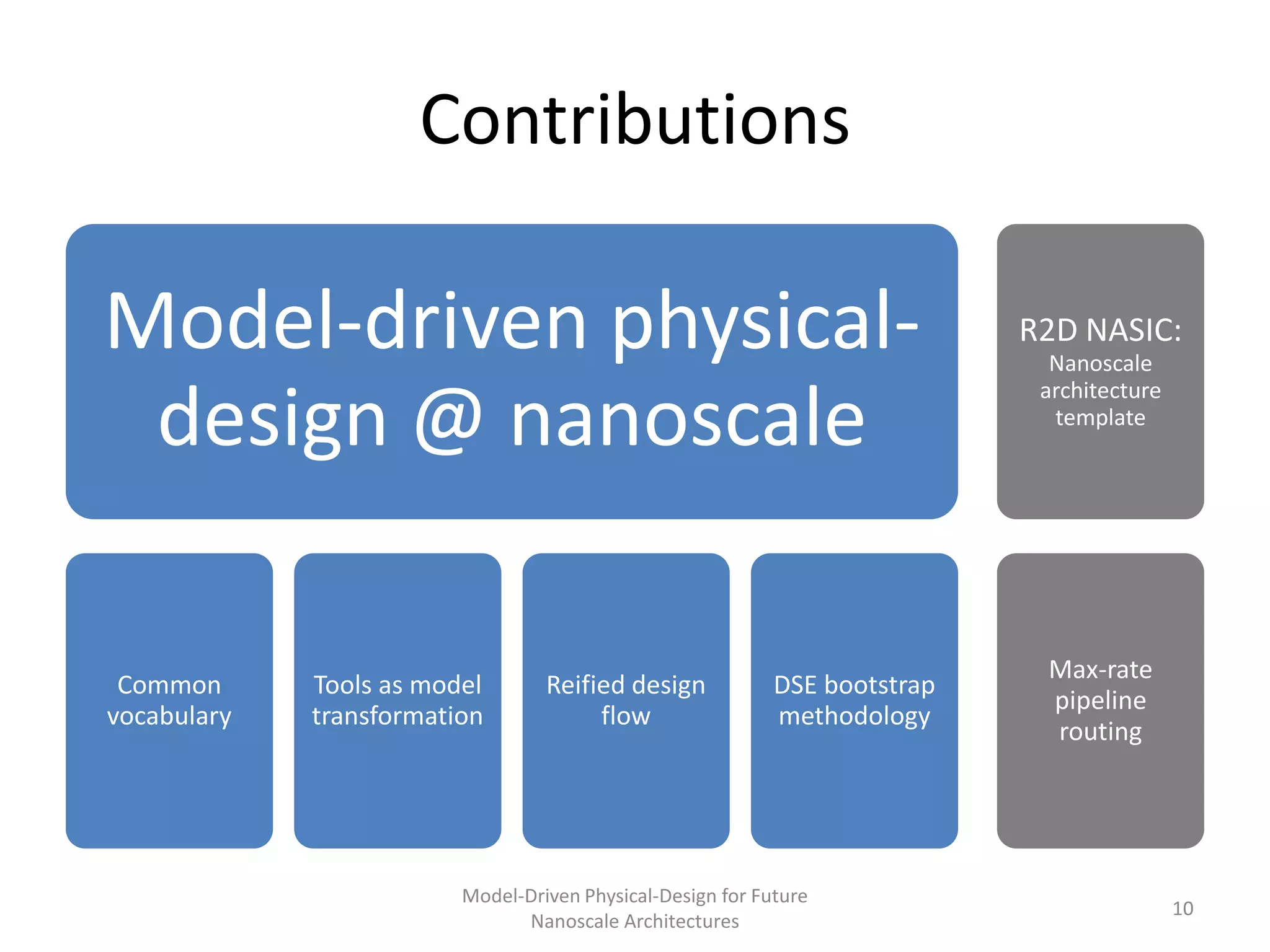
Context
Society Needs

• Smaller & denser circuits which consume much less power

However

• Current technology (CMOS) reaches its limits

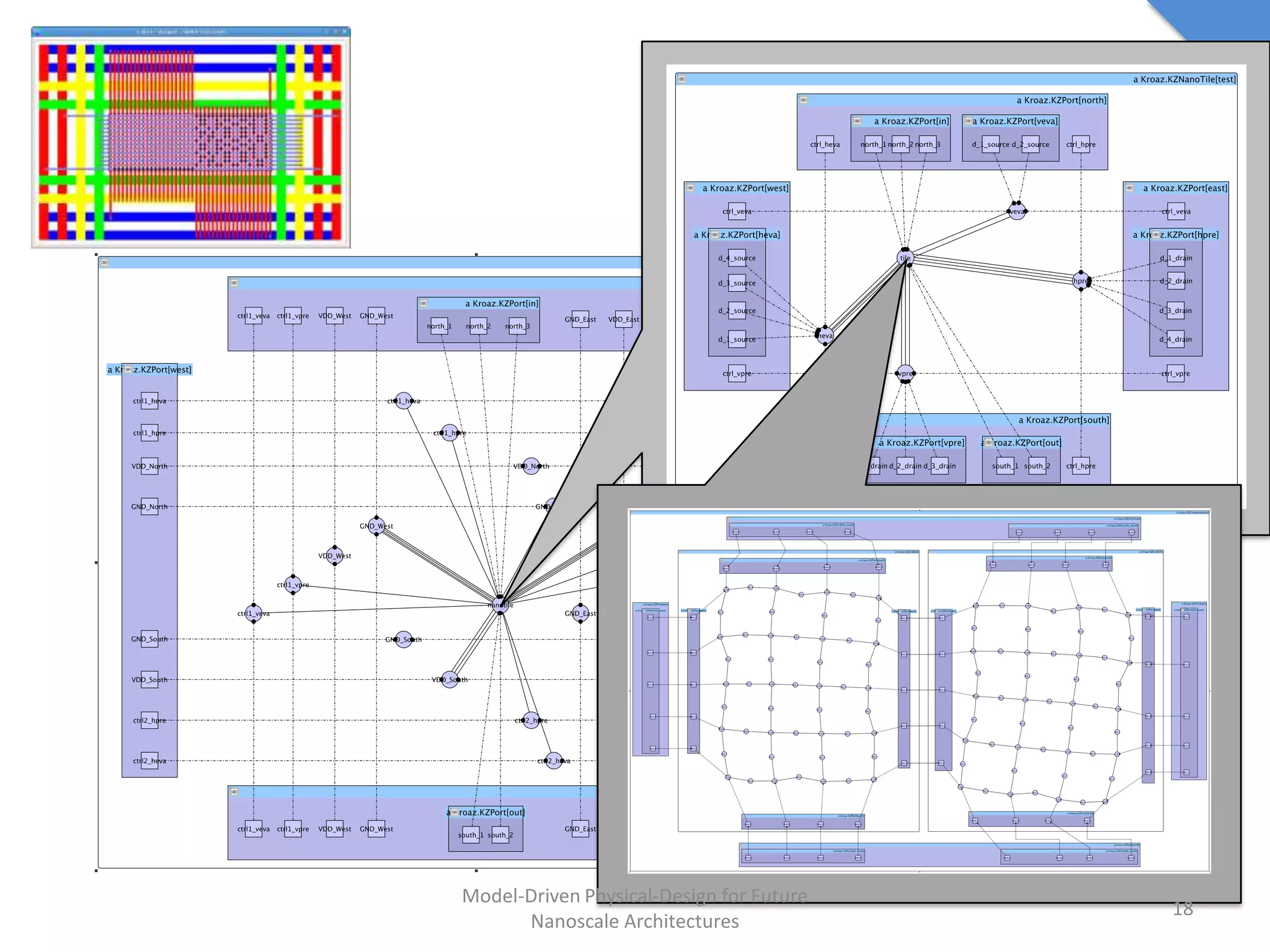
State of the art

• Different architectural propositions based on emergent
  technologies

                   Model-Driven Physical-Design for Future
                                                             3
                         Nanoscale Architectures
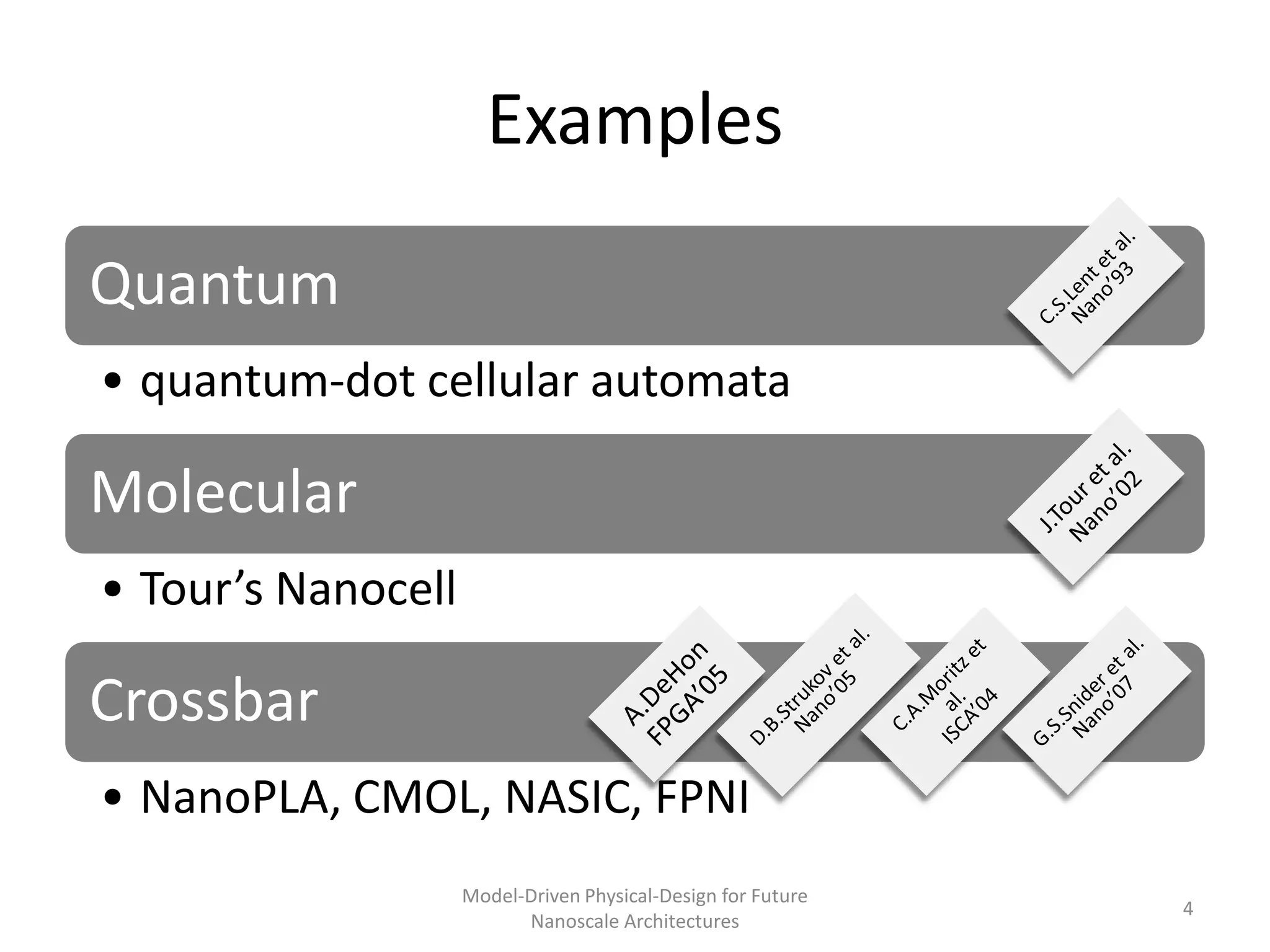
Examples

Quantum
• quantum-dot cellular automata

Molecular
• Tour’s Nanocell

Crossbar
• NanoPLA, CMOL, NASIC, FPNI
                    Model-Driven Physical-Design for Future
                                                              4
                          Nanoscale Architectures
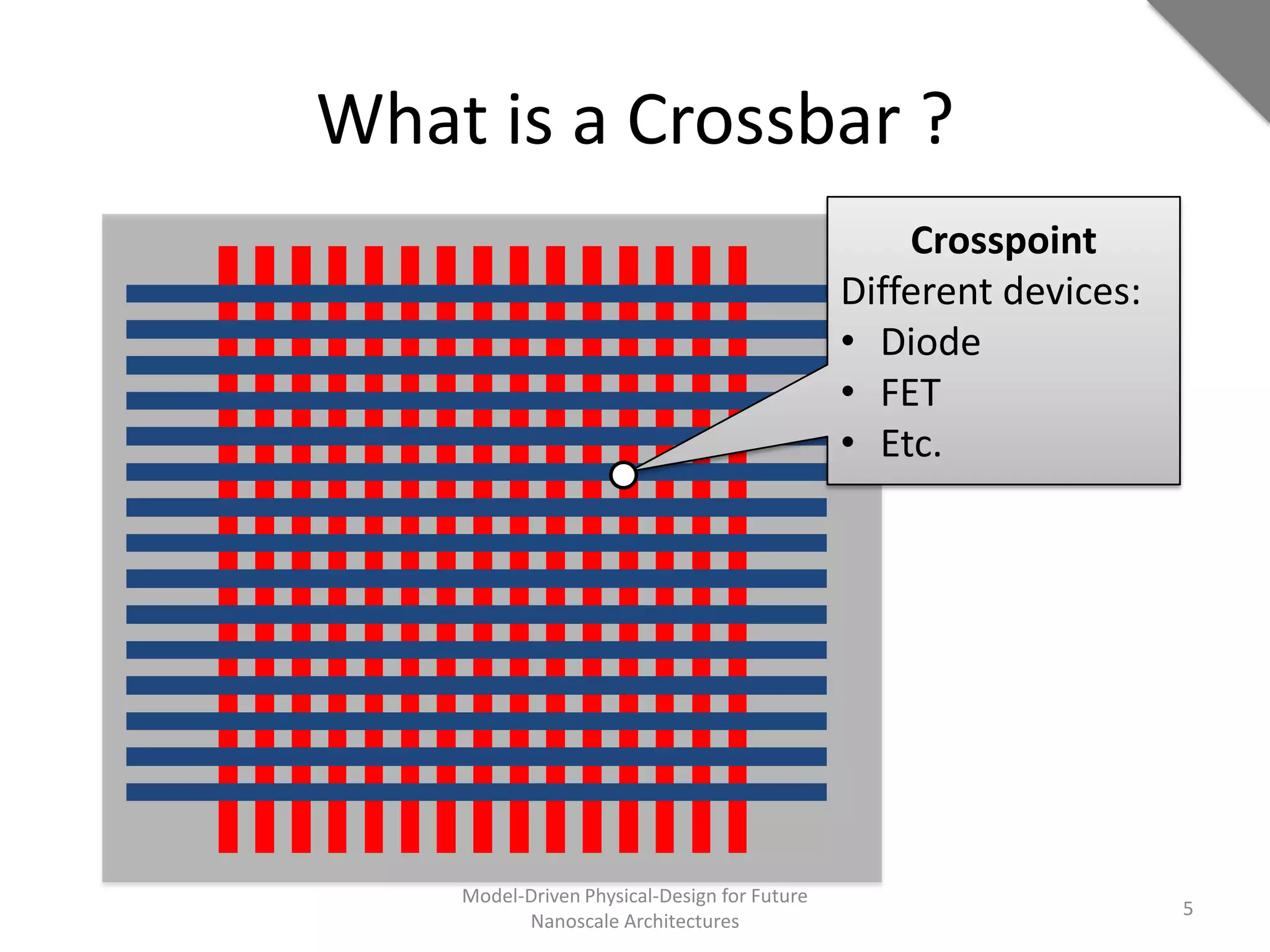
What is a Crossbar ?
                                                  Crosspoint
                                              Different devices:
                                              • Diode
                                              • FET
                                              • Etc.


    Model-Driven Physical-Design for Future
                                                                   5
          Nanoscale Architectures
utilization and performance.

5N I Ah c rs
. ACr ie u
  S ct t e
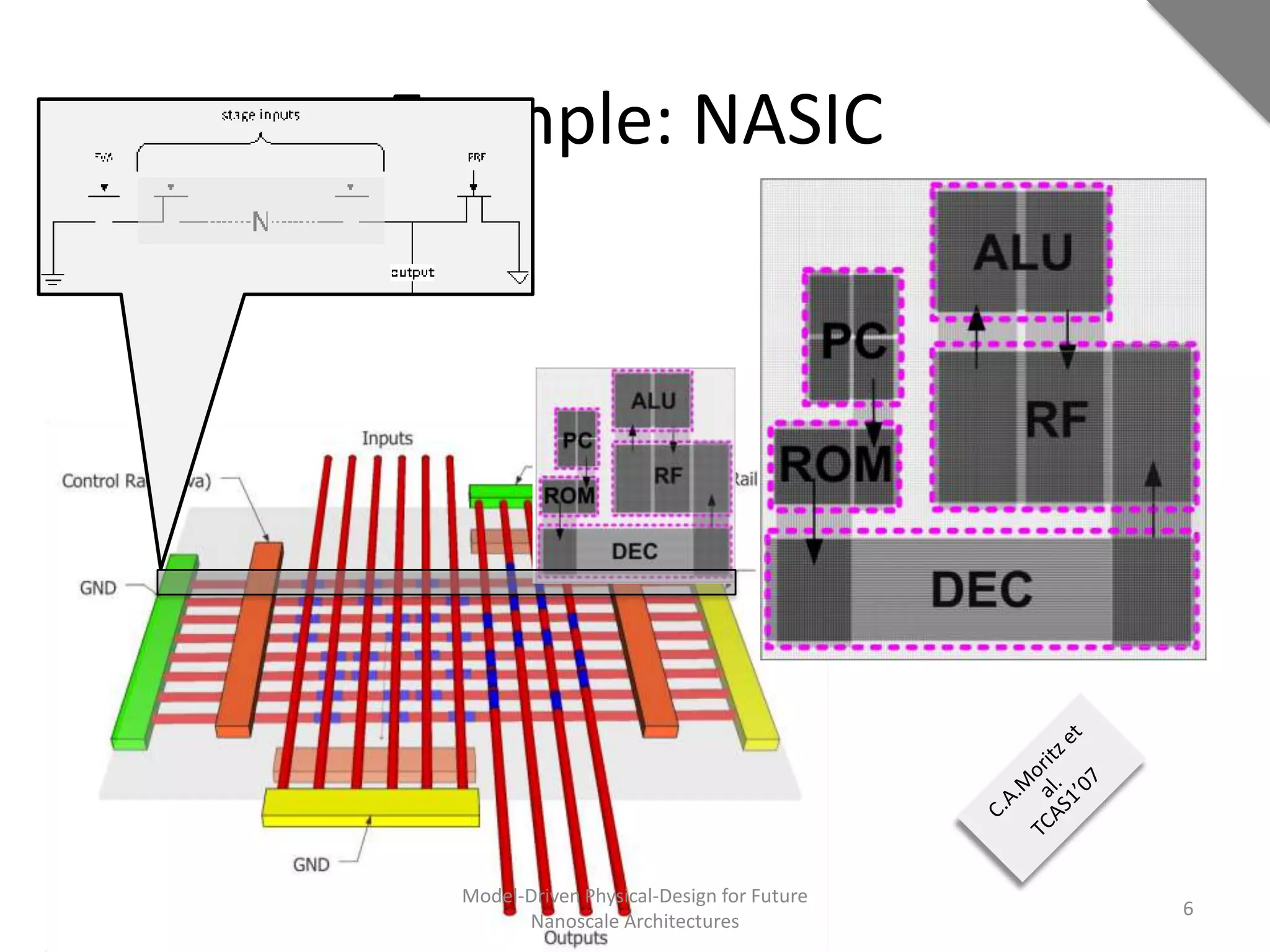
                                           Example: NASIC
Large scale computing systems may be designed using the NASIC fabric and the associated
framework of building blocks, xnwFET based circuits, and logic styles discussed in the
preceding sections. This section discusses two key architectures for the NASIC fabric: the WISP-
0 general purpose processor and a massively parallel architectural framework with
programmable templates for image processing.

     5
     .1 W te i grc s ( I P
        Ie ra nP eoW-)
        r S m os r S      0
WISP-0 is a stream processor that implements a 5-stage
microprocessor pipeline architecture including fetch,
decode, register file, execute and write back stages.
WISP-0 consists of five nanotiles: Program Counter (PC),
ROM, Decoder (DEC), Register File (RF) and Arithmetic
Logic Unit (ALU). Figure 17 shows its layout. A nanotile
is shown as a box surrounded by dashed lines in the
figure. In WISP designs, in order to preserve the density
advantages of nanodevices, data is streamed through the
fabric with minimal control/feedback paths. All hazards Figure 17. WISP-0 Processor Floorplan
are exposed to the compiler. It uses dynamic circuits and
pipelining on the wires to eliminate the need for explicit
flip-flops and therefore improve the density considerably.
WISP-0 supports a simple instruction set including nop,
mov, movi, add and multiply functions. It uses a 7-bit
instruction format with 3-bit instruction and 2-bit source
and destination addresses. The WISP-0 is used as a design
prototype for evaluating key metrics such as area and
performance as well as the impact of various fault-
tolerance techniques on chip yield and process variation
mitigation. Additional enhancements to this design are Figure 18. WISP-0 Program Counter
ongoing in the NASIC group.
                                                    Model-Driven Physical-Design for Future
                                                                                                   6
             5.
              . 1 W - Pgm ue
              1          I P r r C nr
                          S0 o a o t                       Nanoscale Architectures
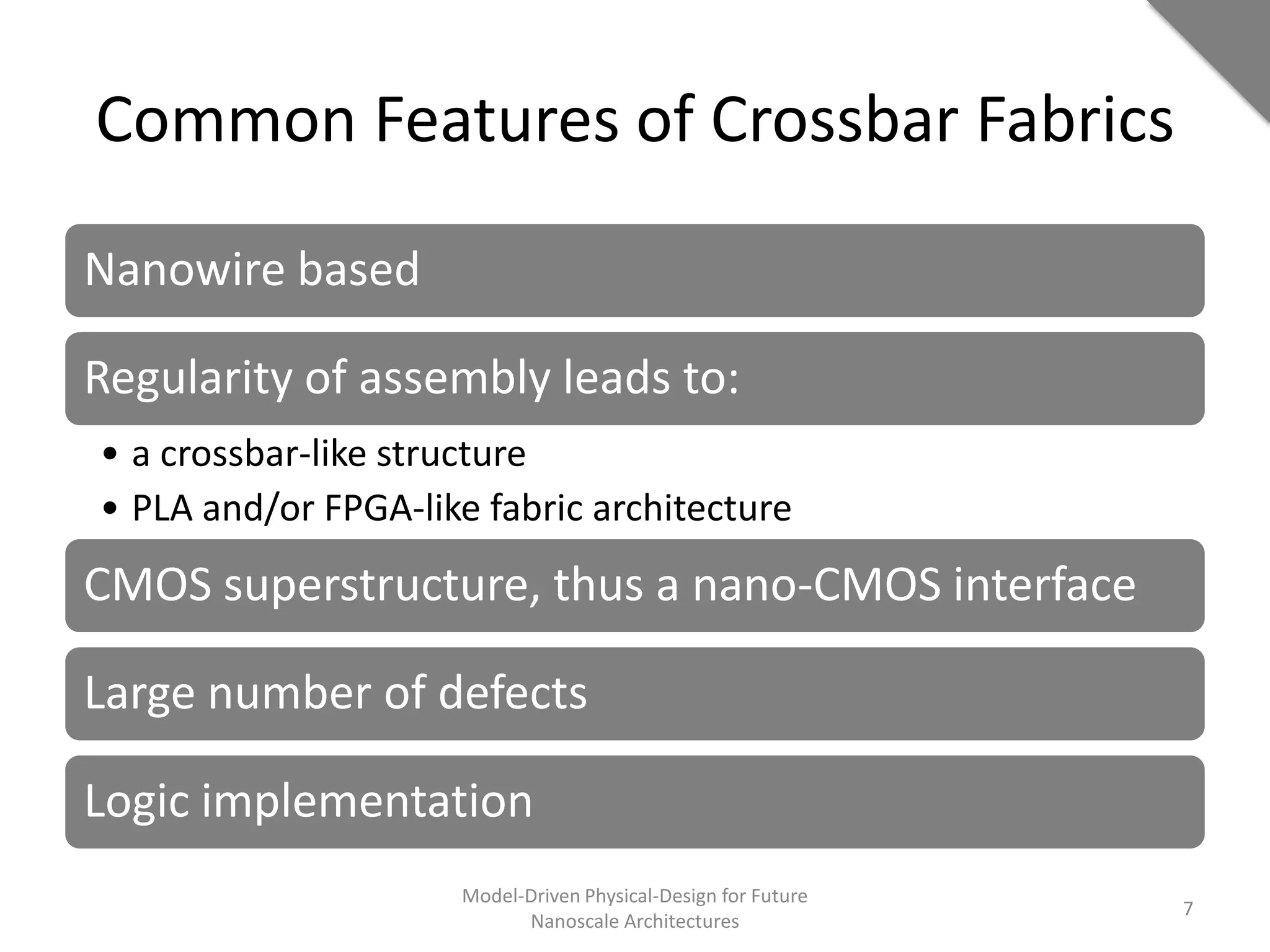
Common Features of Crossbar Fabrics

Nanowire based

Regularity of assembly leads to:
• a crossbar-like structure
• PLA and/or FPGA-like fabric architecture
CMOS superstructure, thus a nano-CMOS interface

Large number of defects

Logic implementation
                     Model-Driven Physical-Design for Future
                                                               7
                           Nanoscale Architectures
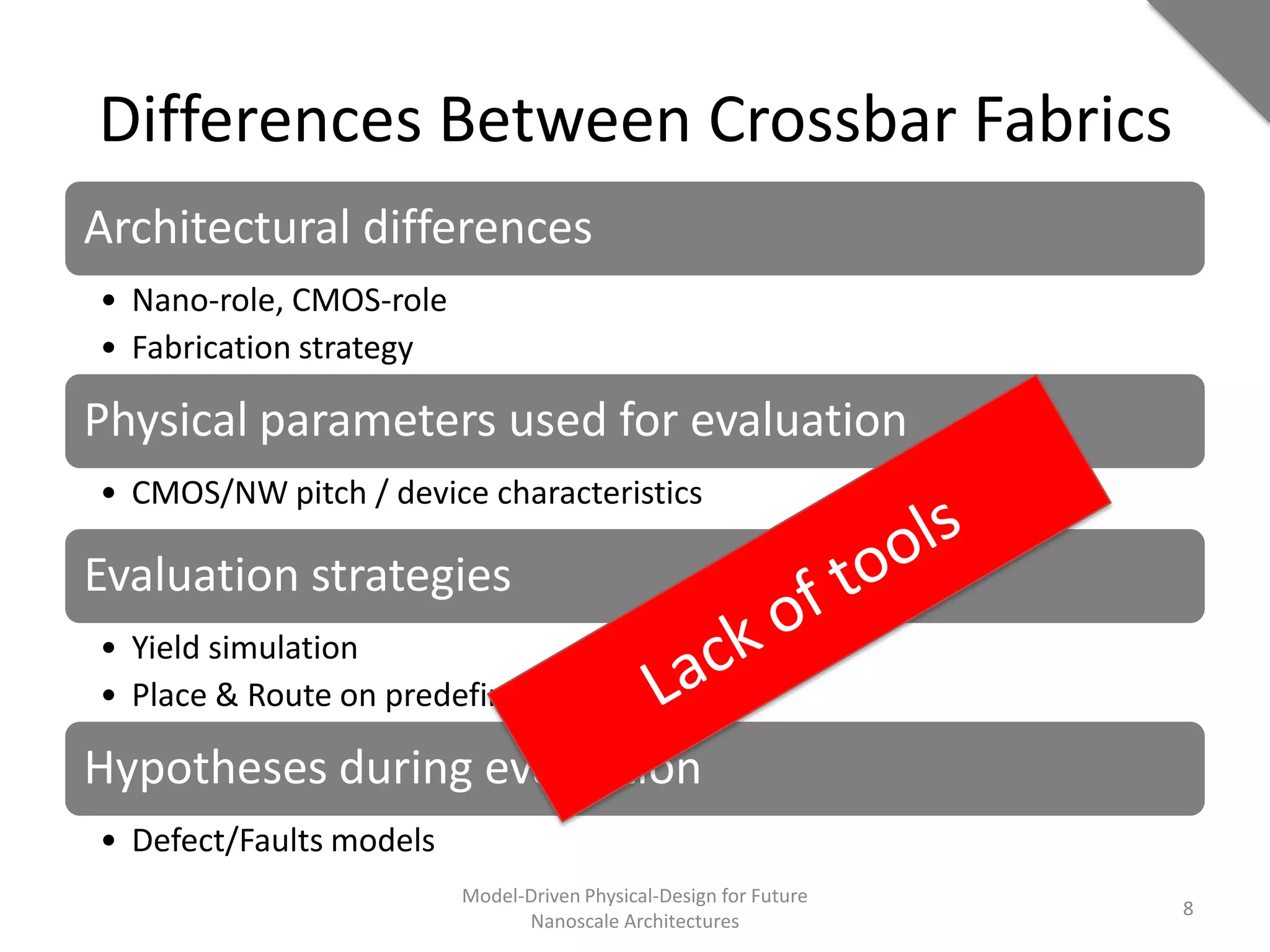
Differences Between Crossbar Fabrics
Architectural differences
• Nano-role, CMOS-role
• Fabrication strategy

Physical parameters used for evaluation
• CMOS/NW pitch / device characteristics

Evaluation strategies
• Yield simulation
• Place & Route on predefined array

Hypotheses during evaluation
• Defect/Faults models
                         Model-Driven Physical-Design for Future
                                                                   8
                               Nanoscale Architectures
Research Questions

How to maximize the reuse of design-tools?

Is it possible to create a generic design toolkit?

How to separate the algorithmic and architectural concerns?

How to add a tools axis to design-space exploration problem?

How to integrate multi-level fault tolerance?


                      Model-Driven Physical-Design for Future
                                                                9
                            Nanoscale Architectures
Contributions

Model-driven physical-                                                      R2D NASIC:
                                                                              Nanoscale

 design @ nanoscale
                                                                             architecture
                                                                              template


                                                                             Max-rate
 Common      Tools as model       Reified design            DSE bootstrap
                                                                             pipeline
vocabulary   transformation            flow                 methodology
                                                                             routing


                         Model-Driven Physical-Design for Future
                                                                                            10
                               Nanoscale Architectures
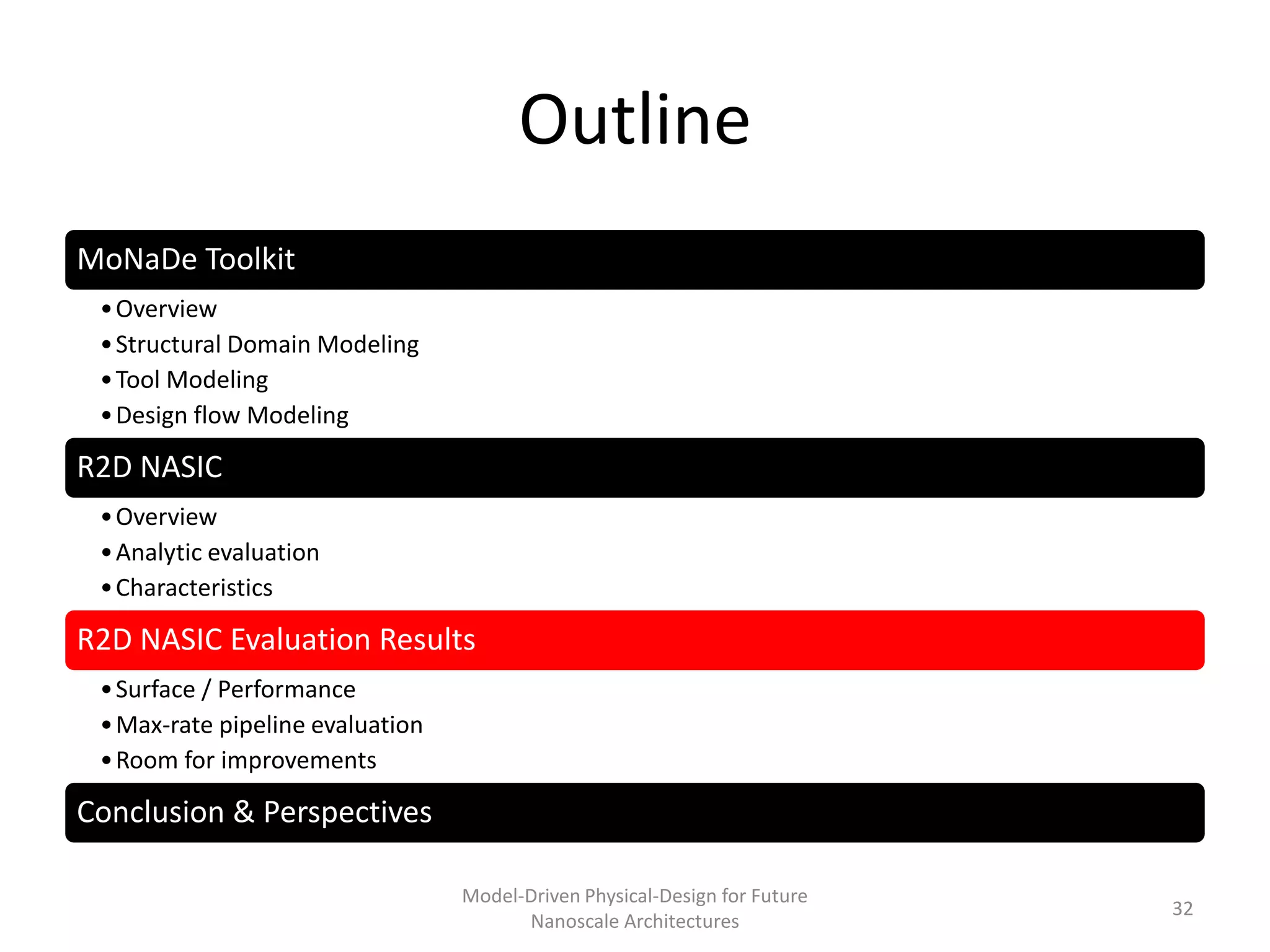
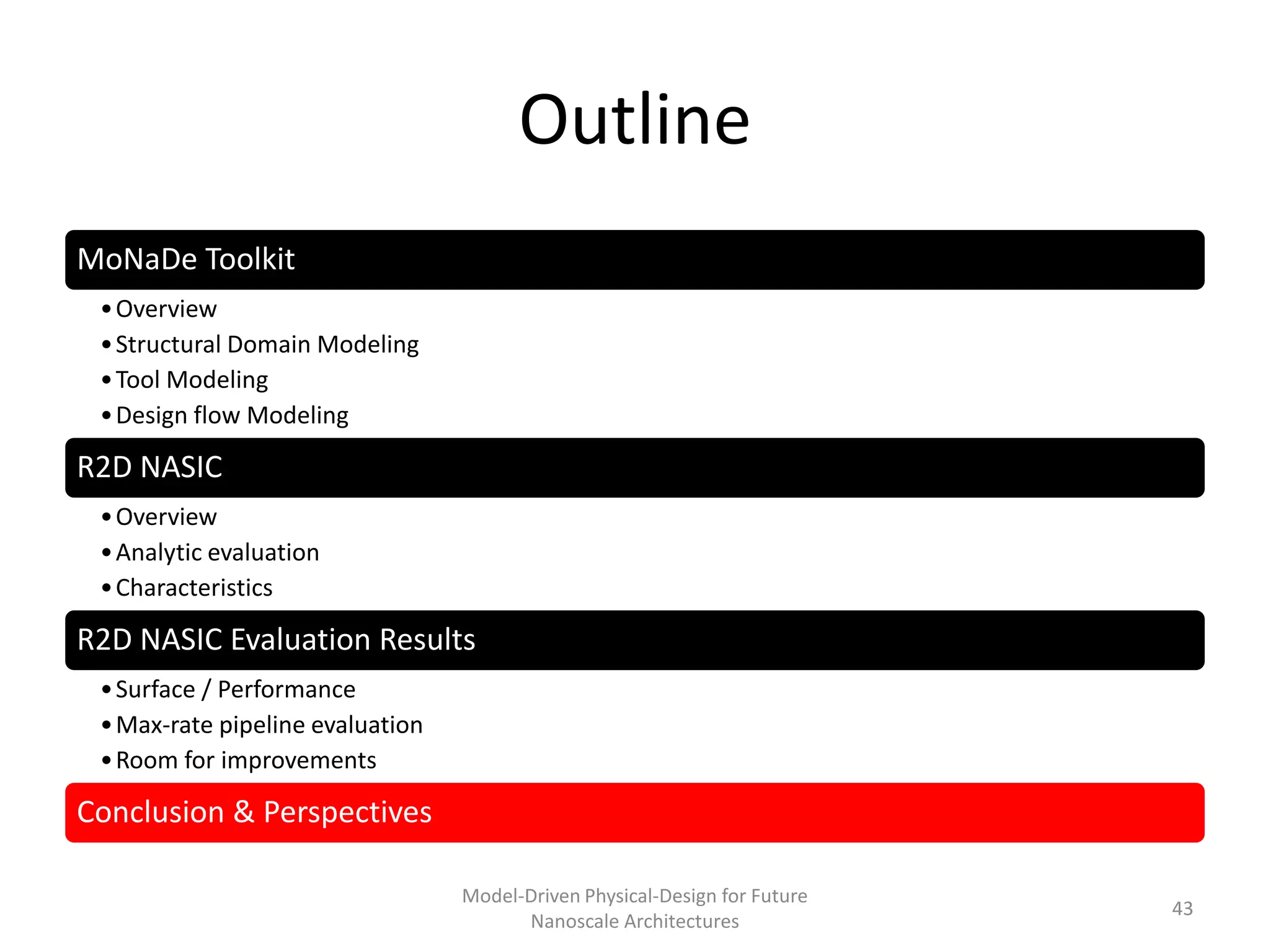
Outline
MoNaDe Toolkit
 • Overview
 • Structural Domain Modeling
 • Tool Modeling
 • Design flow Modeling

R2D NASIC
 • Overview
 • Analytic evaluation
 • Characteristics

R2D NASIC Evaluation Results
 • Surface / Performance
 • Max-rate pipeline evaluation
 • Room for improvements

Conclusion & Perspectives

                                  Model-Driven Physical-Design for Future
                                                                            11
                                        Nanoscale Architectures
Outline
MoNaDe Toolkit
 • Overview
 • Structural Domain Modeling
 • Tool Modeling
 • Design flow Modeling

R2D NASIC
 • Overview
 • Analytic evaluation
 • Characteristics

R2D NASIC Evaluation Results
 • Surface / Performance
 • Max-rate pipeline evaluation
 • Room for improvements

Conclusion & Perspectives

                                  Model-Driven Physical-Design for Future
                                                                            12
                                        Nanoscale Architectures
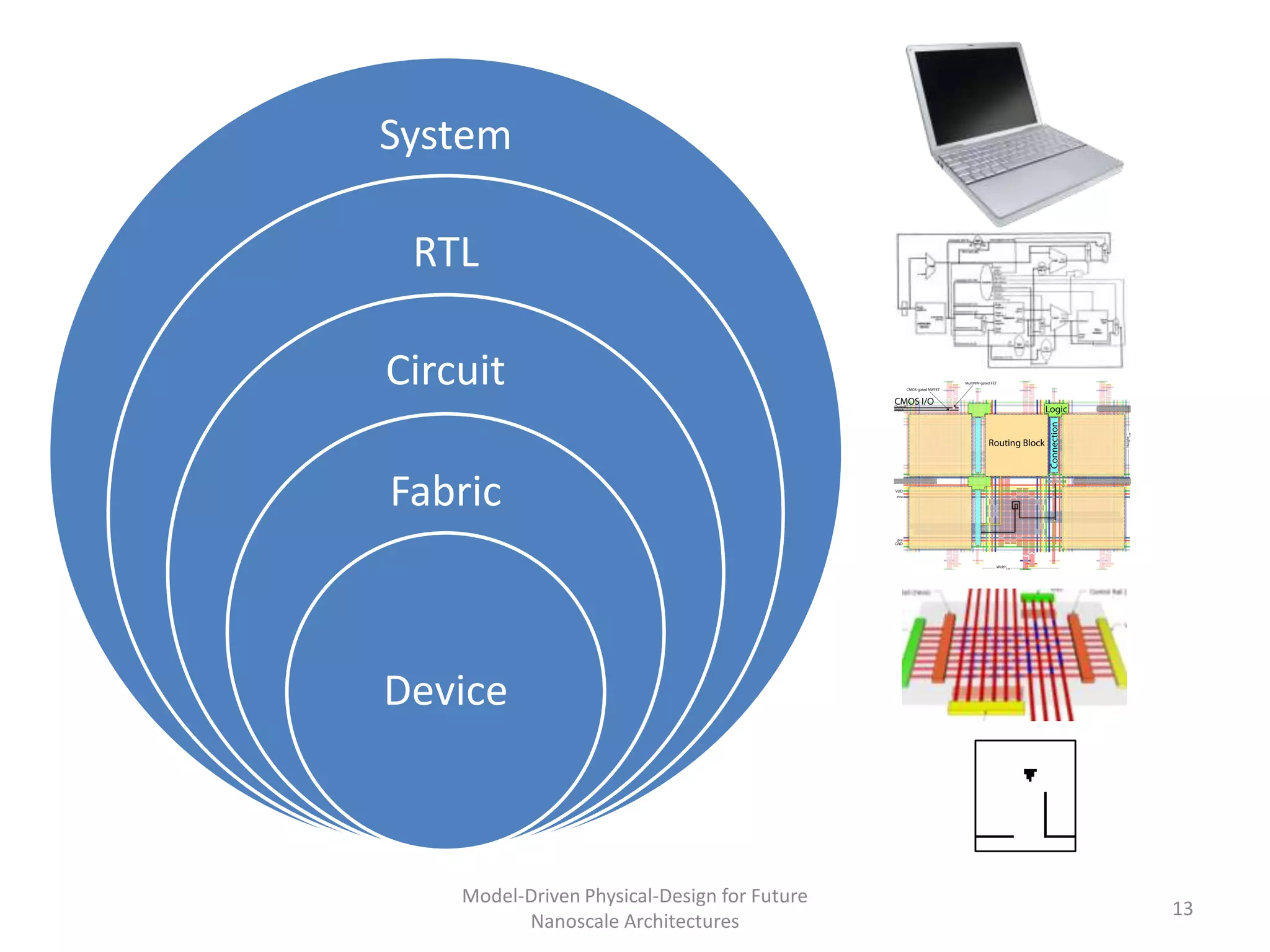
System

 RTL

Circuit

Fabric


Device


    Model-Driven Physical-Design for Future
                                              13
          Nanoscale Architectures
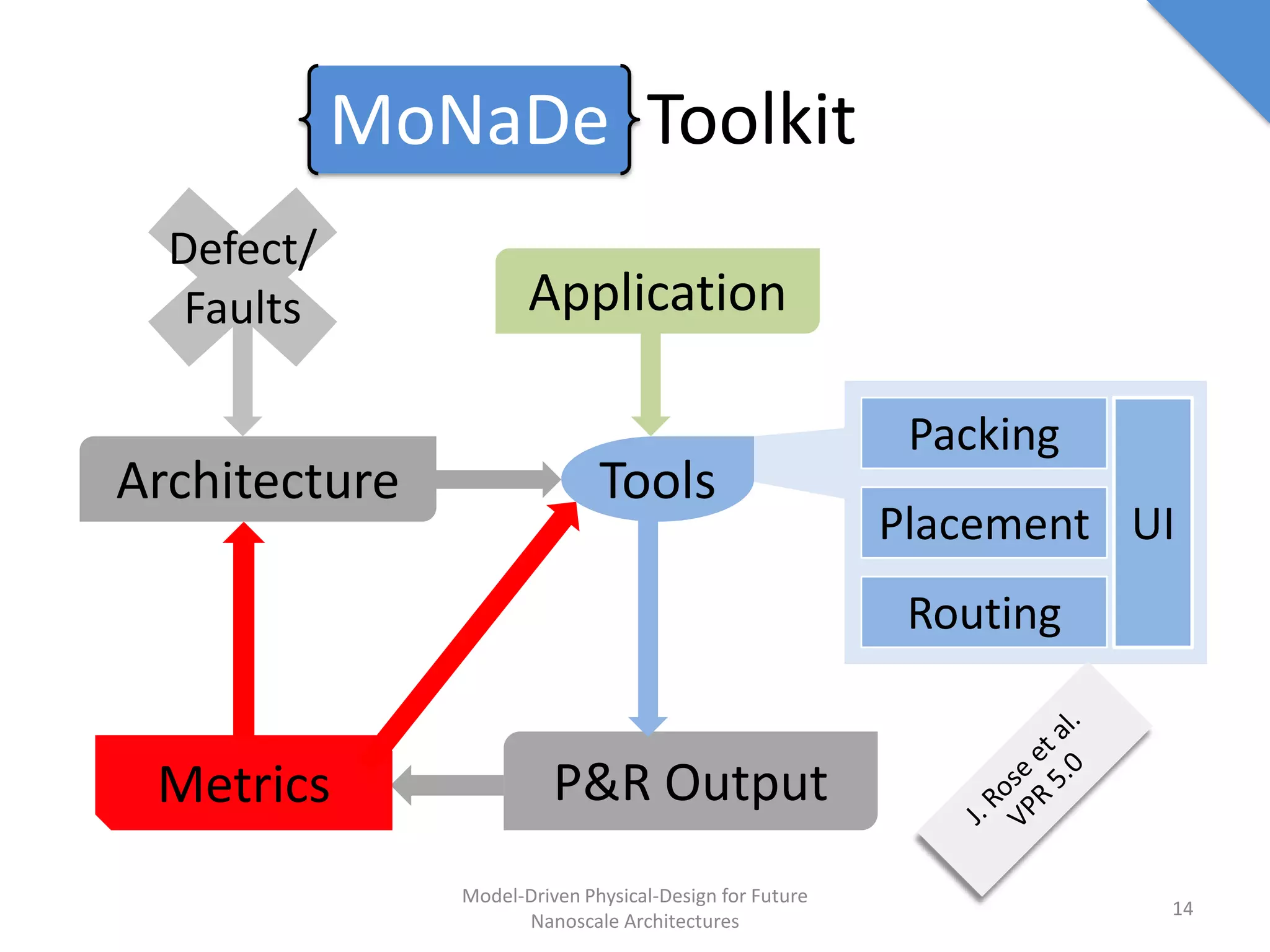
MoNaDe Toolkit
             Typical
  Defect/
   Faults             Application

                                                          Packing
Architecture                  Tools
                                                         Placement UI
                                                          Routing


 Metrics                 P&R Output
               Model-Driven Physical-Design for Future
                                                                    14
                     Nanoscale Architectures
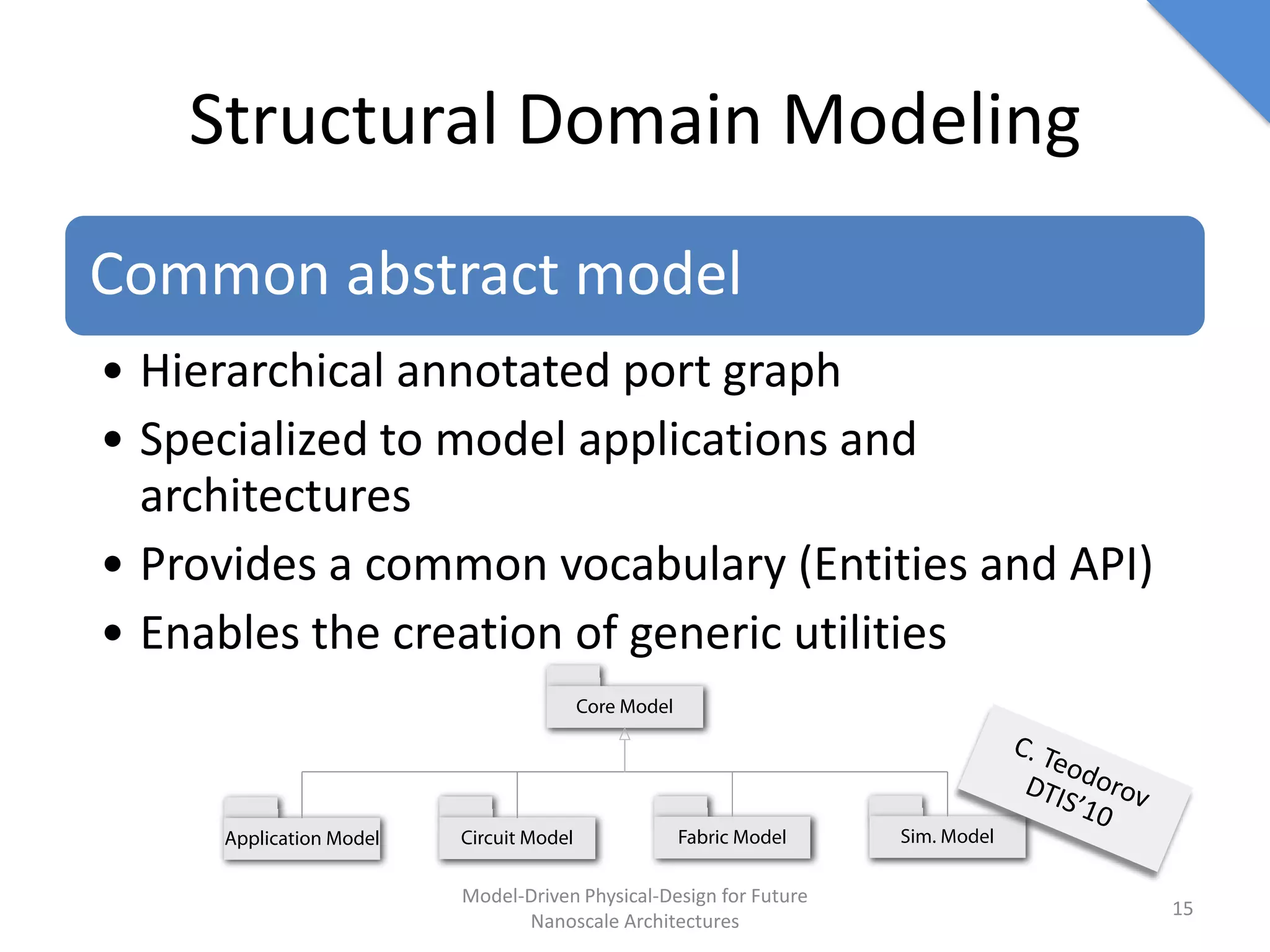
Structural Domain Modeling
Common abstract model
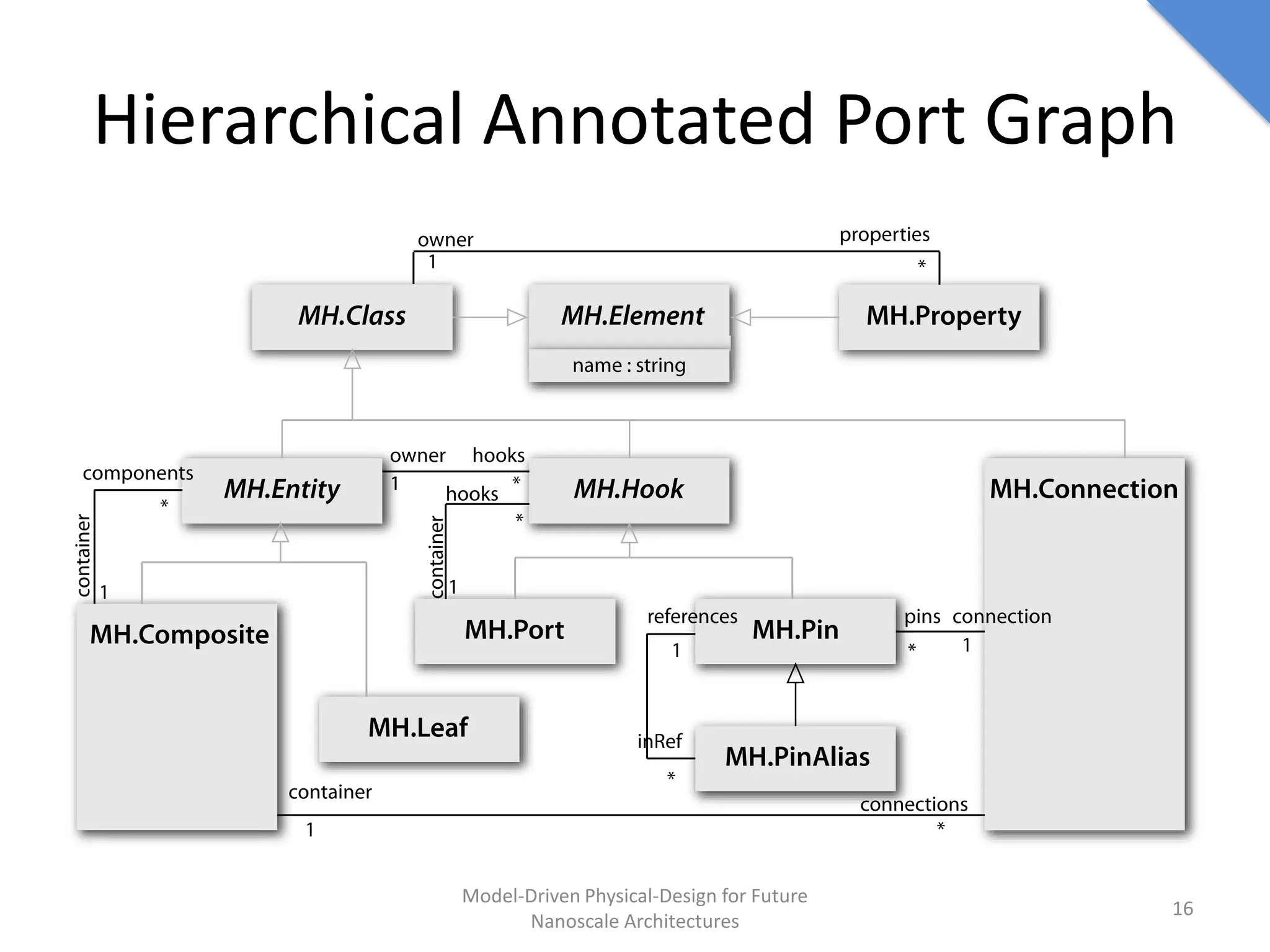
• Hierarchical annotated port graph
• Specialized to model applications and
  architectures
• Provides a common vocabulary (Entities and API)
• Enables the creation of generic utilities


                Model-Driven Physical-Design for Future
                                                          15
                      Nanoscale Architectures
Hierarchical Annotated Port Graph


           Model-Driven Physical-Design for Future
                                                     16
                 Nanoscale Architectures
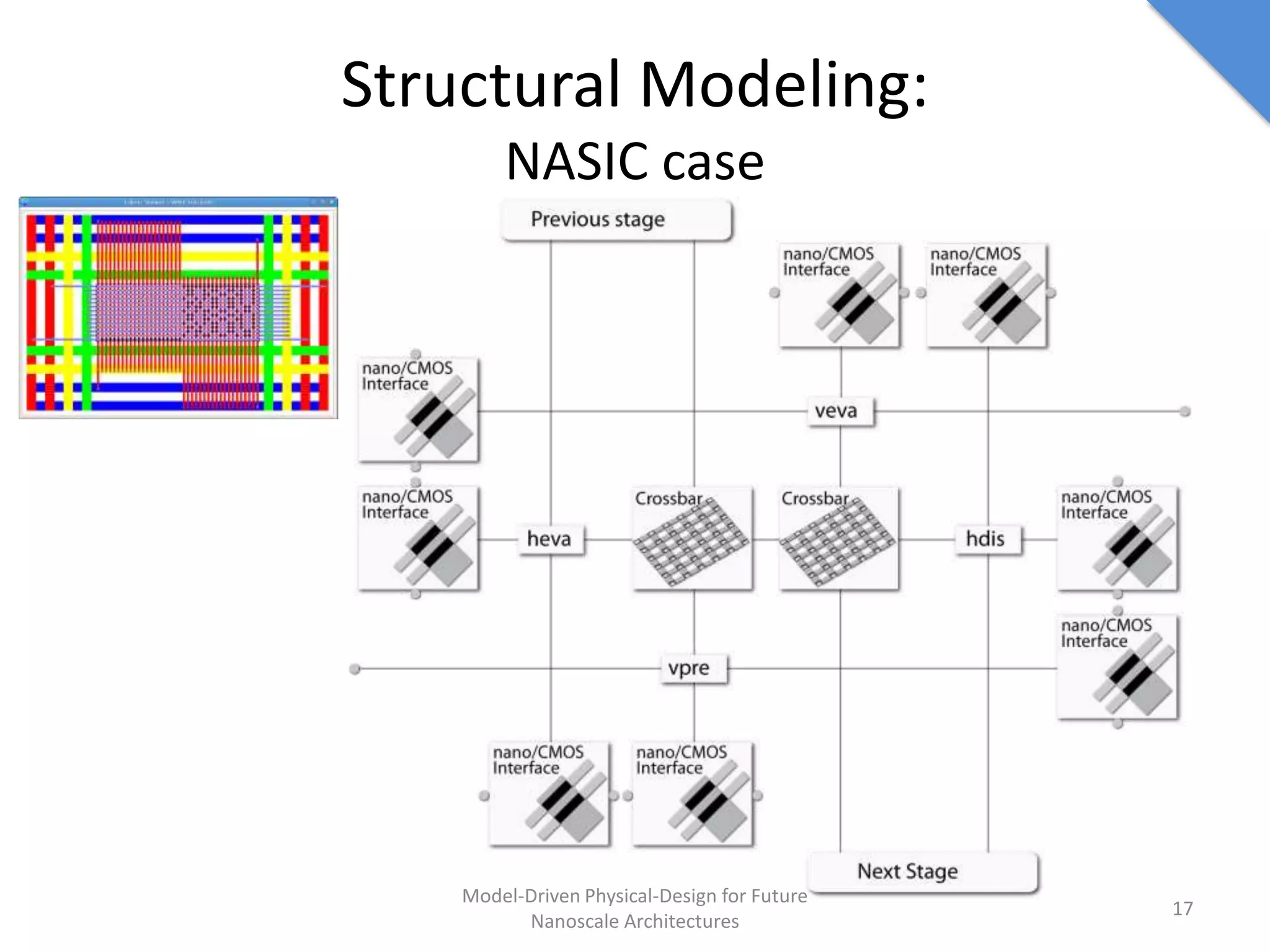
Structural Modeling:
        NASIC case


    Model-Driven Physical-Design for Future
                                              17
          Nanoscale Architectures
Model-Driven Physical-Design for Future
                                          18
      Nanoscale Architectures
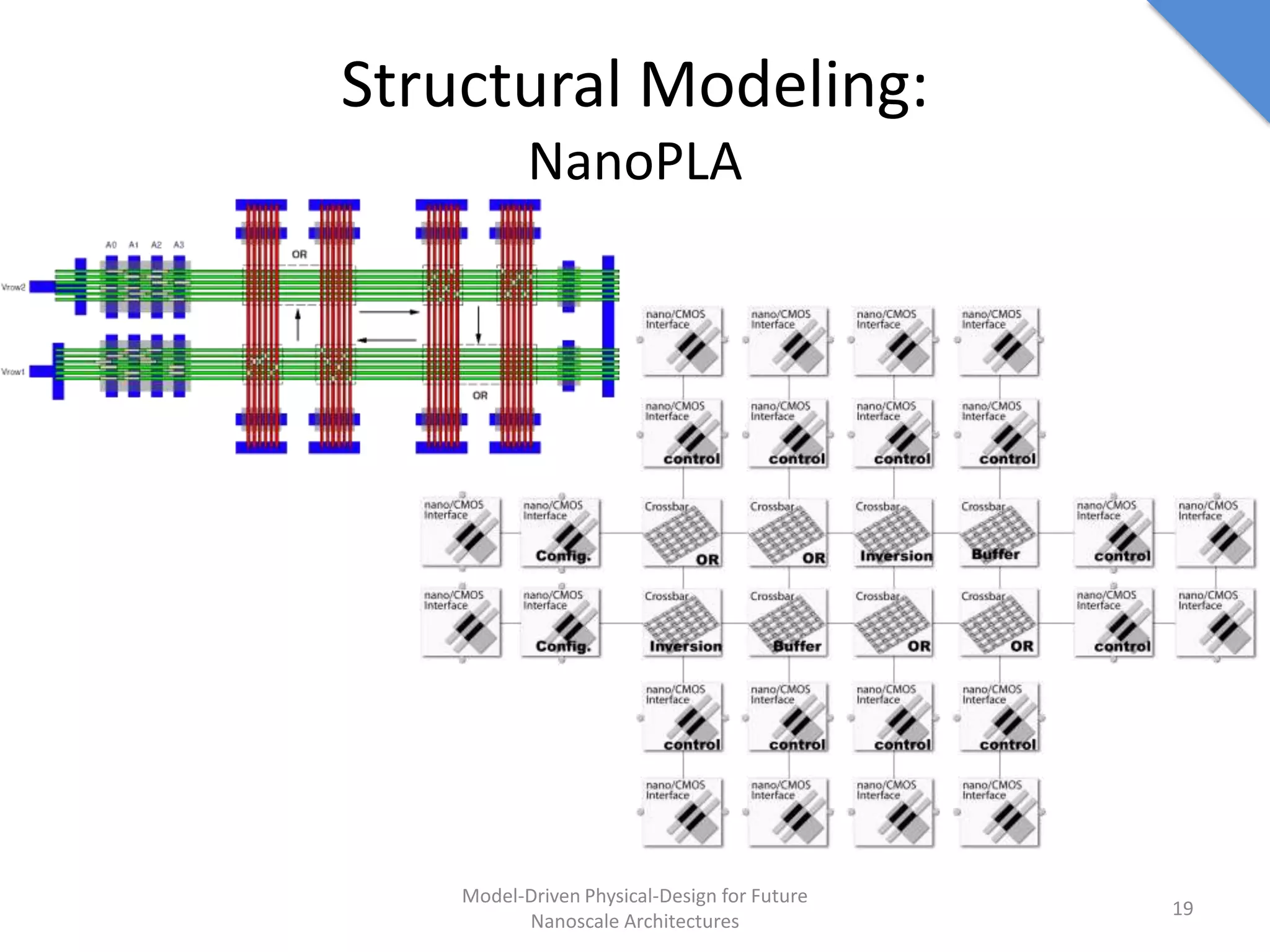
Structural Modeling:
           NanoPLA


    Model-Driven Physical-Design for Future
                                              19
          Nanoscale Architectures
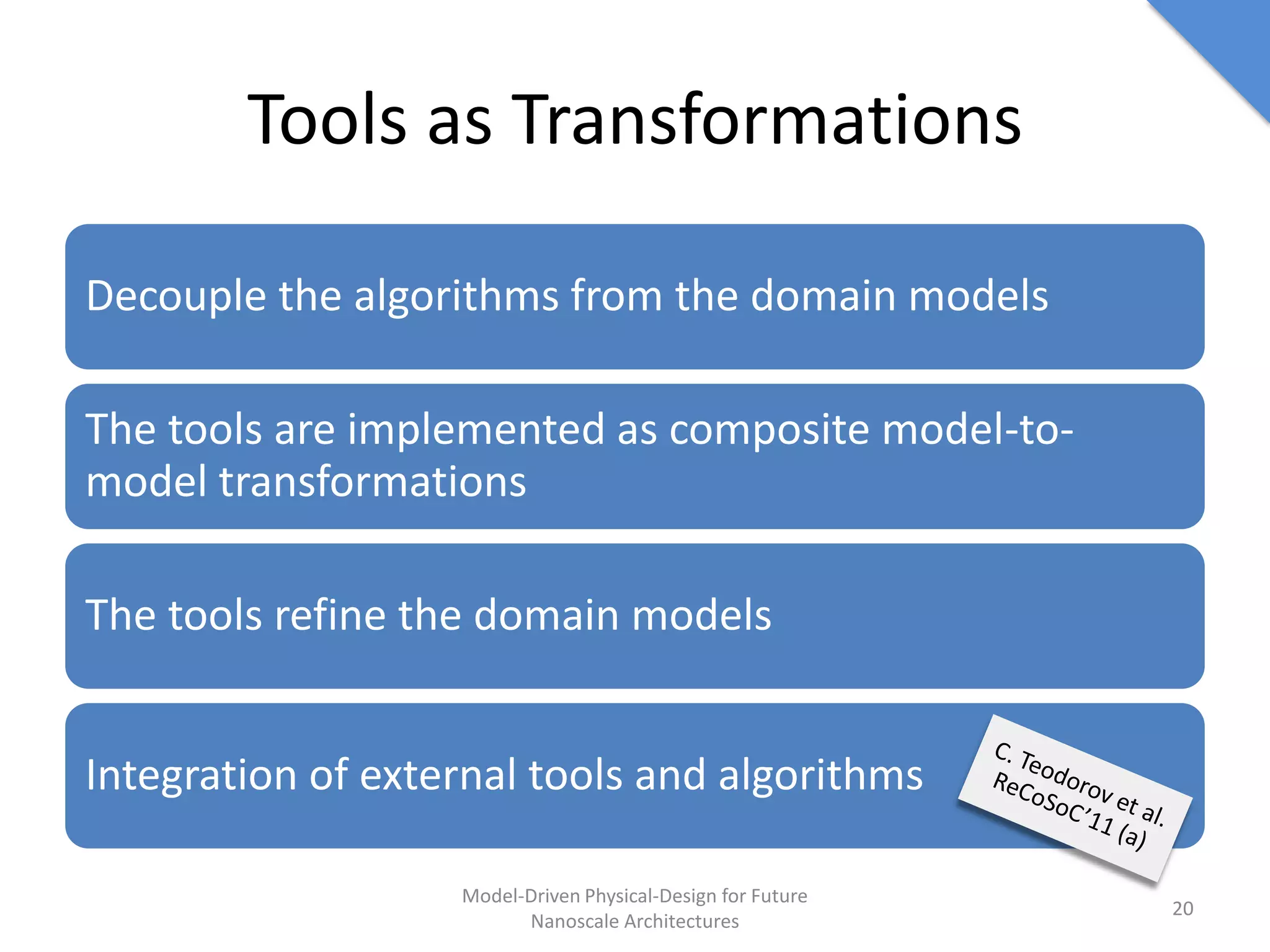
Tools as Transformations

Decouple the algorithms from the domain models

The tools are implemented as composite model-to-
model transformations

The tools refine the domain models


Integration of external tools and algorithms

                   Model-Driven Physical-Design for Future
                                                             20
                         Nanoscale Architectures
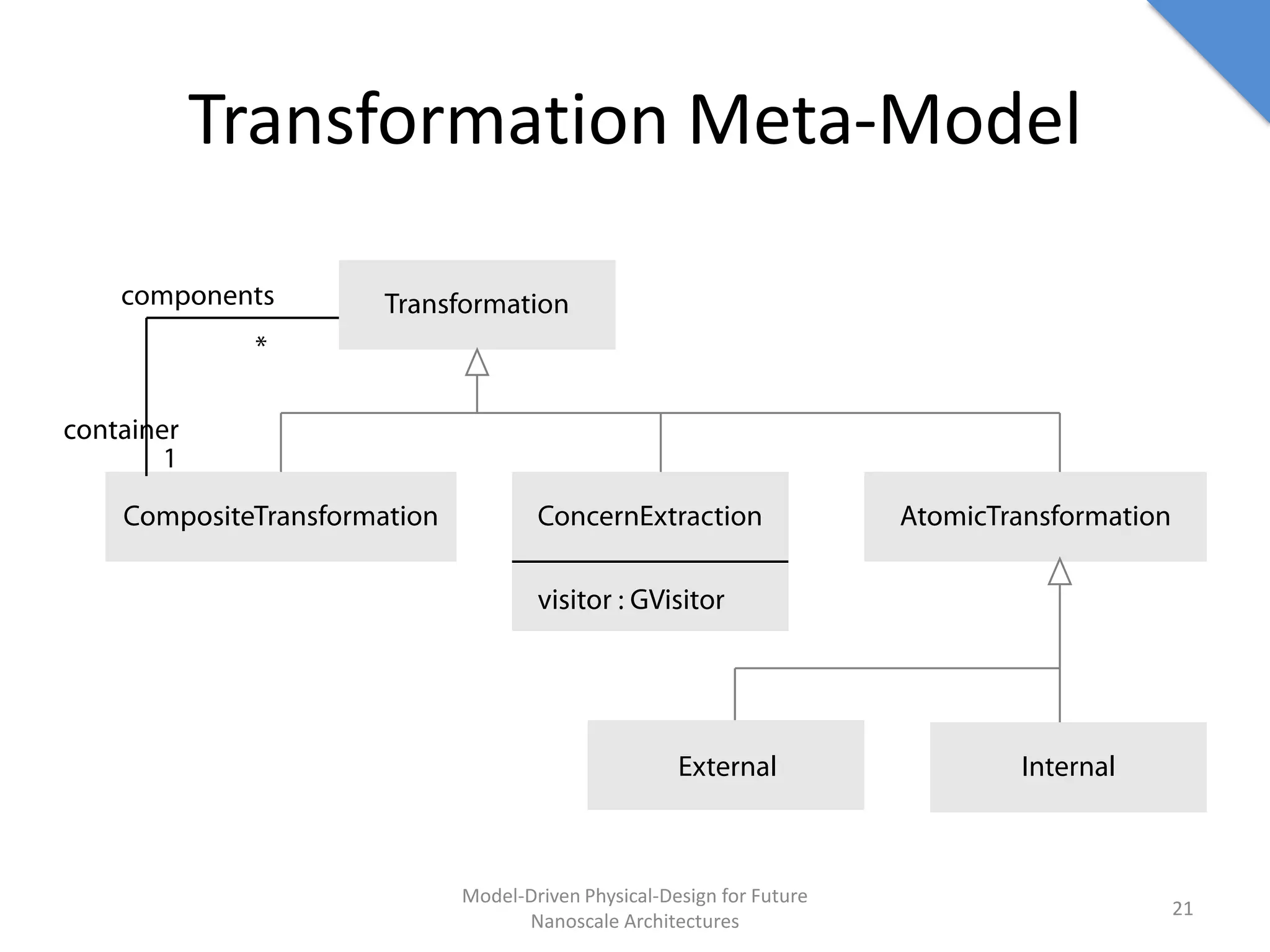
Transformation Meta-Model


       Model-Driven Physical-Design for Future
                                                 21
             Nanoscale Architectures
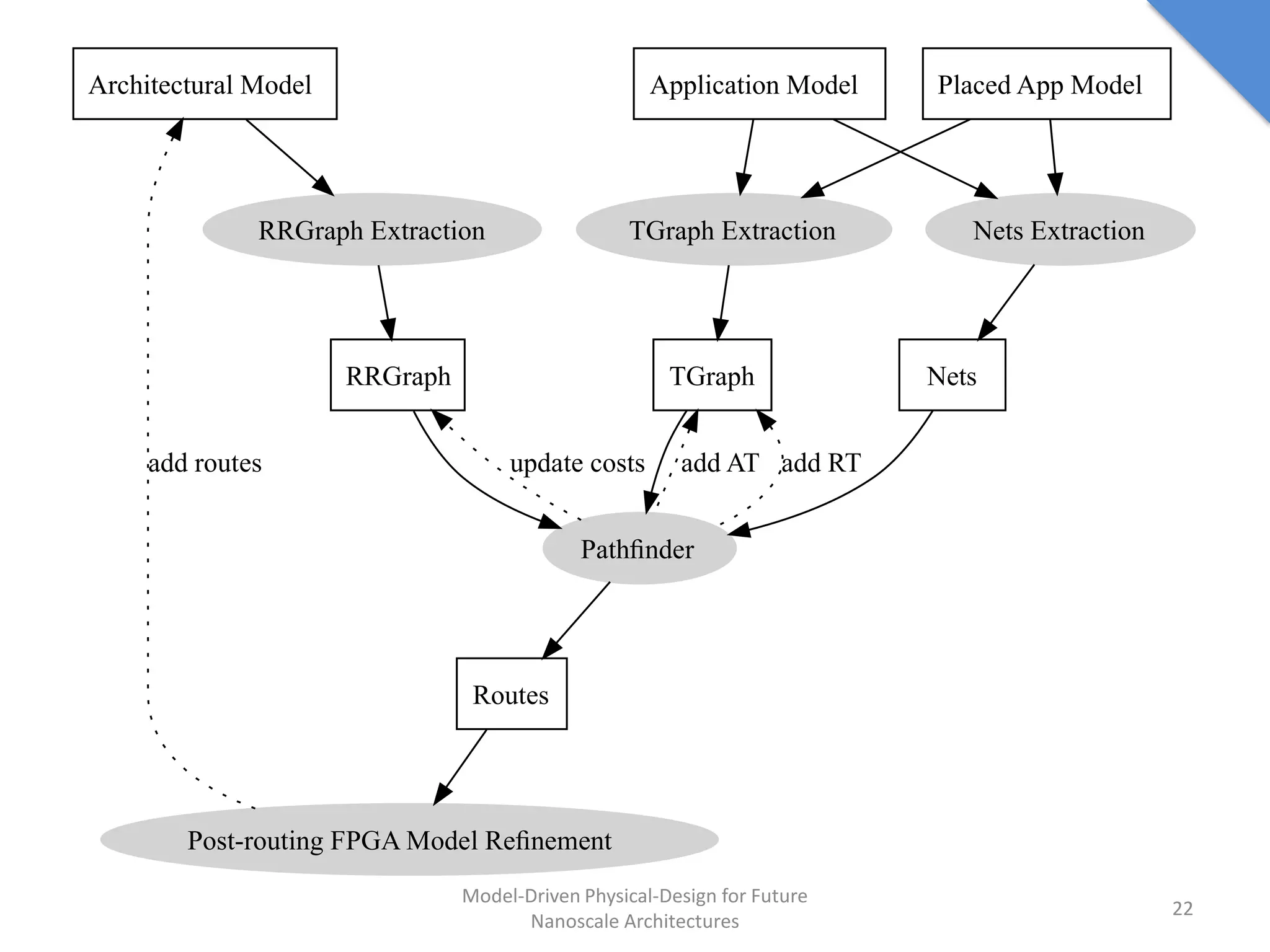
Architectural Model                                  Application Model    Placed App Model


              RRGraph Extraction                  TGraph Extraction          Nets Extraction


                      RRGraph                          TGraph             Nets


     add routes                      update costs       add AT add RT


                                             Pathfinder


                                 Routes


        Post-routing FPGA Model Refinement
                                Model-Driven Physical-Design for Future
                                                                                               22
                                      Nanoscale Architectures
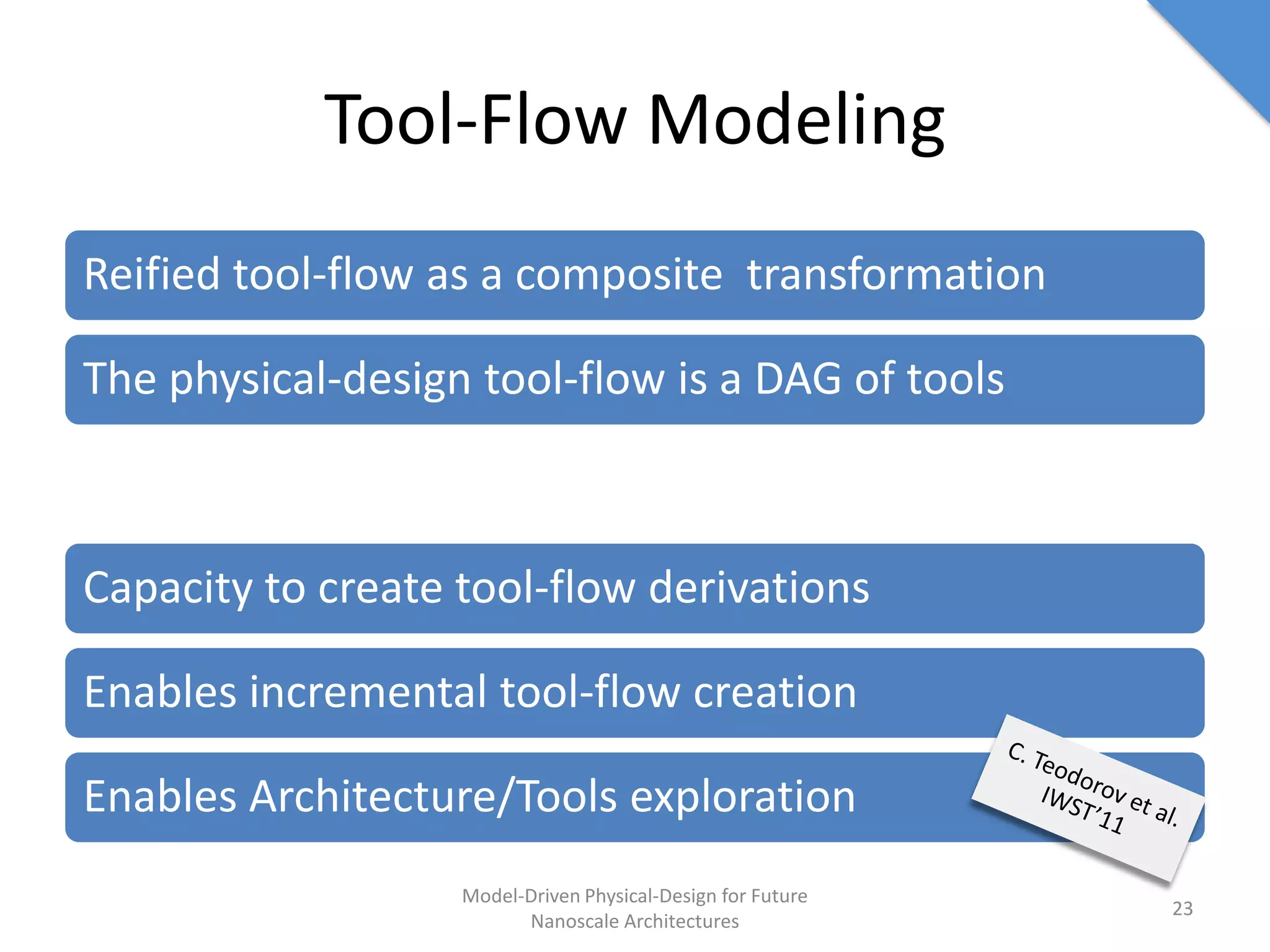
Tool-Flow Modeling
Reified tool-flow as a composite transformation

The physical-design tool-flow is a DAG of tools


Capacity to create tool-flow derivations

Enables incremental tool-flow creation

Enables Architecture/Tools exploration
                   Model-Driven Physical-Design for Future
                                                             23
                         Nanoscale Architectures
Tool-Flow Hierarchy Example

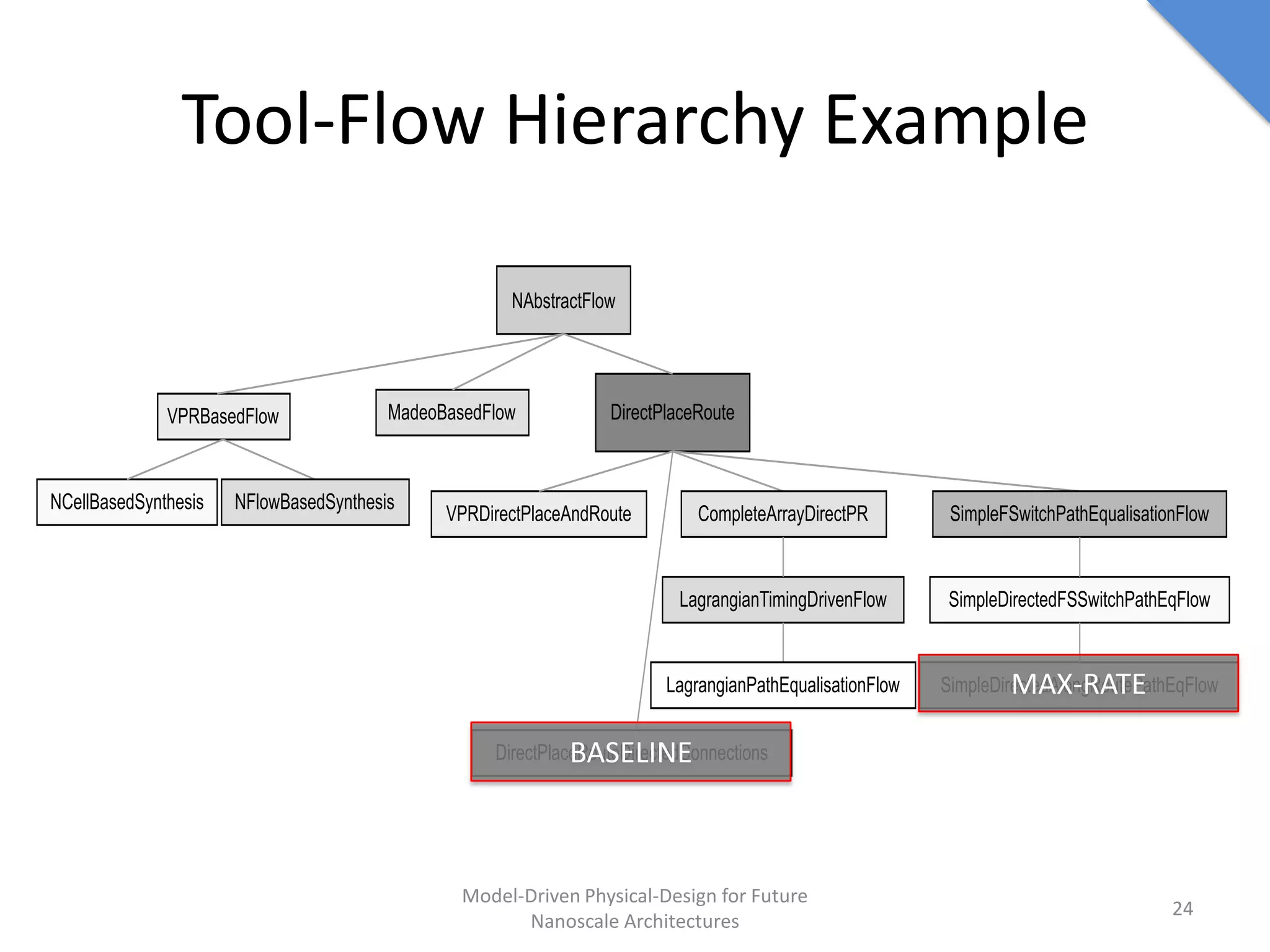
                                                     NAbstractFlow


              VPRBasedFlow              MadeoBasedFlow           DirectPlaceRoute


NCellBasedSynthesis   NFlowBasedSynthesis
                                              VPRDirectPlaceAndRoute         CompleteArrayDirectPR        SimpleFSwitchPathEqualisationFlow


                                                                          LagrangianTimingDrivenFlow     SimpleDirectedFSSwitchPathEqFlow


                                                                        LagrangianPathEqualisationFlow            MAX-RATE
                                                                                                         SimpleDirectedAlongRoutePathEqFlow


                                                             BASELINE
                                                   DirectPlaceRouteDirectedConnections


                                                Model-Driven Physical-Design for Future
                                                                                                                                      24
                                                      Nanoscale Architectures
Outline
MoNaDe Toolkit
 • Overview
 • Structural Domain Modeling
 • Tool Modeling
 • Design flow Modeling

R2D NASIC
 • Overview
 • Analytic evaluation
 • Characteristics

R2D NASIC Evaluation Results
 • Surface / Performance
 • Max-rate pipeline evaluation
 • Room for improvements

Conclusion & Perspectives

                                  Model-Driven Physical-Design for Future
                                                                            25
                                        Nanoscale Architectures
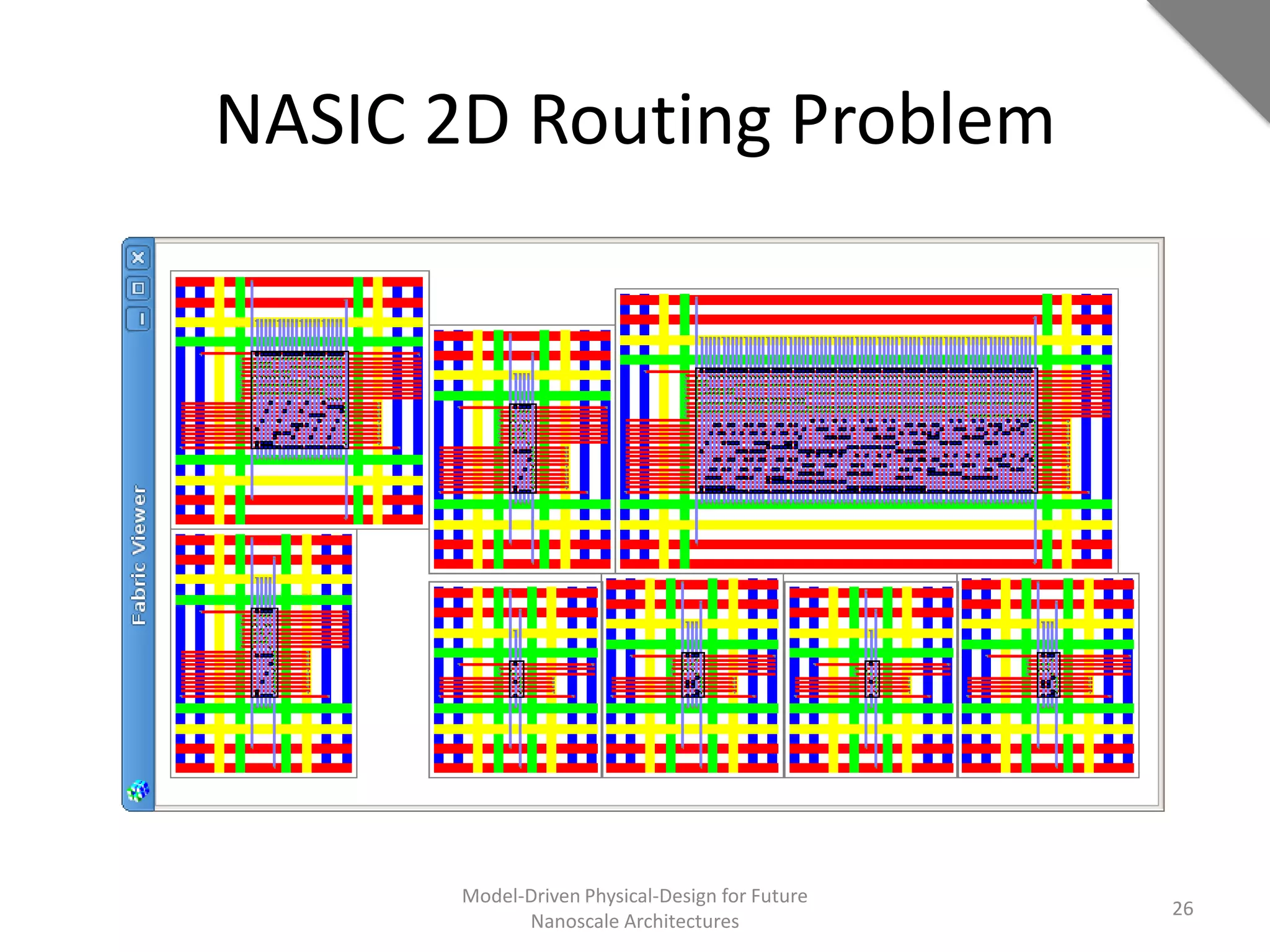
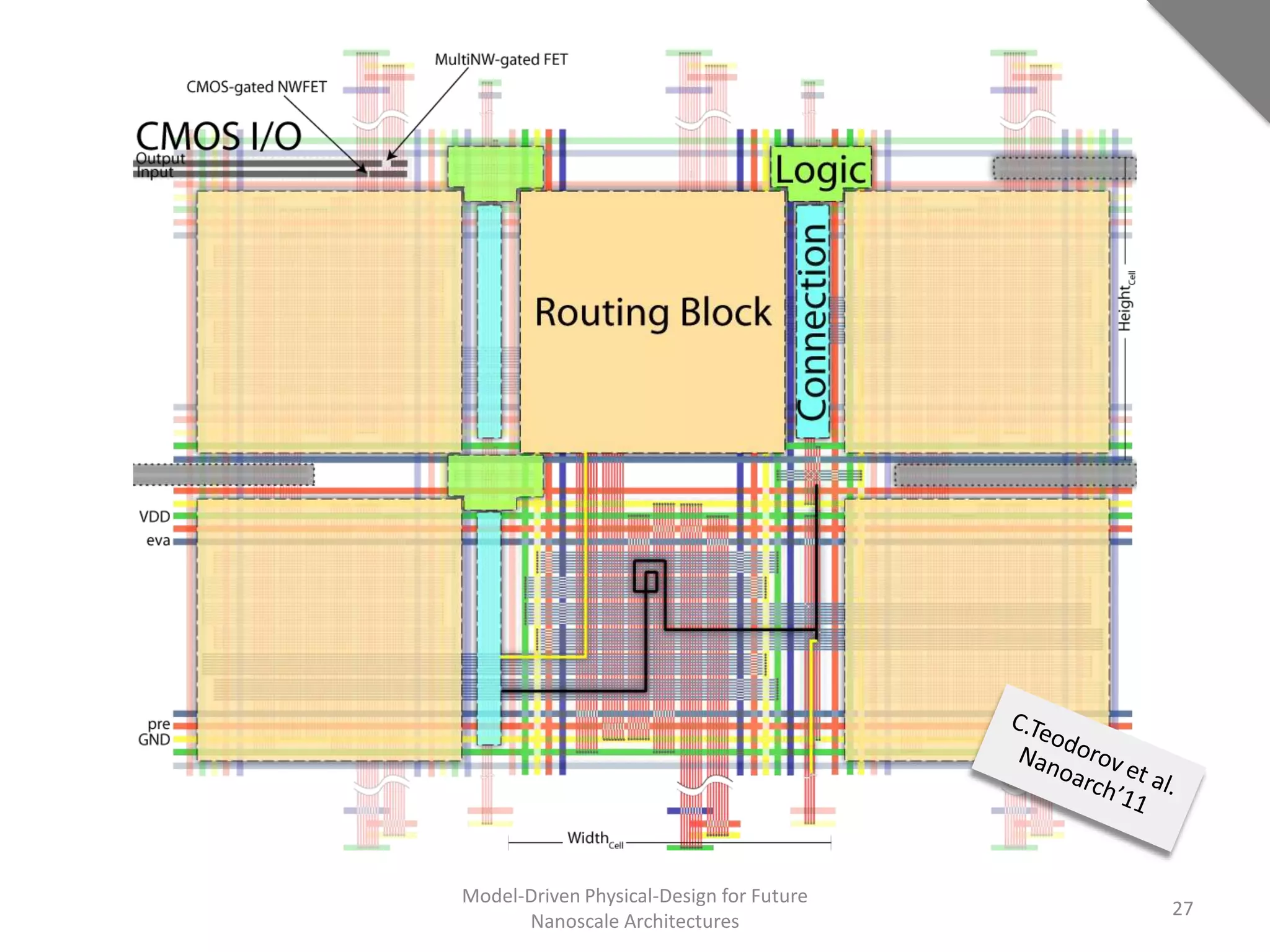
NASIC 2D Routing Problem


       Model-Driven Physical-Design for Future
                                                 26
             Nanoscale Architectures
Model-Driven Physical-Design for Future
                                          27
      Nanoscale Architectures
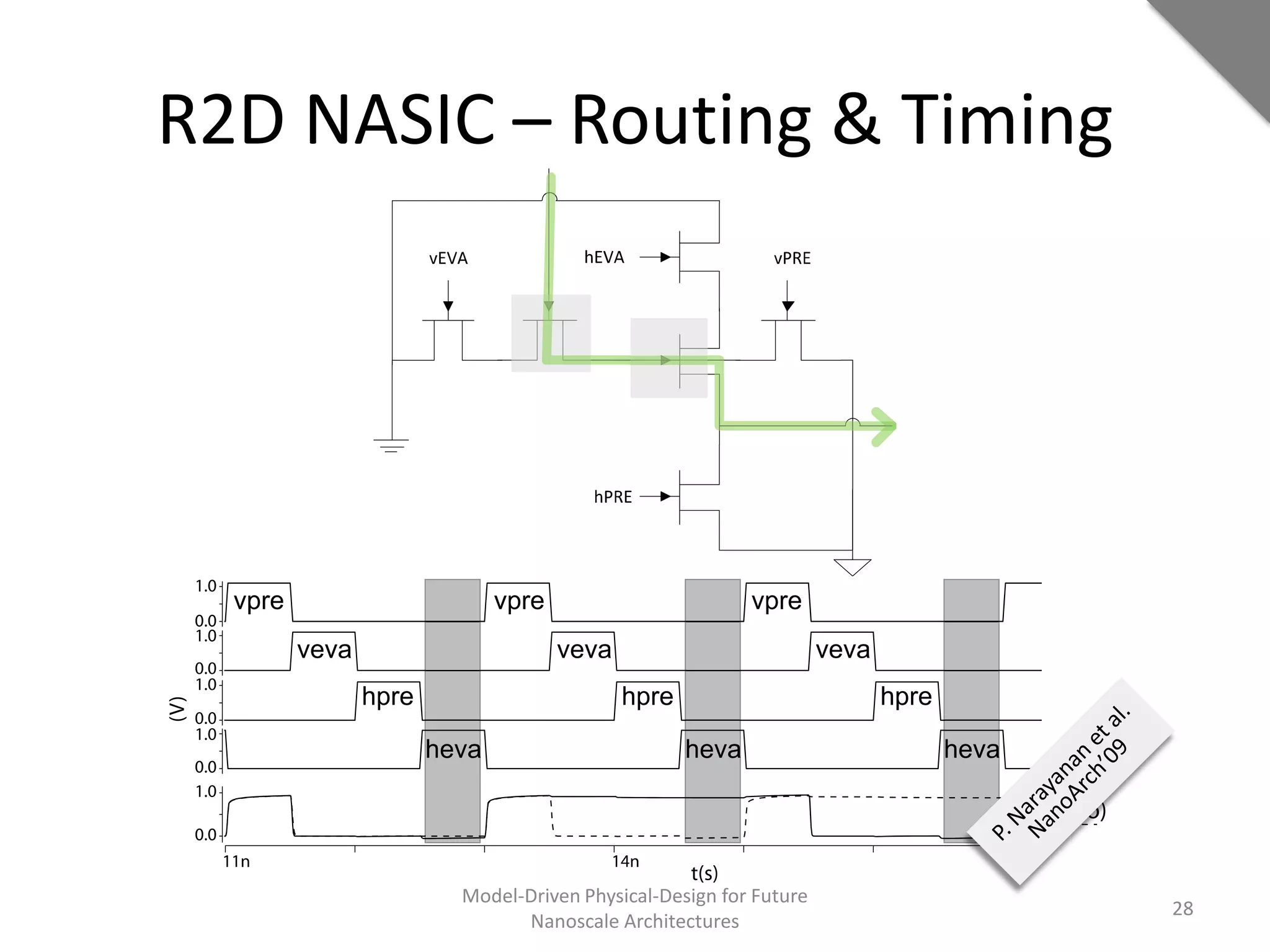
R2D NASIC – Routing & Timing


        Model-Driven Physical-Design for Future
                                                  28
              Nanoscale Architectures
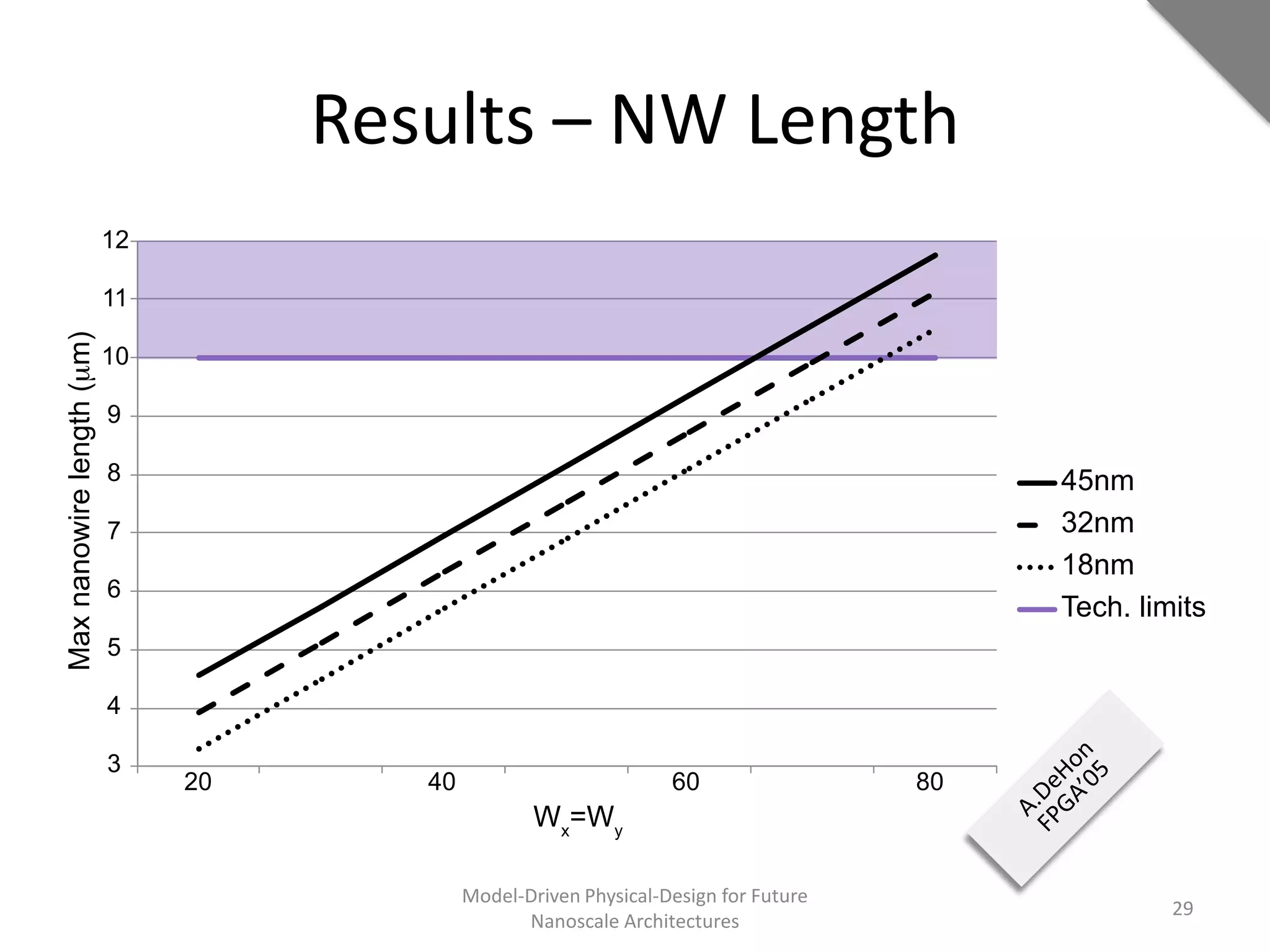
Results – NW Length


    Model-Driven Physical-Design for Future
                                              29
          Nanoscale Architectures
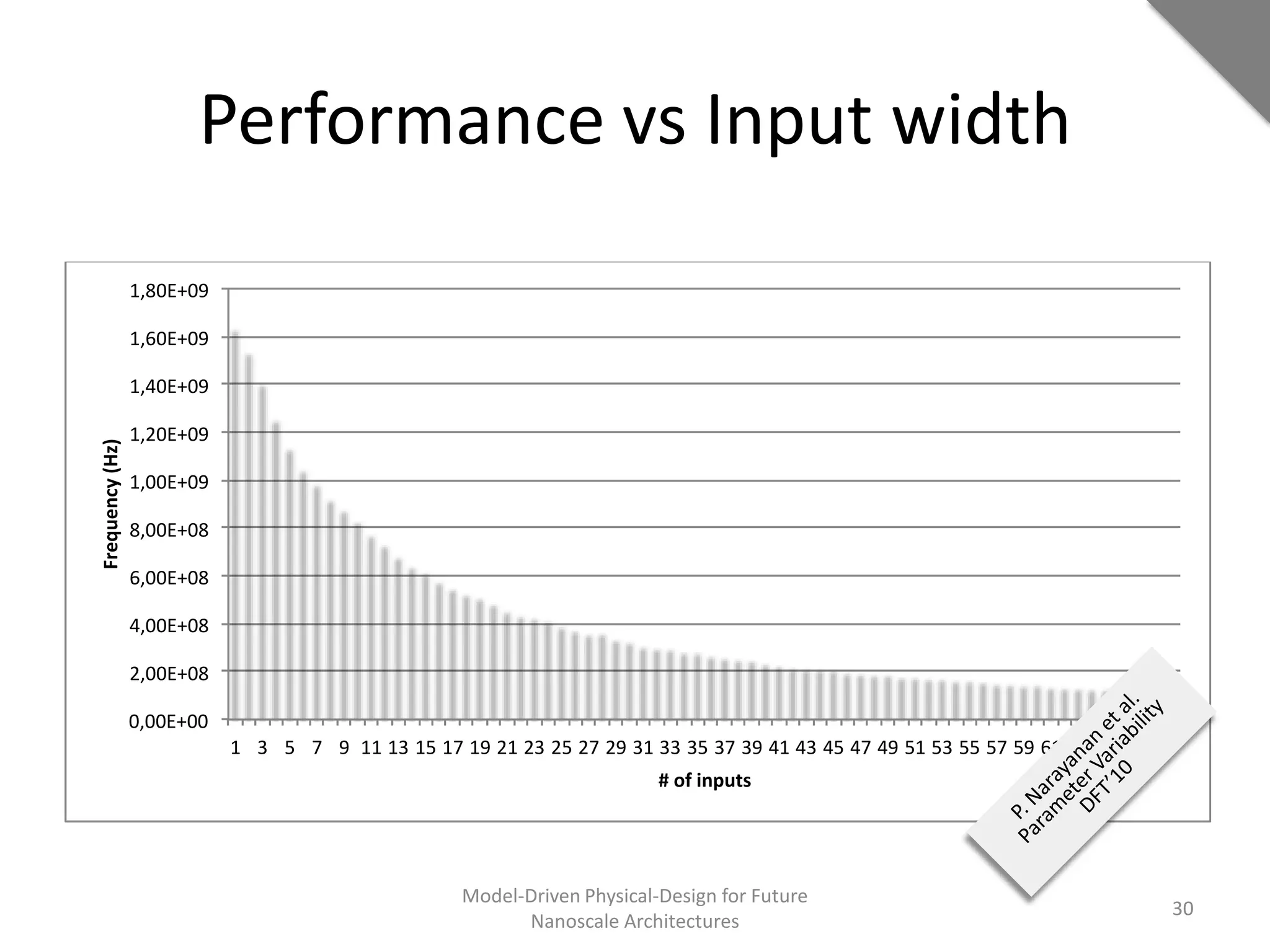
Performance vs Input width
                 1,80E+09

                 1,60E+09

                 1,40E+09

                 1,20E+09
Frequency (Hz)


                 1,00E+09

                 8,00E+08

                 6,00E+08

                 4,00E+08

                 2,00E+08

                 0,00E+00
                            1 3 5 7 9 11 13 15 17 19 21 23 25 27 29 31 33 35 37 39 41 43 45 47 49 51 53 55 57 59 61 63 65 67 69
                                                                          # of inputs


                                                    Model-Driven Physical-Design for Future
                                                                                                                                  30
                                                          Nanoscale Architectures
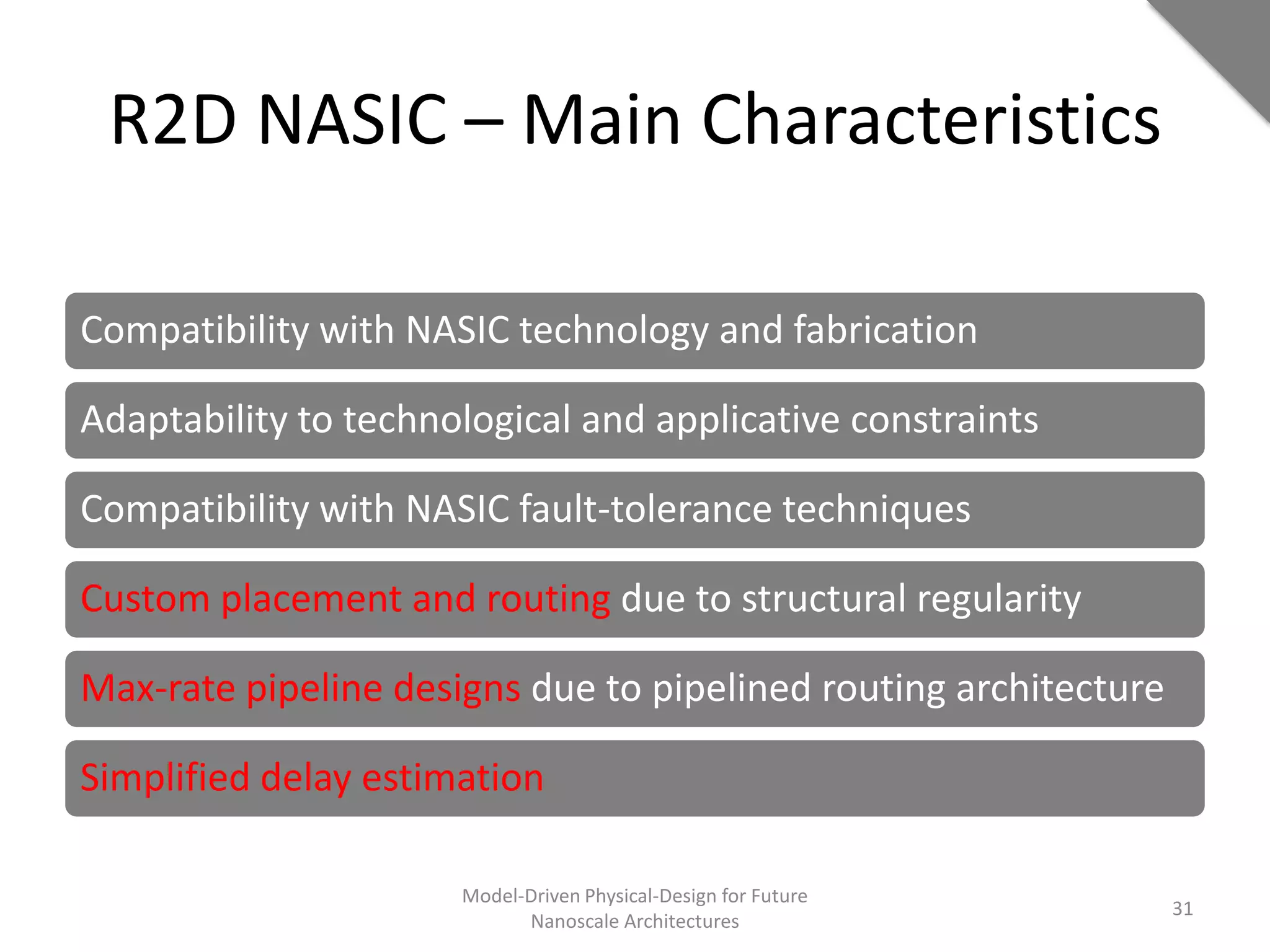
R2D NASIC – Main Characteristics

Compatibility with NASIC technology and fabrication

Adaptability to technological and applicative constraints

Compatibility with NASIC fault-tolerance techniques

Custom placement and routing due to structural regularity

Max-rate pipeline designs due to pipelined routing architecture

Simplified delay estimation

                      Model-Driven Physical-Design for Future
                                                                  31
                            Nanoscale Architectures
Outline
MoNaDe Toolkit
 • Overview
 • Structural Domain Modeling
 • Tool Modeling
 • Design flow Modeling

R2D NASIC
 • Overview
 • Analytic evaluation
 • Characteristics

R2D NASIC Evaluation Results
 • Surface / Performance
 • Max-rate pipeline evaluation
 • Room for improvements

Conclusion & Perspectives

                                  Model-Driven Physical-Design for Future
                                                                            32
                                        Nanoscale Architectures
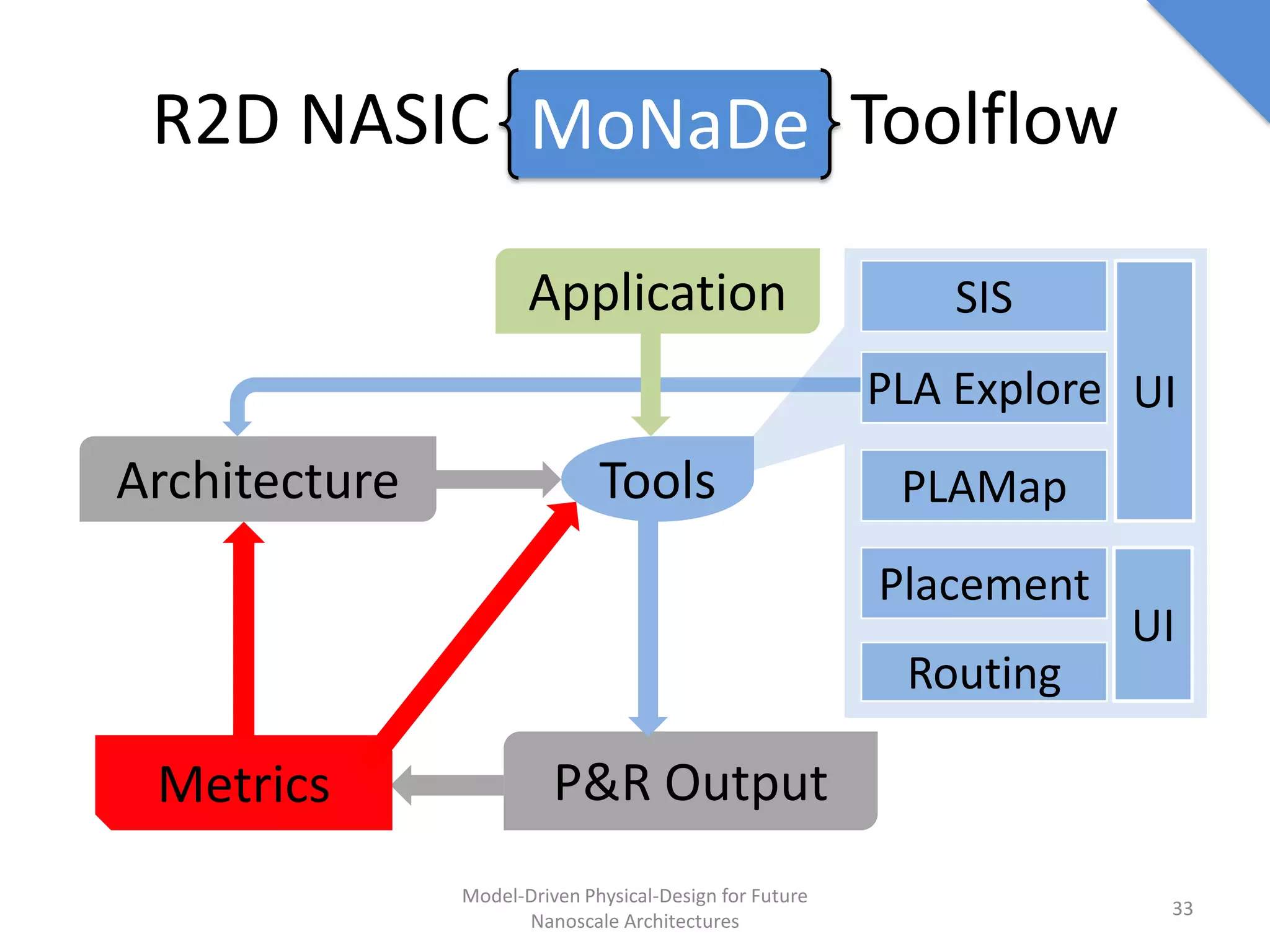
R2D NASIC MoNaDe Toolflow

                      Application                            SIS
                                                         PLA Explore UI
Architecture                  Tools                       PLAMap
                                                         Placement
                                                                     UI
                                                          Routing

 Metrics                 P&R Output
               Model-Driven Physical-Design for Future
                                                                      33
                     Nanoscale Architectures
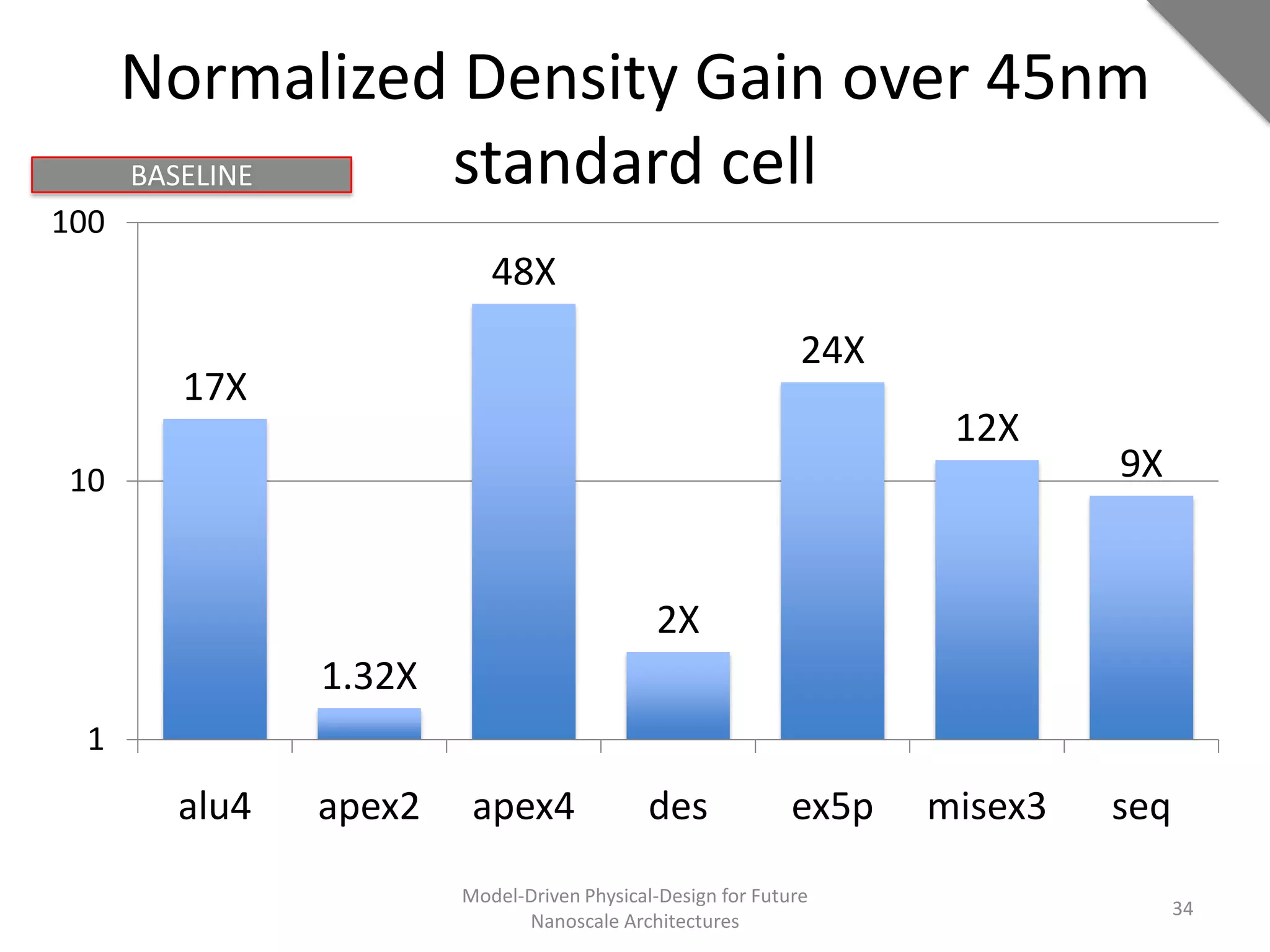
Normalized Density Gain over 45nm
      BASELINE  standard cell
100
                         48X
                                                            24X
        17X
                                                                   12X
 10                                                                        9X


                                           2X
              1.32X
 1
       alu4   apex2    apex4               des             ex5p   misex3   seq
                      Model-Driven Physical-Design for Future
                                                                                 34
                            Nanoscale Architectures
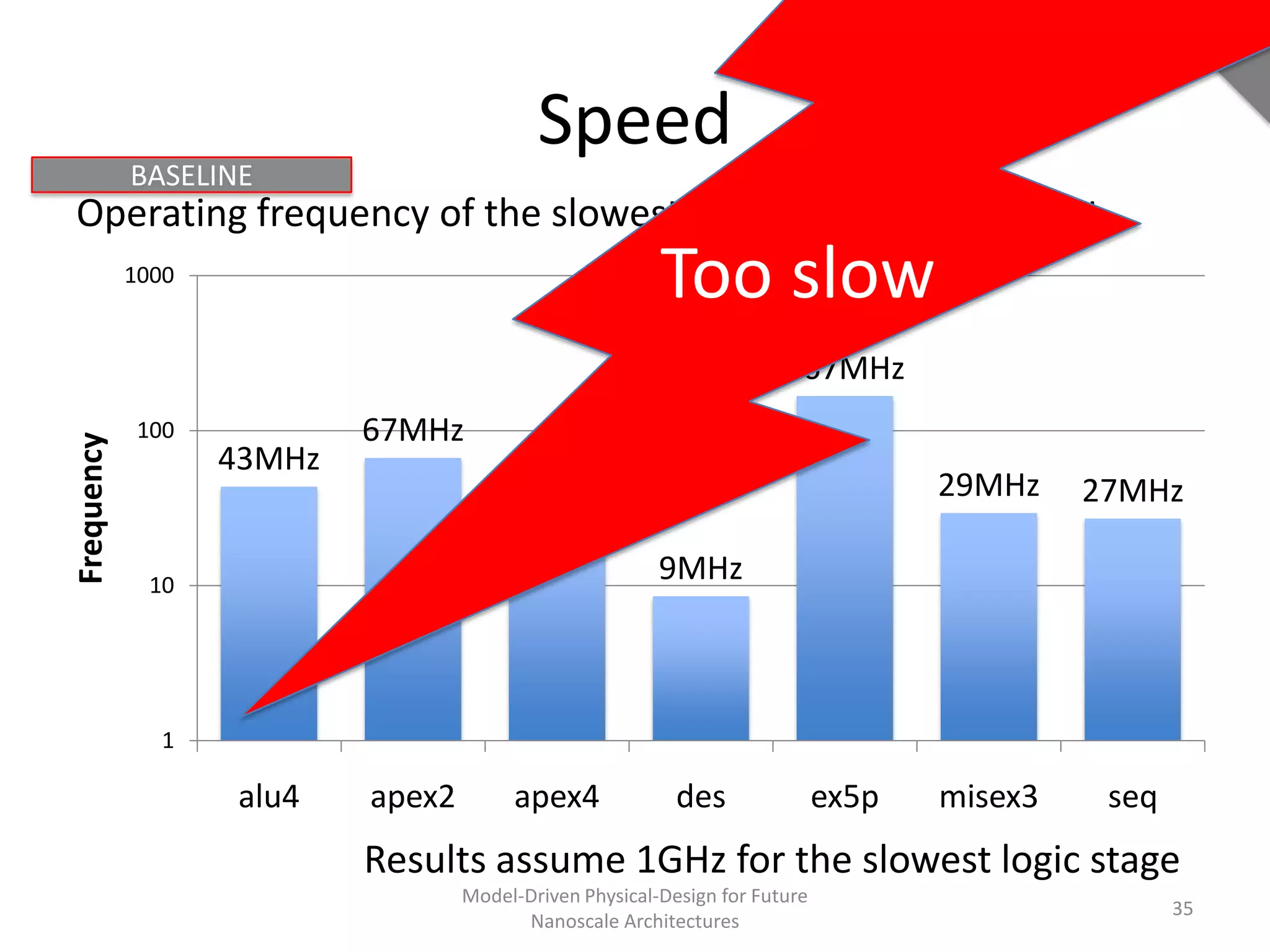
Speed
            BASELINE
Operating frequency of the slowest logic stage / throughput
            1000
                                                         Too slow
                                                                       167MHz
             100           67MHz
Frequency


                   43MHz               40MHz
                                                                                    29MHz    27MHz

              10
                                                         9MHz


               1

                   alu4    apex2        apex4              des               ex5p   misex3    seq
                           Results assume 1GHz for the slowest logic stage
                                   Model-Driven Physical-Design for Future
                                                                                                    35
                                         Nanoscale Architectures
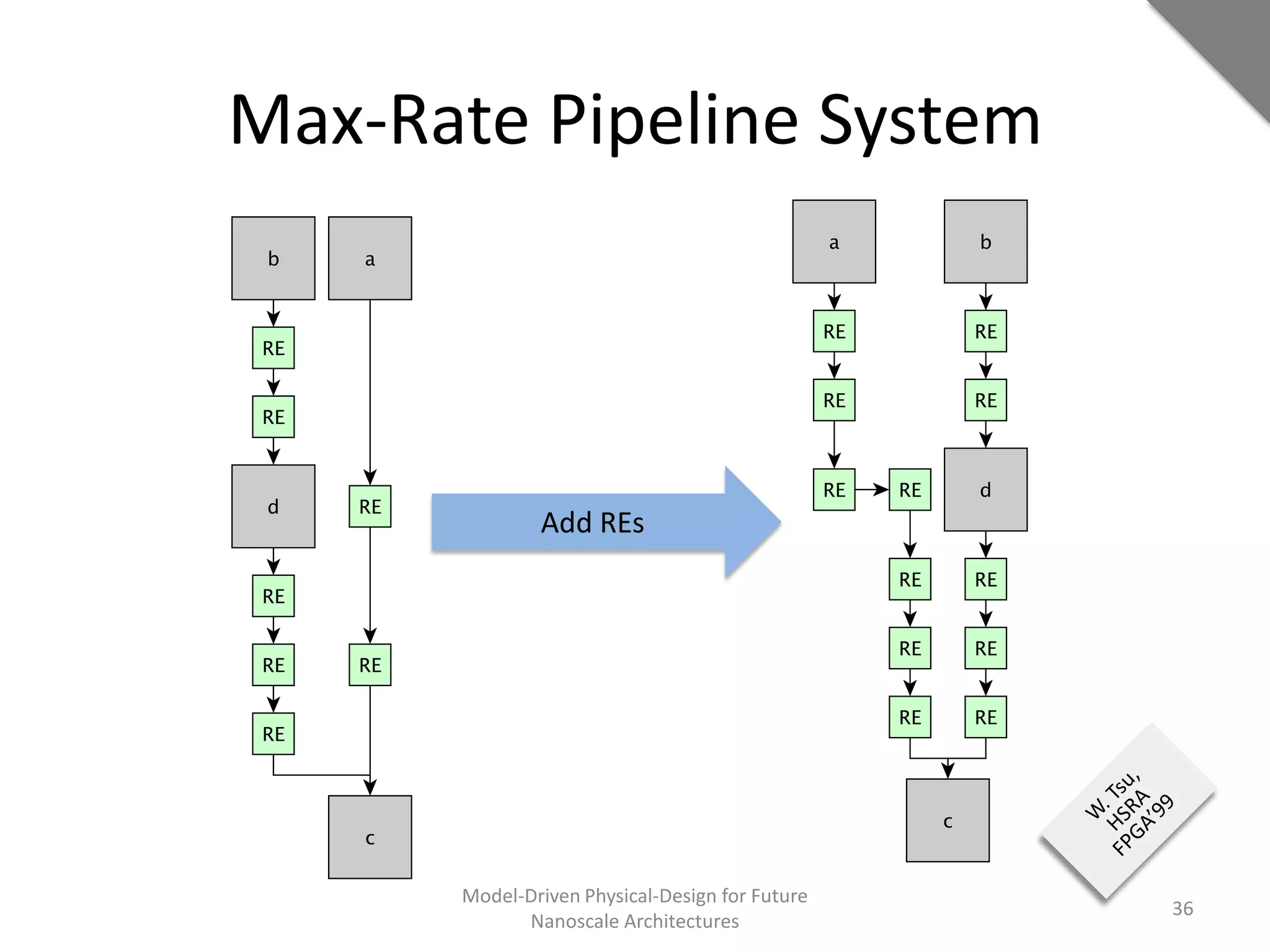
Max-Rate Pipeline System


              Add REs


      Model-Driven Physical-Design for Future
                                                36
            Nanoscale Architectures
Model-Driven Physical-Design for Future
                                          37
      Nanoscale Architectures
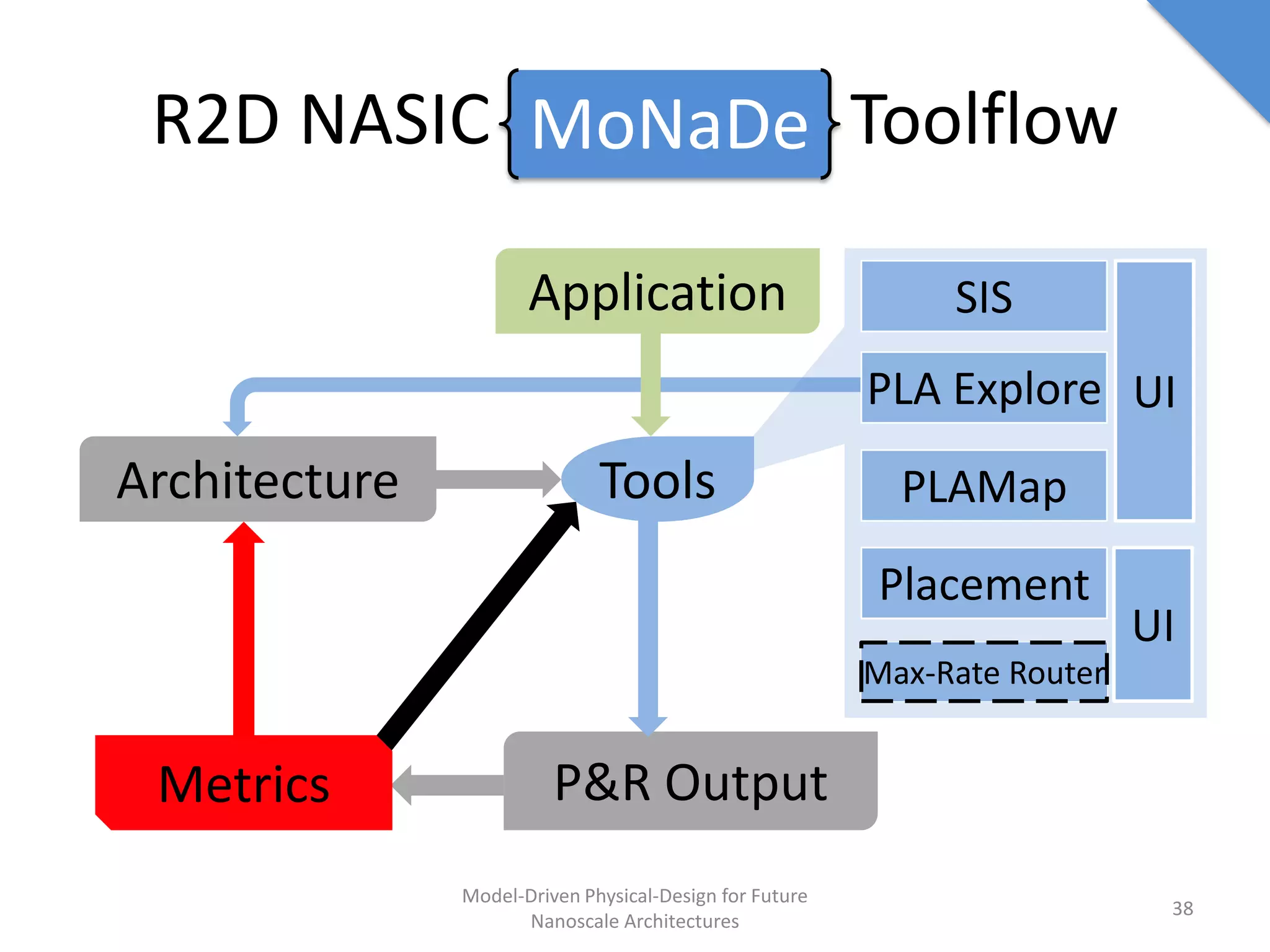
R2D NASIC MoNaDe Toolflow

                      Application                             SIS
                                                         PLA Explore UI
Architecture                  Tools                        PLAMap
                                                         Placement
                                                                           UI
                                                           Routing
                                                         Max-Rate Router


 Metrics                 P&R Output
               Model-Driven Physical-Design for Future
                                                                            38
                     Nanoscale Architectures
Net Performance Improvement
MAX-RATE


           Model-Driven Physical-Design for Future
                                                     39
                 Nanoscale Architectures
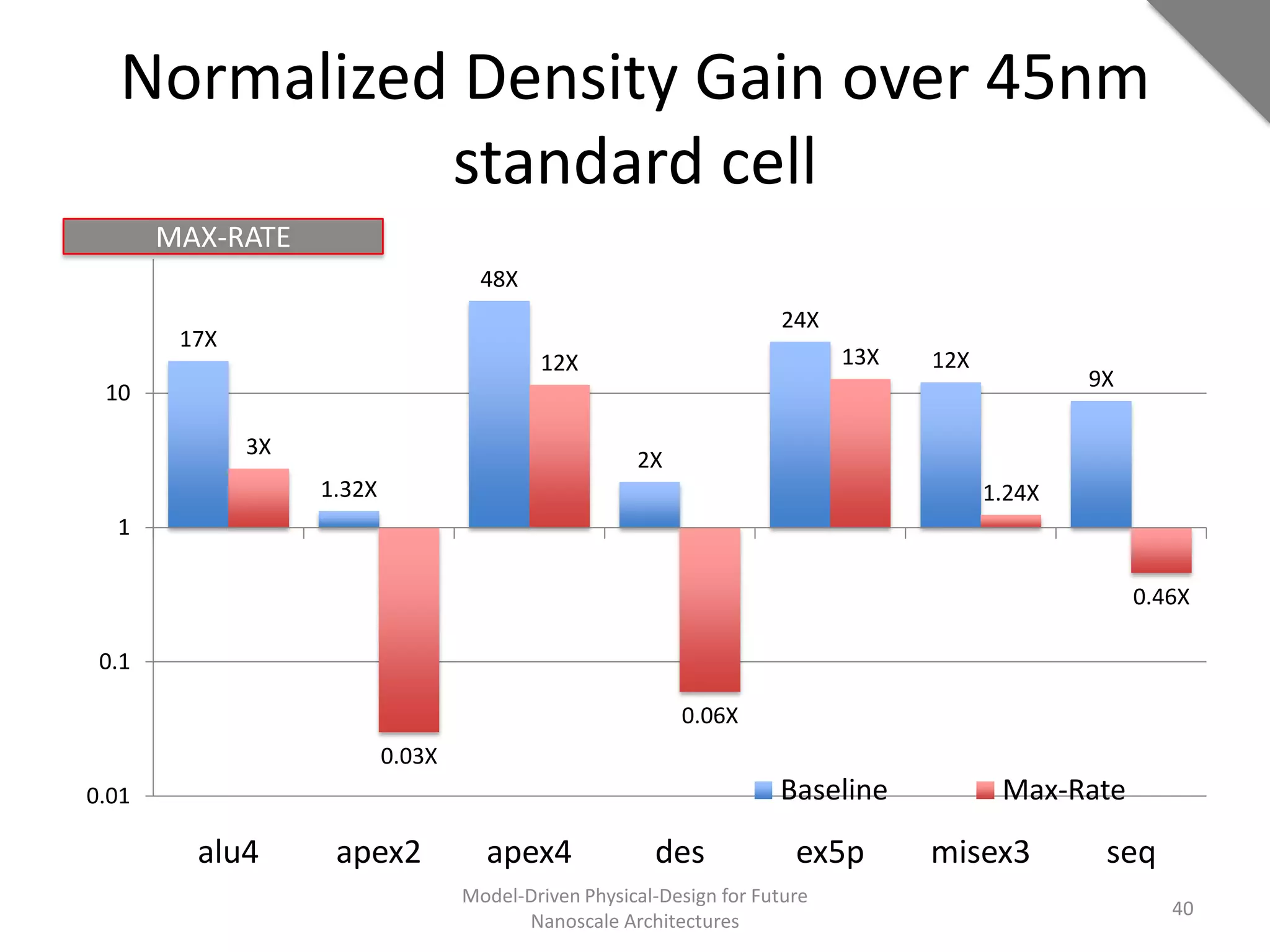
Normalized Density Gain over 45nm
             standard cell
       MAX-RATE
                                     48X
                                                                       24X
        17X
                                           12X                               13X   12X
                                                                                                 9X
 10

              3X
                                                      2X
                   1.32X                                                                 1.24X
  1

                                                                                                      0.46X

 0.1

                                                           0.06X
                           0.03X
0.01                                                                  Baseline            Max-Rate
         alu4       apex2            apex4              des             ex5p       misex3         seq
                                   Model-Driven Physical-Design for Future
                                                                                                         40
                                         Nanoscale Architectures
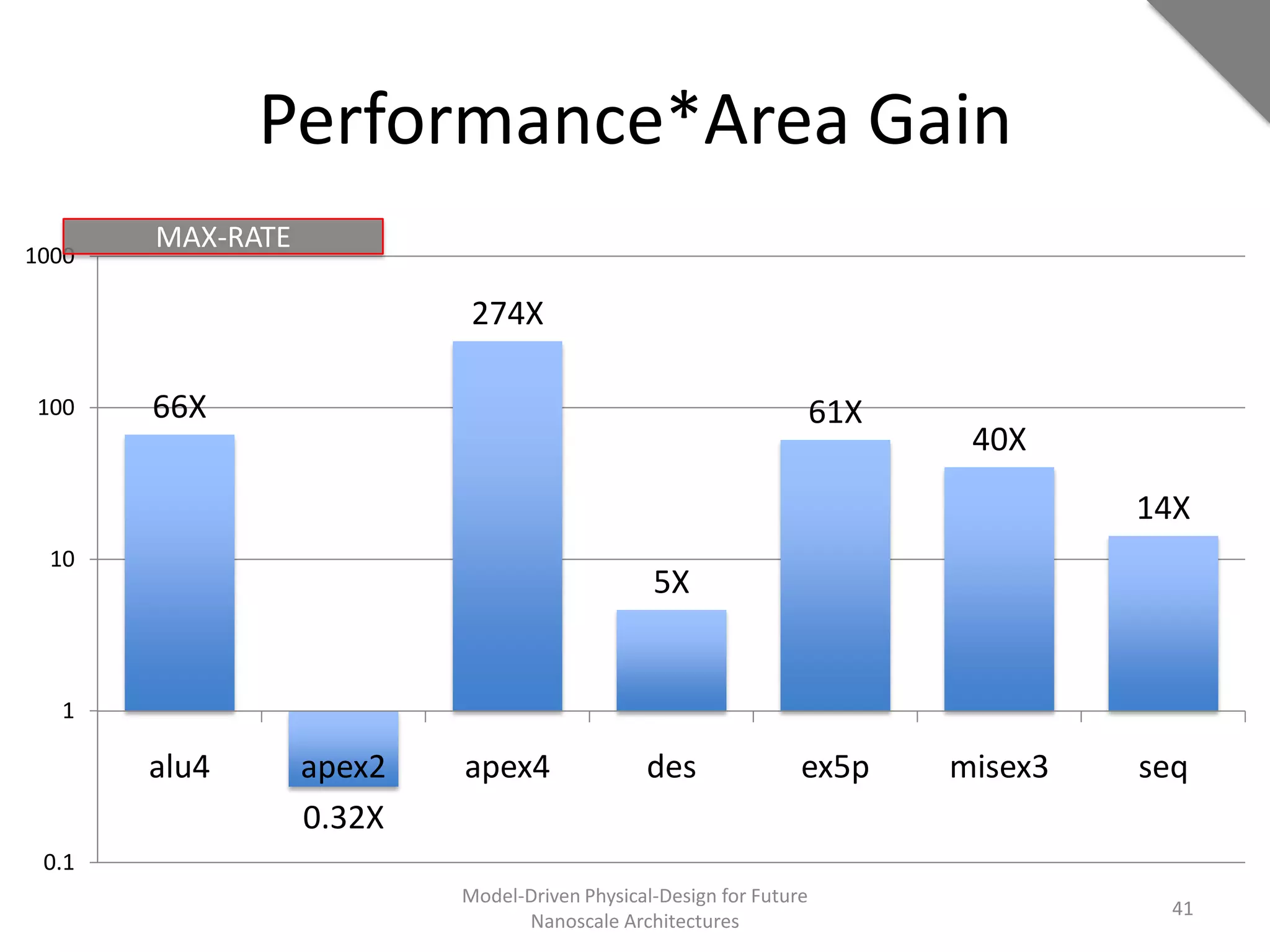
Performance*Area Gain
       MAX-RATE
1000

                           274X

100    66X                                                          61X
                                                                           40X
                                                                                   14X
 10
                                               5X


  1

       alu4       apex2   apex4               des               ex5p      misex3   seq
                  0.32X
 0.1
                          Model-Driven Physical-Design for Future
                                                                                     41
                                Nanoscale Architectures
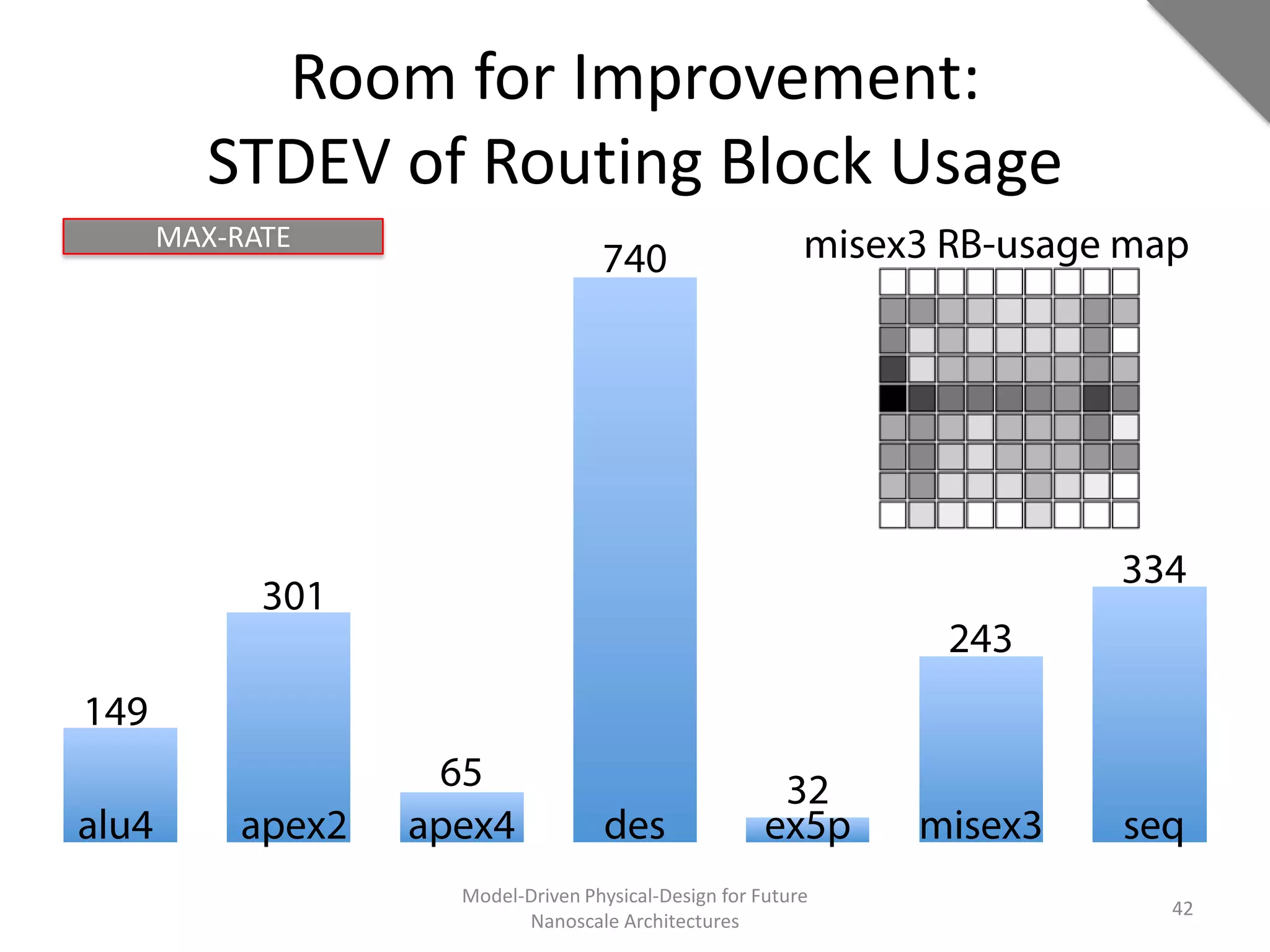
Room for Improvement:
   STDEV of Routing Block Usage
MAX-RATE


           Model-Driven Physical-Design for Future
                                                     42
                 Nanoscale Architectures
Outline
MoNaDe Toolkit
 • Overview
 • Structural Domain Modeling
 • Tool Modeling
 • Design flow Modeling

R2D NASIC
 • Overview
 • Analytic evaluation
 • Characteristics

R2D NASIC Evaluation Results
 • Surface / Performance
 • Max-rate pipeline evaluation
 • Room for improvements

Conclusion & Perspectives

                                  Model-Driven Physical-Design for Future
                                                                            43
                                        Nanoscale Architectures
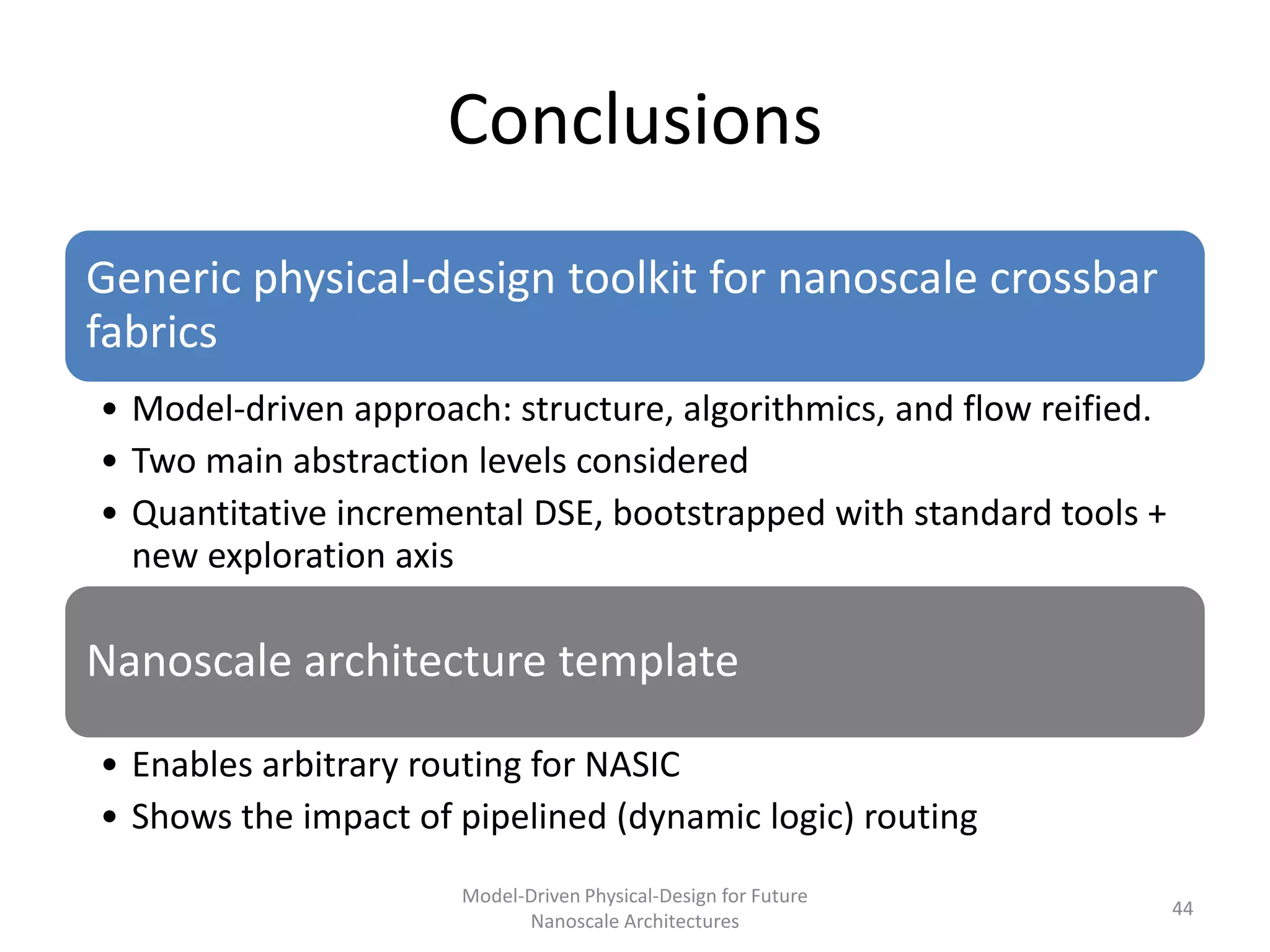
Conclusions
Generic physical-design toolkit for nanoscale crossbar
fabrics
• Model-driven approach: structure, algorithmics, and flow reified.
• Two main abstraction levels considered
• Quantitative incremental DSE, bootstrapped with standard tools +
  new exploration axis

Nanoscale architecture template

• Enables arbitrary routing for NASIC
• Shows the impact of pipelined (dynamic logic) routing
                      Model-Driven Physical-Design for Future
                                                                      44
                            Nanoscale Architectures
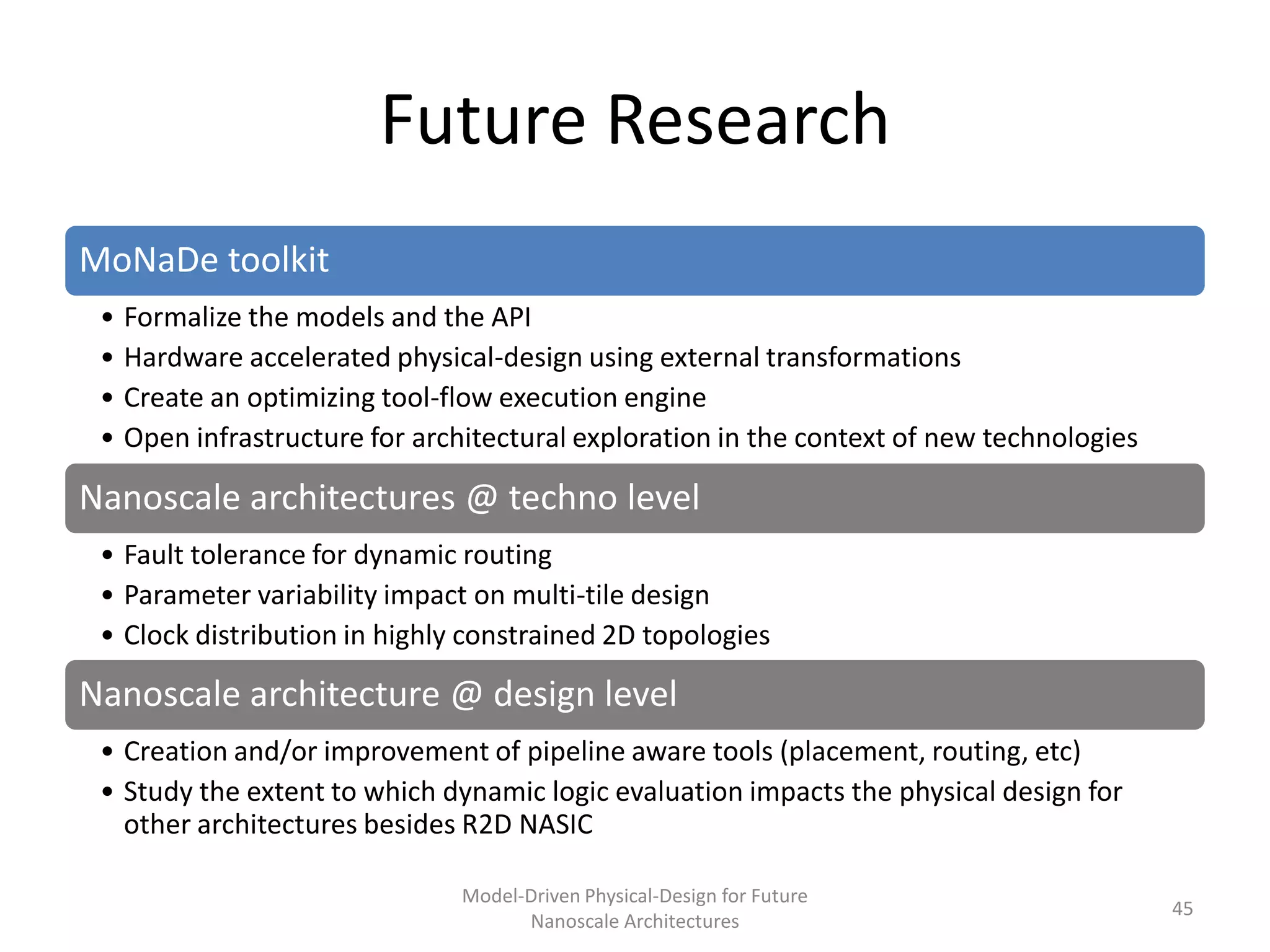
Future Research
MoNaDe toolkit
 • Formalize the models and the API
 • Hardware accelerated physical-design using external transformations
 • Create an optimizing tool-flow execution engine
 • Open infrastructure for architectural exploration in the context of new technologies

Nanoscale architectures @ techno level
 • Fault tolerance for dynamic routing
 • Parameter variability impact on multi-tile design
 • Clock distribution in highly constrained 2D topologies

Nanoscale architecture @ design level
 • Creation and/or improvement of pipeline aware tools (placement, routing, etc)
 • Study the extent to which dynamic logic evaluation impacts the physical design for
   other architectures besides R2D NASIC

                               Model-Driven Physical-Design for Future
                                                                                          45
                                     Nanoscale Architectures
Model-Driven Physical-Design for Future
                                          46
      Nanoscale Architectures
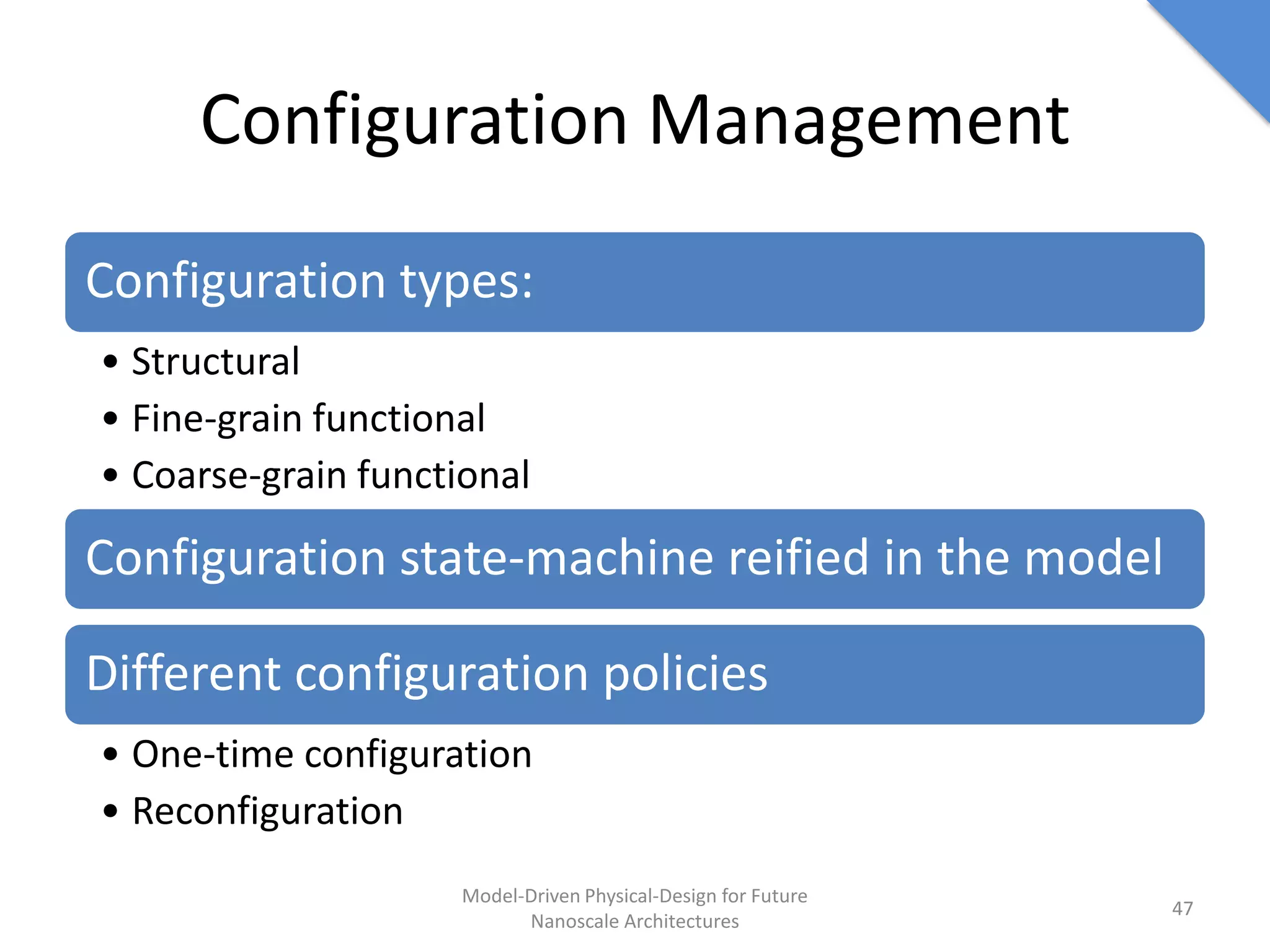
Configuration Management
Configuration types:
• Structural
• Fine-grain functional
• Coarse-grain functional

Configuration state-machine reified in the model

Different configuration policies
• One-time configuration
• Reconfiguration
                     Model-Driven Physical-Design for Future
                                                               47
                           Nanoscale Architectures
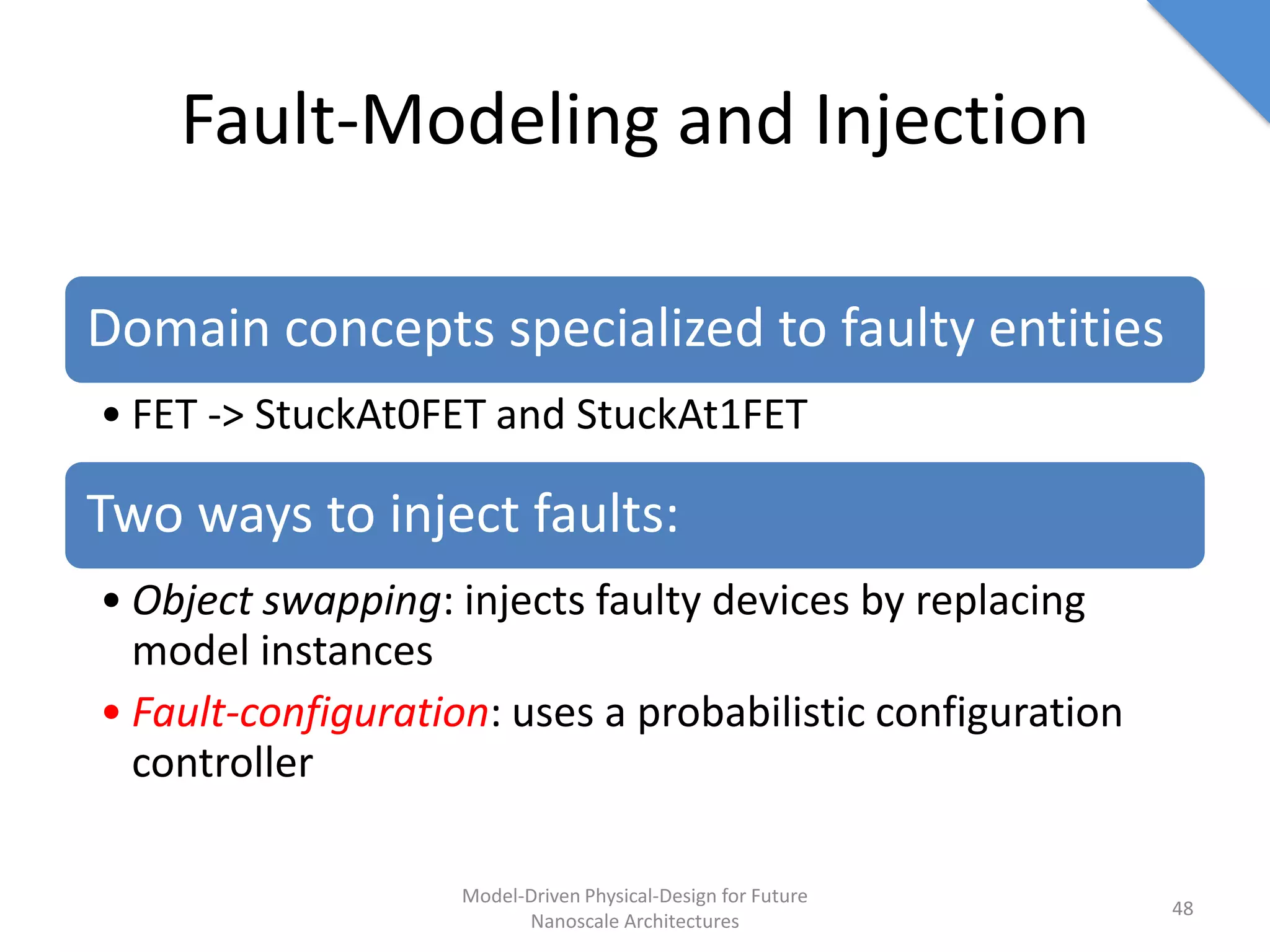
Fault-Modeling and Injection

Domain concepts specialized to faulty entities
• FET -> StuckAt0FET and StuckAt1FET

Two ways to inject faults:
• Object swapping: injects faulty devices by replacing
  model instances
• Fault-configuration: uses a probabilistic configuration
  controller

                    Model-Driven Physical-Design for Future
                                                              48
                          Nanoscale Architectures
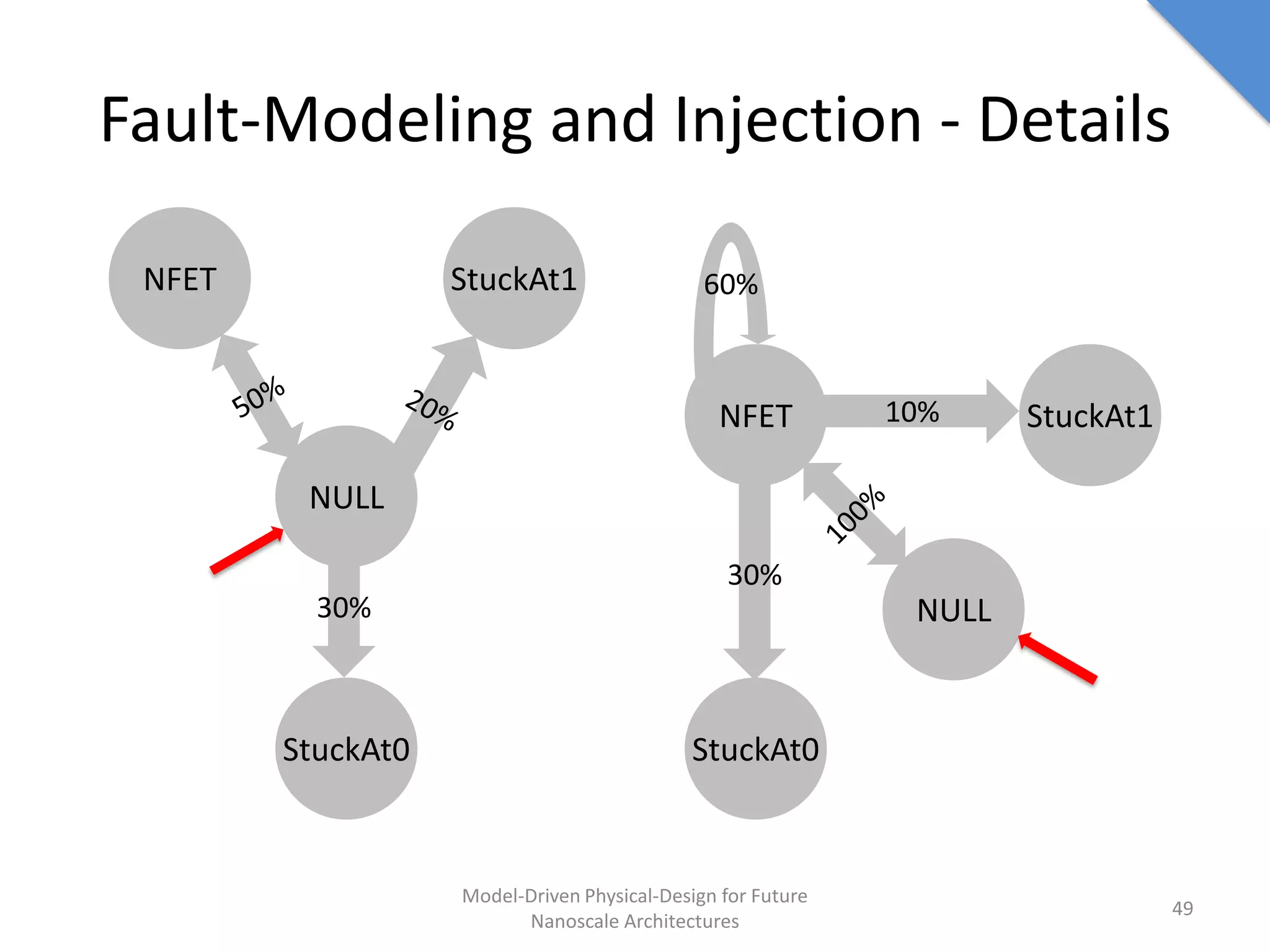
Fault-Modeling and Injection - Details

 NFET              StuckAt1                   60%


                                               NFET          10%     StuckAt1

         NULL

                                                30%
          30%                                                 NULL


        StuckAt0                            StuckAt0


                   Model-Driven Physical-Design for Future
                                                                                49
                         Nanoscale Architectures

Model-Driven Physical-Design for Future Nanoscale Architectures

  • 1.
    Model-Driven Physical-Design for FutureNanoscale Architectures Ciprian TEODOROV Lab-STICC MOCS November, 28th 2011
  • 2.
    Thesis statement Generic physical-designframework based on a common vocabulary is the key to taming nanoscale architectures.
  • 3.
    Context Society Needs • Smaller& denser circuits which consume much less power However • Current technology (CMOS) reaches its limits State of the art • Different architectural propositions based on emergent technologies Model-Driven Physical-Design for Future 3 Nanoscale Architectures
  • 4.
    Examples Quantum • quantum-dot cellularautomata Molecular • Tour’s Nanocell Crossbar • NanoPLA, CMOL, NASIC, FPNI Model-Driven Physical-Design for Future 4 Nanoscale Architectures
  • 5.
    What is aCrossbar ? Crosspoint Different devices: • Diode • FET • Etc. Model-Driven Physical-Design for Future 5 Nanoscale Architectures
  • 6.
    utilization and performance. 5NI Ah c rs . ACr ie u S ct t e Example: NASIC Large scale computing systems may be designed using the NASIC fabric and the associated framework of building blocks, xnwFET based circuits, and logic styles discussed in the preceding sections. This section discusses two key architectures for the NASIC fabric: the WISP- 0 general purpose processor and a massively parallel architectural framework with programmable templates for image processing. 5 .1 W te i grc s ( I P Ie ra nP eoW-) r S m os r S 0 WISP-0 is a stream processor that implements a 5-stage microprocessor pipeline architecture including fetch, decode, register file, execute and write back stages. WISP-0 consists of five nanotiles: Program Counter (PC), ROM, Decoder (DEC), Register File (RF) and Arithmetic Logic Unit (ALU). Figure 17 shows its layout. A nanotile is shown as a box surrounded by dashed lines in the figure. In WISP designs, in order to preserve the density advantages of nanodevices, data is streamed through the fabric with minimal control/feedback paths. All hazards Figure 17. WISP-0 Processor Floorplan are exposed to the compiler. It uses dynamic circuits and pipelining on the wires to eliminate the need for explicit flip-flops and therefore improve the density considerably. WISP-0 supports a simple instruction set including nop, mov, movi, add and multiply functions. It uses a 7-bit instruction format with 3-bit instruction and 2-bit source and destination addresses. The WISP-0 is used as a design prototype for evaluating key metrics such as area and performance as well as the impact of various fault- tolerance techniques on chip yield and process variation mitigation. Additional enhancements to this design are Figure 18. WISP-0 Program Counter ongoing in the NASIC group. Model-Driven Physical-Design for Future 6 5. . 1 W - Pgm ue 1 I P r r C nr S0 o a o t Nanoscale Architectures
  • 7.
    Common Features ofCrossbar Fabrics Nanowire based Regularity of assembly leads to: • a crossbar-like structure • PLA and/or FPGA-like fabric architecture CMOS superstructure, thus a nano-CMOS interface Large number of defects Logic implementation Model-Driven Physical-Design for Future 7 Nanoscale Architectures
  • 8.
    Differences Between CrossbarFabrics Architectural differences • Nano-role, CMOS-role • Fabrication strategy Physical parameters used for evaluation • CMOS/NW pitch / device characteristics Evaluation strategies • Yield simulation • Place & Route on predefined array Hypotheses during evaluation • Defect/Faults models Model-Driven Physical-Design for Future 8 Nanoscale Architectures
  • 9.
    Research Questions How tomaximize the reuse of design-tools? Is it possible to create a generic design toolkit? How to separate the algorithmic and architectural concerns? How to add a tools axis to design-space exploration problem? How to integrate multi-level fault tolerance? Model-Driven Physical-Design for Future 9 Nanoscale Architectures
  • 10.
    Contributions Model-driven physical- R2D NASIC: Nanoscale design @ nanoscale architecture template Max-rate Common Tools as model Reified design DSE bootstrap pipeline vocabulary transformation flow methodology routing Model-Driven Physical-Design for Future 10 Nanoscale Architectures
  • 11.
    Outline MoNaDe Toolkit •Overview • Structural Domain Modeling • Tool Modeling • Design flow Modeling R2D NASIC • Overview • Analytic evaluation • Characteristics R2D NASIC Evaluation Results • Surface / Performance • Max-rate pipeline evaluation • Room for improvements Conclusion & Perspectives Model-Driven Physical-Design for Future 11 Nanoscale Architectures
  • 12.
    Outline MoNaDe Toolkit •Overview • Structural Domain Modeling • Tool Modeling • Design flow Modeling R2D NASIC • Overview • Analytic evaluation • Characteristics R2D NASIC Evaluation Results • Surface / Performance • Max-rate pipeline evaluation • Room for improvements Conclusion & Perspectives Model-Driven Physical-Design for Future 12 Nanoscale Architectures
  • 13.
    System RTL Circuit Fabric Device Model-Driven Physical-Design for Future 13 Nanoscale Architectures
  • 14.
    MoNaDe Toolkit Typical Defect/ Faults Application Packing Architecture Tools Placement UI Routing Metrics P&R Output Model-Driven Physical-Design for Future 14 Nanoscale Architectures
  • 15.
    Structural Domain Modeling Commonabstract model • Hierarchical annotated port graph • Specialized to model applications and architectures • Provides a common vocabulary (Entities and API) • Enables the creation of generic utilities Model-Driven Physical-Design for Future 15 Nanoscale Architectures
  • 16.
    Hierarchical Annotated PortGraph Model-Driven Physical-Design for Future 16 Nanoscale Architectures
  • 17.
    Structural Modeling: NASIC case Model-Driven Physical-Design for Future 17 Nanoscale Architectures
  • 18.
    Model-Driven Physical-Design forFuture 18 Nanoscale Architectures
  • 19.
    Structural Modeling: NanoPLA Model-Driven Physical-Design for Future 19 Nanoscale Architectures
  • 20.
    Tools as Transformations Decouplethe algorithms from the domain models The tools are implemented as composite model-to- model transformations The tools refine the domain models Integration of external tools and algorithms Model-Driven Physical-Design for Future 20 Nanoscale Architectures
  • 21.
    Transformation Meta-Model Model-Driven Physical-Design for Future 21 Nanoscale Architectures
  • 22.
    Architectural Model Application Model Placed App Model RRGraph Extraction TGraph Extraction Nets Extraction RRGraph TGraph Nets add routes update costs add AT add RT Pathfinder Routes Post-routing FPGA Model Refinement Model-Driven Physical-Design for Future 22 Nanoscale Architectures
  • 23.
    Tool-Flow Modeling Reified tool-flowas a composite transformation The physical-design tool-flow is a DAG of tools Capacity to create tool-flow derivations Enables incremental tool-flow creation Enables Architecture/Tools exploration Model-Driven Physical-Design for Future 23 Nanoscale Architectures
  • 24.
    Tool-Flow Hierarchy Example NAbstractFlow VPRBasedFlow MadeoBasedFlow DirectPlaceRoute NCellBasedSynthesis NFlowBasedSynthesis VPRDirectPlaceAndRoute CompleteArrayDirectPR SimpleFSwitchPathEqualisationFlow LagrangianTimingDrivenFlow SimpleDirectedFSSwitchPathEqFlow LagrangianPathEqualisationFlow MAX-RATE SimpleDirectedAlongRoutePathEqFlow BASELINE DirectPlaceRouteDirectedConnections Model-Driven Physical-Design for Future 24 Nanoscale Architectures
  • 25.
    Outline MoNaDe Toolkit •Overview • Structural Domain Modeling • Tool Modeling • Design flow Modeling R2D NASIC • Overview • Analytic evaluation • Characteristics R2D NASIC Evaluation Results • Surface / Performance • Max-rate pipeline evaluation • Room for improvements Conclusion & Perspectives Model-Driven Physical-Design for Future 25 Nanoscale Architectures
  • 26.
    NASIC 2D RoutingProblem Model-Driven Physical-Design for Future 26 Nanoscale Architectures
  • 27.
    Model-Driven Physical-Design forFuture 27 Nanoscale Architectures
  • 28.
    R2D NASIC –Routing & Timing Model-Driven Physical-Design for Future 28 Nanoscale Architectures
  • 29.
    Results – NWLength Model-Driven Physical-Design for Future 29 Nanoscale Architectures
  • 30.
    Performance vs Inputwidth 1,80E+09 1,60E+09 1,40E+09 1,20E+09 Frequency (Hz) 1,00E+09 8,00E+08 6,00E+08 4,00E+08 2,00E+08 0,00E+00 1 3 5 7 9 11 13 15 17 19 21 23 25 27 29 31 33 35 37 39 41 43 45 47 49 51 53 55 57 59 61 63 65 67 69 # of inputs Model-Driven Physical-Design for Future 30 Nanoscale Architectures
  • 31.
    R2D NASIC –Main Characteristics Compatibility with NASIC technology and fabrication Adaptability to technological and applicative constraints Compatibility with NASIC fault-tolerance techniques Custom placement and routing due to structural regularity Max-rate pipeline designs due to pipelined routing architecture Simplified delay estimation Model-Driven Physical-Design for Future 31 Nanoscale Architectures
  • 32.
    Outline MoNaDe Toolkit •Overview • Structural Domain Modeling • Tool Modeling • Design flow Modeling R2D NASIC • Overview • Analytic evaluation • Characteristics R2D NASIC Evaluation Results • Surface / Performance • Max-rate pipeline evaluation • Room for improvements Conclusion & Perspectives Model-Driven Physical-Design for Future 32 Nanoscale Architectures
  • 33.
    R2D NASIC MoNaDeToolflow Application SIS PLA Explore UI Architecture Tools PLAMap Placement UI Routing Metrics P&R Output Model-Driven Physical-Design for Future 33 Nanoscale Architectures
  • 34.
    Normalized Density Gainover 45nm BASELINE standard cell 100 48X 24X 17X 12X 10 9X 2X 1.32X 1 alu4 apex2 apex4 des ex5p misex3 seq Model-Driven Physical-Design for Future 34 Nanoscale Architectures
  • 35.
    Speed BASELINE Operating frequency of the slowest logic stage / throughput 1000 Too slow 167MHz 100 67MHz Frequency 43MHz 40MHz 29MHz 27MHz 10 9MHz 1 alu4 apex2 apex4 des ex5p misex3 seq Results assume 1GHz for the slowest logic stage Model-Driven Physical-Design for Future 35 Nanoscale Architectures
  • 36.
    Max-Rate Pipeline System Add REs Model-Driven Physical-Design for Future 36 Nanoscale Architectures
  • 37.
    Model-Driven Physical-Design forFuture 37 Nanoscale Architectures
  • 38.
    R2D NASIC MoNaDeToolflow Application SIS PLA Explore UI Architecture Tools PLAMap Placement UI Routing Max-Rate Router Metrics P&R Output Model-Driven Physical-Design for Future 38 Nanoscale Architectures
  • 39.
    Net Performance Improvement MAX-RATE Model-Driven Physical-Design for Future 39 Nanoscale Architectures
  • 40.
    Normalized Density Gainover 45nm standard cell MAX-RATE 48X 24X 17X 12X 13X 12X 9X 10 3X 2X 1.32X 1.24X 1 0.46X 0.1 0.06X 0.03X 0.01 Baseline Max-Rate alu4 apex2 apex4 des ex5p misex3 seq Model-Driven Physical-Design for Future 40 Nanoscale Architectures
  • 41.
    Performance*Area Gain MAX-RATE 1000 274X 100 66X 61X 40X 14X 10 5X 1 alu4 apex2 apex4 des ex5p misex3 seq 0.32X 0.1 Model-Driven Physical-Design for Future 41 Nanoscale Architectures
  • 42.
    Room for Improvement: STDEV of Routing Block Usage MAX-RATE Model-Driven Physical-Design for Future 42 Nanoscale Architectures
  • 43.
    Outline MoNaDe Toolkit •Overview • Structural Domain Modeling • Tool Modeling • Design flow Modeling R2D NASIC • Overview • Analytic evaluation • Characteristics R2D NASIC Evaluation Results • Surface / Performance • Max-rate pipeline evaluation • Room for improvements Conclusion & Perspectives Model-Driven Physical-Design for Future 43 Nanoscale Architectures
  • 44.
    Conclusions Generic physical-design toolkitfor nanoscale crossbar fabrics • Model-driven approach: structure, algorithmics, and flow reified. • Two main abstraction levels considered • Quantitative incremental DSE, bootstrapped with standard tools + new exploration axis Nanoscale architecture template • Enables arbitrary routing for NASIC • Shows the impact of pipelined (dynamic logic) routing Model-Driven Physical-Design for Future 44 Nanoscale Architectures
  • 45.
    Future Research MoNaDe toolkit • Formalize the models and the API • Hardware accelerated physical-design using external transformations • Create an optimizing tool-flow execution engine • Open infrastructure for architectural exploration in the context of new technologies Nanoscale architectures @ techno level • Fault tolerance for dynamic routing • Parameter variability impact on multi-tile design • Clock distribution in highly constrained 2D topologies Nanoscale architecture @ design level • Creation and/or improvement of pipeline aware tools (placement, routing, etc) • Study the extent to which dynamic logic evaluation impacts the physical design for other architectures besides R2D NASIC Model-Driven Physical-Design for Future 45 Nanoscale Architectures
  • 46.
    Model-Driven Physical-Design forFuture 46 Nanoscale Architectures
  • 47.
    Configuration Management Configuration types: •Structural • Fine-grain functional • Coarse-grain functional Configuration state-machine reified in the model Different configuration policies • One-time configuration • Reconfiguration Model-Driven Physical-Design for Future 47 Nanoscale Architectures
  • 48.
    Fault-Modeling and Injection Domainconcepts specialized to faulty entities • FET -> StuckAt0FET and StuckAt1FET Two ways to inject faults: • Object swapping: injects faulty devices by replacing model instances • Fault-configuration: uses a probabilistic configuration controller Model-Driven Physical-Design for Future 48 Nanoscale Architectures
  • 49.
    Fault-Modeling and Injection- Details NFET StuckAt1 60% NFET 10% StuckAt1 NULL 30% 30% NULL StuckAt0 StuckAt0 Model-Driven Physical-Design for Future 49 Nanoscale Architectures

Editor's Notes

  • #4 Physical, Material, Power-Thermal, Technological, Economical
  • #5 Physical, Material, Power-Thermal, Technological, Economical
  • #35 16X average
  • #36 54MHz average
  • #40 36X better on average
  • #41 4X better than CMOS