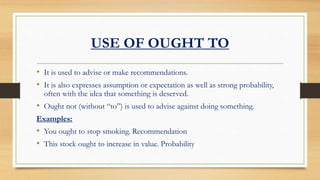
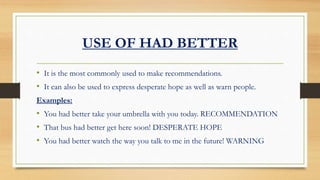
Ought to is used to advise or make recommendations, and also expresses assumption or expectation. Must is used to express certainty or necessity. Had better is commonly used to make recommendations, but can also express desperate hope or serve as a warning. Examples provided illustrate the uses of ought to for recommendations and probability, must for certainty, necessity, strong recommendation and prohibition, and had better for recommendations, desperate hope, and warnings.