U.NO-NU10NGMS04
STATEMENT OF THE PROBLEM
“A correlational study on quality of life and
coping strategies among dialysis patients of a
selected hospital at Mangalore.’’
OBJECTIVES OF THE STUDY
• To assess the quality of life of dialysis patients
in selected hospitals.
• To identify the coping strategies used by the
dialysis patients.
• To find out correlation between the quality of
life and coping strategies among dialysis
patients.
• To find out the association between quality of
life and selected demographic variables
HYPOTHESIS
• H1: There will be a significant relationship
between quality of life and coping strategy
among dialysis patients.
• H2: There will be a significant association
between quality of life of dialysis patients and
selected demographic variables
BACKGROUND OF THE STUDY
• Dialysis patients are increasing worldwide every day. It
is found that 30-40% of patients with chronic renal
failure undergo dialysis in India. Long-term dialysis
therapy itself often results in loss of freedom,
dependence on caregivers, disruption of marital,
family, and social life, and reduced or loss of financial
income. Due to these reasons, the physical,
psychological, socioeconomic, and environmental
aspects of life are negatively affected, leading to
compromised quality of life. haemodialysis patients
used `trying to maintain control' as their most frequent
coping strategy. Hence this present study aimed to find
out the correlation between the quality of life & coping
strategies among dialysis patients.
NEED FOR THE STUDY
• ‘Adding life to years and not just years to life’ is as true
for ESRD patients as for any other individuals. End stage
renal disease (ESRD) is a chronic disease causing high
levels of disability in different domains of the patients’
life, leading to impaired quality of life. Renal failure
decreases the functional capacity of the patient. Thus,
it is a challenge for nurses as well as for other health
care providers to help & promote QOL of dialysis
patients, despite their health problems. To investigate
how health care providers can improve quality of life in
dialysis patients.
REVIEW OF LITERATURE
• Literature on coping strategy used by
hemodialysis patients
• Literature on Quality of life of dialysis patients.
• Literature on Correlation between quality of
life of hemodialysis patient and their coping
strategy
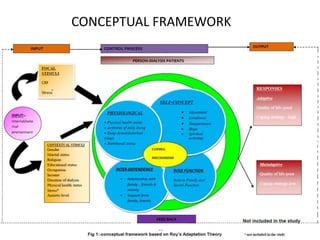
CONCEPTUAL FRAMEWORK
RESEARCH DESIGN
SAMPLING
• Purposive sampling technique.
• Sample size:-60 dialysis patients
SAMPLING DESIGN
PILOT STUDY
A pilot study was conducted between 25th July to
30th July 2011. The sample size of the pilot study
was 6 in number. The sample possessed same
characteristics as that of sample for main study.
Written consent was taken from the subjects.
Data regarding the samples was obtained by
administering them the tool. The Study findings
revealed that there were no significant difference
between the quality of life and coping strategy of
dialysis patient.
DATA COLLECTION INSTRUMENTS
• Demographic proforma
• Rating scale on quality of life
• Rating scale on coping strategy
DATA COLLECTION PROCESS
• To conduct the research study in selected hospitals at
Mangalore, formal written permission was obtained
from Medical superintendent & Dept. of Nephrology.
The data collection period extended from 1/8/11 to
31/10/11. An informed consent was taken from all the
subjects individually after explaining the objectives and
purpose of the study. Confidentiality was assured to
the entire subjects to get their co-operation. Subjects
were instructed to fill the demographic proforma,
Rating Scale on QOL and the rating scale on coping
strategy.
RESULTS
• Section 1:-Description of dialysis patients according
to the demographic characteristics
• Section 2:-Quality of life of dialysis patients
• Section 3:-Coping strategies used by the dialysis
patients.
• Section 4:-Correlation between the quality of life and
coping strategies among dialysis patients.
• Section 5:-Association between quality of life and
selected demographic variables.
Section 1:-Description of dialysis patients according
to the demographic characteristics
Section 2:-Quality of life of dialysis patients
Quality of life of dialysis patients

41

45
40
35
30

Poor QOL
25

19

Average QOL
Good QOL

20
15
10

0

5
0
Series1

Poor QOL
19

Average QOL
41

Good QOL
0
Section 3:-Coping strategies used by the dialysis
patients.
coping strategy of dialysis patients
0

11

Good coping
Satisfactory coping

49
Section 4:-Correlation between the quality of life and
coping strategies among dialysis patients.
Section 5:-Association between quality of life
and selected demographic variables
Limitation
• The study was limited to hemodialysis patients who
were willing to participate in the study, who were
available during the study and those who know
Kannada & English.
• The setting for the study was selected by purposive
sampling & imposes limits in larger generalization.
• Quality of life and coping is purely based on the verbal
reports of the dialysis patients and not through
observation.
• No standardized tools were used for the study.
• The sample size was minimal (60) and hence, it cannot
be generalized.
• The present study was limited to assess the quality of
life & coping strategy of dialysis patient.
RECOMMENDATIONS
On the basis of the present study following
recommendations are made;
• Replication of the study could be done with a larger
sample to validate and generalize the findings.
• A similar study can be conducted on quality of life &
coping strategy among cancer patients.
• A survey of the factors that influence the quality of life
and coping strategy of the dialysis patients can be
undertaken.
• A similar study can be done in individual domains
separately using multiple tools to measure quality of
life & coping strategy, rather than using a single scale.
CONCLUSION
The findings of the study revealed that majority
of dialysis patients have average quality of life
& satisfactory coping. There is a significant
relationship between the quality of life &
coping strategies in dialysis patients. When
the coping strategy scores increases, quality of
life of dialysis patients also increases.
Model thesis

Model thesis

  • 1.
  • 2.
    STATEMENT OF THEPROBLEM “A correlational study on quality of life and coping strategies among dialysis patients of a selected hospital at Mangalore.’’
  • 3.
    OBJECTIVES OF THESTUDY • To assess the quality of life of dialysis patients in selected hospitals. • To identify the coping strategies used by the dialysis patients. • To find out correlation between the quality of life and coping strategies among dialysis patients. • To find out the association between quality of life and selected demographic variables
  • 4.
    HYPOTHESIS • H1: Therewill be a significant relationship between quality of life and coping strategy among dialysis patients. • H2: There will be a significant association between quality of life of dialysis patients and selected demographic variables
  • 5.
    BACKGROUND OF THESTUDY • Dialysis patients are increasing worldwide every day. It is found that 30-40% of patients with chronic renal failure undergo dialysis in India. Long-term dialysis therapy itself often results in loss of freedom, dependence on caregivers, disruption of marital, family, and social life, and reduced or loss of financial income. Due to these reasons, the physical, psychological, socioeconomic, and environmental aspects of life are negatively affected, leading to compromised quality of life. haemodialysis patients used `trying to maintain control' as their most frequent coping strategy. Hence this present study aimed to find out the correlation between the quality of life & coping strategies among dialysis patients.
  • 6.
    NEED FOR THESTUDY • ‘Adding life to years and not just years to life’ is as true for ESRD patients as for any other individuals. End stage renal disease (ESRD) is a chronic disease causing high levels of disability in different domains of the patients’ life, leading to impaired quality of life. Renal failure decreases the functional capacity of the patient. Thus, it is a challenge for nurses as well as for other health care providers to help & promote QOL of dialysis patients, despite their health problems. To investigate how health care providers can improve quality of life in dialysis patients.
  • 7.
    REVIEW OF LITERATURE •Literature on coping strategy used by hemodialysis patients • Literature on Quality of life of dialysis patients. • Literature on Correlation between quality of life of hemodialysis patient and their coping strategy
  • 8.
  • 9.
  • 10.
    SAMPLING • Purposive samplingtechnique. • Sample size:-60 dialysis patients
  • 11.
  • 12.
    PILOT STUDY A pilotstudy was conducted between 25th July to 30th July 2011. The sample size of the pilot study was 6 in number. The sample possessed same characteristics as that of sample for main study. Written consent was taken from the subjects. Data regarding the samples was obtained by administering them the tool. The Study findings revealed that there were no significant difference between the quality of life and coping strategy of dialysis patient.
  • 13.
    DATA COLLECTION INSTRUMENTS •Demographic proforma • Rating scale on quality of life • Rating scale on coping strategy
  • 14.
    DATA COLLECTION PROCESS •To conduct the research study in selected hospitals at Mangalore, formal written permission was obtained from Medical superintendent & Dept. of Nephrology. The data collection period extended from 1/8/11 to 31/10/11. An informed consent was taken from all the subjects individually after explaining the objectives and purpose of the study. Confidentiality was assured to the entire subjects to get their co-operation. Subjects were instructed to fill the demographic proforma, Rating Scale on QOL and the rating scale on coping strategy.
  • 15.
    RESULTS • Section 1:-Descriptionof dialysis patients according to the demographic characteristics • Section 2:-Quality of life of dialysis patients • Section 3:-Coping strategies used by the dialysis patients. • Section 4:-Correlation between the quality of life and coping strategies among dialysis patients. • Section 5:-Association between quality of life and selected demographic variables.
  • 16.
    Section 1:-Description ofdialysis patients according to the demographic characteristics
  • 18.
    Section 2:-Quality oflife of dialysis patients Quality of life of dialysis patients 41 45 40 35 30 Poor QOL 25 19 Average QOL Good QOL 20 15 10 0 5 0 Series1 Poor QOL 19 Average QOL 41 Good QOL 0
  • 19.
    Section 3:-Coping strategiesused by the dialysis patients. coping strategy of dialysis patients 0 11 Good coping Satisfactory coping 49
  • 20.
    Section 4:-Correlation betweenthe quality of life and coping strategies among dialysis patients.
  • 21.
    Section 5:-Association betweenquality of life and selected demographic variables
  • 24.
    Limitation • The studywas limited to hemodialysis patients who were willing to participate in the study, who were available during the study and those who know Kannada & English. • The setting for the study was selected by purposive sampling & imposes limits in larger generalization. • Quality of life and coping is purely based on the verbal reports of the dialysis patients and not through observation. • No standardized tools were used for the study. • The sample size was minimal (60) and hence, it cannot be generalized. • The present study was limited to assess the quality of life & coping strategy of dialysis patient.
  • 25.
    RECOMMENDATIONS On the basisof the present study following recommendations are made; • Replication of the study could be done with a larger sample to validate and generalize the findings. • A similar study can be conducted on quality of life & coping strategy among cancer patients. • A survey of the factors that influence the quality of life and coping strategy of the dialysis patients can be undertaken. • A similar study can be done in individual domains separately using multiple tools to measure quality of life & coping strategy, rather than using a single scale.
  • 26.
    CONCLUSION The findings ofthe study revealed that majority of dialysis patients have average quality of life & satisfactory coping. There is a significant relationship between the quality of life & coping strategies in dialysis patients. When the coping strategy scores increases, quality of life of dialysis patients also increases.